

Why in News? The Ministry of Commerce & Industry launched 7 new interventions under the Export Promotion Mission (EPM) to empower Micro, Small and Medium Enterprises (MSMEs) and enhance India’s global export competitiveness. What are the 7 New Interventions Launched under the Export Promotion Mission? Interventions Under Niryat Protsahan (Financial Enablers) Interventions Under Niryat Disha (Non-Financial Enablers) What is the Export Promotion Mission? Frequently Asked Questions (FAQs) 1. What is the Export Promotion Mission (EPM)?The EPM is a centrally sponsored umbrella scheme to consolidate fragmented export support schemes into a single, digitally monitored framework for MSMEs. 2. What are the two main sub-schemes under the EPM?The EPM operates through Niryat Protsahan (focusing on financial enablers like interest subvention and credit) and Niryat Disha (focusing on non-financial enablers like compliance, logistics, and warehousing). 3. Why is EPM significant in the context of FTAs?With nearly 70% of global GDP accessible through FTAs, EPM ensures that MSMEs can effectively utilize preferential market access by addressing credit, logistics, and compliance barriers.
NABARD DA Exam Analysis 2026 (All Shifts)
The National Bank for Agriculture and Rural Development (NABARD) successfully held the Preliminary examination for the posts of Development Assistant and Development Assistant on 21 February 2026. Candidates who took the exam, as well as those preparing for upcoming shifts or future recruitment cycles, are keen to understand the overall difficulty level, the section-wise distribution of questions, and what can be considered a safe or good number of attempts in the exam. NABARD DA Prelims Exam Analysis 2026 – 21st February Shift 2 – Good Attempts And Difficulty Level Section Total Questions Good Attempts Difficulty Level English Language 40 30–36 Easy–Moderate Numerical Ability 30 25–28 Easy Reasoning 30 26–29 Easy Total 100 81–93 Easy–Moderate Section-wise Analysis: NABARD Development Assistant Prelims [Shift 2] Reasoning Ability (Total Questions: 30) Candidates can check the NABARD DA Prelims Shift 2 analysis 2026 for the Reasoning section through the data provided below. English Language (Total Questions: 40) Candidates can check the NABARD DA Prelims Shift 2 analysis 2026 for the English section through the data provided below. Numerical Ability (Total Questions: 30) Candidates can check the NABARD DA Prelims Shift 2 analysis 2026 for the Numerical Ability section through the data provided below. NABARD DA Exam Analysis 2026 (1st Shift): Overall Difficulty Level Based on student feedback, the overall difficulty level of the NABARD Development Assistant Prelims 2026 was Easy to Moderate. The English section was relatively easy, while Numerical Ability required some calculation-intensive steps. Section No. of Questions Difficulty Level Good Attempts English Language 40 Moderate 32 – 34 Numerical Ability 30 Easy–Moderate 26 – 28 Reasoning Ability 30 Easy 27 – 29 Total 100 Easy–Moderate 85 – 91 Section-wise Analysis: NABARD Development Assistant Prelims 1. English Language (40 Questions) The English section followed the standard banking pattern. Reading Comprehension was based on a story/economic theme, and most candidates found this section the most scoring. 2. Numerical Ability (30 Questions) The Numerical Ability section was Moderate due to some calculative Arithmetic word problems. Data Interpretation (DI) sets were straightforward but time-consuming. 3. Reasoning Ability (30 Questions) Reasoning was largely dominated by Puzzles and Seating Arrangements. However, the logic used was direct and manageable within the 20-minute sectional timing. NABARD Development Assistant Prelims Exam Pattern 2026 Candidates should remember that there is a negative marking of 0.25 for every wrong answer and sectional timings of 20 minutes for each of the three sections. Name of the Test No. of Qs Max Marks Duration English Language 40 40 20 Minutes Numerical Ability 30 30 20 Minutes Reasoning Ability 30 30 20 Minutes Total 100 100 60 Minutes What Next After NABARD DA Prelims? Candidates who score above the expected cut-off should immediately shift their focus to the NABARD DA Mains Exam (Phase-II). The Mains exam is more comprehensive and includes: The marks obtained in the Mains exam will be the sole criteria for the final merit list. Start practicing with NABARD DA Mains Mock Tests today to stay ahead of the competition!
India-France Elevate Ties to Special Global Strategic Partnership
Introduction From Strategic Partnership to Special Global Strategic Partnership Defence: Renewed for Another Decade Defence remains a pillar of the India France Special Global Strategic Partnership, but it is increasingly defined by co-production rather than procurement. The 6th India France Annual Defence Dialogue was held in Bengaluru on February 17, 2026, co-chaired by Defence Minister of India and French Armed Forces Minister Catherine Vautrin. The bilateral defence cooperation agreement was renewed for another 10 years, signed by India’s Defence Secretary and France’s Deputy Director General for International Relations and Strategy. Key outcomes included an MoU between BEL and Safran for the joint manufacture of HAMMER air-to-surface missiles in India under the Make in India initiative, the reciprocal deployment of officers at Indian Army and French Land Forces establishments, and the joint inauguration of the H125 Final Assembly Line, India’s first private sector helicopter manufacturing facility, combining the strengths of TATA Advanced Systems and Airbus. India has also pushed for increasing indigenous content in the Rafale fighter jet by up to 50%, and both sides noted progress in the Safran-HAL partnership for the Indian Multi Role Helicopter (IMRH). The P-75 Scorpène submarine programme delivered its sixth vessel to the Indian Navy in January 2025, and both leaders welcomed the continuation of submarine cooperation. Both countries also agreed to constitute a Joint Advanced Technology Development Group to co-develop critical and emerging technologies in niche areas. Nuclear Energy: Strategic Pillar for India’s Energy Future Civil nuclear cooperation is one of the most substantive areas of the India France Special Global Strategic Partnership. The President of France acknowledged India’s target of achieving 100 GW nuclear power capacity by 2047 and welcomed India’s recent reforms allowing private investment in its nuclear sector. Both leaders agreed to deepen cooperation across the nuclear value chain, from research and skills development to industrial applications. The Special Task Force on civil nuclear energy continues to meet regularly, including on the Jaitapur Nuclear Power Plant Project in Maharashtra. The relationship between DAE and CEA was reaffirmed, with a call for renewed cooperation in nuclear science and technology. A Declaration of Intent on Small and Advanced Modular Reactors (SMR/AMR) signed in 2025 is also being taken forward through research collaboration between the two agencies. Climate and the Planet: Shared Responsibility Both countries have long-standing cooperation on climate and sustainable development, and the India France Special Global Strategic Partnership deepens this further. Both leaders reaffirmed their commitment to the Paris Agreement and to holding global temperature rise to well below 2°C above pre-industrial levels. India and France co-preside over the Coalition for Disaster Resilient Infrastructure (CDRI) and the International Solar Alliance (ISA), both headquartered in New Delhi. Discussions are underway to establish a European office of the ISA in Paris. Both nations also welcomed the entry into force of the BBNJ Treaty on marine biodiversity and called for its ratification by the largest number of states. The MoU between the Ministry of New and Renewable Energy and France’s Ministry of Economies, Finance and Industrial and Digital Sovereignty on renewable energy cooperation was renewed. Both leaders also noted the progress of the AFD Group in financing urban mobility, energy transition, green finance, and biodiversity projects in India. Trade, Economy, and Innovation The two leaders welcomed the deepening of business ties and expressed commitment to unlocking the economic potential of the bilateral relationship. The India France CEO Forum was held during President Macron’s visit, and both sides agreed to hold an Economic and Financial Dialogue in 2026. Key sectors of growing collaboration include aerospace, energy, logistics, agri-food, and telecoms. The amendment to the bilateral tax treaty was signed to provide stability for businesses and encourage greater investment. Both leaders also welcomed the progress of UPI in France, the first European country to offer this payment system, with flagship stores in Paris now accepting it. Both leaders launched the India France Innovation Network to connect innovators, startups, and businesses from both countries. Following the success of ten Indian startups at Station F in Paris, further discussions on startup incubation are underway, including an LoI between T-Hub and Nord France Invest. AI and Technology: Shared Governance The AI Impact Summit 2026, hosted by India, built on the AI Action Summit co-chaired by President Macron and PM Modi in Paris in February 2025. Both leaders reaffirmed their commitment to a secure and trustworthy AI serving people, public interest, and the planet, and affirmed the importance of democratising AI resources and bridging the global AI divide. Both countries are deepening cooperation in space, with the partnership between CNES and ISRO serving as the backbone. India confirmed participation in France’s International Space Summit in July 2026. A binational centre on digital sciences and technology is being opened in India between INRIA and the Department of Science and Technology, and both sides called for an early joint call for projects by ANR and DST in AI and applied mathematics. Conclusion The elevation of India–France relations to a Special Global Strategic Partnership goes beyond a simple diplomatic upgrade and reflects a deeper alignment in their long-term global outlook. It highlights their shared vision of a multipolar world order, where influence and responsibility are distributed among several major powers rather than concentrated in a few. The partnership also shows their strong commitment to jointly developing solutions in crucial areas such as defence, energy, advanced technology, and climate action, recognising that cooperation in these sectors is essential not only for their national interests but also for addressing global challenges. At the same time, it reflects the steady expansion of economic cooperation and stronger people-to-people connections, making the relationship broader and more comprehensive than ever before. Guided by the Horizon 2047 Roadmap, India and France are shaping a long-term partnership that aligns with key milestones in their shared history while looking firmly toward the future. Together, they are positioning themselves not just as partners for mutual benefit, but as a force working toward global stability, progress, and a more cooperative international order.
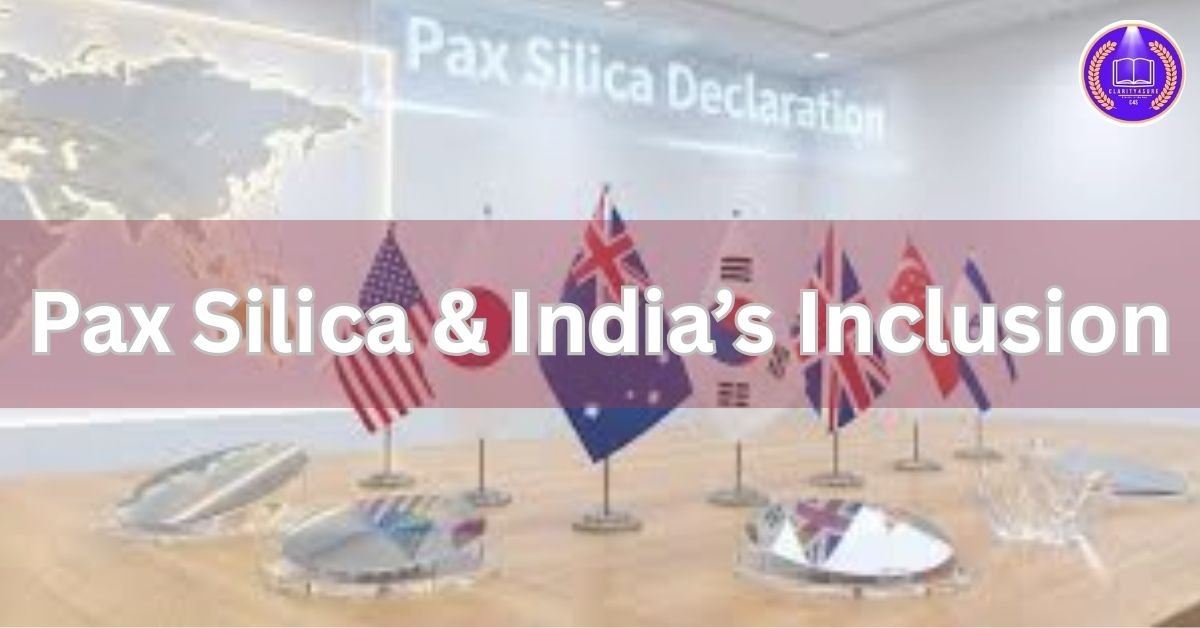
Pax Silica & India’s Inclusion
Why in News? The United States’ newly appointed Ambassador to India, Sergio Gor, stated that India will be invited to join “Pax Silica,” a US-led coalition aimed at securing and strengthening the critical minerals supply chain. What is Pax Silica? Pax Silica and India What are India’s Initiatives to Support Silicon and AI Supply Chain? FAQ’s 1. What is Pax Silica? Pax Silica is a US-led coalition of nine countries aimed at securing a resilient, innovation-driven semiconductor and AI supply chain. 2. Which countries are part of Pax Silica? Japan, Republic of Korea, Singapore, Netherlands, UK, Israel, UAE, Australia, and the US. 3. What are India’s key initiatives in semiconductors and AI? India Semiconductor Mission (ISM), IndiaAI Mission, and National Critical Mineral Mission (NCMM) aim to build indigenous supply chains, AI infrastructure, and critical mineral security.
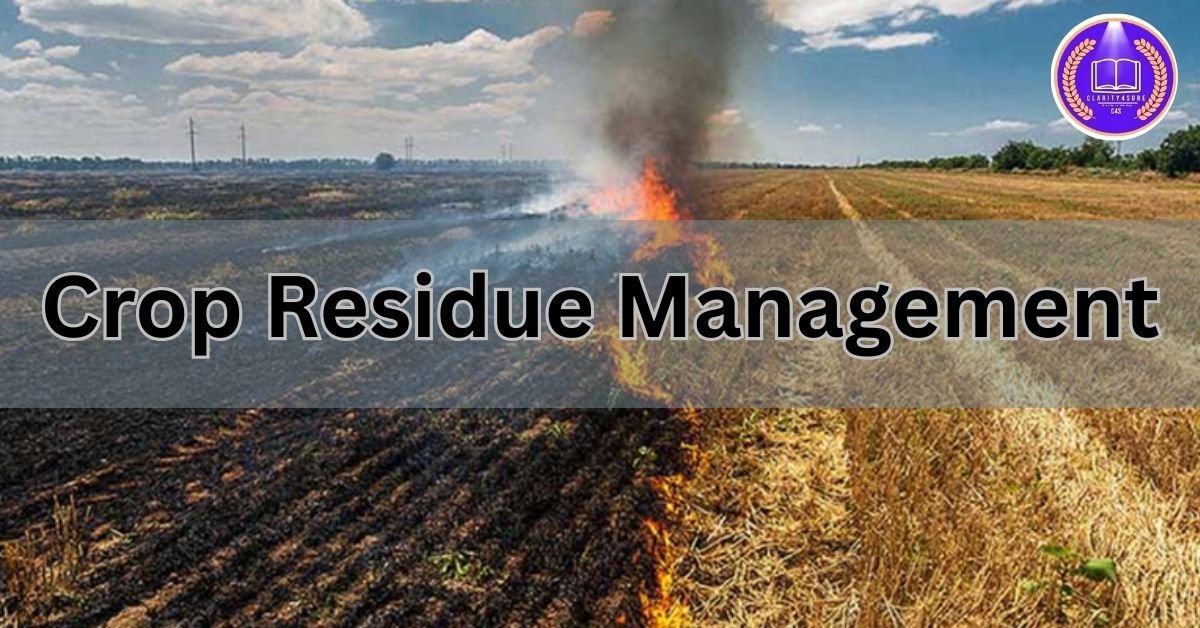
Crop Residue Management
Introduction Harvesting crops produces a huge amount of leftover plant material, known as crop residue, both in the fields and outside them. The Ministry of New and Renewable Energy estimates that India generates around 500 million tonnes (Mt) of crop residue every year. Farmers use crop residue in many useful ways. It can be used as animal bedding and livestock feed, for soil mulching, making biogas, preparing compost or bio-manure, roof thatching in rural homes, mushroom cultivation, biomass energy production, and as fuel for households and industries. Despite these uses, a large share of crop residue is still burnt in the fields to quickly clear land for the next crop. This practice has increased in recent years due to a shortage of labour, the high cost of removing residues, and the use of mechanised harvesting, which leaves large amounts of stubble behind. Crop residue burning is especially common in Haryana, Punjab, Uttar Pradesh, and West Bengal. To control the problem, the National Green Tribunal (NGT) in 2015 banned agricultural residue burning in Delhi, Rajasthan, Punjab, Uttar Pradesh, and Haryana. In particular, paddy stubble burning is widely practiced in the Indo-Gangetic plains, especially in Punjab, Haryana, and Uttar Pradesh, where farmers burn leftover paddy straw to quickly prepare fields for sowing the Rabi crop. In-situ Crop residue management In-situ crop residue management is the practice of leaving crop residue in its natural state on the field. While lowering the danger of pests and diseases, in-situ management techniques can assist maintain the health and fertility of the soil. Several methods can be used to manage crop residues within the field itself (in-situ management) instead of burning them. These practices help protect soil health, conserve moisture, and improve productivity. Crop residue ex-situ management Ex-situ management of crop residue refers to the removal of agricultural waste from the field for use as compost, firewood, or animal feed. Ex-situ management techniques offer a natural source of nutrients for the soil and can assist lower air pollution brought on by burning agricultural leftovers. These ex-situ crop residue management techniques are frequently employed: Adverse effects of crop residue burning Crop Residue Management guidelines According to the updated rules, bilateral agreements between the beneficiary/aggregator and enterprises using paddy straw will build techno-commercial pilot projects for the supply chain of paddy straw, according to a statement from the agricultural ministry. Govt shall provide financial assistance on the capital cost of machinery and equipment. Financial support break-up: The Outcomes of the above interventions are: Way forward Managing crop residues through conservation agriculture practices can improve both soil productivity and crop yields. When crop residues are left in the field and properly managed, they help maintain soil organic matter, which is essential for long-term soil health and fertility. Effective crop residue management also helps increase soil carbon storage, which reduces agriculture’s environmental impact. By keeping more carbon in the soil instead of releasing it into the atmosphere, these practices support climate-friendly farming. Ideally, residue management methods should be selected in a way that increases farm productivity while causing minimal harm to the environment. However, research shows that the impact of crop residue management on crop yields is not always the same. Results can vary widely because many factors influence outcomes. These include the quality of the residue, soil conditions, the health of the previous crop, how sensitive the next crop may be, and management decisions such as crop variety, crop rotation patterns, and planting time. Because of these many interacting factors, no single crop residue management method works best in every situation. Farmers need to make decisions based on their local conditions to achieve the best balance between higher yields and environmental protection. To develop the most effective, location-specific solutions, coordinated efforts are needed from scientists across different fields. Such collaboration can help design crop residue management practices that boost agricultural productivity while also reducing environmental damage. Soil carbon is a valuable resource that supports both food security and environmental sustainability. By adopting improved and cost-effective crop residue management practices, farmers can maintain soil health, enhance agricultural productivity, and contribute to long-term ecological balance.
India’s Tech-Driven Development
Introduction Union Budget 2026 shows that India is moving beyond simply offering incentives for assembling electronics and is now focusing on building a complete manufacturing ecosystem. Instead of looking at electronics production in parts, the government is treating it as a connected value chain — including cloud infrastructure, components, logistics, and semiconductors. This shift reflects a more mature and consistent policy approach. It also highlights India’s larger goal of promoting technology-led development, where digital infrastructure, advanced manufacturing, and innovation play a central role in driving long-term economic growth. How Is India Progressing Towards Tech-Driven Development? What are the Key Issues Associated with India’s Tech-Driven Development? 1. The AI Power Paradox and Resource Intensity Sustainability friction Energy dependence Urban concentration risks 2. Semiconductor Supply Chain “Upstream” Vulnerabilities Critical import dependence Lack of upstream autonomy Mid-stream heavy ecosystem Scale vs dependence 3. The “Employability Gap” in Deep-Tech Roles Skill mismatch Labour market imbalance Two-speed labour market Cybersecurity talent shortage 4. Digital Public Infrastructure (DPI) and Cybersecurity Risks Expanding attack surface Systemic risk Rising cyber incidents 5. The “Regulatory Interpretation” Chasm SME burden Innovation impact Uneven adoption Interpretation challenges 6. Tier-1-Centric Tech Concentration Geographic imbalance Consequences Urban strain Job concentration 7. E-Waste and the Hardware Obsolescence Cycle Informal recycling risks Policy gap Scale of problem 8. Algorithmic Exploitation in the Gig Economy Worker concerns Labour protests 9. Innovation Deficit and IP Ownership Challenges Value capture problem Profit outflow Input-driven growth Low domestic value addition Pseudo-innovation culture Example What Measures are Needed to Strengthen India’s Tech-Driven Development? Conclusion
India as a Global Hub for Cloud and AI Infrastructure
Context Introduction The Union Budget 2026–27 has introduced an important policy to make India a global centre for digital infrastructure. The government understands that technologies like cloud computing, AI data centres, and advanced electronics are becoming essential for economic growth. To attract more investment in these areas, it has announced a tax holiday until 2047 for eligible foreign cloud service providers that operate through data centres located in India. Around the world, data centres are becoming a major source of investment and economic activity. According to the United Nations Conference on Trade and Development (UNCTAD), data centres made up over one-fifth of global greenfield investment projects in 2025, with announced investments crossing USD 270 billion. The growing demand for AI computing and data-heavy digital services is increasing competition among countries to attract such infrastructure. In response, India’s long-term tax policy is designed to give investors confidence, encourage companies to build high-value digital infrastructure within the country, and strengthen India’s position in global digital supply chains. This move also supports the broader goal of transforming India into a developed nation (Viksit Bharat) by 2047. Why This Policy Was Introduced? Data centres and cloud infrastructure require high upfront capital investment, long gestation periods, and sustained policy certainty. AI-oriented data centres, in particular, involve significant expenditure on computing hardware, energy systems, cooling infrastructure, and skilled manpower. With global demand for AI compute capacity rising rapidly, countries are competing to attract large-scale data centre investments. The tax holiday till 2047 is intended to provide long-term visibility and certainty, enabling India to attract global cloud service providers while anchoring critical digital infrastructure within the country. Understanding the Tax Holiday Provision The Budget proposes that a foreign company providing cloud services globally, while utilizing data centre services located in India, will be eligible for a tax holiday extending up to 2047. Under this framework: The exemption applies from Tax Year 2026–27 to Tax Year 2046–47, providing a stable, predictable tax environment for global cloud players investing in India’s data centre infrastructure. Defined Eligibility Framework The exemption is available to foreign companies providing cloud services under a structured framework. A foreign cloud service provider may avail the tax holiday where: This framework establishes regulatory oversight and ensures that the incentive operates within defined policy parameters. Tax Treatment of Domestic Operations Under the proposed framework, profits arising from domestic economic activities will remain taxable as in the case of any other domestic company. These include: Further, where the Indian data centre is a related entity of the foreign company (operating as a cost-plus centre), a safe harbour margin of 15 percent on cost has been proposed. Linkage with Broader Technology Ecosystem Initiatives The tax holiday is part of a wider set of measures announced in Budget 2026–27 to strengthen India’s technology sector and digital manufacturing ecosystem. These initiatives cover different stages of the technology value chain — from semiconductor design and raw materials to electronics components, IT services, and digital infrastructure. India Semiconductor Mission (ISM) 2.0 The Budget has announced the launch of India Semiconductor Mission 2.0, which builds on earlier efforts to develop semiconductor manufacturing in the country. The programme focuses on: An allocation of ₹1,000 crore has been made for ISM 2.0 in FY 2026–27. This initiative aims to build strong core electronics manufacturing capabilities that support digital infrastructure such as data centres and advanced computing systems. Electronics Components Manufacturing Scheme (ECMS) The Budget has increased funding for the Electronics Components Manufacturing Scheme from around ₹22,000 crore to ₹40,000 crore. The scheme has already received 149 applications, which is more than expected and shows strong interest from industry. The higher allocation is meant to boost domestic production of electronics components and strengthen the overall electronics manufacturing ecosystem in India. IT Services Simplification and Safe Harbour Provisions IT services are one of India’s biggest export sectors, with exports exceeding USD 220 billion. To provide clarity in taxation and support industry growth, the Budget proposes: These measures aim to simplify regulations, provide tax certainty, and support the continued growth of India’s IT sector. India’s Expanding Cloud and Digital Infrastructure Base India’s cloud and data centre sector is growing rapidly as the country continues its digital transformation and as more industries start using AI-based technologies and data-driven services. As part of the Digital India programme, the government has created a national cloud system called GI Cloud (MeghRaj) to meet the cloud computing needs of government departments. MeghRaj offers secure, flexible, and scalable cloud services that help deliver e-Governance programmes through the National Informatics Centre (NIC). The country’s National Data Centres also operate with strong multi-layer security systems and work with approved providers that meet global security standards. According to industry estimates, India’s cloud data centre capacity is currently about 1,280 megawatts (MW). This capacity is expected to increase four to five times by 2030, showing the rapidly rising demand for digital services and AI infrastructure in the country. Expanding AI and Cloud Data Centre Infrastructure Data centres, especially AI-focused facilities, form the backbone of modern digital infrastructure. Investments of nearly USD 70 billion are already underway in India’s data centre sector, with an additional USD 90 billion in announced projects, highlighting the scale of expansion. The proposed tax framework extending to 2047 provides long-term policy visibility for such capital-intensive investments. The tax holiday for foreign cloud providers complements broader technology initiatives announced in Budget 2026–27, including India Semiconductor Mission 2.0 and enhanced allocation for the Electronics Components Manufacturing Scheme, complementing digital infrastructure expansion. Together, these measures strengthen both digital infrastructure and electronics manufacturing capacity. Global Policy Momentum in AI Data Centre Infrastructure Across major economies, AI data centres and related digital infrastructure are increasingly being supported through policies that enable large-scale deployment and long-term investment. In the United States, a Presidential Executive Order titled “Accelerating Federal Permitting of Data Center Infrastructure” outlines steps to expedite the development of large AI data centre projects. The Order provides for: The Order defines large-scale data centre projects as those requiring more than 100 megawatts of new load, indicating the scale at which AI infrastructure is being planned. At the same time, Goldman Sachs Research notes that
IRDAI Assistant Manager 2026
What is the IRDAI Assistant Manager 2026 Syllabus? Let’s Break it Down! Before starting with the IRDAI Grade A syllabus, it’s important to first understand the IRDAI Assistant Manager exam pattern. The exam is conducted in three stages: Once you are clear about this structure, it becomes easier to plan your preparation. Let’s now move on to the subject-wise detailed syllabus for Phase 1, Phase 2, and the interview stage of the IRDAI Grade A exam. What is the subject-wise syllabus for IRDAI Assistant Manager Phase 1 ? As mentioned earlier, the official IRDAI Assistant Manager notification does not clearly specify the detailed Phase 1 syllabus—it only lists the names of the subjects. To make your preparation easier and more focused, the expert team at EduTap has carefully analyzed the previous years’ questions (PYQs) from the last three IRDAI recruitments. Based on this analysis, we have compiled a comprehensive list of important chapters and topics that you should cover for each subject. Below is the subject-wise decoded syllabus for the IRDAI Assistant Manager Phase 1 (Prelims) exam, designed to help you prepare with clarity and confidence. Reasoning Syllabus for IRDAI Assistant Manager 2026 Having a clear understanding of reasoning concepts is essential to solve questions quickly and accurately within the given time. To perform well in this section, here are the key Reasoning topics from the IRDAI Grade A syllabus that you should focus on: Quantitative Aptitude Syllabus for IRDAI Assistant Manager 2026 Just like Reasoning, doing well in the Quantitative Aptitude section depends heavily on speed and accuracy. To achieve this, you should first build a strong conceptual foundation in the following IRDAI Grade A Quant syllabus topics: English Syllabus for IRDAI Assistant Manager 2026 English is considered one of the most scoring sections, especially for aspirants who have a good command of the language. A strong performance in this section can significantly help you clear the IRDAI Grade A Phase 1 cut-offs. Here are the important topics you should focus on while preparing for the English section: General Awareness Syllabus for IRDAI Assistant Manager 2026 The General Awareness section requires regular tracking of current affairs along with a strong grip on static GK, particularly in areas related to finance and insurance. To score well, make sure you thoroughly cover all important news from the last 4–5 months before the Phase 1 exam. Below is a category-wise list of topics for current affairs and static General Awareness to guide your preparation effectively. Current Affairs Syllabus Static GK Syllabus IRDAI Assistant Manager 2026 Phase 2 Syllabus: Papers and Topics Before moving on to the IRDAI Grade A Phase 2 syllabus for the 2025 exam, it’s important to understand the structure of this stage. Phase 2 is purely descriptive and consists of three papers: Based on the latest IRDAI Assistant Manager notification, here is the detailed syllabus for the IRDAI Grade A Phase 2 exam, explained in a clear and easy-to-follow manner. Descriptive English Syllabus for IRDAI Assistant Manager 2026 The official notification simply states that questions will be asked from the following areas: To make this clearer, here’s what each part actually involves: The paper carries a total of 100 marks. While the marks per question may change each year, the time limit remains fixed at 60 minutes. ESI Impacting Insurance Syllabus for IRDAI Assistant Manager 2026 The Economic and Social Issues Impacting Insurance paper is divided into two parts: Although the number of questions and marks per question may change each year, the total marks remain 100, and you will get 60 minutes to complete the paper. As per the latest IRDAI Grade A notification, the syllabus for ESI Impacting Insurance broadly includes the following areas: Based on our analysis of previous years’ questions (PYQs), here are the most important topics from the ESI Impacting Insurance syllabus that you should focus on for effective preparation. Insurance and Management Syllabus for IRDAI Assistant Manager 2026 The Insurance and Management paper is also divided into two sections: Although the marks are not separately fixed for Insurance and Management, the IRDAI Grade A Phase 2 Paper 3 carries a total of 100 marks, and you will have 60 minutes to complete the paper. Based on the latest IRDAI Grade A notification, below is the detailed syllabus for Insurance and Management to guide your preparation. Insurance Syllabus for IRDAI Assistant Manager 2026 Management Syllabus for IRDAI Assistant Manager 2026 IRDAI Assistant Manager 2026 Interview Syllabus: Key Details The third and final stage of the IRDAI Assistant Manager exam is the interview. Although the official notification does not clearly define an interview syllabus, there are a few important points you should be aware of: Understanding these points will help you prepare more confidently for the final stage of the selection process. FAQ’s List of Toppers from C4S Courses Below is the list of students who have successfully cleared IRDAI 2024 and were part of our various programs: Sl.No. Name of the Topper of C4S Toppers Talk with C4S 1 Oindrila Das Watch Success Story with C4S 2 Snehal Rawat Watch Success Story with C4S 3 Aniruddha Anil Belkar Watch Success Story with C4S 4 Vineet Verma Watch Success Story with C4S 5 Himakesh Raghu Ram Watch Success Story with C4S
RBI Assistant 2026 Exam Pattern and Syllabus
RBI Assistant 2026 Recruitment The Reserve Bank of India (RBI) conducts the RBI Assistant Exam every year to recruit candidates for Assistant posts across its branches in India. For the RBI Assistant 2026 recruitment, around 650 vacancies are expected to be filled. Candidates who are planning to apply should clearly understand the exam pattern, syllabus, and selection process before starting their preparation. Knowing how the exam is structured helps you plan your study strategy more effectively and improve your chances of success. RBI Assistant Syllabus and Exam Pattern 2026 Particulars Details Organization Name Reserve Bank of India (RBI) Name of Examination RBI Assistant Exam 2026 Type of Exam Objective Test (Online) Exam Dates Prelims: 11th April 2026 Mains: 7th June 2026 Category RBI Assistant Syllabus & Exam Pattern Duration of Exam Preliminary: 60 minutes Mains: 135 minutes Language of Exam English and Hindi Maximum Marks (Online Exam) Preliminary: 100 marks Mains: 200 marks Marking Scheme 1 mark for each correct answer Negative Marking 1/4 mark (0.25) deducted for each wrong answer Selection Process 1. Preliminary Exam (Qualifying) 2. Mains Exam 3. Language Proficiency Test (LPT) RBI Assistant Selection Process 2026 The selection procedure for RBI Assistant 2026 will be conducted in three phases as mentioned below. The candidates who want to grab the job opportunity of an Assistant in the banking sector have to qualify in each stage of the selection procedure. RBI Assistant 2026 has a specific syllabus for all the sections asked in both the preliminary examination and main examination. The major sections covered are: The above-mentioned three sections are the common sections asked in both the preliminary exam and the mains exam. An additional section of General Awareness and Computer Knowledge is asked in Mains Exam apart from the above mentioned three sections. Sectional cut-off as well the overall cut-off for each phase of the examination must be cleared by a candidate in order to get selected for further rounds of the RBI Assistant 2026 Exam. RBI Assistant Exam Pattern 2026 Prelims Exam Pattern 2026 Sections No. of Questions Maximum Marks Duration English Language 30 30 20 minutes Numerical Ability 35 35 20 minutes Reasoning Ability 35 35 20 minutes Total 100 100 60 minutes RBI Assistant Mains Exam Pattern 2026 Sections No. of Questions Maximum Marks Duration English Language 40 40 30 minutes Quantitative Aptitude 40 40 30 minutes Reasoning Ability 40 40 30 minutes Computer Knowledge 40 40 20 minutes General Awareness 40 40 25 minutes Total 200 200 135 minutes Language Proficiency Test (LPT) 2026 The candidates provisionally shortlisted from the main online examination will have to undergo a language proficiency test (LPT). The language proficiency test will be conducted in the Official / Local Language of the State concerned as detailed below. The candidate who is not proficient in the official/ Local Language will be disqualified. Only such several candidates will be called for the Language Proficiency Test who stand sufficiently high in merit based on the aggregate marks of the main online examination, Such merit will be decided by the Bank about the number of notified vacancies to be filled in. The local language that is to be tested as per the official RBI Assistant notification are given below: Area Language for LPT Ahmedabad Gujarati Bengaluru Kannada Bhopal Hindi Bhubaneswar Oriya Chandigarh Punjabi / Hindi Chennai Tamil Guwahati Assamese / Bengali / Khasi / Manipuri / Bodo / Mizo Hyderabad Telugu Jaipur Hindi Jammu Urdu / Hindi / Kashmiri Kanpur & Lucknow Hindi Kolkata Bengali / Nepali Mumbai Marathi / Konkani Nagpur Marathi / Hindi New Delhi Hindi Patna Hindi / Maithili Thiruvananthapuram Malayalam RBI Assistant Syllabus 2026 The RBI Assistant syllabus covers five main subjects — Reasoning Ability, Numerical Ability, English Language, Computer Knowledge, and General Awareness. Each of these sections focuses on important topics that are commonly asked in banking exams. For example, Reasoning tests your logical thinking and problem-solving skills, Numerical Ability checks your maths and calculation skills, English focuses on grammar and reading comprehension, Computer Knowledge covers basic computer concepts, and General Awareness includes current affairs and banking-related information. To prepare well for the RBI Assistant exam, candidates should study all these sections carefully and understand the concepts clearly. Covering the full syllabus properly will help improve performance and increase the chances of success. RBI Assistant Prelims Syllabus 2026 The RBI Assistant Prelims exam syllabus consists of the following subjects – English Language, Numerical Ability, and Reasoning Ability. Candidates will be required to solve questions from all these subjects in 60 minutes. So, this exam does not only check a candidate’s knowledge but also their speed and accuracy. The subject-wise RBI Assistant Prelims Syllabus is given below for candidates to go through. RBI Assistant English Syllabus Subject Syllabus Topics English Comprehension English Subject Verb Agreement English Cloze Test English Sentence Rearrangement English Tenses English Synonyms & Antonyms English Spelling Correction English One-word Substitution English Sentence Completion English Direct & Indirect S RBI Assistant Numerical Ability Syllabus Subject Syllabus Topics Numerical Ability Profit and Loss Numerical Ability Data Interpretation Numerical Ability Quadratic Equation Numerical Ability Number Series Numerical Ability Algebra Numerical Ability Averages Numerical Ability Percentages Numerical Ability Mensuration (2D) Numerical Ability Interest Numerical Ability Averages RBI Assistant Reasoning Syllabus Subject Syllabus Topics Reasoning Odd Man Out Reasoning Blood Relation Reasoning Coding and Decoding Reasoning Analogy Reasoning Direction Based Questions Reasoning Seating Arrangements Reasoning Symbols Reasoning Number Series Note – These 3 sections in the prelims exam – Quantitative Aptitude, Logical Reasoning, English Language will be the same for RBI Assistant mains exam, with an increased level of difficulty. RBI Assistant Mains Syllabus 2026 RBI Assistant Mains Syllabus consists of five sections i.e. Quantitative Aptitude, Logical Reasoning, English Language, Numerical Ability (Math), General Awareness, Computer Knowledge. Among these five sections, three sections – Quantitative Aptitude, Logical Reasoning, English Language are the same as RBI Assistant Prelims exam, with an increased level of difficulty. RBI Assistant General Awareness Syllabus Subject Syllabus Topics General Awareness History, Geography of India General Awareness
IRDAI Assistant Manager 2026 Syllabus
What is the IRDAI Assistant Manager 2026 Syllabus? Let’s Break it Down! Before starting with the IRDAI Grade A syllabus, it’s important to first understand the IRDAI Assistant Manager exam pattern. The exam is conducted in three stages: Once you are clear about this structure, it becomes easier to plan your preparation. Let’s now move on to the subject-wise detailed syllabus for Phase 1, Phase 2, and the interview stage of the IRDAI Grade A exam. What is the subject-wise syllabus for IRDAI Assistant Manager Phase 1 ? As mentioned earlier, the official IRDAI Assistant Manager notification does not clearly specify the detailed Phase 1 syllabus—it only lists the names of the subjects. To make your preparation easier and more focused, the expert team at EduTap has carefully analyzed the previous years’ questions (PYQs) from the last three IRDAI recruitments. Based on this analysis, we have compiled a comprehensive list of important chapters and topics that you should cover for each subject. Below is the subject-wise decoded syllabus for the IRDAI Assistant Manager Phase 1 (Prelims) exam, designed to help you prepare with clarity and confidence. Reasoning Syllabus for IRDAI Assistant Manager 2026 Having a clear understanding of reasoning concepts is essential to solve questions quickly and accurately within the given time. To perform well in this section, here are the key Reasoning topics from the IRDAI Grade A syllabus that you should focus on: Quantitative Aptitude Syllabus for IRDAI Assistant Manager 2026 Just like Reasoning, doing well in the Quantitative Aptitude section depends heavily on speed and accuracy. To achieve this, you should first build a strong conceptual foundation in the following IRDAI Grade A Quant syllabus topics: English Syllabus for IRDAI Assistant Manager 2026 English is considered one of the most scoring sections, especially for aspirants who have a good command of the language. A strong performance in this section can significantly help you clear the IRDAI Grade A Phase 1 cut-offs. Here are the important topics you should focus on while preparing for the English section: General Awareness Syllabus for IRDAI Assistant Manager 2026 The General Awareness section requires regular tracking of current affairs along with a strong grip on static GK, particularly in areas related to finance and insurance. To score well, make sure you thoroughly cover all important news from the last 4–5 months before the Phase 1 exam. Below is a category-wise list of topics for current affairs and static General Awareness to guide your preparation effectively. Current Affairs Syllabus Static GK Syllabus IRDAI Assistant Manager 2026 Phase 2 Syllabus: Papers and Topics Before moving on to the IRDAI Grade A Phase 2 syllabus for the 2025 exam, it’s important to understand the structure of this stage. Phase 2 is purely descriptive and consists of three papers: Based on the latest IRDAI Assistant Manager notification, here is the detailed syllabus for the IRDAI Grade A Phase 2 exam, explained in a clear and easy-to-follow manner. Descriptive English Syllabus for IRDAI Assistant Manager 2026 The official notification simply states that questions will be asked from the following areas: To make this clearer, here’s what each part actually involves: The paper carries a total of 100 marks. While the marks per question may change each year, the time limit remains fixed at 60 minutes. ESI Impacting Insurance Syllabus for IRDAI Assistant Manager 2026 The Economic and Social Issues Impacting Insurance paper is divided into two parts: Although the number of questions and marks per question may change each year, the total marks remain 100, and you will get 60 minutes to complete the paper. As per the latest IRDAI Grade A notification, the syllabus for ESI Impacting Insurance broadly includes the following areas: Based on our analysis of previous years’ questions (PYQs), here are the most important topics from the ESI Impacting Insurance syllabus that you should focus on for effective preparation. Insurance and Management Syllabus for IRDAI Assistant Manager 2026 The Insurance and Management paper is also divided into two sections: Although the marks are not separately fixed for Insurance and Management, the IRDAI Grade A Phase 2 Paper 3 carries a total of 100 marks, and you will have 60 minutes to complete the paper. Based on the latest IRDAI Grade A notification, below is the detailed syllabus for Insurance and Management to guide your preparation. Insurance Syllabus for IRDAI Assistant Manager 2026 Management Syllabus for IRDAI Assistant Manager 2026 IRDAI Assistant Manager 2026 Interview Syllabus: Key Details The third and final stage of the IRDAI Assistant Manager exam is the interview. Although the official notification does not clearly define an interview syllabus, there are a few important points you should be aware of: Understanding these points will help you prepare more confidently for the final stage of the selection process. List of Toppers from C4S Courses Below is the list of students who have successfully cleared IRDAI 2024 and were part of our various programs: Sl.No. Name of the Topper of C4S Toppers Talk with C4S 1 Oindrila Das Watch Success Story with C4S 2 Snehal Rawat Watch Success Story with C4S 3 Aniruddha Anil Belkar Watch Success Story with C4S 4 Vineet Verma Watch Success Story with C4S 5 Himakesh Raghu Ram Watch Success Story with C4S


