Context
The Ministry of Agriculture and Farmers’ Welfare has revamped the certification framework for both organic and natural farming under the Participatory Guarantee System (PGS)-India — via an official order issued a few weeks ago — restricting Regional Councils (RCs) to operate within a single state only. Under the new rules, RCs — the primary local facilitation and verification agencies under India’s peer-review, government-run certification system — will no longer be permitted to take up certification work outside their allotted state area for any scope of certification. Existing RCs operating across multiple states will get a transition window (until 30 April 2027) to transfer local groups to state-based RCs. Existing MoUs signed between state authorities and RCs before 31 March 2026 will continue, but new inter-state registrations are barred. The overhaul aims to strengthen quality control, improve accountability, and enhance localised support for organic + natural farming certification. Stakeholders, however, have raised concerns that the changes may exclude state-run bodies from the accreditation framework.
Introduction
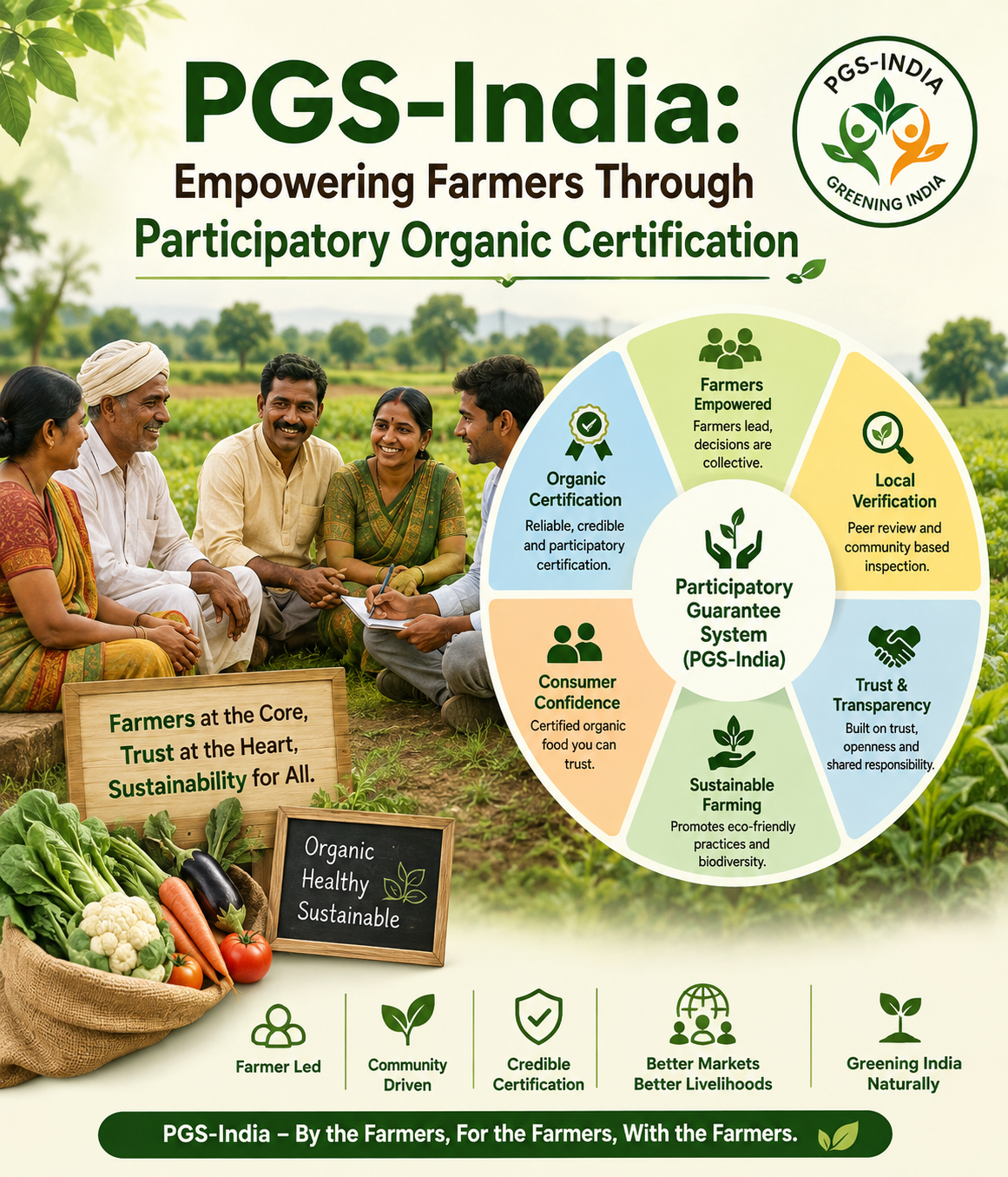
Organic farming in India isn’t just about avoiding chemicals it’s also about proving, in a fair and affordable way, that a farm is truly organic. For India’s small and marginal farmers, expensive third-party certification has always been a barrier. That’s where PGS-India (Participatory Guarantee System of India) comes in — a farmer-friendly, community-driven alternative to conventional organic certification.
What is PGS-India?
PGS-India is a quality assurance initiative that is locally relevant and built around the participation of everyone involved — producers as well as consumers. Rather than relying on an outside inspection agency, PGS-India operates outside the frame of third-party certification, allowing farmers themselves to assess, inspect, and verify each other’s production practices, and collectively declare the entire group’s holding as organic.
It functions under the National Project on Organic Farming (NPOF), a continuing central sector scheme that has been running since the 10th Five Year Plan, with the National Centre for Organic Farming (NCOF) — under the Department of Agriculture & Farmers Welfare, Ministry of Agriculture & Farmers Welfare — serving as the nodal agency.
What are the new rules for Regional Councils (RCs)?
- RCs restricted to operate within one state only for all scopes covered under certification.
- RCs not allowed to take up certification work outside their one allotted state.
- Any agreement made hereafter will not be considered for extension.
- RCs not allowed to change their allotted state after allocation.
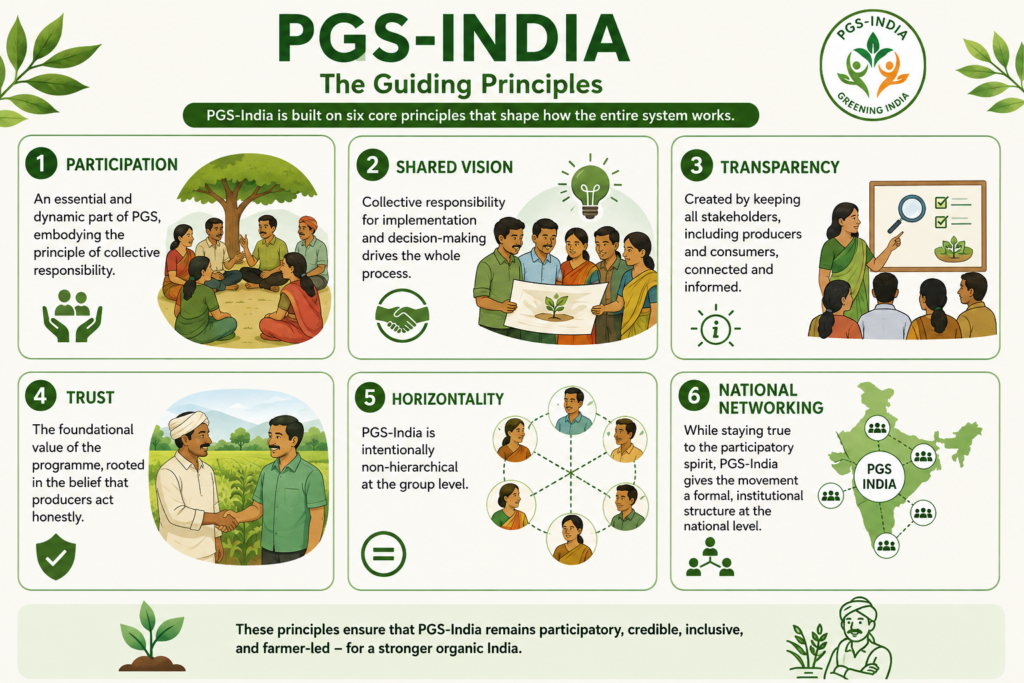
The Guiding Principles
PGS-India is built on six core principles that shape how the entire system works:
- Participation — An essential and dynamic part of PGS, embodying the principle of collective responsibility.
- Shared Vision — Collective responsibility for implementation and decision-making drives the whole process.
- Transparency — Created by keeping all stakeholders, including producers and consumers, connected and informed.
- Trust — The foundational value of the programme, rooted in the belief that producers act honestly.
- Horizontality — PGS-India is intentionally non-hierarchical at the group level.
- National Networking — While staying true to the participatory spirit, PGS-India gives the movement a formal, institutional structure at the national level.
How Certification Works
PGS-India certification flows through a simple, decentralized structure:
- Local Groups (LG) — A minimum of five farmers in the same or nearby villages form a group. Groups with fewer than five members must instead opt for individual certification.
- Registration — The group submits documents such as the application form, farmer history sheets, an organic farmer’s pledge, and an agreement with the Regional Council.
- Regional Council (RC) — The RC verifies farmer history, finalizes working modalities, and registers the group on the PGS-India web portal, issuing each Local Group a Unique ID.
- Peer Inspection — Farmers within the group inspect and verify each other’s practices, rather than depending on an external, paid inspector.
- Certification — Once verified, each farmer receives a PGS-India certificate carrying a unique identification code that traces back to both the Local Group and the Regional Council — enabling consumers to verify authenticity.
Because there’s no costly third-party audit involved, PGS-India is far more affordable and accessible than conventional certification systems, making it especially suited to India’s small and marginal farmers.
The PGS-India Web Portal
The PGS-India online portal plays a central role in keeping the entire system transparent and traceable. Its key benefits include:
- Promoting transparency throughout the certification process
- Creating a database of organic producers and area under PGS certification, with full traceability
- Enabling national networking among organic producers, consumers, and traders
- Making it easy to maintain crop production documents and records
- Keeping information accessible in the public domain
- Allowing consumers to verify the authenticity of organic produce
PGS-India at a Glance
As of now, the PGS-India network includes:
| Metric | Figure |
|---|---|
| Regional Councils | 70 |
| Total Groups | 74,878 |
| Total Farmers | 20,54,335 |
| Valid Certificates | 1,80,120 |
| Certified Cumulative Area | 12,19,690 hectares |
These numbers reflect just how far the participatory model has scaled since its national rollout — growing from a modest beginning into one of the largest community-based organic certification networks in the world.
Why PGS-India Matters
For India’s organic farming movement, PGS-India represents more than a certification mechanism it’s a model of trust-based, community-led governance. It lowers the cost of entry into organic markets for smallholders, builds a transparent, traceable database of organic farmers, and connects producers with consumers through simple, verifiable identification codes all while keeping the process rooted in local participation rather than external oversight.
As consumer demand for genuinely organic produce continues to grow, systems like PGS-India show that credible certification doesn’t have to come at the cost of accessibility. It proves that when farmers are trusted to hold each other accountable, quality assurance can be both rigorous and inclusive.