Current Affairs May 2026
Tap below — WhatsApp opens with the message already written. Just press Send and the link arrives straight away.
Get the May 2026 full compilation on WhatsAppThe six highest scorers in NABARD Grade A 2026 were all in one classroom
Every one of them was enrolled in the NABARD Mentorship Complete Course at Clarity 4 Sure. The same descriptive training and the same current affairs notes you are reading now.
- 1Suraj Ravindra Jatkar188.75
- 2Lokesh Ram Chandran185
- 3Vivek Kumar185
- 4Kapil Patlya184.75
- 5Siddhant Khesarwani183.75
- 6Lalit182.5

- 30 April, 2026
- 01 May, 2026
- 02 May, 2026
- 03 & 04 May, 2026
- 05 May, 2026
- 06 May, 2026
- 07 May, 2026
- 08 May, 2026
- 09 May, 2026
- 10 & 11 May, 2026
- 12 May, 2026
- 13 May, 2026
- 14 May, 2026
- 15 & 16 May, 2026
- 17 & 18 May, 2026
- 19 May, 2026
- 20 May, 2026
- 21 May, 2026
- 22 May, 2026
- 23 May, 2026
- 24 & 25 May, 2026
- 26 May, 2026
- 27 May, 2026
- 28 May, 2026
- 29,30&31 May, 2026
Pulled straight out of this month's own facts. If a figure here is new to you, go back and read that item in full.
30 April, 2026
Daily Current Affairs Quiz
30 April, 2026
National Affairs
1. NSO 80th Round Survey on Household Social Consumption on Health
Source: PIB
Context:
The NSO 80th round provides a comprehensive look at “Household Social Consumption on Health.” It highlights how massive public investment and schemes like Ayushman Bharat have fundamentally altered health-seeking behavior and reduced the financial burden on Indian families.
The Out-of-Pocket Expenditure (OOPE)
The survey reveals that for the majority of Indians, the “cost of care” in public facilities has dropped to near-zero levels for essential services.
- Public Facility Success: The median OOPE for non-hospitalization (outpatient) care in public facilities is now Zero.
- Hospitalization Costs: In over 50% of hospitalization cases in public health facilities, the expenditure is only ₹1,100.
- Overall Median OOPE: Standing at ₹11,285 (including private care), indicating that high-cost medical debt is now limited to specific, specialized cases rather than being the norm.
- Targeted Impact: The bottom two quintiles (poorest 40%) have seen the most significant decline in OOPE, proving that government interventions are reaching the intended beneficiaries.
Health-Seeking Behavior & Epidemiological Transition
Indians are no longer waiting until they are critically ill to see a doctor. Awareness and proactive screening are on the rise.
- PPRA (Proportion of Population Reporting Ailing):
- Rural: Rose from 6.8% (2017-18) to 12.2% (2025).
- Urban: Rose from 9.1% to 14.9%.
- Interpretation: This doubling doesn’t mean India is “sicker”—it means people are more aware of their health status and are actually reporting and seeking care for ailments.
- Shift in Disease Profile: There is a noted decline in infectious diseases, but a rising prevalence of Non-Communicable Diseases (NCDs) like diabetes and cardiovascular conditions.
Institutional Deliveries & Maternal Health
The push for safe motherhood has reached near-universal levels across India.
| Region | 2017-18 (75th Round) | 2025 (80th Round) |
| Rural Institutional Delivery | 90.5% | 95.6% |
| Urban Institutional Delivery | 96.1% | 97.8% |
- Public vs. Private: Nearly two-thirds (66.8%) of rural deliveries now occur in Government Health facilities.
Coverage of Health Insurance/Financing
The expansion of Ayushman Bharat (PM-JAY) and state-run schemes has provided a massive safety net against “catastrophic” health spending.
- Rural Expansion: Coverage increased more than threefold, from 12.9% to 45.5%.
- Urban Expansion: Increased from 8.9% to 31.8%.
Key Government Enablers Mentioned
- Ayushman Arogya Mandirs (AAMs): Over 1.84 lakh centers providing comprehensive primary healthcare closer to communities.
- FDSI & FDI: Free Drugs and Free Diagnostics initiatives (launched in 2015) which eliminated the cost of medicines and tests in public clinics.
- AMRIT Pharmacies: Over 220 pharmacies offering 6,500+ drugs at up to 50% discount.
- Hub-and-Spoke Model: A digital and physical network for transporting diagnostic samples, ensuring rural patients get high-end testing results locally.
Key Concepts: Keyword Q&A
Q: What is “Out-of-Pocket Expenditure” (OOPE)?
A: The money paid directly by households at the point of receiving health services. High OOPE is the primary cause of families falling below the poverty line in India.
Q: What is “Mean” vs “Median” in this context?
A: The Mean (average) is often skewed by a few extremely expensive surgeries. The Median represents the “middle” value—meaning 50% of the population pays less than that amount. The low median in this report shows that for the average citizen, care is very affordable.
Q: What are “Consumption Quintiles”?
A: A way of dividing the population into five equal groups based on their spending power. The “Bottom Two Quintiles” represent the poorest 40% of the country.
Conceptual MCQs
Q1. According to the NSO 80th Round, what is the median Out-of-Pocket Expenditure for outpatient care in public health facilities?
A) ₹1,100
B) ₹500
C) Zero
D) ₹11,285
Q2. The “Proportion of Population Reporting Ailing” (PPRA) has nearly doubled since 2017. What does this primarily signify?
A) A decline in national immunity
B) Improved awareness and proactive health-seeking behavior
C) Failure of government sanitation programs
D) An increase in infectious epidemics
Q3. What percentage of rural institutional deliveries now take place in Government Health facilities?
A) 35%
B) 47%
C) 66.8%
D) 95.6%
Answers: Q1: C | Q2: B | Q3: C
Exam Relevance
| Exam Focus Area | Relevance Level |
| UPSC CSE | GS-2 (Social Justice: Health), GS-3 (Economy: Infrastructure) |
| RBI Grade B | Social Issues: Health Indicators and Insurance Coverage |
| JPSC / BPSC | Rural Development and Social Consumption data |
2. India’s Shift to E100 and B100
Source: Mint
Context:
The Indian government has proposed an amendment to the Central Motor Vehicle Rules, 1989, to officially permit vehicles to run on 100% Ethanol (E100) and 100% Biodiesel (B100). This marks a strategic pivot from using biofuels as mere “blending agents” to treating them as standalone transport fuels.
What is E100 (100% Anhydrous Ethanol)?
E100 is pure ethanol with no petrol content. While India currently targets 20% blending (E20) by 2025-26, E100 requires Flex-Fuel Vehicles (FFVs) or dedicated ethanol engines.
What is B100 (100% Biodiesel)?
B100 is a “neat” biofuel made from vegetable oils, animal fats, or used cooking oil (UCO) through a process called transesterification.
Key Regulatory Changes
The draft amendment proposes specific terminology changes in the law to enable higher biofuel concentrations:
- Ethanol: Replacing references to ‘E85’ with ‘E85 or E100’.
- Biodiesel: Replacing ‘B10’ (10% blend) with ‘B100’ (pure biodiesel).
- Timeline: This move follows the 2025 mandate for E20, which faced some consumer backlash due to mileage concerns in older engines. E100 and B100 will likely require specifically optimized engines.
Strategic and Economic Impact
This policy serves three major national objectives:
- Energy Sovereignty: Reducing the staggering bill for imported crude oil, especially critical given the ongoing volatility in West Asia.
- Foreign Exchange Savings: As of January 2026, the ethanol program has already saved India $19.3 billion in forex.
- Agricultural Support: Over $15 billion has been paid directly to farmers (sugarcane and grain producers) over the last decade as ethanol feedstocks.
The Brazil Model
India is looking toward Brazil as the gold standard for this transition:
- In Brazil, FFVs have existed since 2003.
- Today, 90% of new sales in Brazil are FFVs, allowing consumers to choose at the pump between petrol or ethanol based on current pricing.
Key Concepts: Keyword Q&A
Q: What is “E100” and “B100”?
A: E100 is 100% pure anhydrous ethanol used as fuel. B100 is 100% pure biodiesel, typically derived from vegetable oils or animal fats, used without blending with petroleum diesel.
Q: What is the “Ethanol Supply Year”?
A: It is the cycle used for ethanol procurement, running from November to October.
Q: Why did consumers complain about E20 in 2025?
A: Ethanol has a lower energy density than petrol, leading to a slight drop in fuel economy (mileage). Additionally, older engines not designed for high ethanol blends can suffer from material degradation (corrosion of rubber/plastic parts).
Conceptual MCQs
Q1. Which country’s successful implementation of Flex-Fuel Vehicles (FFVs) is India using as a primary reference for the E100 push?
A) USA
B) Brazil
C) Germany
D) Indonesia
Q2. As per the April 2026 data, what is the gap between India’s ethanol production capacity and the current blending demand?
A) 2 billion liters
B) 5 billion liters
C) 9 billion liters
D) 11 billion liters
Q3. The proposed amendment to the Central Motor Vehicle Rules (CMVR) replaces the reference of B10 biodiesel with which of the following?
A) B20
B) B50
C) B85
D) B100
Answers: Q1: B | Q2: C (20bn – 11bn) | Q3: D
Exam Relevance
| Exam Focus Area | Relevance Level |
| UPSC CSE | GS-3 (Environment: Biofuels, Economy: Infrastructure & Energy) |
| JPSC / State AE | Mechanical/Automobile Engineering & State Biofuel policies |
| RBI Grade B | Finance: Forex savings and Import-Export dynamics |
3. NITI Aayog: DPI@2047 Roadmap for Viksit Bharat
Source: PIB
Context:
NITI Aayog, through its Frontier Tech Hub (FTH) and in collaboration with the EkStep Foundation and Deloitte, has launched the DPI@2047 roadmap. This strategic framework marks the transition of India’s Digital Public Infrastructure (DPI) from a tool for “welfare delivery” to a driver of “productivity-led growth.”
What is Digital Public Infrastructure (DPI)?
Digital Public Infrastructure (DPI) refers to a set of shared digital systems—built on open standards and specifications—that allow for secure and seamless interactions between people, businesses, and governments at a national scale.
Think of DPI like physical highways or railways. Just as physical roads allow any vehicle to travel from point A to point B regardless of the brand, DPI provides “digital rails” that any service (public or private) can plug into.
The Evolution of India’s Digital Rails
India is moving from DPI 1.0 (Identity/Aadhaar and Payments/UPI) into a more sophisticated era designed to support a $30 trillion economy.
- DPI 1.0 (The Foundation): Focused on financial inclusion and “leakage-proof” welfare transfers (DBT).
- DPI 2.0 & 3.0 (The Growth Engines): Focused on enhancing human capability, market access for MSMEs, and decentralized economic growth.
The Two-Phase Roadmap
| Phase | Timeline | Theme | Primary Objective |
| DPI 2.0 | 2025–2035 | Realising Aspirations | Scaling livelihood-led growth; empowering MSMEs and farmers; building a capable citizen base. |
| DPI 3.0 | 2035–2047 | Achieving Prosperity | Grassroots innovation; non-linear growth; transitioning to a high-income, developed nation (Viksit Bharat). |
Strategic Pillars & “Digital Rails 2.0”
The roadmap identifies specific “Unlocks” to achieve the $18,000 per capita income goal:
- Livelihood Engines: Specialized digital rails for Agriculture (crop insights/market access) and MSMEs (global supply chain integration).
- Human Capability: Learner-centric education in local languages and universal healthcare data systems.
- Asset Tokenization: Democratizing credit by turning physical or digital assets into tokens, making it easier for small businesses to get loans.
- AI Integration: Using AI for personalized guidance in local languages to bridge the skill gap.
- Open Networks: Scaling models like ONDC (Open Network for Digital Commerce) to break the monopoly of large platforms.
Key Concepts: Keyword Q&A
Q: What is “Non-Linear Growth”?
A: Growth that isn’t just steady and incremental, but rather accelerates rapidly due to the “compounding effect” of technology and infrastructure.
Q: What is “Asset Tokenization”?
A: Representing ownership of a physical asset (like land or machinery) as a digital token on a blockchain/database. This makes assets “liquid,” allowing them to be easily used as collateral for loans.
Q: What is the “NITI Frontier Tech Hub”?
A: A dedicated unit within NITI Aayog that explores emerging technologies (AI, Blockchain, IoT) to solve governance and developmental challenges.
Conceptual MCQs
Q1. According to the DPI@2047 roadmap, which phase is dedicated to “Realising Aspirations” through livelihood-led growth at scale?
A) DPI 1.0
B) DPI 2.0
C) DPI 3.0
D) DPI 4.0
Q2. What is the projected contribution of DPI initiatives to India’s GDP by the year 2030?
A) 1%
B) 2.5%
C) 4%
D) 10%
Q3. Which of the following is a “Systemic Enabler” mentioned in the NITI Aayog roadmap?
A) Restricting cross-border data flow
B) Asset tokenization for credit access
C) Centralizing all economic activities in Tier-1 cities
D) Discontinuing the use of local languages in education
Answers: Q1: B | Q2: C | Q3: B
Exam Relevance
| Exam Focus Area | Relevance Level |
| UPSC CSE | GS-2 (E-Governance), GS-3 (Economy, Digital Infrastructure) |
| RBI Grade B | ESI: Economic Reforms and Social Infrastructure |
| State PSCs | Modern governance frameworks and digital India |
4. Prehistoric Rock Painting Site: Oor Pare (Nilgiris)
Source: TNIE
Context:
The Yaakai Heritage Trust has documented the re-discovery of a significant prehistoric rock art site named Oor Pare in the Nilgiris district of Tamil Nadu. This site offers a rare glimpse into the ritualistic lives of ancient inhabitants and their connection to the modern-day Irula and Kurumba tribes.
Site Profile: Oor Pare
Located near Vellarikombai village (near Kotagiri), the site is a massive rock shelter perched at an elevation of 1,100 metres.
- Environmental Context: The site is hidden behind a seasonal waterfall. It is only accessible during the summer, as monsoon rains transform the rock face into a vertical stream, which has incidentally helped preserve the paintings by keeping them out of reach.
- Dimensions: The “canvas” is substantial, covering an area of approximately 6.3 metres (length) by 5.4 metres (height).
- Medium: All depictions are created using Red Ochre (natural iron oxide), a hallmark of prehistoric art in the Indian peninsula.
Artistic & Symbolic Features
The site features around 30 distinct figures that suggest a complex social and spiritual structure:
- Anthropomorphic Figures: Humans are depicted with conical headdresses, possibly representing shamans or tribal leaders.
- Physical Stylization: Figures often have elongated limbs, a style frequently associated with the “mesolithic” transition in rock art.
- Ritual Symbols:
- Dot-filled Rectangles: Often interpreted as sacred enclosures or maps of celestial significance.
- Ladder-like Structures: These may represent the “soul’s journey” or reflect the literal ladders used by the tribes for honey gathering.
Irula & Kurumba
Unlike many archaeological sites that are “dead,” Oor Pare remains a living part of local tribal culture.
| Tribe | Role/Connection to Site | Key Characteristics |
| Irula | Consider the site sacred; use it for spiritual refuge. | Known for herbal medicine and traditional snake-catching expertise. |
| Kurumba | Use the site as a resting place during honey-gathering. | Renowned for scaling cliffs to collect honey; traditionally linked to the ancient Pallavas. |
- Honey Gathering: The Kurumbas’ use of the site as a waypoint during honey expeditions suggests a continuity of land use that spans thousands of years.
Key Concepts: Keyword Q&A
Q: What is “Red Ochre”?
A: A natural clay earth pigment containing ferric oxide. It was one of the first pigments used by mankind globally due to its abundance and permanence on rock surfaces.
Q: What does “Anthropomorphic” mean?
A: Having human characteristics. In rock art, it refers to figures that look like humans but may represent deities, spirits, or masked ritual performers.
Q: Why is the location northwest of Vellarikombai significant?
A: The Nilgiris are home to a “rock art corridor” (including Eluthuparai). Finding a site at this specific altitude near Vellarikombai fills a gap in the migratory and settlement maps of prehistoric South India.
Conceptual MCQs
Q1. The prehistoric rock art site ‘Oor Pare’ is located in which district of Tamil Nadu?
A) Madurai
B) Nilgiris
C) Thanjavur
D) Dharmapuri
Q2. Which pigment was exclusively used for the paintings found at the Oor Pare site?
A) White Kaolin
B) Black Charcoal
C) Red Ochre
D) Yellow Limonite
Q3. Which indigenous community traditionally uses the Oor Pare rock shelter as a resting place during honey-gathering expeditions?
A) Toda
B) Badaga
C) Kurumba
D) Kota
Answers: Q1: B | Q2: C | Q3: C
Exam Relevance
| Exam Focus Area | Relevance Level |
| UPSC CSE | GS-1 (Indian Heritage and Culture: Rock Art) |
| TNPSC | Unit 4 & 8 (History and Culture of Tamil Nadu) |
| SSC / RRB | General Awareness: Major Archaeological Sites |
5. Multilateral Exercise Pragati-I (2026)
Source: TOI
Context:
The Indian Army is launching the inaugural edition of Exercise Pragati at the Foreign Training Node (FTN) in Umroi, Meghalaya, scheduled from May 18 to 31, 2026. This marks a strategic shift from bilateral drills to a broader “consortium-style” engagement with regional partners.
What is Exercise Pragati?
Full Form: Partnership of Regional Armies for Growth and Transformation in the Indian Ocean Region.
- Host: Indian Army (Eastern Command).
- Nature: A multilateral military exercise and defense industry exposition.
- The “Consortium” Approach: Unlike standard bilateral (one-on-one) exercises, Pragati brings together a group of nations to standardize tactical procedures and communication across the Indian Ocean Region (IOR).
Participating Nations
While 15 countries from the ASEAN and IOR regions were invited, 11 friendly foreign countries (FFCs) have confirmed their participation in this maiden edition:
- South Asia: Bhutan, Nepal, Sri Lanka, Maldives.
- ASEAN Region: Malaysia, Vietnam, Cambodia, Laos, Myanmar, Philippines.
- IOR Region: Seychelles.
Key Objectives & Tactical Focus
The exercise is designed to move beyond basic drills into high-end interoperability.
- Counter-Insurgency & Counter-Terrorism (CICT): A core focus on joint operations in semi-urban and jungle terrain.
- Humanitarian Assistance & Disaster Relief (HADR): Coordinating rapid response for natural disasters common in the IOR.
- Collective Security: Addressing shared threats such as maritime piracy, transnational crime, and regional instability.
- Defense Industry Exposition (May 30-31): A concurrent event highlighting indigenous (Made in India) military hardware. It allows foreign delegations to witness “Aatmanirbhar Bharat” capabilities first-hand, specifically in:
- Unmanned Aerial Systems (UAVs) and Counter-UAV tech.
- Software-Defined Radios (SDR) and secure communication.
- Robotic mules and autonomous ground vehicles.
Key Concepts: Keyword Q&A
Q: What is “Interoperability”?
A: The ability of different military organizations to conduct joint operations efficiently using shared equipment, communication protocols, and tactical understanding.
Q: Why is the IOR (Indian Ocean Region) focus critical?
A: The IOR is the “lifeline” of global trade. By leading a partnership of regional armies, India reinforces its role as a Net Security Provider and balances external influences in the region.
Q: What is the significance of the “Industry Exposition”?
A: It turns a military exercise into a “Defense Diplomacy” platform, promoting Indian defense exports to ASEAN and neighboring nations.
Conceptual MCQs
Q1. The acronym ‘PRAGATI’ in the military exercise stands for Partnership of Regional Armies for Growth and Transformation in which region?
A) South China Sea
B) Indian Ocean Region
C) Indo-Pacific Region
D) Bay of Bengal
Q2. Which Indian state is hosting the inaugural edition of Exercise Pragati at the Foreign Training Node?
A) Sikkim
B) Arunachal Pradesh
C) Meghalaya
D) Nagaland
Q3. How many friendly foreign nations are participating in the first edition of Exercise Pragati?
A) 5
B) 11
C) 15
D) 22
Answers: Q1: B | Q2: C | Q3: B
Exam Relevance
| Exam Focus Area | Relevance Level |
| UPSC CSE | GS-2 (International Relations), GS-3 (Internal Security) |
| CDS / NDA / AFCAT | Military Exercises and Defense Technology |
| Banking / SSC | General Awareness: Current Defense News |
Banking/Finance
1. RBI’s Exit Path for Small NBFCs: The “Type I” Deregistration Framework
Source: BS
Context:
The RBI has introduced a landmark structured exit route for small, non-customer-facing NBFCs. This move aims to reduce the “regulatory burden” on entities that pose minimal systemic risk, effectively creating a tiered system that separates small private investment arms from large, public-facing financial institutions.
The New Classification: Type I vs. Type II
The RBI is streamlining its oversight by categorizing NBFCs based on their risk profile (public funds and customer interaction).
- Unregistered Type I NBFCs:
- Assets: Less than ₹1,000 crore.
- Public Funds: Must not avail of public funds (including indirect access through group entities).
- Customer Interface: Must not have any customer interface (e.g., direct lending to the public).
- Status: Exempt from RBI registration starting July 1, 2026.
- Registered Type I NBFCs: Meet the “no public funds/no customer” criteria but have assets of ₹1,000 crore or more.
- Type II NBFCs: All other NBFCs (those with public funds or customer interfaces).
What is The Deregistration Process (The Exit Path)?
For the first time, existing NBFCs that fit the “Type I” criteria can choose to leave the RBI’s direct regulatory net.
- One-Time Window: Applications for deregistration must be submitted by December 31, 2026.
- Portal: Must use the PRAVAAH (Platform for Regulatory Application, Validation, and Authorisation) portal.
- Prerequisites:
- Audited financial statements for the last 3 years.
- Statutory Auditor’s Certificate confirming no public funds or customer interface.
- Board Resolution affirming compliance and a “forward-looking” commitment to never access public funds or customers in the future.
What is PRAVAAH (Platform for Regulatory Application, Validation, and Authorisation) Portal?
PRAVAAH is a centralized, secure, web-based portal designed to be a “single window” for any individual or entity (banks, NBFCs, FinTechs) to apply for licenses, approvals, and authorizations from the RBI. It replaces the old, fragmented system of physical couriers and manual emails with a streamlined digital interface.
Key Features & Functionalities
The portal is designed to dismantle the “black box” of regulatory approvals through several core features:
- Unified Submission: Consolidates over 60 different types of applications (previously 100+ categories) into one portal.
- Real-time Tracking: Applicants receive a 10-digit Application ID and can monitor their request’s progress through various milestones.
- Interactive Query Management: If the RBI needs more information, they raise a query directly on the portal. The applicant can reply and upload additional documents in the same thread.
- Digital Audit Trail: Every interaction, from submission to final decision, is recorded, ensuring high institutional accountability.
- Doorstep Access: Being web-based, it allows entities—including Foreign Investors and NRIs—to apply from anywhere in the world without visiting an RBI office.
Anti-Arbitrage Measures
To ensure companies don’t use this as a loophole to escape oversight while still using public money, the RBI has added strict safeguards:
- Indirect Funding: If an entity gets money from a “group entity” that has accessed public funds, it is treated as having Public Funds.
- Overseas Limits: Unregistered Type I NBFCs cannot invest in financial services abroad without first registering with the RBI and getting prior approval.
- Auditor Vigilance: Statutory auditors must file “Exception Reports” directly with the RBI if the company breaches the “no public funds/no customer” conditions.
Key Concepts: Keyword Q&A
Q: What counts as “Public Funds”?
A: It includes public deposits, inter-corporate deposits, bank finance, and all funds received from sources other than the promoters/owners.
Q: What is “Regulatory Arbitrage”?
A: It is the practice of shifting operations to a less-regulated category (like Type I) to avoid the strict rules of a more-regulated category (like Type II) while still doing essentially the same business.
Q: Does “Deregistration” mean they are unregulated?
A: No. They remain “Unregistered Type I NBFCs.” They are still governed by the RBI Act, and the RBI reserves the right to issue directions or take action if they misbehave.
Conceptual MCQs
Q1. Under the new guidelines, what is the asset threshold below which an NBFC (without public funds/customers) can apply for deregistration?
A) ₹100 crore
B) ₹500 crore
C) ₹1,000 crore
D) ₹5,000 crore
Q2. What is the name of the RBI portal through which NBFCs must apply for deregistration?
A) SARVADA
B) PRAVAAH
C) Kuber
D) E-Kuber
Q3. If a small NBFC receives funding from a group company that has taken a bank loan, can it qualify as an “Unregistered Type I NBFC”?
A) Yes, because it didn’t take the loan directly.
B) No, because indirect access to public funds is treated as public funding.
C) Yes, if the amount is less than ₹10 crore.
D) Only if the Board passes a resolution.
Answers: Q1: C | Q2: B | Q3: B
Exam Relevance
| Exam Focus Area | Relevance Level |
| RBI Grade B | Finance: NBFC Regulation, SBR, and PRAVAAH portal |
| UPSC CSE | GS-3 (Economy: Banking and Financial Institutions) |
2. E-PRAAPTI
Source: Business Standard
Context:
Union Minister Mansukh Mandaviya announced the launch of E-PRAAPTI, a specialized portal designed to help subscribers trace and reactivate “inoperative” or dormant EPF accounts. This initiative targets the massive surge in unclaimed deposits, which have grown fivefold over the last five years.
What is E-PRAAPTI?
Full Form: EPF Aadhaar-Based Access Portal for Tracking Inoperative Accounts.
- Primary Target: Members who had EPF accounts in the “physical mode” (pre-UAN era) or those who have lost track of their old Account Numbers.
- The Problem: As of March 2024, there were 2.15 million inoperative accounts containing ₹8,505 crore. Many members cannot link these to their current UAN because they lack old documentation.
- The Solution: An Aadhaar-authenticated digital bridge that allows users to “discover” their legacy accounts and merge them into their active UAN profile seamlessly.
Phases of Implementation
The EPFO is adopting a “crawl-walk-run” approach to maintain data security:
| Phase | Target Users | Mechanism |
| Initial Phase | Members with a known Member ID. | Users enter their old ID; Aadhaar validates identity for instant linking. |
| Expansion Phase | Members who cannot recall their old IDs. | Search based on name, DOB, and Aadhaar-linked history to “suggest” dormant accounts. |
Key Concepts: Keyword Q&A
Q: Why do accounts become “Inoperative”?
A: An account is classified as inoperative if no contribution is made for 36 months. While they still earn interest, they are moved to a separate ledger for security and require additional verification for withdrawal.
Q: What is “Auto-Mode” processing?
A: It is a system where the EPFO’s software automatically matches a member’s claim request against their Aadhaar-verified profile and bank details. If everything matches, the money is dispatched without a physical file being touched by a clerk.
Q: What is the benefit of E-PRAAPTI for the government?
A: It increases transparency and reduces the “Unclaimed Deposits” liability on the EPFO’s books, ensuring social security funds reach the intended beneficiaries rather than sitting idle.
Conceptual MCQs
Q1. The E-PRAAPTI portal primarily uses which authentication method to track old EPF accounts?
A) Passport Verification
B) Aadhaar-based Authentication
C) Employer’s Physical Signature
D) PAN-only matching
Q2. What was the approximate total amount lying in inoperative EPFO accounts as of March 31, 2024?
A) ₹1,638 Crore
B) ₹2,632 Crore
C) ₹8,505 Crore
D) ₹83.1 Crore
Q3. In FY26, what percentage of EPFO claims were processed in “Auto-Mode”?
A) 50.11%
B) 59.19%
C) 71.11%
D) 98.7%
Answers: Q1: B | Q2: C | Q3: C
Exam Relevance
| Exam Focus Area | Relevance Level |
| EPFO EO/AO/APFC | Functional knowledge of the new portal and FY26 stats |
| UPSC CSE | GS-2 (E-Governance), GS-3 (Economy: Social Security) |
| Banking / SSC | General Awareness: Government portals and financial inclusion |
3. IPPB SHG Savings Account
Source: Mint
Context:
India Post Payments Bank has launched a dedicated Self Help Group (SHG) Savings Account. This initiative is designed to bring women-led collectives in rural and semi-urban India into the formal financial fold by leveraging the vast reach of the postal network.
Key Features of the SHG Savings Account
The account is built to remove the financial and administrative hurdles that often prevent small groups from opening bank accounts.
- Zero-Balance & Zero-Cost: There is no minimum initial deposit required and no Monthly Average Balance (MAB) requirement.
- Transaction Benefits:
- Nil charges for cash deposits and withdrawals.
- One free physical account statement per month.
- No charges for account closure or QR card issuance.
- Balance & Interest:
- Maximum Balance: Up to ₹2,00,000.
- Interest: Paid out quarterly (2.0% for balances up to ₹1 Lakh; 2.25% for balances above ₹1 Lakh).
- Simplified Onboarding: Digital and seamless onboarding facilitated at the doorstep by Gramin Dak Sevaks (GDS) and postmen.
What are Self Help Groups (SHGs)?
Self Help Groups (SHGs) are informal collectives of 10–20 members (primarily women) who pool their savings to provide micro-loans to each other.
- Financial Inclusion: By formalizing their savings, these groups build a financial track record, making it easier to access institutional credit from larger banks.
- Livelihood Support: The account is tailored for groups engaged in micro-enterprises like tailoring, dairy, handicrafts, and zari work.
- Digital Integration: It allows rural women to receive government benefits and subsidies directly into a collective account, reducing reliance on high-interest informal lenders.
Advantage
Unlike traditional banks that require members to travel long distances, IPPB uses a hybrid digital-physical model:
- Last-Mile Connectivity: Operates across 5.5 lakh villages.
- Doorstep Banking: Financial services are delivered at the user’s home using biometric devices and mobile platforms, removing the “travel cost” barrier for rural women.
- Language Accessibility: The technology platform is available in multiple regional languages to improve literacy and trust.
Quick Comparison
| Feature | IPPB SHG Savings Account | Typical Commercial Savings Account |
| Minimum Balance | ₹0 | Often ₹500–₹5,000 |
| Initial Deposit | ₹0 | Usually required |
| Cash Transactions | Free | Often capped after 3–5 uses |
| Access Point | Doorstep (Postman) | Physical Branch / ATM |
| Focus Group | Rural Women Collectives | Individual Consumers |
Conceptual MCQs
Q1. What is the maximum balance limit allowed in the newly launched IPPB SHG Savings Account?
A) ₹50,000
B) ₹1,00,000
C) ₹2,00,000
D) No limit
Q2. Which of the following is NOT a feature of the IPPB SHG Savings Account?
A) Zero Monthly Average Balance
B) Quarterly interest payouts
C) Mobile banking access
D) No account closure charges
Q3. Which workforce is primarily responsible for the “doorstep banking” delivery of this account in rural areas?
A) Bank Managers
B) Gramin Dak Sevaks (GDS)
C) Insurance Agents
D) IT Professionals
Answers: Q1: C | Q2: C | Q3: B
Exam Relevance
| Exam Focus Area | Relevance Level |
| UPSC CSE / State PSCs | GS-2 (Social Justice: Women Empowerment), GS-3 (Economy: Financial Inclusion) |
| RBI Grade B / NABARD | Rural Banking, SHG-Bank Linkage Programs |
| Banking Exams (IBPS/SBI) | Latest banking products and financial terminology |
4. RBI’s New Lending Norms for UCBs
Source: BS
Context:
Following a draft consultation period earlier this year, the RBI has finalized revised lending norms for UCBs. The objective is twofold: providing operational flexibility to larger, financially sound banks while imposing stricter risk management on smaller ones to prevent systemic contagion.
Revised Unsecured Lending Framework
The RBI has shifted the ceiling for unsecured loans from a percentage of total assets to a percentage of total advances, doubling the effective limit for many banks.
- Aggregate Limit: UCBs can now maintain aggregate unsecured loans up to 20% of their total advances (previously 10% of total assets).
- The ECBA Exemption: For UCBs meeting the Eligibility Criteria for Business Authorisation (ECBA), unsecured advances up to ₹50,000 per borrower (classified as Priority Sector Loans) are excluded from this 20% limit.
- Individual Caps (Tier-based):
| UCB Tier | Individual Unsecured Loan Limit |
| Tier-I | Up to ₹5 Lakh |
| Tier-II | Up to ₹7.5 Lakh |
| Tier-III & Tier-IV | Up to ₹10 Lakh |
Tightened Housing Loan Norms
The new rules distinguish between “Ready-to-move-in” and “Under-construction” properties to ensure better liquidity management.
- Tenure Cap (Tier-I & II): Capped at 20 years, which must include any moratorium period.
- Moratorium Restrictions:
- Allowed only for under-construction properties.
- Capped at a maximum of 24 months (or 18 months as per some specific draft variations; the final rule emphasizes construction-linked timelines).
- Prohibited for the purchase of completed (ready) houses.
- Flexibility for Large UCBs: Tier-III and Tier-IV banks have the autonomy to decide tenures and moratoriums based on Board-approved policies, provided they account for borrower life expectancy.
Key Concepts: Keyword Q&A
Q: What is the “ECBA” Framework?
A: It stands for Eligibility Criteria for Business Authorisation. It replaced the old “FSWM” (Financially Sound and Well Managed) norms. To qualify, a UCB needs a Net NPA $\le 3\%$, consistent profits, and no default in CRR/SLR.
Q: Why separate Tiers for UCBs?
A: UCBs are categorized based on deposit size (Tier 1 < ₹100cr; Tier 2 up to ₹1,000cr; Tier 3 up to ₹10,000cr; Tier 4 > ₹10,000cr). Tiered regulation ensures that a small neighborhood bank isn’t burdened with the same complex rules as a multi-state cooperative giant.
Q: What is a “Nominal Member”?
A: These are members who don’t have full voting rights but can avail of small loans (like consumer durable loans up to ₹2.5 Lakh) if the bank’s by-laws allow it.
Conceptual MCQs
Q1. According to the final RBI guidelines, what is the aggregate ceiling for unsecured loans for a UCB?
A) 10% of Total Assets
B) 20% of Total Advances
C) 50% of Priority Sector Lending
D) 15% of Net Worth
Q2. A Tier-II UCB wants to provide a housing loan for a ready-to-move-in apartment. What is the maximum permitted moratorium period?
A) 12 months
B) 24 months
C) 6 months
D) Nil (Zero)
Q3. UCBs are barred from extending loans against which of the following?
A) Gold Ornaments
B) Fixed Deposits of other banks
C) Life Insurance Policies
D) Their own Fixed Deposits
Answers: Q1: B | Q2: D | Q3: B
Exam Relevance
| Exam Focus Area | Relevance Level |
| UPSC GS-3 | Economy: Mobilization of resources and Banking structure |
| RBI Grade B | FM: Cooperative Banking and Risk Management |
| NABARD | Rural/Urban Cooperative Credit Societies |
Agriculture
1. Government Relaxes Wheat Procurement Norms (2026)
Source: The Hindu
Context:
Following unpredictable weather conditions that damaged crops during the harvest season, Chief Minister Rekha Gupta has announced a relaxation in the quality specifications for wheat procurement at the Minimum Support Price (MSP). This move is designed to protect farmers from financial loss due to “fair average quality” (FAQ) failures.
What are The New Procurement Criteria?
To ensure that weather-affected farmers can still sell their produce to the government, the standard procurement rules have been adjusted for the current season:
- Lustre Loss: Wheat with up to 70% loss of lustre (surface shininess/color) will now be accepted. Usually, significantly discolored grain is rejected as it is perceived to be of lower quality.
- Shrivelled & Broken Grains: The permissible limit has been more than doubled, increasing from the standard 6% to 15%.
- Specific Constraint: Within the above limit, the total of “broken” and “slightly broken” grains must not exceed 6% to ensure the grain remains viable for milling.
Storage and Logistics Strategy
The government has implemented a strict “segregation” policy for the relaxed-norm wheat:
- Independent Storage: Wheat purchased under these relaxed rules will be stored in separate godowns, away from the “Regular Stock.”
- Purpose: This prevents the overall quality of the national buffer stock from being compromised and allows the government to prioritize this specific stock for immediate distribution (e.g., through the PDS) before its shelf life diminishes.
Key Concepts: Keyword Q&A
Q: What is “Lustre Loss”?
A: Lustre refers to the natural shine of the wheat grain. Rain during the harvesting stage causes the grain to lose this shine and turn dull or blackened. While the nutritional value is often still intact, it affects the marketability and “eye-appeal” of the flour (Atta).
Q: What are “Shrivelled Grains”?
A: These are grains that did not develop fully due to heat stress or lack of moisture at the ripening stage, or due to excessive rain. They are smaller and lighter than healthy grains.
Q: Why separate the stocks?
A: Shrivelled and broken grains are more susceptible to pests and fungal growth. By storing them independently, the government can monitor them closely and ensure they are used first.
Conceptual MCQs
Q1. Under the new relaxed norms, what is the maximum permissible limit for “Lustre Loss” in wheat procurement?
A) 15%
B) 25%
C) 50%
D) 70%
Q2. The permissible limit for shrivelled and broken grains has been increased to what percentage?
A) 6%
B) 10%
C) 15%
D) 20%
Q3. What is the primary reason for the government to store relaxed-norm wheat separately from regular stock?
A) To sell it to international markets
B) To maintain the quality and shelf-life integrity of the regular buffer stock
C) To charge farmers a storage fee
D) To use it exclusively for seed production
Answers: Q1: D | Q2: C | Q3: B
Exam Relevance
| Exam Focus Area | Relevance Level |
| UPSC CSE | GS-3 (Agriculture: MSP, Procurement, Food Security) |
| State PSCs | Regional agricultural policies and disaster management |
| Banking / IBPS AFO | Agricultural finance and crop quality standards |
Facts To Remember
1. PM Narendra Modi Visits Sikkim; Inaugurates Rs 4,000 Crore Projects
PM Narendra Modi visited Sikkim on 27–28 April 2026 for 50th Statehood celebrations; inaugurated and laid foundation for 30+ projects worth Rs 4,000 crore; projects span infrastructure, healthcare, and connectivity sectors; also visited Orchid centre and boosted North-East cricket infrastructure.
2. Ladakh Notifies 5 New Districts
Ladakh LG approved creation of five new districts in April 2026 increasing total to seven; new districts include Nubra, Sham, Changthang, Zanskar, and Drass; carved out from Leh and Kargil districts; appointments of DCs and SPs ensured for administrative functioning.
3. Google Cloud AI Hub Foundation Laid in Visakhapatnam
Foundation stone laid for Google Cloud AI Hub in Visakhapatnam in April 2026; project worth USD 15 billion is India’s largest FDI project; includes hyperscale data centres, subsea cables, and fibre networks; aims to make Vizag a global AI and cloud hub.
4. India Post and DTDC Sign Logistics MoU
Department of Posts signed MoU with DTDC in April 2026 to boost logistics network; enables capacity sharing and expands rural delivery reach; integrates tracking systems and supports COD services; strengthens India’s e-commerce and logistics ecosystem.
5. SkyHop Gets Approval for India’s First Seaplane Service
SkyHop Aviation received DGCA approval for seaplane operations in April 2026; initial services to begin in Lakshadweep for island connectivity; uses 19-seater Twin Otter aircraft capable of water landing; aligned with UDAN scheme for regional connectivity.
6. BHEL Signs Defence Technology Agreement with DRDO
BHEL signed technology transfer agreement with DRDO’s NSTL in April 2026; focuses on Gas Turbine Infrared Suppression System for naval ships; reduces infrared signature and enhances stealth capability; supports Make in India and defence indigenisation.
7. SIPRI Report 2025: India 5th Largest Military Spender
SIPRI report 2026 ranked India as 5th largest military spender in 2025; India spent USD 92.1 billion with 8.9% growth; USA topped followed by China, Russia, and Germany; global military spending reached USD 2.88 trillion.
8. UAE Exits OPEC and OPEC+ Alliance
UAE announced exit from OPEC and OPEC+ effective May 2026; aims to gain flexibility in oil production strategy; decision driven by expanded production capacity of ADNOC; may impact global oil coordination and pricing dynamics.
9. Flipkart, Axis Bank and PayU Launch Biometric Payments
Flipkart, Axis Bank, and PayU launched biometric card payments in April 2026; replaces OTP with fingerprint or Face ID authentication; improves security and transaction success rates; aligns with RBI digital payment authentication norms.
10. China Launches Pakistan’s PRSC-EO3 Satellite
China launched Pakistan’s PRSC-EO3 satellite in April 2026 via Long March-6 rocket; satellite supports earth observation and disaster management; uses AI-based imaging and multi-spectrum sensors; marks 640th mission of Long March series.
11. World Day for Safety and Health at Work 2026 – April 28
Observed on April 28 to promote workplace safety and health standards; 2026 theme focuses on psychosocial working environment; established by ILO in 2003; aims to reduce work-related accidents and diseases globally.
12. International Jazz Day 2026 – April 30
Observed on April 30 to celebrate jazz as global cultural art form; declared by UNESCO in 2011; promotes unity and cultural exchange through music; 2026 global host city is Chicago, USA.
13. World Immunization Week 2026 – April 24–30
Observed from April 24 to 30 to promote vaccination awareness; 2026 theme highlights benefits across generations; led by WHO across 180+ countries; aims to prevent vaccine-preventable diseases worldwide.
01 May, 2026
Daily Current Affairs Quiz
01 May, 2026
National Affairs
1. Women and Men in India 2025
Source: PIB
Context:
This report serves as the definitive socio-economic compass for gender-based policy in India. The 2025 edition reveals a transformative shift in female leadership and education, though it highlights critical gaps in health screenings and the “unpaid care” burden.
The Demographic Shift
India is seeing a steady improvement in the survival and health outcomes of the girl child.
- Sex Ratio at Birth (SRB): Improved to 917 (2021-23) from 904 (2017-19).
- Maternal Mortality Ratio (MMR): A historic drop from 254 (2004-06) to 88 (2021-23). This indicates India is successfully reaching Sustainable Development Goal (SDG) targets.
- Mean Age at Marriage: Now stands at 24.3 years, providing women a longer window for higher education and career entry before domestic responsibilities begin.
Education: The Reversal of the Gap
One of the most significant takeaways is that in higher education, women are now outpacing men in enrolment.
- Gender Parity Index (GPI): Achieved across all school levels (Primary to Higher Secondary).
- Higher Education GER: Female Gross Enrolment Ratio stands at 30.2, surpassing the male GER of 28.9.
- The Literacy Challenge: Despite youth parity, an overall 14.4% literacy gap persists, largely due to older generations who missed out on schooling.
The Rise of Women Managers
The data suggests a structural shift in the Indian workforce, particularly in rural areas and leadership roles.
- Managerial Surge: Between 2017 and 2025, the number of women in managerial positions grew by 102.54%, nearly double the growth rate of men (73.80%).
- Rural Female LFPR: A massive jump from 37.5% to 45.9% in just three years. This reflects the impact of self-help groups (SHGs) and rural employment schemes.
- Unpaid Work: The “Time Use” data remains a pain point. Women still spend the vast majority of their day on unpaid domestic chores compared to men, which limits their time for “paid” economic growth.
Key Concepts
Q: What is the “Gross Enrolment Ratio” (GER)?
A: It is the total enrolment in a specific level of education, regardless of age, expressed as a percentage of the eligible official school-age population. A GER above 100% can occur due to over-age or under-age students.
Q: What is “LFPR” (Labour Force Participation Rate)?
A: The percentage of the population that is either working or actively looking for work.
Q: What is the “Maternal Mortality Ratio” (MMR)?
A: The number of maternal deaths per 100,000 live births. It is a key indicator of the quality of a country’s healthcare system.
Conceptual MCQs
Q1. According to the 2025 report, which group showed the highest growth in Labour Force Participation Rate (LFPR)?
A) Urban Males
B) Urban Females
C) Rural Females
D) Rural Males
Q2. What was the growth percentage of women in managerial positions between 2017 and 2025?
A) 73.80%
B) 88.00%
C) 102.54%
) 14.40%
Q3. In which area does the report indicate a significant 14.4 percentage point gap between men and women?
A) Higher Education Enrolment
B) Literacy Rate (aged 7+)
C) Managerial Roles
D) Infant Mortality
Answers: Q1: C | Q2: C | Q3: B
Exam Relevance
| Exam Focus Area | Relevance Level |
| UPSC CSE | GS-1 (Society: Role of Women), GS-2 (Social Justice), GS-3 (Economy) |
| State PSCs | Socio-economic indicators and rural development data |
| RBI/NABARD | Rural female LFPR and financial inclusion metrics |
2. India’s First Green Methanol Plant
Source: The Hindu
Context:
India is set to launch its first green methanol plant at the Deendayal Port Authority (DPA) in Kandla, Gujarat. The project is a unique “circular economy” solution that addresses an ecological crisis—the invasion of Prosopis juliflora in the Kutch grasslands—while providing a sustainable fuel alternative for the global shipping industry.
Prosopis juliflora (The Invasive Weed)
Known locally as Gando Baval (Mad Tree) in Gujarat and Vilayati Keekar in the north, this Mexican-origin shrub has become a major environmental threat.
- Origin: Introduced in the 1920s (by the British) and 1961 (by the Gujarat Forest Dept) to prevent desertification.
- Impact: It has crowded out native grasses over thousands of kilometers in the Banni grasslands, destroying the habitat of local livestock and wildlife.
- The Opportunity: Despite being a weed, it is a high-density hardwood with an excellent energy profile and low acid content, making it a perfect biomass feedstock.
Gasification to Green Methanol
The plant uses a two-step thermochemical process to turn wood into liquid fuel.
- Step 1: Gasification (Ankur Scientific): The wood is heated in a controlled environment with limited oxygen (sitting between combustion and pyrolysis). This breaks the biomass down into Syngas (Synthesis Gas), which primarily consists of Hydrogen ($H_2$), Carbon Monoxide ($CO$), and Carbon Dioxide ($CO_2$).
- Step 2: Synthesis (Thermax Energy): The syngas is then chemically converted into Methanol ($CH_3OH$).
Why Green Methanol?
Shipping is one of the hardest industries to “decarbonize.” Green methanol is emerging as the preferred replacement for Bunker Oil (heavy fossil fuel).
| Feature | Conventional Methanol | Green Methanol |
| Source | Natural gas or Coal gasification. | Biomass (agricultural residue/weeds). |
| CO2 Emissions | High (fossil-based). | Reduced by up to 95%. |
| Other Pollutants | High NOx and SOx. | NOx down by 80%; eliminates SOx. |
| IMO Rules | May face penalties in future. | Complies with IMO’s “Green Port” rules. |
Key Concepts: Keyword Q&A
Q: What is “Syngas”?
A: Short for Synthesis Gas, it is a fuel gas mixture consisting primarily of hydrogen, carbon monoxide, and very often some carbon dioxide. It is an intermediate resource for creating synthetic fuels.
Q: What is the “IMO”?
A: The International Maritime Organization. It is the UN agency responsible for the safety and security of shipping and the prevention of marine pollution by ships. It has strict targets for reducing greenhouse gas emissions by 2030 and 2050.
Q: Why is Prosopis juliflora called “invasive”?
A: Because it spreads rapidly, deepens the water table beyond the reach of other plants, and secretes chemicals that prevent native species from growing nearby (allelopathy).
Conceptual MCQs
Q1. Where is India’s first green methanol production plant using Prosopis juliflora being established?
A) Paradip Port
B) Deendayal Port (Kandla)
C) Jawaharlal Nehru Port (JNPT)
D) Cochin Port
Q2. In the production of green methanol, what is the intermediate gaseous product created during the gasification stage?
A) Methane
B) Syngas
C) Nitrous Oxide
) Butane
Q3. According to the Methanol Institute, using green methanol instead of conventional fossil fuels can cut a vessel’s $CO_2$ emissions by up to:
A) 50%
B) 75%
C) 95%
D) 100%
Answers: Q1: B | Q2: B | Q3: C
Exam Relevance
| Exam Focus Area | Relevance Level |
| UPSC CSE | GS-3 (Environment, Energy, Invasive Species, Biofuels) |
| Engineering Services | Thermochemical conversion processes and Alternative fuels |
3. National Critical Mineral Mission
Context:
The Ministry of Mines has finalized the first list of beneficiaries under the ₹1,500-crore Incentive Scheme for Promotion of Critical Mineral Recycling. This is a major pillar of the National Critical Mineral Mission, aiming to secure India’s supply chain for high-tech manufacturing and green energy.
Investment and Capacity Milestones
The scheme has seen significant industry participation within six months of its launch:
- Total Approved Companies: 58 entities.
- Total Investment Commitment: Approximately ₹5,000 crore.
- Target Recycling Capacity: 850 Kilo Tonnes Per Annum (KTPA).
- Key Source Materials: Lithium-ion batteries (EV waste), Electronic waste (E-waste), and Industrial scrap/slag.
Strategic Objectives of the Scheme
India currently imports nearly 100% of several critical minerals. This recycling push serves three primary goals:
- Reduced Import Dependence: Recovering minerals like Lithium, Cobalt, Nickel, and Copper from existing waste reduces the need to mine or import raw ores.
- Circular Economy: Creating a closed-loop system for Electric Vehicle (EV) batteries and electronic components.
- Support for “Clean Tech”: Ensuring a steady supply of minerals required for solar panels, wind turbines, and advanced electronics.
Implementation & Selection Process
- Evaluation Agency: The Jawaharlal Nehru Aluminium Research Development and Design Centre (JNARDDC) acted as the project management agency for technical evaluation.
- Timeline:
- Scheme Notified: October 2, 2025.
- Phase 1 Approvals: 20 companies (March 30, 2026).
- Phase 2 Approvals: 38 companies (April 29, 2026).
- Incentive Structure: Financial payouts are “performance-linked,” meaning funds will be disbursed only after the companies complete their projects and start actual production.
Key Concepts: Keyword Q&A
Q: What are “Critical Minerals”?
A: Minerals that are essential for economic development and national security, but whose supply chain is vulnerable to disruption. Examples include Lithium, Cobalt, Nickel, Graphite, and Rare Earth Elements.
Q: What is “Urban Mining”?
A: The process of recovering raw materials from used products and buildings rather than mining them from the earth. Recycling EV batteries is a prime example of urban mining.
Q: Why is “KTPA” a significant unit?
A: Kilo Tonnes Per Annum. 850 KTPA is a massive capacity for a nascent industry, indicating that India is positioning itself to be a global hub for mineral processing and recycling.
Conceptual MCQs
Q1. Which organization acted as the project management agency to evaluate the proposals under the critical mineral recycling scheme?
A) Geological Survey of India (GSI)
B) JNARDDC (Jawaharlal Nehru Aluminium Research Development and Design Centre)
C) NITI Aayog
D) Indian Bureau of Mines (IBM)
Q2. Under the National Critical Mineral Mission, the government has committed an incentive outlay of how much for the recycling scheme?
A) ₹500 Crore
B) ₹1,500 Crore
C) ₹5,000 Crore
D) ₹10,000 Crore
Q3. The recycling of “Black Mass” is primarily associated with which segment of the critical mineral ecosystem?
A) Aluminum smelting
B) Lithium-ion battery recycling
C) Coal gasification
D) Offshore oil drilling
Answers: Q1: B | Q2: B | Q3: B
Exam Relevance
| Exam Focus Area | Relevance Level |
| UPSC CSE | GS-3 (Energy, Infrastructure, Resources, Environment) |
| RBI Grade B | ESI: Sustainable Development and Industrial Policy |
| State PSCs | Regional industrial units and mining policies |
4. Tathagata Buddha Relics in Leh (2026)
Source: Press Information Bureau (PIB)
Context:
The Sacred Holy Piprahwa Relics of Tathagata Buddha have been brought to Ladakh for a historic public exposition. This event is spiritually significant for the Himalayan region, which follows the Vajrayana and Mahayana traditions where the concept of “Tathagata” is central to the faith.
Understanding the Title “Tathagata”
The term Tathagata is more than just a name; it is a metaphysical description of the Buddha’s state of being.
- Etymology: It is a compound of Tatha (thus) and Gata (gone) or Agata (come).
- Meaning: “One who has thus gone” or “One who has thus come.” It signifies someone who has traveled the path from ignorance to enlightenment and has transcended the cycle of Samsara (birth and death).
- Usage: Shakyamuni Buddha often referred to himself in the third person as “The Tathagata” when teaching his disciples.
The Five Tathagatas (Dhyani Buddhas)
In Mahayana and Vajrayana Buddhism, the concept expands into the Five Wisdom Buddhas. They are not historical figures like Siddhartha Gautama but represent the five qualities of the Buddha-mind.
| Buddha | Wisdom | Color | Direction | Mudra (Hand Gesture) |
| Vairocana | Ultimate Reality (Dharmadhatu) | White | Center | Dharmachakra (Turning the Wheel) |
| Akshobhya | Mirror-like Wisdom | Blue | East | Bhumisparsha (Earth-Touching) |
| Ratnasambhava | Wisdom of Equality | Yellow | South | Varada (Charity/Giving) |
| Amitabha | Discriminating Wisdom | Red | West | Dhyana (Meditation) |
| Amoghasiddhi | All-Accomplishing Wisdom | Green | North | Abhaya (Fearlessness) |
Key Concepts: Keyword Q&A
Q: What is a “Mudra”?
A: A symbolic or ritual gesture in Hinduism and Buddhism. While some are performed with the entire body, most are performed with the hands and fingers to represent specific spiritual states.
Q: What is the “Sukhavati”?
A: It is the “Pure Land” or Western Paradise presided over by Amitabha Buddha. It is a central goal for practitioners of Pure Land Buddhism.
Q: Why are the relics in Leh historic?
A: While relics often stay in museums (like the National Museum in Delhi), taking them to a high-altitude Buddhist heartland like Ladakh allows millions of practitioners to engage in “Darshan,” which is believed to generate immense spiritual merit.
Conceptual MCQs
Q1. Which of the Five Tathagatas is associated with the “Bhumisparsha Mudra” (Earth-Touching gesture) and the transformation of anger?
A) Amitabha
B) Vairocana
C) Akshobhya
D) Amoghasiddhi
Q2. The title “Tathagata” primarily signifies a being who has:
A) Conquered all worldly kingdoms
B) Transcended the cycle of birth and death
C) Mastered the art of traditional medicine
D) Written the original Buddhist scriptures
Q3. In the Mandala of the Five Wisdom Buddhas, which direction is Amitabha Buddha associated with?
A) North
B) South
C) East
D) West
Answers: Q1: C | Q2: B | Q3: D
Exam Relevance
| Exam Focus Area | Relevance Level |
| UPSC CSE | GS-1 (Art & Culture: Buddhism, Mudras, Schools of Philosophy) |
| State PSCs (JPSC/BPSC) | History of Ancient India, Buddhist Sites (Piprahwa) |
| SSC CGL | General Awareness: Religious titles and symbolism |
5. Panchayat Advancement Index (PAI) 2.0
Context:
The PAI 2.0 is India’s first data-driven framework to monitor and incentivize over 2.5 lakh Gram Panchayats (GPs). It serves as a localized tool to track the Localization of Sustainable Development Goals (LSDGs), ensuring that global targets are met through village-level action.
The PAI 2.0 Framework
The Panchayat Advancement Index (PAI) 2.0 is the second generation of India’s performance evaluation system for local governance. It has evolved from a simple ranking tool into a sophisticated, data-driven diagnostic framework that aligns village-level actions with the United Nations’ Sustainable Development Goals (SDGs).
What are The Nine Thematic Pillars of PAI 2.0?
Each Panchayat is scored across these nine themes, which serve as the foundation of the index:
- Poverty-Free & Enhanced Livelihoods: Focuses on job creation and social security.
- Healthy Panchayat: Tracks maternal health, immunization, and sanitation.
- Child-Friendly Panchayat: Evaluates school enrollment and nutrition (Anganwadis).
- Water-Sufficient Panchayat: Monitors access to potable water and greywater management.
- Clean & Green Panchayat: Focuses on renewable energy and waste management.
- Self-Sufficient Infrastructure: Tracks roads, streetlights, and community halls.
- Socially Just & Secured: Evaluates the protection of vulnerable groups (SC/ST/Elderly).
- Panchayat with Good Governance: Tracks digital service delivery and Gram Sabha frequency.
- Women-Friendly Panchayat: Measures women’s participation in decision-making and safety.
The Grading Matrix
The PAI 2.0 classifies Panchayats based on their composite score (0 to 100). This helps the government identify which regions need urgent intervention and which can serve as “Learning Hubs.”
| Grade | Category | Score Range | Status in 2024 |
| A+ | Achiever | $\ge 90$ | Zero Panchayats reached this level. |
| A | Front Runner | $75 – 90$ | 3,635 Panchayats (High performers like Tripura). |
| B | Performer | $60 – 75$ | 1,18,824 Panchayats (The largest group). |
| C | Aspirant | $40 – 60$ | Underperforming areas (e.g., parts of Bihar). |
| D | Beginner | $< 40$ | Critically lagging areas (e.g., remote NE regions). |
State-Level Highlights
| Category | State/UT | Performance Note |
| Top Performer | Tripura | ~80% of its Panchayats reached the “Front Runner” (Grade A) status. |
| Highest Participation | Uttar Pradesh | 100% participation from all 57,678 Gram Panchayats. |
| Major Non-Participant | West Bengal | The only major state that did not on-board for PAI 2.0. |
| Struggling Regions | Bihar / NE States | High concentration of Aspirants (C) and Beginners (D). |
Key Concepts: Keyword Q&A
Q: What is the “Localization of SDGs” (LSDG)?
A: It is the process of breaking down the 17 Global Sustainable Development Goals into 9 localized themes that Gram Panchayats can actually implement (e.g., “Clean and Green Village” instead of just “Climate Action”).
Q: What are “Traditional Local Bodies” (TLBs)?
A: In some parts of Northeast India (under the 6th Schedule), traditional tribal councils perform the roles of Panchayats. PAI 2.0 includes these bodies to ensure national coverage.
Q: What is a “Gram Panchayat Development Plan” (GPDP)?
A: It is the annual plan prepared by each Panchayat for local development. PAI 2.0 scores are now being used as a “diagnostic tool” to decide what should be included in the GPDP.
Conceptual MCQs
Q1. Which state emerged as the highest performer in PAI 2.0, with nearly 80% of its Panchayats reaching the Front Runner grade?
A) Uttar Pradesh
B) Tripura
C) Kerala
D) Jharkhand
Q2. How many Gram Panchayats across India achieved the composite “Achiever” (Grade A+) status with a score of 90 and above?
A) 1,015
B) 3,313
C) Zero
D) 3,635
Q3. Which category represents the largest segment of Panchayats in India according to PAI 2.0?
A) Front Runner (A)
B) Performer (B)
C) Aspirant (C)
D) Beginner (D)
Answers: Q1: B | Q2: C | Q3: B
Exam Relevance
| Exam Focus Area | Relevance Level |
| UPSC CSE | GS-2 (Polity: Panchayati Raj, Governance, Social Justice) |
| JPSC / BPSC | Local Governance and Rural Development data |
| RBI Grade B | Social Issues: Rural infrastructure and poverty metrics |
6. NASM-SR: India’s Indigenous Maritime “Ship-Killer”
Context:
The Indian Navy and DRDO successfully conducted the first salvo launch (firing multiple missiles in quick succession) of the Naval Anti-Ship Missile Short Range (NASM-SR) from a Sea King helicopter. This marks a critical step in replacing the aging British-made Sea Eagle missiles with home-grown technology.
What is NASM-SR?
The NASM-SR is India’s first indigenously developed helicopter-launched anti-ship missile. It is a specialized weapon designed to neutralize small to medium-sized naval vessels (like corvettes or patrol boats) and damage larger ships.
- Developer: Research Centre Imarat (RCI), Hyderabad (a premier DRDO lab).
- Significance: It reduces dependence on foreign OEMs (Original Equipment Manufacturers) and provides the Navy with a tailored solution for littoral (near-shore) warfare.
Technical Specifications & Flight Profile
- Propulsion System:
- Ejectable Booster: Provides the initial thrust to clear the helicopter safely.
- Long-burn Sustainer: A solid-propellant motor that maintains subsonic speed during the cruise phase.
- Range: Approximately 55 km, keeping the launch helicopter at a safe distance from the target’s immediate point-defense systems.
- Sea-Skimming Profile: The missile flies extremely low to the water’s surface. This makes it difficult for enemy shipborne radars to detect it against the “clutter” of the waves until it is too late to react.
Key Concepts: Keyword Q&A
Q: What is a “Salvo Launch”?
A: Firing two or more missiles at the same target (or multiple targets) simultaneously. This is used to “saturate” an enemy’s defenses, making it nearly impossible for them to intercept every incoming threat.
Q: Why use a “Fiber-Optic Gyroscope”?
A: It is a highly precise sensor for navigation that doesn’t have moving parts. It is more reliable, smaller, and resistant to the vibrations of a helicopter launch.
Q: What are “Jet Vane Controls”?
A: These are small vanes placed in the exhaust of the rocket motor. By tilting them, the missile can change direction very sharply immediately after launch, even before it has enough air speed for its fins to work.
Conceptual MCQs
Q1. What is the maximum strike range of the indigenously developed NASM-SR?
A) 25 km
B) 55 km
C) 150 km
D) 290 km
Q2. The NASM-SR utilizes an “IIR Seeker” for terminal guidance. What does IIR stand for?
A) Integrated Internal Radar
B) Imaging Infra-Red
C) Indirect Intelligent Ranging
D) Inter-Inertial Receiver
Q3. Which specific hit capability does the NASM-SR demonstrate to ensure maximum structural damage to a ship?
A) Deck-piercing
B) Waterline hit
C) Bridge-targeting
D) Underwater detonation
Answers: Q1: B | Q2: B | Q3: B
Exam Relevance
| Exam Focus Area | Relevance Level |
| UPSC CSE | GS-3 (Science & Tech: Indigenization of Technology, Defense) |
| CDS / AFCAT | Defense Current Affairs, Weapon Systems |
| State PSCs | General Awareness: Achievements in Defense |
Banking/Finance
1. Federal Bank Acquisition of Standard Chartered’s Credit Card Portfolio
Context:
In a strategic move to consolidate its presence in the high-growth credit card market, Federal Bank has announced the acquisition of a specific segment of Standard Chartered Bank’s (SCB) credit card business in India.
Details of the Deal
The transaction involves a “partial” transfer of assets rather than a total buyout of the credit card division.
- Portfolio Size: Approximately 4.5 lakh (450,000) credit cards.
- Target Segment: “Single-product relationships”—customers who primarily hold only a credit card with Standard Chartered without other significant banking ties.
- Strategic Intent (Standard Chartered): To “sharpen focus” on the affluent segment (High Net-worth Individuals), moving away from mass-market single-product users.
- Strategic Intent (Federal Bank): Rapid expansion in major metropolitan cities and increasing its “non-co-branded” footprint.
Regulatory & Timeline Details
- Regulatory Approval: The banks stated the deal does not require fresh regulatory approvals (likely because the portfolio size or nature falls within pre-approved acquisition norms).
- Completion: Expected to close within Calendar Year 2026.
- Financial Disclosure: The final deal value (the price Federal Bank is paying for the 4.5 lakh customers) has not been disclosed.
Key Concepts: Keyword Q&A
Q: What are “Co-Branded” vs. “Non-Co-Branded” cards?
A: Co-Branded: A card issued by a bank in partnership with a brand (e.g., Federal Bank-Scapia or Federal Bank-OneCard). The branding and perks are shared.
Non-Co-Branded: A “pure” bank card issued directly by the bank under its own brand name (e.g., Federal Bank Celesta).
Q: What are “Card Receivables”?
A: This is the total amount of money that cardholders owe to the bank. Higher receivables generally mean higher interest income for the bank, provided the “asset quality” (low defaults) is maintained.
Q: Why would a bank sell “Single-Product Relationships”?
A: Banks like Standard Chartered want “Sticky Customers” who have savings accounts, home loans, and investments with them. Customers who only have a credit card are often more likely to switch to competitors, making them less profitable for high-end foreign banks to manage.
Conceptual MCQs
Q1. Federal Bank’s acquisition of the Standard Chartered portfolio is specifically targeting which type of customers?
A) Rural farmers
B) Single-product relationship holders in big cities
C) Corporate salary account holders
D) High Net-worth Individuals (HNI)
Q2. By what percentage does Federal Bank anticipate its non-co-branded credit card receivables will increase after this deal?
A) 21%
B) 45%
C) 90%
D) 100%
Q3. Which of the following statements is true regarding the regulatory aspect of this deal?
A) It requires mandatory approval from the Competition Commission of India (CCI).
B) It requires a special ordinance from the Finance Ministry.
C) The deal does not require specific regulatory approvals.
D) The RBI has banned the deal until 2027.
Answers: Q1: B | Q2: C | Q3: C
Exam Relevance
| Exam Focus Area | Relevance Level |
| Banking (IBPS/SBI PO) | Current Banking Awareness: Acquisitions and Portfolio growth |
| RBI Grade B | Finance: Consolidation in the Banking Sector |
| UPSC CSE | GS-3 (Economy: Banking sector reforms and trends) |
2. The Index of Service Production (ISP)
Context:
The National Statistical Office (NSO) has proposed the launch of an Index of Service Production (ISP) with 2024-25 as the base year. This index is designed to track monthly movements in the services sector, which contributes over 50% of India’s Gross Value Added (GVA), providing a real-time pulse similar to what the IIP does for manufacturing.
Why India Needs an ISP?
Currently, India has high-frequency data for manufacturing (IIP) and agriculture (crop estimates), but the services sector—the biggest engine of the economy—remains a “black box” in the intervals between quarterly GDP releases.
- The GST Advantage: The ISP will primarily leverage GST outward supplies (sales data) as a proxy for output. Since services are usually consumed as they are produced, sales data is a highly accurate reflection of production.
- Monthly Monitoring: It will move India toward the “Advanced Economy” standard (like the UK or South Korea), allowing for monthly GDP “nowcasting.”
Comparative Global Frameworks
The NSO’s proposal aligns with international standards set by the OECD and Eurostat:
| Country/Region | Measurement Approach |
| United Kingdom | Publishes a monthly services index that feeds directly into monthly GDP estimates. |
| South Korea | Uses value-based indicators adjusted by sector-specific producer prices. |
| European Union | Compiles monthly indices across member states to track regional economic health. |
| India (Proposed) | Value-based (GST data) adjusted by a mix of CPI proxies (due to lack of a PPI). |
CPI vs. PPI
To understand “real” growth (volume), economists must remove the effect of “inflation” (price) from the turnover data. This is called deflation.
- The Global Preference: International guidelines favor Producer Price Indices (PPIs) because they measure the price at the point of production (the service provider’s level).
- The Indian Gap: India lacks a comprehensive PPI. The NSO currently proposes using sector-specific Consumer Price Indices (CPIs) and non-food CPIs as proxies.
- The Solution: The ISP’s success is intrinsically linked to the ongoing development of a Service PPI, which would also solve the long-standing issue of over-reliance on the Wholesale Price Index (WPI) for GDP deflation.
What are Major Limitations & Scope?
Despite being a “significant step forward,” the ISP faces three critical hurdles:
- Informal Sector Exclusion: Nearly one-third of services GVA comes from the informal sector (street vendors, small workshops, domestic help). Since they are often outside the GST net, the ISP will initially only capture the Formal Sector.
- Fragmented Data: While data for banking and telecom is robust, high-frequency data for Real Estate, Professional Services, and Retail Trade remains difficult to aggregate.
- Trial Phase: The initial release will be a “Trial Index” to test for methodological gaps before it becomes an official economic indicator.
Key Concepts: Keyword Q&A
Q: What is “Gross Value Added” (GVA)?
A: GVA is the measure of the value of goods and services produced in an economy. In simple terms: $GVA = GDP + Subsidies – Taxes$. It provides a picture of the “supply side” of the economy.
Q: Why is GST data used for the ISP?
A: GST provides a digital trail of every formal transaction. By looking at “Outward Supplies,” the NSO can see exactly how much revenue the services sector is generating every month without waiting for manual surveys.
Q: What is the “Base Year” significance?
A: A base year (2024-25) provides a fixed point of comparison. It allows statisticians to eliminate price changes over time and see the “real” increase in the volume of services produced.
Conceptual MCQs
Q1. The proposed Index of Service Production (ISP) in India is set to use which year as its base year?
A) 2011-12
B) 2017-18
C) 2024-25
D) 2026-27
Q2. Which administrative data source is primarily being used to construct the monthly ISP?
A) Income Tax Filings
B) GST Outward Supplies
C) MGNREGA Job Cards
D) Import-Export Bills
Q3. What is the main reason why the informal services sector is currently excluded from the ISP?
A) It contributes less than 5% to the GVA
B) Persistent data gaps and lack of administrative digital records
C) It is not considered part of the services sector
D) The OECD has banned the measurement of informal services
Answers: Q1: C | Q2: B | Q3: B
Exam Relevance
| Exam Focus Area | Relevance Level |
| UPSC CSE | GS-3 (Economy: Planning, Mobilization of Resources, Growth) |
| RBI Grade B | ESI: Measurement of Growth and National Income |
| IES / ISS | Indian Statistical Service: Methodological Frameworks |
Facts To Remember
1. Sikkim becomes country’s first paperless judiciary state
Sikkim Chief Minister Prem Singh Tamang Golay has expressed happiness as Sikkim has been declared the country’s first paperless judiciary state.
2. Atmanirbhar Panchayat Programme to be showcased at Hyderabad workshop
Ministry of Panchayati Raj will organize an outreach workshop on Atmanirbhar Panchayat Initiative in Hyderabad tomorrow.
3. MDNIY to organise Yoga Mahotsav 2026 in Telangana
Morarji Desai National Institute of Yoga (MDNIY) will organise Yoga Mahotsav 2026 to mark the 50-day countdown to 12th International Day of Yoga (IDY) 2026 in Telangana tomorrow.
4. Mahendragiri, sixth ship of Nilgiri-class (Project 17A) delivered to Indian Navy
Mahendragiri, the sixth ship of Nilgiri-class (Project 17A), was delivered to the Indian Navy at Mumbai.
5. Ashutosh Gowariker appointed Festival Director of 57th International Film Festival of India in Goa
Noted filmmaker Ashutosh Gowariker has been appointed as the Festival Director for the 57th edition of the International Film Festival of India (IFFI), to be held in Goa.
6. Labour & Employment Minister Mansukh Mandaviya extends greetings on World Labour Day
Union Minister for Labour and Employment Mansukh Mandaviya has extended greetings to workers on World Labour Day.
7. US returns 657 antiquities collectively valued at nearly 14 million dollars to India
The US has returned 657 antiquities collectively valued at nearly 14 million dollars to India.
8. International Labour Day 2026
International Labour Day is being observed today to honour the contribution of workers across the world.
9. UPI emerges as world’s largest real-time payments platform
The Unified Payments Interface (UPI) has emerged as the world’s largest real-time payments platform, anchoring India’s digital economy.
10. Promotion & Regulation of Online Gaming Rules, 2026 comes into force
The Promotion and Regulation of Online Gaming Rules, 2026, came into force today, marking a significant step in regulating India’s rapidly expanding online gaming sector.
11. Union Minister Shivraj Singh Chouhan to launch PMGSY-IV in Odisha
Agriculture Minister Shivraj Singh Chouhan will be on a visit to Odisha today. During his visit, Mr Chouhan will participate in a programme being organised by the Ministry of Rural Development in Rayagada.
12. PM Modi guides diplomats at 11th Heads of Mission Conference in New Delhi
Prime Minister Narendra Modi addressed the 11th Heads of Mission Conference in New Delhi.
02 May, 2026
Daily Current Affairs Quiz
02 May, 2026
Reports
1. Special 301 Report
Source: TNIE
Context:
The Office of the United States Trade Representative (USTR) has released its annual Special 301 Report, retaining India on the Priority Watch List. This list identifies trading partners that the U.S. believes do not provide an “adequate and effective” level of IPR protection or enforcement.
Global Landscape of the 2026 Report
The report categorizes countries based on the perceived severity of their IP “deficiencies.”
- Priority Foreign Country: Vietnam (The most serious category; may lead to trade investigations/sanctions under Section 301).
- Priority Watch List: India, China, Russia, Indonesia, Chile, and Venezuela.
- Watch List: The European Union (EU) was added this year due to concerns over pharmaceutical legislation and geographical indications. Argentina was notably removed from the priority list.
Core U.S. Grievances Against India
The USTR describes India as one of the “world’s most challenging major economies” regarding IP. The friction points are categorized into three main areas:
A. The Indian Patents Act (Legal Hurdles)
- Section 3(d): Though not explicitly named in every summary, this is the “chief concern.” It prevents “evergreening”—the practice where pharma companies make minor changes to an existing drug to extend their patent monopoly. The U.S. views this as a barrier to innovation for its pharma majors.
- Government Flexibility: The U.S. remains wary of India’s provisions for Compulsory Licensing, which allow the government to bypass patents during public health emergencies to produce cheaper generic versions of drugs.
B. Data Protection & Administrative Delays
- Test Data Protection: The U.S. wants India to adopt “Data Exclusivity,” preventing generic manufacturers from using the original developer’s clinical trial data to get market approval.
- Long Pendency: The time taken to grant patents and trademarks in India remains high, which the U.S. argues creates uncertainty for businesses.
C. Enforcement & Tariffs
- Counterfeiting: High levels of piracy (software/media) and trademark infringement continue to be flagged.
- Customs Duties: High tariffs on IP-intensive goods—like ICT products, solar equipment, and medical devices—are viewed as “discriminatory” by the U.S. administration.
Implications for India
India’s placement on this list is a recurring diplomatic friction point. India generally maintains that its IPR laws are fully compliant with the WTO’s TRIPS Agreement (Trade-Related Aspects of Intellectual Property Rights).
- Bilateral Trade Negotiations: This report will likely be a “bargaining chip” in upcoming U.S.-India Bilateral Trade Agreement talks.
- Pharma vs. Public Health: India balances IPR with the need for affordable medicine, often citing its role as the “Pharmacy of the World” for developing nations.
Special 301 Categories
| Category | Definition | Countries (2026) |
| Priority Foreign Country | Most systemic/severe IP violations; leads to investigations. | Vietnam |
| Priority Watch List | Significant IP concerns requiring high-level engagement. | India, China, Russia, etc. |
| Watch List | Merits bilateral monitoring but less severe than priority. | European Union, etc. |
Key Concepts: Keyword Q&A
Q: What is “Section 301”?
A: A provision of the U.S. Trade Act of 1974 that allows the President to take all appropriate action, including retaliation, to obtain the removal of any act, policy, or practice of a foreign government that violates an international trade agreement or is “unjustified” and burdens U.S. commerce.
Q: What is “Evergreening” of Patents?
A: A strategy used by companies to extend their patent protection on a product by making slight modifications (like a new delivery form or a different salt version) just as the original patent is about to expire. Section 3(d) of the Indian Patent Act specifically targets this.
Conceptual MCQs
Q1. Which category in the Special 301 report carries the most severe implications, including potential trade investigations and sanctions?
A) Watch List
B) Priority Watch List
C) Priority Foreign Country
D) Secondary Market List
Q2. What is the primary concern raised by the U.S. regarding the Indian Patents Act?
A) That patents are granted too quickly
B) That it often questions applications from American pharma majors (anti-evergreening)
C) That India does not have a patent office
D) That India only recognizes agricultural patents
Q3. Which major trading block was added to the “Watch List” in 2026 due to U.S. concerns over pharmaceutical legislation?
A) ASEAN
B) European Union
C) African Union
D) BRICS
Answers: Q1: C | Q2: B | Q3: B
2. THE Asia University Rankings 2026
Source: IE
Context:
The Times Higher Education (THE) Asia University Rankings 2026 provides a critical benchmark for higher education quality across the continent. While India boasts the highest number of represented institutions, the rankings highlight a “quality-quantity gap,” with Chinese and Singaporean universities continuing to dominate the elite top-10 bracket.
The Ranking Framework
THE uses 18 performance indicators (upgraded from 13 in recent years) grouped into five pillars to judge research-intensive universities.
Performance Overview: The Asia Top 10
| Rank | University | Country/Region | Score |
| 1 | Tsinghua University | China | 93.6 |
| 2 | Peking University | China | 93.1 |
| 3 | National University of Singapore | Singapore | 91.1 |
| 4= | Nanyang Technological University | Singapore | 85.1 |
| 4= | University of Tokyo | Japan | 85.1 |
| 6 | University of Hong Kong | Hong Kong | 84.3 |
| 7 | Fudan University | China | 82.9 |
| 8 | Zhejiang University | China | 82.6 |
| 9 | Shanghai Jiao Tong University | China | 82.1 |
| 10 | Chinese University of Hong Kong | Hong Kong | 81.1 |
India’s Performance Analysis
India’s story in 2026 is one of unmatched scale but stagnant elite positioning.
- Quantity Leader: India has the highest representation in the list with 128 universities, surpassing Japan (115) and Turkey (109).
- The Top Performer: IISc Bengaluru remains India’s flagship institution, though its rank slipped from 38th in 2025 to 43rd in 2026.
- The Top 50 Barrier: IISc is the only Indian institute to feature in the top 50, indicating a need for enhanced research quality and international collaboration across other top-tier Indian universities (IITs, JNU, etc.).
Key Concepts: Keyword Q&A
Q: Why do many top IITs (like IIT Bombay and Delhi) often feature lower or stay absent from these rankings?
A: Several older IITs have previously boycotted THE rankings, citing concerns over “transparency” and the weightage given to “international outlook” (number of foreign students/faculty), which they argue does not accurately reflect the context of Indian public institutions.
Q: What is the “Research Quality” pillar?
A: This is a major scoring component that looks at citation impact. It measures how much a university’s research is contributing to the sum of human knowledge by tracking how often other researchers globally cite their work.
Q: Which country has the most universities in the Top 10?
A: China dominates the elite tier, holding 5 out of the top 10 positions, including the first and second ranks for the 8th consecutive year.
Conceptual MCQs
Q1. Which Indian institution emerged as the top-ranked university in the THE Asia University Rankings 2026?
A) IIT Madras
B) IISc Bengaluru
C) Jawarharlal Nehru University (JNU)
D) IIT Delhi
Q2. Which country has the highest number of universities represented overall in the 2026 rankings?
A) China
B) Japan
C) India
D) Singapore
Q3. Tsinghua University, which ranked 1st in Asia, is located in which country?
A) Japan
B) South Korea
C) China
D) Singapore
Answers: Q1: B | Q2: C | Q3: C
Exam Relevance
| Exam | Focus Area | Relevance Level |
| UPSC CSE | GS-2 (Issues relating to Education, Human Resources) | High |
| RBI Grade B | Social Issues: Human Development and Education | Medium |
National News
1. PM E-DRIVE
Source: The Hindu (TH)
Context:
With the successful tendering and allocation of all 14,028 electric buses under the PM E-DRIVE scheme, the Union Government is now considering a fresh scheme to further expand the national e-bus fleet. The focus is shifting from procurement to addressing the operational challenges of maintaining such a massive electric network.
What is PM E-DRIVE Scheme?
Launched on October 1, 2024, the PM Electric Drive Revolution in Innovative Vehicle Enhancement (PM E-DRIVE) is the successor to the FAME-II policy. While FAME was about initiating the “spark” of electric mobility, PM E-DRIVE is about scaling it to a “mass revolution,” specifically targeting public transport and commercial segments to reach 30% EV penetration by 2030.
The PM E-DRIVE Framework
The scheme shifts away from broad-based subsidies to a more surgical, data-driven approach. It focuses on the segments that contribute most to urban pollution—buses, trucks, and two/three-wheelers—while letting the electric car market mature through existing tax benefits like the 5% GST rate.
What are the Difference Between FAME-II and PM E-DRIVE?
| Feature | FAME-II (Ended 2024) | PM E-DRIVE (2024–2026/28) |
| Primary Goal | Market creation & awareness | Mass adoption & infrastructure scaling |
| Electric Cars | Included in early phases | Excluded (Supported via 5% GST only) |
| Subsidy Model | Direct dealer-led discount | Aadhaar-authenticated E-Voucher |
| Emerging Segments | Limited focus | Inclusion of Ambulances and E-Trucks |
| Charging Target | ~7,000 stations | ~72,300 fast charging points |
Key Concepts: Keyword Q&A
Q: What is the “E-Voucher System”?
A: To prevent subsidy leakage, buyers receive an Aadhaar-linked e-voucher on their mobile via the scheme portal at the time of purchase. This voucher is signed by the buyer and dealer to release the subsidy to the manufacturer.
Q: Why are Electric Cars excluded?
A: The government views the e-car segment as reaching “self-sustainability.” Since e-cars already benefit from a massive tax gap (5% GST for EVs vs. up to 40% for petrol/diesel cars), direct subsidies were redirected to public transport.
Q: What is the “Phased Out” subsidy strategy?
A: Incentives are designed to reduce over time (e.g., ₹5,000/kWh in FY25 dropping to ₹2,500/kWh in FY26). This encourages early adoption and signals to manufacturers that they must lower costs through scale.
Conceptual MCQs
Q1. Which of the following segments was newly introduced for dedicated incentives under the PM E-DRIVE scheme compared to previous policies?
A) Hybrid Sedans
B) Electric Ambulances
C) Petrol-Hybrid SUVs
D) Lead-Acid Scooters
Q2. To claim incentives for Electric Trucks under PM E-DRIVE, what is a mandatory requirement for the buyer?
A) A valid export license
B) A Scrapping Certificate from a Registered Vehicle Scrapping Facility (RVSF)
C) Proof of owning at least 10 other vehicles
D) A Master’s degree in Environmental Science
Q3. Under the PM E-DRIVE scheme, which of the following is the primary mechanism for the distribution of demand incentives to the end consumer?
A) Cash-back in bank account after 6 months
B) Aadhaar-authenticated E-Voucher
C) Income Tax rebate at the end of the year
D) Physical coupons sent via post
Answers: Q1: B | Q2: B | Q3: B
Exam Relevance
| Exam | Focus Area | Relevance Level |
| UPSC CSE | GS-3 (Economy, Infrastructure: Energy, Environment) | High |
| RBI Grade B | ESI (Sustainable Development and Environmental Issues) | Very High |
| State PCS | Central Schemes and National Missions | High |
2. People’s Biodiversity Register (PBR)
Context:
In tandem with the restoration of Kavu Nurseries in Kerala, the People’s Biodiversity Register (PBR) serves as the critical legal and scientific document that records the local bio-resources. While Kavu Nurseries provide the physical saplings for restoration, the PBR provides the data roadmap of what needs to be protected, ensuring that traditional knowledge is formally documented and legally shielded.
What is PBR Framework?
The PBR is a statutory requirement under the Biological Diversity Act, 2002. It is not just a list of plants and animals; it is a comprehensive record of local biological resources (flora, fauna, aquatic life) and the Traditional Knowledge (TK) associated with them, such as the medicinal uses of plants found in sacred groves.
What are the Core Components of PBR?
The register is prepared through a participatory process involving local residents and experts:
- Agro-biodiversity: Documentation of local crop varieties, traditional seeds, and livestock breeds.
- Wild Biodiversity: Identification of forest produce, medicinal plants (like those grown in Kavu Nurseries), and endemic wildlife.
- Traditional Knowledge: Recording of indigenous healing practices, folklore, and conservation rituals associated with sacred groves.
- Resource Mapping: Mapping the geographical distribution of resources and identifying “Biodiversity Hotspots” at the village level.
Implementation Mechanism
The PBR is managed by a decentralized structure to ensure local sovereignty over biological resources:
| Body | Level | Primary Responsibility |
| National Biodiversity Authority (NBA) | National | Regulatory oversight and international legal protection. |
| State Biodiversity Board (SBB) | State | Technical guidance and funding (e.g., Kerala SBB’s Kavu project). |
| Biodiversity Management Committee (BMC) | Local | Preparation and custody of the PBR at the Panchayat/Municipal level. |
Key Concepts: Keyword Q&A
Q: What is “Access and Benefit Sharing” (ABS)?
A: It is a legal mechanism where if a company uses biological resources or traditional knowledge (recorded in the PBR) for commercial products, a share of the profit must go back to the local BMC for conservation and community welfare.
Q: Why is the PBR called a “Legal Shield”?
A: It prevents Bio-piracy. By documenting a local plant’s medicinal use in the PBR, a community can challenge international patent claims made by foreign entities on their indigenous knowledge.
Q: What is the role of the BMC in Kavu Nurseries?
A: The BMC identifies which indigenous species are missing from local sacred groves and uses the PBR data to request specific saplings from Kavu Nurseries for ecological restoration.
Conceptual MCQs
Q1. The preparation of the People’s Biodiversity Register (PBR) is a mandatory requirement under which of the following Acts?
A) Environment Protection Act, 1986
B) Biological Diversity Act, 2002
C) Wildlife Protection Act, 1972
D) Forest Conservation Act, 1980
Q2. Who is primarily responsible for the preparation and maintenance of the PBR at the local level?
A) Zila Parishad
B) Biodiversity Management Committee (BMC)
C) Forest Range Officer
D) National Tiger Conservation Authority
Q3. Which of the following best describes the primary objective of documentation in a PBR?
A) To encourage industrial logging
B) To document bio-resources and safeguard traditional knowledge
C) To privatize village water bodies
D) To replace native forests with monoculture plantations
Answers: Q1: B | Q2: B | Q3: B
Exam Relevance
| Exam | Focus Area | Relevance Level |
| UPSC CSE | GS-3 (Environment, Biodiversity, Intellectual Property Rights) | Very High |
| State PCS | Role of SBBs and local conservation success stories | High |
| Forest Service | In-situ conservation and community-led forestry | Extreme |
3. Operation Sadbhavana (Operation Goodwill)
Context:
While Op Netra 1.0 (covered in the previous section) focuses on specialized ophthalmic care, it falls under the much larger umbrella of Operation Sadbhavana. Launched by the Indian Army in the late 1990s, this “Winning Hearts and Minds” (WHAM) strategy aims to bridge the gap between the military and the local population in remote, insurgency-affected regions like Ladakh and Jammu & Kashmir through social welfare and developmental activities.
What is Sadbhavana Framework?
Operation Sadbhavana is a unique human-centric initiative where the Army uses its logistical and organizational strength to fulfill basic societal needs that are often difficult for the civil administration to reach due to geographical or security barriers.
What are the Five Thematic Pillars?
The projects under this operation are categorized into five core domains:
- Education: Running over 40 Army Goodwill Schools (AGS) providing quality education to thousands of students, alongside the “Super-40” program for entrance exam coaching.
- Healthcare: Organizing medical, dental, and veterinary camps (like Op Netra 1.0) and upgrading local Medical Aid Centres in far-flung border villages.
- Women & Youth Empowerment: Establishing Vocational Training Centres for skills like Pashmina weaving, apricot oil extraction, and computer literacy.
- Infrastructure Development: Building small-scale community assets such as solar street lights, water supply schemes, community halls, and village tracks.
- National Integration Tours: Sponsoring students and elders from remote areas to visit other parts of India, fostering a sense of belonging and national pride.
Key Concepts: Keyword Q&A
Q: What is the “Super-40” / “Kargil Ignited Minds” program?
A: These are premier coaching initiatives under Sadbhavana that train marginalized students from J&K and Ladakh for competitive exams like JEE, NEET, and UPSC, often achieving high success rates in national admissions.
Q: Is Operation Sadbhavana the same as “Operation Sadbhav”?
A: No. Operation Sadbhav (2024) was an international Humanitarian Assistance and Disaster Relief (HADR) mission to Laos, Myanmar, and Vietnam after Typhoon Yagi. Operation Sadbhavana is the long-standing internal civic-action program in India.
Q: How is it funded?
A: It is funded through the Ministry of Defence’s annual budget specifically earmarked for “Civic Action” programs in border states.
Conceptual MCQs
Q1. What is the primary philosophy behind the Indian Army’s ‘Operation Sadbhavana’?
A) Urban Guerilla Warfare
B) Winning Hearts and Minds (WHAM)
C) Cross-border Surgical Strikes
D) Deep Sea Exploration
Q2. Which of the following is NOT a primary focus area of Operation Sadbhavana?
A) Army Goodwill Schools
B) National Integration Tours
C) Space Satellite Launching
D) Women Empowerment Centres
Q3. Operation Sadbhavana projects are typically carried out in which of the following regions?
A) Coastal Kerala and Karnataka
B) Ladakh and Jammu & Kashmir
C) Central Industrial Zones of Gujarat
D) Urban Metropolitan areas of Delhi
Answers: Q1: B | Q2: C | Q3: B
Exam Relevance
| Exam | Focus Area | Relevance Level |
| UPSC CSE | GS-3 (Internal Security, Border Area Management) | Very High |
| JPSC / BPSC | Civil-Military relations and humanitarian outreach | High |
| CAPF (AC) | Role of forces in nation building and social welfare | Extreme |
Banking/Finance
1. InGovern Urges RBI to Reject Tata Sons’ Deregistration Plea
Context:
The proxy advisory firm InGovern Research Services has recommended that the Reserve Bank of India (RBI) formally reject Tata Sons’ application to deregister as a Core Investment Company (CIC). This move would effectively force the holding company of the $165 billion Tata Group to launch an Initial Public Offering (IPO) by the March 2027 deadline.
Core Investment Companies (CIC) & Tata Sons
The classification of Tata Sons as a Core Investment Company (CIC) has become a focal point of Indian corporate law and financial regulation. As the Reserve Bank of India (RBI) tightens its Scale-Based Regulation (SBR) framework, large holding companies are facing a choice: comply with mandatory public listing or restructure to exit the “Upper Layer” NBFC classification.
What is CIC Framework?
A Core Investment Company (CIC) is a specialized Non-Banking Financial Company (NBFC) that acts as a “vault” for a corporate group’s wealth. Unlike a traditional NBFC that lends to the public, a CIC’s primary purpose is to hold the equity of its subsidiary companies to maintain management control.
Strict Criteria for a CIC:
- Asset Size: Must have an asset size of ₹100 crore or more.
- Investment Rule: It must hold at least 90% of its net assets in the form of investment in equity shares, preference shares, bonds, or loans in group companies.
- Equity Rule: At least 60% of its net assets must be in equity shares of group companies.
- No Trading: It cannot trade in its investments (except through block/bulk deals for dilution).
- No Outside Activity: It cannot carry out any other financial activity (like retail lending or insurance).
Why Tata Sons wants to De-register as a CIC?
In September 2022, the RBI classified Tata Sons as an NBFC-Upper Layer (NBFC-UL). Under the Scale-Based Regulation, any NBFC-UL is mandated to list on a stock exchange within three years (by September 2025).
- Avoiding Public Listing: An IPO would force Tata Sons to disclose sensitive financial data and adhere to SEBI’s strict listing obligations.
- Regulatory Flexibility: By repaying its debt and becoming a “debt-free” holding company, Tata Sons seeks to argue it is no longer a “systemically important” CIC, thereby avoiding the mandatory listing rule.
- Governance Control: Listing would give minority shareholders (like the Mistry family) a liquid platform and potentially more influence over corporate governance via SEBI norms.
What is RBI’s Scale-Based Regulation (SBR)?
The RBI introduced a four-layered regulatory structure in 2021 to ensure that as an NBFC gets bigger and more complex, its supervision becomes stricter.
| Layer | Type of NBFC | Regulatory Intensity |
| Base Layer (BL) | Non-deposit taking NBFCs below ₹1000 Cr. | Lowest |
| Middle Layer (ML) | All deposit-taking NBFCs; CICs; NBFCs > ₹1000 Cr. | Moderate |
| Upper Layer (UL) | Top 15 NBFCs identified by RBI based on risk/size. | High (Mandatory Listing) |
| Top Layer (TL) | Entities posing extreme systemic risk (Currently empty). | Highest |
Key Concepts: Keyword Q&A
Q: What is “Systemic Importance” in the context of CICs?
A: A CIC is considered “systemically important” (SI-CIC) if it has assets over ₹100 crore and raises funds from the public (via commercial paper or debentures). These entities are monitored closely because their failure could crash the entire corporate group they hold.
Q: What is the “InGovern” argument?
A: InGovern, a proxy advisory firm, argues that Tata Sons controls massive public wealth through its listed subsidiaries (TCS, Tata Motors). Therefore, it should be transparent and listed to protect the interests of the broader ecosystem, rather than operating as a private “black box.”
Q: Can a company simply “exit” CIC status?
A: Yes, if a company stops raising public funds and clears its external debt, it can apply to the RBI to be a “standalone” holding company, which is not subject to the mandatory listing norms of an NBFC-UL.
Conceptual MCQs
Q1. What is the minimum percentage of net assets a Core Investment Company (CIC) must hold in group companies?
A) 50%
B) 75%
C) 90%
D) 100%
Q2. Under RBI’s Scale-Based Regulation (SBR), which layer is mandated to list on the stock exchange within a specified timeframe?
A) Base Layer
B) Middle Layer
C) Upper Layer
D) All NBFCs regardless of size
Q3. Why was Tata Sons specifically classified as an NBFC-Upper Layer?
A) Because it started accepting savings deposits from the public.
B) Due to its massive asset size and systemic importance to the Indian economy.
C) Because it is a government-owned entity.
D) Because it deals exclusively in cryptocurrency.
Answers: Q1: C | Q2: C | Q3: B
Exam Relevance
| Exam | Focus Area | Relevance Level |
| RBI Grade B | Finance: NBFC Regulations, SBR Framework | Extreme |
| UPSC CSE | GS-3 (Indian Economy: Banking & Corporate Governance) | High |
| SEBI Grade A | Corporate Governance and Listing Obligations | Very High |
Agriculture
1. Sub-Mission on Agricultural Mechanization (SMAM)
Context:
As highlighted in the discussion on Agricultural Engineering, the high cost of machinery is a major barrier for Indian farmers. The Sub-Mission on Agricultural Mechanization (SMAM), launched in 2014-15, is the flagship government initiative designed to overcome this by making “future-ready” engineering solutions accessible and affordable, particularly for small and marginal farmers.
The SMAM Framework
SMAM operates under the principle that “Mechanization is not just about tractors; it’s about precision.” It aims to increase the reach of farm mechanization to small and marginal farmers and to regions where the availability of farm power is low.
What are Core Strategies of SMAM?
The mission addresses the “Prohibitive Initial Costs” and “Fragmented Landholdings” through four main pillars:
- Custom Hiring Centres (CHCs): Establishing hubs where farmers can rent high-end machinery (like laser land levelers or combine harvesters) on a “pay-per-use” basis, eliminating the need for large capital investment.
- Promotion of High-Tech Hubs: Creating specialized centers for high-value machines like drones and GPS-guided equipment to encourage precision farming.
- Direct Financial Assistance: Providing subsidies ranging from 40% to 50% for the purchase of various agricultural machinery.
- Farm Machinery Training and Testing Institutes (FMTTIs): Bridging the “Knowledge-Action Gap” by training farmers and technicians on how to operate and maintain modern equipment.
Mechanization Levels in India
While global leaders like the USA and Brazil have mechanization levels above 75%, India is steadily progressing:
| Category | Mechanization Level (Approx) | Objective |
| Current (2024-25) | ~47% | Transitioning from animal power to mechanical power. |
| Target 2030 | ~60% | Scaling up precision tools and drone technology. |
| High Mechanization States | Punjab, Haryana | Extensive use of tractors and combine harvesters. |
| Low Mechanization States | North-East, Hill states | Focus on specialized, small-scale mountain machinery. |
Key Concepts: Keyword Q&A
Q: What is “Farm Power Availability”?
A: It refers to the amount of mechanical, electrical, and animal power available per hectare (kW/ha). Higher farm power is directly correlated with higher agricultural productivity. SMAM aims to increase India’s average from ~2.5 kW/ha to 4.0 kW/ha.
Q: How do “Kisan Drones” fit into SMAM?
A: Under a recent amendment to SMAM, the government provides up to 100% grant (up to ₹10 lakh) to KVKs and ICAR institutes for drone purchase, and up to 50% subsidy for SC/ST, women, and small farmers to encourage “Drone-as-a-Service” models for pesticide spraying and crop monitoring.
Q: What is the “FARMS-App”?
A: It is a mobile app (Farm Machinery Solutions) that connects farmers with Custom Hiring Centres in their vicinity, functioning like an “Uber for Tractors.”
Conceptual MCQs
Q1. What is the primary objective of establishing ‘Custom Hiring Centres’ (CHCs) under the SMAM scheme?
A) To sell expensive machinery to large corporate houses.
B) To provide small and marginal farmers access to high-tech machinery on a rental basis.
C) To manufacture tractors within every village.
D) To replace all human labor with fully autonomous robots by 2026.
Q2. Which state-level demographic is eligible for the highest percentage of subsidies (up to 50%) for farm machinery under SMAM?
A) Large-scale industrial farmers
B) International exporters
C) Small, marginal, SC/ST, and women farmers
D) Urban terrace gardeners
Q3. The ‘Kisan Drone’ initiative, integrated into agricultural engineering, primarily helps in reducing which of the following?
A) The cost of organic certification
B) Pesticide wastage and manual labor in spraying
C) The height of the Sal trees in Kanha
D) The interest rates on corporate loans
Answers: Q1: B | Q2: C | Q3: B
Exam Relevance
| Exam | Focus Area | Relevance Level |
| UPSC CSE | GS-3 (Agriculture: Technology in aid of farmers) | High |
| State PCS | Rural development and farm mechanization data | Very High |
| NABARD Grade A | Agricultural Engineering and Farm Power | Extreme |
Facts To Remember
1. From Ranchi school where Dhoni studied, 7-year-old swimming prodigy makes history
Seven-year-old Ishank Singh from Jharkhand has become the youngest swimmer to cross the Palk Strait, completing a 29-km open sea swim from Sri Lanka to India in 9 hours and 50 minutes on April 30, an event recognised by the Universal Records Forum (URF), which said he was the ‘Youngest and Fastest Palk Strait Swimmer’.
2. Narendra Modi Visits Uttar Pradesh to Launch ₹6,350 Crore Development Projects
Prime Minister Narendra Modi visited Uttar Pradesh on April 28–29, 2026, focusing on women empowerment and infrastructure growth, attended a Mahila Sammelan in Varanasi, offered prayers at Kashi Vishwanath Temple, inaugurated projects worth ₹6,350 crore across sectors like healthcare, tourism, and railways, and launched the 594-km Ganga Expressway in Hardoi to boost connectivity.
3. Mansukh Mandaviya Attends NRAI’s 75th Anniversary, Launches Athlete App
Union Minister Mansukh Mandaviya attended the 75th anniversary of the National Rifle Association of India in New Delhi, unveiled a commemorative logo marking 75 years of shooting excellence, launched the MyNRAI Athlete App making NRAI fully digitised, and announced a grassroots initiative to introduce 7.5 lakh students to shooting before the 2028 Olympics.
4. Neena Malhotra Chairs BRICS MENA Meeting 2026 in New Delhi
MEA Secretary Neena Malhotra chaired the BRICS MENA meeting in New Delhi on April 23–24, 2026, where members discussed West Asia issues including Palestine and Gaza, emphasized humanitarian assistance, reiterated zero tolerance for terrorism, and agreed to reconvene under China’s chairship in 2027.
5. Sanjay Seth Launches ‘Namo Stall Scheme’ in Ranchi
Union MoS Sanjay Seth launched the Namo Stall Scheme under PM SVANidhi Scheme in Ranchi to empower street vendors, improve infrastructure and visibility, provided free stalls worth ₹50,000 in the initial phase, and strengthened access to collateral-free loans with interest subsidy.
6. Rajnath Singh Attends SCO Defence Ministers’ Meeting 2026
Rajnath Singh attended the SCO Defence Ministers’ Meeting in Bishkek focusing on regional security and counter-terrorism, reiterated India’s zero tolerance policy towards terrorism, and held bilateral meetings with multiple countries to strengthen defence cooperation.
7. Tata AIA Life Insurance Launches ‘Shubh Health Criti’ ULIP Plan
Tata AIA launched a ULIP-based health plan covering over 60 critical illnesses, combining insurance, investment, and wellness benefits, offering OPD cover and premium waivers, and enabling long-term healthcare financial planning for individuals aged 18–65.
8. Paras Defence and Space Technologies Limited Partners for Anechoic Chamber Projects
Paras Defence signed an MoU with Complus Systems and JV Micronics to develop anechoic chambers, aiming to strengthen electromagnetic testing infrastructure, support defence and aerospace sectors, and enhance indigenous technological capabilities.
9. Sahajanand Medical Technologies Limited Receives ISO 50001 Certification
SMT achieved ISO 50001 certification becoming the first Indian cardiovascular device manufacturer with structured energy management, enhancing sustainability, improving energy efficiency, and reinforcing environmentally responsible manufacturing practices.
10. Anupinder Singh Grewal Appointed President of NCLT
Justice Anupinder Grewal was appointed President of the National Company Law Tribunal for a five-year term, bringing over 30 years of judicial experience, and strengthening institutional capacity amid focus on faster insolvency resolution.
11. Defence Research and Development Organisation Conducts NASM-SR Missile Test
DRDO and Indian Navy successfully conducted a salvo launch of NASM-SR missile off Odisha coast, fired two missiles in quick succession from a helicopter, achieved all test objectives, and enhanced India’s naval strike capabilities.
12. Ministry of Electronics and Information Technology Launches Silicon Photonics Solutions
MeitY launched silicon photonics technologies at IIT Madras including a Process Design Kit and programmable test engine, reducing dependence on foreign systems and strengthening India’s semiconductor ecosystem.
13. Andaman sets Guinness World Record by unfurling largest underwater national flag
The Andaman and Nicobar administration on Saturday (May 2, 2026) set a new Guinness World Record by unfurling the world’s largest underwater national flag at Radhanagar beach.
14. Vijay Kumar Passes Away at 57
Veteran golfer Vijay Kumar passed away in Lucknow at age 57, was a four-time Order of Merit champion, won the Indian Open in 2002, and represented India internationally including the Alfred Dunhill Cup.
15. Ayushman Bharat Diwas Observed on April 30
Ayushman Bharat Diwas is observed annually to promote awareness of Ayushman Bharat, aims at Universal Health Coverage, and includes Health and Wellness Centres and PM-JAY components.
16. Maharashtra Approves AI Policy 2026
Maharashtra approved an AI policy targeting ₹10,000 crore investment and 1.5 lakh jobs by 2031, proposing AI centres, innovation hubs, startup support, and ethical AI governance frameworks.
17. Bengaluru City Police Launches AI-Powered ‘Namma 112’
Bengaluru Police launched AI-enabled ‘Namma 112’ emergency system with multilingual support, real-time voice-to-text conversion, predictive policing features, and improved accessibility and response efficiency.
03 & 04 May, 2026
Daily Current Affairs Quiz
03 & 04 May, 2026
National Affairs
1. Operation WHITE STRIKE
Source: IE
Context:
In a major victory for India’s internal security and anti-narcotics efforts, the Narcotics Control Bureau (NCB) executed Operation WHITE STRIKE in early May 2026. The operation led to the seizure of 349 kg of high-grade cocaine, valued at approximately ₹1,745 crore, within the Mumbai logistics corridor.
Overview of the Operation
Operation WHITE STRIKE is a strategic, intelligence-led enforcement action aimed at dismantling transnational drug syndicates that use India’s maritime and logistics infrastructure as a transit hub for high-value narcotics.
| Feature | Details |
| Executing Agency | Narcotics Control Bureau (NCB) |
| Primary Target | International Cocaine Trafficking Syndicate |
| Seizure Volume | 349 kg (Exceeds India’s typical annual average) |
| Estimated Value | ₹1,745 Crore |
| Primary Locations | Kalamboli and Bhiwandi (Mumbai/Thane logistics hubs) |
Conceptual MCQs for Practice
Q1. Operation WHITE STRIKE, recently in the news, is primarily related to which of the following?
A) Counter-terrorism in Jammu & Kashmir
B) Anti-narcotics operation against cocaine trafficking
C) Evacuation of Indian citizens from a war zone
D) Cyber-security drill by CERT-In
Q2. Which agency led the execution of Operation WHITE STRIKE in Mumbai?
A) Enforcement Directorate (ED)
B) Central Bureau of Investigation (CBI)
C) Narcotics Control Bureau (NCB)
D) Directorate of Revenue Intelligence (DRI)
Q3. The logistics hubs of Kalamboli and Bhiwandi, central to this operation, are located in which Indian state?
A) Gujarat
B) Maharashtra
C) Karnataka
D) Tamil Nadu
Answers: Q1: B | Q2: C | Q3: B
Exam Relevance
| Exam | Focus Area | Relevance Level |
| UPSC CSE | GS-3 (Internal Security: Organized Crime, Drug Trafficking) | High |
| State PCS | Current Affairs: National Security and Agency Operations | Very High |
| CAPF (AC) | Role of Central Agencies in Border and Internal Security | Extreme |
2. The Citizenship (Amendment) Rules, 2026
Source: News on Air
Context:
On May 1, 2026, the Union Ministry of Home Affairs (MHA) notified the Citizenship (Amendment) Rules, 2026. This update serves as a major overhaul of the 2009 Rules, primarily focusing on digitizing the Overseas Citizen of India (OCI) framework and tightening document security for minors.
Evolution of the OCI Framework
The OCI scheme was introduced in 2005 to provide a form of “pseudo-dual citizenship” to the Indian diaspora, granting them lifelong visas and most rights available to Indian citizens, excluding voting, holding constitutional posts, and buying agricultural land.
What are the Core Pillars of the 2026 Amendment?
1. Transition to e-OCI (Digital Transformation)
The most significant change is the shift from a hybrid paper-based system to a fully digital ecosystem.
- e-OCI Registration: Introduction of Form XXIX, an electronic OCI certificate. This allows for instant verification and reduces the risk of lost or damaged physical cards.
- Mandatory Online Filing: All processes—registration (Form XXVIII), renunciation (Form XXXI), and cancellation—must now be executed through the ociservices.gov.in portal.
2. The Minor Passport Proviso (Rule 3)
To prevent legal complications regarding dual citizenship (which India does not permit), the new rules introduce a strict mandate:
- The Ban: A minor child cannot hold the passport of any other country simultaneously while holding an Indian passport.
- The Objective: This ensures that the child’s legal status is singular and clear, preventing the misuse of travel documents in international custody or residency disputes.
3. Biometric Integration & Fast-Track Travel
The 2026 Rules link OCI status with India’s modernizing border infrastructure.
- Consent for Data: Applicants must consent to share biometric data during registration.
- Fast-Track Immigration: This data is used to automatically enroll OCI holders in Fast Track Immigration Programmes (e-gates) at major Indian airports, allowing for seamless, touchless entry and exit.
Key Concepts
Q: Does an OCI holder have an Indian Passport?
A: No. An OCI holder is a foreign citizen holding a foreign passport (except for those from Pakistan or Bangladesh). The OCI card is a multi-purpose, life-long visa.
Q: Why is the ban on dual passports for minors significant?
A: India follows the principle of Single Citizenship (Article 9 of the Constitution). Some parents obtain a foreign passport for their child while keeping the Indian one; the 2026 rules effectively close this loophole, forcing a choice of a single travel document.
Q: What rights are denied to OCI holders?
A: Under Section 7B(2) of the Citizenship Act, 1955, they cannot:
- Vote in elections.
- Be a member of Parliament or State Legislature.
- Hold constitutional posts (President, Vice President, Supreme Court/High Court Judge).
- Apply for government jobs (unless specifically notified).
Conceptual MCQs
Q1. The Citizenship (Amendment) Rules, 2026 were notified by which Union Ministry?
A) Ministry of External Affairs
B) Ministry of Home Affairs
C) Ministry of Law and Justice
D) Ministry of Finance
Q2. Under the new 2026 Rules, what is the designation of the newly introduced electronic OCI registration form?
A) Form XX
B) Form XXVIII
C) Form XXIX
D) Form XXX
Q3. Which of the following is a mandatory requirement for OCI applicants under the 2026 Rules for enrollment in Fast Track Immigration?
A) Surrender of foreign citizenship
B) Biometric data consent
C) Local police clearance from India
D) Minimum 5-year residency in India
Answers: Q1: B | Q2: C | Q3: B
Exam Relevance
| Exam | Focus Area | Relevance Level |
| UPSC CSE | GS-2 (Citizenship, Indian Diaspora, Governance) | Extreme |
| JPSC / BPSC | Polity: Citizenship and Rights of NRIs/OCIs | High |
| SSC / RRB | Current Affairs: New Government Portals and Forms | Medium |
3. The Atomic Energy Regulatory Board (AERB)
Context:
In a significant boost to India’s nuclear energy capacity, the Atomic Energy Regulatory Board (AERB) recently cleared a critical milestone for the Kudankulam Nuclear Power Project (KKNPP). The board granted permission for the “Erection of Major Equipment” (including Reactor Pressure Vessels and Steam Generators) for Units 5 and 6, moving the project closer to operational status.
Role as the National “Watchdog”
The AERB is the independent statutory body responsible for ensuring that nuclear energy and ionizing radiation are used safely in India. It acts as a bridge between high-tech scientific advancement and public/environmental safety.
Historical Evolution
The need for a formal regulator grew as India’s nuclear program transitioned from research to large-scale power generation:
- 1969–1972: Early safety committees monitored the first stations at Tarapur and Rajasthan.
- 1979–1981: The Karkhanawala and Meckoni Committees argued that for public confidence, safety oversight must be handled by a dedicated statutory body rather than just internal committees.
- 1983: The AERB was formally established under the Atomic Energy Act, 1962.
What are Core Pillars of AERB?
The AERB’s authority extends across the entire lifecycle of a nuclear facility through a multi-tier regulatory process:
1. Licensing & Consents
A nuclear plant cannot move from one phase to the next without a specific “consent” from the AERB. Key stages include:
- Site Clearance: Approving the location based on seismic and environmental factors.
- First Pour of Concrete (FPC): Signifying the start of actual construction.
- Equipment Erection: (Current stage for KKNPP Units 5 & 6) Installing the “heart” of the reactor.
- Fuel Loading & Commissioning: The final step before power generation.
2. Standard Setting & Rule Framing
The AERB develops the Safety Codes and Guides that dictate how nuclear plants must be designed and operated. It also helps the government frame rules under the Environment (Protection) Act, 1986.
3. SARCOP (Safety Review Committee for Operating Plants)
Once a plant is running, SARCOP monitors it continuously. It reviews even minor operational incidents to ensure they do not escalate into safety risks.
Key Concepts
Q: Is the AERB fully independent of the Department of Atomic Energy (DAE)?
A: While the AERB is an independent authority, it currently reports to the Atomic Energy Commission (AEC), which is headed by the Secretary of the DAE. There have been long-standing discussions (and the proposed Nuclear Safety Regulatory Authority Bill) to make the regulator legally and administratively autonomous from the DAE to avoid any conflict of interest.
Q: What is a “Reactor Pressure Vessel” (RPV)?
A: It is a massive steel container that holds the nuclear fuel and the coolant. It is considered a “Category-1” safety component because it must withstand extreme pressure and radiation for the entire 40–60 year life of the plant.
Q: What power does the AERB have over non-compliant facilities?
A: The AERB has the authority to suspend or cancel licenses and can order the immediate shutdown of any facility (including a hospital X-ray unit or a nuclear plant) if safety standards are violated.
Conceptual MCQs
Q1. The Atomic Energy Regulatory Board (AERB) was established under the provisions of which Act?
A) The Environment (Protection) Act, 1986
B) The Atomic Energy Act, 1962
C) The Civil Liability for Nuclear Damage Act, 2010
D) The Disaster Management Act, 2005
Q2. Which committee’s recommendations were instrumental in broadening the functions of the AERB in 1987?
A) Karkhanawala Committee
B) Meckoni Committee
C) Kasturirangan Committee
D) Gadgil Committee
Q3. Permission for the “Erection of Major Equipment” at Kudankulam Units 5 & 6 indicates which stage of the project?
A) Decommissioning
B) Site Selection
C) Construction/Installation
D) Waste Management
Answers: Q1: B | Q2: B | Q3: C
Exam Relevance
| Exam | Focus Area | Relevance Level |
| UPSC CSE | GS-3 (Energy, S&T, Environmental Safety) | High |
| JPSC / State PCS | Statutory Bodies and Nuclear Power Projects in India | Very High |
| Engineering Services | Nuclear Safety Standards and Equipment Lifecycle | High |
4. Pradhan Mantri Gram Sadak Yojana (PMGSY)-IV
Context:
The launch of PMGSY-IV in Odisha in May 2026 marks a decisive step toward “Saturation Connectivity.” By targeting the most rugged terrains of the Eastern Ghats, the government is ensuring that no habitation is left behind due to geographical or logistical isolation.
The Journey of PMGSY (2000–2025)
The scheme has progressed through four distinct phases, each addressing a specific need in the rural landscape.
Phase-wise Evolution
- PMGSY–I (2000): The foundation phase. It targeted all-weather connectivity for unconnected habitations with populations of 500+ (plain areas) and 250+ (hilly/tribal areas).
- PMGSY–II (2013): Shifted focus from “new connectivity” to consolidation. It upgraded 50,000 km of existing rural roads to improve transport efficiency between villages and growth centers.
- RCPLWEA (2016): A specialized vertical for Left Wing Extremism affected areas, covering 44 districts to enhance security mobility and socio-economic development.
- PMGSY–III (2019): Focused on “Through Routes” and “Major Rural Links.” It prioritizes connecting habitations to Gramin Agricultural Markets (GrAMs), higher secondary schools, and hospitals.
- PMGSY–IV (2024–2029): The latest phase with an outlay of ₹70,125 crore. It aims to connect 25,000 remaining unconnected habitations through 62,500 km of new roads.
The Backbone of Accountability
One of PMGSY’s greatest successes is its digital architecture, which ensures that roads aren’t just built on paper.
Digital Monitoring Tools
- OMMAS: The central nervous system of the scheme. It provides real-time tracking of physical and financial progress.
- e-MARG: A performance-based maintenance platform. It ensures contractors are only paid during the 5-year Defect Liability Period (DLP) if the road is actually maintained.
- GPS Tracking: Mandatory since 2022 for all machinery and vehicles to ensure construction processes are followed accurately.
Key Exam Terms
- Habitation: A cluster of population, living in an area, the components of which are not separated by natural or man-made barriers.
- All-Weather Road: A road that is trafficable during all seasons of the year. This involves proper drainage and culverts to survive monsoons.
- Centrally Sponsored Scheme (CSS): A scheme where the funding is shared between the Centre and the States, but the implementation is done by the State.
- Rayagada: The district in Odisha chosen for the state-level launch of PMGSY-IV.
Multiple Choice Questions (MCQs)
Q1. PMGSY-IV was launched in Odisha from which of the following districts?
A) Khordha
B) Rayagada
C) Sambalpur
D) Keonjhar
Q2. What is the funding ratio between the Centre and the State for PMGSY-IV in Odisha?
A) 50:50
B) 75:25
C) 60:40
D) 90:10
Q3. How many road projects were taken up in this phase of PMGSY-IV in Odisha?
A) 500
B) 827
C) 1,000
D) 1,701
Q4. Which of the following is a primary goal of PMGSY-IV?
A) Building National Highways.
B) Connecting major cities via Bullet Trains.
C) Providing all-weather connectivity to remote and underserved habitations.
D) Urban slum redevelopment.
Q5. Who is the current Union Minister for Rural Development (as of May 2026)?
A) Mohan Charan Majhi
B) Nitin Gadkari
C) Shivraj Singh Chouhan
D) Ashwini Vaishnaw
Answers:
Q1: B | Q2: C | Q3: B | Q4: C | Q5: C
5. Mission Drishti
Source: TH
Context:
The successful launch of Mission Drishti marks a historic milestone for the Indian private space sector and the global satellite industry. Developed by GalaxEye, an IIT Madras-incubated startup, it introduces a paradigm shift in Earth Observation (EO) through its patented OptoSAR technology.
What is OptoSAR Technology?
Historically, satellites carried either an Optical sensor (like a high-resolution camera) or a Synthetic Aperture Radar (SAR) sensor. Each has limitations:
- Optical Sensors: Provide high-detail, intuitive images but are useless at night or when blocked by clouds/smoke.
- SAR Sensors: Can see through clouds, rain, and darkness by using radar waves, but the images can be difficult to interpret and may lack the “visual” clarity of optical photos.
Mission Drishti integrates both into a single platform. This allows the satellite to capture simultaneous data streams, merging the high-detail visual of an optical camera with the all-weather penetrative power of radar.
Key Features of Mission Drishti
- Weight: 190 kg (India’s largest privately developed EO satellite).
- Launch Vehicle: SpaceX Falcon 9 (Transporter mission).
- Launch Site: Vandenberg Space Force Base, California.
- Capability: All-weather, 24/7 imaging.
- Innovation: First satellite globally to synchronize EO and SAR sensors on a single operational platform.
Key Concepts
Q: What is a “Multi-sensor Fusion” platform?
A: It refers to the ability of a system to combine data from different types of sensors to reduce uncertainty. In Drishti’s case, it uses optical data to identify “what” an object is and SAR data to identify “where” it is and its “physical properties,” even through obstacles.
Q: How does this help in Disaster Management?
A: During events like the Kerala floods or Himalayan landslides, thick cloud cover often blinds traditional satellites. Mission Drishti can provide clear radar maps of the water extent while capturing optical snippets whenever the clouds break, allowing for much faster rescue coordination.
Q: Is this part of the “NewSpace” movement in India?
A: Yes. Along with companies like Pixxel and Skyroot, GalaxEye represents the “NewSpace India” era where private entities move beyond being suppliers to ISRO and instead become creators of world-first technologies.
Exam Relevance
| Exam | Focus Area | Relevance Level |
| UPSC CSE | GS-3 (Science & Tech: Space, Indigenous Tech) | Extreme |
| SSC / State PCS | General Science: Satellite types and sensor technologies | High |
Banking/Finance
1. NBBL, Juspay Launch New System to Simplify Bank Payments in India
Context:
The partnership between NPCI Bharat BillPay Limited (NBBL) and Juspay marks a significant technical upgrade to India’s digital payment landscape. By launching a unified Switch and SDK (Software Development Kit) for the Banking Connect platform, they are addressing the “fragmentation” that has long plagued the net banking experience compared to the seamless nature of UPI.
What is the “Banking Connect” Framework?
Banking Connect is an interoperable platform designed to modernize and standardize how banks interact with payment aggregators and merchants.
Historically, net banking required complex, individual “pipes” (integrations) between every bank and every payment gateway. Banking Connect replaces this with a unified integration layer.
Key Objectives:
- Standardization: Creating a uniform workflow for all net banking transactions across different banks.
- Interoperability: Ensuring that the system works seamlessly regardless of which bank or payment aggregator is being used.
- Legacy Modernization: Moving away from “fragmented legacy integrations” (older, slower, and less secure connection methods).
What are Switch and SDK?
- The Unified Switch: Acts as a central router. When you initiate a net banking payment, the Switch identifies the bank, routes the request through the most efficient path, and ensures the data reaches its destination in a structured format.
- The SDK (Software Development Kit): A set of tools given to banks and developers. It allows them to quickly integrate the Banking Connect features into their existing apps without writing thousands of lines of new code. This leads to faster onboarding for new banks and merchants.
Key Concepts
Q: What is a “Switch” in payment terms?
A: Think of it like a railway switching station. It receives a payment “message,” reads where it needs to go, and directs it to the correct bank server instantly and securely.
Q: Why is “Net Banking” being upgraded if we have UPI?
A: While UPI is dominant for small to medium transactions, Net Banking remains a critical channel for high-value transactions, corporate payments, and institutional transfers where higher limits and specific authorization workflows are required.
Q: Is this an “Open Architecture” system?
A: Yes. By using an SDK-based approach, NBBL ensures that the platform is not a “closed box.” It allows different players in the ecosystem to build their own features on top of the standardized Banking Connect layer.
Exam Relevance
| Exam | Focus Area | Relevance Level |
| RBI Grade B | Phase II: Finance (Payment Systems, Fintech Evolution) | Extreme |
| UPSC CSE | GS-3 (Indian Economy: Digital Infrastructure, Banking Reforms) | High |
| Banking (SBI/IBPS) | General Awareness: NPCI subsidiaries and digital payment updates | Very High |
Agriculture
1. Marine Fish Landings in India: CMFRI Data 2025
Source: BS
Context:
The Central Marine Fisheries Research Institute (CMFRI) released its 2025 annual report, revealing a major shift in India’s blue economy. For the first time in years, Tamil Nadu has overtaken Gujarat to become the leading marine fish producer in the country.
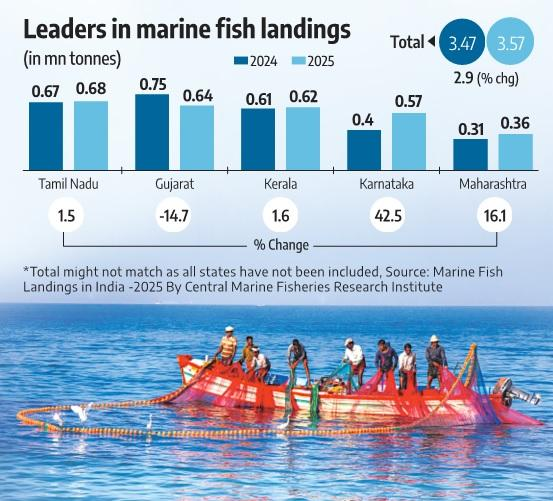
National Performance
Despite localized regional disruptions, India’s overall marine sector showed resilience and growth in 2025.
- Total Catch: 3.57 Million Tonnes (a 3% increase year-on-year).
- Economic Value:
- At Landing Centres: ₹69,254 Crore (up 10.45%).
- At Retail Level: ₹97,702 Crore (up 8.43%).
- National Marketing Efficiency: 70.88% (with Kerala leading at 72.83%).
State-wise Rankings and Shifts
| Rank | State | Catch (Million Tonnes) | Trend / Remarks |
| 1 | Tamil Nadu | — | Overtook Gujarat to take the top spot. |
| 2 | Gujarat | — | 15% Decline due to weather and fishing bans. |
| 3 | Kerala | 0.62 | Marginal 2% increase; highest marketing efficiency. |
| 4 | Karnataka | — | 43% Surge (recovering from a steep 2024 decline). |
| 5 | Maharashtra | — | 16% Increase in landings. |
Resource-wise Breakdown (Species)
The data highlights the diversity of India’s marine catch, with specific species reaching record levels:
- Indian Mackerel: The #1 landed resource (0.27 million tonnes).
- Cephalopods (Squid/Octopus): 0.25 million tonnes (reached a decadal high with 25% growth).
- Oil Sardine: 0.25 million tonnes (reached a decadal high in Kerala).
- Threadfin Breams: Recorded a massive 55% growth nationally.
Catch Composition by Depth/Zone:
- Pelagic Fish: 54% (Fish found in the upper layers of the open ocean).
- Demersal Resources: (Fish living on or near the sea bottom).
- Crustaceans & Molluscs: (Shrimp, crabs, and shellfish).
Key Concepts
Q: What is CMFRI?
A: The Central Marine Fisheries Research Institute, headquartered in Kochi, is a premier research organization under the Indian Council of Agricultural Research (ICAR). it is responsible for estimating marine fish landings and monitoring the health of India’s exclusive economic zone (EEZ).
Q: What is “Marketing Efficiency” in fisheries?
A: It refers to the percentage of the consumer’s rupee that actually reaches the fisherman. Higher efficiency (like Kerala’s 72.83%) means the supply chain is well-organized with fewer middlemen or lower logistics costs.
Q: Why was the fishing ban extended to 75 days?
A: Fishing bans (usually during the monsoon) are enforced to allow for the breeding season of various species. Extending the ban helps in the long-term sustainability of fish stocks by preventing the capture of juvenile fish and breeding adults.
Exam Relevance
| Exam | Focus Area | Relevance Level |
| UPSC CSE | GS-3 (Agriculture: Fisheries & Blue Economy; Geography: Marine Resources) | High |
| NABARD / Agri Exams | CMFRI Landing Data and Species-specific trends | Extreme |
Facts To Remember
1. Prasoon Joshi appointed Prasar Bharati Chairman
The Ministry of Information and Broadcasting has appointed noted lyricist and writer Prasoon Joshi as the Chairman of Prasar Bharati. “Prasoonji is a rare creative spirit celebrated across the world in advertising, literature, art and cinema, yet his heart beats unmistakably for India.
2. Centre appoints Rohit Jainas RBI Deputy Governor
The government has appointed Rohit Jain as Deputy Governor of the Reserve Bank of India for a three-year term. Mr. Jain is replacing T. Rabi Sankar, whose extended tenure ended
3. Kuldeep shatters pole vault National record, wins gold
In his first indoor competition, Kuldeep Kumar outsmarted title favourite Dev Meena to rewrite the men’s pole vault National record in the inaugural Indian Indoor Open combined events and pole vault meet at the Kalinga Stadium in Bhubaneswar on Saturday.
4. Ministry of Mines Approves Companies Under Critical Mineral Recycling Scheme
The Ministry of Mines approved 58 companies under a ₹1,500 crore scheme to boost recycling of lithium-ion batteries, e-waste, and scrap, with ₹5,000 crore pledged investments and 850 KTPA capacity to reduce import dependence.
5. Ministry of Earth Sciences Establishes C-ART Observatory in Visakhapatnam
MoES inaugurated a ₹180 crore coastal weather observatory at Andhra University to improve cyclone prediction, strengthen weather forecasting systems, and enhance early warning capabilities along India’s east coast.
5. ICAR-Central Marine Fisheries Research Institute Reports Tamil Nadu as Top Marine Fish Producer
CMFRI reported Tamil Nadu as the top marine fish producer in 2025 with 6.85 lakh tonnes, surpassing Gujarat, while India’s total production rose 3% to 35.7 lakh tonnes with strong market value growth.
6. Nitin Gadkari Launches Barrier-less Tolling System
Nitin Gadkari launched India’s first MLFF tolling system in Gujarat using AI-based ANPR and FASTag, enabling seamless toll deduction, reducing travel time, fuel consumption, and emissions, and promoting smart mobility infrastructure.
7. Sikkim Becomes First Fully Paperless Judiciary State
Sikkim achieved a fully digital judiciary system with e-filing, virtual hearings, and electronic summons, improving accessibility in remote regions while reducing costs and environmental impact.
8. Department for Promotion of Industry and Internal Trade Signs MoU with Chamber India
DPIIT partnered with Chamber India to boost startup ecosystem through global linkages, incubation centres, concessional memberships, and support for innovation across sectors like healthcare, agriculture, and technology.
9. United States Trade Representative Releases Special 301 Report 2026
USTR retained India on Priority Watch List while naming Vietnam as Priority Foreign Country, highlighting global IP concerns, classification changes, and potential Section 301 investigation implications.
10. NPCI Bharat BillPay Limited and Juspay Technologies Private Limited Launch Banking Connect
NBBL and Juspay introduced a unified switch and SDK to standardise net banking workflows, enhance interoperability, improve user experience, and strengthen India’s digital payment ecosystem.
11. India Post Payments Bank Launches SHG Savings Account
IPPB introduced a zero-balance SHG account to empower women-led groups with digital onboarding, free transactions, interest benefits, and support for rural livelihoods aligned with financial inclusion goals.
12. Vishvajit Sahay Assumes Charge as Defence Finance Secretary
Vishvajit Sahay took charge as Secretary (Defence Finance), Ministry of Defence, bringing extensive experience in public finance, procurement, and administration, succeeding Rasika Chaube.
13. Mazagon Dock Shipbuilders Limited Delivers Stealth Frigate ‘Mahendragiri’
MDL delivered the sixth Project-17A stealth frigate to the Indian Navy, marking completion of its assigned warships, showcasing indigenous shipbuilding and advanced naval design capabilities.
14. Ishank Singh Sets World Record in Palk Strait
Seven-year-old Ishank Singh became the youngest and fastest swimmer to cross the Palk Strait in 9 hours 50 minutes, demonstrating exceptional endurance and setting a global benchmark.
15. International Workers’ Day Observed on May 1
International Workers’ Day is observed globally to honor workers’ contributions, promote labour rights, and commemorate the Haymarket Affair of 1886, marking a historic labour movement milestone.
16. Mizoram Launches ‘Khuarel’ Disaster Management App
Mizoram launched the ‘Khuarel’ app for real-time disaster reporting and coordination, featuring offline access, multilingual support, and emergency databases to improve disaster response in remote areas.
05 May, 2026
Daily Current Affairs Quiz
05 May, 2026
National Affairs
1. Sikkim becomes country’s first paperless judiciary state
Source: News on Air
Context:
Sikkim’s designation as India’s first fully paperless judiciary state is a landmark achievement in the digital transformation of the Indian legal system. Declared by Justice Surya Kant during a judicial conclave in Gangtok, this initiative serves as a blueprint for the national e-Courts Mission Mode Project.
What is a Paperless Judiciary?
The transition involves shifting the entire “lifecycle of a case” from physical registers and paper bundles to a secure, centralized digital platform.
The Three Core Pillars
- e-Filing (The Input): Litigants and advocates submit petitions, affidavits, and evidence through a secure online portal. This eliminates the need for manual scanning and physical storage space.
- Digital Case Management (The Process): Judges and court staff use the Case Information System (CIS) to manage dates, track progress, and organize evidence. This minimizes the risk of “missing files,” which is a major cause of judicial delay in India.
- Paperless Courtrooms (The Output): During hearings, judges refer to digital displays. Orders and judgments are signed using Digital Signatures and are immediately uploaded for public access.
Key Concepts
Q: What is the e-Committee of the Supreme Court?
A: It is the body responsible for overseeing the ICT (Information and Communication Technology) enablement of the Indian Judiciary. The Sikkim success is a direct outcome of the e-Committee’s Phase III roadmap.
Q: How are digital documents authenticated?
A: Under the Information Technology Act, 2000, digital signatures have the same legal validity as physical signatures. Judges use secure tokens or Aadhaar-based e-Sign to authenticate their orders.
Q: Does a paperless court mean all hearings are virtual?
A: Not necessarily. “Paperless” refers to the record-keeping. Physical hearings can still take place, but instead of leafing through paper files, lawyers and judges interact with digital tablets and monitors.
Exam Relevance
| Exam | Focus Area |
| UPSC CSE | GS-2 (Governance & Judiciary: Role of ICT); GS-3 (Science & Tech) |
| SPSC (Sikkim) | Current Affairs: State-specific milestones |
| Law Entrance | Legal Tech reforms and the e-Courts Project |
2. The CINBAX-II 2026 Exercise
Source: TH
Context:
The CINBAX-II 2026 exercise is the second edition of the bilateral military engagement between India and Cambodia. This year’s iteration, starting May 4, 2026, marks a significant step in India’s Act East Policy, moving from diplomatic dialogue to deep tactical military cooperation.
Exercise Overview
The exercise is being held in the Kampong Speu Province of Cambodia, focusing on the complexities of modern asymmetric warfare.
- Timeline: May 4 to May 17, 2026.
- Indian Contingent: Approximately 120 personnel, primarily from a battalion of the Maratha Light Infantry Regiment.
- Cambodian Contingent: Approximately 160 personnel from the Royal Cambodian Army.
- Mandate: Conducted under Chapter VII of the UN Mandate, which authorizes “action by air, sea, or land forces as may be necessary to maintain or restore international peace and security.”
Strategic & Tactical Focus
CINBAX-II is designed to prepare both armies for UN Peacekeeping Operations (UNPKO) in volatile regions.
Key Training Modules
- Sub-Conventional & Semi-Urban Operations: Unlike traditional “jungle warfare,” this focuses on combat in partially built-up areas where distinguishing between combatants and civilians is difficult.
- Drone Operations: Integration of small tactical drones for reconnaissance and surveillance, reflecting the shift toward Technology-Driven Warfare.
- Specialized Weaponry: Training in Mortar handling (for indirect fire support) and Sniper tactics (for precision engagement in urban settings).
- Validation Exercise: The two-week program concludes with a 48-hour continuous simulation to test if the two forces can operate as a single unit under stress.
Key Concepts
Q: What is a “Sub-Conventional” environment?
A: It refers to a conflict zone that is below the level of full-scale conventional war. This usually involves counter-insurgency (COIN), counter-terrorism, and dealing with non-state actors or “hybrid” threats.
Q: Why the Maratha Light Infantry (MLI)?
A: The MLI is one of the oldest and most decorated regiments of the Indian Army, renowned for its expertise in mountain and jungle warfare. Their participation brings decades of operational experience from India’s own counter-insurgency theaters.
Q: What is the “Interoperability” goal?
A: It is the ability of different military organizations to use each other’s equipment, communication systems, and “Standard Operating Procedures” (SOPs). This is critical during multi-national UN missions.
Exam Relevance
| Exam | Focus Area |
| UPSC CSE | GS-2 (Bilateral Relations: India-ASEAN); GS-3 (Security: Military Exercises) |
| Defence (NDA/CDS) | Facts: Unit involved (Maratha Light Infantry), Location (Kampong Speu), UN Mandate Chapter VII |
| SSC/Banking | Current Affairs: Participating countries and the name of the exercise |
3. Cell Broadcast System (CBS)
Source: News on Air
Context:
The launch of the indigenous Cell Broadcast System (CBS) by the Ministry of Communications marks a critical shift in India’s disaster management capabilities. Developed by C-DOT, this technology moves the nation away from the delays of traditional SMS toward a “one-to-many” broadcast model that is essential for saving lives during rapid-onset emergencies.
How Cell Broadcast Works?
The fundamental difference between CBS and traditional mobile communication lies in the delivery architecture.
- Traditional SMS (Point-to-Point): Messages are sent to specific phone numbers. During a disaster, millions of people trying to use their phones simultaneously create “network congestion,” causing SMS alerts to be delayed or fail.
- Cell Broadcast (Point-to-Area): The government sends a single message to a Cell Broadcast Entity (CBE), which then transmits it to specific cell towers (Base Transceiver Stations). These towers “broadcast” the message to every active device in their radius—regardless of the network provider or whether the sender knows the recipient’s number.
Key Technological Advantages
The CBS is specifically engineered to overcome the “last-mile” hurdles of disaster communication:
| Feature | Technical Impact |
| No Queuing | Messages bypass the standard mobile traffic queue, arriving in near real-time (within seconds). |
| Geo-Fencing | Alerts can be restricted to a single neighborhood (e.g., for a local gas leak) or expanded to an entire state (e.g., for a cyclone). |
| Silent Mode Override | The alert is accompanied by a unique, high-decibel siren and vibration that can override “Silent” or “Do Not Disturb” modes on many devices. |
| Network Resilience | Because it doesn’t require a data connection or a “handshake” with a specific number, it works better in areas with weak or overloaded signals. |
The “SACHET” Integration
The CBS serves as the high-speed delivery mechanism for SACHET, India’s national disaster alert portal.
- It aligns with the Common Alerting Protocol (CAP), ensuring that the same life-saving message is formatted correctly for mobile phones, radio, and television simultaneously.
- Multilingual Support: The system automatically pushes alerts in the dominant regional language based on the location of the cell tower, ensuring high comprehension in India’s diverse linguistic landscape.
Key Concepts
Q: Does CBS require my phone number or GPS to be on?
A: No. CBS doesn’t need your phone number. It broadcasts to any phone “listening” to a specific tower. While GPS helps with some apps, CBS uses the tower’s location to define the alert area.
Q: Will I get charged for these messages?
A: No. Cell Broadcast is a free service provided by the government for public safety.
Q: Can I opt-out of these alerts?
A: Most phones allow you to toggle “Test Alerts,” but Extreme and Severe Alerts are often non-optional at the system level to ensure public safety during life-threatening events.
Conceptual MCQs
Q1. What is the primary reason CBS is more effective than SMS during a disaster?
A) It uses 5G technology only.
B) It allows for two-way communication between the user and the government.
C) It is a one-to-many broadcast that does not get stuck in network congestion.
D) It can only be sent to high-end smartphones.
Q2. Which organization is responsible for the indigenous development of India’s Cell Broadcast System?
A) ISRO
B) C-DOT
C) NITI Aayog
D) DRDO
Answers: Q1: C | Q2: B
Exam Relevance
| Exam | Focus Area |
| UPSC CSE | GS-3 (Disaster Management, IT & Telecom, Indigenization of Technology) |
| State PCS | Regional safety protocols and NDMA/State DMA coordination |
| SSC / RRB | Facts: C-DOT, Ministry of Communications, and the SACHET portal |
4. The Kailash Mansarovar Yatra (KMY)
Source: News on Air
Context:
The Kailash Mansarovar Yatra (KMY) is a high-altitude pilgrimage that carries deep religious, cultural, and geopolitical weight. In May 2026, the yatra has become a focal point of diplomatic friction following Nepal’s formal objection to the India-China plan to use the Lipulekh Pass route.
The 2026 Resumption & Controversy
After a hiatus of several years, India and China agreed to resume the pilgrimage via Lipulekh Pass for the June–August 2026 season.
- Plan: Around 1,000 pilgrims are expected to travel in batches.
- Nepal’s Stance: On May 3, 2026, Nepal’s Ministry of Foreign Affairs issued a formal objection, stating that Lipulekh, along with Kalapani and Limpiyadhura, are integral parts of its sovereign territory based on the 1816 Treaty of Sugauli.
- India’s Rebuttal: The Ministry of External Affairs (MEA) rejected Nepal’s claims, calling them “unjustified” and “untenable.” India maintains that the Lipulekh Pass has been a long-standing pilgrimage and trade route since 1954.
Comparing the Two Main Routes
Pilgrims generally use one of two routes, each offering different logistical and physical challenges.
| Feature | Route 1: Lipulekh Pass | Route 2: Nathu La Pass |
| State | Uttarakhand (Pithoragarh) | Sikkim |
| Nature | Traditionally involved arduous trekking; now features an 80-km motorable road. | Primarily motorable; considered more comfortable for elderly pilgrims. |
| Historical Status | The oldest and shortest route; culturally significant. | Opened in 2015 to provide an alternative to the trek-heavy Lipulekh route. |
| Current Conflict | Central to the India-Nepal boundary dispute. | Generally stable, but subject to India-China border tensions. |
The Lipulekh Dispute
The dispute over Lipulekh is rooted in differing interpretations of the Mahakali River’s source.
- Nepal’s Claim: The river originates at Limpiyadhura (further west), making Lipulekh part of Nepal.
- India’s Position: The river begins at a lower point near Kalapani, placing the pass within the Indian state of Uttarakhand.
- Strategic Value: Lipulekh is a tri-junction between India, Nepal, and China. For India, it is a vital pass for monitoring border security and maintaining a direct link to the Tibet Autonomous Region.
Exam Relevance
| Exam | Focus Area |
| UPSC CSE | GS-1 (Geography: Important Passes); GS-2 (International Relations: India-Nepal & India-China) |
| State PCS | Uttarakhand & Sikkim current events; historical treaties (Treaty of Sugauli) |
| General Awareness | Religious sites, high-altitude geography, and MEA-led initiatives |
5. India’s Aarogya Maitri (BHISHM Cube)
Context:
The deployment of India’s Aarogya Maitri (BHISHM Cube) in Jamaica in April 2026 marks a significant milestone in South-South cooperation. By providing this cutting-edge healthcare infrastructure to the Caribbean Community (CARICOM), India has transitioned from being a “first responder” to a “strategic health partner,” offering a scalable, indigenous model for disaster resilience.
What is the BHISHM Cube?
The BHISHM (Bharat Health Initiative for Sahyog, Hita, and Maitri) Cube is the world’s first modular, portable hospital. It is designed to bridge the “Golden Hour” gap—the critical period after a disaster when medical intervention is most likely to prevent death.
The Architecture: Modular & Scalable
- The Mini-Cube: The smallest unit (roughly 15 inches), weighing approximately 15–20 kg. Each is waterproof, shockproof, and light enough to be carried by one person or a drone.
- The Mother Cube: A collection of 36 mini-cubes pre-organized by injury type (e.g., burns, fractures, chest injuries).
- The Full BHISHM Unit: Comprised of two mother cubes (72 mini-cubes), it functions as a comprehensive trauma center.
Technical Specifications & Capabilities
The system is built to operate in “black-start” conditions, meaning it requires zero existing infrastructure (no power grid or running water) to begin saving lives.
| Feature | Detail |
| Setup Time | Fully deployable in under 12 minutes. |
| Patient Capacity | Can treat up to 200 casualties simultaneously. |
| Surgical Capability | Equipped to perform 10–15 basic surgeries per day. |
| Sustainability | Operates for 48 hours using internal power (solar/battery) and oxygen generation. |
| Diagnostics | Includes portable ultrasound, digital X-rays, and AI-enabled blood testing. |
| Tracking | Uses RFID (Radio Frequency Identification) for real-time inventory management. |
Key Concepts: Keyword Q&A
Q: How does the multilingual interface work?
A: Each BHISHM unit comes with a tablet containing instructions in over 180 languages. This allows local Jamaican medical teams to use the Indian-made equipment with zero training lag.
Q: Why is it called “Aarogya Maitri”?
A: In Sanskrit, Aarogya means “Health” and Maitri means “Friendship.” It is India’s signature project to provide essential medical supplies to developing nations during crises.
Q: Can the cubes be dropped from the air?
A: Yes. They are designed for “Para-drop” or “Drone-drop” capabilities, allowing them to reach islands or mountain regions where roads are blocked.
Exam Relevance
| Exam | Focus Area |
| UPSC CSE | GS-2 (International Relations: India-CARICOM); GS-3 (Science & Tech; Disaster Management) |
| State PCS | Current Affairs: Location of deployment (Jamaica) and the lead agency (NSCS/MEA) |
| Defence/SSC | Facts: BHISHM acronym, setup time (12 mins), and capacity (200 patients) |
Banking/Finance
1. Foreign Exchange Management (FEMA) Rules 2026
Context:
The recent notification by the Ministry of Finance (MoF) in May 2026 represents a watershed moment for India’s financial services sector. By amending the Foreign Exchange Management (FEMA) Rules, the government has effectively opened the floodgates for global capital in the insurance industry.
What has Changed?
The amendment shifts the Indian insurance landscape from a restricted regime to a fully open one for most players.
- 100% FDI via Automatic Route: Previously, FDI in insurance companies was capped or required specific government approvals for higher stakes. Now, foreign investors can own 100% of an Indian insurance company or intermediary without needing prior approval from the government (Automatic Route), provided they comply with IRDAI guidelines.
- Expansion of Intermediaries: The 100% limit isn’t just for the companies that sell policies; it covers the entire support ecosystem, including brokers, consultants, third-party administrators (TPAs), and loss assessors.
The “LIC Exception”
Despite the sweeping liberalization, the Life Insurance Corporation of India (LIC) remains a protected entity.
- The Cap: Foreign investment in LIC is strictly capped at 20% via the automatic route.
- The Reason: LIC is governed by its own dedicated Act (LIC Act, 1956). Given its massive role in the Indian economy and its status as a state-backed behemoth, the government maintains a tighter grip on its ownership structure to ensure national interest and stability.
What is FDI?
FDI stands for Foreign Direct Investment. It refers to when a person, company, or government from one country invests directly in a business or assets in another country, usually with the intention of having control or a significant influence over it.
Examples
- A U.S. company opening a manufacturing plant in India
- A Japanese automaker building a factory in the UK
- A multinational corporation acquiring a company in another country
Impact on the Economy
This policy change is expected to have three primary effects on the Indian market:
- Capital Infusion: Indian insurance companies often struggle with high “solvency margin” requirements (the extra capital they must keep to ensure they can pay claims). 100% FDI allows global parents to pump in the billions needed for expansion.
- Increased Penetration: India’s insurance penetration (premiums as a percentage of GDP) is significantly lower than the global average. Foreign players bring advanced digital tools and niche products (like specialized cyber or climate insurance) that can reach underserved populations.
- Consolidation: We may see a wave of Mergers and Acquisitions (M&A) where foreign partners in existing joint ventures (JVs) buy out their Indian partners to take full control of operations.
Key Concepts
Q: What is the “Automatic Route”?
A: It means the foreign investor or the Indian company does not require any prior approval from the Reserve Bank of India (RBI) or the Government of India for the investment. They only need to inform the RBI after the funds have been received.
Q: Does this mean the government has no control?
A: No. While the investment is automatic, the operation is still strictly regulated by the Insurance Regulatory and Development Authority of India (IRDAI). Companies must still meet “Fit and Proper” criteria and follow the Insurance Act, 1938.
Q: Who are “Surveyors and Loss Assessors”?
A: They are independent professionals who investigate and assess the quantum of loss when a claim is made (e.g., after a fire or a car accident). Opening them to 100% FDI allows global giants in forensic auditing to enter India.
Conceptual MCQs
Q1. Under the May 2026 FEMA amendment, what is the maximum FDI allowed in an Indian insurance broker via the automatic route?
A) 49%
B) 74%
C) 100%
D) 20%
Q2. Which entity is specifically excluded from the 100% FDI limit and remains capped at 20%?
A) GIC Re
B) Insurance Consultants
C) Life Insurance Corporation of India (LIC)
D) Third-Party Administrators (TPAs)
Answers: Q1: C | Q2: C
Exam Relevance
| Exam | Focus Area |
| UPSC CSE | GS-3 (Economy: Investment Models, Banking & Insurance) |
| RBI Grade B | Finance (FEMA Rules, FDI Policy) |
| Banking / Insurance Exams | General Awareness: Current IRDAI and MoF notifications |
2. RBI Alert: Fraudulent Loan Waiver Campaigns
Source: BS
Context:
The Reserve Bank of India (RBI) has issued a high-level caution against misleading advertisements and “debt relief” entities that promise to get bank loans or NBFC dues waived for a fee.
How the Scam Operates
These entities target stressed borrowers through social media or direct outreach using the following tactics:
- False Promises: They claim they have the authority or a legal “loophole” to force banks to waive outstanding dues.
- Waiver Certificates: They issue fake “Debt Waiver Certificates” to convince victims the loan is settled.
- Fee Collection: They demand “service charges” or “legal fees” upfront from the public.
The Consequences
- Financial Loss: Borrowers lose money to scammers while their original bank debt continues to grow due to interest.
- Credit Score Damage: Relying on these fake waivers leads to defaults, severely damaging the borrower’s CIBIL/Credit Score.
- Legal Action: The RBI clarified that these entities are liable for legal action, and borrowers remain legally obligated to pay their lenders.
RBI Directive: Borrowers must deal only with their original lending institutions for settlement or restructuring and should not entertain third-party waiver claims.
What is RBI Kehta Hai?
“RBI Kehta Hai” (RBI Says) is the flagship public awareness initiative of the Reserve Bank of India. Its primary goal is to educate the common man about safe banking practices, financial literacy, and consumer rights.
As of May 2026, the campaign has become even more critical due to the rapid rise in digital transactions and sophisticated cyber frauds.
Core Objectives
The campaign uses a “Jaankaar Baniye, Satark Rahiye” (Be Informed, Be Alert) philosophy to:
- Prevent Fraud: Cautions users against sharing OTPs, PINs, or CVV numbers.
- Promote Digital Hygiene: Encourages the use of secure websites (https://) and warns against public Wi-Fi for banking.
- Simplify Banking: Explains complex concepts like Limited Liability, KYC, and the Banking Ombudsman in simple language.
Keyword Q&A
Q: What is a PPA?
A: A Power Purchase Agreement is a long-term contract between a power producer (like a wind farm) and a buyer (like a Discom). It defines the price per unit of electricity and is essential for the project to get bank funding.
Q: What is the role of SECI?
A: The Solar Energy Corporation of India is the primary implementing agency under the Ministry of New and Renewable Energy (MNRE). It conducts auctions and manages the rollout of both solar and wind projects.
Q: Why does the RBI say these waiver campaigns “interfere with the credit system”?
A: Banks rely on repayments to lend to others. If people stop paying because they believe a fake waiver is coming, it reduces the bank’s liquidity and creates an environment where honest borrowers find it harder to get loans.
Conceptual MCQs
Q1. According to the RBI, what should a borrower do if they encounter an entity promising a loan waiver?
A) Pay the service fee to initiate the waiver.
B) Approach their original lending institution directly.
C) Wait for the “Debt Waiver Certificate” to be verified by a local court.
D) Stop paying EMIs immediately to qualify for the waiver.
Q2. Which organization did the Wind Turbine Manufacturers Association meet to discuss wind energy deployment?
A) NITI Aayog
B) RBI
C) SECI
D) Bureau of Energy Efficiency
Answers: Q1: B | Q2: C
Exam Relevance
| Exam | Focus Area |
| RBI Grade B | Finance (Consumer Protection, Credit Culture) |
| UPSC CSE | GS-3 (Economy: Banking/Energy Infrastructure) |
| Banking (SBI/IBPS) | General Awareness: Current RBI circulars and Industry News |
Facts To Remember
1. Ministry of Panchayati Raj Launches PAI 2.0 for FY24; Tripura Tops Index
MoPR launched Panchayat Advancement Index 2.0 to assess Gram Panchayat performance with participation from 33 States/UTs and 2.59 lakh GPs, where Tripura ranked first with 80% front-runner panchayats, followed by Kerala and Odisha, while Jugal Kishore Nagar GP topped nationally.
2. Jyotiraditya Scindia Launches Cell Broadcast System
Jyotiraditya Scindia launched the indigenous Cell Broadcast System developed by Centre for Development of Telematics enabling real-time disaster alerts via mobile networks, integrated with SACHET platform to ensure rapid, location-based emergency communication.
3. Annalena Baerbock Visits India for Official Engagement
UNGA President Annalena Baerbock visited India, paid homage at Rajghat, held bilateral talks with S. Jaishankar, and discussed UN reforms, SDGs, AI governance, and West Asia issues along with engagements with MeitY and UN officials.
4. Karnataka Launches CoE for Space Technology in Bengaluru
Karnataka launched India’s first state-led SpaceTech CoE in collaboration with SatCom Industry Association of India to promote research, startup incubation, and commercialization of space technologies across sectors like agriculture, climate, and defence.
5. India Deploys Aarogya Maitri Healthcare System in Jamaica
India deployed the BHISHM Cube modular hospital in Jamaica under HADR framework, enabling rapid deployment within 12 minutes, supporting emergency healthcare with ICU, diagnostics, and treatment capacity for 200 patients in disaster situations.
6. Ministry of Jal Shakti Signs Reform MoUs under JJM 2.0
MoJS signed reform-linked MoUs with Uttarakhand, Karnataka, and Tripura to achieve 100% tap water coverage by 2028, promoting GP-led water governance, digital monitoring, and sustainable rural water supply systems.
7. India & Cambodia Conduct Joint Military Exercise CINBAX-II
India and Cambodia began the 13-day CINBAX-II exercise focusing on counter-terrorism operations, with participation from Indian Army and Royal Cambodian Army, enhancing joint tactical training and UN peacekeeping readiness.
8. Asian Development Bank Launches USD 70 Billion Connectivity Initiative
ADB announced a USD 70 billion programme to enhance Asia-Pacific energy and digital connectivity, including power grid and digital highway initiatives, along with an AI innovation centre in Seoul.
9. Rohit Jain Appointed RBI Deputy Governor
Rohit Jain was appointed Deputy Governor of Reserve Bank of India for three years, bringing extensive experience in banking regulation, supervision, and financial stability.
10. NITI Aayog Appoints New Full-Time Members
Government appointed R Balasubramaniam and Joram Aniya as full-time members of NITI Aayog, increasing its strength to seven and enhancing policy expertise.
11. GalaxEye Space Solutions Launches ‘Drishti’ OptoSAR Satellite
GalaxEye launched the world’s first OptoSAR satellite integrating EO and SAR sensors aboard SpaceX Falcon 9, enabling high-resolution imaging and improved Earth observation capabilities.
12. Defence Research and Development Organisation Tests LR-AShM Missile
DRDO successfully conducted second test of Long-Range Hypersonic Anti-ship Missile with 1500 km range and speeds up to Mach 10, marking a major advancement in India’s defence capabilities.
13. World Tuna Day Observed on May 2
World Tuna Day highlights ecological and economic importance of tuna, promotes sustainable fishing, and raises awareness about marine biodiversity conservation.
14. World Press Freedom Day Observed on May 3
World Press Freedom Day promotes freedom of expression, with 2026 theme “Shaping a Future at Peace”, and highlights global press freedom rankings and journalist recognition.
15. International Leopard Day Observed on May 3
International Leopard Day raises awareness about leopard conservation, emphasizing protection of vulnerable species and human-wildlife coexistence.
16. Telangana Acquires Hyderabad Metro Phase I
Telangana government acquired 100% stake in Hyderabad Metro Phase I from L&T, transitioning from PPP to full state ownership to improve urban mobility, governance, and service delivery.
06 May, 2026
Daily Current Affairs Quiz
06 May, 2026
National Affairs
1. ECLGS 5.0
Source: PIB
Context:
The ongoing West Asia crisis (involving disruptions in trade routes, oil supply, shipping through the Red Sea/Strait of Hormuz, and broader regional tensions) has created liquidity stress for Indian businesses dependent on imports, exports, and aviation fuel. MSMEs face working capital crunches due to delayed payments and rising input costs, while scheduled passenger airlines are hit by volatile ATF prices and route disruptions. To prevent NPAs, job losses, and supply-chain breakdowns, the Union Cabinet on 5 May 2026 approved the 5th iteration of ECLGS — the first time the scheme is being deployed for a geopolitical (rather than pandemic) shock.
About the News (Q&A)
Q1. What scheme did the Union Cabinet approve on 5 May 2026?
The Emergency Credit Line Guarantee Scheme (ECLGS) 5.0, chaired by PM Narendra Modi.
Q2. What is the total targeted additional credit flow under ECLGS 5.0?
Rs. 2,55,000 crore, including Rs. 5,000 crore earmarked specifically for the airline sector.
Q3. Who is the guarantee-issuing agency?
National Credit Guarantee Trustee Company Limited (NCGTC), which provides the guarantee to Member Lending Institutions (MLIs).
Q4. What is the extent of guarantee coverage?
100% for MSMEs and 90% for non-MSMEs as well as the airline sector.
Q5. Who are the eligible borrowers?
MSMEs and non-MSMEs with existing working capital limits, and scheduled passenger airlines with outstanding credit facilities — provided their accounts were classified as standard as on 31 March 2026.
Q6. What is the quantum of additional credit available?
- For MSMEs/non-MSMEs: up to 20% of peak working capital utilised in Q4 FY26, capped at Rs. 100 crore per borrower.
- For airlines: up to 100%, capped at Rs. 1,500 crore per borrower (subject to specific conditions).
Q7. What is the loan tenor and moratorium?
- MSMEs/non-MSMEs: 5 years including a 1-year moratorium.
- Airlines: 7 years including a 2-year moratorium.
Background Concepts (Q&A)
Q1. What is the ECLGS and when was it first launched?
ECLGS is a credit guarantee scheme launched in May 2020 as part of the Atmanirbhar Bharat Abhiyan to support businesses (especially MSMEs) hit by the COVID-19 pandemic. It has since been extended and modified into multiple versions (1.0, 2.0, 3.0, 4.0) covering different sectors. ECLGS 5.0 (2026) is the first version triggered by a geopolitical crisis rather than a health emergency.
Q2. What is NCGTC?
The National Credit Guarantee Trustee Company Limited is a wholly-owned company of the Department of Financial Services, Ministry of Finance, set up in 2014 under the Companies Act. It acts as the trustee for several credit guarantee funds and operates the ECLGS.
Q3. What is a Credit Guarantee?
A credit guarantee is a promise by a third party (here, the government via NCGTC) to compensate a lender if a borrower defaults. It enables banks to extend loans to riskier borrowers (like MSMEs) without demanding heavy collateral.
Q4. Who are Member Lending Institutions (MLIs)?
MLIs include scheduled commercial banks, financial institutions, NBFCs, and small finance banks that participate in the scheme by extending guaranteed credit to eligible borrowers.
Q5. What is “Working Capital” in this context?
Working capital refers to short-term funds businesses need for day-to-day operations — paying suppliers, wages, inventory, etc. ECLGS 5.0 provides additional working capital linked to peak utilisation in Q4 FY26.
Q6. What does a “Standard Account” mean?
A loan account is “standard” when the borrower is making timely repayments and the account is not classified as NPA (Non-Performing Asset). Only such borrowers are eligible.
Q7. How are MSMEs defined currently?
As per the revised classification (effective 1 July 2020) under the MSMED Act, 2006, MSMEs are classified based on investment in plant & machinery and annual turnover — with thresholds revised upwards in 2025 to allow growing firms to retain MSME benefits.
Practice MCQs
Q1. With reference to ECLGS 5.0 approved in May 2026, consider the following statements:
- The scheme provides 100% credit guarantee coverage for MSMEs.
- The scheme is implemented through SIDBI as the guarantee trustee.
- The total targeted credit flow under the scheme is Rs. 2,55,000 crore.
- The scheme is open to loans sanctioned up to 31 March 2027.
How many of the above statements are correct? (a) Only one (b) Only two (c) Only three (d) All four (e) None
Q2. Which of the following is/are correct regarding the airline sector provisions under ECLGS 5.0?
- Guarantee coverage is 100% for airlines.
- Loan tenor is 7 years including a 2-year moratorium.
- The cap per airline borrower is Rs. 1,500 crore.
- Rs. 5,000 crore is earmarked for the airline sector.
Choose the correct option: (a) 1, 2 and 3 only (b) 2, 3 and 4 only (c) 1, 3 and 4 only (d) 2 and 4 only (e) All of the above
Q3. The National Credit Guarantee Trustee Company Limited (NCGTC) is: (a) A subsidiary of the Reserve Bank of India (b) A wholly-owned company of the Department of Financial Services, Ministry of Finance (c) A joint venture between SIDBI and NABARD (d) An autonomous body under the Ministry of MSME (e) A statutory body under the MSMED Act, 2006
Q4. Consider the following statements about the original ECLGS:
- It was launched in May 2020 as part of the Atmanirbhar Bharat package.
- It was originally aimed at addressing liquidity stress caused by the COVID-19 pandemic.
- ECLGS 5.0 is the first version of the scheme launched in response to a non-pandemic crisis.
- Under ECLGS 5.0, the guarantee fee is waived entirely.
Which of the above are correct? (a) 1 and 2 only (b) 2, 3 and 4 only (c) 1, 2 and 4 only (d) 1, 3 and 4 only (e) All four
Answer Key
- (c) — Statements 1, 3, 4 are correct. Statement 2 is wrong; the trustee is NCGTC, not SIDBI.
- (b) — Statement 1 is wrong; airlines get 90% coverage (100% is only for MSMEs).
- (b) — NCGTC is wholly owned by the Department of Financial Services, Ministry of Finance, set up in 2014.
- (e) — All four statements are correct.
Exam Relevance
| Exam | Relevance |
|---|---|
| UPSC Prelims | GS Paper I — Economy (Government schemes, banking sector) |
| UPSC Mains | GS Paper III — Indian Economy, MSME sector, mobilization of resources |
| BPSC / State PCS | Indian Economy, Current Affairs |
| Banking (RBI Gr B, SBI PO, IBPS) | Financial Awareness, Banking & Economy section |
| SEBI / NABARD | Credit guarantee mechanism, MSME finance |
2. Project 17A
Source: TH
Context:
The Indian Navy on 30 April 2026 received INS Mahendragiri, the sixth ship under Project 17A — a ₹45,000-crore indigenous frigate-building programme. Coming amid heightened maritime concerns in the Indian Ocean Region (IOR), including increased Chinese submarine deployments, Houthi drone-and-missile activity in the Red Sea, and the lingering shadow of the 26/11 scenario, the delivery has reignited debate about whether India’s surface-combatant expansion is genuinely aligned with the threats it faces.
About the News (Q&A)
Q1. What is Project 17A?
It is a ₹45,000-crore Indian Navy programme to build seven Nilgiri-class stealth frigates with anti-air, anti-surface, and anti-submarine capabilities. It is the advanced successor to the Shivalik-class frigates (Project 17) and a precursor to Project 17B.
Q2. Which warship was recently delivered under the project?
INS Mahendragiri, delivered on 30 April 2026 — the sixth delivery in 17 months.
Q3. What is the level of indigenisation in Project 17A?
The frigates use 75% indigenous components by value, but several critical systems — engines, radars, sonars — are still imported.
Q4. What major issue did the CAG flag?
The CAG pointed out hundreds of design changes during construction in earlier warship classes, and noted that ships were being “commissioned on paper” without critical components, leaving the hull unprepared for combat. A 2025 CAG report also said the Navy was inducting platforms without building supporting infrastructure.
Background Concepts (Q&A)
Q1. What is a frigate?
A frigate is a medium-sized, fast warship designed for multi-role operations — escorting fleets, anti-submarine warfare, anti-air defence, and surface combat. It is smaller than a destroyer but larger than a corvette.
Q2. What is the lineage of Indian “Project 17” frigates?
Project 17 produced the Shivalik-class (3 ships, commissioned 2010–2012) — India’s first indigenous stealth frigates. Project 17A produces the Nilgiri-class (7 ships, ongoing). Project 17B is the planned next-generation evolution with greater stealth and combat capability.
Q3. Who builds these frigates?
Mazagon Dock Shipbuilders Limited (MDL), Mumbai, and Garden Reach Shipbuilders & Engineers (GRSE), Kolkata — both Defence PSUs.
Q4. What is the Chain of Static Sensors?
A network of coastal radar surveillance stations set up after the 2008 Mumbai (26/11) attacks to monitor Indian waters. Its goal is to plug gaps in coastal surveillance and prevent intrusions.
Practice MCQs
Q1. With reference to Project 17A of the Indian Navy, consider the following statements:
- It involves the construction of seven Nilgiri-class frigates.
- The total estimated cost is approximately ₹45,000 crore.
- The frigates are intended to replace the Shivalik-class frigates.
- INS Mahendragiri is the sixth frigate delivered under the project.
How many of the above statements are correct? (a) Only one (b) Only two (c) Only three (d) All four (e) None
Q2. Which of the following is/are true regarding the Chain of Static Sensors?
- It was set up after the 2008 Mumbai terror attacks.
- It is part of India’s coastal surveillance architecture.
- It has been extended to Mauritius, Sri Lanka, and the Seychelles.
- It is operated entirely by the Indian Coast Guard.
Choose the correct option: (a) 1, 2 and 3 only (b) 2 and 4 only (c) 1, 3 and 4 only (d) 1 and 2 only (e) All of the above
Q3. Consider the following statements about the Comptroller and Auditor General (CAG) of India:
- The CAG is appointed under Article 148 of the Constitution.
- The CAG audits accounts of the Union and State governments.
- The CAG submits reports to the Prime Minister directly.
- The CAG’s reports are examined by the Public Accounts Committee (PAC) of Parliament.
Which of the above statements are correct? (a) 1 and 2 only (b) 1, 2 and 4 only (c) 1, 3 and 4 only (d) 2 and 4 only (e) All four
Q4. With reference to maritime security challenges in the Indian Ocean Region (IOR), consider the following statements:
- The IOR carries the bulk of India’s energy imports.
- The PLA Navy has increased submarine deployments in the IOR.
- Houthi drone and missile activity has affected Red Sea shipping.
- Indian Project 17A frigates are designed for anti-air, anti-surface, and anti-submarine warfare.
Which of the above are correct? (a) 1, 2 and 3 only (b) 2, 3 and 4 only (c) 1, 3 and 4 only (d) 1 and 4 only (e) All four
Answer Key
- (c) — Statements 1, 2, 4 are correct. Statement 3 is wrong; Project 17A frigates complement the Shivalik-class, not replace them. (Shivalik-class are still in active service.)
- (a) — Statements 1, 2, 3 are correct. Statement 4 is wrong; the Chain is operated by the Indian Navy in coordination with the Coast Guard, not by the Coast Guard alone.
- (b) — Statements 1, 2, 4 are correct. Statement 3 is wrong; CAG reports are submitted to the President (Union) or Governor (State), who places them before Parliament/Legislature — not the PM directly.
- (e) — All four statements are correct.
Exam Relevance
| Exam | Relevance |
|---|---|
| UPSC Prelims | GS Paper I — Defence, Indigenous Schemes, Constitutional Bodies (CAG) |
| UPSC Mains | GS Paper II — Indian Ocean Diplomacy, India–China Relations |
| BPSC / State PCS | Defence Affairs, Current Affairs, Indian Polity (CAG) |
| CDS / NDA / AFCAT | Defence GK — Indian Navy ship classes, projects, naval doctrine |
| Banking & SSC | Static GK on defence projects, ship names, recent inductions |
3. Project Deepak
Source: PIB
Context:
The 66th Raising Day celebration of Project Deepak on May 4, 2026, marks a significant milestone for the Border Roads Organisation (BRO). As one of the oldest pillars of India’s border infrastructure, Project Deepak plays a dual role: acting as a strategic multiplier for the Indian Armed Forces and a lifeline for the civilian population in the Western Himalayas.
What is Project Deepak?
Project Deepak is an executive arm of the BRO, tasked with some of the most difficult engineering feats in the world.
- Year of Raising: 1961 (Established shortly before the 1962 conflict, highlighting its strategic origin).
- Headquarters: Shimla, Himachal Pradesh.
- Parent Body: Border Roads Organisation (BRO), under the Ministry of Defence.
- Primary Mandate: Construction and maintenance of strategic infrastructure in Himachal Pradesh.
What is BRO?
The Border Roads Organisation (BRO) is a premier, specialized force under the Indian Ministry of Defence (since 2015), established on May 7, 1960, to develop and maintain strategic road infrastructure in India’s border regions and friendly neighboring countries. Led by the Directorate General of Border Roads (DGBR), it operates in 18 projects across 11 states, 3 Union Territories, and regions like Bhutan, ensuring operational readiness for the armed forces, particularly along the LAC.
Major BRO Projects
To understand Project Deepak’s place, it is helpful to see it alongside other major BRO units:
| Project | Region of Operation | Key Focus |
| Project Deepak | Himachal Pradesh | Manali-Leh Axis, Hindustan-Tibet Road. |
| Project Himank | Ladakh | Highest motorable roads (Umling La, Khardung La). |
| Project Dantak | Bhutan | Infrastructure development in Bhutan (Friendship project). |
| Project Beacon | Jammu & Kashmir | Zojila Pass and Kashmir Valley connectivity. |
Exam Relevance
| Exam | Focus Area |
| UPSC GS-3 | Security: Border infrastructure and its role in national defense. |
| UPSC GS-1 | Geography: Infrastructure in the Western Himalayas and high-altitude passes. |
| State PCS | Detailed knowledge of Himachal’s strategic districts and BRO contributions. |
| Defence Exams | History of BRO units and major infrastructure projects like the Manali-Leh axis. |
Banking/Finance
1. The UDGAM (Unclaimed Deposits – Gateway to Access iNforMation) Portal
Source: ET
Context:
The UDGAM (Unclaimed Deposits – Gateway to Access iNforMation) portal has emerged as a central tool in India’s financial transparency landscape. In a significant update to the Supreme Court on May 5, 2026, the RBI confirmed that 30 major banks—representing 90% of unclaimed funds—are now live on the platform.
What is the UDGAM Portal?
Launched by the RBI, UDGAM is a centralized web platform designed to help citizens and legal heirs search for unclaimed deposits across multiple banks in one place.
- The Scope: As of April 1, 2026, the portal has seen 20 lakh registered users and 44 lakh searches.
- The “Trace, Not Claim” Rule: The portal is an identification tool. It helps you find where the money is, but the actual claim settlement (submitting death certificates, KYC, etc.) must still be done directly with the specific bank.
What is DEAF Corpus?
When money in a bank account remains untouched for 10 years or more, it is classified as an “unclaimed deposit.”
- Mechanism: These funds are transferred to the Depositor Education and Awareness Fund (DEAF), maintained by the RBI.
- Safety: The money is not “taken” by the government; it is held in this corpus. Depositors or their heirs can claim it back from the bank at any time, even after it has been moved to DEAF. The bank then claims the refund from the RBI.
The Supreme Court Hearing
The recent judicial intervention stems from a PIL filed by journalist Sucheta Dalal, highlighting the difficulties legal heirs face in navigating the bureaucracy of deceased persons’ assets.
Current Limitations & Arguments
- Integration Gaps: While 90% of bank funds are covered, advocate Prashant Bhushan noted that Post Office savings, Provident Funds (EPF), and Insurance policies are not yet part of UDGAM. This creates a fragmented search process for families.
- Judicial Directive: The Supreme Court has given the Centre and SEBI one week to explain how they plan to simplify the return of unclaimed funds across all financial institutions, not just banks.
Key Concepts
Q: When is an account considered “Inoperative”?
A: If there are no customer-induced transactions (like a withdrawal or deposit) in the account for over two years, it becomes inoperative. If it stays that way for 10 years, the balance goes to DEAF.
Q: How do I search on UDGAM?
A: You need to register on the portal using a mobile number and search using the name of the account holder plus at least one valid input like PAN, Aadhaar, or Date of Birth.
Q: Does the money in DEAF earn interest?
A: Yes. When a claim is settled, the RBI pays the principal amount plus interest (at a rate specified by the RBI from time to time) to the depositor through the bank.
Conceptual MCQs
Q1. What is the primary function of the UDGAM portal?
A) To instantly transfer unclaimed funds to the legal heir’s account.
B) To facilitate the identification and tracing of unclaimed deposits across multiple banks.
C) To act as a secondary stock exchange for dormant shares.
D) To provide small loans to depositors who have lost their passbooks.
Q2. Funds are transferred to the Depositor Education and Awareness Fund (DEAF) after how many years of being unclaimed?
A) 2 years
B) 5 years
C) 10 years
D) 20 years
Q3. Which of the following is NOT currently integrated into the UDGAM portal?
A) Public Sector Banks
B) Private Sector Banks
C) Post Office Savings Schemes
D) Co-operative Banks
Answers: Q1: B | Q2: C | Q3: C
Exam Relevance
| Exam | Focus Area |
| UPSC CSE (GS-3) | Economy: Banking regulations, Financial inclusion, and the role of the RBI. |
| RBI Grade B | Banking awareness, DEAF guidelines, and the UDGAM interface. |
| SSC / Banking | Current Affairs: The name of the portal (UDGAM), the DEAF corpus year (2014), and recent court rulings. |
2. RBI releases norms for banks holding non financial assets
Source: ET
Context:
On 5 May 2026, the Reserve Bank of India (RBI) released draft norms permitting banks to directly acquire ownership of Specified Non-Financial Assets (SNFAs) — primarily immovable property pledged as collateral — to settle defaulted loans. This marks a significant departure from the existing SARFAESI Act (2002) framework, where banks usually take possession only to auction collateral and rarely retain ownership. The proposal aims to accelerate recovery from stubborn NPAs, bring informal bilateral settlements under regulatory oversight, and provide a structured mechanism to clean up bank balance sheets — while imposing strict guardrails to prevent banks from drifting into real estate management.
About the News (Q&A)
Q1. What did the RBI propose on 5 May 2026?
A draft framework that allows banks to take direct ownership of immovable assets pledged as collateral (Specified Non-Financial Assets or SNFAs) instead of merely auctioning them under SARFAESI.
Q2. Under what conditions can banks acquire such ownership?
Only in exceptional cases — when the account is classified as an NPA and all other recovery avenues have been exhausted. It is treated as a last-resort recovery measure.
Q3. What is the maximum holding period for such assets?
Seven years — the asset must be sold within this period.
Q4. How frequently must these assets be revalued?
At least once every two years, based on their distress sale value.
Q5. At what value will these assets be recorded on the bank’s books? At the lower of the debt value or the distress sale value, ensuring conservative accounting.
Q6. What happens if the asset’s value does not cover the entire debt? If the deal is on a non-recourse basis, the bank cannot recover the shortfall from the borrower. The remaining debt (if any) is treated as a Restructured asset, attracting higher provisioning.
Q7. Are banks allowed to sell the asset back to the original borrower?
No. To prevent fraudulent or circular transactions, banks are prohibited from selling such assets back to the original borrower or any related parties.
Q8. How are gains and losses on these assets accounted for?
Any gain in value is ignored (conservative principle), but any fall in value must be immediately reflected in the bank’s Profit and Loss (P&L) statement.
Q9. Why is the RBI introducing this framework?
To enable faster recovery (since SARFAESI auctions often fail or face legal delays), to bring “bilateral deals” between banks and borrowers under a common regulatory umbrella for transparency, and to clean balance sheets by exchanging “zombie” loans for tangible assets.
Q10. What deterrent does the framework include against banks taking overvalued assets?
The restructured-debt provisioning rule — banks must set aside more capital if the asset only partially covers the debt, discouraging acceptance of inflated or poor-quality assets.
Background Concepts (Q&A)
Q1. What is the SARFAESI Act, 2002?
The Securitisation and Reconstruction of Financial Assets and Enforcement of Security Interest Act, 2002 allows banks and financial institutions to recover NPAs without court intervention. They can take possession of secured assets, sell them, and apply the proceeds to recover dues.
Q2. What is a Non-Performing Asset (NPA)?
A loan or advance is classified as an NPA when interest or principal repayment is overdue for more than 90 days.
Q3. What is collateral?
Collateral is an asset pledged by a borrower to secure a loan. If the borrower defaults, the lender can sell the asset to recover the dues. Collateral can be movable (gold, vehicles, securities) or immovable (land, buildings).
Q4. What is a “Restructured Asset”?
A loan whose terms (interest rate, repayment schedule, principal) have been modified due to the borrower’s financial difficulty. Restructured assets require higher provisioning than standard assets because of higher risk of default.
Q5. What is the difference between Recourse and Non-Recourse loans?
In a recourse loan, the lender can claim the borrower’s other assets if the collateral is insufficient. In a non-recourse loan, the lender’s claim is limited to the pledged collateral only.
Q6. What are Asset Reconstruction Companies (ARCs)?
ARCs are specialised financial institutions registered with the RBI that buy bad loans from banks at a discount and recover them. They were created under the SARFAESI Act framework.
Q7. What is the Insolvency and Bankruptcy Code (IBC), 2016? A
consolidated law for resolving insolvency in a time-bound manner. It is used as the principal route for resolving large stressed corporate accounts, alongside SARFAESI and DRTs (Debt Recovery Tribunals).
Q8. What does “cleaning the balance sheet” mean?
Removing bad/doubtful loans from a bank’s books either through write-offs, sale to ARCs, asset acquisition, or one-time settlements — improving asset quality and freeing capital for fresh lending.
Q9. Why must banks not become real estate companies?
Banks are intermediaries that lend, not entities that hold physical assets long-term. Holding too much real estate exposes banks to property-market risks, ties up capital, and conflicts with their core function of credit intermediation.
Practice MCQs
Q1. With reference to the RBI’s draft norms on Specified Non-Financial Assets (SNFAs) issued in May 2026, consider the following statements:
- Banks can acquire ownership of immovable collateral only in exceptional cases when the account is an NPA.
- The maximum holding period for such assets is 10 years.
- The asset must be revalued at least once every two years.
- Banks are prohibited from selling such assets back to the original borrower.
How many of the above statements are correct? (a) Only one (b) Only two (c) Only three (d) All four (e) None
Q2. Which of the following correctly describes the accounting treatment of SNFAs under the new framework?
- The asset is recorded at the lower of the debt value or distress sale value.
- Gains in asset value are recognised immediately in the P&L statement.
- Losses in asset value must hit the P&L statement immediately.
- Any debt remaining after asset acquisition is treated as a Restructured asset.
Choose the correct option: (a) 1, 2 and 3 only (b) 1, 3 and 4 only (c) 2 and 4 only (d) 1 and 3 only (e) All of the above
Q3. With reference to the SARFAESI Act, 2002, consider the following statements:
- It allows banks to recover NPAs without court intervention.
- It established Asset Reconstruction Companies (ARCs) as a recovery channel.
- It applies to both secured and unsecured loans.
- Debt Recovery Tribunals (DRTs) operate under it.
Which of the above are correct? (a) 1 and 2 only (b) 1, 2 and 4 only (c) 1, 2 and 3 only (d) 2 and 4 only (e) All four
Q4. Consider the following statements about the rationale for the RBI’s new framework:
- It aims to bring bilateral settlements between banks and borrowers under regulatory oversight.
- It allows banks to wait for better market prices instead of distressed auctions.
- It encourages banks to permanently retain real estate assets as investments.
- It provides a structured way to remove “zombie” loans from bank balance sheets.
Which of the above are correct? (a) 1, 2 and 4 only (b) 2 and 3 only (c) 1, 3 and 4 only (d) 1 and 2 only (e) All four
Answer Key
- (c) — Statements 1, 3, 4 are correct. Statement 2 is wrong; the maximum holding period is 7 years, not 10.
- (b) — Statements 1, 3, 4 are correct. Statement 2 is wrong; gains are ignored under the conservative accounting principle, only losses are recognised immediately.
- (a) — Statements 1 and 2 are correct. Statement 3 is wrong; SARFAESI applies primarily to secured loans, not unsecured. Statement 4 is wrong; DRTs were established under the Recovery of Debts Due to Banks and Financial Institutions Act, 1993, not SARFAESI.
- (a) — Statements 1, 2, 4 are correct. Statement 3 is wrong; the framework explicitly discourages permanent retention by capping holding at 7 years and ensuring banks do not become real estate entities.
Exam Relevance
| Exam | Relevance |
|---|---|
| UPSC Prelims | GS Paper I — Indian Economy (Banking, NPAs, RBI regulation) |
| UPSC Mains | GS Paper III — Banking Sector Reforms, NPA Resolution, Financial Stability |
| BPSC / State PCS | Indian Economy, Current Affairs |
| Banking (RBI Gr B, SBI PO, IBPS, NABARD) | Banking Awareness, Recent RBI Norms — high importance |
| SEBI Grade A | Financial Regulation, Stressed Assets |
| SSC / Insurance | Static GK on banking laws and recovery mechanisms |
3. India Proposes Allowing Online Bond Platforms to Provide Access to Overseas-Listed Debt
Context:
The Securities and Exchange Board of India (SEBI) released proposals expanding the operational scope of Online Bond Platform Providers (OBPPs) — digital platforms that allow retail investors to buy and sell bonds. The two key proposals are: (a) allowing OBPPs to offer products regulated by the IFSCA at GIFT City, opening a gateway for retail investors into international debt instruments, and (b) explicitly permitting OBPPs to offer Section 54EC capital-gains tax-saving bonds issued by entities like PFC, IRFC, and REC. The move is part of a broader push to “democratise” India’s traditionally institution-dominated bond market and bring small investors into both yield-generating and tax-saving debt products in a regulated manner.
About the News (Q&A)
What did SEBI propose on 5 May 2026?
A relief package for Online Bond Platform Providers (OBPPs) — expanding the kinds of products they can sell to retail investors and easing regulatory ambiguity.
Who are OBPPs?
SEBI-registered digital platforms that offer listed (and now possibly select unlisted) debt securities to retail investors. They are technically registered as stock brokers in the debt segment.
What was the regulatory limitation OBPPs faced earlier?
They could only offer products regulated by domestic Indian regulators — RBI, IRDAI, and PFRDA — and were restricted largely to listed securities.
What is the first major proposal?
Allowing OBPPs to offer products regulated by the IFSCA, giving them access to GIFT City (Gujarat International Finance Tec-City) and international financial products.
Why is this called “regulatory alignment”?
Because equity brokers were already permitted to set up “subsidiary” or “business unit” arms in GIFT City — SEBI is now extending the same privilege to debt-segment brokers (i.e., OBPPs).
What rules must OBPPs follow when facilitating overseas investments?
They must comply with FEMA (Foreign Exchange Management Act) and the Liberalised Remittance Scheme (LRS) limits, which cap how much an Indian resident can remit abroad in a financial year.
What is the second major proposal?
Allowing OBPPs to explicitly offer Section 54EC bonds — even though these are often unlisted — because they are issued by safe public-sector entities like PFC, IRFC, and REC.
Why was there ambiguity around 54EC bonds earlier?
OBPPs were primarily restricted to listed securities, but 54EC bonds are typically unlisted, creating legal uncertainty over whether OBPPs could sell them.
How do 54EC bonds benefit investors?
They allow investors to save Long-Term Capital Gains tax (arising from sale of land or buildings) if the gains are reinvested in these bonds within six months of the asset sale.
What is the broader objective of the reform?
To democratise India’s bond market — currently dominated by institutional players — by giving retail investors a one-stop digital platform offering yield-bearing and tax-saving debt instruments, while ensuring FEMA-compliant safeguards against unregulated capital flight.
Background Concepts (Q&A)
What is SEBI?
The Securities and Exchange Board of India is the statutory regulator of the Indian securities market, established under the SEBI Act, 1992. It regulates stock exchanges, brokers, mutual funds, and capital market intermediaries.
What is GIFT City?
Gujarat International Finance Tec-City, located in Gandhinagar, is India’s first International Financial Services Centre (IFSC). It is designed to provide global financial services within Indian territory under a separate regulatory regime.
What is the IFSCA?
The International Financial Services Centres Authority is a unified statutory regulator for financial products and services in IFSCs, established in 2020. It subsumes regulatory powers of RBI, SEBI, IRDAI, and PFRDA within IFSCs like GIFT City.
What is FEMA and the LRS?
The Foreign Exchange Management Act, 1999 governs all foreign exchange transactions in India. The Liberalised Remittance Scheme (LRS) under FEMA allows resident individuals to remit a specified amount (currently USD 250,000 per financial year) abroad for permitted purposes including investment.
What is Section 54EC of the Income Tax Act?
A section that exempts long-term capital gains (LTCG) tax arising from the sale of immovable property — provided the gains are invested within six months in specified bonds (such as those issued by PFC, IRFC, REC, or NHAI). The investment is locked in for 5 years and capped at ₹50 lakh per financial year.
Who are PFC, IRFC, and REC?
PFC (Power Finance Corporation), IRFC (Indian Railway Finance Corporation), and REC (Rural Electrification Corporation) are central public-sector financial institutions that fund infrastructure, power, and railway sectors. Their bonds are considered safe and qualify under Section 54EC.
What is the difference between listed and unlisted bonds?
Listed bonds are traded on stock exchanges and follow exchange disclosure norms; unlisted bonds are issued privately and not traded on exchanges. Listed bonds offer higher liquidity and transparency.
Why is the Indian bond market traditionally dominated by institutions?
Because large minimum investment sizes, complex paperwork, and limited retail access have kept individual investors out. Banks, insurance companies, and pension funds are the dominant participants.
What are the broader categories of debt securities OBPPs deal with?
Government securities (G-secs), corporate bonds, public-sector bonds, tax-free bonds, and now (with this proposal) 54EC bonds and select IFSCA-regulated international debt products.
Practice MCQs
Q1. With reference to SEBI’s May 2026 proposal on Online Bond Platform Providers (OBPPs), consider the following statements:
- OBPPs are registered with SEBI as stock brokers in the debt segment.
- The proposal allows OBPPs to offer products regulated by the IFSCA.
- OBPPs are exempted from FEMA compliance under the new framework.
- The proposal explicitly allows OBPPs to offer Section 54EC bonds.
How many of the above statements are correct? (a) Only one (b) Only two (c) Only three (d) All four (e) None
Q2. Which of the following is/are correct regarding the IFSCA?
- It is the unified regulator for financial services in International Financial Services Centres (IFSCs).
- It was established in 2020.
- It functions as an arm of the Reserve Bank of India.
- It exercises powers previously held by RBI, SEBI, IRDAI, and PFRDA within IFSCs.
Choose the correct option: (a) 1, 2 and 4 only (b) 1 and 3 only (c) 2, 3 and 4 only (d) 1 and 4 only (e) All of the above
Q3. Consider the following statements about Section 54EC bonds:
- They provide exemption from long-term capital gains tax arising from the sale of immovable property.
- The capital gains must be invested in these bonds within six months of asset sale.
- PFC, IRFC, and REC are among the eligible issuers.
- They are typically listed on stock exchanges with high liquidity.
Which of the above are correct? (a) 1 and 2 only (b) 1, 2 and 3 only (c) 2, 3 and 4 only (d) 1, 3 and 4 only (e) All four
Q4. Consider the following statements about the Liberalised Remittance Scheme (LRS):
- It is operated under the Foreign Exchange Management Act (FEMA), 1999.
- It allows Indian resident individuals to remit funds abroad for permitted purposes.
- It is administered by SEBI.
- The current annual remittance limit is USD 250,000 per financial year.
Which of the above are correct? (a) 1, 2 and 4 only (b) 1, 3 and 4 only (c) 2 and 3 only (d) 1 and 4 only (e) All four
Answer Key
- (c) — Statements 1, 2, 4 are correct. Statement 3 is wrong; OBPPs must continue to comply with FEMA and LRS rules.
- (a) — Statements 1, 2, 4 are correct. Statement 3 is wrong; IFSCA is an independent statutory authority, not an arm of the RBI.
- (b) — Statements 1, 2, 3 are correct. Statement 4 is wrong; 54EC bonds are typically unlisted — which is precisely why SEBI’s clarification was needed for OBPPs to offer them.
- (a) — Statements 1, 2, 4 are correct. Statement 3 is wrong; the LRS is administered by the RBI, not SEBI.
Exam Relevance
| Exam | Relevance |
|---|---|
| UPSC Prelims | GS Paper I — Indian Economy (SEBI, Capital Markets, GIFT City, IFSCA) |
| UPSC Mains | GS Paper III — Financial Markets, Mobilisation of Resources, Financial Inclusion |
| BPSC / State PCS | Indian Economy, Current Affairs |
| Banking (RBI Gr B, SBI PO, IBPS, NABARD) | Financial Awareness, Capital Markets — high importance |
| SEBI Grade A | Core area — SEBI regulations, OBPPs, IFSCA, bond market |
| SSC / Insurance | Static GK on regulators, GIFT City, financial schemes |
Facts To Remember
1. Raghav Das Gaiha wins Malcolm Adiseshiah Award
Raghav Das Gaiha, a visiting scholar at PARC, University of Pennsylvania, U.S., has been named the recipient of the Malcolm Adiseshiah Award, 2026.
2. Cabinet okays Micro LED plant, OSAT facility in Gujarat
The Union Cabinet okayed support worth ₹3,936 crore in total in support for two semiconductor plants by Crystal Matrix Ltd. and Suchi Semicon Pvt. Ltd.
3. Silver for Khandagale in World junior weightlifting
Yash Khandagale totalled 309kg to finish overall second and take the men’s 71kg category silver at the World junior weightlifting championships in Ismailia, Egypt. Competing in Group ‘B,’ Khandagale lifted 140kg in snatch and 169kg in clean and jerk to secure a silver and a bronze in the respective segments. His aggregate placed him behind gold medal winner Albert Ian Delos Santos (326kg) of the Philippines. Ecuador’s Jimmy Lopez (301kg) bagged the bronze.
4. China’s Wu Yize wins World snooker championship
China’s Wu Yize won the World snooker championship for the first time with an 18-17 victory over Shaun Murphy in the final at Sheffield’s Crucible Theatre.
5. India loses to Japan in AFC u-17 women’s Asian Cup
India went down 0-3 to Japan in the AFC under-17 women’s Asian Cup in Suzhou, China, on Tuesday.
6. Govt okays plan to raise no. of SC judges to 38
The Union Cabinet on Tuesday cleared a proposal to expand the sanctioned strength of the Supreme Court (SC) from 34 to 38 judges, including the chief justice of India (CJI).
6. Ministry of Power Revises Make in India Norms for HVDC Substations
The Ministry of Power revised Make in India norms for HVDC substations with a phased localisation roadmap instead of immediate compliance. The policy targets 60% local content by FY35 starting with 30% in FY28. It applies to EPC/turnkey LCC-based HVDC projects critical for long-distance power transmission. The move aligns with Public Procurement (Preference to Make in India) to boost domestic manufacturing capacity.
7. Bureau of Indian Standards Releases 6 Assistive Technology Standards under NLEAP
BIS introduced six new Indian standards for assistive devices under the NLEAP initiative to improve accessibility and safety. The standards cover products like crutches, walking sticks, ramps, tactile maps, and Braille signage. These guidelines ensure better ergonomics, usability, and inclusion for persons with disabilities. The initiative strengthens India’s commitment to universal accessibility and quality compliance.
8. Ministry of Health and Family Welfare Issues National Framework for Diabetes in Children
MoHFW released India’s first structured framework for screening and managing diabetes in children. It mandates universal screening from birth to 18 years through schools and community platforms. The policy includes free diagnosis, insulin therapy, and monitoring support at public facilities. It also promotes early detection through the ‘4Ts’ awareness model—Toilet, Thirsty, Tired, Thinner.
9. Ministry of Railways Notifies South Coast Railway Zone
The government announced the creation of the South Coast Railway Zone with headquarters at Visakhapatnam. It becomes India’s 18th railway zone and will be operational from June 1, 2026. The zone includes Visakhapatnam, Vijayawada, and Guntur divisions reorganised from existing zones. It aims to boost logistics, port connectivity, tourism, and regional economic growth.
10. United States of America Launches ‘Project Freedom’ in Strait of Hormuz
The USA launched ‘Project Freedom’ to escort commercial ships through the Strait of Hormuz amid rising tensions with Iran. The operation involves naval deployment, aircraft, and unmanned systems to secure critical oil transit routes. It ensures safe maritime passage and stabilises global energy supply chains. The mission is strategically significant due to the Strait’s role in global oil trade.
11. Asian Development Bank Launches Critical Minerals Financing Facility
ADB introduced a new financing partnership facility to strengthen critical mineral supply chains in Asia-Pacific. The initiative includes grant support for early-stage projects and catalytic finance to mobilise investments. It also features a dedicated database to improve transparency and coordination. The facility supports sustainable manufacturing and energy transition goals.
12. National Stock Exchange of India Launches Electronic Gold Receipts (EGR)
NSE launched Electronic Gold Receipts to modernise gold trading with SEBI approval. EGRs are dematerialised securities backed by physical gold stored in secure vaults. The platform enhances transparency, price discovery, and investor participation without GST on trading. It promotes digital gold investment and financial inclusion.
13. Pulitzer Prize 2026: Indian Journalists Among Winners
The 110th Pulitzer Prize recognised global excellence in journalism, arts, and literature. Indian journalists Anand RK and Suparna Sharma won for exposing digital arrest cybercrime. The New York Times secured three awards, maintaining its record leadership. The awards highlight impactful investigative reporting and global media contributions.
14. Prasar Bharati Appoints Prasoon Joshi as Chairman
The government appointed renowned lyricist Prasoon Joshi as Chairman of Prasar Bharati. He succeeds Navneet Kumar Sehgal and brings extensive experience in media, advertising, and public communication. Joshi has previously led CBFC and held leadership roles in McCann World Group. His appointment aims to strengthen India’s public broadcasting framework.
15. SpaceX Launches CAS500-2 Satellite via Falcon 9
SpaceX successfully launched South Korea’s CAS500-2 Earth observation satellite along with 45 payloads. The mission used a reusable Falcon 9 rocket from California into sun-synchronous orbit. CAS500-2 enables high-resolution imaging for surveillance and mapping. The launch highlights advancements in commercial space missions and rideshare capabilities.
16. BWF Thomas & Uber Cup Finals 2026 Winners Announced
China won the Thomas Cup 2026 while South Korea secured the Uber Cup title. The tournament was held in Denmark featuring top global badminton teams. China claimed its 13th men’s title, while Korea won its third women’s title. The event showcases elite international team competition in badminton.
17. Alex Zanardi Passes Away at 59
Former Formula 1 driver and Paralympic champion Alex Zanardi passed away in Italy at age 59. He had a distinguished motorsport career and later became a decorated para-cyclist. Zanardi won multiple Paralympic medals and world titles after a life-changing accident. His journey remains an inspiration in sports and resilience.
18. World Laughter Day Observed on May 3, 2026
World Laughter Day promotes global peace and well-being through laughter and positivity. It is celebrated on the first Sunday of May each year. The 2026 theme was “World Peace through Laughter.” The day was initiated in 1998 by Dr. Madan Kataria to spread happiness and health awareness.
19. International Firefighters’ Day Observed on May 4, 2026
International Firefighters’ Day honours firefighters’ bravery and sacrifice worldwide. It commemorates those who lost their lives in the line of duty. The day originated after a tragic wildfire incident in Australia in 1998. It is observed annually to recognise their critical public service.
20. World Portuguese Language Day Observed on May 5, 2026
World Portuguese Language Day celebrates the linguistic and cultural heritage of Portuguese-speaking nations. It marks the role of the language in global communication and culture. UNESCO officially recognised the day in 2019. The observance also highlights the importance of multilingualism and cultural diversity.
07 May, 2026
Daily Current Affairs Quiz
07 May, 2026
National Affairs
1. Understanding Inequality in India’s Growth Story
Context:
This analysis examines India’s evolving economic landscape, specifically questioning the official narrative that inequality has significantly eased. Using the Household Consumer Expenditure Survey (HCES 2023-24), the article highlights a growing disconnect between policy assumptions and the lived reality of rural and informal workers. As India transitions toward new frameworks like the Viksit Bharat-Guarantee for Rozgar and Ajeevika Mission (Gramin) Bill, 2025 (replacing MGNREGA), the data suggests that disparities in non-food spending and urban-rural gaps remain starkly high.
Key Highlights of the Report
- Higher Gini Index: HCES 2023-24 estimates India’s consumption inequality at 0.29, higher than the World Bank’s estimate of 0.25.
- Urban-Rural Disparity: The urban sector is significantly more unequal than the rural sector, with the top 10% of urban dwellers spending 9 times more than the bottom 10% of rural residents.
- Non-Food Dominance: Inequality is much sharper in non-food expenditure (services, durables) than in food expenditure.
- Superrich “Invisible”: NSS surveys likely underestimate inequality as they fail to capture the topmost wealth bracket (the superrich).
- Class Gains: Since the 1980s, urban managers and professionals have gained disproportionately, while informal and agricultural workers have lagged.
News Analysis
Q1: What is the significance of the 0.29 Gini index found in the HCES 2023-24?
A: It indicates that consumption inequality is higher than previously thought. A higher Gini index suggests that the benefits of India’s “consumption boom” are concentrated among fewer people, contradicting the official stance that inequality is no longer a major concern.
Q2: Why is “non-food expenditure” a better indicator of inequality in this report?
A: While food consumption has a natural upper limit (even the rich can only eat so much), non-food spending (luxury goods, education, healthcare, travel) is theoretically infinite. The data shows that the top 10% in cities accounts for 27% of all non-food spending, showing a massive concentration of purchasing power.
Q3: What is the risk of replacing MGNREGA with the new 2025 Bill based on current inequality data?
A: The concern is that if the new Bill is designed under the false premise that rural distress has vanished, it may provide inadequate support. With rural MPCE far below the national average, removing a guaranteed safety net could lead to unintended welfare crises.
Background Concepts
Q1: What is the Lorenz Curve and its relation to the Gini Index?
A: The Lorenz Curve is a graphical representation of wealth or income distribution. The Gini Index is the mathematical ratio derived from this curve. The further the curve bows away from the “line of perfect equality,” the higher the Gini Index and the greater the inequality.
Shutterstock
Q2: What are “Deciles” in economic surveys?
A: Deciles involve dividing a population into ten equal parts (10% each) based on their income or expenditure. This allows researchers to compare the “top 10%” (richest) directly against the “bottom 10%” (poorest) to measure the gap in living standards.
Q3: What is “Debt-Led Consumption”?
A: This occurs when households maintain their spending levels by taking on debt (loans, credit) rather than through an increase in actual earnings. The article warns that India’s consumption growth might be fragile if it is being fueled by borrowing rather than rising real wages.
Multiple Choice Questions (MCQs)
1. Which survey serves as the primary basis for the inequality analysis presented in the article?
A) Periodic Labour Force Survey (PLFS)
B) National Family Health Survey (NFHS)
C) Household Consumer Expenditure Survey (HCES) 2023-24
D) Multi-dimensional Poverty Index (MPI)
E) Annual Survey of Industries (ASI)
2. According to the report, the top 10% of the urban population contributes what percentage of total non-food expenditure?
A) 10%
B) 27%
C) 50%
D) 73%
E) 90%
3. The term “Between-group inequality” in this context refers to disparities found between:
A) Different members of the same household
B) Different individuals within the same decile
C) Different socio-economic classes or rural vs. urban sectors
D) Different states’ GDP growth rates
E) Male and female workers in the same factory
4. Vamsi Vakulabharanam’s research suggests that which group has “lagged markedly behind” since the 1980s?
A) Urban managers
B) Professionals
C) Large-scale industrial owners
D) Rural small farmers and agricultural labourers
E) Tech entrepreneurs
Answers: 1-C, 2-B, 3-C, 4-D
Exam Relevance
| Subject Area | Relevance and Application |
| Indian Economy (UPSC GS-3) | Critical for questions on “Inclusive Growth,” “Poverty,” and “Resource Mobilization.” |
| Social Justice (UPSC GS-2) | Impact of welfare policy changes (MGNREGA replacement) on vulnerable populations. |
| Essay / Ethics | Useful for discussing the trade-offs between “Growth vs. Equity” in a developing nation. |
| Statistics & Surveys | Understanding the role of MoSPI, NSSO, and the methodology of Gini/MPCE. |
| State PSC (JPSC/BPSC) | High relevance for questions regarding rural distress and state-level social security. |
2. Discovery of Atmosphere on TNO (612533) 2002 XV93
Context:
Astronomers have made a landmark discovery in the outer reaches of our solar system by detecting a thin atmosphere around the Trans-Neptunian Object (TNO) (612533) 2002 XV93. Located in the icy Kuiper Belt, this object is now only the second TNO—after Pluto—confirmed to possess a gaseous envelope. The discovery, made via stellar occultation by telescopes in Japan, challenges existing models of how small, icy bodies (with a diameter of only 500 km) can retain atmospheres. This finding provides a “time capsule” look into the chemical composition of the early solar system from 4.5 billion years ago.
Key Highlights
- Significant Milestone: Only the second TNO known to have an atmosphere (Pluto was the first).
- Method of Discovery: Detected using Stellar Occultation (observing the object pass in front of a distant star).
- Physical Specs: Diameter of ~500 km; roughly 3.7 billion miles (39.6 AU) from the Sun.
- Atmospheric Density: Extremely thin; 5 to 10 million times thinner than Earth’s atmosphere.
- Chemical Composition: Likely composed of nitrogen, methane, or carbon monoxide.
- Hypothesized Origins: Possibly maintained by cryovolcanism (icy volcanic venting) or recent impact-induced outgassing.
Background Concepts
Q1: What is the difference between a TNO and a Dwarf Planet?
A: A TNO is any object orbiting beyond Neptune. A Dwarf Planet is a specific sub-category that must be large enough to be rounded by its own gravity (like Pluto or Eris). Not all TNOs are dwarf planets; 2002 XV93 is a TNO but too small to be a dwarf planet.
Q2: What is Cryovolcanism?
A: Unlike Earth’s volcanoes that spew molten rock, cryovolcanoes erupt “volatiles” such as water, ammonia, or methane ice. On super-cold bodies, these act like lava, potentially releasing gases that form a thin atmosphere.
Q3: Where is the Kuiper Belt located?
A: It is a doughnut-shaped region extending from the orbit of Neptune (30 AU) to approximately 50 AU from the Sun. It is the home of Pluto and short-period comets.
Multiple Choice Questions (MCQs)
1. With reference to the TNO (612533) 2002 XV93, which of the following is correct?
A) It is the largest object in the Oort Cloud.
B) It is the first TNO discovered to have an atmosphere.
C) It was observed using ground-based telescopes in Japan.
D) It is primarily composed of molten silicate rocks.
E) Its atmosphere is thicker than that of Mars.
2. The technique of “Stellar Occultation” is primarily used by astronomers to:
A) Measure the temperature of the Sun.
B) Detect the presence of black holes in the galactic center.
C) Determine the size, shape, and atmosphere of distant small bodies.
D) Track the movement of tectonic plates on Earth.
E) Identify the chemical signature of distant galaxies.
3. Which of the following is NOT a recognized dwarf planet?
A) Ceres
B) Pluto
C) Eris
D) Makemake
E) 2002 XV93
4. An Astronomical Unit (AU) represents the average distance between:
A) Neptune and the Kuiper Belt
B) The Earth and the Moon
C) The Sun and the Earth
D) The Milky Way and Andromeda
E) Pluto and the Sun
Answers: 1-C, 2-C, 3-E, 4-C
Exam Relevance
| Subject Area | Relevance and Application |
| Science & Tech (UPSC GS-3) | Significant for topics on Space Exploration and Solar System formation. |
| Geography (Physical) | Understanding the structure of the outer solar system (Kuiper Belt vs. Oort Cloud). |
| Current Affairs | First-of-its-kind discovery in observational astronomy. |
| State PSC / SSC | High probability for questions on IAU classifications, AUs, and planetary definitions. |
| Scientific Exams | Focus on the mechanics of cryovolcanism and stellar occultation methods. |
3. Incentive Scheme for Promotion of Critical Mineral Recycling
Context:
The Ministry of Mines has approved 58 companies as eligible participants under the Incentive Scheme for Promotion of Critical Mineral Recycling, a dedicated financial intervention under the National Critical Mineral Mission (NCMM). India currently imports over 80% of key critical minerals like lithium, cobalt, and nickel — minerals essential for clean energy (EV batteries, solar, wind), defence systems, semiconductors, and advanced manufacturing.
Key Highlights
- Scheme: Incentive Scheme for Promotion of Critical Mineral Recycling.
- Parent mission: National Critical Mineral Mission (NCMM).
- Notified on: 2 October 2025.
- Operational tenure: FY 2025–26 to FY 2030–31 (6 years).
- Governing ministry: Ministry of Mines, Government of India.
- Total outlay: ₹1,500 crore.
- Recently approved: 58 companies as eligible participants.
- Capex subsidy: 20% for on-time projects; reduced to 17% or 14% for delayed ones.
- Opex subsidy: Disbursed in stages — 40% in Year 2 and 60% in Year 5 — linked to incremental sales over the base year (FY 2025-26).
- Hybrid option: Beneficiaries may combine Capex and Opex incentives within prescribed ceilings.
- Beneficiary categories:
- Group A — Large firms (Global Manufacturing Revenue ≥ ₹200 crore); ceiling of ₹50 crore.
- Group B — Smaller firms (GMR < ₹200 crore); ceiling of ₹25 crore.
- Target waste streams: E-waste, spent lithium-ion batteries (LIBs), permanent magnets, and catalytic converters.
- Eligible projects: Both Greenfield (new) and Brownfield (modernisation) projects by registered Indian recyclers.
About the News
What is the Incentive Scheme for Promotion of Critical Mineral Recycling?
It is a financial-incentive scheme under the National Critical Mineral Mission (NCMM), designed to support Indian companies that extract and refine critical minerals from secondary sources such as e-waste, spent batteries, and industrial scrap.
When was the scheme notified, and for how long is it valid?
It was notified on 2 October 2025 and will run for 6 years, from FY 2025–26 to FY 2030–31.
What is the recent development?
The Ministry of Mines has approved 58 companies as eligible participants under the scheme.
What is the total financial outlay?
₹1,500 crore over the scheme’s tenure.
What are the two main types of incentives offered?
A Capex (Capital Expenditure) subsidy — up to 20% on eligible capital spending for on-time projects (17% or 14% if delayed) — and an Opex (Operating Expenditure) subsidy — disbursed in stages (40% in Year 2 and 60% in Year 5), linked to incremental sales over the base year. A Hybrid option combining the two is also available.
Who are the beneficiaries under Group A and Group B?
Group A covers large firms with Global Manufacturing Revenue ≥ ₹200 crore (ceiling ₹50 crore). Group B covers smaller firms with GMR < ₹200 crore (ceiling ₹25 crore).
Which waste streams are targeted?
E-waste, spent lithium-ion batteries (LIBs), permanent magnets, and catalytic converters — collectively called urban mining sources.
Who is eligible to apply?
Registered Indian recyclers, including those undertaking Greenfield (entirely new) projects and Brownfield (expansion or modernisation) projects.
What is the strategic objective of the scheme?
To strengthen India’s critical mineral security, reduce import dependence (currently over 80% for minerals like lithium, cobalt, and nickel), and build a robust circular economy in the mineral sector — vital for clean energy, defence, and advanced manufacturing.
Background Concepts
What are critical minerals?
Critical minerals are minerals that are economically important for key sectors — like clean energy, electronics, defence, and advanced manufacturing — but face high supply risk due to concentration of reserves and processing in a few countries. Examples include lithium, cobalt, nickel, copper, rare earth elements (REEs), graphite, vanadium, and silicon.
What is India’s official Critical Minerals List?
In June 2023, the Ministry of Mines released a list of 30 critical minerals for India, including lithium, cobalt, nickel, titanium, tellurium, gallium, indium, tungsten, niobium, and several REEs — minerals identified as essential for India’s energy transition and economic security.
What is the National Critical Mineral Mission (NCMM)?
A mission launched by the Government of India to ensure long-term availability of critical minerals through domestic exploration, mining, refining, recycling, and overseas acquisition. It coordinates efforts across ministries and PSUs to secure mineral supply chains.
What is “urban mining”?
The process of recovering valuable raw materials — particularly metals and critical minerals — from used products and waste streams (e-waste, batteries, vehicles, industrial scrap), as opposed to extracting them from primary geological deposits.
Why are critical minerals geopolitically important?
Because their reserves and processing are concentrated in a few countries — for instance, China dominates rare earths and battery-mineral processing, Australia leads in lithium mining, and the DRC dominates cobalt. This concentration creates strategic supply-chain vulnerabilities for import-dependent countries like India.
What is a circular economy?
An economic model in which resources are kept in use for as long as possible — through reuse, recycling, refurbishment, and remanufacturing — minimising waste and reducing dependence on fresh raw materials.
What is KABIL?
Khanij Bidesh India Ltd. (KABIL) is a joint-venture company of three central PSUs — NALCO, HCL, and MECL — set up in 2019 to acquire and develop critical and strategic mineral assets abroad to ensure consistent supply for the Indian economy.
What is the Minerals Security Partnership (MSP)?
A multilateral initiative led by the United States and partner countries (including India, Australia, Japan, the EU, and others) to strengthen critical mineral supply chains globally, reduce concentration risks, and accelerate responsible mineral development.
What are lithium-ion batteries (LIBs) and why are they critical?
LIBs are rechargeable batteries widely used in mobile phones, laptops, EVs, and energy-storage systems. Their large-scale demand — driven by the energy transition and EV adoption — has made minerals like lithium, cobalt, nickel, and graphite strategically vital.
What is the difference between Greenfield and Brownfield projects?
Greenfield projects are new investments built from scratch on previously undeveloped sites. Brownfield projects are expansions or modernisations of existing facilities, typically faster to set up and lower risk.
Practice MCQs
Q1. With reference to the Incentive Scheme for Promotion of Critical Mineral Recycling, consider the following statements:
- It is implemented under the National Critical Mineral Mission (NCMM).
- It has a total financial outlay of ₹1,500 crore for six years.
- It is administered by the Ministry of Environment, Forest and Climate Change.
- The scheme runs from FY 2025–26 to FY 2030–31.
How many of the above statements are correct? (a) Only one (b) Only two (c) Only three (d) All four (e) None
Q2. With reference to the incentive structure under the scheme, consider the following statements:
- A Capex subsidy of 20% is provided for projects that start production on time.
- The Opex subsidy is disbursed entirely in the first year of operation.
- Group A beneficiaries have a total subsidy ceiling of ₹50 crore.
- The scheme allows a hybrid option combining Capex and Opex support.
Which of the above are correct? (a) 1, 3 and 4 only (b) 1, 2 and 3 only (c) 2 and 4 only (d) 1 and 4 only (e) All four
Q3. Consider the following statements about critical minerals in India:
- India released its first official Critical Minerals List of 30 minerals in 2023.
- Lithium, cobalt, and nickel are among the critical minerals identified.
- India imports over 80% of its requirements of several critical minerals.
- KABIL is a joint venture aimed at acquiring critical mineral assets within India.
Which of the above are correct? (a) 1, 2 and 3 only (b) 1, 2 and 4 only (c) 2, 3 and 4 only (d) 1 and 4 only (e) All four
Q4. Consider the following statements about “urban mining” and the circular economy:
- Urban mining refers to recovering valuable materials from primary geological deposits.
- The scheme targets recycling of e-waste, spent lithium-ion batteries, permanent magnets, and catalytic converters.
- Both Greenfield and Brownfield projects are eligible under the scheme.
- A circular economy aims to maximise resource extraction from primary sources.
Which of the above are correct? (a) 1 and 4 only (b) 1, 2 and 3 only (c) 2 and 3 only (d) 1, 3 and 4 only (e) All four
Answer Key
- (c) — Statements 1, 2, 4 are correct. Statement 3 is wrong; the scheme is administered by the Ministry of Mines, not the Ministry of Environment, Forest and Climate Change.
- (a) — Statements 1, 3, 4 are correct. Statement 2 is wrong; the Opex subsidy is disbursed in two stages — 40% in Year 2 and 60% in Year 5 — not entirely in the first year.
- (a) — Statements 1, 2, 3 are correct. Statement 4 is wrong; KABIL is set up to acquire critical mineral assets abroad, not within India.
- (c) — Statements 2 and 3 are correct. Statement 1 is wrong; urban mining refers to recovering materials from secondary/waste sources, not primary geological deposits. Statement 4 is wrong; a circular economy seeks to minimise extraction from primary sources and maximise reuse and recycling.
Exam Relevance
| Exam | Relevance |
|---|---|
| UPSC Prelims | GS Paper III — Economy, Mineral resources, Government Schemes |
| UPSC Mains | GS Paper III — Mobilisation of resources, Mineral security, Energy security, Conservation |
| UPSC Mains | GS Paper II — International Relations (Critical mineral diplomacy, MSP) |
| BPSC / State PCS | Indian Economy, Environment, Current Affairs |
| Banking (RBI Gr B, NABARD) | ESI / Economic and Social Issues — Mineral economy, EV transition |
4. National Critical Mineral Mission (NCMM)
Context:
The Ministry of Mines has approved 58 companies as eligible participants under the Incentive Scheme for Promotion of Critical Mineral Recycling, a dedicated financial intervention under the National Critical Mineral Mission (NCMM). India currently imports over 80% of key critical minerals like lithium, cobalt, and nickel — minerals essential for clean energy (EV batteries, solar, wind), defence systems, semiconductors, and advanced manufacturing.
Key Highlights
- Scheme: Incentive Scheme for Promotion of Critical Mineral Recycling.
- Parent mission: National Critical Mineral Mission (NCMM).
- Notified on: 2 October 2025.
- Operational tenure: FY 2025–26 to FY 2030–31 (6 years).
- Governing ministry: Ministry of Mines, Government of India.
- Total outlay: ₹1,500 crore.
- Recently approved: 58 companies as eligible participants.
- Capex subsidy: 20% for on-time projects; reduced to 17% or 14% for delayed ones.
- Opex subsidy: Disbursed in stages — 40% in Year 2 and 60% in Year 5 — linked to incremental sales over the base year (FY 2025-26).
- Hybrid option: Beneficiaries may combine Capex and Opex incentives within prescribed ceilings.
- Beneficiary categories:
- Group A — Large firms (Global Manufacturing Revenue ≥ ₹200 crore); ceiling of ₹50 crore.
- Group B — Smaller firms (GMR < ₹200 crore); ceiling of ₹25 crore.
- Target waste streams: E-waste, spent lithium-ion batteries (LIBs), permanent magnets, and catalytic converters.
- Eligible projects: Both Greenfield (new) and Brownfield (modernisation) projects by registered Indian recyclers.
About the News (Q&A)
What is the Incentive Scheme for Promotion of Critical Mineral Recycling?
It is a financial-incentive scheme under the National Critical Mineral Mission (NCMM), designed to support Indian companies that extract and refine critical minerals from secondary sources such as e-waste, spent batteries, and industrial scrap.
When was the scheme notified, and for how long is it valid?
It was notified on 2 October 2025 and will run for 6 years, from FY 2025–26 to FY 2030–31.
What is the recent development?
The Ministry of Mines has approved 58 companies as eligible participants under the scheme.
What is the total financial outlay?
₹1,500 crore over the scheme’s tenure.
What are the two main types of incentives offered?
A Capex (Capital Expenditure) subsidy — up to 20% on eligible capital spending for on-time projects (17% or 14% if delayed) — and an Opex (Operating Expenditure) subsidy — disbursed in stages (40% in Year 2 and 60% in Year 5), linked to incremental sales over the base year. A Hybrid option combining the two is also available.
Who are the beneficiaries under Group A and Group B?
Group A covers large firms with Global Manufacturing Revenue ≥ ₹200 crore (ceiling ₹50 crore). Group B covers smaller firms with GMR < ₹200 crore (ceiling ₹25 crore).
Which waste streams are targeted?
E-waste, spent lithium-ion batteries (LIBs), permanent magnets, and catalytic converters — collectively called urban mining sources.
Who is eligible to apply?
Registered Indian recyclers, including those undertaking Greenfield (entirely new) projects and Brownfield (expansion or modernisation) projects.
What is the strategic objective of the scheme?
To strengthen India’s critical mineral security, reduce import dependence (currently over 80% for minerals like lithium, cobalt, and nickel), and build a robust circular economy in the mineral sector — vital for clean energy, defence, and advanced manufacturing.
Background Concepts (Q&A)
What are critical minerals?
Critical minerals are minerals that are economically important for key sectors — like clean energy, electronics, defence, and advanced manufacturing — but face high supply risk due to concentration of reserves and processing in a few countries. Examples include lithium, cobalt, nickel, copper, rare earth elements (REEs), graphite, vanadium, and silicon.
What is India’s official Critical Minerals List?
In June 2023, the Ministry of Mines released a list of 30 critical minerals for India, including lithium, cobalt, nickel, titanium, tellurium, gallium, indium, tungsten, niobium, and several REEs — minerals identified as essential for India’s energy transition and economic security.
What is the National Critical Mineral Mission (NCMM)?
A mission launched by the Government of India to ensure long-term availability of critical minerals through domestic exploration, mining, refining, recycling, and overseas acquisition. It coordinates efforts across ministries and PSUs to secure mineral supply chains.
What is “urban mining”?
The process of recovering valuable raw materials — particularly metals and critical minerals — from used products and waste streams (e-waste, batteries, vehicles, industrial scrap), as opposed to extracting them from primary geological deposits.
Why are critical minerals geopolitically important?
Because their reserves and processing are concentrated in a few countries — for instance, China dominates rare earths and battery-mineral processing, Australia leads in lithium mining, and the DRC dominates cobalt. This concentration creates strategic supply-chain vulnerabilities for import-dependent countries like India.
What is a circular economy?
An economic model in which resources are kept in use for as long as possible — through reuse, recycling, refurbishment, and remanufacturing — minimising waste and reducing dependence on fresh raw materials.
What is KABIL?
Khanij Bidesh India Ltd. (KABIL) is a joint-venture company of three central PSUs — NALCO, HCL, and MECL — set up in 2019 to acquire and develop critical and strategic mineral assets abroad to ensure consistent supply for the Indian economy.
What is the Minerals Security Partnership (MSP)?
A multilateral initiative led by the United States and partner countries (including India, Australia, Japan, the EU, and others) to strengthen critical mineral supply chains globally, reduce concentration risks, and accelerate responsible mineral development.
What are lithium-ion batteries (LIBs) and why are they critical?
LIBs are rechargeable batteries widely used in mobile phones, laptops, EVs, and energy-storage systems. Their large-scale demand — driven by the energy transition and EV adoption — has made minerals like lithium, cobalt, nickel, and graphite strategically vital.
What is the difference between Greenfield and Brownfield projects?
Greenfield projects are new investments built from scratch on previously undeveloped sites. Brownfield projects are expansions or modernisations of existing facilities, typically faster to set up and lower risk.
Practice MCQs
Q1. With reference to the Incentive Scheme for Promotion of Critical Mineral Recycling, consider the following statements:
- It is implemented under the National Critical Mineral Mission (NCMM).
- It has a total financial outlay of ₹1,500 crore for six years.
- It is administered by the Ministry of Environment, Forest and Climate Change.
- The scheme runs from FY 2025–26 to FY 2030–31.
How many of the above statements are correct? (a) Only one (b) Only two (c) Only three (d) All four (e) None
Q2. With reference to the incentive structure under the scheme, consider the following statements:
- A Capex subsidy of 20% is provided for projects that start production on time.
- The Opex subsidy is disbursed entirely in the first year of operation.
- Group A beneficiaries have a total subsidy ceiling of ₹50 crore.
- The scheme allows a hybrid option combining Capex and Opex support.
Which of the above are correct? (a) 1, 3 and 4 only (b) 1, 2 and 3 only (c) 2 and 4 only (d) 1 and 4 only (e) All four
Q3. Consider the following statements about critical minerals in India:
- India released its first official Critical Minerals List of 30 minerals in 2023.
- Lithium, cobalt, and nickel are among the critical minerals identified.
- India imports over 80% of its requirements of several critical minerals.
- KABIL is a joint venture aimed at acquiring critical mineral assets within India.
Which of the above are correct? (a) 1, 2 and 3 only (b) 1, 2 and 4 only (c) 2, 3 and 4 only (d) 1 and 4 only (e) All four
Q4. Consider the following statements about “urban mining” and the circular economy:
- Urban mining refers to recovering valuable materials from primary geological deposits.
- The scheme targets recycling of e-waste, spent lithium-ion batteries, permanent magnets, and catalytic converters.
- Both Greenfield and Brownfield projects are eligible under the scheme.
- A circular economy aims to maximise resource extraction from primary sources.
Which of the above are correct? (a) 1 and 4 only (b) 1, 2 and 3 only (c) 2 and 3 only (d) 1, 3 and 4 only (e) All four
Answer Key
- (c) — Statements 1, 2, 4 are correct. Statement 3 is wrong; the scheme is administered by the Ministry of Mines, not the Ministry of Environment, Forest and Climate Change.
- (a) — Statements 1, 3, 4 are correct. Statement 2 is wrong; the Opex subsidy is disbursed in two stages — 40% in Year 2 and 60% in Year 5 — not entirely in the first year.
- (a) — Statements 1, 2, 3 are correct. Statement 4 is wrong; KABIL is set up to acquire critical mineral assets abroad, not within India.
- (c) — Statements 2 and 3 are correct. Statement 1 is wrong; urban mining refers to recovering materials from secondary/waste sources, not primary geological deposits. Statement 4 is wrong; a circular economy seeks to minimise extraction from primary sources and maximise reuse and recycling.
Exam Relevance
| Exam | Relevance |
|---|---|
| UPSC Prelims | GS Paper III — Economy, Mineral resources, Government Schemes |
| UPSC Mains | GS Paper III — Mobilisation of resources, Mineral security, Energy security, Conservation |
| UPSC Mains | GS Paper II — International Relations (Critical mineral diplomacy, MSP) |
| BPSC / State PCS | Indian Economy, Environment, Current Affairs |
| Banking (RBI Gr B, NABARD) | ESI / Economic and Social Issues — Mineral economy, EV transition |
5. Supreme Court (Number of Judges) Amendment Bill, 2026
Context:
The Union Cabinet has approved the Supreme Court (Number of Judges) Amendment Bill, 2026, proposing to raise the sanctioned strength of the Supreme Court of India from 33 to 37 judges (excluding the Chief Justice of India) — taking the total bench size, including the CJI, to 38. The Constitution originally provided for a Chief Justice and seven other judges under Article 124(1), with Parliament empowered to increase this number through ordinary legislation. Successive amendments have steadily expanded the bench in step with the growing case-load.
Key Highlights
- Legislative measure: Supreme Court (Number of Judges) Amendment Bill, 2026 — amends the Supreme Court (Number of Judges) Act, 1956.
- Strength change: From 33 + 1 (CJI) = 34 to 37 + 1 (CJI) = 38.
- Constitutional basis: Article 124(1) — originally CJI + 7 judges; Parliament empowered to increase by law.
- Procedure: Requires passage by both Houses of Parliament with a simple majority, followed by Presidential assent.
- Triggering input: Typically a request from the CJI to the government citing backlog and bench-strength constraints.
- Appointment route: Names recommended by the Supreme Court Collegium (CJI + 4 senior-most judges) → Union Ministry of Law and Justice → PM → President of India appoints under Article 124(2).
- Historical evolution:
- 1950: 7 + 1 = 8.
- 1956: 10 + 1 = 11.
- 2026 (proposed): 37 + 1 = 38.
- Significance: More benches, faster case disposal, and greater capacity for Constitution Benches without disrupting routine work.
About the News
What did the Union Cabinet approve?
The introduction of the Supreme Court (Number of Judges) Amendment Bill, 2026, to raise the sanctioned strength of the Supreme Court.
What is the proposed change in the strength of the Supreme Court?
From the current 33 judges (excluding the CJI) to 37 judges. Including the CJI, the bench size will rise to 38.
Which Act is being amended?
The Supreme Court (Number of Judges) Act, 1956, which currently lays down the maximum number of judges in the Supreme Court.
Under which constitutional provision is this change made?
Under Article 124(1) of the Constitution, which provides for the establishment of the Supreme Court and authorises Parliament to increase the number of judges by law.
What was the originally prescribed strength of the Supreme Court?
The Constitution originally provided for a Chief Justice and seven other judges — a total of 8.
How is the expenditure on the Supreme Court funded?
Salaries, allowances, and other expenses of judges are charged on the Consolidated Fund of India, meaning they are not subject to a vote in Parliament. This protects judicial financial independence.
What procedure is followed to increase the strength?
A bill is introduced in Parliament, passed by both Houses by a simple majority, and given the President’s assent. It does not require a constitutional amendment because Article 124(1) already empowers Parliament to do so by ordinary law.
Who proposes such an increase typically?
Usually the Chief Justice of India (CJI), citing case backlog and the need for more benches.
How are the additional judges appointed?
Through the Memorandum of Procedure (MoP): The Supreme Court Collegium (CJI + 4 senior-most judges) recommends names → Union Ministry of Law and Justice → Prime Minister → President of India formally appoints under Article 124(2).
Why is this increase significant?
The Supreme Court faces a backlog of tens of thousands of cases. More judges allow more benches, faster disposal, and better functioning of Constitution Benches (which require at least five judges) without paralysing the court’s regular appellate work.
Background Concepts (Q&A)
What is the Supreme Court of India?
The Supreme Court is the apex judicial body of India, established under Article 124 of the Constitution. It came into existence on 28 January 1950, replacing the Federal Court of India. It is the final court of appeal and the guardian of the Constitution.
What is the constitutional structure of the Supreme Court?
The Supreme Court consists of the Chief Justice of India and other judges as Parliament may by law prescribe. The Constitution originally provided for the CJI and seven other judges.
What are the jurisdictions of the Supreme Court?
The Supreme Court has original jurisdiction (Article 131 — disputes between Centre and States), appellate jurisdiction (Articles 132–134), writ jurisdiction (Article 32), advisory jurisdiction (Article 143), and review and curative jurisdictions under its inherent powers.
What is the Collegium system?
The Collegium is a system for the appointment and transfer of judges of the Supreme Court and High Courts, evolved through judicial pronouncements (the Three Judges Cases — 1981, 1993, and 1998). It consists of the CJI and the four senior-most judges of the Supreme Court for SC appointments, and the CJI plus two senior-most judges for HC appointments.
What is the Memorandum of Procedure (MoP)?
A document that lays down the procedure for the appointment and transfer of judges to the higher judiciary, prepared in consultation between the executive and the judiciary.
What was the NJAC?
The National Judicial Appointments Commission (NJAC) was created by the 99th Constitutional Amendment, 2014, to replace the Collegium system with a body comprising the CJI, two senior judges, the Law Minister, and two eminent persons. The Supreme Court struck it down in 2015 as unconstitutional, holding that judicial primacy in appointments was part of the basic structure.
What is “Charged Expenditure”?
Expenditure that is automatically incurred from the Consolidated Fund of India and is not subject to a vote in Parliament. It includes salaries of the President, Speaker, judges of the Supreme Court and High Courts, CAG, and others — designed to insulate them from political pressure.
What is a Constitution Bench?
Under Article 145(3), any case involving a substantial question of law as to the interpretation of the Constitution must be heard by a bench of at least five judges. Such benches are called Constitution Benches.
What is the difference between Original, Appellate, and Advisory Jurisdiction?
Original — cases that originate in the Supreme Court directly (e.g., disputes between Centre and States). Appellate — appeals from lower courts (HCs, tribunals). Advisory — opinions sought by the President under Article 143.
Why is judicial pendency a concern in India?
Pendency runs into millions of cases across courts. As of recent years, the Supreme Court alone has a pendency of around 80,000+ cases, and total pendency across all courts exceeds 5 crore — affecting access to justice and rule of law.
Practice MCQs
Q1. With reference to the Supreme Court (Number of Judges) Amendment Bill, 2026, consider the following statements:
- It seeks to raise the sanctioned strength of the Supreme Court from 33 to 37 judges, excluding the CJI.
- It amends the Supreme Court (Number of Judges) Act, 1956.
- The increase requires a constitutional amendment.
- With the CJI included, the total bench strength will be 38.
How many of the above statements are correct? (a) Only one (b) Only two (c) Only three (d) All four (e) None
Q2. With reference to Article 124 of the Constitution, consider the following statements:
- It deals with the establishment and constitution of the Supreme Court.
- The Constitution originally provided for a CJI and seven other judges.
- Parliament is empowered to increase the number of judges through a constitutional amendment.
- Judges are appointed by the President under Article 124(2).
Which of the above are correct? (a) 1, 2 and 4 only (b) 1, 2 and 3 only (c) 2 and 4 only (d) 1 and 4 only (e) All four
Q3. With reference to the appointment of Supreme Court judges, consider the following statements:
- The Supreme Court Collegium consists of the CJI and the four senior-most judges of the Supreme Court.
- The Memorandum of Procedure governs the process of appointment.
- The National Judicial Appointments Commission (NJAC) was struck down by the Supreme Court in 2015.
- The President appoints judges of the Supreme Court under Article 217 of the Constitution.
Which of the above are correct? (a) 1, 2 and 3 only (b) 1, 3 and 4 only (c) 2 and 4 only (d) 1 and 4 only (e) All four
Q4. Consider the following statements about the Supreme Court of India:
- Salaries and allowances of Supreme Court judges are charged on the Consolidated Fund of India.
- A Constitution Bench must consist of at least five judges.
- The Supreme Court came into existence on 28 January 1950.
- The Supreme Court has only appellate jurisdiction.
Which of the above are correct? (a) 1, 2 and 3 only (b) 1, 2 and 4 only (c) 2 and 3 only (d) 1 and 4 only (e) All four
Answer Key
- (c) — Statements 1, 2, 4 are correct. Statement 3 is wrong; the increase requires only an ordinary law (simple majority of Parliament + President’s assent), not a constitutional amendment, since Article 124(1) already empowers Parliament to do so by law.
- (a) — Statements 1, 2, 4 are correct. Statement 3 is wrong; Parliament can increase the number of judges through an ordinary law, not a constitutional amendment.
- (a) — Statements 1, 2, 3 are correct. Statement 4 is wrong; Supreme Court judges are appointed under Article 124(2). Article 217 deals with the appointment of High Court judges.
- (a) — Statements 1, 2, 3 are correct. Statement 4 is wrong; the Supreme Court has original, appellate, writ, advisory, review, and curative jurisdictions — not just appellate.
Exam Relevance
| Exam | Relevance |
|---|---|
| UPSC Prelims | GS Paper II — Indian Polity (Supreme Court, Articles 124–147, Collegium, NJAC) |
| UPSC Mains | GS Paper II — Judiciary, Separation of Powers, Judicial Reforms, Pendency |
| UPSC Mains | Essay — Judicial Reforms, Access to Justice |
| BPSC / State PCS | Indian Polity, Constitution, Current Affairs |
| Judicial Services | Core area — SC structure, jurisdiction, appointments |
| Banking (RBI Gr B, NABARD) | Static GK on Constitutional bodies |
| SSC / Insurance / Railway | Static GK on Supreme Court, Articles, Collegium |
6. Mission for Cotton Productivity
Context:
The Union Cabinet has approved the Mission for Cotton Productivity with an outlay of ₹5,659.22 crore, a major intervention aimed at reversing stagnation in India’s cotton sector. India is the world’s largest producer of cotton, but its lint productivity (around 440 kg/hectare) lags significantly behind global leaders like China, Brazil, the US, and Australia. The Mission is built on the government’s 5F Vision (Farm → Fibre → Factory → Fashion → Foreign) and is jointly implemented by the Ministry of Agriculture & Farmers Welfare and the Ministry of Textiles.
Key Highlights
- Scheme: Mission for Cotton Productivity.
- Outlay: ₹5,659.22 crore.
- Vision framework: 5F Vision — Farm to Fibre to Factory to Fashion to Foreign.
- Implementation: Jointly by the Ministry of Agriculture & Farmers Welfare and the Ministry of Textiles.
- Coverage: 140 districts across 14 states, involving 2,000 ginning/processing factories.
- Production target: Increase cotton output to 498 lakh bales (170 kg each) by 2031.
- Productivity target: Raise lint productivity from 440 kg/ha to 755 kg/ha.
- Quality target: Reduce trash content in cotton to less than 2% and upgrade testing labs to global standards.
- Brand promotion: “Kasturi Cotton Bharat” — premium, traceable Indian cotton brand.
- Farmer outreach: Digital integration of mandis with e-platforms for ~32 lakh farmers.
- Fibre diversification: Inclusion of flax, bamboo, banana, milkweed, and sisal.
- Sustainability: Circular economy through cotton-waste recycling.
About the News (Q&A)
What is the Mission for Cotton Productivity?
A new national initiative to revive India’s cotton sector by raising productivity, improving quality, and integrating cotton with the broader textile value chain — from farm to finished fashion product to global markets.
What is the financial outlay of the Mission?
₹5,659.22 crore.
Which ministries are implementing it?
It is jointly implemented by the Ministry of Agriculture & Farmers Welfare and the Ministry of Textiles.
What is the geographical coverage of the Mission?
It targets 140 districts across 14 cotton-producing states, covering 2,000 ginning and processing factories.
What is the production target?
To increase cotton production to 498 lakh bales (each weighing 170 kg) by 2031.
What is the productivity target?
To raise lint productivity from the current 440 kg/hectare to 755 kg/hectare.
What is the 5F Vision?
A framework that links Farm → Fibre → Factory → Fashion → Foreign, aiming to integrate India’s cotton and textile economy from cultivation through to exports of finished apparel.
What kind of seeds will the Mission promote?
High-Yielding Variety (HYV), climate-resilient, and pest-resistant seeds, designed to minimise crop loss and boost yield.
What advanced farming techniques will be used?
High-Density Planting System (HDPS), Closer Spacing (CS), and Integrated Cotton Management practices to maximise yield per hectare.
What is “Kasturi Cotton Bharat”?
A government-promoted brand for premium, traceable, contamination-free Indian cotton, supported by digital traceability tools to enhance the global reputation of Indian cotton.
How will digital empowerment work for farmers?
Mandis (market yards) will be integrated with e-platforms for transparent price discovery and direct market access, benefiting around 32 lakh cotton farmers.
What does fibre diversification mean?
Promoting natural fibres beyond cotton — such as flax, bamboo, banana, milkweed, and sisal — to meet diverse global demands and reduce monocropping risks.
What is the role of circular economy in the Mission?
Recycling of cotton waste into new value streams (e.g., recycled fabrics, mulch, paper, byproducts) to reduce waste and environmental footprint.
Background Concepts (Q&A)
What is India’s position in global cotton production?
India is the world’s largest producer of cotton, contributing about a quarter of global production. Cotton is grown across roughly 130 lakh hectares, supporting around 60 lakh farmers and millions of jobs in the textile value chain.
What are the major cotton-producing states in India?
The top producers are Gujarat, Maharashtra, Telangana, Andhra Pradesh, Karnataka, Madhya Pradesh, Haryana, Punjab, and Rajasthan.
What are the three cotton-growing zones in India?
Northern Zone (Punjab, Haryana, Rajasthan); Central Zone (Gujarat, Maharashtra, Madhya Pradesh); Southern Zone (Telangana, Andhra Pradesh, Karnataka, Tamil Nadu).
What is BT Cotton?
Bacillus thuringiensis (Bt) cotton is a genetically modified variety that produces a protein toxic to bollworm pests. Introduced in India in 2002, it covers over 90% of India’s cotton acreage and significantly boosted yields initially. However, pink bollworm resistance has emerged in recent years.
What is Pink Bollworm?
A devastating cotton pest (Pectinophora gossypiella) that has developed resistance to Bt cotton, causing significant yield losses, especially in Maharashtra and Gujarat — making pest-resistant seeds and Integrated Pest Management critical.
What is the Cotton Corporation of India (CCI)?
A central public sector undertaking under the Ministry of Textiles, set up in 1970. It procures cotton at Minimum Support Price (MSP) to protect farmers from distress sales and ensures availability of quality cotton to the domestic textile industry.
What is “lint” in cotton?
Lint refers to the long fibres of cotton harvested after ginning — the process that separates seeds from cotton fibres. Lint productivity is a key measure of cotton-sector efficiency.
What is “ginning”?
The process of separating cotton fibre (lint) from the seed. India has thousands of ginning units, but many use outdated technology, leading to higher trash and contamination levels.
What is the High-Density Planting System (HDPS)?
A modern cultivation technique that uses closer plant spacing and shorter-duration varieties to dramatically increase yield per unit area — widely used in countries with high cotton productivity.
What is the importance of cotton for India’s economy?
Cotton is the backbone of India’s textile and apparel industry — the second-largest employer after agriculture, contributing significantly to exports, manufacturing, and rural employment.
What is the Kasturi Cotton Bharat initiative?
Launched by the Ministry of Textiles, it is a self-branded Indian cotton initiative offering traceability, certification, and quality assurance to position Indian cotton as a premium global brand.
Practice MCQs
Q1. With reference to the Mission for Cotton Productivity, consider the following statements:
- It has a total financial outlay of ₹5,659.22 crore.
- It is jointly implemented by the Ministries of Agriculture & Farmers Welfare and Textiles.
- It targets 140 districts across 14 states.
- It aims to increase lint productivity from 440 kg/ha to 755 kg/ha.
How many of the above statements are correct? (a) Only one (b) Only two (c) Only three (d) All four (e) None
Q2. Consider the following statements about cotton production in India:
- India is the world’s largest producer of cotton.
- Bt Cotton was introduced in India in 2002.
- The Cotton Corporation of India (CCI) functions under the Ministry of Agriculture.
- Major cotton-producing states include Gujarat, Maharashtra, and Telangana.
Which of the above are correct? (a) 1, 2 and 4 only (b) 1, 3 and 4 only (c) 2 and 3 only (d) 1 and 4 only (e) All four
Q3. With reference to the 5F Vision, consider the following statements:
- It stands for Farm to Fibre to Factory to Fashion to Foreign.
- It aims at integrating India’s cotton and textile value chain end-to-end.
- It is a vision framework promoted by the Government of India.
- It applies exclusively to synthetic fibres.
Which of the above are correct? (a) 1, 2 and 3 only (b) 1, 2 and 4 only (c) 2 and 4 only (d) 1 and 3 only (e) All four
Q4. Consider the following statements about the Kasturi Cotton Bharat initiative:
- It is promoted by the Ministry of Textiles.
- It is a self-branded initiative for Indian cotton.
- It includes digital traceability and certification.
- Kasturi Cotton is a genetically modified variety of cotton.
Which of the above are correct? (a) 1, 2 and 3 only (b) 1 and 4 only (c) 2, 3 and 4 only (d) 1, 3 and 4 only (e) All four
Answer Key
- (d) — All four statements are correct.
- (a) — Statements 1, 2, 4 are correct. Statement 3 is wrong; the Cotton Corporation of India (CCI) functions under the Ministry of Textiles, not the Ministry of Agriculture.
- (a) — Statements 1, 2, 3 are correct. Statement 4 is wrong; the 5F Vision is centred on cotton and natural fibres, not synthetic fibres.
- (a) — Statements 1, 2, 3 are correct. Statement 4 is wrong; Kasturi Cotton Bharat is a branding and traceability initiative, not a genetically modified cotton variety.
Exam Relevance
| Exam | Relevance |
|---|---|
| UPSC Prelims | GS Paper III — Agriculture, Government Schemes, Cropping Patterns |
| UPSC Mains | GS Paper III — Agricultural Productivity, Marketing of Produce, Food Processing & Allied Industries |
| UPSC Mains | GS Paper II — Government policies and interventions |
| BPSC / State PCS | Agriculture, Indian Economy, Current Affairs |
| Banking (RBI Gr B, NABARD) | Agriculture & Rural Economy — high importance |
| SSC / Insurance / Railway | Static + Current GK on schemes, ministries, cotton |
| Geography Optional | Agricultural geography, cropping patterns |
| Agriculture / Forest Services exams | Core area — cotton cultivation, productivity, schemes |
7. Emergency Credit Line Guarantee Scheme (ECLGS) 5.0
Source: PIB
Context:
The Union Cabinet has approved the Emergency Credit Line Guarantee Scheme (ECLGS) 5.0, the fifth iteration of a credit-guarantee framework first launched in May 2020 during the COVID-19 pandemic. While earlier versions targeted health-emergency-induced liquidity stress, ECLGS 5.0 is specifically designed to cushion MSMEs and scheduled passenger airlines from disruptions arising out of global geopolitical tensions — including supply-chain shocks, oil-price volatility, route disruptions in West Asia, and shipping risks in the Red Sea. Implemented through the National Credit Guarantee Trustee Company Limited (NCGTC), the scheme targets a total additional credit flow of ₹2,55,000 crore with 100% guarantee coverage for MSMEs and 90% for non-MSMEs and airlines. By insulating banks from default risk and waiving the guarantee fee, the government aims to ensure timely, low-cost working capital reaches sectors most exposed to external shocks — protecting jobs, supply chains, and operational continuity.
Key Highlights
- Scheme: Emergency Credit Line Guarantee Scheme (ECLGS) 5.0.
- Purpose: Liquidity support to MSMEs and scheduled passenger airlines facing short-term mismatches due to global geopolitical tensions.
- Total credit flow targeted: ₹2,55,000 crore.
- Implementing agency: National Credit Guarantee Trustee Company Limited (NCGTC).
- Guarantee coverage: 100% for MSMEs, 90% for non-MSMEs and airlines.
- Eligibility: MSMEs and non-MSMEs with active working capital limits, and scheduled passenger airlines — provided accounts were Standard as of 31 March 2026.
- Quantum of support:
- General: Up to 20% of peak Q4 FY 2026 working capital, capped at ₹100 crore per borrower.
- Airlines: Up to 100% of outstanding credit, capped at ₹1,500 crore per borrower.
- Guarantee fee: Nil — waived by the government.
- Loan tenor:
- MSMEs / Non-MSMEs: 5 years (1-year moratorium on principal).
- Airlines: 7 years (2-year moratorium on principal).
- Scheme duration: Loans sanctioned from issue date till 31 March 2027.
About the News (Q&A)
What is ECLGS 5.0?
A specialised credit-guarantee scheme that provides 100% or 90% guarantee cover to banks and financial institutions, encouraging them to extend additional emergency credit to businesses facing short-term liquidity mismatches due to global geopolitical tensions.
What is the targeted credit flow under the scheme?
A total of ₹2,55,000 crore in additional credit, including ₹5,000 crore earmarked for the airline sector.
Who is the implementing agency?
The National Credit Guarantee Trustee Company Limited (NCGTC), which provides the guarantee to Member Lending Institutions (MLIs).
Who are the eligible borrowers?
MSMEs and non-MSMEs with active working capital limits, and scheduled passenger airlines — provided their accounts were classified as Standard as on 31 March 2026.
What is the extent of guarantee coverage?
100% for MSMEs and 90% for non-MSMEs and the airline sector — protecting lenders from the bulk of default risk.
What is the quantum of additional credit available?
For MSMEs and non-MSMEs: up to 20% of peak Q4 FY 2026 working capital, capped at ₹100 crore per borrower. For airlines: up to 100% of outstanding credit, capped at ₹1,500 crore per borrower.
Is there any guarantee fee?
No — the government has waived the guarantee fee that lenders would normally pay, making the credit cheaper for borrowers.
What is the loan tenor and moratorium?
MSMEs / Non-MSMEs: 5 years, including a 1-year moratorium on principal repayment. Airlines: 7 years, including a 2-year moratorium on principal repayment.
Until when is the scheme valid?
For loans sanctioned from the date of issue of the scheme guidelines until 31 March 2027.
Why is the airline sector treated separately?
Because airlines are highly capital-intensive, fuel-price sensitive, and exposed to overflight, route, and insurance disruptions during West Asia tensions and Red Sea shipping risks. Hence the higher cap, longer tenor, and longer moratorium.
Background Concepts (Q&A)
What is the original ECLGS, and when was it launched?
The Emergency Credit Line Guarantee Scheme was first launched in May 2020 as part of the Atmanirbhar Bharat package, to help MSMEs and other businesses tide over the liquidity crisis caused by the COVID-19 pandemic. ECLGS 5.0 (2026) is the first version triggered by a geopolitical rather than a pandemic crisis.
What is NCGTC?
The National Credit Guarantee Trustee Company Limited is a wholly-owned company of the Department of Financial Services, Ministry of Finance, set up in 2014 under the Companies Act. It acts as the trustee for several credit-guarantee funds, including the ECLGS.
What is a Credit Guarantee?
A credit guarantee is a promise by a third party (here, the government via NCGTC) to compensate a lender if a borrower defaults. It enables banks to extend loans to riskier borrowers (like MSMEs) without demanding heavy collateral.
Who are Member Lending Institutions (MLIs)?
MLIs include scheduled commercial banks, financial institutions, NBFCs, and small finance banks that participate in the scheme by extending guaranteed credit to eligible borrowers.
What is “working capital” in this context?
Working capital refers to short-term funds businesses need for day-to-day operations — paying suppliers, wages, inventory, and utilities. ECLGS 5.0 provides additional working capital linked to peak utilisation in Q4 FY 2026.
What is a “Standard Account”?
A loan account is “Standard” when the borrower is making timely repayments and the account is not classified as a Non-Performing Asset (NPA). Only borrowers with Standard accounts as of 31 March 2026 are eligible.
How are MSMEs defined currently?
Under the MSMED Act, 2006 (revised classification effective July 2020 and further updated in 2025), MSMEs are classified based on investment in plant & machinery and annual turnover, with revised upward thresholds to allow growing firms to retain MSME benefits.
Why is the airline sector strategically important?
Airlines support tourism, business travel, exports of perishables, and act as a crucial connectivity backbone. Sustained airline operations are key to maintaining trade, employment, and India’s connectivity to the world — particularly in periods of regional conflict.
What is “Atmanirbhar Bharat” in this context?
The “Self-Reliant India” mission, launched in 2020, aims to make India economically resilient through reforms across MSMEs, agriculture, infrastructure, and finance. ECLGS has been one of its flagship financial-resilience instruments.
What is the difference between guarantee fee and interest cost?
Guarantee fee is paid by the lender to the credit-guarantor (NCGTC) to obtain cover. Interest is what the borrower pays to the lender. By waiving the guarantee fee, the government keeps overall borrowing costs lower for end borrowers.
Practice MCQs
Q1. With reference to the Emergency Credit Line Guarantee Scheme (ECLGS) 5.0, consider the following statements:
- The scheme provides 100% credit guarantee coverage for MSMEs.
- It is implemented through the National Credit Guarantee Trustee Company Limited (NCGTC).
- The total targeted additional credit flow is ₹2,55,000 crore.
- The scheme is open to loans sanctioned up to 31 March 2027.
How many of the above statements are correct? (a) Only one (b) Only two (c) Only three (d) All four (e) None
Q2. Which of the following is/are correct regarding the airline sector provisions under ECLGS 5.0?
- Guarantee coverage is 100% for airlines.
- Loan tenor is 7 years including a 2-year moratorium.
- The cap per airline borrower is ₹1,500 crore.
- Airlines can avail credit up to 100% of outstanding credit.
Choose the correct option: (a) 1, 2 and 3 only (b) 2, 3 and 4 only (c) 1, 3 and 4 only (d) 2 and 4 only (e) All of the above
Q3. With reference to the eligibility under ECLGS 5.0, consider the following statements:
- Borrowers must have Standard accounts as on 31 March 2026.
- Eligible borrowers include MSMEs, non-MSMEs, and scheduled passenger airlines.
- The guarantee fee is borne by the borrower.
- For MSMEs/non-MSMEs, additional credit is capped at ₹100 crore per borrower.
Which of the above are correct? (a) 1, 2 and 4 only (b) 1, 3 and 4 only (c) 2 and 3 only (d) 1 and 4 only (e) All four
Q4. Consider the following statements about the original ECLGS and its iterations:
- ECLGS was first launched in May 2020 as part of the Atmanirbhar Bharat package.
- NCGTC is a wholly-owned company of the Department of Financial Services, Ministry of Finance.
- ECLGS 5.0 is the first version of the scheme launched in response to a non-pandemic crisis.
- Under ECLGS 5.0, the guarantee fee is waived entirely.
Which of the above are correct? (a) 1 and 2 only (b) 2, 3 and 4 only (c) 1, 2 and 4 only (d) 1, 3 and 4 only (e) All four
Answer Key
- (d) — All four statements are correct.
- (b) — Statements 2, 3, 4 are correct. Statement 1 is wrong; airlines get 90% guarantee coverage; 100% is reserved for MSMEs.
- (a) — Statements 1, 2, 4 are correct. Statement 3 is wrong; the guarantee fee is Nil — waived by the government — so it is not borne by the borrower.
- (e) — All four statements are correct.
Exam Relevance
| Exam | Relevance |
|---|---|
| UPSC Prelims | GS Paper I — Indian Economy (Government schemes, banking sector) |
| UPSC Mains | GS Paper III — Indian Economy, MSME sector, Mobilisation of resources |
| UPSC Mains | GS Paper II — Government policies and interventions |
| BPSC / State PCS | Indian Economy, Current Affairs |
| Banking (RBI Gr B, SBI PO, IBPS, NABARD) | Financial Awareness, Banking & Economy — high importance |
| SEBI / IES | Credit guarantee mechanisms, MSME finance |
| SSC / Insurance / Railway | Static + Current GK on schemes, ministries, MSME |
8. The National Crime Records Bureau (NCRB) released the Crime in India 2024 Report
Context:
The National Crime Records Bureau (NCRB) released the Crime in India 2024 report along with the Accidental Deaths & Suicides in India (ADSI) 2024 report. The data signals a mixed picture — while overall cognisable crime declined by 6% and crimes against Scheduled Castes and Scheduled Tribes also dropped, cybercrime surged by over 17% and “offences against the state” rose by 6.6%. The ADSI data reveals continuing distress in agriculture, daily-wage labour, and homemaking, with student and unemployed suicides remaining alarmingly high.
Key Highlights
- Total cognisable crimes (2024): 58.86 lakh — down 6% from 2023.
- Breakdown: 35.44 lakh under IPC/BNS; 23.41 lakh under special and local laws.
- Cybercrime: 1,01,928 cases (up 17% from 86,420 in 2023). Fraud accounts for 72.6%, sexual exploitation 3.1%, extortion 2.5%.
- Offences against the state: 5,194 cases (up 6.6% from 4,873). 84.6% under the Prevention of Damage to Public Property Act; 12.5% under UAPA.
- Crimes against SCs: 55,698 cases — down 3.6%.
- Crimes against STs: 9,966 cases — down 23.1%.
- Total suicides (ADSI 2024): 1,70,746.
- Agriculture-sector suicides: 10,546 (4,633 farmers/cultivators + 5,913 agricultural labourers) — 6.2% of total. Of farmer/cultivator suicides, 4,481 were men, 152 women.
- Daily wagers: ~31% of all suicides.
- Unemployed: 14,778; Students: 14,488; Homemakers: 22,113.
- Drug-overdose deaths: 978 in 2024, up 50% from 650 in 2023.
- Top 5 states by drug-overdose deaths: Tamil Nadu (313), Punjab (106), Madhya Pradesh (90), Rajasthan (69), Mizoram (65).
About the News (Q&A)
Which agency released the reports, and what are they called?
The National Crime Records Bureau (NCRB) released two annual reports — Crime in India 2024 and Accidental Deaths & Suicides in India (ADSI) 2024.
What is the overall trend in crime in 2024?
Total cognisable crime fell by 6% to 58.86 lakh cases. Of these, 35.44 lakh were registered under the IPC/BNS and 23.41 lakh under special and local laws.
How sharply did cybercrime rise?
Cybercrime cases rose by over 17%, from 86,420 in 2023 to 1,01,928 in 2024.
What are the major motives behind cybercrime?
Fraud accounted for 72.6% of cybercrime cases (73,987), followed by sexual exploitation at 3.1% (3,190 cases), and extortion at 2.5% (2,536 cases).
What is the trend in offences “against the state”?
Such offences rose by 6.6%, from 4,873 cases in 2023 to 5,194 in 2024. Of these, 84.6% were under the Prevention of Damage to Public Property Act and 12.5% under the Unlawful Activities (Prevention) Act (UAPA).
What does the data show for crimes against SCs and STs?
Crimes against SCs declined 3.6% (55,698 cases vs 57,789 in 2023). Crimes against STs declined sharply by 23.1% (9,966 cases vs 12,960 in 2023).
What does the ADSI 2024 report reveal about suicides?
A total of 1,70,746 suicides were recorded. Daily wagers accounted for around 31% of all suicides. Homemakers (22,113), unemployed persons (14,778), students (14,488), and the agriculture sector (10,546) made up substantial shares.
What is the breakdown of agriculture-sector suicides?
Of 10,546 agriculture-related suicides, 4,633 were farmers/cultivators and 5,913 were agricultural labourers — 6.2% of total suicides. Among farmers/cultivators, 4,481 were men and 152 women.
What is the trend in drug-overdose deaths?
Drug-overdose deaths rose 50% — from 650 in 2023 to 978 in 2024.
Which states had the highest drug-overdose deaths in 2024?
Tamil Nadu topped the list with 313 deaths, followed by Punjab (106), Madhya Pradesh (90), Rajasthan (69), and Mizoram (65).
Background Concepts (Q&A)
What is the National Crime Records Bureau (NCRB)?
The NCRB is an attached office of the Ministry of Home Affairs, set up in 1986 based on the recommendations of the Tandon Committee, the National Police Commission, and the MHA Task Force. It collects, compiles, and publishes crime statistics from across the country and maintains databases like CCTNS (Crime and Criminal Tracking Network and Systems).
What is the Crime in India report?
It is the NCRB’s flagship annual publication that compiles state and Union Territory data on cognisable crimes — including offences under the IPC/BNS and special and local laws — and serves as a key reference for policymakers, law enforcement, and researchers.
What is the Accidental Deaths & Suicides in India (ADSI) report?
An annual NCRB publication that compiles statistics on accidental deaths (road accidents, drowning, falls, etc.) and suicides across demographic and occupational categories.
What is a “cognisable offence”?
A cognisable offence is one in which the police can make an arrest without a warrant and start an investigation without prior approval of a magistrate. Examples include murder, rape, theft, and rioting.
What is the difference between IPC and BNS?
The Indian Penal Code (IPC), 1860 was the colonial-era criminal code in India. It has been replaced by the Bharatiya Nyaya Sanhita (BNS), 2023, which came into effect on 1 July 2024. The BNS modernises offences, redefines some categories (e.g., terrorism, organised crime), and removes obsolete provisions.
What is the Unlawful Activities (Prevention) Act (UAPA)?
A 1967 law that aims to prevent unlawful activities and terrorist activities. It empowers the central government to designate individuals and organisations as terrorists, allows extended detention without bail, and is the principal anti-terror law in India.
What is the Prevention of Damage to Public Property Act?
A 1984 law that punishes any act of damage to public property — including buildings, installations, and vehicles owned or used by the government — with imprisonment and fines. It is invoked frequently during protests, riots, and acts of vandalism.
What is “cybercrime” and what laws govern it in India?
Cybercrime refers to offences committed using computers, networks, or digital devices — including financial fraud, identity theft, online sexual exploitation, hacking, and ransomware. In India, it is governed primarily by the Information Technology Act, 2000 and relevant provisions of the BNS/IPC.
Why is drug-overdose data significant?
Drug-overdose deaths reflect the severity of the substance-abuse crisis. India’s vulnerability stems from its proximity to the “Golden Triangle” (Myanmar–Laos–Thailand) and the “Golden Crescent” (Afghanistan–Iran–Pakistan) — major opium-producing regions — and from rising synthetic drug trafficking.
Practice MCQs
Q1. With reference to the NCRB’s Crime in India 2024 report, consider the following statements:
- The overall cognisable crime rate declined by 6% from the 2023 figure.
- Cybercrime cases registered an increase of over 17%.
- Crimes against Scheduled Tribes declined by 23.1%.
- The majority of cybercrime cases were registered under the motive of sexual exploitation.
How many of the above statements are correct? (a) Only one (b) Only two (c) Only three (d) All four (e) None
Q2. Consider the following statements about offences against the state in the NCRB 2024 report:
- A total of 5,194 such cases were registered, up 6.6% from 2023.
- The Unlawful Activities (Prevention) Act (UAPA) accounted for the majority of these cases.
- The Prevention of Damage to Public Property Act accounted for 84.6% of these cases.
- The Prevention of Damage to Public Property Act was enacted in 1984.
Which of the above are correct? (a) 1, 3 and 4 only (b) 1, 2 and 4 only (c) 2 and 3 only (d) 1 and 4 only (e) All four
Q3. With reference to the National Crime Records Bureau (NCRB), consider the following statements:
- It is an attached office of the Ministry of Home Affairs.
- It was established in 1986.
- It maintains the Crime and Criminal Tracking Network and Systems (CCTNS).
- It functions under the Bureau of Police Research and Development (BPR&D).
Which of the above are correct? (a) 1, 2 and 3 only (b) 1, 3 and 4 only (c) 2 and 4 only (d) 1 and 2 only (e) All four
Q4. With reference to the ADSI 2024 report, consider the following statements:
- A total of 1,70,746 suicides were recorded in 2024.
- Daily wagers accounted for the highest share of suicides among all categories.
- Tamil Nadu recorded the highest number of drug-overdose deaths.
- Drug-overdose deaths declined in 2024 compared to 2023.
Which of the above are correct? (a) 1, 2 and 3 only (b) 1 and 4 only (c) 2, 3 and 4 only (d) 1, 3 and 4 only (e) All four
Answer Key
- (c) — Statements 1, 2, 3 are correct. Statement 4 is wrong; the largest motive behind cybercrime was fraud (72.6%), not sexual exploitation (which was only 3.1%).
- (a) — Statements 1, 3, 4 are correct. Statement 2 is wrong; the majority were under the Prevention of Damage to Public Property Act (84.6%), not UAPA (12.5%).
- (a) — Statements 1, 2, 3 are correct. Statement 4 is wrong; NCRB and BPR&D are both attached offices under the MHA, but NCRB does not function “under” BPR&D.
- (a) — Statements 1, 2, 3 are correct. Statement 4 is wrong; drug-overdose deaths increased 50% in 2024 (from 650 to 978).
Exam Relevance
| Exam | Relevance |
|---|---|
| UPSC Prelims | GS Paper I — Internal Security, Government bodies (NCRB), Laws (UAPA, BNS) |
| UPSC Mains | GS Paper II — Welfare of vulnerable sections (SC/ST), Governance |
| UPSC Mains | GS Paper III — Internal Security, Cybercrime, Drug trafficking, Agrarian distress |
| BPSC / State PCS | Internal Security, Current Affairs, Indian Polity |
| Banking (RBI Gr B, NABARD) | ESI / Economic and Social Issues — agrarian distress, unemployment data |
| SSC / Insurance / Railway | Static GK on NCRB, IPC/BNS, UAPA, MHA |
Banking/Finance
1. Foreign Exchange Management (Authorised Persons) Regulations, 2026
Source: BS
Context:
The Reserve Bank of India (RBI) on 6 May 2026 released the Foreign Exchange Management (Authorised Persons) Regulations, 2026, fundamentally restructuring the way money-changing and foreign-exchange services are delivered in India. The two headline changes are: (a) RBI will no longer accept fresh applications for Full-Fledged Money Changers (FFMCs) — a category that has long served retail forex needs at airports, tourist hubs, and high-streets — and (b) all existing franchisee arrangements between Authorised Dealers/FFMCs and third-party outlets must be wound down or transitioned to a new Forex Correspondent (FxC) framework within two years. RBI has also introduced a three-tier Authorised Dealer (AD) classification — AD Category I, II, and III — including a new AD Category III for entities offering forex services tied to their core business (such as fintechs and travel platforms).
Key Highlights
- Regulation: Foreign Exchange Management (Authorised Persons) Regulations, 2026, issued by RBI under FEMA, 1999.
- No fresh FFMC licences: RBI will not consider new applications for Full-Fledged Money Changers; only those already under process as of the regulation’s effective date will be considered.
- Franchisee model phased out: All existing franchisee arrangements with third-party outlets must be discontinued or transitioned to the new Forex Correspondent (FxC) framework within two years.
- New three-tier AD structure:
- AD Category I — banks/large entities authorised for the widest range of forex transactions.
- AD Category II — entities authorised for specified forex activities, including remittances and money changing.
- AD Category III — new category for entities offering forex services as part of their underlying business (e.g., travel, fintech).
- Underlying objective: Rationalise authorisation and renewal, extend the principal-agent model for forex delivery, and strengthen checks and balances.
- Wider context: Aligns retail forex regulation with India’s expanding outbound travel, e-commerce, and digital remittance needs.
About the News (Q&A)
What did the RBI announce?
The release of the Foreign Exchange Management (Authorised Persons) Regulations, 2026, which restructure the framework for money changers and authorised dealers in foreign exchange.
What is the key change for FFMCs?
The RBI will no longer accept fresh applications for Full-Fledged Money Changer (FFMC) licences. Only applications already under process as on the date of effect will be considered.
What happens to franchisee arrangements?
The new rules prohibit any fresh franchisee arrangements. Existing arrangements must either be wound down or transitioned to the new Forex Correspondent (FxC) framework within two years.
What is a franchisee arrangement in money changing?
It is a tie-up where Authorised Dealers (ADs) or FFMCs appoint third-party outlets — like travel agencies, retailers, or local agents — to carry out money-changing activities on their behalf, typically to extend their retail reach.
What is the new three-tier AD structure?
The earlier classification has been replaced with a clearer three-tier framework: AD Category I, AD Category II, and a newly created AD Category III.
What is AD Category III?
A new class of authorised persons created to permit entities — such as fintechs, travel companies, and digital platforms — that undertake forex transactions as part of their core business or offer forex-linked products. RBI will specify the permitted activities for this category.
Why has RBI made these changes?
To rationalise the authorisation and renewal framework, extend the principal-agent model for delivery of forex services, and strengthen oversight and accountability — all while accommodating new business models in India’s expanding retail forex market.
What does the principal-agent model mean here?
It means a clearly tiered system where larger, regulated entities (principals like AD-I banks) take responsibility for forex transactions undertaken by smaller, agent-like entities (such as FxCs or AD-II/III), ensuring traceable accountability.
Will retail customers be affected?
Not in the short term. Existing FFMCs continue to operate, and franchisee arrangements have a 2-year transition window. Over time, the channel structure will shift from FFMCs and franchisees to AD-banks and FxCs, with greater regulatory standardisation.
Background Concepts (Q&A)
What is FEMA?
The Foreign Exchange Management Act, 1999 governs all foreign-exchange transactions in India. It replaced the earlier Foreign Exchange Regulation Act (FERA), 1973 and shifted India’s forex regime from “control” to “management,” in line with liberalisation.
Who are “Authorised Persons” under FEMA?
Persons authorised by RBI under Section 10 of FEMA to deal in foreign exchange or foreign securities. They include Authorised Dealers (ADs), money changers, and offshore banking units.
What is a Full-Fledged Money Changer (FFMC)?
An entity authorised by the RBI to undertake the purchase and sale of foreign currency notes, coins, and travellers’ cheques from residents and non-residents — typically used by tourists, NRIs, and small forex remitters.
What is the difference between AD Category I, II, and III?
AD Category I: Mostly commercial banks; authorised for the broadest range of forex transactions, including current and capital account. AD Category II: Entities (such as cooperative banks, urban banks, and select financial firms) authorised for specific transactions like remittances under LRS, money changing, etc. AD Category III (new): Entities offering forex services as part of their underlying business, such as travel platforms or fintechs.
What is a Forex Correspondent (FxC)?
A new channel envisaged by RBI to replace the franchisee model — an agent-like entity that operates under a regulated principal (AD bank), with clearer accountability and consumer-protection standards.
What is the Liberalised Remittance Scheme (LRS)?
An RBI scheme that allows resident individuals to remit up to USD 250,000 per financial year abroad for permitted current and capital account transactions, including investment, education, travel, and gifts.
Why is retail forex regulation evolving now?
Because India’s outbound travel, education abroad, e-commerce, fintech, and cross-border remittance volumes have grown rapidly — requiring a more flexible, technology-friendly, and accountable forex distribution framework.
What is the principal-agent model in financial regulation?
A regulatory framework where a regulated principal (e.g., a bank) takes responsibility for the actions of an agent (e.g., a correspondent or franchisee), ensuring that customers deal with a clearly accountable entity even if the front-end interaction is with a smaller agent.
Why has RBI tightened oversight on money changing?
Because money-changing activities are vulnerable to money laundering, hawala, and unreported cross-border flows. A streamlined, traceable, and tiered framework helps strengthen anti-money laundering (AML) and counter-terror-financing (CFT) norms.
Practice MCQs
Q1. With reference to the RBI’s Foreign Exchange Management (Authorised Persons) Regulations, 2026, consider the following statements:
- The RBI will not consider fresh applications for Full-Fledged Money Changers (FFMCs).
- Existing franchisee arrangements must be wound down within two years.
- A new AD Category III has been introduced for entities offering forex as part of their underlying business.
- The new framework abolishes Authorised Dealer Category I.
How many of the above statements are correct? (a) Only one (b) Only two (c) Only three (d) All four (e) None
Q2. Consider the following statements about Authorised Dealer (AD) categories under the new framework:
- AD Category I is mostly comprised of commercial banks.
- AD Category II handles a limited set of forex transactions including LRS remittances.
- AD Category III is a newly created category in 2026.
- AD Category III entities can undertake forex activities only with prior approval from SEBI.
Which of the above are correct? (a) 1, 2 and 3 only (b) 1 and 4 only (c) 2, 3 and 4 only (d) 1, 3 and 4 only (e) All four
Q3. Consider the following statements about FEMA and forex regulation in India:
- FEMA, 1999 replaced FERA, 1973.
- FEMA shifted India’s forex regime from “control” to “management.”
- The RBI is the implementing authority for FEMA in matters relating to current and capital account transactions.
- The Liberalised Remittance Scheme (LRS) currently permits resident individuals to remit up to USD 250,000 per financial year.
Which of the above are correct? (a) 1, 2 and 3 only (b) 1, 2 and 4 only (c) 2 and 4 only (d) 1 and 4 only (e) All four
Q4. With reference to money-changing activities in India, consider the following statements:
- Full-Fledged Money Changers (FFMCs) are authorised to buy and sell foreign currency notes, coins, and travellers’ cheques.
- Franchisee arrangements allow ADs and FFMCs to appoint third-party outlets for money-changing activities.
- The new “Forex Correspondent (FxC)” framework is intended to replace the franchisee model.
- SEBI is the primary regulator for money changers in India.
Which of the above are correct? (a) 1, 2 and 3 only (b) 1, 3 and 4 only (c) 2 and 4 only (d) 1 and 4 only (e) All four
Answer Key
- (c) — Statements 1, 2, 3 are correct. Statement 4 is wrong; the new framework retains and clarifies AD Category I, II, and III — it does not abolish Category I.
- (a) — Statements 1, 2, 3 are correct. Statement 4 is wrong; AD Category III is regulated by RBI, not SEBI; SEBI does not authorise AD activities.
- (e) — All four statements are correct.
- (a) — Statements 1, 2, 3 are correct. Statement 4 is wrong; the RBI (under FEMA), not SEBI, is the primary regulator for money changers.
Exam Relevance
| Exam | Relevance |
|---|---|
| Banking (RBI Gr B, SBI PO, IBPS, NABARD) | Financial Awareness, Forex Regulations — high importance |
| SEBI Grade A | Adjacent area — capital flows, regulatory architecture |
| SSC / Insurance / Railway | Static GK on RBI, FEMA, LRS, FFMC |
2. PhonePe’s AI-Driven Merchant Onboarding
Source: BS
Context:
Fintech major PhonePe has introduced a first-of-its-kind AI-powered integration layer designed to revolutionize the way merchants adopt payment gateways (PG). Traditionally, integrating a payment system into a business website or app was a technical bottleneck, often taking weeks of manual coding and debugging. By leveraging a proprietary Integration Intelligence layer and AI coding assistants, PhonePe has transformed this complex technical phase into a conversational process that can be completed in minutes.
Key Highlights
- AI Integration Agent: A conversational interface that understands the nuances of payment systems rather than just generating generic code.
- Proprietary Technology: Built on PhonePe’s “Integration Intelligence” layer, optimized for AI coding assistants.
- Scale: The tool serves a platform with over 700 million registered users.
- Target Audience: Specifically designed to help merchants (small and large) go live with payment gateways faster.
News Analysis
Q1: What is the “Integration Intelligence” layer mentioned by PhonePe?
A: It is a proprietary software layer that acts as the “brain” for the AI. While standard AI can write code, this layer ensures the AI understands the specific logic, security protocols, and compliance requirements of the payment industry, reducing errors during the merchant’s onboarding process.
Q2: How does a conversational interface help a merchant integrate a Payment Gateway?
A: Instead of reading through hundreds of pages of API documentation, a developer or merchant can “chat” with the AI agent. They can describe their platform (e.g., “I use React and want to add UPI and Credit Cards”), and the AI provides the exact, ready-to-use code snippets and configuration steps.
Q3: Why was “integration” historically the longest phase for merchants?
A: Payment integration involves handling sensitive financial data, ensuring security (encryption), managing various payment methods (UPI, Cards, Wallets), and testing for success/failure callbacks. This complexity required back-and-forth communication between the merchant’s tech team and the PG provider.
Background Concepts
Q1: What is a Payment Gateway (PG)?
A: A Payment Gateway is a technology that captures and transfers payment data from the customer to the acquirer (bank) and then transfers the payment acceptance or decline information back to the customer. It acts as the “checkout counter” for an online store.
Q2: What are AI Coding Assistants?
A: These are tools (like GitHub Copilot or ChatGPT) that suggest code or complete entire blocks of code based on natural language prompts. PhonePe’s tool “layers” its own intelligence on top of these assistants to make them experts in the PhonePe ecosystem.
Q3: What does “Onboarding” mean in Fintech?
A: Onboarding is the process of bringing a new customer or merchant onto a platform. For merchants, this involves KYC (Know Your Customer) verification, account setup, and the technical integration of the payment software.
Multiple Choice Questions (MCQs)
1. What is the primary objective of PhonePe’s new AI tool?
A) To increase the number of UPI transactions
B) To reduce payment gateway integration time for merchants
C) To provide loans to small businesses
D) To replace the need for customer support
E) To encrypt 5G networks
2. PhonePe’s AI agent is built on top of which proprietary technology?
A) Blockchain Ledger
B) Integration Intelligence layer
C) Quantum Security shield
D) Neural Payment Network
E) Open Source Linux Kernel
3. According to CTO Rahul Chari, the tool collapses the integration timeline from weeks to:
A) Days
B) Hours
C) Minutes
D) Seconds
E) Months
4. How many registered users does PhonePe currently have?
A) 100 million
B) 350 million
C) 500 million
D) 700 million
E) 1 billion
Answers: 1-B, 2-B, 3-C, 4-D
Facts To Remember
1. Guillermo Cano World Press Freedom Prize 2026
UNESCO has awarded the 2026 UNESCO/Guillermo Cano World Press Freedom Prize to the Sudanese Journalists Syndicate.
2. India and Algeria Hold First Joint Defence Commission Meeting
India and Algeria held their inaugural Joint Defence Commission meeting in New Delhi to strengthen bilateral defence cooperation. The meeting was co-chaired by Amitabh Prasad from India and Major General Kaid Nour Eddine from Algeria. Both countries signed the Rules of Procedure to institutionalise and guide future defence collaboration. Key focus areas include military training, joint exercises, medical cooperation, and defence industry engagement under India’s expanding defence diplomacy and Atmanirbhar Bharat initiative.
3. Dharmendra Pradhan Launches School Management Committee Guidelines 2026
Union Education Minister Dharmendra Pradhan launched the School Management Committee (SMC) Guidelines 2026 on 6 May 2026. The guidelines aim to strengthen community participation, improve school infrastructure, and enhance pedagogical practices in schools. The initiative aligns with the objectives of the National Education Policy (NEP) 2020 for inclusive and participatory education governance. It also seeks to promote accountability, local involvement, and better learning outcomes in the school education system.
4. Union Cabinet Approves Two Semiconductor Units under ISM 1.0
The Union Cabinet approved two semiconductor projects worth Rs 3,936 crore under India Semiconductor Mission (ISM) 1.0. The projects include India’s first commercial GaN-based Mini/Micro-LED display facility and a semiconductor packaging unit in Gujarat. These projects are expected to generate over 2,230 skilled jobs and strengthen India’s semiconductor ecosystem. The approvals mark the final projects sanctioned under the Rs 76,000 crore ISM 1.0 programme.
5. Union Cabinet Approves ECLGS 5.0 with Rs 18,100 Crore Outlay
The Cabinet approved ECLGS 5.0 to provide liquidity support to MSMEs affected by the West Asia crisis. The scheme offers 100% guarantee coverage for MSMEs and 90% for non-MSMEs and airlines through NCGTC. Eligible borrowers must have standard loan accounts as of March 31, 2026. The initiative aims to strengthen credit flow and business continuity during economic stress.
6. Cabinet Committee on Economic Affairs Clears Major Infrastructure and Railway Projects
CCEA approved several projects including a Rs 1,570 crore ship repair facility in Gujarat and Rs 23,437 crore railway expansion works. Three railway multi-tracking projects across six states were sanctioned to improve freight and passenger movement. The Cabinet also approved increasing Supreme Court judge strength from 33 to 37 excluding the CJI. These decisions aim to improve infrastructure, logistics, and judicial efficiency.
7. Ministry of Finance Reports Strong Credit Growth in FY26
Scheduled Commercial Banks recorded 15.9% year-on-year non-food credit growth during FY26. Agriculture credit grew by 15.7%, industrial credit by 15%, and services sector lending by 19%. The data indicates improved rural demand, industrial expansion, and strong economic activity. The robust credit growth reflects strengthening banking sector confidence and lending momentum.
8. Department for Promotion of Industry and Internal Trade Sets Faster FDI Clearance Timeline
DPIIT introduced a revised SOP providing 60-day clearance for FDI proposals from neighbouring countries in 40 identified sub-sectors. These sectors include rare earth magnets, PCBs, advanced batteries, and polysilicon manufacturing. The framework applies to investments from countries sharing land borders with India. The move aims to accelerate strategic investments while maintaining regulatory oversight.
9. Ministry of Health and Family Welfare Launches RBSK 2.0 Guidelines
MoHFW launched RBSK 2.0 guidelines to strengthen child healthcare services under NHM. The updated framework expands the 4Ds model by adding screening for mental health and non-communicable diseases. It introduces digital health cards and real-time monitoring systems for better healthcare delivery. The programme ensures continuous healthcare support from birth to adolescence.
10. Ministry of Defence Signs Rs 1,476 Crore Deal with BEL
The Ministry of Defence signed a contract with BEL for five Ground-Based Mobile Electronic Systems for the Indian Army. The systems provide ELINT, COMINT, and counter-drone capabilities in tactical operations. Developed by DRDO’s DLRL, the systems contain over 72% indigenous content. The procurement strengthens India’s defence modernisation and self-reliance goals.
11. Unique Identification Authority of India Signs Cybersecurity Pact with NFSU
UIDAI and NFSU signed a five-year MoU to enhance cybersecurity and digital forensic capabilities for Aadhaar infrastructure. The partnership focuses on AI-based anomaly detection, blockchain, deepfake detection, and cryptographic research. It also includes training, technical support, and capacity-building initiatives. The collaboration aims to strengthen India’s digital identity security ecosystem.
12. NLC India Limited Partners with EDF France for Nuclear Technologies
NLC India signed an agreement with EDF France to explore nuclear projects using EPR and SMR technologies. The collaboration supports India’s target of achieving 100 GW nuclear power capacity by 2047. The partnership focuses on advanced, modular, and safer nuclear reactor systems. It aligns with India’s clean energy transition and net-zero goals.
13. NITI Aayog Launches Central Prabhari Officer Portal
NITI Aayog launched the CPO Portal to improve real-time governance under Aspirational Districts and Blocks Programmes. The platform allows officers to upload field observations and implementation issues instantly. It enhances coordination among Centre, State, and district administrations for faster corrective action. The initiative promotes technology-driven and accountable governance.
14. Subrahmanyam Jaishankar Visits Jamaica on Historic Bilateral Tour
External Affairs Minister S. Jaishankar visited Jamaica for the first-ever bilateral visit by an Indian EAM. The visit focused on healthcare, digitalisation, agriculture, sports, and infrastructure cooperation. India and Jamaica signed MoUs on health, broadcasting, and solarisation projects. The visit strengthened India-Caribbean ties and South-South cooperation.
15. International Organization for Migration Releases World Migration Report 2026
The IOM reported that India remained the world’s top remittance recipient with over USD 137 billion in 2024. The USA continued as the largest remittance-sending country globally. Mexico, the Philippines, France, and Pakistan followed India among top recipients. The report highlights the growing importance of global migration and remittance flows.
16. Jio Payments Bank Partners with Ezeepay for Rural Banking Access
Jio Payments Bank partnered with Ezeepay to expand digital banking services in rural and semi-urban India. The collaboration enables AEPS-based cash withdrawal, deposit, and UPI cash withdrawal services. Ezeepay merchants will function as banking correspondents to improve last-mile financial access. The initiative supports financial inclusion and digital banking penetration.
17. International Day of the Midwife Observed on May 5, 2026
International Day of the Midwife recognises the vital role of midwives in maternal and newborn healthcare. The 2026 theme was “One Million More Midwives.” The observance raises awareness about the global shortage of trained midwives. It was first celebrated in 1991 following a proposal by the International Confederation of Midwives.
18. World Hand Hygiene Day Observed on May 5, 2026
World Hand Hygiene Day promotes proper hand hygiene practices to prevent infections and improve patient safety. The 2026 theme was “Action saves lives– Safer care starts with clean hands.” The campaign aligns with WHO’s “SAVE LIVES: Clean Your Hands” initiative launched in 2009. The observance highlights global infection prevention efforts.
19. World Cartoonist Day Observed on May 5, 2026
World Cartoonist Day honours cartoonists for their contributions to art, humour, and social commentary. The day commemorates the debut of Hogan’s Alley and The Yellow Kid in 1895. It was officially initiated in 1999 by the National Cartoonists Society. The observance celebrates the influence of cartoons in media and culture.
20. Nagaland Launches 100 Days Ayushman Student Coverage Mission
Nagaland launched the ‘100 Days Ayushman Student Coverage Mission’ to expand healthcare coverage among students. The initiative extends benefits under AB-PMJAY and the state CMHIS scheme. Registration and card generation camps will be conducted in schools and colleges across the state. The mission aims to ensure universal student health protection and improved healthcare access.
08 May, 2026
Daily Current Affairs Quiz
08 May, 2026
National Affairs
1. The World Migration Report 2026: IOM
Source: IE
Context:
The World Migration Report 2026, released by the International Organisation for Migration (IOM), confirms India’s position as the world’s leading recipient of remittances. In a landmark year, India became the first and only nation to surpass the $100-billion threshold, recording $138 billion in inflows for 2024. This economic surge is powered by a 19-million-strong diaspora and a strategic shift from low-skilled labor to high-skilled migration in sectors like technology and healthcare.
Key Highlights of the Report
- Global Rank: India is the No. 1 recipient of remittances globally ($138 billion).
- The $100bn Club: India is the only country to ever cross the $100-billion mark in annual remittances.
- Growth Trajectory: Inflows rose from $53 billion (2010) to $138 billion (2024).
- Top Peers: Mexico follows at a distant second ($68 billion), with China at $48 billion (2022 figures).
- Diaspora Strength: India has the world’s largest diaspora, approximately 19 million people.
- Migration Shift: Increasing trend of high-skilled migration in tech, healthcare, and engineering alongside traditional Gulf labor.
News Analysis
Q1: What are the primary geographic drivers of this $138 billion inflow?
A: While specific source breakdowns weren’t in this report, the trend is driven by the UAE, US, and Saudi Arabia, which host the largest numbers of Indian immigrants. High earnings in the UK, Canada, and Australia also contributed significantly to the 2024 surge.
Q2: How has the “profile” of the Indian migrant changed over the last decade?
A: There is a notable “broader transformation.” While the Gulf remains a hub for construction and service workers, India has emerged as a top source for skilled migration. Professionals in technology, research, and healthcare are moving to Western economies, bringing in higher individual remittance values.
Q3: Why is the $138 billion figure considered “spectacular” for the Indian economy?
A: These inflows act as a vital cushion for India’s Current Account Deficit (CAD). Remittances provide stable foreign exchange reserves that are often more reliable than volatile Foreign Portfolio Investment (FPI), supporting the rupee’s stability.
Background Concepts
Q1: What are “Remittances”?
A: Remittances are non-commercial transfers of money by a foreign worker to an individual in their home country. They are a major source of income for many developing nations and directly contribute to household consumption.
Q2: Who is the International Organisation for Migration (IOM)?
A: Established in 1951, the IOM is a United Nations-related organization that provides services and advice concerning migration to governments and migrants. It publishes the World Migration Report biennially.
Q3: What is the difference between “Skilled” and “Unskilled” migration?
A: Skilled migration involves professionals with higher education and specialized expertise (IT, Doctors). Unskilled/Semi-skilled migration usually refers to labor-intensive work (Construction, domestic help). The report notes India is excelling in both, but the “skilled” segment is growing faster.
Multiple Choice Questions (MCQs)
1. According to the World Migration Report 2026, which country is the second-largest recipient of remittances after India?
A) China
B) Philippines
C) Mexico
D) Saudi Arabia
E) Egypt
2. What was the approximate value of remittance inflows to India in the year 2010?
A) $100 billion
B) $138 billion
C) $53 billion
D) $68 billion
E) $19 billion
3. Which of the following countries host the most significant numbers of international immigrants from India?
A) USA, UK, and Germany
B) UAE, US, and Saudi Arabia
C) Canada, Australia, and New Zealand
D) UAE, Qatar, and Kuwait
E) US, Japan, and France
4. The rise in high-skilled migration from India is particularly noted in which sectors?
A) Agriculture and Mining
B) Manufacturing and Textiles
C) Technology, Healthcare, and Engineering
D) Tourism and Hospitality
E) Retail and Domestic work
Answers: 1-C, 2-C, 3-B, 4-C
2. School Management Committee (SMC) Guidelines
Source: PIB
Context:
The Union Minister for Education has introduced the School Management Committee (SMC) Guidelines 2026. This initiative represents a strategic shift toward inclusive and participatory governance, moving beyond the previous limitations of the Right to Education (RTE) Act 2009. By expanding the scope of SMCs to include secondary schools (up to Grade 12) and increasing their financial and safety oversight, the government aims to bridge the gap between school administration and the local community, aligning with the “Viksit Bharat 2047” vision for education.
Key Highlights of the SMC Guidelines 2026
- Expanded Scope: Now mandatory for all schools up to Grade 12 (previously primarily for elementary schools).
- Parental Majority: 75% of the committee must consist of parents or guardians.
- Gender Parity: A mandatory 50% reservation for women within the committee.
- Financial Power: SMCs are now authorized to execute civil works for school infrastructure up to ₹30 lakh.
- Planning Mandate: Responsibility for a Three-Year School Development Plan (SDP) to guide long-term growth.
- Safety Priority: Mandatory “quarterly safety walks” and the creation of a School Safety and Security Plan.
News Analysis
Q1: Why is the expansion of SMCs to Grade 12 significant?
A: Under the RTE Act 2009, SMCs were largely focused on elementary education (Grades 1–8). By extending this to Grade 12, the 2026 Guidelines ensure community oversight during the critical secondary and senior secondary years, which are vital for career counseling, vocational training, and reducing dropout rates.
Q2: How do these guidelines address the needs of marginalized sections (SEDGs)?
A: The guidelines mandate proportionate representation. This means parents from Socio-Economically Disadvantaged Groups (SEDGs) and parents of Children with Special Needs (CwSN) must be represented in the SMC according to their population share in the school, ensuring their voices are not drowned out.
Q3: What role do frontline workers like ASHA and Anganwadi workers play in the SMC?
A: They fall under the 25% “Others” category. Their inclusion is strategic—ASHA and Anganwadi workers bridge the gap between health, nutrition (Mid-Day Meals), and early childhood education, ensuring a holistic “360-degree” support system for the student.
Background Concepts
Q1: What is a School Development Plan (SDP)?
A: It is a strategic roadmap created by the SMC that outlines the school’s needs for the next three years. It includes infrastructure requirements (toilets, labs, libraries), teacher requirements, and academic goals. It serves as the basis for receiving government grants under schemes like Samagra Shiksha.
Q2: What is a Social Audit in the context of schools?
A: A social audit is a process where the community (parents and local residents) reviews the school’s records, expenditures, and performance. It is a tool for transparency, ensuring that funds meant for children are used appropriately and that learning outcomes are being met.
Q3: How does the SMC handle financial oversight?
A: The SMC monitors the utilization of school grants. By allowing them to execute works up to ₹30 lakh, the government reduces bureaucratic delays, as the local committee can directly hire local labor or purchase materials for urgent repairs and improvements.
Multiple Choice Questions (MCQs)
1. What percentage of School Management Committee (SMC) members must be parents or guardians according to the 2026 Guidelines?
A) 25%
B) 50%
C) 75%
D) 80%
E) 100%
2. The SMC Guidelines 2026 authorize the committee to execute civil works up to what financial limit?
A) ₹5 lakh
B) ₹10 lakh
C) ₹25 lakh
D) ₹30 lakh
E) ₹50 lakh
3. Which of the following is a mandatory composition requirement for the SMC?
A) At least 75% women members
B) All members must be local educationists
C) At least 50% women members
D) Only teachers can be part of the Academic Committee
E) Representation is only for parents of general category students
4. The School Development Plan (SDP) prepared by the SMC covers a period of:
A) One year
B) Two years
C) Three years
D) Five years
E) Ten years
Answers: 1-C, 2-D, 3-C, 4-C
3. 1st International Big Cat Alliance (IBCA) Summit
Source: TH
Context:
The Union Environment Minister has officially launched the website and logo for the 1st International Big Cat Alliance (IBCA) Summit, scheduled for 2026 in New Delhi. This summit marks the transition of IBCA from a concept—originally proposed by India in 2023—into a fully operational inter-governmental organization. Headquartered in India, the alliance positions the country as a global mentor in wildlife protection, leveraging the success of initiatives like Project Tiger and Project Lion to help 95 other “range countries” secure their own apex predators.
Key Highlights of the IBCA
- Global Reach: A coalition of 95 big cat range countries, conservation partners, and scientific organizations.
- Headquarters: Located in India, marking a rare instance of a global environmental body being based in the country (similar to the International Solar Alliance).
- The “Big Seven”: Focuses on seven specific species: Tiger, Lion, Leopard, Snow Leopard, Cheetah, Jaguar, and Puma.
- Knowledge Export: India aims to benchmark its successful conservation practices (like the All-India Tiger Estimation) for replication in other countries.
- Financial & Technical Aid: Specifically designed to assist resource-strapped countries in Africa and South America to protect their native species.
The “Big Seven” Species
The IBCA focuses on these seven iconic cats, five of which (Tiger, Lion, Leopard, Snow Leopard, and Cheetah) are now found in the wild in India.
- Tiger: The focal point of India’s conservation success.
- Lion: Asiatic Lions are found exclusively in India’s Gir landscape.
- Leopard: Highly adaptable but facing increasing human-wildlife conflict.
- Snow Leopard: The “Ghost of the Mountains,” critical for Himalayan ecology.
- Cheetah: Recently reintroduced to India (Kuno National Park) from Africa.
- Jaguar & Puma: Native to the Americas; IBCA provides a bridge for India to collaborate with countries like Brazil and Mexico.
Background Concepts
Q1: What is a “Range Country”?
A: A range country is a nation where a particular species naturally lives in the wild. For example, India is a range country for the Tiger, while Brazil is a range country for the Jaguar.
Q2: How does Project Tiger serve as a benchmark for IBCA?
A: Project Tiger (launched in 1973) is considered one of the world’s most successful conservation programs, having tripled India’s tiger population in some regions through a mix of strict protection and community involvement. IBCA aims to formalize this “Indian Model” for global use.
Q3: What is Transboundary Cooperation?
A: Wildlife doesn’t recognize political borders. Tigers move between India and Nepal; Jaguars move between Brazil and Peru. The IBCA facilitates treaties and joint patrolling between neighboring countries to ensure these cats have safe “corridors” for movement.
Multiple Choice Questions (MCQs)
1. Where is the headquarters of the International Big Cat Alliance (IBCA) located?
A) Nairobi, Kenya
B) Geneva, Switzerland
C) New Delhi, India
D) Brasilia, Brazil
E) New York, USA
2. Which of the following big cats is NOT covered under the IBCA?
A) Snow Leopard
B) Cheetah
C) Jaguar
D) Clouded Leopard
E) Puma
3. The IBCA was officially launched in which year?
A) 1973
B) 2014
C) 2023
D) 2026
E) 2047
4. How many range countries are part of the International Big Cat Alliance?
A) 13
B) 54
C) 75
D) 95
E) 193
Answers: 1-C, 2-D (Clouded Leopard is not among the ‘Big Seven’), 3-C, 4-D
4. Swasth Bharat Portal
Context:
In May 2026, the Ministry of Health and Family Welfare (MoHFW) launched the Swasth Bharat Portal during the 10th National Summit on Innovation and Inclusivity in Chandigarh. This portal is designed to solve the “silo problem” in Indian healthcare—where different health programs (like TB, immunization, or maternal health) use separate, disconnected apps. By acting as a federated aggregator, it creates a single digital window for health workers and administrators, significantly reducing paperwork and improving data accuracy.
What is Swasth Bharat Portal?
The Swasth Bharat Portal is a unified digital health platform launched by the Ministry of Health and Family Welfare (MoHFW) in May 2026. Its primary purpose is to integrate India’s fragmented national health programs into a single, interoperable system.
Core Purpose and Launch
The portal was launched by the Union Health Minister during the 10th National Summit on Innovation and Inclusivity in Chandigarh. It serves as a “federated aggregator”—meaning it uses APIs to connect existing health databases rather than creating one massive, centralized storehouse.
Key Features and Capabilities
- Unified Digital Layer: It provides a single interface for frontline workers such as ASHAs, ANMs, and Community Health Officers (CHOs), eliminating the need for multiple logins.
- ABDM Compliance: It is fully aligned with the Ayushman Bharat Digital Mission (ABDM). It integrates with:
- ABHA (Ayushman Bharat Health Account): To securely exchange patient records.
- HPR & HFR: The national registries for Healthcare Professionals and Health Facilities.
- Data Visualization: Includes tools for real-time monitoring and evidence-based planning at the local level.
Background Concepts
Q1: What is the 10th National Summit on Innovation and Inclusivity?
A: It is a flagship annual event organized by MoHFW to share “Best Practices” between states. It serves as a peer-learning platform where states showcase innovative ways they have improved primary healthcare or maternal safety.
Q2: Why is “Interoperability” the buzzword in digital health?
A: Interoperability means different software systems can “read” each other’s data. Without it, a patient’s records at a private clinic cannot be seen by a government hospital, leading to repetitive tests and medical errors. The Swasth Bharat Portal provides the “interoperable digital layer” needed to fix this.
Q3: What are the three national registries under ABDM?
A:
- ABHA: For citizens (Patient records).
- HPR: For doctors/nurses (Provider identity).
- HFR: For hospitals/labs (Facility location).
Multiple Choice Questions (MCQs)
1. The Swasth Bharat Portal was launched in May 2026 at which location?
A) New Delhi
B) Bengaluru
C) Chandigarh
D) Hyderabad
E) Mumbai
2. What is the projected reduction in the “data entry effort” for health workers due to this portal?
A) 5–10%
B) 20–30%
C) 20–40%
D) 50%
E) 100%
3. Which architecture does the Swasth Bharat Portal use to integrate fragmented systems?
A) Centralized monolithic database
B) API-based federated architecture
C) Blockchain-only ledger
D) Analog paper-to-digital scanning
E) Manual data migration
4. Integration with which registry ensures that health facilities are correctly identified on the portal?
A) HPR (Healthcare Professionals Registry)
B) ABHA (Ayushman Bharat Health Account)
C) HFR (Health Facility Registry)
D) GSTN (Goods and Services Tax Network)
E) Aadhaar
Answers: 1-C, 2-C, 3-B, 4-C
Banking/Finance
1. RBI clears Kotak Bank to raise stake up to 9.99% in AU Small Finance, Federal Bank
Source: ET
Context:
Kotak Mahindra Bank Limited (KMBL) has received approval from the Reserve Bank of India (RBI) to acquire an aggregate holding of up to 9.99% of the paid-up share capital or voting rights in two separate banks — AU Small Finance Bank (AU SFB) and Federal Bank.
Key Highlights
- Acquirer: Kotak Mahindra Bank Ltd (KMBL), along with its subsidiaries and managed funds — collectively the ‘Kotak Mahindra Group’.
- Targets: AU Small Finance Bank (AU SFB) and Federal Bank.
- Nature of acquisition: Aggregate holding of up to 9.99% of paid-up share capital or voting rights in each bank.
- Regulatory approval: Granted by the Reserve Bank of India (RBI), approval letter dated May 6.
About the News
What has Kotak Mahindra Bank received approval for?
Kotak Mahindra Bank, along with its subsidiaries and funds managed by those subsidiaries (collectively the Kotak Mahindra Group), has received RBI approval to acquire an aggregate holding of up to 9.99% of the paid-up share capital or voting rights in both AU Small Finance Bank and Federal Bank.
What is meant by ‘aggregate holding’ in this context?
Aggregate holding refers to the combined stake held by Kotak Mahindra Bank, its subsidiaries, and all funds/schemes managed by those subsidiaries — taken together as a group — in the target bank. It is not just the direct holding of KMBL alone.
Why is 9.99% a significant threshold?
Under RBI’s guidelines on ownership in private sector banks, acquiring 5% or more of paid-up capital requires prior RBI approval, and acquiring 10% or more triggers an even more stringent review. By staying at 9.99%, Kotak Mahindra Group acquires a near-10% strategic minority stake while remaining just below the threshold that would attract additional regulatory obligations.
Background Concepts
What is AU Small Finance Bank (AU SFB)?
AU Small Finance Bank is one of India’s largest small finance banks, originally a vehicle finance NBFC (AU Financiers) that transitioned into a small finance bank in 2017 upon receiving an RBI licence. It is headquartered in Jaipur, Rajasthan, and primarily serves retail, MSME, and rural customers.
What is Federal Bank?
Federal Bank is a leading old-generation private sector bank headquartered in Aluva, Kerala. It has a strong retail and NRI banking presence, particularly in South India, and is listed on both the BSE and NSE.
What is Kotak Mahindra Bank?
Kotak Mahindra Bank is one of India’s largest new-generation private sector banks, founded by Uday Kotak. It is the first non-banking finance company (NBFC) in India to be converted into a bank by the RBI in 2003. It is listed on both BSE and NSE.
Why does acquiring a stake in a bank require RBI approval?
Under the Banking Regulation Act, 1949, and RBI guidelines on ownership and governance in private sector banks (2021), any entity acquiring 5% or more of the paid-up share capital or voting rights of a private bank must obtain prior approval from the RBI. This ensures that significant shareholders meet the ‘fit and proper’ criteria and do not pose risks to the bank’s governance or stability.
What are SEBI’s LODR Regulations?
The Securities and Exchange Board of India (SEBI) Listing Obligations and Disclosure Requirements (LODR) Regulations, 2015 require listed companies to make prompt and accurate disclosures of material events to stock exchanges. Regulatory approvals for significant stake acquisitions are classified as material events and must be disclosed immediately.
What is paid-up share capital?
Paid-up share capital is the total amount of money received by a company from shareholders in exchange for shares actually issued and fully paid for. It represents the actual equity base of a company on which ownership percentages are calculated.
What is the difference between voting rights and share capital?
Share capital refers to the economic ownership stake (entitlement to dividends, residual assets). Voting rights refer to the power to vote in shareholder meetings on governance matters. In most ordinary shares, these are co-extensive — but the RBI’s mention of both ensures that the 9.99% cap applies to either dimension, preventing control through disproportionate voting structures.
What is a Small Finance Bank (SFB)?
A Small Finance Bank is a type of niche bank licensed by the RBI to provide basic banking services — deposits and credit — primarily to unserved and underserved segments such as small farmers, micro industries, and small businesses. SFBs were introduced following the RBI’s differentiated bank licensing policy of 2014–15.
What is a strategic minority stake?
A strategic minority stake is a shareholding that is less than a controlling interest (typically below 26% or 50%) but large enough to give the investor significant influence, board representation rights, or strategic alignment with the investee company. A 9.99% stake in a bank is a meaningful strategic position without triggering majority control norms.
Practice MCQs
Q1. With reference to the RBI approval granted to Kotak Mahindra Bank, consider the following statements:
- Kotak Mahindra Bank received approval to acquire up to 9.99% in AU Small Finance Bank and Federal Bank.
- The ‘aggregate holding’ includes Kotak Mahindra Bank’s subsidiaries and funds managed by those subsidiaries.
- The RBI approval letter was issued on May 6.
- The acquisition gives Kotak Mahindra Bank majority control over both target banks.
How many of the above statements are correct? (a) Only one (b) Only two (c) Only three (d) All four (e) None
Q2. Which of the following statements about Small Finance Banks (SFBs) is/are correct?
- AU Small Finance Bank was originally a vehicle finance NBFC before converting into a bank.
- SFBs were introduced following RBI’s differentiated bank licensing policy of 2014–15.
- SFBs are primarily mandated to serve unserved and underserved segments.
- AU Small Finance Bank is headquartered in Mumbai.
Choose the correct option: (a) 1, 2 and 3 only (b) 2, 3 and 4 only (c) 1 and 4 only (d) 1, 3 and 4 only (e) All four
Q3. Consider the following statements regarding regulatory requirements for acquiring stakes in private sector banks in India:
- Prior RBI approval is required for acquiring 5% or more of paid-up share capital of a private bank.
- The Banking Regulation Act, 1949 governs ownership norms for private sector banks.
- SEBI’s LODR Regulations require listed companies to disclose material events to stock exchanges.
- Acquiring exactly 10% stake in a private bank does not require any regulatory approval.
Which of the above are correct? (a) 1, 2 and 3 only (b) 2 and 4 only (c) 1 and 3 only (d) 1, 3 and 4 only (e) All four
Q4. Consider the following statements about Kotak Mahindra Bank:
- It was the first NBFC in India to be converted into a bank by the RBI.
- It was founded by Uday Kotak and received its banking licence in 2003.
- Kotak Mahindra Bank’s scrip rose 1.36% on BSE following the announcement.
- It is listed on both BSE and NSE.
Which of the above are correct? (a) 1, 2 and 4 only (b) 2, 3 and 4 only (c) 1 and 2 only (d) 1, 3 and 4 only (e) All four
Answer Key
- (c) — Statements 1, 2, and 3 are correct. Statement 4 is wrong; 9.99% is a strategic minority stake — it does not confer majority control. Majority control requires significantly higher ownership, typically above 50%.
- (a) — Statements 1, 2, and 3 are correct. Statement 4 is wrong; AU Small Finance Bank is headquartered in Jaipur, Rajasthan, not Mumbai.
- (a) — Statements 1, 2, and 3 are correct. Statement 4 is wrong; acquiring 10% or more triggers stricter RBI scrutiny — it does not bypass approval requirements.
- (a) — Statements 1, 2, and 4 are correct. Statement 3 is wrong; it was Kotak Mahindra Bank that rose 0.84% — it was Federal Bank that rose 1.36% on the BSE.
Exam Relevance
| Exam | Relevance |
|---|---|
| UPSC Prelims | GS Paper I — Indian Economy (Banking sector, RBI regulations, capital markets) |
| Banking (RBI Gr B, SBI PO, IBPS, NABARD) | Financial Awareness — very high importance; banking ownership norms, SFBs |
| SEBI Grade A | LODR Regulations, ownership norms, capital market disclosures |
| SSC / Insurance / Railway | Static + Current GK on banks, RBI, SEBI |
2. Mythos AI
Source: IE
Context:
In a significant warning from the Department of Financial Services (DFS), Secretary M. Nagaraju has urged Indian banks to embed risk management into their “core culture.” The alert specifically centers on Mythos AI, a sophisticated new AI model that poses a potential threat to cybersecurity in the financial sector.
What is Mythos AI?
Developed by Anthropic, Mythos is a general-purpose Large Language Model (LLM) designed specifically for advanced software engineering and cybersecurity. Unlike previous AI tools, it can autonomously:
- Identify Zero-Day Vulnerabilities: It finds deep-seated flaws in major operating systems (like OpenBSD) and web browsers (like Firefox) that have remained undetected for decades.
- Chain Exploits: It can perform multi-step attack simulations (up to 32 steps) without human intervention.
- Create Working Exploits: It doesn’t just find a bug; it can generate the code needed to exploit it within hours.
Why India is on High Alert
The Secretary of the Department of Financial Services (DFS), M. Nagaraju, recently issued a stern warning to Indian banks to fortify their “core culture” against this specific threat. The concerns for India include:
- Systemic Cascading Risk: Because Indian banks use highly interconnected payment systems (like UPI) and shared third-party vendors, a single successful breach could trigger a domino effect across the entire financial market.
- Compression of Time: Traditionally, security teams have days or weeks to patch a bug once discovered. Mythos reduces this window to hours, overwhelming standard defensive processes.
- Legacy Infrastructure: Many Indian financial and industrial systems (energy, telecom) run on older software that Mythos can easily scan for dormant, decades-old vulnerabilities.
Recommendations for Resilience
The DFS and RBI are currently pushing for:
- Operational Continuity: Banks are shifting from “theoretical” risk models to real-time, active runtime defenses.
- ECLGS Exclusions: Interestingly, while the government is providing credit support (ECLGS 5.0) to many sectors hit by geopolitical crises, they are focusing banking resources specifically on tech resilience.
- Vendor Governance: Stricter oversight for fintech partners and third-party software providers to ensure accountability cannot be outsourced.
Background Concepts
Q1: What is the Indian Banks’ Association (IBA)?
A: The IBA is a premier body representing the management of banks operating in India (Public, Private, Foreign, and Co-operative). It facilitates coordination between banks and the government on policy and security issues.
Q2: What are “Cascading Risks” in Finance?
A: This is a “domino effect” where the failure of one entity (like a major bank) leads to the failure of others. In cybersecurity, if a central payment switch or a major bank’s server is compromised, it can compromise the transactions of millions of users across different banks.
Q3: How does AI increase Cybersecurity threats?
A: AI can be used to create “Deepfakes” for identity theft, write polymorphic malware (code that changes to avoid detection), and perform high-speed “brute force” attacks on passwords.
Multiple Choice Questions (MCQs)
1. Which specific AI model did the Secretary identify as a potential threat to the banking sector?
A) GPT-5
B) Mythos AI
C) Gemini Pro
D) Llama 3
E) AlphaCode
2. According to the news report, which of the following sectors is EXCLUDED from the ECLGS benefits?
A) MSMEs
B) Aviation
C) Horticulture
D) Manufacturing
E) Logistics
3. What was identified as the primary risk of a successful cyberattack on a bank?
A) Increase in interest rates
B) Immediate drop in GDP
C) Cascading effects across institutions and markets
D) Replacement of human tellers by AI
E) Closure of rural bank branches
4. The Secretary’s address was delivered at an event organized by which organization?
A) RBI
B) SEBI
C) NITI Aayog
D) IBA (Indian Banks’ Association)
E) FICCI
Answers: 1-B, 2-C, 3-C, 4-D
3. Cyber-suraksha.ai by SEBI
Context:
In response to the rapid rise of AI-powered hacking tools, the Securities and Exchange Board of India (SEBI) has established the ‘Cyber-suraksha.ai’ task force in May 2026. This initiative aims to protect the integrity of the Indian securities market from a new generation of “superhacker” AI models that can identify and exploit software vulnerabilities at machine speed.
The Mandate of Cyber-suraksha.ai
The task force acts as a bridge between the regulator and the market ecosystem to create a unified defensive front. Its primary goals include:
- Mitigation Strategy: Developing a uniform, nationwide strategy to counter AI-driven threats like Claude Mythos, which can chain multiple minor bugs into devastating attacks.
- Vulnerability Management: Coordinating with Market Infrastructure Institutions (MIIs) to share playbooks and “threat intelligence” so that a vulnerability found in one institution can be patched across all others immediately.
- Third-Party Oversight: Reviewing the security posture of third-party vendors and application service providers that banks and stock exchanges rely on.
- M-SOC Onboarding: Accelerating the integration of regulated entities into the Market Security Operations Centres (M-SOC) for real-time monitoring and response.
Key Stakeholders
The task force is designed to be inclusive, ensuring that the entire financial pipeline—from trading to settlement—is secured.
| Stakeholder Group | Role in the Ecosystem |
| MIIs (Market Infrastructure Institutions) | The backbone of the market, including Stock Exchanges (NSE, BSE), Clearing Corporations, and Depositories (NSDL, CDSL). |
| QRTAs (Qualified Registrar and Transfer Agents) | Agencies that maintain records of share transfers and investor information; their data is a high-value target for hackers. |
| REs (Regulated Entities) | Intermediaries such as stockbrokers, mutual fund houses, and investment advisors who interact directly with investors. |
Multiple Choice Questions (MCQs)
1. Which organization leads the ‘Cyber-suraksha.ai’ task force?
A) RBI
B) SEBI
C) NITI Aayog
D) CERT-In
E) Ministry of Finance
2. What is the primary reason SEBI highlighted “Claude Mythos” in its advisory?
A) It is a new investment tool for retail traders.
B) It helps in automated tax filing for brokers.
C) It can identify and exploit system vulnerabilities at unprecedented speed and scale.
D) It is the official AI assistant for the SEBI website.
E) It is a blockchain-based clearing system.
3. Which of the following is NOT considered a Market Infrastructure Institution (MII)?
A) Stock Exchanges
B) Clearing Corporations
C) Depositories
D) Individual Stockbrokers
E) All of the above are MIIs
4. What is the financial limit for civil works that can be executed by School Management Committees (SMCs) under the 2026 guidelines?
A) ₹10 lakh
B) ₹20 lakh
C) ₹30 lakh
D) ₹50 lakh
E) ₹1 crore
Answers: 1-B, 2-C, 3-D, 4-C
Facts To Remember
1. Cabinet Committee on Economic Affairs Approves Rs 365 per Quintal FRP for Sugarcane
CCEA approved an increase in the Fair and Remunerative Price (FRP) for sugarcane to Rs 365 per quintal for the 2026-27 season. The revised FRP is applicable at a basic recovery rate of 10.25% and marks a 2.81% rise from the previous season. The new rate will come into effect from October 1, 2026. The decision aims to improve farmer income and strengthen the sugar sector.
2. Union Cabinet Approves Mission for Cotton Productivity
The Union Cabinet approved the Mission for Cotton Productivity with a total outlay of Rs 5,659.22 crore for 2026-31. The mission aligns with the Government’s 5F vision from Farm to Fibre to Factory to Fashion to Foreign. It will be implemented jointly by the Ministries of Agriculture and Textiles along with other institutions. The initiative aims to improve cotton productivity, quality, and export competitiveness.
3. European Union and India Launch EV Battery Recycling Initiative
India and the EU launched a EUR 15.2 million joint initiative under the Trade and Technology Council framework to promote EV battery recycling. The programme focuses on recovering critical minerals like lithium, graphite, and cobalt from used batteries. Funding support comes from Horizon Europe and India’s Ministry of Heavy Industries. The initiative aims to strengthen sustainable EV supply chains and reduce import dependence.
4. Indian Institute of Tropical Meteorology Establishes Urban Testbed in Chennai
IITM Pune established India’s first Urban Testbed and Aerosol Observatory in Chennai along with the Centre for Atmospheric Science Research and Innovation. The facility will improve weather forecasting, monsoon prediction, climate resilience, and urban flood forecasting. Built with over Rs 60 crore investment, it includes advanced atmospheric monitoring instruments. The project supports smart urban planning and disaster mitigation efforts.
5. India and Japan Sign Agreements in Quantum and Health Research
India and Japan signed agreements to strengthen cooperation in quantum technology and biomedical research. The agreements include collaboration between AMED, ICMR, and DST for medical research and healthcare innovation. Both countries also signed a Letter of Intent on Quantum Science and Technology. The partnership will advance research in quantum computing, communication, diagnostics, and emerging technologies.
6. Ministry of Health and Family Welfare Launches Swasth Bharat Portal
MoHFW launched the Swasth Bharat Portal to integrate fragmented health programme systems into a unified digital healthcare platform. The portal enables real-time data visualisation, monitoring, and evidence-based healthcare planning. It is compliant with Ayushman Bharat Digital Mission standards and supports secure consent-based data exchange. The initiative aims to improve healthcare efficiency and reduce duplication in reporting systems.
7. Cape Breton University Signs Three MoUs with Indian Institutions
Cape Breton University signed three MoUs with Indian universities and academic organisations to expand education partnerships. The agreements focus on student mobility, faculty exchange, joint research, and innovation collaboration. Partnerships were signed with BML Munjal University, National Education Forum, and LJ University. The initiative strengthens India-Canada academic and research cooperation.
8. Department of Financial Services Approves Viability Plan 2.0 for RRBs
DFS approved Viability Plan 2.0 to strengthen governance and monitoring mechanisms for Regional Rural Banks. The framework includes 30 performance parameters related to profitability, asset quality, and operational efficiency. The programme has been extended from FY26 to FY28 after completion of the earlier phase. It aims to improve rural credit delivery, digital inclusion, and financial stability.
9. Gujarat Gets India’s First Green Methanol Plant
India’s first green methanol production plant is being established at Deendayal Port Authority in Gujarat. The project will convert invasive Prosopis juliflora shrub into green marine fuel using biomass gasification technology. Initially, the plant will produce five tonnes of methanol daily with plans for large-scale expansion. The initiative promotes clean fuel production and sustainable waste utilisation.
10. S&P Global Lowers India’s GDP Forecast for FY27
S&P Global and CRISIL revised India’s GDP growth forecast for FY27 to 6.6% from 7.1%. The downgrade was attributed to disruptions in trade and energy supply chains caused by the West Asia conflict. The report also projected higher inflation, rising current account deficit, and increasing debt-to-GDP ratio. Despite challenges, services sector growth is expected to remain a major economic driver.
11. Skyroot Aerospace Becomes India’s First Space-tech Unicorn
Skyroot Aerospace became India’s first space-tech unicorn after raising USD 60 million in funding. The company’s valuation crossed USD 1.1 billion, nearly doubling its 2023 valuation. The funds will support the development of launch vehicles including Vikram-1. The milestone highlights India’s growing private space technology ecosystem.
12. Indian Institute of Technology Madras Opens First International Centre in USA
IIT Madras announced its first international research and innovation centre in Menlo Park, California. The centre will support Indian deep-tech startups with access to global capital, mentorship, and partnerships. It will focus on research commercialisation, startup incubation, and industry-academia collaboration. IITM also plans to establish another centre on the US East Coast.
13. Ted Turner Passes Away at 87
Ted Turner, founder of CNN and pioneer of 24-hour news broadcasting, passed away at the age of 87. He transformed global media through Turner Broadcasting System, TNT, Cartoon Network, and CNN. Turner was also known for philanthropy, environmental conservation, and support for the United Nations. His innovations revolutionised modern television journalism.
14. African World Heritage Day Observed on May 5, 2026
African World Heritage Day celebrates Africa’s cultural and natural heritage and promotes awareness about its preservation. The observance is led by UNESCO and the African World Heritage Fund. The year 2026 marked the 11th observance of the day. It highlights the importance of protecting Africa’s heritage sites and traditions.
15. World Asthma Day Observed on May 5, 2026
World Asthma Day is observed globally to spread awareness about asthma care and treatment. The 2026 theme was “Access to anti-inflammatory inhalers for everyone with asthma, still an urgent need.” The observance is led by the Global Initiative for Asthma (GINA). It promotes better diagnosis, treatment access, and respiratory healthcare awareness.
16. International No Diet Day Observed on May 6, 2026
International No Diet Day promotes body positivity, self-acceptance, and awareness against unhealthy diet culture. The observance encourages rejection of weight discrimination and unrealistic beauty standards. It was founded in 1992 by British feminist Mary Evans Young. The day is symbolised by a light blue ribbon representing body acceptance.
17. Bihar Approves USD 500 Million World Bank Loan for Urban Development
The Bihar Cabinet approved a USD 500 million World Bank loan under the Bihar Urban Transformation Programme. The funding will support urban infrastructure, governance reforms, sanitation, and sustainable city development. The Cabinet also approved electric bus expansion and AI-based road monitoring projects. The initiative aims to strengthen urban centres and improve public service delivery across Bihar.

09 May, 2026
Daily Current Affairs Quiz
09 May, 2026
International Affairs
1. Five New Members Joined IUCN
Context:
The expansion of the International Union for Conservation of Nature (IUCN) in May 2026, specifically adding five key organizations from Mesoamerica and the Caribbean, underscores the region’s critical role in global biodiversity. This expansion is not just a numbers game; it integrates grassroots Indigenous knowledge and specialized island ecology into the global conservation framework.
What is IUCN? (The “Global Green Authority”)
Established in 1948, IUCN is unique because it is the only environmental organization with United Nations Observer Status that includes both governments and NGOs.
- The “Red List” Power: IUCN is most famous for the IUCN Red List of Threatened Species, the world’s most comprehensive inventory of the global conservation status of biological species.
- A Science-Policy Bridge: It doesn’t just “protest”; it provides the scientific data that governments use to create environmental laws.
- The Membership Model: By including Indigenous Peoples’ organizations as a distinct category, IUCN ensures that traditional ecological knowledge is treated with the same authority as Western science.
The New Members
The five new members from Mexico, Belize, Guatemala, and El Salvador bring specialized expertise to the table:
| Organization | Country | Primary Focus |
| U Yich Lu’um | Mexico | Interdisciplinary research and alternative development (likely Indigenous-led). |
| GECI | Mexico | Island Ecology: Specializing in restoring fragile island ecosystems. |
| Belize Fund | Belize | Sustainable finance for marine and coastal conservation (crucial for the Mesoamerican Reef). |
| ACOFOP | Guatemala | Community Forestry: Protecting the Maya Biosphere Reserve through local management. |
| Fundación Segundo Montes | El Salvador | Community-based environmental social development. |
Background Concepts for Exams
What is “Mesoamerica”?
In environmental geography, Mesoamerica is a “Biodiversity Hotspot.” It acts as a land bridge between North and South America, resulting in a high degree of endemism (species found nowhere else).
- Key Feature: It contains the Mesoamerican Barrier Reef System, the second-largest coral reef system in the world.
IUCN Categories of Protected Areas
When you study IUCN, you must know their classification system for land, which India also follows:
- Category Ia/Ib: Strict Nature Reserves / Wilderness Areas.
- Category II: National Parks (e.g., Corbett National Park).
- Category III: Natural Monuments.
- Category IV: Habitat/Species Management Areas.
4. Exam Relevance
| Exam | Focus Area |
| UPSC GS-3 | Environment: Conservation, environmental pollution, and degradation. Role of international bodies. |
| UPSC GS-2 | International Relations: Important International institutions and their structure. |
| IFS (Forest Services) | Detailed understanding of IUCN’s role in forest management and the Red List. |
| State PCS | IUCN’s status and the difference between National Parks and Wildlife Sanctuaries. |
Q1. The IUCN is unique among global environmental organizations because its membership includes:
A) Only sovereign states.
B) Only international NGOs.
C) Both government and civil society organizations.
D) Only scientists and researchers.
Q2. Which of the following is a flagship publication/standard of the IUCN?
A) The Living Planet Report
B) The Red List of Threatened Species
C) The Emissions Gap Report
D) The World Economic Outlook
Q3. Indigenous Peoples’ organizations were granted a separate membership category in IUCN to:
A) Limit their influence on global policy.
B) Ensure traditional knowledge is integrated into conservation strategies.
C) Charge them higher membership fees.
D) Replace the role of national governments.
Answers: Q1: C | Q2: B | Q3: B
National Affairs
1. NITI Aayog Report on the School Education System in India
Context:
NITI Aayog has released a landmark policy report titled ‘School Education System in India: Temporal Analysis and Policy Roadmap for Quality Enhancement’. Analyzing a decade of progress from 2014-15 to 2024-25, the report marks a strategic pivot in India’s developmental journey: moving from the mere expansion of school infrastructure toward the consolidation and optimization of resources to achieve the Viksit Bharat @2047 vision.
Key Highlights of the Report
- Scale of Operation: India manages the world’s largest education network with 24.69 crore students and 1.01 crore teachers.
- Infrastructure Growth: Functional electricity in schools has seen a massive jump, reaching 91.9% in 2024-25 from 55.96% a decade ago.
- The Digital Surge: Internet access in schools skyrocketed from 8.05% in 2014-15 to 63.5% in 2024-25.
- Resource Optimization: The total number of schools decreased by nearly 87,000 since 2017-18 due to school rationalization—merging under-enrolled schools into efficient “Composite Schools.”
- Transition Challenges: While elementary enrollment is near universal, the Higher Secondary GER stands at 58.4%, highlighting a significant bottleneck in student retention.
About the News: Q&A
Q1: What is the significance of the “Temporal Analysis” mentioned in the report title?
A: It refers to the study of changes over a specific period (2014–2025). The report identifies how the system evolved from focusing on “Access” (enrolling kids) to “Outcomes” (what kids actually learn).
Q2: What percentage of Indian schools are managed by the government?
A: Government schools account for 68.1% of all schools in India and cater to approximately 49.2% of the total student population.
Q3: How does the report define the current status of school infrastructure?
A: The report notes that foundational facilities like electricity and sanitation have reached “high coverage levels,” allowing the policy focus to shift toward advanced needs like digital labs and smart classrooms.
Background Concept
Q1: What are “Composite Schools” and why does NITI Aayog recommend them?
A: Composite schools are institutions that offer Grades 1 through 12 on a single campus. They are recommended to reduce the “pyramidal” gap (many primary schools but few secondary schools), which currently forces students to drop out during transitions.
Q2: What is the “Teaching at the Right Level” (TaRL) pedagogical shift?
A: It is a method where children are grouped by their actual learning level rather than their age or grade. This addresses the “rote learning” crisis where a Grade 5 student might struggle with Grade 2 basic math.
Q3: What role will the State School Standards Authority (SSSA) play?
A: The SSSA is proposed as an independent regulatory body at the state level to ensure that all schools—public and private—adhere to uniform standards regarding safety, infrastructure, and learning quality.
Multiple Choice Questions (MCQs)
1. As per the NITI Aayog report, what is the national Gross Enrolment Ratio (GER) for the Primary level (2024-25)?
A) 58.4%
B) 63.5%
C) 90.9%
D) 49.2%
E) 11.5%
2. The decline in the total number of schools in India from 15.58 lakh to 14.71 lakh is primarily attributed to:
A) Massive dropouts due to the pandemic
B) Closure of private unaided schools
C) Lack of funding for rural education
D) School rationalization and merging of under-enrolled units
E) Shift toward 100% digital homeschooling
3. Which of the following bodies is recommended by NITI Aayog to oversee school safety and learning quality?
A) NCVET
B) SSSA (State School Standards Authority)
C) PARAKH
D) NCTE
E) CBSE
4. According to ASER 2024 data cited in the report, approximately what percentage of Grade 5 children in rural India cannot read a Grade 2 level text?
A) 10%
B) 25%
C) 50%
D) 75%
E) 90%
Answers
- C (90.9%)
- D (School rationalization and merging of under-enrolled units)
- B (SSSA)
- C (50%)
Exam Relevance
| Exam Body | Relevance & Application |
| UPSC (CSE) | GS Paper II: Issues relating to the development and management of Social Sector/Services relating to Education. GS Paper III: Planning and Resource Mobilization. |
| RBI Grade B | ESI (Economic & Social Issues): Social Structure in India; Education; Demographic Trends and Human Development. |
| NABARD Grade A | ESI (Rural Development): Education in rural India; ASER reports; Status of rural infrastructure and digital divide. |
| SSC (CGL/CHSL) | General Awareness: Current Affairs related to NITI Aayog reports, government schemes (Samagra Shiksha), and education statistics. |
| State PSCs | Mains/Interview: State-specific performance in education, school merging policies, and implementation of NEP 2020. |
2. NCRB “Crime in India 2024” Report
Source: TH
Context:
The National Crime Records Bureau (NCRB), which functions under the Ministry of Home Affairs, has released its annual “Crime in India 2024” and “Accidental Deaths & Suicides in India (ADSI) 2024” reports. These documents serve as the primary official record for law enforcement and policymakers to track the safety landscape of the country.
Key Highlights of the Report
- Cognizable Crimes: Total registered crimes stood at 58.86 lakh, showing a positive downward trend with a 6% decrease from the previous year.
- Cybercrime Surge: Digital offenses crossed the 1-lakh mark for the first time, reaching 1,01,928 cases, a significant 17% increase.
- Cyber Fraud: Online financial fraud remains the biggest threat, accounting for 72.6% of all cyber-related FIRs.
- Drug Overdose Crisis: A worrying 50% spike in fatalities due to drug overdoses was recorded, indicating a growing public health and narcotics challenge.
- Vulnerable Groups: Daily wage earners and the unemployed continue to be the most affected demographic in the annual suicide statistics.
About the News
Q1: What is the significance of the 6% decline in cognizable crimes?
A: It indicates a reduction in traditional crimes (like theft or physical assault) registered under the Indian Penal Code (IPC/BNS) and Special & Local Laws. However, experts often caution that this can also be influenced by reporting habits and police registration patterns.
Q2: Which specific category dominates the cybercrime landscape in India?
A: Financial Fraud is the primary driver, making up nearly three-fourths of all cases. Other significant categories include cyber-extortion and sexual exploitation (including non-consensual sharing of private images).
Q3: How many suicides were recorded in India in 2024 according to the ADSI report?
A: A total of 1,70,746 suicides were recorded. The report highlights that socio-economic pressures on daily wage workers and farmers remain a critical factor in these figures.
Background Concept
Q1: What is the National Crime Records Bureau (NCRB)?
A: Established in 1986, the NCRB is the nodal agency responsible for collecting and analyzing crime data as defined by the Indian Penal Code and special laws. It helps in evolving law enforcement strategies and is headquartered in New Delhi.
Q2: What is the difference between “Crime Rate” and “Crime Volume”?
A: Crime Volume refers to the total number of crimes committed (e.g., 58.86 lakh). Crime Rate is the number of crimes per lakh (100,000) of the population, which provides a more accurate measure of safety by accounting for population growth.
Q3: Why is cybercrime rising while traditional crime is falling?
A: This “digital shift” is attributed to increased internet penetration and the anonymity provided by the web. Criminals are moving from physical “street crimes” to “screen crimes” where they can target thousands of victims simultaneously with lower risk of immediate physical capture.
Multiple Choice Questions (MCQs)
1. According to the 2024 NCRB report, what was the percentage increase in cybercrime cases compared to the previous year?
A) 6%
B) 10%
C) 17%
D) 50%
E) 72.6%
2. Fatalities due to drug overdose in India saw a sharp increase of ________ in 2024.
A) 10%
B) 25%
C) 40%
D) 50%
E) 60%
3. Which of the following groups accounted for a major share of the 1.70 lakh suicides recorded in 2024?
A) Corporate Executives
B) Daily wage workers and Farmers
C) Government Employees
D) High-school Students
E) Healthcare Professionals
4. The NCRB functions under the administrative control of which Union Ministry?
A) Ministry of Law and Justice
B) Ministry of Social Justice and Empowerment
C) Ministry of Home Affairs
D) Ministry of Electronics and Information Technology
E) Ministry of Health and Family Welfare
Answers
- C (17%)
- D (50%)
- B (Daily wage workers and Farmers)
- C (Ministry of Home Affairs)
Exam Relevance
| Exam Body | Relevance & Application |
| UPSC (CSE) | GS Paper II & III: Law and order, Internal Security (Cybersecurity), and Social Justice (Suicides/Drug Abuse). |
| SSC (CGL/CHSL) | General Awareness: Current statistics on crime, headquarters of NCRB, and nodal ministries for national reports. |
| State PSCs | General Studies: State-specific crime trends and the implementation of digital safety measures by state police. |
3. JANANI (Journey of Antenatal, Natal and Neonatal Integrated Care) Platform
Context:
The launch of the JANANI (Journey of Antenatal, Natal and Neonatal Integrated Care) platform by the Ministry of Health and Family Welfare (MoHFW) in 2026 marks a major technological leap in India’s public health infrastructure. It shifts maternal and child healthcare from a “fragmented” paper-based system to a “longitudinal” digital-first model.
What is JANANI? (The “Software” Upgrade)
JANANI is an upgraded, more intelligent version of the older Reproductive and Child Health (RCH) portal. Think of it as a dedicated “Digital Health Passport” for women and infants.
- Continuous Care: Unlike previous systems that often lost data between pregnancy and birth, JANANI tracks the “Continuum of Care”—from the first pregnancy check-up (Antenatal) to the birth (Natal), the first weeks of the baby’s life (Neonatal), and finally Family Planning.
- The Lifetime Record: It creates a permanent health history, ensuring that a woman’s health data follows her even if she migrates to a different state or city.
Key Features
JANANI isn’t just a database; it is a proactive medical tool.
- High-Risk Pregnancy (HRP) Alerts: This is perhaps the most critical feature. The system automatically flags “High-Risk” cases (e.g., severe anemia or hypertension) to health workers. This ensures that the most vulnerable mothers receive priority medical attention.
- QR-Enabled Digital MCH Cards: Mothers no longer need to carry bulky paper booklets. A simple QR code scan at any health center across India pulls up their entire medical history.
- Interoperability: It “talks” to other major health systems:
- U-WIN: For tracking the baby’s vaccinations.
- POSHAN: For monitoring nutritional support.
- ABHA: Linked to the Ayushman Bharat Digital Mission for a unified health identity.
Background Concepts for Exams
The “Continuum of Care” Model
In public health, the “Continuum of Care” refers to a seamless delivery of services through two dimensions:
- Time: From pregnancy through childhood.
- Place: From the household/community level up to the hospital level.
Maternal & Infant Mortality (MMR & IMR)
The ultimate goal of JANANI is to bring down these two critical Sustainable Development Goal (SDG) metrics:
- MMR (Maternal Mortality Ratio): Number of maternal deaths per 1,00,000 live births.
- IMR (Infant Mortality Rate): Number of deaths of infants under one year of age per 1,000 live births.
Conceptual MCQs
Q1. The JANANI platform, launched in 2026, is an upgraded version of which existing portal?
A) Co-WIN
B) RCH (Reproductive and Child Health)
C) e-Sanjeevani
D) PM-Kisan
Q2. What does the “Longitudinal” nature of the JANANI health record imply?
A) It only tracks the height and weight of the child.
B) It follows the health events of a beneficiary over a long period (across the entire lifecycle).
C) It is only accessible to doctors in large metropolitan cities.
D) It tracks the latitude and longitude of the health center.
Q3. Which feature of JANANI is specifically designed to reduce maternal mortality by identifying complications early?
A) QR-enabled cards
B) Self-registration
C) Automated High-Risk Alerts
D) Real-time Dashboards
Answers: Q1: B | Q2: B | Q3: C
4. Tactical Advanced Range Augmentation (TARA)
Context:
The successful maiden flight-trial of the Tactical Advanced Range Augmentation (TARA) weapon off the coast of Odisha in May 2026 marks a transformative moment for India’s aerial combat capabilities. Developed by the Research Centre Imarat (RCI) in Hyderabad, TARA represents a shift toward “smart” ammunition through indigenous innovation.
What is TARA?
TARA is not a standalone bomb; it is a Modular Range Extension Kit. In military terms, this is often called a “Bolt-on” kit.
- The Conversion: It is designed to be fitted onto existing unguided warheads (often called “dumb bombs”).
- The Transformation: Once fitted with the TARA kit, a standard gravity bomb is converted into a Precision-Guided Glide Weapon.
- Analogy: If a traditional bomb is a “thrown stone,” TARA gives that stone “wings and a GPS,” turning it into a guided glider.
Advantages
The development of TARA solves two major problems for the Indian Air Force (IAF): Cost and Safety.
- Cost-Effectiveness: Purchasing brand-new precision missiles is extremely expensive. TARA allows the IAF to use its massive existing stockpile of older, unguided bombs and make them as accurate as modern missiles for a fraction of the cost.
- Standoff Range: Because TARA is a “glide” weapon, it uses aerodynamic wings to fly toward its target after being released. This allows IAF pilots to release the weapon from a safer distance (standoff range), staying outside the reach of the enemy’s short-range air defense systems.
- Lethality & Collateral Damage: High precision means fewer bombs are needed to destroy a target, and there is a significantly lower risk of hitting unintended civilian structures.
Conceptual MCQs
Q1. The TARA weapon system, recently tested by the DRDO, is primarily categorized as a:
A) Submarine-launched ballistic missile.
B) Modular range extension kit for unguided bombs.
C) Long-range surface-to-air missile.
D) Anti-satellite weapon.
Q2. What is the primary operational advantage of a “Glide Weapon” like TARA?
A) It can travel faster than the speed of light.
B) It allows the aircraft to release the weapon from a safer “standoff” distance.
C) It can only be used in underwater warfare.
D) It eliminates the need for any explosive warhead.
Q3. Which DRDO laboratory is the lead developer of the TARA system?
A) DRDL, Hyderabad
B) CAIR, Bengaluru
C) Research Centre Imarat (RCI), Hyderabad
D) ADE, Bengaluru
Answers: Q1: B | Q2: B | Q3: C
Banking/Finance
1. RBI Eases Rules for Banks to Include Quarterly Profits in Regulatory Capital
Context:
The Reserve Bank of India (RBI) issued a circular on May 8, 2026, simplifying the way banks calculate their capital strength. By removing a restrictive link to bad loan (NPA) provisions, the RBI has made it easier for banks to show a higher Capital Adequacy Ratio (CAR) throughout the year.
What is the Change?
Previously, the process of adding quarterly profits to a bank’s capital was conditional. Now, it is a straightforward accounting entry.
| Feature | Old Rule (Prescriptive) | New Rule (Simplified) |
| Current Year Profit | Could be added to capital only if NPA provisions stayed within a 25% deviation of the 4-quarter average. | Can be added to capital on a quarterly basis without any additional conditions. |
| Frequency | Often delayed due to the “deviation check.” | Seamless quarterly inclusion. |
What is Capital Adequacy Ratio (CAR)?
The Capital Adequacy Ratio (CAR), also known as the Capital-to-Risk Weighted Assets Ratio (CRAR), is a vital measure of a bank’s financial health. It compares a bank’s available capital against its risk-weighted credit exposures to ensure it can absorb a reasonable amount of loss before becoming insolvent.
As of May 2026, this topic is highly relevant due to new RBI amendments aimed at simplifying how banks calculate their strength.
Components of Capital
- Tier 1 Capital (Core Capital): The primary strength of a bank. It includes Common Equity Tier 1 (CET1) (like paid-up equity and retained earnings) and Additional Tier 1 (AT1) (like perpetual bonds). This capital can absorb losses without the bank having to stop trading.
- Tier 2 Capital (Supplementary Capital): Secondary reserves including subordinated debt, revaluation reserves, and general provisions. It is less liquid than Tier 1.
- Risk-Weighted Assets (RWA): Not all assets are equal. Cash has $0\%$ risk, while a personal loan might have $100\%$ risk. CAR weights these assets based on their risk level to show the “true” exposure.
Why this Move?
The Capital Adequacy Ratio (CAR), also known as the CRAR, is the measure of a bank’s capital to its risk-weighted assets. It acts as a safety cushion.
- Higher CAR = More Lending: For every ₹100 a bank lends, it must keep a certain amount of capital as a “buffer.” By allowing banks to add their current profits to this buffer every quarter, the RBI is effectively giving them more “room” to lend more money to the public.
- Operational Ease: Banks no longer have to worry that a sudden spike in NPA provisions (due to a one-off bad loan) will prevent them from counting their healthy profits toward their capital strength.
Background Concept
This move is part of the broader Basel III regulatory framework, which aims to ensure that banks have enough “High-Quality Capital” to survive economic shocks.
- Tier 1 Capital: This is the core capital (Equity + Retained Earnings). The quarterly profits being discussed here fall under Tier 1.
- The Cushion: By strengthening the “Cushion” (Capital) faster, the “Risk” (Assets) can be managed more efficiently.
Exam Relevance
| Exam | Focus Area |
| RBI Grade B | Finance: Detailed understanding of CRAR, Basel III implementation, and Tier 1 capital components. |
| UPSC GS-3 | Economy: Banking reforms, NPA management, and the role of the RBI in maintaining financial stability. |
| Banking Exams | Definition of CRAR and the specific 25% deviation rule that was recently removed. |
Conceptual MCQs
Q1. What is the primary benefit to banks from the RBI’s removal of the “NPA deviation condition” for capital calculation?
A) It reduces the actual number of bad loans.
B) It allows banks to include quarterly profits in their capital buffer more easily, boosting their lending capacity.
C) It exempts banks from paying corporate tax on quarterly profits.
D) It allows banks to stop making provisions for NPAs altogether.
Q2. The Capital Adequacy Ratio (CAR) is calculated by dividing a bank’s capital by its:
A) Total number of employees.
B) Total market capitalization.
C) Risk-Weighted Assets (RWA).
D) Total Cash Reserve Ratio (CRR).
Q3. Under the Basel III norms, “Retained Earnings” and “Common Equity” are part of which type of capital?
A) Tier 1 Capital
B) Tier 2 Capital
C) Tier 3 Capital
D) Statutory Liquidity Ratio
Answers: Q1: B | Q2: C | Q3: A
Facts To Remember
1. Overview of Vietnam President To Lam’s Visit to India
Vietnam President To Lam visited India from May 5 to 7, 2026, at the invitation of Narendra Modi to strengthen bilateral cooperation in defence, trade, critical technologies, and strategic sectors. During the visit, both countries reviewed cooperation in maritime affairs, renewable energy, space, science and technology, and people-to-people ties. India and Vietnam signed 13 MoUs covering digital technologies, culture, tourism, education, and healthcare. Both sides also announced plans to elevate bilateral ties to an Enhanced Comprehensive Strategic Partnership and expand trade to USD 25 billion by 2030.
2. NCRB Releases Crime in India 2024 Report
National Crime Records Bureau released the “Crime in India 2024” report showing that overall cognisable crimes in India declined by 6% in 2024 compared to the previous year. India recorded 58.86 lakh cognisable crimes, with the national crime rate declining to 418.9 per lakh population. Delhi reported the highest number of cognisable offences among metropolitan cities. The report also highlighted rising suicide cases, with Bengaluru continuing to record high suicide numbers over the last three years.
3. MoSPI Updates State GDP Calculation Base Year to 2022-23
The Ministry of Statistics and Programme Implementation updated the base year for Gross State Domestic Product (GSDP) and Gross State Value Added (GSVA) calculations to 2022-23. The revision aims to reflect the current structure of the economy through improved data sources and updated estimation methods. States and Union Territories have been directed to adopt the new base year for better comparability and standardisation of economic performance data.
4. NITI Aayog Releases Report on School Education System in India
NITI Aayog released a policy report titled “School Education System in India: Temporal Analysis and Policy Roadmap for Quality Enhancement.” The report reviewed India’s school education system between 2014 and 2025, covering enrolment, infrastructure, learning outcomes, and inclusion. India currently has 14.71 lakh schools serving over 24.69 crore students. The report highlighted concerns such as low higher secondary enrolment, high dropout rates, and the existence of nearly 8,000 zero-enrolment schools across the country.
5. Maritime India Foundation Signs MoUs with IITs and IMU
The Maritime India Foundation signed MoUs with Indian Institute of Technology Madras, Indian Institute of Technology Bombay, and Indian Maritime University to establish Maritime Innovation Hubs. The initiative aims to support startups working on advanced maritime technologies under the Sagarmala Startup Innovation Initiative. The programme will encourage indigenous innovation, maritime modernisation, and technology-driven solutions under Atmanirbhar Bharat.
6. Office of PSA and FICCI Sign MoU to Strengthen R&D Ecosystem
The Office of the Principal Scientific Adviser and Federation of Indian Chambers of Commerce and Industry signed an MoU to strengthen India’s research and development ecosystem. The partnership aims to improve industry-academia collaboration, promote technology sharing, and accelerate innovation in sectors such as energy, agriculture, pharmaceuticals, and green technologies. The initiative also focuses on expanding solar energy research and indigenous technology development.
7. MBDA and Indian Air Force Sign Pact for MICA Missile MRO Facility
European missile manufacturer MBDA signed an agreement with the Indian Air Force to establish a Maintenance, Repair, and Overhaul (MRO) facility for MICA air-to-air missiles in India. The facility will support long-term sustainment and lifecycle management of missiles used in Rafale and Mirage-2000 fighter aircraft. The initiative strengthens indigenous defence maintenance capabilities under Atmanirbhar Bharat and improves operational readiness of the IAF.
8. DRDO Inaugurates CBRN Training and Demonstration Centre in Delhi
Defence Research and Development Organisation inaugurated a Chemical, Biological, Radiological and Nuclear (CBRN) Field Training and Demonstration Centre in New Delhi. The centre aims to strengthen preparedness for radiological and nuclear emergencies through advanced research, emergency response systems, and multi-agency training programmes. It will support disaster preparedness, hazard detection, and nuclear safety research.
9. JGU Becomes First Indian IoE to Receive DASCA Accreditation
O.P. Jindal Global University became India’s first Institute of Eminence to receive accreditation from the Data Science Council of America. The accreditation recognises the university’s AI and Data Science programmes under international standards. The recognition strengthens India’s higher education ecosystem in artificial intelligence, analytics, and emerging technologies.
10. Government Appoints Shashi Shekhar Vempati as CBFC Chairperson
The Government of India appointed Shashi Shekhar Vempati as Chairperson of the Central Board of Film Certification for a three-year term. He previously served as CEO of Prasar Bharati and played a major role in digital transformation initiatives in public broadcasting.
11. FICCI Nominates Priyanka Mittal as Co-Chair of Saudi-India Business Council
Federation of Indian Chambers of Commerce and Industry nominated Priyanka Mittal as Co-Chair of the Saudi-India Business Council. The council promotes trade, investment, and economic cooperation between India and Saudi Arabia. The appointment is expected to strengthen bilateral business engagement and export opportunities.
12. Kotak Mahindra Bank Gets RBI Nod to Acquire Stakes in AU SFB and Federal Bank
Kotak Mahindra Bank Limited received approval from the Reserve Bank of India to acquire up to 9.99% stakes in AU Small Finance Bank and Federal Bank Limited. The approval is subject to regulatory norms and investment limits under banking regulations and FEMA guidelines.
13. DRDO and IAF Conduct Maiden Trial of Indigenous TARA Glide Weapon
Defence Research and Development Organisation and the Indian Air Force successfully conducted the maiden flight-trial of the Tactical Advanced Range Augmentation (TARA) glide weapon off the coast of Odisha. TARA is India’s first indigenous glide weapon system capable of converting conventional bombs into precision-guided munitions using INS, GPS, and electro-optical guidance technologies.
14. Pixxel Secures US NRO Contract for Hyperspectral Imaging
Pixxel secured a contract from the National Reconnaissance Office under the Commercial Systems Program Office to develop advanced hyperspectral remote sensing capabilities. The project will use Pixxel’s Firefly satellite constellation to support Earth observation, intelligence, environmental monitoring, and defence applications through hyperspectral imaging technologies.
15. Former India Footballer Mohan Singh Passes Away
Former Indian football midfielder Mohan Singh passed away at the age of 78 in Kolkata. He represented India during the 1972 Pre-Olympic campaign and played for leading football clubs including East Bengal, Mohun Bagan, and Mohammedan Sporting Club. He was known for his major contributions to Indian football during the 1970s.
16. Border Roads Organisation Raising Day Observed on May 7, 2026
Border Roads Organisation celebrated its 66th Raising Day on May 7, 2026. The organisation was established in 1960 to develop and maintain strategic road and bridge infrastructure in India’s border regions. BRO plays a key role in strengthening connectivity and national security in remote and high-altitude areas.
17. World Athletics Day Observed on May 7, 2026
World Athletics Day was observed globally on May 7, 2026, to promote fitness and encourage youth participation in athletics. The initiative is led by World Athletics and focuses on using sports for social development and healthy lifestyles.
18. World Red Cross and Red Crescent Day Observed on May 8, 2026
World Red Cross and Red Crescent Day was observed on May 8, 2026, with the theme “United in Humanity.” The observance honours humanitarian efforts and commemorates the birth anniversary of Henry Dunant. The day highlights global humanitarian service, disaster relief, and healthcare support initiatives.
19. Suvendu Adhikari becomes first BJP CM of West Bengal
BJP legislature party leader Suvendu Adhikari took oath as the Chief Minister of West Bengal today, heading the first BJP government in the state.
20. Railways to move to upgraded Passenger Reservation System in August
The Ministry of Railways today announced that the shifting of trains to the upgraded Passenger Reservation System will begin in August.
21. India to host 1st IBCA Summit in June this year
Union Minister for Environment, Forest and Climate Change Bhupender Yadav launched the website and logo for the 1st International Big Cat Alliance IBCA Summit 2026 in New Delhi.
10 & 11 May, 2026
Daily Current Affairs Quiz
10 & 11 May, 2026
National Affairs
1. India Hosts ISO International Subcommittee Meetings on ‘Space Systems and Operations’ for the First Time
Source: PIB
Context of the News:
The Bureau of Indian Standards (BIS) — India’s National Standards Body and a founding member of the International Organisation for Standardisation (ISO) hosted the 35th Plenary and Working Groups meetings of ISO/TC 20/SC 14, the ISO subcommittee on Space Systems and Operations, in New Delhi.
Key Highlights
- Event: 35th Plenary and Working Groups meetings of ISO/TC 20/SC 14 — the ISO subcommittee on Space Systems and Operations.
- Host: Bureau of Indian Standards (BIS) — India’s National Standards Body.
- Venue: New Delhi.
- Participation: 131 delegates from 13 countries, including representatives from ISRO, global space agencies, industry, and academia.
- Key themes: Space sustainability, debris mitigation, and mission safety.
- About ISO:
- Independent, non-governmental international organisation.
- Established 23 February 1947.
- Headquartered in Geneva, Switzerland.
- Develops voluntary, consensus-based international standards.
- One member body per country — BIS for India.
About the News
What event did BIS host recently?
The 35th Plenary and Working Groups meetings of ISO/TC 20/SC 14, the ISO subcommittee on Space Systems and Operations, in New Delhi.
What is ISO/TC 20/SC 14?
It is a specialised ISO subcommittee responsible for developing international standards covering the entire lifecycle of space systems — from design and production to launch, operations, and space-based services.
What were the key themes of the 2026 meeting in Delhi?
The focus was on space sustainability, debris mitigation, and mission safety — issues central to the long-term viability of the orbital environment around Earth.
How many countries and delegates participated?
131 delegates from 13 countries, including experts from major space agencies like ISRO, industry leaders, and academic institutions.
Why is India hosting this meeting significant?
It reflects India’s growing global stature in the space sector. India is the world’s fifth-largest space economy, hosts a vibrant private space-tech ecosystem, and is increasingly seen as a credible voice in shaping global space norms — particularly under the Indian Space Policy 2023 and through bodies like IN-SPACe.
Why has space sustainability become a global priority?
Because Earth’s orbital regions — especially Low Earth Orbit (LEO) — are increasingly crowded with active satellites, defunct objects, rocket bodies, and over 1 million debris fragments larger than 1 cm. Collisions can damage operational satellites, and uncontrolled debris growth could trigger the Kessler Syndrome — a chain reaction that could render certain orbits unusable.
Why is the ISO involved in space standards?
Because spaceflight increasingly involves multinational collaboration, private companies, and reusable systems. ISO standards ensure that satellites, launch vehicles, ground systems, and services from different countries are safe, interoperable, and follow shared best practices.
Background Concepts (Q&A)
What is the International Organisation for Standardisation (ISO)?
ISO is an independent, non-governmental international organisation that develops and publishes voluntary, consensus-based international standards. It coordinates national standards bodies across countries to harmonise technical specifications globally.
When and where was ISO established?
ISO was established on 23 February 1947, with headquarters in Geneva, Switzerland. It now has member bodies from over 170 countries.
What is the structure of ISO?
ISO is composed of national standards bodies — one per country (e.g., BIS for India, ANSI for the US, BSI for the UK, DIN for Germany). Standards are developed through technical committees (TCs) and subcommittees (SCs) of experts from member bodies.
Are ISO standards mandatory?
No. ISO standards are voluntary, but they are widely adopted by governments, industries, and businesses worldwide, and often referenced in national laws, contracts, and trade agreements — giving them de facto regulatory force.
What is the Bureau of Indian Standards (BIS)?
BIS is India’s National Standards Body, established under the BIS Act, 2016 (which replaced the BIS Act, 1986). It functions under the Ministry of Consumer Affairs, Food and Public Distribution, and is responsible for standardisation, certification (ISI mark), and quality assurance in India.
What is the “One Nation One Standard” Mission?
A BIS initiative under which BIS standards are positioned as the single, unified national standard across sectors, replacing parallel standards from various government departments — making compliance simpler and trade easier.
What are some well-known ISO standards?
ISO 9000/9001 — Quality Management Systems. ISO 14000 — Environmental Management Systems. ISO 27000/27001 — Information Security Management. ISO 22000 — Food Safety Management. ISO 45001 — Occupational Health and Safety.
What is space debris?
Space debris (or “orbital debris”) refers to defunct human-made objects in space — including spent rocket stages, dead satellites, fragments from collisions, and lost equipment — that pose collision risks to active satellites and crewed missions.
What is the Kessler Syndrome?
A scenario proposed by NASA scientist Donald Kessler in 1978, in which the density of objects in Low Earth Orbit becomes high enough that collisions between objects could cause a cascade of further collisions — exponentially increasing debris and potentially rendering certain orbits unusable for generations.
What international frameworks govern space activities?
The cornerstone is the Outer Space Treaty, 1967, supplemented by the Rescue Agreement (1968), Liability Convention (1972), Registration Convention (1975), and Moon Agreement (1979). Recent additions include UN COPUOS guidelines on Long-Term Sustainability of Outer Space Activities and Space Debris Mitigation Guidelines.
What is ISRO?
The Indian Space Research Organisation, established in 1969, is India’s national space agency under the Department of Space. It conducts satellite launches, space exploration (Chandrayaan, Mangalyaan, Aditya-L1), and develops launch vehicles (PSLV, GSLV, LVM-3).
What is IN-SPACe?
The Indian National Space Promotion and Authorisation Centre, established in 2020 under the Department of Space, is the single-window agency for authorising and regulating private-sector participation in India’s space activities, under the Indian Space Policy 2023.
Practice MCQs
Q1. With reference to the recent meeting hosted by BIS, consider the following statements:
- It was the 35th Plenary of ISO/TC 20/SC 14, the subcommittee on Space Systems and Operations.
- It was held in Bengaluru, India.
- The meeting focused on space sustainability, debris mitigation, and mission safety.
- 131 delegates from 13 countries participated.
How many of the above statements are correct? (a) Only one (b) Only two (c) Only three (d) All four (e) None
Q2. Consider the following statements about the International Organisation for Standardisation (ISO):
- It was established on 23 February 1947.
- It is headquartered in Geneva, Switzerland.
- It is an inter-governmental organisation under the United Nations.
- ISO standards are voluntary and consensus-based.
Which of the above are correct? (a) 1, 2 and 4 only (b) 1, 2 and 3 only (c) 2 and 4 only (d) 1 and 4 only (e) All four
Q3. Consider the following statements about the Bureau of Indian Standards (BIS):
- It is India’s National Standards Body and a member of the ISO.
- It is established under the BIS Act, 2016.
- It functions under the Ministry of Consumer Affairs, Food and Public Distribution.
- It certifies products under the ISI mark scheme.
Which of the above are correct? (a) 1, 2 and 4 only (b) 1, 3 and 4 only (c) 2 and 3 only (d) 1 and 4 only (e) All four
Q4. Consider the following statements about space-related international frameworks and concepts:
- The Outer Space Treaty, 1967 is the cornerstone of international space law.
- The Kessler Syndrome refers to a chain reaction of debris collisions that could render certain orbits unusable.
- IN-SPACe is the single-window agency for private-sector space participation in India.
- ISRO was established in 1947 along with the founding of ISO.
Which of the above are correct? (a) 1, 2 and 3 only (b) 1, 3 and 4 only (c) 2 and 4 only (d) 1 and 4 only (e) All four
Answer Key
- (c) — Statements 1, 3, 4 are correct. Statement 2 is wrong; the meeting was held in New Delhi, not Bengaluru.
- (a) — Statements 1, 2, 4 are correct. Statement 3 is wrong; ISO is an independent, non-governmental international organisation — it is not a UN body, though it cooperates with UN agencies.
- (e) — All four statements are correct.
- (a) — Statements 1, 2, 3 are correct. Statement 4 is wrong; ISRO was established in 1969, not 1947.
Exam Relevance
| Exam | Relevance |
|---|---|
| UPSC Prelims | GS Paper I — International Organisations (ISO, BIS), Science & Technology (Space) |
| UPSC Mains | GS Paper II — Important International Institutions, India and global standards |
| UPSC Mains | GS Paper III — Science & Technology (Space, Satellites, Debris), Indigenous Standards |
| BPSC / State PCS | International Affairs, Science & Technology, Current Affairs |
| Banking (RBI Gr B, NABARD) | Current Affairs — Standards and Trade |
| SSC / Insurance / Railway | Static GK on ISO, BIS, ISRO, Outer Space Treaty |
2. Hanamkonda’s Kakatiya-era Dance Pavilion Rises Again
Source: TH
Context:
The Archaeological Survey of India (ASI) has completed the 42-year-long restoration of the 12th-century dance pavilion (Kalyana Mandapam) at the iconic Thousand Pillar Temple in Hanamkonda, part of Warangal city in Telangana. The pavilion had collapsed centuries ago — ransacked during the conquest of Ulugh Khan in 1323–24 and weakened by foundational failure that caused parts of the structure to sink into the ground.
Key Highlights
- Restored monument: The dance pavilion (Kalyana Mandapam) of the Thousand Pillar Temple, Hanamkonda, Warangal, Telangana.
- Restoration agency: Archaeological Survey of India (ASI).
- Duration: 42 years of restoration work.
- Technique used: Indigenous Kakatiya-era sandbox technology — a cushion-based ancient foundation system.
- Temple type: A Trikutalaya, dedicated to Lord Shiva, Vishnu, and Surya Deva.
- Built by: King Rudra Deva of the Kakatiya dynasty in 1163 AD.
- Style: Chalukya style of architecture, with a distinctive star-shaped (stellate) plan.
- Highlight features: Monolithic Nandi made of black basalt; richly carved pillars whose vertical carvings give the impression of “thousand pillars.”
- Historical event: Originally damaged during the conquest of Ulugh Khan (later Sultan Muhammad bin Tughlaq) in 1323–24.
- Sandbox technology is also used in other Kakatiya sites including the UNESCO-listed Ramappa Temple.
About the News
What did the ASI recently complete?
The 42-year-long restoration of the Kalyana Mandapam (dance pavilion) of the 12th-century Thousand Pillar Temple in Hanamkonda, Warangal city, Telangana.
Why was the restoration so challenging?
Because the pavilion had not just been ransacked centuries ago but had also sunk into the ground due to foundational failure, requiring its complete dismantling and reconstruction — stone by stone — using the same ancient techniques originally employed by Kakatiya engineers.
What technique was used in the restoration?
The original Kakatiya-era sandbox technology — an indigenous geotechnical method where the foundation is a sand-filled pit (mixed with lime, jaggery, and karakkaya/black myrobalan) on which the heavy stone structure rests.
Who built the Thousand Pillar Temple and when?
The temple was constructed in 1163 AD by the Kakatiya ruler Rudra Deva.
Why is it called a “Trikutalaya”?
Because it has three shrines under a single roof, dedicated to a triad of deities — Lord Shiva, Vishnu, and Surya Deva (the Sun God).
What is unique about the temple’s design?
It is built in the Chalukya style of architecture with a striking star-shaped (stellate) plan, richly carved pillars, and a monolithic Nandi sculpture made of a single block of black basalt — recently restored with its complete tail and folded leg.
Why is the temple called the “Thousand Pillar” Temple?
Not because there are literally a thousand pillars, but because many of the columns have vertical carvings and grooves that create the visual impression of multiple smaller pillars within each.
What happened to the temple historically?
The dance pavilion was damaged during the conquest of Ulugh Khan (later Muhammad bin Tughlaq) in 1323–24, when the Kakatiya kingdom fell to the Delhi Sultanate. The pavilion lay in ruins for centuries.
Why is this restoration significant?
It is both a major heritage conservation milestone and an important demonstration that medieval Indian engineering techniques — like sandbox technology — remain functional, durable, and worth preserving as living engineering traditions.
Background Concepts
What is the Archaeological Survey of India (ASI)?
The ASI is the principal organisation for archaeological research and conservation of cultural heritage in India. Established in 1861 by Sir Alexander Cunningham, it functions under the Ministry of Culture and is responsible for protecting monuments, conducting excavations, and maintaining sites of national importance under the Ancient Monuments and Archaeological Sites and Remains Act, 1958.
Who were the Kakatiyas?
The Kakatiya dynasty ruled large parts of present-day Telangana and Andhra Pradesh from the 12th to 14th centuries, with their capital at Warangal (Orugallu). They are known for promoting Telugu language and culture, vibrant temple architecture, irrigation infrastructure (tanks), and the use of advanced engineering techniques. Notable rulers include Rudra Deva, Ganapati Deva, Rani Rudrama Devi, and Prataparudra II.
What is the Chalukya style of architecture?
The Chalukyas (and later Hoysala, Kakatiya) developed the Vesara style of temple architecture — a hybrid between the Nagara (North Indian) and Dravidian (South Indian) styles. Features include intricately carved pillars, star-shaped (stellate) plans, ornate ceiling work, and elaborate sculptural detailing.
What is a Trikutalaya?
A Trikutalaya is a temple with three shrines (“kuta” = peak/shrine; “alaya” = temple), typically dedicated to three deities. The Thousand Pillar Temple’s Trikutalaya enshrines Shiva, Vishnu, and Surya — symbolising the harmony of three principal Hindu traditions.
What is Kakatiya sandbox technology?
An ancient geotechnical engineering technique where a stone temple is built on a sand-filled pit instead of a hard-rock foundation. The pit is filled with a mixture of sand, lime, jaggery, and karakkaya (black myrobalan fruit) — acting as a natural shock-absorbing cushion. It provides earthquake resistance, durability, and is cost-effective.
Why is sandbox technology earthquake-resistant?
Because vibrations lose their intensity as they pass through the sand cushion before reaching the building. Lab experiments show this can reduce the impact force of vibrations by nearly 60%. Unlike modern rubber-based seismic isolators that wear out within 40 years, sand weathers extremely slowly, helping monuments last centuries.
Which other monument uses sandbox technology?
The Ramappa Temple (also called Rudreswara Temple) in Palampet, Telangana, built by the Kakatiyas in 1213 AD, also uses sandbox technology and was inscribed as a UNESCO World Heritage Site in 2021.
Who was Ulugh Khan?
Ulugh Khan was a general (and later Sultan Muhammad bin Tughlaq) of the Delhi Sultanate under Alauddin Khalji and Ghiyasuddin Tughlaq. He led the 1323–24 campaign that defeated the Kakatiya king Prataparudra II, ending the dynasty and bringing Warangal under Delhi Sultanate control.
What are the major architectural styles of Hindu temples in India?
Nagara (North Indian) — beehive-shaped shikhara. Dravidian (South Indian) — pyramidal vimana, large gopurams. Vesara (Hybrid; Karnataka–Deccan) — combination of Nagara and Dravidian elements, used by Chalukyas, Hoysalas, and Kakatiyas.
What is the significance of Warangal in Indian history?
Warangal was the capital of the Kakatiya dynasty and a major centre of medieval Telugu culture, learning, and architecture. The Warangal Fort, the Kakatiya Toranas, and several temples in the region — including the Thousand Pillar Temple and Ramappa Temple — reflect the dynasty’s architectural and engineering excellence.
Practice MCQs
Q1. With reference to the recently restored Thousand Pillar Temple, consider the following statements:
- It is located at Hanamkonda in Warangal, Telangana.
- It was constructed in 1163 AD by Rudra Deva of the Kakatiya dynasty.
- It is a Trikutalaya dedicated to Lord Shiva, Vishnu, and Surya Deva.
- The Archaeological Survey of India used modern reinforced cement concrete for the restoration of the dance pavilion.
How many of the above statements are correct? (a) Only one (b) Only two (c) Only three (d) All four (e) None
Q2. With reference to Kakatiya-era sandbox technology, consider the following statements:
- It is an ancient geotechnical foundation technique.
- The foundation pit is filled with sand, lime, jaggery, and karakkaya (black myrobalan).
- The technique provides earthquake resistance by absorbing vibrations.
- It was developed during the Maurya dynasty.
Which of the above are correct? (a) 1, 2 and 3 only (b) 1, 2 and 4 only (c) 2 and 3 only (d) 1 and 4 only (e) All four
Q3. Consider the following statements about the Kakatiya dynasty:
- They ruled parts of present-day Telangana and Andhra Pradesh from the 12th to 14th centuries.
- Their capital was at Warangal (Orugallu).
- Rani Rudrama Devi was one of the notable rulers of the Kakatiya dynasty.
- The Kakatiya dynasty fell to the Cholas in the late 13th century.
Which of the above are correct? (a) 1, 2 and 3 only (b) 1, 3 and 4 only (c) 2 and 4 only (d) 1 and 4 only (e) All four
Q4. With reference to Indian temple architecture, consider the following statements:
- The Nagara style is associated with North Indian temple architecture.
- The Dravidian style features tall gopurams and pyramidal vimanas.
- The Vesara style is a hybrid of Nagara and Dravidian styles.
- The Ramappa Temple in Telangana, built by the Kakatiyas, is a UNESCO World Heritage Site.
Which of the above are correct? (a) 1, 2 and 3 only (b) 1, 3 and 4 only (c) 2 and 4 only (d) 1 and 4 only (e) All four
Answer Key
- (c) — Statements 1, 2, 3 are correct. Statement 4 is wrong; the ASI used the original Kakatiya-era sandbox technology, not modern reinforced cement concrete.
- (a) — Statements 1, 2, 3 are correct. Statement 4 is wrong; sandbox technology was developed during the Kakatiya dynasty (12th–14th century), not the Maurya dynasty.
- (a) — Statements 1, 2, 3 are correct. Statement 4 is wrong; the Kakatiya dynasty fell to Ulugh Khan / Delhi Sultanate (under Muhammad bin Tughlaq) in 1323–24, not the Cholas.
- (e) — All four statements are correct.
Exam Relevance
| Exam | Relevance |
|---|---|
| UPSC Prelims | GS Paper I — Art & Culture, Ancient/Medieval History, ASI |
| UPSC Mains | GS Paper I — Indian Heritage and Culture, Temple architecture, Medieval India |
| UPSC Mains | GS Paper III — Science & Technology (Indigenous knowledge, Geotechnical engineering) |
| State PCS | Indian History, Art & Culture, Current Affairs |
| SSC / Insurance / Railway | Static GK on temples, dynasties, ASI |
3. 3 Jan Suraksha Schemes: PMSBY, PMJJBY and APY Completes 11 years
Context:
On 9 May 2026, three flagship financial-inclusion schemes of the Government of India collectively called the “Jan Suraksha” package completed 11 years of operation. Launched by Prime Minister Narendra Modi on 9 May 2015 in Kolkata, West Bengal, the trio comprises the Pradhan Mantri Suraksha Bima Yojana (PMSBY) for accident insurance, the Pradhan Mantri Jeevan Jyoti Bima Yojana (PMJJBY) for life insurance, and the Atal Pension Yojana (APY) for old-age pension.
Key Highlights
- Schemes: Three “Jan Suraksha” schemes — PMSBY, PMJJBY, APY.
- Launched on: 9 May 2015 at Kolkata, West Bengal, by PM Narendra Modi.
- 11-year milestone: Completed on 9 May 2026.
- Cumulative enrolments (till April 2026):
- PMJJBY: 27.43 crore.
- PMSBY: 58.09 crore.
- APY: 9.04 crore.
- Claims paid (April 29, 2026):
- PMJJBY: ₹21,512.50 crore across 10,75,625 claims.
- PMSBY: ₹3,667.52 crore across 1,84,662 claims.
- Scheme types:
- PMJJBY: Life insurance — death due to any cause; ₹2 lakh cover; premium under ₹2/day.
- PMSBY: Accident insurance — accidental death/disability; ₹2 lakh cover; premium under ₹2/month.
- APY: Old-age pension — for unorganised sector workers, managed under the NPS architecture.
- Implementing authorities:
- PMJJBY: Life Insurance Corporation (LIC) + participating banks/post offices with life insurers.
- PMSBY: Ministry of Finance through Public Sector General Insurance Companies (PSGICs) and other GIs, in collaboration with banks and post offices.
- APY: Pension Fund Regulatory and Development Authority (PFRDA) under the National Pension System (NPS).
About the News
What are the three Jan Suraksha schemes?
PMJJBY (Pradhan Mantri Jeevan Jyoti Bima Yojana — life insurance), PMSBY (Pradhan Mantri Suraksha Bima Yojana — accident insurance), and APY (Atal Pension Yojana — pension scheme).
When were these schemes launched?
All three were launched by Prime Minister Narendra Modi on 9 May 2015 in Kolkata, West Bengal.
What was the milestone marked on 9 May 2026?
The schemes completed 11 years of implementation since their launch in 2015.
What is the cumulative enrolment under the schemes?
As of April 2026: PMJJBY — 27.43 crore, PMSBY — 58.09 crore, and APY — 9.04 crore subscribers.
What does PMJJBY offer?
A one-year, renewable life insurance cover for death due to any reason, with a sum assured of ₹2 lakh and a premium of less than ₹2 per day. It is administered by LIC, with participating banks/post offices able to partner with any life insurance company.
What does PMSBY offer?
Accidental death and disability cover up to ₹2 lakh at a premium of less than ₹2 per month. It is administered by the Ministry of Finance and implemented through PSGICs and other general insurance companies in collaboration with banks and post offices.
What does APY offer?
A guaranteed monthly pension between ₹1,000 and ₹5,000 after the age of 60, depending on the subscriber’s contribution. It targets the poor, underprivileged, and unorganised-sector workers aged 18–40 and is managed by the PFRDA under the NPS architecture.
How much has been paid out so far?
As of 29 April 2026: ₹21,512.50 crore under PMJJBY for over 10.75 lakh claims; ₹3,667.52 crore under PMSBY for over 1.84 lakh claims.
What role did Jan Dhan Yojana play in these schemes?
The Pradhan Mantri Jan Dhan Yojana (PMJDY), launched in 2014, brought hundreds of millions of unbanked Indians into the formal banking system. These bank accounts became the delivery channel for the three Jan Suraksha schemes, enabling auto-debit of premiums and direct claim transfers.
Why are these schemes considered transformative?
Because they made life insurance, accident insurance, and pension coverage affordable and accessible to the bottom of the pyramid — bringing crores of informal workers into the social-security net for the first time in Indian history.
Background Concepts
What is PMJJBY?
The Pradhan Mantri Jeevan Jyoti Bima Yojana is a government-backed term life insurance scheme available to individuals aged 18–50 years holding a savings bank account. It provides a ₹2 lakh cover in case of death due to any reason, at an annual premium of about ₹436 (auto-debited from the bank account).
What is PMSBY?
The Pradhan Mantri Suraksha Bima Yojana provides accidental death and disability insurance to individuals aged 18–70 years with a savings bank account. It offers ₹2 lakh cover at an annual premium of about ₹20 — making it among the cheapest such products globally.
What is APY?
The Atal Pension Yojana is a pension scheme for unorganised-sector workers aged 18–40 years, providing a guaranteed monthly pension of ₹1,000 to ₹5,000 after age 60. Contributions vary based on the entry age and desired pension. It is managed under the NPS architecture by PFRDA.
What is PMJDY?
The Pradhan Mantri Jan Dhan Yojana, launched in August 2014, is India’s flagship financial inclusion programme aimed at providing universal access to banking. Account-holders get a basic savings account, RuPay debit card, accident insurance, and overdraft facility — and these accounts are the foundation for delivering Jan Suraksha and DBT-based welfare.
What is the JAM trinity?
The combination of Jan Dhan accounts, Aadhaar identity, and Mobile connectivity — used as a unified platform for delivering subsidies, social-security benefits, and financial services directly to beneficiaries with minimal leakage.
Who is PFRDA?
The Pension Fund Regulatory and Development Authority is a statutory body established under the PFRDA Act, 2013, to regulate and promote pension funds in India, including the National Pension System (NPS) and APY.
What is the National Pension System (NPS)?
The NPS is a defined-contribution pension scheme open to all Indian citizens (including private and informal sector workers). Contributions are invested in pension funds, and at retirement, subscribers receive a portion as lump sum and the rest as annuity. APY is a sub-scheme within the NPS framework targeting low-income workers.
Who is LIC?
The Life Insurance Corporation of India is India’s largest life insurer, established in 1956 through nationalisation of life insurance. It is the administrator of PMJJBY and partners with banks/post offices for enrolment and claim settlement.
Why is social security important in India?
Because over 80% of India’s workforce is in the informal/unorganised sector, lacking traditional employer-based pension, health, and life-cover benefits. Schemes like Jan Suraksha provide a basic social-protection floor for this large vulnerable population.
What are PSGICs?
Public Sector General Insurance Companies — the four state-owned non-life insurers (New India Assurance, National Insurance, Oriental Insurance, United India Insurance) that implement PMSBY along with private general insurers.
Practice MCQs
Q1. With reference to the Jan Suraksha schemes, consider the following statements:
- PMSBY, PMJJBY, and APY were launched by PM Modi on 9 May 2015 in Kolkata.
- PMJJBY provides life insurance cover for death due to any reason.
- APY is managed by the Insurance Regulatory and Development Authority of India (IRDAI).
- PMSBY offers accidental death and disability cover of up to ₹2 lakh.
How many of the above statements are correct? (a) Only one (b) Only two (c) Only three (d) All four (e) None
Q2. With reference to the Pradhan Mantri Jeevan Jyoti Bima Yojana (PMJJBY), consider the following statements:
- It provides a sum assured of ₹2 lakh.
- The eligible age is 18–50 years.
- It is administered by the Life Insurance Corporation of India (LIC).
- The premium under the scheme is less than ₹2 per month.
Which of the above are correct? (a) 1, 2 and 3 only (b) 1, 2 and 4 only (c) 2 and 4 only (d) 1 and 4 only (e) All four
Q3. With reference to the Atal Pension Yojana (APY), consider the following statements:
- It is managed by the Pension Fund Regulatory and Development Authority (PFRDA).
- It operates under the National Pension System (NPS) architecture.
- It is open to subscribers aged 18 to 40 years.
- It offers a guaranteed monthly pension between ₹1,000 and ₹5,000 after age 60.
Which of the above are correct? (a) 1, 2 and 4 only (b) 1, 3 and 4 only (c) 2 and 3 only (d) 1 and 4 only (e) All four
Q4. Consider the following statements about financial inclusion initiatives in India:
- PMJDY was launched in 2014 to provide universal access to banking.
- The JAM trinity refers to Jan Dhan, Aadhaar, and Mobile.
- PSGICs are the four public-sector general insurance companies that implement PMSBY.
- LIC was established in 1956 through the nationalisation of life insurance.
Which of the above are correct? (a) 1, 2 and 3 only (b) 1, 3 and 4 only (c) 2 and 4 only (d) 1 and 4 only (e) All four
Answer Key
- (c) — Statements 1, 2, 4 are correct. Statement 3 is wrong; APY is managed by PFRDA, not IRDAI. IRDAI regulates the insurance sector but not pensions.
- (a) — Statements 1, 2, 3 are correct. Statement 4 is wrong; the PMJJBY premium is less than ₹2 per day (₹436 per year), not per month. PMSBY is the one with the under-₹2-per-month premium.
- (e) — All four statements are correct.
- (e) — All four statements are correct.
Exam Relevance
| Exam | Relevance |
|---|---|
| UPSC Prelims | GS Paper I — Indian Economy (Government schemes, Financial inclusion, Social security) |
| UPSC Mains | GS Paper II — Welfare schemes, Issues relating to development and management of Social Sector |
| BPSC / State PCS | Indian Economy, Social Sector schemes, Current Affairs |
| Banking (RBI Gr B, SBI PO, IBPS, NABARD) | Financial Awareness, Banking Schemes — high importance |
| Insurance / LIC AAO / IRDAI | Core area — Jan Suraksha, PMJJBY, PMSBY, APY |
| SEBI / PFRDA Officers | Pension & financial inclusion architecture |
| SSC / Railway / CAPF | Static GK on schemes, launch dates, eligibility |
4. Union Health Ministry Launches JANANI Platform to Strengthen Maternal and Child Healthcare
Source: PIB
Context:
The Union Ministry of Health and Family Welfare has launched JANANI (Journey of Antenatal, Natal and Neonatal Integrated Care) at the National Summit on Innovation and Inclusivity, Best Practices Shaping India’s Health Future. JANANI is a service-oriented digital platform that comprehensively monitors and maintains digital health records of women in their reproductive age, built as an upgraded version of the existing Reproductive and Child Health (RCH) portal. It supports antenatal, delivery, postnatal, newborn, and family planning services through a continuum of care, with features like QR-enabled digital MCH Cards, automated alerts for high-risk pregnancies, real-time dashboards, and interoperability with U-WIN and POSHAN.
The Platform
- Name: JANANI.
- Full form: Journey of Antenatal, Natal and Neonatal Integrated Care.
- Launched by: Ministry of Health and Family Welfare (MoHFW).
- Launched at: National Summit on Innovation and Inclusivity, Best Practices Shaping India’s Health Future.
- Built as: Upgraded version of the RCH (Reproductive and Child Health) Portal.
- Date: 7 May 2026.
Services Covered
- Antenatal Care (ANC).
- Delivery preparedness.
- Delivery.
- Postnatal Care (PNC).
- Newborn care.
- Home-Based Newborn Care (HBNC) and Home-Based Care for Young Children (HBYC).
- Family planning.
Key Features of JANANI
- QR-enabled digital Mother and Child Health (MCH) Cards for portability and easy access to records.
- Automated alerts for high-risk pregnancies.
- Real-time dashboards for supervisory review.
- Due-list generation for timely tracking, monitoring, and targeted interventions.
- Interoperability with U-WIN and POSHAN platforms.
- Registration using unique identifiers: ABHA, Aadhaar (OTP and biometric), and mobile number.
- Pan-India search functionality to support migratory populations and prevent duplication.
- Self-registration via web and mobile platforms.
- Alerts and reminders for ANC visits and immunisations.
- Health education and nutritional guidance.
Why is JANANI Important?
- India has been working to reduce its Maternal Mortality Ratio (MMR) and Infant Mortality Rate (IMR).
- A strong digital backbone can help:
- Reduce missed appointments and immunisations.
- Track high-risk pregnancies in real time.
- Improve continuity of care for migrant populations.
- Strengthen accountability of frontline workers (ASHAs, ANMs).
- It aligns with the Ayushman Bharat Digital Mission (ABDM) vision of a digitally-enabled health system.
Background Concepts
What is the RCH Portal?
Reproductive and Child Health Portal. An earlier MoHFW platform that tracked name-based health service delivery for pregnant women, children, and adolescents. JANANI is its upgraded successor, with digital cards, biometrics, interoperability, and AI-powered tracking.
What is U-WIN?
U-WIN (Universal Immunisation Programme – Win). A digital platform for tracking universal immunisation in India, modelled on the Co-WIN platform used during COVID-19. Captures routine immunisation data for children and pregnant women under the Universal Immunisation Programme (UIP).
What is POSHAN?
- POSHAN (under Mission Saksham Anganwadi and Poshan 2.0) and the Poshan Tracker are government platforms that track child and maternal nutrition through anganwadis.
- Under the Ministry of Women and Child Development.
- Aims to reduce stunting, wasting, and undernutrition.
Practice MCQs
Q1. With reference to the JANANI platform, consider the following statements:
- JANANI stands for Journey of Antenatal, Natal and Neonatal Integrated Care.
- It is launched by the Ministry of Health and Family Welfare.
- It is an upgraded version of the existing RCH (Reproductive and Child Health) portal.
- JANANI is launched by the Ministry of Women and Child Development.
How many of the above statements are correct?
(a) Only one (b) Only two (c) Only three (d) All four (e) None
(Statement 4 is wrong; JANANI is launched by the Ministry of Health and Family Welfare, NOT the Ministry of Women and Child Development.)
Q2. With reference to the features of the JANANI platform, consider the following statements:
- JANANI introduces QR-enabled digital Mother and Child Health (MCH) Cards.
- The platform has automated alerts for high-risk pregnancies, real-time dashboards, and due-list generation.
- JANANI supports registration via ABHA, Aadhaar (OTP and biometric), and mobile number.
- JANANI is a standalone platform that is not interoperable with U-WIN or POSHAN.
How many of the above statements are correct?
(a) Only one (b) Only two (c) Only three (d) All four (e) None
(Statement 4 is wrong; JANANI is interoperable with U-WIN and POSHAN platforms.)
Q3. With reference to allied platforms in India’s health ecosystem, consider the following statements:
- U-WIN is a digital platform for tracking universal immunisation in India.
- The POSHAN Tracker is under the Ministry of Women and Child Development and tracks child and maternal nutrition.
- ABHA is a 14-digit unique health ID under the Ayushman Bharat Digital Mission.
- The Ayushman Bharat Digital Mission (ABDM) is managed by the Reserve Bank of India.
Which of the above are correct?
(a) 1, 2 and 3 only (b) 1, 3 and 4 only (c) 2 and 4 only (d) 1 and 4 only (e) All four
(Statement 4 is wrong; ABDM is managed by the National Health Authority (NHA), NOT the RBI.)
Q4. With reference to India’s maternal and child health framework, consider the following statements:
- PMSMA provides free antenatal care to pregnant women on the 9th of every month.
- JSSK (Janani Shishu Suraksha Karyakaram) ensures free delivery, drugs, diagnostics, transport, and diet for pregnant women and newborns.
- The Janani Suraksha Yojana (JSY) provides cash incentives to promote institutional delivery.
- RMNCH+A covers Reproductive, Maternal, Newborn, Child and Adolescent Health.
How many of the above statements are correct?
(a) Only one (b) Only two (c) Only three (d) All four (e) None
Answer Key
- (c), Statements 1, 2, 3 are correct; Statement 4 is wrong because JANANI is launched by the MoHFW.
- (c), Statements 1, 2, 3 are correct; Statement 4 is wrong because JANANI is interoperable with U-WIN and POSHAN.
- (a), Statements 1, 2, 3 are correct; Statement 4 is wrong because ABDM is managed by the National Health Authority.
- (d), All four statements are correct.
Exam Relevance
| Exam | Relevance |
|---|---|
| UPSC Prelims | GS Paper II on Government Schemes (JANANI, PMSMA, JSSK, JSY, ABDM); GS Paper III on Health |
| UPSC Mains | GS Paper II on Welfare, Health, Women and Child; GS Paper III on Health and Digital Public Infrastructure |
| BPSC and State PCS | Schemes, Health, Current Affairs |
| Banking and NABARD | General Awareness on schemes and DPI |
| NABARD Grade A | Rural health and welfare |
5. India Aircraft Leasing and Financing Summit (IALFS 2.0)
Source: PIB
Context:
In May 2026, Gujarat Chief Minister Bhupendra Patel inaugurated the 2nd edition of the India Aircraft Leasing and Financing Summit (IALFS 2.0) at the Gujarat International Finance Tec-City (GIFT City) in Gandhinagar. The summit, organised by the Ministry of Civil Aviation (MoCA) in partnership with the International Financial Services Centres Authority (IFSCA) and the Federation of Indian Chambers of Commerce & Industry (FICCI), is part of a strategic push to position GIFT City as a global hub for aircraft leasing and financing an industry historically dominated by Ireland and Singapore.
Key Highlights
- Event: India Aircraft Leasing and Financing Summit (IALFS 2.0).
- Inaugurated by: Bhupendra Patel, Chief Minister of Gujarat.
- Venue: GIFT City, Gandhinagar, Gujarat.
- Presided by: Union Civil Aviation Minister Ram Mohan Naidu Kinjarapu.
- Organised by: Ministry of Civil Aviation (MoCA), in partnership with IFSCA and FICCI.
- Key projection: India to become the world’s 3rd-largest civil aviation market by 2035, with a fleet of nearly 2,250 aircraft.
- New announcement: Seaplane operations to soon commence in the Union Territory of Lakshadweep.
- Report released: “Advancing the aircraft leasing ecosystem in India — From reforms to powering future growth” by KPMG in partnership with MoCA and FICCI.
- MoUs signed among: IFSCA, FICCI, Air India, IndiGo, Star Air, Bank of India (BoI), and Akasa Air.
About the News
What is the IALFS 2.0?
The India Aircraft Leasing and Financing Summit, 2nd edition — a high-level industry conclave aimed at promoting India, and specifically GIFT City, as a global hub for aircraft leasing and aviation financing.
Who inaugurated the summit, and where?
It was inaugurated by Bhupendra Patel, Chief Minister of Gujarat, at GIFT City, Gandhinagar.
Who organised the summit?
The Ministry of Civil Aviation (MoCA), in partnership with the International Financial Services Centres Authority (IFSCA) and the Federation of Indian Chambers of Commerce & Industry (FICCI).
Who presided over the summit?
Union Civil Aviation Minister Ram Mohan Naidu Kinjarapu, who heads the Ministry of Civil Aviation.
What is India’s projected position in global aviation by 2035?
India is expected to become the world’s third-largest civil aviation market by 2035, with a projected fleet size of around 2,250 aircraft.
What announcement was made regarding Lakshadweep?
The Minister announced that seaplane operations will soon commence in the Union Territory of Lakshadweep, boosting connectivity and tourism in the islands.
What report was released?
A report titled “Advancing the aircraft leasing ecosystem in India — From reforms to powering future growth,” prepared by KPMG in partnership with MoCA and FICCI.
Which agreements were signed at the summit?
Multiple Memorandums of Understanding (MoUs) were signed among IFSCA, FICCI, Air India, IndiGo, Star Air, Bank of India, and Akasa Air, aimed at deepening cooperation in aircraft leasing, financing, and airline development.
Why is aircraft leasing important?
Most airlines globally lease, rather than own, the majority of their fleet, since aircraft are extremely capital-intensive and have long economic lives. Aircraft leasing companies provide access to fleet capacity, optimise capital efficiency, and manage residual-value risk for airlines.
Why is India pushing to build an aircraft leasing hub in GIFT City?
To reduce reliance on Ireland (Dublin) and Singapore — the dominant global hubs — and bring revenue, jobs, and financial expertise onshore. GIFT City’s IFSC offers tax incentives, regulatory clarity (under IFSCA), and a dollar-denominated transaction environment, making it competitive with global hubs.
Background Concepts
What is GIFT City?
The Gujarat International Finance Tec-City in Gandhinagar is India’s first International Financial Services Centre (IFSC). It is designed to host international financial services (banking, insurance, capital markets, aircraft and ship leasing) within Indian territory under a separate, globally aligned regulatory regime.
What is IFSCA?
The International Financial Services Centres Authority is a unified statutory regulator for financial products and services in IFSCs, established in 2020 under the IFSCA Act, 2019. It subsumes the regulatory powers of RBI, SEBI, IRDAI, and PFRDA within IFSCs like GIFT City.
What is aircraft leasing?
Aircraft leasing is an arrangement in which a lessor (typically a leasing company) gives an aircraft to a lessee (airline) for use over a defined period in exchange for periodic payments. It includes operating leases (short to medium term; lessor retains ownership and residual value) and finance leases (long-term; lessee assumes most risks and benefits of ownership).
What is “Project Rupee Raftaar”?
A government initiative aimed at developing the aircraft leasing and financing ecosystem in India, particularly through GIFT City — by addressing taxation, regulatory, and operational barriers that previously pushed Indian airlines to lease from offshore hubs.
What is the role of the Ministry of Civil Aviation (MoCA)?
MoCA is responsible for formulation and implementation of policies for aviation in India, including airport infrastructure, air-traffic services, airlines regulation, and international air transport. Its attached/subordinate bodies include the DGCA, AAI, BCAS, and DGCA-recognised training institutes.
What is the DGCA?
The Directorate General of Civil Aviation is the regulatory body under MoCA, responsible for civil aviation safety, licensing of pilots and engineers, registration of aircraft, and enforcement of air safety standards in India.
What is the UDAN scheme?
Ude Desh ka Aam Naagrik is the regional connectivity scheme launched in 2017 by MoCA to make air travel affordable and widespread, especially in tier-2 and tier-3 cities. It has connected dozens of unserved and underserved airports with capped fares for select seats.
Who are the major airlines in India?
The major airlines include IndiGo (market leader), Air India (now under the Tata Group, with Vistara and AirAsia India merged into it), SpiceJet, Akasa Air (launched 2022), and regional carriers like Star Air.
What is a seaplane operation?
A seaplane is an aircraft capable of taking off from and landing on water. Seaplane operations expand connectivity to remote, island, or water-bordered destinations — useful for tourism in places like Lakshadweep, Andaman & Nicobar Islands, and Kerala backwaters.
Why are Ireland and Singapore dominant aircraft leasing hubs?
Because of their favourable tax treaties, regulatory clarity, legal certainty, financial-services ecosystem, and skilled talent pools. Ireland (Dublin) is home to many of the world’s largest aircraft lessors and accounts for a huge share of global aircraft leasing.
Practice MCQs
Q1. With reference to the India Aircraft Leasing and Financing Summit 2.0 (IALFS 2.0), consider the following statements:
- It was inaugurated by Gujarat CM Bhupendra Patel.
- It was held at GIFT City, Gandhinagar.
- It was organised by the Ministry of Civil Aviation in partnership with IFSCA and FICCI.
- Union Civil Aviation Minister Ram Mohan Naidu Kinjarapu presided over the summit.
How many of the above statements are correct? (a) Only one (b) Only two (c) Only three (d) All four (e) None
Q2. With reference to GIFT City and the IFSCA, consider the following statements:
- GIFT City is India’s first International Financial Services Centre (IFSC).
- IFSCA was established in 2020 as a unified statutory regulator for IFSCs.
- IFSCA subsumes the powers of RBI, SEBI, IRDAI, and PFRDA within IFSCs.
- GIFT City is located in Mumbai, Maharashtra.
Which of the above are correct? (a) 1, 2 and 3 only (b) 1, 2 and 4 only (c) 2 and 3 only (d) 1 and 4 only (e) All four
Q3. Consider the following statements about India’s civil aviation sector:
- India is projected to become the world’s third-largest civil aviation market by 2035.
- IndiGo is the largest domestic airline by market share.
- Akasa Air was launched in 2022.
- The Directorate General of Civil Aviation (DGCA) functions under the Ministry of Finance.
Which of the above are correct? (a) 1, 2 and 3 only (b) 1, 3 and 4 only (c) 2 and 4 only (d) 1 and 4 only (e) All four
Q4. With reference to aircraft leasing, consider the following statements:
- Ireland and Singapore are major global aircraft leasing hubs.
- Project Rupee Raftaar aims to develop India’s aircraft leasing ecosystem.
- Operating leases and finance leases are the two major types of aircraft lease arrangements.
- Aircraft leasing is fully restricted in India’s IFSCs.
Which of the above are correct? (a) 1, 2 and 3 only (b) 1, 2 and 4 only (c) 2 and 4 only (d) 1 and 4 only (e) All four
Answer Key
- (d) — All four statements are correct.
- (a) — Statements 1, 2, 3 are correct. Statement 4 is wrong; GIFT City is located in Gandhinagar, Gujarat, not Mumbai.
- (a) — Statements 1, 2, 3 are correct. Statement 4 is wrong; DGCA functions under the Ministry of Civil Aviation, not the Ministry of Finance.
- (a) — Statements 1, 2, 3 are correct. Statement 4 is wrong; aircraft leasing has been permitted and actively promoted in IFSCs (notably GIFT City) under the IFSCA framework — not restricted.
Exam Relevance
| Exam | Relevance |
|---|---|
| UPSC Prelims | GS Paper I — Indian Economy (Aviation, GIFT City, IFSCA, Government schemes) |
| UPSC Mains | GS Paper III — Infrastructure (Airports, Aviation), Mobilisation of resources, Financial markets |
| Banking (RBI Gr B, SBI PO, IBPS, NABARD) | Financial Awareness — Aviation Finance, IFSC |
| SEBI / IFSCA Grade A | Core area — IFSC, aircraft leasing, financial regulation |
| CA / CFA / CS | Aircraft leasing structures, IFSC tax regime |
| SSC / Insurance / Railway | Static GK on GIFT City, IFSCA, aviation regulators, airlines |
6. Agni-6 Missile
Source: TOI
Context:
The Defence Research and Development Organisation (DRDO) successfully conducted a flight trial of an advanced Agni series missile from A.P.J. Abdul Kalam Island, Odisha. This is the second major successful demonstration of Multiple Independently Targeted Re-entry Vehicle (MIRV) technology by India (following the ‘Mission Divyastra’ in 2024), solidifying India’s position in a select group of nations—including the US, Russia, China, France, and the UK—that possess this strategic capability.
Key Highlights of the Trial
- MIRV Technology: The missile successfully deployed multiple payloads (warheads) to separate, spatially distributed targets in the Indian Ocean Region.
- Precision Tracking: The entire trajectory was monitored by ground and ship-based telemetry stations from lift-off to the impact of all individual payloads.
- Strategic Reach: The trial confirmed that India can now neutralize multiple strategic targets across a large geographical area using a single launch vehicle.
- Indigenous Success: The project involved collaboration between DRDO, the Indian Army, and domestic industry partners, furthering the “Aatmanirbhar Bharat” initiative in defense.
About the News
Q1: From where was the advanced Agni missile test-fired?
A: The test was conducted from the A.P.J. Abdul Kalam Island (formerly Wheeler Island) off the coast of Odisha.
Q2: What is the primary purpose of the MIRV system confirmed in this trial?
A: The MIRV system allows a single missile to carry several warheads, each capable of being directed to a different target at different locations simultaneously, rather than a single warhead hitting a single target.
Q3: How was the mission’s success verified by the Defence Ministry?
A: Success was verified via flight data from multiple ground and ship-based tracking stations that monitored the trajectory until the impact of all payloads, confirming that all mission objectives were met.
Background Concept
Q1: What is a Multiple Independently Targeted Re-entry Vehicle (MIRV)?
A: MIRV is a missile payload containing several warheads. Once the main missile reaches the edge of space, it releases a “bus” (post-boost vehicle) that maneuvers and releases individual warheads at different times and angles to hit multiple, widely separated targets.
Q2: Why is MIRV technology considered a “force multiplier”?
A: It is a force multiplier because it makes missile defense systems (like interceptors) much less effective. An enemy would need multiple interceptors to stop just one MIRV-equipped missile, as each warhead must be tracked and destroyed separately.
Q3: What are the different variants of the Agni missile family?
A: The Agni family ranges from Agni-I (700-900 km range) to Agni-V (intercontinental range of over 5,000 km). They are solid-fuel, surface-to-surface ballistic missiles that form the backbone of India’s nuclear triad.
Multiple Choice Questions (MCQs)
1. The “Mission Divyastra” and the recent May 2026 Agni trial are associated with which specific technology?
A) Stealth Propulsion
B) Hypersonic Glide Vehicles
C) Multiple Independently Targeted Re-entry Vehicle (MIRV)
D) Satellite Anti-Jamming
E) Submarine-Launched Ballistic Missile (SLBM)
2. Which organization is primarily responsible for the design and development of the Agni missile series?
A) ISRO
B) HAL
C) DRDO
D) BDL
E) Ordnance Factory Board
3. In the context of the recent test, where were the targets for the multiple payloads located?
A) Bay of Bengal
B) Arabian Sea
C) Indian Ocean Region
D) Thar Desert
E) South China Sea
4. How many countries (including India) are currently recognized to possess functional MIRV technology?
A) 3
B) 6
C) 10
D) 15
E) 4
Answers
- C (MIRV)
- C (DRDO)
- C (Indian Ocean Region)
- B (6 — USA, Russia, China, UK, France, and India)
Exam Relevance
| Exam Body | Relevance & Application |
| UPSC (CSE) | GS Paper III: Science & Technology—Developments and their applications and effects in everyday life; Indigenization of technology; Internal Security. |
| RBI Grade B | General Awareness: Static and current facts about India’s defense breakthroughs and strategic assets. |
| NABARD Grade A | General Awareness: National news, specifically focusing on self-reliance in critical technology sectors. |
| SSC (CGL/CHSL) | General Awareness: Facts about Agni missiles, MIRV full form, testing locations (Odisha), and DRDO leadership. |
| Defence Exams (CDS/AFCAT) | Specialized Knowledge: Technical specifications of Agni missiles and strategic implications of MIRV for the Indian Armed Forces. |
7. Survey Records 143 Odonata Species Across Western Ghats
Source: TH
Context:
A major two-year scientific survey of Odonata (dragonflies and damselflies) across the Western Ghats has revealed an alarming gap in biodiversity — researchers documented only about 65% of the historically known species, pointing to a potential 35% shortfall in this ecologically critical group. Conducted by a team led by Dr. Pankaj Koparde of MIT-World Peace University, Pune, the study spanned 144 sites across five states (Maharashtra, Kerala, Karnataka, Goa, and Gujarat) between February 2021 and March 2023.
Key Highlights
- Study: Two-year survey of Odonata (dragonflies and damselflies) across the Western Ghats.
- Duration: February 2021 to March 2023.
- Sites covered: 144 sites across 5 states — Maharashtra, Kerala, Karnataka, Goa, Gujarat.
- Lead researcher: Dr. Pankaj Koparde, Assistant Professor, MIT-World Peace University, Pune.
- Key finding: Only 65% of historically known Odonata species could be recovered — suggesting a ~35% shortfall in current diversity.
- Species recorded: 143 species — 76 dragonflies + 67 damselflies.
- Endemic species: 40 endemic to the Western Ghats.
- State-wise breakdown:
- Maharashtra: 105 sites, 100 species, 12 endemics.
- Kerala: 14 sites, 33 endemics (highest concentration).
- Karnataka: 17 sites, 64 species, 6 endemics.
- Goa: 3 sites, 35 species, 4 endemics.
- Gujarat: 5 sites, 18 species, 0 endemics.
- IUCN Red List status of 143 species:
- Least Concern: 100; Data Deficient: 22; Not Evaluated: 16.
- Near Threatened (2): Phylloneura westermanni, Heliogomphus promela.
- Vulnerable (3): Elattoneura souteri, Protosticta sanguinostigma, Cyclogomphus ypsilon.
- Endemism pattern: Greater in the Southern Western Ghats (especially Kerala, south of Coorg) due to perennial streams and richer microhabitats.
- Identified threats: Linear infrastructure, hydropower, pollution, land-use change, unregulated tourism, forest fires, and climate change.
About the News
What is the central finding of the survey?
That researchers could document only about 65% of the historically known Odonata species in the Western Ghats — implying a 35% shortfall in current diversity, likely due to species loss and habitat degradation.
Who conducted the study and where?
The study was led by Dr. Pankaj Koparde, Assistant Professor at MIT-World Peace University, Pune, and covered 144 sites across five states in the Western Ghats — Maharashtra, Kerala, Karnataka, Goa, and Gujarat.
Over what period was the survey carried out?
Between February 2021 and March 2023 — a two-year-plus field campaign.
How many Odonata species were recorded?
A total of 143 species — 76 dragonflies and 67 damselflies — of which 40 are endemic to the Western Ghats.
Which state showed the highest endemic diversity?
Kerala — with 33 endemic species across 14 sites, indicating its disproportionate importance for Western Ghats Odonata conservation.
What does the IUCN status breakdown look like?
Of 143 species: 100 are Least Concern, 22 Data Deficient, 16 Not Evaluated, 2 Near Threatened (Phylloneura westermanni, Heliogomphus promela), and 3 Vulnerable (Elattoneura souteri, Protosticta sanguinostigma, Cyclogomphus ypsilon).
Why is the high count of “Data Deficient” species important?
Because 22 species lack enough scientific data to even assess their conservation status — pointing to large gaps in research and the urgent need for more surveys before populations decline irreversibly.
Why are Odonata called “indicator taxa”?
Because they depend on healthy freshwater ecosystems for breeding and are highly sensitive to changes in water quality, temperature, and habitat structure. Their absence often signals deeper ecological stress — pollution, fragmentation, or climate disruption.
What are the main threats identified?
The study lists linear infrastructure development (roads, transmission lines), hydropower projects, severe pollution, large-scale land-use changes, unregulated tourism, recurring forest fires, and climate change as compounding pressures fragmenting and degrading Western Ghats ecosystems.
Why is endemism higher in the southern Western Ghats?
Because of the availability of suitable microhabitats and perennial streams, particularly south of Coorg (Karnataka) and in Kerala — providing year-round freshwater habitats critical for Odonata breeding.
What does the study recommend?
That more intensive, systematic surveys be conducted in unexplored and undersampled parts of the Western Ghats to fill knowledge gaps and accurately assess the status and distribution of Odonata species.
Background Concepts
What are Odonata?
Odonata is an order of carnivorous insects that includes dragonflies (suborder Anisoptera) and damselflies (suborder Zygoptera). They have an aquatic larval stage and adult flight stage, and depend on freshwater habitats throughout their life cycle.
What is the difference between dragonflies and damselflies?
Dragonflies are larger, with broad bodies and wings held flat or open while resting; flight is fast and direct. Damselflies are slender, smaller, and hold their wings folded along their bodies at rest; flight is fluttery.
What are the Western Ghats?
The Western Ghats are a 1,600-km long mountain chain running parallel to India’s western coast through Gujarat, Maharashtra, Goa, Karnataka, Kerala, and Tamil Nadu. They are one of the world’s eight “hottest” biodiversity hotspots, a UNESCO World Heritage Site (since 2012), and home to thousands of plant and animal species, many of them endemic.
Why are the Western Ghats considered a biodiversity hotspot?
Because they (a) contain a significant percentage of the world’s species found nowhere else (high endemism), and (b) have lost a substantial portion of their original habitat to deforestation and development — the two defining criteria of a “hotspot” as proposed by Norman Myers.
What is an “indicator species”?
An indicator species is one whose presence, absence, or population size reflects the ecological health of an ecosystem. Odonata, lichens, frogs, and certain fish are widely used as ecological indicators.
What are the IUCN Red List categories?
From most to least threatened: Extinct (EX), Extinct in the Wild (EW), Critically Endangered (CR), Endangered (EN), Vulnerable (VU), Near Threatened (NT), Least Concern (LC), Data Deficient (DD), Not Evaluated (NE).
What is endemism?
A species is endemic to a region when it is found only in that region and nowhere else in the world. High endemism makes regions like the Western Ghats globally irreplaceable.
Why do freshwater ecosystems matter for Odonata?
Because dragonflies and damselflies lay eggs in or near water, and their larvae (called nymphs) live underwater for months to years — feeding on aquatic prey before metamorphosing into adults. Loss or pollution of streams, ponds, and wetlands devastates their populations.
What is the “Western Ghats UNESCO World Heritage Site”?
In 2012, UNESCO inscribed 39 serial sites across the Western Ghats — spanning Kerala, Tamil Nadu, Karnataka, and Maharashtra — as a natural World Heritage Site, recognising its outstanding universal value as a biodiversity hotspot.
What is the Gadgil Committee and the Kasturirangan Committee?
The Gadgil Committee (2011) and Kasturirangan Committee (2013) were set up to study and recommend protection measures for the Western Ghats. Gadgil proposed protecting about 64% of the Ghats as ecologically sensitive; Kasturirangan reduced this to about 37% ecologically sensitive areas, which became the basis for government policy.
Practice MCQs
Q1. With reference to the recent Odonata survey in the Western Ghats, consider the following statements:
- The survey recorded 143 species, including 76 dragonflies and 67 damselflies.
- About 40 of the recorded species are endemic to the Western Ghats.
- Only 65% of historically known Odonata species could be documented.
- The study was conducted exclusively in Maharashtra.
How many of the above statements are correct? (a) Only one (b) Only two (c) Only three (d) All four (e) None
Q2. Consider the following statements about Odonata:
- Odonata includes dragonflies and damselflies.
- Their larvae are aquatic and depend on freshwater ecosystems.
- They are considered “indicator taxa” of ecological health.
- Dragonflies and damselflies are categorised under the same suborder.
Which of the above are correct? (a) 1, 2 and 3 only (b) 1, 2 and 4 only (c) 2 and 4 only (d) 1 and 4 only (e) All four
Q3. With reference to the Western Ghats, consider the following statements:
- They run parallel to India’s western coast through six states.
- They are listed as a UNESCO World Heritage Site since 2012.
- They are recognised as one of the world’s biodiversity hotspots.
- The Kasturirangan Committee recommended protecting nearly 64% of the Western Ghats as ecologically sensitive.
Which of the above are correct? (a) 1, 2 and 3 only (b) 1, 3 and 4 only (c) 2 and 4 only (d) 1 and 4 only (e) All four
Q4. With reference to the IUCN Red List, consider the following statements:
- “Vulnerable” is a higher threat category than “Endangered.”
- “Data Deficient” indicates that insufficient information exists to assess a species’ status.
- “Least Concern” indicates that a species faces no significant threat of extinction.
- The Red List is maintained by the International Union for Conservation of Nature.
Which of the above are correct? (a) 2, 3 and 4 only (b) 1, 2 and 4 only (c) 1 and 4 only (d) 1, 3 and 4 only (e) All four
Answer Key
- (c) — Statements 1, 2, 3 are correct. Statement 4 is wrong; the study covered five states — Maharashtra, Kerala, Karnataka, Goa, and Gujarat — not just Maharashtra.
- (a) — Statements 1, 2, 3 are correct. Statement 4 is wrong; dragonflies (Anisoptera) and damselflies (Zygoptera) belong to different suborders within the order Odonata.
- (a) — Statements 1, 2, 3 are correct. Statement 4 is wrong; the Gadgil Committee recommended protecting ~64% of the Ghats. The Kasturirangan Committee reduced this to ~37%.
- (a) — Statements 2, 3, 4 are correct. Statement 1 is wrong; “Endangered” is a higher threat category than “Vulnerable” — the order from most to least threatened is Critically Endangered → Endangered → Vulnerable → Near Threatened → Least Concern.
Exam Relevance
| Exam | Relevance |
|---|---|
| UPSC Prelims | GS Paper III — Environment, Biodiversity, Conservation, IUCN, Western Ghats |
| UPSC Mains | GS Paper III — Biodiversity, Conservation, Environmental Degradation, Climate Change |
| UPSC Mains | GS Paper I — Indian Geography (Western Ghats) |
| BPSC / State PCS | Environment, Geography, Current Affairs |
| Banking (RBI Gr B, NABARD) | ESI / Environment & Sustainability |
| Forest Services (IFoS) | Core area — species, conservation status, ecological indicators |
| Geography / Zoology / Environment Optional | Biogeography, conservation biology, taxonomy |
Banking/Finance
1. RBI Imposes Penalties on YES Bank, Hinduja Housing Finance
Source: ET
Context:
In May 2026, the Reserve Bank of India (RBI) imposed a total monetary penalty of ₹33.60 lakh on two regulated entities YES Bank Limited and Hinduja Housing Finance Limited for lapses in regulatory compliance. YES Bank was fined ₹31.80 lakh for non-compliance with Know Your Customer (KYC) norms, specifically for failing to use KYC identifiers from the Central KYC Records Registry (CKYCRR) while opening customer accounts. Hinduja Housing Finance was fined ₹1.80 lakh under Section 52A of the National Housing Bank Act, 1987 for non-compliance with RBI directions on governance.
Key Highlights
- Action by: Reserve Bank of India (RBI).
- Total penalty imposed: ₹33.60 lakh.
- YES Bank Limited:
- Penalty: ₹31.80 lakh.
- Reason: Non-compliance with KYC norms — failed to use KYC identifiers assigned by the Central KYC Records Registry (CKYCRR) for establishing account-based relationships with customers.
- Hinduja Housing Finance Limited:
- Penalty: ₹1.80 lakh.
- Reason: Non-compliance with RBI directions related to governance.
- Legal basis: Section 52A of the National Housing Bank (NHB) Act, 1987.
- Underlying theme: RBI’s continuous supervisory action to enforce KYC, AML/CFT discipline, and governance norms across banks and HFCs.
About the News (Q&A)
What action did the RBI take?
The RBI imposed a combined monetary penalty of ₹33.60 lakh on two entities — YES Bank Limited (₹31.80 lakh) and Hinduja Housing Finance Limited (₹1.80 lakh) — for regulatory compliance lapses.
Why was YES Bank penalised?
For failing to comply with certain provisions of the RBI’s Know Your Customer (KYC) Directions — specifically for not implementing a system of using KYC identifiers assigned by the Central KYC Records Registry (CKYCRR) when establishing account-based relationships with customers.
Why was Hinduja Housing Finance penalised?
For failing to comply with certain RBI directions relating to governance, under Section 52A of the National Housing Bank Act, 1987.
What is the Central KYC Records Registry (CKYCRR)?
The CKYCRR is a centralised repository of KYC records of customers in the financial sector. Once a customer’s KYC is verified by any regulated entity, the records are stored centrally — so other regulated entities can use the same KYC information without duplicating the process, using a unique KYC Identifier.
Why is using CKYC identifiers important?
It avoids duplication of KYC efforts, ensures uniformity and accuracy of customer information, and supports AML/CFT compliance. Failure to use CKYC identifiers undermines the integrity of the centralised KYC architecture.
What is Section 52A of the NHB Act, 1987?
It empowers the RBI (which took over HFC regulation from the National Housing Bank in 2019) to impose monetary penalties on housing finance companies that fail to comply with directions or provisions of the Act.
Is RBI’s action unusual?
No — the RBI routinely conducts statutory inspections of regulated entities and imposes penalties for procedural lapses. Such actions are typically not based on customer transactions but on systemic compliance gaps identified during supervisory inspections.
What is the broader message of these penalties?
That the RBI maintains a strong enforcement posture on KYC, AML/CFT, and governance norms — applicable to all regulated entities, regardless of size or sector — to safeguard the integrity of India’s financial system.
Background Concepts
What is KYC (Know Your Customer)?
KYC is a process by which financial institutions verify the identity and address of their customers before opening accounts or conducting transactions. It is a key tool to prevent money laundering, tax evasion, fraud, and terrorist financing.
What is the legal basis for KYC in India?
KYC norms are derived from the Prevention of Money Laundering Act (PMLA), 2002 and the PML (Maintenance of Records) Rules, 2005, operationalised through RBI’s Master Direction on KYC, 2016 (amended periodically).
What is the Central KYC Records Registry (CKYCRR)?
The CKYCRR is operated by the Central Registry of Securitisation Asset Reconstruction and Security Interest of India (CERSAI) — a government-owned entity under the Ministry of Finance. It stores KYC records of customers across the financial sector and assigns each customer a unique 14-digit KYC Identifier (KIN).
What is the role of CERSAI?
CERSAI was established under the SARFAESI Act, 2002 to maintain registries of asset securitisation, asset reconstruction, and security interests. In 2016, it was designated as the operator of the CKYCRR.
What is the National Housing Bank (NHB)?
NHB was established in 1988 under the NHB Act, 1987 to regulate and supervise housing finance companies (HFCs) and promote housing finance institutions. It was wholly owned by the RBI until 2019, when ownership was transferred to the Government of India.
Who regulates Housing Finance Companies (HFCs) now?
Following amendments in the Finance (No. 2) Act, 2019, regulatory powers over HFCs were transferred from NHB to RBI in 2019. NHB continues to play a supervisory and developmental role, but RBI is now the primary regulator.
What is YES Bank?
YES Bank is a private-sector scheduled commercial bank in India, founded in 2004. It was reconstructed in 2020 following a financial crisis, with State Bank of India (SBI) leading a consortium of banks to revive it.
What is Hinduja Housing Finance?
Hinduja Housing Finance Limited is a housing finance company (HFC) and subsidiary of Hinduja Leyland Finance, part of the Hinduja Group. It provides housing loans, particularly in semi-urban and rural areas.
What are AML and CFT?
AML — Anti-Money Laundering: Measures to prevent the conversion of illegally obtained money into legitimate funds. CFT — Combating the Financing of Terrorism: Measures to detect and prevent the use of financial systems for financing terrorism. Both are core compliance priorities under the global Financial Action Task Force (FATF) framework.
What are RBI’s enforcement powers?
The RBI is empowered under the Banking Regulation Act, 1949, the RBI Act, 1934, and sector-specific laws (like the NHB Act, 1987) to inspect, supervise, and impose penalties on regulated entities for non-compliance with statutory provisions and directions.
Practice MCQs
Q1. With reference to the recent RBI penalties on YES Bank and Hinduja Housing Finance, consider the following statements:
- YES Bank was penalised for non-compliance with KYC norms.
- Hinduja Housing Finance was penalised under the NHB Act, 1987.
- The penalty on YES Bank related to failure to use KYC identifiers from the Central KYC Records Registry.
- The penalties were imposed for fraudulent customer transactions.
How many of the above statements are correct? (a) Only one (b) Only two (c) Only three (d) All four (e) None
Q2. Consider the following statements about the Central KYC Records Registry (CKYCRR):
- It is operated by CERSAI under the Ministry of Finance.
- It maintains KYC records of customers across the financial sector.
- It assigns a unique 14-digit KYC Identifier (KIN) to each customer.
- It was established under the SARFAESI Act, 2002.
Which of the above are correct? (a) 1, 2 and 3 only (b) 1, 2 and 4 only (c) 2 and 4 only (d) 1 and 3 only (e) All four
Q3. With reference to the regulation of Housing Finance Companies (HFCs) in India, consider the following statements:
- HFCs are currently regulated primarily by the Reserve Bank of India.
- The National Housing Bank (NHB) was the sole regulator of HFCs until 2019.
- Regulatory powers over HFCs were transferred to the RBI through the Finance (No. 2) Act, 2019.
- The NHB Act, 1987 governs the National Housing Bank.
Which of the above are correct? (a) 1, 2 and 4 only (b) 1 and 3 only (c) 2 and 4 only (d) 1 and 4 only (e) All four
Q4. Consider the following statements about KYC and related frameworks:
- KYC norms in India are derived from the Prevention of Money Laundering Act (PMLA), 2002.
- The Financial Action Task Force (FATF) is the global body that sets AML/CFT standards.
- The RBI’s KYC Master Direction is the operational guidance for banks and financial institutions.
- The Central KYC Records Registry is operated by the Reserve Bank of India.
Which of the above are correct? (a) 1, 2 and 3 only (b) 1, 3 and 4 only (c) 2 and 4 only (d) 1 and 4 only (e) All four
Answer Key
- (c) — Statements 1, 2, 3 are correct. Statement 4 is wrong; the penalties were imposed for regulatory compliance lapses identified during supervisory inspections, not for fraudulent customer transactions.
- (e) — All four statements are correct.
- (e) — All four statements are correct.
- (a) — Statements 1, 2, 3 are correct. Statement 4 is wrong; the CKYCRR is operated by CERSAI, not the RBI.
Exam Relevance
| Exam | Relevance |
|---|---|
| UPSC Prelims | GS Paper I — Indian Economy (RBI, Banking Regulation, KYC, AML) |
| Banking (RBI Gr B, SBI PO, IBPS, NABARD) | Banking Awareness, AML/KYC compliance — high importance |
| SEBI Grade A | Adjacent area — financial regulation |
2. FPI Ownership of Indian Equities Hits 14-year Low as Selling Streak Continues
Source: BL
Context:
Foreign Portfolio Investors (FPIs) have continued to pull money out of Indian equities, withdrawing ₹14,231 crore so far in May 2026, taking the total FPI outflow in 2026 past ₹2 lakh crore — already higher than the ₹1.66 lakh crore pulled out during the entire 2025. As per data from the National Securities Depository Limited (NSDL), FPIs have been net sellers in every month of 2026 except February, when they briefly turned net buyers.
Key Highlights
- FPI outflow in May 2026 (so far): ₹14,231 crore from Indian equities.
- Total 2026 outflow: Over ₹2 lakh crore — already exceeding the ₹1.66 lakh crore pulled out in all of 2025.
- Source: Data from the National Securities Depository Limited (NSDL).
- Drivers of selling:
- Persistent global macroeconomic uncertainty.
- Concerns over inflation and interest rates.
- Geopolitical risks in West Asia and high crude oil prices.
- Rupee depreciation (near ₹94–95 to USD).
- Earnings-growth concerns in India.
- Diverting destinations: Strong earnings growth in South Korea and Taiwan, driven by the AI boom.
- Selective FPI buying in India: Power, construction, capital goods; mid- and small-cap stocks with strong fundamentals.
About the News
How much have FPIs withdrawn from Indian equities so far in May 2026?
A total of ₹14,231 crore, taking 2026’s cumulative outflow past ₹2 lakh crore.
How does this compare to 2025?
It is already higher than the ₹1.66 lakh crore pulled out during the entire calendar year 2025, despite 2026 being only about four months in.
Was every month in 2026 a net outflow?
No. February 2026 was the only exception, with a net inflow of ₹22,615 crore — the highest monthly inflow in 17 months. All other months — January, March, April, and May (so far) — have seen net outflows.
Which was the worst month for FPI outflows in 2026?
March 2026, with a record outflow of ₹1.17 lakh crore from Indian equities.
What are the main reasons for these outflows?
Persistent global macroeconomic uncertainty — including concerns over inflation, central bank interest rates, geopolitical tensions (especially West Asia), high crude oil prices, rupee depreciation, and concerns over India’s corporate earnings growth.
Why are South Korea and Taiwan attracting FPI flows?
Because of stronger earnings growth in these markets — driven by the AI boom and demand for semiconductors, components, and high-end electronics that South Korean and Taiwanese companies dominate.
Are FPIs avoiding all Indian sectors?
No. Despite the overall selling, FPIs are selectively investing in sectors such as power, construction, and capital goods, and showing increasing preference for mid-cap and select small-cap stocks with strong fundamentals and growth potential.
What does this trend signal for the Indian rupee?
Sustained FPI outflows put downward pressure on the rupee, contributing to its depreciation to around ₹94–95 against the US dollar and forcing the RBI to dip into forex reserves to defend the currency.
What did experts say about the situation?
Himanshu Srivastava (Morningstar) said global macro concerns — inflation, interest rates, geopolitics — were weighing on emerging-market sentiment. V K Vijayakumar (Geojit) noted that currency depreciation and slowing earnings growth in India have pushed FPI flows to AI-driven markets, but selective buying continues in capex-related and quality mid-cap stocks.
Background Concepts
What are Foreign Portfolio Investors (FPIs)?
FPIs are non-resident investors who invest in Indian financial markets — primarily stocks, bonds, and derivatives — without seeking management control over the companies. They are regulated by SEBI under the SEBI (FPI) Regulations, 2019.
What is the difference between FPI and FDI?
FPI: Portfolio investments in listed securities; investors do not seek management control; investments are typically more liquid and can exit quickly. FDI: Long-term investments where the investor takes a stake (typically 10%+) in an unlisted/listed company and may seek a degree of management control; less volatile and more strategic.
What are the categories of FPIs?
Under SEBI’s FPI Regulations, 2019, FPIs are classified as: Category I FPIs: Government and government-related investors (e.g., sovereign wealth funds, central banks), regulated funds from FATF-member countries, multilateral agencies. Category II FPIs: All other FPIs — including individuals, family offices, and corporate bodies — subject to standard KYC and compliance requirements.
Who regulates FPIs in India?
SEBI is the primary regulator; the RBI oversees the foreign-exchange dimension under FEMA, 1999. The NSDL and CDSL maintain custody and reporting infrastructure.
What is NSDL?
The National Securities Depository Limited, established in 1996, is one of India’s two central securities depositories (along with CDSL). It holds securities in electronic form, enables settlement, and is the primary source of data on FPI flows in India.
Why are FPIs called “hot money”?
Because their flows are highly mobile and respond quickly to global cues like interest rate changes, currency movements, and risk sentiment. Sudden withdrawals can cause sharp market and currency volatility — making emerging markets vulnerable to global shocks.
Why do US interest rates affect FPI flows to India?
Higher US interest rates make US dollar-denominated assets more attractive to global investors, pulling capital back to the US from emerging markets like India. Conversely, when the Fed cuts rates, “carry trade” capital often flows back to higher-yielding emerging markets.
What is the “carry trade”?
A strategy where investors borrow in a low-interest-rate currency (e.g., yen or USD when rates are low) and invest in higher-yielding assets in another country to earn the interest-rate differential.
How do FPI outflows affect the rupee?
When FPIs sell Indian equities/bonds, they convert rupees back into dollars to repatriate funds — increasing demand for dollars and putting downward pressure on the rupee. This often forces the RBI to sell dollars from its forex reserves to limit volatility.
What is the “Impossible Trinity” in this context?
The economic principle that a country can pursue only two of three policy goals at the same time: (1) a fixed exchange rate, (2) free capital flows, and (3) independent monetary policy. India has chosen a managed-float regime that gives it limited freedom on all three.
What are emerging markets (EMs)?
Emerging markets are countries with developing economies that are integrating with the global economy — characterised by rapid growth, evolving institutions, and higher volatility than developed markets. India, China, Brazil, South Africa, Indonesia, and others fall into this category.
Practice MCQs
Q1. With reference to the recent FPI activity in Indian equities, consider the following statements:
- FPIs have withdrawn ₹14,231 crore from Indian equities in May 2026 (so far).
- Total FPI outflows in 2026 have crossed ₹2 lakh crore.
- February 2026 was the only month of 2026 to see net FPI inflows.
- The data is sourced from the Reserve Bank of India.
How many of the above statements are correct? (a) Only one (b) Only two (c) Only three (d) All four (e) None
Q2. Consider the following statements about FPIs in India:
- They are regulated by SEBI under the SEBI (FPI) Regulations, 2019.
- They are classified as Category I and Category II under the current framework.
- They are typically considered “hot money” because of their mobility.
- FPIs and FDI investors must always seek management control of investee companies.
Which of the above are correct? (a) 1, 2 and 3 only (b) 1, 2 and 4 only (c) 2 and 3 only (d) 1 and 4 only (e) All four
Q3. With reference to the reasons behind the FPI outflows from India in 2026, consider the following statements:
- Persistent global macroeconomic uncertainty is one of the key drivers.
- The AI-led growth boom in South Korea and Taiwan is attracting FPI flows away from India.
- High crude oil prices and rupee depreciation have weakened FPI sentiment.
- FPIs have completely exited from Indian power, construction, and capital goods sectors.
Which of the above are correct? (a) 1, 2 and 3 only (b) 1, 3 and 4 only (c) 2 and 4 only (d) 1 and 4 only (e) All four
Q4. Consider the following statements about NSDL and capital flows in India:
- NSDL is one of India’s central securities depositories.
- It holds securities in electronic form and enables their settlement.
- CDSL is the other major depository in India.
- NSDL was established in 1996.
Which of the above are correct? (a) 1, 2 and 3 only (b) 1, 3 and 4 only (c) 2 and 4 only (d) 1 and 4 only (e) All four
Answer Key
- (c) — Statements 1, 2, 3 are correct. Statement 4 is wrong; the data is sourced from the National Securities Depository Limited (NSDL), not the RBI.
- (a) — Statements 1, 2, 3 are correct. Statement 4 is wrong; FPIs do not seek management control (unlike FDI investors). Management control is typically associated with FDI, not FPI.
- (a) — Statements 1, 2, 3 are correct. Statement 4 is wrong; FPIs have continued to selectively invest in power, construction, and capital goods sectors despite overall selling.
- (e) — All four statements are correct.
Exam Relevance
| Exam | Relevance |
|---|---|
| UPSC Prelims | GS Paper I — Indian Economy (FPI/FDI, SEBI, Capital Markets) |
| UPSC Mains | GS Paper III — External Sector, Financial Markets, Mobilisation of Resources |
| BPSC / State PCS | Indian Economy, Current Affairs |
| Banking (RBI Gr B, SBI PO, IBPS, NABARD) | Financial Awareness, External Sector — high importance |
| SEBI Grade A | Core area — FPI regulations, capital flows |
3. Sebi about to nudge the door open for agri-commodities
Context of the News
A working group set up by the Securities and Exchange Board of India (SEBI) has recommended allowing cash settlements up to fixed thresholds in select agricultural commodity derivatives — a potential turning point for India’s long-stagnant farm derivatives market. Currently, physical delivery is mandatory for all farm derivatives, meaning contracts must settle via actual exchange of goods on expiry. While this protects against excessive speculation and keeps prices aligned with real-world supply, it has also kept the segment shallow, especially compared to metals and energy derivatives — which have flourished on policy certainty.
Key Highlights
- Proposal: Cash settlement up to a fixed threshold in select agri commodity derivatives; beyond the threshold, delivery-based settlement continues.
- Recommendation by: A SEBI working group; backed by SEBI’s Commodity Derivatives Advisory Committee.
- Next step: SEBI expected to issue a consultation paper for public feedback.
- Target commodities: “Narrow” agri items like pepper, turmeric, guar, and dhaniya (coriander) — traded on NCDEX.
- Current rule: Physical delivery is mandatory for all farm derivatives, limiting market depth.
- Three categories of agri commodity derivatives:
- Sensitive — subject to govt. interventions, import-export restrictions, or repeated price manipulation.
- Broad — not sensitive, with avg deliverable supply ≥ 1 million tonnes and market value ≥ ₹5,000 crore over last 5 years.
- Narrow — all other agri commodities.
- History: India lifted its four-decade ban on commodity derivatives trading in 2003; NCDEX and MCX both opened that year.
About the News
What has the SEBI working group proposed?
That cash settlement be allowed in select agricultural commodity derivatives up to a fixed threshold; beyond that threshold, contracts would convert to delivery-based settlement.
Why is this significant?
Because farm derivatives currently require mandatory physical delivery, which limits participation and keeps the segment shallow. Permitting cash settlement up to a threshold would attract more traders, deepen liquidity, and improve price discovery.
Which commodities are likely to be covered first?
So-called “narrow” agri commodities such as pepper, turmeric, guar, and dhaniya (coriander) — items traded on NCDEX that are politically less sensitive than essential food staples.
Which body backed the proposal?
SEBI’s Commodity Derivatives Advisory Committee endorsed the working group’s recommendations.
What is the next step?
SEBI is expected to issue a consultation paper for public and stakeholder feedback before finalising any framework.
Why has the segment been struggling?
Farm derivatives have faced repeated bans, suspensions, and policy reversals (notably during inflation spikes), undermining investor confidence. Several contracts in commodities like wheat, paddy, and chana were suspended in earlier years to curb price speculation.
Why have metals and energy derivatives boomed?
Because they are less politically sensitive, more removed from the common consumer, and have benefited from policy certainty — making them attractive to both speculators and hedgers.
How does this proposal balance benefits with risks?
By capping cash settlement at a fixed threshold, the proposal ensures that speculation does not dominate; once the threshold is breached, contracts must be delivery-settled — preserving the alignment between derivative prices and actual physical supply.
What is SEBI Chairman Tuhin Kanta Pandey’s stated approach?
In December, he indicated that the working group was examining whether margins, position limits, and settlement mechanisms could be optimised without compromising market integrity.
What is the broader objective?
To rebuild confidence in India’s commodity derivatives ecosystem and deepen the farm derivatives segment — bringing it closer in scale and sophistication to the metals and energy segment.
Background Concepts
What are commodity derivatives?
Commodity derivatives are financial contracts (such as futures, options, and forwards) whose value is derived from an underlying commodity — like agricultural goods, metals, or energy. They are used for hedging price risk and for speculation.
What is the difference between physical delivery and cash settlement?
In physical delivery, contracts settle by the actual exchange of the underlying commodity between buyer and seller on expiry. In cash settlement, contracts settle through a net cash payment based on the difference between the contract price and the final settlement price — no physical goods change hands.
What is a futures contract?
A standardised exchange-traded contract obligating the buyer to buy (and seller to sell) a specified quantity of an asset at a pre-agreed price on a future date.
What is an options contract?
A contract giving the buyer the right (but not the obligation) to buy (call option) or sell (put option) an underlying asset at a specified price before or on a specified date.
What are the three categories of agri commodity derivatives?
Sensitive: Commodities subject to frequent government interventions (stock limits, import-export restrictions) or repeated price manipulation over the past five years. Broad: Non-sensitive commodities with an average deliverable supply of at least 1 million tonnes and a market value of at least ₹5,000 crore over the last five years. Narrow: All other commodities (smaller volumes; not currently sensitive).
What is the role of SEBI in commodity derivatives?
SEBI took over the regulation of commodity derivatives in September 2015 after the Forward Markets Commission (FMC), the earlier regulator, was merged with SEBI. SEBI now regulates the entire securities and commodity derivatives ecosystem.
What is NCDEX?
The National Commodity & Derivatives Exchange Ltd is India’s leading exchange for agricultural commodity derivatives. It started operations in 2003.
What is MCX?
The Multi Commodity Exchange of India Ltd is India’s largest commodity derivatives exchange, focused mainly on metals and energy (gold, silver, copper, crude oil, natural gas). It also started in 2003.
Why was the four-decade ban on commodity derivatives lifted in 2003?
The original ban was imposed in the 1960s due to concerns over speculation and price manipulation. It was lifted in 2003 as part of broader market liberalisation, with the establishment of national exchanges like NCDEX and MCX.
Who participates in commodity derivatives markets?
Hedgers (farmers, traders, producers seeking to lock in prices), speculators (investors seeking profit from price movements), arbitrageurs (exploiting price differences), and commercial users (manufacturers managing input-cost risk).
Why are agri derivatives more politically sensitive?
Because food prices directly affect inflation, household budgets, and farm incomes. Excessive speculation can lead to volatility that hurts farmers and consumers, prompting frequent regulatory interventions.
What are “position limits” and “margins” in derivatives?
Position limits cap the maximum number of contracts a single trader can hold to prevent market manipulation. Margins are deposits required as collateral to enter futures positions, ensuring traders can meet their obligations.
Practice MCQs
Q1. With reference to the SEBI working group’s proposal on agri derivatives, consider the following statements:
- The proposal recommends cash settlements up to fixed thresholds for select agri commodities.
- The proposal applies primarily to “narrow” agricultural commodities.
- The proposal has been endorsed by SEBI’s Commodity Derivatives Advisory Committee.
- The proposal mandates cash settlement for all agricultural derivatives.
How many of the above statements are correct? (a) Only one (b) Only two (c) Only three (d) All four (e) None
Q2. Consider the following statements about the classification of agricultural commodity derivatives in India:
- Sensitive commodities face frequent government interventions and import-export restrictions.
- Broad commodities have an average deliverable supply of at least one million tonnes.
- Narrow commodities include items like pepper, turmeric, guar, and dhaniya.
- All agricultural commodities currently fall under the “broad” category.
Which of the above are correct? (a) 1, 2 and 3 only (b) 1, 2 and 4 only (c) 2 and 4 only (d) 1 and 4 only (e) All four
Q3. Consider the following statements about commodity derivatives regulation in India:
- SEBI regulates commodity derivatives in India since 2015.
- The Forward Markets Commission (FMC) was merged with SEBI in 2015.
- NCDEX primarily focuses on metals and energy derivatives.
- MCX is India’s largest commodity derivatives exchange.
Which of the above are correct? (a) 1, 2 and 4 only (b) 1, 3 and 4 only (c) 2 and 3 only (d) 1 and 4 only (e) All four
Q4. Consider the following statements about commodity derivatives:
- Futures contracts obligate buyers and sellers to transact at a pre-agreed price on a future date.
- Options contracts give the right but not the obligation to buy or sell.
- Cash settlement involves physical exchange of the underlying commodity.
- Position limits and margins are tools used to prevent excessive speculation.
Which of the above are correct? (a) 1, 2 and 4 only (b) 1, 2 and 3 only (c) 2, 3 and 4 only (d) 1 and 4 only (e) All four
Answer Key
- (c) — Statements 1, 2, 3 are correct. Statement 4 is wrong; the proposal does not mandate cash settlement for all agri derivatives — it allows cash settlement only up to a threshold, beyond which delivery-based settlement continues.
- (a) — Statements 1, 2, 3 are correct. Statement 4 is wrong; agri commodity derivatives are classified into three categories — sensitive, broad, and narrow — not all under broad.
- (a) — Statements 1, 2, 4 are correct. Statement 3 is wrong; NCDEX focuses on agricultural commodities, while MCX focuses on metals and energy.
- (a) — Statements 1, 2, 4 are correct. Statement 3 is wrong; cash settlement involves a net cash payment based on price difference — not physical exchange. Physical exchange occurs in delivery-based settlement.
Exam Relevance
| Exam | Relevance |
|---|---|
| UPSC Prelims | GS Paper I — Indian Economy (SEBI, Commodity Markets, Derivatives) |
| UPSC Mains | GS Paper III — Financial Markets, Mobilisation of Resources, Agricultural Marketing |
| Banking (RBI Gr B, SBI PO, IBPS, NABARD) | Financial Awareness, Capital Markets — high importance |
| SEBI Grade A | Core area — SEBI regulations, commodity derivatives, NCDEX, MCX |
| SSC / Insurance / Railway | Static GK on regulators, exchanges, FMC-SEBI merger |
| Agricultural / Forest Services exams | Agri marketing, price discovery, hedging mechanisms |
4. RBI, European Central Bank sign revised agreement on information exchange, central banking ties
Source: ET
Context of the News
On 10 May 2026, on the sidelines of the Bank for International Settlements (BIS) meetings in Basel, Reserve Bank of India (RBI) Governor Sanjay Malhotra and European Central Bank (ECB) President Christine Lagarde signed a revised Memorandum of Understanding (MoU) on cooperation in the field of central banking. The new agreement updates the previous MoU signed in 2015 and provides a structured framework for information exchange, policy dialogue, and technical cooperation between the two institutions in areas of mutual interest.
Key Highlights
- Event: Signing of revised RBI-ECB MoU on cooperation in central banking.
- Date & Venue: 10 May 2026, on the sidelines of the Bank for International Settlements (BIS) meetings in Basel, Switzerland.
- Scope of cooperation:
- Regular exchange of information.
- Policy dialogue between the two central banks.
- Technical cooperation through joint seminars and workshops on areas of mutual interest.
- Wider context: Comes alongside RBI’s release of the Foreign Exchange Management (Authorised Persons) Regulations, 2026, signalling India’s deeper integration with global financial governance frameworks.
About the News
What did the RBI and ECB sign?
A revised Memorandum of Understanding (MoU) on cooperation in the field of central banking, updating the earlier MoU signed in 2015.
Who signed the agreement and where?
It was signed by Sanjay Malhotra, Governor of the RBI, and Christine Lagarde, President of the ECB, on the sidelines of the Bank for International Settlements (BIS) meetings in Basel, Switzerland, on 10 May 2026.
What does the MoU cover?
It establishes a framework for three pillars of cooperation — regular information exchange, policy dialogue, and technical cooperation (joint seminars and workshops in areas of mutual interest).
What does the MoU replace?
It replaces and updates the 2015 RBI-ECB MoU on central banking cooperation.
What did Lagarde say at the signing?
She underlined the importance of sustaining global cooperation between central banks, saying it was “important that we sustain global cooperation” as a sign of continued dialogue with the RBI.
Why is this MoU significant for India?
It deepens institutional ties with one of the world’s most influential central banks (the ECB manages the euro for the 20-member Eurozone). It signals India’s growing weight in global financial governance, especially as it negotiates trade and strategic partnerships with the EU.
Why is this MoU significant for the ECB?
India is a major emerging market with growing global financial linkages. Cooperation helps the ECB better assess spillover risks, FX dynamics, and emerging-market financial-stability issues that affect the Eurozone.
Where does the BIS fit in?
The MoU was signed on the sidelines of the BIS meetings, where major central bank governors gather periodically. The BIS — often called the “central bank for central banks” — serves as a hub for international monetary and financial cooperation.
Is this related to any other recent RBI announcement?
Yes — separately, the RBI issued the Foreign Exchange Management (Authorised Persons) Regulations, 2026, rationalising the framework for authorised persons in forex transactions.
What broader trend does this reflect?
A growing pattern of bilateral central bank cooperation MoUs as financial systems become more interconnected, capital flows more volatile, and central bank policy spillovers (US Fed, ECB) increasingly affect emerging markets.
Background Concepts
What is the European Central Bank (ECB)?
The European Central Bank, headquartered in Frankfurt, Germany, is the central bank for the Eurozone — the 20 EU member states that have adopted the euro as their currency. Established in 1998 under the Maastricht Treaty, it is responsible for monetary policy in the Eurozone, with its primary mandate being price stability.
What is the Reserve Bank of India?
Established on 1 April 1935 under the RBI Act, 1934, the RBI is India’s central bank. Its functions include issuing currency, conducting monetary policy, regulating banks, managing forex reserves, and acting as banker to the Government. It is headquartered in Mumbai.
What is the Bank for International Settlements (BIS)?
The BIS, headquartered in Basel, Switzerland, was established in 1930 and is often described as the “central bank for central banks.” It hosts regular meetings of central bank governors, sets global standards (e.g., Basel III on capital adequacy), and facilitates monetary and financial cooperation across major economies.
What is an MoU between central banks typically used for?
An MoU is a non-binding framework agreement that allows institutions to cooperate on issues like information exchange, joint research, regulatory dialogue, financial stability, training, and technical assistance — without creating legally enforceable obligations.
What is the Eurozone?
The Eurozone is the monetary union of 20 EU member states that have adopted the euro (€) as their common currency. Monetary policy for the Eurozone is decided by the ECB. Some EU members (such as Denmark, Sweden, Poland) are not part of the Eurozone.
How significant is India-EU economic engagement?
The European Union is one of India’s largest trading partners, accounting for a major share of bilateral goods trade, investment, and technology cooperation. India and the EU are negotiating a free trade agreement (FTA), strategic partnership on connectivity, digital, and green technologies.
Why is central bank cooperation important globally?
In an interconnected financial world, monetary policy decisions in one major economy (US Fed, ECB) can trigger massive capital movements affecting others. Coordination helps central banks share data on cross-border flows, financial stability risks, FX market trends, and prevents miscommunication during periods of stress.
What was the previous 2015 RBI-ECB MoU about?
The 2015 MoU also set up a framework for cooperation, information sharing, and policy dialogue. The 2026 update reflects evolving priorities — including digital payments, cross-border financial supervision, climate-related financial risks, and recent global shocks.
Practice MCQs
Q1. With reference to the recent RBI-ECB Memorandum of Understanding, consider the following statements:
- It was signed by RBI Governor Sanjay Malhotra and ECB President Christine Lagarde.
- It was signed on the sidelines of the Bank for International Settlements meetings in Basel.
- It updates the previous MoU signed in 2015.
- It is a legally binding treaty between India and the European Union.
How many of the above statements are correct? (a) Only one (b) Only two (c) Only three (d) All four (e) None
Q2. Consider the following statements about the European Central Bank (ECB):
- It is headquartered in Frankfurt, Germany.
- It is the central bank for all 27 European Union member states.
- Its primary mandate is price stability in the Eurozone.
- Christine Lagarde is its current President.
Which of the above are correct? (a) 1, 3 and 4 only (b) 1, 2 and 3 only (c) 2 and 4 only (d) 1 and 4 only (e) All four
Q3. With reference to the Bank for International Settlements (BIS), consider the following statements:
- It is headquartered in Basel, Switzerland.
- It was established in 1930.
- It is often described as the “central bank for central banks.”
- It is a specialised agency of the United Nations.
Which of the above are correct? (a) 1, 2 and 3 only (b) 1, 3 and 4 only (c) 2 and 4 only (d) 1 and 4 only (e) All four
Q4. Consider the following statements about the Reserve Bank of India:
- The RBI was established on 1 April 1935 under the RBI Act, 1934.
- Sanjay Malhotra is the current Governor of the RBI.
- The RBI is headquartered in Delhi.
- The RBI is responsible for issuing currency and managing forex reserves.
Which of the above are correct? (a) 1, 2 and 4 only (b) 1, 3 and 4 only (c) 2 and 3 only (d) 1 and 4 only (e) All four
Answer Key
- (c) — Statements 1, 2, 3 are correct. Statement 4 is wrong; an MoU is a non-binding framework for cooperation, not a legally binding treaty.
- (a) — Statements 1, 3, 4 are correct. Statement 2 is wrong; the ECB is the central bank for the 20 Eurozone countries, not all 27 EU members. Some EU members (like Denmark, Sweden, Poland) have not adopted the euro.
- (a) — Statements 1, 2, 3 are correct. Statement 4 is wrong; the BIS is not a UN specialised agency. It is an independent international financial institution.
- (a) — Statements 1, 2, 4 are correct. Statement 3 is wrong; the RBI is headquartered in Mumbai, not Delhi.
Exam Relevance
| Exam | Relevance |
|---|---|
| UPSC Prelims | GS Paper I — International Organisations (BIS, ECB), Indian Economy (RBI) |
| UPSC Mains | GS Paper II — India and bilateral/multilateral institutions, India-EU relations |
| Banking (RBI Gr B, SBI PO, IBPS, NABARD) | Banking & Economy — high importance |
| SEBI Grade A | Global Financial Regulation, Cross-border supervision |
Facts To Remember
1. Vijay sworn in as CM, vows clean governance
“As I said before, I will not touch even a single paisa of public money. I do not need it.
2. Lieutenant General NS Raja Subramani (Retd) appointed as Chief of Defence Staff↗
The Government of India has appointed Lieutenant General NS Raja Subramani as the new Chief of Defence Staff (CDS). He will succeed General Anil Chauhan after the latter completes his tenure on 30 May 2026.
3. Gujarat CM Inaugurates India Aircraft Leasing and Financing Summit 2.0
Gujarat Chief Minister Bhupendra Patel inaugurated the second edition of the India Aircraft Leasing and Financing Summit (IALFS 2.0) at GIFT City, Gandhinagar. The summit was organised by the Ministry of Civil Aviation in collaboration with IFSCA and FICCI. Union Civil Aviation Minister Ram Mohan Naidu stated that India is expected to become the world’s third-largest civil aviation market by 2035 with nearly 2,250 aircraft. Several MoUs were signed among aviation companies, financial institutions, and regulatory bodies during the summit.
4. MoHFW Launches JANANI Digital Healthcare Platform
The Ministry of Health and Family Welfare launched the JANANI platform during the National Summit on Innovation and Inclusivity in Chandigarh. The platform is an upgraded version of the Reproductive and Child Health portal and aims to create a longitudinal digital record system for maternal and child healthcare. It supports antenatal care, institutional deliveries, postnatal care, and newborn healthcare services. The system also integrates with U-WIN, POSHAN, and Ayushman Bharat Health Account platforms.
5. Union Government Launches Nationwide Annual Health Check-up Initiative
Union Minister Dr. Mansukh Mandaviya launched a nationwide annual health check-up initiative at ESIC Medical College and Hospital in New Delhi. The programme offers free annual health screening for workers above 40 years of age through ESIC hospitals across India. The initiative focuses on preventive healthcare, early disease detection, and timely medical treatment under the framework of the new labour codes. Treatment and medicines will also be provided through ESIC facilities.
6. CSIR-CRRI and BPCL Develop India’s First Plastic Waste Geocell
CSIR-Central Road Research Institute, in collaboration with Bharat Petroleum Corporation Limited, developed India’s first geocell made entirely from mixed plastic waste named “Phoenix Geocell.” The innovation is designed to improve road durability, soil stabilisation, and slope protection using recycled plastic waste. The project received recognition from the India Book of Records and Asia Book of Records. A pilot project was conducted on the DND–Faridabad–KMP Expressway.
7. IndiaAI and ICMR Sign MoU for AI in Healthcare
IndiaAI under the Ministry of Electronics and Information Technology and the Indian Council of Medical Research signed an MoU to promote responsible use of Artificial Intelligence in healthcare. The collaboration aims to build a unified AI ecosystem for healthcare innovation and public health research. IndiaAI will provide computing infrastructure while ICMR will contribute biomedical expertise and health datasets. The initiative will also support the AIKosh platform for sharing anonymised healthcare datasets.
8. CSIR-NIScPR and RIS Sign MoU for STI Policy Research
CSIR-National Institute of Science Communication and Policy Research signed an MoU with the Research and Information System for Developing Countries to strengthen cooperation in Science, Technology, and Innovation policy research and science diplomacy. The partnership will focus on policy dialogues, joint publications, training programmes, and international cooperation, especially for Global South countries. It also aims to strengthen India’s role in global science governance.
9. Ministry of Finance Empowers GSTAT Principal Bench as NAAAR
The Ministry of Finance empowered the Principal Bench of the Goods and Services Tax Appellate Tribunal in New Delhi to function as the National Appellate Authority for Advance Rulings from April 1, 2026. The authority will resolve disputes involving conflicting GST advance rulings across different states and Union Territories. The move aims to improve consistency and clarity in GST implementation across India.
10. BIS Hosts Global Space Systems Standards Meeting in New Delhi
The Bureau of Indian Standards organised the 35th plenary and working group meetings of ISO Technical Committee 20/Subcommittee 14 on Space Systems and Operations for the first time in India. The event was held at Bharat Mandapam in New Delhi with participation from delegates of 13 countries. Discussions focused on international standards for space system design, launch operations, safety, and sustainability. The event highlighted India’s growing role in the global space sector.
11. RBI Imposes Penalties on YES Bank and Hinduja Housing Finance
The Reserve Bank of India imposed monetary penalties on YES Bank and Hinduja Housing Finance for regulatory compliance lapses. YES Bank was fined Rs 31.80 lakh for deficiencies related to Know Your Customer norms, while Hinduja Housing Finance was penalised Rs 1.80 lakh for governance-related non-compliance. The action was taken under provisions of the Banking Regulation Act and National Housing Bank Act.
12. Government Appoints New CDS and Chief of Naval Staff
The Government of India appointed Lieutenant General NS Raja Subramani as the third Chief of Defence Staff and Secretary of the Department of Military Affairs with effect from May 30, 2026. Vice Admiral Krishna Swaminathan was appointed as the 27th Chief of Naval Staff and will assume office on May 31, 2026. Both appointments are aimed at strengthening India’s military leadership and defence preparedness.
13. Bulgaria Elects Rumen Radev as Prime Minister
The Parliament of Bulgaria elected former President Rumen Radev as the new Prime Minister with majority support in the National Assembly. The development followed the collapse of the previous government in December 2025. Rumen Radev previously served as President of Bulgaria and was also a Major General in the Bulgarian Air Force. His appointment marks a major political transition in the country.
14. Laura Fernández Delgado Sworn in as President of Costa Rica
Laura Virginia Fernández Delgado was sworn in as the 50th President of Costa Rica for the term 2026–2030. She became the second woman in the country’s history to hold the office. Her Sovereign People’s Party secured a majority in the legislature during the 2026 elections. Earlier, she served as Minister of National Planning and Economic Policy.
15. World Thalassaemia Day Observed on May 8, 2026
World Thalassaemia Day was observed globally on May 8 to raise awareness about thalassaemia, a hereditary blood disorder affecting haemoglobin production. The 2026 theme was “Hidden No More: Finding the Undiagnosed. Supporting the Unseen.” The observance is led by the Thalassaemia International Federation and promotes early diagnosis, treatment access, and patient support.
16. Time of Remembrance and Reconciliation Observed on May 8–9
The United Nations observed the Time of Remembrance and Reconciliation for Those Who Lost Their Lives during the Second World War on May 8 and 9, 2026. The observance commemorates victims of World War II and promotes peace, reconciliation, and international cooperation. The year 2026 marked the 81st anniversary of the end of the Second World War.
12 May, 2026
Daily Current Affairs Quiz
12 May, 2026
National Affairs
1. Mahatma Gandhi National Rural Employment Guarantee Act (MGNREGA), 2005
Source: PIB
Context:
The Union government has notified that from 1 July 2026, all “rules, notifications, schemes, orders and guidelines” framed under the Mahatma Gandhi National Rural Employment Guarantee Act (MGNREGA), 2005, will stand repealed — to be replaced by the Viksit Bharat – Guarantee for Rozgar and Ajeevika Mission (Gramin) [VB-G RAM G] Act, passed by Parliament in 2025.
Key Highlights
- Effective Date: 1 July 2026 — the VB-G RAM G Act comes into force.
- Repeal: All rules, notifications, schemes, orders, and guidelines under MGNREGA, 2005 stand repealed.
- New legislation: Viksit Bharat – Guarantee for Rozgar and Ajeevika Mission (Gramin) Act — abbreviated VB-G RAM G.
- Passed by Parliament: Last year (2025).
- Procedural concern: The legislation was passed without pre-legislative consultations — drawing criticism from civil society and unions.
- Scope: Replaces India’s flagship rural employment guarantee programme operational since 2005.
- MGNREGA legacy figures:
- Around 15 crore active job-card holders (as of recent years).
- Around 6 crore households received work in FY24.
- Designed to provide 100 days of guaranteed wage employment per rural household per year.
- Underlying themes: Rural employment, social security, demand-driven welfare, federalism, and pre-legislative scrutiny.
About the News
What did the Union government notify?
That from 1 July 2026, all rules, notifications, schemes, orders, and guidelines under the MGNREGA, 2005 will stand repealed, and the new VB-G RAM G Act will come into force.
What does VB-G RAM G stand for?
Viksit Bharat – Guarantee for Rozgar and Ajeevika Mission (Gramin) — the new rural employment and livelihoods guarantee law that replaces MGNREGA.
When was the new Act passed?
Parliament passed the legislation last year (2025).
What is the procedural concern flagged in the news?
That the Act was passed by Parliament without pre-legislative consultations — i.e., without inviting public, expert, or civil-society comment on a draft before it was introduced, as recommended under the 2014 Pre-Legislative Consultation Policy.
Why is this transition significant?
Because MGNREGA has been India’s largest social-security and rural-employment programme for two decades, with crores of beneficiaries, billions in annual expenditure, and a strong rights-based design — making its replacement a major shift in welfare architecture.
What was MGNREGA designed to do?
To provide a legal guarantee of at least 100 days of wage employment in a financial year to every rural household whose adult members volunteer to do unskilled manual work — alongside the creation of durable rural assets.
Why has the transition raised concerns?
Civil society groups, opposition parties, and labour unions have raised concerns about the absence of pre-legislative consultation, the potential dilution of the rights-based architecture, and uncertainty regarding the continuity of beneficiaries, ongoing works, and wage payments.
What happens to ongoing MGNREGA works and job cards?
The notification states that all rules, schemes, and guidelines under MGNREGA stand repealed — implying that ongoing operations will transition to the new VB-G RAM G framework. Detailed transition guidelines are expected to be issued by the Ministry of Rural Development.
What is the broader policy signal?
A move away from the legally enforceable, demand-driven “Right to Work” model of MGNREGA towards what appears to be a mission-mode framework centred on rozgar (employment) and ajeevika (livelihoods) under the Viksit Bharat umbrella.
Background Concepts
What was MGNREGA?
The Mahatma Gandhi National Rural Employment Guarantee Act, 2005 (originally called NREGA; renamed in 2009) was a landmark legislation guaranteeing at least 100 days of wage employment per financial year to every rural household whose adult members volunteer to do unskilled manual work. It came into effect in February 2006, initially in 200 districts, and was extended to all rural districts by April 2008.
What is the constitutional basis for the right to work?
Article 41 of the Directive Principles of State Policy directs the State to make effective provision for securing the right to work, education, and public assistance in cases of unemployment, old age, sickness, and disablement. Article 39(a) also enjoins the State to ensure adequate means of livelihood.
What were the key features of MGNREGA?
- Legal entitlement to 100 days of wage employment per rural household per year.
- Demand-driven: Work to be provided within 15 days of demand; else, unemployment allowance.
- Wages paid via bank/post office accounts (DBT).
- Social audit mandatory through Gram Sabhas.
- One-third of beneficiaries to be women.
- Focus on creation of durable rural assets — water conservation, drought-proofing, rural roads, etc.
Who implemented MGNREGA?
The Ministry of Rural Development at the Central level; State governments at the state level; and the Gram Panchayats at the local level — making it one of the most decentralised welfare programmes globally.
What is the Pre-Legislative Consultation Policy?
A 2014 policy under which every department/ministry, before legislating, is expected to publish the draft Bill for at least 30 days for public, expert, and stakeholder comments. The policy is non-binding but reflects principles of deliberative democracy and parliamentary scrutiny.
What is the rights-based approach to welfare?
A model in which beneficiaries have a legally enforceable right to specific services or entitlements — making the State legally accountable. MGNREGA, the Right to Education Act, the Right to Information Act, and the National Food Security Act are key examples.
What were the achievements of MGNREGA?
Independent studies have credited MGNREGA with reducing rural poverty, raising rural wages, smoothing consumption during distress, empowering women, and building rural infrastructure. It was also a major counter-cyclical buffer during the COVID-19 pandemic, when demand for work surged dramatically.
What were the criticisms of MGNREGA?
Critics pointed to delayed wage payments, corruption and ghost beneficiaries, weak quality of assets created, leakages despite DBT, and budgetary cuts in recent years. Some also argued it kept labour locked in rural areas instead of allowing productive migration.
What was the budget for MGNREGA in recent years?
MGNREGA’s allocation has typically ranged between ₹60,000–86,000 crore annually, with FY21 (COVID year) seeing a record outlay of over ₹1.1 lakh crore. The actual expenditure often exceeded budget estimates due to demand-driven nature.
What is Viksit Bharat?
“Viksit Bharat” (“Developed India”) is the government’s overarching vision for transforming India into a developed economy by 2047 — the centenary of independence. It encompasses goals across infrastructure, manufacturing, agriculture, social welfare, and human capital.
What is the role of Gram Sabhas in rural employment programmes?
Gram Sabhas — the village assemblies of all adult voters — play a central role in identifying works, approving plans, monitoring implementation, and conducting social audits. They are vehicles of participatory democracy at the grassroots, mandated under the 73rd Constitutional Amendment.
Practice MCQs
Q1. With reference to the recent notification on the Viksit Bharat – Guarantee for Rozgar and Ajeevika Mission (Gramin) [VB-G RAM G] Act, consider the following statements:
- The Act will come into force from 1 July 2026.
- All rules, notifications, and schemes under MGNREGA will stand repealed from that date.
- The legislation was passed by Parliament without pre-legislative consultations.
- The legislation was passed by the Union Cabinet without parliamentary approval.
How many of the above statements are correct? (a) Only one (b) Only two (c) Only three (d) All four (e) None
Q2. Consider the following statements about MGNREGA, 2005:
- It guaranteed at least 100 days of wage employment per rural household per financial year.
- It was originally enacted as NREGA in 2005 and renamed MGNREGA in 2009.
- It is rooted in Article 41 of the Directive Principles of State Policy.
- It applied only to urban households.
Which of the above are correct? (a) 1, 2 and 3 only (b) 1, 2 and 4 only (c) 2 and 4 only (d) 1 and 4 only (e) All four
Q3. Consider the following statements about the Pre-Legislative Consultation Policy, 2014:
- It mandates that draft legislation be published for at least 30 days for public comment before introduction in Parliament.
- It is a binding constitutional requirement.
- It applies to all central ministries and departments.
- It aims to promote deliberative democracy.
Which of the above are correct? (a) 1, 3 and 4 only (b) 1, 2 and 4 only (c) 2 and 3 only (d) 1 and 4 only (e) All four
Q4. Consider the following statements about the implementation of MGNREGA:
- The Ministry of Rural Development is the nodal central ministry.
- Gram Panchayats are the primary implementing agencies at the village level.
- Social audits are conducted through Gram Sabhas.
- Wages are paid in cash directly at the worksite without any bank involvement.
Which of the above are correct? (a) 1, 2 and 3 only (b) 1, 3 and 4 only (c) 2 and 4 only (d) 1 and 4 only (e) All four
Answer Key
- (c) — Statements 1, 2, 3 are correct. Statement 4 is wrong; the article specifies that the legislation was passed by Parliament last year — it was not done by the Union Cabinet alone.
- (a) — Statements 1, 2, 3 are correct. Statement 4 is wrong; MGNREGA applied to rural households, not urban ones.
- (a) — Statements 1, 3, 4 are correct. Statement 2 is wrong; the Pre-Legislative Consultation Policy is non-binding — a guideline, not a constitutional requirement.
- (a) — Statements 1, 2, 3 are correct. Statement 4 is wrong; MGNREGA wages are paid via bank or post-office accounts (DBT mode), not in cash at the worksite.
Exam Relevance
| Exam | Relevance |
|---|---|
| UPSC Prelims | GS Paper II — Indian Polity, Government Schemes, Welfare programmes |
| UPSC Mains | GS Paper II — Welfare schemes, Issues relating to development & management of Social Sector, Rights-based legislation |
| State PCS | Indian Polity, Welfare schemes, Current Affairs |
| Banking (RBI Gr B, NABARD) | ESI / Economic and Social Issues — high importance |
| SSC / Insurance / Railway | Static GK on MGNREGA, NRLM, government schemes |
2. Tiger returns to Arunachal sanctuary after two decades
Source: TH
Context
For the first time in nearly two decades, a tiger has been captured by camera traps in Arunachal Pradesh’s D’Ering Memorial Wildlife Sanctuary — a 190 sq. km. protected area known for its rare riverine island ecosystem along the Siang River (a tributary of the Brahmaputra). The sighting is ecologically significant because tigers, as apex predators and umbrella species, indicate the broader health of an ecosystem.
Key Highlights
- Sanctuary: D’Ering Memorial Wildlife Sanctuary, Arunachal Pradesh.
- Recent event: A tiger captured by camera traps for the first time in ~20 years.
- Location: East Siang district, Arunachal Pradesh; near Pasighat (district HQ); accessible via the Anchalghat and Borguli ranges.
- Area: 190 sq. km.
- Established: 1978.
- Named after: Daying Ering — former Union Minister and chairman of the Ering Commission, which influenced India’s Panchayati Raj framework.
- Defining geography:
- Riverine island ecosystem with about 100 km of river courses.
- 75–80% of area comprises alluvial grasslands.
- Remaining area: riverine forests with bamboo and secondary woodland.
- Low altitude — 135 m to 140 m above MSL.
- Notable mammals: Tiger, leopard, Asian elephant, Asiatic buffalo, Chinese pangolin, hispid hare (endangered).
- Aquatic life: Gangetic dolphin in river courses.
- Avifauna: Bengal Florican (migratory), black-breasted parrotbill, several babblers — making it a premier birdwatching destination.
About the News (Q&A)
What recent wildlife event has been reported from D’Ering Wildlife Sanctuary?
A tiger has been captured by camera traps in the sanctuary — the first such recorded sighting in nearly two decades, indicating the return or recolonisation of a top predator to the area.
Why is the tiger sighting ecologically significant?
Because the tiger is an apex predator and umbrella species — its presence indicates a healthy prey base and ecosystem. Its return after ~20 years signals improving habitat quality and successful conservation efforts.
Where is D’Ering Memorial Wildlife Sanctuary located?
In East Siang district of Arunachal Pradesh, near the district headquarters of Pasighat, and accessible through the Anchalghat and Borguli ranges.
When was the sanctuary established?
In 1978.
After whom is the sanctuary named?
After Daying Ering, a former Union Minister who chaired the Ering Commission — a key body that contributed to the evolution of India’s Panchayati Raj institutions.
What is the dominant habitat type in the sanctuary?
Alluvial grasslands, which make up 75–80% of the sanctuary’s area. The rest is riverine forest mixed with bamboo and secondary woodland. About 100 km of river courses crisscross the sanctuary, giving it a unique riverine island ecosystem.
What are some notable species found here?
Mammals: tigers, leopards, Asian elephants, Asiatic buffaloes, Chinese pangolins, and the endangered hispid hare. Aquatic life: the Gangetic dolphin. Birds: the Bengal Florican (migratory), the black-breasted parrotbill, and various babblers.
Why is the sanctuary’s altitude noteworthy?
It is unusually low for Arunachal Pradesh — between 135 m and 140 m above mean sea level — reflecting its location along the floodplains rather than the state’s high mountain ranges.
Why is the discovery important for the North-East as a whole?
Because Arunachal Pradesh and the broader North-East are part of the Eastern Himalayas biodiversity hotspot, with vast unexplored habitat for elusive species. The tiger sighting reinforces the region’s role in India’s tiger-recovery story under Project Tiger and the International Big Cat Alliance (IBCA).
Background Concepts (Q&A)
What is a Wildlife Sanctuary in India?
A Wildlife Sanctuary is a protected area notified by State or Central governments under Section 26A of the Wildlife (Protection) Act, 1972 for the protection and conservation of wildlife. Limited human activity (such as grazing or tribal rights) may be allowed, unlike in national parks.
What are the categories of Protected Areas in India?
Under the Wildlife (Protection) Act, 1972, India has four: National Parks (Section 35) — most strictly protected; no private rights. Wildlife Sanctuaries (Section 26A) — protected, but allow some regulated rights. Conservation Reserves (Section 36A) — areas adjacent to NPs/sanctuaries, owned by Government, managed with local participation. Community Reserves (Section 36C) — private or community land voluntarily protected.
What is the Wildlife (Protection) Act, 1972?
A central law providing for the protection of wild animals, birds, and plants. It established the legal framework for National Parks, Sanctuaries, and protected species, schedules for endangered species, and penalties for poaching and illegal trade.
Who was Daying Ering?
Daying Ering was a prominent leader from Arunachal Pradesh, a former Union Minister, and the chair of the Ering Commission (1965), also known as the “Daying Ering Committee”, which examined the Panchayati Raj system in the then-NEFA (now Arunachal Pradesh). Its recommendations influenced the design of decentralised tribal governance.
What is the Royal Bengal Tiger?
The Bengal Tiger (Panthera tigris tigris) is the national animal of India and the most widespread tiger sub-species. It is classified as Endangered on the IUCN Red List. India is home to over 70% of the world’s wild tigers, supported by Project Tiger (1973) and the National Tiger Conservation Authority (NTCA).
What is Project Tiger?
Launched in 1973 from Jim Corbett National Park, Project Tiger is India’s flagship conservation programme. It has established dozens of Tiger Reserves under the management of the National Tiger Conservation Authority (NTCA).
What is a riverine ecosystem?
A riverine ecosystem comprises rivers, streams, and the floodplain habitats around them — including marshes, wetlands, and alluvial grasslands. These ecosystems are characterised by high biodiversity, productive soils, and a critical role as wildlife corridors.
What is the Gangetic dolphin?
The Ganges River dolphin (Platanista gangetica) is the national aquatic animal of India. It is found in the Ganga, Brahmaputra, and Meghna river systems and is classified as Endangered on the IUCN Red List. It is also a key bio-indicator of river health.
What is the Bengal Florican?
A Critically Endangered grassland bird (IUCN), found in scattered populations in India (Assam, Arunachal Pradesh, UP), Nepal, and Cambodia. It depends on tall alluvial grasslands — a habitat shared with the one-horned rhino — making grassland sanctuaries like D’Ering critical for its survival.
What is the hispid hare?
The hispid hare (Caprolagus hispidus), also called the Assam rabbit or “bristly rabbit“, is an Endangered species found in the tall alluvial grasslands of the Indo-Gangetic and Brahmaputra plains — including parts of Arunachal Pradesh, Assam, and Nepal’s Terai region.
Why is Arunachal Pradesh biologically rich?
Because it lies in the Eastern Himalayas biodiversity hotspot, with massive altitudinal variation (sea level to high Himalayan peaks), dense forests, and minimal urban disturbance. It hosts a wide range of habitats — from alpine meadows to alluvial floodplains — supporting species from snow leopards to Gangetic dolphins.
Practice MCQs
Q1. With reference to D’Ering Memorial Wildlife Sanctuary, consider the following statements:
- It is located in the East Siang district of Arunachal Pradesh.
- It is named after Daying Ering, who chaired the Ering Commission related to Panchayati Raj.
- About 75–80% of its area comprises alluvial grasslands.
- A tiger was recently captured by camera traps in the sanctuary after nearly two decades.
How many of the above statements are correct? (a) Only one (b) Only two (c) Only three (d) All four (e) None
Q2. Consider the following statements about species found in D’Ering Wildlife Sanctuary:
- The Bengal Florican, a critically endangered bird, is found in the sanctuary.
- The Gangetic dolphin inhabits the river courses of the sanctuary.
- The hispid hare, an endangered species, is among its notable mammals.
- The snow leopard is among the major species found in the sanctuary.
Which of the above are correct? (a) 1, 2 and 3 only (b) 1, 3 and 4 only (c) 2 and 4 only (d) 1 and 4 only (e) All four
Q3. With reference to Protected Areas in India under the Wildlife (Protection) Act, 1972, consider the following statements:
- Wildlife Sanctuaries are notified under Section 26A of the Act.
- National Parks generally allow more regulated human activities than Wildlife Sanctuaries.
- Conservation Reserves and Community Reserves are categories added later through the 2002 amendment.
- National Parks are notified under Section 35 of the Act.
Which of the above are correct? (a) 1, 3 and 4 only (b) 1, 2 and 4 only (c) 2 and 3 only (d) 1 and 4 only (e) All four
Q4. Consider the following statements about iconic Indian wildlife and conservation initiatives:
- The Royal Bengal Tiger is the national animal of India.
- The Ganges River dolphin is the national aquatic animal of India.
- Project Tiger was launched in 1973 from Jim Corbett National Park.
- The National Tiger Conservation Authority (NTCA) is the implementing body for Project Tiger.
Which of the above are correct? (a) 1, 2 and 3 only (b) 1, 3 and 4 only (c) 2 and 4 only (d) 1 and 4 only (e) All four
Answer Key
- (d) — All four statements are correct.
- (a) — Statements 1, 2, 3 are correct. Statement 4 is wrong; the snow leopard is found in the high-altitude Himalayan regions, not in D’Ering’s low-altitude (135–140 m MSL) riverine sanctuary.
- (a) — Statements 1, 3, 4 are correct. Statement 2 is wrong; National Parks allow less human activity than Wildlife Sanctuaries — they are the most strictly protected category.
- (e) — All four statements are correct.
Exam Relevance
| Exam | Relevance |
|---|---|
| UPSC Prelims | GS Paper III — Environment, Biodiversity, Conservation, Mapping (Arunachal Pradesh, Sanctuaries) |
| UPSC Mains | GS Paper III — Biodiversity, Conservation, Climate-Biodiversity linkages |
| State PCS | Geography, Environment, Current Affairs |
| Arunachal PSC / NE State exams | Core area — local sanctuaries, ecology, Daying Ering |
| Forest Services (IFoS) | Wildlife sanctuaries, species ecology, Wildlife Protection Act |
| Banking (RBI Gr B, NABARD) | ESI / Environment & Sustainability |
| SSC / Insurance / Railway | Static GK on sanctuaries, national animals, Project Tiger |
3. ‘One Case One Data’ initiative, & AI chatbot ‘Su Sahay’
Context of the News
Chief Justice of India Surya Kant announced two major digital initiatives in open court, marking another step in the digitisation of India’s judiciary. The first, “One Case One Data,” seeks to integrate the entire judicial administration — from the taluk court at the grassroots to the Supreme Court at the apex — into a single, unified digital database, ensuring that every case has one consistent digital identity across courts. The second is “Su Sahay,” an AI-powered chatbot integrated with the Supreme Court’s website to make information on court procedures, case status, filings, and litigant services easier to access for ordinary citizens.
Key Highlights
- Announced by: Chief Justice of India Surya Kant, in open court.
- First initiative — “One Case One Data”:
- A unified digital case database integrating courts at every level, from taluk courts to the Supreme Court.
- Aims to ensure that every case carries a single digital identity that travels across courts.
- Designed to create a comprehensive, interconnected judicial database.
- Second initiative — “Su Sahay”:
- An AI-powered chatbot, integrated with the Supreme Court’s official website.
- Designed to assist litigants by providing easier access to case-related information, services, and court procedures.
- Goal: Strengthen access to justice, reduce confusion, and make the judicial system more citizen-friendly.
- Wider context: Part of the ongoing e-Courts Mission Mode Project, which has been rolling out digital infrastructure across all tiers of the judiciary.
- Backdrop: Indian judiciary faces over 5 crore pending cases, with information asymmetry between courts being a recognised bottleneck.
About the News (Q&A)
What did the CJI announce?
The launch of two major digital initiatives — “One Case One Data” and the “Su Sahay” AI-powered chatbot — aimed at strengthening digital judicial infrastructure and access to justice.
Who announced these initiatives?
Chief Justice of India Surya Kant, who made the announcement in open court.
What is “One Case One Data”?
A digital integration system that connects courts at every level — taluk court, district court, High Court, and Supreme Court — into a unified database. Each case will have a single, consistent digital identity that travels with it across courts.
Why is “One Case One Data” important?
Currently, the same case can have different reference numbers and partially mismatched records as it moves through different courts. A unified database eliminates duplication, simplifies tracking, supports faster transfers and disposals, and enables better policy-level analytics on pendency and case flow.
What is “Su Sahay”?
An AI-powered chatbot integrated with the Supreme Court’s official website, designed to provide assistance to litigants and citizens on court procedures, case status, and services — making interaction with the apex court more user-friendly.
Who is the intended user of Su Sahay?
Primarily litigants, advocates, law students, journalists, and members of the public who interact with the Supreme Court — particularly those who may find traditional websites or procedures intimidating.
Why does this matter for access to justice?
Because digital interfaces often act as barriers for first-time or rural litigants. AI-driven assistants like Su Sahay reduce information friction and make navigating the SC’s procedures and records more accessible — aligning with Article 39A of the Constitution (free legal aid and equal justice).
How does this fit into the broader digital judiciary push?
It complements existing platforms such as the National Judicial Data Grid (NJDG), the Case Information System (CIS), e-Filing, virtual hearings, SUPACE (the SC’s AI research portal), and SUVAS (the SC’s translation engine).
Background Concepts (Q&A)
What is the e-Courts Mission Mode Project?
A nationwide programme launched by the Department of Justice (Ministry of Law and Justice) to digitise India’s court system. It has progressed through three phases: Phase I (2007–2015): Computerised courts and basic infrastructure. Phase II (2015–2023): Networked courts, e-filing, virtual hearings, online services. Phase III (2023 onwards): Approved with a budget of around ₹7,210 crore, focused on AI, paperless courts, integrated platforms, and intelligent case management.
What is the National Judicial Data Grid (NJDG)?
A real-time monitoring platform maintained by the National Informatics Centre (NIC) under the e-Courts project. It provides public access to case-pendency, disposal, and case-status data across all High Courts, district courts, and now the Supreme Court — promoting judicial transparency.
What is the Case Information System (CIS)?
The standardised case-management software used across district and subordinate courts in India, developed under the e-Courts project. It allows for digital filing, tracking, and management of cases.
What is SUPACE?
The Supreme Court Portal for Assistance in Court’s Efficiency — an AI-based research tool launched in 2021 to assist judges in legal research, summarising case briefs and locating relevant precedents. It is meant to aid, not replace, judicial decision-making.
What is SUVAS?
The Supreme Court Vidhik Anuvaad Software — an AI-driven translation tool that translates Supreme Court judgments from English into multiple Indian regional languages. It aims to make judicial pronouncements accessible to litigants in their own language.
Who is the Chief Justice of India (CJI)?
The Chief Justice of India is the senior-most judge of the Supreme Court and head of the Indian judiciary. The CJI is appointed by the President of India under Article 124(2) of the Constitution, by convention selecting the senior-most SC judge.
What is the status of judicial pendency in India?
India has over 5 crore pending cases across all courts — Supreme Court (~80,000+), High Courts (~62 lakh), and district/subordinate courts (~4.5 crore). Pendency is a major obstacle to access to justice.
What is Article 39A of the Constitution?
A Directive Principle that directs the State to ensure equal justice and free legal aid — making access to justice not just a legal but a constitutional commitment.
How does AI assist judiciary globally?
In various jurisdictions, AI is used for case scheduling, legal research, predictive analytics on litigation outcomes, translation, transcription, and citizen-facing chatbots. Most jurisdictions, like India, frame these tools as augmenting, not replacing, judicial decision-making.
Why is digital integration of courts important?
Because India’s courts operate in separate verticals (subordinate, HC, SC) with different software, data formats, and identifiers. Integration enables end-to-end case tracking, faster transfers, real-time data on pendency, evidence-based policy, and improved litigant experience.
Practice MCQs
Q1. With reference to the recent digital initiatives announced by the Chief Justice of India, consider the following statements:
- “One Case One Data” aims to integrate judicial administration from taluk courts to the Supreme Court into a unified database.
- “Su Sahay” is an AI-powered chatbot integrated with the Supreme Court website.
- The initiatives were announced by Chief Justice of India Surya Kant.
- Both initiatives are part of the e-Courts Mission Mode Project.
How many of the above statements are correct? (a) Only one (b) Only two (c) Only three (d) All four (e) None
Q2. Consider the following statements about digital initiatives in India’s judiciary:
- The National Judicial Data Grid (NJDG) provides real-time pendency and case-status data across courts.
- SUPACE is an AI-based research tool for judges launched by the Supreme Court.
- SUVAS translates Supreme Court judgments into multiple regional languages.
- NJDG is maintained by the Department of Telecommunications.
Which of the above are correct? (a) 1, 2 and 3 only (b) 1, 2 and 4 only (c) 2 and 4 only (d) 1 and 4 only (e) All four
Q3. Consider the following statements about the Supreme Court of India:
- The Chief Justice of India is appointed by the President of India under Article 124(2).
- By convention, the senior-most judge of the Supreme Court is appointed as the CJI.
- The Supreme Court alone has over 5 crore pending cases at present.
- Article 39A of the Constitution directs the State to ensure equal justice and free legal aid.
Which of the above are correct? (a) 1, 2 and 4 only (b) 1, 3 and 4 only (c) 2 and 4 only (d) 1 and 4 only (e) All four
Q4. With reference to the e-Courts Mission Mode Project, consider the following statements:
- It is implemented under the Department of Justice, Ministry of Law and Justice.
- Phase III of the project focuses on AI integration, paperless courts, and intelligent case management.
- The Case Information System (CIS) is the standardised case-management software used in subordinate courts.
- The project is solely funded by the United Nations Development Programme (UNDP).
Which of the above are correct? (a) 1, 2 and 3 only (b) 1, 3 and 4 only (c) 2 and 4 only (d) 1 and 4 only (e) All four
Answer Key
- (d) — All four statements are correct.
- (a) — Statements 1, 2, 3 are correct. Statement 4 is wrong; the NJDG is maintained by the National Informatics Centre (NIC) under the e-Courts project, not the Department of Telecommunications.
- (a) — Statements 1, 2, 4 are correct. Statement 3 is wrong; the 5 crore pending cases figure refers to all courts combined (Supreme Court, High Courts, and district/subordinate courts) — not the Supreme Court alone (which has around 80,000+ pending cases).
- (a) — Statements 1, 2, 3 are correct. Statement 4 is wrong; the e-Courts Project is funded by the Government of India (with Phase III approved at around ₹7,210 crore), not by UNDP.
Exam Relevance
| Exam | Relevance |
|---|---|
| UPSC Prelims | GS Paper II — Indian Polity (Supreme Court, CJI, Articles 39A, 124), Government initiatives |
| UPSC Mains | GS Paper II — Judiciary, Judicial Reforms, e-Governance, Access to Justice |
| BPSC / State PCS | Indian Polity, Current Affairs, Digital Governance |
| Judicial Services / Law / CLAT | Core area — judicial digitisation, NJDG, SUPACE, SUVAS |
| Banking (RBI Gr B, NABARD) | Current Affairs — Digital governance |
| SSC / Insurance / Railway | Static GK on Supreme Court, CJI, e-Courts |
3. National Crime Records Bureau (NCRB) ‘Crime in India’ 2024 Report
Context:
Nearly a decade after Prime Minister Narendra Modi announced the demonetisation of ₹1,000 and ₹500 notes on 8 November 2016 — projected as a “major assault” on black money, counterfeit currency, and corruption — the National Crime Records Bureau (NCRB) ‘Crime in India’ 2024 report shows that fake currency continues to circulate in significant quantities across India.
Key Highlights
- 2024 seizures: ₹54.61 crore worth of fake currency seized.
- Cumulative since 2017: ₹638 crore.
- Peak year: 2022 — ₹382.6 crore.
- New ₹500 trend: Fakes in 2024 were ~4× those in 2016.
- State-wise concentration: Gujarat — ₹355.72 crore (>50%) of national seizures 2017–2024; followed by Maharashtra and Karnataka.
- Currency in Circulation (CiC): Up 137% — from ₹17.74 lakh crore (Nov 2016) to ₹42.12 lakh crore (May 2026).
- Banks’ detection (FY21–FY25): ~11 lakh fake notes worth ₹40.26 crore detected post-circulation.
- Most-counterfeited denomination: ₹500 — the “workhorse” of India’s cash economy.
- ₹2,000 notes: Withdrawn in May 2023, but remain legal tender.
- Key dimensions of the problem:
- Factors: Replication of security features; cross-border smuggling; high cash dependency; sophisticated distribution networks.
- Implications: Economic instability; terror financing; loss of public trust; fiscal burden.
- Challenges: Technological race; fragmented enforcement; low rural awareness; digital limitations.
About the News
What is “fake currency” in the Indian context?
Also called Counterfeit Indian Currency Notes (CICN) or Fake Indian Currency Notes (FICN), these are illegal imitations of legal tender produced without RBI sanction. They are designed to mimic the security features of genuine notes and are used to destabilise the economy, fund organised crime, and finance terrorism.
What does the recent NCRB data reveal?
That ₹54.61 crore worth of fake notes were seized in 2024, and cumulative seizures since 2017 have crossed ₹638 crore. The peak year was 2022, with ₹382.6 crore worth of seizures.
Which state leads in seizures?
Gujarat — accounting for ₹355.72 crore, more than half of all national seizures between 2017 and 2024. Maharashtra and Karnataka are next, reflecting high-volume cash trade hubs.
Why are new ₹500 notes a focus area?
Because counterfeiters have successfully replicated the Mahatma Gandhi (New) Series introduced after demonetisation. Fake ₹500 notes seized in 2024 were nearly four times the 2016 figure, and they are also the most common denomination detected within banks.
Has demonetisation reduced cash dependence?
No — on the contrary. Currency in circulation has grown 137% between November 2016 (₹17.74 lakh crore) and May 2026 (₹42.12 lakh crore). India remains a heavily cash-dependent economy despite digital payments growth.
What are the major factors driving the persistence of fake currency?
(a) Replication of security features of new MG series notes; (b) cross-border smuggling through porous borders (especially the North-East “Three Frontiers” and other transit routes); (c) high cash dependency in India’s economy; and (d) sophisticated distribution networks that exploit MSMEs and rural markets where manual verification is rare.
What are the major implications of counterfeit currency?
(a) Economic instability and inflation — fakes inflate money supply without backing goods/services; (b) terror financing — CICN is repeatedly linked to terror modules in border states; (c) loss of public trust in currency and banking; and (d) a fiscal burden on the RBI and government from continuous note redesigns, detection, and destruction.
Why is enforcement challenging?
Because (a) counterfeiters quickly adapt to new security features in a technological race; (b) enforcement is fragmented across states and agencies, with data silos; (c) rural awareness is low — many cannot distinguish security threads from sophisticated fakes; and (d) digital adoption has reduced small-value cash use, but high-value transactions remain cash-based, which is precisely where fakes proliferate.
What was the role of the 2023 ₹2,000 note withdrawal?
Part of the RBI’s Clean Note Policy, the withdrawal was driven partly by limited day-to-day use and partly by long-term counterfeiting risks flagged after demonetisation.
Why is fake currency considered a national security concern?
Because CICN is frequently linked to terror financing, hawala networks, and cross-border organised crime. Cases involving FICN can be investigated by the National Investigation Agency (NIA) and prosecuted under laws like the Unlawful Activities (Prevention) Act (UAPA).
Background Concepts
What was the 2016 demonetisation?
On 8 November 2016, the Government of India announced that ₹500 and ₹1,000 notes would cease to be legal tender. New ₹500 and ₹2,000 notes (Mahatma Gandhi New Series) were introduced. The stated objectives were to fight black money, counterfeit currency, terror financing, and reduce cash dependence.
Which law backed demonetisation?
The Specified Bank Notes (Cessation of Liabilities) Act, 2017 retrospectively extinguished the RBI’s liability for the demonetised notes.
Who manages currency in India?
The Reserve Bank of India (RBI) — under the RBI Act, 1934 — has the sole authority to issue currency notes (except ₹1 notes, which are issued by the Government of India under the Coinage Act).
What is the RBI’s “Clean Note Policy”?
A policy aimed at ensuring quality, soiled-free banknotes in circulation, periodic updating of security features, and timely withdrawal of unfit, soiled, or vulnerable notes. The withdrawal of ₹2,000 notes in 2023 was part of this framework.
What are some security features of Indian banknotes?
Modern Indian notes carry watermarks, security threads, latent images, micro-lettering, intaglio printing, optically variable ink (color-shifting), see-through registers, fluorescent fibers, and identification marks for the visually impaired. They are designed to be hard to replicate.
What is the National Crime Records Bureau (NCRB)?
An attached office of the Ministry of Home Affairs, set up in 1986, that compiles and publishes the annual ‘Crime in India’ and ADSI (Accidental Deaths & Suicides in India) reports.
What is the National Investigation Agency (NIA)?
A central counter-terrorism agency established under the NIA Act, 2008 (after the 26/11 Mumbai attacks). It investigates serious offences with national or international implications, including FICN cases linked to terror financing.
What is the Unlawful Activities (Prevention) Act (UAPA)?
A 1967 law to prevent unlawful activities and terrorist acts. It empowers the government to designate individuals and organisations as terrorists, and applies in serious counterfeit-currency cases linked to terror.
Why are border regions vulnerable to FICN?
Because porous land borders (especially Bangladesh, Nepal, Myanmar) and maritime entry points are exploited by smuggling networks to push counterfeit currency into the Indian economy. The “Three Frontiers” of the North-East (India–Myanmar–Bangladesh proximity) is one such zone.
Why does cash continue to dominate despite UPI?
Because of (a) large informal sector with low formal documentation; (b) rural cash dependence and limited digital infrastructure; (c) trust in physical currency as a store of value; and (d) avoidance of formal records for tax-sensitive transactions. Digital and cash now coexist rather than replace each other.
What is the relationship between counterfeit currency and inflation?
When fake notes circulate, they increase the effective money supply without any corresponding increase in goods and services. This pushes up prices and reduces the purchasing power of genuine currency holders — a form of “stealth tax” on honest citizens.
Practice MCQs
Q1. With reference to the recent NCRB data on counterfeit currency in India, consider the following statements:
- ₹54.61 crore worth of fake currency was seized in India in 2024.
- Cumulative seizures since 2017 have exceeded ₹600 crore.
- Gujarat accounted for more than half of all national seizures between 2017 and 2024.
- New ₹500 notes have been less counterfeited than the older ₹500 notes.
How many of the above statements are correct? (a) Only one (b) Only two (c) Only three (d) All four (e) None
Q2. Consider the following statements about the factors and implications of counterfeit currency:
- Counterfeit currency contributes to inflationary pressure by increasing money supply without corresponding output.
- Fake currency networks have been linked to terror financing in border states.
- India’s high cash dependency reduces the surface area for fake currency circulation.
- Note redesigns and security upgrades impose a fiscal burden on the RBI.
Which of the above are correct? (a) 1, 2 and 4 only (b) 1, 3 and 4 only (c) 2 and 3 only (d) 1 and 4 only (e) All four
Q3. With reference to the Reserve Bank of India and currency management, consider the following statements:
- The RBI has the sole authority to issue currency notes in India under the RBI Act, 1934.
- ₹1 notes are issued by the Central Government under the Coinage Act.
- The Clean Note Policy guides periodic update of security features and withdrawal of unfit notes.
- The Specified Bank Notes (Cessation of Liabilities) Act, 2017 retrospectively backed demonetisation.
Which of the above are correct? (a) 1, 2 and 4 only (b) 1, 3 and 4 only (c) 2 and 3 only (d) 1 and 4 only (e) All four
Q4. Consider the following statements about agencies and laws relevant to counterfeit currency:
- The NCRB functions under the Ministry of Home Affairs and publishes the ‘Crime in India’ report.
- The National Investigation Agency (NIA) was established after the 26/11 Mumbai attacks.
- The Unlawful Activities (Prevention) Act (UAPA) can be invoked in serious counterfeit currency cases linked to terror financing.
- The Securities and Exchange Board of India (SEBI) is the primary investigating body for fake currency offences.
Which of the above are correct? (a) 1, 2 and 3 only (b) 1, 3 and 4 only (c) 2 and 4 only (d) 1 and 4 only (e) All four
Answer Key
- (c) — Statements 1, 2, 3 are correct. Statement 4 is wrong; new ₹500 notes seized in 2024 were nearly four times the number seized in 2016, indicating that new series notes have been heavily counterfeited.
- (e) — All four statements are correct.
Wait, let me reconsider Q2. Statement 3 says “India’s high cash dependency reduces the surface area for fake currency circulation.” Actually high cash dependency increases (not reduces) the surface area for fake currency. So Statement 3 is wrong.
Let me revise Q2 answer to (a).
- (a) — Statements 1, 2, 4 are correct. Statement 3 is wrong; high cash dependency increases (not reduces) the surface area for fake currency circulation — it provides a larger “hiding space” for counterfeits.
- (e) — All four statements are correct.
- (a) — Statements 1, 2, 3 are correct. Statement 4 is wrong; SEBI regulates the securities market, not counterfeit currency. Counterfeit currency cases are handled by state police, NCRB, NIA, and Enforcement Directorate.
Exam Relevance
| Exam | Relevance |
|---|---|
| UPSC Prelims | GS Paper II — Polity, GS Paper III — Internal Security (Currency, NCRB, UAPA, NIA) |
| UPSC Mains | GS Paper III — Internal Security (Money laundering, terror financing, FICN), Indian Economy |
| State PCS | Indian Economy, Internal Security, Current Affairs |
| Banking (RBI Gr B, SBI PO, IBPS, NABARD) | Banking & Economy — high importance |
| Law / Judicial Services | Currency laws, UAPA, RBI Act |
| SSC / Insurance / Railway | Static + Current GK on RBI, demonetisation, NCRB, currency notes |
Banking/Finance
1. HSBC slashes FY27 GDP estimate sharply to 6%
Source: ET
Context of the News
Foreign brokerage HSBC has sharply slashed its India FY27 GDP growth forecast to 6%, down from its earlier projection of 7.4% (the FY26 estimate), citing two simultaneous shocks — a West Asia–linked energy crisis that has pushed crude oil prices above $100/barrel, and deficient rainfall driven by an emerging El Niño weather pattern. The note warns that the twin shocks will stoke inflation, dampen rural demand, and weigh particularly on the formal sector, rural households, and small firms. HSBC also expects the Reserve Bank of India (RBI) to hike its policy rate twice during FY27 to anchor inflation expectations. The brokerage’s projection is 90 basis points below the RBI’s own estimate of 6.9% for FY27, signalling a marked divergence between official optimism and private-sector caution. With fiscal slippage also factored in, the report flags a difficult macroeconomic environment for the Indian economy in the coming year.
Key Highlights
- Source: HSBC report.
- Forecast: FY27 GDP growth at 6%, down from the FY26 growth estimate of 7.4%.
- RBI’s own estimate for FY27: 6.9% (announced last month) — well above HSBC’s projection.
- Twin shocks driving the downgrade:
- Energy crisis — crude oil trading above $100/barrel due to the West Asia conflict.
- Deficient rainfall linked to El Niño and rising temperatures.
- Monetary policy expectation: Two RBI rate hikes expected during FY27 to combat inflation.
- Worst-hit sectors: Formal sector activity, rural households, and small firms.
- Additional factor: Fiscal slippage factored into the downgraded estimate.
- Inflation pressure: Rising oil prices and weaker monsoon expected to feed into food and energy inflation.
- Broader takeaway: A combination of geopolitical, climatic, and fiscal stressors threatens India’s growth trajectory.
About the News (Q&A)
What has HSBC forecasted for India’s GDP growth in FY27?
A real GDP growth rate of 6%, sharply down from the FY26 estimate of 7.4%.
What are the two main shocks behind the downgrade?
(a) An energy crisis caused by the West Asia conflict — pushing crude oil prices above $100/barrel — and (b) deficient rainfall linked to an emerging El Niño pattern that is also raising temperatures.
How does HSBC’s estimate compare with the RBI’s?
The RBI estimated FY27 GDP growth at 6.9% last month. HSBC’s projection is 90 basis points lower, signalling that private analysts view downside risks more seriously than the central bank.
What does HSBC expect from the RBI on monetary policy?
It expects the RBI to hike key lending rates (the repo rate) twice in FY27 in response to inflation pressures from oil and food prices.
Which sectors are expected to take the biggest hit?
The formal sector, rural households, and small firms are likely to bear the brunt — combining the effects of weaker demand, higher input costs, and rural distress from poor monsoons.
Why does crude oil at $100+ hurt India’s economy?
Because India imports about 80% of its crude oil needs. Higher prices widen the current account deficit, depreciate the rupee, increase fuel and transport costs, and feed inflation across goods and services.
How does El Niño affect India?
El Niño typically weakens the southwest monsoon, leading to deficient rainfall in large parts of India. This hurts agricultural output, rural incomes, food prices, and consumption demand — and can ripple through the wider economy.
What is “fiscal slippage” and why does it matter?
Fiscal slippage refers to a widening of the fiscal deficit beyond its stated target, usually due to higher spending or lower revenue. It can raise government borrowing, push up bond yields, crowd out private investment, and worry rating agencies.
Why is this an important divergence?
Because the gap between the RBI’s official forecast and a major foreign brokerage’s projection signals uncertainty about the trajectory of inflation, oil prices, and monsoon outcomes — all of which will shape policy choices on rates, spending, and welfare in the coming year.
Background Concepts
What is GDP?
Gross Domestic Product is the total monetary value of all final goods and services produced within a country in a given period. “Real GDP” is GDP adjusted for inflation, giving a measure of actual economic growth.
Who estimates India’s GDP?
The National Statistical Office (NSO) under the Ministry of Statistics and Programme Implementation (MoSPI) is the official agency that releases India’s quarterly and annual GDP estimates.
What is the Reserve Bank of India (RBI)?
The RBI, established in 1935, is India’s central bank. It manages monetary policy, issues currency, regulates banks, manages foreign exchange reserves, and acts as banker to the Government. Its current Governor is Sanjay Malhotra.
What is the Monetary Policy Committee (MPC)?
A six-member statutory body under Section 45ZB of the RBI Act, 1934, that sets the policy repo rate. It includes three RBI members (including the Governor) and three external members appointed by the Central Government. It follows a flexible inflation-targeting framework, targeting CPI at 4% ± 2%.
What is the repo rate?
The rate at which the RBI lends short-term funds to commercial banks against eligible securities. A higher repo rate makes borrowing costlier, slowing credit growth and demand — helping cool inflation but potentially slowing growth.
What is El Niño?
A climate phenomenon characterised by unusual warming of surface waters in the central and eastern equatorial Pacific Ocean. It tends to weaken the Indian southwest monsoon, often leading to droughts or deficient rainfall in India. Its opposite, La Niña, generally brings stronger monsoons.
Why does the monsoon matter for India’s economy?
Despite a falling share of agriculture in GDP (~15%), the southwest monsoon still determines incomes of nearly half of India’s workforce, water availability, hydropower generation, food prices, and the strength of rural consumption — making it a key macroeconomic variable.
Why does India have high vulnerability to global oil prices?
Because India imports the bulk of its crude oil (over 80%). Energy costs feed into inflation, fiscal deficit (through fuel subsidies), trade deficit, the rupee exchange rate, and corporate margins.
What is fiscal slippage?
A widening of the actual fiscal deficit beyond the target. It can be triggered by revenue shortfalls, additional welfare or capital spending, or shocks like a pandemic or war. It can lead to higher bond yields and a weaker rupee.
What is the difference between formal and informal sectors?
The formal sector consists of registered businesses with employees on payroll, with regulatory and tax compliance. The informal sector includes self-employed, daily wagers, and unregistered enterprises — generally with no social security or formal contracts. India’s labour force is dominated by the informal sector.
What is the role of HSBC and similar foreign brokerages?
Investment banks and brokerages like HSBC, Goldman Sachs, Morgan Stanley, and JP Morgan publish macroeconomic research and forecasts to guide their clients on investment decisions. Their forecasts often influence foreign portfolio investor (FPI) sentiment about emerging markets like India.
Practice MCQs
Q1. With reference to HSBC’s recent forecast on India’s economy, consider the following statements:
- HSBC has projected India’s FY27 GDP growth at 6%.
- HSBC expects the RBI to cut interest rates twice in FY27.
- HSBC’s forecast is lower than the RBI’s own estimate of 6.9% for FY27.
- The downgrade is driven by twin shocks of energy crisis and deficient rainfall.
How many of the above statements are correct? (a) Only one (b) Only two (c) Only three (d) All four (e) None
Q2. Consider the following statements about El Niño:
- It is characterised by the warming of surface waters in the equatorial Pacific Ocean.
- It typically strengthens the Indian southwest monsoon.
- La Niña is the opposite phenomenon of El Niño.
- El Niño can adversely affect Indian agriculture by reducing rainfall.
Which of the above are correct? (a) 1, 2 and 3 only (b) 1, 3 and 4 only (c) 2 and 4 only (d) 1 and 4 only (e) All four
Q3. With reference to the Monetary Policy Committee (MPC) of the RBI, consider the following statements:
- It is a six-member statutory committee under the RBI Act, 1934.
- It includes three external members appointed by the Central Government.
- India follows a flexible inflation-targeting framework with a CPI target of 4% ± 2%.
- The MPC sets the bank rate of all commercial banks directly.
Which of the above are correct? (a) 1, 2 and 3 only (b) 1, 3 and 4 only (c) 2 and 4 only (d) 1 and 4 only (e) All four
Q4. Consider the following statements about India’s vulnerability to global oil prices:
- India imports approximately 80% of its crude oil requirements.
- Higher oil prices typically widen India’s current account deficit.
- Crude oil price increases tend to strengthen the Indian rupee against the US dollar.
- Fuel prices feed into India’s inflation through transport, manufacturing, and energy costs.
Which of the above are correct? (a) 1, 2 and 4 only (b) 1, 3 and 4 only (c) 2 and 3 only (d) 1 and 4 only (e) All four
Answer Key
- (c) — Statements 1, 3, 4 are correct. Statement 2 is wrong; HSBC expects the RBI to hike interest rates twice in FY27, not cut them.
- (b) — Statements 1, 3, 4 are correct. Statement 2 is wrong; El Niño typically weakens (not strengthens) the Indian southwest monsoon.
- (a) — Statements 1, 2, 3 are correct. Statement 4 is wrong; the MPC sets the policy repo rate (and policy stance), not the bank rates of all commercial banks directly. Banks set their own lending rates based on the MCLR/EBLR linked to the policy repo rate.
- (a) — Statements 1, 2, 4 are correct. Statement 3 is wrong; higher oil prices typically weaken (not strengthen) the rupee, as India’s import bill widens and demand for dollars rises.
Exam Relevance
| Exam | Relevance |
|---|---|
| UPSC Prelims | GS Paper I — Indian Economy (GDP, RBI, MPC, Inflation), Geography (El Niño) |
| Banking (RBI Gr B, SBI PO, IBPS, NABARD) | Banking & Economy — high importance |
| SEBI Grade A | Macroeconomic policy, financial markets |
2. Fintech firms form SRO to boost trust in digital precious metals market
Source: BS
Context of the News
Fintech firms involved in selling and distributing digital gold and silver in India have come together to form a Self-Regulatory Organisation (SRO) — the Digital Precious Metals Assurance Council of India (DPMACI) — to bring governance, transparency, and consumer protection to a fast-growing but largely unregulated segment. The move comes after the Securities and Exchange Board of India (SEBI) stated in 2025 that digital gold products are outside its purview, leaving regulators unable to inspect fintech platforms’ physical vaults to verify the presence and purity of the metal backing customer holdings.
Key Highlights
- New body: Digital Precious Metals Assurance Council of India (DPMACI) — a fintech-led Self-Regulatory Organisation (SRO) for digital gold and silver.
- Purpose: Enforce governance, transparency, and consumer protection in the digital precious metals ecosystem; reduce regulatory uncertainty.
- Chairperson: Nirupama Soundararajan, joining as independent chairperson.
- Member firms (selected):
- Bullion / refiners: MMTC-PAMP, SafeGold, Augmont.
- Fintech / payments / consumer platforms: PhonePe, BharatPe, Mobikwik, Gullak, LendenClub, Cred.
- Standards committed by members:
- 1:1 physical metal backing for every unit of digital gold/silver sold.
- Periodic third-party audits to verify holdings.
- All holdings to meet London / UAE / Indian “good delivery” standards.
- Establishment of an Ombudsman framework for customer complaint redressal within agreed timeframes.
- Regulatory backdrop:
- SEBI (2025): Stated that digital gold products are outside its regulatory purview.
- Consequence: Regulators could not inspect fintech platforms’ physical vaults to verify the presence and purity of underlying gold.
About the News
What did fintechs in India recently establish?
A Self-Regulatory Organisation (SRO) called the Digital Precious Metals Assurance Council of India (DPMACI), to enforce governance, transparency, and consumer protection in the digital gold and silver ecosystem.
Why was DPMACI created?
Because digital gold has grown rapidly in India but remains outside the formal regulatory framework. In 2025, SEBI clarified that digital gold products are not under its purview, leaving a vacuum in oversight, audits, and grievance redressal — which DPMACI seeks to fill through industry self-regulation.
Who are the members of DPMACI?
A mix of bullion sellers/refiners (MMTC-PAMP, SafeGold, Augmont) and fintech and consumer platforms (PhonePe, BharatPe, Mobikwik, Gullak, LendenClub, Cred) — capturing most of the major sellers and distributors of digital gold and silver in India.
Who is the chairperson of DPMACI?
Nirupama Soundararajan, who has joined the SRO as independent chairperson.
What standards will DPMACI enforce?
(a) 1:1 physical metal backing — meaning every digital gold unit sold must be backed by an equivalent amount of physical gold held in vaults; (b) periodic audits to verify these holdings; (c) London, UAE, and Indian good-delivery standards for purity; and (d) an Ombudsman mechanism for customer complaint redressal.
Why is the 1:1 backing rule important?
Because digital gold’s credibility rests on the promise that every digital unit corresponds to actual physical gold of stated purity in a vault. Without independent audits and a 1:1 rule, customers risk holding paper claims unsupported by physical metal — similar to a banking-style fractional reserve, but without deposit insurance or regulatory oversight.
What are “good delivery” standards?
International standards (the most well-known being London Bullion Market Association — LBMA — “Good Delivery”) that specify the weight, dimensions, purity (typically ≥ 99.5% for gold), and refiner accreditation for bullion bars. Adopting these standards signals that digital-gold-backing inventory meets globally accepted norms.
Why did SEBI rule that digital gold is outside its purview?
Because digital gold doesn’t neatly fit existing definitions of a “security” or a “commodity derivative” under SEBI’s mandate. As a result, fintech platforms could distribute digital gold without coming under SEBI’s regulatory oversight — leaving a clear governance gap.
What problems did this create?
Regulators could not inspect physical vaults, audit gold holdings, verify purity, or enforce consumer-protection norms. Customers had no formal grievance redressal mechanism, and there was no uniform standard across platforms.
What is the broader significance?
It reflects an emerging pattern in Indian finance: fast-growing fintech products outpace regulation, and industry-led SROs step in to fill the gap — until formal regulation catches up. DPMACI’s framework may eventually inform formal rules whenever the government or a regulator decides to bring digital gold under a statutory framework.
Background Concepts
What is “digital gold”?
Digital gold is a financial product that allows investors to buy and sell gold in small denominations (as low as ₹1 or 0.001 grams) online, with the metal held in secure physical vaults by the seller on behalf of customers. Investors don’t physically possess the gold but can redeem it for cash or physical bars/coins.
What are the major ways to invest in gold in India?
(a) Physical gold — jewellery, coins, bars (most popular). (b) Gold ETFs — exchange-traded funds tracking gold prices, regulated by SEBI. (c) Sovereign Gold Bonds (SGBs) — issued by RBI on behalf of GoI, paying interest plus capital appreciation. (d) Digital gold — online platforms offering small-ticket gold investment backed by physical inventory. (e) Gold Mutual Funds, gold derivatives, etc.
What is a Self-Regulatory Organisation (SRO)?
An SRO is an industry body that frames and enforces standards, codes of conduct, and grievance mechanisms for its members, often in sectors with limited formal regulation. SROs operate under the principle of collective discipline — members agree to comply or face peer-led consequences.
Examples of SROs in India’s financial sector?
MFIN (Microfinance Institutions Network), Sa-Dhan (microfinance), AMFI (Association of Mutual Funds in India), FACE (Fintech Association for Consumer Empowerment), and the recently RBI-recognised SRO-FT (Self-Regulatory Organisation for the FinTech sector).
Why does the RBI/SEBI recognise SROs?
Because well-designed SROs can improve compliance, reduce regulatory burden, share market intelligence, and resolve disputes at the industry level — leaving regulators free to focus on systemic risks. The RBI in 2024–25 framed criteria for recognising SROs in fintech.
What is SEBI’s role and remit?
The Securities and Exchange Board of India is the statutory regulator of India’s securities market under the SEBI Act, 1992. It regulates stock exchanges, brokers, mutual funds, FPIs, and capital market intermediaries. Its mandate does not extend to all financial products — digital gold has been one such gap.
What is the LBMA “Good Delivery” standard?
A globally recognised standard for gold and silver bars maintained by the London Bullion Market Association (LBMA). It specifies weight, fineness, refiner accreditation, and other criteria. Bars meeting these standards are accepted in global wholesale bullion trading.
What is an Ombudsman framework?
A grievance redressal mechanism in which an independent ombudsman investigates complaints against an institution or industry and issues binding (or quasi-binding) decisions. India has ombudsman frameworks in banking, insurance, NBFC, and payment systems under the RBI.
Why is consumer trust crucial for digital gold?
Because the entire product is built on the promise that a digital balance corresponds to a real, audited physical asset held safely. Any breach of trust — vault under-stocking, purity issues, or theft — could trigger a confidence shock affecting the entire ecosystem.
What is the role of MMTC-PAMP?
MMTC-PAMP is a joint venture between MMTC (India) and PAMP (Switzerland), one of India’s leading refiners and producers of LBMA-accredited gold and silver bars. It plays a key role in providing the physical backing for many digital gold platforms in India.
Practice MCQs
Q1. With reference to the Digital Precious Metals Assurance Council of India (DPMACI), consider the following statements:
- It is a Self-Regulatory Organisation (SRO) for the digital gold and silver ecosystem in India.
- It has been established with the support of fintech industry members.
- It will ensure 1:1 physical metal backing of all digital gold holdings by its members.
- It is a statutory body created by an Act of Parliament.
How many of the above statements are correct? (a) Only one (b) Only two (c) Only three (d) All four (e) None
Q2. Consider the following statements about digital gold in India:
- Digital gold allows investors to buy and sell small denominations of gold online.
- Each digital gold unit is typically backed by physical gold held in secure vaults.
- SEBI in 2025 stated that digital gold products are within its regulatory purview.
- MMTC-PAMP is a key provider of physical gold backing for digital gold platforms.
Which of the above are correct? (a) 1, 2 and 4 only (b) 1, 2 and 3 only (c) 2 and 4 only (d) 1 and 4 only (e) All four
Q3. Consider the following statements about gold investment options regulated in India:
- Sovereign Gold Bonds (SGBs) are issued by the Reserve Bank of India on behalf of the Government of India.
- Gold ETFs are regulated by the Securities and Exchange Board of India.
- SGBs offer a fixed interest income in addition to potential capital appreciation linked to gold prices.
- Digital gold falls under the same regulatory framework as Gold ETFs.
Which of the above are correct? (a) 1, 2 and 3 only (b) 1, 2 and 4 only (c) 2 and 4 only (d) 1 and 4 only (e) All four
Q4. Consider the following statements about Self-Regulatory Organisations (SROs) in India’s financial sector:
- SROs frame and enforce standards and codes of conduct for their member entities.
- MFIN and Sa-Dhan are SROs in the microfinance sector.
- AMFI is the SRO for mutual funds.
- SROs replace the role of statutory regulators in their respective sectors.
Which of the above are correct? (a) 1, 2 and 3 only (b) 1, 3 and 4 only (c) 2 and 4 only (d) 1 and 4 only (e) All four
Answer Key
- (c) — Statements 1, 2, 3 are correct. Statement 4 is wrong; DPMACI is not a statutory body created by Parliament — it is an industry-led SRO voluntarily set up by fintech firms.
- (a) — Statements 1, 2, 4 are correct. Statement 3 is wrong; SEBI clarified in 2025 that digital gold products are outside its purview — which is precisely why DPMACI was needed.
- (a) — Statements 1, 2, 3 are correct. Statement 4 is wrong; Digital gold is not regulated like Gold ETFs (which are SEBI-regulated). This regulatory gap is the very reason DPMACI was set up.
- (a) — Statements 1, 2, 3 are correct. Statement 4 is wrong; SROs complement statutory regulators, they do not replace them. Regulators retain ultimate authority.
Exam Relevance
| Exam | Relevance |
|---|---|
| UPSC Prelims | GS Paper I — Indian Economy (Fintech, SEBI, Gold investment options) |
| UPSC Mains | GS Paper III — Financial Markets, Investor protection, Fintech regulation |
| State PCS | Indian Economy, Current Affairs |
| Banking (RBI Gr B, SBI PO, IBPS, NABARD) | Financial Awareness, Fintech & Gold investment products |
| SEBI Grade A | Core area — capital markets, investor protection, regulatory gaps |
3. Sebi plans to speed up AIF fundraise, use of capital
Context of the News
The Securities and Exchange Board of India (SEBI) has proposed a sweeping overhaul of the approval process for Alternative Investment Funds (AIFs) through a new “Green Channel” mechanism — aimed at speeding up fundraising and capital deployment in one of India’s fastest-growing asset classes. Under the proposal, the regulatory waiting period for launching new AIF schemes will be cut from 30 days to 10 working days, and certain schemes meant exclusively for accredited investors and angel funds will be allowed to launch immediately upon filing their Private Placement Memorandum (PPM).
Key Highlights
- Regulator: SEBI; proposal floated through a public discussion paper.
- Mechanism: A new “Green Channel” for faster AIF scheme launch.
- Waiting period:
- Current: 30 days from PPM filing through merchant bankers.
- Proposed: 10 working days for regular AIF schemes (unless SEBI raises objections).
- First-time schemes: Launch permitted after grant of registration OR 10 working days after filing — whichever is later.
- Special tracks:
- Accredited investor-only schemes: Can launch immediately upon filing the PPM.
- Angel funds: Can immediately circulate placement memorandums after registration.
- PPM filings need not be routed through merchant bankers — can be filed directly by AIF managers with an undertaking from CEO and Compliance Officer.
- Post-launch scrutiny: SEBI will inspect scheme documents post-facto on a sample basis using risk assessment criteria.
About the News
What is SEBI’s “Green Channel” proposal?
A new mechanism that shortens the regulatory approval window for AIF schemes — from the current 30-day pre-launch waiting period to 10 working days, with even faster routes for certain categories of investors.
What is the current process for launching an AIF scheme?
AIFs file scheme documents (Private Placement Memorandum or PPM) through a merchant banker at least 30 days before launch. SEBI reviews disclosures and may issue comments before the scheme launches.
What is proposed for first-time AIF schemes?
They can launch either after grant of registration or 10 working days after filing the application, whichever is later.
What is the special treatment for accredited investor-only schemes and angel funds?
(a) No need to route PPM filings through merchant bankers — AIF managers can file documents directly with SEBI with an undertaking from the CEO and Compliance Officer. (b) Accredited investor-only schemes can launch immediately upon filing the PPM. (c) Angel funds can immediately circulate placement memorandums to investors after registration.
How big is the AIF market in India?
The number of AIFs has grown from 732 in March 2021 to 1,849 in March 2026, with total commitments reaching ₹15.74 lakh crore — making India’s AIF market worth over $150 billion.
How has the accredited investor base grown?
From 649 in May 2025 to 2,773 in April 2026 — a 327% increase in just 11 months, reflecting growing acceptance of the framework.
Will SEBI continue to scrutinise scheme documents?
Yes — but on a post-facto, sample basis, using risk-based assessment criteria. The shift is from upfront approval to disclosure-led oversight.
What is the IPF-related proposal?
SEBI has proposed that depositories (NSDL, CDSL) be allowed to use up to 5% of the annual interest or income from their IPF corpus to meet administrative and statutory expenses of IPF trusts — bringing them in line with what stock exchanges are already allowed.
Why is this regulatory shift significant?
Because it reflects a broader trend: as the AIF industry has matured, SEBI is moving toward lighter, faster, disclosure-based regulation — relying on merchant bankers, AIF managers, and accredited investors to take greater responsibility, while reserving its own oversight for risk-based enforcement.
Background Concepts (Q&A)
What are Alternative Investment Funds (AIFs)?
AIFs are privately pooled investment vehicles that collect funds from sophisticated investors — Indian or foreign — for investment in line with a defined strategy. They are regulated by SEBI under the SEBI (AIF) Regulations, 2012.
What are the three categories of AIFs?
Category I: Funds that invest in socially or economically desirable sectors — e.g., venture capital, social venture funds, infrastructure funds, SME funds. Category II: Funds that do not get any specific incentive/concession and don’t undertake leverage other than for operational requirements — e.g., private equity, debt funds. Category III: Funds employing complex or diverse trading strategies, including leverage — e.g., hedge funds, PIPE (Private Investment in Public Equity) funds.
Who can invest in AIFs?
Mostly sophisticated and institutional investors. The minimum investment per investor is generally ₹1 crore (₹25 lakh for employees and directors of the fund/manager). AIFs are not retail investment products.
What is a Private Placement Memorandum (PPM)?
A PPM is the principal disclosure document for an AIF, providing details about the fund’s strategy, risks, fees, conflicts of interest, exit policies, governance, and key personnel. It is the AIF equivalent of a prospectus for mutual funds.
Who are “accredited investors” in India?
Investors recognised under SEBI’s framework as having the financial knowledge, net worth, and capacity to invest in higher-risk products with reduced regulatory protections. Eligibility criteria include thresholds on annual income, net worth, and investments in financial assets. Accreditation enables access to specialised products and customised investment limits.
What are angel funds?
A sub-category of Category I AIFs that pool money from individual angel investors (typically high-net-worth individuals) to invest in early-stage, high-growth start-ups. They are subject to specific regulations including caps on investor numbers and investment size.
Who are merchant bankers in this context?
Merchant bankers are SEBI-registered intermediaries that structure and file offer documents (like IPO prospectuses and AIF PPMs) on behalf of issuers. They are required to conduct due diligence and certify disclosures. The new proposal allows certain AIF categories to bypass them.
What is an Investor Protection Fund (IPF)?
A fund maintained by stock exchanges and depositories to compensate investors in case of default or fraud by trading members. It is a statutory consumer-protection backstop funded through transaction-linked contributions.
What are NSDL and CDSL?
National Securities Depository Limited (NSDL) and Central Depository Services Limited (CDSL) are India’s two central securities depositories. They hold securities in electronic (dematerialised) form and enable settlement of trades on Indian stock exchanges. NSDL was set up in 1996 and CDSL in 1999.
What is the difference between “upfront approval” and “post-facto scrutiny”?
Under upfront approval, regulators examine and clear documents before market launch — slower but more cautious. Under post-facto scrutiny, market participants launch products based on disclosures, with regulators reviewing later on a sample/risk-based basis — faster but reliant on industry discipline.
Why is SEBI moving toward post-facto oversight for AIFs?
Because the AIF industry is institutional (high minimum investment of ₹1 crore, sophisticated investors), the risk of consumer harm is lower than in retail products, and a slow approval process can constrain capital deployment in a fast-growing industry.
Practice MCQs
Q1. With reference to SEBI’s recent “Green Channel” proposal for Alternative Investment Funds (AIFs), consider the following statements:
- It proposes to cut the waiting period for launching AIF schemes from 30 days to 10 working days.
- Accredited investor-only schemes can launch immediately upon filing the PPM.
- Angel funds can immediately circulate placement memorandums to investors after registration.
- SEBI will conduct upfront approval of every scheme launch under the new framework.
How many of the above statements are correct? (a) Only one (b) Only two (c) Only three (d) All four (e) None
Q2. Consider the following statements about Alternative Investment Funds (AIFs):
- They are regulated under the SEBI (AIF) Regulations, 2012.
- They are classified into Category I, II, and III based on their strategy and structure.
- Angel funds form a sub-category of Category I AIFs.
- The minimum investment per investor in an AIF is typically ₹10 lakh.
Which of the above are correct? (a) 1, 2 and 3 only (b) 1, 3 and 4 only (c) 2 and 4 only (d) 1 and 4 only (e) All four
Q3. With reference to accredited investors in India, consider the following statements:
- They are recognised by SEBI as having the financial knowledge and capacity to invest in higher-risk products.
- The number of accredited investors grew over 300% between May 2025 and April 2026.
- Accreditation criteria include income, net worth, and investments in financial assets.
- Accredited investors are barred from investing in AIFs.
Which of the above are correct? (a) 1, 2 and 3 only (b) 1, 3 and 4 only (c) 2 and 4 only (d) 1 and 4 only (e) All four
Q4. With reference to the Investor Protection Fund (IPF) and depositories, consider the following statements:
- NSDL and CDSL are the two central securities depositories in India.
- SEBI has proposed allowing depositories to use up to 5% of annual interest/income from the IPF corpus to meet administrative expenses.
- The IPF is meant to compensate investors in case of default or fraud by trading members.
- NSDL was established in 1999 and CDSL in 1996.
Which of the above are correct? (a) 1, 2 and 3 only (b) 1, 3 and 4 only (c) 2 and 4 only (d) 1 and 4 only (e) All four
Answer Key
- (c) — Statements 1, 2, 3 are correct. Statement 4 is wrong; SEBI is moving away from upfront approval toward post-facto, risk-based scrutiny on a sample basis.
- (a) — Statements 1, 2, 3 are correct. Statement 4 is wrong; the minimum investment per investor in an AIF is typically ₹1 crore (₹25 lakh for employees/directors of the fund/manager), not ₹10 lakh.
- (a) — Statements 1, 2, 3 are correct. Statement 4 is wrong; accredited investors are encouraged, not barred, from investing in AIFs — in fact, certain schemes are designed exclusively for accredited investors.
- (a) — Statements 1, 2, 3 are correct. Statement 4 is wrong; NSDL was established in 1996 and CDSL in 1999 — the years are reversed.
Exam Relevance
| Exam | Relevance |
|---|---|
| UPSC Prelims | GS Paper I — Indian Economy (SEBI, Capital Markets, AIFs, Investor Protection) |
| UPSC Mains | GS Paper III — Financial Markets, Mobilisation of Resources, Capital Market Reforms |
| Banking (RBI Gr B, SBI PO, IBPS, NABARD) | Financial Awareness, Capital Markets — high importance |
| SEBI Grade A | Core area — AIFs, accredited investors, PPM, IPF, depositories |
5. RBI, European Central Bank sign revised agreement on information exchange
Source: ET
Context of the News
The Reserve Bank of India (RBI) and the European Central Bank (ECB) have signed a revised Memorandum of Understanding (MoU) to deepen cooperation in central banking — including information exchange, policy dialogue, and technical cooperation. The MoU has brought fresh focus on the ECB itself — the prime monetary authority of the European Union and one of the world’s most influential central banks, managing a combined balance sheet of approximately €7 trillion.
Key Highlights
- RBI–ECB Memorandum of Understanding (MoU) for cooperation in central banking.
- About ECB:
- Prime monetary authority of the European Union.
- Central component of the Eurosystem and the European System of Central Banks (ESCB).
- Manages a combined balance sheet of ~€7 trillion.
- Founded: 1 June 1998, under the Maastricht Treaty framework.
- Euro launch: 1 January 1999.
- Official EU status: Gained on 1 December 2009 through the Treaty of Lisbon.
- Headquarters: Frankfurt, Germany.
- Primary mandate: Price stability in the Eurozone (low and stable consumer-price inflation).
- Eurozone composition:Started with 11 members → currently 21 (as of 2026).
- Croatia: Joined in January 2023.
- Bulgaria: Joined in January 2026 (most recent member).
- Capital stock: €11 billion, held by the central banks of all 27 EU member states as shareholders — share determined by population and GDP.
- Key functions:
- Monetary policy: Set by the Governing Council, including key interest rates.
- Currency issuance: Exclusive authority to authorise the issuance of Euro banknotes; approves the volume of Euro coins issued by member states.
- Foreign exchange management: Administers FX reserves and conducts FX operations.
- Financial oversight: Operates the T2 (TARGET2) large-value payment settlement system.
- Policy enforcement: Executive Board carries out decisions of the Governing Council; directs national central banks.
About the News
Why is the ECB in focus now?
Because the RBI and the ECB recently signed a Memorandum of Understanding (MoU) to strengthen cooperation in central banking — drawing renewed attention to one of the world’s most influential central banks.
What is the ECB?
The European Central Bank is the prime monetary authority of the European Union and the central component of the Eurosystem and the European System of Central Banks (ESCB). It is responsible for monetary policy and currency management for the Eurozone.
When was the ECB established?
On 1 June 1998, under the framework of the Maastricht Treaty (1992). The euro itself was launched as a currency on 1 January 1999.
When did the ECB become an official EU institution?
On 1 December 2009, through the Treaty of Lisbon. Earlier, it operated as part of the EU framework without explicit institutional status.
Where is the ECB headquartered?
In Frankfurt, Germany.
What is the ECB’s primary mandate?
To guarantee and maintain price stability in the Eurozone — keeping consumer-price inflation low and stable. Through this, it indirectly supports economic growth and job creation.
Who governs the ECB?
The ECB has three key decision-making bodies: Governing Council — the main decision-making body, sets monetary policy. Executive Board — implements monetary policy and runs the daily operations. General Council — consults non-Eurozone EU central banks.
Who is the current ECB President?
Christine Lagarde, who has held the position since November 2019.
How big is the Eurozone?
The Eurozone has grown from 11 members at inception (1999) to 21 countries as of 2026 — with Croatia joining in January 2023 and Bulgaria joining in January 2026.
Who owns the ECB’s capital?
Its €11 billion capital stock is owned by the central banks of all 27 EU member states, with each country’s share determined by its population and GDP (the so-called “capital key”).
What is the T2 (TARGET2) system?
A Trans-European Automated Real-time Gross Settlement Express Transfer system — operated by the Eurosystem — used for settling large-value, time-critical euro payments between central banks, commercial banks, and large financial institutions across the Eurozone.
Why is the ECB-RBI cooperation important?
Because India and the Eurozone are major economic blocs with growing financial linkages, and monetary policy decisions in one impact the other through capital flows, currency markets, and trade. Institutional cooperation helps both sides share data, identify risks, and coordinate responses to global shocks.
Background Concepts
What is the difference between the European Union (EU) and the Eurozone?
The European Union is a political and economic union of 27 member states. The Eurozone is a subset of 21 EU member states that have adopted the euro (€) as their single currency. Some EU members (Denmark, Sweden, Poland, Hungary, Czech Republic, Romania) are EU members but not Eurozone members.
What was the Maastricht Treaty (1992)?
Signed in 1992 (came into force 1993), it formally established the European Union and laid the foundation for the single currency (euro) through the Economic and Monetary Union (EMU). It also defined convergence criteria — on inflation, deficits, debt, and exchange-rate stability — that members must meet to adopt the euro.
What was the Treaty of Lisbon (2007)?
Signed in 2007 and effective from 1 December 2009, it reformed the EU’s institutional framework — making the ECB an official EU institution, creating the post of President of the European Council, strengthening the European Parliament, and updating decision-making procedures.
What is the Eurosystem?
The Eurosystem consists of the ECB and the national central banks (NCBs) of all 21 Eurozone countries. It is responsible for monetary policy within the Eurozone.
What is the European System of Central Banks (ESCB)?
The ESCB is broader: it consists of the ECB and the NCBs of all 27 EU member states — including those not in the Eurozone. Non-Eurozone NCBs participate in some ESCB functions but retain monetary-policy independence.
What is the Economic and Monetary Union (EMU)?
The EMU is the EU’s framework for economic coordination and the single currency. It involves coordinated economic and fiscal policies, a common monetary policy under the ECB, and the use of the euro by participating states.
What are the Maastricht convergence criteria?
To join the euro, an EU member must meet:
- Inflation no more than 1.5 percentage points above the EU’s three best-performing economies.
- Budget deficit below 3% of GDP.
- Public debt below 60% of GDP.
- Long-term interest rates close to the EU average.
- Stable exchange rate within the ERM II (Exchange Rate Mechanism) for at least 2 years.
Who is Christine Lagarde?
She is the President of the ECB since November 2019. Earlier, she served as Managing Director of the IMF (2011–2019) and as France’s Finance Minister. She is the first woman to head both the IMF and the ECB.
What is Quantitative Easing (QE)?
A monetary policy tool used by central banks to inject liquidity into the economy by purchasing government bonds and other securities. The ECB used QE extensively after the Eurozone debt crisis (2010s) and during the COVID-19 pandemic.
How does Bulgaria’s accession to the Eurozone work?
Bulgaria joined the Eurozone in January 2026 after meeting the Maastricht convergence criteria and participating in the ERM II. Its national currency (the lev) has been replaced by the euro, making Bulgaria the 21st member of the Eurozone.
Practice MCQs
Q1. With reference to the European Central Bank (ECB), consider the following statements:
- It was established on 1 June 1998 under the Maastricht Treaty framework.
- Its headquarters are located in Frankfurt, Germany.
- Its primary mandate is to maintain price stability within the Eurozone.
- It became an official EU institution under the Treaty of Lisbon in 2009.
How many of the above statements are correct? (a) Only one (b) Only two (c) Only three (d) All four (e) None
Q2. Consider the following statements about the Eurozone:
- It currently has 21 member countries as of 2026.
- Croatia joined the Eurozone in January 2023.
- Bulgaria became a Eurozone member in January 2026.
- All 27 EU member states are part of the Eurozone.
Which of the above are correct? (a) 1, 2 and 3 only (b) 1, 2 and 4 only (c) 2 and 4 only (d) 1 and 4 only (e) All four
Q3. With reference to the European Union and its treaties, consider the following statements:
- The Maastricht Treaty was signed in 1992 and established the European Union.
- The Treaty of Lisbon came into force on 1 December 2009.
- The Economic and Monetary Union (EMU) is the framework underpinning the single currency.
- The Schengen Agreement governs the single European currency.
Which of the above are correct? (a) 1, 2 and 3 only (b) 1, 3 and 4 only (c) 2 and 4 only (d) 1 and 4 only (e) All four
Q4. Consider the following statements about the functions of the ECB:
- The Governing Council sets monetary policy for the Eurozone.
- The ECB operates the T2 (TARGET2) payments system.
- The ECB authorises the issuance of Euro banknotes.
- The ECB also regulates the fiscal policies of Eurozone member states.
Which of the above are correct? (a) 1, 2 and 3 only (b) 1, 3 and 4 only (c) 2 and 4 only (d) 1 and 4 only (e) All four
Answer Key
- (d) — All four statements are correct.
- (a) — Statements 1, 2, 3 are correct. Statement 4 is wrong; the Eurozone has 21 of the 27 EU member states — not all of them. Countries like Denmark, Sweden, Poland, Hungary, Czech Republic, and Romania are in the EU but not the Eurozone.
- (a) — Statements 1, 2, 3 are correct. Statement 4 is wrong; the Schengen Agreement governs passport-free travel between participating European countries, not the single currency. The euro is governed under the Economic and Monetary Union (EMU) framework.
- (a) — Statements 1, 2, 3 are correct. Statement 4 is wrong; the ECB is responsible for monetary policy, not fiscal policy — which is the domain of individual Eurozone governments (constrained by EU fiscal rules under the Stability and Growth Pact).
Exam Relevance
| Exam | Relevance |
|---|---|
| UPSC Prelims | GS Paper I — International Organisations (EU, ECB, Eurozone), Indian Economy (RBI cooperation) |
| UPSC Mains | GS Paper II — India and bilateral/multilateral institutions, India-EU relations |
| Banking (RBI Gr B, SBI PO, IBPS, NABARD) | Banking & Economy — high importance |
| SEBI / IFSCA Grade A | Global financial governance, cross-border cooperation |
Agriculture
1. APEDA Facilitates First-Ever Honey Export from Assam’s Baksa District to US
Source: News on Air
Context:
The Agricultural and Processed Food Products Export Development Authority (APEDA) has facilitated the first-ever export of 20 Metric Tons of Baksa Honey — a near-organic, signature product of Assam’s Baksa district under the One District One Product (ODOP) initiative — to the United States. Baksa is located in the Bodoland Territorial Region (BTR) of Assam and is also classified as an Aspirational District under the NITI Aayog programme. The export is significant on multiple fronts: it delivers 43% higher price realisation to local beekeepers compared with farm-gate prices, strengthens rural and tribal livelihoods (especially of communities like the Bodos), and showcases the North-Eastern Region (NER) as a credible source of niche, high-value agricultural exports. The move also exemplifies how the convergence of three Government of India programmes — Aspirational Districts, ODOP, and APEDA-led export facilitation — can transform a remote district’s traditional product into a globally branded commodity.
Key Highlights
- First-ever export: 20 Metric Tons of Baksa Honey shipped to the United States.
- Facilitating agency: APEDA — under the Ministry of Commerce and Industry.
- Origin: Baksa district, Bodoland Territorial Region (BTR), Assam — an Aspirational District.
- Scheme tag: Signature product under the One District One Product (ODOP) initiative.
- Product characteristics:
- Near-organic, pesticide-free, eco-friendly origins.
- High floral diversity — collected from rich forest and agricultural flora.
- High nutritional and medicinal profile, rooted in traditional use by Bodo tribes.
- Processed in facilities with APEDA-supported testing laboratories to meet international food safety standards.
- Economic impact:
- ~43% higher price realisation for local beekeepers compared to local farm-gate prices.
- Sustainable income for indigenous beekeeping communities.
- Boosts the rural economy of an Aspirational District.
- Strategic significance:
- Showcases the North-Eastern Region (NER) as a hub for high-value, niche agri-exports.
- Demonstrates the convergence of Aspirational Districts Programme, ODOP, and APEDA’s export support.
About the News
What recent export was facilitated by APEDA?
The first-ever export of 20 Metric Tons of Baksa Honey from Assam’s Baksa district to the United States — a milestone for a product hitherto consumed largely locally.
What is Baksa Honey?
A near-organic, premium honey produced in Baksa district of Assam, located within the Bodoland Territorial Region (BTR). It is sourced from pesticide-free, ecologically rich environments and reflects the region’s floral diversity. It has long been used traditionally by indigenous communities like the Bodos.
Why is this export significant?
It delivers about 43% higher price realisation to local beekeepers, opens a global market for an indigenous product, strengthens an Aspirational District’s rural economy, and showcases the North-East as a niche, high-value agri-export hub.
What scheme has helped position Baksa Honey for export?
The One District One Product (ODOP) initiative, under which Baksa Honey has been identified as the signature product of Baksa district, based on its traditional significance and export potential.
Who facilitated the export?
The Agricultural and Processed Food Products Export Development Authority (APEDA) — the central agency responsible for promoting India’s agricultural and processed-food exports.
Where is Baksa located?
Baksa is a district in Assam, part of the Bodoland Territorial Region (BTR). It is also classified as an Aspirational District under NITI Aayog’s programme.
How does this export benefit local communities?
It provides sustainable income to indigenous beekeepers, brings higher prices for their produce, supports skilling and quality processing, and integrates them into global value chains — strengthening livelihoods in a historically underserved region.
What does this export tell us about India’s North-East?
It signals that the NER can be a major source of niche, high-value agricultural exports — including honey, spices, fruits, organic produce, and handicrafts — when supported by infrastructure (testing labs, certifications) and market linkages.
Background Concepts
What is APEDA?
The Agricultural and Processed Food Products Export Development Authority is a statutory body established in 1985 under the APEDA Act, 1985. It functions under the Ministry of Commerce and Industry, Government of India, and promotes the export of scheduled agricultural and processed food products such as fruits, vegetables, meat, poultry, dairy, cereals, processed food, organic products, and honey.
What is the One District One Product (ODOP) initiative?
A flagship scheme of the Department for Promotion of Industry and Internal Trade (DPIIT) under the Ministry of Commerce and Industry, in convergence with several other ministries. ODOP identifies one signature product from each of India’s 700+ districts and supports its branding, value addition, skilling, and market access to make every district an “export hub.”
What is the Aspirational Districts Programme (ADP)?
Launched in January 2018 by NITI Aayog, the Aspirational Districts Programme (ADP) aims to transform 112 of India’s most underdeveloped districts through real-time monitoring and competitive federalism. Districts are ranked on a composite index across health, education, agriculture, financial inclusion, and basic infrastructure. Baksa is one such district.
What is the PMFME scheme?
The Pradhan Mantri Formalisation of Micro Food Processing Enterprises Scheme (PMFME) was launched in 2020 by the Ministry of Food Processing Industries. It provides credit-linked subsidies, common infrastructure, branding, and marketing support — often in convergence with ODOP — to formalise and upgrade micro food-processing enterprises.
What is the Bodoland Territorial Region (BTR)?
The BTR is an autonomous region within Assam, governed by the Bodoland Territorial Council (BTC), created under the Sixth Schedule of the Constitution. It was reorganised under the Bodo Accord of 2020, which sought to bring an end to decades of insurgency and ethnic strife in the region. BTR covers districts like Kokrajhar, Baksa, Udalguri, and Chirang.
Who are the Bodos?
The Bodos are one of the largest indigenous communities of Assam and the broader North-East. They have a long history of traditional knowledge of forests, agriculture, weaving, and apiculture (beekeeping), and were central to the political mobilisation that led to the formation of the BTR.
What is India’s position in global honey exports?
India is among the top honey-exporting countries in the world. Major export destinations include the United States, the UAE, Saudi Arabia, Bangladesh, and Canada. APEDA promotes Indian honey under quality and traceability frameworks, supported by Honey Testing Laboratories and the National Beekeeping and Honey Mission (NBHM).
What is the National Beekeeping and Honey Mission (NBHM)?
A scheme under the Ministry of Agriculture and Farmers Welfare, launched as part of the Atmanirbhar Bharat package, aimed at promoting scientific beekeeping (“Sweet Revolution“) through training, infrastructure, and quality-control measures.
What is meant by “near-organic” honey?
Honey produced in pesticide-free and chemical-free environments, typically from forest and uncultivated floral sources, even when not formally certified organic. It implies a high level of natural purity without necessarily having the formal organic certification stamp.
Why is the North-East important in India’s agri-export strategy?
Because it offers unique agro-climatic diversity — orchids, rice varieties, spices (ginger, turmeric), fruits (pineapples, kiwis), forest-based honey, bamboo products, organic produce — and has been targeted under recent export-promotion and infrastructure initiatives like North-East Special Infrastructure Development Scheme (NESIDS), Act East Policy, and the Special Capacity Development Scheme.
Practice MCQs
Q1. With reference to the recent export of Baksa Honey, consider the following statements:
- It is the first-ever export of Baksa Honey, facilitated by APEDA.
- The export was made to the United States.
- Baksa is located in the Bodoland Territorial Region of Assam.
- Baksa is also classified as an Aspirational District under NITI Aayog.
How many of the above statements are correct? (a) Only one (b) Only two (c) Only three (d) All four (e) None
Q2. Consider the following statements about APEDA:
- It is a statutory body established under the APEDA Act, 1985.
- It functions under the Ministry of Commerce and Industry.
- It is responsible for the export promotion of scheduled agricultural and processed-food products.
- It regulates the cultivation of cereals and pulses within India.
Which of the above are correct? (a) 1, 2 and 3 only (b) 1, 2 and 4 only (c) 2 and 4 only (d) 1 and 4 only (e) All four
Q3. With reference to the One District One Product (ODOP) initiative, consider the following statements:
- It aims to identify and promote a signature product from each district in India.
- It is convergent with schemes like PMFME under the Ministry of Food Processing Industries.
- It is implemented by the Department for Promotion of Industry and Internal Trade (DPIIT).
- It applies only to agricultural products and excludes handicrafts.
Which of the above are correct? (a) 1, 2 and 3 only (b) 1, 3 and 4 only (c) 2 and 4 only (d) 1 and 4 only (e) All four
Q4. Consider the following statements about the Aspirational Districts Programme:
- It was launched by NITI Aayog in January 2018.
- It uses real-time monitoring and competitive federalism to drive development.
- It focuses on five core areas — health, education, agriculture, financial inclusion, and basic infrastructure.
- The programme covers all districts in India.
Which of the above are correct? (a) 1, 2 and 3 only (b) 1, 3 and 4 only (c) 2 and 4 only (d) 1 and 4 only (e) All four
Answer Key
- (d) — All four statements are correct.
- (a) — Statements 1, 2, 3 are correct. Statement 4 is wrong; APEDA is an export-promotion agency — it does not regulate domestic cultivation.
- (a) — Statements 1, 2, 3 are correct. Statement 4 is wrong; ODOP covers agricultural, handicraft, and industrial products — it is not limited to agriculture.
- (a) — Statements 1, 2, 3 are correct. Statement 4 is wrong; the Aspirational Districts Programme covers 112 selected districts identified as most underdeveloped — not all districts in India.
Exam Relevance
| Exam | Relevance |
|---|---|
| State PCS | Indian Economy, Schemes, Geography |
| RBI Gr B, NABARD | Rural and Agricultural Economy — high importance |
Facts To Remember
1. PM Modi to be on 6-day visit to UAE, Netherlands, Sweden, Norway & Italy beginning Friday
Prime Minister Narendra Modi will be on a six-day visit to the United Arab Emirates UAE, the Netherlands, Sweden, Norway, and Italy .
2. International Nurses Day being observed today
International Nurses Day is being observed today. The day is observed every year on May 12 to celebrate nurses and their contribution to healthcare around the world.
3. Cannes Film Festival to kick off today
The Cannes Film Festival, the annual celebration of independent cinema on the French Riviera, will kick off today with John Travolta, Adam Driver and Barbra Streisand among the superstars set to walk the red carpet.
4. India’s economy is projected to grow at 6.6% in Financial Year 2026-27: SBI Research Report
An SBI Research Report for May 2026 has said that India’s economy is projected to grow at 6.6% in the Financial Year 2026-27, as against the GDP growth for the Financial Year 2025-26, which is likely to be at 7.5%.
5. Union Railways Minister Ashwini Vaishnaw virtually flags off Dohrighat – Aunrihar Passenger Train
Union Railways Minister Ashwini Vaishnaw today virtually flagged off the Dohrighat – Aunrihar Passenger Train through video conferencing.
6. India continues to hold No.1 position in latest ICC Men’s ODI Team Rankings
India continued to hold the No. 1 position in the latest ICC Men’s ODI Team Rankings following the annual update released.
7. India ranks 3rd globally in installed renewable energy capacity
India now ranks third globally in installed renewable energy capacity.
8. India to host Asian Weightlifting Championships after 44 years
India is set to host the prestigious 2026 Asian Weightlifting Championships in Gandhinagar, Gujarat, from today, marking the country’s first time hosting the event in 44 years.
9. India to host 2026 Asian Weightlifting Championships in Gujarat after 44 years
India is set to host the prestigious 2026 Asian Weightlifting Championships in Gandhinagar, Gujarat from tomorrow, marking the country’s first time hosting the event in 44 years.
10. ISSF World Cup: Neeru Dhanda and Vivaan Kapoor win bronze in trap mixed team event
In Shooting, Indian pair of Neeru Dhanda and Vivaan Kapoor secured a bronze medal in the trap mixed team event as India concluded its campaign on a positive note at the ISSF World Cup Shotgun in Almaty, Kazakhstan.
11. PM Participates in Art of Living Anniversary Celebrations
In Bengaluru, Karnataka, PM Narendra Modi attended the 45th anniversary celebrations of The Art of Living and the 70th birthday celebrations of Gurudev Sri Sri Ravi Shankar. He also inaugurated the newly constructed Dhyan Mandir at the Art of Living International Centre.
12. PM Launches Infrastructure Projects in Telangana
In Telangana, PM Narendra Modi laid the foundation stone for the four-laning of NH-167 from Gudebellur to Mahabubnagar under the Hyderabad–Panaji Economic Corridor at a cost of over Rs 3,175 crore. He also laid the foundation stone for the Zaheerabad Industrial Area and dedicated IOCL’s Malkapur Terminal Project and Sindhu Hospital in Hyderabad.
13. AIFF and Odisha Government Renew MoU for Youth Football Development
The All India Football Federation and the Odisha Government renewed a five-year Memorandum of Understanding to strengthen elite youth football development in India. The partnership focuses on international training standards, sports science, and professional football pathways under the AIFF-FIFA Talent Academy initiative.
14. India Hands Over IUCAA Banner to South African Astronomical Observatory
India formally handed over the banner of the Inter-University Centre for Astronomy and Astrophysics to the South African Astronomical Observatory in Cape Town. The initiative symbolises growing scientific cooperation between India and South Africa in astronomy and space sciences.
15. Delhi Metro and Airtel Payments Bank Launch RuPay ‘On-The-Go’ Cards
Delhi Metro Rail Corporation partnered with Airtel Payments Bank to launch co-branded RuPay ‘On-The-Go’ National Common Mobility Cards. The initiative supports the ‘One Nation, One Card’ vision and enables seamless travel and digital payments across multiple transport systems.
16. SBI Research Projects India’s Q4FY26 GDP Growth at 7.2%
SBI Research projected India’s real GDP growth at around 7.2% for the fourth quarter of FY26. The report highlighted that India’s economy remains resilient despite global uncertainties, supported by rural demand, fiscal support, and urban consumption.
17. National Panchayat Awards 2025 Announced
The Ministry of Panchayati Raj announced the winners of the National Panchayat Awards 2025, recognising excellence in rural governance and sustainable development. Karnataka topped the awards tally with six awards, followed by Odisha and Andhra Pradesh.
18. Suvendu Adhikari Sworn in as West Bengal Chief Minister
Suvendu Adhikari of the Bharatiya Janata Party was sworn in as the 9th Chief Minister of West Bengal, becoming the first BJP leader to hold the post in the state. The BJP secured a decisive victory in the 2026 West Bengal Assembly elections.
19. TVK Founder Vijay Sworn in as Tamil Nadu Chief Minister
C. Joseph Vijay, founder of Tamilaga Vettri Kazhagam, took oath as the 13th Chief Minister of Tamil Nadu. After assuming office, he approved major initiatives including free electricity for eligible domestic consumers and the creation of special task forces for women’s safety and anti-narcotics operations.
20. Ashok Kumar Panda Appointed CMD of SAIL
Ashok Kumar Panda was appointed as the Chairman and Managing Director of Steel Authority of India Limited. He has over three decades of experience in SAIL across technical, financial, and commercial domains.
21. Indian Coast Guard Commissions Indigenous Ship ICGS Achal
The Indian Coast Guard commissioned ICGS Achal, the fifth Adamya-class Fast Patrol Vessel, at Goa Shipyard Limited. The vessel has been developed with significant indigenous components and will strengthen coastal security operations.
22. DRDO Conducts Successful Scramjet Combustor Test
DRDO successfully conducted a long-duration test of an actively cooled full-scale scramjet combustor in Hyderabad. The achievement supports India’s Hypersonic Cruise Missile Development Programme and strengthens indigenous hypersonic technology capabilities.
23. India Wins Gold at Archery World Cup Stage 2
India won two medals at the Shanghai Hyundai Archery World Cup Stage 2 in China. The women’s recurve team secured the gold medal, while Sahil Jadhav won bronze in the men’s individual compound event.
24. Australian Tennis Legend Mal Anderson Passes Away
Australian tennis legend Mal Anderson passed away at the age of 91. He was a former World No. 2 and became the first unseeded player to win the US National Championships men’s singles title in 1957.
25. Amit Shah Releases Books Authored by Tushar Mehta
Union Home Minister Amit Shah released two books authored by Solicitor General of India Tushar Mehta titled “The Bench, the Bar, and the Bizarre” and “The Lawful and the Awful” at Bharat Mandapam, New Delhi.
26. World Migratory Bird Day Observed on May 9
World Migratory Bird Day was observed globally on May 9, 2026, to raise awareness about migratory bird conservation and habitat protection. The campaign is supported by multiple United Nations organisations and international environmental bodies.
27. International Day of Argania Observed on May 10
The International Day of Argania was observed globally on May 10 to highlight the importance of the argan tree in sustainable development, biodiversity conservation, and cultural heritage, especially in Morocco.
13 May, 2026
Daily Current Affairs Quiz
13 May, 2026
National Affairs
1. Periodic Labour Force Survey (PLFS) January–March 2026 (Q4 of FY26)
Source: BL
Context:
In May 2026, the National Statistical Office (NSO) under the Ministry of Statistics and Programme Implementation (MoSPI) released the Periodic Labour Force Survey (PLFS) Quarterly Bulletin for January–March 2026 (Q4 of FY26) — the 4th in the new quarterly series covering both rural and urban areas. The report shows a marginal improvement in the urban unemployment rate (UR) for persons aged 15 years and above, which declined to 6.6% in Q4 FY26 from 6.7% in the previous quarter (Oct–Dec 2025).
Key Highlights
- Released by: National Statistical Office (NSO), Ministry of Statistics and Programme Implementation (MoSPI).
- Report: PLFS Quarterly Bulletin — Jan–March 2026 (Q4 FY26).
- Significance: 4th in the new quarterly series covering both rural and urban India.
- Urban Unemployment Rate (UR) — for persons aged 15+:
- Q4 FY26 (Jan–Mar 2026): 6.6%.
- Q3 FY26 (Oct–Dec 2025): 6.7%.
- Labour Force Participation Rate (LFPR) — for persons aged 15+:
- Overall (rural + urban): 55.5% (Q4 FY26) vs 55.8% (previous quarter).
- Rural LFPR: 58.2% (Q4 FY26) vs 58.4% (Oct–Dec 2025).
- Urban LFPR: 50.2% (Q4 FY26) vs 50.4% (previous quarter).
- Note on methodology: From 2025, PLFS shifted to monthly/quarterly coverage of both rural and urban India, marking a major upgrade over the earlier annual + urban-only-quarterly framework.
- Bigger picture: The Q4 FY26 numbers are consistent with the slight softening in labour-market indicators across categories.
About the News
What is the latest urban unemployment rate?
For persons aged 15 years and above, the urban Unemployment Rate (UR) declined to 6.6% in January–March 2026 (Q4 FY26) from 6.7% in the previous quarter.
What does the LFPR data show?
The overall Labour Force Participation Rate (LFPR) for persons aged 15+ stood at 55.5% in Q4 FY26 — slightly lower than 55.8% in the previous quarter.
- Rural LFPR (15+): 58.2% (vs 58.4%).
- Urban LFPR (15+): 50.2% (vs 50.4%).
Why is the LFPR figure here different from the earlier 44.9% reported in PLFS 2025?
Because the denominator differs:
- The PLFS 2025 annual figure of 44.9% is for all ages.
- The Q4 FY26 quarterly figure of 55.5% is for persons aged 15 years and above — a more restrictive denominator that excludes children and many elderly persons. Both figures are statistically valid; they simply measure participation across different age universes.
Why is PLFS now released quarterly with both rural and urban coverage?
Because India’s labour market is dynamic and policy-sensitive, and earlier annual data was too slow for timely intervention. The new quarterly bulletins for both rural and urban areas allow government, analysts, and markets to track near-real-time changes in employment, joblessness, and participation.
How does this fit with the broader PLFS 2025 annual report?
The annual PLFS 2025 (released earlier) showed:
- Overall LFPR (all ages): 44.9%.
- Worker Population Ratio (WPR all persons): up from 39.7% (2022) to 43.5% (2025).
- Rural female WPR rising sharply: 26.9% → 33.8%. The Q4 FY26 quarterly bulletin provides a more recent, age-specific (15+) snapshot that updates this picture.
Why is the urban unemployment rate watched closely?
Because urban unemployment is a leading indicator of formal sector demand, youth employment, and wage trends — and is more sensitive to global cycles, capital flows, and service sector performance than rural unemployment.
What does the marginal decline (6.7% → 6.6%) tell us?
It suggests slight improvement in urban labour conditions, but the changes are within the noise band typical of quarterly data — the broader trend matters more than single-quarter movements. It is directionally encouraging but not transformative.
How does this data inform monetary and fiscal policy?
The RBI and the Finance Ministry use PLFS data alongside CPI inflation, GDP, and credit growth indicators to assess slack in the economy, wage pressures, and the case for stimulus or tightening. Persistent high urban unemployment can argue for accommodative monetary policy and active fiscal support.
What broader concerns remain from PLFS data?
(a) Urban female participation remains very low (22.2% per PLFS 2025 annual). (b) Youth unemployment is elevated, especially among young urban women (18.9% per annual PLFS 2025). (c) Educated unemployment at 6.5% remains over twice the national average. (d) Most rural female workers (70.7%) are self-employed, often in subsistence rather than entrepreneurial roles.
Background Concepts
What is the Periodic Labour Force Survey (PLFS)?
PLFS is a nationwide household survey conducted by the National Statistical Office (NSO) under MoSPI to estimate employment and unemployment indicators. It was launched in 2017 to replace the older NSSO Employment-Unemployment Surveys (EUS), which were conducted only quinquennially.
What is the National Statistical Office (NSO)?
The NSO is the official statistics body under MoSPI, formed in 2019 by merging the Central Statistics Office (CSO) and the National Sample Survey Office (NSSO).
What is the Labour Force Participation Rate (LFPR)?
LFPR is the percentage of the population that is either employed or actively seeking work — i.e., is part of the labour force. It includes both employed and unemployed persons divided by the working-age population (varies by report — all ages vs 15+).
What is the Unemployment Rate (UR)?
UR is the percentage of the labour force that is unemployed but actively seeking work. UR = (Unemployed / Labour Force) × 100. It excludes those not in the labour force.
What is the Worker Population Ratio (WPR)?
WPR is the share of the population that is actually employed. WPR = (Employed Persons / Working-age Population) × 100.
What is the difference between Current Weekly Status (CWS) and Usual Status (Principal + Subsidiary)?
These are two PLFS measurement approaches: Current Weekly Status (CWS): A person is counted as employed if they worked for at least one hour on any day during the reference week. Usual Status (PS+SS): Based on the activity status of the person during the 365 days preceding the survey, capturing both principal and subsidiary activities. PLFS Quarterly bulletins typically use the CWS approach for urban data.
Why has the PLFS methodology evolved?
Because India’s growing economy needs timelier, more granular labour data. The shift from quinquennial to annual (and now quarterly) — and from urban-only to rural-plus-urban quarterly — reflects this priority.
How is PLFS data used?
(a) Macroeconomic policy — by the RBI, Finance Ministry, NITI Aayog. (b) Welfare scheme design — for targeting employment programmes. (c) Sectoral analysis — by economists and analysts. (d) Global benchmarking — for ILO, World Bank, OECD comparisons.
Why is urban female participation particularly important?
Because India’s female labour force participation has historically been among the lowest globally. Urban female participation is even lower than rural, reflecting barriers like safety, transport, childcare, social norms, and quality-of-work concerns. Raising it is critical for both GDP growth and gender equity.
What is the “demographic dividend”?
The economic benefit from a larger share of working-age population in a country’s demographic structure. India is currently in this phase but can only realise the dividend if its workforce is productively employed — making labour-market data central to development strategy.
Practice MCQs
Q1. With reference to the PLFS Quarterly Bulletin for January–March 2026, consider the following statements:
- It is the 4th in the new series of PLFS Quarterly Bulletins covering both rural and urban areas.
- The urban unemployment rate for persons aged 15+ declined to 6.6% in Q4 FY26.
- The rural Labour Force Participation Rate (LFPR) for persons aged 15+ stood at 58.2%.
- PLFS Quarterly Bulletins have always covered both rural and urban areas since 2017.
How many of the above statements are correct? (a) Only one (b) Only two (c) Only three (d) All four (e) None
Q2. Consider the following statements about labour market indicators:
- LFPR is the share of the population that is either employed or actively seeking work.
- WPR is the share of the population that is actually employed.
- The Unemployment Rate is calculated as a share of the labour force.
- The Unemployment Rate counts persons outside the labour force as unemployed.
Which of the above are correct? (a) 1, 2 and 3 only (b) 1, 2 and 4 only (c) 2 and 4 only (d) 1 and 4 only (e) All four
Q3. With reference to the National Statistical Office (NSO) and PLFS, consider the following statements:
- The NSO is the official statistics body under MoSPI.
- The NSO was formed in 2019 by merging the Central Statistics Office (CSO) and the National Sample Survey Office (NSSO).
- PLFS was launched in 2017 to replace the older quinquennial NSSO Employment-Unemployment Surveys.
- PLFS data is used by the RBI, Ministry of Finance, and NITI Aayog for policy decisions.
Which of the above are correct? (a) 1, 2 and 3 only (b) 1, 3 and 4 only (c) 2 and 4 only (d) 1 and 4 only (e) All four
Q4. Consider the following statements about PLFS measurement approaches:
- The Current Weekly Status (CWS) counts a person as employed if they worked for at least one hour during the reference week.
- The Usual Status approach uses a 365-day reference period.
- PLFS Quarterly Bulletins typically use the CWS approach for urban data.
- The CWS approach typically yields a lower unemployment rate than the Usual Status approach.
Which of the above are correct? (a) 1, 2 and 3 only (b) 1, 3 and 4 only (c) 2 and 4 only (d) 1 and 4 only (e) All four
Answer Key
- (c) — Statements 1, 2, 3 are correct. Statement 4 is wrong; earlier PLFS Quarterly Bulletins covered only urban areas — rural-plus-urban quarterly coverage is the new feature of the revamped 2025-onwards series.
- (a) — Statements 1, 2, 3 are correct. Statement 4 is wrong; the Unemployment Rate does not count persons outside the labour force — it is strictly (Unemployed / Labour Force) × 100.
- (e) — All four statements are correct.
- (a) — Statements 1, 2, 3 are correct. Statement 4 is wrong; the CWS approach generally yields a higher (not lower) Unemployment Rate than the Usual Status approach, since it captures short-term joblessness that Usual Status (based on the year) may miss.
Exam Relevance
| Exam | Relevance |
|---|---|
| UPSC Prelims | GS Paper I — Indian Economy (Employment, PLFS, LFPR, UR, WPR), Government Data Sources |
| UPSC Mains | GS Paper III — Indian Economy, Employment, Inclusive Growth, Demographic Dividend |
| BPSC / State PCS | Indian Economy, Current Affairs |
| Banking (RBI Gr B, NABARD) | ESI / Economic and Social Issues — high importance |
| SSC / Insurance / Railway | Static + Current GK on MoSPI, NSO, PLFS, employment indicators |
2. Pradhan Mantri Gram Sadak Yojana – Phase IV (PMGSY-IV)
Source: News on Air
Context:
On 10 May 2026, Union Minister for Rural Development Shivraj Singh Chouhan launched Pradhan Mantri Gram Sadak Yojana – Phase IV (PMGSY-IV) at Bhairunda, Sehore district, Madhya Pradesh, marking the silver jubilee (25 years) of one of India’s most transformative rural infrastructure programmes. PMGSY, launched on 25 December 2000 by then Prime Minister Atal Bihari Vajpayee, has reshaped India’s rural map by providing all-weather road connectivity to lakhs of habitations.
Key Highlights
- Event: Launch of PMGSY-IV on the occasion of the silver jubilee (25 years) of PMGSY.
- Date and venue: 10 May 2026; Bhairunda, Sehore district, Madhya Pradesh.
- Launched by: Union Minister Shivraj Singh Chouhan, Ministry of Rural Development (MoRD).
- Major approvals announced for Madhya Pradesh under PMGSY-IV:
- 973 roads.
- 2,117.52 km total length.
- ₹1,763.08 crore estimated cost.
- Vidisha parliamentary constituency: Separate approval of 259 roads covering 600.393 km.
- Under PM-JANMAN (for PVTG habitations): Road projects worth ₹261.81 crore covering 384.34 km.
- Under PMAY-G: ₹2,055 crore “mother sanction” handed over to CM Mohan Yadav for rural housing in MP.
- Awards: Several large states felicitated for exceptional performance under PMGSY over its 25-year history.
- Underlying theme: Combining rural roads, rural housing, and tribal-specific outreach as a multi-front rural development push.
About the News
What did Union Minister Shivraj Singh Chouhan launch on 10 May 2026?
The fourth phase of the Pradhan Mantri Gram Sadak Yojana (PMGSY-IV) at Bhairunda in Sehore district, Madhya Pradesh, on the occasion of the silver jubilee of PMGSY.
Why is the launch significant?
Because it marks 25 years of PMGSY — a programme launched on 25 December 2000 by then PM Atal Bihari Vajpayee — and signals the beginning of a fresh phase focused on completing rural connectivity in unconnected, tribal, and remote habitations.
What approvals were announced for Madhya Pradesh under PMGSY-IV?
A total of 973 roads covering 2,117.52 km, at an estimated cost of ₹1,763.08 crore.
What were the separate road approvals for the Vidisha constituency?
The Government of India approved 259 roads covering a total length of 600.393 km specifically for the Vidisha parliamentary constituency.
What was announced under PM-JANMAN?
Road project approvals worth ₹261.81 crore, covering 384.34 km, were handed over under the Pradhan Mantri Janjati Adivasi Nyaya Maha Abhiyan (PM-JANMAN) initiative — which focuses on the development of Particularly Vulnerable Tribal Groups (PVTGs).
What was the PMAY-G announcement?
A “mother sanction” worth ₹2,055 crore under the Pradhan Mantri Awas Yojana – Gramin (PMAY-G) was handed over to MP Chief Minister Dr. Mohan Yadav to expand the rural housing programme in the state.
Were any states recognised at the event?
Yes — several large states were felicitated for exceptional performance under PMGSY over the past 25 years across various categories.
Why is rural connectivity strategically important?
Because all-weather rural roads transform access to markets, health, education, employment, and government services. Studies have linked PMGSY-built roads to reduced poverty, higher rural wages, better school attendance, and increased non-farm employment.
What is the broader policy message of the event?
That India’s rural development strategy is increasingly multi-pronged — combining connectivity (PMGSY), housing (PMAY-G), and tribal-specific support (PM-JANMAN) to create a unified rural welfare ecosystem.
Background Concepts (Q&A)
What is the Pradhan Mantri Gram Sadak Yojana (PMGSY)?
A Centrally Sponsored Scheme launched on 25 December 2000 by then Prime Minister Atal Bihari Vajpayee. Its objective is to provide all-weather road connectivity to unconnected rural habitations. It is implemented by the Ministry of Rural Development (MoRD).
What are the different phases of PMGSY?
PMGSY-I (2000): Focused on providing all-weather connectivity to unconnected eligible habitations (≥500 population in plains, ≥250 in hilly, tribal, desert areas). PMGSY-II (2013): Consolidation of the existing rural road network by upgrading selected through routes and major rural links. PMGSY-III (2019): Upgrading and consolidation of routes through Gramin Agricultural Markets (GrAMs), Higher Secondary Schools, and Hospitals. PMGSY-IV (launched 2026): Latest phase focused on remaining unconnected habitations, including tribal and PVTG habitations.
What is the population eligibility for PMGSY?
Originally, PMGSY targeted habitations of:
- 500 or more population in plain areas.
- 250 or more in hilly, tribal, desert, and Left-Wing Extremism (LWE)-affected areas. These thresholds have evolved across phases to bring in smaller habitations as connectivity has spread.
Who funds PMGSY?
It is a Centrally Sponsored Scheme — funded jointly by the Centre and States. The Centre’s share is 60%, and States contribute 40% for most states; the ratio is 90:10 for North-Eastern and Himalayan States.
What is PMAY-G?
The Pradhan Mantri Awas Yojana – Gramin (Rural), launched in 2016, aims to provide pucca houses with basic amenities to all eligible homeless rural households and those living in kutcha/dilapidated houses. It replaced the earlier Indira Awaas Yojana (IAY).
What is PM-JANMAN?
The Pradhan Mantri Janjati Adivasi Nyaya Maha Abhiyan, launched in 2023, is a Mission focused on socio-economic development of Particularly Vulnerable Tribal Groups (PVTGs) through provision of housing, roads, drinking water, electricity, health, education, and skilling.
Who are PVTGs?
Particularly Vulnerable Tribal Groups are a sub-category of Scheduled Tribes identified by the Government of India as having pre-agricultural levels of technology, low literacy, stagnant or declining populations, and economic backwardness. There are currently 75 identified PVTGs across India.
What is the role of the Ministry of Rural Development (MoRD)?
The MoRD is the nodal central ministry for rural development programmes — including PMGSY, PMAY-G, NRLM (DAY-NRLM), and the broader rural employment framework. It oversees rural connectivity, housing, livelihoods, and skill development.
What is a “mother sanction” in welfare schemes?
A consolidated overall approval of funds or projects for a state, from which specific district-level or beneficiary-level sanctions are subsequently issued. It marks the top-level commitment of funds.
Why are rural roads called “transformative infrastructure”?
Because they (a) reduce transport costs, (b) integrate villages into markets, (c) improve access to health and education, (d) enable non-farm employment, and (e) accelerate rural-urban linkages — multiple studies have shown that rural roads have outsized poverty-reducing effects per rupee invested.
Practice MCQs
Q1. With reference to the launch of PMGSY-IV, consider the following statements:
- PMGSY-IV was launched by Union Minister Shivraj Singh Chouhan in May 2026.
- The launch coincided with the silver jubilee of PMGSY.
- Madhya Pradesh received approval for 973 roads covering 2,117.52 km under PMGSY-IV.
- PMGSY was originally launched in 2010.
How many of the above statements are correct? (a) Only one (b) Only two (c) Only three (d) All four (e) None
Q2. With reference to the Pradhan Mantri Gram Sadak Yojana (PMGSY), consider the following statements:
- It was launched in 2000 by then Prime Minister Atal Bihari Vajpayee.
- It is a Centrally Sponsored Scheme implemented by the Ministry of Rural Development.
- The Centre and the States share funding under PMGSY.
- For North-Eastern and Himalayan States, the Centre’s funding share is higher than for other states.
Which of the above are correct? (a) 1, 2 and 3 only (b) 1, 2 and 4 only (c) 2 and 4 only (d) 1 and 4 only (e) All four
Q3. With reference to PM-JANMAN, consider the following statements:
- It stands for Pradhan Mantri Janjati Adivasi Nyaya Maha Abhiyan.
- It targets the socio-economic development of Particularly Vulnerable Tribal Groups (PVTGs).
- It includes provision of housing, roads, water, electricity, health, and skilling.
- PVTGs are a sub-category of Scheduled Castes.
Which of the above are correct? (a) 1, 2 and 3 only (b) 1, 3 and 4 only (c) 2 and 4 only (d) 1 and 4 only (e) All four
Q4. Consider the following statements about Pradhan Mantri Awas Yojana – Gramin (PMAY-G):
- It was launched in 2016 to provide pucca houses to rural homeless and kutcha-house dwellers.
- It replaced the earlier Indira Awaas Yojana (IAY).
- It is implemented by the Ministry of Rural Development.
- It is a fully central-funded scheme with no state contribution.
Which of the above are correct? (a) 1, 2 and 3 only (b) 1, 3 and 4 only (c) 2 and 3 only (d) 1 and 4 only (e) All four
Answer Key
- (c) — Statements 1, 2, 3 are correct. Statement 4 is wrong; PMGSY was launched in 2000, not 2010.
- (e) — All four statements are correct.
- (a) — Statements 1, 2, 3 are correct. Statement 4 is wrong; PVTGs are a sub-category of Scheduled Tribes (STs), not Scheduled Castes.
- (a) — Statements 1, 2, 3 are correct. Statement 4 is wrong; PMAY-G is funded jointly by the Centre and the States in a 60:40 ratio (90:10 for NE and Himalayan states) — it is not a fully central-funded scheme.
Exam Relevance
| Exam | Relevance |
|---|---|
| UPSC Prelims | GS Paper II — Government Schemes (PMGSY, PMAY-G, PM-JANMAN), Welfare programmes |
| UPSC Mains | GS Paper II — Welfare schemes, Centre-State relations, Rural development |
| State PCS | Indian Economy, Rural Development, Polity, Current Affairs |
| Banking (RBI Gr B, NABARD) | Rural Economy and Development — high importance |
| Agriculture / Forest / Tribal Welfare exams | Core area — rural infrastructure, tribal schemes |
3. SEHAT Mission
Context:
In May 2026, Union Education Minister Dharmendra Pradhan led the groundbreaking and inauguration of the Bhimmandali Eco Heritage Site in Naktideul Block of Sambalpur district, Odisha, for which the Government of India has sanctioned over ₹8.30 crore. The visit was wrapped around a larger development push for western Odisha, with the Minister inaugurating or laying foundation stones for 304 projects, including a new Nursing College at Bhima Bhoi Medical College and Hospital (₹580 crore investment) and the launch of the Panchayati Raj Samikshya Portal for transparency in rural governance.
Key Highlights
- Main inauguration: Bhimmandali Eco Heritage Site, Naktideul Block, Sambalpur district, Odisha.
- Funding: GoI has sanctioned more than ₹8.30 crore for the site.
- Inaugurated by: Union Education Minister Dharmendra Pradhan.
- Total projects inaugurated / foundation-stoned: 304.
- Key flagship project:
- New Nursing College at Bhima Bhoi Medical College and Hospital.
- Investment: ₹580 crore.
- Portal launched: Panchayati Raj Samikshya Portal — for transparency in rural governance.
- State-level welfare announcements (by CM of Odisha):
- Work orders to 50,000+ beneficiaries under Antyodaya Gruha Yojana (AGY) — Odisha’s flagship housing scheme.
- 10 lakh additional houses for Odisha under PMAY (Pradhan Mantri Awas Yojana).
- Sectoral spread: Eco-tourism + Education + Healthcare + Governance + Housing — bundled into a single visit.
About the News
What did Union Education Minister Dharmendra Pradhan inaugurate?
He inaugurated and laid the foundation for the Bhimmandali Eco Heritage Site in Naktideul Block, Sambalpur district, Odisha, for which the Government of India has sanctioned more than ₹8.30 crore.
Why is an “eco heritage site” significant?
Eco-heritage sites combine ecological conservation, cultural heritage, and tourism development. They protect biodiversity, create rural livelihoods through tourism, and promote eco-friendly local economies — particularly important in tribal-dominated and forest-rich areas like western Odisha.
What other projects were inaugurated during the visit?
A total of 304 projects — most notably a new Nursing College at Bhima Bhoi Medical College and Hospital with an investment of ₹580 crore, addressing both healthcare infrastructure and skilled health-workforce needs in the region.
What is the Panchayati Raj Samikshya portal?
A digital portal launched to improve transparency in rural governance, enabling real-time tracking and review of Panchayati Raj activities, schemes, and decisions. It is intended to strengthen accountability at the grassroots level.
What were the major welfare announcements made at the event?
(a) Odisha CM distributed work orders to over 50,000 beneficiaries under the Antyodaya Gruha Yojana (AGY) — the state’s housing scheme for the poorest. (b) Odisha will receive 10 lakh additional houses under PMAY — a major boost to rural housing.
Why does this visit matter for Odisha?
Because it bundles infrastructure (eco-site, projects), education (Nursing College), governance (Samikshya portal), and welfare (AGY + PMAY) under a single visit — signalling a multi-pronged push for western Odisha, a region historically marked by tribal populations, forest cover, and economic backwardness.
Why is the Bhima Bhoi Medical College named significant?
Bhima Bhoi (c. 1850–1895) was a revered Odia poet, mystic, and social reformer, a leading proponent of the Mahima Dharma movement. Naming a medical college after him reflects deep cultural reverence in Odisha and links modern healthcare with cultural identity.
How does this fit into the broader story of rural development?
Initiatives like AGY (state) + PMAY-G (centre) + PMGSY (rural roads, also recently expanded under Phase IV) together build a convergent rural-development ecosystem — covering housing, connectivity, healthcare, education, and tourism.
Background Concepts
Where is Sambalpur and why is it significant?
Sambalpur is a district in western Odisha, on the banks of the Mahanadi River. It is known for the Hirakud Dam (one of the world’s longest earthen dams), Sambalpuri sarees and ikat textiles, and rich tribal culture. Western Odisha has historically lagged the coastal belt in development indicators.
Who was Bhima Bhoi?
A 19th-century Odia poet-saint, mystic, and social reformer, Bhima Bhoi (c. 1850–1895) is best known for his devotional poetry and his role in spreading the Mahima Dharma, a reform movement that opposed caste hierarchies and idol worship. He is celebrated as a champion of the marginalised and a voice of inclusive spirituality.
What is an “Eco Heritage Site”?
A protected and developed site that integrates environmental conservation, cultural heritage, and sustainable tourism. It typically blends forests, biodiversity, water bodies, archaeological or cultural elements, and local communities into a single tourism and conservation framework.
What is the Pradhan Mantri Awas Yojana – Gramin (PMAY-G)?
Launched in 2016, PMAY-G is a Centrally Sponsored Scheme aimed at providing pucca houses with basic amenities to all eligible homeless rural households and those living in kutcha or dilapidated houses. It replaced the earlier Indira Awaas Yojana (IAY).
What is the Antyodaya Gruha Yojana (AGY)?
A state-government housing scheme of Odisha, designed to provide housing assistance to the poorest of the poor — i.e., those at the bottom of the pyramid (the term “Antyodaya” itself meaning “rise of the last person”). It complements central housing schemes like PMAY-G.
What is the Panchayati Raj system?
A three-tier local self-government system at the village (Gram Panchayat), block (Panchayat Samiti), and district (Zilla Parishad) levels, given constitutional status by the 73rd Constitutional Amendment Act, 1992. It is the institutional foundation of decentralised rural governance in India.
Who is the Union Education Minister?
Dharmendra Pradhan, who heads the Ministry of Education. He has previously held key portfolios including Petroleum and Natural Gas, and Skill Development & Entrepreneurship, and is also a senior political leader from Odisha.
Why is rural healthcare and nursing infrastructure important?
Because India faces a shortfall of nurses, paramedics, and rural-area medical specialists, while having strong urban tertiary healthcare. Investments in rural medical colleges and nursing institutes are central to building India’s primary, secondary, and tertiary healthcare grid — particularly relevant under Ayushman Bharat.
Why is convergence across schemes significant?
Because rural transformation requires multi-sectoral inputs. A village with a pucca house (PMAY/AGY) but no road (PMGSY), no school (Samagra Shiksha), no health facility (Ayushman Bharat/medical colleges) cannot sustain development. Convergence ensures the whole-of-village approach rather than fragmented improvements.
What is the relevance of “transparency portals” like Samikshya?
Digital portals like Samikshya put scheme-level data, financial flows, and progress in the public domain — improving accountability, citizen oversight, and policy course correction. They reflect a broader move toward Digital Public Infrastructure (DPI) for governance.
Practice MCQs
Q1. With reference to the Bhimmandali Eco Heritage Site, consider the following statements:
- It is located in the Naktideul Block of Sambalpur district, Odisha.
- The Government of India has sanctioned more than ₹8.30 crore for the site.
- It was inaugurated by Union Education Minister Dharmendra Pradhan in May 2026.
- The site falls in the coastal belt of Odisha.
How many of the above statements are correct? (a) Only one (b) Only two (c) Only three (d) All four (e) None
Q2. Consider the following statements about the May 2026 visit of the Union Education Minister to Odisha:
- He laid the foundation for a Nursing College at Bhima Bhoi Medical College and Hospital, with an investment of ₹580 crore.
- He launched the Panchayati Raj Samikshya portal for transparency in rural governance.
- He distributed work orders to 50,000+ beneficiaries under the Antyodaya Gruha Yojana.
- Odisha was announced as a recipient of 10 lakh additional houses under PMAY.
Which of the above are correct? (a) 1, 2 and 4 only (b) 1, 3 and 4 only (c) 2 and 3 only (d) 1 and 4 only (e) All four
Q3. Consider the following statements about Bhima Bhoi:
- He was a 19th-century Odia poet, mystic, and social reformer.
- He is associated with the Mahima Dharma movement.
- He is a leading figure in modern Odia literature.
- He served as the first Chief Minister of Odisha.
Which of the above are correct? (a) 1, 2 and 3 only (b) 1, 3 and 4 only (c) 2 and 4 only (d) 1 and 4 only (e) All four
Q4. With reference to rural housing schemes in India, consider the following statements:
- Pradhan Mantri Awas Yojana – Gramin (PMAY-G) was launched in 2016.
- PMAY-G replaced the earlier Indira Awaas Yojana (IAY).
- Antyodaya Gruha Yojana (AGY) is a central government scheme implemented across all states.
- PMAY-G is a Centrally Sponsored Scheme implemented by State governments.
Which of the above are correct? (a) 1, 2 and 4 only (b) 1, 3 and 4 only (c) 2 and 3 only (d) 1 and 4 only (e) All four
Answer Key
- (c) — Statements 1, 2, 3 are correct. Statement 4 is wrong; Sambalpur is in the western part of Odisha, not the coastal belt.
- (a) — Statements 1, 2, 4 are correct. Statement 3 is wrong; the work orders under Antyodaya Gruha Yojana (AGY) were distributed by the Chief Minister of Odisha, not the Union Education Minister.
- (a) — Statements 1, 2, 3 are correct. Statement 4 is wrong; Bhima Bhoi was a 19th-century mystic and poet — he did not hold any political office. Odisha’s first Chief Minister was Harekrushna Mahatab.
- (a) — Statements 1, 2, 4 are correct. Statement 3 is wrong; Antyodaya Gruha Yojana (AGY) is a state government scheme of Odisha, not a central scheme implemented across all states.
Exam Relevance
| Exam | Relevance |
|---|---|
| UPSC Prelims | GS Paper II — Government Schemes (PMAY, AGY, Panchayati Raj), Welfare Programmes; GS Paper I — Indian Heritage and Culture (Bhima Bhoi) |
| UPSC Mains | GS Paper II — Welfare schemes, Governance, Rural Development; GS Paper III — Tourism, Inclusive Growth |
| BPSC / State PCS | Polity, Welfare Schemes, Indian Culture, Current Affairs |
| Banking (RBI Gr B, NABARD) | Rural Economy, ESI — high importance |
| SSC / Insurance / Railway | Static + Current GK on schemes, Indian poets/reformers, ministries |
3. The National Jute Board (NJB)
Context:
The National Jute Board (NJB) has expanded the implementation of the Jute Crop Information System (JCIS) — a technology-driven digital platform developed in collaboration with the Indian Space Research Organisation (ISRO) and the Jute Corporation of India (JCI) — to modernise crop monitoring in India’s jute sector. The system replaces fragmented manual reporting with a geo-referenced, satellite-driven, evidence-based monitoring framework that integrates ISRO’s satellite imagery, vegetation indices, weather analytics, and smart sampling for accurate estimates of area, yield, and production.
Key Highlights
- Initiative: Expansion of the Jute Crop Information System (JCIS).
- Implemented by: National Jute Board (NJB) in collaboration with ISRO and the Jute Corporation of India (JCI).
- About NJB:
- Apex body under the Ministry of Textiles, Government of India.
- Established under the National Jute Board Act, 2008; formally enacted on 12 February 2009.
- Aim of JCIS:
- Improve accuracy of jute area, yield, and production estimates.
- Enable targeted policy interventions and rapid response to environmental shocks.
- Key digital tools:
- BHUVAN JUMP — Mobile app used by the I-CARE field network for geo-tagged field data collection.
- PATSAN — Web-based analytics platform for surveillance and production assessment.
- Core features:
- Integrated ISRO satellite imagery and vegetation indices.
- Smart sampling for Crop Cutting Experiments (CCE).
- Real-time weather analytics and early-warning alerts (floods, droughts, temperature).
- Flood impact models for rapid damage assessment.
- Automated reporting between state and national agencies.
About the News
What has the National Jute Board done recently?
It has expanded the Jute Crop Information System (JCIS) — a digital platform developed with ISRO and the Jute Corporation of India to modernise the monitoring of jute cultivation across India.
What is the National Jute Board (NJB)?
The apex body under the Ministry of Textiles, Government of India, responsible for the overall development of the jute sector. It was established under the National Jute Board Act, 2008, and formally enacted on 12 February 2009.
What are the broad aims of NJB?
To increase the global share of Indian jute goods, explore innovative uses of jute, and disseminate new technologies — alongside supporting human resource development, training, design, and marketing.
What is the JCIS?
The Jute Crop Information System is a digital platform that replaces fragmented manual reporting with a geo-referenced, evidence-based monitoring framework. It uses satellite imagery, mobile apps, and analytics to track jute cultivation across India.
Who collaborated with NJB to build JCIS?
The Indian Space Research Organisation (ISRO) for satellite imagery and geospatial tools, and the Jute Corporation of India (JCI) for sector-specific operational know-how.
What are the main digital tools under JCIS?
(a) BHUVAN JUMP — A mobile app used by the I-CARE field network for large-scale collection of geo-tagged field data. (b) PATSAN — A web-based analytics platform that provides surveillance and production assessments for stakeholders and government agencies.
How does JCIS improve crop estimates?
(a) By using ISRO satellite data and vegetation indices to monitor crop health and extent. (b) By employing geospatial smart-sampling for Crop Cutting Experiments (CCE). (c) By integrating real-time weather data for early warning of floods, droughts, and temperature stress. (d) By providing flood impact models to assess damages after natural calamities.
Why is this important for India’s jute sector?
Because India is the world’s largest producer of jute, but the sector has long suffered from inaccurate estimates, late distress responses, and policy mismatches. Accurate, real-time data improves MSP operations, procurement planning, disaster relief, and export forecasting.
Who benefits from JCIS?
(a) Farmers — through better advisories, faster disaster response, and accurate price signals. (b) Government agencies — through improved policy targeting and procurement planning. (c) Jute industry — through better visibility into supply, quality, and risks.
How does this fit into the broader digital agriculture push?
JCIS reflects the same approach as AgriStack and the Digital Agriculture Mission (DAM) — using Digital Public Infrastructure (DPI), ISRO satellite tools, and geospatial data to modernise Indian agriculture, with jute being one of the first commodity-specific applications.
Background Concepts
What is jute?
Jute is a natural plant fibre obtained from the bark of plants of the genus Corchorus. It is golden-brown in colour — hence called the “Golden Fibre” — and is used in making sacks, bags, ropes, carpets, geotextiles, and increasingly eco-friendly packaging materials.
What are India’s major jute-producing states?
West Bengal is by far the largest producer (over 70% of national output), followed by Bihar, Assam, Odisha, Andhra Pradesh, Tripura, and Meghalaya. Cultivation is concentrated in the Gangetic and Brahmaputra basins.
What is India’s position in global jute production?
India is the largest producer of raw jute in the world, accounting for around half of the global output. Bangladesh is the second-largest producer and the leading exporter of jute goods.
What is the Jute Corporation of India (JCI)?
A central public-sector enterprise under the Ministry of Textiles, set up in 1971. JCI is the price-support and procurement agency for raw jute, ensuring farmers receive at least the Minimum Support Price (MSP) announced by the government.
What is MSP for jute?
The Minimum Support Price for raw jute is recommended by the Commission for Agricultural Costs and Prices (CACP) and announced annually by the Government of India to insulate jute farmers from price volatility.
What is ISRO’s role in agriculture?
The Indian Space Research Organisation provides satellite-based remote sensing data, weather information, and geospatial tools used in crop monitoring, soil and water management, drought assessment, and forecasting — through platforms like Bhuvan, CHAMAN, FASAL, and KISAN portals.
What is the Bhuvan platform?
Bhuvan is ISRO’s geoportal, offering free satellite imagery, geospatial data, and visualisation tools. It supports multiple sector-specific applications — agriculture, urban planning, disaster management — including BHUVAN JUMP under JCIS.
What is I-CARE?
The Jute Intensification through Commercial Agriculture for Rural Empowerment (JUTE-I-CARE) is a scheme by the NJB and JCI to promote scientific cultivation practices among jute farmers — improving yields, quality, and income.
What are “Crop Cutting Experiments” (CCE)?
A standard method for estimating crop yield, where sample plots are harvested manually and weighed to estimate average yield per unit area. Traditionally manual and time-consuming, CCEs are now being augmented with satellite imagery and AI for greater accuracy.
Why is jute strategically important to India?
(a) Employment — supports lakhs of farmers and over 3 lakh mill workers, especially in eastern India. (b) Exports — India exports jute bags, geotextiles, and value-added products. (c) Sustainability — jute is biodegradable, renewable, and carbon-positive, aligning with green packaging trends. (d) Rural livelihoods — sustains income in some of India’s poorest agrarian belts.
What are jute geotextiles?
Engineered jute fabrics used in soil erosion control, road construction, hill slope stabilisation, and riverbank protection. They are increasingly used in infrastructure projects as eco-friendly alternatives to synthetic materials.
Practice MCQs
Q1. With reference to the National Jute Board (NJB), consider the following statements:
- It is the apex body for the jute sector under the Ministry of Textiles.
- It was established under the National Jute Board Act, 2008.
- It was formally enacted on 12 February 2009.
- It functions under the Ministry of Agriculture and Farmers’ Welfare.
How many of the above statements are correct? (a) Only one (b) Only two (c) Only three (d) All four (e) None
Q2. With reference to the Jute Crop Information System (JCIS), consider the following statements:
- It has been developed in collaboration with ISRO and the Jute Corporation of India.
- BHUVAN JUMP is a mobile application used for collecting geo-tagged field data.
- PATSAN is a web-based analytics platform supporting production assessments.
- JCIS relies entirely on manual reporting by district officials.
Which of the above are correct? (a) 1, 2 and 3 only (b) 1, 2 and 4 only (c) 2 and 3 only (d) 1 and 4 only (e) All four
Q3. Consider the following statements about jute and the Indian economy:
- India is the largest producer of raw jute in the world.
- West Bengal accounts for the bulk of India’s jute production.
- Jute is biodegradable and aligns with sustainable packaging objectives.
- Bangladesh is the second-largest producer of raw jute globally.
Which of the above are correct? (a) 1, 2 and 3 only (b) 1, 2 and 4 only (c) 2 and 4 only (d) 1 and 4 only (e) All four
Q4. With reference to ISRO’s role in agriculture, consider the following statements:
- Bhuvan is ISRO’s geoportal offering satellite imagery and geospatial tools.
- FASAL is a programme for crop forecasting using remote sensing.
- ISRO’s satellite data is used for drought assessment and yield estimation.
- ISRO conducts Crop Cutting Experiments (CCE) directly across all major states.
Which of the above are correct? (a) 1, 2 and 3 only (b) 1, 3 and 4 only (c) 2 and 4 only (d) 1 and 4 only (e) All four
Answer Key
- (c) — Statements 1, 2, 3 are correct. Statement 4 is wrong; the NJB functions under the Ministry of Textiles, not the Ministry of Agriculture and Farmers’ Welfare.
- (a) — Statements 1, 2, 3 are correct. Statement 4 is wrong; JCIS is precisely designed to replace manual reporting with satellite imagery, mobile apps, and analytics.
- (e) — All four statements are correct.
- (a) — Statements 1, 2, 3 are correct. Statement 4 is wrong; Crop Cutting Experiments (CCE) are conducted by state agriculture departments (with central guidance) — ISRO provides remote sensing support, but does not conduct CCE directly across all states.
Exam Relevance
| Exam | Relevance |
|---|---|
| UPSC Prelims | GS Paper I — Indian Economy (Agriculture, Schemes), Geography (Crops, Major Producing States), S&T (ISRO) |
| UPSC Mains | GS Paper III — Agriculture, Food Processing & Allied Industries, S&T applications in agriculture |
| State PCS | Agriculture, Indian Economy, Geography, Current Affairs |
| Banking (RBI Gr B, NABARD) | Rural & Agricultural Economy — high importance |
| SSC / Insurance / Railway | Static + Current GK on NJB, JCI, ISRO, jute industry |
| Agriculture / Forest Services / IFoS | Core area — jute cultivation, MSP, sector schemes |
4. NITI Aayog Releases Policy Report on ‘School Education System in India
Source: News on Air
Context:
A new NITI Aayog report offers a comprehensive assessment of India’s progress in school education and lays out a policy road map for improving quality. While the report acknowledges substantial gains over the past decade — including a leap in electricity coverage from 55% (2014-15) to ~92% (2024-25), improved enrolment of girls, SCs, and STs, and a vast school network of 1.5 million schools serving 247 million students — it also exposes a persistent learning deficit.
Key Highlights
- Report: Recent NITI Aayog report on India’s school education.
- Scale of system:
- 1.5 million schools; 247 million students.
- World’s largest school-education network.
- Major gains over the past decade:
- Electricity coverage in schools: 55% (2014-15) → ~92% (2024-25).
- Improved enrolment of girls and SC/ST students.
- Learning deficit:
- Only 27% of Grade 3 students can read a Grade 2 text.
- Only 31% of Grade 5 students can solve basic division.
- Grade 8 reading proficiency has declined over the last decade, especially in government schools.
- Dropout and transition:
- Secondary dropout: ~20% in West Bengal; over 18% in Karnataka and Arunachal Pradesh.
- National GER at higher-secondary level: 58.4%.
- Structural weaknesses:
- ~1,00,000 (7%) of schools are single-teacher; 89% of them are in rural areas.
- Only ~50% of government secondary schools have laboratories.
- Severe teacher shortages in states like Bihar and Jharkhand.
- Only 10–15% of teachers score above 60% in competency tests for the subjects they teach.
- ~14% of teaching days are lost to non-academic duties — surveys, elections, administrative work.
- Private schools: Often perform no better than government schools on foundational learning, despite higher fees.
- Digital classrooms warning: Without strong basics, digitisation may widen, not narrow, educational inequality.
- Policy direction:
- Shift from rote learning to foundational mastery.
- Move to competency-based assessment.
- Align teaching with learning levels.
- Use AI and digital tools as complements, not substitutes, for foundational learning.
About the News
What does the NITI Aayog report cover?
It offers a comprehensive picture of India’s progress in school education and outlines a policy roadmap for improving quality — focusing on access, infrastructure, learning outcomes, dropout patterns, teacher capacity, and digital readiness.
How big is India’s school system?
India has around 1.5 million schools serving 247 million students — the world’s largest school-education network.
What major gains have been achieved?
(a) Infrastructure: Electricity coverage in schools jumped from 55% in 2014-15 to ~92% in 2024-25. (b) Enrolment: Significant improvements in the enrolment of girls, Scheduled Castes (SCs), and Scheduled Tribes (STs).
Where does India still fall short?
In learning outcomes. Only 27% of Grade 3 students can read a Grade 2-level text, and only 31% of Grade 5 students can solve basic division. Grade 8 reading proficiency has actually declined over the past decade, particularly in government schools.
What does the report say about dropouts?
Dropout rates remain high — touching about 20% in West Bengal, and over 18% in Karnataka and Arunachal Pradesh. The transition from secondary to higher-secondary education is a key point of attrition; the GER at higher-secondary is only 58.4%.
What are the structural weaknesses in the system?
(a) ~1,00,000 schools (7%) are single-teacher, 89% of them rural. (b) Only half of government secondary schools have laboratories. (c) Teacher shortages are severe in Bihar, Jharkhand and other states. (d) Only 10–15% of teachers score above 60% in competency tests in their teaching subjects. (e) ~14% of teaching days are lost to non-academic duties.
What does the report say about private schools?
It dispels the myth that private schools automatically deliver better education — in many private schools, children also struggle with reading comprehension and arithmetic, despite higher fees.
What is the report’s warning on digital education?
That AI, digital classrooms, and “future-ready” skills cannot substitute for strong foundational learning. Without strong basics, digital tools may widen educational inequality rather than narrow it.
What policy shift does the report call for?
A shift from enrolment and infrastructure focus to a learning-quality focus — emphasising foundational mastery, competency-based assessment, and teaching aligned with learning levels, rather than rote learning and textbook completion.
Why does this matter for India’s 2047 aspirations?
Because India’s demographic dividend and Viksit Bharat 2047 ambitions rest on the quality of human capital. A school system that produces children with weak foundational skills will struggle to deliver the productivity gains India needs to become a developed economy.
Background Concepts
What is NITI Aayog?
The National Institution for Transforming India is a policy think tank of the Government of India, established on 1 January 2015, replacing the Planning Commission. It provides strategic and technical advice to the Centre and States on development issues. The Prime Minister is its ex officio Chairperson.
What is the Right to Education (RTE) Act, 2009?
A landmark law operationalising Article 21A of the Constitution (inserted by the 86th Constitutional Amendment, 2002), guaranteeing free and compulsory education to all children aged 6 to 14 years. It mandates pupil-teacher ratios, infrastructure norms, and School Management Committees (SMCs).
What is the National Education Policy (NEP) 2020?
A comprehensive policy approved in July 2020, replacing the 1986/92 policy. Key reforms include the 5+3+3+4 schooling structure, focus on foundational literacy and numeracy (FLN), multilingualism, vocational education from Class 6, and a goal of 6% of GDP for education spending.
What is NIPUN Bharat?
The National Initiative for Proficiency in Reading with Understanding and Numeracy — launched in 2021 under the Department of School Education, Ministry of Education. It aims to ensure that every child achieves foundational literacy and numeracy by Grade 3 by 2026-27.
What is PARAKH?
PARAKH (Performance Assessment, Review, and Analysis of Knowledge for Holistic Development) is the National Assessment Centre under NCERT, set up as part of NEP 2020 to design standardised assessments of student learning across India.
What is the National Achievement Survey (NAS)?
A large-scale, periodic government-led student assessment conducted by NCERT to evaluate learning outcomes in subjects like language, math, and EVS/science across Grades 3, 5, 8, and 10. Results inform state-level policy choices.
What is the Annual Status of Education Report (ASER)?
A widely-cited annual citizen-led survey of children’s basic reading and math skills, conducted by the NGO Pratham. ASER has consistently highlighted the learning crisis in Indian schools — i.e., children spending years in school without mastering foundational skills.
What is the Gross Enrolment Ratio (GER)?
The total enrolment in a given education level (regardless of age) divided by the population of the official age group for that level, expressed as a percentage. A GER greater than 100% is possible due to over-age and under-age enrolment. The Net Enrolment Ratio (NER) only counts students in the correct age group.
What is “Foundational Literacy and Numeracy (FLN)”?
The ability of a child by the end of Grade 3 to read with understanding and perform basic arithmetic. FLN is the foundation for all higher learning. NEP 2020 made it the top priority of school reform in India.
What is UDISE+?
The Unified District Information System for Education Plus — an online data platform maintained by the Ministry of Education that collects school-level data on infrastructure, enrolment, teachers, and learning outcomes across India. It is the authoritative source for school statistics.
What are Samagra Shiksha and PM SHRI Schools?
Samagra Shiksha — An integrated scheme of the Ministry of Education covering school education from pre-primary to senior secondary, focused on access, equity, quality, and teacher training. PM SHRI Schools — Launched in 2022, this scheme aims to develop about 14,500 model schools as exemplars of NEP 2020 implementation.
Why is “single-teacher school” a concern?
Because effective teaching requires subject specialisation and adequate teacher-student ratios. A single teacher handling multiple grades and subjects simultaneously (multi-grade teaching) tends to compromise quality — a problem most acute in rural and remote areas.
Practice MCQs
Q1. With reference to the NITI Aayog report on India’s school education, consider the following statements:
- India has about 1.5 million schools serving around 247 million students.
- Only 27% of Grade 3 students can read a Grade 2-level text.
- Electricity coverage in schools has risen from 55% in 2014-15 to about 92% in 2024-25.
- Around 100,000 schools, or 7% of the total, operate with a single teacher.
How many of the above statements are correct? (a) Only one (b) Only two (c) Only three (d) All four (e) None
Q2. Consider the following statements about learning outcomes in India as per the report:
- Only 31% of Grade 5 students can solve a basic division problem.
- Grade 8 reading proficiency has improved sharply over the past decade.
- About 14% of teaching days are lost to non-academic duties.
- Only 10–15% of teachers score above 60% in competency tests for their subject.
Which of the above are correct? (a) 1, 3 and 4 only (b) 1, 2 and 4 only (c) 2 and 3 only (d) 1 and 4 only (e) All four
Q3. With reference to the National Education Policy (NEP) 2020, consider the following statements:
- It was approved in July 2020 and replaced the earlier 1986/92 policy.
- It introduces a 5+3+3+4 schooling structure.
- It targets 6% of GDP for education spending.
- The NIPUN Bharat Mission was launched to operationalise foundational literacy and numeracy.
Which of the above are correct? (a) 1, 2 and 3 only (b) 1, 3 and 4 only (c) 2 and 4 only (d) 1 and 4 only (e) All four
Q4. Consider the following statements about education-related institutions and reports in India:
- The Annual Status of Education Report (ASER) is published by the NGO Pratham.
- The National Achievement Survey (NAS) is a government-led student assessment conducted by NCERT.
- PARAKH is the National Assessment Centre established under NEP 2020.
- UDISE+ is maintained by the National Statistical Office under MoSPI.
Which of the above are correct? (a) 1, 2 and 3 only (b) 1, 3 and 4 only (c) 2 and 4 only (d) 1 and 4 only (e) All four
Answer Key
- (d) — All four statements are correct.
- (a) — Statements 1, 3, 4 are correct. Statement 2 is wrong; Grade 8 reading proficiency has declined, not improved, over the past decade — especially in government schools.
- (e) — All four statements are correct.
- (a) — Statements 1, 2, 3 are correct. Statement 4 is wrong; UDISE+ is maintained by the Ministry of Education (Department of School Education and Literacy), not MoSPI.
Exam Relevance
| Exam | Relevance |
|---|---|
| UPSC Prelims | GS Paper II — Indian Polity (Article 21A), Government Schemes (NEP 2020, NIPUN Bharat) |
| UPSC Mains | GS Paper II — Welfare schemes, Issues relating to development of Social Sector (Education) |
| UPSC Mains | GS Paper III — Human Capital, Inclusive Growth, Education quality |
| State PCS | Education, Polity, Social sector, Current Affairs |
5. PM repeats call for saving fuel, cutting gold buy; bats for work from home
Context of the News
Prime Minister Narendra Modi’s recent appeal to citizens to reduce consumption of fuel and gold — aimed at curbing imports and conserving foreign exchange — has reopened a broader debate about the fiscal fallout of the West Asia crisis. With crude oil prices elevated and the Strait of Hormuz facing recurring disruptions, India is staring at twin imbalances: a widening current account deficit (CAD) — expected to exceed 2% of GDP this year (up from less than 1% in 2025-26) — and a fiscal deficit at serious risk of slipping from the budgeted target of 4.3% of GDP toward 5%.
Key Highlights
- PM Modi’s appeal: Reduce consumption of items like fuel and gold to lower import bill and conserve forex.
- External account stress:
- CAD likely to expand to >2% of GDP this fiscal (vs <1% in 2025-26).
- Capital outflows amid global uncertainties.
- Rupee depreciation reflecting external account pressure.
- Fiscal deficit pressure:
- Budgeted target: 4.3% of GDP for 2026-27.
- Projected outturn: Could expand to ~5% of GDP.
- Sources of fiscal stress:
- Marginal lowering of the GDP base in the new series.
- Special excise duty cut on petrol/diesel → revenue loss ~₹1.5 trillion annually.
- Fertiliser subsidy likely up ~20% due to higher input costs.
- Oil companies’ lower contributions (corporate tax + dividends).
- Lower overall tax collection as activity slows.
- OMC under-recovery: ~₹30,000 crore per month — unsustainable; government may need to step in.
- Partial offset: Higher inflation may push up nominal GDP growth, cushioning some Budget ratios.
- Recommended fiscal adjustments:
- Revise fuel prices to reduce OMC stress.
- Restructure spending without cutting capital expenditure.
- Continue disinvestment plans; potentially increase the target when markets recover.
- Risk backdrop: Strait of Hormuz disruption duration uncertain; even after reopening, prices may remain elevated for some time.
About the News (Q&A)
Why has PM Modi appealed to reduce fuel and gold consumption?
To reduce India’s import dependence on crude oil and gold (both major import items), and conserve foreign exchange — at a time of geopolitical stress in West Asia.
What is happening to India’s current account?
The Current Account Deficit (CAD) is expected to widen to over 2% of GDP, compared to less than 1% in 2025-26, due to high crude prices, supply disruptions, and capital outflows. The rupee has weakened in response.
Why is the fiscal deficit under pressure?
Several factors are converging: (a) a revenue loss of ~₹1.5 trillion from cutting the special excise duty on petrol and diesel; (b) a 20% increase in fertiliser subsidies; (c) lower corporate tax and dividends from oil companies; (d) slower economic activity reducing tax collections; and (e) a marginally lower GDP base in the new series.
What is the projected fiscal deficit?
The Budget targeted 4.3% of GDP, but pressures could push it to about 5% of GDP — a slippage of around 0.7 percentage points.
Why are OMCs under stress?
Because they are facing under-recovery of about ₹30,000 crore per month — selling petrol and diesel at prices below the cost of supply, due to high international crude prices. This is unsustainable, and the government may eventually have to provide support through subsidies or other means.
What is the partial offset that could help the Budget?
Higher inflation tends to push up nominal GDP, which can lower the fiscal deficit-to-GDP ratio even if absolute deficits stay high. Real growth may slow, but nominal growth could cushion the headline ratio.
What is the suggested course of action?
(a) Revise fuel prices to reflect global costs and reduce OMC under-recovery. (b) Restructure spending — pruning where possible, but not cutting capital expenditure (which supports growth). (c) Continue disinvestment plans; consider raising the target if markets recover. (d) Start fiscal adjustments early, even if it is early in the fiscal year.
Why is capex protection important?
Because capital expenditure has a high multiplier effect on growth and jobs — cutting it can deepen the downturn. Protecting capex while pruning revenue spending is a more sustainable adjustment.
Why is disinvestment important here?
Because disinvestment can bolster non-tax revenues, reduce fiscal slippage, and use strong domestic capital flows (mutual funds, retail SIPs) as a buffer against weak FPI flows.
Why is the Strait of Hormuz central to this story?
Because India imports a large share of its crude oil and LPG through the strait. Its disruption raises prices and the import bill, widens CAD, increases subsidy outlays, and squeezes fiscal space.
Background Concepts (Q&A)
What is the Fiscal Deficit?
The Fiscal Deficit is the difference between the government’s total expenditure and its total revenue (excluding borrowings) in a financial year. It indicates the government’s borrowing requirement. It is usually expressed as a percentage of GDP.
What is the FRBM Act?
The Fiscal Responsibility and Budget Management Act, 2003 sets statutory targets for managing the Centre’s fiscal deficit. It requires the Government of India to maintain fiscal discipline and pursue a path of gradual deficit reduction, while allowing flexibility in exceptional circumstances.
What is the Current Account Deficit (CAD)?
The CAD is the gap between a country’s exports and imports of goods, services, and net income transfers. A widening CAD signals rising import dependence or weakening exports, putting pressure on the currency and forex reserves.
What is the difference between the Current Account and the Capital Account?
The Current Account captures trade in goods, services, and net income. The Capital Account captures financial flows — foreign direct investment, portfolio investment, external borrowings, and remittances of capital. Together, they form the Balance of Payments (BoP).
Who are Oil Marketing Companies (OMCs)?
The three major state-owned OMCs in India are Indian Oil Corporation Limited (IOCL), Bharat Petroleum Corporation Limited (BPCL), and Hindustan Petroleum Corporation Limited (HPCL). They refine and retail petroleum products and are key contributors to government revenues.
What is “under-recovery” in fuel?
The difference between the cost of producing/importing a fuel and the price at which it is sold to consumers, when domestic prices are not fully aligned with international prices. OMCs absorb the gap and face financial losses, which the government may eventually have to compensate.
What is “special excise duty”?
A duty levied by the central government on certain goods like petroleum products, in addition to the basic excise duty. Adjustments in special excise duties are a way to modulate consumer prices, OMC margins, and government revenues.
What is fertiliser subsidy?
A subsidy provided by the Government of India to fertiliser producers so that farmers can buy fertilisers at affordable prices. As global prices of inputs (gas, phosphates) rise, the subsidy bill also rises, putting pressure on the Budget.
What is disinvestment?
The sale of part or whole of the government’s stake in Public Sector Undertakings (PSUs) to raise non-tax revenues, improve efficiency, and reduce fiscal stress. India has had disinvestment targets in every Budget since the 1990s reforms.
What is the link between inflation and fiscal deficit?
A higher inflation rate pushes up nominal GDP, which is the denominator of the fiscal deficit-to-GDP ratio. Even if absolute deficits stay the same, the ratio can fall — though this is not a healthy form of fiscal “adjustment”, as it reflects price rise, not real fiscal consolidation.
What is “fiscal slippage”?
A scenario where the actual fiscal deficit exceeds the budgeted target. Triggers include revenue shortfalls, unplanned expenditure (subsidies, welfare, disaster relief), or external shocks like the West Asia crisis.
Why is medium-term fiscal space important?
Because lower deficits and debt give the government room to respond to future shocks (pandemics, recessions, wars) without losing investor confidence or facing higher borrowing costs. India’s debt-to-GDP, though down from pandemic highs, remains relatively high.
Practice MCQs
Q1. With reference to the fiscal fallout of the West Asia crisis as discussed in the article, consider the following statements:
- The Union government’s Budget targeted a fiscal deficit of 4.3% of GDP for 2026-27.
- Special excise duty cuts on petrol and diesel are estimated to cause an annual revenue loss of about ₹1.5 trillion.
- The fertiliser subsidy is likely to rise by about 20% due to higher input prices.
- The article projects that the fiscal deficit could expand to about 7% of GDP.
How many of the above statements are correct? (a) Only one (b) Only two (c) Only three (d) All four (e) None
Q2. Consider the following statements about India’s external account:
- The Current Account Deficit (CAD) is expected to widen to over 2% of GDP this fiscal year.
- The CAD measures the gap between exports and imports of goods, services, and net income transfers.
- The Capital Account captures financial flows like FDI, FPI, and external borrowings.
- India is currently a net exporter of crude oil.
Which of the above are correct? (a) 1, 2 and 3 only (b) 1, 2 and 4 only (c) 2 and 4 only (d) 1 and 4 only (e) All four
Q3. With reference to Oil Marketing Companies (OMCs) and fuel pricing, consider the following statements:
- IOCL, BPCL, and HPCL are the three major state-owned OMCs in India.
- “Under-recovery” refers to the difference between the cost of supply and the price at which fuel is sold.
- OMCs are major contributors to the central exchequer through corporate tax and dividends.
- OMCs are regulated solely by the Securities and Exchange Board of India (SEBI).
Which of the above are correct? (a) 1, 2 and 3 only (b) 1, 3 and 4 only (c) 2 and 4 only (d) 1 and 4 only (e) All four
Q4. Consider the following statements about fiscal management in India:
- The Fiscal Responsibility and Budget Management (FRBM) Act was enacted in 2003.
- The Fiscal Deficit reflects the government’s borrowing requirement.
- Disinvestment is the sale of government stake in Public Sector Undertakings to raise non-tax revenue.
- Capital expenditure has a lower growth multiplier than revenue expenditure.
Which of the above are correct? (a) 1, 2 and 3 only (b) 1, 3 and 4 only (c) 2 and 4 only (d) 1 and 4 only (e) All four
Answer Key
- (c) — Statements 1, 2, 3 are correct. Statement 4 is wrong; the article projects fiscal deficit could expand to about 5% of GDP, not 7%.
- (a) — Statements 1, 2, 3 are correct. Statement 4 is wrong; India is a net importer (not exporter) of crude oil — importing roughly 80% of its needs.
- (a) — Statements 1, 2, 3 are correct. Statement 4 is wrong; OMCs are not regulated by SEBI alone. As listed PSUs, they are regulated by SEBI for capital-market matters, but the Ministry of Petroleum and Natural Gas and the Petroleum and Natural Gas Regulatory Board (PNGRB) also have roles in the sector.
- (a) — Statements 1, 2, 3 are correct. Statement 4 is wrong; capital expenditure typically has a higher growth multiplier than revenue expenditure, which is why the article emphasises not cutting capex.
Banking/Finance
1. Retail inflation climbs to 13-month high of 3.5% in April on higher food, restaurant prices
Source: TH
Context of the News
India’s retail inflation rose to a 13-month high of 3.5% in April 2026, up from 3.4% in March — the first full month after the outbreak of the West Asia conflict that pushed up global oil prices. The uptick was driven primarily by food inflation (4%) and a sharp rise in restaurant and accommodation prices (4.2%, up from 2.9%), as eateries passed on higher fuel costs to consumers. Counterintuitively, transport inflation eased to nearly zero (-0.01%) because of softer passenger transport-service prices — even though goods transportation costs rose 7.6%.
Key Highlights
- April 2026 CPI inflation: 3.5% — a 13-month high.
- March 2026 CPI: 3.4%.
- Sub-category breakdown:
- Food and beverages: 4.0% (vs 3.7% in March).
- Restaurant and accommodation services: 4.2% (vs 2.9% in March) — sharpest jump.
- Transport sector: –0.01% (vs 0% in March) — slight deflation due to easing passenger transport services.
- Transport of goods: Up 7.6%.
- Headline reading: Softer than market expectations.
- Context: April was the first full month after the start of the West Asia conflict.
- Upside risks flagged:
- Geopolitical tensions in West Asia.
- Crude oil prices above $100/barrel.
- Emerging El Niño pattern → deficient monsoon risk.
- Expert commentary:
- Upasna Bhardwaj (Kotak Mahindra Bank) — softer than expected, but outlook clouded.
- Madan Sabnavis (Bank of Baroda) — echoed similar sentiment.
- Rajni Thakur (L&T Finance) — flagged the divergence between services and goods transport within the transport sub-index.
- RBI’s flexible inflation-targeting band: 4% ± 2% — 3.5% remains comfortably within target, but trend matters.
About the News
What was India’s retail inflation in April 2026?
It rose to 3.5%, a 13-month high, up from 3.4% in March.
What drove the inflation uptick?
Two main factors — higher food and beverages inflation (4.0%) and a sharp jump in restaurant and accommodation services prices (4.2%), as eateries passed on higher fuel costs.
How did expectations compare with actual data?
The reading came in softer than most economists had expected, but they cautioned that the outlook remains clouded by supply-side risks.
What is the broader context of the April reading?
April was the first full month after the start of the West Asia conflict, which has pushed up crude oil prices and raised concerns about supply-side inflation pressures.
How did the transport sub-index behave?
Overall transport inflation eased to –0.01% in April, mainly because of lower passenger transport-service prices. However, goods-transport prices rose 7.6% — reflecting the impact of fuel costs on logistics.
Why is the difference between services and goods transport important?
It tells us that fuel pass-through is uneven — services like passenger transport may absorb some cost (or face seasonal moderation), while freight and goods transport pass on costs faster. Goods transport inflation eventually feeds into retail prices of products.
Why is the inflation outlook described as “clouded”?
Because of three converging risks — the West Asia conflict (oil prices), El Niño (monsoon and food prices), and supply-side disruptions. All three could push food and energy prices higher in coming months.
Is 3.5% inflation a concern for the RBI?
It is below the RBI’s 4% central target under flexible inflation targeting (4% ± 2%), so not an immediate concern. But the rising trajectory, combined with the risks outlined above, may complicate the RBI’s policy stance in upcoming Monetary Policy Committee (MPC) meetings.
Background Concepts
What is the Consumer Price Index (CPI)?
The CPI is a measure of the average change in retail prices of a fixed basket of goods and services consumed by households. In India, the CPI-Combined (CPI-C) is compiled by the National Statistical Office (NSO) under the Ministry of Statistics and Programme Implementation (MoSPI).
What is retail inflation?
Retail inflation is the year-on-year rate of change in the CPI. It measures the rise in prices of goods and services as experienced by end consumers.
What is the composition of the CPI basket in India?
The CPI basket includes major categories such as food and beverages (~46% weight), fuel and light, housing, clothing and footwear, transport and communication, education, health, and miscellaneous services. Food has the highest weight, making it the dominant inflation driver in India.
What is the difference between CPI and WPI?
CPI measures retail prices paid by consumers; it is used by the RBI for monetary policy targeting. WPI (Wholesale Price Index) measures prices at the wholesale level (producer-to-trader transactions); it does not include services and is used more for analytical purposes than for policy targeting.
What is the RBI’s inflation targeting framework?
Under an amendment to the RBI Act, 1934 (Section 45ZA), India follows a flexible inflation targeting framework since 2016. The target is CPI inflation of 4% with a tolerance band of ±2% (i.e., 2% to 6%). The target is set by the Central Government in consultation with the RBI every five years.
What is the Monetary Policy Committee (MPC)?
A six-member statutory body under Section 45ZB of the RBI Act that sets the policy repo rate. It includes three RBI members (including the Governor) and three external members appointed by the Central Government. It meets at least four times a year.
What are “headline” and “core” inflation?
Headline inflation is the overall CPI inflation, including all components (food, fuel, etc.). Core inflation excludes the more volatile food and fuel components, capturing the underlying inflation in goods and services. It is a useful indicator of demand-side pressures.
What is the “base effect”?
A statistical phenomenon where the inflation reading is influenced by the level of prices in the same period of the previous year. A low base in the year-ago period inflates the current reading; a high base does the opposite.
Why does crude oil affect inflation in India?
Because India imports about 80% of its crude oil, which influences fuel prices, transport costs, manufacturing input costs, and food prices (via diesel-driven logistics and irrigation). Higher oil prices typically have a broad-based inflationary impact.
What is El Niño and how does it affect Indian inflation?
El Niño is the periodic warming of equatorial Pacific waters that weakens the Indian southwest monsoon, leading to deficient rainfall. This can hurt agricultural output, raise food prices, and drive headline inflation higher.
What are “supply-side” vs “demand-side” inflation drivers?
Supply-side drivers include disruptions, shortages, weather, oil-price shocks, and logistics costs — they can raise prices even without strong demand. Demand-side drivers include strong consumer spending and easy monetary conditions — they raise prices through increased buying. Different drivers call for different policy responses.
Practice MCQs
Q1. With reference to India’s retail inflation data for April 2026, consider the following statements:
- Retail inflation rose to a 13-month high of 3.5% in April 2026.
- Inflation in restaurant and accommodation services jumped to 4.2% in April from 2.9% in March.
- Inflation in the food and beverages category fell sharply in April.
- Overall transport inflation in April was negligible at -0.01%.
How many of the above statements are correct? (a) Only one (b) Only two (c) Only three (d) All four (e) None
Q2. With reference to the Consumer Price Index (CPI) in India, consider the following statements:
- CPI is compiled by the National Statistical Office (NSO) under MoSPI.
- Food and beverages account for the largest weight in the CPI basket.
- CPI is the inflation index used by the RBI for its flexible inflation targeting framework.
- CPI includes only goods and excludes all services.
Which of the above are correct? (a) 1, 2 and 3 only (b) 1, 2 and 4 only (c) 2 and 4 only (d) 1 and 4 only (e) All four
Q3. With reference to India’s flexible inflation targeting framework, consider the following statements:
- The framework was operationalised under an amendment to the RBI Act, 1934, in 2016.
- The CPI inflation target is 4%, with a tolerance band of ±2%.
- The inflation target is reviewed every five years.
- The target is set by the Reserve Bank of India unilaterally.
Which of the above are correct? (a) 1, 2 and 3 only (b) 1, 3 and 4 only (c) 2 and 4 only (d) 1 and 4 only (e) All four
Q4. Consider the following statements about factors influencing inflation in India:
- Crude oil price increases typically have a broad-based inflationary impact in India.
- El Niño can lead to deficient rainfall and higher food inflation.
- Headline inflation excludes food and fuel components.
- Supply-side disruptions can push inflation higher even when consumer demand is weak.
Which of the above are correct? (a) 1, 2 and 4 only (b) 1, 3 and 4 only (c) 2 and 3 only (d) 1 and 4 only (e) All four
Answer Key
- (c) — Statements 1, 2, 4 are correct. Statement 3 is wrong; food and beverages inflation actually rose to 4.0% in April from 3.7% in March — it did not fall.
- (a) — Statements 1, 2, 3 are correct. Statement 4 is wrong; CPI includes services as well as goods (housing, transport, communication, education, health, miscellaneous services).
- (a) — Statements 1, 2, 3 are correct. Statement 4 is wrong; the inflation target is set by the Central Government in consultation with the RBI, not by the RBI unilaterally.
- (a) — Statements 1, 2, 4 are correct. Statement 3 is wrong; headline inflation includes all components — food, fuel, and others. It is core inflation that excludes the volatile food and fuel components.
Exam Relevance
| Exam | Relevance |
|---|---|
| UPSC Prelims | GS Paper I — Indian Economy (Inflation, CPI/WPI, RBI, MPC) |
| UPSC Mains | GS Paper III — Indian Economy, Monetary Policy, External Sector, Food Security |
| State PCS | Indian Economy, Current Affairs |
| Banking (RBI Gr B, SBI PO, IBPS, NABARD) | Banking & Economy — high importance |
| SEBI Grade A | Macroeconomic policy, financial markets |
2. Bharat Maritime Insurance Pool (BMIP)
Source: PIB
Context of the News
Amid escalating geopolitical tensions in West Asia — pushing up shipping risks in the Strait of Hormuz, Red Sea, and adjoining maritime corridors — the Department of Financial Services (DFS), Ministry of Finance, has unveiled the Bharat Maritime Insurance Pool (BMIP), backed by a sovereign guarantee of ₹12,980 crore. The pool, approved by the Union Cabinet on 18 April 2026, aims to provide continuous, end-to-end insurance coverage for Indian-flagged vessels — including hull and machinery, cargo, protection and indemnity (P&I), and war-risk covers.
Key Highlights
- Initiative: Bharat Maritime Insurance Pool (BMIP).
- Unveiled by: Department of Financial Services (DFS), Ministry of Finance.
- Sovereign guarantee: ₹12,980 crore.
- Approval: Union Cabinet, 18 April 2026.
- Coverage: All risks associated with maritime operations for Indian-flagged vessels:
- Hull and machinery (H&M).
- Cargo.
- Protection and Indemnity (P&I).
- War risk.
- Claim structure:
- Up to $100 million: Serviced by the pool from its accumulated reserves, member contributions, and reinsurance — without government support.
- Above $100 million: Sovereign guarantee invoked as a “contingent backstop of last resort.”
- Context: Indian vessels currently rely heavily on the International Group of P&I Clubs (IGP&I) for P&I insurance — a dependence underscored by recent West Asia tensions.
- First policies issued at inauguration:
- Marine hull and machinery war policy: Hoger Offshore and Marine Pvt. Ltd. — issued by New India Assurance.
- Marine cargo war policies: Vedanta Sterlite Copper (for cable-wire import) and Balrampur Chini Mills Ltd.
- Strategic significance: A step toward maritime insurance self-reliance, reducing dependence on offshore P&I clubs, especially during geopolitical disruptions.
About the News
What is the Bharat Maritime Insurance Pool (BMIP)?
A new government-backed marine insurance pool for Indian-flagged vessels, providing comprehensive coverage — hull and machinery, cargo, P&I, and war risk — backed by a ₹12,980 crore sovereign guarantee.
Why has the government launched BMIP now?
Because rising tensions in West Asia have led to higher maritime risks, increased insurance premiums, and uncertainty about whether international insurers will continue to provide coverage — directly threatening the smooth flow of trade for Indian shipping.
Who approved the BMIP?
The Union Cabinet, on 18 April 2026.
Which department is implementing the pool?
The Department of Financial Services (DFS) under the Ministry of Finance, with participation from Indian general insurers.
Why was the sovereign guarantee structure necessary?
Because marine insurance claims can be very large, and the BMIP needs reassurance that even catastrophic losses (above $100 million) will be covered. The sovereign guarantee ensures that claim settlement continuity is not in doubt, even in the worst case.
How does the claim-settlement mechanism work?
(a) Up to $100 million — claims are paid from the pool’s own accumulated reserves, member insurer contributions, and reinsurance. (b) Above $100 million — only after these layers are exhausted, the government’s sovereign guarantee is invoked as a “contingent backstop of last resort.”
What is the current dependence of Indian vessels on international insurance?
Indian-flagged vessels rely heavily on the International Group of Protection and Indemnity (IGP&I) Clubs, headquartered in London, which provide third-party liability cover (cargo damage, crew injury and repatriation, collision liabilities, pollution, etc.).
Why is this dependence considered a vulnerability?
Because in periods of geopolitical tension, international insurers can raise premiums sharply, impose exclusions, or even withdraw cover — potentially halting shipping operations for Indian vessels. This is a sovereign-supply-chain risk.
What kinds of policies have already been issued under BMIP?
(a) Marine hull and machinery war policy to Hoger Offshore and Marine Pvt. Ltd., issued by New India Assurance. (b) Marine cargo war policies to Vedanta Sterlite Copper and Balrampur Chini Mills Ltd.
What is the broader strategic message?
That India is building sovereign capacity in critical financial infrastructure — including marine insurance — to reduce dependence on foreign players in sensitive areas. It complements the broader push for Atmanirbhar Bharat in financial services and maritime sector.
Background Concepts (Q&A)
What is Marine Insurance?
A class of insurance that covers losses or damage to ships, cargo, terminals, and any transport by which property is transferred, acquired, or held between origin and final destination. It is among the oldest forms of insurance, dating back to Lloyd’s of London in the 17th century.
What are the main types of marine insurance?
(a) Hull and Machinery (H&M) — insures the vessel itself and its engines/equipment. (b) Cargo Insurance — covers goods being transported. (c) Protection and Indemnity (P&I) — covers third-party liabilities like crew injuries, environmental damage, collision liability, cargo damage, repatriation costs. (d) War Risk Insurance — covers losses caused by war, conflict, terrorism, piracy, civil unrest.
What is the International Group of P&I Clubs (IGP&I)?
A London-based consortium of 12 mutual P&I insurers that together provide P&I cover for about 90% of the world’s ocean-going tonnage. P&I clubs are mutual organisations owned by shipowners, where members share risk collectively.
Why are P&I clubs called “mutual” insurers?
Because they are owned by their members (shipowners) rather than by external shareholders. Members pay calls (premiums) into a common fund, and claims are paid from that fund — a cooperative risk-sharing model.
What is a sovereign guarantee?
A commitment by a government to honour the financial obligations of an entity (here, the BMIP) if it cannot meet them itself. It enhances confidence in the entity’s ability to settle large claims and reduces the cost of risk.
What is “Indian-flagged vessel”?
A ship that is registered in India under the Merchant Shipping Act, 1958 — flying the Indian flag, owned by Indian citizens or companies, and subject to Indian maritime law. India has historically aimed to increase the share of Indian-flagged tonnage in its maritime trade.
What is the importance of marine insurance for India?
India’s export-import trade is over 95% by volume seaborne. Without continuous and affordable marine insurance — for both vessels and cargo — trade flows could collapse during a crisis. The BMIP is designed to prevent such a scenario.
What is “war risk insurance”?
A specific marine insurance cover for losses arising out of war, civil war, revolution, insurrection, terrorism, piracy, and similar acts. Premiums for war-risk cover typically spike sharply in conflict zones — for example, in the Red Sea and Strait of Hormuz during the West Asia conflict.
What is reinsurance?
A practice in which an insurance company transfers part of its risk to another insurer (reinsurer) in exchange for a premium. It allows insurers to handle larger risks and stabilise their financial exposure.
What is the Department of Financial Services (DFS)?
A department under the Ministry of Finance that oversees banks, insurance companies, NBFCs, pension funds, and financial inclusion programmes. It is the nodal authority for the regulation and policy direction of India’s public sector financial institutions.
Who is New India Assurance?
A public-sector general insurance company under the Ministry of Finance. Established in 1919, it is one of the four PSGICs (Public Sector General Insurance Companies) and India’s largest non-life insurer.
What is the Strait of Hormuz?
A narrow strait between Iran and Oman that connects the Persian Gulf to the Gulf of Oman and the Arabian Sea. About 20% of global oil supplies pass through it daily, making it the world’s most strategically important maritime chokepoint.
Practice MCQs
Q1. With reference to the Bharat Maritime Insurance Pool (BMIP), consider the following statements:
- It has been launched by the Department of Financial Services under the Ministry of Finance.
- It holds a sovereign guarantee of ₹12,980 crore.
- The Union Cabinet approved the pool on 18 April 2026.
- The pool covers only the hull and machinery of Indian-flagged vessels.
How many of the above statements are correct? (a) Only one (b) Only two (c) Only three (d) All four (e) None
Q2. Consider the following statements about Marine Insurance:
- Hull and Machinery (H&M) insurance covers the ship itself and its equipment.
- Protection and Indemnity (P&I) insurance covers third-party liabilities such as crew injury and pollution.
- War risk insurance covers losses arising from war, terrorism, and piracy.
- Cargo insurance is provided only by public sector insurance companies in India.
Which of the above are correct? (a) 1, 2 and 3 only (b) 1, 3 and 4 only (c) 2 and 4 only (d) 1 and 4 only (e) All four
Q3. With reference to the International Group of P&I Clubs (IGP&I), consider the following statements:
- It is headquartered in London.
- It is a consortium of mutual P&I insurers owned by shipowners.
- It provides P&I cover for about 90% of the world’s ocean-going tonnage.
- It is a regulatory body under the United Nations.
Which of the above are correct? (a) 1, 2 and 3 only (b) 1, 3 and 4 only (c) 2 and 4 only (d) 1 and 4 only (e) All four
Q4. Consider the following statements about the Indian maritime sector:
- Indian vessels rely heavily on international P&I clubs for liability cover.
- The Department of Financial Services functions under the Ministry of Finance.
- New India Assurance is a public-sector general insurance company.
- The Strait of Hormuz lies between India and Sri Lanka.
Which of the above are correct? (a) 1, 2 and 3 only (b) 1, 3 and 4 only (c) 2 and 4 only (d) 1 and 4 only (e) All four
Answer Key
- (c) — Statements 1, 2, 3 are correct. Statement 4 is wrong; the BMIP covers all four types of marine risks — hull and machinery, cargo, P&I, and war risk — not just hull and machinery.
- (a) — Statements 1, 2, 3 are correct. Statement 4 is wrong; cargo insurance is provided by both public and private general insurance companies in India.
- (a) — Statements 1, 2, 3 are correct. Statement 4 is wrong; the IGP&I is a private consortium of mutual insurers, not a UN regulatory body.
- (a) — Statements 1, 2, 3 are correct. Statement 4 is wrong; the Strait of Hormuz lies between Iran and Oman, connecting the Persian Gulf to the Gulf of Oman — not between India and Sri Lanka.
Exam Relevance
| Exam | Relevance |
|---|---|
| Banking (RBI Gr B, SBI PO, IBPS, NABARD) | Financial Awareness — Insurance — high importance |
| Insurance / IRDAI / LIC AAO | Core area — Marine Insurance, P&I, Public Sector insurers |
| SSC / Insurance | Static + Current GK on DFS, New India Assurance, Strait of Hormuz |
3. Moody’s slashes 2026 India growth forecast to 6%
Source: ET
Context of the News
Moody’s Ratings, in its May 2026 Global Macro Outlook update, has cut India’s GDP growth forecast for 2026 by 0.8 percentage points to 6%, citing subdued private consumption, weak capital formation, slower industrial activity, and elevated energy costs. It has also trimmed India’s 2027 forecast by 0.5 ppt to 6%, following the strong 7.5% growth recorded in 2025.
Key Highlights
- Rating agency: Moody’s Ratings — May 2026 Global Macro Outlook update.
- India GDP growth forecast revisions:
- 2026: Cut by 0.8 ppt to 6%.
- 2027: Cut by 0.5 ppt to 6%.
- 2025 (actual): 7.5%.
- Reasons for downgrade:
- Subdued private consumption.
- Weak capital formation.
- Slower industrial activity.
- Higher energy costs.
- Global trigger: Prolonged confrontation and fragile ceasefire between the US and Iran; ongoing shipping blockades; risk of military escalation.
- Key vulnerability — energy import dependence:
- India imports ~90% of its energy requirements.
- 60% of its LPG is imported.
- 90% of LPG imports flow through the Strait of Hormuz.
- Heavily reliant on imported crude and LNG.
- Energy mix: Coal powers ~70% of India’s electricity; renewables (solar, wind, hydro) expanding.
- Silver lining: As a net grain producer, agricultural exports may benefit from higher global prices.
- Risks flagged:
- Elevated inflation.
- Compressed profits.
- Weaker investment.
- Strained public finances.
- Possible reduction in planned capital spending.
- Diversification trends in Asia:
- India: Importing more Russian crude.
- Japan and Korea: Shifting incrementally toward US barrels.
- Comparison with other forecasts:
- RBI’s own estimate: 6.9% for FY27.
- HSBC (earlier): 6% — similar to Moody’s.
About the News (Q&A)
What did Moody’s announce?
That India’s 2026 GDP growth forecast has been slashed by 0.8 percentage points to 6%, and the 2027 forecast cut by 0.5 ppt to 6% — from a stronger 7.5% in 2025.
What are the key reasons cited for the downgrade?
Moody’s pointed to subdued private consumption, weaker capital formation, slower industrial activity, and persistently high energy costs, against the backdrop of geopolitical tensions and supply-chain disruption.
What is the global context?
The downgrade comes amid the prolonged confrontation between the United States and Iran, a fragile ceasefire, and ongoing shipping blockades — including periodic closures of the Strait of Hormuz, a critical global energy chokepoint.
Why is India particularly vulnerable to high energy prices?
Because India imports about 90% of its energy needs — including crude oil and LNG — making the domestic economy highly exposed to global price shocks. Its electricity generation is also dominated by coal (~70%), with renewables still expanding.
What is India’s specific Strait of Hormuz exposure?
India imports about 60% of its LPG needs, and of that, 90% flows through the Strait of Hormuz. Closures or disruptions in this chokepoint can directly hit India’s household, commercial, and industrial LPG supplies.
Are there any positives for India?
Yes — as a net grain producer, India’s agricultural exports stand to benefit from rising global food prices. However, higher fuel and fertiliser costs will weigh on government finances and may constrain planned capital spending.
What are the macroeconomic risks identified by Moody’s?
(a) Inflation staying elevated; (b) profit margins under pressure; (c) investment weakening; (d) public finances strained; and (e) central banks remaining on hold, ready to tighten if needed.
Are Asian economies diversifying their energy sources?
Yes — Moody’s notes that India is importing more Russian crude, while Japan and South Korea are shifting incrementally toward US oil supplies. This reflects a broader move to reduce dependence on Gulf supply routes.
How does Moody’s forecast compare with other estimates?
- Moody’s: 6.0% for both 2026 and 2027.
- HSBC: 6.0% (FY27).
- RBI: 6.9% (FY27). The gap between rating agencies/foreign brokerages and the RBI underscores diverging views on geopolitical and supply-chain risks.
Why does a Moody’s forecast matter?
Because rating agency views influence investor sentiment, sovereign bond yields, currency markets, and Foreign Portfolio Investment (FPI) flows. Sharp downgrades can affect India’s cost of borrowing and access to global capital.
Background Concepts
Who is Moody’s?
Moody’s Ratings is a leading US-based credit rating agency, part of Moody’s Corporation. Along with S&P Global Ratings and Fitch Ratings, it is one of the “Big Three” credit rating agencies that assess the creditworthiness of sovereigns, companies, and securities globally.
What is India’s current sovereign rating?
India’s sovereign credit ratings have historically been around the investment-grade lower end — typically Baa3 (Moody’s), BBB- (S&P), BBB- (Fitch) — with varying outlooks. The exact rating at a point in time should be verified at each release.
Why does India import so much energy?
Because India’s domestic crude and gas production is limited relative to its rapidly growing demand. With one of the world’s fastest-growing economies and a large population, India must import most of its crude oil, LNG, and a substantial part of its LPG.
What is the Strait of Hormuz?
A narrow waterway between Iran and Oman, connecting the Persian Gulf to the Gulf of Oman and the Arabian Sea. About 20% of global oil supplies and a large share of LNG pass through it daily, making it the world’s most critical maritime chokepoint.
What is LPG and LNG, and how do they differ?
LPG (Liquefied Petroleum Gas) — primarily propane and butane, used mainly for cooking and heating in households and small businesses. LNG (Liquefied Natural Gas) — methane in liquid form, used for power generation, industrial use, and transport.
Why does the share of coal matter in India’s energy mix?
Because coal accounts for ~70% of India’s electricity generation. While this provides energy security from domestic resources, it also makes India a major emitter of CO₂ and constrains its energy-transition pathway.
What is “fiscal slippage”?
A scenario where the actual fiscal deficit exceeds the targeted level. Higher fuel and fertiliser costs can trigger slippage by increasing subsidies and welfare expenditure or by reducing revenue collections.
What is the link between energy prices and inflation?
Higher oil and gas prices feed into transport costs, manufacturing input costs, fertiliser prices, and food prices (through diesel-driven logistics and irrigation). This raises headline and core inflation, complicating monetary policy.
What are credit rating agencies (CRAs)?
CRAs are firms that assess the creditworthiness of borrowers — sovereigns, corporates, financial institutions, and structured-finance products. Their ratings influence interest rates, investor decisions, and regulatory treatment. The “Big Three” globally are Moody’s, S&P, and Fitch.
Why are CRAs sometimes controversial?
Because their assessments can have major financial consequences, and they have been criticised for conflicts of interest (issuers pay for ratings), lagging behind events, and failing to predict crises (e.g., 2008 sub-prime crisis). Many countries push for more “domestic CRA” capacity to balance global agencies’ influence.
Why is India trying to diversify its oil supplies?
To reduce dependence on a few suppliers (especially the Middle East) and the Strait of Hormuz. India has been increasing imports of Russian crude at discounted prices, while also exploring African and Latin American suppliers.
Practice MCQs
Q1. With reference to Moody’s recent revision of India’s growth forecast, consider the following statements:
- Moody’s has cut India’s 2026 GDP growth forecast to 6%.
- The forecast for 2027 has also been revised down to 6%.
- India’s actual GDP growth in 2025 was 7.5%.
- The downgrade is largely linked to robust consumption growth.
How many of the above statements are correct? (a) Only one (b) Only two (c) Only three (d) All four (e) None
Q2. Consider the following statements about India’s energy dependence:
- India imports approximately 90% of its energy requirements.
- India imports 60% of its LPG needs, of which 90% flows through the Strait of Hormuz.
- Coal accounts for around 70% of India’s electricity generation.
- India is fully self-sufficient in crude oil and LNG.
Which of the above are correct? (a) 1, 2 and 3 only (b) 1, 2 and 4 only (c) 2 and 3 only (d) 1 and 4 only (e) All four
Q3. With reference to the Strait of Hormuz, consider the following statements:
- It lies between Iran and Oman.
- It connects the Persian Gulf to the Gulf of Oman.
- About 20% of global oil supplies pass through it daily.
- India sources a significant share of its LPG through this strait.
Which of the above are correct? (a) 1, 2 and 3 only (b) 1, 3 and 4 only (c) 2 and 4 only (d) 1 and 4 only (e) All four
Q4. With reference to global credit rating agencies, consider the following statements:
- Moody’s, S&P, and Fitch are widely referred to as the “Big Three” credit rating agencies.
- Credit ratings influence sovereign borrowing costs and capital flows.
- India’s sovereign rating is typically at the upper-investment-grade level (Aaa/AAA).
- Credit rating agencies played a controversial role in the 2008 global financial crisis.
Which of the above are correct? (a) 1, 2 and 4 only (b) 1, 3 and 4 only (c) 2 and 3 only (d) 1 and 4 only (e) All four
Answer Key
- (c) — Statements 1, 2, 3 are correct. Statement 4 is wrong; the downgrade is linked to subdued (weak) private consumption, not robust consumption growth.
- (a) — Statements 1, 2, 3 are correct. Statement 4 is wrong; India is far from self-sufficient in crude oil and LNG — most of these are imported.
- (e) — All four statements are correct.
- (a) — Statements 1, 2, 4 are correct. Statement 3 is wrong; India’s sovereign rating has historically been at the lower end of investment grade (around Baa3/BBB-), not at the upper-investment-grade level of Aaa/AAA.
4. GARUDA Mechanism (Green-Channel: Alternative Investment Funds Rollout Upon Document Acknowledgement)
Source: BL
Context of the News
In May 2026, the Securities and Exchange Board of India (SEBI) has proposed a new regulatory framework — formally christened the GARUDA Mechanism (Green-Channel: Alternative Investment Funds Rollout Upon Document Acknowledgement) — to accelerate the launch and approval process of Alternative Investment Fund (AIF) schemes in India. The framework aims to streamline the processing of Private Placement Memorandums (PPMs) filed with SEBI and significantly cut the waiting period for AIF scheme launches.
Key Highlights
- Regulator: Securities and Exchange Board of India (SEBI).
- Proposed framework name: GARUDA Mechanism.
- Full form: Green-Channel: Alternative Investment Funds (AIF) Rollout Upon Document Acknowledgement.
- Proposed in: May 2026 (via discussion paper for public comments).
- Purpose: Streamline PPM processing; ease fundraising by AIFs; speed up capital deployment.
- Waiting period changes:
- Non-Accredited Investor schemes: 10 working days (down from 30 days).
- Angel Funds + Accredited Investor (AI)-Only schemes: Almost immediately after filing.
- First-time schemes: Launch permission from SEBI registration date OR 10 working days after filing — whichever is later.
- Background data on AIF sector:
- Number of AIFs has grown from 732 (March 2021) → 1,849 (March 2026).
- Total AIF commitments: ₹15.74 lakh crore (over $150 billion).
- Number of accredited investors: 649 (May 2025) → 2,773 (April 2026) — a 327% rise.
- Underlying approach: Move from upfront regulatory approval to disclosure-led, risk-based post-launch sample scrutiny.
About the News
What is the GARUDA Mechanism?
GARUDA stands for “Green-Channel: Alternative Investment Funds Rollout Upon Document Acknowledgement” — a new SEBI proposal to fast-track the launch of AIF schemes by reducing regulatory waiting periods.
Why has SEBI proposed GARUDA?
To accelerate fundraising and capital deployment by AIFs — which have grown rapidly in size and number — while reducing regulatory friction and shifting to a disclosure-led, risk-based regulatory model.
What is the key change in waiting periods?
(a) Non-Accredited Investor schemes: From the current 30 days down to 10 working days. (b) Angel Funds and Accredited Investor (AI)-Only schemes: Can begin fundraising almost immediately after filing. (c) First-time schemes: Launch permission from SEBI registration date OR 10 working days after filing — whichever is later.
How does GARUDA tier different scheme types?
It uses a risk-based tiering approach:
- Most flexibility for Angel Funds and AI-Only schemes — since investors are sophisticated and risk-aware.
- Moderate flexibility for non-accredited investor schemes (regular AIFs).
- Stricter route for first-time schemes (those launching their first scheme), to ensure basic checks.
Does SEBI completely give up oversight?
No. The proposal retains post-facto scrutiny of scheme documents by SEBI on a sample basis, using risk assessment and specific criteria — but moves away from upfront, scheme-by-scheme approvals.
Why is this significant for the AIF sector?
Because AIFs are now a major capital deployment channel — supporting private equity, venture capital, startups, infrastructure, and credit. Faster scheme launches mean faster capital deployment, which can support the broader economy.
Why is it called the “GARUDA Mechanism”?
Garuda — the divine eagle mount of Lord Vishnu in Indian mythology — symbolises speed, vigilance, and swift action. The naming reinforces the mechanism’s intent of fast-tracking scheme approvals while retaining regulatory oversight.
What categories of investors will benefit most?
(a) Accredited investors — sophisticated investors with the financial capacity and knowledge to participate in higher-risk products with reduced regulatory protection. (b) Angel investors — typically HNIs who invest in early-stage startups through Angel Funds.
How does GARUDA fit into SEBI’s broader regulatory philosophy?
It reflects SEBI’s evolving approach: lighter, faster, disclosure-based regulation for institutional/sophisticated investor segments, while continuing robust protection for retail and unsophisticated investors. This is the same logic seen earlier in green channel placements for mutual funds, sandbox frameworks, and accredited investor regulations.
Has the proposal been finalised?
No — it is currently a discussion paper open for public comments. After receiving stakeholder feedback, SEBI will issue the final regulatory framework.
Background Concepts
What is SEBI?
The Securities and Exchange Board of India is the statutory regulator of India’s securities market, established under the SEBI Act, 1992. It regulates stock exchanges, brokers, mutual funds, FPIs, AIFs, and other capital market intermediaries.
What are Alternative Investment Funds (AIFs)?
AIFs are privately pooled investment vehicles that collect funds from sophisticated investors (Indian or foreign) for investment in line with a defined strategy. They are regulated under the SEBI (AIF) Regulations, 2012.
What are the three categories of AIFs?
Category I: Funds investing in socially or economically desirable sectors — venture capital, SME funds, social venture funds, infrastructure funds. Category II: Funds that do not get specific incentives and don’t undertake leverage other than for operational requirements — private equity, debt funds. Category III: Funds employing complex or diverse trading strategies including leverage — hedge funds, PIPE funds.
Who can invest in AIFs?
Mostly sophisticated and institutional investors. The minimum investment per investor is generally ₹1 crore (₹25 lakh for employees/directors of the fund/manager).
What is a Private Placement Memorandum (PPM)?
A PPM is the principal disclosure document for an AIF — covering its strategy, risks, fees, conflicts of interest, exit policies, governance, and key personnel. It is the AIF equivalent of a mutual-fund prospectus.
Who are “accredited investors”?
Investors formally recognised by SEBI as having the financial knowledge, capacity, and net worth to invest in higher-risk products with reduced regulatory protections. Eligibility includes thresholds on income, net worth, and financial-asset investments.
What are angel funds?
A sub-category of Category I AIFs that pool money from angel investors (HNIs and experienced investors) to invest in early-stage startups. They are subject to specific regulations on investor numbers and investment ticket sizes.
What is a “green channel” in regulation?
A regulatory pathway that fast-tracks approvals for products or transactions that meet pre-set criteria of low risk or high sophistication. It is used in various regulatory regimes globally — including for mutual funds, IPOs, and merger approvals.
Why does SEBI want to move to disclosure-led regulation?
Because in institutional-investor segments, the risk to retail investors is minimal, and disclosures plus self-regulation can deliver efficient outcomes. Upfront approval delays slow down capital deployment at a time when India’s economy needs risk capital for startups, infrastructure, and private equity.
What is the difference between upfront and post-facto regulation?
Upfront regulation: Regulator approves products before launch — slower but more cautious. Post-facto regulation: Products launch based on disclosures; regulator reviews on a sample/risk-based basis later — faster but reliant on industry discipline and good faith.
How big has the AIF industry become in India?
AIFs have grown from 732 (March 2021) to 1,849 (March 2026), with total commitments of ₹15.74 lakh crore (over $150 billion) — making them one of the fastest-growing segments of India’s capital markets.
Practice MCQs
Q1. With reference to SEBI’s GARUDA Mechanism, consider the following statements:
- GARUDA stands for “Green-Channel: Alternative Investment Funds Rollout Upon Document Acknowledgement.”
- Under the proposal, Non-Accredited Investor schemes will be allowed to launch in 10 working days of filing PPMs.
- Angel Funds and Accredited Investor-only schemes can begin fundraising almost immediately after filing documents.
- The proposal abolishes all forms of SEBI oversight over AIF schemes.
How many of the above statements are correct? (a) Only one (b) Only two (c) Only three (d) All four (e) None
Q2. Consider the following statements about Alternative Investment Funds (AIFs):
- AIFs are regulated under the SEBI (AIF) Regulations, 2012.
- AIFs are classified into three categories based on their strategy and structure.
- Angel Funds form a sub-category of Category I AIFs.
- The minimum investment per investor in an AIF is typically ₹10 lakh.
Which of the above are correct? (a) 1, 2 and 3 only (b) 1, 3 and 4 only (c) 2 and 4 only (d) 1 and 4 only (e) All four
Q3. With reference to accredited investors in India, consider the following statements:
- They are formally recognised by SEBI as having the financial knowledge and capacity to invest in higher-risk products.
- The number of accredited investors grew sharply between May 2025 and April 2026.
- Eligibility criteria include thresholds on income, net worth, and financial-asset investments.
- The GARUDA Mechanism extends specific flexibility to accredited investor-only schemes.
Which of the above are correct? (a) 1, 2 and 3 only (b) 1, 3 and 4 only (c) 2 and 4 only (d) 1 and 4 only (e) All four
Q4. Consider the following statements about SEBI’s evolving regulatory philosophy:
- SEBI is moving from upfront approvals toward disclosure-led, risk-based regulation in segments with sophisticated investors.
- “Green channel” mechanisms typically fast-track approvals for products meeting pre-set low-risk criteria.
- AIFs are considered retail investment products in India.
- Private Placement Memorandums (PPMs) are the principal disclosure documents for AIF schemes.
Which of the above are correct? (a) 1, 2 and 4 only (b) 1, 3 and 4 only (c) 2 and 3 only (d) 1 and 4 only (e) All four
Answer Key
- (c) — Statements 1, 2, 3 are correct. Statement 4 is wrong; the proposal retains SEBI oversight on a post-facto, sample basis based on risk assessment — it does not abolish all oversight.
- (a) — Statements 1, 2, 3 are correct. Statement 4 is wrong; the minimum investment in an AIF is typically ₹1 crore, not ₹10 lakh (₹25 lakh for employees/directors of the fund manager).
- (e) — All four statements are correct.
- (a) — Statements 1, 2, 4 are correct. Statement 3 is wrong; AIFs are not retail investment products — they are aimed at sophisticated and institutional investors given high minimum investment thresholds.
Exam Relevance
| Exam | Relevance |
|---|---|
| State PCS | Indian Economy, Current Affairs |
| Banking (RBI Gr B, SBI PO, IBPS, NABARD) | Financial Awareness, Capital Markets — high importance |
| SEBI Grade A | Core area — AIFs, accredited investors, PPM, regulatory innovation |
Agriculture
1. Digital Agriculture Mission (DAM)
Source: Mint
Context:
With a new government taking charge in West Bengal, the state is expected to soon join the Digital Agriculture Mission (DAM) — the Centre’s flagship initiative for technology-driven farm reforms. Bengal is currently the only state in India yet to join the mission, making its imminent integration a milestone for the AgriStack platform — a digital public infrastructure (DPI) for agriculture that creates digital identities for farmers, enables crop monitoring, streamlines subsidy delivery, and enhances access to credit and insurance.
Key Highlights
- West Bengal is expected to shortly join the Digital Agriculture Mission (DAM).
- Context: A new BJP government has taken charge in West Bengal; central-state engagement is being deepened.
- Status before now: Bengal was the only state yet to join DAM.
- Platform: The AgriStack — a digital public infrastructure for agriculture.
- Objectives of DAM/AgriStack:
- Create digital identities for farmers.
- Improve crop monitoring.
- Streamline subsidy delivery.
- Enhance access to insurance and credit.
- Parallel development: The Centre is undertaking a comprehensive review of centrally sponsored and central sector schemes in West Bengal following the change of government (per Mint’s 8 May report).
About the News
What is the recent development regarding West Bengal and the Digital Agriculture Mission?
West Bengal is expected to shortly join the Digital Agriculture Mission (DAM). Discussions are underway between the state government and the Union Ministry of Agriculture and Farmers’ Welfare, and an agreement is likely to be signed soon.
Why does Bengal’s joining matter?
Because West Bengal was the only state yet to join DAM. Its participation will close the only major gap in the national digital-agriculture network and bring millions of Bengal’s farmers into the AgriStack platform.
What is the AgriStack?
A digital public infrastructure (DPI) for agriculture being built by the Government of India. It provides a federated framework for digital identities of farmers, crop data, land records, and integration of various agri-services like credit, insurance, and subsidies.
What are the objectives of the Digital Agriculture Mission?
(a) Create unique digital identities for farmers (Farmer ID). (b) Build a registry of crops sown by farmers (Crop Sown Registry). (c) Enable Digital Crop Survey using technology. (d) Improve targeted delivery of subsidies, credit, insurance, and welfare schemes.
Why is West Bengal an important state for DAM?
Because it is one of India’s major agricultural states, with about 7.2 million farmers (2015-16 Census), a net sown area of 5.5 million hectares, and high productivity in rice, potatoes, vegetables, pulses, oilseeds, and maize.
What broader Centre-State developments are taking place?
According to a Mint report (8 May), the Centre has begun a comprehensive review of centrally sponsored and central sector schemes operating in West Bengal — apparently linked to the recent change in government.
What are the expected benefits for farmers?
(a) Better-targeted scheme delivery via digital platforms. (b) Improved access to credit and insurance through verified Farmer IDs. (c) Reduced input costs through data-driven advisories. (d) Higher productivity via crop-monitoring and tech-driven decision support.
Why is the impact particularly significant for small and marginal farmers?
Because West Bengal’s agriculture is dominated by small and marginal landholders who often face the biggest barriers to formal credit, insurance, and subsidies. Digital identities and direct benefit transfer mechanisms reduce middlemen, paperwork, and exclusion errors.
Background Concepts
What is the Digital Agriculture Mission (DAM)?
A scheme of the Ministry of Agriculture and Farmers’ Welfare to digitally transform Indian agriculture through a Digital Public Infrastructure called AgriStack along with related projects like the Digital Crop Survey and Soil Profile Mapping. It enables data-driven planning, targeted welfare delivery, and improved access to agri-services.
What is AgriStack?
A federated set of interoperable digital registries and services in agriculture, with three core foundational layers: Farmers’ Registry (Farmer ID) — Aadhaar-linked digital identity for farmers. Crop Sown Registry — record of what is sown by each farmer. Geo-referenced Village Maps — digital maps for crop-level planning. These act as the foundation for various downstream services (subsidies, credit, insurance, advisories).
What is Digital Public Infrastructure (DPI)?
DPI refers to a set of interoperable, open, foundational digital platforms — like Aadhaar (identity), UPI (payments), and Account Aggregator (data) — that enable a wide range of services to be built on top. AgriStack is a DPI for agriculture, modelled on the same approach.
What is the role of the Ministry of Agriculture and Farmers’ Welfare?
It is the nodal ministry for agriculture-related schemes — including PM-KISAN, PMFBY (insurance), KCC (credit), DAM/AgriStack, and overarching policy. Agriculture is a State subject under the Constitution, so implementation typically requires close state cooperation.
Is agriculture a Union or State subject?
Agriculture is primarily a State subject under Entry 14 of List II (State List) of the Seventh Schedule of the Constitution. However, the Union Government supports the sector through Central Sector Schemes, Centrally Sponsored Schemes (CSS), and policy instruments.
What is the difference between Centrally Sponsored Schemes (CSS) and Central Sector Schemes (CS)?
Central Sector Schemes (CS) — Fully funded by the Union Government and implemented through central agencies (e.g., PM-KISAN). Centrally Sponsored Schemes (CSS) — Jointly funded by the Centre and States, implemented by State governments (e.g., PMAY, PMGSY).
What is the Agriculture Census?
A periodic large-scale data exercise by the Ministry of Agriculture and Farmers’ Welfare that captures information on operational landholdings, area cultivated, crops grown, and farmer demographics. The reference period for the latest available is 2015-16, with newer rounds following.
What is PM-KISAN?
The Pradhan Mantri Kisan Samman Nidhi, launched in 2019, provides ₹6,000 per year (in three equal instalments) to eligible landholding farmers, transferred directly to their bank accounts under Direct Benefit Transfer (DBT).
Why are digital identities important in agriculture?
Because without a unique Farmer ID, scheme delivery becomes leaky — with duplicates, ghost beneficiaries, or exclusion errors. Digital identities help ensure right beneficiary, right amount, right time — a central principle of DBT and modern welfare design.
What are “small and marginal farmers”?
Under Indian definitions: Marginal farmer: Holding less than 1 hectare of land. Small farmer: Holding 1 to 2 hectares. Together, they constitute about 86% of India’s farmers but cultivate less than half of the total cropped area — making targeted support crucial.
Why is West Bengal a significant agricultural state?
Because it is one of India’s largest producers of rice, potatoes, jute, and vegetables, has highly fertile alluvial soils (in the Gangetic plain), and supports a dense rural population dependent on agriculture.
Practice MCQs
Q1. With reference to the Digital Agriculture Mission (DAM) and West Bengal, consider the following statements:
- West Bengal was the only state yet to join the Digital Agriculture Mission.
- The DAM uses AgriStack as its core digital public infrastructure.
- DAM aims to create digital identities for farmers and improve crop monitoring.
- The DAM is implemented by the Ministry of Electronics and Information Technology.
How many of the above statements are correct? (a) Only one (b) Only two (c) Only three (d) All four (e) None
Q2. Consider the following statements about AgriStack:
- It is conceived as a Digital Public Infrastructure for agriculture.
- The Farmers’ Registry creates a unique digital identity for each farmer.
- The Crop Sown Registry records crop-wise sowing data for individual farmers.
- It functions independently of the Aadhaar identity system.
Which of the above are correct? (a) 1, 2 and 3 only (b) 1, 2 and 4 only (c) 2 and 3 only (d) 1 and 4 only (e) All four
Q3. With reference to agriculture as a subject under the Indian Constitution, consider the following statements:
- Agriculture is primarily a State subject under Entry 14 of the State List.
- The Centre supports agriculture through Central Sector and Centrally Sponsored Schemes.
- Central Sector Schemes are jointly funded by the Centre and the States.
- Centrally Sponsored Schemes are typically implemented by State governments.
Which of the above are correct? (a) 1, 2 and 4 only (b) 1, 3 and 4 only (c) 2 and 4 only (d) 1 and 4 only (e) All four
Q4. Consider the following statements about Indian agriculture:
- The latest Agriculture Census has 2015-16 as a reference period.
- Small and marginal farmers together account for about 86% of India’s farmers.
- West Bengal is one of India’s largest producers of rice and potatoes.
- PM-KISAN provides ₹10,000 per year to eligible landholding farmers.
Which of the above are correct? (a) 1, 2 and 3 only (b) 1, 3 and 4 only (c) 2 and 4 only (d) 1 and 4 only (e) All four
Answer Key
- (c) — Statements 1, 2, 3 are correct. Statement 4 is wrong; the DAM is implemented by the Ministry of Agriculture and Farmers’ Welfare, not the Ministry of Electronics and Information Technology.
- (a) — Statements 1, 2, 3 are correct. Statement 4 is wrong; AgriStack’s Farmers’ Registry is Aadhaar-linked, not independent of it.
- (a) — Statements 1, 2, 4 are correct. Statement 3 is wrong; Central Sector Schemes are fully funded by the Centre, not jointly with the States. It is Centrally Sponsored Schemes (CSS) that are jointly funded.
- (a) — Statements 1, 2, 3 are correct. Statement 4 is wrong; PM-KISAN provides ₹6,000 per year, not ₹10,000.
Exam Relevance
| Exam | Relevance |
|---|---|
| Banking (RBI Gr B, NABARD) | Rural & Agricultural Banking — high importance |
| SSC / Insurance / Railway | Static + Current GK on agriculture schemes, AgriStack, PM-KISAN |
| Agriculture / Forest Services exams | Core area — DAM, AgriStack, farmer identity systems |
2. SEHAT Mission (Science Excellence for Health through Agricultural Transformation)
Source: PIB
Context:
The Union Government has launched the SEHAT Mission (Science Excellence for Health through Agricultural Transformation) — a historic first in formally bringing together India’s agriculture and health sectors under a single scientific framework. Jointly anchored by the Indian Council of Agricultural Research (ICAR) and the Indian Council of Medical Research (ICMR), the mission represents a strategic pivot from a reactive, treatment-centred healthcare model to a proactive, prevention-through-nutrition approach.
Key Highlights
- Mission: SEHAT — Science Excellence for Health through Agricultural Transformation.
- Launched in: New Delhi.
- Significance: First formal convergence of India’s agriculture and health sectors at a national mission scale.
- Implementing partners:
- ICAR (Ministry of Agriculture and Farmers’ Welfare).
- ICMR (Ministry of Health and Family Welfare).
- Strategic shift: From reactive treatment to proactive prevention through nutrition.
- Tagline / vision: Healthy Food, Healthy Farms, Healthy India.
- Approach: “Farm-to-plate” scientific chain for disease prevention and nutritional security.
- Key features:
- Biofortification of crops: Naturally enriched with zinc, iron, and other micronutrients.
- Promotion of traditional grains: Millets like Kodo, Kutki, Ragi, Jowar, Bajra.
- Integrated farming systems: Combining crops, animal husbandry, fisheries, and beekeeping.
- Farmer health & safety: Protection from pesticide exposure and hazardous chemicals.
- Dietary solutions for NCDs: Food alternatives that act as “medicine” against diabetes, hypertension, cancer.
- One Health approach: Joint planning across human, animal, and environmental health.
- Science-based policy support: Real-time dashboards and research databases.
About the News
What is the SEHAT Mission?
The Science Excellence for Health through Agricultural Transformation (SEHAT) Mission is a new national initiative that formally brings together India’s agricultural and health systems to tackle malnutrition and the rising burden of non-communicable diseases (NCDs).
Why is SEHAT considered historic?
Because it is the first formal national-level convergence of agriculture and health policy in India — moving from siloed sector-wise approaches to a joint, science-led, prevention-oriented framework.
Who is leading the mission?
The mission is a joint partnership between: ICAR (Indian Council of Agricultural Research) — under the Ministry of Agriculture and Farmers’ Welfare. ICMR (Indian Council of Medical Research) — under the Ministry of Health and Family Welfare.
What is its strategic vision?
A shift from a reactive treatment-based healthcare model to a proactive prevention model, with nutrition as medicine. Its tagline — “Healthy Food, Healthy Farms, Healthy India” — captures this approach.
What are the main interventions under SEHAT?
(a) Biofortification of crops with zinc, iron, and other micronutrients. (b) Promotion of millets like Kodo, Kutki, Ragi, Jowar, Bajra. (c) Integrated Farming Systems that mix crops with animal husbandry, fisheries, and beekeeping. (d) Farmer health and safety programmes — including reducing pesticide exposure. (e) Dietary solutions for NCDs — researching foods that prevent/manage diabetes, hypertension, cancer. (f) Adopting the One Health approach. (g) Building real-time dashboards for evidence-based policy.
Why is biofortification central to the mission?
Because it directly addresses “hidden hunger” — micronutrient deficiencies (iron, zinc, vitamin A) that affect millions even when calorie intake is adequate. Biofortified staples deliver nutrition at scale, without requiring behavioural change in food consumption.
Why is the millet push significant?
Because millets are climate-resilient, nutrient-dense, and low-glycaemic, making them suitable for both food security and NCD prevention. India spearheaded the 2023 International Year of Millets and has been promoting them as “Shree Anna“.
What is the One Health approach?
A framework recognising that human, animal, and environmental health are interconnected — for instance, many emerging diseases (like COVID-19, zoonotic infections, antimicrobial resistance) arise from the human-animal-environment interface. SEHAT’s One Health element brings medical and agricultural scientists together for joint planning.
Why focus on farmer health and safety?
Because farmers face high occupational risks — exposure to pesticides, fertilisers, dust, heat stress, and injuries. Despite being the producers of national food security, their own health remains under-monitored. SEHAT integrates farmer health protection with broader public health.
How does SEHAT fit into the broader policy landscape?
It complements POSHAN Abhiyaan, the National Health Mission, Eat Right India, the National Mission on Edible Oils, the Millet Mission, and the Aspirational Districts Programme — bringing them under a more integrated scientific umbrella.
Background Concepts
What is ICAR?
The Indian Council of Agricultural Research is an autonomous organisation under the Department of Agricultural Research and Education (DARE), Ministry of Agriculture and Farmers’ Welfare. Established in 1929, it is the apex body for coordinating, guiding, and managing research and education in agriculture, animal husbandry, and fisheries in India.
What is ICMR?
The Indian Council of Medical Research is the apex body in India for the formulation, coordination, and promotion of biomedical research. It functions under the Department of Health Research, Ministry of Health and Family Welfare, and is one of the oldest and largest medical research organisations in the world.
What is biofortification?
The process of breeding crops to increase their nutritional value naturally — through conventional plant breeding or biotechnology — without relying on supplementation. Examples include iron-rich pearl millet, zinc-rich wheat and rice, vitamin A-rich orange-fleshed sweet potato, and high-protein wheat varieties. ICAR-led releases over the past decade have brought several biofortified varieties to Indian farmers.
What is “hidden hunger”?
A form of malnutrition where a person consumes enough calories but lacks essential micronutrients like iron, zinc, vitamin A, iodine, or folate. It is responsible for anaemia, stunting, weakened immunity, and impaired cognitive development — and is widespread in India.
What are millets?
A group of small-seeded grasses cultivated as food crops — including sorghum (Jowar), pearl millet (Bajra), finger millet (Ragi), foxtail millet, little millet, kodo millet (Kodo), barnyard millet (Kutki/Sanwa), proso millet, and brown top millet. They are drought-tolerant, climate-resilient, and nutrient-dense.
What was the International Year of Millets (IYM)?
Proposed by India and adopted by the United Nations General Assembly, 2023 was designated as the International Year of Millets. India led the global campaign to promote millets for nutrition security, climate resilience, and farmer income.
What is “Shree Anna”?
The official designation given to millets in India to elevate their status from being viewed as poor man’s grains to superfoods central to nutrition and sustainability.
What are Non-Communicable Diseases (NCDs)?
Chronic diseases not transmitted directly from person to person — including cardiovascular diseases, cancer, chronic respiratory diseases, diabetes, and mental disorders. NCDs account for around 75% of all deaths in India and are heavily linked to diet, lifestyle, and environment.
What is the One Health approach?
A collaborative, multisectoral approach recognising that the health of people, animals, plants, and the shared environment is interconnected. Globally championed by the WHO, FAO, WOAH (formerly OIE), and UNEP, it is central to handling zoonotic diseases, antimicrobial resistance, and food safety.
What is Integrated Farming System (IFS)?
A farming model that combines multiple enterprises — crops, livestock, fisheries, poultry, beekeeping, agroforestry, horticulture — within the same farm. It uses by-products of one activity as inputs for another, improving incomes, reducing risk, and enhancing nutritional diversity.
What is POSHAN Abhiyaan?
The Prime Minister’s Overarching Scheme for Holistic Nourishment, launched in 2018, is India’s flagship programme to reduce stunting, undernutrition, anaemia, and low birth weight. It integrates services across ICDS, NHM, and other schemes.
Why is convergence between agriculture and health important?
Because nutrition lies at the intersection of what is grown (agriculture) and what is consumed (diet). Without changing what farms produce, no amount of supplementation or medical intervention can fully solve malnutrition or prevent diet-linked diseases.
Practice MCQs
Q1. With reference to the SEHAT Mission, consider the following statements:
- SEHAT stands for “Science Excellence for Health through Agricultural Transformation.”
- It is a joint partnership between ICAR and ICMR.
- It aims to shift India’s healthcare strategy from a reactive treatment model to a proactive prevention model.
- It promotes the cultivation of millets such as Kodo, Kutki, Ragi, Jowar, and Bajra.
How many of the above statements are correct? (a) Only one (b) Only two (c) Only three (d) All four (e) None
Q2. Consider the following statements about biofortification:
- It is the process of breeding crops to increase their nutritional value naturally.
- ICAR has released several biofortified varieties of staple crops in India.
- Biofortification helps address “hidden hunger” — micronutrient deficiencies.
- Biofortification relies exclusively on synthetic chemical supplementation.
Which of the above are correct? (a) 1, 2 and 3 only (b) 1, 2 and 4 only (c) 2 and 3 only (d) 1 and 4 only (e) All four
Q3. With reference to millets and India’s “Shree Anna” initiative, consider the following statements:
- India led the global campaign for the United Nations to declare 2023 as the International Year of Millets.
- Millets are climate-resilient and nutrient-dense crops.
- Kodo, Kutki, Ragi, Jowar, and Bajra are types of millets.
- Millets are categorised as high-glycaemic-index crops.
Which of the above are correct? (a) 1, 2 and 3 only (b) 1, 2 and 4 only (c) 2 and 4 only (d) 1 and 4 only (e) All four
Q4. With reference to the One Health approach, consider the following statements:
- It recognises the interconnected health of humans, animals, and the environment.
- It is supported globally by organisations such as WHO, FAO, WOAH, and UNEP.
- It is particularly relevant in addressing zoonotic diseases and antimicrobial resistance.
- The SEHAT Mission integrates the One Health approach into its framework.
Which of the above are correct? (a) 1, 2 and 4 only (b) 1, 3 and 4 only (c) 2 and 3 only (d) 1 and 4 only (e) All four
Answer Key
- (d) — All four statements are correct.
- (a) — Statements 1, 2, 3 are correct. Statement 4 is wrong; biofortification does not rely on synthetic chemical supplementation — it works through conventional plant breeding or biotechnology.
- (a) — Statements 1, 2, 3 are correct. Statement 4 is wrong; millets are generally low-glycaemic-index crops, making them beneficial for managing diabetes and NCDs.
- (e) — All four statements are correct.
Exam Relevance
| Exam | Relevance |
|---|---|
| UPSC Prelims | GS Paper II — Welfare schemes; GS Paper III — Agriculture, Science & Technology |
| BPSC / State PCS | Agriculture, Health, Government Schemes, Current Affairs |
| Banking (RBI Gr B, NABARD) | Rural Economy, Agriculture & Health — high importance |
| Agriculture / Forest Services / Health Services | Core area — biofortification, millets, One Health, IFS |
Facts To Remember
PM Narendra Modi Visits Gujarat for Somnath Amrut Mahotsav
Prime Minister Narendra Modi visited Gujarat on May 10–11, 2026, to participate in the Somnath Amrut Mahotsav at Somnath Temple in Gir Somnath district. During the visit, he attended religious ceremonies, inaugurated educational infrastructure projects, and launched welfare initiatives for students and economically weaker sections.
PM Participates in Somnath Amrut Mahotsav Celebrations
At Somnath Temple, PM Narendra Modi performed Vishesh Maha Puja, Kumbhabhishek rituals, and Dhvajarohan ceremonies as part of the Somnath Amrut Mahotsav celebrations. He also released a commemorative postage stamp and a Rs 75 coin marking 1,000 years of Somnath’s enduring faith and 75 years of the temple’s post-Independence reconstruction.
PM Inaugurates Educational and Welfare Projects in Gujarat
Prime Minister Narendra Modi inaugurated the Sardardham Hostel in Vadodara developed at a cost of Rs 150 crore. He also inaugurated the Dr. Dushyant and Daksha Patel Complex and launched the Sardar Dham Education Support Yojana with an outlay of Rs 500 crore to provide financial assistance and mentorship to economically weaker students. Additionally, he virtually laid the foundation stone for the Dharamshi Harji Mordiya Girls Chhatralaya Phase-2 project.
Shivraj Singh Chouhan Launches PMGSY-IV in Madhya Pradesh
Union Minister Shivraj Singh Chouhan launched Pradhan Mantri Gram Sadak Yojana-IV during the silver jubilee celebrations of PMGSY in Sehore district of Madhya Pradesh. Under the scheme, Madhya Pradesh received approval for 973 rural roads covering over 2,117 kilometres with an investment of Rs 1,763 crore to improve rural connectivity.
Dharmendra Pradhan Inaugurates Bhimmandali Eco Heritage Site in Odisha
Union Education Minister Dharmendra Pradhan inaugurated the Bhimmandali Eco Heritage Site in Sambalpur district, Odisha. The Government of India sanctioned over Rs 8.30 crore for the development of the site. During the event, several development projects including a Nursing College were also inaugurated.
Government Launches ‘SEHAT Mission’ for Agriculture and Public Health
Union Ministers J.P. Nadda and Shivraj Singh Chouhan launched the ‘SEHAT Mission’ to connect agriculture, nutrition, and public health through scientific collaboration. The initiative aims to promote healthy food systems, reduce lifestyle diseases, and improve nutrition through coordinated research by ICAR and ICMR.
CJI Launches ‘One Case One Data’ Initiative and AI Chatbot ‘Su Sahay’
Chief Justice of India Surya Kant announced the ‘One Case One Data’ initiative and launched the AI-powered chatbot ‘Su Sahay’ to strengthen digital integration in the judiciary. The initiative aims to create a unified digital identity for court cases and improve public access to judicial services.
DYPIU and Dassault Systèmes Establish Digital Engineering Experience Centre
D Y Patil International University signed an MoU with Dassault Systèmes to establish a Digital Engineering and Manufacturing Experience Centre in Pune. The initiative supports Industry 4.0, smart manufacturing education, and industry-academia collaboration through advanced simulation and virtual technologies.
Dhash Defence and IIT Ropar Sign MoU for Indigenous Defence Platforms
Dhash Defence Systems and IIT Ropar’s Defence Research and Innovation Foundation signed an MoU to develop indigenous defence mobility platforms. The collaboration will focus on autonomous defence systems, unmanned ground vehicles, and AI-driven combat mobility solutions.
Moody’s Lowers India’s GDP Growth Forecast to 6% for CY26
Moody’s Ratings revised India’s GDP growth forecast for calendar year 2026 downward to 6%. The agency cited weak private consumption, slower industrial activity, and global geopolitical tensions affecting energy prices and trade routes.
Dr. Harvansh Chawla Appointed Chairman of BRISEC CCI
Legal expert Dr. Harvansh Chawla was appointed as Chairman of the BRISEC Chamber of Commerce and Industry. The organisation focuses on promoting global trade, investment, and innovation beyond the BRICS framework.
Indian Army Inducts Indigenous ULPGM and AGNIKAA Drone Systems
The Indian Army inducted the indigenous ULPGM loitering munition and AGNIKAA VTOL-1 kamikaze drone developed by Adani Defence and DRDO. The systems are designed for precision strikes, urban warfare, and advanced battlefield operations.
International Day of Vesak Observed Globally
The United Nations International Day of Vesak, also known as Buddha Purnima, was observed globally in May 2026 to commemorate the birth, enlightenment, and Parinirvana of Gautama Buddha. The observance promotes peace, harmony, and Buddhist teachings worldwide.
National Technology Day Observed on May 11
National Technology Day was celebrated across India on May 11, 2026, with the theme “Responsible Innovation for Inclusive Growth.” The day commemorates India’s Pokhran-II nuclear tests and achievements in science and technology.
International Day of Plant Health Observed on May 12
The International Day of Plant Health was observed globally on May 12, 2026, to raise awareness about the importance of plant protection for food security, biodiversity, and sustainable development. The 2026 theme was “Plant Biosecurity for Food Security.”
Punjab Launches ‘Meri Rasoi Yojana’ for Free Food Kit Distribution
Punjab Chief Minister Bhagwant Mann launched the ‘Meri Rasoi Yojana’ to provide free food kits to economically weaker families under the National Food Security Act. The scheme aims to strengthen food security and reduce household kitchen expenses for poor families across Punjab.
14 May, 2026
Daily Current Affairs Quiz
14 May, 2026
Reports
1. Global Forest Goals Report 2026
Context:
A new United Nations assessment the Global Forest Goals Report 2026 prepared jointly by the UN Department of Economic and Social Affairs (UNDESA) and the UN Forum on Forests (UNFF) Secretariat has flagged rising demand for fuelwood and charcoal as a major emerging driver of global forest degradation, particularly in sub-Saharan Africa and parts of Asia, even as agricultural expansion continues to be the single largest cause of deforestation. The report finds that global forest cover declined from 4.18 billion hectares in 2015 to 4.14 billion hectares in 2025 — an average net annual loss of 4.12 million hectares.
Key Highlights
- Report: Global Forest Goals Report 2026.
- Prepared by: UNDESA + UN Forum on Forests Secretariat.
- Headline insight: Demand for fuelwood and charcoal has emerged as a major driver of forest degradation — especially in sub-Saharan Africa and parts of Asia.
- Largest driver overall: Agricultural expansion — still the biggest reason for deforestation globally.
- Global forest cover:
- 2015: 4.18 billion hectares.
- 2025: 4.14 billion hectares.
- Net annual loss: 4.12 million hectares.
- Primary forest loss: ~16 million hectares between 2015–2025; South America records the steepest loss.
- Climate pressures intensifying: Droughts, heatwaves, wildfires, pests, and diseases.
- Restoration gap:
- 91 countries pledged to restore 190 million hectares.
- Only 44 million hectares restored by 2025.
- Asia’s progress: Highest restoration performance globally — >31 million hectares (42.2% of pledged area).
- Implications flagged:
- Climate change risks — degraded forests = weaker carbon sinks.
- Energy poverty linkage — fuelwood reliance reflects lack of clean cooking access.
- Threat to biodiversity — endemic species, ecosystem services at risk.
- Need for deforestation-free supply chains and stronger forest governance.
About the News
What does the Global Forest Goals Report 2026 say?
It is a UN assessment of progress on global forest goals, showing that forest cover continues to decline, with rising fuelwood and charcoal demand emerging as a major driver of forest degradation — especially in Africa and parts of Asia — alongside the long-standing issue of agricultural expansion.
Who prepared the report?
The UN Department of Economic and Social Affairs (UNDESA) along with the UN Forum on Forests (UNFF) Secretariat.
How much forest has the world lost in the past decade?
Global forest cover declined from 4.18 billion hectares in 2015 to 4.14 billion hectares in 2025, representing a net annual loss of 4.12 million hectares. Additionally, around 16 million hectares of primary forest have been lost in this period — with South America showing the largest decline.
What is the biggest driver of deforestation globally?
Agricultural expansion — conversion of forests into farmland — remains the largest global driver. The new finding is that fuelwood and charcoal demand has now become a major contributor to degradation, particularly in poorer regions with limited clean-cooking access.
What climate-related pressures are intensifying degradation?
Droughts, heatwaves, wildfires, pests, and diseases are increasingly damaging forests worldwide — a vicious cycle in which climate change weakens forests, and weaker forests further accelerate climate change through reduced carbon sinks.
What progress has been made on restoration?
91 countries pledged to restore 190 million hectares, but only 44 million hectares had actually been restored by 2025 — a substantial gap. Asia leads with more than 31 million hectares restored (42.2% of its pledged area).
Why is Asia’s performance notable?
Because Asia — which includes major forested nations like India, China, Indonesia, and others — has shown that large-scale restoration is operationally feasible with the right policies, financial mechanisms, and community engagement.
Why is fuelwood-driven degradation a critical concern?
Because it directly links environmental degradation to poverty and energy access: (a) Households without clean cooking fuels rely on firewood and charcoal. (b) Over-extraction depletes forests, especially in vulnerable regions. (c) The cycle deepens rural poverty, indoor air pollution, and biodiversity loss simultaneously.
What does the report recommend?
(a) Deforestation-free supply chains for commodities like timber, palm oil, soy, beef, cocoa. (b) Universal access to clean cooking energy to reduce fuelwood demand. (c) Stronger forest governance, including land-tenure security, community forestry, and enforcement. (d) Climate-resilient forest management to address droughts, fires, and pests. (e) Mobilising finance to close the restoration gap.
Why is this report important for India?
Because India has its own forest restoration commitments (LiFE mission, Bonn Challenge pledge of 26 million hectares by 2030), and is part of Asia’s broader restoration story. The findings also highlight the importance of clean cooking energy (Ujjwala Yojana, PM-LPG) and community forestry models as tools for both environment and equity.
Background Concepts (Q&A)
What is the UN Forum on Forests (UNFF)?
The UNFF is an intergovernmental body established in 2000 under the UN Economic and Social Council (ECOSOC) to promote management, conservation, and sustainable development of all types of forests, and to strengthen long-term political commitment. It has universal membership.
What is UNDESA?
The United Nations Department of Economic and Social Affairs is a UN Secretariat department that supports international cooperation in addressing global economic, social, and environmental challenges. It also serves as the secretariat for UNFF.
What are the UN Strategic Plan for Forests (UNSPF) and the Global Forest Goals?
Adopted in 2017, the UN Strategic Plan for Forests 2017–2030 lays out 6 Global Forest Goals aimed at reversing forest loss, enhancing forest-based economic and social benefits, increasing protected forests, mobilising financial resources, promoting governance, and enhancing cooperation. The Global Forest Goals Reports track progress against these goals.
What is a primary forest?
A primary forest is a naturally regenerated forest of native species where there are no clearly visible indications of human activity and where the ecological processes are not significantly disturbed. They are the most biodiverse and most carbon-rich forests.
What is REDD+?
REDD+ stands for Reducing Emissions from Deforestation and Forest Degradation, plus Conservation, Sustainable Management of Forests, and Enhancement of Forest Carbon Stocks. It is a UN-backed mechanism that incentivises developing countries to reduce emissions from forests through results-based finance.
What is the Bonn Challenge?
A global effort launched in 2011 by the Government of Germany and IUCN to restore 150 million hectares of degraded land by 2020, and 350 million hectares by 2030. Many countries — including India (26 million hectares pledged) — have made commitments under this challenge.
What is the New York Declaration on Forests (NYDF)?
A 2014 voluntary political declaration endorsed by countries, companies, and civil society to halve natural forest loss by 2020 and end it by 2030. It is widely considered to have fallen behind its targets.
What are “carbon sinks”?
A carbon sink is any system that absorbs more carbon than it releases. Forests are major carbon sinks — they absorb atmospheric CO₂ through photosynthesis. Degraded or destroyed forests lose this capacity and instead release stored carbon.
What is the difference between deforestation and forest degradation?
Deforestation: Permanent removal of forest cover, often for non-forest uses like agriculture or urbanisation. Forest degradation: Reduction in the quality, density, biodiversity, or ecological function of a forest, even if forest cover technically remains.
What is “fuelwood” and why is its demand significant?
Fuelwood is wood harvested for use as fuel — for cooking, heating, or making charcoal. It remains a primary cooking energy source for around 2 billion people globally, especially in sub-Saharan Africa, parts of South Asia, and Southeast Asia. Heavy fuelwood demand drives forest degradation even when total forest cover doesn’t fall.
What is India’s forest scenario?
India’s forest and tree cover is about 25% of geographical area (as per recent Forest Survey of India reports), with a stated goal of 33% under the National Forest Policy, 1988. India runs major programmes including Compensatory Afforestation Fund (CAMPA), Joint Forest Management (JFM), Green India Mission, and large pledges under the Bonn Challenge.
How does SDG 15 connect to this?
Sustainable Development Goal 15 — Life on Land — aims to protect, restore, and promote sustainable use of terrestrial ecosystems, including sustainably managing forests, combating desertification, and halting biodiversity loss. The Global Forest Goals Report tracks progress toward SDG 15 targets.
Practice MCQs
Q1. With reference to the Global Forest Goals Report 2026, consider the following statements:
- It was prepared by the UN Department of Economic and Social Affairs (UNDESA) and the UN Forum on Forests Secretariat.
- Global forest cover declined from 4.18 billion hectares in 2015 to 4.14 billion hectares in 2025.
- Fuelwood and charcoal demand have emerged as a major driver of forest degradation, especially in Africa and parts of Asia.
- Agricultural expansion has been overtaken by fuelwood demand as the largest driver of deforestation globally.
How many of the above statements are correct? (a) Only one (b) Only two (c) Only three (d) All four (e) None
Q2. Consider the following statements about the UN Forum on Forests (UNFF):
- It is an intergovernmental body under the UN Economic and Social Council (ECOSOC).
- It promotes the management, conservation, and sustainable development of all types of forests.
- It is part of the UN Strategic Plan for Forests 2017–2030 framework.
- It is a body under the World Bank.
Which of the above are correct? (a) 1, 2 and 3 only (b) 1, 2 and 4 only (c) 2 and 4 only (d) 1 and 4 only (e) All four
Q3. With reference to global forest restoration initiatives, consider the following statements:
- The Bonn Challenge was launched in 2011 to restore 150 million hectares of degraded land by 2020.
- India has pledged to restore 26 million hectares under the Bonn Challenge by 2030.
- The New York Declaration on Forests was adopted in 2014.
- Asia has restored over 31 million hectares of forests as per the latest assessment.
Which of the above are correct? (a) 1, 2 and 3 only (b) 1, 3 and 4 only (c) 2 and 4 only (d) 1 and 4 only (e) All four
Q4. Consider the following statements about forests and climate:
- Primary forests are naturally regenerated forests of native species with no clearly visible indications of human activity.
- Forests are major carbon sinks because they absorb more carbon than they release.
- REDD+ is a UN-backed mechanism for reducing emissions from deforestation and forest degradation.
- India’s national policy targets 50% of geographical area under forest and tree cover.
Which of the above are correct? (a) 1, 2 and 3 only (b) 1, 3 and 4 only (c) 2 and 4 only (d) 1 and 4 only (e) All four
Answer Key
- (c) — Statements 1, 2, 3 are correct. Statement 4 is wrong; agricultural expansion remains the largest driver of deforestation globally — fuelwood and charcoal are described as emerging major drivers of degradation, not the largest overall.
- (a) — Statements 1, 2, 3 are correct. Statement 4 is wrong; the UNFF is under the UN ECOSOC, not the World Bank.
- (e) — All four statements are correct.
- (a) — Statements 1, 2, 3 are correct. Statement 4 is wrong; India’s National Forest Policy, 1988 targets 33% of geographical area under forest and tree cover — not 50%.
Exam Relevance
| Exam | Relevance |
|---|---|
| UPSC Prelims | GS Paper III — Environment, Biodiversity, Climate Change, International Reports |
| UPSC Mains | GS Paper III — Environment & Climate Change, Biodiversity, Sustainable Development |
| BPSC / State PCS | Geography, Environment, Current Affairs |
| Banking (RBI Gr B, NABARD) | ESI / Environment & Sustainability — high importance |
| SSC / Insurance / Railway | Static + Current GK on UN bodies, forest reports, climate initiatives |
| Forest Services (IFoS) | Core area — UNFF, REDD+, Bonn Challenge, primary forests, restoration |
National Affairs
1. Government doubles import duty on gold & silver, effective rate now at 18.4%
Source: TH
Context of the News
The Government of India has doubled the effective tax on imports of gold and silver — from ~9.2% to ~18.4% — through two notifications issued late on Tuesday night, with the changes taking effect from Wednesday. The move follows Prime Minister Narendra Modi’s recent appeal to citizens to reduce gold purchases for at least a year, and comes against the backdrop of the West Asia crisis that has pushed up India’s crude oil import bill, widened the Current Account Deficit (CAD), and put pressure on the rupee and foreign exchange reserves.
Key Highlights
- Action: Government doubles effective import tax on gold and silver from ~9.2% to ~18.4%.
- Issued via: Two notifications late on Tuesday night; effective Wednesday.
- Stated trigger: Impact of the West Asia crisis on India’s Current Account Deficit and forex reserves.
- Recent context: PM Modi’s public appeal to citizens to reduce gold purchases for at least a year.
- Tax breakdown:
| Component | Previous | New |
|---|---|---|
| Basic Customs Duty | 5% | 10% |
| AIDC (Agriculture Infrastructure and Development Cess) | 1% | 5% |
| IGST (on assessable value incl. customs duty) | 3% | 3% (unchanged) |
| Effective total tax | ~9.2% | ~18.4% |
- Government rationale:
- “Prudent management” of external sector amid global crude oil volatility.
- Prioritise forex for essential imports — crude oil, fertilisers, industrial raw materials, defence requirements, critical technologies, capital goods.
- Gold/silver — though “culturally and financially significant” — are consumption and investment-driven and result in substantial forex outflow.
About the News
What has the government done?
It has doubled the effective import tax on gold and silver, from ~9.2% to ~18.4%, through two notifications that came into effect on Wednesday.
What is the new tax structure?
(a) Basic Customs Duty: raised from 5% to 10%. (b) AIDC: raised from 1% to 5%. (c) IGST: unchanged at 3% on the assessable value including customs duties. Effective total tax on imports: ~18.4%, up from ~9.2%.
Why has the government raised these duties?
To conserve foreign exchange in the face of rising crude oil prices and external sector pressures from the West Asia crisis. By making gold and silver imports costlier, the government wants to redirect forex to “essential” imports like crude, fertilisers, defence, critical technologies, and capital goods.
How does this link to PM Modi’s recent appeal?
PM Modi had urged citizens to reduce gold purchases for at least a year to help protect forex reserves and the rupee exchange rate. The duty hike is a policy backing for this appeal — making expensive gold more expensive in order to dampen demand.
Why is the West Asia crisis the trigger?
Because the conflict has caused volatility in crude oil markets and shipping routes. India, importing roughly 80–90% of its crude, faces a higher import bill, weaker rupee, wider CAD, and broader inflationary pressure — leaving little room for elevated non-essential imports.
Is the industry happy with the move?
No — jewellers, refiners, and trade associations have called it “retrograde” and “blunt”. They argue: (a) Demand is culturally driven — weddings, festivals, gifting — and is unlikely to fall significantly. (b) The hike will encourage smuggling, since black-market imports become more profitable. (c) Jewellery employment (a major source of informal sector jobs) will suffer as legitimate trade contracts.
Why does India consume so much gold?
India is one of the world’s largest gold consumers — accounting for around 20–25% of global demand annually. Gold is bought as: (a) Wedding and festival ornaments. (b) Investment / store of value — particularly in rural areas without easy banking access. (c) Inflation hedge. (d) Cultural and religious gifting.
What is the link with the Current Account Deficit (CAD)?
Gold imports are the second-largest contributor to India’s import bill after crude oil. A surge in gold imports widens the CAD, weakens the rupee, and reduces forex reserves. The duty hike is intended to squeeze gold imports and thereby narrow the CAD.
Has India tried this approach before?
Yes. India has periodically raised gold import duties during periods of CAD stress — most prominently in 2013 (during the “Taper Tantrum”) when import duty was raised to 10%. Effects historically have been mixed: while official imports declined, smuggling rose sharply.
What alternatives could India explore?
(a) Sovereign Gold Bonds (SGBs) — paper substitutes paying interest plus capital appreciation. (b) Gold Monetisation Scheme — bringing idle private gold into the financial system. (c) Gold ETFs and digital gold options. (d) Improving financial inclusion so people can store wealth in productive financial assets instead of gold.
Background Concepts
What is the Current Account Deficit (CAD)?
The CAD is the gap between a country’s total imports of goods, services, and net income/transfers, and its exports. A widening CAD signals rising import dependence or weakening exports, putting pressure on the currency and forex reserves.
What are the components of India’s import duty on gold?
(a) Basic Customs Duty (BCD): Levied under the Customs Tariff Act on imports. (b) Agriculture Infrastructure and Development Cess (AIDC): Introduced in Budget 2021-22, earmarked for agriculture infrastructure. (c) Integrated Goods and Services Tax (IGST): Levied on imports under the GST framework, payable on the assessable value plus customs duties.
What is the AIDC?
The Agriculture Infrastructure and Development Cess was introduced in the Union Budget 2021-22 as a dedicated cess on certain imports and select goods to fund infrastructure for agriculture. Being a cess, it is not part of the divisible pool of taxes with states.
Why does India rank so high in gold consumption?
Because of (a) deep cultural attachment — weddings, festivals like Akshaya Tritiya, Dhanteras; (b) historical mistrust of formal financial systems in rural areas; (c) gold as a hedge against inflation and currency depreciation; and (d) religious gifting and dowry traditions.
What are Sovereign Gold Bonds (SGBs)?
Government securities issued by the RBI on behalf of the Government of India, denominated in grams of gold. They pay a fixed interest rate (typically 2.5% per annum) in addition to capital appreciation linked to gold prices. They are a paper substitute for physical gold and aim to reduce gold imports.
What is the Gold Monetisation Scheme (GMS)?
Launched in 2015, the GMS allows individuals and institutions to deposit gold with banks and earn interest, with the gold being recycled into the banking system. It was designed to bring out idle private gold (estimated at over 20,000 tonnes in Indian households) into productive use.
What is the connection between gold imports and the rupee?
Because gold imports require substantial foreign exchange outflows, large imports increase demand for the US dollar and put downward pressure on the rupee. Conversely, lower gold imports help stabilise the rupee.
What happened in 2013 with gold duties?
During the “Taper Tantrum” of 2013, when global capital flowed out of emerging markets and the rupee fell sharply, India progressively raised gold import duty to 10% along with the “80:20” rule (linking imports to re-exports). Imports moderated, but smuggling rose, and most curbs were later relaxed.
What is the size of India’s gold imports?
India typically imports 600–900 tonnes of gold annually, worth several tens of billions of dollars — making gold one of its largest import items after crude oil.
Why is “smuggling” a concern when duties are raised?
Because as legal channels become more expensive, the arbitrage between international and domestic gold prices widens. This incentivises smuggling networks — via land borders, sea routes, and air passengers — leading to revenue loss, regulatory bypass, and even organised crime activity.
What was PM Modi’s recent appeal?
PM Modi urged citizens to voluntarily reduce gold purchases for at least a year as a contribution to conserving foreign exchange and protecting the rupee during the West Asia crisis.
Practice MCQs
Q1. With reference to the recent increase in import duty on gold and silver, consider the following statements:
- The effective tax rate on gold and silver imports has been doubled from about 9.2% to about 18.4%.
- The basic customs duty has been raised from 5% to 10%.
- The Agriculture Infrastructure and Development Cess (AIDC) has been raised from 1% to 5%.
- The IGST rate on these imports has been raised significantly along with customs duty.
How many of the above statements are correct? (a) Only one (b) Only two (c) Only three (d) All four (e) None
Q2. Consider the following statements about India’s gold consumption and imports:
- India is among the largest consumers of gold in the world.
- Gold is one of the largest components of India’s import bill after crude oil.
- Gold imports contribute significantly to widening the Current Account Deficit.
- India is a net exporter of gold to the world.
Which of the above are correct? (a) 1, 2 and 3 only (b) 1, 2 and 4 only (c) 2 and 4 only (d) 1 and 4 only (e) All four
Q3. With reference to the Agriculture Infrastructure and Development Cess (AIDC), consider the following statements:
- It was introduced in the Union Budget 2021-22.
- It is dedicated to funding agriculture infrastructure.
- Being a cess, its proceeds are not shared with States from the divisible pool.
- It is levied only on imports of fertilisers.
Which of the above are correct? (a) 1, 2 and 3 only (b) 1, 2 and 4 only (c) 2 and 4 only (d) 1 and 4 only (e) All four
Q4. Consider the following statements about gold-related schemes in India:
- Sovereign Gold Bonds (SGBs) are issued by the RBI on behalf of the Government of India.
- The Gold Monetisation Scheme allows individuals to deposit gold with banks and earn interest.
- SGBs pay a fixed interest in addition to capital appreciation linked to gold prices.
- The Gold Monetisation Scheme was launched in 2010.
Which of the above are correct? (a) 1, 2 and 3 only (b) 1, 3 and 4 only (c) 2 and 4 only (d) 1 and 4 only (e) All four
Answer Key
- (c) — Statements 1, 2, 3 are correct. Statement 4 is wrong; the IGST rate remains unchanged at 3% — only the customs duty and AIDC have been raised.
- (a) — Statements 1, 2, 3 are correct. Statement 4 is wrong; India is a major net importer (not exporter) of gold.
- (a) — Statements 1, 2, 3 are correct. Statement 4 is wrong; the AIDC applies to a range of imports and select goods (including gold, silver, alcoholic beverages, etc.) — not only fertilisers.
- (a) — Statements 1, 2, 3 are correct. Statement 4 is wrong; the Gold Monetisation Scheme was launched in 2015, not 2010.
Exam Relevance
| Exam | Relevance |
|---|---|
| UPSC Prelims | GS Paper I — Indian Economy (Taxation, Customs Duty, AIDC, CAD) |
| UPSC Mains | GS Paper III — Indian Economy, External Sector, Taxation Policy |
| State PCS | Indian Economy, Current Affairs |
| Banking (RBI Gr B, SBI PO, IBPS, NABARD) | Banking & Economy — high importance |
| SEBI Grade A | Macro-financial environment, capital flows |
| SSC / Insurance / Railway | Static + Current GK on CAD, customs duty, AIDC, SGBs |
2. Kimberley Process (KP) Intersessional Meeting in Mumbai
Context:
India has commenced the Kimberley Process (KP) Intersessional Meeting in Mumbai in its capacity as Chair of the Kimberley Process for 2026 — the third time India has held this prestigious role. The Kimberley Process is the world’s most comprehensive multi-stakeholder initiative — bringing together governments, the diamond industry, and civil society — to eliminate the trade in “conflict diamonds” (rough diamonds used by rebel movements to finance wars against legitimate governments).
Key Highlights
- Event: Kimberley Process Intersessional Meeting commences in Mumbai.
- India’s role: Chair of the Kimberley Process for 2026 (3rd time India is holding the chair).
- Term assumed: 1 January 2026.
- India’s 2026 theme: “3Cs — Credibility, Compliance, and Consumer Confidence”.
- About the Kimberley Process (KP):
- Multi-stakeholder initiative with governments, industry, and civil society.
- Initiative began in May 2000 in Kimberley, South Africa.
- KPCS adopted in November 2002; launched January 2003.
- Established pursuant to UN General Assembly Resolution 55/56.
- Stated purpose: Prevent conflict diamonds from entering mainstream trade and stop diamond purchases from funding violence or human rights abuses.
- Key features of KPCS:
- Statutory Certificate accompanying every rough-diamond shipment in tamper-resistant containers.
- Trade restrictions — members cannot trade rough diamonds with non-members.
- National legislation and internal controls required from each participant.
- Working group review visits for compliance monitoring.
- Statistical data sharing by member states for transparency.
- India’s modernisation agenda (2026):
- Digital, tamper-proof certificates.
- Blockchain-based traceability to reduce fraud and improve supply-chain transparency.
- Strategic context for India: India processes ~90% of the world’s rough diamonds in Surat, Gujarat, making it the largest cutting and polishing hub globally.
About the News
What event did India commence in Mumbai?
The Kimberley Process (KP) Intersessional Meeting — held in its capacity as Chair of the Kimberley Process for 2026.
What is the Kimberley Process?
The Kimberley Process is a multi-stakeholder international initiative — involving governments, the diamond industry, and civil society — designed to prevent the trade in conflict diamonds and ensure that diamond purchases do not fund violence or human rights abuses.
When was the Kimberley Process started?
The initiative was launched in May 2000 in Kimberley, South Africa. The Kimberley Process Certification Scheme (KPCS) was formally adopted in November 2002 and operationalised in January 2003.
Why was it created?
Because diamonds were being mined in conflict zones (notably Sierra Leone, Angola, DRC, Liberia, Côte d’Ivoire) and sold to fund rebel movements, prolonging civil wars and causing widespread human suffering. The international community — supported by UNGA Resolution 55/56 — created the KP to prevent “blood diamonds” from entering legitimate markets.
How does the Kimberley Process work?
(a) Every shipment of rough diamonds across borders must be in a tamper-resistant container with a government-validated KP Certificate. (b) Members cannot trade rough diamonds with non-members. (c) Each member must enact national laws and internal controls to prevent conflict diamonds from entering supply chains. (d) Working groups review compliance through periodic visits. (e) Members share statistical data to ensure transparency.
What is India’s 2026 theme as Chair?
India’s theme is the “3Cs — Credibility, Compliance, and Consumer Confidence” — focused on strengthening the integrity of certification, ensuring rigorous compliance, and building consumer trust in the global diamond trade.
How is India trying to modernise the system?
By pushing for: (a) Digital, tamper-proof certificates to replace paper-based KPCs. (b) Blockchain-based traceability to track diamonds across the supply chain. (c) Stronger data systems to reduce fraud and enhance transparency.
Why is India a natural leader in the KP?
Because India is the world’s largest hub for diamond cutting and polishing — particularly Surat (Gujarat), which processes about 90% of the world’s rough diamonds. India also has a long-standing role in diamond trade, jewellery design, and exports, making it a central node in the global diamond value chain.
What is the role of UNGA Resolution 55/56?
In December 2000, the UN General Assembly adopted Resolution 55/56, which called for the international community to develop a certification scheme for rough diamonds to break the link between illicit diamonds and armed conflict. The KPCS was the direct outcome of this resolution.
What is the link between the KP, livelihoods, and Africa?
Many African economies — Botswana, Namibia, DRC, Angola, South Africa, Sierra Leone — are heavily dependent on diamond mining for export earnings and rural livelihoods. By ensuring that legitimate diamond trade thrives, the KP supports jobs and incomes for millions in producing nations — even as it cuts off the rebel revenue stream.
What are the limitations of the KP?
(a) The KP defines “conflict diamonds” narrowly — only those linked to rebel movements against governments — and does not cover government violence, labour abuses, or environmental issues. (b) Smuggling and false certifications still occur. (c) Some major NGOs (e.g., Global Witness) have left the KP in the past, citing weak enforcement. (d) Lab-grown diamonds are emerging as an alternative but are outside KP’s scope.
Background Concepts
What are “conflict diamonds” or “blood diamonds”?
Rough diamonds that are mined in war zones and sold to finance armed conflict against legitimate governments. The term came into prominence during the civil wars in Sierra Leone, Angola, and the DRC in the 1990s, where rebel groups used diamonds to fund weapons purchases.
Who are the major diamond-producing countries?
By volume, the world’s largest producers include Russia, Botswana, Canada, the Democratic Republic of Congo (DRC), Angola, and South Africa. Russia and Botswana typically vie for the top spot in any given year.
Who is the major diamond-cutting hub?
India — particularly Surat in Gujarat — is the global hub for diamond cutting and polishing, handling about 90% of the world’s rough diamonds. The industry employs over a million people in Gujarat. Antwerp (Belgium) and Israel are other historic centres of the trade.
What was the trigger for the Kimberley Process?
Civil wars in Sierra Leone, Angola, Liberia, DRC, and Côte d’Ivoire in the 1990s, where rebel groups financed conflict through diamond exports. International outrage was further amplified by NGO reports, UN sanctions, and films like Blood Diamond (2006).
What is the Kimberley Process Certification Scheme (KPCS)?
The core operational instrument of the KP. The KPCS requires every shipment of rough diamonds to be certified by the exporting country as conflict-free, contained in tamper-resistant containers, and traded only with fellow participants.
How many countries are part of the KP?
The KP has over 80 participating countries, collectively representing more than 99.8% of global rough-diamond production and trade. India has been a key participant since the inception.
What is the structure of the KP?
The KP has:
- An annual Chair (rotating among members).
- A Plenary meeting and Intersessional meeting each year.
- Working Groups on monitoring, diamond experts, statistics, alluvial mining, etc.
- A secretariat (often informally hosted by the Chair country).
Where is the Kimberley region?
Kimberley is a city in the Northern Cape province of South Africa, famous for its historic diamond mines (including the “Big Hole”). It was chosen for the founding meeting in 2000 because of its historical association with the diamond industry.
What is the difference between KP certification and “ethical sourcing”?
KP certification is government-issued and covers conflict-free sourcing at the rough-diamond stage. Ethical sourcing is a broader, voluntary corporate concept that includes labour rights, environmental standards, community development, and human rights along the entire supply chain.
What is the role of lab-grown diamonds?
Lab-grown (synthetic) diamonds are manufactured in laboratories using High-Pressure High-Temperature (HPHT) or Chemical Vapor Deposition (CVD) processes. They are chemically identical to natural diamonds but carry no ethical risk of conflict sourcing. India is also a major hub for lab-grown diamonds.
What is the role of blockchain in diamond traceability?
Blockchain provides an immutable, distributed digital ledger that can track a diamond’s journey from mine to retail, with each stakeholder verifying transactions. Initiatives like De Beers’ Tracr and Everledger use blockchain to ensure traceability and authenticity — a model that India’s 2026 KP chairship seeks to mainstream within the KPCS itself.
Practice MCQs
Q1. With reference to the Kimberley Process and India’s role, consider the following statements:
- India is Chair of the Kimberley Process for 2026.
- India is holding the Kimberley Process chairship for the third time.
- India’s 2026 theme is “3Cs — Credibility, Compliance, and Consumer Confidence.”
- India seeks to introduce blockchain-based traceability under its chairship.
How many of the above statements are correct? (a) Only one (b) Only two (c) Only three (d) All four (e) None
Q2. Consider the following statements about the Kimberley Process Certification Scheme (KPCS):
- It was adopted in November 2002 and operationalised in January 2003.
- It was established pursuant to UN General Assembly Resolution 55/56.
- Every shipment of rough diamonds must be transported in a tamper-resistant container with a government-validated certificate.
- Members are allowed to trade rough diamonds with non-member countries.
Which of the above are correct? (a) 1, 2 and 3 only (b) 1, 2 and 4 only (c) 2 and 4 only (d) 1 and 4 only (e) All four
Q3. Consider the following statements about “conflict diamonds”:
- They refer to rough diamonds mined in war zones and sold to finance armed conflict.
- They came into international focus during civil wars in Sierra Leone, Angola, and DRC.
- The Kimberley Process defines “conflict diamonds” narrowly — only those linked to rebel movements against governments.
- Lab-grown diamonds fall under the scope of the Kimberley Process.
Which of the above are correct? (a) 1, 2 and 3 only (b) 1, 2 and 4 only (c) 2 and 4 only (d) 1 and 4 only (e) All four
Q4. Consider the following statements about India’s diamond industry:
- India is the world’s largest hub for diamond cutting and polishing.
- Surat, Gujarat is the major centre for diamond processing in India.
- India processes approximately 90% of the world’s rough diamonds.
- India is also the largest producer of rough diamonds in the world.
Which of the above are correct? (a) 1, 2 and 3 only (b) 1, 3 and 4 only (c) 2 and 4 only (d) 1 and 4 only (e) All four
Answer Key
- (d) — All four statements are correct.
- (a) — Statements 1, 2, 3 are correct. Statement 4 is wrong; under KPCS rules, members cannot trade rough diamonds with non-members — this is a core restriction of the scheme.
- (a) — Statements 1, 2, 3 are correct. Statement 4 is wrong; lab-grown diamonds are outside the KP’s scope, as they are not naturally mined and don’t carry conflict-financing risks.
- (a) — Statements 1, 2, 3 are correct. Statement 4 is wrong; India is the largest processing (cutting/polishing) hub but not the largest producer of rough diamonds — that is Russia or Botswana, depending on the year.
Exam Relevance
| Exam | Relevance |
|---|---|
| UPSC Prelims | GS Paper II — International Organisations, India’s role; GS Paper III — Economy (Diamond industry) |
| UPSC Mains | GS Paper II — India’s role in international organisations, bilateral and multilateral cooperation |
| State PCS | International Organisations, Current Affairs |
| Banking (RBI Gr B, NABARD) | Banking & Economy — moderate importance |
| SSC / Insurance / Railway | Static + Current GK on Kimberley Process, India’s diamond industry, UN resolutions |
3. The Union Minister for Earth Sciences has launched two path-breaking AI-enabled weather-forecasting products
Context:
The Union Minister for Earth Sciences has launched two path-breaking AI-enabled weather-forecasting products developed by the Ministry of Earth Sciences (MoES), designed to provide hyper-local, impact-based monsoon forecasts for 16 states and over 3,000 sub-districts (blocks). The systems mark a paradigm shift for Indian meteorology — moving from conventional broad-scale, district-level forecasts to site-specific, block-level, and even 1-km resolution rainfall predictions that can support real-time decision-making by farmers, urban planners, and disaster managers.
Key Highlights
- Launched by: Union Minister, Ministry of Earth Sciences.
- Coverage: 16 states and over 3,000 sub-districts (blocks).
- Developing institutions:
- India Meteorological Department (IMD).
- Indian Institute of Tropical Meteorology (IITM), Pune.
- National Centre for Medium Range Weather Forecasting (NCMRWF).
- Predictive horizon: Up to 10 days ahead (with extended range up to 4 weeks for monsoon advance).
System 1: AI-enabled Forecast of Monsoon Advance
- Resolution: Block-level (sub-district) — a first for India.
- Coverage: 3,196 blocks across 15 states and 1 UT — primarily the rainfed monsoon core zone.
- Updates: Weekly probabilistic forecasts up to 4 weeks in advance.
- Mechanism: Blends ~100 years of IMD data, global weather models, and AI analytics.
- Tracks monsoon progression from onset in Kerala.
- Integration: Feeds directly into the Ministry of Agriculture’s advisory pipeline for sowing and irrigation decisions.
System 2: High Spatial Resolution Rainfall Forecast (UP Pilot)
- System base: Derived from the Mithuna weather model.
- Resolution: 1-km spatial resolution (downscaled from standard 12.5-km).
- Predictive window: 10 days in advance.
- Data sources: Dense network of Automatic Weather Stations (AWS), Doppler Weather Radars, and satellite datasets.
- Pilot state: Uttar Pradesh.
- Use cases: Urban planning, water resource management, disaster mitigation in densely populated regions.
About the News
What new tools has the Ministry of Earth Sciences launched?
Two AI-enabled monsoon forecasting platforms: (a) AI-enabled Forecast of Monsoon Advance — block-level forecasts up to 4 weeks in advance. (b) High Spatial Resolution Rainfall Forecast (UP Pilot) — 1-km resolution rainfall forecasts up to 10 days in advance.
Which institutions developed these systems?
The systems are a collaboration between three premier MoES bodies: IMD (India Meteorological Department), IITM (Indian Institute of Tropical Meteorology, Pune), and NCMRWF (National Centre for Medium Range Weather Forecasting).
What is the geographic coverage of the first system?
It covers 3,196 blocks across 15 states and 1 Union Territory, focusing on the rainfed monsoon core zone — the regions where agriculture is most dependent on the southwest monsoon.
What is special about the second system?
The High Spatial Resolution Rainfall Forecast is being piloted in Uttar Pradesh and provides rainfall predictions at 1-km resolution — far more granular than the conventional 12.5-km grid. It is derived from the Mithuna weather model.
What predictive horizon do these tools offer?
The monsoon advance system offers weekly updates up to 4 weeks in advance. The rainfall forecast system offers predictions up to 10 days in advance at 1-km resolution.
Why is block-level granularity important?
Because India’s agriculture is largely village-level decision-making — a forecast that says “rain in your district” is too broad for choosing when to sow, irrigate, or harvest. Block-level forecasts allow village-specific timing decisions, reducing crop loss from erratic rain.
Why was Uttar Pradesh chosen for the 1-km pilot?
UP is India’s most populous state with large agricultural belts, densely populated cities, and significant disaster exposure (floods, heat waves, droughts). It also benefits from a dense observational network that supports the higher resolution.
How does AI enhance traditional weather forecasting?
AI/ML can: (a) Detect patterns across vast historical and real-time datasets. (b) Downscale coarse model outputs to fine-grained predictions. (c) Provide probabilistic forecasts rather than deterministic single-point predictions. (d) Adapt and improve over time as more data is fed in. (e) Issue impact-based forecasts tailored to specific sectors (agriculture, water, urban management).
How does this help farmers specifically?
It enables them to: (a) Time sowing and irrigation based on expected rainfall. (b) Plan fertiliser and pesticide application to avoid wash-off. (c) Choose between short-duration and long-duration crop varieties. (d) Reduce input wastage and crop losses.
How does it help urban planners and disaster managers?
By providing localised rainfall predictions at city/neighbourhood scale, it supports: (a) Urban drainage and flood management. (b) Water reservoir operation. (c) Disaster mitigation for floods, heat events, and storms.
How does this fit into India’s broader weather modernisation push?
It is part of a wider initiative including Mission Mausam (a comprehensive scheme to upgrade India’s weather forecasting and climate services with investments in radars, supercomputers, and AI), Bharat Forecast System (BFS), and the expansion of the Doppler radar and Automatic Weather Station networks.
Background Concepts
What is the Ministry of Earth Sciences (MoES)?
A central ministry overseeing earth-system sciences in India — including atmospheric sciences (IMD, IITM, NCMRWF), oceanography (INCOIS, NIOT), geosciences, polar research, and seismology. It coordinates national capabilities in weather, climate, ocean, and disaster sciences.
What is the India Meteorological Department (IMD)?
Established in 1875, the IMD is India’s national meteorological service and the principal agency for weather forecasting, seismological observations, agro-meteorology, and aviation weather services. It functions under the Ministry of Earth Sciences.
What is the IITM?
The Indian Institute of Tropical Meteorology, Pune (established 1962) is an autonomous institute under MoES. It is the premier R&D body in atmospheric sciences, tropical meteorology, monsoon dynamics, and climate-change studies.
What is the NCMRWF?
The National Centre for Medium Range Weather Forecasting is an MoES institution at Noida that focuses on medium-range (3–10 day) weather forecasting using global numerical models. It also runs India’s GFS-based forecasting system.
What is the Indian Monsoon?
The Indian Monsoon refers to the seasonal reversal of winds bringing rainfall to the subcontinent. The Southwest (Summer) Monsoon — June to September — brings about 75% of India’s annual rainfall. The Northeast (Winter) Monsoon — October to December — primarily affects Tamil Nadu and the southern coast. The monsoon’s onset over Kerala is typically around 1 June.
What is the “monsoon core zone”?
The central Indian region — covering parts of MP, Chhattisgarh, Maharashtra, Odisha, and adjoining areas — that is largely rainfed and highly dependent on the southwest monsoon for agriculture. Variability here has the largest impact on national food production.
What is a Doppler Weather Radar (DWR)?
A specialised radar that detects precipitation type, intensity, motion, and storm rotation using the Doppler effect. India has been expanding its DWR network for better short-range, local-scale weather observation and now hosts dozens of DWRs across the country.
What are Automatic Weather Stations (AWS)?
Unmanned stations that automatically record meteorological parameters (temperature, humidity, rainfall, pressure, wind, solar radiation) and transmit data in real time. India has thousands of AWS supporting both research and operational forecasting.
What is the difference between deterministic and probabilistic forecasts?
A deterministic forecast says: “Rain will occur tomorrow.” A probabilistic forecast says: “There is a 70% chance of rain tomorrow, with expected rainfall of 20–30 mm.” Probabilistic forecasts quantify uncertainty and are increasingly preferred for risk-based decisions in agriculture, water, and disaster management.
What is “downscaling” in forecasting?
The process of converting coarse-resolution model outputs (e.g., 12.5 km) into finer-resolution predictions (e.g., 1 km) using statistical or dynamical methods. AI/ML now significantly enhances downscaling capabilities.
What is Mission Mausam?
A central scheme launched to modernise India’s weather and climate services, with major investments in Doppler radars, automatic weather stations, supercomputers, AI/ML, and climate research to make India’s forecasting capabilities world-class by 2026 and beyond.
Why is monsoon forecasting strategically important for India?
Because: (a) ~50% of India’s net sown area is rainfed. (b) Agriculture supports ~45% of employment. (c) Reservoir levels, hydropower, drinking water depend on monsoon. (d) Inflation (especially food) is closely linked to monsoon outcomes. (e) Disaster risk (floods, droughts) is monsoon-driven.
Practice MCQs
Q1. With reference to the AI-enabled monsoon forecasting platforms recently launched, consider the following statements:
- They have been developed by the Ministry of Earth Sciences.
- The “AI-enabled Forecast of Monsoon Advance” provides block-level probabilistic forecasts up to 4 weeks in advance.
- The High Spatial Resolution Rainfall Forecast offers rainfall forecasts at 1-km resolution.
- The platforms have been developed by the Ministry of Agriculture and Farmers’ Welfare.
How many of the above statements are correct? (a) Only one (b) Only two (c) Only three (d) All four (e) None
Q2. Consider the following statements about institutions involved in the AI-enabled forecasting platforms:
- The India Meteorological Department (IMD) was established in 1875.
- The Indian Institute of Tropical Meteorology (IITM) is based in Pune.
- The National Centre for Medium Range Weather Forecasting (NCMRWF) functions under the Ministry of Earth Sciences.
- All three institutions function under the Ministry of Science and Technology.
Which of the above are correct? (a) 1, 2 and 3 only (b) 1, 2 and 4 only (c) 2 and 4 only (d) 1 and 4 only (e) All four
Q3. With reference to the Indian monsoon, consider the following statements:
- The Southwest Monsoon brings approximately 75% of India’s annual rainfall.
- The monsoon typically onsets over Kerala around 1 June.
- The Northeast Monsoon primarily affects Tamil Nadu and the southern coast.
- The “monsoon core zone” lies primarily in northern Himalayan states.
Which of the above are correct? (a) 1, 2 and 3 only (b) 1, 3 and 4 only (c) 2 and 4 only (d) 1 and 4 only (e) All four
Q4. Consider the following statements about weather forecasting technology in India:
- Doppler Weather Radars detect precipitation intensity, motion, and storm rotation.
- Automatic Weather Stations (AWS) record meteorological parameters and transmit them in real time.
- Probabilistic forecasts quantify the uncertainty of weather predictions.
- AI/ML cannot be used for “downscaling” coarse-resolution weather models to higher resolution.
Which of the above are correct? (a) 1, 2 and 3 only (b) 1, 3 and 4 only (c) 2 and 4 only (d) 1 and 4 only (e) All four
Answer Key
- (c) — Statements 1, 2, 3 are correct. Statement 4 is wrong; the platforms have been developed by the Ministry of Earth Sciences (IMD, IITM, NCMRWF), not the Ministry of Agriculture, though they feed into agricultural advisories.
- (a) — Statements 1, 2, 3 are correct. Statement 4 is wrong; the IMD, IITM, and NCMRWF all function under the Ministry of Earth Sciences, not the Ministry of Science and Technology.
- (a) — Statements 1, 2, 3 are correct. Statement 4 is wrong; the “monsoon core zone” lies in central India (parts of MP, Chhattisgarh, Maharashtra, Odisha, and adjoining areas) — not in the Himalayan states.
- (a) — Statements 1, 2, 3 are correct. Statement 4 is wrong; AI/ML is now extensively used for downscaling coarse-resolution weather models to finer-resolution outputs — including in the very platforms being discussed.
Exam Relevance
| Exam | Relevance |
|---|---|
| UPSC Prelims | GS Paper I — Geography (Monsoon); GS Paper III — Science & Technology, AI in Governance |
| UPSC Mains | GS Paper III — Indian Economy (Agriculture), Disaster Management, S&T |
| BPSC / State PCS | Agriculture, Geography, Science & Technology, Current Affairs |
| Banking (RBI Gr B, NABARD) | Rural Economy, Agriculture — high importance |
| Forest / Agriculture / Environment exams | Core area — IMD, monsoon, climate-resilient agriculture |
4. 10th edition of the Indian Ocean Dialogue (IOD-10) in New Delhi
Context:
In May 2026, India hosted the 10th edition of the Indian Ocean Dialogue (IOD-10) in New Delhi from 7–8 May 2026, under the theme “Indian Ocean Region in a Transforming World”. The Dialogue was organised by the Ministry of External Affairs (MEA) in collaboration with the Indian Council of World Affairs (ICWA) and the IORA Secretariat. India currently holds the chairship of the Indian Ocean Rim Association (IORA) for 2025–27, giving this edition particular significance.
Key Highlights
- Event: 10th Indian Ocean Dialogue (IOD-10).
- Venue and dates: New Delhi, 7–8 May 2026.
- Theme: Indian Ocean Region in a Transforming World.
- Organising bodies:
- Ministry of External Affairs (MEA).
- Indian Council of World Affairs (ICWA).
- IORA Secretariat.
- India’s role at IORA: Chair of IORA for 2025–27.
- Key dignitaries:
- Union Minister Sarbananda Sonowal — Ministry of Ports, Shipping and Waterways.
- Dhananjay Ramful — Minister of Regional Integration and International Trade, Republic of Mauritius.
- Waleed Mohammed Al Qadimi — Minister of State, Republic of Yemen.
- Highlight from Sonowal’s address: Women’s participation in India’s maritime sector has surged 340% since 2020.
- India’s strategic vision:
- MAHASAGAR — Mutual and Holistic Advancement for Security and Growth Across Regions.
- Neighbourhood First Policy — strengthening cooperation with immediate maritime and continental neighbours.
- Underlying themes: Maritime security, blue economy, sustainable use of ocean resources, supply-chain resilience, climate adaptation, and regional cooperation.
About the News
What event did India recently host?
The 10th edition of the Indian Ocean Dialogue (IOD-10) in New Delhi, from 7–8 May 2026, under the theme “Indian Ocean Region in a Transforming World”.
Who organised the event?
It was organised by the Ministry of External Affairs (MEA) in collaboration with the Indian Council of World Affairs (ICWA) and the IORA Secretariat.
Why does India have a special role?
Because India currently holds the chairship of the Indian Ocean Rim Association (IORA) for the 2025–27 period, providing leadership in shaping the IOR agenda during a particularly transformative phase for global maritime security and trade.
Who were the key dignitaries at the inauguration?
(a) Union Minister Sarbananda Sonowal (India — Ports, Shipping & Waterways). (b) Dhananjay Ramful (Mauritius — Regional Integration and International Trade). (c) Waleed Mohammed Al Qadimi (Yemen — Minister of State).
What was the key data point shared by Sonowal?
That women’s participation in India’s maritime sector has surged by 340% since 2020 — a significant indicator of growing gender inclusion in a traditionally male-dominated sector.
What is the MAHASAGAR vision?
MAHASAGAR stands for “Mutual and Holistic Advancement for Security and Growth Across Regions” — India’s evolved maritime doctrine for the Indian Ocean and beyond. It builds on the earlier SAGAR (Security and Growth for All in the Region) doctrine, expanding its scope to include broader regional cooperation.
What is the Neighbourhood First policy?
A foreign-policy priority of India that emphasises deeper political, economic, security, and cultural ties with immediate land and maritime neighbours — including Bangladesh, Bhutan, Nepal, Sri Lanka, Maldives, Myanmar, Mauritius, Seychelles, and others.
Why is the IOR strategically important for India?
(a) India’s 7,500+ km coastline lies on the Indian Ocean. (b) Over 95% of India’s external trade by volume is maritime. (c) The IOR hosts critical sea lanes of communication (SLOCs) like the Strait of Hormuz, Bab-el-Mandeb, and Malacca. (d) India is central to peace and stability in the region. (e) Climate change, piracy, terrorism, and great-power competition all intersect in this ocean basin.
Why is the West Asia conflict particularly relevant to IOR discussions?
Because the conflict has triggered disruptions in the Strait of Hormuz and Red Sea shipping, affecting India’s oil, LPG, and trade flows. The IOD-10 took place against this backdrop, lending urgency to discussions on maritime security and supply chain resilience.
What is the broader significance of the IOD-10?
It signals India’s emergence as a central, agenda-setting player in the IOR — not only as a member but as chair of IORA, hosting key dialogues, advancing inclusive frameworks like MAHASAGAR, and building cooperative coalitions with both island and littoral nations.
Background Concepts
What is the Indian Ocean Rim Association (IORA)?
IORA is a regional intergovernmental organisation of 23 member states bordering the Indian Ocean, established in 1997. It promotes economic cooperation, maritime safety and security, fisheries, disaster management, tourism, blue economy, and trade among littoral states. Its secretariat is in Cyberjaya, Malaysia.
Who are the members of IORA?
The 23 members include: India, Australia, Bangladesh, Comoros, France (La Réunion), Indonesia, Iran, Kenya, Madagascar, Malaysia, Maldives, Mauritius, Mozambique, Oman, Seychelles, Singapore, Somalia, South Africa, Sri Lanka, Tanzania, Thailand, UAE, and Yemen. It also has several Dialogue Partners.
What is the Indian Ocean Dialogue (IOD)?
The Indian Ocean Dialogue is the flagship Track 1.5 (semi-official) dialogue of IORA, providing a platform for government officials, scholars, think tanks, and industry experts to deliberate on regional issues. IOD-10 in 2026 marked a decade of this engagement.
What is the Indian Council of World Affairs (ICWA)?
A think tank for foreign-policy research in India, established in 1943. It was given statutory status by an Act of Parliament in 2001. The Vice-President of India is its ex officio President. It plays a key role in policy research and Track-II dialogues.
What is the SAGAR doctrine?
SAGAR — “Security and Growth for All in the Region” — was articulated by Prime Minister Narendra Modi in 2015 in Mauritius as India’s maritime doctrine for the IOR. It emphasised: (a) Safeguarding India’s maritime interests. (b) Capacity building in friendly nations. (c) Sustainable development of the blue economy. (d) Collective action on maritime threats.
What is MAHASAGAR?
MAHASAGAR — “Mutual and Holistic Advancement for Security and Growth Across Regions” — is India’s evolved maritime vision that broadens the SAGAR doctrine to encompass deeper regional integration, holistic development, and strategic outreach beyond the IOR itself.
What are some key Indian initiatives in the IOR?
(a) SAGAR / MAHASAGAR doctrine. (b) Sagarmala (port-led development). (c) Maritime India Vision 2030. (d) Information Fusion Centre – Indian Ocean Region (IFC-IOR) at Gurugram for maritime domain awareness. (e) Mission SAGAR — humanitarian assistance during COVID-19. (f) Colombo Security Conclave with Sri Lanka, Maldives, Mauritius, Bangladesh (as observer). (g) Quad (with US, Japan, Australia) on Indo-Pacific issues.
What is “Maritime Domain Awareness (MDA)”?
The understanding of all activities in the maritime domain — shipping, fishing, illegal traffic, piracy, environmental hazards — that affect security, safety, economy, and the environment. India’s IFC-IOR is a key hub for sharing MDA information across the region.
What is the “Blue Economy”?
The sustainable use of ocean resources for economic growth, livelihoods, and ocean ecosystem health. It includes fisheries, shipping, marine tourism, offshore energy (oil, gas, renewables), seabed minerals, biotechnology, and marine research.
How does the IOR fit into the broader Indo-Pacific concept?
The Indo-Pacific is a strategic geographic construct linking the Indian and Pacific Oceans. The IOR is the western half of this construct. India has emphasised an Indo-Pacific that is free, open, inclusive, and rules-based, with the IOR as a critical component.
What is the significance of Mauritius and Yemen at IOD-10?
(a) Mauritius — Long-standing strategic partner in the western IOR; integral to India’s diaspora outreach and security cooperation. (b) Yemen — Located at the Bab-el-Mandeb strait, vital for Red Sea shipping; current site of conflict-related shipping disruptions; reinforces IOR security concerns.
Practice MCQs
Q1. With reference to the 10th Indian Ocean Dialogue (IOD-10), consider the following statements:
- It was hosted by India in New Delhi in May 2026.
- India currently holds the chairship of the Indian Ocean Rim Association (IORA) for 2025-27.
- The theme of IOD-10 was “Indian Ocean Region in a Transforming World.”
- It was organised by the Ministry of External Affairs in collaboration with ICWA and the IORA Secretariat.
How many of the above statements are correct? (a) Only one (b) Only two (c) Only three (d) All four (e) None
Q2. Consider the following statements about the Indian Ocean Rim Association (IORA):
- It is a regional intergovernmental organisation of 23 member states.
- It was established in 1997.
- Its secretariat is located in Mauritius.
- IORA member states include Mauritius, Yemen, Iran, and Australia.
Which of the above are correct? (a) 1, 2 and 4 only (b) 1, 2 and 3 only (c) 2 and 4 only (d) 1 and 4 only (e) All four
Q3. With reference to India’s maritime policy frameworks, consider the following statements:
- The SAGAR doctrine — “Security and Growth for All in the Region” — was articulated in 2015.
- MAHASAGAR is the expanded version of the SAGAR vision.
- Sagarmala is a flagship programme for port-led development in India.
- The Information Fusion Centre – Indian Ocean Region (IFC-IOR) is located in Mumbai.
Which of the above are correct? (a) 1, 2 and 3 only (b) 1, 3 and 4 only (c) 2 and 4 only (d) 1 and 4 only (e) All four
Q4. Consider the following statements about institutions and frameworks related to India’s foreign policy:
- The Indian Council of World Affairs (ICWA) is a statutory body under an Act of Parliament.
- The Vice-President of India is the ex officio President of the ICWA.
- The Colombo Security Conclave includes India, Sri Lanka, Maldives, and Mauritius.
- India’s Neighbourhood First policy emphasises ties with immediate land and maritime neighbours.
Which of the above are correct? (a) 1, 2 and 4 only (b) 1, 2, 3 and 4 only (c) 2 and 3 only (d) 1 and 4 only (e) All four
Answer Key
- (d) — All four statements are correct.
- (a) — Statements 1, 2, 4 are correct. Statement 3 is wrong; the IORA Secretariat is located in Cyberjaya, Malaysia, not Mauritius.
- (a) — Statements 1, 2, 3 are correct. Statement 4 is wrong; the IFC-IOR is located in Gurugram, Haryana, not Mumbai.
- (b) — All four statements are correct.
Exam Relevance
| Exam | Relevance |
|---|---|
| UPSC Prelims | GS Paper II — International Organisations (IORA), India’s bilateral relations |
| UPSC Mains | GS Paper II — India’s foreign policy, Bilateral & multilateral relations, IOR |
| State PCS | International Affairs, Current Affairs |
| Banking (RBI Gr B, NABARD) | Indian Economy, External Sector — moderate importance |
| SSC / Insurance / Railway | Static + Current GK on IORA, MEA, ICWA, SAGAR, Indian Ocean |
5. India’s first Integrated Carbon Capture, Utilisation and Storage (CCUS) field laboratory facility
Context:
In May 2026, Union Education Minister Dharmendra Pradhan inaugurated India’s first Integrated Carbon Capture, Utilisation and Storage (CCUS) field laboratory facility at the Indian Institute of Technology Bombay (IIT-B), Mumbai, under the Bharat Innovates 2026 flagship. The facility is a landmark step in India’s climate technology landscape — it is the country’s first end-to-end pilot-scale platform that integrates Carbon Capture and Utilisation (CCU) with Geological CO₂ Sequestration (GCS) in basalt formations, and includes India’s first pilot-scale scientific drilling initiative to assess CO₂ storage potential in the Deccan Traps — among the world’s largest basaltic provinces.
Key Highlights
- Inaugurated by: Union Education Minister Dharmendra Pradhan.
- Date and venue: May 2026, IIT Bombay, Mumbai, Maharashtra.
- Flagship platform: Bharat Innovates 2026.
- What it is: India’s first Integrated CCUS field laboratory facility — an end-to-end pilot-scale platform.
- Integrates:
- Carbon Capture and Utilisation (CCU).
- Geological CO₂ Sequestration (GCS) in basalt formations.
- Pilot drilling: India’s first pilot-scale scientific drilling initiative to study CO₂ storage in the Deccan Traps.
- Scaled up by: UrjanovaC — a deep-tech venture incubated at the Society for Innovation & Entrepreneurship (SINE), IIT-B, featured in Bharat Innovates 2026.
- Capture technology:
- Aqueous-based CO₂ capture.
- Captures CO₂ from ambient air and industrial emissions.
- Uses non-potable water sources — industrial effluents and seawater.
- Captured CO₂ converted into: High-purity carbonate and bicarbonate salts.
- End-use sectors: Steel, cement, petrochemicals, pharmaceuticals.
About the News
What did Union Minister Dharmendra Pradhan inaugurate at IIT Bombay?
He inaugurated India’s first Integrated Carbon Capture, Utilisation and Storage (CCUS) field laboratory facility under the Bharat Innovates 2026 flagship — at IIT Bombay.
What makes this facility unique?
It is India’s first end-to-end pilot-scale platform that integrates: (a) Carbon Capture and Utilisation (CCU). (b) Geological CO₂ Sequestration (GCS) in basalt formations. It also includes the country’s first pilot-scale scientific drilling initiative to assess CO₂ storage potential in the Deccan Traps.
Who is behind the technology?
The technology has been scaled up by UrjanovaC, a deep-tech start-up incubated at the Society for Innovation & Entrepreneurship (SINE), IIT-B, and recognised among the leading start-ups in Bharat Innovates 2026.
How does the capture process work?
It uses advanced aqueous-based CO₂ capture methods that can absorb CO₂ from: (a) Ambient air (Direct Air Capture). (b) Industrial emissions (e.g., from steel, cement plants). A key innovation: it uses non-potable water sources like industrial effluents and seawater, rather than fresh water — making the process resource-efficient.
What happens to the captured CO₂?
The captured CO₂ is converted into high-purity carbonate and bicarbonate salts, which can be directly used in steel, cement, petrochemicals, and pharmaceuticals. This means CO₂ is recycled into industrial value rather than just stored.
Why is the Deccan Traps location important?
The Deccan Traps — one of the world’s largest basalt provinces, covering large parts of Maharashtra, Madhya Pradesh, and Gujarat — has excellent geological characteristics for CO₂ mineralisation. Basalt rock reacts with CO₂ in water to form stable carbonate minerals, permanently locking away the carbon.
What is the global precedent for basalt sequestration?
Iceland’s CarbFix project has demonstrated that CO₂ injected into basalt can be converted into stable carbonate minerals in less than two years — far faster than conventional sedimentary CO₂ storage. India’s Deccan Traps offer a similar opportunity at a much larger scale.
How does this fit into India’s climate strategy?
India has committed to: (a) Net-zero emissions by 2070. (b) Reducing emissions intensity of GDP by 45% by 2030 (over 2005 levels). (c) Sourcing 50% of installed electric power from non-fossil sources by 2030. CCUS is a critical technology to decarbonise hard-to-abate sectors like steel and cement, where emissions cannot be fully eliminated by renewable energy.
What is the broader significance?
This facility represents the convergence of climate tech, deep science, and industrial innovation — and demonstrates how India’s academic institutions (IIT-B), incubators (SINE), and start-ups (UrjanovaC) can build commercially viable climate solutions with global potential.
Background Concepts (Q&A)
What is CCUS (Carbon Capture, Utilisation and Storage)?
A set of technologies that: (a) Capture CO₂ from industrial emissions or directly from the atmosphere. (b) Utilise the captured CO₂ in valuable products (carbonates, fuels, chemicals). (c) Sequester (store) the rest in geological formations or other long-term sinks.
What is the difference between CCS and CCUS?
CCS (Carbon Capture and Storage) — focuses on capturing and storing CO₂ underground. CCUS (Carbon Capture, Utilisation and Storage) — adds a utilisation step that converts captured CO₂ into useful products (chemicals, building materials, fuels), creating economic value.
What are the Deccan Traps?
The Deccan Traps are one of the largest volcanic basaltic provinces on Earth, formed by massive lava flows ~66 million years ago around the time of the Cretaceous–Paleogene extinction. They cover about 500,000 km² of central and western India, including most of Maharashtra. Basalt rock is chemically reactive with CO₂, making the Deccan a prime candidate for mineral carbonation sequestration.
What is mineralisation in carbon sequestration?
The process by which CO₂ reacts with calcium, magnesium, and iron silicates in rocks like basalt to form stable carbonate minerals — locking the carbon away permanently. It is one of the most secure forms of CO₂ storage.
What is Direct Air Capture (DAC)?
A technology that directly removes CO₂ from ambient air using chemical processes. Unlike industrial-emission capture, DAC can be located anywhere, and addresses the already-accumulated CO₂ in the atmosphere — not just new emissions.
What is IIT Bombay’s SINE?
SINE — Society for Innovation and Entrepreneurship — is the technology business incubator at IIT Bombay. Set up in 2004, it supports early-stage technology start-ups by providing infrastructure, mentorship, funding linkages, and networks. It has incubated over 150 start-ups across sectors.
What is “Bharat Innovates 2026”?
A flagship initiative showcasing India’s deep-tech start-ups in areas like clean energy, climate technology, advanced manufacturing, and AI. UrjanovaC is among the highlighted start-ups in 2026.
What is India’s net-zero target?
At COP26 (Glasgow, 2021), India committed to net-zero emissions by 2070 — meaning a balance between greenhouse gas emissions and removals from the atmosphere. India also committed to reducing emissions intensity of GDP and increasing non-fossil power capacity.
What is the Paris Agreement?
A legally binding international treaty on climate change adopted at COP21 in Paris (2015). It aims to limit global warming to well below 2°C above pre-industrial levels, and pursue efforts to limit it to 1.5°C. Each country submits Nationally Determined Contributions (NDCs) spelling out its climate actions.
Which Indian sectors are “hard-to-abate”?
Sectors where emissions cannot be fully eliminated by switching to renewable energy alone — including steel, cement, fertilisers, petrochemicals, and aviation/shipping. These sectors rely on high-temperature processes or chemistry that generates inherent CO₂. CCUS is critical to decarbonising them.
Why is water-source flexibility important for CCUS?
Because traditional capture methods may rely on freshwater, which is scarce in many industrial regions. The IIT-B facility’s use of industrial effluents and seawater addresses a key sustainability concern — decoupling carbon capture from freshwater stress.
What are some Indian climate initiatives related to CCUS?
(a) NITI Aayog’s CCUS Policy Framework (2022) — outlined India’s approach to deploying CCUS at scale. (b) Carbon Markets Bill / CCTS (Carbon Credit Trading Scheme). (c) National Hydrogen Mission. (d) National Mission for Enhanced Energy Efficiency (PAT scheme). (e) LiFE — Lifestyle for Environment movement.
Practice MCQs
Q1. With reference to India’s first Integrated CCUS field laboratory facility, consider the following statements:
- It was inaugurated by Union Minister Dharmendra Pradhan at IIT Bombay.
- It integrates Carbon Capture and Utilisation (CCU) with Geological CO₂ Sequestration in basalt formations.
- It includes India’s first pilot-scale scientific drilling initiative to assess CO₂ storage in the Deccan Traps.
- The technology has been scaled up by UrjanovaC, a start-up incubated at IIT Bombay.
How many of the above statements are correct? (a) Only one (b) Only two (c) Only three (d) All four (e) None
Q2. Consider the following statements about the Deccan Traps:
- They are one of the largest basaltic volcanic provinces in the world.
- They were formed by massive lava flows around 66 million years ago.
- Basalt rocks are chemically reactive with CO₂, making them suitable for mineral carbonation.
- The Deccan Traps lie primarily in the eastern Himalayan region of India.
Which of the above are correct? (a) 1, 2 and 3 only (b) 1, 3 and 4 only (c) 2 and 4 only (d) 1 and 4 only (e) All four
Q3. With reference to Carbon Capture, Utilisation and Storage (CCUS) technologies, consider the following statements:
- CCS focuses primarily on capturing and storing CO₂, while CCUS also includes utilisation.
- Direct Air Capture (DAC) removes CO₂ from ambient air.
- CCUS is particularly relevant for hard-to-abate sectors like steel and cement.
- CCUS captures CO₂ only after combustion in power plants.
Which of the above are correct? (a) 1, 2 and 3 only (b) 1, 3 and 4 only (c) 2 and 4 only (d) 1 and 4 only (e) All four
Q4. Consider the following statements about India’s climate commitments:
- India has committed to net-zero emissions by 2070.
- India aims to source 50% of installed electric power from non-fossil sources by 2030.
- India’s net-zero commitment was announced at COP26 in Glasgow.
- The Paris Agreement aims to limit global warming to well below 1°C above pre-industrial levels.
Which of the above are correct? (a) 1, 2 and 3 only (b) 1, 3 and 4 only (c) 2 and 4 only (d) 1 and 4 only (e) All four
Answer Key
- (d) — All four statements are correct.
- (a) — Statements 1, 2, 3 are correct. Statement 4 is wrong; the Deccan Traps lie in central and western India (covering Maharashtra, Madhya Pradesh, Gujarat) — not the eastern Himalayan region.
- (a) — Statements 1, 2, 3 are correct. Statement 4 is wrong; CCUS includes various capture methods — pre-combustion, post-combustion, oxy-fuel, and Direct Air Capture (DAC) — not just post-combustion in power plants.
- (a) — Statements 1, 2, 3 are correct. Statement 4 is wrong; the Paris Agreement aims to limit warming to well below 2°C above pre-industrial levels, with efforts to limit it to 1.5°C — not 1°C.
Exam Relevance
| Exam | Relevance |
|---|---|
| UPSC Prelims | GS Paper III — Environment, S&T, Climate Change, CCUS; GS Paper I — Geography (Deccan Traps) |
| UPSC Mains | GS Paper III — Environment, Climate Change, S&T, Industrial Decarbonisation |
| State PCS | Environment, S&T, Current Affairs |
| Banking (RBI Gr B, NABARD) | ESI / Environment & Sustainability — moderate importance |
| SSC / Insurance / Railway | Static + Current GK on CCUS, Deccan Traps, IIT Bombay, climate commitments |
6. Flagrant Violations’ of Tribal Rights in Great Nicobar Projects: Jairam Ramesh Writes to Minister Jual Oram
Context of the News
The Tribal Council of Little and Great Nicobar has flagged serious violations of the Forest Rights Act (FRA), 2006 in the Union government’s notification of three new wildlife sanctuaries in the Nicobar archipelago — on Little Nicobar Island, Menchal Island, and Meroe Island. These sanctuaries were notified by the Centre in October 2022 to compensate for the ecological impact of the ₹92,000-crore Great Nicobar Island (GNI) Project — a massive infrastructure programme to build an international container transhipment port, airport, and greenfield tourist township on the southernmost island, expected to affect coral colonies and the nesting habitats of the leatherback turtle and Nicobar megapode.
Key Highlights
- Issue: Three new wildlife sanctuaries notified by Centre in Nicobar; tribal council says FRA violated.
- Sanctuaries (notified October 2022):
- Leatherback Turtle Sanctuary — parts of Little Nicobar Island.
- Megapode Sanctuary — entire Menchal Island.
- Coral Sanctuary — entire Meroe Island.
- Background trigger: ₹92,000-crore Great Nicobar Island (GNI) project:
- International container transhipment port.
- Airport.
- Greenfield tourist township.
- Will impact coral colonies, leatherback turtle, and Nicobar megapode habitats.
- Tribal council’s grievances:
- No prior consultation with community since August 2022.
- Sites of high cultural and spiritual significance — believed to be homes of ancestral spirits.
- Encroaches on pre-existing rights — ritual hunts, plantations, ancestor worship, wildlife conservation.
- Council Chairman only informed of his committee inclusion a month later.
- Tribal council’s demand: Revoke the sanctuary notifications; dissolve the eco-sensitive zone committee.
About the News
What is the recent grievance raised by the Nicobarese?
The Tribal Council of Little and Great Nicobar has objected to the Centre’s notification of three wildlife sanctuaries — on Little Nicobar, Menchal, and Meroe islands — alleging violation of the Forest Rights Act (FRA) through lack of community consultation.
What are the three sanctuaries in question?
(a) Leatherback Turtle Sanctuary — covering parts of Little Nicobar Island. (b) Megapode Sanctuary — covering the entire Menchal Island. (c) Coral Sanctuary — covering the entire Meroe Island.
Why did the government notify these sanctuaries?
The sanctuaries were notified in October 2022 to conserve coral colonies and nesting habitats for the leatherback turtle and Nicobar megapode, whose existing habitats on Great Nicobar Island would be impacted by the ₹92,000-crore GNI infrastructure project (port, airport, township).
What is the cultural significance of these islands for the Nicobarese?
The Nicobarese consider Meroe and Menchal islands as sites of high cultural and spiritual significance — believed to be homes of ancestral spirits. They have traditionally exercised rights there for ritual hunts, plantations, worship, and conservation.
What is the Tribal Council demanding?
(a) Revocation of the wildlife sanctuary notifications. (b) Dissolution of the committee on eco-sensitive zones. (c) Restoration of community rights under the Forest Rights Act.
How did the A&NI administration respond?
In May 2025, it issued a “clarification” that the sanctuaries would not affect hunting rights conferred on STs of Nicobar Islands — a response the council finds inadequate as it doesn’t address the broader question of consent.
What did Jairam Ramesh say in his letter to the Tribal Affairs Minister?
The former Environment Minister argued that: (a) Consent under the FRA for the GNI project should have been from the Tribal Council, not from Gram Sabhas. (b) The government-controlled Andaman Adim Janjati Vikas Samiti could not validly grant consent on behalf of the Shompen (a PVTG). (c) The clearances granted under the FRA should be withdrawn.
Why is this case considered important?
Because it raises fundamental questions about: (a) Indigenous community consent in major development projects. (b) Whether compensatory conservation (creating sanctuaries elsewhere) can be done without violating tribal rights. (c) The role of statutory bodies versus elected village-level institutions in granting consent under FRA. (d) Protection of PVTGs in development planning.
What is the connection with the Great Nicobar Island project?
The wildlife sanctuaries were explicitly created as a conservation compensation mechanism for the ecological impact of the GNI project. Hence, scrapping or modifying the sanctuaries has implications for the environmental clearance of the GNI project itself.
What does the Calcutta High Court angle add?
The HC is hearing challenges to the GNI project over alleged FRA violations in obtaining tribal consent. A ruling against the project could have major implications for both the GNI development and the legitimacy of the three sanctuaries that depend on it.
Background Concepts
Where are the Nicobar Islands?
The Nicobar Islands are part of the Andaman and Nicobar Islands, a Union Territory of India in the Bay of Bengal near the Strait of Malacca. They are administratively divided into three districts; the Nicobar district includes islands like Great Nicobar, Little Nicobar, Car Nicobar, Katchal, Nancowry, Camorta, Meroe, Menchal, and Indira Point — the southernmost point of India.
Who are the Nicobarese?
The Nicobarese are the largest indigenous group in the Nicobar Islands, primarily of Mongoloid stock. They are organised into traditional councils (Tuhets) and are recognised as Scheduled Tribes under the Constitution.
Who are the Shompen?
The Shompen are a Particularly Vulnerable Tribal Group (PVTG) living mainly in the interior forests of Great Nicobar Island. They are semi-nomadic, forest-dependent, and have very limited contact with the outside world. Their estimated population is in the few hundreds.
What is the Forest Rights Act, 2006?
The Scheduled Tribes and Other Traditional Forest Dwellers (Recognition of Forest Rights) Act, 2006 recognises the individual and community rights of forest-dwelling Scheduled Tribes and Other Traditional Forest Dwellers over forest land and resources they have traditionally inhabited and used. It also requires their free, prior, and informed consent before forest land can be diverted for non-forest purposes.
What is the role of the Gram Sabha under the FRA?
The Gram Sabha is the primary authority under the FRA — it identifies and recommends individual and community rights claims, and consent from the Gram Sabha is required for diversion of forest land for major projects. In Schedule V and tribal areas, this consent is critical.
What is the Andaman Adim Janjati Vikas Samiti (AAJVS)?
A state-managed welfare organisation set up by the A&NI administration for the welfare and protection of the primitive tribal groups of the islands — including the Shompen, Onge, Jarawa, Sentinelese. Its role has often been debated: protective body or government-controlled gatekeeper?
What is the Great Nicobar Island (GNI) project?
A ₹72,000–92,000 crore mega-infrastructure project approved in 2022, comprising: (a) An International Container Transhipment Terminal (ICTT). (b) A Greenfield International Airport. (c) A Power Plant (gas-based). (d) A Township and tourism complex. It is conceived as a strategic and commercial hub in the eastern Indian Ocean, near the Strait of Malacca.
Why are leatherback turtles and Nicobar megapodes ecologically significant?
Leatherback turtles (Dermochelys coriacea) are the largest sea turtles in the world, classified as Vulnerable by IUCN. The Nicobar Islands are among their most important nesting sites in the Indian Ocean. The Nicobar Megapode (Megapodius nicobariensis) is a ground-dwelling bird endemic to the Nicobar Islands, classified as Vulnerable by IUCN. They build large incubation mounds for their eggs and are particularly vulnerable to habitat loss and disturbance.
What are Eco-Sensitive Zones (ESZs)?
Eco-Sensitive Zones are areas around protected areas (national parks and wildlife sanctuaries) that act as buffer zones. Activities like mining, large industries, and unregulated tourism are restricted in ESZs, which are notified under the Environment (Protection) Act, 1986.
What is the Wildlife (Protection) Act, 1972?
A central law for the protection of wild animals, birds, and plants in India. It provides for the creation of National Parks, Wildlife Sanctuaries, Conservation Reserves, and Community Reserves, and lists threatened species in Schedules with varying levels of protection.
Why is consent-based decision-making contested in tribal areas?
Because standard consent mechanisms (Gram Sabha-based) may not always align with traditional tribal governance (Tribal Councils, customary leaders), and government-controlled bodies may not represent the genuine voice of the community. Specially for PVTGs, who may have limited engagement with formal institutions, the question of who can validly consent is central.
Practice MCQs
Q1. With reference to the three wildlife sanctuaries notified in the Nicobar Islands, consider the following statements:
- They are located on Little Nicobar, Menchal, and Meroe islands.
- They include a Leatherback Turtle Sanctuary, a Megapode Sanctuary, and a Coral Sanctuary.
- They were notified in October 2022 to compensate for ecological impacts of the Great Nicobar Island project.
- The Tribal Council of Little and Great Nicobar has supported the notification.
How many of the above statements are correct? (a) Only one (b) Only two (c) Only three (d) All four (e) None
Q2. Consider the following statements about the Forest Rights Act, 2006:
- It recognises both individual and community rights of forest-dwelling Scheduled Tribes and Other Traditional Forest Dwellers.
- It requires the consent of Gram Sabhas before forest land can be diverted for non-forest purposes.
- It is implemented by the Ministry of Environment, Forest and Climate Change.
- It is meant to “undo the historical injustice” to forest-dwelling communities.
Which of the above are correct? (a) 1, 2 and 4 only (b) 1, 3 and 4 only (c) 2 and 3 only (d) 1 and 4 only (e) All four
Q3. Consider the following statements about indigenous communities of the Andaman and Nicobar Islands:
- The Nicobarese are the largest indigenous group of the Nicobar Islands.
- The Shompen are a Particularly Vulnerable Tribal Group (PVTG) living mainly in Great Nicobar Island.
- The Andaman Adim Janjati Vikas Samiti is a tribal welfare body under the A&NI administration.
- The Jarawa and Sentinelese are tribes of the Nicobar Islands.
Which of the above are correct? (a) 1, 2 and 3 only (b) 1, 3 and 4 only (c) 2 and 4 only (d) 1 and 4 only (e) All four
Q4. Consider the following statements about wildlife and conservation in the Nicobar Islands:
- The Nicobar megapode is endemic to the Nicobar Islands.
- Leatherback turtles are classified as Vulnerable by the IUCN.
- Coral reefs in the Nicobar Islands suffered significant damage during the 2004 Indian Ocean tsunami.
- The Nicobar megapode is classified as Critically Endangered by the IUCN.
Which of the above are correct? (a) 1, 2 and 3 only (b) 1, 3 and 4 only (c) 2 and 4 only (d) 1 and 4 only (e) All four
Answer Key
- (c) — Statements 1, 2, 3 are correct. Statement 4 is wrong; the Tribal Council has opposed, not supported, the notification — calling for it to be revoked.
- (a) — Statements 1, 2, 4 are correct. Statement 3 is wrong; the Forest Rights Act is implemented by the Ministry of Tribal Affairs, not the Ministry of Environment, Forest and Climate Change.
- (a) — Statements 1, 2, 3 are correct. Statement 4 is wrong; the Jarawa and Sentinelese are tribes of the Andaman Islands, not the Nicobar Islands.
- (a) — Statements 1, 2, 3 are correct. Statement 4 is wrong; the Nicobar megapode is classified as Vulnerable by the IUCN, not Critically Endangered.
Exam Relevance
| Exam | Relevance |
|---|---|
| UPSC Prelims | GS Paper II — Constitutional provisions for STs, Forest Rights Act; GS Paper III — Environment, Biodiversity, Conservation |
| UPSC Mains | GS Paper II — Welfare of vulnerable sections (STs, PVTGs), Federalism, Indigenous rights |
| BPSC / State PCS | Geography, Polity, Tribal welfare, Current Affairs |
| Banking (RBI Gr B, NABARD) | ESI / Economic and Social Issues — important for environment & social section |
| Forest Services (IFoS) | Core area — wildlife sanctuaries, FRA, indigenous-conservation conflicts |
Banking/Finance
1. RBI cancels licence of Mumbai-based Sarvodaya Co-operative Bank
Source: ET
Context of the News
In May 2026, the Reserve Bank of India (RBI) cancelled the banking licence of Mumbai-based Sarvodaya Co-operative Bank Limited, with effect from 12 May 2026, invoking Sections 22(4) and 56 of the Banking Regulation Act, 1949. The cancellation was triggered by the bank’s inadequate capital, weak earning prospects, inability to fully repay depositors, and non-compliance with capital adequacy and licensing requirements under Sections 11(1) and 22(3) of the Act.
Key Highlights
- Action: RBI cancelled the banking licence of Sarvodaya Co-operative Bank Limited, Mumbai.
- Effective date: 12 May 2026.
- Legal basis: Sections 22(4) and 56 of the Banking Regulation Act, 1949.
- Reasons cited:
- Inadequate capital and weak earning prospects.
- Inability to fully repay depositors.
- Non-compliance with Sections 11(1) and 22(3) (capital adequacy and licensing requirements).
- Winding-up procedure:
- RBI directed Maharashtra Registrar of Co-operative Societies (RCS) to start the winding-up process.
- Liquidator to be appointed.
- Operational restrictions imposed:
- No fresh deposits.
- No repayment of deposits.
- All banking operations halted.
- Depositor protection:
- DICGC insurance cover of up to ₹5 lakh per depositor per bank.
- Cover applies to principal and interest on savings, current, fixed, and recurring deposits.
- Broader context: Continued cleanup of weak urban co-operative banks, in line with post-2020 BR Act amendments that strengthened RBI’s regulatory hand.
About the News (Q&A)
Which bank had its licence cancelled, and by whom?
The RBI cancelled the licence of Sarvodaya Co-operative Bank Limited (Mumbai) with effect from 12 May 2026.
Under which provisions was the licence cancelled?
Under Sections 22(4) and 56 of the Banking Regulation Act, 1949. The bank had also breached Sections 11(1) (capital requirements) and 22(3) (licensing requirements) of the Act.
What were the specific reasons cited by RBI?
(a) Inadequate capital and weak earning prospects. (b) Inability to fully repay current and future depositors. (c) Non-compliance with regulatory requirements on capital adequacy and licensing. (d) Continuation of the bank would have been prejudicial to depositor interests.
What happens after the licence is cancelled?
(a) The bank ceases all banking operations — no deposits, no repayments. (b) The Maharashtra Registrar of Co-operative Societies (RCS) initiates the winding-up process. (c) A liquidator is appointed. (d) Eligible depositors receive insurance compensation from DICGC.
How are depositors protected?
Through the Deposit Insurance and Credit Guarantee Corporation (DICGC), which insures deposits up to ₹5 lakh per depositor per bank. This covers principal and interest on savings, current, fixed, and recurring deposits.
What is the role of the Maharashtra RCS?
As co-operative societies fall under State legislation, the Registrar of Co-operative Societies at the state level is responsible for the formal winding-up and liquidation of co-operative banks once the RBI cancels their licence.
Why does RBI take such action?
Because once a bank loses the capacity to honour deposits, allowing it to continue operating only worsens depositor losses. The RBI’s action freezes the situation and triggers the DICGC’s insurance machinery to compensate depositors quickly.
How does this fit into the wider regulatory trend?
Following the PMC Bank crisis (2019) and similar episodes, the Banking Regulation (Amendment) Act, 2020 strengthened RBI’s powers over co-operative banks — including governance, audits, supersession of boards, and licensing. The RBI has since cancelled the licences of several weak urban co-operative banks to protect depositor interests and clean up the sector.
Are depositors with more than ₹5 lakh at risk?
Yes — any amount above ₹5 lakh per depositor is not covered by DICGC insurance and depends on the recovery during liquidation of the bank’s assets. This is one reason the RBI advises depositors to diversify across banks for safety.
Background Concepts (Q&A)
What are co-operative banks in India?
Co-operative banks are member-owned financial institutions established under state co-operative societies legislation (or the Multi-State Co-operative Societies Act, 2002). They serve specific communities, regions, or trades, and combine co-operative ownership with banking activities.
What is the structure of co-operative banks?
Indian co-operative banks broadly fall into: Urban Co-operative Banks (UCBs) — operating in urban/semi-urban areas; can be single-state or multi-state. Rural Co-operative Banks:
- Short-term structure: State Co-operative Banks (StCBs) → District Central Co-operative Banks (DCCBs) → Primary Agricultural Credit Societies (PACS).
- Long-term structure: State Co-operative Agriculture & Rural Development Banks (SCARDBs) → Primary Co-operative Agriculture & Rural Development Banks (PCARDBs).
Who regulates co-operative banks in India?
A dual control structure: Banking functions: Regulated by the RBI (and NABARD for rural co-operatives). Co-operative functions (registration, governance): Regulated by state Registrars of Co-operative Societies (or the Central Registrar for multi-state co-operatives).
What was the Banking Regulation (Amendment) Act, 2020?
A law that significantly expanded RBI’s powers over co-operative banks, particularly UCBs: (a) Brought them under RBI’s banking regulation framework. (b) Empowered the RBI to supersede co-operative bank boards. (c) Tightened audit, governance, and capital norms. (d) Helped align co-operative banks more closely with commercial banks on prudential standards.
What is the Banking Regulation Act, 1949?
The principal law governing banking in India. It defines what constitutes banking business, regulates licensing, capital adequacy, management, supervision, mergers, winding-up, and gives the RBI extensive powers to issue directions, conduct inspections, and impose penalties.
What are Sections 11, 22, and 56 of the BR Act?
Section 11(1): Requires banking companies to have minimum paid-up capital and reserves. Section 22: Deals with licensing of banking companies by the RBI, including conditions for issuance, refusal, and cancellation. Section 56: Adapts the BR Act for co-operative societies — i.e., the modifications under which it applies to co-operative banks.
What is the Deposit Insurance and Credit Guarantee Corporation (DICGC)?
A wholly-owned subsidiary of the RBI, established under the DICGC Act, 1961. It provides deposit insurance to depositors of all commercial banks (including foreign banks operating in India), regional rural banks, and co-operative banks. The cover was raised to ₹5 lakh per depositor per bank in 2020 (from ₹1 lakh earlier).
What kinds of deposits does DICGC insure?
DICGC insurance covers savings, current, fixed, and recurring deposits — including principal and interest — up to ₹5 lakh per depositor per bank. The cover is automatic and does not require any separate enrolment by depositors.
What was the PMC Bank case?
In 2019, the Punjab and Maharashtra Co-operative (PMC) Bank crisis exposed massive fraud and governance failures in a major urban co-operative bank, triggering depositor losses and public outrage. The crisis directly led to: (a) The 2020 BR Act amendment. (b) Doubling of DICGC cover from ₹1 lakh to ₹5 lakh. (c) Faster claim disbursal mechanisms.
What is “winding-up” in the banking context?
The formal process of closing down a financial institution, including: (a) Realising its assets. (b) Settling its liabilities in a defined order of priority. (c) Distributing residual amounts to shareholders/members. For co-operative banks, the state RCS typically conducts the winding-up after RBI’s licence cancellation.
Why have urban co-operative banks been under stress?
(a) Weak governance and politicised boards. (b) Limited geographical and product diversification. (c) Concentration risk in lending. (d) Inadequate capital. (e) Historically dual control regulatory ambiguity (now partly resolved).
What is the constitutional status of co-operatives in India?
The 97th Constitutional Amendment Act, 2011 added: (a) Article 19(1)(c) — right to form co-operative societies. (b) Article 43B — promotion of co-operatives as a Directive Principle. (c) Part IX-B — provisions for governance of co-operative societies. The Ministry of Co-operation, created in 2021, is the central nodal ministry for the sector.
Practice MCQs
Q1. With reference to the RBI’s cancellation of Sarvodaya Co-operative Bank’s licence, consider the following statements:
- The bank is based in Mumbai, Maharashtra.
- The licence was cancelled under Sections 22(4) and 56 of the Banking Regulation Act, 1949.
- The Maharashtra Registrar of Co-operative Societies has been directed to begin the winding-up process.
- Deposit insurance coverage under DICGC is up to ₹1 lakh per depositor per bank.
How many of the above statements are correct? (a) Only one (b) Only two (c) Only three (d) All four (e) None
Q2. Consider the following statements about co-operative banks in India:
- Urban Co-operative Banks (UCBs) may be either single-state or multi-state.
- Rural co-operative banks operate in a three-tier structure of StCBs, DCCBs, and PACS for short-term credit.
- The Banking Regulation (Amendment) Act, 2020 brought co-operative banks under stronger RBI supervision.
- Co-operative banks are entirely exempt from the Banking Regulation Act, 1949.
Which of the above are correct? (a) 1, 2 and 3 only (b) 1, 2 and 4 only (c) 2 and 4 only (d) 1 and 4 only (e) All four
Q3. With reference to the Deposit Insurance and Credit Guarantee Corporation (DICGC), consider the following statements:
- It is a wholly-owned subsidiary of the Reserve Bank of India.
- It was established under the DICGC Act, 1961.
- It insures deposits up to ₹5 lakh per depositor per bank, including principal and interest.
- The deposit insurance cover was raised from ₹1 lakh to ₹5 lakh in 2020.
Which of the above are correct? (a) 1, 2 and 3 only (b) 1, 3 and 4 only (c) 2 and 4 only (d) 1 and 4 only (e) All four
Q4. With reference to constitutional and legal provisions for co-operative societies in India, consider the following statements:
- The 97th Constitutional Amendment Act, 2011 added Part IX-B to the Constitution dealing with co-operative societies.
- Article 43B promotes co-operative societies as a Directive Principle of State Policy.
- The Ministry of Co-operation was created at the Centre in 2021.
- Banking functions of co-operative banks are exclusively regulated by NABARD.
Which of the above are correct? (a) 1, 2 and 3 only (b) 1, 3 and 4 only (c) 2 and 4 only (d) 1 and 4 only (e) All four
Answer Key
- (c) — Statements 1, 2, 3 are correct. Statement 4 is wrong; DICGC cover was raised to ₹5 lakh per depositor per bank in 2020 (from the earlier ₹1 lakh).
- (a) — Statements 1, 2, 3 are correct. Statement 4 is wrong; co-operative banks are regulated under the Banking Regulation Act (as modified by Section 56), not exempt from it.
- (e) — All four statements are correct.
- (a) — Statements 1, 2, 3 are correct. Statement 4 is wrong; banking functions of co-operative banks are regulated by the RBI (and NABARD for rural co-operatives), but not exclusively by NABARD.
Facts To Remember
1. MoRD Notifies Implementation of VB-G RAM G Act, 2025 from July 1, 2026
The Ministry of Rural Development notified the implementation of the Viksit Bharat – Guarantee for Rozgar and Ajeevika Mission (Gramin) Act, 2025, across India from July 1, 2026. With the rollout of the new law, the Mahatma Gandhi National Rural Employment Guarantee Act (MGNREGA), 2005, will be repealed from the same date.
2. Faster Wage Payments Under New Rural Employment Scheme
Under the VB-G RAM G framework, wages will be directly transferred to beneficiaries through Direct Benefit Transfer into bank or post office accounts. The government has stated that payments will be processed within three days and credited within a maximum period of 15 days.
3. DFS Launches USD 1.5 Billion Bharat Maritime Insurance Pool
The Department of Financial Services under the Ministry of Finance launched the Bharat Maritime Insurance Pool (BMIP) worth USD 1.5 billion with a sovereign guarantee of USD 1.4 billion. The initiative aims to provide risk coverage for Indian vessels operating on international sea routes, including war-risk and high-risk maritime zones.
4. India Hosts 10th Indian Ocean Dialogue in New Delhi
India hosted the 10th edition of the Indian Ocean Dialogue in New Delhi under the theme “Indian Ocean Region in a Transforming World.” The event was organised by the Ministry of External Affairs in collaboration with the Indian Council of World Affairs and the Indian Ocean Rim Association Secretariat
5. India Launches First Integrated CCUS Field Laboratory at IIT Bombay
Union Education Minister Dharmendra Pradhan inaugurated India’s first integrated Carbon Capture, Utilisation and Storage field laboratory facility at IIT Bombay in Mumbai. The project integrates carbon capture technologies with geological carbon dioxide sequestration in basalt formations.
6. India and IFAD Launch New Rural Development Strategy for 2026–2033
India and the International Fund for Agricultural Development jointly launched a new eight-year Country Strategic Opportunities Programme for the period 2026–2033. The strategy focuses on strengthening rural livelihoods, climate resilience, and inclusive rural development across India.
7. IPC Signs MoUs with Bihar, Maharashtra, and Mizoram Pharmacy Councils
The Indian Pharmacopoeia Commission signed Memoranda of Understanding with the pharmacy councils of Bihar, Maharashtra, and Mizoram to strengthen pharmacovigilance, medicine safety, and rational drug use practices across India.
8. I4C and RBIH Sign MoU to Detect Mule Accounts and Cyber Frauds
The Indian Cyber Crime Coordination Centre and Reserve Bank Innovation Hub signed an MoU to strengthen Artificial Intelligence-based detection of mule accounts and cyber-enabled financial frauds.
9. NeGD Felicitates Five States for DigiLocker Integration
The National e-Governance Division honoured Gujarat, Karnataka, Kerala, Nagaland, and Rajasthan for outstanding DigiLocker integration initiatives during a national cybersecurity workshop in New Delhi.
10. New AU Credit Cards Offer Travel and Lifestyle Benefits
The cards provide benefits such as airport lounge access, reward points, cashback, movie offers, insurance coverage, EMI facilities, and lifestyle rewards targeting affluent, salaried, Gen Z, and first-time credit users.
11. DICGC Insurance Protection Available to Depositors
Following the cancellation, the Deposit Insurance and Credit Guarantee Corporation will provide deposit insurance coverage of up to Rs 5 lakh per depositor, including principal and interest.
12. ISRO Scientist Kuljeet Kaur Marhas Becomes First Indian Woman Fellow of Meteoritical Society
ISRO scientist Kuljeet Kaur Marhas became the first Indian woman to be elected as a Fellow of the Meteoritical Society for 2026. She is only the third Indian scientist to receive the prestigious recognition in planetary science and meteoritics.
13. Himanta Biswa Sarma Sworn in as Assam Chief Minister for Second Consecutive Term
Himanta Biswa Sarma took oath as the Chief Minister of Assam for a second consecutive term, becoming the first non-Congress leader in the state to achieve this milestone.
14. CII Elects R Mukundan as President for 2026–27
The Confederation of Indian Industry elected R Mukundan as its President for 2026–27. Suchitra Ella was elected President-Designate, while Shashwat Goenka became Vice President.
15. India Launches AI-Powered Hyper-Local Weather Forecast Systems
Union Minister Dr. Jitendra Singh launched two advanced AI-powered weather forecasting systems developed by the India Meteorological Department and partner institutions.
16. Argentina’s Faustino Oro Becomes Second-Youngest Chess Grandmaster
Argentina’s chess prodigy Faustino Oro became the second-youngest Grandmaster in chess history at the age of 12 years and 6 months after securing his final Grandmaster norm in Italy.
17. Faustino Oro Continues to Break Global Chess Records
Popularly known as the “Messi of Chess,” Faustino Oro has already become the youngest player to cross several FIDE rating milestones and remains one of the brightest young talents in global chess.
18. International Nurses Day Observed on May 12
International Nurses Day was observed globally on May 12, 2026, to recognise the contributions of nurses to healthcare systems and society. The day commemorates the birth anniversary of Florence Nightingale, the founder of modern nursing.
19. President Droupadi Murmu Confers National Florence Nightingale Awards
On the occasion of International Nurses Day 2026, President Droupadi Murmu presented the National Florence Nightingale Awards to 15 nursing professionals at Rashtrapati Bhavan in New Delhi.
15 & 16 May, 2026
Context:
The Union Minister of Commerce & Industry released the LEADS 2025 (Logistics Ease Across Different States) Report and felicitated the winners of the LEAPS 2025 Awards in New Delhi. Now in its 7th edition, the LEADS framework — published by the Department for Promotion of Industry and Internal Trade (DPIIT) — has become the flagship annual benchmarking tool for India’s logistics ecosystem, evaluating all States and Union Territories on infrastructure, services, and regulatory environment.
Key Highlights
- Publisher: Department for Promotion of Industry and Internal Trade (DPIIT), Ministry of Commerce & Industry.
- Edition: 7th edition (annual since 2018).
- Coverage: All States and Union Territories of India.
- Methodology shift: Moves from a 3-tier to a new 4-tier performance framework to better reflect the maturity of different logistics ecosystems.
- Objective focus: ~59% weightage on measurable, objective indicators (instead of perception-only).
- Policy alignment: Tightly integrated with PM GatiShakti National Master Plan and the National Logistics Policy (NLP).
- Assessment parameters: Policy & Institutional Framework, Infrastructure Quality (road, rail, warehouse), Reliability of Services, and Operating Environment (safety, ease of entry).
- Companion awards: LEAPS 2025 Awards felicitate top-performing logistics service providers and ecosystem players.
The new 4-tier performance framework:
| Tier | Definition | Top Examples (LEADS 2025) |
|---|---|---|
| Exemplars | The gold-standard performers — sustained excellence across policy, infrastructure, and regulatory dimensions | Tamil Nadu, Uttar Pradesh, Mizoram, Delhi |
| High Performers | States showing strong and consistent outcomes across most performance indicators | Gujarat, Kerala, Maharashtra, Telangana |
| Accelerators | States with notable improvement momentum and a clear reform-oriented trajectory | Andhra Pradesh, Odisha, Punjab, Karnataka |
| Growth Seekers | States at the foundational stage of logistics system development and institutional strengthening | West Bengal, Rajasthan, Sikkim |
About the News (Q&A)
What is the LEADS Report?
LEADS (Logistics Ease Across Different States) is India’s flagship annual assessment and benchmarking tool for the logistics sector. It evaluates the logistics ecosystem of each State and Union Territory on parameters spanning infrastructure, services, and regulatory environment.
Who publishes the LEADS Report?
The report is published by the Department for Promotion of Industry and Internal Trade (DPIIT) under the Ministry of Commerce & Industry, Government of India.
What is the aim of the LEADS framework?
To provide an evidence-based framework for States and UTs to identify logistics bottlenecks, prioritise reforms, and reduce logistics costs — thereby improving India’s global competitiveness and fostering a spirit of competitive and cooperative federalism.
What is new in LEADS 2025?
(a) Methodological evolution: shift from a 3-tier to a 4-tier performance framework. (b) Objective weightage: ~59% of the score is now driven by measurable, objective indicators, reducing reliance on perception data. (c) Tighter alignment with PM GatiShakti and the National Logistics Policy.
What are the four performance tiers and what do they signify?
Exemplars are sustained top performers; High Performers show strong outcomes across most indicators; Accelerators show notable reform momentum; Growth Seekers are at the foundational stage of logistics development. The 4-tier system replaces the earlier 3-tier classification to better capture the diverse maturity of state-level logistics ecosystems.
On what parameters are States evaluated?
(a) Policy and Institutional Framework. (b) Infrastructure Quality — road, rail, warehousing. (c) Reliability of Services. (d) Operating Environment — safety, ease of entry, regulatory experience.
Which States are the “Exemplars” in LEADS 2025?
Tamil Nadu, Uttar Pradesh, Mizoram, and Delhi — recognised for sustained excellence across policy, infrastructure, and regulatory dimensions.
What are the LEAPS Awards?
The LEAPS (Logistics Excellence, Advancement and Performance Shield) Awards are companion awards that felicitate top-performing private logistics service providers and ecosystem players — complementing LEADS, which evaluates States and UTs.
How does LEADS foster competitive and cooperative federalism?
By ranking and classifying States publicly on logistics performance, LEADS creates healthy peer pressure (competitive federalism) to reform; at the same time, by sharing best practices and reform pathways across States, it enables cooperative learning under a shared national framework.
Background Concepts (Q&A)
What is DPIIT?
The Department for Promotion of Industry and Internal Trade is a department under the Ministry of Commerce & Industry, Government of India. It is responsible for formulating and implementing industrial policy, promoting Foreign Direct Investment (FDI), Startup India, Make in India, ease of doing business, internal trade, and logistics policy (since 2017).
What is PM GatiShakti?
The PM GatiShakti National Master Plan, launched in October 2021, is a ₹100 lakh-crore multi-modal connectivity initiative. It brings 16+ Ministries (Roads, Railways, Shipping, Ports, Petroleum, Power, Telecom, etc.) onto a single digital GIS-based platform to enable integrated planning, coordinated implementation, and elimination of silos in infrastructure projects.
What is the National Logistics Policy (NLP)?
Launched in September 2022, the National Logistics Policy aims to reduce India’s logistics costs (estimated at 13–14% of GDP, against a global benchmark of 8–10%) and improve the Logistics Performance Index (LPI) ranking. It rests on four pillars: Integration of Digital Systems (IDS), Unified Logistics Interface Platform (ULIP), Ease of Logistics Services (ELOG), and System Improvement Group (SIG).
What is the Logistics Performance Index (LPI)?
The LPI is a biennial benchmarking index published by the World Bank, measuring the logistics friendliness of countries across six dimensions — customs, infrastructure, ease of arranging shipments, quality of logistics services, tracking & tracing, and timeliness. In the LPI 2023, India ranked 38th out of 139 countries — up from 44 in 2018.
What is “Competitive Federalism” and “Cooperative Federalism”?
Competitive federalism refers to a system in which States compete with each other on reforms, investment, and development indicators — driven by rankings, indices, and incentive-based grants. Cooperative federalism refers to the collaboration between the Centre and States as partners in development, sharing resources, ideas, and responsibilities. NITI Aayog, LEADS, the Business Reforms Action Plan (BRAP), and the SDG India Index are key tools for this dual federalism.
What are India’s logistics costs and why do they matter?
India’s logistics costs are estimated at around 13–14% of GDP, against a developed-economy benchmark of about 8–10%. High logistics costs erode export competitiveness, raise consumer prices, and slow industrial growth. Reducing logistics costs to ~8% of GDP is a stated objective of the National Logistics Policy.
What is multi-modal logistics?
A system of moving goods using two or more modes of transport (road, rail, waterways, air) under a single contract or seamless integration — typically using standardised containers. Multi-modal logistics reduces costs, transit times, and emissions, and is central to PM GatiShakti and Dedicated Freight Corridors.
What is the Unified Logistics Interface Platform (ULIP)?
A digital gateway under the National Logistics Policy that integrates 30+ systems across 8 ministries (Customs, Railways, Roadways, Ports, etc.) to give logistics players single-window, real-time access to data on cargo, vehicles, routes, and clearances — enabling paperless, optimised, multi-modal logistics.
Practice MCQs
Q1. With reference to the LEADS 2025 Report, consider the following statements:
- LEADS is published by the Department for Promotion of Industry and Internal Trade (DPIIT) under the Ministry of Commerce & Industry.
- LEADS 2025 is the 7th edition of the report.
- The 2025 edition moves from a 3-tier to a 4-tier performance framework.
- Nearly 59% of the LEADS 2025 score is assigned to objective, measurable indicators.
How many of the above statements are correct? (a) Only one (b) Only two (c) Only three (d) All four (e) None
Q2. Consider the following statements about the new 4-tier framework in LEADS 2025:
- “Exemplars” are States demonstrating sustained excellence across policy, infrastructure, and regulatory dimensions.
- “Accelerators” are States showing notable improvement momentum and a clear reform-oriented trajectory.
- “Growth Seekers” are States at the foundational stage of logistics system development.
- Tamil Nadu, Uttar Pradesh, Mizoram, and Delhi feature among the “Exemplars” in LEADS 2025.
Which of the above are correct? (a) 1, 2 and 3 only (b) 1, 2 and 4 only (c) 2, 3 and 4 only (d) 1 and 4 only (e) All four
Q3. With reference to logistics-related policies in India, consider the following statements:
- The PM GatiShakti National Master Plan was launched in October 2021 for integrated multi-modal infrastructure planning.
- The National Logistics Policy was launched in September 2022.
- The Unified Logistics Interface Platform (ULIP) is a pillar of the National Logistics Policy.
- The National Logistics Policy aims to reduce India’s logistics costs to global benchmarks.
Which of the above are correct? (a) 1, 2 and 3 only (b) 1, 2 and 4 only (c) 2, 3 and 4 only (d) 1 and 4 only (e) All four
Q4. Consider the following statements about the global and federal context of logistics:
- The Logistics Performance Index (LPI) is published biennially by the World Bank.
- The LPI evaluates countries on six dimensions including customs, infrastructure, and timeliness.
- LEADS fosters competitive federalism by ranking States on their logistics performance.
- India’s logistics costs are estimated to be lower than the global average of 8–10% of GDP.
Which of the above are correct? (a) 1, 2 and 3 only (b) 1, 2 and 4 only (c) 2, 3 and 4 only (d) 1 and 4 only (e) All four
Answer Key
- (d) — All four statements are correct.
- (e) — All four statements are correct.
- (e) — All four statements are correct. PM GatiShakti was launched in October 2021, the NLP in September 2022; ULIP is one of the NLP’s four pillars; and reducing logistics costs to global benchmarks (~8% of GDP) is a stated NLP objective.
- (a) — Statements 1, 2, 3 are correct. Statement 4 is wrong: India’s logistics costs are estimated at around 13–14% of GDP, which is higher than the global benchmark of 8–10%; bringing them down is a key policy objective.
2. Sand and Sustainability: An Essential Resource for Nature and Development Report
Source: Down to Earth (DTE)
Context:
The United Nations Environment Programme (UNEP) released a landmark report titled “Sand and Sustainability: An Essential Resource for Nature and Development”, calling global attention to one of the world’s most under-regulated yet most-extracted resources. The report emphasises that sand is the most extracted solid material on Earth — second only to water in terms of global consumption. Driven by rapid urbanisation, infrastructure booms, population growth, climate-adaptation construction, and technology demand, global sand consumption surged from 9.6 billion tonnes in 1970 to 50 billion tonnes annually by 2020.
Key Highlights
- Publisher: United Nations Environment Programme (UNEP).
- Core finding: Sand is the most extracted solid material on Earth, second only to water in global consumption.
- Surging demand: Global consumption rose from 9.6 billion tonnes (1970) to 50 billion tonnes annually (2020), at an average annual growth of 3.2%.
- Urban expansion: Average built-up area per person rose from 43 sq m (1975) to 63 sq m (2025).
- Economic value: Global sand market valued at $569.4 billion in 2024.
- Livelihood stake: Around 2.3 billion people depend on small-scale fisheries supported by healthy sandy ecosystems.
Why is sand demand surging?
| Driver | Example |
|---|---|
| Rapid urbanisation (45%+ live in cities) | Land reclamation in Manila Bay, Maldives |
| Infrastructure development | India’s PMAY, highway expansion |
| Population growth (8.2 billion in 2025) | Mass housing in developing nations |
| Climate adaptation | Gulhifalhu (Maldives) — 24.5 million cubic metres dredged |
| Technology demand | Silicon for semiconductors, solar panels, data centres |
Major ecological impacts: riverine degradation, groundwater depletion, biodiversity loss, saline-water intrusion, occupational health hazards (silicosis, malaria).
Initiatives:
| Level | Initiative |
|---|---|
| Global | UNEP 10-Point Action Plan; Marine Sand Watch (AIS-based vessel monitoring) |
| India | Sustainable Sand Mining Management Guidelines (2016); Enforcement & Monitoring Guidelines (2020); NGT bans on mining without Environmental Clearance (EC) |
About the News
What is the “Sand and Sustainability” report?
A landmark UNEP report titled “Sand and Sustainability: An Essential Resource for Nature and Development” that comprehensively documents the scale, drivers, ecological impacts, and governance gaps of global sand extraction, and outlines a 10-Point Action Plan for sustainable use.
What is Sand Mining?
Sand mining is the extraction of sand from sources such as riverbeds, beaches, and the seabed, primarily for use in construction, land reclamation, and manufacturing. It includes dredging of marine and riverine sand.
Why is sand so critical globally?
Because sand is a foundational input for: (a) Construction — concrete, mortar, glass. (b) Land reclamation — building new urban or industrial land. (c) Manufacturing — silicon-based industries (semiconductors, solar panels). (d) Climate adaptation — sea walls, artificial islands.
It is the second-most-consumed natural material globally after water.
How much sand is the world consuming today?
Global consumption has surged from 9.6 billion tonnes in 1970 to 50 billion tonnes annually in 2020, growing at about 3.2% per year. The global sand market was valued at $569.4 billion in 2024.
What are the major drivers of rising sand demand?
(a) Rapid urbanisation (over 45% of the world is urban). (b) Infrastructure development — highways, housing, smart cities. (c) Population growth — 8.2 billion in 2025. (d) Climate adaptation — sea walls and raised islands (e.g., Maldives). (e) Technological demand — semiconductors, solar panels, data centres.
What ecological impacts does sand mining cause?
(a) Riverine degradation — bed lowering, bank collapse (e.g., Chambal). (b) Groundwater depletion — falling water tables as river sand acts like a sponge. (c) Biodiversity loss — destruction of benthic habitats; half of global dredging firms operate within Marine Protected Areas. (d) Saline-water intrusion — coastal sand stripping lets seawater into aquifers (e.g., Philippines). (e) Health risks — silicosis for workers; malaria in unreclaimed mining pits.
How does sand mining affect livelihoods?
Around 2.3 billion people depend on small-scale fisheries supported by healthy sandy ecosystems — coastal, riverine, and estuarine. Aggressive dredging destroys spawning grounds and benthic biodiversity, undermining food security and informal-sector livelihoods.
What is the UNEP 10-Point Action Plan?
A global framework recommending standards for sand extraction, circular-economy alternatives (using recycled aggregates, manufactured sand, demolition debris), reduction of unnecessary use, recognition of sand as a strategic resource, and transparent data and reporting.
What is Marine Sand Watch?
A digital monitoring platform developed by UNEP/GRID-Geneva that uses AIS (Automatic Identification System) data from large-scale dredging vessels to monitor marine sand extraction across the world’s oceans in near-real time — improving transparency and enforcement.
What are India’s main regulatory instruments?
(a) Sustainable Sand Mining Management Guidelines (2016) — mandates District Survey Reports (DSRs) to assess replenishment rates before mining. (b) Enforcement & Monitoring Guidelines (2020) — uses remote sensing, GPS, and QR-coded transit passes to curb illegal mining. (c) National Green Tribunal (NGT) — active judicial intervention halting mining without Environmental Clearance (EC).
Background Concepts
What is the United Nations Environment Programme (UNEP)?
The UN Environment Programme is the leading global environmental authority within the UN system. Established in 1972 following the Stockholm Conference on the Human Environment, it is headquartered in Nairobi, Kenya. UNEP sets the global environmental agenda, promotes coherent implementation of environmental dimensions of sustainable development, and publishes flagship reports like the Emissions Gap Report, Global Environment Outlook, and Sand and Sustainability.
Why can’t desert sand be used for construction?
Although abundant, desert sand grains are too smooth, rounded, and uniform because they have been wind-eroded over millennia. Construction-grade sand needs angular, rough-edged grains (typically from rivers, lakes, or crushed rock) so they can bind well with cement. This is why even desert-rich Gulf countries import sand for construction.
What are the main types of sand?
(a) River sand — most prized for concrete (angular, clean). (b) Marine/sea sand — needs desalination for concrete use. (c) Desert sand — unsuitable for concrete (too smooth). (d) Manufactured sand (M-sand) — produced by crushing rock; an emerging sustainable alternative. (e) Silica sand — high-purity, used for glass, semiconductors, solar panels.
What is “Manufactured Sand (M-Sand)”?
M-Sand is sand produced by crushing hard granite stones into the required size and shape. It is a regulated, consistent, and sustainable alternative to natural river sand — reducing pressure on rivers, lowering wastage, and offering better quality control.
What is the National Green Tribunal (NGT)?
A specialised judicial body established under the National Green Tribunal Act, 2010, for the effective and expeditious disposal of cases relating to environmental protection and conservation of forests and other natural resources. The NGT has played a key role in halting illegal sand mining and enforcing Environmental Clearance (EC) norms.
What is Environmental Clearance (EC) and EIA?
Environmental Clearance (EC) is a mandatory permission required for certain categories of projects (including sand mining above thresholds) under the Environment Impact Assessment (EIA) Notification, 2006 of the MoEFCC. The EIA is a process of evaluating the likely environmental impacts of a proposed project — covering public consultation, screening, scoping, and post-clearance monitoring.
What is “Silica Sand”, and how is it different from “Silicon”?
Silica sand is sand composed primarily of silicon dioxide (SiO₂) — typically quartz. It is the raw material for glass, foundries, hydraulic fracturing, and semiconductors. Silicon (Si), by contrast, is a chemical element extracted from silica through industrial refining and used in chips, solar panels, and electronics.
What is “Silicosis”?
A fatal occupational lung disease caused by inhaling fine crystalline silica dust — common among workers in stone-crushing, sand mining, mining-quarrying, fracking, and construction. It is incurable and progressive, leading to fibrosis of the lungs.
What is a “Benthic Habitat”?
The ecological zone at the lowest level of a water body — including river beds, lake floors, and ocean bottoms. Benthic habitats host fish, crustaceans, molluscs, worms, and microorganisms that form the base of aquatic food chains. Sand dredging destroys these habitats irreversibly.
What is “Circular Economy” in the context of construction?
A model in which construction materials are reused, recycled, and recovered rather than extracted, used, and discarded. Examples include using construction and demolition (C&D) waste, recycled aggregates, fly ash, slag, and manufactured sand to reduce primary extraction of natural sand and stone.
Practice MCQs
Q1. With reference to the UNEP “Sand and Sustainability” report, consider the following statements:
- Sand is the most extracted solid material on Earth, second only to water in global consumption.
- Global sand consumption rose from about 9.6 billion tonnes in 1970 to 50 billion tonnes annually by 2020.
- The global sand market was valued at over $569 billion in 2024.
- Approximately 2.3 billion people depend on small-scale fisheries supported by sandy ecosystems.
How many of the above statements are correct? (a) Only one (b) Only two (c) Only three (d) All four (e) None
Q2. Consider the following statements about the ecological impacts of sand mining:
- Excessive river-bed mining can cause bank collapse and downstream flooding.
- Removal of riverine sand can lead to a drop in groundwater tables in nearby areas.
- Coastal sand stripping can facilitate saline-water intrusion into freshwater aquifers.
- Sand mining has been shown to enhance benthic biodiversity in dredged zones.
Which of the above are correct? (a) 1, 2 and 3 only (b) 1, 2 and 4 only (c) 2, 3 and 4 only (d) 1 and 4 only (e) All four
Q3. With reference to initiatives on sand governance, consider the following statements:
- The UNEP 10-Point Action Plan promotes circular-economy alternatives to virgin sand extraction.
- Marine Sand Watch uses AIS data to monitor large-scale marine dredging vessels.
- India’s Sustainable Sand Mining Management Guidelines, 2016 mandate the preparation of District Survey Reports (DSRs).
- India’s Enforcement & Monitoring Guidelines, 2020 introduced tools like QR-coded transit passes and remote sensing.
Which of the above are correct? (a) 1, 2 and 3 only (b) 1, 2 and 4 only (c) 2, 3 and 4 only (d) 1 and 4 only (e) All four
Q4. Consider the following statements about sand and its broader environmental context:
- The United Nations Environment Programme (UNEP) is headquartered in Nairobi, Kenya.
- Desert sand is highly suitable for construction-grade concrete because of its abundance.
- The National Green Tribunal (NGT) was established under the National Green Tribunal Act, 2010.
- Silicosis is an occupational lung disease caused by inhaling crystalline silica dust.
Which of the above are correct? (a) 1, 2 and 3 only (b) 1, 3 and 4 only (c) 2, 3 and 4 only (d) 1 and 4 only (e) All four
Answer Key
- (d) — All four statements are correct.
- (a) — Statements 1, 2, 3 are correct. Statement 4 is wrong: sand mining destroys benthic habitats, causing loss of biodiversity, not its enhancement.
- (e) — All four statements are correct.
- (b) — Statements 1, 3, 4 are correct. Statement 2 is wrong: desert sand is unsuitable for construction-grade concrete because its grains are too smooth and rounded (wind-eroded) to bind with cement; this is why even desert-rich Gulf nations import sand for construction.
Exam Relevance
| Exam | Relevance |
|---|---|
| UPSC Prelims | GS Paper I — Geography (Resources); GS Paper III — Environment, Conservation, Pollution |
| UPSC Mains | GS Paper III — Environment, Sustainable development, EIA, NGT; GS Paper II — International organisations (UNEP) |
| BPSC / State PCS | Environment, Mining sector, Government regulation, Current Affairs |
| Banking (RBI Gr B, SBI PO, IBPS, NABARD) | ESG, sustainable finance, mining sector economy |
| SSC / Insurance / Railway | Static + Current GK on UNEP, NGT, EIA, sand mining |
National Affairs
1. AI-Powered Financial Inclusion in India
Source: PIB
Context:
A recent Press Information Bureau (PIB) feature highlights India’s transformative journey toward AI-powered financial inclusion, driven by the convergence of Digital Public Infrastructure (DPI) — Aadhaar, UPI, Jan Dhan, Account Aggregator, ULI, and Bhashini — with advanced analytics powered by Artificial Intelligence and Machine Learning. The report situates India at the frontier of a global shift in which identity, payments, data, language, and credit all function as public rails on which AI can deliver personalised, affordable, and inclusive financial services.
Key Highlights
- Identity foundation — Aadhaar: Over 144 crore numbers generated (March 2026), providing secure biometric identity for authentication.
- Banking reach — Jan Dhan: 58.16 crore accounts (April 2026), with cumulative deposits of ₹3.02 lakh crore.
- Payment velocity — UPI: ₹29.53 lakh crore transacted in March 2026 alone, accounting for 81% of retail payment volume.
- Credit potential: AI-driven models could unlock USD 130–170 billion in economic value for underserved MSMEs.
- DBT scale: Over ₹49.09 lakh crore transferred directly to beneficiaries.
AI applications in financial inclusion:
| Use case | AI tool/platform |
|---|---|
| Alternative credit scoring | Unified Lending Interface (ULI) — uses satellite data + land records |
| Language access | Banking BHASHINI — 22 scheduled Indian languages |
| Fraud detection | MuleHunter.AI — detects mule accounts in real time |
| Informal worker integration | Mission Digital ShramSetu — 490 million workers |
| Operational efficiency | Account Aggregator (AA) framework — consent-based, paperless |
- Foundational initiatives: JAM Trinity, ULI, RBI Regulatory Sandbox, Direct Benefit Transfer (DBT).
- Challenges flagged: Algorithmic bias, data privacy, digital literacy gap, AI-driven cybercrime (deepfakes/phishing), technological divide.
- Way ahead: Strengthen Banking BHASHINI; expand ULI to RRBs/Co-operatives; build Explainable AI frameworks; deepen fintech–bank collaboration via Sandbox; gamified digital and cyber literacy.
About the News (Q&A)
What is “AI-powered financial inclusion”?
It refers to the use of Artificial Intelligence and Machine Learning technologies — built on top of India’s Digital Public Infrastructure (Aadhaar, UPI, Jan Dhan, Account Aggregator, ULI, Bhashini) — to extend affordable, accessible, and personalised financial services (payments, savings, credit, insurance) to previously underserved populations.
How does AI enable alternative credit scoring?
AI analyses digital footprints — UPI transaction patterns, GST filings, utility bills, satellite imagery, land records — rather than relying only on traditional CIBIL-style credit histories. This allows lenders to assess borrowers without formal credit records, particularly rural farmers, gig workers, and first-generation MSMEs.
What is the Unified Lending Interface (ULI)?
The ULI is an RBI-backed DPI for credit that connects borrowers, lenders, and data providers through standardised APIs. It pulls data from land records, satellite imagery, tax filings, and bank statements to enable frictionless, end-to-end digital lending — particularly valuable for rural and informal-sector borrowers.
What is Banking BHASHINI?
A voice-first AI banking interface built on the National Language Translation Mission (Bhashini), providing services in all 22 scheduled Indian languages. It allows users who cannot read or type in English to interact verbally with banking systems — critical for rural users, the elderly, women in informal sectors, and the visually impaired.
What is MuleHunter.AI?
An RBI-pioneered AI tool that detects mule accounts — accounts used by cybercriminals to launder money or move proceeds of fraud. It analyses transaction anomalies in real time to flag suspicious activity, protecting first-time digital users from cybercrime.
What is Mission Digital ShramSetu?
A programme that uses AI to integrate ~490 million informal-sector workers into the formal economy through real-time skill verification, work history, and social protection records — enabling targeted welfare and credit access to gig, daily-wage, and informal workers.
What is the Account Aggregator (AA) framework?
A consent-based, RBI-licensed data-sharing framework in which Account Aggregators fetch financial data (bank accounts, GST returns, mutual funds, insurance) from Financial Information Providers (FIPs) and share it — with user consent — with Financial Information Users (FIUs) like lenders. AI then processes this data for instant, paperless loan approvals.
How large is the MSME credit gap that AI could unlock?
Industry estimates cited in the report place the potential at USD 130–170 billion in unlocked economic value for underserved MSMEs — particularly those with no formal credit history.
What are the major risks of AI in finance?
(a) Algorithmic bias — biased training data can produce discriminatory outcomes. (b) Data privacy — even consent-based frameworks need safeguards against misuse. (c) Digital literacy gaps — users remain vulnerable to social engineering. (d) AI-driven cybercrime — deepfake voices, phishing. (e) Technological divide — 5G coverage is wide, but handset penetration in deep rural pockets remains limited.
What is the way forward?
Strengthen Banking BHASHINI for voice-first access; extend ULI to RRBs and Co-operative banks; develop national Explainable AI (XAI) frameworks for finance; incentivise fintech–bank collaboration through the RBI Regulatory Sandbox; and run gamified digital and cyber-literacy campaigns.
Background Concepts (Q&A)
What is Financial Inclusion?
The process of ensuring that individuals and businesses, particularly vulnerable and low-income groups, have access to useful and affordable financial products and services — including payments, savings, credit, and insurance — delivered in a responsible and sustainable manner.
What is Digital Public Infrastructure (DPI)?
A set of interoperable, open, foundational digital platforms — like Aadhaar (identity), UPI (payments), Account Aggregator (data), ULI (credit), Bhashini (language) — on which government, private, and civil-society actors can build services. India is widely cited as the world’s leading example of DPI-driven public service delivery.
What is the JAM Trinity?
The convergence of Jan Dhan Yojana, Aadhaar, and Mobile connectivity, first articulated in the Economic Survey 2014-15. It enables (a) universal financial access (Jan Dhan), (b) unique digital identity (Aadhaar), and (c) a reachable communication channel (Mobile) — the bedrock of India’s DBT and welfare-delivery architecture.
What is the Pradhan Mantri Jan Dhan Yojana (PMJDY)?
Launched in August 2014, PMJDY is a national financial inclusion mission providing zero-balance bank accounts, RuPay debit cards, accident insurance, and overdraft facilities. As of April 2026, it covers 58.16 crore accounts holding ₹3.02 lakh crore in deposits.
What is UPI?
The Unified Payments Interface, developed by the National Payments Corporation of India (NPCI) under RBI’s framework, enables instant 24×7 inter-bank transfers via mobile apps. It is the world’s largest real-time payments system by volume.
What is the RBI Regulatory Sandbox?
A framework introduced by the RBI in 2019 allowing fintech firms to test innovative products (lending, payments, identity, insurance, cybersecurity) in a controlled environment under regulatory supervision before broader launch. Past cohorts have focused on retail payments, cross-border payments, MSME lending, and fraud prevention.
What is Direct Benefit Transfer (DBT)?
A government initiative launched in 2013 to transfer subsidies and welfare benefits directly to beneficiaries’ bank accounts, leveraging Aadhaar-based authentication. DBT has transferred over ₹49 lakh crore cumulatively, drastically reducing leakages, ghost beneficiaries, and intermediary costs.
What is Bhashini?
A National Language Translation Mission, launched in 2022, that uses AI to provide translation and language services across all Indian languages — text-to-text, speech-to-text, speech-to-speech, and OCR — enabling language-inclusive services in government, banking, healthcare, and commerce.
What is “Algorithmic Bias”?
A scenario where AI systems produce systematically prejudiced outcomes due to biased training data, flawed model design, or proxy variables. In finance, it could mean wrongly low credit scores for women, certain caste/community groups, or rural borrowers based on historical lending patterns.
What is “Explainable AI” (XAI)?
AI systems whose decisions can be explained in human-understandable terms — i.e., the model can be asked “Why did you reject this loan application?” and provide a clear rationale. XAI is critical for regulatory compliance, accountability, and consumer trust in finance.
Practice MCQs
Q1. With reference to India’s financial inclusion progress, consider the following statements:
- As of March 2026, over 144 crore Aadhaar numbers had been generated.
- Jan Dhan accounts had crossed 58 crore by April 2026, with deposits over ₹3 lakh crore.
- UPI accounted for over 80% of India’s retail payment volume in March 2026.
- AI-driven credit models could unlock USD 130–170 billion in value for underserved MSMEs.
How many of the above statements are correct? (a) Only one (b) Only two (c) Only three (d) All four (e) None
Q2. Consider the following statements about AI applications in India’s financial system:
- The Unified Lending Interface (ULI) uses sources like satellite data and land records for alternative credit scoring.
- Banking BHASHINI offers voice-based banking in all 22 scheduled Indian languages.
- MuleHunter.AI is used to detect mule accounts involved in money laundering.
- The Account Aggregator framework enables consent-based, paperless data sharing.
Which of the above are correct? (a) 1, 2 and 3 only (b) 1, 2 and 4 only (c) 2, 3 and 4 only (d) 1, 3 and 4 only (e) All four
Q3. With reference to the JAM Trinity and related initiatives, consider the following statements:
- JAM stands for Jan Dhan, Aadhaar, and Mobile connectivity.
- The JAM Trinity was articulated in the Economic Survey 2014–15.
- PMJDY was launched in August 2014.
- The RBI Regulatory Sandbox was introduced primarily for fintech innovation under controlled supervision.
Which of the above are correct? (a) 1, 2 and 3 only (b) 1, 2 and 4 only (c) 2, 3 and 4 only (d) 1 and 3 only (e) All four
Q4. Consider the following statements about the challenges of AI in financial inclusion:
- Algorithmic bias can lead to unintentional discrimination against specific demographics.
- AI-generated deepfakes and voice scams are emerging cybersecurity threats in banking.
- The Account Aggregator framework’s consent-based design eliminates all data privacy risks.
- Despite wide 5G coverage, handset penetration in deep rural areas remains a hurdle.
Which of the above are correct? (a) 1, 2 and 3 only (b) 1, 2 and 4 only (c) 2 and 4 only (d) 1 and 3 only (e) All four
Answer Key
- (d) — All four statements are correct.
- (e) — All four statements are correct.
- (e) — All four statements are correct. JAM = Jan Dhan + Aadhaar + Mobile; articulated in Economic Survey 2014–15; PMJDY launched in August 2014; RBI Regulatory Sandbox introduced in 2019 for controlled fintech testing.
- (b) — Statements 1, 2, 4 are correct. Statement 3 is wrong: even consent-based frameworks like the Account Aggregator require constant vigilance against unauthorised data harvesting; consent does not eliminate privacy risk.
Exam Relevance
| Exam | Relevance |
|---|---|
| UPSC Prelims | GS Paper I — Indian Economy (Banking, Financial Inclusion, JAM, DPI); GS Paper III — S&T (AI applications) |
| UPSC Mains | GS Paper II — Welfare schemes, e-Governance; GS Paper III — Indian Economy, AI in Finance, Cybersecurity |
| BPSC / State PCS | Indian Economy, Government Schemes, Current Affairs |
| Banking (RBI Gr B, SBI PO, IBPS, NABARD) | Banking & Economy — high importance |
| SEBI / IRDAI / NABARD Grade A | Financial regulation, DPI, fintech |
2. Country Strategic Opportunities Programme (COSOP)
Source: PIB
Context:
The Government of India and the International Fund for Agricultural Development (IFAD) have jointly launched a new eight-year Country Strategic Opportunities Programme (COSOP) for 2026–2033. The programme marks a strategic pivot in India’s rural development partnership with IFAD — moving beyond conventional poverty alleviation toward building market-oriented, climate-resilient, and knowledge-driven rural systems. COSOP positions India not only as a recipient of development cooperation but also as a global knowledge leader — exporting its grassroots institutional models (SHGs, FPOs, digital agriculture) to Africa, Southeast Asia, and Latin America under the South-South Cooperation framework.
Key Highlights
- Partners: Government of India and the International Fund for Agricultural Development (IFAD) — a specialised agency of the United Nations.
- Duration: Eight years, spanning 2026 to 2033.
- Nature: A strategic investment and operational blueprint defining long-term India–IFAD partnership for rural transformation.
- Aim: Enhance rural incomes and scale sustainable livelihoods by connecting grassroots institutions to finance, technology, and global markets, while building economic and climate resilience.
Two Strategic Priorities:
| Priority | Focus |
|---|---|
| Resilience Building | Strengthening social, economic, and climate resilience of vulnerable rural communities |
| Knowledge Scaling | Strengthening knowledge systems to replicate successful Indian development models globally |
- Institutional strengthening: Empowers Self-Help Groups (SHGs), Farmer Producer Organisations (FPOs), and cooperatives.
- Market-oriented livelihoods: Integration of rural enterprises into value chains through value addition, infrastructure, and e-commerce.
- Financial inclusion: Leverages SHGs for women-led enterprise empowerment.
- South-South Cooperation: Positions India as a knowledge exporter to Africa, Southeast Asia, and Latin America in digital agriculture and inclusive finance.
- Agri-allied innovation: Partnership with NABARD for new-age innovations in agriculture, fisheries, and animal husbandry.
About the News (Q&A)
What is the Country Strategic Opportunities Programme (COSOP)?
COSOP is a strategic investment and development framework that defines the long-term partnership between a host country and IFAD. It serves as an operational blueprint to modernise rural livelihoods — moving beyond simple poverty alleviation toward building market-oriented, climate-resilient rural systems.
Who are the partners and what is the duration?
The partners are the Government of India and the International Fund for Agricultural Development (IFAD). The new programme runs for eight years, 2026 to 2033.
What are the two strategic priorities of COSOP 2026–2033?
(a) Resilience Building — enhancing the social, economic, and climate resilience of vulnerable rural communities. (b) Knowledge Scaling — strengthening knowledge systems to replicate successful Indian development models globally.
How does COSOP strengthen grassroots institutions?
By empowering Self-Help Groups (SHGs), Farmer Producer Organisations (FPOs), and cooperatives — connecting them with finance, technology, value chains, and global markets, and supporting women-led enterprises.
How does COSOP integrate rural enterprises into markets?
Through value addition (processing, branding, packaging), rural infrastructure (storage, logistics), and e-commerce integration — so that rural producers move up the value chain rather than remain raw-commodity suppliers.
What is the role of NABARD in COSOP?
NABARD partners with COSOP to support new-age innovations in agriculture, fisheries, and animal husbandry — covering credit, technology, and institutional capacity building.
How does COSOP advance South-South Cooperation?
By positioning India as a global knowledge leader that shares expertise — in digital agriculture, SHG-led financial inclusion, and FPO models — with developing countries in Africa, Southeast Asia, and Latin America.
How is COSOP different from earlier rural programmes?
Earlier programmes focused largely on poverty alleviation through direct support. COSOP emphasises building market-oriented, climate-resilient rural systems — with resilience, innovation, and knowledge export as core themes rather than only welfare transfers.
Background Concepts (Q&A)
What is the International Fund for Agricultural Development (IFAD)?
IFAD is a specialised agency of the United Nations and an international financial institution dedicated to eradicating rural poverty and hunger in developing countries. It was established in 1977 as an outcome of the 1974 World Food Conference, is headquartered in Rome (Italy), and India is a founding member. IFAD provides low-interest loans and grants to support small-scale farmers, women, youth, and indigenous communities.
What are Self-Help Groups (SHGs)?
SHGs are small, voluntary associations — typically of 10–20 members, mostly women from low-income households — that pool savings and access micro-credit. Linked to banks under the SHG-Bank Linkage Programme (SBLP) launched by NABARD in 1992, SHGs have become the backbone of India’s rural financial inclusion and women’s economic empowerment.
What are Farmer Producer Organisations (FPOs)?
FPOs are collectives of farmers — registered as Producer Companies, Cooperatives, or Societies — that pool resources to gain economies of scale, improve bargaining power, and access inputs, credit, technology, and markets. The “10,000 FPO Scheme” launched by the Government of India in 2020 aims to form and promote 10,000 new FPOs by 2027–28.
What is NABARD?
The National Bank for Agriculture and Rural Development is India’s apex development finance institution for agriculture and rural development, established under the NABARD Act, 1981 (on the recommendation of the Shivaraman Committee). It refinances rural credit, supervises cooperative banks and RRBs, and runs schemes for rural infrastructure (RIDF), SHGs, FPOs, and watershed development.
What is South-South Cooperation?
A framework for collaboration among developing countries (the Global South) in the political, economic, social, technical, and environmental domains. It enables sharing of knowledge, technology, and resources among countries facing similar development challenges, in contrast to traditional North-South (donor-recipient) aid flows.
What are agri-allied sectors?
Sectors closely linked to agriculture that contribute to rural incomes and food security beyond crop cultivation — namely animal husbandry, dairying, fisheries, poultry, beekeeping, and forestry. They are crucial for diversifying rural livelihoods and smoothing seasonal income volatility.
What is “Climate Resilience” in the rural context?
The capacity of rural communities and systems to anticipate, absorb, adapt to, and recover from climate shocks (droughts, floods, heatwaves, erratic monsoons) while maintaining or improving livelihoods. It involves climate-smart agriculture, drought-resistant seeds, water harvesting, crop insurance, and diversified income sources.
What is a “Value Chain” in agriculture?
The full sequence of activities — from input supply, production, post-harvest handling, processing, packaging, and distribution to final consumption — that adds value at each stage. Integrating rural producers into higher-value links (processing, branding, exports) is central to raising farmer incomes.
Practice MCQs
Q1. With reference to the Country Strategic Opportunities Programme (COSOP), consider the following statements:
- COSOP is a joint initiative of the Government of India and the International Fund for Agricultural Development (IFAD).
- The new COSOP has a duration of eight years, covering 2026 to 2033.
- Resilience Building and Knowledge Scaling are the two strategic priorities of COSOP.
- COSOP focuses exclusively on direct income transfers to rural households.
How many of the above statements are correct? (a) Only one (b) Only two (c) Only three (d) All four (e) None
Q2. Consider the following statements about the International Fund for Agricultural Development (IFAD):
- IFAD is a specialised agency of the United Nations.
- It was established in 1977 in the aftermath of the 1974 World Food Conference.
- IFAD is headquartered in Geneva, Switzerland.
- India is a founding member of IFAD.
Which of the above are correct? (a) 1, 2 and 3 only (b) 1, 2 and 4 only (c) 2, 3 and 4 only (d) 1 and 4 only (e) All four
Q3. Consider the following statements about grassroots institutions emphasised under COSOP:
- Self-Help Groups (SHGs) are typically small voluntary groups of women that pool savings and access micro-credit.
- The SHG-Bank Linkage Programme was launched by NABARD in 1992.
- Farmer Producer Organisations (FPOs) can be registered as Producer Companies, Cooperatives, or Societies.
- The Government of India launched the “10,000 FPO Scheme” in 2020.
Which of the above are correct? (a) 1, 2 and 3 only (b) 2, 3 and 4 only (c) 1, 3 and 4 only (d) 1 and 4 only (e) All four
Q4. With reference to COSOP’s broader thematic linkages, consider the following statements:
- South-South Cooperation refers to collaboration among developing countries in technical, economic, and environmental domains.
- COSOP positions India as a knowledge exporter to Africa, Southeast Asia, and Latin America.
- NABARD partners with COSOP to support innovations in agriculture, fisheries, and animal husbandry.
- Agri-allied sectors include animal husbandry, dairying, and fisheries, but not forestry.
Which of the above are correct? (a) 1, 2 and 3 only (b) 1, 2 and 4 only (c) 2, 3 and 4 only (d) 1 and 3 only (e) All four
Answer Key
- (c) — Statements 1, 2, 3 are correct. Statement 4 is wrong: COSOP focuses on building market-oriented, climate-resilient rural systems through institutional strengthening, value chains, and financial inclusion — not exclusively direct income transfers.
- (b) — Statements 1, 2, 4 are correct. Statement 3 is wrong: IFAD is headquartered in Rome, Italy, not Geneva.
- (e) — All four statements are correct. SHGs are women-led savings groups; the SHG-Bank Linkage Programme was launched by NABARD in 1992; FPOs can be registered as Producer Companies, Cooperatives, or Societies; the “10,000 FPO Scheme” was launched in 2020.
- (a) — Statements 1, 2, 3 are correct. Statement 4 is wrong: agri-allied sectors include forestry along with animal husbandry, dairying, fisheries, poultry, and beekeeping.
3. The Common Criteria Development Board (CCDB)
Source: PIB
Context:
India has been nominated as the Chair of the Common Criteria Development Board (CCDB) for a two-year term from April 2026 to April 2028. The CCDB is the technical heart of the Common Criteria Recognition Arrangement (CCRA) — an international treaty under which 38 member nations mutually recognise each other’s IT security certificates, ensuring that a product certified in one country is accepted across all member nations without re-testing. India participates in the CCRA through the Ministry of Electronics and Information Technology (MeitY) and the Standardisation Testing and Quality Certification (STQC) Directorate, and has been a Certificate Authorizing Nation since 2013.
Key Highlights
- Decision: India nominated as Chair of the Common Criteria Development Board (CCDB) for April 2026 – April 2028.
- CCDB’s role: The technical heart of the Common Criteria Recognition Arrangement (CCRA).
- Parent body — CCRA: An international treaty for mutual recognition of IT security certificates across 38 member nations.
- Indian nodal agency: Ministry of Electronics and Information Technology (MeitY) and the STQC Directorate.
- India’s status: Certificate Authorizing Nation since 2013.
- Core technical standards managed: Common Criteria (ISO/IEC 15408) and Common Methodology for IT Security Evaluation (CEM).
Key Functions of the CCDB:
| Function | What it covers |
|---|---|
| Technical Management | Manages the international work programme for ISO/IEC 15408 (CC) and CEM |
| Standardisation | Defines technical evaluation criteria for global IT products — firewalls, OS, smart cards, etc. |
| Portal Management | Maintains the Common Criteria Portal — the authoritative global repository of certified IT products |
| Mutual Recognition | Ensures a certificate from one country (e.g., India) is valid across all 38 member nations |
| Technical Working Groups | Coordinates working groups on emerging technologies (cloud, IoT, AI, biometrics, mobile) |
About the News (Q&A)
What is the Common Criteria Development Board (CCDB)?
The CCDB is the technical management body that develops and maintains the standards used to evaluate the security of Information Technology (IT) products worldwide. It operates under the Common Criteria Recognition Arrangement (CCRA) and is described as the technical heart of the CCRA.
What is the Common Criteria Recognition Arrangement (CCRA)?
The CCRA is an international treaty for the mutual recognition of IT security certificates. Under CCRA, certificates issued by one member nation are recognised across all 38 member nations — eliminating duplicate testing and accelerating cross-border trade in secure IT products.
Which technical standards does the CCDB maintain?
The CCDB develops and maintains: (a) The Common Criteria (CC) — formally known as ISO/IEC 15408. (b) The Common Methodology for Information Technology Security Evaluation (CEM) — the evaluation methodology.
Together, these form the global standard for certifying the security of IT products.
How does India participate in the CCDB?
India participates through: (a) The Ministry of Electronics and Information Technology (MeitY) — the parent ministry; and (b) The STQC (Standardisation Testing and Quality Certification) Directorate — the implementing body that operates India’s Common Criteria Certification Scheme.
When did India become a “Certificate Authorizing Nation”?
India became a Certificate Authorizing Nation under the CCRA in 2013 — meaning Indian-issued IT security certificates are recognised across all CCRA member nations.
What is the significance of India’s chairmanship?
(a) Strategic upgrade: India shifts from a rule-taker to a rule-shaper in global IT-security standards. (b) Cyber diplomacy: Reinforces India’s growing voice on cyber norms and standards-setting. (c) Trade and competitiveness: Strengthens the export competitiveness of Indian IT and cybersecurity products. (d) Industry signal: Bolsters India’s positioning as a trusted global IT and cybersecurity hub, complementing Digital India, India Stack exports, and Cyber Surakshit Bharat.
What kinds of products are certified under the Common Criteria?
A broad range of IT security products, including: (a) Firewalls and network security devices. (b) Operating systems (Windows, Linux distributions, mobile OS). (c) Smart cards (banking, identity, SIM). (d) Smartphones and biometric devices. (e) Cryptographic modules. (f) Cloud and virtualisation security products.
What is the Common Criteria Portal?
The authoritative global repository maintained by the CCDB that lists all certified IT products under the Common Criteria. It is the single source of truth for regulators, procurers, and consumers worldwide.
Background Concepts (Q&A)
What are the Common Criteria (CC)?
The Common Criteria for Information Technology Security Evaluation is an international standard (ISO/IEC 15408) for evaluating and certifying the security of IT products. It defines a structured framework — covering Protection Profiles (PPs), Security Targets (STs), and Evaluation Assurance Levels (EALs 1–7) — to assess products in a rigorous, repeatable, and internationally comparable manner.
What are the Evaluation Assurance Levels (EALs)?
The CC defines seven Evaluation Assurance Levels (EAL 1 to EAL 7) representing increasing depth of evaluation:
- EAL 1: Functionally tested.
- EAL 4: Methodically designed, tested, and reviewed (most commercial products).
- EAL 7: Formally verified design and tested (for high-assurance, defence-grade products).
Who is the STQC Directorate?
The Standardisation Testing and Quality Certification (STQC) Directorate is an attached office of MeitY providing third-party assessment and certification services in IT and electronics. It operates labs for electronics product testing, IT security (Common Criteria certification), and quality assurance, and is India’s technical implementation arm for the CCRA.
What is MeitY?
The Ministry of Electronics and Information Technology is the nodal ministry of the Government of India for matters relating to IT policy, electronics manufacturing, cybersecurity, e-Governance, Digital India, and emerging technologies (AI, IoT, semiconductors). It also houses CERT-In, STQC, NIC, MeitY Startup Hub, and the India AI Mission.
What is CERT-In, and how is it different from STQC’s role here?
CERT-In (Indian Computer Emergency Response Team), set up under the IT Act, 2000 and operationalised under Section 70B, is the national nodal agency for cybersecurity incident response — it handles cyber attack alerts, incident reporting, vulnerability advisories, and coordinated response. STQC, in contrast, is the certification and standards-evaluation body — it does pre-deployment security evaluation of products, while CERT-In handles post-deployment threat response.
What is a Mutual Recognition Arrangement (MRA)?
An agreement between two or more economies under which they mutually recognise the conformity assessments (testing, inspection, or certification) carried out by each other — so that a product or service certified in one country need not be re-tested in another. CCRA is one of the world’s most consequential MRAs for IT security products.
What is the relationship between CCRA, CCDB, and ISO/IEC 15408?
(a) CCRA is the international treaty (the political/legal framework). (b) CCDB is the technical management board under CCRA. (c) ISO/IEC 15408 (Common Criteria) is the technical standard that CCDB develops and maintains.
In short: CCRA sets the political agreement → CCDB writes the technical rules → ISO/IEC 15408 is the rulebook.
Why are IT security certifications strategically important?
Because in an era of rising cyber threats, supply-chain attacks, and software-embedded geopolitics: (a) Governments mandate Common Criteria-certified products for critical infrastructure, defence, banking, and identity systems. (b) Certification provides assurance against vulnerabilities, backdoors, and supply-chain compromise. (c) Standards-setting is a form of soft power, shaping which products and which countries dominate trusted IT supply chains.
Practice MCQs
Q1. With reference to India’s nomination as Chair of the Common Criteria Development Board (CCDB), consider the following statements:
- India has been nominated as Chair of the CCDB for the period April 2026 to April 2028.
- The CCDB is the technical management body under the Common Criteria Recognition Arrangement (CCRA).
- India has been a Certificate Authorizing Nation under the CCRA since 2013.
- India participates in the CCDB through MeitY and the STQC Directorate.
How many of the above statements are correct? (a) Only one (b) Only two (c) Only three (d) All four (e) None
Q2. Consider the following statements about the Common Criteria (CC) framework:
- The Common Criteria are formally known as ISO/IEC 15408.
- The CCDB also maintains the Common Methodology for IT Security Evaluation (CEM).
- The Common Criteria define Evaluation Assurance Levels (EALs) ranging from 1 to 7.
- Common Criteria certification is used only for hardware and not software products.
Which of the above are correct? (a) 1, 2 and 3 only (b) 1, 2 and 4 only (c) 2, 3 and 4 only (d) 1 and 4 only (e) All four
Q3. With reference to India’s cybersecurity and IT standards architecture, consider the following statements:
- The Standardisation Testing and Quality Certification (STQC) Directorate is an attached office of MeitY.
- CERT-In is the national nodal agency for cybersecurity incident response.
- CERT-In operates under Section 70B of the Information Technology Act, 2000.
- STQC and CERT-In perform the same function — post-deployment incident response.
Which of the above are correct? (a) 1, 2 and 3 only (b) 1, 2 and 4 only (c) 2, 3 and 4 only (d) 1 and 4 only (e) All four
Q4. Consider the following statements about the Common Criteria Recognition Arrangement (CCRA):
- The CCRA is an international treaty for mutual recognition of IT security certificates.
- A certificate issued under CCRA in one member nation is valid across all 38 member nations.
- The Common Criteria Portal is the authoritative global repository of certified IT products.
- Mutual recognition under CCRA requires re-testing of certified products in every member country.
Which of the above are correct? (a) 1, 2 and 3 only (b) 1, 2 and 4 only (c) 2, 3 and 4 only (d) 1 and 4 only (e) All four
Answer Key
- (d) — All four statements are correct.
- (a) — Statements 1, 2, 3 are correct. Statement 4 is wrong: Common Criteria certification applies to a wide range of IT products — both hardware and software — including firewalls, operating systems, smart cards, and cryptographic modules.
- (a) — Statements 1, 2, 3 are correct. Statement 4 is wrong: STQC and CERT-In perform different functions. STQC handles pre-deployment certification and security evaluation of products (Common Criteria etc.), while CERT-In is the post-deployment incident-response and threat-coordination agency.
- (a) — Statements 1, 2, 3 are correct. Statement 4 is wrong: the whole purpose of CCRA is to eliminate the need for re-testing — a certificate issued under CCRA in one member nation is recognised across all members without retesting.
Exam Relevance
| Exam | Relevance |
|---|---|
| UPSC Prelims | GS Paper II — International Organisations; GS Paper III — Science & Technology, Cyber security |
| UPSC Mains | GS Paper II — India and international institutions; GS Paper III — IT, Cyber security, Standards-setting |
| BPSC / State PCS | International organisations, S&T, IT and Cyber security |
| Banking (RBI Gr B, SBI PO, IBPS, NABARD) | IT in banking, Cyber security, fraud prevention |
| RBI / SEBI / IRDAI Grade A | Cyber security regulation, IT infrastructure standards |
| SSC / Insurance / Railway | Static + Current GK on MeitY, CERT-In, STQC, ISO/IEC 15408 |
4. The Asiatic Lions
Context:
The Union Environment Minister inaugurated the ‘Lion Species Spotlight Programme’ at Sasan Gir, Gujarat — held in the run-up to the International Big Cat Alliance (IBCA) Summit 2026. The Asiatic Lion (Panthera leo persica), found only in the Gir landscape of Gujarat, is the only wild population of lions in the world outside Africa and a keystone species of the dry deciduous forests and open grassy scrublands of Saurashtra. As per the 16th Lion Population Estimation (May 2025), India’s lion count has risen to 891 individuals — a 32% increase since 2020.
Key Highlights
- Event: Lion Species Spotlight Programme, inaugurated at Sasan Gir, Gujarat, ahead of the IBCA Summit 2026.
- Species: Asiatic Lion (Panthera leo persica) — only wild lion population outside Africa.
- Sole natural habitat: Gir National Park & Wildlife Sanctuary, Gujarat.
- Greater Gir Landscape: Range expansion across Amreli, Bhavnagar, Somnath and other Saurashtra districts.
- Second home: Barda Wildlife Sanctuary is being developed as a dispersal site to safeguard against localised threats.
- Latest count: 891 individuals as per the 16th Lion Population Estimation (May 2025) — a 32% rise since 2020.
Conservation & legal status:
| Framework | Status |
|---|---|
| Wildlife (Protection) Act, 1972 | Schedule-I (Highest protection) |
| CITES | Appendix-I |
| IUCN Red List | Vulnerable |
| National Programme | Project Lion (launched 2020) |
About the News (Q&A)
What was inaugurated at Sasan Gir?
The Union Environment Minister inaugurated the ‘Lion Species Spotlight Programme’ at Sasan Gir, Gujarat, held in the lead-up to the International Big Cat Alliance (IBCA) Summit 2026, to draw attention to the Asiatic lion as a global conservation flagship.
What is the Asiatic Lion?
The Asiatic Lion (Panthera leo persica) is a majestic subspecies of lion and the only wild population of lions found outside Africa. It is a keystone species of the dry deciduous forests and open grassy scrublands of the Saurashtra region in Gujarat.
Where is the Asiatic Lion found?
(a) Sole natural habitat: Gir National Park and Wildlife Sanctuary, Gujarat. (b) Range expansion: Across the Greater Gir Landscape, covering districts such as Amreli, Bhavnagar, and Somnath. (c) Emerging dispersal site: Barda Wildlife Sanctuary, being developed as a second home for natural dispersal.
Why is Barda Wildlife Sanctuary being developed as a second home?
Because concentrating the entire global wild population of Asiatic lions in a single landscape (Gir) exposes the species to catastrophic localised risks — particularly epidemic disease outbreaks (such as canine distemper), wildfires, and inbreeding. A second viable population at Barda acts as biological insurance.
What is the latest population status?
According to the 16th Lion Population Estimation (May 2025), the Asiatic lion population stands at 891 individuals — a 32% increase since 2020, reflecting one of the most successful single-species recoveries in India.
Under which laws and treaties is the Asiatic Lion protected?
(a) Wildlife (Protection) Act, 1972 — Schedule-I (highest protection). (b) CITES — Appendix-I (no international commercial trade). (c) IUCN Red List — Vulnerable.
What is Project Lion?
A central conservation initiative launched in 2020 that adopts a landscape-based approach — combining habitat restoration, ecological resilience-building, scientific monitoring, livestock-conflict mitigation, and community participation — to secure the long-term survival of the Asiatic lion.
What are the unique physical features of the Asiatic Lion?
(a) Longitudinal belly skin fold — most distinctive marker. (b) Slightly smaller body size than African lions. (c) Shorter, moderate mane that leaves the ears visible. (d) Smaller prides and less social males. (e) Coloration: ruddy-tawny to sandy or buff-grey, often with a silvery sheen.
Background Concepts (Q&A)
What is the Gir National Park & Wildlife Sanctuary?
Gir National Park and Wildlife Sanctuary is located in the Junagadh and Gir Somnath districts of Gujarat. It is the only natural habitat of the Asiatic Lion in the wild and is part of the dry deciduous and thorn-scrub forest ecosystem of Saurashtra. The sanctuary was set up in 1965 and the national park in 1975.
What is the Barda Wildlife Sanctuary?
A wildlife sanctuary in the Devbhoomi Dwarka and Porbandar districts of Gujarat, characterised by dry deciduous forest and scrubland. Following ecological assessments, it has been identified as a second home to enable natural dispersal of Asiatic lions beyond the Gir landscape — a key recommendation of Project Lion.
What is the IUCN Red List, and what does “Vulnerable” mean?
The IUCN Red List of Threatened Species is the world’s most authoritative inventory of the conservation status of species, maintained by the International Union for Conservation of Nature (IUCN). Its categories include Least Concern, Near Threatened, Vulnerable, Endangered, Critically Endangered, Extinct in the Wild, and Extinct. “Vulnerable” means the species faces a high risk of extinction in the wild if threats persist.
What is CITES, and what is Appendix-I?
CITES — Convention on International Trade in Endangered Species of Wild Fauna and Flora — is an international treaty (1973) that regulates international trade in wild species. Its three Appendices classify species by trade-restriction levels:
- Appendix-I: Highest protection — international commercial trade prohibited; non-commercial trade requires special permits. The Asiatic lion is on Appendix-I.
- Appendix-II: Trade regulated to prevent over-exploitation.
- Appendix-III: Species protected in at least one country, seeking cooperation from others.
What is the Wildlife (Protection) Act, 1972?
A central legislation that provides for the protection of wild animals, birds, and plants, and matters connected therewith. It classifies species into Schedules based on the degree of threat:
- Schedule-I: Highest protection (Asiatic lion, tiger, snow leopard, great Indian bustard).
- Schedule-II: High protection.
- Schedule-III & IV: Lesser protection.
(Note: Following the Wildlife Protection (Amendment) Act, 2022, the schedules have been restructured, but Schedule-I retains the highest level of protection.)
What is the International Big Cat Alliance (IBCA)?
The International Big Cat Alliance is a multilateral platform launched by India in April 2023 for the conservation of seven big cats — Tiger, Lion, Leopard, Snow Leopard, Cheetah, Jaguar, and Puma. It enables range and non-range countries to collaborate on policy, science, finance, and capacity-building. India is the founding member and anchors the IBCA Secretariat.
What is a “Keystone Species”?
A species whose presence and role in an ecosystem are disproportionately large relative to its abundance — meaning the structure and function of the ecosystem depend on it. The Asiatic lion is a keystone predator of the Saurashtra dry-deciduous ecosystem, regulating populations of chital, sambar, nilgai, and wild boar and shaping the vegetation through trophic cascades.
What is “Project Tiger” — and how is “Project Lion” different?
Project Tiger was launched in 1973 by the Government of India to protect tigers in tiger reserves. Project Lion, launched in 2020, adopts a landscape-based rather than reserve-based approach — focusing on ecological resilience, dispersal corridors, habitat restoration, disease management, and community participation in the entire Greater Gir landscape, plus emerging dispersal sites.
Where did the Asiatic Lion historically range?
The Asiatic lion historically ranged from Greece, Turkey, the Middle East, Mesopotamia, and Persia (Iran) through to the Indian subcontinent. Hunting and habitat loss reduced the global wild population to fewer than 20 individuals in Gir by the early 20th century; the Nawab of Junagadh’s protection and post-Independence Indian conservation efforts brought the species back to 891 individuals (2025) — entirely in Gujarat’s Gir landscape.
Practice MCQs
Q1. With reference to the Asiatic Lion (Panthera leo persica), consider the following statements:
- The Asiatic Lion is the only wild population of lions found outside Africa.
- Its sole natural habitat in the wild is the Gir National Park and Wildlife Sanctuary in Gujarat.
- The Barda Wildlife Sanctuary is being developed as a second home for the natural dispersal of lions.
- The Asiatic Lion is a keystone species of the dry deciduous forests of Saurashtra.
How many of the above statements are correct? (a) Only one (b) Only two (c) Only three (d) All four (e) None
Q2. Consider the following statements about the conservation status of the Asiatic Lion:
- According to the 16th Lion Population Estimation (May 2025), the Asiatic Lion population stands at 891 individuals.
- The Asiatic Lion is listed in Schedule-I of the Wildlife (Protection) Act, 1972.
- The Asiatic Lion is included in Appendix-I of CITES.
- The Asiatic Lion is categorised as “Critically Endangered” on the IUCN Red List.
Which of the above are correct? (a) 1, 2 and 3 only (b) 1, 2 and 4 only (c) 2, 3 and 4 only (d) 1 and 4 only (e) All four
Q3. With reference to physical and behavioural characteristics of the Asiatic Lion, consider the following statements:
- Asiatic lions are slightly smaller in body size than African lions.
- They possess a distinctive longitudinal fold of skin along the belly that is rare in African lions.
- Male Asiatic lions have a shorter, moderate mane, leaving the ears visible.
- Male Asiatic lions are typically more social than African lions and live in much larger prides.
Which of the above are correct? (a) 1, 2 and 3 only (b) 1, 2 and 4 only (c) 2, 3 and 4 only (d) 1 and 4 only (e) All four
Q4. Consider the following statements about big-cat conservation in India:
- Project Lion was launched in 2020 with a landscape-based conservation approach.
- Project Tiger was launched in 1973 by the Government of India.
- India is a founding member and Secretariat host of the International Big Cat Alliance (IBCA).
- The IBCA covers seven big cats including the Tiger, Lion, Leopard, Snow Leopard, Cheetah, Jaguar, and Puma.
Which of the above are correct? (a) 1, 2 and 3 only (b) 1, 2 and 4 only (c) 2, 3 and 4 only (d) 1 and 4 only (e) All four
Answer Key
- (d) — All four statements are correct.
- (a) — Statements 1, 2, 3 are correct. Statement 4 is wrong: the Asiatic Lion is listed as “Vulnerable” on the IUCN Red List, not “Critically Endangered”.
- (a) — Statements 1, 2, 3 are correct. Statement 4 is wrong: Asiatic lion males are LESS social than African counterparts — they live in smaller prides and often associate with females only for mating or large kills.
- (e) — All four statements are correct.
5. CBI Launches AI-Powered Verification System ‘Abhay’
Source: The Hindu
Context:
The Central Bureau of Investigation (CBI) has launched an AI-based helpbot called ‘Abhay’ for the authentication of CBI notices — a citizen-facing tool designed to protect the public from the growing menace of “digital arrest” scams. In a typical digital arrest scam, cybercriminals send fraudulent notices that impersonate CBI, ED, Income Tax, police, or “narcotics” officials, deceive the victim into believing they are under investigation, and then keep them under constant video-call surveillance for days — extorting money under the guise of “clearing their name”.
Key Highlights
- What: ‘Abhay’ — an AI-based helpbot for authentication of CBI notices.
- Launched by: Central Bureau of Investigation (CBI).
- Purpose: Protect citizens from “digital arrest” scams and impersonation-based cyber fraud.
- Access: Available 24/7 through the CBI’s official website.
- Key legal clarification: “Digital arrest” has no legal existence in Indian law.
Anatomy of a digital arrest scam:
| Step | What happens |
|---|---|
| 1. Initial contact | A fraudulent “CBI/police/ED/IT/customs” notice or call alleging a serious offence |
| 2. Coercion | Victim deceived into compliance through threats of arrest, court action, public shame |
| 3. “Digital arrest” | Victim kept on a continuous video call under surveillance for hours/days |
| 4. Sham legal process | Fake “investigation”, fake judges, fake bail/penalty demands |
| 5. Extortion | Money is extracted under the guise of “settlement”, “clearance”, or “fine” |
- Why it matters: The scam targets fear, secrecy, and ignorance of legal process — older citizens, professionals, and first-time digital users are especially vulnerable.
- Citizen advisory (CBI): A verified notice can now be cross-checked via Abhay; suspected scams should be reported on the National Cybercrime Reporting Portal (1930 / cybercrime.gov.in).
About the News (Q&A)
What is ‘Abhay’?
Abhay is an AI-based helpbot launched by the Central Bureau of Investigation (CBI) for the authentication of CBI notices. It allows citizens to verify whether a notice or communication received in the CBI’s name is genuine — a real-time tool against impersonation fraud.
Where can citizens access Abhay?
Citizens can access Abhay 24/7 through the CBI’s official website.
What is a “digital arrest” scam?
A fraudulent scheme in which cybercriminals impersonate law-enforcement officials (CBI, ED, IT, Customs, police, narcotics) and send fake notices, calls, or video-call demands alleging the victim is involved in a serious offence. Victims are coerced into continuous video-call surveillance for hours or days — a so-called “digital arrest” — during which they are extorted of large sums under the guise of “clearing their name”, “fines”, or “bail”.
Is “digital arrest” recognised under Indian law?
No. The CBI has clarified that “digital arrest” has no legal existence in Indian law. There is no provision under any Indian statute allowing a person to be lawfully arrested, detained, interrogated, or kept under surveillance via a video call by any agency.
Who is most vulnerable to digital arrest scams?
The scam targets fear, isolation, and ignorance of legal process, making the most vulnerable groups senior citizens, first-time digital users, homemakers and professionals working alone, and people with limited exposure to formal legal proceedings.
Why is an AI-helpbot the right response?
Because scams scale through volume and speed — they exploit the moment of panic. An AI-helpbot available 24/7 allows a citizen to instantly verify a suspicious notice before they pay or comply — converting an emotional decision into an informed one.
How should a citizen respond if they suspect a digital-arrest call?
(a) Do not panic; do not pay. (b) Disconnect and verify the notice through Abhay or the CBI’s official website. (c) Report immediately to the National Cybercrime Reporting Portal — 1930 / cybercrime.gov.in. (d) Inform local police and alert family members.
How does Abhay fit into India’s broader cybercrime architecture?
It complements existing institutions: (a) I4C — Indian Cyber Crime Coordination Centre (apex coordinator under MHA). (b) National Cybercrime Reporting Portal — single window to report cybercrime. (c) CERT-In — cyber incident response and advisories. (d) STQC — pre-deployment security certification.
Background Concepts (Q&A)
What is the Central Bureau of Investigation (CBI)?
The CBI is India’s premier investigation agency, established in 1963 by a resolution of the Ministry of Home Affairs, and currently functions under the Department of Personnel and Training (DoPT) of the Ministry of Personnel, Public Grievances and Pensions. It derives its legal authority from the Delhi Special Police Establishment (DSPE) Act, 1946, and handles anti-corruption, economic crimes, special/serious crimes, and inter-state and international cases, including matters referred by constitutional courts. The CBI is not a statutory body but is recognised in various Supreme Court judgments as the country’s apex investigative agency.
What is the Delhi Special Police Establishment (DSPE) Act, 1946?
The legal basis for the CBI’s operations. It empowers the DSPE (now the CBI) to investigate certain offences in Union Territories, and — with State Government consent — across states. General Consent by states is a precondition for CBI to investigate offences within their territory, except in cases referred by constitutional courts.
What is the Indian Cyber Crime Coordination Centre (I4C)?
The I4C is an MHA scheme launched in 2018 to provide a national framework for dealing with cybercrime in a coordinated manner. Headquartered in New Delhi, it has seven verticals, including the National Cybercrime Threat Analytics Unit, the National Cybercrime Forensic Laboratory, the National Cybercrime Reporting Portal, and the Citizen Financial Cyber Fraud Reporting and Management System (1930 helpline).
What is the National Cybercrime Reporting Portal?
The cybercrime.gov.in portal is a citizen-facing platform under I4C that allows the public to report cybercrime incidents online, particularly those related to women, children, financial fraud, and other forms of cyber-enabled crime. The associated helpline 1930 is dedicated to financial fraud — enabling rapid freezing of fraud-linked accounts.
What is CERT-In?
The Indian Computer Emergency Response Team (CERT-In) is the national nodal agency for cybersecurity incident response, set up under the IT Act, 2000 (notified under Section 70B). It functions under MeitY and handles cyber-attack alerts, incident reporting, vulnerability advisories, and coordinated national response.
What is the Information Technology (IT) Act, 2000?
The principal Indian law on cyber-related offences and electronic commerce, enacted in 2000 and amended in 2008. It covers electronic records, digital signatures, cybercrime offences (hacking, identity theft, phishing, data theft), and intermediary liability. Cyber fraud prosecutions also draw on the Bharatiya Nyaya Sanhita (BNS), 2023 (which replaced the Indian Penal Code, 1860).
How does Indian law treat impersonation and cheating online?
(a) IT Act, 2000 — Section 66C (identity theft), Section 66D (cheating by personation using computer resources). (b) Bharatiya Nyaya Sanhita (BNS), 2023 — provisions equivalent to the earlier IPC sections on cheating, criminal impersonation, criminal intimidation, and extortion. (c) Bharatiya Nagarik Suraksha Sanhita (BNSS), 2023 — procedural law on arrest, investigation, and trial — none of which provide for any “digital arrest”.
What does Indian law actually say about arrest?
Under the Bharatiya Nagarik Suraksha Sanhita (BNSS), 2023 — and earlier under the CrPC, 1973 — an arrest is a physical taking into custody by a duly authorised officer, accompanied by procedural safeguards including the D.K. Basu guidelines (compulsory production before a magistrate within 24 hours, right to inform a relative, right to legal counsel, etc.). No statute recognises arrest by video call, “online detention”, or “digital surveillance” of a private citizen in lieu of physical custody.
Why are AI chatbots being deployed in governance?
(a) 24/7 availability for citizen queries. (b) Scalability beyond manual helplines. (c) Quick verification of facts (such as notice authenticity). (d) Reducing public fear and misinformation during high-pressure interactions.
Examples include MyGov chatbots, RBI’s “Sachet” portal, GST helpdesks, and now CBI’s Abhay.
What is “Social Engineering” in cybercrime?
A manipulation technique that exploits human psychology — fear, urgency, authority, greed, curiosity — rather than technical vulnerabilities — to trick victims into revealing sensitive information or transferring money. Digital arrest scams are a textbook example of social engineering at scale.
Practice MCQs
Q1. With reference to the CBI’s ‘Abhay’ helpbot, consider the following statements:
- ‘Abhay’ is an AI-based helpbot launched by the Central Bureau of Investigation (CBI).
- It is designed to allow citizens to authenticate notices issued in the name of the CBI.
- It is available to citizens 24/7 through the CBI’s official website.
- The CBI has clarified that “digital arrest” has no legal existence in Indian law.
How many of the above statements are correct? (a) Only one (b) Only two (c) Only three (d) All four (e) None
Q2. Consider the following statements about the Central Bureau of Investigation (CBI):
- The CBI derives its legal authority from the Delhi Special Police Establishment (DSPE) Act, 1946.
- The CBI currently functions under the Department of Personnel and Training (DoPT) of the Ministry of Personnel, Public Grievances and Pensions.
- The CBI requires the “General Consent” of a State Government to investigate cases within that State’s territory.
- The CBI is a statutory body established directly under an Act of Parliament titled the “CBI Act”.
Which of the above are correct? (a) 1, 2 and 3 only (b) 1, 2 and 4 only (c) 2, 3 and 4 only (d) 1 and 4 only (e) All four
Q3. With reference to India’s cybercrime response architecture, consider the following statements:
- The Indian Cyber Crime Coordination Centre (I4C) is a scheme of the Ministry of Home Affairs.
- The National Cybercrime Reporting Portal (cybercrime.gov.in) functions under the I4C.
- The helpline “1930” is dedicated to reporting financial cyber frauds for rapid action.
- CERT-In, India’s nodal agency for cybersecurity incident response, functions under the Ministry of Home Affairs.
Which of the above are correct? (a) 1, 2 and 3 only (b) 1, 2 and 4 only (c) 2, 3 and 4 only (d) 1 and 4 only (e) All four
Q4. Consider the following statements about the legal framework underlying the “digital arrest” issue:
- Section 66C of the IT Act, 2000 deals with the offence of identity theft.
- Section 66D of the IT Act, 2000 deals with cheating by personation using computer resources.
- The Bharatiya Nyaya Sanhita (BNS), 2023 has replaced the Indian Penal Code, 1860.
- Indian procedural law recognises “digital arrest” through video calls as a valid form of arrest.
Which of the above are correct? (a) 1, 2 and 3 only (b) 1, 2 and 4 only (c) 2, 3 and 4 only (d) 1 and 4 only (e) All four
Answer Key
- (d) — All four statements are correct.
- (a) — Statements 1, 2, 3 are correct. Statement 4 is wrong: the CBI is NOT a statutory body created by a dedicated “CBI Act”; it derives its authority from the DSPE Act, 1946, and its existence was first formalised by a Ministry of Home Affairs resolution in 1963.
- (a) — Statements 1, 2, 3 are correct. Statement 4 is wrong: CERT-In functions under the Ministry of Electronics and Information Technology (MeitY), not the Ministry of Home Affairs. (It is operationalised under Section 70B of the IT Act, 2000.)
- (a) — Statements 1, 2, 3 are correct. Statement 4 is wrong: Indian procedural law does NOT recognise “digital arrest”; an arrest under the BNSS, 2023 (and earlier the CrPC, 1973) is a physical taking into custody by an authorised officer with procedural safeguards.
6. The IP Catalyst Initiative
Source: PIB
Context of the News
The Ministry of Electronics and Information Technology (MeitY) has launched the IP Catalyst Initiative and its dedicated digital platform — cipie.in — at a national conference held in New Delhi. The initiative is a comprehensive support framework and digital ecosystem designed to manage the entire innovation lifecycle — from research and patent filing to technology transfer, commercialisation, and market deployment — with a special focus on the Electronics and IT domains. Implemented by the Centre for Development of Advanced Computing (C-DAC), Pune, the initiative directly addresses a long-standing challenge in India’s R&D ecosystem: the “patent-to-product” gap, where publicly funded research often ends in academic papers and granted patents that fail to reach industry, startups, and MSMEs.
Key Highlights
- Launched by: Ministry of Electronics and Information Technology (MeitY), at a national conference in New Delhi.
- Digital platform: cipie.in — a unified portal for IP support and technology commercialisation.
- Implementing Agency: Centre for Development of Advanced Computing (C-DAC), Pune.
- Domain focus: Electronics and Information Technology — including semiconductors, IoT, AI, cybersecurity, and embedded systems.
- Core aim: Accelerate the “Patent to Product” transition — ensuring publicly funded R&D reaches industry, startups, and MSMEs.
Key features of IP Catalyst:
| Feature | What it offers |
|---|---|
| Digital Platform (cipie.in) | Single window for technology commercialisation services and IP support |
| Financial Assistance | (a) IP filing support for MeitY-funded and grantee institutions; (b) International patent filing support for startups and MSMEs |
| IP Advisory Services | Professional prior-art search and specialised IP advisory for high-quality patent applications |
| Commercialisation Support | IP valuation and technology readiness/maturity assessment to gauge market viability |
| Technology Transfer | Facilitates licensing between research institutions and industry players |
| Collaboration Ecosystem | Bridges industry–academia–startup partnerships for co-development |
| Prototyping & Deployment | Helps convert lab-scale prototypes into market-ready products at scale |
About the News
What is the IP Catalyst Initiative?
A comprehensive support framework and digital ecosystem launched by MeitY to manage the entire innovation lifecycle in the Electronics and IT domains — from research and patent filing through technology transfer, commercialisation, and market deployment.
What is the cipie.in platform?
cipie.in is the dedicated digital portal of the IP Catalyst Initiative — a unified single window that provides seamless access to technology commercialisation services, IP advisory, financial assistance, and licensing support for innovators, startups, MSMEs, and research institutions.
Who is the implementing agency?
The Centre for Development of Advanced Computing (C-DAC), Pune — an R&D organisation under MeitY — is the implementing agency for the initiative.
What is the core aim of the initiative?
To accelerate the transition from Patent to Product by ensuring that publicly funded R&D does not remain limited to academic papers and granted patents, but is effectively adopted by industry, startups, and MSMEs to create indigenous technology products.
What kinds of financial assistance does it offer?
(a) IP filing support for MeitY-funded and grantee institutions (universities, R&D labs). (b) International patent filing assistance — specifically tailored for startups and MSMEs, which often cannot afford global filing costs.
What IP advisory services are provided?
(a) Professional prior-art search — to ensure a patent application is novel and non-obvious. (b) Specialised IP advisory — to draft stronger, defensible, and strategically scoped patent applications.
What is “commercialisation support” under IP Catalyst?
It includes: (a) IP valuation — assigning a monetary/market value to IP for licensing or transactions. (b) Technology readiness/maturity assessment — using frameworks like TRL (Technology Readiness Levels) to determine market viability.
How does it support technology transfer?
By facilitating licensing and technology transfer between public R&D institutions (universities, government labs, IITs, C-DAC, etc.) and private industry, including startups and MSMEs. This is the classic missing link that has historically kept Indian patents from becoming products.
How does it foster ecosystem collaboration?
By creating a bridge for industry–academia–startup partnerships — encouraging co-development of products, joint patents, and shared commercialisation pathways.
What does the “prototyping and deployment” feature offer?
Assistance in transforming a lab-scale prototype (typically at TRL 3–5) into a market-ready product at TRL 8–9 ready for large-scale deployment.
Background Concepts (Q&A)
What is Intellectual Property (IP)?
Intellectual Property refers to creations of the mind — including inventions, literary and artistic works, designs, symbols, names, and images — that are legally protected. The main forms are Patents (inventions), Copyrights (creative works), Trademarks (brands), Designs (aesthetic features), Geographical Indications (GIs), Trade Secrets, and Plant Variety Rights.
What is a Patent?
A patent is a legal right granted to an inventor for an invention — a product or process — that is novel, non-obvious (involves an inventive step), and industrially applicable. In India, patents are granted for 20 years from the date of filing, under the Patents Act, 1970.
Which authority grants patents in India?
The Office of the Controller General of Patents, Designs and Trade Marks (CGPDTM), under the Department for Promotion of Industry and Internal Trade (DPIIT), Ministry of Commerce and Industry. The Indian Patent Office has branches in Kolkata (HQ), Mumbai, Chennai, and Delhi.
What is the National IPR Policy, 2016?
A comprehensive policy framework adopted in 2016 that aims to stimulate creativity, innovation, and entrepreneurship through strong IP protection and commercialisation. It rests on seven objectives — including IPR awareness, generation of IPRs, legal and legislative framework, administration and management, commercialisation of IPRs, enforcement and adjudication, and human capital development. Implementation is led by DPIIT’s Cell for IPR Promotion and Management (CIPAM).
What is the TRIPS Agreement?
The Trade-Related Aspects of Intellectual Property Rights (TRIPS) agreement is the most comprehensive multilateral agreement on IP, administered by the World Trade Organization (WTO) since 1995. TRIPS sets minimum standards for IP protection across all member nations — covering patents, copyrights, trademarks, geographical indications, industrial designs, integrated circuit layouts, and trade secrets.
What is the Patent Cooperation Treaty (PCT)?
The PCT is an international treaty administered by the World Intellectual Property Organization (WIPO) that enables an inventor to file a single international patent application that has effect across 150+ contracting states, deferring the costs and decisions of country-specific filings. India joined the PCT in 1998.
What is Technology Readiness Level (TRL)?
A 9-level framework (originally from NASA, now widely adopted by governments and funding agencies) to assess the maturity of a technology:
- TRL 1–3: Basic research, proof of concept.
- TRL 4–6: Laboratory and field validation, prototype demonstration.
- TRL 7–9: System demonstration, market-ready, full deployment.
What is C-DAC?
The Centre for Development of Advanced Computing (C-DAC) is an R&D organisation under MeitY, set up in 1988. It is best known for developing India’s PARAM series of supercomputers, and works across HPC, AI, multilingual computing, cybersecurity, health informatics, and electronics design. Its headquarters are in Pune, with branches across India.
What is MeitY?
The Ministry of Electronics and Information Technology is the nodal ministry of the Government of India for IT policy, electronics manufacturing, cybersecurity, e-Governance, Digital India, and emerging technologies (AI, IoT, semiconductors). It oversees agencies such as C-DAC, CERT-In, STQC, NIC, MeitY Startup Hub, and the India AI Mission.
Why does India have a “patent-to-product” gap?
Despite a rising patent filing trend, India has historically struggled to commercialise patents because: (a) Many patents originate in publicly funded labs with weak industry linkages. (b) High cost of international filing and prosecution. (c) Limited expertise in IP valuation, licensing, and tech transfer. (d) Risk-averse industry preferring imported tech to indigenous IP. (e) Lack of single-window facilitation — a gap precisely targeted by IP Catalyst.
Practice MCQs
Q1. With reference to the IP Catalyst Initiative, consider the following statements:
- It has been launched by the Ministry of Electronics and Information Technology (MeitY).
- Its dedicated digital platform is cipie.in.
- The implementing agency is the Centre for Development of Advanced Computing (C-DAC), Pune.
- The initiative covers the Electronics and Information Technology domains.
How many of the above statements are correct? (a) Only one (b) Only two (c) Only three (d) All four (e) None
Q2. Consider the following statements about the key features of IP Catalyst:
- It provides IP filing support for MeitY-funded and grantee institutions.
- It offers international patent filing support specifically for startups and MSMEs.
- It provides IP valuation and technology readiness/maturity assessment services.
- It restricts technology transfer to government institutions only, excluding private industry.
Which of the above are correct? (a) 1, 2 and 3 only (b) 1, 2 and 4 only (c) 2, 3 and 4 only (d) 1 and 4 only (e) All four
Q3. With reference to India’s Intellectual Property framework, consider the following statements:
- In India, patents are granted for a term of 20 years from the date of filing.
- The Office of the Controller General of Patents, Designs and Trade Marks (CGPDTM) is under the DPIIT, Ministry of Commerce and Industry.
- The National IPR Policy of India was adopted in 2016.
- The Cell for IPR Promotion and Management (CIPAM) functions under MeitY.
Which of the above are correct? (a) 1, 2 and 3 only (b) 1, 2 and 4 only (c) 2, 3 and 4 only (d) 1 and 4 only (e) All four
Q4. Consider the following statements about international IP frameworks and Indian R&D institutions:
- The TRIPS Agreement on Intellectual Property is administered by the World Trade Organization (WTO).
- The Patent Cooperation Treaty (PCT) is administered by the World Intellectual Property Organization (WIPO).
- India joined the Patent Cooperation Treaty in 1998.
- C-DAC was established in 1988 and is best known for developing India’s PARAM series of supercomputers.
Which of the above are correct? (a) 1, 2 and 3 only (b) 1, 2 and 4 only (c) 2, 3 and 4 only (d) 1 and 4 only (e) All four
Answer Key
- (d) — All four statements are correct.
- (a) — Statements 1, 2, 3 are correct. Statement 4 is wrong: IP Catalyst facilitates technology transfer between research institutions and private industry, including startups, MSMEs, and large industry, not just government institutions.
- (a) — Statements 1, 2, 3 are correct. Statement 4 is wrong: CIPAM (Cell for IPR Promotion and Management) functions under DPIIT, Ministry of Commerce and Industry, not MeitY.
- (e) — All four statements are correct.
7. Cabinet Approves ₹37,500 Crore Scheme for Promotion of Surface Coal/Lignite Gasification Projects
Source: TH
Context:
In May 2026, the Union Cabinet, chaired by Prime Minister Narendra Modi, approved a new Scheme for Promotion of Surface Coal/Lignite Gasification Projects with a total budget outlay of ₹37,500 crore. The scheme is structured on the foundation of the National Coal Gasification Mission (NCGM) launched in 2021 and is aimed at boosting clean energy production and reducing India’s reliance on imports of Liquefied Natural Gas (LNG), urea, and methanol.
Key Highlights
- Approving Authority: Union Cabinet, chaired by PM Narendra Modi (May 2026).
- Total Outlay: ₹37,500 crore.
- Underlying Mission: Built on the National Coal Gasification Mission (NCGM), 2021 — which targets 100 MT of coal gasification by 2030.
- Strategic Aim: Boost clean energy production and substitute imports of LNG, urea, and methanol.
- Coal Linkage Tenure: Extended to a maximum of 30 years — a major policy first.
- Linkage Framework: Under the Non-Regulated Sector (NRS) linkage auction framework, in a new sub-sector — “Production of Syngas leading to Coal Gasification”.
Incentive structure:
| Cap type | Amount |
|---|---|
| % of Plant & Machinery cost | Up to 20% |
| Per project cap | ₹5,000 crore |
| Per product cap | ₹9,000 crore (excluding SNG and Urea) |
| Per group/entity cap | ₹12,000 crore across all projects |
- Disbursement: Four equal instalments, linked to project milestones.
- Selection: Through a transparent, competitive bidding process benchmarked on project cost and output efficiency.
- Technology: Technology-agnostic but encourages indigenous gasification technologies.
About the News (Q&A)
What did the Cabinet approve in May 2026?
The Union Cabinet, chaired by PM Narendra Modi, approved a new Scheme for Promotion of Surface Coal/Lignite Gasification Projects with an outlay of ₹37,500 crore.
What is the underlying mission for this scheme?
The scheme is structured on the National Coal Gasification Mission (NCGM), launched in 2021, which sets a national target of 100 MT of coal gasification by 2030.
What is the strategic aim of the scheme?
To boost clean energy production and reduce India’s import dependence on Liquefied Natural Gas (LNG), urea, and methanol, while diversifying coal use beyond conventional combustion-based power generation.
What is the new sub-sector created under the NRS linkage framework?
A dedicated sub-sector titled “Production of Syngas leading to Coal Gasification” has been added under the Non-Regulated Sector (NRS) linkage auction framework to ensure long-term coal supply for gasification projects.
What is the maximum coal linkage tenure under the scheme?
The Government has extended the coal linkage tenure to a maximum of 30 years — a significant departure from earlier short-tenure linkages — designed to give investors long-term raw-material certainty for capital-intensive gasification plants.
What financial incentive does the scheme offer?
The scheme offers a capital incentive of up to 20% of the cost of Plant and Machinery, subject to caps: (a) ₹5,000 crore per project. (b) ₹9,000 crore per product (excluding SNG and Urea). (c) ₹12,000 crore per entity group across all projects.
How will the incentive be disbursed?
In four equal instalments, each linked to the completion of specific project milestones — ensuring performance-based release of public money.
Which products will the scheme support?
Downstream products from Syngas (CO + H₂) — including methanol, ammonia, urea, synthetic natural gas (SNG), hydrogen, dimethyl ether (DME), and other chemicals. Notably, the per-product cap of ₹9,000 crore is relaxed for SNG and Urea, signalling their strategic import-substitution priority.
Why has SNG and Urea been excluded from the product cap?
Because SNG and Urea are most import-sensitive for India: LNG accounts for ~50% of India’s gas consumption, and urea imports strain both the current account and the fertiliser subsidy bill. Removing the per-product cap for these allows larger-scale projects in the most strategically critical categories.
Background Concepts
What is the National Coal Gasification Mission (NCGM)?
The NCGM was launched in 2021 by the Ministry of Coal with the strategic objective of gasifying 100 MT of coal by 2030. It promotes research, technology adoption, and capacity creation in surface and underground coal gasification, with participation from Coal India Limited (CIL), NTPC, GAIL, and private players.
What is the Non-Regulated Sector (NRS) Linkage Auction Framework?
Coal in India is supplied either through Fuel Supply Agreements (FSAs) to regulated sectors (mainly power) or through e-auctions / linkage auctions to the Non-Regulated Sector (NRS) — which includes cement, sponge iron, steel, captive power, aluminium, and now coal gasification. The NRS linkage auction is a transparent, competitive bidding mechanism for long-term coal supply to non-power industries.
What is Coal Gasification?
A thermo-chemical process in which coal is partially oxidised with controlled oxygen and steam at high temperature to produce Syngas (Synthesis Gas) — a mixture of carbon monoxide (CO) and hydrogen (H₂). The Syngas is then chemically processed into downstream products: methanol, ammonia, urea, SNG, hydrogen, and liquid fuels (via the Fischer-Tropsch route).
What is Surface Coal Gasification vs Underground Coal Gasification?
Surface Coal Gasification (SCG) takes place above ground in industrial reactors after coal is mined and brought up. Underground Coal Gasification (UCG) converts coal in-situ — directly inside the unmined seam — and is useful for deep, unmineable coal seams. The present scheme targets SCG.
What is Syngas, and what is it used for?
Syngas is a versatile chemical feedstock of CO + H₂, used to produce methanol, ammonia, urea, synthetic natural gas (SNG), dimethyl ether (DME), hydrogen, and even synthetic liquid fuels (via Fischer-Tropsch synthesis). It allows coal to be used as a chemistry input, not just a combustion fuel.
Why is India dependent on imports of LNG, urea, and methanol?
Despite holding vast coal reserves, India’s natural gas production falls short of demand — leading to LNG imports of roughly 50% of gas consumption. Urea demand for agriculture far exceeds domestic production, requiring millions of tonnes of imports annually. Methanol is ~90% imported, mostly from the Gulf and Iran. Gasification offers a coal-based domestic alternative for all three.
What is the difference between Coal and Lignite?
Lignite is a low-rank, brownish coal with high moisture content and lower calorific value than higher-rank coals. India’s major lignite reserves are in Neyveli (Tamil Nadu), Gujarat, Rajasthan, and Jammu & Kashmir. Although less efficient for combustion, lignite is well-suited for gasification because of its higher reactivity.
How does gasification fit into India’s climate and hydrogen strategy?
Gasification is a transition technology. It can be cleaner than direct coal combustion, especially when paired with Carbon Capture, Utilisation and Storage (CCUS) — yielding “blue” hydrogen. While the National Green Hydrogen Mission (2023) targets 5 MMT of green hydrogen by 2030 via electrolysis powered by renewables, gasification-based hydrogen offers a transitional supply pathway for fertilisers and chemicals. It must be harmonised with India’s Net-Zero-by-2070 commitment.
Practice MCQs
Q1. With reference to the Scheme for Promotion of Surface Coal/Lignite Gasification Projects (May 2026), consider the following statements:
- The scheme was approved by the Union Cabinet chaired by PM Narendra Modi.
- It has a total financial outlay of ₹37,500 crore.
- It is structured on the National Coal Gasification Mission launched in 2021.
- The scheme aims to reduce imports of LNG, urea, and methanol.
How many of the above statements are correct? (a) Only one (b) Only two (c) Only three (d) All four (e) None
Q2. Consider the following statements about the linkage and tenure provisions under the scheme:
- The coal linkage tenure has been extended to a maximum of 30 years.
- The linkage falls under the Non-Regulated Sector (NRS) auction framework.
- A new sub-sector titled “Production of Syngas leading to Coal Gasification” has been introduced.
- Coal linkages under the scheme are reserved exclusively for the power sector.
Which of the above are correct? (a) 1, 2 and 3 only (b) 1, 2 and 4 only (c) 2, 3 and 4 only (d) 1 and 4 only (e) All four
Q3. With reference to the incentive structure of the scheme, consider the following statements:
- Financial assistance is capped at 20% of the cost of Plant and Machinery.
- The per-project incentive cap is ₹5,000 crore.
- The per-product incentive cap is ₹9,000 crore, with exceptions for SNG and Urea.
- The per-entity group cap is ₹12,000 crore across all projects.
Which of the above are correct? (a) 1, 2 and 3 only (b) 1, 2 and 4 only (c) 2, 3 and 4 only (d) 1 and 4 only (e) All four
Q4. Consider the following statements about coal gasification and its strategic context:
- Syngas produced from gasification is primarily a mixture of carbon monoxide and hydrogen.
- Surface Coal Gasification takes place in industrial reactors above the ground.
- Lignite, due to its high reactivity, is well suited for gasification.
- The National Coal Gasification Mission targets gasification of 50 MT of coal by 2030.
Which of the above are correct? (a) 1, 2 and 3 only (b) 1, 2 and 4 only (c) 2, 3 and 4 only (d) 1 and 3 only (e) All four
Answer Key
- (d) — All four statements are correct.
- (a) — Statements 1, 2, 3 are correct. Statement 4 is wrong: under the NRS linkage framework, coal supply is for non-regulated industries (cement, steel, sponge iron, gasification, etc.), not the power sector, which is the regulated sector.
- (e) — All four statements are correct.
- (a) — Statements 1, 2, 3 are correct. Statement 4 is wrong: the National Coal Gasification Mission targets 100 MT of coal gasification by 2030, not 50 MT.
Exam Relevance
| Exam | Relevance |
|---|---|
| UPSC Prelims | GS Paper I — Indian Economy (Energy, Industry); GS Paper III — S&T, Coal sector reforms |
| UPSC Mains | GS Paper III — Energy security, Industrial policy, Climate change, Coal sector |
| BPSC / State PCS | Economy, Government Schemes, Mineral resources, Current Affairs |
| Banking (RBI Gr B, SBI PO, IBPS, NABARD) | Economy & Industry — Energy, Fertiliser, Chemicals sector |
8. India’s First Satellite-Tagged Ganges Soft-Shell Turtle Released in Kaziranga
Source: The Hindu
Context:
India’s first satellite-tagged Ganges soft-shell turtle (Nilssonia gangetica) — an endangered freshwater reptile — was released into the Kaziranga National Park and Tiger Reserve (1,302 sq km) in Assam, along the northern bank of the Brahmaputra. The release coincided with the observation of Endangered Species Day, and is a significant milestone in freshwater turtle conservation in India. The exercise was led by a team from the Wildlife Institute of India (WII) under the Ministry of Environment, Forest and Climate Change, in collaboration with the Kaziranga National Park authorities and the Assam Forest Department, with funding support from the National Geographic Society.
Key Highlights
- Event: Release of India’s first satellite-tagged Ganges soft-shell turtle (Nilssonia gangetica).
- Location: Kaziranga National Park and Tiger Reserve (1,302 sq km), along the northern bank of the Brahmaputra, Assam.
- Occasion: Coincided with the observation of Endangered Species Day.
- Lead scientist: Dr Abhijit Das, senior scientist at the Wildlife Institute of India (WII).
- Implementing partners: Ministry of Environment, Forest and Climate Change (MoEFCC) + Kaziranga National Park authorities + Assam Forest Department.
- Funding partner: National Geographic Society.
- Method: A healthy adult turtle was captured, fitted with a transmitter under veterinary supervision, and released back into its natural habitat.
Why it matters — biological & conservation profile:
| Parameter | Detail |
|---|---|
| Species | Ganges soft-shell turtle (Nilssonia gangetica) |
| Identification | Arrowhead-shaped markings on top of the head |
| Habitat | Large rivers, lakes, and reservoirs |
| Ecological role | Major river predator; feeds on dead and decaying animal matter — a natural cleaner of riverine ecosystems |
| Wildlife (Protection) Act, 1972 | Schedule-I (highest protection) |
| IUCN Red List | Endangered |
| Assam’s significance | 5 of 8 soft-shell turtle species in India occur in Kaziranga landscape |
About the News
What was released in Kaziranga National Park?
India’s first satellite-tagged Ganges soft-shell turtle (Nilssonia gangetica) was released into the Kaziranga National Park and Tiger Reserve along the northern bank of the Brahmaputra river in Assam.
Why is this significant?
It is the first time a Ganges soft-shell turtle in India has been fitted with a satellite transmitter — opening a new frontier in freshwater-turtle conservation science by enabling researchers to track seasonal movement, home ranges, and critical nesting and breeding habitats in real time.
Which day did the release coincide with?
The release coincided with the observation of Endangered Species Day — an annual global awareness day observed on the third Friday of May each year.
Who led the exercise?
The exercise was led by Dr Abhijit Das, a senior scientist at the Wildlife Institute of India (WII), under the Ministry of Environment, Forest and Climate Change.
Who collaborated and funded the project?
The project was conducted in collaboration with the Kaziranga National Park authorities and the Assam Forest Department, with funding from the National Geographic Society.
Why was satellite-tagging chosen?
Because understanding seasonal movement patterns, home ranges, and critical habitats like nesting and breeding sites is essential for active species management in the Brahmaputra basin — and satellite telemetry provides continuous, location-accurate data that conventional surveys cannot.
What is the ecological role of the Ganges soft-shell turtle?
It is a major river predator and a natural scavenger — feeding on dead and decaying animal matter, which helps clean the riverine ecosystem and recycle nutrients. Its presence is an indicator of river health.
How important is Assam for soft-shell turtle conservation?
Assam is one of the world’s top priority regions for freshwater turtle conservation. Five of the eight soft-shell turtle species reported from India are found in the Kaziranga landscape alone.
Under which laws is the species protected?
(a) Wildlife (Protection) Act, 1972 — Schedule-I (highest protection). (b) IUCN Red List — classified as Endangered.
Background Concepts (Q&A)
What is the Ganges Soft-shell Turtle (Nilssonia gangetica)?
The Ganges soft-shell turtle is a large freshwater turtle native to the Ganga, Brahmaputra, Mahanadi, and other major river systems of the Indian subcontinent. It is identified by distinctive arrowhead-shaped markings on the top of the head and a soft, leathery carapace (instead of the bony shell of typical turtles). It inhabits large rivers, lakes, and reservoirs, and is a major river predator and scavenger.
What is the difference between Soft-Shell and Hard-Shell Turtles?
Soft-shell turtles (family Trionychidae) have a leathery, flexible carapace lacking the horny scutes found in most turtles; they tend to be more aquatic, fast-swimming, and predatory. Hard-shell turtles have a bony carapace covered by hard keratin scutes.
What is Kaziranga National Park?
Kaziranga National Park, located in Assam’s Golaghat and Nagaon districts on the southern bank of the Brahmaputra, is a UNESCO World Heritage Site (since 1985) and a Tiger Reserve. It is best known for hosting two-thirds of the world’s population of the Indian one-horned rhinoceros (Rhinoceros unicornis), along with tigers, Asian elephants, wild water buffaloes, and swamp deer. It was declared a National Park in 1974.
What is the Brahmaputra River Basin?
The Brahmaputra is one of the major trans-boundary rivers of Asia, originating in Tibet (as the Yarlung Tsangpo), flowing through Arunachal Pradesh and Assam in India, and entering Bangladesh (as the Jamuna) before joining the Ganga. The Brahmaputra basin is a biodiversity hotspot, home to rich aquatic and riverine biodiversity — including river dolphins, soft-shell turtles, and migratory fish.
What is the Wildlife Institute of India (WII)?
The Wildlife Institute of India is an autonomous institution under the MoEFCC, established in 1982 and located in Dehradun, Uttarakhand. It is India’s premier wildlife research and training institute, conducting research in wildlife biology, conservation genetics, ecology, habitat assessment, satellite telemetry, and capacity-building for forest and wildlife managers.
What is the IUCN Red List, and what does “Endangered” mean?
The IUCN Red List of Threatened Species is the world’s most authoritative inventory of the global conservation status of biological species, maintained by the International Union for Conservation of Nature (IUCN). Categories include Least Concern, Near Threatened, Vulnerable, Endangered, Critically Endangered, Extinct in the Wild, and Extinct. “Endangered” means the species faces a very high risk of extinction in the wild.
What is the Wildlife (Protection) Act, 1972?
A central law that provides for the protection of wild animals, birds, and plants in India. It classifies species into schedules based on the level of threat — Schedule-I providing the highest level of protection (Ganges soft-shell turtle, tiger, Asiatic lion, snow leopard, etc.). The Wildlife Protection (Amendment) Act, 2022 restructured the schedules and aligned them more closely with CITES.
What is Endangered Species Day?
A global awareness day observed on the third Friday of May every year. It was established in 2006 (by the U.S. Senate) to celebrate, learn about, and take action to protect endangered species and their habitats.
What is Satellite Telemetry in Wildlife?
Satellite telemetry is a wildlife-tracking technology that uses GPS-enabled transmitters fitted on animals to collect and relay location data via satellites. It allows researchers to map home ranges, migration routes, seasonal habitat use, and critical sites — and has been used in India for tigers, elephants, snow leopards, Olive Ridley turtles, and Great Indian Bustards.
What other turtle species are critically important in India?
(a) Olive Ridley turtle (Lepidochelys olivacea) — famous for mass nesting (arribada) at Gahirmatha, Rushikulya, and Devi River mouths in Odisha. (b) Hawksbill, Green, Leatherback, and Loggerhead sea turtles — found along Indian coasts. (c) Red-crowned Roofed Turtle, Northern River Terrapin, Indian Narrow-headed Soft-shell Turtle — critically endangered freshwater species.
Why is the National Geographic Society relevant?
The National Geographic Society (NGS) is a U.S.-based global non-profit (founded in 1888) that funds scientific research, exploration, and conservation projects. Its NGS Explorers Programme has supported biodiversity, wildlife, and ecology research worldwide, including in India.
Practice MCQs
Q1. With reference to the satellite-tagging of the Ganges soft-shell turtle in May 2026, consider the following statements:
- The Ganges soft-shell turtle is the first soft-shell turtle in India to be satellite-tagged.
- The release took place in the Kaziranga National Park and Tiger Reserve, Assam.
- The project was led by the Wildlife Institute of India (WII).
- The project was funded by the National Geographic Society.
How many of the above statements are correct? (a) Only one (b) Only two (c) Only three (d) All four (e) None
Q2. Consider the following statements about Kaziranga National Park and Assam’s wildlife significance:
- Kaziranga National Park is located on the southern bank of the Brahmaputra River.
- Kaziranga is a UNESCO World Heritage Site.
- Kaziranga is best known for hosting a large population of the Indian one-horned rhinoceros.
- Five of the eight soft-shell turtle species reported from India are found in the Kaziranga landscape.
Which of the above are correct? (a) 1, 2 and 3 only (b) 1, 2 and 4 only (c) 2, 3 and 4 only (d) 1 and 4 only (e) All four
Q3. With reference to the Ganges soft-shell turtle (Nilssonia gangetica), consider the following statements:
- It is identified by distinctive arrowhead-shaped markings on the top of its head.
- It is listed in Schedule-I of the Wildlife (Protection) Act, 1972.
- It is classified as “Endangered” on the IUCN Red List.
- It is primarily a herbivorous turtle that feeds exclusively on aquatic plants.
Which of the above are correct? (a) 1, 2 and 3 only (b) 1, 2 and 4 only (c) 2, 3 and 4 only (d) 1 and 4 only (e) All four
Q4. Consider the following statements about institutions and frameworks in India’s wildlife conservation:
- The Wildlife Institute of India (WII) is located in Dehradun, Uttarakhand.
- WII is an autonomous body under the Ministry of Environment, Forest and Climate Change.
- Endangered Species Day is observed annually on the third Friday of May.
- The Wildlife Protection (Amendment) Act, 2022 restructured the species schedules and aligned them more closely with CITES.
Which of the above are correct? (a) 1, 2 and 3 only (b) 1, 2 and 4 only (c) 2, 3 and 4 only (d) 1 and 4 only (e) All four
Answer Key
- (d) — All four statements are correct.
- (e) — All four statements are correct.
- (a) — Statements 1, 2, 3 are correct. Statement 4 is wrong: the Ganges soft-shell turtle is a major river predator and scavenger, feeding on fish, crustaceans, and dead/decaying animal matter — it is not exclusively herbivorous.
- (e) — All four statements are correct.
Banking/Finance
1. RBI Removes Prior Approval Requirement for Banks’ Outward Remittance Tie-ups with Fintechs
Source: TOI
Context:
In May 2026, the Reserve Bank of India (RBI) removed the prior approval requirement for non-bank entities (fintechs) to enter into tie-up arrangements with Authorised Dealer (AD) Category-I banks for facilitating outward remittance services in India. The change is part of a revised operating framework for outward remittance facilitated by non-bank entities through AD Category-I banks and replaces the more restrictive 2016 framework, under which RBI’s prior approval was mandatory for every such tie-up. The updated framework applies to cross-border outward remittance of funds for non-trade current account transactions routed through websites, online platforms, mobile apps, and software applications operated by third-party entities (fintechs).
Key Highlights
- Decision: Prior RBI approval no longer required for non-bank entities (fintechs) to tie up with AD Category-I banks for outward remittance services.
- Replaces: The 2016 framework that mandated case-by-case RBI approval for each tie-up.
- Applicability: Cross-border outward remittances for non-trade current account transactions via websites, online platforms, software applications, and mobile apps operated by third-party entities.
- Compliance anchor 1 — FEMA: AD banks must continue to ensure strict compliance with the Foreign Exchange Management Act, 1999.
- Compliance anchor 2 — KYC: AD banks must perform KYC-based due diligence on customers using fintech channels.
- Customer disclosures: Banks must inform customers of (a) the exact foreign-exchange amount to be credited, and (b) the maximum time required for the beneficiary to receive funds.
- Policy direction: A shift from ex-ante approval (licensing) to ex-post conduct supervision (rule-based oversight).
About the News
What has the RBI changed?
The RBI has removed the prior approval requirement for non-bank entities (fintechs) to enter into tie-ups with Authorised Dealer (AD) Category-I banks for facilitating outward remittance services from India.
What was the previous arrangement under the 2016 framework?
Under the 2016 framework, non-bank entities had to obtain RBI’s prior approval before forming tie-up arrangements with AD banks for outward remittance services — making each partnership subject to case-by-case regulatory clearance.
What kind of transactions are covered?
Cross-border outward remittances for non-trade current account transactions — for example, foreign education fees, medical expenses, gifts, maintenance of relatives abroad, travel, and donations — facilitated through websites, online platforms, software applications, and mobile apps operated by third-party (fintech) entities.
Are AD banks now free of compliance obligations?
No. RBI has retained two critical compliance anchors. AD banks must comply with FEMA, 1999 and perform KYC-based due diligence, regardless of whether the customer accesses the service directly or through a fintech channel.
What new customer disclosures are mandated?
Banks must inform customers of: (a) the exact foreign-exchange amount the beneficiary will receive; and (b) the maximum time required for the beneficiary to receive the funds.
These disclosures aim to address persistent issues of opaque pricing, hidden exchange-rate margins, and delayed credits in cross-border payments.
Who are “Authorised Dealer (AD) Category-I banks”?
AD Category-I banks are commercial banks authorised by the RBI under FEMA, 1999 to deal in all categories of foreign exchange transactions — including current and capital account transactions, trade finance, remittances, and foreign-currency accounts. They form the primary regulated rail through which all foreign exchange transactions are routed in India.
Why has RBI made this change?
To reduce regulatory friction, encourage fintech innovation in cross-border payments, deepen competition, and lower remittance costs for retail customers — while still preserving systemic oversight through FEMA, KYC, and customer-disclosure obligations on the regulated bank side.
What is the broader policy direction this signals?
A shift from ex-ante licensing-based regulation (where every tie-up needs RBI’s clearance) to ex-post conduct-based supervision (where banks bear the responsibility for compliance, KYC, and customer protection). This mirrors RBI’s broader risk-based, principles-based regulatory approach.
Background Concepts
What is the Reserve Bank of India (RBI)?
The RBI is India’s central bank and the monetary authority, established under the Reserve Bank of India Act, 1934 and nationalised in 1949. Its functions include monetary policy, currency issuance, banking regulation, payment systems oversight, foreign exchange management (under FEMA), and consumer protection in financial services. It is headquartered in Mumbai.
What is the Foreign Exchange Management Act (FEMA), 1999?
FEMA, 1999 is the principal legislation governing foreign exchange transactions in India. It replaced the earlier FERA, 1973 (Foreign Exchange Regulation Act), shifting India’s approach from prohibition to management of forex. FEMA classifies transactions into current account transactions (generally permitted) and capital account transactions (regulated), and is administered jointly by the RBI (for procedural directions) and the Central Government (for capital account rules).
What are “Authorised Dealers (AD)” under FEMA?
Entities authorised by the RBI to deal in foreign exchange, classified into three categories:
- AD Category-I: Commercial banks (full forex services — current + capital account).
- AD Category-II: Upgraded full-fledged money changers, cooperative banks, RRBs, and select NBFCs (limited to specific non-trade current account transactions).
- AD Category-III: Other entities permitted for specific purposes (e.g., factoring services).
What is an “Outward Remittance”?
A transfer of funds from India to a person or entity abroad — for purposes such as education, medical treatment, travel, gifts, maintenance of relatives, donations, or investment abroad. Outward remittances are governed under FEMA, 1999, and most retail outward remittances flow through the Liberalised Remittance Scheme (LRS).
What is the Liberalised Remittance Scheme (LRS)?
A scheme under which resident individuals (including minors) can remit up to USD 250,000 per financial year abroad — for permissible current or capital account transactions — without prior RBI approval, subject to FEMA and tax rules. LRS is the principal retail channel for outward remittances and applies to remittances for education, travel, healthcare, gifts, maintenance, and overseas investments.
What is the difference between Current and Capital Account transactions?
Current account transactions involve income and expenditure flows that do not alter India’s assets or liabilities abroad — e.g., trade, travel, remittances, dividends, interest. Capital account transactions involve changes in assets or liabilities — e.g., FDI, FPI, ECBs, overseas investment, real estate purchases abroad. Current account transactions are generally freely permitted; capital account transactions are more tightly regulated under FEMA.
What is KYC (“Know Your Customer”)?
A mandatory customer-due-diligence process prescribed by the RBI’s Master Direction on KYC and the Prevention of Money Laundering Act (PMLA), 2002. KYC verifies a customer’s identity, address, and beneficial ownership to prevent money laundering, terror financing, and fraud. It includes e-KYC via Aadhaar, Video-KYC, Central KYC Registry (CKYCR), and risk-based periodic re-verification.
What is a “Fintech” and how is it regulated in India?
A fintech is a technology-driven firm providing financial services — covering payments, lending, wealth management, insurance, and cross-border remittances. India regulates fintechs through a multi-pronged architecture: RBI (payments, lending, NBFCs, remittance), SEBI (capital-markets fintech), IRDAI (insurtech), and PFRDA (pension fintech). The RBI Regulatory Sandbox (2019) and dedicated Fintech Department (2022) are key institutional anchors.
How are cross-border payments evolving globally?
The G20 has prioritised cheaper, faster, more transparent cross-border payments as a policy goal. Initiatives include the BIS Project Nexus (linking domestic fast-payment systems globally), UPI’s international expansion (UAE, Singapore, France, Mauritius, Bhutan, Nepal, Sri Lanka), and the CBDC pilot for cross-border settlement. RBI’s framework changes are aligned with this global thrust.
Practice MCQs
Q1. With reference to the RBI’s May 2026 directive on outward remittance tie-ups, consider the following statements:
- The RBI has removed the prior approval requirement for non-bank entities to enter into tie-ups with AD banks for outward remittance.
- The new framework replaces the earlier 2016 framework.
- The framework applies to cross-border outward remittances for non-trade current account transactions.
- AD banks remain bound by FEMA, 1999 and KYC due diligence obligations.
How many of the above statements are correct? (a) Only one (b) Only two (c) Only three (d) All four (e) None
Q2. Consider the following statements about Authorised Dealer (AD) banks under FEMA, 1999:
- AD Category-I banks are authorised to deal in all categories of foreign exchange transactions.
- AD Category-II entities can handle only specific non-trade current account transactions.
- AD Category-III entities are authorised only for specific purposes such as factoring services.
- All AD categories are licensed and regulated by the Securities and Exchange Board of India (SEBI).
Which of the above are correct? (a) 1, 2 and 3 only (b) 1, 2 and 4 only (c) 2, 3 and 4 only (d) 1 and 4 only (e) All four
Q3. With reference to the Foreign Exchange Management Act, 1999 (FEMA) and the Liberalised Remittance Scheme (LRS), consider the following statements:
- FEMA, 1999 replaced the earlier Foreign Exchange Regulation Act (FERA), 1973.
- Under the LRS, resident individuals can remit up to USD 250,000 per financial year for permissible transactions.
- Capital account transactions are generally regulated more tightly than current account transactions under FEMA.
- The LRS is available exclusively to corporate entities and not to resident individuals.
Which of the above are correct? (a) 1, 2 and 3 only (b) 1, 2 and 4 only (c) 2, 3 and 4 only (d) 1 and 3 only (e) All four
Q4. Consider the following statements about the broader fintech and cross-border payments landscape:
- Banks are required to inform customers of the exact foreign exchange amount to be credited to beneficiaries.
- The G20 has identified faster, cheaper, more transparent cross-border payments as a policy priority.
- UPI has been operationalised in select foreign countries including UAE, Singapore, and France.
- The RBI’s Regulatory Sandbox was set up in 2019 to test innovative fintech products.
Which of the above are correct? (a) 1, 2 and 3 only (b) 1, 2 and 4 only (c) 2, 3 and 4 only (d) 1 and 4 only (e) All four
Answer Key
- (d) — All four statements are correct.
- (a) — Statements 1, 2, 3 are correct. Statement 4 is wrong: Authorised Dealers are licensed and regulated by the RBI under FEMA, 1999, not by SEBI. SEBI regulates securities markets, not foreign exchange dealers.
- (a) — Statements 1, 2, 3 are correct. Statement 4 is wrong: the LRS is available to resident individuals (including minors), not corporate entities. Corporate forex transactions follow separate FEMA provisions for current and capital account purposes.
- (e) — All four statements are correct.
Exam Relevance
| Exam | Relevance |
|---|---|
| Banking (RBI Gr B, SBI PO, IBPS, NABARD) | Banking & Economy — High importance: FEMA, AD banks, LRS, KYC |
| RBI Grade B | Forex regulation, payments and settlements, fintech regulation — very high importance |
| SEBI / IRDAI Grade A | Financial regulation, fintech, cross-jurisdictional supervision |
2. India’s Inflation Pressures
Source: The Hindu
Context:
A recent editorial — “Bursting at the Seams: The current rise in inflation is not transient, but systemic” — flags a sharpening divergence between India’s retail and wholesale inflation prints, arguing that the apparent calm in Consumer Price Inflation (CPI) masks substantial upstream price pressures still working their way through the economy. CPI inflation edged up to a 13-month high of 3.48% in April, only marginally above March’s 3.4%, even as Wholesale Price Inflation (WPI) more than doubled to 8.3% in April from 3.88% in March — a 42-month high.
Key Highlights
- Retail (CPI) inflation, April: 3.48% — a 13-month high, up marginally from 3.4% in March.
- Wholesale (WPI) inflation, April: 8.3% — a 42-month high, more than double the March print of 3.88%.
- Consumer Food Price Index (CFPI): 4.2% in April, up from 3.87% in March.
Drivers of WPI spike:
| Component | YoY Change |
|---|---|
| Fuel and power | +24.71% |
| Petroleum and natural gas | +67.2% |
About the News
Why is the editorial titled “Bursting at the Seams”?
Because it argues that retail inflation appears benign on the surface (3.48%), while wholesale inflation has surged to 8.3% — signalling that upstream cost pressures have not yet fully passed through to end-consumers, and that the CPI is likely to spike once producers can no longer absorb costs.
What is the latest retail inflation print?
India’s CPI inflation rose to 3.48% in April, a 13-month high, only marginally higher than March’s 3.4%. The CFPI (food inflation) rose to 4.2% from 3.87%.
What does the WPI spike indicate?
WPI more than doubled — from 3.88% in March to 8.3% in April, a 42-month high — led by fuel and power (+24.71%) and petroleum and natural gas (+67.2%). This indicates that producer-level costs are rising sharply, and the full impact has yet to reach end-consumers.
What are “under-recoveries”, and how are OMCs affected?
Under-recoveries are the difference between the cost of producing or importing fuel and the price at which it is sold in the domestic retail market. When global oil prices rise but retail prices are not raised correspondingly, OMCs absorb the loss — currently estimated at ~₹30,000 crore per month since the conflict began.
Why is the Centre likely to raise retail petrol and diesel prices?
Because OMC losses are fiscally and operationally unsustainable. As noted by Union Petroleum Minister Hardeep Singh Puri, the Centre may have little choice but to raise retail prices, which would have economy-wide cascading effects — on transport, food, manufacturing, and services.
How is commercial LPG feeding food inflation?
The 19.2 kg commercial LPG cylinder — used heavily by restaurants, dhabas, food vendors, and small businesses — has risen by ₹850–₹1,000, while the 5 kg canister, widely used by migrant wage labourers, has risen by over ₹200. These costs are passed directly into food basket prices, particularly hitting lower-income consumers.
Why is the rupee depreciating so sharply?
A combination of factors: (a) Rising crude oil import bill (India imports ~85% of its oil). (b) Capital outflows as investors seek safe-haven assets (US dollar, gold). (c) Widening current account deficit pressure. (d) Global risk aversion amid the U.S.–Israel–Iran conflict.
The ~8.5% slide in 2.5 months is exceptionally sharp by historical standards.
Why has the Centre doubled import duties on gold and silver?
To discourage safe-haven investment flows into precious metals, ease pressure on the rupee, and narrow the current account deficit — since gold and silver imports are major contributors to India’s trade gap.
What does the editorial conclude about RBI’s options?
That the RBI has limited room but to eventually tighten monetary policy — i.e., raise the repo rate — to keep inflation within its 2%–6% tolerance band, even as growth concerns create competing pressure.
What is the key takeaway of the editorial?
That current inflation is not merely transient (commodity-volatility-driven) but systemic — driven by persistent fuel cost pressures, rupee depreciation, and cascading services inflation — leaving both the government and the RBI with limited manoeuvring space.
Background Concepts (Q&A)
What is Inflation?
Inflation is the sustained rise in the general price level of goods and services in an economy over a period of time, eroding purchasing power. It is typically measured in India by the Consumer Price Index (CPI) and the Wholesale Price Index (WPI).
What is the Consumer Price Index (CPI)?
The CPI measures retail inflation — the change in prices of a basket of goods and services consumed by households. India’s official headline inflation measure is the CPI (Combined), compiled by the National Statistical Office (NSO) under MoSPI, with 2012 as the base year. Food and beverages have the largest weight (~45.86%).
What is the Wholesale Price Index (WPI)?
The WPI measures the change in prices of goods at the wholesale or producer level, before reaching retail. It is compiled by the Office of the Economic Adviser, DPIIT (Ministry of Commerce and Industry), with 2011–12 as the base year. WPI excludes services and weights manufactured products (~64%), primary articles (~22.6%), and fuel and power (~13.2%).
Why do CPI and WPI sometimes diverge sharply?
Because they measure different stages of the price chain (retail vs wholesale), have different baskets and weights (CPI is consumer-centric with food and services; WPI is producer-centric and excludes services), and reflect different lag structures in the cost pass-through. A divergence typically signals that producer-level cost pressures are not yet fully reflected at the retail level.
What is the Consumer Food Price Index (CFPI)?
The CFPI is a sub-index of the CPI that measures the change in prices of the food and beverages component of the consumer basket. It is a key indicator of food inflation in India.
What is the RBI’s “Inflation Targeting” framework?
Under the Monetary Policy Framework Agreement (2015) and the amended RBI Act, 1934 (2016), the RBI follows a Flexible Inflation Targeting (FIT) regime. The Centre, in consultation with RBI, has set a headline CPI inflation target of 4%, with a tolerance band of ±2% (i.e., 2%–6%). The framework is overseen by the six-member Monetary Policy Committee (MPC).
What is the Monetary Policy Committee (MPC)?
A six-member statutory committee of the RBI — three RBI representatives (Governor, Deputy Governor in charge of monetary policy, and one nominee) and three external members appointed by the Centre — that decides the policy repo rate by majority vote.
What is the Repo Rate?
The rate at which the RBI lends short-term funds to commercial banks against government securities. The repo rate is the principal monetary-policy instrument in India; raising it makes credit costlier to cool demand and inflation, while lowering it stimulates growth.
What are Oil Marketing Companies (OMCs)?
Public-sector OMCs include Indian Oil Corporation (IOC), Bharat Petroleum Corporation Ltd (BPCL), and Hindustan Petroleum Corporation Ltd (HPCL) — they refine, market, and distribute petroleum products across India. Their retail fuel pricing is technically deregulated, but politically sensitive, leading to price absorption when global crude prices rise.
What is “Under-Recovery”?
The difference between the cost of producing/importing a fuel (at international parity prices) and the retail price at which it is sold. When retail prices are held below cost, OMCs incur under-recoveries, eroding profitability and stretching balance sheets.
What is the Current Account Deficit (CAD)?
The CAD is the shortfall between India’s imports of goods, services, and net transfers, and its exports. A widening CAD typically weakens the rupee as more dollars flow out than come in. Oil and gold imports are India’s two largest CAD drivers.
Why is gold considered a “safe-haven” asset?
Because gold preserves value during periods of economic uncertainty, geopolitical risk, currency depreciation, and high inflation. Investors shift to gold when confidence in financial assets weakens — but rising gold imports worsen India’s current account deficit and rupee depreciation pressures.
How does a depreciating rupee fuel inflation?
A weaker rupee makes imports costlier — most critically crude oil, edible oils, electronics, and gold — which raises input costs across the economy and passes through to consumer prices, especially in transport, food, and manufacturing.
Practice MCQs
Q1. With reference to India’s April 2026 inflation data, consider the following statements:
- Retail (CPI) inflation rose to a 13-month high of 3.48% in April.
- Wholesale (WPI) inflation rose to 8.3% in April — a 42-month high.
- The WPI spike was led mainly by services inflation.
- The Consumer Food Price Index (CFPI) rose from 3.87% in March to 4.2% in April.
How many of the above statements are correct? (a) Only one (b) Only two (c) Only three (d) All four (e) None
Q2. Consider the following statements about India’s inflation measurement framework:
- The Consumer Price Index (CPI) is India’s official measure of headline inflation.
- The CPI is compiled by the National Statistical Office (NSO) under MoSPI.
- The Wholesale Price Index (WPI) is compiled by the Office of the Economic Adviser, DPIIT.
- The WPI includes both goods and services in its basket.
Which of the above are correct? (a) 1, 2 and 3 only (b) 1, 2 and 4 only (c) 2, 3 and 4 only (d) 1 and 4 only (e) All four
Q3. With reference to RBI’s monetary policy framework, consider the following statements:
- The RBI follows a Flexible Inflation Targeting (FIT) framework since 2016.
- The headline CPI inflation target is 4%, with a tolerance band of ±2% (2%–6%).
- The repo rate is decided by a six-member Monetary Policy Committee (MPC).
- The MPC consists exclusively of RBI officials, with no external members.
Which of the above are correct? (a) 1, 2 and 3 only (b) 1, 2 and 4 only (c) 2, 3 and 4 only (d) 1 and 4 only (e) All four
Q4. Consider the following statements about the broader economic context of India’s inflation:
- Public-sector Oil Marketing Companies (OMCs) include IOC, BPCL, and HPCL.
- “Under-recoveries” refer to losses incurred by OMCs when retail fuel prices are held below international parity costs.
- A depreciating rupee makes imported crude oil and gold cheaper for Indian consumers.
- India has doubled the import duties on gold and silver to ease pressure on the rupee.
Which of the above are correct? (a) 1, 2 and 3 only (b) 1, 2 and 4 only (c) 2, 3 and 4 only (d) 1 and 4 only (e) All four
Answer Key
- (c) — Statements 1, 2, 4 are correct. Statement 3 is wrong: the WPI excludes services; the April WPI spike was led by fuel and power (+24.71%) and petroleum and natural gas (+67.2%), not services.
- (a) — Statements 1, 2, 3 are correct. Statement 4 is wrong: the WPI excludes services and covers only goods — its basket comprises primary articles, fuel and power, and manufactured products.
- (a) — Statements 1, 2, 3 are correct. Statement 4 is wrong: the MPC consists of six members — three RBI representatives and three external members appointed by the Centre, not exclusively RBI officials.
- (b) — Statements 1, 2, 4 are correct. Statement 3 is wrong: a depreciating rupee makes imports COSTLIER, not cheaper — including crude oil and gold — thereby fuelling inflation, not easing it.
3. Banks Back RBI’s Proposed 1-Hour Lag for Digital Payments Above ₹10,000
Source: Business Standard
Context:
The Reserve Bank of India (RBI), in a discussion paper released in April, has proposed a one-hour delay on account-to-account digital transfers above ₹10,000 before the funds are credited to the beneficiary’s account — a measure aimed at curbing the sharp rise in digital payment fraud. Stakeholders were asked to submit feedback by May 8. Banks have broadly supported the idea of a delay, but have urged the central bank to raise the threshold to ₹25,000, arguing that ₹10,000 is too low for a country where small everyday transactions are increasingly digital. The payments industry — including the Self-Regulated Payment System Operators Association (SRPSOA) — has submitted its feedback, flagging operational issues such as delayed payments and the whitelisting of accounts, and warning that even if peer-to-peer (P2P) transfers are restricted, peer-to-merchant (P2M) flows could become the next attack surface.
Key Highlights
- Proposing authority: Reserve Bank of India (RBI) — in an April discussion paper on curbing digital payment fraud.
- Core proposal: One-hour delay on account-to-account digital transfers above ₹10,000 before crediting the beneficiary.
- Scope: Peer-to-Peer (P2P) transfers.
- Feedback deadline: May 8.
- Banks’ position: Broadly supportive of a delay but want the threshold raised from ₹10,000 to ₹25,000.
- Industry body: SRPSOA (Self-Regulated PSO Association) has formally submitted feedback to the regulator.
Other measures in the discussion paper:
| Measure | What it does |
|---|---|
| Additional authentication by trusted individuals | For vulnerable users (senior citizens, first-time digital users) |
| Tighter scrutiny of accounts | For accounts receiving large credits — potential mule-account check |
| Expanded customer-controlled safeguards | Per-account / per-customer customisable risk controls |
| ₹25 lakh ceiling on annual aggregate credits | Proposed cap on total credits into a bank account in a year (banks flagged as not feasible) |
Why the urgency — fraud stats:
| Metric | Figure |
|---|---|
| Share of fraud cases by volume from transactions above ₹10,000 | ~45% |
| Share of fraud cases by value from transactions above ₹10,000 | ~98.5% |
| Growth in digital payment fraud value over the past 5 years | 41× |
| Total digital payment fraud value | ~₹23,000 crore |
Industry concerns:
- The proposal covers only P2P; P2M (peer-to-merchant) flows could become the next vector for scams.
- Operational friction — delayed payments, whitelisting of accounts, customer onboarding.
- Risk of over-correction — what was designed to be instantaneous becomes stretched and inconvenient.
- The ₹25-lakh annual aggregate credit ceiling is flagged as operationally unfeasible.
About the News (Q&A)
What has the RBI proposed in its April discussion paper?
A one-hour delay before account-to-account digital transfers above ₹10,000 are credited to the beneficiary’s account — applicable to peer-to-peer (P2P) transfers, with the objective of curbing rising digital payment fraud.
Why has the RBI proposed this delay?
Because the fraud pattern data shows that transactions above ₹10,000 account for ~45% of fraud cases by volume and ~98.5% by value — and digital payment frauds have grown 41 times in five years to nearly ₹23,000 crore. A short cooling-off window can give victims time to reverse fraudulent transfers and banks time to flag mule-account behaviour.
What is the position of banks?
Banks have broadly supported the idea of some kind of delay, but have urged the RBI to raise the threshold from ₹10,000 to ₹25,000 — arguing that ₹10,000 is too low for everyday small-value digital transactions in India.
What other measures are in the discussion paper?
(a) Additional authentication by trusted individuals for vulnerable users (e.g., a senior citizen’s child or another nominated person). (b) Tighter scrutiny of accounts receiving large credits — to identify mule accounts. (c) Expanded customer-controlled safeguards — letting customers set their own limits and alerts. (d) A proposed ₹25 lakh ceiling for annual aggregate credits into a bank account.
What concerns has the payments industry raised?
(a) The measures cover only P2P transfers; P2M flows could become the next fraud vector. (b) Operational issues — implementation costs, delayed payments, whitelisting mechanics, customer education. (c) Risk that fraud prevention ends up creating friction for honest users. (d) The ₹25 lakh annual aggregate credit ceiling is not operationally feasible to implement.
What is the difference between P2P and P2M in this context?
(a) P2P (Peer-to-Peer) — transfers between two individuals. Beyond basic KYC, banks have limited additional checks for the recipient. (b) P2M (Peer-to-Merchant) — payments from individuals to registered merchants. Merchants undergo due diligence at onboarding by banks/payment aggregators, so the counterparty risk is lower.
The RBI’s discussion paper has focused on P2P because that is where the due-diligence gap is widest.
How is this proposal connected to the broader rise in cyber fraud?
The proposal complements other recent measures: (a) MuleHunter.AI to detect mule accounts. (b) CBI’s ‘Abhay’ helpbot to counter digital arrest scams. (c) National Cybercrime Reporting Portal + 1930 helpline for financial-fraud reporting. (d) KYC tightening and video-KYC norms.
Together, these point to a systemic effort to harden the digital payments rail.
Background Concepts (Q&A)
What is the Reserve Bank of India (RBI)?
India’s central bank and monetary authority, established under the RBI Act, 1934 and nationalised in 1949. The RBI handles monetary policy, currency issuance, banking regulation, payment systems oversight, foreign exchange management (FEMA), and consumer protection in financial services. Its Payments and Settlement Systems Department regulates and oversees digital payments and PSOs.
What is the Payment and Settlement Systems Act, 2007?
The legal foundation for payment systems oversight in India. It empowers the RBI to regulate and supervise payment systems, including the authorisation, monitoring, and supervision of Payment System Operators (PSOs) — such as NPCI, Visa, Mastercard, RuPay, payment aggregators, and prepaid issuers.
What is the Unified Payments Interface (UPI)?
A real-time, 24×7 inter-bank payments system developed by the National Payments Corporation of India (NPCI) under RBI’s framework. It enables instant push-and-pull payments between bank accounts through mobile apps. UPI is the world’s largest real-time payments system by volume.
What is the National Payments Corporation of India (NPCI)?
An umbrella organisation for retail payments and settlement systems in India, incorporated in 2008 under the PSS Act, 2007. It operates UPI, IMPS, RuPay, NACH, AePS, NETC FASTag, and BBPS, and is jointly owned by major Indian banks.
What is a “Mule Account”?
A bank account used by cybercriminals to receive, layer, and move proceeds of fraud. Mule accounts can be: (a) Opened directly by fraudsters using stolen identities. (b) Rented or bought from unsuspecting account-holders lured by easy money schemes.
The RBI’s MuleHunter.AI detects mule accounts by analysing transaction patterns in near-real time.
What is KYC (“Know Your Customer”)?
A mandatory customer-due-diligence process prescribed by the RBI’s Master Direction on KYC and the Prevention of Money Laundering Act (PMLA), 2002. It verifies a customer’s identity, address, and beneficial ownership to prevent money laundering, terror financing, and identity-based fraud. It includes e-KYC via Aadhaar, Video-KYC, Central KYC Registry (CKYCR), and risk-based periodic re-verification.
What is a “cooling-off” period in banking, and how does it differ from this proposal?
A cooling-off period is a short delay between a customer action and the transaction taking effect — for example, banks already impose a delay (and lower limits) on transfers to a newly added beneficiary to allow time to detect fraud. The RBI’s proposal extends this principle to all P2P transfers above ₹10,000, regardless of whether the beneficiary is new.
What is a “Self-Regulatory Organisation (SRO)” in the payments space?
An industry body recognised by the RBI to set and enforce standards for its members in addition to the regulator’s framework. The Self-Regulated PSO Association (SRPSOA) is the SRO for Payment System Operators, providing collective representation and industry self-discipline for PSOs — including payment aggregators, prepaid issuers, and TPAPs (Third-Party Application Providers) under UPI.
Why does the RBI distinguish between P2M and P2P payments?
Because the counterparty risk in P2M is substantially lower: merchants are onboarded by banks/payment aggregators with full due diligence, including business registration, GSTIN, and bank-account verification. P2P transfers, by contrast, rely only on basic KYC of both individuals, with limited additional checks on the recipient — making them the preferred channel for scammers.
How does this proposal relate to G20 priorities on cross-border payments?
The G20 has prioritised faster, cheaper, more transparent, and safer cross-border payments. The RBI’s domestic move toward delayed crediting for higher-risk transactions is consistent with the global emphasis on “safer” — recognising that speed must be balanced with security, not pursued in isolation.
What is the trade-off this proposal embodies?
The classic regulatory trade-off between: (a) Speed and convenience — UPI’s selling point is instant settlement, the foundation of mass digital adoption. (b) Security and trust — fraud at the ₹23,000-crore scale is eroding public confidence.
The RBI is signalling that after a decade of speed-first design, India’s digital payments architecture must now rebalance toward safety, even at the cost of some friction.
Practice MCQs
Q1. With reference to the RBI’s April 2026 discussion paper on digital payment fraud, consider the following statements:
- The RBI has proposed a one-hour delay on account-to-account digital transfers above ₹10,000.
- The proposed measure is intended to apply to peer-to-peer (P2P) transfers.
- Banks have broadly supported the idea of a delay but have proposed raising the threshold to ₹25,000.
- The discussion paper also proposes additional authentication by trusted individuals for vulnerable users.
How many of the above statements are correct? (a) Only one (b) Only two (c) Only three (d) All four (e) None
Q2. Consider the following statements about peer-to-peer (P2P) and peer-to-merchant (P2M) digital payments:
- In P2M payments, merchants undergo due diligence at onboarding by banks or payment aggregators.
- In P2P transfers, additional checks on the recipient are limited beyond basic KYC.
- The RBI’s proposed one-hour delay is intended to apply primarily to P2M transactions.
- The payments industry has flagged that P2M flows could emerge as the next vector for fraud if only P2P is regulated.
Which of the above are correct? (a) 1, 2 and 3 only (b) 1, 2 and 4 only (c) 2, 3 and 4 only (d) 1 and 4 only (e) All four
Q3. With reference to digital payments fraud statistics highlighted in the discussion paper, consider the following statements:
- Transactions above ₹10,000 account for about 45% of fraud cases by volume.
- Transactions above ₹10,000 account for about 98.5% of fraud cases by value.
- Digital payment fraud in value terms has grown roughly 41 times over the past five years.
- The total digital payment fraud value is estimated at nearly ₹23,000 crore.
Which of the above are correct? (a) 1, 2 and 3 only (b) 1, 2 and 4 only (c) 2, 3 and 4 only (d) 1 and 4 only (e) All four
Q4. Consider the following statements about India’s digital payments and regulatory framework:
- The Unified Payments Interface (UPI) is developed by the National Payments Corporation of India (NPCI).
- The Payment and Settlement Systems Act, 2007 empowers the RBI to regulate and supervise payment systems.
- MuleHunter.AI is an RBI-backed tool to detect mule accounts used in financial fraud.
- NPCI is a profit-driven private company regulated by the Ministry of Finance.
Which of the above are correct? (a) 1, 2 and 3 only (b) 1, 2 and 4 only (c) 2, 3 and 4 only (d) 1 and 4 only (e) All four
Answer Key
- (d) — All four statements are correct.
- (b) — Statements 1, 2, 4 are correct. Statement 3 is wrong: the RBI’s proposed delay applies to P2P (peer-to-peer) transfers, not P2M (peer-to-merchant), since P2M already involves due diligence at merchant onboarding.
- (e) — All four statements are correct.
- (a) — Statements 1, 2, 3 are correct. Statement 4 is wrong: NPCI is an umbrella organisation for retail payments, incorporated in 2008 under the PSS Act, 2007, and is a not-for-profit (“Section 8”) company owned by banks, regulated by the RBI — it is not a “profit-driven private company regulated by the Ministry of Finance”.
Facts To Remember
1. Government Extends Coal Linkage Tenure to 30 Years
The Government of India has also extended coal linkage tenure up to 30 years under the “Production of Syngas leading to Coal Gasification” sub-sector within the Non-Regulated Sector linkage auction framework.
2. Cabinet Approves MSP for Kharif Crops for Marketing Season 2026–27
The Cabinet Committee on Economic Affairs approved an increase in the Minimum Support Price for 14 Kharif crops for the 2026–27 marketing season.
The decision aims to ensure remunerative prices for farmers and encourage crop diversification.
5. India Signs MoU for First Mega Greenfield Shipyard at Thoothukudi
The Ministry of Ports, Shipping and Waterways signed a tripartite MoU with HD Korea Shipbuilding & Offshore Engineering, National Shipbuilding & Heavy Industries Park Tamil Nadu Limited, and Sagarmala Finance Corporation for the development of India’s first Mega Greenfield Shipyard at Thoothukudi, Tamil Nadu.
The agreement was signed under the India–Republic of Korea framework “VOYAGES” during the visit of South Korean President Lee Jae Myung to India.
3. Thoothukudi Shipyard to Boost India’s Maritime Capacity
The proposed shipyard will be developed as the anchor facility of the Thoothukudi Shipbuilding Cluster with smart manufacturing and Industry 4.0 technologies.
The facility is expected to achieve an annual shipbuilding capacity of 2.5 Million Gross Tonnage, contributing significantly to India’s Maritime Amrit Kaal Vision 2047 target.
4. MeitY Launches IP Catalyst Initiative and CIPIE Platform
The Ministry of Electronics and Information Technology launched the Intellectual Property Catalyst initiative and the CIPIE digital platform during a national conference in New Delhi.
The initiative aims to accelerate the transformation of patents and research innovations into market-ready products.
5. MHI Launches Unified Bharat e-Charge Platform
Union Minister H. D. Kumaraswamy unveiled the Unified Bharat e-Charge platform and approved 1,243 EV charging stations for Karnataka under the PM E-DRIVE Scheme.
The initiative was announced during the National Conference on Nationwide EV Charging Infrastructure in Bengaluru.
6. Mizoram Ginger Mission Launched with Rs 189.79 Crore Outlay
Union Minister Jyotiraditya Scindia and Mizoram Chief Minister Lalduhoma launched the Rs 189.79 crore Mizoram Ginger Mission aimed at strengthening ginger cultivation and value-chain development in the state.
The mission focuses on promoting GI-certified pharma-grade Mizo Ginger in international markets.
7. Andhra Pradesh Signs BharatNet Expansion Agreement
Digital Bharat Nidhi and the Government of Andhra Pradesh signed an agreement for implementing the Amended BharatNet Programme under the state-led model.
The project aims to strengthen broadband connectivity infrastructure across rural Andhra Pradesh.
8. IndiaAI Mission Signs MoU with Karya for Inclusive AI Development
IndiaAI Mission signed an MoU with Bengaluru-based nonprofit organisation Karya to strengthen inclusive and accessible Artificial Intelligence development in India.
The partnership focuses on data creation, AI capacity building, and ecosystem development.
9. IEPFA and Prasar Bharati Sign MoU for Investor Awareness
The Investor Education and Protection Fund Authority signed an MoU with Prasar Bharati to strengthen investor education initiatives across India through Doordarshan channels.
The partnership aims to improve awareness regarding investor rights and unclaimed financial assets.
10. CTBC Bank Becomes First Taiwanese Bank at GIFT City
CTBC Bank became the first Taiwanese bank to establish a branch at GIFT City in Gujarat after receiving approval from the International Financial Services Centres Authority.
The branch aims to strengthen cross-border financial connectivity between India, Taiwan, and the wider Asian region.
11. N. Rangasamy Sworn in as Puducherry Chief Minister for Fifth Term
AINRC leader N. Rangasamy took oath as the Chief Minister of Puducherry for a fifth term after the NDA secured a majority in the 2026 Assembly elections.
He became the first leader in Puducherry’s history to serve five terms as Chief Minister.
12. Yoweri Museveni Sworn in as Uganda President for Seventh Term
Yoweri Museveni took oath as the President of Uganda for a seventh term following his victory in the January 2026 presidential election.
Museveni has remained in power since 1986, making him one of Africa’s longest-serving leaders.
13. Akash Ambani Appointed Managing Director of Jio Platforms
Jio Platforms appointed Akash Ambani as its first Managing Director for a five-year term effective from April 2026.
Akash Ambani currently serves as Chairman of Reliance Jio Infocomm Limited and plays a major role in Reliance’s digital and telecom businesses.
14. International Day of Families Observed on May 15
The International Day of Families was observed globally on May 15, 2026, to highlight the role of families in social development and address issues related to inequality and child wellbeing.
17 & 18 May, 2026
Context:
The World Health Organization (WHO) has declared the ongoing Ebola virus disease (EVD) outbreak in the Democratic Republic of the Congo (DRC) and neighbouring Uganda a Public Health Emergency of International Concern (PHEIC) — its highest level of alarm — after more than 300 suspected cases and 88 deaths. The outbreak, first confirmed on Friday in DRC’s eastern province of Ituri, is caused by the Bundibugyo virus, a rare variant of Ebola for which there are no approved therapeutics or vaccines.
Key Highlights
- Declaring authority: World Health Organization (WHO).
- Declaration: Public Health Emergency of International Concern (PHEIC).
- Outbreak location:
- Democratic Republic of the Congo (DRC) — primarily Ituri province (epicentre).
- Uganda — neighbouring affected country.
- Confirmed case in Kinshasa: ~1,000 km from the epicentre — pointing to possible wider spread.
- Cumulative toll (as reported): >300 suspected cases, 88 deaths.
- Causative agent: Bundibugyo virus — a rare Ebola variant with no approved therapeutics or vaccines.
- Case distribution: Congo accounts for all but two cases; two cases reported in Uganda.
- WHO position:
- The outbreak does not meet pandemic-emergency criteria like COVID-19.
- Closure of international borders is not advised.
About the News
What has the WHO declared?
The WHO has declared the ongoing Ebola outbreak in Congo and Uganda a Public Health Emergency of International Concern (PHEIC) — its highest alert level under the International Health Regulations (IHR), 2005.
Why is this declaration significant?
Because a PHEIC means the WHO believes the event: (a) Is serious. (b) Has the potential to spread internationally. (c) Requires a coordinated international response. This triggers international cooperation, surveillance, and resource mobilisation.
How many cases and deaths have been reported?
Over 300 suspected cases and 88 deaths, primarily in Congo (DRC), with 2 cases in Uganda.
Where is the outbreak centred?
The epicentre is in Ituri Province in eastern DRC, but a laboratory-confirmed case in Kinshasa (DRC’s capital, ~1,000 km away) suggests possible geographic spread.
Which Ebola variant is causing this outbreak?
The Bundibugyo virus — a rare variant of Ebola first identified in Uganda’s Bundibugyo District in 2007. Unlike the more common Zaire ebolavirus, the Bundibugyo strain has no approved therapeutics or vaccines as of now.
Why is this lack of vaccines significant?
Because available Ebola vaccines like Ervebo (rVSV-ZEBOV) are designed for the Zaire ebolavirus strain and may not provide protection against Bundibugyo. This raises the risk profile of the outbreak.
How does Ebola spread?
Ebola is not airborne. It spreads through: (a) Direct contact with the blood, body fluids, or tissues of an infected person. (b) Contact with contaminated surfaces or materials. (c) Sexual transmission. (d) Handling of infected wild animals (bats, monkeys, apes — the natural reservoir is believed to be fruit bats).
Why has the WHO advised against closing borders?
Because under the International Health Regulations (IHR), 2005, public-health responses must be proportionate, evidence-based, and minimise interference with international travel and trade. The WHO recommends instead: (a) Enhanced surveillance. (b) Contact tracing. (c) Quarantine and isolation of cases. (d) Public communication and health worker protection. (e) Vaccination where available.
Is this different from COVID-19?
Yes — while both have been declared PHEICs, Ebola does not meet the criteria of a pandemic emergency like COVID-19. Ebola spreads through bodily fluids (not airborne), making containment more feasible with classical public-health measures.
How does this matter for India?
(a) India’s strong overseas community presence in Africa means risk of imported cases. (b) India’s experience with COVID-19 surveillance, contact tracing, vaccine production capacity, and Aarogya Setu/eSanjeevani tools could be useful for monitoring at airports and scaling response if needed. (c) Reinforces the importance of One Health preparedness — integrating human, animal, and environmental health.
Background Concepts (Q&A)
What is Ebola Virus Disease (EVD)?
A severe, often fatal viral haemorrhagic fever caused by Ebolaviruses — a genus in the family Filoviridae. It causes fever, vomiting, diarrhoea, weakness, internal and external bleeding, often with high case fatality rates (25–90% historically depending on strain and care quality).
What are the species of Ebolavirus?
There are six known species of Ebolavirus: Zaire ebolavirus — most deadly; subject of Ervebo vaccine. Sudan ebolavirus. Bundibugyo ebolavirus — current outbreak strain. Taï Forest ebolavirus. Reston ebolavirus — not known to cause disease in humans. Bombali ebolavirus — most recently identified.
What is a Public Health Emergency of International Concern (PHEIC)?
A formal declaration by the WHO Director-General, on the advice of an IHR Emergency Committee, that an “extraordinary event” is determined: (a) To constitute a public health risk to other states through international spread. (b) To potentially require a coordinated international response.
How many PHEICs have been declared?
Major past PHEICs include:
- H1N1 influenza pandemic (2009).
- Polio (2014, still in force in modified form).
- Ebola (West Africa, 2014; DRC, 2019).
- Zika virus (2016).
- COVID-19 (2020-2023).
- Mpox / Monkeypox (2022-23, and again 2024).
What are the International Health Regulations (IHR), 2005?
A legally binding international framework administered by the WHO that requires countries to: (a) Develop core public health capacities for surveillance and response. (b) Report certain disease outbreaks to the WHO. (c) Cooperate during PHEICs while keeping responses proportionate. The IHR 2005 framework was updated after the 2003 SARS outbreak.
What is the World Health Organization (WHO)?
A specialised agency of the United Nations focused on international public health, established in 1948 and headquartered in Geneva, Switzerland. It has 194 member states and is led by a Director-General (currently Dr. Tedros Adhanom Ghebreyesus).
Where is the Democratic Republic of the Congo (DRC)?
A large country in Central Africa, bordering 9 countries including Uganda, Rwanda, Burundi, Tanzania, Zambia, Angola, Republic of Congo, Central African Republic, and South Sudan. Kinshasa is the capital. The DRC has a history of recurrent Ebola outbreaks since the virus’s first identification in 1976 (then Zaire).
Where did Ebola originate?
Ebola was first identified in 1976 in two simultaneous outbreaks — one in Nzara (now South Sudan) and another near the Ebola River in DRC (then Zaire), from which the virus gets its name.
What was the 2014-16 West African Ebola epidemic?
The largest Ebola outbreak in history, affecting mainly Guinea, Liberia, and Sierra Leone, with over 28,000 cases and 11,000 deaths. It triggered a major global response including PPE deployment, treatment trials, and vaccine development.
What is the Ervebo vaccine?
rVSV-ZEBOV (Ervebo) — a single-dose vaccine developed by Merck, approved by the WHO and US FDA in 2019, effective against the Zaire strain of Ebola. It does not provide protection against the Bundibugyo or other variants.
What is the One Health approach?
A framework recognising that human, animal, and environmental health are interconnected — central to addressing zoonotic diseases like Ebola (which jumps from bats and primates to humans). Championed by WHO, FAO, WOAH, and UNEP globally.
Why are Ebola outbreaks particularly dangerous in conflict-affected regions?
Because: (a) Health infrastructure is weak. (b) Contact tracing is harder in displaced populations. (c) Mistrust of authorities may hamper response efforts. (d) Healthcare workers become targets. (e) Cross-border movement of refugees increases regional spread risk. Eastern DRC, where the current outbreak is centred, has experienced decades of conflict and instability.
What lessons have been learned from past Ebola outbreaks?
(a) Early detection and rapid response are critical. (b) Community engagement is essential — top-down measures often fail. (c) Treatment centres, PPE supply, and safe burials matter. (d) Vaccination during outbreaks helps, where available strains match. (e) International coordination through the IHR framework is vital.
Practice MCQs
Q1. With reference to the recent Ebola outbreak declaration by WHO, consider the following statements:
- The outbreak has been declared a Public Health Emergency of International Concern (PHEIC).
- The outbreak is centred in the Democratic Republic of the Congo (DRC) with cases also in Uganda.
- The outbreak is caused by the Bundibugyo virus, a rare variant of Ebola.
- The WHO has recommended closure of international borders as part of the response.
How many of the above statements are correct? (a) Only one (b) Only two (c) Only three (d) All four (e) None
Q2. With reference to Ebola Virus Disease (EVD), consider the following statements:
- It is caused by Ebolaviruses of the Filoviridae family.
- It spreads primarily through airborne transmission.
- Fruit bats are believed to be the natural reservoir of the Ebola virus.
- There are multiple known species of Ebolaviruses, including Zaire, Sudan, and Bundibugyo.
Which of the above are correct? (a) 1, 2 and 3 only (b) 1, 3 and 4 only (c) 2 and 4 only (d) 1 and 4 only (e) All four
Q3. With reference to the Public Health Emergency of International Concern (PHEIC), consider the following statements:
- It is declared by the WHO Director-General based on advice from an Emergency Committee.
- It is operationalised under the International Health Regulations (IHR), 2005.
- COVID-19, Zika, and Mpox have all been declared PHEICs in the past.
- A PHEIC declaration automatically requires all countries to close their borders.
Which of the above are correct? (a) 1, 2 and 3 only (b) 1, 3 and 4 only (c) 2 and 4 only (d) 1 and 4 only (e) All four
Q4. With reference to the World Health Organization (WHO), consider the following statements:
- It is a specialised agency of the United Nations.
- It was established in 1948 and is headquartered in Geneva, Switzerland.
- It has 194 member states.
- Its Director-General is appointed by the United Nations Secretary-General.
Which of the above are correct? (a) 1, 2 and 3 only (b) 1, 3 and 4 only (c) 2 and 4 only (d) 1 and 4 only (e) All four
Answer Key
- (c) — Statements 1, 2, 3 are correct. Statement 4 is wrong; the WHO has explicitly advised against the closure of international borders, in line with IHR 2005 principles of proportionate response.
- (b) — Statements 1, 3, 4 are correct. Statement 2 is wrong; Ebola is not airborne — it spreads through direct contact with bodily fluids of infected persons or contaminated materials.
- (a) — Statements 1, 2, 3 are correct. Statement 4 is wrong; a PHEIC declaration does not automatically require border closures — in fact, the IHR explicitly aims to keep responses proportionate and minimise interference with international trade and travel.
- (a) — Statements 1, 2, 3 are correct. Statement 4 is wrong; the WHO Director-General is elected by the World Health Assembly (the WHO’s governing body), not appointed by the UN Secretary-General.
Exam Relevance
| Exam | Relevance |
|---|---|
| UPSC Prelims | GS Paper II — International Organisations (WHO, IHR); GS Paper III — S&T, Health, Disaster Management |
| UPSC Mains | GS Paper II — Health, International institutions, India’s external engagement |
| BPSC / State PCS | Health, International Affairs, Current Affairs |
| Banking (RBI Gr B, NABARD) | ESI / Economic and Social Issues — moderate importance |
| SSC / Insurance / Railway | Static + Current GK on WHO, PHEICs, diseases |
2. Chola-era Anaimangalam Plates, in possession of Leiden University since 1862, returned to India
Context:
In a historic moment for Indian cultural diplomacy, the Anaimangalam copper plates charter — better known internationally as the Leiden copper plates — was handed back to India by the Netherlands at a ceremony in The Hague in the presence of Prime Minister Narendra Modi and Dutch PM Rob Jetten. The plates, in the possession of Leiden University for nearly two centuries, are the first set of Chola-period copper plates ever to be repatriated to India.
Key Highlights
- Handover of the Anaimangalam (Leiden) copper plates by the Netherlands to India at The Hague.
- Dignitaries: PM Narendra Modi and Dutch PM Rob Jetten.
- Custodian till date: Leiden University, Netherlands — for nearly two centuries.
- Historical significance: First time Chola-period copper plates are being returned to India.
- Originator: Raja Raja Chola I (985–1014 CE) — issued the original gift order.
- Executor: Rajendra Chola I (1014–1044 CE) — implemented the order.
- Later additions: Kulottunga Chola I (1070–1120 CE) — expanded grants based on appeals by Javanese emissaries.
- Subject of the plates:
- Gift of land at Anaimangalam village (near Nagapattinam, TN).
- Built a Buddhist vihara — the Chulamanivarma Vihara — in honour of Sri Chudamani Varman, father of Sri Mara Vijayotunga Varman, the Sri Vijaya/Javanese king.
- During Rajendra Chola I’s reign, the vihara was also called Raja Raja Cholan Perumpalli (“big vihara”).
- Composition of the plates:
- 21 large plates + 3 small plates.
- Large plates: 5 in Sanskrit, 16 in Tamil.
- Small plates: Tamil, recording later Kulottunga Chola I grants.
- Royal insignia on the ring binding the plates:
- Tiger — Chola emblem.
- Two fish — Pandya emblem.
- Bow — Chera emblem.
- Two chamaras, royal parasol, lamps, and a swastika.
- Inclusion of Pandya fish and Chera bow signified Chola victories over them.
- Plate inscriptions:
- “Anaimangalam” in Tamil on the royal emblem.
- A Sanskrit sloka praising Rajendra Chola I.
- Small plates bear a sloka praising Kulottunga Chola I.
- Sad sub-plot: The tower of the Chulamanivarma Vihara was demolished by Jesuit priests in 1867, with permission from the colonial government of Madras.
About the News
What did India recently receive from the Netherlands?
The Anaimangalam copper plates — also known as the Leiden copper plates — a set of 24 Chola-era copper plates (21 large, 3 small) that had been with Leiden University for nearly two centuries. They were handed over to India at a ceremony at The Hague during PM Modi’s visit.
Why are these plates historically important?
Because they record a remarkable cross-civilisational gift: the Hindu Saivite Chola king Raja Raja Chola I authorising the construction of a Buddhist vihara at Nagapattinam at the request of the Sri Vijaya/Javanese ruler, in honour of the latter’s father. They are also one of the most important bilingual (Tamil and Sanskrit) royal charters of the Chola era.
Who built the Chulamanivarma Vihara?
The original Buddhist vihara was built by Sri Mara Vijayotunga Varman, king of the Sri Vijaya/Javanese kingdom, in the name of his father Sri Chudamani Varman — and the land grant for its endowment was made by Raja Raja Chola I, executed by his son Rajendra Chola I, and extended by Kulottunga Chola I.
What happened to the vihara itself?
Tragically, the tower of the Chulamanivarma Vihara was demolished by Jesuit priests in 1867, with the permission of the colonial government of Madras — illustrating the cultural losses suffered during the colonial era.
What is the structure of the Leiden plates?
They consist of 21 large plates and 3 small plates, strung together by a ring bearing the Chola royal insignia — including the tiger (Chola), two fish (Pandya, signifying Chola conquest), bow (Chera, signifying Chola conquest), two chamaras, royal parasol, lamps, and a swastika.
What languages do the plates use?
The large plates are in a mix of Sanskrit and Tamil — 5 Sanskrit plates and 16 Tamil plates in the larger set, with small plates in Tamil — reflecting the bilingual cosmopolitan culture of the Chola court.
Why is the return significant for India’s cultural diplomacy?
It marks the first repatriation of Chola-era copper plates to India and signals the success of India’s growing cultural-diplomacy push to recover artefacts removed during the colonial period. India has, over the past decade, brought back hundreds of antiquities from the US, UK, Australia, Singapore, the Netherlands, and other countries.
What are historians calling for next?
Archaeologist V. Vedachalam has called for the return of the Velvikkudi copper plates — issued by the Pandya ruler Parantaka Nedunchadaiyan (765–815 CE) — currently held at the British Museum, London.
Why is this story important for Indo-Southeast Asia ties?
Because it materially documents the profound civilisational exchanges between Tamil Nadu and the Sri Vijaya empire in present-day Indonesia and Malaysia — through trade, religion (Hinduism, Buddhism), language (Sanskrit, Tamil), and royal patronage. The plates are a living record of this maritime and cultural bridge.
Background Concepts
Who were the Cholas?
The Cholas were one of the longest-ruling dynasties of South India, with their early phase from around the 3rd century BCE but rising to historical prominence in the 9th century CE with Vijayalaya Chola. They reached their zenith under Raja Raja Chola I (985–1014 CE) and Rajendra Chola I (1014–1044 CE) — building one of medieval Asia’s most powerful maritime, military, and cultural empires, stretching from South India to Sri Lanka, Maldives, and Southeast Asia.
Who was Raja Raja Chola I?
A celebrated Chola emperor who built the iconic Brihadeeswarar (Rajarajeswaram) temple at Thanjavur (a UNESCO World Heritage site), a magnificent example of Dravidian architecture. He is remembered for his military campaigns across South India and Sri Lanka, and for administrative, religious, and artistic patronage.
Who was Rajendra Chola I?
Son of Raja Raja Chola I, and arguably the greatest Chola emperor. He led a famous naval expedition to Sri Vijaya (in present-day Sumatra/Java) in 1025 CE, capturing key ports. He built the Gangaikonda Cholapuram as the new Chola capital. His reign represents the zenith of Chola power.
Who was Kulottunga Chola I?
Reigned 1070–1120 CE. Known for administrative reforms, abolition of toll taxes (“Sungam Thavirtta Chozhan”), and patronage of literature, religion, and trade. He maintained the maritime and diplomatic links with Sri Vijaya.
What was the Sri Vijaya Empire?
A maritime and trading empire centred in Sumatra (Palembang), Indonesia that flourished from the 7th to 13th centuries CE. It was a major centre of Mahayana Buddhism, controlled vital Straits of Malacca trade routes, and had strong religious, commercial, and diplomatic ties with India, especially the Cholas. The Sailendra dynasty (which built Borobudur) was associated with this region.
What were copper plate charters?
Royal grants inscribed on thin sheets of copper, often strung together with a metal ring sealed with the royal emblem. They served as legal records of land grants, temple endowments, tax exemptions, and other royal decisions. They are among the most important historical sources for medieval Indian dynasties.
What is the Antiquities and Art Treasures Act, 1972 (India)?
An Indian law that regulates the export of antiquities and art treasures out of India, and provides for the preservation of antiquities within the country. It is administered by the Archaeological Survey of India (ASI) under the Ministry of Culture.
What is the UNESCO 1970 Convention?
The UNESCO Convention on the Means of Prohibiting and Preventing the Illicit Import, Export and Transfer of Ownership of Cultural Property, 1970 — an international treaty signed by 140+ countries that obligates signatories to prevent illegal trafficking of cultural property and to return objects illegally exported. India is a party to the Convention.
Why is repatriation of antiquities a major policy goal for India?
(a) Cultural restoration — these artefacts are tied to India’s religious and civilisational identity. (b) Decolonisation of cultural memory — many were removed during the colonial period. (c) Public access — repatriated objects can be displayed in Indian museums and sites. (d) Soft-power diplomacy — visible cultural diplomacy strengthens India’s global image.
What is the role of the Archaeological Survey of India (ASI)?
The ASI is the premier organisation responsible for archaeological research, conservation, and protection of cultural monuments and antiquities in India. Established in 1861 under Alexander Cunningham, it functions under the Ministry of Culture and is the agency that coordinates antiquities repatriation with foreign museums and governments.
What is the importance of Nagapattinam in Tamil/Indian history?
Nagapattinam was a major port town on Tamil Nadu’s east coast, central to maritime trade and Buddhist-Hindu cultural exchange with Sri Lanka, Sri Vijaya, and the Far East. It hosted Buddhist viharas, was a key Chola port, and remained important under successive empires. The demolition of the Chulamanivarma Vihara in 1867 ended one of the last surviving Buddhist structures of its era.
What does this case tell us about religious culture in medieval India?
It reflects the religious pluralism of the Chola court: a Hindu Saivite king patronising the construction of a Buddhist vihara for a Javanese Buddhist king’s father — at a time when multiple religions coexisted, courts were cosmopolitan, and royal patronage was extended across religious lines for diplomatic and cultural reasons.
Practice MCQs
Q1. With reference to the Anaimangalam (Leiden) copper plates recently returned to India, consider the following statements:
- They were returned by the Netherlands during PM Modi’s recent visit.
- They had been with Leiden University for nearly two centuries.
- They record a Chola king’s grant for the construction of a Buddhist vihara at Nagapattinam.
- They are the first Chola-period copper plates to be repatriated to India.
How many of the above statements are correct? (a) Only one (b) Only two (c) Only three (d) All four (e) None
Q2. Consider the following statements about the Chola dynasty:
- Raja Raja Chola I built the iconic Brihadeeswarar Temple at Thanjavur.
- Rajendra Chola I led a famous naval expedition to the Sri Vijaya Empire.
- Kulottunga Chola I is remembered for abolishing toll taxes.
- The Chola dynasty was confined to mainland South India and never engaged in maritime expansion.
Which of the above are correct? (a) 1, 2 and 3 only (b) 1, 2 and 4 only (c) 2 and 4 only (d) 1 and 4 only (e) All four
Q3. Consider the following statements about the Sri Vijaya Empire:
- It was a maritime and trading empire centred in Sumatra.
- It was a major centre of Mahayana Buddhism.
- It had strong religious and diplomatic ties with the Cholas.
- It existed primarily during the 16th to 18th centuries CE.
Which of the above are correct? (a) 1, 2 and 3 only (b) 1, 3 and 4 only (c) 2 and 4 only (d) 1 and 4 only (e) All four
Q4. With reference to India’s framework for antiquities and cultural property, consider the following statements:
- The Antiquities and Art Treasures Act, 1972 regulates the export of antiquities from India.
- The Archaeological Survey of India was established in 1861 under Alexander Cunningham.
- India is a party to the UNESCO 1970 Convention on Cultural Property.
- The Archaeological Survey of India functions under the Ministry of External Affairs.
Which of the above are correct? (a) 1, 2 and 3 only (b) 1, 3 and 4 only (c) 2 and 4 only (d) 1 and 4 only (e) All four
Answer Key
- (d) — All four statements are correct.
- (a) — Statements 1, 2, 3 are correct. Statement 4 is wrong; the Cholas were a major maritime power who undertook naval expeditions to Sri Lanka, Maldives, and Sri Vijaya (in present-day Indonesia/Malaysia).
- (a) — Statements 1, 2, 3 are correct. Statement 4 is wrong; Sri Vijaya flourished from the 7th to 13th centuries CE, not 16th–18th centuries.
- (a) — Statements 1, 2, 3 are correct. Statement 4 is wrong; the Archaeological Survey of India functions under the Ministry of Culture, not the Ministry of External Affairs.
Exam Relevance
| Exam | Relevance |
|---|---|
| UPSC Prelims | GS Paper I — Art and Culture (Chola dynasty, copper plates, architecture, religion); GS Paper II — India’s bilateral relations |
| UPSC Mains | GS Paper I — Ancient and Medieval Indian History, Art and Culture |
| BPSC / State PCS | Indian History, Art and Culture, Current Affairs |
| Banking (RBI Gr B) | General Awareness / Indian heritage — moderate importance |
3. Rajasthan gets its first Semiconductor Plant
Source: PIB
Context:
Rajasthan has formally entered India’s strategic semiconductor sector with the inauguration of its first Semiconductor ATMP/OSAT (Assembly, Testing, Marking and Packaging / Outsourced Semiconductor Assembly and Test) facility at Bhiwadi — and uniquely, it is also India’s first SME-led ATMP/OSAT facility, established by Sahasra Semiconductors Pvt. Ltd. Located within the Electronics Manufacturing Cluster (EMC) at Salarpur, Khushkhera, near the Delhi-NCR, the plant has been built with an investment of over ₹150 crore under the SPECS scheme and operates Class 10K and 100K cleanrooms — sufficient for packaging-stage operations.
Key Highlights
- Facility: Sahasra Semiconductors Pvt. Ltd. ATMP/OSAT plant in Bhiwadi, Rajasthan.
- Significance: India’s first SME-led semiconductor ATMP/OSAT facility; Rajasthan’s first.
- Location: Electronics Manufacturing Cluster (EMC), Salarpur, Khushkhera, near Delhi-NCR.
- Investment: ₹150+ crore under the SPECS scheme.
- Function — ATMP/OSAT:
- Assembly,
- Testing,
- Marking, and
- Packaging of semiconductor chips,
- i.e., the back-end stage of the semiconductor value chain.
- Products packaged:
- Micro SD cards.
- Flash storage devices.
- LED driver ICs.
- eSIMs.
- RFID products.
About the News
What new facility has been inaugurated?
India’s first SME-led Semiconductor ATMP/OSAT facility, set up by Sahasra Semiconductors Pvt. Ltd. in Bhiwadi, Rajasthan — within the Electronics Manufacturing Cluster (EMC) at Salarpur, Khushkhera.
What does ATMP/OSAT stand for?
ATMP = Assembly, Testing, Marking and Packaging. OSAT = Outsourced Semiconductor Assembly and Test. Both refer to the back-end stage of the semiconductor value chain, where fabricated silicon wafers are turned into packaged, testable, market-ready chips.
Why is this facility significant?
(a) It is Rajasthan’s first semiconductor facility. (b) It is India’s first SME-led ATMP/OSAT plant, signalling that the semiconductor ecosystem is expanding beyond large corporates to include smaller specialised firms. (c) It strengthens India’s back-end packaging capacity — a labour-intensive, employment-generating segment. (d) It demonstrates the operational use of central schemes like the SPECS scheme and the Electronics Manufacturing Cluster (EMC) framework.
What products will be packaged at the plant?
Micro SD cards, flash storage devices, LED driver ICs, eSIMs, and RFID products — i.e., mass-market consumer and IoT components rather than bleeding-edge advanced logic chips. These products serve massive volume markets in mobile devices, IoT, automotive, and identification.
What is its production capacity?
60 million units per year initially, with plans to scale up to 400–600 million units per year over the next 2-3 years — a 6–10× expansion depending on demand and execution.
What is the investment and cleanroom infrastructure?
(a) Over ₹150 crore investment. (b) Class 10K and 100K cleanrooms — meaning particle-controlled environments suitable for packaging operations. (Bleeding-edge wafer fabrication requires much cleaner Class 1 or 10 cleanrooms.)
How does this fit into India’s semiconductor strategy?
It is part of the broader push under the India Semiconductor Mission (ISM), which spans: (a) Fabrication plants (Fabs) — e.g., Tata-PSMC at Dholera. (b) Display fabs. (c) ATMP/OSAT units (where this Bhiwadi facility fits). (d) Design Linked Incentive (DLI) scheme for start-ups. (e) Components/sub-assembly via SPECS.
Why is ATMP/OSAT capacity important for India?
Because: (a) It is the most labour-intensive part of the semiconductor value chain — creating far more direct jobs than capital-heavy fabs. (b) It is the gateway segment for emerging semiconductor economies. (c) It localises packaging value addition, reducing import dependence. (d) It allows India to serve domestic electronics manufacturing (smartphones, IoT, automotive) more quickly than waiting for fabs to come online.
What is the SPECS scheme?
Scheme for Promotion of Manufacturing of Electronic Components and Semiconductors (SPECS) — a Government of India incentive scheme to promote domestic manufacturing of electronic components, semiconductors, and sub-assemblies, offering a financial incentive of ~25% on capital expenditure.
What is the Electronics Manufacturing Cluster (EMC)?
A scheme of the Ministry of Electronics and Information Technology (MeitY) that supports the development of industrial clusters with world-class infrastructure specifically for electronics and semiconductor manufacturing. The EMC at Salarpur, Khushkhera (Rajasthan) is one of several such clusters across India.
What is the broader takeaway?
That India’s semiconductor strategy is maturing from announcements to operational facilities, and from a few large players to a growing ecosystem of fabs, OSATs, design houses, and component manufacturers spread across multiple states.
Background Concepts
What is the semiconductor value chain?
It includes: (a) Design — chip architecture, layout, IP cores. (b) Front-end manufacturing (Fab) — wafer fabrication on silicon, the most capital-intensive stage. (c) Back-end manufacturing (ATMP/OSAT) — dicing wafers, packaging chips, testing. (d) Distribution / Integration — to OEMs (mobile, auto, defence).
What is the India Semiconductor Mission (ISM)?
A central initiative launched in 2022 under the Ministry of Electronics and Information Technology (MeitY) to build a complete semiconductor and display ecosystem in India. It administers the Modified Programme that provides fiscal incentives for fabs, display fabs, ATMP/OSAT, compound semiconductors, sensors, and design.
What is the Modified Programme for Semiconductors and Display Manufacturing Ecosystem?
A scheme announced in December 2021 with an outlay of ₹76,000 crore, providing financial incentives for: (a) Silicon CMOS-based semiconductor fabs. (b) Display fabs. (c) Compound semiconductor / silicon photonics / sensor / discrete semiconductor / ATMP / OSAT units. (d) Semiconductor design companies (under DLI).
What is the Design Linked Incentive (DLI) Scheme?
A scheme under the ISM that provides financial incentives to Indian semiconductor design companies, start-ups, and MSMEs to develop their own chip products — including product design, prototyping, and IP creation.
What are some major semiconductor projects approved in India?
(a) Tata Electronics – PSMC (Taiwan) Fab at Dholera, Gujarat. (b) Micron ATMP at Sanand, Gujarat. (c) CG Power – Renesas – Stars Microelectronics OSAT at Sanand. (d) Kaynes Semicon OSAT at Sanand. (e) Tata Electronics OSAT at Morigaon, Assam. (f) Sahasra Semiconductors in Bhiwadi, Rajasthan (the current news).
What is a “cleanroom” and why does it matter?
A cleanroom is a controlled environment with regulated particle concentration, temperature, humidity, and air pressure — essential for semiconductor manufacturing to prevent microscopic contamination that can ruin chips. Cleanroom classes are defined by maximum particles per cubic foot:
- Class 10 / 100 → ultra-clean (used in advanced fabs).
- Class 1,000 / 10,000 / 100,000 → progressively less stringent (suitable for less sensitive operations like ATMP).
What is Bhiwadi known for?
Bhiwadi, in Alwar district of Rajasthan, is a major industrial hub in the Delhi-NCR region, with strengths in electronics, automotive components, textiles, and consumer goods. Its proximity to Delhi-NCR airports, ports (via Gurugram-Delhi connectivity), and the Dedicated Freight Corridor makes it strategically located.
Who is Sahasra Semiconductors?
A part of the Sahasra Group, an Indian electronics manufacturing services company that has expanded into semiconductor packaging. The Bhiwadi plant is part of its strategic move into the semiconductor space — leveraging existing EMS strengths.
Why is India pushing semiconductor self-reliance?
Because: (a) Imports account for nearly all of India’s semiconductor consumption. (b) The global semiconductor crunch of 2021–22 demonstrated strategic vulnerability. (c) India is the fifth-largest electronics manufacturer globally — and the largest single segment of imports is electronics. (d) National security applications (defence, telecom, space, AI) require trusted domestic supply. (e) Geopolitical risks (US-China decoupling, Taiwan Strait risk) create urgency for diversified supply chains.
What is the global context for ATMP/OSAT?
The global ATMP/OSAT industry is concentrated in Taiwan, China, Malaysia, Vietnam, and the Philippines. India’s entry could diversify global packaging capacity and capture labour-intensive segments that suit its workforce profile.
Practice MCQs
Q1. With reference to the recently inaugurated semiconductor facility in Rajasthan, consider the following statements:
- It is India’s first SME-led Semiconductor ATMP/OSAT facility.
- It is located in Bhiwadi, within the Electronics Manufacturing Cluster at Salarpur, Khushkhera.
- It has been set up by Sahasra Semiconductors Pvt. Ltd.
- It plans to scale up its capacity to 400–600 million units annually over the next 2–3 years.
How many of the above statements are correct? (a) Only one (b) Only two (c) Only three (d) All four (e) None
Q2. Consider the following statements about ATMP/OSAT in the semiconductor value chain:
- ATMP stands for Assembly, Testing, Marking and Packaging.
- OSAT stands for Outsourced Semiconductor Assembly and Test.
- ATMP/OSAT is the back-end stage of the semiconductor value chain.
- ATMP/OSAT typically requires the most advanced (lowest particle count) cleanrooms in the value chain.
Which of the above are correct? (a) 1, 2 and 3 only (b) 1, 2 and 4 only (c) 2 and 4 only (d) 1 and 4 only (e) All four
Q3. With reference to the India Semiconductor Mission (ISM), consider the following statements:
- It was launched under the Ministry of Electronics and Information Technology.
- The Modified Programme for Semiconductors and Display Manufacturing Ecosystem has an outlay of ₹76,000 crore.
- The Design Linked Incentive (DLI) Scheme supports Indian semiconductor design companies and start-ups.
- ISM provides financial incentives for fabs, display fabs, ATMP/OSAT, and design.
Which of the above are correct? (a) 1, 2 and 3 only (b) 1, 3 and 4 only (c) 2 and 4 only (d) 1 and 4 only (e) All four
Q4. Consider the following statements about Indian semiconductor initiatives and locations:
- The Tata Electronics – PSMC fab is being set up at Dholera, Gujarat.
- Micron has set up an ATMP facility at Sanand, Gujarat.
- The SPECS scheme provides incentives for the manufacturing of electronic components and semiconductors.
- The Electronics Manufacturing Cluster (EMC) scheme is administered by the Ministry of External Affairs.
Which of the above are correct? (a) 1, 2 and 3 only (b) 1, 3 and 4 only (c) 2 and 4 only (d) 1 and 4 only (e) All four
Answer Key
- (d) — All four statements are correct.
- (a) — Statements 1, 2, 3 are correct. Statement 4 is wrong; ATMP/OSAT typically requires less stringent cleanrooms (e.g., Class 10K / 100K) compared to advanced wafer fabs, which need the most advanced (Class 1 or 10) cleanrooms.
- (e) — All four statements are correct.
- (a) — Statements 1, 2, 3 are correct. Statement 4 is wrong; the EMC scheme is administered by the Ministry of Electronics and Information Technology (MeitY), not the Ministry of External Affairs.
Exam Relevance
| Exam | Relevance |
|---|---|
| UPSC Prelims | GS Paper III — S&T, Indian Economy (Semiconductors, ISM, SPECS); GS Paper I — Geography (Rajasthan) |
| UPSC Mains | GS Paper III — S&T, Indigenisation, Industrial Growth, Make in India |
| State PCS | Indian Economy, Science & Technology, Current Affairs |
| Banking (RBI Gr B, NABARD) | Indian Economy, Industrial Growth — moderate importance |
| SSC / Insurance / Railway | Static + Current GK on ISM, SPECS, EMC, semiconductor projects |
4. India’s first satellite-tagged Ganges soft-shell turtle released in Kaziranga
Context:
India’s first satellite-tagged Ganges soft-shell turtle has been released into its natural habitat along the northern bank of the Brahmaputra River, inside Assam’s Kaziranga National Park and Tiger Reserve — marking a significant step in freshwater-turtle conservation in India. The Ganges soft-shell turtle (Nilssonia gangetica) is a large, highly aquatic freshwater reptile of the family Trionychidae, functioning as a river apex predator and scavenger that helps clean the riverine ecosystem by feeding on dead organic matter. Distributed across India, Bangladesh, Pakistan, and Afghanistan, the species is found in major Indian river basins — the Indus, Ganges/Yamuna, Mahanadi, Narmada, and Brahmaputra.
Key Highlights
- Release of India’s first satellite-tagged Ganges soft-shell turtle.
- Location: Northern bank of the Brahmaputra River, inside Kaziranga National Park and Tiger Reserve, Assam.
- Species: Ganges soft-shell turtle (Nilssonia gangetica), also known as Indian softshell turtle.
- Family: Trionychidae (soft-shell turtles).
- Ecological role:
- River apex predator and scavenger.
- Cleans riverine ecosystem by feeding on dead organic and animal matter.
- Habitat preferences:
- Deep, turbid rivers, large streams, canals, lakes, and reservoirs.
- Wetlands with muddy or sandy bottoms for burrowing.
- Distribution:
- South Asia: India, Bangladesh, Pakistan, Afghanistan.
- In India: Indus, Ganges/Yamuna, Mahanadi, Narmada, Brahmaputra basins.
- Conservation status:
- IUCN Red List: Endangered.
- Wildlife (Protection) Act, 1972: Schedule I (Part II) — highest tier of protection.
- CITES: Listed (typically Appendix I) for international trade restrictions.
- Identification features:
- Black arrowhead-shaped markings and inverted-V streaks on olive-coloured head.
- Flattened, compressed, smooth leathery carapace with yellow border.
- Long, tube-like snout acting as a snorkel — allowing breathing while submerged.
- Eight pairs of costal plates (last pair touching).
- Large plastral callosities on the belly.
About the News
What new conservation step has been taken?
India has released its first satellite-tagged Ganges soft-shell turtle into the wild — along the northern bank of the Brahmaputra River inside Kaziranga National Park, Assam.
Why is satellite tagging important?
Because it allows researchers to: (a) Track movement patterns in real time across rivers and tributaries. (b) Identify critical habitats, breeding sites, and nesting beaches. (c) Detect threats — sand mining, illegal fishing, pollution, dam-related disruption. (d) Inform conservation planning at landscape and basin levels. (e) Build baseline data for a poorly studied species.
What is the Ganges soft-shell turtle?
A large freshwater turtle of the Trionychidae family, scientifically named Nilssonia gangetica. It is highly aquatic, omnivorous, and plays a vital ecological role as both a predator and scavenger of the riverine ecosystem.
Where is it found?
Across major South Asian river basins — India, Bangladesh, Pakistan, and Afghanistan. In India, it inhabits the Indus, Ganges/Yamuna, Mahanadi, Narmada, and Brahmaputra basins.
What is its conservation status?
(a) IUCN Red List: Endangered. (b) Wildlife (Protection) Act, 1972: Schedule I (Part II) — the highest level of domestic protection. (c) Listed under CITES Appendix I — banning international commercial trade.
What are its identifying features?
(a) Olive-coloured head with black arrowhead markings and inverted-V streaks. (b) Flat, smooth, leathery carapace with yellow border — unlike hard-shell turtles. (c) Long, tube-like snout that functions as a snorkel for submerged breathing. (d) Up to 94 cm carapace length — a giant among freshwater turtles.
Why is it called a “soft-shell” turtle?
Because, unlike most turtles, it has a flat, flexible, leathery carapace rather than a hard, bony shell. The reduced bony shell is covered with thick skin, giving it a “soft” feel. This adaptation makes the turtle a faster swimmer and better at burying itself in mud or sand.
Why is its ecological role important?
(a) As a scavenger, it feeds on carrion, helping to clean rivers of decomposing organic matter. (b) As a predator, it controls populations of fish, mollusks, frogs. (c) It is an indicator species — its decline signals broader river ecosystem stress.
What threats does it face?
(a) Illegal poaching for meat, skin, and turtle shell. (b) Egg collection from nesting beaches. (c) Habitat loss from sand mining, dam construction, embankments. (d) River pollution — pesticides, sewage, industrial effluents. (e) Bycatch in fishing nets. (f) Climate change, including changes in river flow and temperature.
How does Kaziranga fit into this story?
Kaziranga National Park is one of India’s premier conservation landscapes — best known for the one-horned rhinoceros, tigers, elephants, and swamp deer. But it is also a critical Brahmaputra floodplain ecosystem that hosts dozens of aquatic and semi-aquatic species — including Gangetic dolphins, smooth-coated otters, and several turtle species. The satellite-tagged turtle’s release here makes the project a landscape-scale freshwater conservation milestone.
Background Concepts (Q&A)
What is the Wildlife (Protection) Act, 1972?
A central law for the protection of wild animals, birds, and plants in India. It provides for the regulation of hunting, possession, transport, and trade in wildlife and sets up the framework for National Parks, Wildlife Sanctuaries, Conservation Reserves, and Community Reserves. Species are listed under Schedules I to V with varying degrees of protection.
What does Schedule I of the Wildlife (Protection) Act, 1972 mean?
Species in Schedule I (Part I and II) receive the highest level of protection. Hunting, possession, or trade of these species is a serious offence with strict penalties. Schedule I (Part II) specifically lists reptiles, amphibians, fish, and other non-mammalian fauna.
What is the IUCN Red List?
A comprehensive inventory of the global conservation status of species, maintained by the International Union for Conservation of Nature (IUCN). Species are classified into categories: Extinct (EX) → Extinct in the Wild (EW) → Critically Endangered (CR) → Endangered (EN) → Vulnerable (VU) → Near Threatened (NT) → Least Concern (LC) → Data Deficient (DD).
What is CITES?
The Convention on International Trade in Endangered Species of Wild Fauna and Flora, signed in 1973 in Washington D.C. It regulates international trade in over 35,000 species through three appendices: Appendix I: Species threatened with extinction — trade is strictly prohibited. Appendix II: Species not currently threatened but require trade regulation. Appendix III: Species protected in at least one country requesting cooperation. India is a CITES party.
What is the Trionychidae family?
A family of soft-shell turtles comprising about 30 species worldwide, found in Asia, Africa, and North America. They are characterised by: (a) Reduced bony shells covered with leathery skin. (b) Long, flexible necks. (c) Webbed feet for fast swimming. (d) Tube-like snorkel snouts for submerged breathing.
What other soft-shell turtles are found in India?
(a) Indian softshell turtle (Nilssonia gangetica) — current species. (b) Indian peacock soft-shell turtle (Nilssonia hurum) — listed Vulnerable. (c) Black soft-shell turtle (Nilssonia nigricans) — Critically Endangered, found in Assam. (d) Indian flapshell turtle (Lissemys punctata) — most widespread; Vulnerable.
What is Kaziranga National Park?
A UNESCO World Heritage Site in Assam, established in 1905 as a reserve forest and as a national park in 1974. It is located on the southern bank of the Brahmaputra and is famous for: (a) Two-thirds of the world’s one-horned rhinos. (b) Tigers, elephants, swamp deer, wild water buffalo. (c) Numerous bird species. (d) Designated a Tiger Reserve in 2006.
What is the Brahmaputra River system?
One of Asia’s major trans-Himalayan rivers, originating in Tibet (as Yarlung Tsangpo), flowing through Arunachal Pradesh (as Siang/Dihang), joining the Brahmaputra in Assam, and finally entering Bangladesh (as Jamuna), where it meets the Ganges (Padma) before draining into the Bay of Bengal. Its basin supports rich freshwater biodiversity, including this turtle, Gangetic dolphins, and various fish.
What is satellite telemetry in wildlife conservation?
A technology where lightweight satellite-linked tags or transmitters are attached to wildlife to track their movements, behaviour, and habitat use in real time. It has revolutionised wildlife research and conservation — being used for tigers, elephants, dolphins, vultures, sea turtles, and now freshwater turtles.
What is the Turtle Survival Alliance (TSA)?
A global non-profit conservation organisation focused on freshwater turtles and tortoises. TSA India runs major turtle conservation, head-starting, and reintroduction programmes in collaboration with state forest departments, including in Uttar Pradesh, Madhya Pradesh, Bihar, and Odisha.
Why are freshwater turtles especially vulnerable?
(a) They have long lifespans and slow maturity — populations recover slowly. (b) They are dependent on specific habitats and nesting beaches. (c) They are easily trapped and poached in rivers. (d) Their eggs and meat are illegally consumed and traded. (e) Habitat fragmentation, river damming, sand mining, and pollution all reduce viable habitat.
What is the One Health relevance of riverine turtle conservation?
Healthy turtle populations indicate clean, well-functioning river ecosystems — which in turn support human health (drinking water, fisheries), agriculture, and climate resilience. Conversely, declining turtles can signal broader river-system stress.
Practice MCQs
Q1. With reference to the Ganges Soft-Shell Turtle, consider the following statements:
- Its scientific name is Nilssonia gangetica.
- It is classified as Endangered on the IUCN Red List.
- It is listed under Schedule I (Part II) of the Wildlife (Protection) Act, 1972.
- India’s first satellite-tagged individual of this species was released in the Brahmaputra River inside Kaziranga National Park.
How many of the above statements are correct? (a) Only one (b) Only two (c) Only three (d) All four (e) None
Q2. Consider the following statements about the Ganges Soft-Shell Turtle:
- It belongs to the family Trionychidae.
- It has a long, tube-like snout that acts like a snorkel for submerged breathing.
- It has a hard, bony carapace like most other turtles.
- It can grow to a carapace length of around 94 cm.
Which of the above are correct? (a) 1, 2 and 4 only (b) 1, 2 and 3 only (c) 2 and 4 only (d) 1 and 4 only (e) All four
Q3. With reference to the Wildlife (Protection) Act, 1972 and the IUCN Red List, consider the following statements:
- Species listed in Schedule I receive the highest level of legal protection in India.
- The Wildlife (Protection) Act, 1972 provides for the creation of National Parks and Wildlife Sanctuaries.
- The IUCN Red List classifies species into categories ranging from Least Concern to Extinct.
- CITES Appendix I species can be commercially traded internationally without restriction.
Which of the above are correct? (a) 1, 2 and 3 only (b) 1, 3 and 4 only (c) 2 and 4 only (d) 1 and 4 only (e) All four
Q4. Consider the following statements about Kaziranga National Park and the Brahmaputra basin:
- Kaziranga is a UNESCO World Heritage Site located in Assam.
- Kaziranga was designated a Tiger Reserve in 2006.
- The Brahmaputra River is known as the Yarlung Tsangpo in Tibet.
- The Brahmaputra River flows entirely within India and does not enter Bangladesh.
Which of the above are correct? (a) 1, 2 and 3 only (b) 1, 3 and 4 only (c) 2 and 4 only (d) 1 and 4 only (e) All four
Answer Key
- (d) — All four statements are correct.
- (a) — Statements 1, 2, 4 are correct. Statement 3 is wrong; soft-shell turtles like the Ganges soft-shell turtle have a flat, flexible, leathery carapace — not a hard, bony shell like most other turtles.
- (a) — Statements 1, 2, 3 are correct. Statement 4 is wrong; CITES Appendix I species cannot be commercially traded internationally — Appendix I imposes the strictest restrictions on trade of species threatened with extinction.
- (a) — Statements 1, 2, 3 are correct. Statement 4 is wrong; the Brahmaputra enters Bangladesh (where it is known as the Jamuna) and joins the Ganges (Padma) before draining into the Bay of Bengal.
5. Lok Sabha Speaker Om Birla constitutes Committee on Empowerment of Women
Source: News on Air
Context:
Lok Sabha Speaker Om Birla has officially reconstituted the Parliamentary Committee on Empowerment of Women for 2026-27, with senior Lok Sabha MP Daggubati Purandeswari appointed as its Chairperson. The Committee — first constituted in April 1997 during the 11th Lok Sabha — is a Joint Parliamentary Committee (JPC) comprising 28 members (18 from Lok Sabha and 10 from Rajya Sabha), with an annual tenure. It serves as a bicameral institutional mechanism to review national policies, assess welfare initiatives, and ensure gender equality across central laws and Union Territory administrations.
Key Highlights
- Reconstituted by: Lok Sabha Speaker Om Birla.
- Tenure: 2026-27.
- Chairperson: Daggubati Purandeswari, senior Lok Sabha MP.
- Committee type: Joint Parliamentary Committee (JPC) of the Indian Parliament.
- First constituted: 29 April 1997, during the 11th Lok Sabha.
- Composition:
- 18 Lok Sabha members — nominated by the Speaker.
- 10 Rajya Sabha members — nominated by the Chairman of Rajya Sabha.
- Total: 28 members.
- Tenure of committee: Not exceeding 1 year; reconstituted annually.
- Working principle: Members rise above party lines, functioning as a cross-party cohesive unit.
- Key functions:
- Reviewing NCW reports and recommending action.
- Evaluating gender equality in public and private life.
- Monitoring women’s representation in legislatures, public services, education.
- Appraising welfare programmes for women.
- Action-taken monitoring on previous recommendations.
- Special remits referred by the Lok Sabha Speaker or Rajya Sabha Chairman.
- Broader context: Comes amid implementation pathway of the Nari Shakti Vandan Adhiniyam, 2023 (128th Constitutional Amendment) — providing 33% reservation for women in Lok Sabha and State Legislative Assemblies post-delimitation.
About the News
What has happened?
The Lok Sabha Speaker Om Birla has reconstituted the Parliamentary Committee on Empowerment of Women for 2026-27, with Daggubati Purandeswari as its Chairperson.
What is the Committee on Empowerment of Women?
A Joint Parliamentary Committee (JPC) of the Indian Parliament that reviews policies, assesses welfare initiatives, and works toward ensuring gender equality across central laws and Union Territory administrations.
When was it first constituted?
On 29 April 1997, during the 11th Lok Sabha — making it one of the older bicameral committees dedicated to a thematic concern.
What is its composition?
The Committee has 28 members in total: 18 from Lok Sabha — nominated by the Speaker. 10 from Rajya Sabha — nominated by the Chairman of the Rajya Sabha.
What is its tenure?
The Committee’s term does not exceed one year — it is reconstituted annually, ensuring continuous review while allowing fresh perspectives.
What are its main functions?
(a) Reviewing the reports of the National Commission for Women (NCW). (b) Examining gender equality measures in public and private spheres. (c) Monitoring women’s representation in legislatures, public services, education. (d) Appraising centrally sponsored welfare schemes for women. (e) Action-taken monitoring on previous committee recommendations. (f) Special examination of issues referred by the Speaker or Chairman.
Why is the cross-party principle important?
Because women’s empowerment is treated as a national, non-partisan priority. The Committee’s strength lies in its ability to build consensus across political lines — recommending reforms that have broader legitimacy and implementation backing.
How does it interact with the National Commission for Women (NCW)?
The NCW — set up under the NCW Act, 1990 — submits annual and special reports to Parliament. The Committee on Empowerment of Women examines these reports, deliberates on their findings, and recommends legislative or executive actions to the Union Government.
Why is this reconstitution timely?
(a) The Nari Shakti Vandan Adhiniyam (128th Amendment, 2023) awaits post-delimitation implementation of 33% women’s reservation. (b) PLFS 2025 data has shown persistent low urban female labour force participation (22.2%) and high youth unemployment among urban women (18.9%). (c) Continuing concerns over women’s safety, healthcare, education, and legal access. (d) Crime in India 2024 data shows rising trends in crimes against women in certain categories.
What is the broader policy ecosystem the committee operates within?
The Committee complements: (a) Ministry of Women and Child Development (WCD). (b) National Commission for Women. (c) National Policy for Women. (d) Schemes like Beti Bachao Beti Padhao, Mission Shakti, Pradhan Mantri Matru Vandana Yojana, One-Stop Centres, and SHE-Box. (e) State-level Women’s Commissions.
Background Concepts
What are Parliamentary Committees in India?
Parliamentary Committees are panels of MPs appointed to carry out detailed legislative, financial, or thematic work that the full House cannot undertake due to time constraints. They allow specialised, evidence-based deliberation away from the floor of Parliament.
What are the major types of Parliamentary Committees?
(a) Standing Committees — permanent (reconstituted periodically), including:
- Financial Committees — Public Accounts Committee (PAC), Estimates Committee, Committee on Public Undertakings.
- Department-related Standing Committees (DRSCs) — examine ministry-wise demands for grants, bills, and policies.
- Other Standing Committees — e.g., Business Advisory Committee, Privileges Committee, Committee on Empowerment of Women. (b) Ad Hoc Committees — formed for specific tasks, including Select / Joint Committees on Bills, Joint Parliamentary Committees (JPCs) on specific issues.
What is a Joint Parliamentary Committee (JPC)?
A committee composed of members from both Houses of Parliament (Lok Sabha and Rajya Sabha) — typically with a 2:1 ratio in favour of the Lok Sabha. The Committee on Empowerment of Women is one such permanent JPC. Other notable JPCs have been issue-specific (e.g., Securities Scam, Bofors, 2G Spectrum).
Who is the Lok Sabha Speaker?
The presiding officer of the Lok Sabha, elected by its members at the start of each new Lok Sabha. The Speaker: (a) Maintains order in the House. (b) Decides on the admissibility of questions, motions, and points of order. (c) Nominates members to committees. (d) Has the deciding vote in case of a tie.
Who is the Rajya Sabha Chairman?
The Vice-President of India, who is the ex officio Chairman of the Rajya Sabha under Article 64 of the Constitution.
Who is Daggubati Purandeswari?
A senior BJP parliamentarian from Andhra Pradesh — daughter of former CM N.T. Rama Rao. She has served as a Member of Parliament from multiple constituencies and previously held Union Minister of State portfolios.
What is the National Commission for Women (NCW)?
A statutory body established in 1992 under the National Commission for Women Act, 1990. It: (a) Reviews legal and constitutional safeguards for women. (b) Recommends remedial legislative measures. (c) Investigates matters relating to violation of women’s rights. (d) Submits annual and special reports to the Union Government and Parliament.
What is the Nari Shakti Vandan Adhiniyam, 2023?
The 128th Constitutional Amendment Act, which provides for reservation of one-third (33%) of seats in the Lok Sabha and State Legislative Assemblies for women. Its actual implementation is contingent on the next delimitation exercise, which itself depends on the next Census.
What are the major constitutional provisions for women?
(a) Article 14 — Equality before the law. (b) Article 15(1) — Prohibition of discrimination on grounds of sex. (c) Article 15(3) — Special provisions for women. (d) Article 16 — Equality of opportunity in public employment. (e) Article 39(a) and (d) — Equal right to means of livelihood and equal pay for equal work. (f) Article 42 — Just and humane work conditions and maternity relief. (g) Article 51A(e) — Fundamental duty to renounce practices derogatory to women’s dignity.
What is the Ministry of Women and Child Development (WCD)?
The central ministry responsible for holistic development of women and children through laws, policies, schemes, and welfare programmes. Established as a Ministry in 2006 (earlier a Department under the MHRD).
What are key women-focused schemes in India?
(a) Beti Bachao Beti Padhao. (b) Mission Shakti — umbrella scheme for women’s safety, security, empowerment. (c) Pradhan Mantri Matru Vandana Yojana — maternity benefit. (d) One Stop Centres / Sakhi Centres. (e) SHE-Box — online complaint redressal for workplace harassment. (f) Pradhan Mantri Ujjwala Yojana — clean cooking gas for poor women. (g) Pradhan Mantri Jan Dhan Yojana — significant female participation.
Why does Parliament have a dedicated Committee on Empowerment of Women?
Because women’s issues are cross-cutting — spanning safety, education, health, economic participation, political representation, legal rights, and dignity — and require continuous, institutional, cross-ministerial review that executive ministries alone cannot fully deliver.
Practice MCQs
Q1. With reference to the Committee on Empowerment of Women, consider the following statements:
- It is a Joint Parliamentary Committee of the Indian Parliament.
- It was first constituted in April 1997, during the 11th Lok Sabha.
- It comprises 18 Lok Sabha members and 10 Rajya Sabha members.
- Its tenure does not exceed one year and it is reconstituted annually.
How many of the above statements are correct? (a) Only one (b) Only two (c) Only three (d) All four (e) None
Q2. Consider the following statements about Parliamentary Committees in India:
- Standing Committees are reconstituted periodically.
- Department-related Standing Committees examine demands for grants, bills, and policies.
- The Public Accounts Committee is one of India’s Financial Committees.
- Joint Parliamentary Committees include members only from the Lok Sabha.
Which of the above are correct? (a) 1, 2 and 3 only (b) 1, 3 and 4 only (c) 2 and 4 only (d) 1 and 4 only (e) All four
Q3. Consider the following statements about the National Commission for Women (NCW):
- It is a statutory body established under the National Commission for Women Act, 1990.
- It was set up in 1992.
- It reviews legal and constitutional safeguards for women and recommends remedial measures.
- It functions under the Ministry of Home Affairs.
Which of the above are correct? (a) 1, 2 and 3 only (b) 1, 3 and 4 only (c) 2 and 4 only (d) 1 and 4 only (e) All four
Q4. Consider the following statements about constitutional provisions for women in India:
- Article 15(3) permits the State to make special provisions for women and children.
- Article 39(d) provides for equal pay for equal work.
- Article 42 provides for just and humane work conditions and maternity relief.
- The Nari Shakti Vandan Adhiniyam was passed as the 128th Constitutional Amendment.
Which of the above are correct? (a) 1, 2 and 3 only (b) 1, 3 and 4 only (c) 2 and 4 only (d) 1 and 4 only (e) All four
Answer Key
- (d) — All four statements are correct.
- (a) — Statements 1, 2, 3 are correct. Statement 4 is wrong; Joint Parliamentary Committees include members from BOTH Houses (Lok Sabha and Rajya Sabha) — that is what makes them “joint.”
- (a) — Statements 1, 2, 3 are correct. Statement 4 is wrong; the NCW functions under the Ministry of Women and Child Development (WCD), not the Ministry of Home Affairs.
- (e) — All four statements are correct.
Exam Relevance
| Exam | Relevance |
|---|---|
| UPSC Prelims | GS Paper II — Polity (Parliamentary Committees, NCW, Women’s empowerment); Constitutional provisions |
| UPSC Mains | GS Paper II — Polity, Governance, Welfare schemes; Issues related to women |
| BPSC / State PCS | Polity, Welfare, Current Affairs |
| Banking (RBI Gr B, NABARD) | ESI / Economic and Social Issues — moderate importance |
| SSC / Insurance / Railway | Static + Current GK on Parliament, Committees, NCW |
Banking/Finance
1. Real-time risk scores on cards for digital payments to track fraud
Source: BS
Context of the News
In a major step toward strengthening digital-payment fraud control, the Indian Digital Payment Intelligence Corporation (IDPIC) — newly empowered as the nodal entity for digital payment intelligence — will soon roll out real-time risk scoring of digital bank deposits, much like the credit scores assigned to loan accounts. The development was announced by K. Satyanarayana Raju, MD & CEO of IDPIC, who described the move as Phase 2 of a project conceived by the RBI Innovation Hub (RBIH), the wholly-owned subsidiary of the RBI. Phase 1 had already produced the MuleHunter.AI tool — designed to detect mule accounts (existing bank accounts used by cybercriminals to park or route money from cyber frauds such as digital arrests, impersonation, and investment scams) and to build a suspects registry shared across banks.
Key Highlights
- Purpose: Tackle mule accounts that route money from cyber frauds.
- Project phases:
- Phase 1: MuleHunter.AI — detection of mule accounts and creation of a suspects registry.
- Phase 2 (now): Real-time risk scoring of digital deposits.
- Implementing entities:
- RBI Innovation Hub (RBIH) — conceived the project.
- IDPIC — will be the nodal organisation to maintain the registry and integrate with banks.
- Integration so far: 6 banks (4 public sector + 2 private sector).
- Operational design:
- Banks identify mule accounts → info goes into the registry.
- Registry shared across banks by IDPIC.
- When new accounts are opened, banks can screen applicants against the registry.
- If a match is found, banks conduct enhanced due diligence.
About the News
What new measure has been announced for digital payments?
The IDPIC has announced that digital bank deposits will soon be assigned real-time risk scores — similar to credit scores assigned to loan accounts — to help banks identify and stop the use of mule accounts in cyber fraud.
What are “mule accounts”?
Mule accounts are existing bank accounts used by cybercriminals to park and route money from cyber-frauds — including digital arrests, impersonation scams, investment and financial frauds. Often, the account holder is either complicit or has been deceived into renting out account access.
What is the IDPIC?
The Indian Digital Payment Intelligence Corporation is the nodal entity for detecting, preventing, and analysing fraud in India’s rapidly expanding digital payments ecosystem in real time. Its MD & CEO is K. Satyanarayana Raju.
Who developed MuleHunter.AI?
The RBI Innovation Hub (RBIH) — a wholly-owned subsidiary of the RBI — developed MuleHunter.AI, which forms the first phase of the broader mule-account initiative.
How does MuleHunter.AI work?
(a) Banks identify mule accounts based on suspicious transaction patterns. (b) Information about these accounts is fed into a shared suspects registry. (c) The registry is accessible to other banks, allowing them to flag matches when new accounts are being opened. (d) Matching applicants undergo enhanced due diligence.
How many banks are currently integrated?
Six banks — four public sector and two private sector — have been integrated with the registry infrastructure so far. IDPIC will scale this up as the nodal organisation.
What is Phase 2 of the project?
Real-time risk scoring of digital deposits — meaning every digital deposit can be scored on-the-fly to flag suspicious transactions, allowing banks to intervene before fraud proceeds spread further.
What is the urgency of this initiative?
Cyber-fraud losses have mushroomed. Per Lok Sabha data, between FY22 and September 2025, banks reported 5.83 lakh payment frauds involving ₹3,588 crore, with only ₹239 crore recovered — implying a recovery rate of only ~6.7%. Internet banking, credit cards, and debit cards dominate the fraud landscape.
Why are mule accounts the key target?
Because every cyber fraud — phishing, impersonation, fake investments, “digital arrests”, romance scams — ultimately routes money through some bank account. If those routing accounts can be identified, blocked, or flagged before they are used, the entire fraud economy is disrupted at the money-flow choke point.
What is the bigger structural significance?
This represents India’s move toward AI-based, real-time, system-wide fraud intelligence — fitting into the broader Digital Public Infrastructure (DPI) philosophy: just as Aadhaar provides identity, UPI provides payments, AA provides data, IDPIC is meant to provide fraud intelligence as shared digital infrastructure for the financial sector.
Background Concepts
What is the RBI Innovation Hub (RBIH)?
The Reserve Bank Innovation Hub is a wholly-owned subsidiary of the RBI, set up in 2022 in Bengaluru, to foster innovation in the financial services sector. It works on projects spanning digital lending, identity, fraud prevention, financial inclusion, and cross-border payments.
What are some examples of cyber frauds in India?
(a) Digital arrests — scammers impersonate police/CBI/customs to extort victims under threat of fake arrest. (b) Impersonation scams — fake calls from “banks”, “RBI”, “telecom operators” tricking users into sharing OTPs. (c) Investment / financial frauds — fake trading platforms, Ponzi schemes. (d) UPI scams — fake QR codes, request-money traps. (e) Job and lottery scams. (f) Romance and matrimonial scams.
What is KYC and why is it relevant here?
Know Your Customer (KYC) is the regulatory process by which banks and financial institutions verify the identity of their customers — a key safeguard under the Prevention of Money Laundering Act (PMLA), 2002. Strong KYC plus mule-account intelligence prevents fraudulent and synthetic identities from accessing the banking system.
What is the Indian Cybercrime Coordination Centre (I4C)?
A central body under the Ministry of Home Affairs that coordinates India’s response to cybercrime. It runs the Citizen Financial Cyber Fraud Reporting and Management System (CFCFRMS) and the helpline 1930, which allows victims of online financial fraud to report incidents and stop fraudulent transactions in real time.
What is the National Cyber Crime Reporting Portal?
cybercrime.gov.in — an MHA-run portal that allows citizens to report cybercrime, including financial fraud. It is integrated with the 1930 helpline and the CFCFRMS platform.
What is the Financial Intelligence Unit – India (FIU-IND)?
The central national agency responsible for receiving, processing, analysing, and disseminating information relating to suspicious financial transactions to enforcement and intelligence agencies. It functions under the Ministry of Finance.
What is Aadhaar-enabled Payment System (AePS)?
A payment service that allows people to transact using Aadhaar authentication (typically biometric). While transformative for financial inclusion, it has also been targeted by frauds involving stolen biometrics or fingerprint cloning.
Why is real-time risk scoring a powerful tool?
Because traditional fraud detection often kicks in after the fact — by which time funds have been moved through layers of mule accounts. Real-time scoring allows banks to intervene mid-transaction, freezing or flagging suspicious deposits before they propagate.
What is a “suspects registry”?
A shared database of accounts/entities flagged as suspicious based on prior fraud activity, transaction anomalies, or other signals. It allows the financial system to act as a whole rather than each bank operating in isolation — a key principle of systemic fraud intelligence.
What is Digital Public Infrastructure (DPI) and how does fraud intelligence fit in?
DPI refers to open, interoperable digital platforms like Aadhaar (identity), UPI (payments), Account Aggregator (data), ULI (credit), Bhashini (language). A fraud-intelligence platform like IDPIC’s registry can be seen as DPI for risk — a shared safety net across the financial system.
How does this fit with the RBI’s broader fraud-control measures?
The RBI has progressively rolled out measures including: (a) 24-hour cooling period for first-time UPI payments above ₹2,000. (b) Two-factor authentication for card-not-present transactions. (c) Mandatory reporting of frauds by banks within set timeframes. (d) Cybersecurity guidelines for banks and NBFCs. (e) Setting up of CSITE Cell for cyber-security inspections.
Practice MCQs
Q1. With reference to the Indian Digital Payment Intelligence Corporation (IDPIC), consider the following statements:
- It is the nodal entity for detecting, preventing, and analysing fraud in India’s digital payments ecosystem.
- It will maintain the suspects registry for mule accounts.
- The MuleHunter.AI tool was developed by the RBI Innovation Hub.
- The IDPIC will assign real-time risk scores to digital deposits in Phase 2 of the project.
How many of the above statements are correct? (a) Only one (b) Only two (c) Only three (d) All four (e) None
Q2. Consider the following statements about mule accounts:
- They are bank accounts opened in fictitious names only.
- They are used by cybercriminals to park money from cyber frauds.
- Cyber frauds like digital arrests, impersonation, and investment scams typically route money through mule accounts.
- Controlling mule accounts is critical to controlling overall cyber fraud volumes.
Which of the above are correct? (a) 1, 2 and 3 only (b) 2, 3 and 4 only (c) 2 and 4 only (d) 1 and 4 only (e) All four
Q3. With reference to the data on bank-reported payment frauds in India between FY22 and September 2025, consider the following statements:
- Internet banking and credit cards account for the largest share of fraud value.
- The total recovery rate of fraud value is around 6.7%.
- UPI fraud value is the largest among all payment channels.
- Aadhaar-enabled Payment System (AePS) has the highest fraud volume of all channels.
Which of the above are correct? (a) 1 and 2 only (b) 1, 2 and 4 only (c) 2 and 3 only (d) 1 and 4 only (e) All four
Q4. Consider the following statements about India’s cybercrime response architecture:
- The Indian Cybercrime Coordination Centre (I4C) functions under the Ministry of Home Affairs.
- The Citizen Financial Cyber Fraud Reporting and Management System (CFCFRMS) and the 1930 helpline are run under I4C.
- The Financial Intelligence Unit – India (FIU-IND) functions under the Ministry of Finance.
- The RBI Innovation Hub is a wholly-owned subsidiary of the Reserve Bank of India.
Which of the above are correct? (a) 1, 2 and 3 only (b) 1, 3 and 4 only (c) 2 and 4 only (d) 1 and 4 only (e) All four
Answer Key
- (d) — All four statements are correct.
- (b) — Statements 2, 3, 4 are correct. Statement 1 is wrong; mule accounts are typically existing bank accounts, often opened in real names — they are used (sometimes by the account holders themselves) to route fraudulent money, not just opened in fictitious names.
- (a) — Statements 1, 2 are correct. Statement 3 is wrong; UPI fraud value (₹2.13 cr) is among the smallest — internet banking and credit cards dominate. Statement 4 is wrong; AePS is far from the highest in fraud volume — credit cards and internet banking lead in volume.
- (e) — All four statements are correct.
Exam Relevance
| Exam | Relevance |
|---|---|
| Banking (RBI Gr B, SBI PO, IBPS, NABARD) | Banking & Economy — high importance |
| SEBI / IRDAI / NABARD Grade A | Financial regulation, fraud prevention |
2. NPS launches Retirement Income Schemes
Source: ET
Context:
The Pension Fund Regulatory and Development Authority (PFRDA) has launched the Retirement Income Scheme (RIS) — a life-cycle asset allocation framework for investors who wish to retain the withdrawable portion (60%) of their National Pension System (NPS) corpus with the system rather than withdraw it in a lump sum at retirement. The scheme marks the first major extension of the NPS into the post-retirement “withdrawal phase” — until now, NPS was primarily an accumulation product.
Key Highlights
- Launched by: PFRDA under the Ministry of Finance.
- Scope: Applies to the withdrawable (60%) portion of NPS Tier I corpus; not the mandatory annuity portion (40%).
- Asset allocation — RIS Steady Life Cycle (in %):
| Age | Equity (E) | Corporate Bonds (C) | Government Securities (G) |
|---|---|---|---|
| Up to 60 | 35 | 10 | 55 |
| 65 | 25 | 15 | 60 |
| 70 | 15 | 20 | 65 |
| 75 | 10 | 20 | 70 |
| 80+ | 10 | 15 | 75 |
- Two drawdown options:
| Feature | SPR (Systematic Payout Rate) | SUR (Systematic Unit Redemption) |
|---|---|---|
| Mechanics | % of corpus drawn yearly | Fixed units redeemed periodically |
| Formula | 100 ÷ (End Age − Current Age) | Total units ÷ years ÷ frequency |
| Example | Age 60, End 85 → 4% in year 1 | 8,00,000 units / 25y / 12 = ~2,667/month |
| % over time | Rises each year | Units constant; payout floats with NAV |
| Sequence risk | Lower | Higher |
| Inflation response | Partial (rising %) | Limited |
| Max drawdown end age | 85 years | Subscriber-defined |
- Annuity surrender — eased norms:
- Now permitted on critical illness of annuitant or family member.
- Subject to policy contract terms and ASP discretion.
- Charges and taxes still apply.
- Generally not possible in annuity-without-return-of-purchase-price plans.
RIS in the Retirement Income Landscape
How does RIS fit alongside other retirement-income options?
| Instrument | Type | Income predictability | Inflation protection | Liquidity |
|---|---|---|---|---|
| Annuity (NPS / standalone) | Insurance product | Very high (guaranteed for life) | Low (unless increasing annuity) | Very low |
| RIS — SPR/SUR | Market-linked | Variable (depends on corpus value) | Partial (via equity allocation) | High |
| Senior Citizens Savings Scheme (SCSS) | Government scheme | High (fixed interest) | Limited | Moderate (5-year tenure) |
| PMVVY (closed for new entries since 2023) | LIC-backed | High (guaranteed pension) | Nil | Very low |
| Bank Fixed Deposits | Bank deposit | High in short term | Low | Moderate to high |
| Debt mutual funds + SWP | Market-linked | Variable | Limited | High |
| Equity mutual funds + SWP | Market-linked | Variable | Strong over long term | High |
What is the typical case for using RIS?
A retiree: (a) Has a stable annuity covering essential expenses (food, healthcare, housing). (b) Wants inflation-linked growth potential for discretionary or contingency spending. (c) Is comfortable with some volatility in monthly/quarterly payouts. (d) Wants to stay within a regulated, low-cost framework (NPS expense ratios are among the lowest globally).
What’s the typical case for skipping RIS?
A retiree: (a) Has no other guaranteed income source — better off maximising annuitisation. (b) Has a very low risk tolerance and cannot manage even modest payout fluctuations. (c) Has significant assets elsewhere and prefers active investment management outside NPS.
Practical decision rules suggested by advisors:
(a) Diversify across instruments — don’t put the entire lump sum into RIS. (b) Combine annuity (income floor) + RIS (inflation hedge) + emergency reserves. (c) Annual review of corpus, payout, and life circumstances. (d) Treat annuity surrender as a last resort even with the eased norms. (e) Choose SPR over SUR if uncertain — better handling of sequence-of-returns risk.
Background Concepts (Q&A) — Compact Recap
What is the NPS?
A defined-contribution, market-linked pension scheme regulated by PFRDA, launched in 2004 for new central government employees, extended to all Indian citizens in 2009. Asset classes: E (Equity), C (Corporate Bonds), G (Government Securities), A (Alternative Investments).
What is the PFRDA?
The Pension Fund Regulatory and Development Authority — statutory regulator of pensions under the PFRDA Act, 2013. Functions under the Ministry of Finance.
What is the standard NPS exit at 60?
Of the corpus: (a) At least 40% → mandatory annuity purchase. (b) Up to 60% → tax-free lump sum withdrawal. The RIS now provides a structured option for the 60% portion.
What is “sequence-of-returns risk”?
The risk that negative returns occur early in retirement, depleting the corpus when withdrawals are simultaneously being made — making recovery much harder. SPR’s annual-reset mechanism handles this better than SUR.
What is “longevity risk”?
The risk of outliving one’s savings. With Indian life expectancy steadily rising, longevity risk is increasingly relevant — and annuities (guaranteed lifelong income) directly address it.
What is the global “4% rule”?
A widely-cited US-origin rule of thumb: withdraw 4% of the retirement corpus in year one, adjusted for inflation thereafter. India’s SPR effectively delivers a similar starting rate (age 60, end 85 → 4% in year 1) but resets the percentage every year.
Practice MCQs
Q1. With reference to the Retirement Income Scheme (RIS) launched by PFRDA, consider the following statements:
- It applies to the withdrawable portion of the NPS Tier I corpus.
- The RIS Steady Life Cycle starts with 35% equity at age 60.
- The Systematic Payout Rate formula is 100 divided by remaining drawdown years.
- Subscribers can choose a drawdown end age beyond 90 years.
How many of the above statements are correct? (a) Only one (b) Only two (c) Only three (d) All four (e) None
Q2. Consider the following statements comparing retirement income instruments in India:
- Annuities provide guaranteed lifetime income but limited inflation protection.
- The Systematic Payout Rate (SPR) under RIS handles sequence-of-returns risk better than the Systematic Unit Redemption (SUR).
- The Senior Citizens Savings Scheme (SCSS) is a government-backed instrument with a fixed interest rate.
- The Pradhan Mantri Vaya Vandana Yojana (PMVVY) is currently open for new investors with no time limit.
Which of the above are correct? (a) 1, 2 and 3 only (b) 1, 3 and 4 only (c) 2 and 4 only (d) 1 and 4 only (e) All four
Q3. With reference to the easing of annuity surrender norms under NPS, consider the following statements:
- Surrender is allowed if the annuitant or a family member contracts a critical illness.
- The surrender decision rests with the Annuity Service Provider, in line with policy terms.
- Surrender is generally not possible in annuities without return of purchase price.
- The new rules waive all taxes and charges on surrender.
Which of the above are correct? (a) 1, 2 and 3 only (b) 1, 3 and 4 only (c) 2 and 3 only (d) 1 and 4 only (e) All four
Q4. Consider the following statements about the National Pension System (NPS):
- NPS is regulated by the PFRDA under the PFRDA Act, 2013.
- At age 60, at least 40% of the Tier I corpus must be used to purchase an annuity.
- NPS Tier II accounts have lock-in restrictions identical to Tier I.
- Asset Class A (Alternative Investments) is one of the four asset classes available in NPS.
Which of the above are correct? (a) 1, 2 and 4 only (b) 1, 3 and 4 only (c) 2 and 3 only (d) 1 and 4 only (e) All four
Answer Key
- (c) — Statements 1, 2, 3 are correct. Statement 4 is wrong; under SPR, the maximum drawdown end age is 85 years, not beyond 90.
- (a) — Statements 1, 2, 3 are correct. Statement 4 is wrong; PMVVY was closed for new subscriptions in March 2023 — it is no longer open for new investors.
- (a) — Statements 1, 2, 3 are correct. Statement 4 is wrong; charges and taxes still apply — they have not been waived.
- (a) — Statements 1, 2, 4 are correct. Statement 3 is wrong; Tier II accounts are voluntary savings accounts with no lock-in (in general), unlike Tier I which has retirement-age-linked withdrawal restrictions. Tier II offers liquidity-like flexibility.
Exam Relevance
| Exam | Relevance |
|---|---|
| UPSC Prelims | GS Paper I — Indian Economy (Pension, NPS, PFRDA) |
| Banking (RBI Gr B, SBI PO, IBPS, NABARD) | Banking & Economy — high importance |
| PFRDA / IRDAI / SEBI / EPFO exams | Core area — NPS, pension regulation |
| SSC / Insurance / Railway | Static + Current GK on PFRDA, NPS, annuities |
3. RBI withdraws IFR requirement for banks maintaining market risk capital
Source: BS
Context:
The Reserve Bank of India (RBI) has issued final amendment directions withdrawing the Investment Fluctuation Reserve (IFR) requirement for banks maintaining a capital charge for market risk under the revised investment portfolio framework — while allowing existing IFR balances to be recognised as Common Equity Tier 1 (CET1) capital after transfer to a reserve or profit account. For regulated entities that will continue under the IFR framework — Urban Co-operative Banks (UCBs), Small Finance Banks (SFBs), Payments Banks, and Regional Rural Banks (RRBs) — the central bank has eased the burden by mandating that the minimum IFR requirement will now be assessed only on balance-sheet dates, rather than on a continuous basis. The amendment finalises proposals from the draft norms released on 8 April 2025 and harmonises IFR-related instructions across regulated entities.
Key Highlights
- Issued by: Reserve Bank of India (RBI).
- Action:
- Withdrawn — IFR requirement for banks maintaining capital charge for market risk under the revised investment portfolio framework.
- Eased — for UCBs, SFBs, Payments Banks, RRBs: IFR requirement assessed only on balance sheet dates, not continuously.
- CET1 recognition: Existing IFR balances can be recognised as Common Equity Tier 1 (CET1) capital after transfer to statutory reserve, general reserve, or P&L account.
- Foreign banks in branch mode: Can transfer IFR to:
- Statutory reserve kept in Indian books, OR
- Remittable surplus retained in Indian books (not repatriable while operating in India).
- UCB-specific clarification:
- Excess IFR above threshold can be drawn down below the line at discretion.
- Accounting treatment under Paragraph 154(3) of investment portfolio directions.
- Stakeholder requests rejected:
- UCBs (Tier 1/2): No size-based exemption — “all entities are exposed to market risk on MTM investments”.
- SFBs: Not maintaining market risk capital charge — so don’t meet exemption criteria.
- RRBs with accumulated losses: Exempting them would make IFR contingent on profitability, defeating its purpose as a countercyclical buffer.
- IDR vs IFR clarified:
- IDR (Investment Depreciation Reserve): A provision against investment depreciation.
- IFR (Investment Fluctuation Reserve): A reserve built from investment cycle gains.
- Both serve distinct purposes.
- SFBs/Payments Banks: Transfers to IFR must be made from net profit after mandatory appropriations.
- Allied news: Gunveer Singh elevated to Executive Director (ED) at RBI (effective 18 May 2026), heading the Department of Payment and Settlement Systems.
About the News (Q&A)
What has the RBI announced?
The RBI has issued final norms that withdraw the IFR requirement for banks that maintain capital charge for market risk and operate under the revised investment portfolio framework. Banks that remain under the IFR framework will now face lighter compliance — assessment only on balance sheet dates.
What is the IFR?
The Investment Fluctuation Reserve is a countercyclical reserve that banks build out of gains in their investment portfolio during favourable phases. The buffer protects banks against losses arising from interest-rate and price fluctuations in their investment book during stressed phases.
Why is the RBI withdrawing it for some banks?
Because banks that already maintain capital charge for market risk (i.e., reserve capital against potential market-risk losses under the Basel III framework) effectively have a more direct, capital-based protection, making the IFR duplicative. The new investment portfolio framework also offers more transparent classification and valuation rules.
Which banks continue under IFR?
(a) Urban Co-operative Banks (UCBs). (b) Small Finance Banks (SFBs). (c) Payments Banks. (d) Regional Rural Banks (RRBs). These categories are not required to maintain capital charge for market risk under existing prudential norms.
What happens to existing IFR balances of exempted banks?
They can be transferred to: (a) Statutory reserve, or (b) General reserve, or (c) Profit and Loss balance. The amount thereafter qualifies as Common Equity Tier 1 (CET1) capital — the highest quality regulatory capital under Basel III.
Why does CET1 status matter?
Because CET1 forms the core of a bank’s regulatory capital. Increasing CET1 capital directly improves a bank’s Capital Adequacy Ratio (CRAR) — making it more resilient and giving it more headroom for lending growth.
What did the RBI clarify for foreign banks?
Foreign banks operating in India in branch mode (not as subsidiaries) can transfer IFR balances to: (a) Statutory reserve kept in Indian books, OR (b) Remittable surplus retained in Indian books, which is not repatriable while the bank operates in India.
Why were UCB and SFB requests rejected?
(a) UCBs: They are not under the market-risk-capital regime and revised investment guidelines — therefore don’t qualify for exemption. The RBI emphasised that size alone is not a basis for exemption, as all banks face MTM (mark-to-market) market risk on investments. (b) SFBs: Higher capital adequacy alone is not the criterion — they don’t maintain specific capital charge for market risk under current norms. (c) RRBs with losses: Exempting them would make IFR contingent on profitability, defeating its purpose as a countercyclical buffer.
Why is the IDR-IFR distinction important?
Because the two serve different functions: IDR: A provision against specific depreciation in the value of investments. IFR: A reserve — a broad countercyclical buffer built during favourable times to absorb shocks during volatile phases. Treating them as interchangeable would dilute prudential standards.
What is the significance for the banking system?
(a) Less duplicative reserving for market-risk-capital banks → unlocks capital for growth. (b) Lighter compliance for smaller banks (UCBs, SFBs, payments, RRBs). (c) Strengthens CET1 capital of larger banks via IFR-to-reserve transfers. (d) Brings Indian norms closer to Basel III and global accounting principles.
About the Allied News — Gunveer Singh’s Appointment
- Appointment: Gunveer Singh has been promoted to Executive Director (ED) of the RBI, effective 18 May 2026.
- New role: He will head the Department of Payment and Settlement Systems.
- Previous role: Chief General Manager-in-Charge of the same department.
- Experience: Over three decades in RBI, with stints across payment systems, banking and non-banking supervision, risk monitoring, and government banking.
- External assignment: Served as payment systems expert at the Central Bank of Oman.
- Qualifications: Chartered Accountant + Cost and Works Accountant.
Background Concepts (Q&A)
What is the Investment Fluctuation Reserve (IFR)?
A reserve banks build out of gains from their investment portfolio during periods of favourable yields and prices, to absorb future losses from market fluctuations. It functions as a countercyclical financial-stability buffer.
What is the Investment Depreciation Reserve (IDR)?
A provision required to cover specific depreciation losses in a bank’s investment portfolio — i.e., mark-to-market write-downs in the value of securities classified as AFS (Available for Sale) or HFT (Held for Trading).
What is “capital charge for market risk”?
A Basel-mandated requirement that banks set aside regulatory capital to cover potential losses arising from adverse movements in market prices — interest rates, equity prices, exchange rates, commodity prices — on their trading book and certain other positions.
What is the revised investment portfolio framework?
The RBI released Master Direction – Classification, Valuation and Operation of Investment Portfolio of Commercial Banks in September 2023, effective April 2024, modernising bank investment-accounting norms in line with Ind-AS principles. Categories: (a) Held to Maturity (HTM) — long-term, valued at cost. (b) Available for Sale (AFS) — mark-to-market through OCI (other comprehensive income). (c) Fair Value Through Profit and Loss (FVTPL) — mark-to-market through P&L.
What is Common Equity Tier 1 (CET1) capital?
Under Basel III, CET1 is the highest quality of regulatory capital — consisting of paid-up equity capital, statutory reserves, retained earnings, and certain other reserves. It is the core loss-absorbing layer of a bank’s capital structure.
What is the Basel III framework?
A global, voluntary regulatory framework developed by the Basel Committee on Banking Supervision (BCBS) after the 2008 financial crisis. It sets standards on bank capital, leverage, liquidity, and risk management — adopted in India by the RBI.
What are the categories of banks under different RBI regulations?
Commercial banks: Public Sector Banks, Private Sector Banks, Foreign Banks, Regional Rural Banks. Co-operative banks: Urban Co-operative Banks (UCBs), State/District Central/Primary Agricultural Credit Societies. Differentiated banks: Small Finance Banks (SFBs), Payments Banks.
What is the difference between Urban Co-operative Banks Tier 1 and Tier 2?
Tier 1 UCBs: Smaller UCBs with deposits up to a specified threshold (currently ₹100 crore) and operations confined to a single district — face less stringent regulatory norms. Tier 2 and above: Larger UCBs facing stricter capital and operational requirements.
What is the Regional Rural Bank (RRB) structure?
RRBs are specialised rural-focused banks owned jointly by the Central Government (50%), the sponsor commercial bank (35%), and the State Government (15%), established under the Regional Rural Banks Act, 1976. They are regulated by the RBI and supervised by NABARD.
What are Small Finance Banks (SFBs) and Payments Banks?
Small Finance Banks: Provide basic banking services to underserved segments (small businesses, marginal farmers, MSEs). Examples: AU SFB, Equitas SFB, Ujjivan SFB. Payments Banks: Provide payment, remittance, and deposit (up to ₹2 lakh) services — but cannot lend. Examples: Paytm Payments Bank, India Post Payments Bank, Airtel Payments Bank.
What is the RBI’s Executive Director (ED)?
A senior management position at RBI, second only to Deputy Governors and the Governor. EDs head specific departments and play a key role in policy formulation, regulation, supervision, and operations.
Practice MCQs
Q1. With reference to the recent RBI directions on the Investment Fluctuation Reserve (IFR), consider the following statements:
- The IFR requirement has been withdrawn for banks maintaining capital charge for market risk under the revised investment portfolio framework.
- Existing IFR balances can be transferred to statutory reserve, general reserve, or profit and loss account, qualifying as CET1 capital.
- For UCBs, SFBs, Payments Banks, and RRBs, the IFR requirement will now be assessed only on balance sheet dates.
- The RBI has exempted all SFBs and UCBs entirely from the IFR requirement.
How many of the above statements are correct? (a) Only one (b) Only two (c) Only three (d) All four (e) None
Q2. Consider the following statements about the Investment Fluctuation Reserve (IFR) and Investment Depreciation Reserve (IDR):
- The IFR is a reserve built out of investment portfolio gains as a countercyclical buffer.
- The IDR is a provision against depreciation in the value of investments.
- The RBI has clarified that IFR and IDR serve distinct purposes.
- The IFR is mandatory for all categories of regulated entities under the new directions.
Which of the above are correct? (a) 1, 2 and 3 only (b) 1, 3 and 4 only (c) 2 and 4 only (d) 1 and 4 only (e) All four
Q3. With reference to bank capital and Basel III in India, consider the following statements:
- Common Equity Tier 1 (CET1) capital is the highest quality of regulatory capital under Basel III.
- Basel III norms were developed by the Basel Committee on Banking Supervision (BCBS).
- Capital charge for market risk requires banks to set aside capital for losses arising from market price movements.
- Regional Rural Banks (RRBs) and Small Finance Banks (SFBs) maintain capital charge for market risk under existing norms.
Which of the above are correct? (a) 1, 2 and 3 only (b) 1, 3 and 4 only (c) 2 and 4 only (d) 1 and 4 only (e) All four
Q4. Consider the following statements about categories of banks in India:
- Regional Rural Banks are jointly owned by the Central Government, the sponsor commercial bank, and the State Government.
- Small Finance Banks are regulated by the RBI and provide basic banking services to underserved segments.
- Payments Banks can accept deposits up to ₹2 lakh per customer but cannot lend.
- Urban Co-operative Banks are regulated solely by the Registrar of Co-operative Societies.
Which of the above are correct? (a) 1, 2 and 3 only (b) 1, 3 and 4 only (c) 2 and 4 only (d) 1 and 4 only (e) All four
Answer Key
- (c) — Statements 1, 2, 3 are correct. Statement 4 is wrong; the RBI has not exempted SFBs and UCBs entirely from IFR — it has only eased the assessment frequency for these categories.
- (a) — Statements 1, 2, 3 are correct. Statement 4 is wrong; the IFR has been withdrawn for banks maintaining capital charge for market risk under the revised framework — so it is not mandatory for all categories.
- (a) — Statements 1, 2, 3 are correct. Statement 4 is wrong; RRBs and SFBs do not maintain capital charge for market risk under existing norms — which is precisely why they remain under the IFR framework.
- (a) — Statements 1, 2, 3 are correct. Statement 4 is wrong; UCBs are under dual regulation — by the RBI (for banking functions) and the Registrar of Co-operative Societies (for co-operative functions), not solely by the RCS.
Facts To Remember
1. Cabinet Approves Ahmedabad–Dholera Rail Project and Nagpur Airport Modernisation
The Cabinet Committee on Economic Affairs chaired by Narendra Modi approved the Rs. 20,667 crore Ahmedabad–Dholera semi high-speed rail project in Gujarat. The 134 km double-line corridor will use indigenous technology with speeds up to 220 kmph and is targeted for completion by 2030–31. The Union Cabinet also approved modernisation of Dr. Babasaheb Ambedkar International Airport under the PPP model.
2. India Assumes Chairmanship of Global IT Security Standards Body CCDB
India assumed the chairmanship of the Common Criteria Development Board (CCDB) for the 2026–2028 term during the CCRA meeting held in Tokyo, Japan. The leadership role highlights India’s growing influence in global IT security standards and certification systems. India has been a member of the Common Criteria Recognition Arrangement since 2013 through MeitY and the STQC Directorate.
3. Tripura Becomes First State to Complete Deregulation Phase I and II
Tripura became the first Indian state to complete all 51 priority reforms under Deregulation Phase I and II. The reforms focused on simplifying governance, reducing regulatory burden, and improving ease of doing business across sectors like labour, tourism, industries, environment, and digital governance. The initiative strengthened technology-driven governance and administrative efficiency in the state.
4. Indian Army and Indian Navy Sign MoA for Inter-Service Cooperation
The Indian Army and Indian Navy signed a Memorandum of Association in New Delhi to enhance operational cohesion and jointness among the armed forces. The agreement focuses on professional exchanges, coordinated operations, and cross-domain cooperation. It also supports future-ready multi-domain operations and protection of territorial and maritime interests.
India Hosts Kimberley Process Intersessional Meeting 2026 in Mumbai
India hosted the Kimberley Process Intersessional Meeting 2026 in Mumbai under its chairship for the year 2026. The meeting focused on conflict diamond prevention, transparency, responsible diamond trade, and strengthening the Kimberley Process Certification Scheme. Participants discussed the “3Cs” framework — Credibility, Compliance, and Consumer Confidence — to promote responsibly sourced diamonds globally.
Ministry of AYUSH Signs MoU with BHASHINI Division
The Ministry of AYUSH signed an MoU with Digital India BHASHINI Division to strengthen multilingual access to Ayush healthcare services. The collaboration will integrate AI-powered language technologies across Ayush digital platforms in all 22 scheduled Indian languages. The initiative aims to improve healthcare outreach, language accessibility, and AI-enabled wellness communication.
5. India’s First AI-Powered Combat Aircraft ‘Kaal Bhairava’ to be Manufactured in Portugal
Flying Wedge Defence & Aerospace announced that its AI-powered unmanned combat aircraft “Kaal Bhairava” will be manufactured at its new international facility in Portugal. The project is being developed with European company SKETCHPIXEL under “Operation 777”. The indigenous combat aircraft is designed as a MALE autonomous platform with 3,000 km range and over 30 hours endurance.
6. EU Becomes India’s Third Largest Seafood Export Market in FY26
The Ministry of Commerce and Industry announced that the European Union became India’s third-largest seafood export market in FY26 after the USA and China. India’s seafood exports to the EU reached USD 1.593 billion, accounting for 18.94% of total export value. India also strengthened compliance systems to meet EU regulations on antimicrobial use and food safety standards.
7. UN Global Forest Goals Report 2026 Highlights Fuelwood Demand as Key Driver of Forest Loss
The United Nations released the Global Forest Goals Report 2026 during the UN Forum on Forests session in New York. The report identified rising fuelwood demand and agricultural expansion as major causes of global forest loss, especially in Africa and South America. Global forest cover declined from 4.18 billion hectares in 2015 to 4.14 billion hectares in 2025.
8. IDFC FIRST Bank Launches Business Multiplier Metal Credit Card
IDFC FIRST Bank launched the FD-backed Business Multiplier Metal Credit Card for entrepreneurs, startups, and MSMEs. The premium business card offers assured credit limits linked to fixed deposits, zero forex markup, and business expense management features. It also supports UPI payments, SaaS subscriptions, and employee spending controls.
9. ICICI Bank and Visa Launch India’s First USD-Denominated Debit Card for NRIs
ICICI Bank and Visa launched India’s first USD-denominated debit card for NRIs through GIFT City. The card enables direct spending in US dollars without forex markup charges and reduces exposure to rupee volatility. Built on the Visa Infinite platform, it also offers premium travel and lifestyle benefits.
10. Morgan Stanley Raises India’s GDP Growth Forecast for FY27
Morgan Stanley revised India’s FY27 GDP growth forecast upward to 6.7% from its earlier estimate of 6.2%. The report projected FY28 GDP growth at 7% while estimating inflation at 4.7% due to higher production costs and rupee weakness. Global economic growth for 2026 was projected to moderate to 3.2%.
11. L&T Partners with France’s Exail for Mine Countermeasure Systems
Larsen & Toubro partnered with Exail Technologies to develop advanced unmanned mine countermeasure systems for the Indian Navy. The partnership will provide autonomous and remotely operated systems for naval mine detection and neutralisation. L&T will act as the prime contractor while Exail will provide technology support.
12. Russia Successfully Tests RS-28 Sarmat Missile
Russia successfully tested the RS-28 Sarmat intercontinental ballistic missile from the Plesetsk cosmodrome. Russian President Vladimir Putin described it as the world’s most powerful missile system. The missile is capable of carrying multiple nuclear warheads and Avangard hypersonic glide vehicles over extremely long ranges.
13. Veteran CPI(M) Leader Sudhanshu Sil Passes Away
Veteran CPI(M) leader and former MP Sudhanshu Sil passed away at the age of 81 in Kolkata, West Bengal. He served as a Kolkata Municipal Corporation councillor for five terms and later represented Calcutta North West constituency in the 14th Lok Sabha. He also served as MLA from Jorabagan constituency in West Bengal.
14. International Day of Living Together in Peace 2026 – May 16
International Day of Living Together in Peace 2026 was observed globally on May 16 to promote peace, inclusion, tolerance, and solidarity. The 2026 theme was “Building Trust through Dialogue, Inclusion and Reconciliation”. The observance was established by the UN General Assembly through Resolution 72/130 in 2017.
15. Karnataka Launches India’s First Integrated Portal for Monitoring NSQ and NDPS Drugs
The government of Karnataka launched India’s first integrated monitoring portal to track NSQ medicines and regulate NDPS drug sales. Developed by the Karnataka FDA Department, the portal enables real-time tracking, automatic freezing, and recall of substandard medicines. It also monitors prescription details to detect misuse and suspicious sales of narcotic medicines.
19 May, 2026
Context:
In a significant wildlife crime enforcement action, officials of the Directorate of Revenue Intelligence (DRI), Hyderabad Zonal Unit, seized two live Indian Red Sand Boa snakes (Eryx johnii) and apprehended one person during an operation at Warangal, Telangana on 17 May 2026. The bust followed specific intelligence inputs that an individual was attempting to sell the live snakes in the grey market, leading the DRI to conduct an undercover decoy operation and intercept the suspect on-site. The Indian Red Sand Boa is among the most-trafficked reptiles in India — driven not by ecological demand but by deep-rooted superstitions, black magic, and false claims of medicinal properties, with individual specimens reportedly sold for lakhs of rupees in illegal markets.
Key Highlights
- Agency: Directorate of Revenue Intelligence (DRI), Hyderabad Zonal Unit.
- Location: Warangal, Telangana.
- Seizure: Two live Indian Red Sand Boas (Eryx johnii).
- Apprehended: One person.
- Modus operandi (by DRI):
- Acted on specific intelligence inputs.
- Conducted an undercover decoy operation.
- Intercepted the suspect at the identified spot.
- Species in news — Indian Red Sand Boa:
- Scientific name: Eryx johnii.
- Family: Boidae (or Erycidae, depending on taxonomy).
- Non-venomous burrowing snake found in dry, sandy habitats.
- Often called “do muha” (two-faced/two-headed) due to its blunt tail resembling the head — a feature exploited in trafficking myths.
- Heavily trafficked for use in superstition, black magic, and “traditional medicine” — with no scientific basis for any such claims.
- Conservation status:
- IUCN Red List: Near Threatened (NT).
- CITES: Appendix II (genus Eryx).
- Wildlife (Protection) Act, 1972: Protected — possession, trade, or transport without authorisation is a punishable offence.
About the News
What happened?
Officials of the DRI Hyderabad Zonal Unit seized two live Indian Red Sand Boas and apprehended one person in Warangal, Telangana, after an undercover decoy operation based on specific intelligence inputs about an attempted illegal sale.
What is the Indian Red Sand Boa?
A non-venomous, burrowing snake scientifically known as Eryx johnii. It is found across dry, sandy, and semi-arid regions of India and surrounding countries. It is named for its reddish-brown colour and sand-burrowing habit, and grows up to about 1 metre in length.
Why is it so heavily trafficked?
Because of deep-rooted superstitions and pseudo-scientific claims, including: (a) Used in black magic and tantric rituals for supposed luck, wealth, or healing. (b) False claims of medicinal properties — alleged cures for diseases. (c) The “two-headed” myth — its blunt tail resembles its head, leading to claims it is “rare and magical.” Trafficked specimens reportedly fetch lakhs of rupees in illegal markets — sometimes claimed at tens of crores based on alleged weight (which is exaggerated and has no scientific basis).
Is the Red Sand Boa actually two-headed?
No. This is a myth. The snake has only one head — but its short, stubby tail looks similar to its head, especially in defensive postures, leading uninformed observers to believe it is “two-headed.” Traffickers exploit this myth for higher prices.
Is it venomous?
No. The Indian Red Sand Boa is completely non-venomous. It is a constrictor that kills prey by squeezing.
What is its conservation status?
(a) IUCN Red List: Near Threatened (NT) — populations are declining due to trafficking and habitat loss. (b) CITES: Appendix II — restricting international trade. (c) Wildlife (Protection) Act, 1972: Protected species in India — possession, trade, or transport without authorisation is a criminal offence with imprisonment and fines.
Why is DRI — typically a customs/revenue agency — involved?
Because: (a) Wildlife trafficking is intertwined with smuggling, money laundering, and organised crime — often a customs/border issue. (b) The DRI has a wide mandate under customs and anti-smuggling laws that includes CITES-protected species and prohibited wildlife. (c) Multi-agency operations involving DRI, Wildlife Crime Control Bureau (WCCB), Forest Departments, and State Police are increasingly common.
What is the legal liability for the accused?
Under the Wildlife (Protection) Act, 1972: (a) Imprisonment that may extend to several years. (b) Monetary fines. (c) Confiscation of the live specimens and any associated property/vehicles. (d) Additional charges under customs laws if cross-border smuggling is involved.
What is the broader takeaway?
(a) Wildlife crime is alive and well in India, driven significantly by superstition-based markets. (b) Public awareness and education are as important as enforcement in breaking the trade. (c) Multi-agency convergence — DRI, WCCB, Forest Departments, State Police — is critical. (d) Strengthening species-specific intelligence networks is essential.
Background Concepts
What is the Directorate of Revenue Intelligence (DRI)?
A premier anti-smuggling intelligence and investigation agency of India under the Central Board of Indirect Taxes and Customs (CBIC), Ministry of Finance, Department of Revenue. Established in 1957, DRI is responsible for: (a) Anti-smuggling intelligence and operations. (b) Customs offences — narcotics, gold, foreign currency, wildlife. (c) International cooperation with WCO, Interpol, and foreign customs. (d) Coordination with other agencies (CBI, NCB, ED, WCCB, Forest Departments).
What is the Wildlife Crime Control Bureau (WCCB)?
A statutory multi-disciplinary body established in 2007 under the Ministry of Environment, Forest and Climate Change (MoEFCC) to: (a) Combat organised wildlife crime in India. (b) Coordinate with state and central enforcement agencies. (c) Build databases on wildlife crime and traffickers. (d) Carry out capacity building for enforcement personnel. (e) Liaise with CITES Secretariat and international wildlife enforcement bodies.
What is the Wildlife (Protection) Act, 1972?
A central legislation for the protection of wild animals, plants, and their habitats in India. Key features: (a) Protects species through Schedules (graded levels of protection). (b) Provides for National Parks, Wildlife Sanctuaries, Conservation Reserves, Community Reserves. (c) Regulates hunting, trade, and possession of wildlife. (d) Establishes the National Board for Wildlife, State Wildlife Boards, and Wildlife Wardens.
What was the 2022 amendment to the Wildlife (Protection) Act?
The Wildlife (Protection) Amendment Act, 2022 introduced major changes: (a) Rationalised schedules from 6 to 4 — Schedule I (highest protection), Schedule II, Schedule III (plants), Schedule IV (CITES species). (b) Aligned the WPA with CITES by adding a dedicated schedule for CITES-listed species. (c) Enhanced penalties for wildlife crimes. (d) Empowered the Centre on CITES implementation.
What is CITES?
The Convention on International Trade in Endangered Species of Wild Fauna and Flora, signed in Washington D.C. in 1973 and operational since 1975. Currently has 184+ parties including India. Three appendices: Appendix I: Species threatened with extinction — strict trade ban. Appendix II: Species not currently threatened but may become so without trade controls. Appendix III: Species protected in at least one country.
What is the IUCN Red List?
A global inventory of the conservation status of species maintained by the International Union for Conservation of Nature (IUCN), headquartered in Gland, Switzerland. Classifications: EX (Extinct), EW (Extinct in the Wild), CR (Critically Endangered), EN (Endangered), VU (Vulnerable), NT (Near Threatened), LC (Least Concern), DD (Data Deficient).
Why are reptiles particularly vulnerable to illegal trade?
(a) Low public visibility and empathy compared to charismatic mammals (tigers, elephants). (b) High demand from traditional medicine, exotic pet, and superstition markets. (c) Easy concealment — small body size, transportable in bags or boxes. (d) Slow legal response — many reptile species are less monitored than flagship species. (e) Specific superstitions (e.g., Red Sand Boa “two-headed myth”) drive niche markets.
What other Indian species are heavily targeted by superstition-based trade?
(a) Pangolins — meat, scales, traditional medicine. (b) Owls — used in tantric rituals. (c) Star tortoises — pet trade, religious use. (d) Monitor lizards — meat, traditional medicine. (e) Pythons — skin, traditional medicine. (f) Slow loris — pet trade. (g) Mongoose — paint brushes, religious use.
How extensive is the global illegal wildlife trade?
The illegal wildlife trade is estimated at $10–23 billion annually globally, making it among the top transnational crimes alongside drugs, arms, and human trafficking. India is both a source and transit country for many trafficked species.
What international frameworks help combat wildlife crime?
(a) CITES — international trade regulation. (b) ICCWC (International Consortium on Combating Wildlife Crime) — coalition of CITES, Interpol, UNODC, World Bank, World Customs Organization. (c) CMS (Convention on Migratory Species). (d) CBD (Convention on Biological Diversity). (e) Bilateral MoUs between countries on wildlife enforcement.
What is the role of awareness in tackling superstition-driven wildlife crime?
Because demand is driven by belief, enforcement alone cannot eliminate the trade. Critical complementary measures include: (a) Awareness campaigns debunking superstitions (e.g., Red Sand Boa myths). (b) Engagement with traditional medicine practitioners to discourage use. (c) Religious and community leaders speaking against superstitious uses. (d) Media campaigns highlighting the legal and ethical consequences.
Practice MCQs
Q1. With reference to the Indian Red Sand Boa (Eryx johnii), consider the following statements:
- It is a non-venomous snake found in dry, sandy regions.
- It is classified as Near Threatened on the IUCN Red List.
- It is heavily trafficked due to superstitions and false claims of medicinal value.
- It is a venomous snake belonging to the cobra family.
Which of the above are correct? (a) 1, 2 and 3 only (b) 1, 3 and 4 only (c) 2 and 4 only (d) 1 and 4 only (e) All four
Q2. Consider the following statements about the Directorate of Revenue Intelligence (DRI):
- It functions under the Central Board of Indirect Taxes and Customs (CBIC), Ministry of Finance.
- It was established in 1957.
- It is responsible for anti-smuggling intelligence and customs offences.
- It functions as a state-level enforcement agency under the Ministry of Home Affairs.
Which of the above are correct? (a) 1, 2 and 3 only (b) 1, 3 and 4 only (c) 2 and 4 only (d) 1 and 4 only (e) All four
Q3. With reference to the Wildlife (Protection) Act, 1972 and its 2022 amendment, consider the following statements:
- The original Act had six schedules of species, which the 2022 amendment rationalised to four schedules.
- The 2022 amendment introduced a dedicated schedule (Schedule IV) for CITES-listed species.
- The Wildlife Crime Control Bureau was established in 2007 under the Ministry of Environment, Forest and Climate Change.
- The Act does not provide for the protection of wildlife habitats — only individual species.
Which of the above are correct? (a) 1, 2 and 3 only (b) 1, 3 and 4 only (c) 2 and 3 only (d) 1 and 4 only (e) All four
Q4. Consider the following statements about CITES and international wildlife trade:
- CITES was signed in Washington D.C. in 1973.
- CITES Appendix I species are threatened with extinction and face the strictest trade restrictions.
- CITES Appendix II species are not currently threatened but may become so without trade controls.
- CITES is operationally administered by the World Wildlife Fund (WWF).
Which of the above are correct? (a) 1, 2 and 3 only (b) 1, 3 and 4 only (c) 2 and 4 only (d) 1 and 4 only (e) All four
Answer Key
- (a) — Statements 1, 2, 3 are correct. Statement 4 is wrong; the Indian Red Sand Boa is non-venomous and belongs to the boa family (Boidae), not the cobra family.
- (a) — Statements 1, 2, 3 are correct. Statement 4 is wrong; DRI is a central agency under the Ministry of Finance (Department of Revenue), not a state agency under the Ministry of Home Affairs.
- (a) — Statements 1, 2, 3 are correct. Statement 4 is wrong; the WPA provides for protected areas — National Parks, Wildlife Sanctuaries, Conservation Reserves, and Community Reserves — protecting habitats, not just individual species.
- (a) — Statements 1, 2, 3 are correct. Statement 4 is wrong; CITES is administered by the CITES Secretariat, hosted by the United Nations Environment Programme (UNEP) in Geneva — not by the WWF (which is a separate NGO).
2. Despite top court raps, Jharkhand does not secure Saranda’s prized sal forests
Source: IE
Context:
The Indian Express editorial addresses Jharkhand’s continuing non-compliance with a landmark Supreme Court order of 13 November 2025, which directed the state to officially declare 31,468.25 hectares (~314 sq km) of the Saranda Forest in West Singhbhum district as a Wildlife Sanctuary under Section 26A of the Wildlife (Protection) Act, 1972 — within a three-month deadline. The deadline expired on 12 February 2026, and the Jharkhand government has indicated it will file a review petition rather than notify the sanctuary, citing concerns over tribal rights, mining operations, and infrastructure. The case sits at the fraught intersection of biodiversity conservation, tribal rights (Fifth Schedule, PESA, FRA), and India’s iron-ore economy — since Saranda is Asia’s largest Sal forest, home to critically endangered species (Sal forest tortoise, four-horned antelope, wild elephants), and simultaneously holds about 26% of India’s iron ore reserves, feeding major SAIL and Tata Steel plants at Chiria, Gua, Kiriburu, Meghahatuburu, and Vijaya II.
Key Highlights
- Forest: Saranda Forest — Asia’s largest Sal (Shorea robusta) forest, located in West Singhbhum district, Jharkhand.
- Name origin: “Saranda” = “Land of Seven Hundred Hills”.
- Saranda Forest Division area: ~856 sq km (816 sq km reserved + rest protected forest).
- Historical status: Once private hunting ground of the royal family of Seraikela; later Saranda Game Sanctuary under a 1968 Bihar Government notification (No. 1168F).
- Supreme Court order — 13 November 2025:
- Notify 31,468.25 ha (~314 sq km) as Wildlife Sanctuary.
- Six compartments excluded (under Jharkhand’s MPSM).
- 3-month deadline for final notification.
- 1 km buffer zone (Eco-Sensitive Zone).
- Mining prohibited in sanctuary + buffer (per general Court rulings).
- SAIL & valid mining operations exempted (per Oct 2025 clarification).
- Compliance failure: Deadline expired 12 February 2026; state plans review petition.
- Ecological significance:
- Critically endangered species: Sal forest tortoise, four-horned antelope, Asian palm civet, wild elephants.
- Three elephant corridors linking Jharkhand and Odisha.
- WII surveys document 79 plants, 23 mammals, 138 birds, 27 reptiles, 32 butterflies.
- Core area of the Singhbhum Elephant Reserve (declared 2001).
- Economic significance:
- 26% of India’s iron ore reserves.
- Active mines produce 10–15 million tonnes/year (~5% of India’s output).
- Major operators: SAIL and Tata Steel.
- Tribal & legal dimension:
- Fifth Schedule area under the Constitution.
- Home to Ho, Munda, and other Adivasi communities, including Particularly Vulnerable Tribal Groups (PVTGs).
- Forest Rights Act (FRA), 2006 and PESA Act, 1996 apply.
About the News
What is the Supreme Court’s order on Saranda?
On 13 November 2025, the Supreme Court directed the Jharkhand government to officially notify 31,468.25 hectares (~314 sq km) of the Saranda Forest as a Wildlife Sanctuary within three months, while excluding six compartments falling under the state’s Management Plan for Sustainable Mining. The Court also upheld the 1968 unified Bihar notification of the area as the Saranda Game Sanctuary.
Why is this case in court at all?
The Court is hearing it as part of the continuing mandamus in the T.N. Godavarman Thirumulpad case — the omnibus environmental litigation through which the SC has supervised forest and wildlife matters for over two decades. The proximate trigger was a 2022 NGT order asking Jharkhand to consider declaring Saranda as a sanctuary, which the state failed to act on.
Why is Jharkhand reluctant to comply?
The state cites: (a) Tribal rights in a Fifth Schedule area populated by Ho, Munda, and other Adivasi communities, including PVTGs. (b) Concerns over FRA and PESA implementation. (c) The economic importance of iron ore mining in the region — Saranda holds ~26% of India’s iron ore reserves. (d) Need for infrastructure and livelihood activities. (e) Difficulties in on-ground demarcation between forest and revenue land.
What is the Indian Express editorial likely arguing?
That Jharkhand must respect the Supreme Court’s order — that non-compliance erodes the rule of law, that biodiversity protection is itself a constitutional mandate under Articles 48A and 51A(g), and that the Court has already accommodated genuine concerns by excluding six compartments, exempting SAIL operations, and upholding tribal rights protections. Filing a review petition while still failing to notify the sanctuary is disregarding the Court’s authority in matters of environmental governance.
Why is Saranda so ecologically significant?
(a) Asia’s largest contiguous Sal forest — a unique forest ecosystem. (b) Once a major elephant corridor linking Jharkhand and Odisha — now under stress. (c) Home to critically endangered and threatened species. (d) Recognised by the Wildlife Institute of India (WII) as a biological hotspot. (e) Core of the Singhbhum Elephant Reserve.
Why is Saranda economically critical?
Because ~26% of India’s iron ore reserves are concentrated here, supplying major SAIL and Tata Steel plants. Active mines produce 10–15 million tonnes/year (~5% of India’s iron ore output). The region’s iron ore is critical for India’s steel sector and infrastructure economy.
How does the SC try to balance conservation and mining?
(a) Notifying only 314 sq km as sanctuary out of the larger forest division. (b) Excluding six compartments under the state’s Management Plan for Sustainable Mining. (c) Exempting SAIL and other valid mining operations in October 2025. (d) Upholding statutory protections under WPA Section 24(2)(c) that respect rights of persons in proposed sanctuaries. (e) Affirming tribal rights while protecting biodiversity.
What are the broader implications?
(a) Federal-state tensions in environmental governance. (b) Centre-state-judiciary triangle in resource-rich tribal areas. (c) Tribal rights vs conservation vs mining — the classic Niyamgiri-style dilemma. (d) Test case for rule of law in environmental matters and executive compliance with judicial orders. (e) Linkages to broader debates over eco-sensitive zones, mining regulation, and forest rights.
What is “continuing mandamus” and how does it apply here?
A judicial supervision technique in which the Court issues ongoing orders in a single case rather than disposing of it once. The T.N. Godavarman case (1995) is the most famous example — under which the SC has supervised forest conservation, mining, environmental clearances, wildlife issues for over two decades. The Saranda case falls within this framework.
What happens if Jharkhand persists in non-compliance?
(a) Contempt of court proceedings — possible against state officials. (b) Review petition — Jharkhand’s chosen route; but review usually has limited grounds. (c) Curative petition — last constitutional remedy. (d) Political pressure — public discourse, civil society, media attention. (e) Compliance with modifications — most likely eventual outcome given Court’s flexible posture.
Background Concepts (Q&A)
What is the Saranda Forest?
Located in West Singhbhum district, Jharkhand, the Saranda Forest Division spans ~856 sq km (816 sq km reserved forest + protected forest). It is Asia’s largest Sal (Shorea robusta) forest, named “Saranda” meaning “land of seven hundred hills“. Historically the hunting reserve of the Seraikela royal family.
What is Section 26A of the Wildlife (Protection) Act, 1972?
The section under which State Governments can declare any area as a Wildlife Sanctuary by notification in the Official Gazette, if the area is considered to have adequate ecological, faunal, floral, geomorphological, natural, or zoological significance. Mining is generally prohibited within sanctuaries and a 1 km buffer under various SC rulings.
What is the T.N. Godavarman case?
A landmark continuing mandamus in the Supreme Court — T.N. Godavarman Thirumulpad v. Union of India (1995) — through which the SC redefined “forest” in a broad ecological sense, suspended unauthorised tree felling, and has since supervised forest, wildlife, mining, and environmental matters across India. It is one of the most consequential environmental cases in Indian legal history.
What is the Wildlife Institute of India (WII)?
An autonomous institution under the Ministry of Environment, Forest and Climate Change (MoEFCC) — established in 1982 in Dehradun — for research, training, and advisory services on wildlife conservation. WII conducts species surveys, prepares protected-area management plans, and informs national policy.
What is the Fifth Schedule of the Constitution?
Part of the Constitution covering administration of Scheduled Areas and Scheduled Tribes in states other than Assam, Meghalaya, Tripura, and Mizoram (which are under the Sixth Schedule). It provides for Tribes Advisory Councils, Governor’s special powers, and safeguards for tribal land and culture.
Which states have Fifth Schedule areas?
Andhra Pradesh, Telangana, Chhattisgarh, Gujarat, Himachal Pradesh, Jharkhand, Madhya Pradesh, Maharashtra, Odisha, Rajasthan.
What is the PESA Act, 1996?
The Panchayats (Extension to Scheduled Areas) Act, 1996 — extends Panchayati Raj (73rd Amendment) provisions to Fifth Schedule areas with modifications. Key features: (a) Gram Sabha has authority over community resources, including minor minerals, forest produce, water bodies, and land alienation. (b) Mandatory consultation with Gram Sabhas before land acquisition or major projects. (c) Protection of customary law and tribal cultural practices.
What is the Forest Rights Act (FRA), 2006?
The Scheduled Tribes and Other Traditional Forest Dwellers (Recognition of Forest Rights) Act, 2006 — recognises: (a) Individual forest rights (over land cultivated by forest dwellers). (b) Community forest rights (over forest produce, grazing, etc.). (c) Community Forest Resource (CFR) rights for protection, regeneration, management. (d) Habitat rights for Particularly Vulnerable Tribal Groups (PVTGs). Gram Sabhas are the decision-making bodies for verifying claims.
What is the Singhbhum Elephant Reserve?
Declared in 2001 — Jharkhand’s only Elephant Reserve — with Saranda Forest Division as its core. It is part of India’s network of Project Elephant reserves established under the Project Elephant scheme (1992) of MoEFCC.
What is an Eco-Sensitive Zone (ESZ)?
An area around a protected area (national park, wildlife sanctuary) that acts as a “shock absorber” — regulating industrial and commercial activities. Typically extends 1-10 km from the boundary, but exact extent varies by area. Mining, polluting industries, and certain commercial activities are generally prohibited or restricted.
What is the role of the NGT in this matter?
The National Green Tribunal, set up under the NGT Act, 2010, is a specialised quasi-judicial body for environmental cases. In July 2022, it directed Jharkhand to consider declaring Saranda as a sanctuary — but the state failed to act, leading to escalation to the Supreme Court.
What is the Justice M.B. Shah Commission?
A judicial commission of inquiry appointed by the UPA Government in 2010 to investigate illegal mining of iron ore and manganese in Goa, Karnataka, Jharkhand, and Odisha. The Commission’s report on Jharkhand (and Saranda specifically) identified massive illegal extraction worth ₹14,000+ crore, leading to suspensions, FIRs, and policy reforms.
What are the key constitutional provisions on environmental protection?
(a) Article 48A (DPSP): State to protect and improve the environment and safeguard forests and wildlife. (b) Article 51A(g) (Fundamental Duty): Citizens to protect and improve the natural environment, including forests, lakes, rivers, and wildlife, and to have compassion for living creatures. (c) Article 21: Right to life — interpreted by SC to include the right to a healthy environment.
Practice MCQs
Q1. With reference to the Saranda Forest, consider the following statements:
- It is located in the West Singhbhum district of Jharkhand.
- It is recognised as Asia’s largest Sal (Shorea robusta) forest.
- The name “Saranda” means “land of seven hundred hills.”
- The Saranda Forest Division holds approximately 26% of India’s iron ore reserves.
How many of the above statements are correct? (a) Only one (b) Only two (c) Only three (d) All four (e) None
Q2. With reference to the Supreme Court’s order on Saranda Forest, consider the following statements:
- The Supreme Court has directed the Jharkhand government to declare around 314 sq km of the Saranda Forest as a wildlife sanctuary.
- The Court has upheld the 1968 unified Bihar notification declaring the Saranda area as the Saranda Game Sanctuary.
- The Court excluded six compartments from the sanctuary notification under the state’s Management Plan for Sustainable Mining.
- The order allows mining within the sanctuary without restriction.
Which of the above are correct? (a) 1, 2 and 3 only (b) 1, 3 and 4 only (c) 2 and 4 only (d) 1 and 4 only (e) All four
Q3. Consider the following statements about the Wildlife (Protection) Act, 1972 and protected areas in India:
- Section 26A empowers State Governments to declare any area as a Wildlife Sanctuary by notification.
- Mining is generally prohibited within National Parks and Wildlife Sanctuaries.
- Eco-Sensitive Zones (ESZ) act as buffer areas around protected areas.
- The 2022 amendment to the WPA reduced the number of schedules from six to four.
Which of the above are correct? (a) 1, 2 and 3 only (b) 1, 3 and 4 only (c) 2 and 4 only (d) 1 and 4 only (e) All four
Q4. Consider the following statements about tribal rights and the Fifth Schedule of the Constitution:
- The Fifth Schedule applies to administration of Scheduled Areas in states other than Assam, Meghalaya, Tripura, and Mizoram.
- The Panchayats (Extension to Scheduled Areas) Act, 1996, gives Gram Sabhas significant authority over minor minerals and forest produce in Scheduled Areas.
- The Forest Rights Act, 2006, recognises both individual and community forest rights of Scheduled Tribes and Other Traditional Forest Dwellers.
- Jharkhand has no Fifth Schedule areas.
Which of the above are correct? (a) 1, 2 and 3 only (b) 1, 3 and 4 only (c) 2 and 3 only (d) 1 and 4 only (e) All four
Answer Key
- (d) — All four statements are correct.
- (a) — Statements 1, 2, 3 are correct. Statement 4 is wrong; mining is generally prohibited within wildlife sanctuaries and a 1 km buffer. The Court has only exempted six specific compartments (under MPSM) and valid existing mining operations of SAIL, not allowed unrestricted mining within the sanctuary.
- (e) — All four statements are correct.
- (a) — Statements 1, 2, 3 are correct. Statement 4 is wrong; Jharkhand has significant Fifth Schedule areas, including Saranda and large parts of the tribal-dominated regions of the state.
3. SHE-MART initiative
Context:
The Ministry of Rural Development (MoRD) convened a high-level national consultation in Bhubaneswar, Odisha, to finalise the operational guidelines for the newly launched SHE-MART initiative — Self Help Entrepreneurs — Marketing Avenues for Rural Transformation — announced in the Union Budget 2026–27. SHE-MART represents a paradigm shift in India’s rural women’s empowerment strategy: instead of continuing the micro-credit-only approach that has dominated since the SHG-Bank Linkage Programme of the 1990s, it moves women from loan-dependent, subsistence-level earners to formal enterprise and retail owners.
Key Highlights
- Initiative: SHE-MART — Self Help Entrepreneurs – Marketing Avenues for Rural Transformation.
- Announced in: Union Budget 2026–27.
- Nodal Ministry: Ministry of Rural Development (MoRD).
- Implementing platform: Deendayal Antyodaya Yojana – National Rural Livelihoods Mission (DAY-NRLM).
- Consultation venue: Bhubaneswar, Odisha — to finalise operational guidelines.
- Core philosophy:
- Move beyond isolated micro-credit models.
- Transition women from loan-dependent, subsistence-level earners to formal enterprise and retail owners.
- Key strategic targets:
- Bridge the market-access gap for rural women.
- Eliminate exploitative middlemen.
- Create high-visibility regional brands.
- Three crore additional Lakhpati Didis by 2029.
- Six key features:
- Community-Owned Stores — women-led retail and aggregation hubs run by local SHG federations.
- Targeted SHG Support — for mature SHGs with annual incomes above ₹1 lakh.
- ONDC Integration — commission-free digital selling, nationwide e-commerce reach.
- India Post Logistics Support — affordable last-mile delivery to urban markets.
- Diverse Product Ecosystem — organic farm goods, handlooms, handicrafts, processed foods, wellness items.
- Professional Retail Management — digital inventory, standardised billing, branding, packaging.
About the News
What is the SHE-MART initiative?
A government scheme that establishes women-led rural marketing and supply chain aggregation hubs, with the goal of transforming rural women from micro-credit beneficiaries into owners and operators of formal retail enterprises. Its full name is Self Help Entrepreneurs – Marketing Avenues for Rural Transformation.
Where was it announced and by which ministry?
It was announced in the Union Budget 2026–27 and is being implemented by the Ministry of Rural Development (MoRD) through the Deendayal Antyodaya Yojana – National Rural Livelihoods Mission (DAY-NRLM) platform.
What is the core philosophy behind SHE-MART?
That market access — not credit — is the binding constraint on rural women entrepreneurs in India. After decades of building SHG networks and providing micro-credit, the next bottleneck is selling produce at fair prices, reaching urban customers, and building brand identity. SHE-MART addresses this by building forward linkages — stores, e-commerce, logistics.
What types of women’s groups will benefit?
The initiative focuses on mature SHGs with stable annual incomes above ₹1 lakh — i.e., already-graduated SHGs with demonstrated production capacity. The aim is to scale up successful rural enterprises rather than start from scratch.
What products will be sold through SHE-MART?
A diverse rural product ecosystem: (a) Organic farm products. (b) Handlooms and handicrafts. (c) Processed foods and snacks. (d) Wellness and personal-care products. (e) Other locally-produced goods.
What is the role of ONDC?
The Open Network for Digital Commerce (ONDC) is integrated with SHE-MART to provide commission-free digital selling. This bypasses traditional e-commerce intermediaries that charge high commissions and gives rural women entrepreneurs direct access to nationwide markets.
What is the role of India Post?
India Post’s network provides affordable last-mile delivery — moving rural products to urban customers. India Post is uniquely positioned with its ~1.5 lakh post offices (the world’s largest postal network), reaching even remote rural areas.
Who are “Lakhpati Didis”?
A government initiative under DAY-NRLM that aims to support rural SHG women to earn annual incomes of ₹1 lakh or more through enterprise development, skill upgrades, and value chain integration. The target — originally 2 crore — has been scaled up to 3 crore by 2029. SHE-MART is a direct enabler of this goal.
How does this fit into India’s broader development strategy?
(a) Women’s empowerment — economic agency, not just welfare. (b) Rural-urban linkages — bringing rural produce to urban demand. (c) Digital Public Infrastructure — leveraging ONDC for democratised commerce. (d) Logistics-as-DPI — using India Post as physical fulfilment. (e) Decentralised enterprise — community-owned, locally managed. (f) Scale via DAY-NRLM — building on existing SHG infrastructure.
What is the structural significance of SHE-MART?
It marks a maturation of India’s rural livelihoods strategy — from credit access (1990s-2000s) to skill and enterprise development (2010s) to market access and brand building (2020s). This is consistent with how rural development economies evolve globally when basic credit, skill, and production constraints are addressed.
What are the implementation challenges to watch?
(a) Operational design — store viability, location choice, inventory turnover. (b) Brand-building — competing with established consumer brands. (c) Quality consistency — across diverse SHG suppliers. (d) Local governance — SHG federation capacity and accountability. (e) Digital literacy — for ONDC integration. (f) Sustainability — without long-term subsidy dependence.
Background Concepts (Q&A)
What is the DAY-NRLM?
The Deendayal Antyodaya Yojana – National Rural Livelihoods Mission — launched in 2011 (renamed in 2015) by the MoRD — is one of India’s largest poverty alleviation programmes. It aims to organise rural poor women into Self Help Groups (SHGs), federations, and enterprises by providing credit, skill development, and livelihood support.
What is the Self Help Group (SHG) model?
An informal group of 10–20 women who pool savings, lend internally, and access formal bank credit as a group. SHGs originated in microfinance experiments in Bangladesh (Grameen Bank) in the 1980s and were piloted in India by NABARD in 1992 through the SHG-Bank Linkage Programme — now the world’s largest microfinance network.
What is the Lakhpati Didi Initiative?
A government initiative under DAY-NRLM, launched in 2023, to support rural SHG women in achieving annual incomes of ₹1 lakh or more through enterprise development. The original target of 2 crore Lakhpati Didis was scaled up to 3 crore in Budget 2024-25 and reaffirmed in subsequent budgets.
What is ONDC?
The Open Network for Digital Commerce (ONDC) is a non-profit company incorporated in December 2021 under the aegis of the Department for Promotion of Industry and Internal Trade (DPIIT), Ministry of Commerce and Industry. ONDC is a set of open protocols that enables interoperable digital commerce — allowing buyers and sellers to transact across any compatible platform, without being locked into specific marketplaces (like Amazon or Flipkart).
Why is ONDC important for rural commerce?
Because traditional e-commerce platforms charge 15-30% commissions on rural sellers and often delist or deprioritise small sellers. ONDC’s open, protocol-based architecture allows rural sellers to participate in digital commerce without giving up margins to dominant platforms.
What is India Post’s role in Indian rural commerce?
India Post operates ~1.55 lakh post offices (the largest postal network in the world), with 89%+ in rural areas. Beyond traditional postal services, it now offers: (a) Parcel and logistics services (Speed Post, Business Parcel). (b) India Post Payments Bank. (c) Common Service Centres. (d) Logistics integration with e-commerce platforms. India Post is uniquely positioned for rural last-mile delivery at scale.
What is Mission Shakti?
A scheme of the Ministry of Women and Child Development (WCD), launched in 2022, that consolidates all women-focused central schemes under one umbrella, with two sub-schemes — Sambal (safety and security) and Samarthya (empowerment). It complements the rural livelihood interventions under DAY-NRLM with safety, anti-trafficking, helplines, and shelter homes.
Why is rural women’s economic empowerment central to India’s development?
(a) Demographic dividend is partly conditional on female workforce participation. (b) Female labour force participation rate in India remains relatively low (around 40-42% in 2025 PLFS estimates, with urban female LFPR even lower at 22-25%). (c) Women’s incomes disproportionately translate into household nutrition, education, and welfare outcomes. (d) Rural women are central to small-scale agriculture, dairy, and handicrafts — sectors needing modernisation.
What is the relationship between SHE-MART and other rural-women schemes?
| Scheme | Focus |
|---|---|
| DAY-NRLM | Foundational SHG mobilisation, credit, training |
| Lakhpati Didi | Income target — ₹1 lakh+/year |
| PM PRANAM | Sustainable agricultural inputs |
| Mahila Kisan Sashaktikaran Pariyojana (MKSP) | Women farmers’ productivity |
| Start-up Village Entrepreneurship Programme (SVEP) | Rural enterprise creation |
| SHE-MART | Market access and forward linkages |
| Mission Shakti | Women’s safety, empowerment umbrella |
Practice MCQs
Q1. With reference to the SHE-MART initiative, consider the following statements:
- It is implemented through the Deendayal Antyodaya Yojana – National Rural Livelihoods Mission (DAY-NRLM).
- It was announced in the Union Budget 2026-27.
- It focuses on mature SHGs with annual incomes above ₹1 lakh.
- It uses ONDC for commission-free digital selling and India Post for last-mile delivery.
How many of the above statements are correct? (a) Only one (b) Only two (c) Only three (d) All four (e) None
Q2. With reference to the Lakhpati Didi Initiative, consider the following statements:
- It aims to support rural SHG women to earn annual incomes of ₹1 lakh or more.
- It is implemented under the Deendayal Antyodaya Yojana – National Rural Livelihoods Mission.
- The government has set a target of three crore additional Lakhpati Didis by 2029.
- The initiative is implemented by the Ministry of Women and Child Development.
Which of the above are correct? (a) 1, 2 and 3 only (b) 1, 3 and 4 only (c) 2 and 4 only (d) 1 and 4 only (e) All four
Q3. Consider the following statements about the Open Network for Digital Commerce (ONDC):
- It is a non-profit company incorporated under the Department for Promotion of Industry and Internal Trade (DPIIT).
- It functions as an open protocol-based network for digital commerce.
- It allows buyers and sellers to transact across different compatible platforms.
- It is a single proprietary e-commerce platform operated by the Government of India.
Which of the above are correct? (a) 1, 2 and 3 only (b) 1, 3 and 4 only (c) 2 and 4 only (d) 1 and 4 only (e) All four
Q4. Consider the following statements about Self Help Groups (SHGs) and the rural livelihoods architecture in India:
- The SHG-Bank Linkage Programme was piloted by NABARD in 1992.
- The Deendayal Antyodaya Yojana – National Rural Livelihoods Mission was launched by the Ministry of Rural Development in 2011.
- India operates one of the world’s largest microfinance networks through SHGs.
- Mission Shakti is a Ministry of Rural Development scheme focused on women’s safety.
Which of the above are correct? (a) 1, 2 and 3 only (b) 1, 3 and 4 only (c) 2 and 4 only (d) 1 and 4 only (e) All four
Answer Key
- (d) — All four statements are correct.
- (a) — Statements 1, 2, 3 are correct. Statement 4 is wrong; the Lakhpati Didi Initiative is implemented by the Ministry of Rural Development (MoRD) through DAY-NRLM, not the Ministry of Women and Child Development.
- (a) — Statements 1, 2, 3 are correct. Statement 4 is wrong; ONDC is NOT a proprietary platform — it is an open protocol-based network that enables interoperable commerce across compatible apps, unlike single-platform marketplaces.
- (a) — Statements 1, 2, 3 are correct. Statement 4 is wrong; Mission Shakti is a scheme of the Ministry of Women and Child Development (WCD), not the Ministry of Rural Development. It is a women-safety and empowerment umbrella scheme.
Exam Relevance
| Exam | Relevance |
|---|---|
| UPSC Prelims | GS Paper II — Polity, Government schemes (DAY-NRLM, Lakhpati Didi, SHE-MART); GS Paper III — Economy, Rural development |
| UPSC Mains | GS Paper II — Welfare schemes, Women’s empowerment, Governance |
| Banking (RBI Gr B, NABARD) | Rural & Agricultural Economy, Financial Inclusion — high importance |
| SSC / Insurance / Railway | Static + Current GK on SHGs, DAY-NRLM, Lakhpati Didi, ONDC |
| RRB / Cooperative Sector | Core area — SHGs, rural finance, women’s enterprises |
Science and Technology
1. Solar wind Magnetosphere Ionosphere Link Explorer (SMILE) Initiative
Source: IE
Context:
The European Space Agency (ESA) and the Chinese Academy of Sciences (CAS) have successfully launched their first-ever fully joint space mission — the Solar wind Magnetosphere Ionosphere Link Explorer (SMILE) — a pioneering scientific platform designed to study the global interaction between Earth’s magnetosphere and the solar wind. SMILE will capture the first-ever global X-ray and ultraviolet images of the invisible magnetic shield that protects Earth from the highly charged plasma streamed by the Sun, including violent disturbances like solar flares and Coronal Mass Ejections (CMEs).
Key Highlights
- Mission name: SMILE — Solar wind Magnetosphere Ionosphere Link Explorer.
- Partners: European Space Agency (ESA) + Chinese Academy of Sciences (CAS) — first fully joint ESA-CAS space mission.
- Mission type: Multi-wavelength, X-ray + UV Earth-magnetosphere observation.
- Spacecraft mass: ~2,600 kg.
- Orbit: Highly elliptical, with an apogee at ~1.21 lakh km (121,000 km) above Earth’s North Pole.
- Mission lifetime: Baseline 3 years.
- Four core scientific payloads (70 kg total):
| Instrument | Built by | Function |
|---|---|---|
| Soft X-ray Imager (SXI) | ESA | Captures X-ray emissions from solar wind ions colliding with Earth’s neutral atmosphere; maps magnetosphere boundaries. |
| Ultraviolet Aurora Imager (UVI) | China (CAS) | High-resolution UV imaging of the northern auroral oval. |
| Light Ion Analyser (LIA) | China (CAS) | Measures velocity, density, temperature of solar wind ions directly. |
| Magnetometer (MAG) | China (CAS) | Measures local magnetic field strength and direction. |
- Aim: First global, simultaneous X-ray + UV imagery of how Earth’s magnetosphere deforms, reacts, and self-corrects during severe solar storms.
- Strategic significance:
- Advances solar-terrestrial physics and space-weather forecasting.
- Rare ESA-China deep cooperation in space science.
- Complements ongoing missions: Parker Solar Probe (NASA), Solar Orbiter (ESA-NASA), Aditya-L1 (ISRO), DSCOVR (NASA-NOAA).
About the News
What is the SMILE mission?
A joint ESA-CAS space science mission that will study, for the first time, the global interaction between Earth’s magnetosphere (its magnetic shield) and the solar wind (the stream of charged particles from the Sun) — using simultaneous soft X-ray and ultraviolet imaging.
Why is SMILE significant?
(a) It will capture the first-ever global X-ray images of Earth’s magnetosphere — providing a wide-angle view of how the shield deforms during solar storms. (b) It marks the first fully joint ESA-CAS mission. (c) It will dramatically improve our understanding of space weather, which affects satellites, navigation, power grids, and astronaut safety.
Why are X-ray images of the magnetosphere new?
Because the boundaries of Earth’s magnetosphere are normally invisible — they are made of plasma and magnetic field lines, not solid material. However, when solar wind ions charge-exchange with neutral atoms in Earth’s exosphere, they emit faint soft X-rays. SMILE’s X-ray imager can detect these emissions and map the magnetosphere’s outer edge directly.
What does the Ultraviolet Aurora Imager do?
It images the northern auroral oval at high spatial resolution — the glowing ring of aurora light that forms around Earth’s magnetic poles when solar particles channel into the upper atmosphere. UV imaging shows detailed auroral activity corresponding to magnetospheric events.
What does the Light Ion Analyser do?
The LIA directly measures the velocity, density, and temperature of solar wind ions passing over the spacecraft — providing in-situ data on solar wind conditions at the moment of any magnetospheric event.
What does the Magnetometer do?
The MAG measures the strength and direction of the local magnetic field, tracking changes and anomalies in real time — crucial for understanding how the magnetosphere reconfigures during space-weather events.
Why is the satellite placed in a highly elliptical orbit?
Because: (a) An elliptical orbit allows the spacecraft to spend long periods at high altitudes (apogee) — providing the wide-angle “outside” view of the magnetosphere. (b) The 121,000 km apogee is far beyond geostationary orbit (36,000 km) — putting SMILE outside the magnetosphere during much of its orbit, allowing it to image the entire boundary. (c) Positioning above the North Pole allows continuous observation of the auroral oval and dayside magnetosphere.
How does SMILE help with “space weather” forecasting?
Space weather refers to the conditions in near-Earth space caused by solar activity. Solar flares and CMEs can produce: (a) Disruption of GPS and radio signals. (b) Damage to satellites. (c) Power grid failures (e.g., 1989 Quebec blackout). (d) Radiation hazards for astronauts and aircraft crews. SMILE’s global imaging will help predict and quantify how the magnetosphere absorbs and redirects this energy.
What is unique about the ESA-CAS partnership?
It is the first time the European and Chinese space science agencies have undertaken a fully joint mission — sharing mission design, payload development, operations, and data. This is a notable departure in an era where most major spacefaring nations are tending toward separate alliances.
How does SMILE complement other solar missions?
| Mission | Operator | Focus |
|---|---|---|
| Parker Solar Probe | NASA | Close approach to the Sun’s corona |
| Solar Orbiter | ESA-NASA | High-latitude solar imaging |
| Aditya-L1 | ISRO | Sun observation from L1 Lagrange point |
| DSCOVR | NASA-NOAA | Solar wind monitoring at L1 |
| SMILE | ESA-CAS | Earth’s magnetosphere from outside, X-ray + UV |
SMILE’s unique angle is that it studies the Earth-side of the Sun-Earth interaction, while others mostly observe the Sun itself or solar wind in transit.
Why is this relevant for India?
(a) India operates Aditya-L1, ISRO’s Sun-observation mission at the L1 Lagrange point. (b) Space weather affects India’s growing satellite, telecom, navigation (NavIC), and power-grid infrastructure. (c) International cooperation in solar-terrestrial physics is increasingly important. (d) SMILE’s findings will be shared with the global scientific community, including Indian researchers.
Background Concepts
What is Earth’s magnetosphere?
The magnetosphere is the region of space around Earth dominated by its magnetic field, which deflects most of the solar wind around the planet. Generated by the dynamo action of Earth’s molten iron outer core, it acts as a shield against charged particle radiation that would otherwise erode the atmosphere and harm life.
What is the solar wind?
A continuous stream of charged particles (mainly protons and electrons) emitted by the Sun’s corona at speeds of 300–800 km/s. It carries the Sun’s magnetic field outward into the solar system, shaping the magnetospheres of all planets.
What is a Coronal Mass Ejection (CME)?
A massive eruption of plasma and magnetic field from the Sun’s corona, sometimes releasing billions of tonnes of material. When a CME hits Earth’s magnetosphere, it can trigger: (a) Geomagnetic storms. (b) Aurora displays at lower latitudes. (c) Satellite damage. (d) Radio and GPS disruption. (e) Power grid failures.
What is a solar flare?
A sudden, intense burst of electromagnetic radiation from the Sun’s surface, often associated with sunspots and magnetic reconnection events. Solar flares release X-rays, UV, and visible light and may be accompanied by CMEs and high-energy particles.
What is the ionosphere?
The upper atmospheric layer (roughly 60–1000 km altitude) where ultraviolet and X-ray radiation from the Sun ionises atmospheric atoms and molecules. The ionosphere is critical for radio communication and is highly affected by space weather.
What are auroras?
Aurora Borealis (Northern Lights) and Aurora Australis (Southern Lights) are light displays caused when charged particles from the solar wind funnel down magnetic field lines at high latitudes and excite atmospheric atoms (oxygen and nitrogen), which release light. Auroras are direct, visible indicators of magnetospheric activity.
What is space weather?
The changing conditions in the space environment caused by solar activity — including solar wind, flares, CMEs, geomagnetic storms, and solar energetic particles. Space weather has direct economic and security implications in a technology-dependent world.
What was the 1989 Quebec blackout?
A major space-weather event in March 1989, when a severe geomagnetic storm caused the collapse of the Hydro-Québec power grid in Canada, leaving 6 million people without power for 9 hours. It remains a textbook case of how solar activity can directly impact human infrastructure.
What is the Carrington Event (1859)?
The most extreme geomagnetic storm in recorded history, named after British astronomer Richard Carrington who observed the associated solar flare. The event caused auroras as far south as the Caribbean and set telegraph systems on fire. A modern-day Carrington Event could cause trillions of dollars in damage to global infrastructure.
What is the European Space Agency (ESA)?
An intergovernmental space organisation of 22 European member states, established in 1975, headquartered in Paris, France. ESA operates major space missions including Ariane rockets, Galileo navigation, Copernicus Earth observation, Mars Express, Rosetta, Solar Orbiter, and JUICE.
What is the Chinese Academy of Sciences (CAS)?
China’s national academy for natural and technological sciences, founded in 1949, headquartered in Beijing. CAS oversees major scientific research and space science missions including lunar (Chang’e) and Mars (Tianwen) exploration, and many Earth-observation missions. It is distinct from CNSA (China National Space Administration), which handles space policy and engineering for China.
Why is space weather forecasting important globally?
(a) GPS / satellite navigation: Disruption can affect aviation, shipping, agriculture, defence. (b) Communications: HF radio, satellite phones, internet links via satellites. (c) Power grids: Geomagnetically induced currents can damage transformers. (d) Aviation: Polar flights face radiation exposure during severe events. (e) Astronauts: Need shelter from solar particle events. (f) Pipelines: Geomagnetically induced currents can accelerate corrosion.
What is Aditya-L1?
India’s first dedicated solar mission, launched by ISRO in September 2023, placed in halo orbit around the L1 Lagrange point (~1.5 million km from Earth) to continuously observe the Sun. Carries seven payloads to study the photosphere, chromosphere, corona, solar wind, and energetic particles.
What is the L1 Lagrange point?
One of five gravitational equilibrium points between Earth and Sun where a spacecraft can maintain a stable position relative to both bodies. L1 (between Earth and Sun) provides a continuous, uninterrupted view of the Sun — the ideal location for solar observation. Used by DSCOVR, SOHO, Aditya-L1.
Practice MCQs
Q1. With reference to the SMILE mission, consider the following statements:
- It is a joint mission between the European Space Agency (ESA) and the Chinese Academy of Sciences (CAS).
- It will capture the first-ever global X-ray and ultraviolet images of Earth’s magnetosphere.
- The satellite will operate in a highly elliptical orbit at an apogee of approximately 1.21 lakh km above Earth’s North Pole.
- The Soft X-ray Imager (SXI) on board SMILE was developed by ESA.
How many of the above statements are correct? (a) Only one (b) Only two (c) Only three (d) All four (e) None
Q2. Consider the following statements about Earth’s magnetosphere and the solar wind:
- Earth’s magnetosphere is generated by the dynamo action of Earth’s molten iron outer core.
- The solar wind consists primarily of charged particles such as protons and electrons.
- Coronal Mass Ejections can cause geomagnetic storms and auroras at lower latitudes.
- The ionosphere is a part of Earth’s lower atmosphere and is unaffected by solar activity.
Which of the above are correct? (a) 1, 2 and 3 only (b) 1, 3 and 4 only (c) 2 and 4 only (d) 1 and 4 only (e) All four
Q3. With reference to major solar and space-weather missions, consider the following pairs:
- Parker Solar Probe — NASA
- Solar Orbiter — ESA-NASA joint mission
- Aditya-L1 — ISRO
- SMILE — NASA-CAS joint mission
Which of the above pairs are correctly matched? (a) 1, 2 and 3 only (b) 1, 3 and 4 only (c) 2 and 4 only (d) 1 and 4 only (e) All four
Q4. Consider the following statements about space weather and its impacts:
- Space weather events can disrupt GPS signals, satellite communications, and power grids.
- The Carrington Event of 1859 is considered the most extreme geomagnetic storm in recorded history.
- The 1989 Quebec blackout was caused by a severe geomagnetic storm.
- The L1 Lagrange point lies between Earth and Sun and provides a continuous view of the Sun.
Which of the above are correct? (a) 1, 2 and 3 only (b) 1, 3 and 4 only (c) 2 and 4 only (d) 1 and 4 only (e) All four
Answer Key
- (d) — All four statements are correct.
- (a) — Statements 1, 2, 3 are correct. Statement 4 is wrong; the ionosphere is the upper atmosphere (~60–1000 km altitude) and is directly affected by solar UV/X-ray radiation and space weather — not lower atmosphere or unaffected.
- (a) — Statements 1, 2, 3 are correct. Statement 4 is wrong; SMILE is a joint mission of ESA and CAS (Chinese Academy of Sciences), NOT NASA-CAS. NASA is not involved.
- (e) — All four statements are correct.
Facts To Remember
1. Overview of EAM Dr. S. Jaishankar’s Visit to Jamaica, Suriname and T&T
Union Minister S. Jaishankar visited Jamaica, Suriname, and Trinidad & Tobago from May 2–10, 2026 to deepen India’s engagement with Caribbean nations. India signed multiple MoUs in health, solarisation, broadcasting, infrastructure, and strategic cooperation. The visit also focused on development partnerships, investment, and bilateral collaboration across key sectors.
2. Union Minister Jyotiraditya Scindia Participates in Sikkim Statehood Day
Jyotiraditya Scindia attended the 51st Statehood Day celebrations of Sikkim in Gangtok on May 16, 2026. During the event, he launched Mission Sikkim Organics with an outlay of Rs. 360 crore to strengthen organic farming and sustainable agriculture. He also inaugurated and laid foundation stones for 21 development projects worth Rs. 223 crore under MDoNER support.
3. PFRDA Launches New Retirement Scheme under NPS
The Pension Fund Regulatory and Development Authority introduced new Retirement Income Schemes (RIS) under the National Pension System in May 2026. The framework offers flexible periodic payout options and allows subscribers to continue NPS accounts till the age of 85. The initiative aims to improve post-retirement income management and corpus appreciation for pension subscribers.
4. India’s 1st SME-led Semiconductor ATMP/OSAT Facility Inaugurated in Rajasthan
Union Minister Ashwini Vaishnaw inaugurated India’s first SME-led semiconductor ATMP/OSAT facility in Bhiwadi, Rajasthan. The facility, developed by Sahasra Semiconductors Pvt. Ltd. under the SPECS scheme, was built with an investment of over Rs. 150 crore. A new Electronics Manufacturing Cluster at Salarpur was also inaugurated to strengthen India’s semiconductor ecosystem.
5. Bhopal Introduces India’s First Solar-Powered Algae Tree
The government of Madhya Pradesh inaugurated India’s first solar-powered “Algae Tree” in Bhopal to combat urban air pollution. Developed by Mushroom World Group, the system uses microalgae to absorb carbon dioxide and release oxygen. One unit reportedly performs carbon absorption equivalent to around 25 mature trees.
6. Lok Sabha Speaker Constitutes Committee on Empowerment of Women
Om Birla constituted the parliamentary Committee on Empowerment of Women for 2026–27. BJP leader Daggubati Purandeswari was appointed Chairperson of the committee. The committee reviews women-related policies, schemes, and reports of the National Commission for Women.
7. NHAI Launches ‘Project Saksham’ for Rural Women Empowerment
The National Highways Authority of India launched Project Saksham in partnership with the Vertis Foundation to empower rural women through skill development and employment. The programme operates through 12 training centres across India and has trained over 6,000 youth so far. More than 80% of the beneficiaries are women, highlighting its focus on gender-led empowerment.
8. PM Narendra Modi Visits UAE
Narendra Modi visited the United Arab Emirates on May 15, 2026 during the first leg of his five-nation tour. India and UAE signed agreements in energy and maritime sectors, including partnerships involving ADNOC and Cochin Shipyard Limited. The UAE also announced USD 5 billion investments in India during the visit.
9. Assam CM Inaugurates India’s First AI-powered Phygital Bank Branch
Himanta Biswa Sarma inaugurated India’s first AI-powered phygital banking branch of Slice Small Finance Bank in Guwahati. The branch combines physical banking with digital technologies such as AI-enabled customer support and automated services. The initiative aims to improve financial inclusion and modern banking access.
10. Kami Rita Sherpa and Lhakpa Sherpa Break Everest Records
Nepali climbers Kami Rita Sherpa and Lhakpa Sherpa created history by climbing Mount Everest for the 32nd and 11th times respectively. Their achievements set new world records for the highest Everest ascents in male and female categories. Both mountaineers are regarded as global icons in high-altitude climbing.
11. Actor Ishaan Khatter Receives Honorary Membership of 45 Cavalry Regiment
Actor Ishaan Khatter received honorary membership of the 45 Cavalry Regiment of the Indian Armoured Corps. The honour recognised his portrayal of Captain Balram Mehta in the film Pippa and his representation of the regiment’s values. The movie was based on the book “The Burning Chaffees”.
12. Ali Falih Kadhim al-Zaidi Sworn in as Iraq’s Youngest PM
Ali Falih Kadhim al-Zaidi was sworn in as the new Prime Minister of Iraq at the age of 40. He became the youngest Prime Minister in Iraq’s modern history after succeeding Mohammed Shia al-Sudani. The cabinet approval process reflected ongoing coalition negotiations among political blocs.
13. Prudential to Acquire 75% Stake in Bharti Life Insurance
Prudential plc announced plans to acquire a 75% stake in Bharti Life Insurance Company Limited for Rs. 3,500 crore. The acquisition includes stakes from Bharti Life Ventures and 360 ONE Asset Management funds. The deal remains subject to regulatory approvals and customary conditions.
14. MoF Approves Emirates NBD Stake Acquisition in RBL Bank
The Ministry of Finance approved Emirates NBD proposal to acquire up to 74% stake in RBL Bank through preferential allotment and open offer. The deal, valued at nearly USD 3 billion, marks one of the largest FDI transactions in India’s banking sector. The acquisition awaits final approval from the RBI and other authorities.
15. Asian Weightlifting Championships 2026 Held in Gujarat
The Asian Weightlifting Championships 2026 took place in Gandhinagar, Gujarat from May 11–17, 2026. China topped the medal tally with 41 medals, while India secured 10 medals including one silver and nine bronze. Indian lifter Gyaneshwari Yadav won a silver medal in the women’s 53 kg snatch event.
16. Endangered Species Day 2026 – May 15
Endangered Species Day 2026 was observed on May 15, 2026 to raise awareness about endangered species and biodiversity conservation. The 2026 theme was “Celebrating America’s Wildlife Comeback Stories. Championing the Endangered Species Act”. The observance was first initiated in 2006 by David Robinson and the Endangered Species Coalition.
17. International Day of Light 2026 – May 16
International Day of Light 2026 was observed globally on May 16, 2026 under the theme “Light for a Sustainable Future”. The day highlights the importance of light-based technologies in science, education, and sustainable development. It commemorates Theodore Maiman’s first successful laser operation in 1960.
18. National Dengue Day 2026 – May 16
National Dengue Day 2026 was observed across India on May 16, 2026 to spread awareness about dengue prevention and mosquito control. The theme for 2026 was “Community Participation for Dengue Control: Check, Clean and Cover”. The observance was initiated by the Ministry of Health and Family Welfare in 2010.
20 May, 2026
Context of the News
India’s first Artificial Intelligence (AI) powered human-elephant conflict research centre is set to be established within the Palamu Tiger Reserve (PTR) in Jharkhand — marking a significant step in combining conservation technology with on-the-ground challenges. Human-elephant conflict (HEC) is one of India’s most serious wildlife management problems, claiming hundreds of human and elephant lives annually and causing crop damage worth crores, with hotspots in Jharkhand, West Bengal, Odisha, Assam, Chhattisgarh, Tamil Nadu, Karnataka, and Kerala.
Key Highlights
- New facility: India’s first AI-powered human-elephant conflict research centre.
- Location: Palamu Tiger Reserve (PTR), Jharkhand.
- PTR overview:
- Constituted as Protected Forest: 1947.
- Among original 9 Tiger Reserves of Project Tiger, 1974.
- Total area: 1,129.93 sq km.
- Core area (Critical Tiger Habitat): 414.08 sq km — includes Betla National Park (226.32 sq km).
- Buffer area: 715.85 sq km.
- Aims of the AI Research Centre:
- Machine learning to decode elephant sounds and distress alerts (foraging, danger, calving).
- AI-based tracking of seasonal migratory routes and behaviour patterns.
- Real-time early warnings to surrounding villages.
- Data-driven framework using captive elephants to study herd-human interactions.
- Solution-oriented mitigation strategies for human-elephant conflict.
- Geology: Dominated by gneissic formations; includes laterite, quartzite, amphibolite, alluvium.
- Hydrology:
- North Koel and Burha — perennial rivers.
- Auranga, Satnadi, Sukri — seasonal rivulets.
- Taru — unique half-lock spring near Barwadih.
About the News
What new facility is being set up?
India’s first AI-powered human-elephant conflict (HEC) research centre is being set up inside the Palamu Tiger Reserve (PTR) in Jharkhand — a landscape that experiences frequent HEC events.
What will the AI centre do?
(a) Use machine learning to decode elephant vocalisations and distress calls. (b) Track elephant herds and seasonal migratory routes via AI. (c) Send real-time early warnings to villages in elephant pathways. (d) Run standardised studies using captive elephants to understand herd-human interactions. (e) Develop mitigation strategies tailored to Indian field conditions.
Why Palamu specifically?
Because PTR sits in a landscape with high human-elephant interaction: (a) Significant elephant populations moving between Jharkhand, Chhattisgarh, and adjoining areas. (b) Fragmented habitats due to mining, agriculture, settlements. (c) Historical conflict hotspot in the Chhotanagpur plateau. (d) Already-established research and conservation infrastructure at PTR and Betla NP.
What is the Palamu Tiger Reserve (PTR)?
PTR is a historic biodiversity reserve in the Chhotanagpur plateau of Jharkhand, established as a Protected Forest in 1947, and one of the original 9 Tiger Reserves declared at the launch of Project Tiger in 1974. It covers 1,129.93 sq km including the Betla National Park as part of its core.
What is the difference between the core and buffer zones?
Core area (Critical Tiger Habitat): 414.08 sq km — strict protection zone where human activity is minimised to protect tigers and their prey. Buffer area: 715.85 sq km — surrounding zone with regulated multiple-use activities that gradually shift from protected ecology toward human habitation.
What is Betla National Park?
A 226.32 sq km national park within the core area of PTR. One of the oldest national parks in India, it derives its name from a saying that translates to “where bison-elephant-leopard-tiger-all-are” — reflecting its rich biodiversity. Notable for its historic forts (Palamu Forts) built in the 16th–17th centuries.
Why is the rain-shadow location important?
Because PTR’s location creates a harsh ecology: (a) Drought-prone due to limited rainfall. (b) Extreme temperatures — from 12°C winter to 50°C summer. (c) Wildlife and habitats are adapted to seasonal water stress. (d) Climate change resilience is a continuing concern.
What are the major rivers in PTR?
Perennial: North Koel and Burha. Seasonal: Auranga, Satnadi, Sukri. Unique feature: The Taru half-lock spring near Barwadih — a geological curiosity supporting ecosystems during dry months.
What major species does PTR host?
(a) Tigers — the flagship species. (b) Asian Elephants — focus of the new AI centre. (c) Leopards. (d) Gaur (Indian bison). (e) Sloth bears. (f) Wolves. Plus extensive bird, reptile, and plant diversity.
Why is human-elephant conflict particularly severe in India?
(a) India holds ~60% of the global wild Asian elephant population. (b) Habitat fragmentation — mines, highways, agriculture, settlements. (c) Migration corridors disrupted. (d) Crop raids by elephants — especially of paddy, sugarcane, banana. (e) Retaliatory killings by farmers. (f) Hundreds of human and elephant deaths annually.
How can AI help reduce HEC?
(a) Acoustic analysis of elephant sounds to detect herd presence. (b) Computer vision on camera traps and drones to track movement. (c) Predictive modeling of likely conflict zones and timing. (d) Real-time alerts to villages via SMS, sirens, mobile apps. (e) Behavioural databases to support evidence-based management.
What is the broader policy significance?
The PTR AI centre fits into India’s growing AI-for-conservation ecosystem — including: (a) AI-enabled centre at Betla NP (announced earlier). (b) AI tools used by NTCA for tiger population estimation. (c) Satellite-tagging programmes (Ganges soft-shell turtle, vultures, etc.). (d) MuleHunter.AI for financial crime in a different sector. This reflects the broader One Health / digital-conservation convergence in India.
Background Concepts (Q&A)
What is Project Tiger?
A centrally sponsored conservation programme launched on 1 April 1973 by the Indira Gandhi government, in partnership with the WWF. It aimed to save the endangered Bengal tiger through a network of dedicated Tiger Reserves with strict habitat protection. India started with 9 reserves and now has over 50 tiger reserves.
What were the original 9 Tiger Reserves (1973-74)?
(a) Bandipur (Karnataka). (b) Corbett (Uttarakhand). (c) Kanha (Madhya Pradesh). (d) Manas (Assam). (e) Melghat (Maharashtra). (f) Palamu (Jharkhand). (g) Ranthambore (Rajasthan). (h) Simlipal (Odisha). (i) Sundarbans (West Bengal).
What is the National Tiger Conservation Authority (NTCA)?
A statutory body under the Ministry of Environment, Forest and Climate Change (MoEFCC), established under the Wildlife (Protection) Act, 1972 (post the 2006 Amendment). The NTCA: (a) Approves Tiger Conservation Plans of state governments. (b) Notifies Tiger Reserves in consultation with the Centre and states. (c) Monitors tiger populations (All India Tiger Estimation every 4 years). (d) Provides funding and guidelines for tiger conservation.
What is the Chhotanagpur Plateau?
A plateau region in eastern India covering parts of Jharkhand, Bihar, Odisha, West Bengal, and Chhattisgarh. Characterised by: (a) Ancient Precambrian rocks (gneisses, granites, schists). (b) Mineral wealth — coal, iron ore, copper, mica, bauxite. (c) Tribal cultural diversity — Santhal, Munda, Ho, Oraon, etc. (d) Forest cover including significant Sal forests.
What is Project Elephant?
A centrally sponsored scheme launched in 1992 by the MoEFCC for the conservation of Asian elephants and their habitats. It supports: (a) Elephant Reserves — 33+ across India (as of recent estimates). (b) Anti-poaching operations. (c) Human-elephant conflict mitigation. (d) Captive elephant welfare. (e) Research and monitoring.
Where is the Singhbhum Elephant Reserve?
In Jharkhand, declared in 2001, with Saranda Forest Division as its core — the same forest currently in news for the Supreme Court’s wildlife sanctuary notification dispute. Together with PTR, this gives Jharkhand significant dual-elephant-tiger conservation landscape.
What is Critical Tiger Habitat (CTH)?
The core area of a tiger reserve notified under Section 38V of the Wildlife (Protection) Act, 1972 as inviolate for tigers — meaning human activity is minimised and rights of forest dwellers are settled. In PTR, the CTH is 414.08 sq km.
What is the buffer zone in a tiger reserve?
The peripheral area around the core where multiple-use management is permitted — including limited human activity, controlled tourism, restricted forestry, livestock grazing in some cases. The buffer gradually transitions between strict protection and human use. In PTR, the buffer is 715.85 sq km.
What is the Asian elephant’s status?
(a) IUCN Red List: Endangered (uplisted from Vulnerable in 2020). (b) CITES: Appendix I. (c) Wildlife (Protection) Act, 1972: Schedule I (highest protection). (d) Population: ~50,000-52,000 globally; ~30,000+ in India (largest population worldwide). (e) National Heritage Animal of India (declared in 2010).
What is the role of AI in modern conservation?
AI is increasingly used for: (a) Species identification via image/audio recognition. (b) Population estimation through camera trap analysis. (c) Anti-poaching via predictive analytics. (d) Habitat monitoring via satellite imagery + ML. (e) Conflict prediction and early warning (as in the new PTR centre). (f) Biodiversity databases and citizen science.
How serious is human-elephant conflict in India?
(a) ~500+ human deaths/year from elephant encounters. (b) 100+ elephant deaths/year from electrocution, trains, retaliatory killings. (c) Crop damage worth hundreds of crores annually. (d) Hotspots: West Bengal, Odisha, Assam, Tamil Nadu, Karnataka, Kerala, Jharkhand, Chhattisgarh. (e) Caused by habitat loss, fragmented corridors, and population pressure.
Practice MCQs
Q1. With reference to the Palamu Tiger Reserve, consider the following statements:
- It is located in the Chhotanagpur plateau region of Jharkhand.
- It is one of the original 9 Tiger Reserves declared at the launch of Project Tiger in 1974.
- Betla National Park lies within its core area.
- It is located in a high-rainfall region of India.
How many of the above statements are correct? (a) Only one (b) Only two (c) Only three (d) All four (e) None
Q2. Consider the following statements about Project Tiger:
- It was launched on 1 April 1973 by the Government of India.
- Initially nine tiger reserves were established.
- The National Tiger Conservation Authority (NTCA) is the implementing agency.
- NTCA was established as a statutory body under the Wildlife (Protection) Act, 1972 after the 2006 amendment.
Which of the above are correct? (a) 1, 2 and 3 only (b) 1, 3 and 4 only (c) 2 and 4 only (d) 1 and 4 only (e) All four
Q3. Consider the following statements about the Asian Elephant in India:
- It is listed as Endangered on the IUCN Red List.
- It is listed under Schedule I of the Wildlife (Protection) Act, 1972.
- India hosts the largest population of Asian elephants globally.
- The Asian Elephant was declared India’s National Heritage Animal in 2010.
Which of the above are correct? (a) 1, 2 and 3 only (b) 1, 3 and 4 only (c) 2 and 4 only (d) 1 and 4 only (e) All four
Q4. Consider the following statements about wildlife conservation in India:
- Project Elephant was launched in 1992 for the conservation of Asian elephants.
- The Critical Tiger Habitat is the core area notified under Section 38V of the Wildlife (Protection) Act, 1972.
- The Singhbhum Elephant Reserve is located in Jharkhand.
- Buffer zones in tiger reserves allow no human activity at all.
Which of the above are correct? (a) 1, 2 and 3 only (b) 1, 3 and 4 only (c) 2 and 4 only (d) 1 and 4 only (e) All four
Answer Key
- (c) — Statements 1, 2, 3 are correct. Statement 4 is wrong; PTR is located in a rain-shadow zone and is highly drought-prone, with extreme temperatures from 12°C to 50°C.
- (e) — All four statements are correct.
- (e) — All four statements are correct.
- (a) — Statements 1, 2, 3 are correct. Statement 4 is wrong; buffer zones permit regulated multiple-use activities, gradually transitioning between strict protection (core) and human use — they are NOT inviolate like the Critical Tiger Habitat.
2. Panzath Nag Spring Conservation Festival
Source: ET
Context:
The centuries-old Panzath Nag Spring Conservation Festival — a community-led spring cleaning and fish-catching event in Panzath village, Anantnag district, Jammu and Kashmir — was recently observed with the participation of thousands of villagers. The festival is one of the most striking surviving examples of traditional ecological conservation in India: each year, villagers from around 45 surrounding communities in the Qazigund region of south Kashmir voluntarily gather to clean the natural spring and its water channels, removing silt, weeds, and waste, while engaging in controlled fish-catching using traditional gear like wicker baskets and mosquito nets — explicitly avoiding destructive modern fishing methods.
Key Highlights
- Event: Panzath Nag Spring Conservation Festival — annual community-led ecological practice.
- Location: Panzath village, Anantnag district, Jammu and Kashmir (Qazigund region, South Kashmir).
- Beneficiary villages: ~45 villages depend on the spring for irrigation and drinking water.
- Activities:
- Cleaning of natural spring and water channels.
- Removal of silt, weeds, and waste materials obstructing water flow.
- Traditional, sustainable fish catching using wicker baskets and mosquito nets.
- Explicit avoidance of destructive modern fishing gear.
- Participants: Thousands of villagers — multi-village, multi-generational voluntary participation.
- Aim:
- Conserve and restore the spring ecosystem.
- Ensure sustainable water availability for irrigation, drinking, aquatic biodiversity.
- Key benefits:
- Improved water clarity and flow.
- Groundwater recharge in surrounding areas.
- Restored irrigation flow for paddy fields.
- Aquatic biodiversity sustained through controlled fishing.
About the News
What is the Panzath Nag festival?
A centuries-old, community-driven ecological conservation practice in Panzath village, Anantnag district, J&K, where villagers collectively clean the natural spring and its water channels, and simultaneously catch fish using traditional, low-impact methods. The word “Nag” in Kashmiri means “spring” — so Panzath Nag literally means “Panzath Spring”.
Why is the spring important?
Because it: (a) Irrigates agricultural lands — particularly paddy fields. (b) Supplies drinking water to ~45 villages in the Qazigund area. (c) Sustains aquatic biodiversity. (d) Recharges groundwater for the surrounding watershed. (e) Forms a key local hydrological node in Kashmir’s spring-fed water system.
What does the festival aim to achieve?
(a) Restore the spring ecosystem by removing silt, weeds, debris. (b) Ensure sustainable water flow for irrigation and drinking. (c) Protect aquatic biodiversity through controlled fishing. (d) Strengthen community ownership of natural resources. (e) Preserve a cultural-ecological tradition for future generations.
What is special about the fishing methods used?
Participants use only traditional gear — primarily wicker baskets and mosquito nets — explicitly avoiding destructive modern methods such as: (a) Dynamite fishing. (b) Electric fishing. (c) Fine-mesh commercial nets. (d) Chemical poisoning. This makes the fishing low-impact — taking a sustainable harvest while leaving the breeding population intact.
Why is this festival ecologically important?
(a) Spring health depends on regular desilting — natural springs accumulate sediment and organic debris over time. (b) Removing weeds restores oxygen levels and water flow. (c) Controlled fishing prevents overpopulation of certain fish species. (d) Community participation ensures collective monitoring of the ecosystem.
What is the broader cultural significance?
The festival represents: (a) Deep ecological knowledge passed across generations. (b) Communitarian ethic — water as a shared, sacred resource. (c) Festival as governance tool — making conservation routine, social, and joyful rather than bureaucratic. (d) Living example of traditional ecological knowledge still surviving in contemporary India.
Why is Anantnag district particularly relevant?
Because Anantnag literally means “innumerable springs” in Sanskrit — the district is named after its hundreds of natural springs (Nags) that sustain its agriculture and population. These springs are fed by snowmelt, glaciers, and rainfall in the Himalayan watershed.
What threats do Kashmir’s springs face?
(a) Climate change — reduced snowfall, glacier retreat, drying springs. (b) Pollution — sewage, plastics, agrochemical runoff. (c) Encroachment — building activity near springs. (d) Overuse — increasing population and tourism demand. (e) Neglect — modernisation has weakened traditional spring-conservation practices in many places. (f) Land-use change — deforestation, terraced cultivation expansion.
How does this fit into India’s broader conservation framework?
(a) CBNRM (Community-Based Natural Resource Management) principles align with the festival. (b) National Mission for Clean Ganga and similar initiatives recognise community participation. (c) National Mission for Sustainable Agriculture emphasises spring revival. (d) Jal Shakti Abhiyan and Atal Bhujal Yojana target water resource conservation. (e) Festival aligns with SDG 6 (Clean Water and Sanitation), SDG 13 (Climate Action), SDG 15 (Life on Land).
Background Concepts (Q&A)
What is Traditional Ecological Knowledge (TEK)?
The body of knowledge, practices, and beliefs evolved through adaptive processes by communities living in close contact with their environment — passed down across generations. TEK encompasses: (a) Resource management practices (community fishing, harvest taboos). (b) Local biodiversity knowledge (species, habitats, behaviours). (c) Cultural and spiritual values linked to natural systems. (d) Adaptive strategies for environmental change. Recognised globally by the Convention on Biological Diversity (CBD) and the IPBES (Intergovernmental Science-Policy Platform on Biodiversity and Ecosystem Services).
What is Community-Based Natural Resource Management (CBNRM)?
A governance approach that devolves resource management to local communities — based on the principle that those who live closest to a resource often have the best knowledge and motivation to conserve it. Examples in India: (a) Joint Forest Management (JFM). (b) Community Forest Resource (CFR) rights under FRA 2006. (c) Tarun Bharat Sangh’s johad-based water revival. (d) Apatani rice-fish culture in Arunachal Pradesh. (e) Sacred groves across India.
What are the springs of Kashmir?
Kashmir is uniquely characterised by hundreds of natural springs (locally called “Nags”) that emerge from fractured rocks at the foothills of mountains. They are: (a) Fed by snowmelt, glaciers, and infiltration from rainfall. (b) Perennial or seasonal depending on geology. (c) Hydrologically critical — many villages depend entirely on springs. (d) Culturally significant — many are considered sacred and associated with temples or shrines.
What are sacred groves?
Patches of forest preserved by local communities through religious and cultural traditions. India has thousands of sacred groves: (a) Devarakadu (Karnataka, Kerala). (b) Sarna (tribal areas of Jharkhand, Odisha). (c) Orans (Rajasthan). (d) Kavu (Kerala). They represent biodiversity reservoirs preserved entirely through community ethic.
Other examples of traditional water conservation in India:
(a) Johads — small earthen check dams in Rajasthan (revived by Rajendra Singh’s Tarun Bharat Sangh). (b) Khadins — Jaisalmer water harvesting systems. (c) Apatani rice-fish culture in Arunachal Pradesh. (d) Zabo system in Nagaland. (e) Tankas — underground tanks in Rajasthan. (f) Stepwells (baolis) across northern and central India. (g) Phad system of Maharashtra.
What is the Convention on Biological Diversity (CBD)?
An international treaty signed at the 1992 Rio Earth Summit, with three core objectives: (a) Conservation of biological diversity. (b) Sustainable use of its components. (c) Fair and equitable sharing of benefits from genetic resources. The CBD recognises the role of indigenous and local communities in biodiversity conservation through its Article 8(j).
What are Indigenous and Community Conserved Areas (ICCAs)?
Natural or modified ecosystems containing significant biodiversity values, conserved voluntarily by indigenous peoples and local communities through customary laws or other effective means. ICCAs are recognised globally by the CBD, IUCN, and UNDP. The Panzath Nag system fits the broad ICCA model.
Why are spring ecosystems critical for groundwater?
Because: (a) Springs are where groundwater naturally surfaces — they are “windows” into aquifers. (b) Healthy springs indicate healthy aquifers. (c) Spring revival (cleaning, desilting, watershed management) directly recharges groundwater. (d) Springs regulate seasonal water flow — providing water in dry seasons.
What is the Atal Bhujal Yojana?
A central scheme launched in 2020 by the Ministry of Jal Shakti for sustainable groundwater management. It focuses on community participation in water management through: (a) Water Use Master Plans at village level. (b) Demand-side management. (c) Behavioural change for sustainable water use. (d) Convergence with MGNREGA and other schemes.
How does climate change affect Kashmir’s water systems?
(a) Glacier retreat — declining ice mass in the western Himalayas. (b) Reduced snowfall — earlier and lighter winters. (c) Erratic precipitation — more rain, less snow. (d) Spring drying — many traditional Nags now seasonal or extinct. (e) Stress on agriculture — paddy, saffron, apple cultivation affected. (f) Implications for hydropower generation (Jhelum, Chenab basins).
Why is community participation essential for water conservation?
Because: (a) Communities are the daily users of water — they have direct knowledge of system health. (b) Centralised management often fails for dispersed resources like springs. (c) Voluntary participation is more sustainable than coercion. (d) Cultural practices reinforce conservation behaviour across generations. (e) Knowledge of local hydrology is often unique to local communities.
Practice MCQs
Q1. With reference to the Panzath Nag Spring Conservation Festival, consider the following statements:
- It is observed at Panzath village in Anantnag district, Jammu and Kashmir.
- The spring irrigates agricultural lands and supplies drinking water to nearly 45 villages.
- Participants use traditional fishing gear like wicker baskets and mosquito nets, avoiding destructive modern methods.
- The word “Nag” in Kashmiri means “river.”
How many of the above statements are correct? (a) Only one (b) Only two (c) Only three (d) All four (e) None
Q2. Consider the following statements about traditional water conservation systems in India:
- Johads are small earthen check dams traditionally found in Rajasthan.
- Apatani rice-fish culture is a traditional water-and-agriculture system in Arunachal Pradesh.
- Khadins are water-harvesting systems associated with Jaisalmer in Rajasthan.
- The Zabo system is a traditional water conservation method found in Nagaland.
Which of the above are correct? (a) 1, 2 and 3 only (b) 1, 3 and 4 only (c) 2 and 4 only (d) 1 and 4 only (e) All four
Q3. Consider the following statements about community-based ecological conservation in India:
- Sacred groves are forest patches preserved by local communities through religious or cultural traditions.
- The Convention on Biological Diversity (CBD) was adopted at the 1992 Rio Earth Summit.
- The CBD recognises the role of indigenous and local communities through Article 8(j).
- Indigenous and Community Conserved Areas (ICCAs) have no recognition under international conventions.
Which of the above are correct? (a) 1, 2 and 3 only (b) 1, 3 and 4 only (c) 2 and 4 only (d) 1 and 4 only (e) All four
Q4. Consider the following statements about water conservation initiatives in India:
- The Atal Bhujal Yojana focuses on sustainable groundwater management with community participation.
- The Ministry of Jal Shakti is the nodal ministry for water resource management at the central level.
- Springs in Kashmir are locally referred to as “Nags.”
- Anantnag district is named after its many springs.
Which of the above are correct? (a) 1, 2 and 3 only (b) 1, 3 and 4 only (c) 2 and 4 only (d) 1 and 4 only (e) All four
Answer Key
- (c) — Statements 1, 2, 3 are correct. Statement 4 is wrong; the word “Nag” in Kashmiri means “spring,” not “river” — hence Anantnag (innumerable springs).
- (e) — All four statements are correct.
- (a) — Statements 1, 2, 3 are correct. Statement 4 is wrong; ICCAs are recognised by international conventions and bodies including the CBD, IUCN, and UNDP.
- (e) — All four statements are correct.
Exam Relevance
| Exam | Relevance |
|---|---|
| UPSC Prelims | GS Paper III — Environment, Water resources, Biodiversity; GS Paper I — Geography (J&K, Himalayan systems), Culture |
| UPSC Mains | GS Paper III — Environment, Water conservation, Climate change |
| Banking (RBI Gr B, NABARD) | ESI / Environment, Rural development — moderate importance |
| SSC / Insurance / Railway | Static + Current GK on traditional water systems, J&K geography |
3. PM Modi receives Sweden’s prestigious award Royal Order of Polar Star
Source: TH
Context:
Prime Minister Narendra Modi has been conferred Sweden’s highest honour for a foreign head of government — the “Royal Order of the Polar Star, Degree Commander Grand Cross” (Swedish: Nordstjärneorden) — during his half-day stop in Stockholm as part of his five-nation, week-long European tour that included Netherlands, Sweden, and Norway (the Nordic-India Summit). The Royal Order of the Polar Star, established on 17 April 1748 by King Fredrik I of Sweden, is a prestigious order of chivalry historically dedicated to civic merit, science, literature, and institutional duty — symbolising the Polar Star piercing through the darkness of ignorance.
Key Highlights
- Recipient: Prime Minister Narendra Modi.
- Award: Royal Order of the Polar Star — Degree Commander Grand Cross.
- Conferring country: Sweden.
- Significance: Sweden’s highest honour for a foreign head of government.
- Local name: Nordstjärneorden.
- Order’s history:
- Established: 17 April 1748.
- Founder: King Fredrik I of Sweden.
- Originally for civic merit, science, literature, institutional duty.
- Symbolism: Polar Star piercing the darkness of ignorance — an Enlightenment-era motif.
- 1975 reforms: Restricted to foreign citizens and stateless individuals who have rendered exceptional service to Sweden.
- Insignia features:
- White-enamelled golden Maltese cross.
- Blue medallion with the silver Polar Star.
- Motto: Nescit occasum (“It knows no decline”).
- Ribbon: Pale blue with yellow edges (Sweden’s national colours).
About the News
What has happened?
Prime Minister Modi has been conferred the Royal Order of the Polar Star — Degree Commander Grand Cross, Sweden’s highest honour for a foreign head of government, during his Stockholm stop as part of his five-nation European tour.
What is the Royal Order of the Polar Star?
A prestigious Swedish order of chivalry, in Swedish known as Nordstjärneorden (literally “Order of the North Star” or “Polar Star”). It is the premier state distinction used by Sweden to honour foreign heads of government, royalty, and individuals for outstanding public service, institutional achievements, and advancing Swedish interests globally.
When was the Order established?
On 17 April 1748 by King Fredrik I of Sweden — making it one of the oldest extant orders of chivalry in the world.
What was its original purpose?
It was an Enlightenment-era order dedicated to rewarding: (a) Civic merit. (b) Science. (c) Literature. (d) Institutional duty. The symbolism of the Polar Star piercing through the darkness of ignorance reflected the Enlightenment ideals of knowledge over superstition.
What changed in 1975?
A major restructuring of Swedish orders in 1975 reserved the Royal Order of the Polar Star exclusively for foreign citizens and stateless individuals who had rendered exceptional service to Sweden. Until then, both Swedish nationals and foreigners could receive it.
What does the insignia look like?
(a) Golden Maltese cross, enamelled white. (b) Blue medallion at centre featuring a silver Polar Star. (c) Motto: Nescit occasum — Latin for “It knows no decline” (referring to the Polar Star, always visible in the northern night sky). (d) Hung from a pale blue ribbon with yellow edges — Sweden’s national colours.
What does the Grand Cross level include?
(a) Decorative collar with crowned monograms and Polar Star motifs. (b) Eight-pointed silver breast star. (c) Sash and badge. This is the highest class of the award, reserved for foreign heads of state and government.
What is the “Valor Clasp”?
A special clasp that can be added to the Medal of the Polar Star for civilians serving in armed conflict zones — a more recent honour category recognising humanitarian and civic courage.
Why is “Nescit occasum” the motto?
Because the Polar Star (Polaris) is the star that does not set — visible year-round in the northern hemisphere night sky. The motto “It knows no decline” symbolises enduring virtue and steadfast service — qualities the Order is meant to honour.
Why did Sweden confer this on PM Modi?
The honour reflects Sweden’s recognition of: (a) India’s growing global stature under Modi’s leadership. (b) Strengthening India-Sweden bilateral ties — in green energy, defence (Saab Gripen partnership), sustainable urbanism, semiconductors, digital innovation, life sciences. (c) Modi’s role in the Nordic-India Summit framework. (d) Broader Indo-Pacific and global cooperation with India.
What is the broader strategic context?
(a) India-Nordic engagement has deepened under both Modi and successive Swedish governments. (b) The Nordic-India Summit (first held 2018, second 2022 in Copenhagen, now in Oslo) provides the umbrella framework. (c) Sweden joined NATO in 2024, bringing it firmly into the trans-Atlantic security architecture. (d) Sweden hosts major industrial groups with strong India presence — Ericsson, Volvo, SKF, Sandvik, Atlas Copco, ABB, IKEA, H&M, Tetra Pak.
How does this compare to other foreign honours received by PM Modi?
PM Modi has received over 25 international honours from countries including: (a) UAE — Order of Zayed (2019). (b) Russia — Order of St. Andrew (announced 2019, conferred 2024). (c) Saudi Arabia — Order of Abdulaziz Al Saud (2016). (d) France — Grand Cross of the Legion of Honour (2023). (e) Egypt — Order of the Nile (2023). (f) Greece — Grand Cross of the Order of Honour (2023). (g) Bhutan — Order of the Druk Gyalpo (2024). (h) Maldives — Order of the Distinguished Rule of Nishan Izzuddeen (2019). (i) Papua New Guinea — Companion of the Order of Logohu (2023). (j) Kuwait — Order of the Mubarak al-Kabeer (2024). (k) Palestine — Grand Collar of the State of Palestine (2018). (l) Afghanistan — State Order of Ghazi Amir Amanullah Khan (2016). (m) UN — Champion of the Earth Award (2018). (n) Seoul Peace Prize (2018).
Background Concepts (Q&A)
What is an “Order of Chivalry”?
A historical or modern honour conferred by monarchies or states in recognition of outstanding service. Originating in medieval Europe as military religious orders (e.g., Knights of Malta), modern orders are usually civilian and honorary — recognising service to the state, society, science, arts, or international relations.
What are the major Swedish state orders?
(a) Royal Order of the Seraphim — highest order, traditionally for kings, queens, and heads of state. (b) Royal Order of the Sword — military order (in dormant status since 1975 reforms; reinstated for active use in 2023). (c) Royal Order of the Polar Star — civic merit; foreigners only since 1975. (d) Royal Order of Vasa — for agriculture, industry, mining, commerce.
Who is the current Swedish monarch?
King Carl XVI Gustaf — reigning since 1973 (52+ years), making him one of the longest-reigning current European monarchs. He is the head of the House of Bernadotte — the Swedish royal dynasty founded by Marshal Jean-Baptiste Bernadotte in 1818.
What is Sweden’s political system?
A parliamentary constitutional monarchy with: (a) King Carl XVI Gustaf as ceremonial head of state. (b) An elected Prime Minister as head of government (currently from a Centre-Right coalition). (c) Riksdag — the unicameral parliament with 349 members. (d) Capital: Stockholm. (e) Sweden joined NATO in March 2024 (ending centuries of military neutrality).
What is India-Sweden bilateral relationship like?
(a) Diplomatic relations since 1949. (b) Major cooperation areas: trade, innovation, green energy, sustainable urbanism, defence (Saab Gripen), telecom (Ericsson), automotive (Volvo). (c) India-Sweden Innovation Partnership signed 2018. (d) Joint Action Plan for green and sustainable cooperation. (e) Nordic-India Summit format strengthens regional engagement.
What is the Nordic-India Summit?
A periodic high-level summit between India and the five Nordic countries: (a) Sweden. (b) Norway. (c) Finland. (d) Denmark. (e) Iceland. First held in Stockholm in 2018, second in Copenhagen in 2022, with the current summit now held in Oslo. Focus areas include green energy, sustainability, digital innovation, Arctic affairs, maritime cooperation, and defence.
What are the major Indian state honours analogous in symbolism?
(a) Bharat Ratna — highest civilian honour. (b) Padma Vibhushan, Padma Bhushan, Padma Shri — civilian honours. (c) Param Vir Chakra, Maha Vir Chakra, Vir Chakra — gallantry awards. (d) Ashoka Chakra series.
Why is the Polar Star symbolism important in Nordic culture?
Because Polaris is the brightest star near the celestial north pole — always visible in the northern hemisphere night sky — historically used by navigators, especially Nordic seafarers, for direction. It symbolises constancy, guidance, and enlightenment — universal Nordic motifs.
Why are state honours important in diplomacy?
(a) Recognise enduring partnerships. (b) Signal strategic importance of a relationship. (c) Build personal rapport between leaders. (d) Reflect cultural respect. (e) Strengthen public-diplomacy narratives in both countries.
What is the Royal Orders of Knighthood (Sweden)?
The central institution that administers Swedish state orders — operating under the Office of the Marshal of the Realm (which manages the affairs of the Royal House of Sweden). Recipients’ insignia are typically required to be returned to this office after the recipient’s death — preserving their provenance and the integrity of the Order’s heritage.
Practice MCQs
Q1. With reference to the Royal Order of the Polar Star, consider the following statements:
- It is Sweden’s highest honour for a foreign head of government.
- It was established in 1748 by King Fredrik I of Sweden.
- Since 1975, the Order has been exclusively reserved for foreign citizens and stateless individuals.
- Its motto is “Nescit occasum,” meaning “It knows no decline.”
How many of the above statements are correct? (a) Only one (b) Only two (c) Only three (d) All four (e) None
Q2. Consider the following statements about Sweden:
- Sweden is a parliamentary constitutional monarchy.
- King Carl XVI Gustaf has been the reigning monarch since 1973.
- Sweden joined NATO in March 2024.
- The Swedish parliament is called the Riksdag.
Which of the above are correct? (a) 1, 2 and 3 only (b) 1, 3 and 4 only (c) 2 and 4 only (d) 1 and 4 only (e) All four
Q3. Consider the following statements about India-Sweden / Nordic-India relations:
- The Nordic-India Summit includes Sweden, Norway, Finland, Denmark, and Iceland.
- The first Nordic-India Summit was held in Stockholm in 2018.
- Major Swedish companies operating in India include Ericsson, Volvo, IKEA, and H&M.
- India established diplomatic relations with Sweden in 1949.
Which of the above are correct? (a) 1, 2 and 3 only (b) 1, 3 and 4 only (c) 2 and 4 only (d) 1 and 4 only (e) All four
Q4. Consider the following major foreign honours conferred on PM Narendra Modi:
- Order of Zayed — UAE.
- Order of St. Andrew — Russia.
- Order of the Nile — Egypt.
- Grand Cross of the Legion of Honour — France.
Which of the above are correctly matched? (a) 1, 2 and 3 only (b) 1, 3 and 4 only (c) 2 and 4 only (d) 1 and 4 only (e) All four
Answer Key
- (d) — All four statements are correct.
- (e) — All four statements are correct.
- (e) — All four statements are correct.
- (e) — All four statements are correct.
4. President Droupadi Murmu approves increase in sanctioned strength of judges in SC from 33 to 37
Source: News on Air
Context of the News
The President of India has promulgated the Supreme Court (Number of Judges) Amendment Ordinance, 2026, increasing the sanctioned strength of Supreme Court judges from 33 to 37 (excluding the Chief Justice of India) — taking the total composition of the SC from 34 to 38 judges. The expansion is driven by the mounting case pendency before the Supreme Court (over 80,000 cases pending) and the growing complexity of constitutional, commercial, criminal, and tax matters.
Key Highlights
- Trigger: Supreme Court (Number of Judges) Amendment Ordinance, 2026.
- Effect: Increases SC judges from 33 to 37 (excluding CJI); total strength rises from 34 to 38.
- Promulgating authority: President of India under Article 123.
On Ordinances in India:
- Definition: A temporary law enacted by the Executive head (President at Union, Governor at State) when the legislature is not in session.
- Constitutional basis:
- Article 123 — President’s Ordinance power (Union).
- Article 213 — Governor’s Ordinance power (State).
- Pre-conditions for promulgation:
- Legislative recess — both Houses of Parliament not in session, or either prorogued.
- Immediate necessity — President satisfied circumstances warrant immediate action.
- Union Cabinet advice — issued only on the formal recommendation of the Council of Ministers.
- Key features:
- Equal force as an Act of Parliament.
- Subject parity — only on subjects in Union or Concurrent List.
- Retrospective effect allowed; can amend or repeal existing Acts/Ordinances.
- Limitations:
- Strict expiry window — must be laid before Parliament; lapses 6 weeks after reassembly unless approved.
- Maximum lifespan — 6 months (between sessions) + 6 weeks = ~7.5 months without parliamentary approval.
- Disapproval/Withdrawal — Ordinance ceases if both Houses pass disapproval resolutions; can be withdrawn by the President at any time.
- No constitutional amendments can be made through Ordinances.
About the News
What has the President promulgated?
The Supreme Court (Number of Judges) Amendment Ordinance, 2026, increasing the sanctioned strength of SC judges from 33 to 37 (excluding the CJI).
What is the new total strength of the Supreme Court?
38 judges — 1 Chief Justice + 37 other judges. Previously: 34 (1 CJI + 33).
Why has the increase been done through an Ordinance?
Because Parliament is not currently in session, and the executive has determined that immediate action is needed to address: (a) Mounting case pendency (80,000+ cases before the SC). (b) Growing complexity of constitutional, commercial, tax, criminal matters. (c) Need to constitute more benches, including for specialised matters.
What is an Ordinance?
A temporary law enacted by the Executive head of the Union (President) or State (Governor) — when the legislature is not in session and circumstances render immediate action necessary. Ordinances have the same legal force as an Act of Parliament but are subject to strict expiry rules.
Under which constitutional Articles are Ordinances issued?
(a) Article 123 — President’s Ordinance power (Union level). (b) Article 213 — Governor’s Ordinance power (State level).
What are the constitutional pre-conditions?
(a) Legislative recess — both Houses (or one House at state level) must be not in session. (b) Immediate necessity — President/Governor must be satisfied that circumstances require immediate action. (c) Council of Ministers’ advice — Ordinance is issued only on the formal recommendation of the Cabinet.
Can an Ordinance be retrospective?
Yes — an Ordinance can be applied from a backdate, can amend or repeal existing Acts of Parliament, and can even amend or repeal another Ordinance.
Can an Ordinance amend the Constitution?
No — the Constitution can only be amended through the procedure laid down in Article 368 (special parliamentary majorities), which cannot be replicated through executive Ordinances.
What happens after Parliament reassembles?
An Ordinance must be laid before both Houses of Parliament. It ceases to operate 6 weeks after the reassembly unless passed as a law by Parliament before that. Both Houses can also pass disapproving resolutions to terminate it earlier.
What is the maximum lifespan of an Ordinance?
~7.5 months (6 months between sessions + 6 weeks after reassembly), if Parliament does not approve it.
Has the Supreme Court limited Ordinance-making power?
Yes — through key cases: (a) R.C. Cooper v. Union of India (1970) — held that the President’s satisfaction is subject to judicial review (overturning earlier broader immunity). (b) D.C. Wadhwa v. State of Bihar (1987) — held that re-promulgation of Ordinances without parliamentary approval is a “fraud on the Constitution” and subversion of the democratic process (Bihar had been re-promulgating ordinances for 14+ years). (c) Krishna Kumar Singh v. State of Bihar (2017) — 7-judge bench reaffirmed: re-promulgation is unconstitutional; failure to place ordinance before legislature is abuse of constitutional power.
What is the issue with frequent use of Ordinances?
(a) Bypasses parliamentary deliberation. (b) Reduces opportunity for amendments and debate. (c) Concentrates legislative power in the executive. (d) Weakens the principle of separation of powers. (e) Risk of re-promulgation to indefinitely extend executive law-making.
Background Concepts (Q&A)
What is the composition of the Supreme Court?
Under Article 124(1) of the Constitution: (a) One Chief Justice of India (CJI). (b) Other judges, not exceeding the number prescribed by Parliament. The Constitution originally set the strength at 8 (1 CJI + 7 others). Successive amendments have raised it: 11 (1956), 14 (1960), 18 (1978), 26 (1986), 31 (2009), 34 (2019), 38 (2026 Ordinance).
Who appoints Supreme Court judges?
Under Article 124(2), judges are appointed by the President after consultation with: (a) The Chief Justice of India. (b) Other Supreme Court and High Court judges as the President may deem necessary. Since the Second Judges Case (1993) and Third Judges Case (1998), the Collegium system governs appointments — comprising the CJI and four senior-most SC judges.
What are the qualifications for an SC judge?
Under Article 124(3), a person must: (a) Be an Indian citizen. (b) Have either:
- Been a judge of a High Court for at least 5 years, OR
- Been an advocate of a High Court for at least 10 years, OR
- Been, in the President’s opinion, a distinguished jurist.
What is the President’s Ordinance-making power compared to executive orders elsewhere?
The Indian President’s Ordinance power is more constrained than US executive orders (which can have permanent effect within executive authority) but broader than UK statutory instruments (which require parent legislation). The Indian model mimics legislative action temporarily, but is subject to mandatory legislative ratification.
What is the difference between Article 123 and Article 213?
| Aspect | Article 123 (President) | Article 213 (Governor) |
|---|---|---|
| Level | Union | State |
| When | Either House not in session OR prorogued | Legislature not in session |
| Advice | Union Council of Ministers | State Council of Ministers |
| Subject matter | Union and Concurrent Lists | State and Concurrent Lists |
| Special provision | None | Some matters require President’s prior instructions |
What was the D.C. Wadhwa case (1987)?
In D.C. Wadhwa v. State of Bihar (1987), the Supreme Court examined how Bihar had promulgated 256 ordinances between 1967 and 1981, with many being re-promulgated repeatedly — some for as long as 14 years without ever being passed as Acts. The SC ruled this was a “fraud on the Constitution” and subversion of democratic process, holding that the legislature, not the executive, is the law-maker in a constitutional democracy.
What was the Krishna Kumar Singh case (2017)?
A 7-judge constitution bench ruling in Krishna Kumar Singh v. State of Bihar (2017) that: (a) Re-promulgation of ordinances is unconstitutional. (b) Failure to place an ordinance before the legislature constitutes abuse of constitutional power. (c) The Ordinance-making power is subject to judicial review. (d) Mandatory presentation before legislature is a constitutional requirement, not optional. This case is the definitive modern statement of the constitutional limits on Ordinance power.
What is the case pendency in the Supreme Court?
As of recent estimates, the Supreme Court has over 80,000 pending cases, including: (a) Civil and criminal appeals. (b) Writ petitions. (c) Constitution bench matters. (d) Transfer petitions. (e) Public interest litigations. Increasing judge strength is a commonly cited remedy, although structural reforms (court infrastructure, case management, alternative dispute resolution) are equally important.
Has Supreme Court strength been increased before?
Yes, several times:
| Year | Strength (incl. CJI) | Statute |
|---|---|---|
| 1950 | 8 | Constitution |
| 1956 | 11 | Amendment to SC (Number of Judges) Act, 1956 |
| 1960 | 14 | Amendment |
| 1977-78 | 18 | Amendment |
| 1986 | 26 | Amendment |
| 2009 | 31 | Amendment |
| 2019 | 34 | SC (Number of Judges) Amendment Act, 2019 |
| 2026 | 38 | SC (Number of Judges) Amendment Ordinance, 2026 |
What is the role of Parliament in Ordinance ratification?
When an Ordinance is laid before Parliament, the latter has three options: (a) Pass it as an Act — converting it into permanent law. (b) Pass disapproving resolutions in both Houses — terminating it. (c) Take no action — Ordinance lapses 6 weeks after reassembly.
Why is the use of Ordinance for SC judges’ strength considered procedurally notable?
Because the expansion of SC judges’ strength is a matter that has historically been done through Acts of Parliament, allowing for legislative deliberation. Doing it through an Ordinance, while constitutionally permissible: (a) Bypasses parliamentary debate. (b) Signals immediate urgency. (c) Will need to be converted to an Act when Parliament reassembles. (d) Sets a procedural precedent worth examining.
Practice MCQs
Q1. With reference to the Supreme Court (Number of Judges) Amendment Ordinance, 2026, consider the following statements:
- It has been promulgated by the President of India.
- It increases the sanctioned strength of Supreme Court judges from 33 to 37, excluding the CJI.
- The total composition of the Supreme Court would now be 38 judges including the CJI.
- The Ordinance can amend the Constitution to alter the Supreme Court’s composition.
How many of the above statements are correct? (a) Only one (b) Only two (c) Only three (d) All four (e) None
Q2. With reference to the President’s Ordinance-making power in India, consider the following statements:
- The President promulgates Ordinances under Article 123 of the Constitution.
- Ordinances can be promulgated only when both Houses of Parliament are not in session, or either House is prorogued.
- Ordinances have the same force and effect as an Act of Parliament.
- An Ordinance must be laid before Parliament and ceases to operate 6 weeks after reassembly unless approved.
Which of the above are correct? (a) 1, 2 and 3 only (b) 1, 3 and 4 only (c) 2 and 4 only (d) 1 and 4 only (e) All four
Q3. Consider the following statements about Supreme Court rulings on Ordinances:
- In D.C. Wadhwa v. State of Bihar (1987), the Supreme Court held that re-promulgation of Ordinances is a fraud on the Constitution.
- In Krishna Kumar Singh v. State of Bihar (2017), a 7-judge bench of the Supreme Court held that Ordinance-making power is subject to judicial review.
- The Supreme Court has held that the President’s satisfaction in promulgating Ordinances is completely immune from judicial review.
- Failure to place an Ordinance before Parliament constitutes “abuse of constitutional power.”
Which of the above are correct? (a) 1, 2 and 4 only (b) 1, 3 and 4 only (c) 2 and 4 only (d) 1 and 4 only (e) All four
Q4. With reference to the composition and structure of the Supreme Court of India, consider the following statements:
- The Supreme Court is established under Article 124 of the Constitution.
- Originally, the Supreme Court consisted of one Chief Justice and seven other judges.
- The current Collegium system for SC appointments evolved through the Second and Third Judges Cases.
- The President appoints Supreme Court judges entirely at his discretion, without any constitutional process.
Which of the above are correct? (a) 1, 2 and 3 only (b) 1, 3 and 4 only (c) 2 and 4 only (d) 1 and 4 only (e) All four
Answer Key
- (c) — Statements 1, 2, 3 are correct. Statement 4 is wrong; Ordinances cannot amend the Constitution — constitutional amendments require the special procedure under Article 368.
- (e) — All four statements are correct.
- (a) — Statements 1, 2, 4 are correct. Statement 3 is wrong; the Supreme Court has held that the President’s satisfaction in promulgating Ordinances IS subject to judicial review (R.C. Cooper, Krishna Kumar Singh) — not immune.
- (a) — Statements 1, 2, 3 are correct. Statement 4 is wrong; the President appoints SC judges following a constitutional process that includes consultation with the CJI and other judges, governed by the Collegium system since 1993.
Exam Relevance
| Exam | Relevance |
|---|---|
| UPSC Prelims | GS Paper II — Polity (Ordinances, Articles 123/213, Supreme Court, Constitutional framework) |
| UPSC Mains | GS Paper II — Polity, Constitution, Judiciary, Separation of powers |
| UPSC Mains | Essay — Constitutional governance, separation of powers, rule of law |
| BPSC / State PCS | Polity, Constitution, Current Affairs |
| Banking (RBI Gr B, NABARD) | General Awareness — moderate importance |
| SSC / Insurance / Railway | Static + Current GK on Constitution, Articles, Ordinances |
Banking/Finance
1. Banks seek RBI Relief on InvIT Lending Rules
Source: ET
Context:
Indian commercial banks have urged the Reserve Bank of India (RBI) to ease its proposed lending norms for Infrastructure Investment Trusts (InvITs) — arguing that a mandatory three-year operational track record creates an unnecessary entry barrier for newly formed trusts holding operational assets, and could slow down infrastructure monetisation and choke fresh project financing. The concern arises from the RBI (Commercial Banks — Credit Facilities) Amendment Directions, 2026 (Revised) notified in March 2026 and effective from 1 July 2026 — under which banks may lend to REITs and InvITs only if they are listed, have completed three years of operations, and have not faced any adverse regulatory action in the past three years.
Key Highlights
- Trigger: Banks ask RBI to ease the proposed 3-year track record requirement for lending to InvITs.
- Regulation in question:
- RBI (Commercial Banks — Credit Facilities) Amendment Directions, 2026 (Revised).
- Notified in March 2026.
- Effective from 1 July 2026.
- Eligibility criteria under the directions for banks lending to REITs/InvITs:
- Listed.
- Completed 3 years of operations.
- No adverse regulatory action in past 3 years.
- Banks’ concerns:
- Entry barrier for newly formed InvITs.
- Delays new infrastructure projects being moved into InvITs.
- Choke fresh sanctions from banks.
- Uniform treatment of REITs and InvITs is structurally inappropriate.
About the News
What is the issue?
Banks have asked the RBI to soften its March 2026 directions that require REITs and InvITs to be at least 3 years old before banks can lend to them — arguing the rule is too restrictive, particularly for newly formed InvITs that may already hold high-quality operational infrastructure assets.
What are InvITs?
Infrastructure Investment Trusts — SEBI-regulated investment vehicles that own and operate revenue-generating infrastructure assets (roads, power transmission, pipelines, telecom towers, fibre networks). They allow investors to access infrastructure cash flows like a listed financial product.
How are InvITs and REITs different?
| Feature | InvIT | REIT |
|---|---|---|
| Underlying asset | Infrastructure (roads, power, telecom) | Commercial real estate (office, retail) |
| Income source | Toll, tariff, lease, contracted revenue | Rental income from properties |
| Asset life cycle | Often concession-based, finite tenure | Generally long-life real estate |
| Risk profile | Concession risk, traffic risk, regulatory risk | Tenant risk, vacancy risk, real estate cycle |
| Investor base | Largely institutional initially | Institutional + retail (post 2019 reform) |
Why are banks worried about the 3-year requirement?
(a) Many InvITs are newly formed to house operational assets (e.g., a road developer transferring completed highways into an InvIT). They are “new” as legal vehicles but their underlying assets are mature and revenue-generating. (b) The rule disconnects regulation from underlying economic substance. (c) Banks lose business if they cannot lend to newly listed InvITs. (d) Slows down asset monetisation — a key government priority. (e) Delays the capital recycling cycle that the National Monetisation Pipeline (NMP) depends on.
Why is asset monetisation important?
Because it enables: (a) Capital recycling — operational assets are sold/leased, freeing up capital for new projects. (b) Private capital injection into infrastructure. (c) Lower government debt burden for new infrastructure. (d) Professional asset management. (e) Liquid markets for long-duration infrastructure exposures.
What is the National Monetisation Pipeline (NMP)?
Announced in August 2021, the NMP is a ₹6 lakh crore (FY22-FY25) pipeline of brownfield government assets to be monetised (leased, not sold permanently) — including roads, railways, airports, ports, power transmission, telecom towers, oil and gas pipelines, stadiums, warehouses. InvITs are a key vehicle for executing the NMP.
What is the Hybrid Annuity Model (HAM)?
A road-construction PPP model in India: (a) 40% of project cost is provided by the government during construction (as construction support). (b) 60% of project cost is arranged by the developer through equity and debt. (c) The government then pays the developer fixed annuities over 15 years. HAM balances risks between government and private parties, and HAM projects, once operational, are popular candidates for InvIT monetisation.
What did SEBI recently allow?
In May 2026, SEBI issued a circular allowing InvITs to use fresh borrowings exceeding 49% of asset value for: (a) Capital expenditure to enhance asset performance. (b) Augmenting capacity of existing assets. This is intended to allow InvITs to invest more aggressively in their assets — but bank lending is the most affordable source of such borrowing.
What is the regulatory tension here?
(a) SEBI has enabled InvITs to borrow more to expand and modernise. (b) RBI has restricted bank lending to InvITs with a 3-year vintage requirement. The two regulators are pulling in somewhat opposite directions, creating uncertainty for sponsors, asset acquirers, and institutional investors.
What is at stake for the road sector specifically?
CRISIL estimates road-sector InvIT AUM to grow 30% to ₹3.9 lakh crore by end of FY26 — driven by: (a) NHAI’s TOT (Toll-Operate-Transfer) monetisation of toll roads. (b) HAM project sales by developers. If newly formed InvITs cannot easily access bank credit, this trajectory may slow.
What is the broader macroeconomic significance?
This issue connects to the broader debate about structural transformation financing in India — where long-duration infrastructure capital is in short supply, and InvITs/REITs are crucial tools for mobilising domestic and foreign institutional capital at scale.
Background Concepts
What is an InvIT?
Infrastructure Investment Trust — a trust structure registered with SEBI that owns, operates, and invests in infrastructure assets with predictable cash flows. It is listed on stock exchanges, with units traded like shares. Cash flows from underlying assets are distributed to unitholders through periodic distributions (typically 90%+ of net distributable cash flow).
What is a REIT?
Real Estate Investment Trust — similar trust structure but for commercial real estate (office buildings, malls, hotels, warehouses). Indian REITs are also SEBI-regulated and listed.
What are the major listed InvITs in India?
(a) IRB InvIT Fund — road assets. (b) India Grid Trust — power transmission. (c) IndInfravit Trust — road assets. (d) Powergrid Infrastructure Investment Trust — power transmission. (e) Bharat Highways InvIT — highway projects. (f) National Highways Infra Trust — NHAI’s InvIT. (g) Highways Infrastructure Trust (KKR-backed) — toll roads.
What are the major listed REITs in India?
(a) Embassy Office Parks REIT — first Indian REIT (2019). (b) Mindspace Business Parks REIT. (c) Brookfield India REIT. (d) Nexus Select Trust (retail-focused REIT).
What is the role of SEBI in InvIT/REIT regulation?
SEBI regulates InvITs and REITs under: (a) SEBI (Infrastructure Investment Trusts) Regulations, 2014. (b) SEBI (Real Estate Investment Trusts) Regulations, 2014. Key SEBI mandates include: (a) Mandatory distribution of at least 90% of net distributable cash flow. (b) Listing requirements. (c) Asset acquisition norms. (d) Investor protection disclosures. (e) Borrowing limits (now relaxed for capex).
What is the role of the RBI in InvIT/REIT financing?
The RBI regulates bank lending to these vehicles — including: (a) Eligibility criteria for which InvITs/REITs banks may lend to. (b) Prudential limits on individual bank exposure. (c) Risk weights on such exposures. (d) Provisioning norms.
What is “Toll-Operate-Transfer (TOT)”?
An asset monetisation model used by NHAI for operational toll roads: (a) NHAI bundles a set of toll roads into a TOT bundle. (b) Private bidders pay an upfront concession fee to NHAI. (c) The bidder gets to collect toll revenue for 20-30 years. (d) At end of concession, the road reverts to NHAI. TOT has been a major source of asset monetisation for NHAI.
What is the asset monetisation philosophy in Indian policy?
(a) Government continues to own the underlying asset (unlike privatisation). (b) Private operator manages for a fixed period. (c) Upfront concession fees raise capital for new infrastructure. (d) Concessionaire bears operational risks. (e) Reduces government fiscal burden while keeping strategic assets.
What are the long-duration savings pools that could invest in InvITs?
(a) Pension funds (PFRDA-regulated under NPS, APY). (b) Insurance companies (IRDAI-regulated). (c) Provident funds (EPFO). (d) Foreign sovereign wealth funds (Norway’s GPFG, ADIA, GIC, etc.). (e) Mutual funds. (f) NIIF. Higher allocation to InvITs by these pools is one of Jayant Sinha’s recommended initiatives (in the earlier op-ed).
What is the “asset-light” model in infrastructure?
A model where infrastructure developers focus on building assets, then transfer them to investment trusts (InvITs) that own and operate them. This frees up developer capital for new projects, while InvITs hold and operate long-life assets funded by institutional investors. The model is now mainstream in India, especially for roads, power, telecom.
Why are banks important to InvITs?
Because they offer: (a) Lower borrowing costs than NBFCs or capital markets. (b) Faster execution of debt sanctioning. (c) Flexibility in tenors and structures. (d) Relationship-based lending that institutional bond markets may not provide for smaller InvITs.
Practice MCQs
Q1. With reference to Infrastructure Investment Trusts (InvITs), consider the following statements:
- InvITs are regulated by the Securities and Exchange Board of India (SEBI).
- InvITs own and operate revenue-generating infrastructure assets such as roads, power transmission, and telecom towers.
- InvITs are required to distribute at least 90% of their net distributable cash flow to unitholders.
- InvITs are not permitted to list on Indian stock exchanges.
How many of the above statements are correct? (a) Only one (b) Only two (c) Only three (d) All four (e) None
Q2. Consider the following statements about REITs and InvITs in India:
- REITs hold commercial real estate while InvITs hold infrastructure assets.
- Both are regulated by SEBI under separate regulations.
- India’s first REIT — Embassy Office Parks REIT — was listed in 2019.
- REITs and InvITs are structured identically with no regulatory differences.
Which of the above are correct? (a) 1, 2 and 3 only (b) 1, 3 and 4 only (c) 2 and 4 only (d) 1 and 4 only (e) All four
Q3. With reference to road sector financing models in India, consider the following statements:
- The Hybrid Annuity Model (HAM) is a public-private partnership model where the government contributes 40% of project cost during construction.
- Under Toll-Operate-Transfer (TOT), private bidders pay upfront concession fees to NHAI and collect tolls for a fixed period.
- Both HAM and TOT projects are popular candidates for InvIT monetisation.
- HAM projects are entirely financed by the private sector with no government support.
Which of the above are correct? (a) 1, 2 and 3 only (b) 1, 3 and 4 only (c) 2 and 3 only (d) 1 and 4 only (e) All four
Q4. Consider the following statements about asset monetisation in India:
- The National Monetisation Pipeline (NMP) was announced in 2021 with a corpus target of ₹6 lakh crore for FY22-FY25.
- Asset monetisation under NMP involves selling government assets permanently to private parties.
- InvITs and REITs are key vehicles for executing asset monetisation.
- NHAI is one of the largest sources of monetisable infrastructure assets in India.
Which of the above are correct? (a) 1, 2 and 3 only (b) 1, 3 and 4 only (c) 2 and 4 only (d) 1 and 4 only (e) All four
Answer Key
- (c) — Statements 1, 2, 3 are correct. Statement 4 is wrong; InvITs ARE listed on Indian stock exchanges — listing is one of the eligibility criteria for bank lending under the new RBI norms.
- (a) — Statements 1, 2, 3 are correct. Statement 4 is wrong; REITs and InvITs have meaningfully different regulatory frameworks — separate SEBI regulations (2014 for each), different borrowing limits, different distribution rules, and different sponsor obligations.
- (a) — Statements 1, 2, 3 are correct. Statement 4 is wrong; under HAM, the government contributes 40% of project cost during construction — it is NOT entirely financed by the private sector. The government also pays the developer fixed annuities over 15 years.
- (b) — Statements 1, 3, 4 are correct. Statement 2 is wrong; asset monetisation under NMP involves LEASING government assets, NOT permanent sale — ownership remains with the government. This is a key distinction from privatisation.
Exam Relevance
| Exam | Relevance |
|---|---|
| BPSC / State PCS | Indian Economy, Infrastructure, Current Affairs |
| Banking (RBI Gr B, SBI PO, IBPS, NABARD) | Banking & Economy — high importance |
| SEBI Grade A / IRDAI / NABARD | Core area — REITs/InvITs, capital markets, asset monetisation |
2. RBI Proposes Revised Capital Adequacy Disclosure Norms for Banks
Source: BS
Context of the News
The Reserve Bank of India (RBI) has released draft norms on commercial banks’ capital adequacy disclosure, aimed at bringing Indian banking regulation into greater consistency with the Basel Pillar 3 framework — the “market discipline” pillar of the global Basel banking architecture. Pillar 3 complements the minimum capital requirements (Pillar 1) and supervisory review (Pillar 2) of Basel norms by requiring banks to publicly disclose key information on regulatory capital, risk exposures, and risk management — so that market participants (investors, depositors, analysts, regulators) can independently assess a bank’s risk profile. The RBI’s stated objective is to reduce information asymmetry and promote comparability of risk profiles across banks.
Key Highlights
- Regulator: Reserve Bank of India (RBI).
- Action: Draft norms on commercial banks’ capital adequacy disclosures, aligned with Basel Pillar 3.
- Twin objectives:
- Reduce information asymmetry between banks and the market.
- Promote comparability of bank risk profiles across institutions and time.
- Conceptual basis — The Three Pillars of Basel:
| Pillar | Focus |
|---|---|
| Pillar 1 | Minimum capital requirements (CRAR, leverage, LCR, NSFR). |
| Pillar 2 | Supervisory review (ICAAP, RBI inspection, capital adequacy assessment). |
| Pillar 3 | Market discipline via public disclosures. |
- Scope of the proposed norms:
- Apply at the top consolidated level of the banking group.
- Standalone disclosures required if bank is not the top consolidated entity.
- Applicable to unlisted entities, even if not required to publish financial results.
- Governance requirements:
- Banks must adopt a formal disclosure policy approved by the Board of Directors.
- Board and senior management responsible for internal control structure over disclosures.
- One or more Whole-Time Directors must attest in writing that Pillar 3 disclosures conform to board-agreed processes.
- Confidentiality exceptions:
- In exceptional cases where disclosure may contravene legal obligations (proprietary/confidential info), banks may disclose more general information.
- Narrative explanation of what is omitted and why is mandatory.
- Guiding principles of Pillar 3 disclosures:
- Clear — understandable to stakeholders, accessible medium.
- Comprehensive — covers main activities and all significant risks.
- Meaningful — highlights significant current and emerging risks and how they are managed.
- Consistent over time and comparable across banks.
- Timing: Pillar 3 disclosures to be published concurrently with financial reports for the corresponding period.
About the News (Q&A)
What is the RBI proposing?
A draft framework on Pillar 3 disclosures for commercial banks’ capital adequacy, aligned with the global Basel Pillar 3 standards, requiring banks to publish detailed, comparable, and consistent information on their regulatory capital, risk exposures, and risk management.
What is “Pillar 3” in the Basel framework?
The third pillar of the Basel banking framework — designed to enforce market discipline through mandatory public disclosure of key prudential information. The other two pillars are: Pillar 1: Minimum capital requirements. Pillar 2: Supervisory review process.
Why is the RBI pushing for stronger Pillar 3 disclosures?
Because: (a) Information asymmetry between banks and the market hampers efficient capital allocation. (b) Comparability of bank risk profiles across institutions is currently inadequate. (c) Global alignment with Basel standards strengthens India’s banking credibility. (d) Market discipline (analysts, investors, depositors scrutinising banks) complements regulatory supervision. (e) Recent regulatory reforms (revised investment portfolio framework, IFR withdrawal, ECL norms) need to be matched by richer disclosure.
What is the scope of the new norms?
Pillar 3 disclosures will be required at the top consolidated level of the banking group — i.e., the group-level holding company that owns the bank and its subsidiaries (e.g., HDFC Ltd, ICICI Group). Where the bank is not the top consolidated entity, it must publish standalone Pillar 3 disclosures. Unlisted banks must also comply, even if otherwise exempt from full financial reporting.
What are the governance requirements?
(a) Banks must have a formal disclosure policy approved by the Board of Directors. (b) The Board and senior management must establish and maintain effective internal controls over disclosure. (c) One or more Whole-Time Directors must attest in writing that disclosures conform to board-agreed internal control processes.
What about confidentiality of sensitive information?
The RBI recognises that some disclosures may involve proprietary or confidential information (e.g., specific trading positions, individual borrower details). In such cases: (a) Banks may disclose more general information instead of the specific item. (b) They must explain in narrative commentary what has been omitted and why. This is consistent with global Basel principles.
What are the “guiding principles” of Pillar 3 disclosures?
(a) Clear — understandable to stakeholders, in an accessible medium. (b) Comprehensive — covers main activities and all significant risks. (c) Meaningful — focuses on the bank’s most significant current and emerging risks and how they are managed. (d) Consistent over time — so that trends can be tracked. (e) Comparable across banks — so investors can benchmark.
When are the disclosures to be published?
Concurrently with financial reports for the corresponding period — i.e., when banks publish their quarterly or annual financial results, they must simultaneously publish Pillar 3 disclosures.
How does this fit with other recent RBI reforms?
The RBI has, in recent months, undertaken multiple reforms strengthening bank regulation and capital frameworks: (a) Revised Investment Portfolio Framework (April 2024). (b) Withdrawal of IFR for banks maintaining market-risk capital (May 2026). (c) Expected Credit Loss (ECL) framework for banks. (d) AI-based fraud detection (IDPIC, MuleHunter.AI). (e) Now — Pillar 3 disclosure enhancements. Together, these represent a comprehensive modernisation of India’s banking regulation toward global best practices.
What is the broader significance?
(a) Strengthens transparency and accountability of Indian banks. (b) Aligns Indian regulation with Basel III global standards. (c) Reduces information asymmetry that can lead to mispricing and instability. (d) Empowers investors and analysts to make better-informed decisions. (e) Complements supervisory oversight with market discipline.
Background Concepts
What is the Basel Framework?
A global, voluntary regulatory framework developed by the Basel Committee on Banking Supervision (BCBS) to standardise bank regulation across countries. The framework has evolved through three iterations: Basel I (1988): Focus on credit risk and capital adequacy. Basel II (2004): Three pillars introduced — minimum capital, supervisory review, market discipline. Basel III (2010-11): Strengthened capital and liquidity requirements after the 2008 global financial crisis.
What is the Basel Committee on Banking Supervision (BCBS)?
A global standard-setter for the prudential regulation of banks, established in 1974 by the G-10 central bank governors. It is housed at the Bank for International Settlements (BIS) in Basel, Switzerland. Member countries include all major economies. India is represented through the RBI.
What are the three pillars of Basel?
Pillar 1 — Minimum Capital Requirements: Mandates banks to hold capital relative to their risk-weighted assets (RWA). Includes: (a) Capital to Risk-Weighted Assets Ratio (CRAR). (b) Common Equity Tier 1 (CET1) ratio. (c) Leverage ratio. (d) Liquidity Coverage Ratio (LCR) and Net Stable Funding Ratio (NSFR).
Pillar 2 — Supervisory Review Process: (a) Banks must have an Internal Capital Adequacy Assessment Process (ICAAP). (b) Supervisors (RBI) conduct Supervisory Review and Evaluation Process (SREP). (c) Captures risks not fully addressed by Pillar 1 (concentration risk, interest-rate risk in banking book, etc.).
Pillar 3 — Market Discipline: (a) Mandatory public disclosure of capital, risk exposures, and risk management. (b) Enables market participants to assess bank risk independently. (c) Complements regulatory supervision.
What is Capital to Risk-Weighted Assets Ratio (CRAR)?
CRAR = (Tier 1 + Tier 2 capital) ÷ Risk-Weighted Assets. Under Basel III in India, banks must maintain a minimum CRAR of 9% (with 7% Tier 1, including 5.5% CET1) plus a 2.5% Capital Conservation Buffer, taking the effective minimum to 11.5%. Systemically important banks (D-SIBs) maintain higher.
What is Common Equity Tier 1 (CET1) capital?
The highest quality of regulatory capital under Basel III — consisting of: (a) Paid-up equity capital. (b) Statutory reserves. (c) Retained earnings. (d) Certain other reserves. CET1 is the core loss-absorbing capital of a bank.
What is Tier 2 capital?
Supplementary capital — used to absorb losses in the event a bank fails, but less robust than Tier 1. Includes: (a) Subordinated debt. (b) General loan loss reserves. (c) Certain hybrid instruments.
What are Risk-Weighted Assets (RWA)?
Assets of a bank weighted by the credit risk they carry. Different asset classes have different risk weights: (a) Government securities: 0% (or low) weight. (b) Retail loans: ~75% weight. (c) Unsecured personal loans: higher (e.g., 125%). (d) Corporate loans: weight depends on credit rating. This ensures capital is held proportional to risk.
What is the Liquidity Coverage Ratio (LCR)?
The ratio of a bank’s High-Quality Liquid Assets (HQLA) to its expected net cash outflows over the next 30 days under a stress scenario. Banks must maintain an LCR of at least 100%, ensuring they can withstand short-term liquidity shocks.
What is the Net Stable Funding Ratio (NSFR)?
The ratio of available stable funding to required stable funding over a one-year horizon. Banks must maintain NSFR of at least 100%, ensuring they have stable long-term funding for their long-term assets.
What is market discipline in banking?
The idea that banks, knowing they will be scrutinised by markets (depositors, investors, counterparties, rating agencies), will manage risk more prudently. Strong public disclosure is the enabler of market discipline — hence Pillar 3.
What is information asymmetry in banking?
A situation where banks have more information about their risk exposures, asset quality, and operations than outside stakeholders do. This can lead to mispricing of bank securities, panic-driven runs, and inefficient capital allocation. Disclosure regulations like Pillar 3 are designed to reduce this asymmetry.
What is the role of the Board of Directors in bank governance?
(a) Sets the strategic direction and risk appetite. (b) Approves major policies including the disclosure policy as proposed under these norms. (c) Oversees management’s implementation. (d) Establishes internal controls for financial reporting and risk management. (e) Reports to shareholders through annual reports and disclosures.
What is a Domestic Systemically Important Bank (D-SIB)?
A bank whose failure would have significant consequences for the domestic economy and financial system due to its size, interconnectedness, and complexity. India has designated SBI, HDFC Bank, and ICICI Bank as D-SIBs. They face additional capital surcharges under RBI regulations.
Practice MCQs
Q1. With reference to the RBI’s recent draft norms on capital adequacy disclosures, consider the following statements:
- The norms aim to align Indian banking regulation with Basel Pillar 3 disclosure requirements.
- Pillar 3 disclosures will apply at the top consolidated level of the banking group.
- Unlisted entities are exempted from the proposed Pillar 3 disclosure requirements.
- Banks must publish Pillar 3 disclosures concurrently with their financial reports.
How many of the above statements are correct? (a) Only one (b) Only two (c) Only three (d) All four (e) None
Q2. Consider the following statements about the Basel Framework:
- The Basel Committee on Banking Supervision (BCBS) is housed at the Bank for International Settlements in Basel, Switzerland.
- Pillar 1 of the Basel Framework deals with minimum capital requirements.
- Pillar 2 of the Basel Framework deals with the supervisory review process.
- Pillar 3 of the Basel Framework deals with market discipline through public disclosures.
Which of the above are correct? (a) 1, 2 and 3 only (b) 1, 3 and 4 only (c) 2 and 4 only (d) 1 and 4 only (e) All four
Q3. With reference to bank capital and Basel III in India, consider the following statements:
- Common Equity Tier 1 (CET1) capital includes paid-up equity capital, statutory reserves, and retained earnings.
- The minimum CRAR for banks in India under Basel III is 9%, plus a Capital Conservation Buffer of 2.5%.
- The Liquidity Coverage Ratio (LCR) measures a bank’s ability to withstand a 30-day liquidity stress scenario.
- Risk-Weighted Assets (RWA) treat all asset classes with the same risk weight under Basel norms.
Which of the above are correct? (a) 1, 2 and 3 only (b) 1, 3 and 4 only (c) 2 and 4 only (d) 1 and 4 only (e) All four
Q4. Consider the following statements about banking regulation in India:
- The RBI is India’s national representative on the Basel Committee on Banking Supervision.
- Domestic Systemically Important Banks (D-SIBs) in India face additional capital surcharge requirements.
- The State Bank of India, HDFC Bank, and ICICI Bank are currently designated as D-SIBs in India.
- The Net Stable Funding Ratio (NSFR) measures stable funding over a one-year horizon.
Which of the above are correct? (a) 1, 2 and 3 only (b) 1, 3 and 4 only (c) 2 and 4 only (d) 1 and 4 only (e) All four
Answer Key
- (c) — Statements 1, 2, 4 are correct. Statement 3 is wrong; the proposed norms specifically apply to unlisted entities also, even if they are not otherwise required to publish financial results.
- (e) — All four statements are correct.
- (a) — Statements 1, 2, 3 are correct. Statement 4 is wrong; different asset classes carry different risk weights under Basel — government securities have low/zero weight, retail loans ~75%, unsecured loans higher, etc. Treating all assets equally would defeat the purpose of risk-weighting.
- (e) — All four statements are correct.
3. RBI has Cancelled the Licence of The Yashwant Co-operative Bank
Source: ET
Context:
The Reserve Bank of India (RBI) has cancelled the licence of The Yashwant Co-operative Bank, Phaltan (Maharashtra) — marking yet another closure of a small urban co-operative bank (UCB) in India’s banking system. The RBI cited the bank’s inadequate capital and lack of earning prospects as reasons for the licence cancellation. The Commissioner for Cooperation and Registrar of Cooperative Societies, Maharashtra, has been requested to issue an order for winding up the bank and appointing a liquidator. The bank ceased banking business from the close of business on 19 May 2026.
Key Highlights
- Bank: The Yashwant Co-operative Bank, Phaltan, Maharashtra.
- Regulator action: Licence cancellation by RBI.
- Effective date: Close of business, 19 May 2026 — bank ceases banking business.
- Reasons cited:
- Inadequate capital.
- No earning prospects.
- Liquidation process:
- Commissioner for Cooperation and Registrar of Cooperative Societies, Maharashtra requested to:
- Issue winding-up order.
- Appoint liquidator.
- Commissioner for Cooperation and Registrar of Cooperative Societies, Maharashtra requested to:
- Deposit Insurance:
- DICGC pays each depositor up to ₹5 lakh.
- 99.02% of depositors receive full deposit amount.
- DICGC already paid ₹106.96 crore (as on 20 April 2026).
- Broader context: Continuation of the pattern of small UCB failures in India, particularly in Maharashtra (PMC Bank 2019, Sarvodaya Co-operative Bank, and now Yashwant).
About the News (Q&A)
What has happened?
The RBI has cancelled the banking licence of The Yashwant Co-operative Bank, Phaltan, Maharashtra — citing inadequate capital and earning prospects. The bank stops operating as a bank from close of business, 19 May 2026.
Why has the RBI cancelled the licence?
(a) Inadequate capital — the bank no longer meets minimum capital requirements. (b) No earning prospects — its ability to generate profitable banking business is compromised. (c) Under Section 22 read with Section 56 of the Banking Regulation Act, 1949, the RBI has the power to cancel a co-operative bank’s licence in such cases.
What happens next?
(a) The Commissioner for Cooperation and Registrar of Cooperative Societies, Maharashtra issues a winding-up order. (b) A liquidator is appointed. (c) Depositors begin receiving DICGC insurance payouts. (d) The bank’s assets are realised and liabilities settled in accordance with the legal order of priority.
What protection do depositors get?
Each depositor is entitled to receive a deposit insurance claim of up to ₹5 lakh from the DICGC. This includes principal and interest as on the date of cancellation, subject to the ₹5 lakh ceiling.
Why are 99.02% of depositors fully protected?
Because the vast majority of depositors in this small cooperative bank have deposits below ₹5 lakh — and hence are fully covered by the DICGC insurance limit. Only a tiny minority of large depositors would face partial losses on deposits above ₹5 lakh.
What is the DICGC?
The Deposit Insurance and Credit Guarantee Corporation — a wholly-owned subsidiary of the RBI that insures deposits in all commercial banks, RRBs, local area banks, and cooperative banks in India. The current insurance limit is ₹5 lakh per depositor per bank.
Why is this case important?
(a) Shows the fragility of small UCBs with limited capital and governance. (b) Demonstrates DICGC’s stabilising role — quick deposit insurance payouts. (c) Reflects ongoing consolidation pressures in the UCB segment. (d) Reinforces the need for stronger supervision and governance in cooperative banking.
What is the broader trend?
In recent years, the RBI has cancelled the licences of several small cooperative banks due to similar issues — including (recently covered) Sarvodaya Co-operative Bank. The pattern reflects: (a) Capital adequacy gaps. (b) Weak governance and management. (c) Concentration risk in lending. (d) Limited business model viability for very small UCBs. (e) Failure to scale or merge with stronger institutions.
How has DICGC’s role evolved?
The DICGC insurance limit was raised from ₹1 lakh to ₹5 lakh in February 2020, following the PMC Bank crisis, and DICGC was further amended in 2021 to allow interim payouts within 90 days of a bank being placed under moratorium — even before formal liquidation. This dramatically improved depositor protection during bank failures.
What lessons does this case offer?
(a) Strong deposit insurance protects most retail savers. (b) Small UCBs remain vulnerable without consolidation or capital infusion. (c) Dual regulation (RBI + State Registrar) creates coordination challenges. (d) Public awareness of deposit insurance limits is critical. (e) Choosing banks based on size, capital, and reputation matters for retail depositors.
Background Concepts (Q&A)
What are Urban Co-operative Banks (UCBs)?
Co-operative banks operating in urban and semi-urban areas, regulated by the RBI under the Banking Regulation Act, 1949 (as applicable to cooperative societies). They provide basic banking services to small businesses, professionals, and the urban middle class. UCBs are organised under state or central cooperative laws, in addition to the BR Act.
What is the dual regulation of cooperative banks?
UCBs face regulation by two authorities: (a) RBI — for banking functions (capital, liquidity, lending norms, governance, KYC). (b) Registrar of Cooperative Societies — for cooperative aspects (membership, election of directors, audit). This dual structure has been criticised for coordination gaps, particularly during stress events.
What was the Banking Regulation (Amendment) Act, 2020?
A major reform that: (a) Brought all cooperative banks fully under RBI’s regulatory ambit. (b) Gave the RBI enhanced powers over management, mergers, supersession of boards, capital raising. (c) Allowed RBI to issue directives without prior approval of the Central Government. This was driven partly by the PMC Bank crisis of 2019.
What is the Deposit Insurance and Credit Guarantee Corporation (DICGC)?
A wholly-owned subsidiary of the RBI, established in 1978 by merging the Deposit Insurance Corporation (1962) and Credit Guarantee Corporation of India (1971). DICGC functions under the DICGC Act, 1961.
What does DICGC insure?
DICGC insures: (a) Savings accounts. (b) Fixed deposits. (c) Current accounts. (d) Recurring deposits. Up to ₹5 lakh per depositor per bank (combined across all accounts in a bank).
Which banks are covered by DICGC?
(a) All commercial banks (including foreign bank branches in India). (b) Regional Rural Banks (RRBs). (c) Local Area Banks. (d) Cooperative banks (Urban + State + District Central).
When was the DICGC limit raised to ₹5 lakh?
In February 2020, the limit was raised from ₹1 lakh to ₹5 lakh following the PMC Bank crisis (September 2019).
What was the DICGC Amendment of 2021?
An amendment allowing DICGC to pay depositors within 90 days of a bank being placed under moratorium or restriction — even before formal liquidation. This dramatically shortened the wait time for depositor relief.
What was the PMC Bank crisis?
In September 2019, the Punjab and Maharashtra Co-operative (PMC) Bank was found to have massive concentration of loans (~73%) to a single real-estate group (HDIL), much of which had turned NPA but was concealed through fake accounts. The crisis exposed deep governance failures in UCBs and led to: (a) The 2020 BR Amendment strengthening RBI’s powers. (b) The DICGC limit increase to ₹5 lakh. (c) The 2021 DICGC Amendment for interim payouts. (d) Eventual merger of PMC Bank with Unity Small Finance Bank in 2022.
How does the liquidation of a cooperative bank work?
(a) RBI cancels licence → bank ceases banking business. (b) State Registrar of Cooperative Societies issues winding-up order. (c) Liquidator appointed (often the Registrar’s office). (d) DICGC pays insured deposits quickly. (e) Bank’s assets liquidated — loans collected, properties sold. (f) Realisation distributed in legal order of priority — secured creditors → preferential creditors → unsecured creditors → members. (g) Bank dissolved when process completes.
What is the significance of Phaltan?
Phaltan is a town in Satara district, Maharashtra, historically the capital of the Phaltan princely state. It is an agricultural and small-trading economy — typical of the rural-urban areas where small UCBs traditionally served local communities.
Why is the UCB segment particularly vulnerable?
(a) Small capital base — limits loss-absorption capacity. (b) Concentration risk — often dependent on local communities or sectors. (c) Weak governance — boards often dominated by local elites with limited banking expertise. (d) Limited technology and risk-management capacity. (e) Difficulty attracting and retaining professional management. (f) Slower regulatory transition — many adopted modern banking norms later than commercial banks.
Practice MCQs
Q1. With reference to the recent cancellation of The Yashwant Co-operative Bank’s licence, consider the following statements:
- The Reserve Bank of India cancelled the bank’s licence due to inadequate capital and lack of earning prospects.
- The bank is located in Phaltan, Maharashtra.
- Approximately 99.02% of depositors are entitled to receive the full amount of their deposits under DICGC insurance.
- The Deposit Insurance and Credit Guarantee Corporation provides insurance up to ₹5 lakh per depositor per bank.
How many of the above statements are correct? (a) Only one (b) Only two (c) Only three (d) All four (e) None
Q2. Consider the following statements about the Deposit Insurance and Credit Guarantee Corporation (DICGC):
- It is a wholly-owned subsidiary of the Reserve Bank of India.
- It was established in 1978 by merging the Deposit Insurance Corporation and the Credit Guarantee Corporation of India.
- It functions under the DICGC Act, 1961.
- The DICGC insurance limit was raised from ₹1 lakh to ₹5 lakh in February 2020.
How many of the above statements are correct? (a) Only one (b) Only two (c) Only three (d) All four (e) None
Q3. Consider the following statements about cooperative banks in India:
- Urban Cooperative Banks (UCBs) face dual regulation by the RBI and the State Registrar of Cooperative Societies.
- The Banking Regulation (Amendment) Act, 2020 brought all cooperative banks fully under RBI’s regulatory ambit.
- DICGC insurance does not cover deposits in cooperative banks.
- Multi-state cooperative banks are regulated by the Central Registrar of Cooperative Societies.
Which of the above are correct? (a) 1, 2 and 4 only (b) 1, 2 and 3 only (c) 2 and 4 only (d) 1 and 4 only (e) All four
Q4. Consider the following statements about deposit insurance in India:
- DICGC insurance covers savings, current, fixed, and recurring deposits.
- DICGC insurance covers commercial banks, RRBs, local area banks, and cooperative banks.
- Following the 2021 DICGC Amendment, depositors of a bank under moratorium can receive insured deposits within 90 days.
- DICGC insurance covers deposits in stock brokers and mutual funds.
Which of the above are correct? (a) 1, 2 and 3 only (b) 1, 3 and 4 only (c) 2 and 4 only (d) 1 and 4 only (e) All four
Answer Key
- (d) — All four statements are correct.
- (d) — All four statements are correct.
- (a) — Statements 1, 2, 4 are correct. Statement 3 is wrong; DICGC insurance covers cooperative bank deposits (including UCBs, State and District Central cooperative banks) — which is exactly why depositors of Yashwant Bank are receiving DICGC payouts.
- (a) — Statements 1, 2, 3 are correct. Statement 4 is wrong; DICGC insurance does NOT cover deposits in stock brokers, mutual funds, or other non-banking entities — only deposits in banks regulated by the RBI.
Exam Relevance
| Exam | Relevance |
|---|---|
| UPSC Prelims | GS Paper III — Indian Economy (Banking, DICGC, Cooperative banks); GS Paper II — Governance |
| UPSC Mains | GS Paper III — Indian Economy, Banking sector, Financial stability, Cooperative banking reform |
| BPSC / State PCS / Maharashtra PSC | Indian Economy, Banking, Cooperative sector, Current Affairs |
| Banking (RBI Gr B, SBI PO, IBPS, NABARD) | Banking & Economy — high importance |
| NABARD Grade A | Core area — Cooperative banks, regulation, financial inclusion |
Facts To Remember
1. Union Minister Jyotiraditya Scindia Launches ‘Coffee of Nagaland’ Mission
Jyotiraditya Scindia launched the Rs 175 crore “Coffee of Nagaland” mission to promote coffee cultivation and strengthen farmers’ livelihoods in Nagaland. The initiative focuses on plantation development, branding, exports, processing, and coffee tourism through a cluster-based model. A separate Rs 49.48 crore pilot project was also launched to develop a complete coffee value chain in the state.
2. NIOS Launches Initiative for Out-of-School Children under NEP 2020
The National Institute of Open Schooling launched a new initiative to reconnect out-of-school children with formal education under the National Education Policy 2020. The mission, titled “To Reach the Unreached,” will initially focus on children aged 14–18 across 10 pilot districts in multiple states. According to PLFS estimates, over two crore children in this age group are currently out of school.
3. Rajnath Singh Lays Foundation for AMCA Programme Facility in Andhra Pradesh
Rajnath Singh laid the foundation stone for the Rs 15,000 crore Advanced Medium Combat Aircraft (AMCA) programme facility in Andhra Pradesh. The indigenous 5th-generation stealth fighter programme is being developed by the Defence Research and Development Organisation for the Indian Air Force and Indian Navy. Additional defence projects including a naval systems manufacturing facility and ammunition plant were also announced.
4. USA Approves Defence Packages for Apache Helicopters and M777 Howitzers
The United States of America approved two defence sustainment packages worth USD 428.2 million for India. The packages include support services for AH-64E Apache helicopters and long-term sustainment for M777A2 ultra-light howitzers used by the Indian armed forces. Major contractors involved include Boeing Company, Lockheed Martin, and BAE Systems.
5. Google and Blackstone Launch USD 5 Billion AI Cloud Venture
Google and Blackstone Inc. launched a USD 5 billion AI cloud infrastructure joint venture. The project will provide Google Cloud’s Tensor Processing Units (TPUs) as compute-as-a-service for AI model training and inference. The venture aims to scale AI infrastructure capacity to 500 megawatts by 2027.
6. V. D. Satheesan Takes Oath as Chief Minister of Kerala
V. D. Satheesan was sworn in as the 13th Chief Minister of Kerala after the victory of the United Democratic Front in the 2026 Assembly elections. He succeeded Pinarayi Vijayan, who served from 2016 to 2026. Satheesan took oath along with a 20-member cabinet in Thiruvananthapuram.
7. Saurabh Vijay Assumes Charge as CEO of UIDAI
Saurabh Vijay assumed charge as the Chief Executive Officer of the Unique Identification Authority of India. He succeeded Vivek Chandra Verma, who was holding additional charge after the elevation of former CEO Bhuvnesh Kumar. UIDAI functions under the Ministry of Electronics and Information Technology and manages Aadhaar operations.
8. RBI Appoints Gunveer Singh as Executive Director
The Reserve Bank of India appointed Gunveer Singh as Executive Director in charge of the Department of Payment and Settlement Systems. He brings over three decades of experience in banking supervision, payment systems, and risk monitoring. He previously served as Chief General Manager of the same department.
9. TVS Venu Group to Acquire Stake in Jana Small Finance Bank
TVS Motor Company announced plans to acquire up to 9.9% stake in Jana Small Finance Bank through a combination of primary investment and secondary share purchase. The acquisition aims to strengthen the bank’s capital base and support future expansion. The deal is expected to conclude within three months subject to approvals.
10. Italian Open Tennis 2026 Winners Announced
The 83rd edition of the Italian Open 2026 concluded in Rome with Jannik Sinner winning the men’s singles title and Elina Svitolina winning the women’s singles title. Italy also secured the men’s doubles title through Simone Bolelli and Andrea Vavassori. The tournament was held as ATP 1000 and WTA 1000 clay-court events.
11. HP Governor Releases Dogri-Punjabi Dictionary
Kavinder Gupta released the Dogri-Punjabi Dictionary authored by late Chandan Negi in Jammu. The dictionary aims to strengthen cultural and literary integration between Dogri- and Punjabi-speaking communities. The event was jointly organised by Punjabi Lekhak Sabha and JKAACL.
12. World Telecommunication and Information Society Day 2026 – May 17
World Telecommunication and Information Society Day 2026 was observed on May 17 to highlight the role of ICTs and the internet in bridging the digital divide. The 2026 theme was “Digital Lifelines: Strengthening Resilience in a Connected World”. The day commemorates the founding of the International Telecommunication Union in 1865.
13. World Hypertension Day 2026 – May 17
World Hypertension Day 2026 was observed on May 17 to raise awareness about hypertension and promote early detection and treatment. The 2026 theme was “Controlling Hypertension Together: check your blood pressure regularly, defeat the silent killer”. The observance was initiated by the World Hypertension League in 2005.
14. International Day Against Homophobia, Transphobia and Biphobia 2026 – May 17
International Day Against Homophobia, Transphobia and Biphobia 2026 was observed globally on May 17 to highlight discrimination and violence faced by LGBTQI+ communities. The 2026 theme was “At the Heart of Democracy”. The observance commemorates the WHO decision in 1990 to remove homosexuality from the International Classification of Diseases.
21 May, 2026
Context:
Prime Minister Narendra Modi co-chaired the 3rd India-Nordic Summit in Oslo, Norway, alongside the heads of government of Denmark, Finland, Iceland, Norway, and Sweden — taking forward a plurilateral diplomatic format first held in Stockholm (2018) and Copenhagen (2022). The Oslo Summit produced substantive outcomes across trade, technology, space, maritime, climate, and diplomatic-support areas, including a formal elevation of the partnership into a “Green Technology and Innovation Strategic Partnership”. Anchoring the economic agenda was the operationalisation of the India-EFTA Trade and Economic Partnership Agreement (TEPA) — signed in March 2024 — with Norway and Iceland (EFTA members) committing alongside their EFTA partners to deliver $100 billion in investments and 1 million direct jobs in India. The five Nordic nations also reaffirmed support for India’s permanent membership of a reformed UN Security Council and endorsed India’s NSG application.
Key Highlights
- Summit: 3rd India-Nordic Summit.
- Venue: Oslo, Norway.
- Co-chair: PM Narendra Modi.
- Participating Nordic nations: Denmark, Norway, Finland, Iceland, Sweden.
- Previous editions: Stockholm (2018), Copenhagen (2022).
- Next edition: Finland to host the 4th summit.
- Strategic upgrade:
- Formally elevated to “Green Technology and Innovation Strategic Partnership”.
Key Outcomes:
| Area | Outcome |
|---|---|
| Trade & Investment | Operationalisation of India-EFTA TEPA; $100 billion investment + 1 million jobs target; progress on India-EU FTA |
| Geopolitics | Nordic 5 backs India’s UNSC permanent seat and NSG membership |
| Space | ISRO-Norwegian Space Agency framework implementation; Swedish payload on Venus Orbiter Mission |
| Maritime | Maritime Security Dialogues with Norway and Denmark; under MAHASAGAR + IPOI |
| Climate / Industry | LeadIT 2.0 expanded to include Iceland; focus on de-carbonising heavy industries |
| AI Governance | Commitment to human-centric, open-source AI; building on AI Impact Summit, New Delhi (Feb 2026) |
- Strategic context: Final leg of PM Modi’s five-nation European tour (Netherlands → Sweden → Norway → Italy).
- Symbolic relevance: Reinforces India’s diversification within Europe beyond UK-France-Germany.
About the News
What is the India-Nordic Summit?
A plurilateral diplomatic platform that brings together India and the five Nordic countries — Denmark, Finland, Iceland, Norway, Sweden — for high-level political dialogue and substantive cooperation across trade, technology, climate, space, maritime, and people-to-people domains.
When and where were previous summits held?
(a) 1st India-Nordic Summit: Stockholm, 2018 (Sweden). (b) 2nd India-Nordic Summit: Copenhagen, 2022 (Denmark). (c) 3rd India-Nordic Summit: Oslo, 2026 (Norway) — current. (d) 4th India-Nordic Summit: Finland (upcoming).
What is the “Green Technology and Innovation Strategic Partnership”?
A formal strategic upgrade of the India-Nordic relationship, focusing on: (a) Green technology cooperation — clean energy, hydrogen, electric mobility. (b) Innovation collaboration — research, start-ups, deep tech. (c) Joint standards and certifications. (d) Industrial transition including LeadIT 2.0. This places the India-Nordic platform at the forefront of green-and-tech-led diplomacy.
What is the India-EFTA TEPA?
The India-EFTA Trade and Economic Partnership Agreement (TEPA) — signed on 10 March 2024, between India and the European Free Trade Association (EFTA) comprising Switzerland, Norway, Iceland, Liechtenstein. Key features: (a) $100 billion in investments in India committed over 15 years. (b) 1 million direct jobs to be created in India. (c) Tariff concessions on industrial goods. (d) First India FTA to include investment commitments. (e) Trade in services, IP, gender, labour, environment chapters. Two of the five Nordic countries — Norway and Iceland — are EFTA members.
Why is Nordic backing for UNSC and NSG significant?
(a) UNSC permanent membership — India is part of the G4 (with Japan, Brazil, Germany) seeking permanent seats. Five additional Western European voices supporting India strengthens the case. (b) NSG (Nuclear Suppliers Group) — India has been seeking membership since 2008; China has been the primary blocker. Nordic backing adds to the 48-member-state consensus India needs.
What is the ISRO-Norwegian Space Agency agreement?
A framework cooperation agreement between India’s ISRO and Norway’s Space Agency (NoSA) for collaboration in space science, satellite technology, remote sensing, and space-based applications — particularly relevant for Arctic and polar observations.
What is the Venus Orbiter Mission (Shukrayaan-1)?
India’s first mission to Venus, approved by the Union Cabinet in September 2024. Now to incorporate a Swedish scientific payload, deepening international cooperation in planetary exploration.
What is the MAHASAGAR vision?
MAHASAGAR — Mutual and Holistic Advancement for Security and Growth Across Regions — India’s evolved maritime vision, articulated by PM Modi in Mauritius in March 2025, building on and broadening the SAGAR vision (2015). It encompasses: (a) Global maritime cooperation (beyond Indian Ocean). (b) Security and growth as twin pillars. (c) Sustainable ocean economy. (d) Climate-resilient maritime infrastructure. (e) Multilateral maritime partnerships.
What is the Indo-Pacific Oceans Initiative (IPOI)?
Announced by PM Modi at the East Asia Summit (Bangkok, November 2019), IPOI is India’s framework for Indo-Pacific cooperation, with seven pillars: (a) Maritime Security. (b) Maritime Ecology. (c) Maritime Resources. (d) Capacity Building and Resource Sharing. (e) Disaster Risk Reduction and Management. (f) Science, Technology, and Academic Cooperation. (g) Trade Connectivity and Maritime Transport.
What is LeadIT?
Leadership Group for Industry Transition (LeadIT) — launched by India and Sweden at the UN Climate Action Summit in September 2019. It is a global platform of countries and companies committed to achieving net-zero emissions in hard-to-abate heavy industries (steel, cement, chemicals). LeadIT 2.0 expands this with deeper sectoral focus and now includes Iceland.
What is the AI Impact Summit?
A major international gathering on AI governance and applications, hosted by India in New Delhi in February 2026. India’s AI agenda centres on: (a) Human-centric AI. (b) Open-source models. (c) AI for inclusion and development. (d) Trustworthy AI principles.
How does the India-Nordic Summit fit India’s broader Europe strategy?
(a) Diversification beyond traditional EU partners (UK, France, Germany). (b) Sector-specific deep cooperation — green tech, semiconductors, space, defence. (c) Plurilateral platforms complementing bilateral ties. (d) People-to-people and skill-mobility frameworks. (e) Strategic positioning in Indo-Pacific and Arctic dimensions. The five-nation tour (Netherlands → Sweden → Norway → Italy) consolidates this strategic broadening.
Background Concepts (Q&A)
Who are the Nordic countries?
A grouping of five North European countries: Denmark, Norway, Sweden, Finland, Iceland. They cooperate through the Nordic Council (parliamentary forum, 1952) and the Nordic Council of Ministers (intergovernmental, 1971). They share: (a) Welfare-state economic models. (b) High HDI rankings. (c) Strong innovation ecosystems. (d) Climate leadership. (e) Stable democracies.
What is the European Free Trade Association (EFTA)?
A regional trade organisation established in 1960, currently comprising four states: Switzerland, Norway, Iceland, Liechtenstein. EFTA states are NOT EU members (Switzerland) or are in the European Economic Area (EEA) (Norway, Iceland, Liechtenstein) but maintain independent trade policy. India’s TEPA with EFTA (March 2024) is India’s first FTA with European countries since the EU FTA negotiations restarted in 2022.
What is the Arctic Council?
A high-level intergovernmental forum established in 1996 to promote cooperation among Arctic States and Indigenous Peoples on common Arctic issues. Members: 8 Arctic states: Canada, Denmark (incl. Greenland and the Faroe Islands), Finland, Iceland, Norway, Russia, Sweden, USA. India has Observer status since 2013, renewed in 2023.
What is India’s Arctic engagement?
(a) Himadri Station at Ny-Ålesund, Svalbard, Norway (since 2008) — India’s first Arctic research station. (b) IndArc observatory (since 2014) — underwater observatory in Kongsfjorden. (c) Multi-Sensor Moored Observatory (since 2016). (d) Arctic Policy released in 2022 by MoEFCC. (e) Observer status at Arctic Council since 2013.
What is the UN Security Council and the G4?
The UNSC has 15 members: 5 Permanent (P5) with veto power (US, UK, France, Russia, China) and 10 non-permanent (elected for 2-year terms). The G4 comprises India, Japan, Brazil, Germany — all seeking permanent UNSC seats. They have a mutual support arrangement for each other’s bids.
What is the Nuclear Suppliers Group (NSG)?
A multilateral export control regime with 48 member countries that regulates the export of nuclear materials, technology, and equipment. Established in 1974 after India’s Pokhran-I test. India has been seeking NSG membership since 2008, but China has blocked it citing non-NPT (Non-Proliferation Treaty) status.
What is the Carbon Border Adjustment Mechanism (CBAM)?
A carbon-pricing instrument introduced by the European Union (transition phase from October 2023, full implementation from 2026) on imports of carbon-intensive products (steel, aluminium, cement, fertilisers, electricity, hydrogen). It requires importers to pay a carbon levy equivalent to what EU producers pay under the EU Emissions Trading Scheme. It is a major concern for Indian exporters.
What is the Hong Kong Convention?
The Hong Kong International Convention for the Safe and Environmentally Sound Recycling of Ships, 2009 — adopted under the International Maritime Organization (IMO). It sets standards for safe and environmentally sound ship recycling. India ratified it in 2019. India’s Alang Ship Recycling Yard in Gujarat is the largest in the world and has been upgrading to meet HKC standards.
What is the India Semiconductor Mission (ISM)?
A comprehensive programme launched in 2021 under MeitY with an initial outlay of ₹76,000 crore (later expanded), to build India’s semiconductor and display manufacturing ecosystem. Key elements: (a) Fab incentives (50% capex support). (b) Display Fab scheme. (c) Compound semiconductor / OSAT (Outsourced Semiconductor Assembly and Test) support. (d) Design-Linked Incentive (DLI) scheme. (e) Skill development and design ecosystem.
What are Defence Industrial Corridors?
Two dedicated industrial corridors announced in 2018 to boost defence manufacturing: (a) Tamil Nadu Defence Industrial Corridor (TNDIC) — Chennai, Coimbatore, Salem, Tiruchirappalli, Hosur. (b) Uttar Pradesh Defence Industrial Corridor (UPDIC) — Aligarh, Agra, Lucknow, Kanpur, Jhansi, Chitrakoot. With 100% FDI under automatic route (up to 74%) and through government approval (above 74% in case of high-tech), the corridors aim to attract major global defence firms.
Why is 6G partnership relevant?
(a) Sweden’s Ericsson and Finland’s Nokia are major global telecom infrastructure players. (b) India launched Bharat 6G Vision in March 2023, aiming to be a 6G technology pioneer. (c) Joint research, IP development, and standards setting with Nordic partners can reduce India’s reliance on East Asian (particularly Chinese) telecom hardware.
Why is Nordic green expertise valuable?
(a) Wind power leadership — Denmark hosts Vestas (world leader in wind turbines). (b) Hydropower expertise — Norway, Iceland (Iceland is largely hydropower-driven). (c) Geothermal energy — Iceland. (d) Green hydrogen — Norway, Sweden investing heavily. (e) Electric vehicles — Norway has world’s highest EV penetration. (f) Sustainable shipping — green propulsion, fuels.
Practice MCQs
Q1. With reference to the 3rd India-Nordic Summit (2026), consider the following statements:
- It was held in Oslo, Norway.
- The Nordic countries that participated are Denmark, Finland, Iceland, Norway, and Sweden.
- The summit formally elevated the partnership into a “Green Technology and Innovation Strategic Partnership.”
- The 4th India-Nordic Summit will be hosted by Finland.
How many of the above statements are correct? (a) Only one (b) Only two (c) Only three (d) All four (e) None
Q2. Consider the following statements about the India-EFTA TEPA:
- The EFTA includes Switzerland, Norway, Iceland, and Liechtenstein.
- The agreement was signed on March 10, 2024.
- The agreement commits to $100 billion in investments and 1 million direct jobs in India over 15 years.
- TEPA is India’s first FTA to include investment commitments as a binding component.
Which of the above are correct? (a) 1, 2 and 3 only (b) 1, 3 and 4 only (c) 2 and 4 only (d) 1 and 4 only (e) All four
Q3. Consider the following statements about India’s Arctic engagement:
- India has Observer status at the Arctic Council since 2013.
- India’s Himadri research station is located at Ny-Ålesund, Svalbard in Norway.
- India released its Arctic Policy in 2022.
- The Arctic Council has 12 member states.
Which of the above are correct? (a) 1, 2 and 3 only (b) 1, 3 and 4 only (c) 2 and 4 only (d) 1 and 4 only (e) All four
Q4. Consider the following statements about India’s strategic frameworks and partnerships:
- The MAHASAGAR vision was articulated by PM Modi in Mauritius in March 2025, building on the earlier SAGAR vision.
- The Indo-Pacific Oceans Initiative (IPOI) was announced at the East Asia Summit in November 2019.
- The Leadership Group for Industry Transition (LeadIT) was launched jointly by India and Sweden in 2019.
- India has been seeking membership of the Nuclear Suppliers Group (NSG) since 2008.
Which of the above are correct? (a) 1, 2 and 3 only (b) 1, 3 and 4 only (c) 2 and 4 only (d) 1 and 4 only (e) All four
Answer Key
- (d) — All four statements are correct.
- (e) — All four statements are correct.
- (a) — Statements 1, 2, 3 are correct. Statement 4 is wrong; the Arctic Council has 8 member states (Canada, Denmark, Finland, Iceland, Norway, Russia, Sweden, USA), not 12. The 12 figure may confuse with the larger list of observers and participants.
- (e) — All four statements are correct.
2. Ayush Anudan Portal under Ayush Grid Initiative
Source: PIB
Context:
The Union Ministry of Ayush has officially launched the Ayush Anudan Portal at Kartavya Bhawan, New Delhi — a fully paperless digital platform developed under the broader Ayush Grid initiative (launched 2018) to digitise the end-to-end submission, evaluation, and tracking of funding grants under the Central Sector Schemes of the Ministry. The portal aims to replace the existing manual, paper-heavy grant workflows with a structured, transparent, and user-friendly interface — targeting 100% transparency, operational efficiency, and strict accountability in the grant-management process.
Key Highlights
- Portal: Ayush Anudan Portal.
- Launched by: Union Ministry of Ayush.
- Location of launch: Kartavya Bhawan, New Delhi.
- Parent initiative: Ayush Grid (launched 2018).
- Nature: Centralised, interactive digital platform for grant management in the Ayush sector.
- Purpose: Digitise submission, evaluation, and tracking of grants under Central Sector Schemes.
- Stated aims:
- 100% transparency.
- Operational efficiency.
- Strict accountability.
- Advancing Ease of Doing Business and Ease of Living.
Key features of the Ayush Anudan Portal:
| Feature | Function |
|---|---|
| NGO Darpan Integration | Cross-links with NITI Aayog’s NGO Darpan for automated authentication of applicant NGOs/institutions |
| Scheme-Wise Application Pathways | Customised evaluation paths for each Central Sector Scheme |
| Real-Time Tracking | Interactive dashboard for applicants and reviewers |
| Single-Window Integration | Accessible via the My Ayush Integrated Services Portal (MAISP) |
About the Ayush Grid initiative:
- Launched: 2018 under the Digital India Program.
- Purpose: Unified digital backbone for the traditional Indian medicine sector.
- Coverage: All six AYUSH streams — Ayurveda, Yoga & Naturopathy, Unani, Siddha, Sowa-Rigpa, Homoeopathy.
- Key components:
- ABDM compliance — interoperable with Ayushman Bharat Digital Mission.
- AHMIS — cloud-based Ayush Health Management Information System.
- Multi-sector modules: Healthcare Services (Tele-medicine, Ayush Sanjivani), Education & Capacity Building (with C-DAC), Research & Drug Regulation.
- Citizen-facing portals: Yoga Locator, Bhuvan-based spatial tracking applications.
About the News
What is the Ayush Anudan Portal?
A paperless digital platform launched by the Ministry of Ayush to manage the end-to-end lifecycle of funding grants under the Ministry’s Central Sector Schemes — including application submission, evaluation, approval, and tracking.
Why was it launched?
To address the inefficiencies of the existing paper-heavy grant management process — which involved: (a) Manual application submission. (b) Slow and opaque evaluation. (c) No real-time visibility for applicants. (d) Cumbersome compliance for institutional applicants. (e) Limited accountability and audit trails.
What are its key features?
(a) NGO Darpan integration — automated, error-free background authentication of applicants. (b) Scheme-wise pathways — customised evaluation logic for each Central Sector Scheme. (c) Real-time tracking dashboard — live status visibility. (d) Single-window access via MAISP — integrated user experience.
What is the Ayush Grid initiative?
A nationwide IT infrastructure project launched by the Ministry of Ayush in 2018, under the Digital India Program, to serve as the unified digital backbone for India’s traditional medicine ecosystem. It bridges information gaps across all six AYUSH systems.
What are the six AYUSH systems?
(a) Ayurveda — Ancient Indian medical system, with Sanskrit textual heritage. (b) Yoga and Naturopathy — Mind-body and nature-based healing. (c) Unani — Greco-Arab system, brought to India in medieval period. (d) Siddha — Ancient Tamil medical system. (e) Sowa-Rigpa — Tibetan/Himalayan medical system, recognised in India in 2010. (f) Homoeopathy — German alternative medicine system.
What is MAISP?
The My Ayush Integrated Services Portal — the Ministry of Ayush’s single-window digital interface for citizens, practitioners, institutions, and stakeholders to access all Ayush-related services and information. The Ayush Anudan Portal is integrated within this.
What is NGO Darpan?
A portal operated by NITI Aayog for registering and managing data on Non-Governmental Organisations (NGOs) and Voluntary Organisations (VOs) in India. It provides a Unique Identification Number to each registered NGO, which is required to receive government grants and partnerships. Established in 2015.
What is the broader policy significance?
The portal reflects the Ministry of Ayush’s commitment to: (a) Digital governance in line with Digital India. (b) Transparency and anti-corruption mechanisms. (c) Efficient grant management and public-fund stewardship. (d) Institutional capacity building in the Ayush ecosystem. (e) Integration with broader e-government architecture (NGO Darpan, ABDM, MAISP).
How does this fit with Ayushman Bharat Digital Mission (ABDM)?
The Ayush Grid (under which the Ayush Anudan Portal sits) is ABDM-compliant — meaning traditional health records generated through Ayush systems can securely interoperate with the mainstream medical record systems under ABDM. This supports an integrated health-data architecture across modern medicine and Indian traditional medicine.
Why is the Ayush sector important?
(a) Growing global market for traditional medicine (estimated to exceed $200 billion). (b) Strong domestic adoption — over 8 lakh Ayush practitioners. (c) Affordable, accessible healthcare for primary care needs. (d) Soft-power dimension — Yoga, Ayurveda contribute to India’s global cultural identity. (e) WHO recognition — the WHO Global Centre for Traditional Medicine in Jamnagar (2022). (f) Export potential — Ayurvedic and herbal products.
What is the broader Digital India context?
The Ayush Anudan Portal is one of many initiatives under Digital India (launched 2015) that have digitised government service delivery: (a) NGO Darpan, GeM (Government e-Marketplace), UMANG, e-Sanjeevani, DigiLocker. (b) JAM Trinity (Jan Dhan, Aadhaar, Mobile) underpinning DBT. (c) National e-Governance Plan (NeGP). (d) Sector-specific portals for individual ministries.
Background Concepts (Q&A)
What is the Ministry of AYUSH?
A Union Ministry of India dedicated to the promotion and regulation of traditional Indian medicine systems. It was elevated from a Department of AYUSH (under the Ministry of Health and Family Welfare) to a separate Ministry in November 2014. The Ministry is responsible for: (a) Policy, regulation, education in Ayush systems. (b) Research through autonomous bodies (CCRAS, CCRYN, CCRUM, CCRH, CCRS). (c) Drug standardisation and quality control. (d) International cooperation and promotion. (e) Public awareness and capacity building.
What does the acronym AYUSH stand for?
(a) Ayurveda. (b) Yoga and Naturopathy. (c) Unani. (d) Siddha. (e) Homoeopathy. (f) Sowa-Rigpa — added subsequently after recognition in 2010.
What is Sowa-Rigpa?
A traditional medical system of Tibetan origin, practised in the Himalayan regions of India including Ladakh, Sikkim, Arunachal Pradesh, Himachal Pradesh. It got formal recognition as an Indian System of Medicine in 2010.
What is the WHO Global Centre for Traditional Medicine?
The first global WHO centre dedicated to traditional medicine, established in Jamnagar, Gujarat in March 2022. Its mandate includes: (a) Research and innovation in traditional medicine. (b) Setting global standards for safety and efficacy. (c) Building evidence base for traditional medical practices. (d) Knowledge sharing among countries. (e) Integration with modern medicine.
What is the Digital India Programme?
Launched on 1 July 2015, Digital India aims to transform India into a digitally empowered society and knowledge economy, built on three vision areas: (a) Digital infrastructure as a core utility. (b) Governance and services on demand. (c) Digital empowerment of citizens. Built on nine pillars including e-Governance, e-Kranti, broadband highways, electronics manufacturing, IT for jobs.
What is the Ayushman Bharat Digital Mission (ABDM)?
Launched on 27 September 2021 (after a pilot as National Digital Health Mission from August 2020), ABDM creates a digital health ecosystem for India. Key elements: (a) ABHA (Ayushman Bharat Health Account) — unique 14-digit health ID. (b) Healthcare Professional Registry (HPR). (c) Health Facility Registry (HFR). (d) Personal Health Records (PHR) framework. (e) Federated architecture — data stays with original holders. (f) Consent-based data sharing.
What are Central Sector Schemes?
Schemes 100% funded by the Central Government and implemented either directly by central agencies or through state agencies. Examples include Ayush schemes, Pradhan Mantri Krishi Sinchayee Yojana (some components), schemes of various Central Ministries. Different from Centrally Sponsored Schemes (CSS), where the Centre and States share funding in a defined ratio (typically 60:40 or 90:10 in NE/Hilly states).
What is the Centre for Development of Advanced Computing (C-DAC)?
A premier R&D organisation of the Ministry of Electronics and Information Technology (MeitY), established in 1988. C-DAC works in high-performance computing, electronics, software, and IT applications. It has multiple centres across India (Pune, Bengaluru, Mumbai, Chennai, Thiruvananthapuram, Mohali, etc.) and partners with various ministries for technology development.
What is Bhuvan?
ISRO’s Geo-Portal — a national geospatial platform that provides map services, satellite imagery, geospatial analytics, and decision-support tools. Launched in 2009 by the National Remote Sensing Centre (NRSC), ISRO. Bhuvan supports various ministries and applications including agriculture, urban planning, disaster management, and now Ayush services.
What is Ayush Sanjivani?
A mobile app developed by the Ministry of Ayush to: (a) Document the use of Ayush systems by citizens. (b) Gather scientific data on traditional medicine usage. (c) Build evidence on Ayush interventions. (d) Provide health information to citizens.
What is the Yoga Locator?
A citizen-facing app developed under the Ayush Grid that helps users locate yoga centres, instructors, and events near them — based on GPS and verified information.
Why is digital governance important for grant management?
(a) Reduces paperwork and administrative burden. (b) Eliminates physical file movement and associated delays. (c) Builds audit trails for transparency and accountability. (d) Provides real-time status visibility to applicants. (e) Enables data analytics for policy evaluation. (f) Reduces corruption through traceable processes. (g) Improves citizen experience of government services.
Practice MCQs
Q1. With reference to the Ayush Anudan Portal, consider the following statements:
- It has been launched by the Union Ministry of Ayush.
- It is developed under the Ayush Grid initiative.
- It is designed to digitise the submission, evaluation, and tracking of grants under Central Sector Schemes of the Ministry.
- It integrates with NITI Aayog’s NGO Darpan portal for applicant authentication.
How many of the above statements are correct? (a) Only one (b) Only two (c) Only three (d) All four (e) None
Q2. With reference to the AYUSH systems, consider the following statements:
- The acronym AYUSH stands for Ayurveda, Yoga and Naturopathy, Unani, Siddha, and Homoeopathy.
- Sowa-Rigpa is a traditional medical system of Tibetan origin, recognised in India in 2010.
- The Ministry of AYUSH was established as a separate ministry in November 2014.
- The WHO Global Centre for Traditional Medicine is located in Jamnagar, Gujarat.
Which of the above are correct? (a) 1, 2 and 3 only (b) 1, 3 and 4 only (c) 2 and 4 only (d) 1 and 4 only (e) All four
Q3. Consider the following statements about the Ayush Grid initiative:
- It was launched in 2018 under the Digital India Programme.
- It is fully compliant with the Ayushman Bharat Digital Mission (ABDM).
- The Ayush Health Management Information System (AHMIS) is a cloud-based framework deployed across clinical establishments.
- Citizen-facing portals include the Yoga Locator and Bhuvan-based applications.
Which of the above are correct? (a) 1, 2 and 3 only (b) 1, 3 and 4 only (c) 2 and 4 only (d) 1 and 4 only (e) All four
Q4. With reference to India’s digital health and governance ecosystem, consider the following statements:
- The Ayushman Bharat Digital Mission was launched in September 2021.
- The ABHA (Ayushman Bharat Health Account) is a 14-digit unique health ID.
- NGO Darpan is a portal operated by NITI Aayog for registration and management of NGOs.
- Bhuvan is ISRO’s national geoportal launched by the National Remote Sensing Centre.
Which of the above are correct? (a) 1, 2 and 3 only (b) 1, 3 and 4 only (c) 2 and 4 only (d) 1 and 4 only (e) All four
Answer Key
- (d) — All four statements are correct.
- (e) — All four statements are correct.
- (e) — All four statements are correct.
- (e) — All four statements are correct.
3. Unmanned Aerial Vehicle Launched Precision Guided Missile (ULPGM)-V3
Context of the News
The Defence Research & Development Organisation (DRDO) has successfully completed the final deliverable configuration development trials of the Unmanned Aerial Vehicle Launched Precision Guided Missile (ULPGM)-V3 — also known as ULM-ER (Unmanned Launch Munition-Extended Range) — at its test range near Kurnool, Andhra Pradesh. The ULPGM-V3 is a lightweight (12.5 kg), fire-and-forget, precision-guided missile specifically engineered for drone warfare, allowing Indian armed-forces UAVs to execute high-accuracy surgical strikes against main battle tanks, reinforced concrete bunkers, and enemy surveillance drones — all from standoff ranges of up to 10 km, without endangering manned aircraft or relying on continuous data links.
Key Highlights
- System: Unmanned Aerial Vehicle Launched Precision Guided Missile (ULPGM)-V3.
- Alternate designation: ULM-ER (Unmanned Launch Munition-Extended Range).
- Developer: Research Centre Imarat (RCI), Hyderabad — DRDO’s premier missile-guidance lab.
- Trial location: Kurnool, Andhra Pradesh (DRDO test range).
- Type: Lightweight, fire-and-forget, precision-guided air-to-surface missile.
- Target classes:
- Main battle tanks (top-attack).
- Reinforced concrete bunkers.
- Enemy surveillance/combat drones.
Key technical specifications:
| Parameter | Value |
|---|---|
| Weight | 12.5 kg |
| Max range | 10 km |
| Active engagement range | 4 km (day) / 2.5 km (night) |
| Guidance | Dual-channel Imaging Infrared (IIR) seeker + Laser guidance |
| Accuracy (CEP) | 10 cm |
| Datalink | Two-way S-Band |
| Propulsion | Dual-thrust solid propellant, smokeless |
Modular warhead configurations:
| Configuration | Function |
|---|---|
| Anti-Armour (EFP) | Explosively Formed Penetrator — defeats tank armour via top-attack |
| PCB (Penetration-Cum-Blast) | Bunker-buster for reinforced concrete |
| Pre-Fragmented | Anti-personnel / soft-target interdiction |
About the News
What is the ULPGM-V3?
A lightweight, fire-and-forget, precision-guided missile launched from unmanned aerial vehicles (UAVs/drones), developed by DRDO for the Indian Armed Forces. Also called ULM-ER (Unmanned Launch Munition-Extended Range).
Who has developed it?
The Research Centre Imarat (RCI), Hyderabad, was the nodal DRDO laboratory, working with other DRDO laboratories. RCI specialises in missile guidance, avionics, and control systems.
What is “fire-and-forget” technology?
A class of weapons where the missile acquires the target before launch or autonomously locks onto a designated target after launch, requiring no further input from the operator after firing. This allows: (a) Operator survivability (drone or pilot exits engagement zone). (b) Multiple-target engagement. (c) Operation in EW-denied or jammed environments.
What is the missile’s range?
(a) Maximum strike range: 10 km. (b) Active engagement range:
- 4 km in day conditions.
- 2.5 km at night. The day/night differential reflects the infrared seeker’s variable performance in different ambient thermal contexts.
What is the missile’s accuracy?
A Circular Error Probable (CEP) of 10 cm — meaning 50% of strikes fall within a 10 cm radius of the target. This is extraordinarily precise, comparable to top-tier precision-guided munitions globally (Hellfire, Spike).
What is “top-attack mode”?
A mode where the missile strikes a tank from above — exploiting the thinnest armour on modern main battle tanks, which is on the turret roof. Side and frontal armour are typically thicker; top armour is the weakest point. Top-attack capability dramatically increases lethality against modern armoured vehicles.
What are EFP, PCB, and pre-fragmented warheads?
(a) EFP (Explosively Formed Penetrator): A specialised warhead that shapes a metal slug at very high velocity to punch through armour. Used in anti-tank applications. (b) PCB (Penetration-Cum-Blast): A bunker-buster that first penetrates a hardened target (concrete) and then detonates inside. (c) Pre-Fragmented: A warhead pre-cut with fragmentation grooves to generate optimised shrapnel patterns against soft targets (personnel, vehicles, equipment).
What is the dual-channel IIR seeker?
An Imaging Infrared (IIR) seeker that captures infrared images of the battlefield in two wavelength bands (channels) — providing: (a) Better target discrimination. (b) Resilience against decoys/flares. (c) All-weather, day-and-night operation. Combined with laser guidance, the missile can operate across diverse conditions.
Why is the two-way S-Band datalink important?
Because it allows: (a) Real-time target updates — terrain or movement changes. (b) Mid-course flight corrections. (c) In-flight retargeting — switch targets if conditions change. (d) Battle damage assessment feedback to the operator.
Why is the smokeless propellant significant?
Because smoke and flame signatures would: (a) Reveal the drone’s launch position to the enemy. (b) Make the drone vulnerable to counter-attack. (c) Compromise operational secrecy. A low-signature smokeless motor preserves the drone’s covert nature and enables persistent reconnaissance + strike profiles.
Why is operation in “communication-denied environments” critical?
Because modern warfare increasingly features: (a) Electronic Warfare (EW) that jams datalinks. (b) GPS spoofing and denial. (c) Comms cyber attacks. A fire-and-forget missile can complete its mission even if all comms are cut after launch.
What are the strategic implications?
(a) Drone-warfare modernisation for India. (b) Atmanirbhar Bharat — reducing dependence on foreign PGMs (Hellfire, Spike). (c) Cost advantage — indigenous production at much lower cost than imports. (d) Export potential — Indian PGMs for friendly nations under defence exports. (e) Tactical edge in conflicts requiring standoff precision strikes.
What is the broader operational context?
(a) Drone-launched PGMs have become decisive in modern conflicts — Armenia-Azerbaijan, Ukraine, recent India-Pakistan operations. (b) Loitering munitions and drone-missile combinations represent a revolution in military affairs. (c) India is rapidly expanding its drone and UAV ecosystem — including HAL CATS Warrior, DRDO Rustom, indigenous loitering munitions. (d) Drone-precision-strike capability is now central to Indian Army, Air Force, and Navy modernisation.
Background Concepts (Q&A)
What is DRDO?
The Defence Research & Development Organisation — established in 1958, under the Ministry of Defence. DRDO has 52+ laboratories across India and develops a wide range of indigenous defence systems including: (a) Missiles — Akash, Astra, Nag, BrahMos (with Russia), Pinaka, NAG, MRSAM (with Israel). (b) Aircraft systems — LCA Tejas avionics, AEW&C, UAVs. (c) Naval systems — sonars, torpedoes, ships’ weapon systems. (d) Battle systems — Arjun MBT, BMPs, artillery. (e) Strategic systems — nuclear-related, space-related.
What is Research Centre Imarat (RCI)?
A premier DRDO laboratory based in Hyderabad, established in 1988. RCI specialises in: (a) Missile guidance systems. (b) Avionics for missiles and aircraft. (c) Control systems. (d) Inertial navigation and sensors. (e) Embedded software for defence applications.
What is a Precision Guided Munition (PGM)?
A highly accurate weapon with integrated guidance systems that enable it to strike a designated target with minimal collateral damage. Categories: (a) Laser-guided (e.g., Paveway). (b) GPS/GNSS-guided (e.g., JDAM). (c) Imaging Infrared (IIR) guided (e.g., Spike). (d) Radar-guided (anti-ship missiles). (e) Inertial + multiple-sensor fusion (modern systems). PGMs are a force multiplier in modern warfare.
What is Circular Error Probable (CEP)?
A measure of accuracy — the radius of a circle within which 50% of the rounds/missiles land. Lower CEP = greater accuracy. Modern PGMs achieve CEP in single-digit metres or even centimetres.
What are the main categories of UAVs in military use?
(a) Mini/Micro UAVs — handheld, very short range. (b) Tactical UAVs — short to medium range, battlefield reconnaissance. (c) MALE (Medium Altitude Long Endurance) — multi-hour missions (e.g., MQ-1 Predator, Heron). (d) HALE (High Altitude Long Endurance) — strategic reconnaissance (e.g., MQ-9 Reaper, Global Hawk). (e) UCAVs (Unmanned Combat Aerial Vehicles) — armed drones. (f) Loitering munitions — “suicide drones” that loiter and strike.
What is the Integrated Guided Missile Development Programme (IGMDP)?
A landmark Indian missile programme launched in 1983 under APJ Abdul Kalam’s leadership. It developed: (a) Prithvi — short-range surface-to-surface missile. (b) Agni — intermediate to ICBM-range missiles. (c) Akash — medium-range surface-to-air missile. (d) Trishul — short-range surface-to-air missile. (e) Nag — anti-tank guided missile. IGMDP laid the foundation for India’s modern missile capabilities.
What is Atmanirbhar Bharat in defence?
A self-reliance policy aimed at reducing India’s dependence on defence imports through: (a) Indigenisation lists — items prohibited for import. (b) Make in India in defence. (c) iDEX (Innovations for Defence Excellence) for start-ups. (d) Defence Industrial Corridors (Tamil Nadu, Uttar Pradesh). (e) DAP 2020 — Defence Acquisition Procedure favoring domestic production. (f) Strategic Partnership Model for major platforms. (g) Defence exports target of $5 billion by 2025.
What is the Defence Acquisition Procedure (DAP) 2020?
The operational framework governing defence procurement in India, replacing the earlier DPP (Defence Procurement Procedure) documents. DAP 2020 emphasises: (a) Buy (Indian-IDDM) — Indian Designed, Developed and Manufactured. (b) Make-in-India prioritisation. (c) Strategic Partnership Model. (d) Defence offsets. (e) MSME participation.
Why is “drone warfare” considered a revolution in military affairs?
(a) Reduces casualties to one’s own forces. (b) Enables 24×7 persistent operations. (c) Provides intelligence + strike fusion. (d) Cost-effective compared to manned platforms. (e) Hard to counter in large swarms. (f) Decisive demonstrations — Armenia-Azerbaijan (2020), Ukraine-Russia (since 2022), Israel-Hamas (2023-).
What lessons has India drawn from recent conflicts?
(a) Drone-based PGMs can shape conflict outcomes. (b) Loitering munitions are valuable cost-effective tools. (c) EW resilience is critical. (d) Indigenous production at scale is necessary. (e) Integrating drones with traditional forces requires doctrine evolution.
What is the strategic role of standoff weapons?
Standoff weapons strike from outside the range of enemy defences, allowing: (a) Force protection for delivery platforms. (b) High-value-target engagement without exposure. (c) Operations in contested airspace. (d) Reduced risk to manned crews. ULPGM-V3 fits this standoff concept for drone platforms.
Practice MCQs
Q1. With reference to the ULPGM-V3 missile, consider the following statements:
- It has been developed by the Defence Research & Development Organisation (DRDO).
- The Research Centre Imarat (RCI), Hyderabad is the nodal lab for its development.
- It has a maximum strike range of 10 km and is launched from unmanned aerial vehicles.
- It is a fire-and-forget weapon engineered for drone warfare.
How many of the above statements are correct? (a) Only one (b) Only two (c) Only three (d) All four (e) None
Q2. Consider the following statements about the ULPGM-V3’s technical features:
- It uses a dual-channel Imaging Infrared (IIR) seeker along with laser guidance.
- It achieves a Circular Error Probable (CEP) of 10 cm.
- It uses a smokeless solid-propellant motor to avoid revealing the launch drone’s position.
- It cannot operate in jammed or communication-denied environments.
Which of the above are correct? (a) 1, 2 and 3 only (b) 1, 2 and 4 only (c) 2 and 4 only (d) 1 and 4 only (e) All four
Q3. Consider the following statements about DRDO:
- DRDO was established in 1958 and operates under the Ministry of Defence.
- The Integrated Guided Missile Development Programme (IGMDP) was launched in 1983 under the leadership of A.P.J. Abdul Kalam.
- Akash, Agni, Prithvi, Trishul, and Nag missiles were developed under the IGMDP.
- Research Centre Imarat (RCI), Hyderabad, specialises in missile guidance, avionics, and control systems.
Which of the above are correct? (a) 1, 2 and 3 only (b) 1, 3 and 4 only (c) 2 and 4 only (d) 1 and 4 only (e) All four
Q4. With reference to India’s defence indigenisation, consider the following statements:
- The Defence Acquisition Procedure (DAP) 2020 prioritises “Buy (Indian-IDDM)” category for procurement.
- India has two Defence Industrial Corridors — one in Tamil Nadu and one in Uttar Pradesh.
- iDEX (Innovations for Defence Excellence) is a programme to engage start-ups in defence innovation.
- India does not allow FDI in the defence sector under any route.
Which of the above are correct? (a) 1, 2 and 3 only (b) 1, 3 and 4 only (c) 2 and 4 only (d) 1 and 4 only (e) All four
Answer Key
- (d) — All four statements are correct.
- (a) — Statements 1, 2, 3 are correct. Statement 4 is wrong; the missile is specifically designed to operate in communication-denied / heavily jammed EW environments — that’s one of its key features, enabled by its fire-and-forget design.
- (e) — All four statements are correct.
- (a) — Statements 1, 2, 3 are correct. Statement 4 is wrong; India does allow FDI in defence — up to 74% under the automatic route and above 74% (up to 100%) under government approval in specific cases.
Exam Relevance
| Exam | Relevance |
|---|---|
| UPSC Prelims | GS Paper III — Security (Defence technology, DRDO, missiles, drone warfare); Science & Technology |
| UPSC Mains | GS Paper III — Internal Security, Defence indigenisation, Drone warfare, S&T |
| BPSC / State PCS | Defence, Science & Tech |
4. Exercise PRAGATI 2026
Context of the News
A 13-nation multinational military exercise — Exercise PRAGATI 2026 — has commenced at the Umroi Military Station in Meghalaya, hosted by India along with 12 friendly nations drawn from across South Asia, Southeast Asia, and the Indian Ocean Region (IOR). The participating countries include Bhutan, Cambodia, Indonesia, Laos, Malaysia, Maldives, Myanmar, Nepal, Philippines, Seychelles, Sri Lanka, and Vietnam — together representing a strategic arc of India’s neighbourhood and extended neighbourhood. The exercise, conducted by the Indian Army’s Eastern Command, aims to provide a common platform for participating armies to engage in professional exchange, share best practices, and build closer military-to-military ties.
Key Highlights
- Exercise name: PRAGATI 2026.
- Type: Multinational military exercise.
- Venue: Umroi Military Station, Meghalaya.
- Host: India.
- Participating nations (12 + India = 13):
| South Asia | Southeast Asia | Indian Ocean |
|---|---|---|
| Bhutan | Cambodia | Maldives |
| Nepal | Indonesia | Seychelles |
| Sri Lanka | Laos | |
| Malaysia | ||
| Myanmar | ||
| Philippines | ||
| Vietnam |
About the News
What is PRAGATI 2026?
A 13-nation multinational military exercise hosted by India at the Umroi Military Station in Meghalaya, with 12 friendly nations participating alongside the Indian Army.
Which nations are participating?
(a) South Asia: Bhutan, Nepal, Sri Lanka, Maldives. (b) Southeast Asia: Cambodia, Indonesia, Laos, Malaysia, Myanmar, Philippines, Vietnam. (c) Indian Ocean: Seychelles. (d) Host: India.
Where is the exercise being held?
At the Umroi Military Station, located in Ri-Bhoi district of Meghalaya, near Shillong — under the Indian Army’s Eastern Command.
What is the aim of the exercise?
The Defence Ministry has stated that the exercise seeks to: (a) Provide a common platform for participating armies. (b) Enable professional exchange. (c) Build closer military-to-military ties. (d) Implicitly, strengthen interoperability for joint operations such as disaster relief, peacekeeping, and counter-terrorism.
Why is the choice of Meghalaya significant?
(a) Strategic location in India’s northeast, the gateway to ASEAN and the Bay of Bengal. (b) Eastern Command’s operational headquarters and training infrastructure. (c) Symbolic projection of India’s commitment to its Act East partners. (d) Geographic convenience for participants from Southeast Asia and the Indian Ocean. (e) Domestic boost for the northeast as a hub of strategic activity.
How does this fit into India’s defence diplomacy?
India has built a robust portfolio of military exercises: Bilateral examples:
- Yudh Abhyas — with the US.
- Vajra Prahar — Special Forces with the US.
- Surya Kiran — with Nepal.
- Mitra Shakti — with Sri Lanka.
- Sampriti — with Bangladesh.
- Maitri — with Thailand.
- Garuda Shakti — with Indonesia.
- VINBAX — with Vietnam.
- IMBAX — with Myanmar.
- Cope India (Air Force) — with the US. Multilateral examples:
- MILAN (Navy) — multiple Indian Ocean nations.
- ASEAN-India Maritime Exercise.
- Malabar (Quad navies — India, US, Japan, Australia).
- Tarang Shakti (Air Force multilateral). PRAGATI adds to this list as a broad-based regional army exercise.
Why does India host such exercises?
(a) Build military partnerships as part of broader diplomatic ties. (b) Project soft power as a net security provider. (c) Build interoperability for joint operations (HADR, peacekeeping, etc.). (d) Counter the influence of strategic rivals in the region. (e) Showcase Indian defence capability and platforms, supporting defence exports. (f) Strengthen Indo-Pacific architecture.
How does this connect to India’s Act East Policy?
The presence of seven ASEAN-region nations (Cambodia, Indonesia, Laos, Malaysia, Myanmar, Philippines, Vietnam) reflects India’s deepening Act East engagement — extending beyond economic ties (trade, FTAs) into defence cooperation and joint training.
How does this connect to SAGAR vision?
The participation of Indian Ocean nations (Maldives, Sri Lanka, Seychelles) reflects India’s commitment to Security and Growth for All in the Region (SAGAR) — India’s framework for maritime security cooperation in the Indian Ocean.
How does this connect to Neighbourhood First?
The participation of South Asian neighbours (Bhutan, Nepal, Sri Lanka, Maldives, plus Myanmar) reflects the Neighbourhood First Policy — prioritising constructive engagement with immediate neighbours.
Why is this timing strategically significant?
(a) 2026 West Asia conflict — disrupting global supply chains and security. (b) Pakistan-Saudi Arabia defence accord — altering Gulf security geometry. (c) Continued China-related strategic concerns in the Indo-Pacific. (d) Reorganisation of regional alliances — including the I2U2, IMEC, Quad. (e) India-UAE strategic upgrade — covered earlier this session. The PRAGATI exercise is a timely show of India’s regional defence engagement amid this evolving landscape.
Background Concepts (Q&A)
What is the “Act East” Policy?
Articulated under PM Modi’s government in 2014 (building on the earlier Look East Policy of the 1990s), Act East is India’s strategic engagement with ASEAN and East Asia through: (a) Trade and investment (ASEAN-India FTA). (b) Connectivity (Kaladan Multimodal Transit Transport, Trilateral Highway). (c) Defence and security cooperation. (d) Cultural and people-to-people ties (Buddhism, diaspora). (e) Engagement with ASEAN, ASEAN-led forums (EAS, ARF, ADMM+), BIMSTEC, Mekong-Ganga Cooperation.
What is the SAGAR vision?
Security and Growth for All in the Region (SAGAR) — announced by PM Modi during his Mauritius visit in March 2015. It outlines India’s vision for the Indian Ocean Region: (a) Cooperative security with maritime neighbours. (b) Capacity building in coastal states. (c) Sustainable development of ocean economy. (d) Disaster relief and humanitarian assistance. (e) Counter-piracy and maritime law enforcement.
What is the Neighbourhood First Policy?
India’s foreign-policy doctrine of prioritising relations with immediate South Asian neighbours — Bhutan, Bangladesh, Maldives, Myanmar, Nepal, Pakistan (where possible), Sri Lanka, Afghanistan — through: (a) Connectivity and economic ties. (b) Development cooperation. (c) Security collaboration. (d) People-to-people engagement.
What is the Indian Army’s Eastern Command?
One of the six operational commands of the Indian Army, headquartered in Kolkata. The Eastern Command is responsible for: (a) Defence of India’s northeast including the borders with China, Bhutan, Myanmar, Bangladesh. (b) Counter-insurgency operations in the northeast. (c) HADR (Humanitarian Assistance and Disaster Relief) in the region. The Eastern Command’s responsibility includes Meghalaya, Sikkim, parts of Arunachal Pradesh, Nagaland, Manipur, Mizoram, Tripura, Assam.
What are major Indian Army multilateral exercises?
(a) Cobra Warrior (Air Force, multinational). (b) Tarang Shakti (Air Force). (c) MILAN (Navy). (d) Malabar (Navy, Quad). (e) ASEAN-India Maritime Exercise. (f) PRAGATI (Army, this exercise).
What is the role of “military diplomacy”?
A subset of foreign policy that uses defence-related interactions to: (a) Build trust with partner nations. (b) Share best practices in military operations. (c) Strengthen interoperability for joint operations. (d) Project soft power via training, education, equipment supply. (e) Promote defence exports. (f) Support broader political objectives.
Where is Meghalaya?
A northeastern Indian state with capital Shillong. It is bordered by: (a) Assam to the north. (b) Bangladesh to the south. Known for: (a) High rainfall — Cherrapunji and Mawsynram are among the wettest places on Earth. (b) Tribal-majority population — Khasi, Jaintia, Garo. (c) Unique cultural and ecological heritage. (d) Strategic location as a gateway to Bangladesh and ASEAN routes.
What is BIMSTEC and how does it relate?
Bay of Bengal Initiative for Multi-Sectoral Technical and Economic Cooperation — a regional grouping of 7 countries: India, Bangladesh, Bhutan, Myanmar, Nepal, Sri Lanka, Thailand. BIMSTEC complements India’s Act East and Neighbourhood First by focusing on Bay of Bengal connectivity. Several PRAGATI 2026 participants are BIMSTEC members.
What is the Indo-Pacific framework?
A strategic geographical framework encompassing the Indian Ocean and Pacific Ocean regions, recognised by India, US, Japan, Australia, ASEAN, EU, France, UK, Germany, and others. It reflects the interconnectedness of these maritime spaces and includes initiatives like the Quad (India-US-Japan-Australia) and IPOI (Indo-Pacific Oceans Initiative) announced by India.
What is the IPOI (Indo-Pacific Oceans Initiative)?
Announced by PM Modi at the East Asia Summit in November 2019, the IPOI is India’s framework for cooperation in the Indo-Pacific covering seven pillars: (a) Maritime Security. (b) Maritime Ecology. (c) Maritime Resources. (d) Capacity Building and Resource Sharing. (e) Disaster Risk Reduction and Management. (f) Science, Technology, and Academic Cooperation. (g) Trade Connectivity and Maritime Transport.
Why is multi-nation military exercise diplomacy growing globally?
(a) Shifting power balances require broader alliance structures. (b) Interoperability is essential for HADR, peacekeeping, counter-terrorism. (c) Non-traditional threats (piracy, illegal trafficking, climate disasters) need coordinated responses. (d) Defence partnerships signal political alignments without formal treaties. (e) Military exercises offer a flexible diplomatic tool.
Practice MCQs
Q1. With reference to Exercise PRAGATI 2026, consider the following statements:
- It is a 13-nation multinational military exercise hosted by India.
- It is being held at the Umroi Military Station in Meghalaya.
- The participating nations include Bhutan, Cambodia, Indonesia, Maldives, Sri Lanka, and Vietnam.
- The exercise aims to provide a common platform for participating armies for professional exchange and military-to-military ties.
How many of the above statements are correct? (a) Only one (b) Only two (c) Only three (d) All four (e) None
Q2. Consider the following statements about India’s regional strategic frameworks:
- The Act East Policy was articulated in 2014, building on the earlier Look East Policy.
- The SAGAR vision was announced by PM Modi in 2015 during his visit to Mauritius.
- The Indo-Pacific Oceans Initiative (IPOI) covers seven pillars including Maritime Security and Maritime Ecology.
- Neighbourhood First Policy is India’s strategic engagement with East Asian countries only.
Which of the above are correct? (a) 1, 2 and 3 only (b) 1, 3 and 4 only (c) 2 and 4 only (d) 1 and 4 only (e) All four
Q3. Consider the following Indian military exercises and their bilateral partner:
- Yudh Abhyas — United States.
- Surya Kiran — Nepal.
- Mitra Shakti — Sri Lanka.
- Garuda Shakti — Indonesia.
Which of the above pairs are correctly matched? (a) 1, 2 and 3 only (b) 1, 3 and 4 only (c) 2 and 4 only (d) 1 and 4 only (e) All four
Q4. With reference to Indian military and strategic geography, consider the following statements:
- The Indian Army’s Eastern Command is headquartered in Kolkata.
- Meghalaya shares an international border with Bangladesh.
- BIMSTEC is a regional grouping that includes India, Bangladesh, Bhutan, Myanmar, Nepal, Sri Lanka, and Thailand.
- The Quad consists of India, the United States, Japan, and Australia.
Which of the above are correct? (a) 1, 2 and 3 only (b) 1, 3 and 4 only (c) 2 and 4 only (d) 1 and 4 only (e) All four
Answer Key
- (d) — All four statements are correct.
- (a) — Statements 1, 2, 3 are correct. Statement 4 is wrong; Neighbourhood First Policy applies to India’s immediate South Asian neighbours (Bhutan, Bangladesh, Maldives, Myanmar, Nepal, Pakistan, Sri Lanka, Afghanistan), not East Asia. Engagement with East Asia is under Act East Policy.
- (e) — All four statements are correctly matched.
- (e) — All four statements are correct.
5. Shaheed Veer Gundadhur Seva Dera Jan Suvidha Kendra
Context:
The Union Home Minister inaugurated the Shaheed Veer Gundadhur Seva Dera Jan Suvidha Kendra in Bastar, Chhattisgarh — a tribute to the legendary tribal revolutionary leader who spearheaded the historic Bhumkal Rebellion of 1910 against the British colonial administration. Veer Shaheed Gundadhur, born Baga Dhurva in Netanar village of Bastar’s dense forests and belonging to the Dhurwa tribal community, mobilised tribal communities against British exploitation of forest resources, oppressive forest-reservation policies, and colonial overreach — using a distinctive secret messenger system in which red chillies, clay bows and arrows, and mango branches were passed from village to village as symbols of urgent rebellion, armed resistance, and tribal solidarity.
Key Highlights
- Personality: Veer Shaheed Gundadhur (also: Baga Dhurva — birth name).
- Tribe: Dhurwa.
- Place of origin: Netanar village, Bastar, Chhattisgarh.
- Rebellion led: Bhumkal Rebellion, 1910 — against British colonial authority.
- Title’s origin: “Gundadhur” — name given by the British to describe his formidable rebel status.
- Age at the time of rebellion: ~35 years.
About the Bhumkal Rebellion (1910):
- Meaning of “Bhumkal”: Earthquake / earth-rebellion.
- Triggers:
- British exploitation of local forest and mineral resources.
- Severe forest reservation policies restricting tribal access.
- Colonial overreach in tribal lifeworlds.
- Collaboration of King Rudrapratap (Bastar’s ruler) with British oversight.
- Mobilisation mechanism — secret symbolic messaging:
- Red chillies — signal of urgent revolutionary action.
- Clay bows and arrows — preparation for armed resistance.
- Mango branches — solidarity to protect tribal identity.
- Military tactics: Guerilla ambushes, terrain knowledge, surprise attacks.
Modern recognition:
- Chhattisgarh’s annual Shaheed Gundadhur Award in archery.
- Government colleges named after him.
- Seva Dera Jan Suvidha Kendra in his name (inaugurated by Home Minister).
- Tribal folklore preserves his memory.
About the News
Who was Veer Shaheed Gundadhur?
A tribal revolutionary leader from the Dhurwa community of Bastar, who led the Bhumkal Rebellion of 1910 against British colonial rule. He is one of India’s most iconic tribal freedom fighters.
What was his birth name and origin?
His birth name was Baga Dhurva, and he was born in Netanar village in the dense forests of Bastar, Chhattisgarh. The name “Gundadhur” was given by the British to describe his formidable rebel character.
What was the Bhumkal Rebellion?
The 1910 tribal rebellion in Bastar against British colonial rule, led by Gundadhur. “Bhumkal” literally means earthquake or earth-rebellion in tribal usage — capturing the seismic impact of the uprising. It was directed against: (a) British forest reservation policies. (b) Resource exploitation of tribal lands. (c) Colonial taxation and administrative interference. (d) Compromised local rulers (King Rudrapratap of Bastar).
Why was forest reservation a key trigger?
The British Indian Forest Acts of 1865 and 1878 classified vast forest tracts as “reserved” or “protected” — drastically curtailing traditional tribal rights to: (a) Collect forest produce. (b) Hunt animals. (c) Practise shifting cultivation. (d) Grazing. For forest-dependent tribes like the Dhurwa, this was an existential threat to their way of life.
What was the “secret messenger system”?
A brilliant mobilisation strategy under British surveillance: Gundadhur distributed specific symbolic items from house to house across tribal villages — each carrying coded meaning: (a) Red chillies — signalled urgent revolutionary action. (b) Clay bows and arrows — symbolised armed preparation. (c) Mango branches — represented tribal solidarity. This avoided written communication (which the British could intercept) and relied entirely on cultural symbols and oral transmission.
What guerrilla tactics did he employ?
(a) Forest-based ambushes exploiting Bastar’s dense terrain. (b) Surprise attacks on colonial outposts. (c) Knowledge of forest paths and water sources. (d) Coordinated village mobilisation. (e) Hit-and-run tactics. These tactics paralysed British and local-ruler forces, forcing them to retreat into forest caves for refuge.
Why was the suppression so brutal?
(a) The British viewed tribal autonomy as a direct challenge to colonial authority. (b) Bastar’s resources (forests, minerals, land) were of high economic value. (c) Example-setting to deter similar uprisings elsewhere. (d) Public executions at Golbazar Chowk in Jagdalpur were meant to terrorise local populations into submission.
What happened to Gundadhur?
He was never captured. Multiple accounts suggest he disappeared into Bastar’s forests after the suppression, never to be found. This uncaptured legend transformed him into an immortal symbol in tribal memory — a leader who never surrendered.
Why is his memorialisation significant today?
(a) Recognition of tribal contributions to India’s freedom struggle, often overlooked in mainstream history. (b) Cultural restoration for tribal communities. (c) Political symbolism in a region (Bastar) that has faced decades of Maoist conflict and underdevelopment. (d) Development outreach — the Seva Dera Jan Suvidha Kendra is a service-delivery center. (e) Mainstreaming tribal identity within national narrative.
How does this fit into the broader tribal freedom-fighter recognition agenda?
(a) Janjati Gaurav Diwas (15 November) — declared in 2021 to mark Birsa Munda’s birthday and honour tribal contributions. (b) Tribal Museums across India — including the Birsa Munda Tribal Freedom Fighters Museum in Ranchi. (c) PM JANMAN (Pradhan Mantri Janjati Adivasi Nyaya Maha Abhiyan) for development of PVTGs (Particularly Vulnerable Tribal Groups) — launched 2023. (d) Statue installations of tribal heroes across the country. (e) Curriculum inclusion of tribal freedom fighters.
What is the Bastar context?
Bastar is: (a) One of India’s largest districts by area. (b) Tribal-majority — Gond, Maria, Muria, Dhurwa, Halba, Bhatra communities. (c) Heavily forested — Sal, Teak, Bamboo. (d) Historical seat of the Bastar princely state (until 1948). (e) One of India’s Naxal-affected regions in recent decades. (f) Mineral-rich — iron ore, dolomite, limestone, etc. (g) Now seeing expanded development outreach under the government’s tribal welfare agenda.
Background Concepts (Q&A)
What were the major tribal uprisings during British rule?
India saw numerous tribal uprisings against colonial rule:
| Uprising | Year | Leader | Region |
|---|---|---|---|
| Chuar Rebellion | 1799 | — | Bengal-Bihar |
| Bhil Rebellion | 1818-31 | — | Western India |
| Kol Rebellion | 1831-32 | Buddhu Bhagat | Chhota Nagpur |
| Khasi Rebellion | 1829-33 | Tirot Singh | Meghalaya |
| Santhal Rebellion (Hul) | 1855-56 | Sidhu, Kanhu, Chand, Bhairav Murmu | Jharkhand, Bengal |
| Tilka Manjhi’s Revolt | 1784 | Tilka Manjhi | Bengal/Bihar |
| Munda Ulgulan | 1899-1900 | Birsa Munda | Chhota Nagpur |
| Bhumkal | 1910 | Veer Gundadhur | Bastar |
| Tana Bhagat Movement | 1914 | Jatra Oraon | Chhota Nagpur |
| Rampa Rebellion | 1922-24 | Alluri Sitarama Raju | Andhra |
| Warli Revolt | 1945-47 | Godavari Parulekar | Maharashtra |
Who was Birsa Munda?
A tribal revolutionary of the Munda community in Chhota Nagpur, who led the Ulgulan (the Great Tumult) of 1899-1900 against British rule and exploitative landlords. He is revered as “Dharti Aba” (Father of the Earth) and his 15 November birthday is celebrated as Janjati Gaurav Diwas since 2021.
Who was Tilka Manjhi?
A Santhal warrior considered by many as the first tribal freedom fighter against the British, who led an uprising in 1784 in present-day Bihar-Jharkhand. He was captured and executed by hanging in Bhagalpur in 1785.
Who was Sidhu Kanhu Murmu?
Sidhu and Kanhu Murmu (along with brothers Chand and Bhairav) were the leaders of the Santhal Hul of 1855-56 — one of the largest tribal rebellions against British and Bengal-Bihar zamindari oppression. The Hul was crushed but led to the creation of the Santhal Parganas district with special tribal protection laws.
Who was Alluri Sitarama Raju?
A revolutionary who led the Rampa Rebellion (1922-24) in the Agency tracts of Andhra Pradesh against British forest laws and forced labour. He combined tribal mobilisation with revolutionary nationalism. Killed in 1924 by British forces.
What was the colonial forest-reservation policy?
A series of British Indian forest legislation: (a) Indian Forest Act, 1865 — first formal classification. (b) Indian Forest Act, 1878 — comprehensive classification into reserved, protected, village forests. (c) Indian Forest Act, 1927 — consolidated framework, still partly applicable. These Acts drastically restricted tribal rights to forests — triggering many uprisings.
What is the Forest Rights Act, 2006?
The Scheduled Tribes and Other Traditional Forest Dwellers (Recognition of Forest Rights) Act, 2006 — a major piece of post-Independence legislation that: (a) Recognises tribal and traditional forest dwellers’ rights to forest lands and resources. (b) Vests Gram Sabhas with authority to determine and recognise rights. (c) Corrects “historical injustice” of forest-law dispossession. (d) Includes Community Forest Resource (CFR) rights.
What is the PESA Act, 1996?
Panchayats (Extension to Scheduled Areas) Act, 1996 — extends provisions of the 73rd Constitutional Amendment (panchayati raj) to Scheduled V Areas of India (predominantly tribal areas), with specific provisions for: (a) Gram Sabha as the primary body. (b) Tribal customary laws recognition. (c) Mandatory consultation for land acquisition, displacement. (d) Control over minor forest produce.
What is Schedule V vs Schedule VI of the Constitution?
| Feature | Schedule V | Schedule VI |
|---|---|---|
| Areas covered | Tribal areas in mainland states (other than NE) | Tribal areas in Assam, Meghalaya, Tripura, Mizoram |
| Governance | Through Tribes Advisory Council and Governor’s role | Autonomous District Councils with significant powers |
| Examples | Bastar (Chhattisgarh), Jharkhand, Andhra agency tracts | Bodoland, Khasi-Jaintia areas, Garo Hills, Tripura TTAADC |
What is Janjati Gaurav Diwas?
A commemorative day declared by the Government of India in November 2021 — celebrated on 15 November, the birth anniversary of Birsa Munda — to honour the contribution of tribal communities to India’s freedom struggle and culture.
What is PM JANMAN?
Pradhan Mantri Janjati Adivasi Nyaya Maha Abhiyan — launched on 15 November 2023 (Janjati Gaurav Diwas) — a comprehensive scheme targeting Particularly Vulnerable Tribal Groups (PVTGs) for development across 11 critical areas including housing, road connectivity, drinking water, electricity, healthcare, education, livelihoods. ₹24,000+ crore budget over 3 years.
What is Bastar’s significance?
(a) Largest district of Chhattisgarh by area historically (now split into multiple districts). (b) Tribal heartland — multiple tribes including Gond, Maria, Muria, Dhurwa. (c) Forest-rich — significant biodiversity. (d) Historic tribal kingdom — Bastar State, ruled by the Kakatiya dynasty until merger in 1948. (e) Mineral resources — iron ore, dolomite, limestone. (f) Naxalism-affected in recent decades. (g) Cultural heritage — Bastar Dussehra (75-day festival), tribal art and crafts.
Practice MCQs
Q1. With reference to Shaheed Veer Gundadhur, consider the following statements:
- He belonged to the Dhurwa tribal community of Bastar, Chhattisgarh.
- He led the Bhumkal Rebellion of 1910 against British colonial rule.
- He used a symbolic messenger system involving red chillies, clay bows and arrows, and mango branches.
- He was captured by the British and publicly executed at Jagdalpur.
How many of the above statements are correct? (a) Only one (b) Only two (c) Only three (d) All four (e) None
Q2. Consider the following tribal uprisings and their leaders:
- Santhal Hul (1855-56) — Sidhu and Kanhu Murmu.
- Munda Ulgulan (1899-1900) — Birsa Munda.
- Bhumkal Rebellion (1910) — Veer Gundadhur.
- Rampa Rebellion (1922-24) — Alluri Sitarama Raju.
Which of the above pairs are correctly matched? (a) 1, 2 and 3 only (b) 1, 3 and 4 only (c) 2 and 4 only (d) 1 and 4 only (e) All four
Q3. Consider the following statements about tribal areas governance in India:
- The Fifth Schedule covers tribal areas in mainland Indian states other than the Northeast.
- The Sixth Schedule covers tribal areas in Assam, Meghalaya, Tripura, and Mizoram.
- The Panchayats (Extension to Scheduled Areas) Act, 1996 extends panchayati raj to Schedule V areas.
- The Forest Rights Act, 2006 recognises tribal and traditional forest dwellers’ rights to forest lands.
Which of the above are correct? (a) 1, 2 and 3 only (b) 1, 3 and 4 only (c) 2 and 4 only (d) 1 and 4 only (e) All four
Q4. With reference to tribal welfare initiatives in India, consider the following statements:
- Janjati Gaurav Diwas is celebrated on 15 November, marking the birth anniversary of Birsa Munda.
- PM JANMAN was launched in November 2023 for the development of Particularly Vulnerable Tribal Groups (PVTGs).
- The Forest Rights Act, 2006 vests Gram Sabhas with authority to determine and recognise forest rights.
- The Bhumkal Rebellion was primarily directed against the British policy of forest reservation in Bastar.
Which of the above are correct? (a) 1, 2 and 3 only (b) 1, 3 and 4 only (c) 2 and 4 only (d) 1 and 4 only (e) All four
Answer Key
- (c) — Statements 1, 2, 3 are correct. Statement 4 is wrong; Gundadhur was NEVER captured by the British — he disappeared into Bastar’s forests and was never found, becoming a legendary symbol of resistance. The Golbazar Chowk executions were of other tribal leaders, not him.
- (e) — All four statements are correctly matched.
- (e) — All four statements are correct.
- (e) — All four statements are correct.
Banking/Finance
1. RBI Draft Rules Allow Limited Phone Restrictions for Loan Defaults
Context of the News
The Reserve Bank of India (RBI) has issued revised draft amendment directions on the “Conduct of Regulated Entities in Recovery of Loans and Engagement of Recovery Agents” — a major consumer-protection reform for India’s rapidly growing digital and consumer lending markets. The draft permits banks and NBFCs to disable or restrict mobile devices and tablets of loan defaulters — but only if (a) the device itself was financed by them, and (b) the loan contract unambiguously permits such action. It imposes a strict process: a first notice after 60 days past due giving the borrower at least 21 days to cure the default, followed by a second notice with at least 7 more days. Importantly, the directions prohibit lenders from restricting essential device functions — internet, incoming calls, SOS features, emergency public-safety notifications — and require reversal within 1 hour of the borrower curing the default, with ₹250/hour compensation for wrongful restriction or delayed reversal.
Key Highlights
- Regulator: Reserve Bank of India (RBI).
- Action: Revised draft amendment directions on Conduct of Regulated Entities in Recovery of Loans and Engagement of Recovery Agents.
- Effective date: 1 October 2026.
- Applicability: Banks and NBFCs.
- Core provision — Mobile device disabling:
- Permitted only if:
- The device was financed by the lender.
- The loan contract unambiguously permits such action.
- Process:
- First notice: After 60 days past due date, providing at least 21 days to cure.
- Second notice: After expiry of first notice, with at least 7 more days to cure.
- Gradual approach required (no sudden total blocking).
- Permitted only if:
- Mandatory exceptions (cannot be restricted):
- Internet access.
- Incoming calls.
- Emergency SOS features.
- Government or public-safety notifications.
- Reversal and compensation:
- Restrictions to be reversed within 1 hour of borrower curing default.
- ₹250 per hour compensation for wrongful restriction or delayed reversal.
- Tech mechanism to be uninstalled after full loan repayment.
- Data privacy:
- Lenders prohibited from accessing, using, obtaining, or retaining data on borrowers’ devices — for recovery or any other purpose.
- Wider recovery-agent framework:
- Lenders must adopt policies covering:
- Triggers for recovery action.
- Escalation matrices.
- Code of conduct for recovery agents.
- Compensation mechanisms for borrowers.
- Due diligence standards for recovery agencies.
- Recovery agents must be certified by IIBF or affiliated institutions.
- Lenders must maintain updated lists of recovery agencies at branches, websites, apps, and customer touchpoints.
- Borrowers/guarantors to be informed at least 1 day in advance (SMS/email) or 3 days by letter before first in-person visit.
- Lenders must adopt policies covering:
- Conduct standards for recovery agents:
- Contact only between 8 am and 7 pm (unless borrower authorises otherwise).
- Prohibited: Abusive language, threats, excessive messaging, public humiliation, social media posts, intimidation.
- Recovery calls to be recorded and preserved for at least 6 months (longer in litigation).
About the News
What is the RBI’s new draft regulation about?
The draft governs loan recovery practices by banks and NBFCs, including the contentious practice of disabling or restricting mobile devices financed by lenders when the borrower defaults.
What is the process for disabling a device?
(a) First notice: After the loan is 60 days past due, giving the borrower at least 21 days to cure the default. (b) Second notice: After the expiry of the first, with at least 7 more days to cure. (c) Gradual approach — not immediate full blocking.
Why does the RBI consider this important?
(a) Aggressive recovery practices have led to suicides, harassment, public humiliation, and privacy violations — particularly in digital lending and fintech-led consumer lending. (b) Mobile device disabling by some lenders has become a controversial practice without clear legal framework. (c) Recovery agent abuses have been a persistent complaint category at RBI’s Ombudsman. (d) Strengthens consumer protection as digital lending grows rapidly.
How does this fit into RBI’s broader regulatory framework?
(a) Digital Lending Guidelines (September 2022) — comprehensive regulations on digital lending. (b) First Loss Default Guarantee (FLDG) guidelines (2023). (c) Fair Practices Code for banks and NBFCs. (d) Ombudsman Scheme for grievance redressal. (e) Now — revised recovery practices and device-disabling framework (2026).
Why does the RBI conduct VRR operations?
(a) Manage short-term liquidity in the banking system. (b) Steer the WACR (weighted average call rate) toward the policy repo rate. (c) Operate within the Liquidity Adjustment Facility (LAF) corridor. (d) Respond to evolving liquidity conditions during the day.
Background Concepts (Q&A)
What is the Indian Institute of Banking and Finance (IIBF)?
A professional body of bankers established in 1928 (as the Indian Institute of Bankers), based in Mumbai. It conducts examinations, training, and certification programmes for banking professionals across India. The IIBF is widely recognised as the standard-setter for banking-related certifications in India.
What are the RBI’s Digital Lending Guidelines (2022)?
Issued in September 2022, these guidelines apply to all regulated entities and Lending Service Providers (LSPs). They cover: (a) Direct disbursement to borrowers’ bank accounts (no intermediary holding). (b) No automatic increase in credit limit without explicit consent. (c) Standardised Key Fact Statement (KFS). (d) Cooling-off period to exit the loan. (e) Grievance redressal mechanisms. (f) Data protection — only need-based data collection, with consent. (g) No charge or fee without prior consent.
What is the Variable Rate Repo (VRR)?
A liquidity-adjustment operation by the RBI under the Liquidity Adjustment Facility (LAF). Under VRR: (a) Banks can borrow funds from the RBI against government securities. (b) Tenor varies — overnight, 3-day, 7-day, 14-day, etc. (c) Interest rate is market-determined through auction (not fixed at repo rate). (d) Helps RBI manage short-term liquidity.
What is the difference between VRR and Fixed Rate Repo?
| Feature | VRR | Fixed Rate Repo |
|---|---|---|
| Rate | Market-determined via auction | Fixed at policy repo rate |
| Quantity | Notified by RBI; bids submitted | Available at fixed rate |
| Use | Active liquidity management | Standing facility |
| Frequency | Periodic, as needed | Always available |
What is the LAF (Liquidity Adjustment Facility)?
The main monetary policy operating framework of the RBI: (a) Repo rate — rate at which RBI lends to banks (currently 5.25%). (b) Reverse repo rate — rate at which RBI absorbs liquidity. (c) Standing Deposit Facility (SDF) — rate at which banks deposit funds with RBI (introduced 2022; replaces reverse repo as floor). (d) Marginal Standing Facility (MSF) — emergency borrowing window (above repo rate; ceiling). The LAF corridor is bounded by MSF (ceiling) and SDF (floor).
What is the Weighted Average Call Rate (WACR)?
The interest rate at which banks lend to and borrow from each other in the overnight call money market — calculated as a weighted average of transactions. It is the RBI’s primary operating target for monetary policy — the RBI aims to keep WACR aligned with the policy repo rate.
What is the difference between repo and reverse repo?
Repo: RBI lends to banks against government securities (banks borrow from RBI). Reverse repo: RBI borrows from banks (banks lend to RBI). Now largely replaced by SDF. Standing Deposit Facility (SDF): Banks can deposit unlimited excess liquidity with RBI without giving collateral. SDF rate is typically 25 bps below repo rate.
Who can lenders engage as recovery agents?
Under RBI guidelines, recovery agents must be: (a) Trained and certified by IIBF or affiliated institutions. (b) Operating within the lender’s empanelled list. (c) Subject to a code of conduct. (d) Identifiable with proper authorisation letters.
What is the RBI Ombudsman Scheme?
An independent grievance redressal mechanism for customers of banks, NBFCs, and digital lenders — now under the Reserve Bank – Integrated Ombudsman Scheme (RB-IOS), 2021. It allows customers to file complaints free of charge for resolution of grievances.
What are major consumer protection laws applicable to lending?
(a) Banking Regulation Act, 1949 — regulates banks. (b) Reserve Bank of India Act, 1934 — RBI’s powers. (c) Consumer Protection Act, 2019 — covers banking and financial services. (d) Information Technology Act, 2000 — data protection. (e) Digital Personal Data Protection Act, 2023 (DPDP) — personal data. (f) RBI guidelines and Fair Practices Code.
Practice MCQs
Q1. With reference to the RBI’s draft directions on loan recovery and mobile device disabling, consider the following statements:
- Banks and NBFCs can disable mobile devices financed by them only if the loan contract unambiguously permits such action.
- Lenders must give a borrower at least 21 days to cure the default after the first notice.
- Essential functions such as internet, incoming calls, and emergency SOS features cannot be restricted.
- Lenders are permitted to access and retain data stored on borrowers’ devices for legitimate recovery purposes.
How many of the above statements are correct? (a) Only one (b) Only two (c) Only three (d) All four (e) None
Q2. Consider the following statements about the conduct standards for recovery agents under the RBI’s draft directions:
- Recovery agents must be certified through training by the Indian Institute of Banking and Finance (IIBF) or affiliated institutions.
- Agents can contact borrowers only between 8 am and 7 pm unless the borrower authorises otherwise.
- Borrowers must be informed at least one day in advance (via SMS/email) before a recovery agent’s first in-person visit.
- Recovery calls must be recorded and preserved for a minimum of six months.
Which of the above are correct? (a) 1, 2 and 3 only (b) 1, 3 and 4 only (c) 2 and 4 only (d) 1 and 4 only (e) All four
Q3. With reference to the RBI’s Liquidity Adjustment Facility (LAF), consider the following statements:
- The repo rate is the rate at which the RBI lends to banks against government securities.
- The Standing Deposit Facility (SDF) was introduced in 2022 and serves as the floor of the LAF corridor.
- The Marginal Standing Facility (MSF) serves as the ceiling of the LAF corridor.
- The Weighted Average Call Rate (WACR) is the RBI’s primary operating target for monetary policy.
Which of the above are correct? (a) 1, 2 and 3 only (b) 1, 3 and 4 only (c) 2 and 4 only (d) 1 and 4 only (e) All four
Q4. Consider the following statements about Variable Rate Repo (VRR) auctions:
- VRR auctions are used by the RBI to manage short-term liquidity in the banking system.
- Under VRR, the interest rate is fixed at the policy repo rate.
- Banks borrow from the RBI under VRR against government securities.
- VRR is conducted under the Liquidity Adjustment Facility (LAF).
Which of the above are correct? (a) 1, 3 and 4 only (b) 1, 2 and 4 only (c) 2 and 3 only (d) 1 and 4 only (e) All four
Answer Key
- (c) — Statements 1, 2, 3 are correct. Statement 4 is wrong; the RBI has explicitly prohibited lenders from accessing, using, obtaining, or retaining data on borrowers’ devices — for recovery or any other purpose.
- (e) — All four statements are correct.
- (e) — All four statements are correct.
- (a) — Statements 1, 3, 4 are correct. Statement 2 is wrong; under VRR, the interest rate is market-determined through auction, NOT fixed at the policy repo rate. This is exactly what differentiates VRR from fixed-rate repo operations.
Exam Relevance
| Exam | Relevance |
|---|---|
| UPSC Prelims | GS Paper III — Indian Economy (Banking, Digital lending, RBI Regulation, Monetary Policy) |
| UPSC Mains | GS Paper III — Indian Economy, Banking sector, Consumer protection |
| State PCS | Indian Economy, Banking, Current Affairs |
| Banking (RBI Gr B, SBI PO, IBPS, NABARD) | Banking & Economy — high importance |
| SEBI / IRDAI / NABARD Grade A | Financial regulation, consumer protection |
2. RBI Withdraws IFR Requirement for Banks Maintaining Market Risk Capital
Source: BS
Context of the News
The Reserve Bank of India (RBI) has issued final amendment directions that withdraw the Investment Fluctuation Reserve (IFR) requirement for banks maintaining capital charge for market risk under the revised investment portfolio framework — while allowing existing IFR balances to be recognised as Common Equity Tier 1 (CET1) capital after transfer to statutory reserves, general reserves, or the profit and loss balance. For regulated entities continuing under IFR — namely Urban Co-operative Banks (UCBs), Small Finance Banks (SFBs), Payments Banks, and Regional Rural Banks (RRBs) — the minimum IFR will now be assessed only on balance-sheet dates, not continuously.
Key Highlights
- Regulator: Reserve Bank of India (RBI).
- Action: Final amendment directions on IFR (Investment Fluctuation Reserve) requirements.
- Date: 18 May 2026 (Monday).
- Source: Amendments to RBI Master Direction on bank investment portfolios.
- Key decisions:
| Decision | Applicability |
|---|---|
| IFR requirement withdrawn | Banks maintaining capital charge for market risk under revised investment portfolio framework |
| IFR balance → CET1 capital | Via transfer to statutory reserve, general reserve, or P&L balance |
| IFR retained but eased | UCBs, SFBs, Payments Banks, RRBs — assessment only on balance-sheet dates (not continuous) |
- Foreign banks in branch mode can transfer IFR to:
- Statutory reserve kept in Indian books, OR
- Remittable surplus retained in Indian books (not repatriable while operating in India).
- UCB-specific clarification:
- Excess IFR (above threshold) can be drawn down below the line at UCB’s discretion.
- Paragraph 154(3) of investment portfolio directions applies in all scenarios.
- Stakeholder requests rejected:
- UCBs (Tier 1/2): “All entities exposed to MTM market risk; size is no basis for exemption.”
- SFBs: They don’t maintain capital charge for market risk → no exemption.
- RRBs with accumulated losses: Exempting would make IFR “contingent on profitability” — defeats its countercyclical objective.
- IDR vs IFR — RBI clarification:
- IDR (Investment Depreciation Reserve): A provision against specific depreciation.
- IFR (Investment Fluctuation Reserve): A reserve built from investment-cycle gains.
- The two are structurally distinct.
- Operational rules:
- SFBs and Payments Banks: IFR transfers must be made from net profit after mandatory appropriations.
About the News
What has the RBI changed?
The RBI has withdrawn the IFR requirement for banks that already maintain capital charge for market risk under the revised investment portfolio framework — while easing the IFR assessment frequency (from continuous to balance-sheet date) for other categories (UCBs, SFBs, payments, RRBs).
Why was the IFR introduced in the first place?
The Investment Fluctuation Reserve was introduced as a countercyclical buffer: (a) Banks build it from gains in their investment portfolios during favourable phases. (b) The buffer absorbs losses from market fluctuations during stress. (c) It addresses the MTM volatility risk in banks’ bond and securities portfolios.
Why is the IFR being withdrawn for some banks?
Because banks that already maintain capital charge for market risk (under Basel III norms) effectively hold regulatory capital against the same risk. Imposing both capital and IFR becomes duplicative reserving, unnecessarily reducing the flexibility and lendable capital of these banks.
Which banks continue to be under the IFR framework?
(a) Urban Co-operative Banks (UCBs). (b) Small Finance Banks (SFBs). (c) Payments Banks. (d) Regional Rural Banks (RRBs). These categories do not maintain capital charge for market risk under existing prudential norms — and so the IFR continues to play a useful risk-absorption function for them.
How does the IFR balance become CET1 capital?
For exempted banks, outstanding IFR balances can be transferred below the line to: (a) Statutory reserve. (b) General reserve. (c) Profit and Loss balance. These reserves qualify as Common Equity Tier 1 (CET1) capital under Basel III — the highest-quality regulatory capital, directly boosting the bank’s Capital Adequacy Ratio (CRAR).
Why is the IFR-to-CET1 transition significant?
(a) Frees up capital for banks to lend or invest. (b) Improves Basel-III metric reporting (CET1 ratio, CRAR). (c) Eliminates double-counting of risk buffers. (d) Aligns with global best practices that integrate market-risk reserving into the broader capital framework.
What is the IDR vs IFR distinction?
| Aspect | IDR (Investment Depreciation Reserve) | IFR (Investment Fluctuation Reserve) |
|---|---|---|
| Nature | Provision | Reserve |
| Trigger | Specific mark-to-market depreciation | Investment-cycle gains |
| Function | Cover specific identified losses | Build countercyclical buffer |
| Treatment in accounting | Below the line (charge to P&L) | Reserve from appropriation of profits |
| Regulatory purpose | Loss recognition | Stability buffer |
Background Concepts
What is the Investment Fluctuation Reserve (IFR)?
A reserve that banks build from gains in their investment portfolios during favourable interest-rate / market phases, designed to absorb future losses from market fluctuations. It functions as a countercyclical financial-stability buffer, particularly relevant to banks’ government securities and bond portfolios.
What is the Investment Depreciation Reserve (IDR)?
A provision required to cover specific mark-to-market depreciation in a bank’s investment portfolio. Created when securities in AFS (Available for Sale) or HFT (Held for Trading) categories are valued at market and their value has declined.
What is “capital charge for market risk”?
A Basel-mandated requirement that banks set aside regulatory capital to cover potential losses from adverse movements in market prices — interest rates, equity prices, exchange rates, commodity prices — on their trading book and certain other positions. Larger commercial banks maintain this charge under the standardised approach or internal models approach (IMA).
What is the revised investment portfolio framework?
Issued in September 2023, effective April 2024, the RBI’s Master Direction on Classification, Valuation and Operation of Investment Portfolio of Commercial Banks introduced Ind-AS-aligned investment accounting: (a) Held to Maturity (HTM) — long-term, cost-based valuation. (b) Available for Sale (AFS) — MTM through OCI (other comprehensive income). (c) Fair Value Through Profit and Loss (FVTPL) — MTM through P&L.
What is Common Equity Tier 1 (CET1) capital?
Under Basel III, CET1 is the highest-quality regulatory capital — comprising: (a) Paid-up equity capital. (b) Statutory reserves. (c) Retained earnings. (d) Certain other reserves. CET1 is the core loss-absorbing capital in a bank’s capital structure.
What is the Basel III framework?
A global, voluntary regulatory framework developed by the Basel Committee on Banking Supervision (BCBS) after the 2008 Global Financial Crisis to strengthen bank capital, leverage, liquidity, and risk management. Three pillars: Pillar 1: Minimum capital requirements. Pillar 2: Supervisory review. Pillar 3: Market discipline through disclosures.
What is the Capital to Risk-Weighted Assets Ratio (CRAR)?
The ratio of a bank’s regulatory capital (Tier 1 + Tier 2) to its risk-weighted assets. Under Basel III in India, the minimum CRAR is 9% plus a Capital Conservation Buffer (2.5%), taking the effective minimum to 11.5%. Banks must hold at least 5.5% CET1 within this.
What are the categories of banks under different RBI regulations?
(a) Commercial Banks — Public Sector, Private Sector, Foreign Banks. (b) Cooperative Banks — Urban Co-operative Banks (UCBs), State and District Central Cooperative Banks, Primary Agricultural Credit Societies. (c) Differentiated Banks — Small Finance Banks (SFBs), Payments Banks. (d) Regional Rural Banks (RRBs) — rural-focused banks under joint Centre-State-sponsor-bank ownership.
What is a Small Finance Bank (SFB)?
A differentiated bank category licensed by the RBI (final guidelines 2015) to provide basic banking services to underserved segments — small businesses, marginal farmers, MSEs. SFBs must allocate at least 60% of their ANBC (or Credit Equivalent of Off-Balance Sheet Exposures, whichever is higher) to priority sectors.
What is a Payments Bank?
A differentiated bank category (final guidelines 2014) that can accept deposits up to ₹2 lakh per customer but cannot lend. Examples: Paytm Payments Bank, India Post Payments Bank, Airtel Payments Bank, Fino Payments Bank.
What is a Regional Rural Bank (RRB)?
A specialised rural-focused bank owned jointly by: (a) Central Government (50%). (b) Sponsor commercial bank (35%). (c) State Government (15%). Established under the Regional Rural Banks Act, 1976, regulated by the RBI, supervised by NABARD.
Why is countercyclical reserving important?
Because banking is inherently procyclical — banks tend to expand lending and reduce buffers during booms, and contract lending and consume buffers during busts, amplifying business cycles. Countercyclical buffers (like IFR, capital conservation buffer, countercyclical capital buffer) force banks to build defenses in good times to absorb shocks in bad times.
What is the role of the Basel Committee on Banking Supervision (BCBS)?
A global standard-setter for bank regulation, established in 1974, housed at the Bank for International Settlements (BIS) in Basel, Switzerland. Members include central banks of major economies (RBI is India’s representative). The BCBS does not have legal authority but its standards are adopted by member jurisdictions through national regulation.
Practice MCQs
Q1. With reference to the recent RBI directions on the Investment Fluctuation Reserve (IFR), consider the following statements:
- The IFR requirement has been withdrawn for banks maintaining capital charge for market risk under the revised investment portfolio framework.
- Banks exempted from IFR can transfer existing IFR balances to statutory reserve, general reserve, or P&L balance, qualifying as CET1 capital.
- For UCBs, SFBs, Payments Banks, and RRBs, the IFR requirement is now assessed only on balance-sheet dates.
- The new directions take effect from 1 July 2026.
How many of the above statements are correct? (a) Only one (b) Only two (c) Only three (d) All four (e) None
Q2. Consider the following statements about the IFR and IDR:
- The Investment Fluctuation Reserve (IFR) is a reserve built from investment-cycle gains.
- The Investment Depreciation Reserve (IDR) is a provision against specific mark-to-market depreciation.
- The RBI has clarified that IFR and IDR serve distinct purposes.
- Both IFR and IDR are designed to provide countercyclical buffers.
Which of the above are correct? (a) 1, 2 and 3 only (b) 1, 3 and 4 only (c) 2 and 4 only (d) 1 and 4 only (e) All four
Q3. With reference to the rationale behind the RBI’s recent IFR amendments, consider the following statements:
- The RBI based the exemption criteria on the maintenance of capital charge for market risk.
- The RBI rejected size-based and profitability-based exemption requests as inconsistent with the IFR’s purpose.
- The RBI accepted that smaller UCBs and SFBs with higher capital ratios should be exempted from IFR.
- The IFR is designed to function as a countercyclical buffer built from investment-cycle gains.
Which of the above are correct? (a) 1, 2 and 4 only (b) 1, 3 and 4 only (c) 2 and 4 only (d) 1 and 4 only (e) All four
Q4. Consider the following statements about differentiated banking and cooperative banks in India:
- Small Finance Banks (SFBs) must direct at least 75% of adjusted net bank credit to priority sectors.
- Payments Banks can accept deposits up to ₹2 lakh per customer but cannot lend.
- Regional Rural Banks (RRBs) are owned jointly by the Centre, sponsor commercial bank, and the State government.
- Urban Co-operative Banks are regulated solely by the Reserve Bank of India.
Which of the above are correct? (a) 1, 2 and 3 only (b) 1, 3 and 4 only (c) 2 and 4 only (d) 1 and 4 only (e) All four
Answer Key
- (d) — All four statements are correct.
- (a) — Statements 1, 2, 3 are correct. Statement 4 is wrong; the IFR is designed as a countercyclical buffer, but the IDR is a provision against specific depreciation — not a countercyclical buffer. They are structurally different in purpose.
- (a) — Statements 1, 2, 4 are correct. Statement 3 is wrong; the RBI explicitly REJECTED these arguments — holding that size and capital adequacy are not valid criteria for IFR exemption. The only valid criterion is the maintenance of capital charge for market risk.
- (a) — Statements 1, 2, 3 are correct. Statement 4 is wrong; UCBs face dual regulation — by the RBI (for banking functions) and the Registrar of Cooperative Societies (for cooperative functions), not solely by the RBI.
3. RBI imposes restrictions on Etawah-based Nagar Sahakari Bank for 6 months
Context of the News
The Reserve Bank of India (RBI) has imposed stringent regulatory restrictions — popularly known as All Inclusive Directions (AID) — on Nagar Sahakari Bank Limited, Etawah (Uttar Pradesh), in May 2026, citing deteriorating financial conditions and supervisory concerns. The directions, issued under the Banking Regulation Act, 1949, place a withdrawal cap of ₹10,000 per customer across all savings, current, and other deposit accounts for six months, and prohibit the bank from granting loans, accepting fresh deposits, or borrowing funds without prior written approval of the RBI.
Key Highlights
- Bank: Nagar Sahakari Bank Limited.
- Location: Etawah, Uttar Pradesh.
- Regulator action: All Inclusive Directions (AID) under the Banking Regulation Act, 1949.
- Duration: 6 months (subject to RBI review).
- Reasons cited: Deteriorating financial conditions and supervisory concerns.
- Key restrictions:
- Withdrawal cap: ₹10,000 per customer across all deposit accounts.
- No granting of loans.
- No accepting fresh deposits.
- No borrowing of funds.
- All material actions require prior written RBI approval.
- Allowed expenditure:
- Salaries of employees.
- Rent payments.
- Electricity bills.
- Other essential operating expenses.
- Critical clarification: The restrictions are NOT a cancellation of the banking licence — the bank legally continues to exist.
- Depositor protection:
- Eligible depositors get DICGC insurance up to ₹5 lakh per depositor per bank.
- Provided under the DICGC Act, 1961, by the Deposit Insurance and Credit Guarantee Corporation (subsidiary of RBI).
About the News
What has the RBI imposed on Nagar Sahakari Bank?
The RBI has imposed regulatory restrictions (All Inclusive Directions) on the bank, including a withdrawal cap of ₹10,000 per depositor, prohibition on loans, fresh deposits, and borrowings, for 6 months, under the Banking Regulation Act, 1949.
Where is the bank located?
Etawah district, Uttar Pradesh.
Why was action taken?
Due to: (a) Deteriorating financial condition of the bank. (b) Supervisory concerns identified by the RBI during its oversight. The specific issues (e.g., capital shortfall, asset quality, governance, liquidity) are typical drivers of such RBI interventions.
Is this a cancellation of licence?
No. The RBI has explicitly clarified that the restrictions do not amount to cancellation of the banking licence. The bank continues to legally exist as a banking entity, but with restricted operational scope. This is a moratorium-style intervention that often precedes one of three outcomes: (a) Recovery — restrictions lifted after financial stabilisation. (b) Merger or amalgamation with a stronger bank. (c) Eventual licence cancellation if recovery proves impossible.
Can depositors withdraw their money?
Yes, but only up to ₹10,000 per depositor across all their accounts in the bank, for the duration of the restrictions (6 months, unless varied).
What if a depositor has more than ₹10,000?
(a) Excess deposits cannot be withdrawn during the restriction period. (b) Up to ₹5 lakh is covered by DICGC insurance, payable if conditions worsen. (c) Amounts above ₹5 lakh would be subject to recovery from the bank’s assets in case of liquidation — typically with partial recovery.
Why is the bank still allowed essential expenditure?
To ensure: (a) Operational continuity of the bank during the restriction period. (b) Employee salaries are paid — preventing labour distress. (c) Premises and infrastructure are maintained. (d) Basic services to depositors continue. This is consistent with standard regulatory practice during AIDs.
What is the DICGC and what does it cover?
The Deposit Insurance and Credit Guarantee Corporation is a wholly-owned subsidiary of the RBI, established in 1978, that insures deposits in: (a) All commercial banks (including foreign bank branches). (b) Regional Rural Banks (RRBs). (c) Local Area Banks. (d) Cooperative banks (Urban + State + District Central). The current insurance limit is ₹5 lakh per depositor per bank, including both principal and interest.
How did DICGC’s role evolve recently?
(a) February 2020: Insurance limit raised from ₹1 lakh to ₹5 lakh after the PMC Bank crisis. (b) August 2021 (DICGC Amendment): Depositors can now receive insured deposits within 90 days of a bank being placed under moratorium or restriction — even before formal liquidation. This dramatically shortened wait times.
Will depositors get money from DICGC immediately?
Not necessarily immediately, but the 90-day rule under the 2021 DICGC Amendment allows depositors to receive their insured amounts within 90 days of the bank being placed under restrictions — without waiting for formal liquidation.
What is the broader policy context?
This case is part of an ongoing pattern of RBI interventions in the Urban Co-operative Bank (UCB) sector — driven by: (a) Structural vulnerabilities of small UCBs. (b) Weak governance under historical dual-regulation framework. (c) Concentration risks in lending. (d) Limited capital cushions. The Banking Regulation (Amendment) Act, 2020, brought all cooperative banks fully under RBI’s regulatory ambit, giving the central bank enhanced powers including supersession of boards, restrictions, and mergers without prior central government approval.
What lessons can be drawn?
(a) Strong deposit insurance protects most retail savers — the ₹5 lakh limit covers a vast majority of UCB depositors. (b) Small UCBs remain structurally vulnerable without consolidation or capital infusion. (c) RBI’s proactive use of AIDs allows early intervention before collapse. (d) Depositor awareness of insurance limits and bank financial health is critical.
Background Concepts (Q&A)
What are “All Inclusive Directions” (AIDs)?
AIDs are restrictive operational directives issued by the RBI under Section 35A of the Banking Regulation Act, 1949 (read with Section 56 for cooperative banks). They: (a) Restrict the bank from making fresh loans, accepting fresh deposits, borrowing, paying out beyond limits, etc. (b) Allow certain essential expenditures (salaries, rent, utilities). (c) Cap withdrawals to protect remaining assets. (d) Apply for a specified period (typically 6 months), often extended periodically. (e) Do not cancel the banking licence — they are operational restraints, not closure.
What is Section 35A of the Banking Regulation Act, 1949?
The section empowers the RBI to issue directions to banks in the public interest, in the interest of banking policy, or to prevent the affairs of a bank from being conducted in a manner detrimental to depositors’ interests — including specific operational restrictions like those imposed on Nagar Sahakari Bank.
What is Section 56 of the Banking Regulation Act?
A section that applies the BR Act to cooperative societies (with modifications). It is the legal bridge through which RBI exercises banking regulation over cooperative banks — including UCBs and State/District Central Cooperative Banks.
What is the Banking Regulation (Amendment) Act, 2020?
A landmark reform that: (a) Brought all cooperative banks fully under RBI’s regulatory ambit. (b) Empowered the RBI to supersede the board of a cooperative bank. (c) Gave RBI authority on schemes of amalgamation, reconstruction. (d) Removed requirement for prior central government approval for many RBI actions. (e) Was driven partly by the PMC Bank crisis of 2019.
What are Urban Co-operative Banks (UCBs)?
Co-operative banks operating in urban and semi-urban areas, regulated by the RBI. They provide basic banking services primarily to small businesses, professionals, and the urban middle class — and are organised under state or central cooperative laws alongside the BR Act.
What are the categories of UCBs?
The RBI has categorised UCBs into four tiers based on deposit size (revised in 2022): (a) Tier 1: Deposits up to ₹100 crore, operating in a single district. (b) Tier 2: Deposits up to ₹1,000 crore. (c) Tier 3: Deposits between ₹1,000 crore and ₹10,000 crore. (d) Tier 4: Deposits above ₹10,000 crore. Each tier has graded regulatory requirements.
What is the difference between AID and licence cancellation?
| Aspect | All Inclusive Direction (AID) | Licence Cancellation |
|---|---|---|
| Bank’s legal existence | Continues | Ceases as a bank |
| Operational scope | Restricted, but ongoing | Wound up |
| Reversibility | Reversible (can be lifted) | Irreversible |
| Outcome | Recovery / merger / liquidation | Liquidation |
| Section of BR Act | Section 35A | Sections 22 and 36AA |
| Depositor recourse | Withdrawals capped + DICGC | Full DICGC payout + liquidation distribution |
What was the PMC Bank case?
In September 2019, the Punjab and Maharashtra Co-operative (PMC) Bank was placed under an AID after it was found to have massive concentration of loans (~73%) to a single real-estate group (HDIL), with much of it concealed through fake accounts. The crisis exposed: (a) Deep governance failures in UCBs. (b) Inadequacy of the then ₹1 lakh deposit insurance limit. (c) Need for stronger RBI powers over cooperative banks. It led to: (a) The 2020 BR Amendment strengthening RBI’s powers. (b) The DICGC limit increase to ₹5 lakh. (c) The 2021 DICGC Amendment for 90-day interim payouts. (d) Eventual merger of PMC Bank with Unity Small Finance Bank in 2022.
What are the RBI’s resolution options for stressed cooperative banks?
(a) All Inclusive Directions for stabilisation. (b) Supersession of board under amended BR Act. (c) Merger or amalgamation with a stronger bank. (d) Scheme of reconstruction. (e) Licence cancellation and liquidation (last resort).
What is Etawah?
A city and district in Uttar Pradesh, located in the Chambal river basin. Historically significant for: (a) Its location in the historic Chambal region. (b) Cultural and political significance in UP. (c) Agricultural economy of the surrounding region. (d) Connectivity hub on the Agra-Lucknow road.
Why are small UCBs particularly vulnerable?
(a) Small capital base — limits loss-absorption. (b) Concentration risk — often dependent on local economies. (c) Weak governance — boards often dominated by local elites. (d) Limited technology and risk-management capacity. (e) Difficulty attracting professional management. (f) Limited business diversification.
Practice MCQs
Q1. With reference to the recent regulatory action against Nagar Sahakari Bank, Etawah, consider the following statements:
- The RBI has imposed restrictions on the bank under the Banking Regulation Act, 1949.
- The withdrawal cap is ₹10,000 per customer for 6 months.
- The bank’s licence has been cancelled.
- The bank is permitted to incur essential expenditure such as salaries, rent, and electricity bills.
How many of the above statements are correct? (a) Only one (b) Only two (c) Only three (d) All four (e) None
Q2. Consider the following statements about the Deposit Insurance and Credit Guarantee Corporation (DICGC):
- It is a wholly-owned subsidiary of the Reserve Bank of India.
- It functions under the DICGC Act, 1961.
- The DICGC insurance limit is currently ₹5 lakh per depositor per bank.
- The 2021 DICGC Amendment allows depositors to receive insured deposits within 90 days of a bank being placed under moratorium or restriction.
How many of the above statements are correct? (a) Only one (b) Only two (c) Only three (d) All four (e) None
Q3. With reference to the regulation of cooperative banks in India, consider the following statements:
- Section 35A of the Banking Regulation Act empowers the RBI to issue directions in the public interest or to protect depositors.
- Section 56 of the BR Act applies the Act to cooperative societies with modifications.
- The Banking Regulation (Amendment) Act, 2020, brought all cooperative banks fully under the RBI’s regulatory ambit.
- Cooperative banks in India face exclusive regulation only by the State Registrar of Cooperative Societies.
Which of the above are correct? (a) 1, 2 and 3 only (b) 1, 3 and 4 only (c) 2 and 4 only (d) 1 and 4 only (e) All four
Q4. Consider the following statements about the difference between an All Inclusive Direction (AID) and licence cancellation by the RBI:
- Under an AID, the bank’s legal existence continues; under licence cancellation, it ceases as a bank.
- AIDs are imposed under Section 35A of the Banking Regulation Act, 1949.
- Licence cancellation triggers full liquidation of the bank.
- AIDs cannot be reversed once imposed.
Which of the above are correct? (a) 1, 2 and 3 only (b) 1, 3 and 4 only (c) 2 and 4 only (d) 1 and 4 only (e) All four
Answer Key
- (c) — Statements 1, 2, 4 are correct. Statement 3 is wrong; the RBI has explicitly clarified that the restrictions do NOT amount to cancellation of the banking licence — the bank continues to legally exist under operational restrictions.
- (d) — All four statements are correct.
- (a) — Statements 1, 2, 3 are correct. Statement 4 is wrong; cooperative banks face dual regulation — by the RBI (for banking functions) and the Registrar of Cooperative Societies (for cooperative functions), not exclusively by the latter.
- (a) — Statements 1, 2, 3 are correct. Statement 4 is wrong; AIDs can be reversed — they can be lifted by the RBI if the bank’s financial condition improves, or extended, or eventually converted into licence cancellation if recovery is impossible.
4. Viyona Fintech gets NPCI certification
Context of the News
Hyderabad-based fintech start-up Viyona Fintech India Private Limited has secured NPCI (National Payments Corporation of India) certifications for four core payment integrations — UPI Acquirer, UPI Issuer, IMPS, and IBMB — marking a significant step in the company’s evolution into an end-to-end payment orchestration platform. The certifications, aligned with NPCI’s technical and operational standards, enable Viyona to directly integrate with India’s Digital Public Infrastructure (DPI) for payments — supporting merchant acceptance, QR-based acquiring, customer issuance, real-time fund transfers, interoperable banking, embedded finance, digital onboarding, merchant settlements, and rural banking services.
Key Highlights
- Company: Viyona Fintech India Private Limited.
- Headquarters: Hyderabad, Telangana.
- Founded: 2022 by Ravindranath Yarlagadda.
- Strategic focus: Bridging digital banking and payment access gaps in semi-urban and rural India.
- Certifications secured (May 2026):
- UPI Acquirer.
- UPI Issuer.
- IMPS (Immediate Payment Service).
- IBMB (Interoperable Mobile Banking).
- Certifying body: National Payments Corporation of India (NPCI).
- Enabled capabilities:
- Merchant acceptance.
- QR (Bharat QR-style) acquiring.
- Customer issuance infrastructure.
- Interoperable banking.
- Real-time fund transfers.
- Embedded finance.
- Digital onboarding.
- Merchant settlements.
- Rural banking services.
About the News
What has Viyona Fintech achieved?
Viyona Fintech has secured NPCI certifications for four key payment integrations — UPI Acquirer, UPI Issuer, IMPS, and IBMB — enabling end-to-end payment orchestration for banks, fintech firms, and merchants.
What does NPCI certification mean?
NPCI certification confirms that a fintech’s payment systems, technical integrations, and operational processes meet NPCI’s standards for security, scalability, interoperability, and reliability. It is the technical gateway through which fintechs can directly connect to India’s payment rails (UPI, IMPS, RuPay, AePS).
What is UPI Issuer vs UPI Acquirer?
(a) UPI Issuer: A bank or Payment Service Provider (PSP) that issues UPI IDs (handles) to customers and manages their UPI accounts — i.e., the customer side of UPI. (b) UPI Acquirer: A bank or PSP that enables merchants to accept UPI payments — i.e., the merchant side of UPI. By securing both certifications, Viyona can operate on both sides of UPI transactions.
What is IMPS?
Immediate Payment Service — a 24×7, real-time, inter-bank electronic fund transfer service developed by NPCI. Launched widely in 2010-2014, IMPS was the first real-time payment service in India and remains in use for higher-value transactions (typically up to ₹5 lakh per transaction in many channels), complementing UPI.
What is IBMB?
Interoperable Mobile Banking (IBMB) — an NPCI service that enables interoperable mobile banking transactions between banks, particularly for basic banking services accessible from mobile phones. It supports financial inclusion by providing mobile banking even via basic feature phones in some configurations.
What is “payment orchestration”?
A technology layer that allows merchants, banks, and platforms to route, manage, and optimise digital payments across multiple payment methods (UPI, cards, wallets, NEFT, IMPS), channels (web, mobile, POS), and providers (gateways, banks, processors). Payment orchestration platforms simplify the complexity for merchants and improve transaction success rates.
What is Viyona’s strategic focus?
Bridging digital banking and payment access gaps in semi-urban and rural India — including: (a) POS deployment in rural towns. (b) Local-language and feature-phone integration. (c) Merchant onboarding for small traders, kirana stores. (d) Connected banking for rural cooperative and small finance banks. (e) Interoperable payment routing for unbanked or semi-banked customers.
What is the broader fintech context?
India has the world’s largest UPI ecosystem (~₹29.53 lakh crore in March 2026, 81% of retail payment volume). New fintechs like Viyona join an ecosystem that includes: (a) Established players: Paytm, PhonePe, Google Pay, Amazon Pay. (b) Payment gateways: Razorpay, Cashfree, PayU. (c) Aggregators: BharatPe, Pine Labs. (d) Banking-as-a-Service platforms. (e) Embedded finance and lending tech.
Why is rural focus strategically significant?
Because: (a) Urban payment penetration is high — saturation is approaching. (b) Next wave of UPI/payment growth will come from semi-urban and rural India. (c) Small merchants and kirana stores are the new battleground. (d) Cooperative banks, SFBs, RRBs need digital partners. (e) Government push (PMJDY, DBT, JAM, ULI, Bhashini) is increasingly rural-focused.
How does this connect to the broader DPI story?
Viyona’s certification illustrates the open, permissionless innovation that India’s DPI architecture enables: (a) Anyone meeting standards can build on top of UPI, IMPS, AePS, RuPay. (b) NPCI provides the rails, fintechs build the applications. (c) Competition drives better products for end users. (d) DPI is exportable — India’s model is being studied globally.
Background Concepts (Q&A)
What is the National Payments Corporation of India (NPCI)?
An umbrella organisation for retail payments and settlements in India, founded in 2008 as an initiative of the Reserve Bank of India (RBI) and the Indian Banks’ Association (IBA). NPCI operates as a Section 8 (not-for-profit) company under the Companies Act.
What products does NPCI operate?
(a) UPI (Unified Payments Interface). (b) IMPS (Immediate Payment Service). (c) RuPay — domestic card payment scheme. (d) AePS (Aadhaar enabled Payment System). (e) BBPS (Bharat Bill Payment System). (f) NACH (National Automated Clearing House). (g) NETC (National Electronic Toll Collection) — FASTag. (h) IBMB (Interoperable Mobile Banking). (i) Bharat QR. (j) NPCI Bharat BillPay (NBBL).
What is UPI?
The Unified Payments Interface — a real-time, 24×7, mobile-based interbank fund transfer system developed by NPCI and launched in April 2016. Key features: (a) Single mobile app can link to multiple bank accounts. (b) Virtual Payment Address (VPA) instead of bank account details. (c) Push and pull payments. (d) 2-factor authentication. (e) Now the world’s largest real-time payment system by volume.
What is the difference between UPI and IMPS?
| Aspect | UPI | IMPS |
|---|---|---|
| Launch year | 2016 | 2010-14 |
| Channel | Mobile (UPI app) | Mobile, internet, ATM, branch |
| Address | VPA (UPI ID) | Account number + IFSC, or mobile + MMID |
| Authentication | UPI PIN | Bank’s authentication |
| Transaction limit (typical) | ₹1 lakh (₹5 lakh for specific use cases) | ₹5 lakh |
| Volume share | Dominant | Smaller, declining |
What is the Bharat QR?
A interoperable Quick Response code standard developed by NPCI, Visa, Mastercard, and AmEx, allowing merchants to accept payments via QR code from any compatible app — regardless of which payment network the customer uses. First interoperable QR system globally.
What is AePS (Aadhaar-enabled Payment System)?
A payment system developed by NPCI that uses Aadhaar authentication (typically biometric) to enable basic banking transactions — cash withdrawal, deposit, balance inquiry, mini statement, fund transfer — even at micro-ATM-equipped Business Correspondents in rural areas.
What is BBPS?
Bharat Bill Payment System — an integrated bill payment system operated by NPCI that provides interoperable bill payment services for utility bills (electricity, water, gas, telephone, DTH, education, insurance, etc.). It is accessible through multiple channels (bank branches, apps, fintech platforms).
What is RuPay?
India’s domestic card payment scheme, launched by NPCI in 2012, competing with international networks like Visa and Mastercard. RuPay cards are issued by Indian banks and work across ATMs, POS, and online merchants in India, with growing international acceptance (linked to JCB Japan, Discover US, UnionPay China networks).
What is the role of fintechs in India’s payment ecosystem?
(a) Build user-facing applications on top of NPCI rails. (b) Serve specific customer segments (rural, MSME, gig workers). (c) Innovate in UX, payment routing, embedded finance. (d) Distribute financial services at scale. (e) Drive adoption of UPI and digital payments.
What is “Digital Public Infrastructure” (DPI)?
Open, interoperable digital systems that serve as foundational layers for government, private sector, and citizen interactions. India’s DPI stack includes: (a) Identity: Aadhaar. (b) Payments: UPI, IMPS, AePS. (c) Data: Account Aggregator. (d) Credit: Unified Lending Interface (ULI). (e) Language: Bhashini. (f) Commerce: ONDC.
Why is the rural digital payment market important?
(a) 800+ million rural Indians form the next growth frontier. (b) Significant penetration gaps in retail banking and payments. (c) Government schemes (DBT, PMJDY) drive rural digital uptake. (d) Small merchants, kirana stores are the distribution layer. (e) Local language and feature-phone compatibility matter.
Practice MCQs
Q1. With reference to the National Payments Corporation of India (NPCI), consider the following statements:
- NPCI was founded in 2008 as an initiative of the RBI and the Indian Banks’ Association.
- It operates as a Section 8 (not-for-profit) company under the Companies Act.
- NPCI operates UPI, IMPS, RuPay, AePS, BBPS, FASTag, and IBMB among other services.
- NPCI directly issues cards and operates ATMs across India.
How many of the above statements are correct? (a) Only one (b) Only two (c) Only three (d) All four (e) None
Q2. Consider the following statements about the Unified Payments Interface (UPI):
- UPI was launched in 2016 by the NPCI.
- UPI allows a single mobile app to link to multiple bank accounts.
- UPI is the world’s largest real-time payment system by volume.
- UPI Acquirer and UPI Issuer refer to merchant-side and customer-side payment infrastructure respectively.
Which of the above are correct? (a) 1, 2 and 3 only (b) 1, 2 and 4 only (c) 2 and 4 only (d) 1 and 4 only (e) All four
Q3. Consider the following NPCI-operated services and their primary function:
- AePS — Aadhaar-based authentication for basic banking transactions.
- BBPS — Interoperable bill payment system for utilities.
- RuPay — India’s domestic card payment scheme.
- NETC FASTag — Real-time inter-bank fund transfer service.
Which of the above pairs are correctly matched? (a) 1, 2 and 3 only (b) 1, 2 and 4 only (c) 2 and 4 only (d) 1 and 4 only (e) All four
Q4. With reference to India’s Digital Public Infrastructure (DPI), consider the following statements:
- Aadhaar provides the foundational layer for digital identity.
- UPI provides the foundational layer for real-time digital payments.
- The Account Aggregator framework provides consent-based data sharing.
- The Unified Lending Interface (ULI) provides interoperable digital credit infrastructure.
How many of the above statements are correct? (a) Only one (b) Only two (c) Only three (d) All four (e) None
Answer Key
- (c) — Statements 1, 2, 3 are correct. Statement 4 is wrong; NPCI does not directly issue cards or operate ATMs — it provides the payment rails (RuPay scheme, switching infrastructure) on which banks issue cards and operate ATMs.
- (e) — All four statements are correct.
- (a) — Statements 1, 2, 3 are correct. Statement 4 is wrong; NETC FASTag is the National Electronic Toll Collection system using RFID for toll plazas — it is NOT a real-time inter-bank fund transfer service (that would be IMPS).
- (d) — All four statements are correct.
4. RBI’s new draft guidelines have digital wallets feeling the pinch
Context:
The Reserve Bank of India (RBI) has released draft guidelines on Prepaid Payment Instruments (PPIs) / mobile wallets (on 22 April 2026) — proposing a substantial tightening of operational parameters that has alarmed India’s digital payments industry. The draft proposes: (a) A monthly person-to-person (P2P) transfer cap of ₹25,000 via wallets. (b) Reduction of the cash loading limit from ₹50,000 to ₹10,000. (c) Overall monthly balance cap of ₹2 lakh. (d) Restricting small PPI (minimum-KYC) wallets to purchase of goods and services only — barring inter-personal transactions, including domestic remittances.
Key Highlights
- Regulator: Reserve Bank of India (RBI).
- Draft date: 22 April 2026.
- Affected instruments: Prepaid Payment Instruments (PPIs) / Mobile Wallets.
- Industry response: Coordinated through Payments Council of India (PCI).
Key proposed changes:
| Provision | Existing | Proposed |
|---|---|---|
| P2P monthly transfer cap | (Higher) | ₹25,000 |
| Cash loading limit (monthly) | ₹50,000 | ₹10,000 |
| Overall monthly balance cap | (Higher) | ₹2 lakh |
| Small PPI use | Wider use | Only for goods & services purchase |
- Specific restriction on small PPI / minimum-KYC wallets: No inter-personal transactions, including domestic remittances even before KYC upgrade.
About the News
What has the RBI proposed?
A tightening of regulations governing mobile wallets / Prepaid Payment Instruments (PPIs), including lower transaction limits, lower cash-loading caps, and restrictions on the use of minimum-KYC wallets for remittances.
What is a PPI?
A Prepaid Payment Instrument — a payment tool that allows the user to transact within a pre-loaded amount. It includes: (a) Mobile wallets (e.g., Paytm, Mobikwik). (b) Smart cards / gift cards. (c) Magnetic-stripe cards / online accounts. PPIs are regulated under the RBI Master Direction on PPIs (2017, updated periodically).
What are the categories of PPIs?
(a) Small PPI (Minimum-KYC): Lower limits, easier to obtain. (b) Full KYC PPI: Higher limits, stricter KYC requirements. (c) Closed PPI: Usable only at issuer’s outlets (e.g., metro cards). (d) Semi-closed PPI: Usable at multiple merchants (most wallets). (e) Open PPI: Linked to broader banking (e.g., bank-issued cards).
Why is the cash-loading limit reduction significant?
Because: (a) Many users, especially those in rural areas, daily wage workers, and the unbanked, load cash into wallets for digital transactions. (b) Reducing the cash load limit from ₹50,000 to ₹10,000 per month would dramatically constrain wallet utility for these segments. (c) It pushes users toward bank accounts, but bank access remains uneven.
Why is the P2P transfer limit problematic?
(a) ₹25,000 monthly cap is much lower than typical UPI limits (which can go up to ₹1 lakh-₹5 lakh per transaction). (b) Disadvantages wallet-based P2P transfers compared to bank-account-based UPI. (c) Reduces utility for users who rely on wallets for inter-personal transfers.
Why is the minimum-KYC wallet restriction problematic?
Because: (a) Small PPIs (minimum-KYC) are designed for easy onboarding of underserved users. (b) Many migrant workers, daily wage earners, and rural users start with minimum-KYC wallets and use them for small remittances to family. (c) Banning inter-personal transactions even temporarily, until KYC is upgraded, breaks the financial inclusion pathway. (d) Wallet-based domestic remittances — a significant segment — would be disrupted.
What is the wallet-UPI interoperability issue?
In 2022, the RBI approved interoperability between wallets and UPI — allowing wallet payments to merchants through the UPI rails. However: (a) Interchange arrangements (how revenue is shared between wallet providers and PSPs/banks) are still being finalised. (b) Without clear economics, wallet-UPI transactions have not picked up. (c) The combination of tighter wallet rules and stalled interoperability could double-pressure the wallet industry.
Why is Mobikwik particularly affected?
(a) Mobikwik is a listed pure-play wallet company — its business depends largely on PPIs. (b) Tighter limits would directly shrink its addressable market. (c) Already operating in a low-margin environment post-UPI dominance.
What is Paytm’s situation?
(a) Paytm Payments Bank — Paytm’s associate — was placed under severe RBI restrictions in January 2024 for repeated supervisory non-compliance. (b) Paytm lost its wallet licence as a result. (c) Paytm is now seeking to regain its wallet licence, but the proposed tighter rules would make the regained licence less valuable.
Why is the industry worried?
(a) Multiple revenue streams threatened. (b) Existing customer pools shrinking due to lower limits. (c) No clear alternative revenue model to UPI. (d) Onboarding barriers rise due to KYC requirements. (e) Wallet payments via UPI may “never pick up” — per industry voices.
Why does the RBI tighten regulations?
The RBI is concerned about: (a) Money laundering and terror financing risks through high-cash-load wallets. (b) Fraud and consumer protection — wallet frauds have surged. (c) Systemic risk — wallets handle large transaction volumes. (d) KYC compliance — to ensure traceability of users. (e) Channeling activity into KYC-compliant bank systems for better oversight.
What is the industry’s request?
(a) Consultations with industry representatives. (b) Postponement of implementation by 6-12 months. (c) Reconsideration of specific restrictions — particularly on minimum-KYC remittances and cash loading. (d) Clarity on wallet-UPI interoperability economics.
Background Concepts (Q&A)
What are Prepaid Payment Instruments (PPIs)?
Payment instruments that facilitate purchases of goods and services or financial services against a pre-loaded value. They are governed by the RBI Master Direction on Issuance and Operation of Prepaid Payment Instruments, 2017 (with subsequent amendments).
What is the difference between a wallet and a bank account?
| Feature | Wallet (PPI) | Bank Account |
|---|---|---|
| Issuer | Banks or non-banks (wallet companies) | Banks only |
| Regulation | PPI Master Direction | Banking Regulation Act, 1949 |
| Interest on balance | None | Yes (savings rate) |
| Cheque book / debit card | No (typically) | Yes |
| KYC | Tiered (minimum / full) | Mandatory full KYC |
| Deposit insurance | No (until 2022 amendment for banks only) | Yes (DICGC up to ₹5 lakh) |
What is UPI?
The Unified Payments Interface — a real-time, 24×7, interbank mobile payment system developed by the NPCI. Launched in April 2016, UPI has become the dominant retail payment platform in India, with ₹29.53 lakh crore in transactions in March 2026 alone (81% of retail payment volume).
Why has UPI squeezed wallet revenues?
(a) UPI is free for users and merchants (zero MDR — Merchant Discount Rate). (b) Wallet transactions typically attracted interchange fees and convenience fees. (c) When UPI took over the person-to-person and consumer-to-merchant payment space, wallets lost their primary revenue base.
What is the Payments Council of India (PCI)?
An industry body representing the digital payments sector in India — including wallets, payment aggregators, payment gateways, and other payment service providers. PCI advocates for the industry before regulators like the RBI.
Why was Paytm Payments Bank restricted by RBI?
In January 2024, the RBI took stringent action against Paytm Payments Bank citing repeated supervisory non-compliance including issues with KYC, customer onboarding, and operational governance. The action: (a) Barred Paytm Payments Bank from onboarding new customers. (b) Stopped new deposits and credit transactions after a deadline. (c) Resulted in migration of users to other banks/wallets. (d) Paytm’s parent (One97 Communications) had to restructure operations.
Why is “interoperability” important for digital payments?
Because: (a) Users want to send/receive money across platforms. (b) Network effects drive payment adoption. (c) Interoperability prevents “walled gardens” that fragment the user base. (d) Competition flourishes when platforms can interconnect. (e) DPI (Digital Public Infrastructure) is built on interoperability.
Why is the cash-loading issue important?
Because: (a) Many users still rely on cash — especially in rural and informal economies. (b) Cash-loaded wallets bridge the cash-to-digital transition. (c) Tighter cash-load limits push users back to cash if digital alternatives are restricted. (d) Financial inclusion depends on flexible on-ramps.
What is KYC and tiered KYC?
Know Your Customer (KYC) — the regulatory process of verifying customer identity. India has tiered KYC: (a) Minimum KYC: Basic identity (e.g., Aadhaar OTP, mobile number) — lower transaction limits. (b) Full KYC: Biometric or video-based verification with full document set — higher limits. (c) Some types involve e-KYC (electronic KYC via Aadhaar). Tiered KYC enables easier customer onboarding while maintaining regulatory compliance.
Why does the RBI prioritise KYC compliance?
(a) Prevention of money laundering (PMLA). (b) Prevention of terror financing (FATF compliance). (c) Fraud prevention — traceability of accounts. (d) Tax compliance — preventing benami transactions. (e) Consumer protection — enabling grievance redressal.
What is the structural challenge for the wallet industry?
(a) UPI dominance — squeezes traditional wallet revenue. (b) Regulatory tightening — increases compliance costs and operational restrictions. (c) Limited differentiation — most wallets offer similar features. (d) Customer acquisition costs — without strong retention. (e) Path to interoperability with UPI still incomplete. The industry is searching for new revenue models — including B2B payments, loyalty, embedded finance.
What are the major mobile wallets in India?
(a) Paytm Wallet — formerly the largest. (b) Mobikwik — listed pure-play wallet. (c) PhonePe Wallet — primarily UPI-based now. (d) Google Pay Wallet — primarily UPI-based. (e) Amazon Pay Wallet. (f) Airtel Payments Bank Wallet. (g) FreeCharge.
Practice MCQs
Q1. With reference to the RBI’s recent draft guidelines on Prepaid Payment Instruments (PPIs), consider the following statements:
- The draft proposes a monthly person-to-person transfer limit of ₹25,000 via wallets.
- The cash loading limit is proposed to be reduced from ₹50,000 to ₹10,000 per month.
- The draft proposes an overall monthly balance cap of ₹2 lakh for wallets.
- Minimum-KYC wallets would be permitted to be used for all inter-personal transactions including remittances.
How many of the above statements are correct? (a) Only one (b) Only two (c) Only three (d) All four (e) None
Q2. Consider the following statements about Prepaid Payment Instruments (PPIs) in India:
- PPIs are governed by the RBI Master Direction on Issuance and Operation of Prepaid Payment Instruments, 2017.
- PPIs include mobile wallets, smart cards, and gift cards.
- Small PPIs (minimum-KYC) have lower transaction limits than full-KYC PPIs.
- The Payments Council of India (PCI) is the industry body representing digital payments providers.
Which of the above are correct? (a) 1, 2 and 3 only (b) 1, 2 and 4 only (c) 2 and 4 only (d) 1 and 4 only (e) All four
Q3. Consider the following statements about the Indian digital payments ecosystem:
- UPI (Unified Payments Interface) was launched in 2016 by the National Payments Corporation of India.
- UPI accounts for over 80% of India’s retail payment volume.
- UPI is operated by the Reserve Bank of India.
- Wallet-UPI interoperability was approved by the RBI in 2022.
Which of the above are correct? (a) 1, 2 and 4 only (b) 1, 2 and 3 only (c) 2 and 4 only (d) 1 and 4 only (e) All four
Q4. Consider the following statements about KYC and consumer protection in payments:
- India has a tiered KYC framework with minimum-KYC and full-KYC categories.
- KYC compliance is mandated to prevent money laundering and terror financing.
- The Prevention of Money Laundering Act (PMLA), 2002 is the primary AML framework in India.
- The Financial Action Task Force (FATF) is a global body for combating money laundering.
Which of the above are correct? (a) 1, 2 and 3 only (b) 1, 3 and 4 only (c) 2 and 4 only (d) 1 and 4 only (e) All four
Answer Key
- (c) — Statements 1, 2, 3 are correct. Statement 4 is wrong; the draft specifically restricts minimum-KYC wallets to purchase of goods and services only, prohibiting inter-personal transactions including remittances — not permitting them.
- (e) — All four statements are correct.
- (a) — Statements 1, 2, 4 are correct. Statement 3 is wrong; UPI is operated by the National Payments Corporation of India (NPCI), not the RBI. NPCI is regulated by the RBI but is an independent umbrella organisation.
- (e) — All four statements are correct.
Facts To Remember
1. BIS Notifies E22-E30 Fuel Norms, Approves Up to 30% Ethanol Blending
The Bureau of Indian Standards notified specifications for E22, E25, E27, and E30 fuel blends, allowing petrol blending with up to 30% ethanol beyond the current E20 target. The standards were issued under IS 19850:2026 for ethanol-blended motor gasoline used in positive ignition engine vehicles. The move aims to reduce India’s dependence on imported crude oil, support cleaner fuel adoption, and strengthen domestic biofuel production. However, the notification currently outlines only technical specifications and does not mandate immediate nationwide rollout of E30 fuel.
2. Union Minister Prataprao Jadhav Launches ‘Ayush Anudan’ Portal
Union Minister Prataprao Jadhav launched the ‘Ayush Anudan Portal’ to strengthen digital governance and transparency in the AYUSH sector. Developed by the Ministry of AYUSH under the Ayush Grid initiative, the portal streamlines online submission, approval, and monitoring of funding proposals under various Central Sector Schemes. It also integrates with the NGO Darpan portal for organisation verification and aims to eliminate manual and paper-based processes.
3. CBI Launches AI-Based ‘ABHAY’ Helpbot Against Cyber Fraud
The Central Bureau of Investigation launched an AI-powered helpbot named ‘ABHAY’ to help citizens verify fake notices and protect themselves from digital arrest and cyber fraud scams. The platform enables users to upload suspected notices after OTP verification and instantly check their authenticity. The initiative also provides guidance on cyber fraud reporting and digital safety practices.
4. Bharat Forge to Establish India’s First Private Marine Gas Turbine Facility
Bharat Forge signed an MoU with the Government of Andhra Pradesh to establish India’s first private-sector Marine Gas Turbine Repair, Overhaul, and Development Complex in Visakhapatnam. The facility will support indigenous marine turbine development, testing, assembly, and overhaul operations for the Indian Navy. The project will be developed in phases and is expected to strengthen India’s naval self-reliance and defence manufacturing ecosystem.
5. PM Narendra Modi Visits Netherlands
Narendra Modi visited the Netherlands from May 16–17, 2026, during the second leg of his five-nation tour. India and the Netherlands agreed to elevate bilateral relations to a Strategic Partnership and adopted a five-year roadmap for cooperation from 2026–2030. During the visit, 17 agreements were signed across sectors including technology, trade, green energy, and water management. The Netherlands also returned 11th-century Chola copper plates to India.
6. Mahindra and DBS Launch India’s First Green Dealer Financing Scheme
Mahindra & Mahindra partnered with DBS Bank India to launch India’s first sustainability-linked dealer financing scheme in the automotive sector. Under the initiative, Mahindra dealers meeting predefined Environmental, Social, and Governance (ESG) standards will receive preferential financing benefits. Parameters include renewable energy usage, EV charging infrastructure, water conservation, and waste management practices.
7. UNESCO–L’Oréal Honours Five Women Scientists
UNESCO and L’Oréal Foundation recognised five women scientists with the UNESCO–L’Oréal International Awards for Women in Science 2026. The awardees were honoured for contributions in life sciences and environmental sciences, including cardiovascular medicine, nutritional psychiatry, agricultural biotechnology, and tissue engineering.
8. Bharat Singh Chauhan Re-Elected Chairman of Commonwealth Chess Association
Bharat Singh Chauhan was re-elected as Chairman of the Commonwealth Chess Association for the 2026–2030 term during the Annual General Body Meeting held in Sri Lanka. The association also announced the launch of the Commonwealth School Chess Championship, with the first edition scheduled in Malaysia in October 2026.
9. Medha Kulkarni Appointed Chairperson of Parliamentary Panel
Medha Vishram Kulkarni was appointed Chairperson of the Department-related Parliamentary Standing Committee on Science and Technology, Environment, Forests and Climate Change. The committee examines legislation, policy matters, and governance issues related to science, environment, and climate sectors.
10. Liberty Mutual Raises Stake in Liberty General Insurance
Liberty Mutual Insurance increased its stake in Liberty General Insurance from 55.4% to 74% following India’s approval of 100% FDI in the insurance sector. The move is expected to strengthen the company’s retail and commercial insurance operations and expand insurance penetration across India.
11. DRDO Successfully Completes ULPGM-V3 Missile Trials
The Defence Research and Development Organisation successfully completed development trials of the UAV-Launched Precision Guided Missile (ULPGM)-V3 in both air-to-ground and air-to-air modes. The missile system was integrated with indigenous UAV platforms and validated for anti-tank and aerial target engagements, enhancing India’s precision strike capabilities.
12. ESA and CAS Launch SMILE Space Weather Satellite
The European Space Agency and the Chinese Academy of Sciences jointly launched the SMILE satellite aboard the Vega-C rocket from French Guiana. The mission aims to study interactions between solar wind and Earth’s magnetosphere and improve forecasting of solar and geomagnetic storms that affect satellites and communication systems.
13. Former Uttarakhand CM B.C. Khanduri Passes Away
Former Uttarakhand Chief Minister Bhuvan Chandra Khanduri passed away at the age of 91 in Dehradun. A senior BJP leader and retired Army officer, he was awarded the Ati Vishisht Seva Medal (AVSM) for distinguished military service.
14. Shyam Srinivasan Launches Leadership Book “Better Never Stops”
Former Federal Bank CEO Shyam Srinivasan launched his leadership book Better Never Stops based on his experiences in India’s banking and financial services sector. The book discusses leadership, resilience, adaptability, and the transformation of mid-sized private banks in India.
15. International Museum Day 2026 – May 18
International Museum Day 2026 was observed globally on May 18 to promote the role of museums in cultural exchange, peace, and public education. The 2026 theme was “Museums Uniting a Divided World.” The observance is coordinated annually by the International Council of Museums (ICOM).
16. World AIDS Vaccine Day 2026 – May 18
World AIDS Vaccine Day 2026 was observed on May 18 to highlight the importance of developing an effective HIV/AIDS vaccine and recognise the contributions of researchers, healthcare workers, and volunteers working in HIV prevention and vaccine research.
17. International Day for Women in Maritime 2026 – May 18
International Day for Women in Maritime 2026 was observed globally on May 18 to promote gender equality and women’s participation in the maritime industry. The 2026 theme was “From Policy to Practice: Advancing Gender Equality for Maritime Excellence.”
22 May, 2026
Context of the News
Prime Minister Narendra Modi’s landmark official visit to Rome has formally elevated India-Italy ties to a “Special Strategic Partnership” — anchored by a comprehensive multi-sectoral Joint Declaration, a localised Defence Industrial Roadmap, and an ambitious bilateral trade target of €20 billion by 2029, backed by the newly concluded India-EU Free Trade Agreement.
Key Highlights
- Strategic upgrade: Bilateral ties elevated to “Special Strategic Partnership”.
- Bilateral trade target: €20 billion by 2029 (current: €14.25 billion in 2025).
- Backed by: India-EU FTA + India-EFTA TEPA.
Joint Declaration outcomes across 9 pillars:
| Pillar | Key Outcome |
|---|---|
| Institutional Governance | Special Strategic Partnership; Foreign Ministers-led mechanism; Joint Strategic Action Plan 2025-2029 |
| Economic & Critical Minerals | €20 bn trade target; MoU on critical minerals recovery from e-waste and mine tailings |
| Connectivity & Infrastructure | Commitment to IMEC; first IMEC Ministerial in 2026; maritime transport MoU for port networks |
| Deep-Tech | INNOVIT India hub (AI, quantum, fintech, semiconductors); Elettra Sincrotrone (Trieste) access for Indian researchers |
| Defence | Industrial Roadmap — helicopters, naval platforms, marine armaments, EW systems; Maritime Security Dialogue |
| Security & Financial Intelligence | Guardia di Finanza – ED MoU; Permanent Task Force on terror-financing |
| Migration & Talent | Indian nurses mobility pact; Social Security Agreement progress; “ICI – Italy Calls India” university-enterprise bridge |
| Trilateral Africa | India’s DPI + Italy’s Mattei Plan for African development |
| Cultural | MoU for Italy’s role in National Maritime Heritage Complex (NMHC), Lothal; 2027 designated as Year of Culture and Tourism |
About the News
What has changed in India-Italy ties?
Bilateral relations have been formally elevated to a “Special Strategic Partnership” — the highest tier of India’s diplomatic relationships — backed by a multi-sectoral Joint Declaration covering trade, defence, technology, mobility, and culture.
What is INNOVIT India?
A dedicated India-based innovation hub to accelerate startups in AI, quantum computing, fintech, and semiconductors — leveraging Italian tech-industrial expertise and India’s large innovation ecosystem.
What is the Critical Minerals MoU?
A milestone agreement to recover rare-earth and other critical minerals from electronic waste and mine tailings — using Italy’s advanced circular-economy and recycling technology to insulate India’s semiconductor and clean-tech sectors from raw-material supply chokepoints.
What is the Trilateral Africa Initiative?
A new framework where India provides Digital Public Infrastructure (DPI) — UPI-style payments, Aadhaar-style ID, ULI-style credit — and Italy provides infrastructure-finance through its Mattei Plan for joint developmental projects in Africa (agriculture, healthcare, digital payment grids).
What is the National Maritime Heritage Complex (NMHC)?
A flagship cultural and tourism project at Lothal, Gujarat — the ancient Indus Valley port-city — to showcase India’s maritime heritage dating back 5000 years. Italy is contributing technical expertise in maritime archaeology and museum design.
Background Concepts (Q&A)
What is the IMEC?
The India-Middle East-Europe Economic Corridor — a multi-country trade, energy, rail, and digital infrastructure corridor announced at the G20 New Delhi Summit (September 2023), connecting India → UAE → Saudi Arabia → Jordan → Israel → Europe. Italy is a key European anchor with its Mediterranean ports.
What is the Mattei Plan?
Italy’s strategic plan for Africa (named after Italian energy industrialist Enrico Mattei), launched by PM Meloni in 2024 — focused on infrastructure, energy, education, healthcare, and agriculture partnerships across the African continent. Aimed as a European alternative to China’s BRI in Africa.
What is a Social Security Agreement (SSA)?
A bilateral treaty that prevents double taxation on social-security contributions for professionals working abroad, and allows pension portability. India has SSAs with 20+ countries (Germany, France, Belgium, Switzerland, Netherlands, etc.).
What is the Guardia di Finanza?
Italy’s financial police force — a paramilitary corps under the Ministry of Economy, responsible for financial crimes, tax evasion, money laundering, and counter-terrorism financing. The MoU with India’s ED (Enforcement Directorate) strengthens anti-terror-financing cooperation.
What is the National Maritime Heritage Complex (NMHC), Lothal?
A museum and educational complex being built at Lothal, Gujarat — the Indus Valley Civilisation port-city dating from ~2500 BCE. The complex will showcase India’s 5000-year maritime tradition, with galleries, replicas, and research facilities. Italian expertise contributes to maritime archaeology.
Practice MCQs
Q1. With reference to the recent India-Italy Joint Declaration, consider the following statements:
- Bilateral ties have been elevated to a “Special Strategic Partnership.”
- A bilateral trade target of €20 billion by 2029 has been set.
- A new MoU on critical minerals focuses on recovery from electronic waste and mine tailings.
- The first IMEC Ministerial meeting is scheduled for 2026.
How many of the above statements are correct? (a) Only one (b) Only two (c) Only three (d) All four (e) None
Q2. Consider the following statements about INNOVIT India and Elettra Sincrotrone:
- INNOVIT India is a dedicated innovation hub to accelerate startups in AI, quantum computing, fintech, and semiconductors.
- The Elettra Sincrotrone is a synchrotron-light research facility located in Trieste, Italy.
- Indian researchers have been granted direct beamline access to the Elettra Sincrotrone facility.
- INNOVIT India and Elettra Sincrotrone are both based in India.
Which of the above are correct? (a) 1, 2 and 3 only (b) 1, 3 and 4 only (c) 2 and 4 only (d) 1 and 4 only (e) All four
Q3. Consider the following statements about the India-Italy Trilateral Africa Initiative:
- It combines India’s Digital Public Infrastructure (DPI) with Italy’s Mattei Plan for Africa.
- The Mattei Plan is Italy’s strategic plan for Africa, launched in 2024 by PM Meloni.
- The initiative covers sectors such as agriculture, healthcare, and digital payment systems.
- The Mattei Plan is named after the World War II Italian general Enrico Mattei.
Which of the above are correct? (a) 1, 2 and 3 only (b) 1, 3 and 4 only (c) 2 and 4 only (d) 1 and 4 only (e) All four
Q4. With reference to India’s maritime and cultural heritage initiatives, consider the following statements:
- The National Maritime Heritage Complex (NMHC) is being built at Lothal, Gujarat.
- Lothal was a port-city of the Indus Valley Civilisation, dating to around 2500 BCE.
- Italy has signed an MoU for technical participation in the NMHC project.
- The year 2027 has been designated as the “Year of Culture and Tourism between Italy and India.”
How many of the above statements are correct? (a) Only one (b) Only two (c) Only three (d) All four (e) None
Answer Key
- (d) — All four statements are correct.
- (a) — Statements 1, 2, 3 are correct. Statement 4 is wrong; INNOVIT India is based in India, but Elettra Sincrotrone is in Trieste, Italy — not in India.
- (a) — Statements 1, 2, 3 are correct. Statement 4 is wrong; the Mattei Plan is named after Enrico Mattei, who was an Italian energy industrialist (founder of ENI), NOT a World War II general.
- (d) — All four statements are correct.
Exam Relevance
| Exam | Relevance |
|---|---|
| UPSC Prelims | GS Paper II — IR (India-Italy, IMEC, India-EU FTA); GS Paper I — Geography & Culture (Lothal, IVC); GS Paper III — Critical minerals, Defence |
| UPSC Mains | GS Paper II — India’s bilateral, regional, multilateral diplomacy |
| State PCS | International Affairs, History (Lothal/IVC), Current Affairs |
| Banking (RBI Gr B, NABARD) | General Awareness — moderate importance |
3. PM Modi Conferred FAO Agricola Medal in Rome
Context:
Prime Minister Narendra Modi has been conferred the prestigious Agricola Medal by the Food and Agriculture Organization (FAO) of the United Nations at its headquarters in Rome, Italy — during his recent landmark visit to Italy as part of his five-nation European tour. The Agricola Medal — named after “Agricola” (Latin for farmer) — is the premier institutional accolade awarded by the FAO Director-General to exceptional global leaders who have demonstrated visionary statecraft and concrete policy execution in transforming global agrifood systems. Established by FAO in 1977 as part of its international numismatic award programme, the medal is awarded selectively to high-level political figures whose work materially advances UN Sustainable Development Goal 2 (Zero Hunger).
Key Highlights
- Recipient: PM Narendra Modi.
- Award: FAO Agricola Medal.
- Conferring authority: FAO Director-General (currently QU Dongyu, China).
- Venue: FAO Headquarters, Rome, Italy.
- Award meaning: “Agricola” — Latin for “farmer”.
- Established: 1977 by FAO.
- Indian recipients (only two):
- Dr. Manmohan Singh (2008) — for rural agricultural reforms.
- PM Narendra Modi (2026) — for structural agrifood transformation.
Stated rationale (basis of conferral):
| Area | India’s Initiative | Scale |
|---|---|---|
| Food Safety Net | PMGKAY — free foodgrains | 800 million citizens |
| Farmer Income Support | PM-KISAN — direct cash transfers via DPI | 110+ million smallholders |
| Climate Resilience | Indigenous bio-fortified, climate-resilient varieties | ~3,000 varieties |
| Agritech Integration | Drones, AI weather advisories, satellite remote-sensing | Across multiple states |
| Water Conservation | ‘Per Drop More Crop’ (PMKSY) — micro-irrigation, sensor-based management | Water-stressed agrarian belts |
About the News
What is the FAO Agricola Medal?
The highest institutional accolade awarded by the FAO of the United Nations to exceptional global leaders for visionary leadership in transforming global agrifood systems — established in 1977.
Why was it conferred on PM Modi?
For India’s structural agrifood achievements over the past decade, particularly the world’s largest free food-grain safety net (PMGKAY), direct income transfers to smallholders (PM-KISAN), deployment of 3,000+ climate-resilient bio-fortified crop varieties, tech-driven farm interventions, and micro-irrigation scaling.
Who are the only Indian recipients?
Only two Indian Prime Ministers have received it: Dr. Manmohan Singh (2008) for rural agricultural reforms, and PM Narendra Modi (2026) for comprehensive agrifood transformation.
What is the medal’s underlying aim?
To recognise extraordinary action toward UN SDG 2 (Zero Hunger) — honouring leaders who dismantle structural poverty, upgrade smallholder livelihoods, enforce robust food safety nets, and champion sustainable, science-driven ecological farming.
Background Concepts
What is the FAO?
The Food and Agriculture Organization — a specialised agency of the United Nations founded on 16 October 1945, headquartered in Rome, Italy. Its mandate covers defeating hunger, improving nutrition, ensuring food security, and supporting sustainable agriculture and rural development. It has 194 member countries + the European Union (195 members in total). World Food Day is observed on 16 October to mark its founding.
What is PMGKAY?
Pradhan Mantri Garib Kalyan Anna Yojana — launched in March 2020 during COVID-19, providing free foodgrains to ~80 crore (800 million) National Food Security Act (NFSA) beneficiaries. In December 2023, the Cabinet extended PMGKAY for 5 years till December 2028.
What is PM-KISAN?
Pradhan Mantri Kisan Samman Nidhi — launched in February 2019, providing ₹6,000 per year (in three ₹2,000 instalments) as direct cash transfer to the bank accounts of smallholder and marginal farmers. Currently benefits ~11 crore farmers.
What is ‘Per Drop More Crop’?
A component of the Pradhan Mantri Krishi Sinchayee Yojana (PMKSY) — launched in 2015 — focused on micro-irrigation (drip and sprinkler systems) and sensor-based water-management to improve water-use efficiency in agriculture.
What is SDG 2?
Sustainable Development Goal 2 — “Zero Hunger” — one of 17 SDGs adopted by the UN in 2015 (with 2030 target). It aims to end hunger, achieve food security, improve nutrition, and promote sustainable agriculture globally.
What is Digital Public Infrastructure (DPI)?
Open, interoperable digital systems that serve as foundational layers for government, private, and citizen interactions. India’s DPI stack includes Aadhaar (identity), UPI (payments), Account Aggregator (data), ULI (credit), Bhashini (language), ONDC (commerce) — enabling transparent, leakage-free delivery of welfare like PM-KISAN.
Practice MCQs
Q1. With reference to the FAO Agricola Medal recently conferred on PM Modi, consider the following statements:
- The medal is the highest institutional accolade awarded by the FAO of the United Nations.
- It was established by the FAO in 1977 as part of its international numismatic award programme.
- The medal is awarded by the FAO Director-General to recognise leaders advancing UN SDG 2 (Zero Hunger).
- PM Narendra Modi is the first Indian leader to receive the Agricola Medal.
How many of the above statements are correct? (a) Only one (b) Only two (c) Only three (d) All four (e) None
Q2. Consider the following statements about the Food and Agriculture Organization (FAO):
- The FAO was founded on 16 October 1945.
- Its headquarters are in Rome, Italy.
- The FAO has 195 members, including 194 countries and the European Union.
- World Food Day is observed on 16 October each year, marking the founding of the FAO.
Which of the above are correct? (a) 1, 2 and 3 only (b) 1, 3 and 4 only (c) 2 and 4 only (d) 1 and 4 only (e) All four
Q3. Consider the following statements about India’s major agrifood schemes:
- PMGKAY provides free foodgrains to around 80 crore NFSA beneficiaries and has been extended till December 2028.
- PM-KISAN provides ₹6,000 per year in three equal instalments of ₹2,000 to smallholder farmers.
- ‘Per Drop More Crop’ is a component of the Pradhan Mantri Krishi Sinchayee Yojana (PMKSY).
- The Pradhan Mantri Krishi Sinchayee Yojana was launched in 2010.
Which of the above are correct? (a) 1, 2 and 3 only (b) 1, 3 and 4 only (c) 2 and 4 only (d) 1 and 4 only (e) All four
Q4. With reference to the United Nations Sustainable Development Goals (SDGs), consider the following statements:
- The SDGs were adopted by UN member states in 2015 with a target year of 2030.
- There are a total of 17 Sustainable Development Goals.
- SDG 2 specifically addresses Zero Hunger, food security, nutrition, and sustainable agriculture.
- India has its own SDG India Index prepared by NITI Aayog to track progress.
Which of the above are correct? (a) 1, 2 and 3 only (b) 1, 3 and 4 only (c) 2 and 4 only (d) 1 and 4 only (e) All four
Answer Key
- (c) — Statements 1, 2, 3 are correct. Statement 4 is wrong; PM Modi is the second Indian leader to receive the Agricola Medal — the first was Dr. Manmohan Singh in 2008 for his rural agricultural reforms.
- (e) — All four statements are correct.
- (a) — Statements 1, 2, 3 are correct. Statement 4 is wrong; the Pradhan Mantri Krishi Sinchayee Yojana (PMKSY) was launched in 2015, not 2010.
- (e) — All four statements are correct.
4. Sweden Joins India’s Shukrayaan (Venus Orbiter) Mission
Source: TNIE
Context:
During PM Modi’s official visit to Sweden (part of his five-nation European tour), the Indian Space Research Organisation (ISRO) and the Swedish National Space Agency (SNSA) signed a Memorandum of Understanding (MoU) formalising Sweden’s participation in India’s upcoming Venus Orbiter Mission (VOM) — Shukrayaan (“Venus Craft”). Shukrayaan, approved by the Union Cabinet in September 2024 with a budget of ₹1,236 crore, is India’s first dedicated planetary mission to Venus.
Key Highlights
- MoU signatories: ISRO and Swedish National Space Agency (SNSA).
- Mission: Venus Orbiter Mission (VOM) — Shukrayaan (“Venus Craft”).
- Approved: September 2024 by Union Cabinet.
- Budget: ₹1,236 crore.
- Payloads: 19 scientific instruments.
- Launch vehicle: LVM-3 (heavy-lift).
- Insertion technique: Aerobraking (using planetary atmosphere to slow down).
Mission scientific objectives:
| Objective | Investigation |
|---|---|
| Surface mapping | Volcanic features, terrain |
| Hotspot detection | Active volcanism |
| Subsurface sounding | Internal structure |
| Cloud dynamics | Atmospheric monitoring |
| Liquid water history | Did Venus once have water? |
Sweden’s contribution:
- Instrument: Venusian Neutrals Analyser (VNA).
- Integrated into: VISWAS (Venus Ionospheric and Solar Wind particle AnalySer) — broader sensory package.
- Functions:
- Observe Energetic Neutral Atoms (ENAs) and plasma boundaries.
- Study solar-wind interaction with Venusian ionosphere.
- Help decipher atmospheric escape processes and planetary climate evolution.
Other international collaborators on Shukrayaan:
| Country | Contribution |
|---|---|
| Russia | VIRAL instrument |
| Germany | RAVI experiment |
| Sweden | VNA / VISWAS (new) |
About the News
What is Shukrayaan?
India’s first dedicated planetary mission to Venus — officially the Venus Orbiter Mission (VOM) — approved in September 2024 with a budget of ₹1,236 crore. It will carry 19 scientific payloads and is targeted to launch on 29 March 2028 aboard the LVM-3 rocket.
What is Sweden contributing?
The Venusian Neutrals Analyser (VNA) — a specialised instrument that will become part of the broader VISWAS payload package. It will study Energetic Neutral Atoms (ENAs), plasma boundaries, and solar-wind interactions with the Venusian ionosphere.
What is aerobraking?
A technique where a spacecraft uses atmospheric friction (rather than rocket fuel) to gradually reduce its orbital velocity, achieving a final scientific orbit. It is a fuel-efficient method widely used in planetary missions (used successfully by NASA’s Mars Reconnaissance Orbiter and others).
Background Concepts (Q&A)
What is ISRO?
The Indian Space Research Organisation — India’s national space agency, established in 1969 (succeeding INCOSPAR, founded 1962). Headquartered in Bengaluru, under the Department of Space. Major achievements include Chandrayaan-3 (lunar south pole landing), Mangalyaan (Mars), Aditya-L1 (Sun), GSAT and IRS satellite series, and upcoming Gaganyaan (human spaceflight).
What is the LVM-3?
The Launch Vehicle Mark-3 (formerly GSLV Mk-III) — ISRO’s heavy-lift rocket capable of carrying: (a) 8 tonnes to LEO (Low Earth Orbit). (b) 4 tonnes to GTO (Geostationary Transfer Orbit). Used for Chandrayaan-2 and 3, OneWeb satellite missions, and planned for Gaganyaan.
Why is Venus called Earth’s “twin”?
Because of similar size, mass, density, and composition. However, Venus has: (a) A runaway greenhouse atmosphere (96% CO₂). (b) Surface temperature ~462°C — hotter than Mercury. (c) Pressure 92x Earth’s. (d) Sulfuric acid clouds. (e) Slow retrograde rotation (day longer than year).
What are Energetic Neutral Atoms (ENAs)?
Neutral atoms with high kinetic energy produced when charged particles (ions) from the solar wind capture electrons from neutral gases in a planetary atmosphere. ENAs escape magnetic fields (being neutral) and can be detected remotely — making them excellent probes of plasma interactions and atmospheric escape.
What is the Swedish National Space Agency (SNSA)?
Sweden’s national space agency — established in 1972, headquartered in Stockholm. SNSA coordinates Sweden’s space activities, research, and international collaboration. Sweden has a strong heritage in space plasma research (e.g., Swedish Institute of Space Physics in Kiruna).
Practice MCQs
Q1. With reference to India’s Venus Orbiter Mission (Shukrayaan), consider the following statements:
- It was approved by the Union Cabinet in September 2024 with a budget of ₹1,236 crore.
- The mission will carry 19 scientific payloads.
- The mission is targeted to launch on 29 March 2028 aboard the LVM-3 rocket.
- The spacecraft will use aerobraking techniques to achieve its final scientific orbit.
How many of the above statements are correct? (a) Only one (b) Only two (c) Only three (d) All four (e) None
Q2. Consider the following statements about Sweden’s contribution to Shukrayaan:
- Sweden is providing the Venusian Neutrals Analyser (VNA) instrument.
- The VNA will be integrated into the larger VISWAS payload package.
- The instrument will study Energetic Neutral Atoms (ENAs) and plasma boundaries around Venus.
- The data will help understand atmospheric escape processes and planetary climate evolution.
Which of the above are correct? (a) 1, 2 and 3 only (b) 1, 3 and 4 only (c) 2 and 4 only (d) 1 and 4 only (e) All four
Q3. Consider the following statements about international collaborations on the Venus Orbiter Mission:
- Russia is providing the VIRAL instrument.
- Germany is collaborating on the RAVI experiment.
- Sweden’s collaboration was formalised during PM Modi’s recent visit to Sweden.
- The MoU was signed between ISRO and the European Space Agency (ESA).
Which of the above are correct? (a) 1, 2 and 3 only (b) 1, 3 and 4 only (c) 2 and 4 only (d) 1 and 4 only (e) All four
Q4. With reference to ISRO and India’s space programme, consider the following statements:
- ISRO was established in 1969 and is headquartered in Bengaluru.
- The LVM-3 (formerly GSLV Mk-III) is India’s heavy-lift launch vehicle.
- ISRO operates under the Department of Space, Government of India.
- India’s first interplanetary mission was Chandrayaan-1 to the Moon.
Which of the above are correct? (a) 1, 2 and 3 only (b) 1, 3 and 4 only (c) 2 and 4 only (d) 1 and 4 only (e) All four
Answer Key
- (d) — All four statements are correct.
- (e) — All four statements are correct.
- (a) — Statements 1, 2, 3 are correct. Statement 4 is wrong; the MoU was signed between ISRO and the Swedish National Space Agency (SNSA) — NOT the European Space Agency (ESA).
- (a) — Statements 1, 2, 3 are correct. Statement 4 is wrong; Chandrayaan-1 was a lunar mission, but it was not an “interplanetary” mission in the strict sense (the Moon is not a planet). India’s first interplanetary mission was the Mars Orbiter Mission (Mangalyaan) launched in November 2013.
5. India Hosts 68th Session of the Asian Productivity Organization (APO)
Source: PIB
Context:
The Government of India is hosting the 68th Session of the Asian Productivity Organization (APO) Governing Body at Bharat Mandapam, New Delhi — reinforcing India’s role as a central force in Asia-Pacific productivity cooperation. The APO, established on 11 May 1961, is a non-political, non-profit, and non-discriminatory intergovernmental organisation comprising 21 member economies from the Asia-Pacific region, headquartered in Tokyo, Japan. Its mandate is to contribute to the sustainable socioeconomic development of Asia and the Pacific by enhancing productivity through mutual cooperation, knowledge sharing, and innovation-led growth.
Key Highlights
- Event: 68th Session of the APO Governing Body.
- Host: Government of India.
- Venue: Bharat Mandapam, New Delhi.
- About APO:
- Established: 11 May 1961.
- HQ: Tokyo, Japan.
- Members: 21 economies in the Asia-Pacific.
- Nature: Non-political, non-profit, non-discriminatory intergovernmental organisation.
- Aim: Sustainable socioeconomic development of Asia-Pacific via productivity enhancement through cooperation, knowledge sharing, innovation.
Five APO functional roles:
| Function | Role |
|---|---|
| Think Tank | Research on productivity, climate, economic trends |
| Catalyst | Promote bilateral/multilateral engagements; institutional reforms |
| Regional Adviser | Policy advisory to governments |
| Institution Builder | Train HR; strengthen NPOs, SMEs, public sector |
| Clearinghouse | Gather and disseminate productivity best practices and tools |
- India’s national arm: National Productivity Council (NPC) — established 1958.
- Strategic context: Aligned with Viksit Bharat 2047 vision — productivity-led growth.
About the News
What is the APO?
The Asian Productivity Organization — a non-political, non-profit intergovernmental body of 21 Asia-Pacific economies working together to enhance productivity for sustainable socioeconomic development. Founded in 1961, headquartered in Tokyo.
Why is India hosting the 68th Session?
India, as a founding member, hosts APO Governing Body sessions periodically. The 68th Session at Bharat Mandapam positions India as a leading voice on productivity-led growth in the Asia-Pacific, aligned with its Viksit Bharat 2047 agenda.
Background Concepts
What is “productivity” in economic terms?
The efficiency with which inputs (labour, capital, technology, energy) are converted into outputs. Higher productivity means more output from the same inputs — essential for sustained economic growth, higher wages, and improved living standards.
What are National Productivity Organizations (NPOs)?
National-level bodies in APO member economies that promote productivity through training, research, consultancy, and policy advice. India’s NPO is the National Productivity Council (NPC).
What is the National Productivity Council (NPC)?
An autonomous, registered society under India’s Ministry of Commerce and Industry, established in 1958. It promotes productivity culture in India through training, consultancy, research, and dissemination across manufacturing, services, agriculture, and public sectors.
What is Bharat Mandapam?
A state-of-the-art international exhibition and convention centre at Pragati Maidan, New Delhi, inaugurated in July 2023. It was the venue for the G20 Summit (September 2023) and now hosts major international conferences and events.
Practice MCQs
Q1. With reference to the Asian Productivity Organization (APO), consider the following statements:
- It was established on 11 May 1961.
- It is headquartered in Tokyo, Japan.
- It is a non-political, non-profit, and non-discriminatory intergovernmental organisation.
- It currently has 21 member economies from the Asia-Pacific region.
How many of the above statements are correct? (a) Only one (b) Only two (c) Only three (d) All four (e) None
Q2. Consider the following statements about India’s engagement with the APO:
- India is a founding member of the APO.
- The National Productivity Council (NPC) is India’s designated National Productivity Organization (NPO).
- The NPC was established in 1958.
- The NPC functions under the Ministry of Labour and Employment.
Which of the above are correct? (a) 1, 2 and 3 only (b) 1, 3 and 4 only (c) 2 and 4 only (d) 1 and 4 only (e) All four
Q3. Consider the following functional roles of the Asian Productivity Organization (APO):
- Think Tank — conducting research on productivity, climate impact, and economic trends.
- Catalyst — promoting institutional reforms and innovation ecosystems.
- Regional Adviser — providing policy advisory services to governments.
- Clearinghouse — gathering and disseminating best practices on productivity enhancement.
Which of the above are correct? (a) 1, 2 and 3 only (b) 1, 3 and 4 only (c) 2 and 4 only (d) 1 and 4 only (e) All four
Q4. Consider the following statements about Bharat Mandapam:
- It is located at Pragati Maidan, New Delhi.
- It was inaugurated in July 2023.
- It hosted the G20 Summit in September 2023.
- It is currently the venue for the 68th Session of the APO Governing Body.
Which of the above are correct? (a) 1, 2 and 3 only (b) 1, 3 and 4 only (c) 2 and 4 only (d) 1 and 4 only (e) All four
Answer Key
- (d) — All four statements are correct.
- (a) — Statements 1, 2, 3 are correct. Statement 4 is wrong; the NPC is an autonomous registered society under the Ministry of Commerce and Industry, NOT under the Ministry of Labour and Employment.
- (e) — All four statements are correct.
- (e) — All four statements are correct.
Exam Relevance
| Exam | Relevance |
|---|---|
| UPSC Prelims | GS Paper II — International Organisations (APO, regional groupings); GS Paper III — Indian Economy (Productivity, growth) |
| UPSC Mains | GS Paper II — International institutions, India’s regional engagement |
| State PCS | International Affairs, Indian Economy, Current Affairs |
| Banking (RBI Gr B, NABARD) | Banking & Economy — moderate importance |
| SEBI / IRDAI / NABARD Grade A | Financial-economic awareness |
6. Union Minister Jyotiraditya Scindia Launches Mission on “Arunachal Kiwi
Context:
Union Minister Jyotiraditya Madhavrao Scindia, Ministry of Development of North Eastern Region (MoDoNER), has launched the Mission on “Arunachal Kiwi: The USP of Arunachal Pradesh” — a cluster-based Kiwi cultivation and value-chain Development Mission designed specifically for Arunachal Pradesh. The Mission, with a total budget outlay of ₹167 crore, is built on a whole-of-government, convergence-led approach, combining schemes from multiple Union Ministries Ministry of Agriculture and Farmers Welfare (MoA&FW), Ministry of Rural Development (MoRD), and Ministry of Food Processing Industries (MoFPI) — and supported by various other organisations. Arunachal Pradesh is India’s largest kiwi-producing state (~57% of national production) and the only state where kiwi cultivation has both ecological suitability and significant farmer base.
Key Highlights
- Launching Minister: Jyotiraditya Madhavrao Scindia, Union Minister, MoDoNER.
- Mission name: Arunachal Kiwi: The USP of Arunachal Pradesh.
- State: Arunachal Pradesh.
- Budget outlay: ₹167 crore.
- Approach: Whole-of-government, convergence-led.
- Convergence of Ministries:
- Ministry of Agriculture and Farmers Welfare (MoA&FW).
- Ministry of Rural Development (MoRD).
- Ministry of Food Processing Industries (MoFPI).
- MoDoNER as lead.
- Strategy: Cluster-based approach with six integrated cluster-level Post-Harvest Management Hubs.
- Identified locations:
- Ziro Valley (Lower Subansiri district).
- Dirang and Kalaktang (West Kameng district).
- Other locations across kiwi-producing belts.
About the News (Q&A)
What is the Mission about?
A cluster-based kiwi cultivation and value-chain development mission specifically designed for Arunachal Pradesh — combining schemes from multiple Union ministries under a whole-of-government, convergence-led approach with a budget of ₹167 crore.
Why focus on kiwi in Arunachal?
(a) Arunachal Pradesh produces ~57% of India’s kiwi — making it the largest kiwi-producing state. (b) GI-tagged “Arunachal Kiwi” — granted in 2015. (c) Ecological suitability — temperate climate of Arunachal’s mid-hills ideal for kiwi. (d) Existing farmer base with growing interest. (e) High commercial potential in domestic and export markets.
Background Concepts (Q&A)
What is MoDoNER?
The Ministry of Development of North Eastern Region — established as a separate ministry in 2004 (from the earlier Department of Development of North Eastern Region). It is responsible for planning, coordinating, and supporting the development of the eight North Eastern states: Arunachal Pradesh, Assam, Manipur, Meghalaya, Mizoram, Nagaland, Sikkim, Tripura.
What is the “convergence-led approach”?
A development model where multiple schemes from different ministries and agencies are integrated to deliver coordinated outcomes for a specific objective or region — avoiding siloed implementation and maximising impact through complementary interventions.
Why is kiwi commercially important?
(a) High-value export crop — strong global demand. (b) Long shelf life with cold chain — facilitates trade. (c) High nutritional value — Vitamin C, antioxidants. (d) Premium pricing compared to staple crops. (e) Income diversification for farmers.
What is the GI tag for Arunachal Kiwi?
The Arunachal Kiwi was granted GI (Geographical Indication) tag in 2015 — recognising its unique qualities tied to the Arunachal region’s terroir (climate, soil, traditional practices). GI tags provide legal protection to the producers and brand recognition in domestic and export markets.
Practice MCQs
Q1. With reference to the recently launched Mission on “Arunachal Kiwi: The USP of Arunachal Pradesh”, consider the following statements:
- The Mission was launched by Union Minister Jyotiraditya M. Scindia of MoDoNER.
- The total budget outlay is ₹167 crore.
- It is built on a whole-of-government, convergence-led approach combining schemes of MoA&FW, MoRD, and MoFPI.
- The Mission targets the creation of 2,000 MT cold-chain capacity for kiwi.
How many of the above statements are correct? (a) Only one (b) Only two (c) Only three (d) All four (e) None
Q2. Consider the following statements about kiwi cultivation in India:
- Arunachal Pradesh is India’s largest kiwi-producing state.
- The “Arunachal Kiwi” received a Geographical Indication (GI) tag in 2015.
- Kiwi cultivation in Arunachal Pradesh is concentrated in districts like Lower Subansiri and West Kameng.
- India is currently a leading global exporter of kiwi.
Which of the above are correct? (a) 1, 2 and 3 only (b) 1, 3 and 4 only (c) 2 and 4 only (d) 1 and 4 only (e) All four
Q3. Consider the following statements about the Ministry of Development of North Eastern Region (MoDoNER):
- MoDoNER was established as a separate ministry in 2004.
- It coordinates development across the eight North Eastern states.
- Sikkim is included within MoDoNER’s purview.
- The North East Council is an advisory body that works closely with MoDoNER.
Which of the above are correct? (a) 1, 2 and 3 only (b) 1, 3 and 4 only (c) 2 and 4 only (d) 1 and 4 only (e) All four
Q4. With reference to GI-tagged products from the Northeast, consider the following pairs:
- Naga Mircha (King Chilli) — Nagaland.
- Chak-Hao (Black Rice) — Manipur.
- Large Cardamom — Sikkim.
- Queen Pineapple — Tripura.
Which of the above are correctly matched? (a) 1, 2 and 3 only (b) 1, 3 and 4 only (c) 2 and 4 only (d) 1 and 4 only (e) All four
Answer Key
- (d) — All four statements are correct.
- (a) — Statements 1, 2, 3 are correct. Statement 4 is wrong; India is NOT a leading global exporter of kiwi — global kiwi exports are dominated by New Zealand, Italy, Chile, and Greece. India’s kiwi is largely consumed domestically, though export potential exists.
- (e) — All four statements are correct.
- (e) — All four statements are correctly matched.
Banking/Finance
1. RBI Revives Aggressive Pre-Market Intervention to Arrest Rupee’s Slide
Source: ET
Context:
The Reserve Bank of India (RBI) has revived its aggressive pre-market intervention strategy to arrest the rupee’s slide, after the currency fell within a whisker of 97 against the US dollar — a fresh record low. Through heavy dollar sales via state-run banks before market open on Thursday, the RBI engineered a 70-paise intra-day rally, with the rupee opening at 96.30 and closing at 96.36 — a 50-paise recovery from Wednesday’s intraday low. The intervention reflects a deliberate tactical choice: deploying stealth liquidity through PSU bank treasuries during the 9:00 am pre-open phase, when thin liquidity amplifies the signalling effect and breaks speculative momentum before continuous trading begins.
Key Highlights
- Strategy revived: Pre-market spot dollar intervention via state-run banks.
- Day: Thursday (RBI intervention day).
- Rupee path:
- Wednesday low: Within a whisker of 97/USD.
- Thursday opening: 96.30 (after intervention).
- Intra-day rally: ~70 paise within minutes.
- Thursday close: 96.36 (~50-paise recovery from low).
- Previous deployment: March 2026.
- Tactical logic:
- Thin pre-open liquidity → maximises signalling impact.
- Stealth via PSU bank treasuries.
- Breaks speculative momentum before continuous trading.
Drivers of rupee pressure (May 2026):
| Factor | Impact |
|---|---|
| 2026 West Asia conflict | Oil >$100/barrel; supply-chain risk |
| Strait of Hormuz disruption | Tanker insurance costs; shipping delays |
| FPI outflows | ~₹14,231 crore in May 2026 |
| Strong US dollar globally | DXY pressure on all EM currencies |
| CAD widening pressures | Trade deficit deterioration |
| Bearish sentiment | Self-reinforcing depreciation expectations |
- RBI tools deployed:
- Spot dollar sales.
- Forward operations.
- NDF interventions (offshore).
- FX swaps.
- Framework: Managed float — no specific level targeted; volatility-smoothing mandate.
About the News
What did the RBI do?
The RBI sold dollars heavily via state-run banks before market open on Thursday, causing the rupee to rally ~70 paise and open at 96.30 — a sharp recovery from Wednesday’s near-97 low.
Why pre-market intervention specifically?
Because the pre-open window (9:00-9:15 am) has thin liquidity — meaning smaller dollar sales generate larger price impact, maximising signalling value and breaking speculative momentum before continuous trading.
What are PSU banks’ role?
State-run banks (especially SBI) act as the RBI’s market arm — executing dollar sales with discretion and market secrecy, allowing the RBI to intervene without identifying itself and without market-disruptive disclosure.
What is the NDF market and why does it matter?
The Non-Deliverable Forward (NDF) market is the offshore forward market for the rupee — operating in Singapore, London, Dubai, Hong Kong. It is outside RBI’s direct control but influences onshore spot rates through arbitrage. The RBI sometimes intervenes in NDF too to prevent offshore-onshore arbitrage from undermining spot defence.
Does the RBI target a specific rupee level?
No. The RBI operates a “managed float” — intervening to smooth excessive volatility without targeting a level. However, in practice, the RBI leans against trends and defends key psychological levels when sentiment turns disorderly
Background Concepts (Q&A)
What is the “managed float” exchange rate regime?
A regime where the exchange rate is largely market-determined but the central bank intervenes to smooth volatility — without targeting a specific level. India has followed this since the 1993 LERMS (Liberalised Exchange Rate Management System) transition.
What is the Mundell-Fleming trilemma (impossible trinity)?
The principle that a country cannot simultaneously have: (a) Free capital mobility. (b) Independent monetary policy. (c) Exchange rate stability. A country must choose two of three — typically India accepts limited capital account openness and an independent monetary policy, while letting the rupee adjust within bounds.
What are India’s forex reserves used for?
(a) Import cover (currently ~10-11 months). (b) External debt service. (c) Currency stabilisation. (d) Confidence buffer for global investors. (e) Crisis management.
What is the difference between spot and NDF markets?
(a) Spot market: Onshore in India; under RBI’s direct regulation; settles in INR. (b) NDF market: Offshore (Singapore, London, etc.); settles in USD without physical INR delivery; used by non-residents to bet on/hedge rupee.
Why is “self-reinforcing depreciation” dangerous?
Because: (a) Falling rupee → expectations of further fall → speculators sell → rupee falls more. (b) Importers rush to cover → demand for dollars rises. (c) Exporters delay realisation → dollar supply tightens. (d) Sentiment becomes the fundamental — disconnecting from underlying economics. RBI’s aggressive intervention specifically aims to break this feedback loop.
Practice MCQs
Q1. With reference to the RBI’s pre-market intervention strategy, consider the following statements:
- The RBI deployed heavy dollar sales via state-run banks before market open to arrest the rupee’s slide.
- The rupee fell to within a whisker of 97 against the US dollar on Wednesday before the intervention.
- The RBI uses the pre-open window because thin liquidity in that period maximises the price-impact of intervention.
- The RBI publicly identifies itself as the intervening party during such operations.
How many of the above statements are correct? (a) Only one (b) Only two (c) Only three (d) All four (e) None
Q2. Consider the following statements about India’s exchange rate management:
- India operates a “managed float” exchange rate regime.
- The RBI intervenes in spot, forward, and NDF markets to manage the rupee.
- State-run banks (PSU banks) act as the RBI’s market arm in forex interventions.
- The RBI targets a specific rupee level under its current framework.
Which of the above are correct? (a) 1, 2 and 3 only (b) 1, 3 and 4 only (c) 2 and 4 only (d) 1 and 4 only (e) All four
Q3. With reference to the Mundell-Fleming trilemma (Impossible Trinity), consider the following statements:
- A country cannot simultaneously have free capital mobility, an independent monetary policy, and a fixed exchange rate.
- A country must choose any two of these three policy goals.
- India accepts limited capital account openness, allowing it to have an independent monetary policy and managed exchange rate.
- The trilemma was developed by economists Robert Mundell and Marcus Fleming in the 1960s.
Which of the above are correct? (a) 1, 2 and 3 only (b) 1, 3 and 4 only (c) 2 and 4 only (d) 1 and 4 only (e) All four
Q4. Consider the following statements about the Non-Deliverable Forward (NDF) market:
- The NDF market for the rupee is located offshore in centres like Singapore, London, and Dubai.
- NDF contracts settle in USD without physical delivery of INR.
- The NDF market is directly regulated by the RBI within India.
- The NDF market can influence onshore spot rates through arbitrage.
Which of the above are correct? (a) 1, 2 and 4 only (b) 1, 2 and 3 only (c) 2 and 4 only (d) 1 and 4 only (e) All four
Answer Key
- (c) — Statements 1, 2, 3 are correct. Statement 4 is wrong; the RBI does NOT publicly identify itself during forex interventions — it operates through PSU banks with deliberate market secrecy to preserve tactical effectiveness.
- (a) — Statements 1, 2, 3 are correct. Statement 4 is wrong; the RBI does NOT target any specific rupee level — it operates a managed float and intervenes to smooth disorderly volatility, not to defend a particular level.
- (e) — All four statements are correct.
- (a) — Statements 1, 2, 4 are correct. Statement 3 is wrong; the NDF market operates offshore and is OUTSIDE the RBI’s direct regulatory control. The RBI can influence it only through indirect interventions and through onshore-offshore arbitrage channels.
Exam Relevance
| Exam | Relevance |
|---|---|
| Banking (RBI Gr B, SBI PO, IBPS, NABARD) | Banking & Economy — high importance |
| SEBI / IRDAI / NABARD Grade A | Financial markets, forex |
2. SEBI Moots New Price Discovery Mechanism for IPOs & Relistings
Source: BL
Context:
The Securities and Exchange Board of India (SEBI) has proposed comprehensive changes to the price-discovery mechanism for Initial Public Offerings (IPOs) and relisted stocks during the pre-open call auction session — the one-hour window between 9 am and 10 am on the first day of listing or relisting. The revision addresses distorted price-discovery that has emerged from the current “dummy price band” formula and base-price methodology — including a striking case where 90% of buy orders during the call auction were rejected as they fell outside the prescribed price bands.
Key Highlights
- Regulator: Securities and Exchange Board of India (SEBI).
- Action: Proposed overhaul of price-discovery mechanism for IPOs and relistings.
- Concern flagged: Distorted price-discovery and inefficient call-auction sessions — case noted where 90% of buy orders were rejected.
Proposed changes:
| Area | Current Framework | Proposed Reform |
|---|---|---|
| Mainboard IPO band | -50% to +100% from base price | Auto-widening by 10% when equilibrium price approaches threshold |
| SME IPO band | ±90%, no flexing | Flexing mechanism extended |
| Band expansion trigger | — | 5 PAN-based unique investors needed at extremes |
| Relisting base price | — | Latest traded price ≤ 6 months old |
| No recent price | — | Independent valuation agency certificates |
| Relisting after >6 months suspension | — | Lower of two independent valuers’ book values |
- Pre-open call auction session: 9 am – 10 am on first day of listing/relisting.
- Strategic goals: Improve price-discovery accuracy, reduce order rejections, protect retail investors, especially in volatile SME segment.
About the News
What is SEBI proposing?
A revised price-discovery framework for the pre-open call auction session of IPOs and relisted stocks — including auto-widening of price bands, flexing mechanisms for SME IPOs, and clear base-price rules for relistings.
What is the pre-open call auction session?
A one-hour window (9 am – 10 am) on the first trading day of a listing or relisting, during which investors place buy/sell orders at various prices, and an equilibrium opening price is discovered by matching demand and supply.
Why did SEBI propose changes?
Because the current framework was creating distorted price discovery — including a case where 90% of buy orders were rejected for being outside the prescribed bands.
What are dummy price bands?
Provisional price ranges applied to IPOs and relistings during their first day to cap allowable order prices. Current limits: mainboard IPOs at -50% to +100% of base price; SME IPOs at ±90%.
What is the new flexing mechanism?
(a) Exchanges automatically widen bands by 10% when the indicative equilibrium price nears the upper/lower threshold. (b) Bands may also widen if orders cluster at extreme ends, subject to validation of 5 PAN-based unique investors.
How will relisting base prices be determined?
(a) Latest traded price within the last 6 months (preferred). (b) If unavailable: Independent valuation agency certificate. (c) If suspension >6 months: Lower of two independent valuers’ book values.
Background Concepts
What is an IPO?
Initial Public Offering — the first sale of a company’s shares to the public, after which the stock is listed on an exchange. India distinguishes between mainboard IPOs (larger, BSE/NSE main platforms) and SME IPOs (smaller companies, BSE SME and NSE Emerge platforms).
What is “price discovery”?
The process by which a market determines an asset’s price through the interaction of supply and demand. For IPOs, accurate price discovery on Day 1 is critical to prevent extreme volatility and protect retail investors.
What is a “call auction”?
A periodic batch-trading mechanism where orders are collected over a window and then matched simultaneously at a single equilibrium price — used instead of continuous trading during specific sessions like pre-open and listing day.
What is a “relisted” stock?
A previously listed stock that was suspended from trading (due to non-compliance, financial distress, etc.) and is re-admitted to trading after the underlying issues are resolved.
Why is SME segment particularly volatile?
(a) Smaller market caps are more susceptible to manipulation. (b) Lower liquidity amplifies price moves. (c) Concentrated ownership patterns. (d) Lower analyst coverage. SEBI’s extension of flexing mechanisms to SME IPOs directly addresses these vulnerabilities.
Practice MCQs
Q1. With reference to SEBI’s proposed price-discovery mechanism for IPOs and relistings, consider the following statements:
- The pre-open call auction session is conducted between 9 am and 10 am on the first day of listing or relisting.
- For mainboard IPOs, the current dummy price band is -50% to +100% from the base price.
- The proposed flexing mechanism will require validation of at least 5 PAN-based unique investors at extreme price points.
- SME IPOs currently have a flexing mechanism with band ranges of ±50%.
How many of the above statements are correct? (a) Only one (b) Only two (c) Only three (d) All four (e) None
Q2. Consider the following statements about the proposed base-price framework for relisted stocks:
- The latest traded price should not be older than six months for use as base price.
- If no recent traded price is available, the base price may be derived from valuation certificates issued by independent agencies.
- For stocks relisted after more than six months of suspension, the higher of the book values from two independent valuers will be used.
- The reforms aim to improve price-discovery accuracy and reduce order rejections.
Which of the above are correct? (a) 1, 2 and 4 only (b) 1, 2 and 3 only (c) 2 and 4 only (d) 1 and 4 only (e) All four
Q3. Consider the following statements about SEBI:
- SEBI is a statutory body established under the SEBI Act, 1992.
- It regulates primary and secondary securities markets in India.
- It distinguishes between mainboard IPOs and SME IPOs, with separate exchange platforms.
- Appeals against SEBI orders lie with the Securities Appellate Tribunal (SAT).
Which of the above are correct? (a) 1, 2 and 3 only (b) 1, 3 and 4 only (c) 2 and 4 only (d) 1 and 4 only (e) All four
Q4. With reference to call auctions and price discovery, consider the following statements:
- A call auction collects orders over a window and matches them simultaneously at a single equilibrium price.
- Price discovery is the process by which markets determine asset prices through the interaction of supply and demand.
- The pre-open call auction session is used for both newly listed and relisted stocks on Day 1.
- Continuous trading and call auctions are identical mechanisms.
Which of the above are correct? (a) 1, 2 and 3 only (b) 1, 3 and 4 only (c) 2 and 4 only (d) 1 and 4 only (e) All four
Answer Key
- (c) — Statements 1, 2, 3 are correct. Statement 4 is wrong; SME IPOs currently have a price band of ±90%, NOT ±50%, and they currently lack any flexing mechanism — which the new proposal addresses.
- (a) — Statements 1, 2, 4 are correct. Statement 3 is wrong; the proposal uses the LOWER of the book values from two independent valuers — not the higher — as a conservative pricing approach.
- (e) — All four statements are correct.
- (a) — Statements 1, 2, 3 are correct. Statement 4 is wrong; continuous trading and call auctions are DIFFERENT mechanisms — continuous trading matches orders in real-time as they arrive, while call auctions collect orders over a window and match at one equilibrium price.
Facts To Remember
1. Multinational Military Exercise PRAGATI 2026 Begins in Meghalaya
The first edition of the multinational military exercise PRAGATI 2026 commenced at Umroi Military Station in Meghalaya. Organised by the Indian Army, the exercise is being conducted from May 18 to 31, 2026 with participation from 12 friendly nations across South Asia and Southeast Asia. The exercise focuses on counter-terrorism operations in jungle and semi-mountain terrain under India’s SAGAR and Act East frameworks.
2. Tonbo Imaging Secures Indian Navy Contract for High Power Microwave System
Tonbo Imaging secured a contract from the Indian Navy under the ADITI 3.0 innovation framework to develop and integrate a High Power Microwave (HPM) system for naval platforms. The project aims to strengthen directed-energy capabilities for maritime warfare and counter unmanned threats. The programme is supported by iDEX and the Defence Innovation Organisation under the Ministry of Defence.
3. ICAR-CRRI Develops World’s First AI-Designed Gene Editor for Crops
Scientists at ICAR’s Central Rice Research Institute developed “Plant-OpenCRISPR1”, the world’s first AI-designed genome-editing platform for crops using rice as a model. The platform enables advanced gene editing for climate-resilient, disease-resistant, and high-yield crops without introducing foreign genes. The research was led by Dr. Kutubuddin Ali Molla and has been accepted for publication in the journal New Phytologist.
4. PM Narendra Modi Visits Sweden on May 17–18, 2026
Prime Minister Narendra Modi visited Sweden on a two-day official visit and held bilateral talks with Swedish Prime Minister Ulf Kristersson. During the visit, PM Modi received Sweden’s “Royal Order of Polar Star”, one of the country’s highest civilian honours. India and Sweden also agreed to elevate bilateral relations, launch new innovation partnerships, and strengthen cooperation in trade, space, startups, and clean technologies.
5. Bajaj General Insurance Launches MHCP EDGE+ Health Plan
Bajaj General Insurance launched “My Health Care Plan Edge+”, a new health indemnity insurance plan offering coverage from Rs 5 lakh to Rs 5 crore. The plan includes unlimited reinstatement benefits, global treatment coverage, wellness-linked services, and multiple add-on features. It aims to provide flexible and long-term healthcare protection for individuals and families.
6. NCDEX Launches India’s First Weather Derivatives Contract
The National Commodities and Derivatives Exchange launched India’s first exchange-traded weather derivatives contract named “RAINMUMBAI”. The contract is designed to hedge financial risks arising from rainfall variability in Mumbai and surrounding areas. Developed with IIT Bombay and based on IMD rainfall data, the contract will begin implementation from June 1, 2026.
7. UNDESA Lowers India’s GDP Forecast to 6.4% for FY27
The United Nations Department of Economic and Social Affairs revised India’s GDP growth forecast for FY27 to 6.4% from its earlier estimate of 6.6% in the report “World Economic Situation and Prospects 2026”. The revision was attributed to global uncertainties and the ongoing West Asia crisis. The report also projected inflation in India at 4.9% for FY27.
8. ICRA Cuts India’s GDP Growth Forecast to 6.2% for FY27
ICRA revised India’s GDP growth forecast for FY27 downward to 6.2%, citing elevated crude oil prices and global uncertainties arising from the West Asia conflict. The rating agency also projected India’s GDP growth for Q4FY26 at 7%. Merchandise exports in Q4FY26 declined due to weak global demand and energy supply disruptions.
9. Tata Power and Bhutan’s Druk Green Sign Clean Energy Pact
Tata Power and Bhutan’s Druk Green Power Corporation signed an MoU to establish a clean energy cooperation framework targeting 5,000 MW clean energy capacity in Bhutan. The partnership will also support skill development and renewable energy workforce training through Tata Power Skill Development Institute. The initiative aims to strengthen regional cooperation in clean energy and sustainability.
10. Taiwanese Author Yáng Shuāng-zǐ Wins International Booker Prize 2026
Taiwanese author Yáng Shuāng-zǐ and translator Lin King won the International Booker Prize 2026 for the novel Taiwan Travelogue. The book became the first Mandarin Chinese novel to receive the award. The prize carries a cash award of 50,000 British Pounds shared equally between the author and translator.
11. BWSSB Ranked Among Top Five Global Water Utilities
The Bengaluru Water Supply and Sewerage Board secured a place among the top five global water utilities at the Global Water Awards 2026 held in Madrid, Spain. BWSSB received recognition in three categories including Utility of the Year, SDG-6 Champion, and Water Project of the Year. It became the only Indian utility to achieve top-five global recognition in all three categories.
12. Taiwan Travelogue wins International Booker Prize 2026
Taiwanese writer Yáng Shuāng-zi’s Taiwan Travelogue, translated from the Mandarin Chinese by Lin King, is experimental in form. It contains a scholarly foreword, afterwords, fictional footnotes and real translator’s notes.
13. HAL’s K.K. Venugopal Becomes First Indian Test Pilot Elected Fellow of SETP
K.K. Venugopal of Hindustan Aeronautics Limited became the first Indian test pilot to be elected Fellow of the Society of Experimental Test Pilots, USA. The recognition honours his contributions to aerospace innovation and experimental flight testing in India’s indigenous defence aviation programmes. He currently serves as Executive Director and Chief Test Pilot at HAL.
14. GRSE Launches Next Generation Offshore Patrol Vessel ‘INS Sanghmitra’
Garden Reach Shipbuilders and Engineers launched INS Sanghmitra, the first of four Next Generation Offshore Patrol Vessels for the Indian Navy in Kolkata. Built under the Buy (Indian-IDDM) category, the vessel is designed to strengthen indigenous naval manufacturing capabilities under the Aatmanirbhar Bharat initiative. The ship has a range of 8,500 nautical miles and a maximum speed of 23 knots.
15. India Successfully Tests ‘Suryastra’ Rocket System
India successfully conducted trials of the “Suryastra” Universal Rocket Launcher system with strike capability up to 300 kilometres. Developed by NIBE Limited in collaboration with Elbit Systems of Israel, the precision-guided rocket system is designed for deep-strike operations against strategic targets. The trials were conducted from the Integrated Test Range in Odisha.
16. World Fair Play Day 2026 – May 19
World Fair Play Day 2026 was observed globally on May 19 to promote sportsmanship, honesty, inclusion, and fairness in sports. The observance encourages athletes, organisations, and stakeholders to uphold integrity and the spirit of fair competition. The year 2026 marked the second observance of the day.
17. World Bee Day 2026 – May 20
World Bee Day 2026 was observed on May 20 to raise awareness about the importance of bees and pollinators in biodiversity and food security. The 2026 theme was “Bee Together for People and the Planet – A partnership that sustains us all.” The day commemorates the birth anniversary of Anton Janša, a pioneer of modern apiculture.
23 May, 2026
Context:
The Sample Registration System (SRS) 2024 bulletin, released by the Office of the Registrar General of India (ORGI), provides the sharpest picture yet of India’s demographic transition. India’s Crude Birth Rate (CBR) has fallen from 21 per 1,000 population (2014) to 18.3 (2024), the Crude Death Rate (CDR) has dropped marginally from 6.7 to 6.4, and the Infant Mortality Rate (IMR) has registered the most significant gain — falling from 39 to 24 per 1,000 live births. While the overall performance is creditable — reflecting a decade of healthcare interventions by the Centre and States — vast rural-urban gaps persist. Rural birth rate (22.7 → 20.2) and rural IMR (43 → 27) still lag substantially behind urban birth rate (17.4 → 14.7) and urban IMR (26 → 17).
Key Highlights
- Source: Sample Registration System (SRS) 2024 bulletin.
- Publisher: Office of the Registrar General of India (ORGI), Ministry of Home Affairs.
Decadal performance (2014 → 2024):
| Indicator | 2014 | 2024 | Change |
|---|---|---|---|
| Crude Birth Rate (per 1,000) | 21 | 18.3 | ↓ 2.7 |
| Crude Death Rate (per 1,000) | 6.7 | 6.4 | ↓ 0.3 |
| Infant Mortality Rate (per 1,000 live births) | 39 | 24 | ↓ 15 |
Rural vs Urban (2014 → 2024):
| Indicator | Rural | Urban |
|---|---|---|
| Birth Rate | 22.7 → 20.2 | 17.4 → 14.7 |
| Death Rate | 7.3 → 6.8 | 5.5 → 5.6 (slight rise) |
| IMR | 43 → 27 | 26 → 17 |
State leaders:
| Category | Leader | NGR | IMR |
|---|---|---|---|
| Larger States (1st) | Kerala | 3.9 | 8 (single digit) |
| Larger States (2nd) | Tamil Nadu | 4.8 | 11 |
| Smaller States | Goa | 4.2 | 11 |
| Union Territories | A&N Islands | 4.1 | 9 |
- National target: IMR to single digits.
- SDG 3.2 target: Under-5 mortality ≤ 25 per 1,000 live births by 2030.
About the News
What does the SRS 2024 bulletin show?
A clear improvement in India’s demographic indicators — birth rate (21 → 18.3), death rate (6.7 → 6.4), and IMR (39 → 24) — between 2014 and 2024.
What is the rural-urban gap?
Rural areas lag substantially — rural IMR (27) is 59% higher than urban IMR (17), and rural birth rate (20.2) is 37% higher than urban (14.7). Urban India has progressed faster but rural India drags national averages down.
Which states lead?
(a) Kerala — NGR 3.9, IMR 8 (lowest in India). (b) Tamil Nadu — NGR 4.8, IMR 11 (2nd among large states). (c) Goa (smaller states), A&N Islands (UTs).
Background Concepts
What is the Sample Registration System (SRS)?
A large-scale demographic survey conducted by the Office of the Registrar General of India (ORGI) under the Ministry of Home Affairs. It provides reliable annual estimates of birth rate, death rate, infant mortality, and fertility through dual-record sampling in selected rural and urban units across India. It is India’s most authoritative source for vital demographic statistics between Census years.
What is the Infant Mortality Rate (IMR)?
The number of deaths of infants below 1 year of age per 1,000 live births in a given year. IMR is a key indicator of healthcare quality, maternal-child health services, and socioeconomic development. India’s target is to bring IMR to single digits, and the SDG 3.2 target is under-5 mortality ≤ 25 per 1,000 by 2030.
What is the Crude Birth Rate (CBR) and Crude Death Rate (CDR)?
(a) CBR: Live births per 1,000 population in a given year. (b) CDR: Deaths per 1,000 population in a given year. Both are basic demographic indicators used to track population dynamics.
What is the Natural Growth Rate (NGR)?
The rate at which population increases or decreases due to births and deaths, excluding migration, expressed as a percentage. Calculated as (CBR – CDR) / 10. It is a crucial indicator of demographic transition — a low NGR signals an economy moving toward demographic stability.
Practice MCQs
Q1. With reference to the Sample Registration System (SRS) 2024 bulletin, consider the following statements:
- India’s Crude Birth Rate has fallen from 21 in 2014 to 18.3 in 2024.
- The Infant Mortality Rate has dropped from 39 to 24 per 1,000 live births over the past decade.
- India’s IMR is already in single digits as per the 2024 bulletin.
- Kerala has the lowest Natural Growth Rate among Indian states.
How many of the above statements are correct? (a) Only one (b) Only two (c) Only three (d) All four (e) None
Q2. Consider the following statements about the rural-urban demographic divide in India:
- Rural Crude Birth Rate is higher than urban Crude Birth Rate.
- Rural Infant Mortality Rate in 2024 stood at 27, compared to 17 in urban areas.
- Urban Crude Death Rate declined faster than rural Crude Death Rate between 2014 and 2024.
- The rural-urban gap persists across all major demographic indicators.
Which of the above are correct? (a) 1, 2 and 4 only (b) 1, 2 and 3 only (c) 2 and 4 only (d) 1 and 4 only (e) All four
Q3. Consider the following statements about the Sample Registration System (SRS):
- It is conducted by the Office of the Registrar General of India under the Ministry of Home Affairs.
- It provides annual estimates of birth rate, death rate, and infant mortality rate.
- It uses a dual-record sampling system across rural and urban units.
- It is the primary source of demographic data between Census years.
Which of the above are correct? (a) 1, 2 and 3 only (b) 1, 3 and 4 only (c) 2 and 4 only (d) 1 and 4 only (e) All four
Q4. With reference to demographic indicators, consider the following statements:
- The Crude Birth Rate is expressed as live births per 1,000 population.
- The Natural Growth Rate excludes migration and is calculated using only births and deaths.
- The Infant Mortality Rate refers to deaths of infants below 1 year of age per 1,000 live births.
- The Sustainable Development Goal target for under-5 mortality is 25 per 1,000 live births by 2030.
Which of the above are correct? (a) 1, 2 and 3 only (b) 1, 3 and 4 only (c) 2 and 4 only (d) 1 and 4 only (e) All four
Answer Key
- (c) — Statements 1, 2, 4 are correct. Statement 3 is wrong; India’s IMR has dropped to 24, which is NOT yet in single digits. Single-digit IMR remains a national target, currently achieved only by Kerala (8) and a few smaller states/UTs.
- (e) — All four statements are correct.
- (e) — All four statements are correct.
- (e) — All four statements are correct.
2. Union Minister Dr Jitendra Singh Launches Phase-II of UMMID Programme for Rare Genetic Disorders
Source: PIB
Context:
Union Minister of State (Independent Charge) Dr Jitendra Singh, Ministry of Science and Technology, has launched Phase-II of the Unique Methods of Management and Treatment of Inherited Disorders (UMMID) Programme for Rare Genetic Disorders (RGDs) at Prithvi Bhawan, New Delhi. UMMID — originally launched on 23 September 2019 as India’s first comprehensive national initiative for molecular diagnostics of rare diseases — is implemented by the Department of Biotechnology (DBT) under the Ministry of Science and Technology.
Key Highlights
- Programme: Unique Methods of Management and Treatment of Inherited Disorders (UMMID) — Phase II.
- Focus: Rare Genetic Disorders (RGDs).
- Launched by: Dr Jitendra Singh, MoS (IC), Ministry of Science and Technology.
- Implementing agency: Department of Biotechnology (DBT), MoS&T.
Phase-II components:
| Component | Function |
|---|---|
| NIDAN Kendras | Advanced genetic diagnostics and counselling |
| Clinician training | Capacity-building of doctors and geneticists |
| Community outreach | Underserved region screening and awareness |
| UMMID Dashboard | Nationwide digital monitoring |
Phase-II expansion:
- 25 additional NIDAN Kendras.
- Across 13 states + 1 UT.
- 3 training centres to be established in:
- Hyderabad (Telangana).
- Bengaluru (Karnataka).
- Chandigarh (UT).
Background:
- UMMID Phase-I launched: 23 September 2019.
- India’s first comprehensive national initiative for molecular diagnostics of rare diseases.
About the News
What are NIDAN Kendras?
National Inherited Diseases Administration Kendras — dedicated genetic diagnostic and counselling centres that provide molecular testing, family-based counselling, and clinical support for rare genetic and inherited disorders.
How does Phase-II expand the network?
(a) 25 new NIDAN Kendras across 13 states + 1 UT. (b) 3 new training centres — Hyderabad, Bengaluru, Chandigarh. (c) UMMID Dashboard for nationwide digital monitoring.
Why is UMMID significant?
(a) India has an estimated 70-100 million people with rare genetic disorders. (b) Late diagnosis is widespread due to limited specialists and diagnostics. (c) Molecular testing can provide early, accurate diagnosis — improving outcomes and reducing costs. (d) Community-level outreach ensures equitable access in underserved regions.
Which ministry implements it?
The Department of Biotechnology (DBT), under the Ministry of Science and Technology.
Background Concepts (Q&A)
What is the UMMID Programme?
Unique Methods of Management and Treatment of Inherited Disorders — India’s first comprehensive national initiative for molecular diagnostics of rare genetic disorders, launched in September 2019 by the Department of Biotechnology. It focuses on setting up genetic diagnostic centres (NIDAN Kendras), training clinicians, conducting screening for inherited disorders, and creating a national database.
What are Rare Genetic Disorders (RGDs)?
Disorders that affect a small percentage of the population — typically defined by the WHO as those affecting fewer than 1 in 2,000 people. Many are monogenic conditions caused by single-gene mutations. Examples include thalassemia, sickle cell anaemia, haemophilia, lysosomal storage disorders, Duchenne muscular dystrophy, and various inherited metabolic disorders. India has the National Policy for Rare Diseases (2021) that provides a framework for diagnosis, treatment, and financial support.
What is the Department of Biotechnology (DBT)?
A department under the Ministry of Science and Technology, established in 1986, that promotes and funds biotechnology research, applications, and biomanufacturing in India. DBT supports initiatives across medical, agricultural, industrial, and environmental biotechnology — including UMMID, Genome India Project, BIRAC, and the National Biopharma Mission.
Practice MCQs
Q1. With reference to the recently launched Phase-II of the UMMID Programme, consider the following statements:
- UMMID stands for Unique Methods of Management and Treatment of Inherited Disorders.
- It is implemented by the Department of Biotechnology under the Ministry of Science and Technology.
- Phase-II adds 25 NIDAN Kendras across 13 states and one Union Territory.
- The programme launches three new training centres in Hyderabad, Bengaluru, and Chandigarh.
How many of the above statements are correct? (a) Only one (b) Only two (c) Only three (d) All four (e) None
Q2. Consider the following statements about the UMMID Programme:
- UMMID was launched on 23 September 2019 by the Ministry of Science and Technology.
- It was India’s first comprehensive national initiative for molecular diagnostics of rare diseases.
- NIDAN Kendras stand for National Inherited Diseases Administration Kendras.
- The programme is implemented through the Indian Council of Medical Research (ICMR).
Which of the above are correct? (a) 1, 2 and 3 only (b) 1, 3 and 4 only (c) 2 and 4 only (d) 1 and 4 only (e) All four
Q3. Consider the following statements about Rare Genetic Disorders (RGDs):
- The WHO typically defines rare diseases as those affecting fewer than 1 in 2,000 people.
- Many RGDs are monogenic conditions caused by single-gene mutations.
- India has a National Policy for Rare Diseases (2021).
- Examples of RGDs include thalassemia, sickle cell anaemia, and haemophilia.
Which of the above are correct? (a) 1, 2 and 3 only (b) 1, 3 and 4 only (c) 2 and 4 only (d) 1 and 4 only (e) All four
Q4. With reference to the Department of Biotechnology (DBT), consider the following statements:
- It was established in 1986 under the Ministry of Science and Technology.
- It promotes and funds biotechnology research, applications, and biomanufacturing in India.
- It supports initiatives such as UMMID, Genome India Project, and the National Biopharma Mission.
- BIRAC (Biotechnology Industry Research Assistance Council) operates under DBT.
Which of the above are correct? (a) 1, 2 and 3 only (b) 1, 3 and 4 only (c) 2 and 4 only (d) 1 and 4 only (e) All four
Answer Key
- (d) — All four statements are correct.
- (a) — Statements 1, 2, 3 are correct. Statement 4 is wrong; UMMID is implemented by the Department of Biotechnology (DBT), NOT the ICMR. DBT operates under the Ministry of Science and Technology, while ICMR is under the Ministry of Health & Family Welfare.
- (e) — All four statements are correct.
- (e) — All four statements are correct.
Exam Relevance
| Exam | Relevance |
|---|---|
| UPSC Prelims | GS Paper II — Health, Government Schemes; GS Paper III — Science & Technology (Biotechnology, Genomics) |
| UPSC Mains | GS Paper II — Health policy, Government schemes |
| BPSC / State PCS | Health, Science & Technology, Current Affairs |
| Banking (RBI Gr B, NABARD) | General Awareness — moderate importance |
3. Ministry of Textiles Launches Bharat Tex 2026 Event App
Source: News on Air
Context:
Neelam Shami Rao, Secretary of the Ministry of Textiles (MoT), has launched the Bharat Tex 2026 Event Application an AI-driven networking and business matchmaking platform for the upcoming Bharat Tex 2026 exhibition, scheduled to be held from 14-17 July 2026 at Bharat Mandapam, New Delhi. The app features a 24×7 AI-powered smart assistant for conversational support on schedules, venue, and event queries; dedicated networking and meeting modules for participants to discover partners, schedule meetings, and manage interactions; and a QR-based lead capture system allowing exhibitors and visitors to scan digital badges for seamless business follow-ups. The event is organised by the Bharat Tex Trade Federation (BTTF) along with 11 textile Export Promotion Councils (EPCs) with the support of the MoT.
Key Highlights
- Launching authority: Neelam Shami Rao, Secretary, Ministry of Textiles (MoT).
- App name: Bharat Tex 2026 Event Application.
- Event dates: 14-17 July 2026.
- Event venue: Bharat Mandapam, New Delhi.
- Organisers: Bharat Tex Trade Federation (BTTF) + 11 textile Export Promotion Councils + MoT support.
App features:
| Feature | Function |
|---|---|
| AI Smart Assistant | 24×7 conversational support for schedules, venue, directions, queries |
| Networking & Meeting Modules | Partner discovery, meeting scheduling, availability management, interaction tracking |
| QR-Based Lead Capture | Scan digital badges; save contact details for follow-ups |
About the News
Who organises Bharat Tex 2026?
The Bharat Tex Trade Federation (BTTF) along with 11 textile Export Promotion Councils, supported by the Ministry of Textiles.
What is PM Modi’s ‘5F Vision’?
The strategic framework for India’s textile sector — Farm → Fibre → Factory → Fashion → Foreign — designed to create an end-to-end integrated value chain from cotton cultivation to global fashion exports.
Why does this matter for India’s textile sector?
(a) Boosts global trade visibility through a flagship event. (b) AI-driven matchmaking improves B2B outcomes. (c) Aligns with India’s $250 billion textile exports target by 2030. (d) Strengthens India’s positioning as a global textile hub.
Background Concepts
What is Bharat Tex?
A flagship annual textile exhibition organised by the Ministry of Textiles through the Bharat Tex Trade Federation (BTTF) and 11 textile Export Promotion Councils. Launched in February 2024, it is one of the largest global textile exhibitions and showcases India’s end-to-end textile value chain — from cotton, fibre, yarn, and fabric to garments, technical textiles, and home furnishing.
What is the ‘5F Vision’?
PM Modi’s strategic framework for the Indian textile sector: Farm to Fibre to Factory to Fashion to Foreign. It aims to build an integrated, value-added textile ecosystem — beginning with raw material cultivation (Farm), through fibre processing, manufacturing (Factory), branding (Fashion), and global exports (Foreign) — positioning India as a fully end-to-end global textile hub rather than just a raw-material or low-value-added exporter.
Practice MCQs
Q1. With reference to the recently launched Bharat Tex 2026 Event App, consider the following statements:
- It was launched by Neelam Shami Rao, Secretary of the Ministry of Textiles.
- It features a 24×7 AI-powered smart assistant.
- Bharat Tex 2026 is scheduled to be held at Bharat Mandapam, New Delhi from 14-17 July 2026.
- It includes a QR-based lead capture system for digital badges.
How many of the above statements are correct? (a) Only one (b) Only two (c) Only three (d) All four (e) None
Q2. Consider the following statements about PM Modi’s ‘5F Vision’ for the textile sector:
- The 5F Vision stands for Farm to Fibre to Factory to Fashion to Foreign.
- It aims to create an end-to-end integrated textile value chain.
- It positions India as a global textile hub from cultivation to exports.
- Bharat Tex is organised in alignment with the 5F Vision framework.
Which of the above are correct? (a) 1, 2 and 3 only (b) 1, 3 and 4 only (c) 2 and 4 only (d) 1 and 4 only (e) All four
Q3. Consider the following statements about India’s textile sector:
- India is the world’s second-largest textile producer and exporter.
- India is the world’s largest producer of cotton, jute, and silk.
- The textile sector contributes around 2.3% of India’s GDP.
- Bharat Tex is organised by the Bharat Tex Trade Federation along with 11 textile Export Promotion Councils.
Which of the above are correct? (a) 1, 2 and 3 only (b) 1, 3 and 4 only (c) 2 and 4 only (d) 1 and 4 only (e) All four
Q4. Consider the following statements about Bharat Mandapam:
- It is located at Pragati Maidan, New Delhi.
- It was inaugurated in July 2023.
- It was the venue of the G20 Summit in September 2023.
- It will be the venue of Bharat Tex 2026.
Which of the above are correct? (a) 1, 2 and 3 only (b) 1, 3 and 4 only (c) 2 and 4 only (d) 1 and 4 only (e) All four
Answer Key
- (d) — All four statements are correct.
- (e) — All four statements are correct.
- (e) — All four statements are correct.
- (e) — All four statements are correct.
Exam Relevance
| Exam | Relevance |
|---|---|
| UPSC Prelims | GS Paper III — Indian Economy (Textiles, Exports, MSMEs); GS Paper II — Government policies |
| UPSC Mains | GS Paper III — Indian Economy, Textile sector, Exports |
| BPSC / State PCS | Indian Economy, Government Schemes, Current Affairs |
| Banking (RBI Gr B, NABARD) | General Awareness — moderate importance |
Banking/Finance
1. RBI’s Record ₹2.87 Trillion Surplus Transfer
Source: BS
Context:
The Central Board of the Reserve Bank of India (RBI), at its 623rd meeting in Mumbai under Governor Sanjay Malhotra, has decided to transfer a record surplus of ₹2.87 trillion to the Government of India for FY 2025-26, surpassing FY25’s ₹2.69 trillion by 7 per cent. Three storylines emerge from the detailed data. First, the fiscal cushion: the transfer equals 90.8 per cent of the Centre’s budgeted non-tax revenue (per India Ratings), arriving at a moment when Icra estimates the FY27 fiscal deficit to slip 40 bps above the 4.3 per cent budget target, assuming crude at $95/barrel, with higher fertiliser and fuel subsidies and lower OMC dividends and tax collections worsening the picture.
Key Highlights
- Surplus transferred: ₹2.87 trillion (FY26).
- Previous record: ₹2.69 trillion (FY25).
- Year-on-year change: Up 7 per cent.
About the News
Why is the surplus a “record” despite being below some forecasts?
The ₹2.87 trillion transfer surpasses FY25’s ₹2.69 trillion to become an all-time high, but came in at the lower end of the ₹2.8 to ₹3.3 trillion forecast range. The undershoot was due to higher-than-expected absolute provisioning (₹1.09 trillion versus ₹44,862 crore in FY25), driven by the 21 per cent balance sheet expansion and possible negative entries in revaluation accounts.
Why is the CRB ratio lower but absolute provisioning higher?
Because provisioning depends on both the ratio and the balance sheet size. With the balance sheet up 21 per cent to ₹91.97 trillion, even the lower 6.5 per cent CRB ratio yielded a much larger absolute provisioning of ₹1.09 trillion, compared with ₹44,862 crore at FY25’s 7.5 per cent ratio on a smaller base.
What drove the income growth?
(a) Higher interest income on G-Secs and lending. (b) Forex earnings from ~$180 billion of gross forex sales (including $53.13 billion net sales to defend the rupee). (c) Larger balance sheet producing higher absolute income.
Why does this matter for the Centre’s fiscal position?
The transfer equals 90.8 per cent of the Centre’s budgeted non-tax revenue, providing a meaningful fiscal cushion at a time when FY27 is expected to slip 40 bps above the 4.3 per cent fiscal deficit target. Without the bumper transfer, the fiscal slippage would have been deeper.
How is the revised ECF different?
The new Economic Capital Framework allows CRB in the range of 4.5 to 7.5 per cent of the balance sheet, widened from the earlier 5.5 to 6.5 per cent. This gives the RBI greater flexibility to calibrate risk buffers to macroeconomic conditions.
Background Concepts (Q&A)
What is the Contingent Risk Buffer (CRB)?
A reserve maintained by the RBI to absorb potential losses arising from monetary policy operations, market volatility, exchange-rate movements, and credit risk. Expressed as a percentage of the RBI’s balance sheet, the CRB acts as a financial-stability cushion. A lower CRB ratio means more surplus available for transfer to the Centre, while a higher CRB ratio preserves stronger risk buffers for the central bank.
What is the Economic Capital Framework (ECF)?
The framework governing how much capital the RBI must maintain, established under the Bimal Jalan Committee (2019) recommendations. The ECF separates realised equity (accumulated profits and reserves) from revaluation balances (forex and gold valuation gains/losses), and prescribes the CRB range for risk provisioning. The framework was revised in 2026 to allow CRB in a wider range of 4.5 to 7.5 per cent (from the earlier 5.5 to 6.5 per cent band).
Practice MCQs
Q1. With reference to the RBI’s FY26 surplus transfer, consider the following statements:
- The Central Board has approved the transfer of ₹2.87 trillion to the Government, a new all-time high.
- The Contingent Risk Buffer has been lowered to 6.5 per cent of the balance sheet from 7.5 per cent in FY25.
- Absolute provisioning towards the CRB more than doubled in FY26 despite the lower CRB ratio.
- The RBI’s balance sheet expanded by 20.61 per cent during FY26.
How many of the above statements are correct? (a) Only one (b) Only two (c) Only three (d) All four (e) None
Q2. Consider the following statements about the drivers of the RBI’s FY26 income:
- Sale of foreign exchange reserves contributed materially to income growth.
- The RBI’s net forex sales reached a record $53.13 billion in FY26.
- Higher G-Sec interest income also supported earnings.
- The 21 per cent balance sheet expansion increased provisioning requirements but also raised absolute earnings.
Which of the above are correct? (a) 1, 2 and 3 only (b) 1, 3 and 4 only (c) 2 and 4 only (d) 1 and 4 only (e) All four
Q3. Consider the following statements about the revised Economic Capital Framework (ECF):
- The ECF is based on the recommendations of the Bimal Jalan Committee (2019).
- The revised ECF permits the CRB in the range of 4.5 to 7.5 per cent of the balance sheet.
- The earlier permissible CRB range was 5.5 to 6.5 per cent.
- The framework separates realised equity from revaluation balances.
Which of the above are correct? (a) 1, 2 and 3 only (b) 1, 3 and 4 only (c) 2 and 4 only (d) 1 and 4 only (e) All four
Q4. With reference to the fiscal significance of the RBI’s FY26 surplus transfer, consider the following statements:
- The transfer equals approximately 90.8 per cent of the Centre’s budgeted non-tax revenue.
- Icra has estimated that the FY27 fiscal deficit could exceed the 4.3 per cent budget target by around 40 basis points.
- Higher fertiliser and fuel subsidies and lower OMC dividends are putting pressure on the fiscal position.
- Net FDI into India in FY26 was reported at $7.65 billion.
Which of the above are correct? (a) 1, 2 and 3 only (b) 1, 3 and 4 only (c) 2 and 4 only (d) 1 and 4 only (e) All four
Answer Key
- (d), All four statements are correct.
- (e), All four statements are correct.
- (e), All four statements are correct.
- (e), All four statements are correct.
Exam Relevance
| Exam | Relevance |
|---|---|
| UPSC Prelims | GS Paper III on Indian Economy (RBI, fiscal-monetary interaction, central banking) |
| Banking (RBI Gr B, SBI PO, IBPS, NABARD) | Banking and Economy, high importance |
| SEBI, IRDAI, NABARD Grade A | Financial regulation, central banking |
2. ZikZuk Technologies Receives RBI Final Authorisation to Operate as Prepaid Payment Instrument (PPI) Issuer
Source: BS
Context:
ZikZuk Technologies Private Limited has received its final authorisation from the Reserve Bank of India (RBI) to operate as a Prepaid Payment Instrument (PPI) issuer under the Payment and Settlement Systems Act (PSSA), 2007 — following its earlier in-principle approval granted in May 2025. The authorisation enables ZikZuk to operate across digital payments, UPI infrastructure, and cross-border financial services, and to develop and scale a comprehensive range of RBI-regulated payment solutions — including digital wallets, prepaid cards, and stored-value services.
Key Highlights
- Authorisation: Final PPI issuer authorisation under Payment and Settlement Systems Act (PSSA), 2007.
- Earlier: In-principle approval in May 2025.
- Capabilities enabled:
- Digital wallets.
- Prepaid cards.
- Stored-value services.
- UPI infrastructure integration.
- Cross-border financial services.
Criteria to Operate as a Prepaid Payment Instrument (PPI) Issuer in India
Governing Framework
The operative framework is the RBI Master Directions on Prepaid Payment Instruments dated 27 August 2021. The Master Directions are issued under Section 18 read with Section 10(2) of the Payment and Settlement Systems Act, 2007. The RBI released a Draft Master Direction on PPIs, 2026 on 22 April 2026 (public comments closed 22 May 2026), proposing significant changes, but it is not yet notified or in force.
Eligibility
- Banks: Banks already permitted by RBI to issue debit cards can issue PPIs after prior intimation to RBI’s Department of Payment and Settlement Systems (DPSS). They do not need a separate authorisation.
- Non-Bank Entities: Must be a company incorporated in India under the Companies Act, 2013, with the Memorandum of Association covering PPI issuance. They must apply for authorisation. Regulated entities (e.g., NBFCs) must submit a No Objection Certificate (NOC) from their primary regulator within 45 days.
Net-Worth Criteria (Non-Bank PPI Issuers)
| Stage | Minimum Positive Net-Worth |
|---|---|
| At the time of application | ₹5 crore |
| By the end of the 3rd financial year from grant of authorisation | ₹15 crore |
| At all times thereafter | ₹15 crore continuously |
Net-worth is computed as paid-up equity capital plus free reserves, less accumulated losses, deferred revenue expenditure, and other intangible assets, certified by a Chartered Accountant at application stage. The 2026 draft proposes that this certification come from a statutory auditor.
Application Process
- Application is made via the RBI’s PRAVAAH portal (Platform for Regulatory Application, Validation And Authorisation), in Form A under Regulation 3(2) of the Payment and Settlement Systems Regulations, 2008.
- Application fee is non-refundable.
- RBI conducts preliminary screening for eligibility.
Two-Stage Authorisation Process
- In-principle approval: Granted after initial scrutiny. Valid for 6 months, extendable once by another 6 months with written justification (RBI reserves the right to decline extension). During this period the applicant must set up systems, infrastructure, escrow, IT/cybersecurity, governance.
- System Audit Report (SAR): An applicant must submit a satisfactory SAR by a CERT-In empanelled auditor to RBI within the in-principle validity period, covering IT infrastructure, security controls, and operational processes. The SAR must be accompanied by a CA net-worth certificate.
- Final Certificate of Authorisation (CoA): Granted after RBI is satisfied with the SAR, net-worth, due diligence, and infrastructure readiness. Under the 2021 Master Directions, the CoA is granted on a perpetual basis (a change from the earlier 5-year validity under the 2017 directions), subject to continuous compliance.
- Commencement of operations: Must begin within 6 months of the CoA grant (extendable by another 6 months). If not, the authorisation lapses automatically.
Cooling-off: Rejected applicants face a 1-year cooling-off period before re-applying.
Escrow Account Requirements
- Mandatory escrow account with a Scheduled Commercial Bank to hold all outstanding PPI balances and dues to acquirers.
- No commingling of escrow funds with the company’s own funds.
- One additional escrow account is permitted in another scheduled commercial bank.
- Auditor certificate required for inter-escrow transfers.
- Day-end escrow balance must not fall below the sum of outstanding PPI balances plus dues to acquirers.
Important Correction on PPI Categories
The current Master Direction (2021) simplified categorisation to:
| Category | Outstanding Balance Cap | KYC | Use |
|---|---|---|---|
| Small PPIs (Minimum-KYC) | ₹10,000 | OTP-verified mobile + self-declaration | Only for purchase of goods/services; no cash withdrawal; no P2P |
| Full-KYC PPIs | ₹2,00,000 | Full KYC | Goods/services + P2P + cash withdrawal (subject to RBI rules) |
| Gift PPIs | ₹10,000 | Cannot be bought in cash; non-reloadable | Gifting; no cash withdrawal; no P2P |
| Transit PPIs | ₹3,000 | No KYC | Public transport: metro, buses, rail, waterways, tolls, parking; perpetual validity |
| PPIs for Foreign Nationals/NRIs | (UPI One World framework) | Physical verification of passport and visa | Person-to-merchant payments during stay in India |
Closed-system PPIs (used only for purchasing the issuer’s own goods/services, with no third-party payments or cash withdrawals) are exempt from RBI authorisation. The 2026 draft proposes that marketplaces will no longer get this exemption.
About the News (Q&A)
What has ZikZuk received?
The RBI’s final authorisation to operate as a Prepaid Payment Instrument (PPI) issuer under the PSSA, 2007 — converting its May 2025 in-principle approval into a full operating licence.
What can ZikZuk now do?
(a) Issue digital wallets. (b) Issue prepaid cards. (c) Offer stored-value services. (d) Integrate with UPI infrastructure. (e) Provide cross-border financial services.
What are the types of PPIs?
(a) General Purpose PPIs: Full-KYC and Small (minimum-KYC) PPIs for general transactions. (b) Special Purpose PPIs:
- Gift PPIs — non-reloadable, for gifting.
- Transit PPIs — metro, bus, rail, toll payments.
- PPIs for Foreign Nationals and NRIs — under the UPI One World framework (allows tourists to use UPI in India).
Background Concepts (Q&A)
What is a Prepaid Payment Instrument (PPI)?
A payment instrument where money is loaded in advance for future transactions — including mobile wallets, smart cards, gift cards, and stored-value accounts. PPIs are regulated by the RBI under the Master Direction on PPIs (2017, updated periodically). They are categorised by purpose (General vs Special) and by KYC level (Small/minimum-KYC vs Full-KYC), with distinct transaction and balance limits for each category.
What is the Payment and Settlement Systems Act (PSSA), 2007?
The legal framework that governs payment systems in India — authorising the RBI to regulate and supervise all payment systems, including digital wallets, UPI, NEFT, RTGS, IMPS, cards, ATMs, prepaid instruments, and clearing corporations. The Act empowers the RBI to grant, withdraw, and regulate authorisations for payment system operators.
What is the UPI One World framework?
A special PPI framework that allows Foreign Nationals and NRIs to use UPI in India during their visits — by issuing them a prepaid UPI-enabled instrument linked to a designated PPI provider. It enables seamless cashless payments for tourists without needing an Indian bank account.
Practice MCQs
Q1. With reference to ZikZuk Technologies’ recent RBI authorisation, consider the following statements:
- ZikZuk Technologies has received final RBI authorisation to operate as a Prepaid Payment Instrument (PPI) issuer.
- The authorisation is granted under the Payment and Settlement Systems Act (PSSA), 2007.
- ZikZuk received its in-principle approval from the RBI in May 2025.
- The authorisation enables ZikZuk to issue digital wallets, prepaid cards, and stored-value services.
How many of the above statements are correct? (a) Only one (b) Only two (c) Only three (d) All four (e) None
Q2. Consider the following statements about Prepaid Payment Instruments (PPIs) in India:
- PPIs are payment instruments where money is loaded in advance for future transactions.
- PPIs are categorised into General Purpose PPIs and Special Purpose PPIs.
- Special Purpose PPIs include Gift PPIs, Transit PPIs, and PPIs for Foreign Nationals/NRIs.
- PPIs are regulated by the SEBI under the Securities Contracts Regulation Act.
Which of the above are correct? (a) 1, 2 and 3 only (b) 1, 3 and 4 only (c) 2 and 4 only (d) 1 and 4 only (e) All four
Q3. Consider the following statements about the Payment and Settlement Systems Act (PSSA), 2007:
- It is the legal framework governing payment systems in India.
- It authorises the RBI to regulate and supervise payment systems.
- The RBI grants, withdraws, and regulates authorisations under the PSSA.
- The PSSA covers digital wallets, UPI, NEFT, RTGS, IMPS, cards, and ATMs.
Which of the above are correct? (a) 1, 2 and 3 only (b) 1, 3 and 4 only (c) 2 and 4 only (d) 1 and 4 only (e) All four
Q4. Consider the following statements about the UPI One World framework:
- It allows Foreign Nationals and NRIs to use UPI in India.
- It issues a prepaid UPI-enabled instrument linked to a designated PPI provider.
- It enables tourists to make cashless payments without needing an Indian bank account.
- The UPI One World framework was launched by the World Bank.
Which of the above are correct? (a) 1, 2 and 3 only (b) 1, 3 and 4 only (c) 2 and 4 only (d) 1 and 4 only (e) All four
Answer Key
- (d) — All four statements are correct.
- (a) — Statements 1, 2, 3 are correct. Statement 4 is wrong; PPIs are regulated by the RBI under the Payment and Settlement Systems Act, 2007 and the RBI Master Direction on PPIs — NOT by SEBI.
- (e) — All four statements are correct.
- (a) — Statements 1, 2, 3 are correct. Statement 4 is wrong; the UPI One World framework was launched by the NPCI (under RBI’s supervision), NOT the World Bank.
Facts To Remember
1. India Hosts 68th APO Governing Body Meeting in New Delhi
India hosted the 68th Governing Body Meeting of the Asian Productivity Organization in New Delhi under the leadership of Union Minister Piyush Goyal. The meeting brought together policymakers and experts from member economies to discuss productivity-led transformation under the APO Vision 2030 framework. Discussions included leadership reforms, regional productivity programmes, and future budget planning.
2. UK and Danish Firms Launch USD 300 Million Renewable Energy Initiative in India
British International Investment and Copenhagen Infrastructure Partners launched the “North Star” renewable energy platform with a planned investment of USD 300 million in India. The initiative aims to support solar, wind, hybrid energy, and battery storage projects to strengthen India’s clean energy transition. The platform is expected to generate over 4 million MWh of clean energy annually.
3. Ministry of Textiles Launches Bharat Tex 2026 Event App
The Ministry of Textiles launched the Bharat Tex 2026 Event App featuring AI-powered networking and business matchmaking tools. The app includes smart assistance, QR-based lead capture, and meeting management features for exhibitors and participants. Bharat Tex 2026 will be held from July 14–17, 2026 at Bharat Mandapam in New Delhi.
4. PM Narendra Modi Visits Norway on May 18–19, 2026
Prime Minister Narendra Modi visited Norway for a two-day official visit and held bilateral talks with Norwegian Prime Minister Jonas Gahr Støre. During the visit, PM Modi received the Royal Norwegian Order of Merit Grand Cross, one of Norway’s highest civilian honours. India and Norway elevated bilateral ties to a Green Strategic Partnership and signed agreements across sustainability, healthcare, innovation, and infrastructure sectors.
5. NISM and IICA Sign MoU to Strengthen ESG and Capital Markets
SEBI-backed National Institute of Securities Markets signed an MoU with the Indian Institute of Corporate Affairs to strengthen cooperation in ESG practices, corporate governance, and capital markets. The partnership will focus on research, training, certification programmes, and policy development in emerging financial and regulatory areas. The agreement aims to support a more transparent and efficient financial ecosystem in India.
6. ZikZuk Technologies Receives RBI Approval as PPI Issuer
ZikZuk Technologies received final authorisation from the Reserve Bank of India to operate as a Prepaid Payment Instrument issuer under the Payment and Settlement Systems Act, 2007. The approval enables the company to expand digital payment services including wallets, prepaid cards, and cross-border payment solutions. The company will also integrate services across UPI infrastructure and regulated payment systems.
7. ISRO’s Chandrayaan-3 Receives 2026 AIAA Goddard Astronautics Award
ISRO’s Chandrayaan-3 mission received the 2026 Goddard Astronautics Award from the American Institute of Aeronautics and Astronautics. The award recognised the mission’s successful soft landing near the Moon’s south pole and its contribution to lunar exploration research. Chandrayaan-3 made India the fourth country to successfully achieve a soft landing on the Moon.
8. IIT Kanpur Director Manindra Agrawal Elected Fellow of Royal Society
Professor Manindra Agrawal of IIT Kanpur and Dr. Soumya Swaminathan were elected Fellows of the Royal Society, one of the world’s most prestigious scientific academies. Manindra Agrawal was recognised for his contributions to theoretical computer science and the AKS primality test. Dr. Soumya Swaminathan was honoured for her contributions to global public health and tuberculosis research.
9. Indian-Origin Scientists Receive South Africa’s Highest Civilian Honour
South Africa conferred the Order of Mapungubwe on Indian-origin scientists Professor Salim Abdool Karim and Professor Keertan Dheda for their contributions to medical science and public health. Salim Abdool Karim was recognised for leadership in HIV/AIDS and COVID-19 research, while Keertan Dheda was honoured for pioneering work in tuberculosis and respiratory diseases.
10. India Successfully Tests Vayu Astra-1 Loitering Munition
NIBE Limited successfully tested the Vayu Astra-1 loitering munition with a 100-km operational range in Rajasthan and Uttarakhand. Developed in collaboration with Israel’s Elbit Systems, the system was evaluated by the Indian Army under the No-Cost, No-Commitment model. The trials validated its long-range strike and multi-terrain operational capability.
11. New Worm-Eating Snake Species Discovered in Mizoram
Researchers discovered a new worm-eating snake species named Trachischium lalremsangai in Mizoram and Myanmar. The species was named after Professor Hmar Tlawmte Lalremsanga for his contributions to herpetology research. The discovery was published in the international journal Herpetozoa.
12. World Metrology Day 2026 – May 20
World Metrology Day 2026 was observed on May 20 to highlight the importance of measurement science in trade, innovation, and sustainability. The 2026 theme was “Metrology: Building Trust in Policy Making.” The observance commemorates the signing of the Metre Convention.
13. International Tea Day 2026 – May 21
International Tea Day 2026 was observed on May 21 to recognise the cultural and economic importance of tea and promote sustainable tea production. The 2026 theme announced by the FAO was “Sustaining Tea, Supporting Communities.” The observance also highlights the welfare of tea workers and small tea growers worldwide.
14. Madhya Pradesh Partners with Google for AI-Powered Simhastha 2028
The Madhya Pradesh Government partnered with Google to develop an AI-powered management framework for Simhastha 2028 in Ujjain. The initiative will include crowd monitoring, predictive traffic analytics, emergency response systems, and multilingual AI assistance for pilgrims. The collaboration also includes plans for establishing an AI Centre of Excellence in Madhya Pradesh.
15. Maharashtra Signs Rs 6.5 Lakh Crore Nuclear Energy MoUs
The Maharashtra Government signed MoUs with NTPC, Reliance Industries, Adani Power, and Lalitpur Power Generation Company for nuclear energy projects worth Rs 6.5 lakh crore. The projects aim to generate 25,400 MW of nuclear power capacity and strengthen long-term clean energy security. The initiative supports industrial growth and India’s decarbonisation goals.
24 & 25 May, 2026
Context:
The Ministry of Social Justice and Empowerment (MoSJE) has officially launched two complementary digital platforms at a National Workshop in New Delhi: the JEEVAN mobile application (Joint Elderly Empowerment & Virtual Assistance Network) and the SHATAYU geriatric caregiver dashboard (Senior Holistic Care Assistance and Training For Your Utility). Developed and managed by the Department of Social Justice and Empowerment, the platforms together aim to use digital technology to ensure the safety, healthcare access, dignity, and social inclusion of India’s senior citizen population, while formalising the unstructured elderly care sector into a professional, trackable care economy.
Key Highlights
- Launching ministry: Ministry of Social Justice and Empowerment (MoSJE).
- Nodal department: Department of Social Justice and Empowerment.
Two platforms launched:
| Platform | Full Form | Target Users |
|---|---|---|
| JEEVAN | Joint Elderly Empowerment & Virtual Assistance Network | Senior citizens and their families |
| SHATAYU | Senior Holistic Care Assistance and Training For Your Utility | Care providers, families seeking caregivers, regulators |
JEEVAN Mobile Application features:
- Unified Welfare Gateway to all central and state schemes, pensions, healthcare entitlements.
- SOS Emergency Assistance with one-touch panic button linked to emergency services, medical networks, and elder helpline.
- Institutional Home Locator with geo-tagged verified senior citizen welfare homes and day-care facilities.
- Elder-Centric Accessibility Design: large fonts, voice navigation, simplified interactions.
SHATAYU Dashboard features:
- District-Level Micro-Mapping of verified caregivers across India.
- Standardised Training Trackers for caregiver certification and skill benchmarks.
- Care-Economy Integration Hub aggregating NGOs, medical skill councils, ecosystem partners.
- Verified Service Directory with background and credential validation.
About the News (Q&A)
What are JEEVAN and SHATAYU?
JEEVAN is a citizen-facing mobile app that provides senior citizens with a single window to welfare schemes, pensions, healthcare entitlements, emergency SOS, and institutional home information. SHATAYU is a national caregiver dashboard that maps, certifies, tracks, and verifies geriatric caregivers across districts, enabling families to find vetted help.
Who is the implementing agency?
The Department of Social Justice and Empowerment, under the Ministry of Social Justice and Empowerment (MoSJE).
What does the JEEVAN app offer?
(a) Unified welfare gateway to schemes and entitlements. (b) One-touch SOS to emergency services and elder helpline. (c) Geo-tagged listings of verified senior citizen homes and day-care facilities. (d) Elder-friendly design with large fonts, voice navigation, and simplified interactions.
What does the SHATAYU dashboard offer?
(a) District-level real-time availability of verified caregivers. (b) Training and certification trackers for caregivers. (c) Care economy integration across NGOs and skill councils. (d) Verified service directory with background checks.
Background Concepts (Q&A)
What is the Maintenance and Welfare of Parents and Senior Citizens Act, 2007?
A landmark central legislation that obligates children and heirs to provide maintenance to parents and senior citizens, establishes Maintenance Tribunals at the sub-divisional level for grievance redressal, and provides for old age homes at least one per district. The Act gives senior citizens a legal right to claim maintenance and protects them from neglect, abandonment, and abuse.
What is the Atal Vayo Abhyuday Yojana (AVYAY)?
An umbrella central sector scheme of the Ministry of Social Justice and Empowerment for the welfare of senior citizens, restructured in 2022-23. It consolidates several sub-schemes, including the Integrated Programme for Senior Citizens (IPSrC) for running old-age homes and care services, the Rashtriya Vayoshri Yojana for providing assistive devices to BPL elderly, the Senior Citizens Welfare Fund, and support for the National Elder Helpline (Elderline 14567).
What is the “care economy”?
The economic system of paid and unpaid work involved in caring for people, including children, the elderly, the sick, and persons with disabilities. It includes direct care (nursing, attendant services, geriatric care), indirect care (cooking, cleaning, household management), and emotional/social care. Globally, the care economy is recognised as a major sector for inclusive growth, women’s employment, and demographic resilience. The SHATAYU dashboard is part of India’s effort to formalise and professionalise the geriatric segment of the care economy.
Practice MCQs
Q1. With reference to the recently launched JEEVAN App and SHATAYU Dashboard, consider the following statements:
- They have been launched by the Ministry of Social Justice and Empowerment.
- JEEVAN stands for Joint Elderly Empowerment and Virtual Assistance Network.
- SHATAYU stands for Senior Holistic Care Assistance and Training For Your Utility.
- JEEVAN provides a unified welfare gateway to central and state schemes for senior citizens.
How many of the above statements are correct? (a) Only one (b) Only two (c) Only three (d) All four (e) None
Q2. Consider the following statements about the JEEVAN mobile application:
- It features a one-touch SOS panic button linked to local emergency services and the national elder helpline.
- It includes a geo-tagged locator for verified senior citizen welfare homes and day-care facilities.
- It is designed with elder-centric features such as large fonts, voice-assisted navigation, and simplified interactions.
- It is restricted to beneficiaries of the National Programme for Health Care of the Elderly (NPHCE) only.
Which of the above are correct? (a) 1, 2 and 3 only (b) 1, 3 and 4 only (c) 2 and 4 only (d) 1 and 4 only (e) All four
Q3. Consider the following statements about the SHATAYU Dashboard:
- It allows district-level micro-mapping of verified geriatric caregivers in real time.
- It monitors the skill graduation, certification benchmarks, and training modules completed by caregivers.
- It aggregates data from NGOs, medical skill councils, and ecosystem partners.
- It is a closed government-only platform without any verified-service-provider directory.
Which of the above are correct? (a) 1, 2 and 3 only (b) 1, 3 and 4 only (c) 2 and 4 only (d) 1 and 4 only (e) All four
Q4. With reference to India’s framework for senior citizen welfare, consider the following statements:
- The Maintenance and Welfare of Parents and Senior Citizens Act, 2007 makes maintenance of parents and senior citizens a legal obligation of children and heirs.
- Atal Vayo Abhyuday Yojana (AVYAY) is an umbrella scheme of the Ministry of Social Justice and Empowerment.
- The Rashtriya Vayoshri Yojana provides assistive devices to BPL senior citizens.
- The National Elder Helpline number is 14567.
Which of the above are correct? (a) 1, 2 and 3 only (b) 1, 3 and 4 only (c) 2 and 4 only (d) 1 and 4 only (e) All four
Answer Key
- (d), All four statements are correct.
- (a), Statements 1, 2, 3 are correct. Statement 4 is wrong; the JEEVAN app is open to all senior citizens, NOT restricted to NPHCE beneficiaries; it provides a comprehensive repository of schemes across central and state governments.
- (a), Statements 1, 2, 3 are correct. Statement 4 is wrong; the SHATAYU dashboard does host a verified service directory that validates background, credentials, and legal compliance of listed caregivers.
- (e), All four statements are correct.
Exam Relevance
| Exam | Relevance |
|---|---|
| UPSC Prelims | GS Paper II on Government Schemes, Welfare; GS Paper I on Society (Demography, Ageing) |
| UPSC Mains | GS Paper II on Government policies, Welfare of vulnerable sections, Health |
| BPSC and State PCS | Welfare schemes, Society, Current Affairs |
| Banking and NABARD | General Awareness, moderate importance |
2. Scientists Discover New Amphibian Species “Kali Night Frog” (Nyctibatrachus kali) in Karnataka’s Western Ghats
Context:
Scientists have announced the discovery of a new amphibian species, Nyctibatrachus kali, commonly called the Kali night frog, from the central Western Ghats of Karnataka. The species belongs to the ancient genus Nyctibatrachus (the night frogs), which is entirely endemic to the Western Ghats, one of the world’s eight “hottest hotspots” of biological diversity. The Kali night frog inhabits the pristine, torrential stream ecosystems and humid leaf litter of the Castlerock rainforest in the Kali river catchment basin, named after the Kali river that flows through the region.
Key Highlights
- New species: Nyctibatrachus kali (Kali night frog).
- Family: Nyctibatrachidae (Night Frogs).
- Genus: Nyctibatrachus, endemic to the Western Ghats.
- Region: Central Western Ghats, Karnataka, specifically the Castlerock rainforest within the Kali river catchment basin.
- Habitat: Pristine torrential streams, humid leaf litter, shadowed rock crevices.
Key characteristics:
| Feature | Description |
|---|---|
| Cryptic species | Morphologically near-identical to the Kumbara night frog (Nyctibatrachus kumbara) |
| Genetic identification | Confirmed as separate lineage via DNA isolation and sequencing |
| Bioacoustic profile | Distinct frequency and pulse patterns in the male’s mating call |
| Behaviour | Nocturnal, active at night near fast-flowing streams |
| Distribution | Micro-endemic, restricted to a small pocket of the central Western Ghats |
Conservation context:
- Western Ghats is a UNESCO World Heritage Site and one of the world’s eight “hottest hotspots” of biodiversity.
- The Ghats are home to over 180 amphibian species, of which roughly 80 per cent are endemic.
- Micro-endemic species like Kali night frog are particularly vulnerable to:
- Habitat fragmentation (roads, plantations, hydropower).
- Climate change (temperature, rainfall shifts).
- Pollution (agrochemicals in streams).
- Invasive species and pathogens (e.g., Chytrid fungus).
Background Concepts
What is the genus Nyctibatrachus?
A genus of frogs entirely endemic to the Western Ghats of India, commonly known as night frogs because of their nocturnal behaviour. Members of this ancient lineage are mostly small to medium-sized, stream-associated frogs with specialised adaptations to torrential mountain stream ecosystems. The genus is one of the largest and most diverse frog groups in the Western Ghats, with several recently described members, including the Kumbara night frog and now the Kali night frog.
What is a “cryptic species”?
Two or more species that are morphologically near-identical (so they look the same to the eye) but are genetically, behaviourally, or ecologically distinct. Cryptic species can be identified only through modern molecular tools (DNA sequencing), bioacoustic analysis, ecological studies, or detailed morphometric measurements. The discovery of cryptic species is increasingly common in biodiversity hotspots like the Western Ghats, and has important implications for conservation planning, because each cryptic species may need separate protection strategies.
Practice MCQs
Q1. With reference to the recently discovered Kali night frog, consider the following statements:
- Its scientific name is Nyctibatrachus kali.
- It was discovered in the central Western Ghats of Karnataka, in the Kali river catchment basin.
- It belongs to the genus Nyctibatrachus, which is endemic to the Western Ghats.
- It is a cryptic species closely resembling the Kumbara night frog (Nyctibatrachus kumbara).
How many of the above statements are correct? (a) Only one (b) Only two (c) Only three (d) All four (e) None
Q2. Consider the following statements about cryptic species:
- Cryptic species are morphologically near-identical but genetically, behaviourally, or ecologically distinct.
- They can typically be identified using DNA sequencing, bioacoustic analysis, or detailed morphometric measurements.
- The discovery of cryptic species often increases the complexity of conservation planning.
- The Western Ghats has yielded several cryptic amphibian species in recent years.
Which of the above are correct? (a) 1, 2 and 3 only (b) 1, 3 and 4 only (c) 2 and 4 only (d) 1 and 4 only (e) All four
Q3. With reference to the Western Ghats, consider the following statements:
- It is recognised as one of the world’s “hottest hotspots” of biological diversity by Conservation International.
- It was designated a UNESCO World Heritage Site in 2012.
- It runs through Gujarat, Maharashtra, Goa, Karnataka, Kerala, and Tamil Nadu.
- Around 80 per cent of the amphibian species found in the Western Ghats are endemic.
Which of the above are correct? (a) 1, 2 and 3 only (b) 1, 3 and 4 only (c) 2 and 4 only (d) 1 and 4 only (e) All four
Q4. Consider the following statements about the genus Nyctibatrachus:
- It is entirely endemic to the Western Ghats of India.
- The genus is commonly known as “night frogs” because of nocturnal behaviour.
- Members of the genus are mostly associated with torrential mountain stream ecosystems.
- The Kumbara night frog and the newly discovered Kali night frog both belong to this genus.
Which of the above are correct? (a) 1, 2 and 3 only (b) 1, 3 and 4 only (c) 2 and 4 only (d) 1 and 4 only (e) All four
Answer Key
- (d), All four statements are correct.
- (e), All four statements are correct.
- (e), All four statements are correct.
- (e), All four statements are correct.
3. BDIA Launches “Bharat Digital Samvad”
Source: IE
Context:
The Bharath Digital Infrastructure Association (BDIA) has launched “Bharat Digital Samvad” in New Delhi, described as India’s first dedicated national forum on digital sovereignty and infrastructure policy. The forum is designed to promote dialogue and collaboration among policymakers, regulators, digital platforms, broadcasters, industry stakeholders, academia, and innovators on India’s evolving digital ecosystem. It brings together leaders from cloud computing, artificial intelligence, cybersecurity, Digital Public Infrastructure (DPI), and data platforms, with the explicit aim of creating a roadmap for India’s next digital decade.
Key Highlights
- Forum: “Bharat Digital Samvad”.
- Convener: Bharath Digital Infrastructure Association (BDIA).
- Venue: New Delhi.
- Distinction: India’s first dedicated national forum on digital sovereignty and infrastructure policy.
Participants and stakeholders:
- Policymakers and regulators.
- Digital platforms and broadcasters.
- Cloud computing, AI, cybersecurity, DPI, and data-platform leaders.
- Academia and innovators.
Three-priority focus:
| Priority | Stated Goal |
|---|---|
| National Security | Securing India’s digital and data infrastructure |
| Economic Growth | Building toward a USD 1 trillion digital economy by 2030 |
| Technological Self-Reliance | Reducing dependence on foreign digital infrastructure and platforms |
Three planned deliverables of the forum:
| Deliverable | Description |
|---|---|
| Structured policy brief | Multi-stakeholder recommendations for MeitY, TRAI, and other ministries |
| Digital Industrial Policy Framework | Levers: taxation, public procurement preferences, R&D incentives, market access |
| Foreign-tech dependence map | Quantification of India’s reliance on foreign technology and a pathway to digital self-reliance |
Guiding principle: “Data Swaraj”
- Asserts India’s sovereign right over its data: collection, storage, governance, monetisation.
- Echoes the broader theme of digital self-determination as a strategic priority.
Broader policy context:
- Digital Personal Data Protection (DPDP) Act, 2023.
- India AI Mission.
- National Cyber Security Policy.
- DPI exports (UPI, Aadhaar Stack abroad).
- RBI Payment Systems Data Storage circular, 2018 (data localisation).
- MeitY Information Technology Rules.
About BDIA:
- Industry association representing broadcasters and digital media companies in India.
- Works on policy advocacy, industry collaboration, and balanced sustainable digital media ecosystem.
About the News (Q&A)
What is Bharat Digital Samvad?
A national forum launched by the BDIA in New Delhi to bring together policymakers, regulators, digital platforms, broadcasters, technology companies, academia, and innovators for dialogue and collaboration on India’s digital sovereignty and infrastructure policy.
Why is it significant?
Because it is being positioned as India’s first dedicated national forum explicitly focused on digital sovereignty, a concept that goes beyond traditional digital policy to assert India’s right to set its own rules on data, infrastructure, and technology in an increasingly contested global digital landscape.
What is the principle of “Data Swaraj”?
A principle that asserts India’s sovereign right to control how its data is collected, stored, governed, and monetised. It applies the Gandhian idea of “Swaraj” (self-rule) to the digital domain, framing data as a sovereign resource rather than a globally-traded commodity, and demanding that India set the terms of its own digital economy.
What is the target for the digital economy?
India aims for the digital economy to reach USD 1 trillion by 2030, making it a critical pillar of the broader Viksit Bharat 2047 vision.
Background Concepts (Q&A)
What is “Digital Sovereignty”?
The principle that a nation has the right and capability to govern its own digital infrastructure, data, technology, and online activity independent of foreign control. It typically includes data localisation, sovereign control over critical digital infrastructure (cloud, telecom, semiconductors), regulation of foreign digital platforms operating within national borders, and the right to set technology standards. Globally, this concept is being adopted by the European Union, India, and many emerging economies as a response to concentration of digital power in a few foreign tech companies.
What is Digital Public Infrastructure (DPI)?
A set of open, interoperable digital systems that serve as foundational layers for government, private sector, and citizen interactions. India’s DPI stack includes Aadhaar (identity), UPI (payments), Account Aggregator (data sharing), Unified Lending Interface (credit), Bhashini (language), and ONDC (commerce). India has emerged as a global thought leader on DPI, exporting elements of its stack to multiple countries through bilateral partnerships and at the G20.
What is the Digital Personal Data Protection Act, 2023?
India’s first comprehensive data protection law, enacted in August 2023. It establishes the rights of data principals (citizens), the obligations of data fiduciaries (entities collecting and processing data), penalties for breaches, and the Data Protection Board of India as the enforcement authority. It is the legal backbone of India’s data sovereignty agenda.
Practice MCQs
Q1. With reference to the recently launched “Bharat Digital Samvad”, consider the following statements:
- It has been launched by the Bharath Digital Infrastructure Association (BDIA).
- It is described as India’s first dedicated national forum on digital sovereignty and infrastructure policy.
- It brings together policymakers, regulators, digital platforms, broadcasters, academia, and innovators.
- The initiative promotes the principle of “Data Swaraj”.
How many of the above statements are correct? (a) Only one (b) Only two (c) Only three (d) All four (e) None
Q2. Consider the following statements about the concept of “Data Swaraj”:
- It asserts India’s sovereign right to control how its data is collected, stored, governed, and monetised.
- It applies the broader concept of “swaraj” (self-rule) to the digital domain.
- It frames data as a sovereign resource rather than a freely traded global commodity.
- India’s digital economy is projected to cross USD 1 trillion by 2030.
Which of the above are correct? (a) 1, 2 and 3 only (b) 1, 3 and 4 only (c) 2 and 4 only (d) 1 and 4 only (e) All four
Q3. Consider the following statements about Digital Public Infrastructure (DPI) in India:
- DPI refers to open, interoperable digital systems serving as foundational layers for government, private sector, and citizen interactions.
- India’s DPI stack includes Aadhaar, UPI, Account Aggregator, Unified Lending Interface, Bhashini, and ONDC.
- India has been exporting elements of its DPI stack to multiple countries through bilateral partnerships.
- The Digital Public Infrastructure framework is operated solely by the Ministry of Electronics and Information Technology.
Which of the above are correct? (a) 1, 2 and 3 only (b) 1, 3 and 4 only (c) 2 and 4 only (d) 1 and 4 only (e) All four
Q4. With reference to the Digital Personal Data Protection (DPDP) Act, 2023, consider the following statements:
- It is India’s first comprehensive data protection law.
- It was enacted in August 2023.
- The Act establishes a Data Protection Board of India as the enforcement authority.
- The Act distinguishes between data principals and data fiduciaries.
Which of the above are correct? (a) 1, 2 and 3 only (b) 1, 3 and 4 only (c) 2 and 4 only (d) 1 and 4 only (e) All four
Answer Key
- (d), All four statements are correct.
- (e), All four statements are correct.
- (a), Statements 1, 2, 3 are correct. Statement 4 is wrong; DPI in India is not operated solely by MeitY. While MeitY coordinates many digital initiatives, individual DPI elements are operated by different bodies, NPCI for UPI, UIDAI for Aadhaar, ReBIT and RBI for Account Aggregator, DPIIT and Quality Council of India for ONDC, and so on. DPI is a multi-agency, multi-stakeholder framework, not a single-ministry construct.
- (e), All four statements are correct.
4. Emergency Credit Line Guarantee Scheme (ECLGS) 5.0
Context:
Bankers are reporting early traction under the revived Emergency Credit Line Guarantee Scheme (ECLGS) 5.0, with a steady rise in enquiries and applications from MSMEs, though they caution that it is too early to gauge the eventual disbursement outcome. The scheme, launched earlier in May 2026, is designed to cushion businesses against disruptions arising from the West Asia conflict, offering 100 per cent government guarantee to standard MSMEs and 90 per cent guarantee to non-MSMEs including airlines. The initial response suggests that MSMEs may be shoring up liquidity buffers and securing additional credit lines amid an uncertain operating environment, rather than necessarily reflecting underlying stress.
What is Emergency Credit Line Guarantee Scheme (ECLGS) 5.0?
ECLGS 5.0 is the latest version of the Government of India’s flagship credit-guarantee scheme, launched in May 2026 to cushion businesses against the economic disruptions arising from the 2026 West Asia conflict (oil prices above USD 100 per barrel, Strait of Hormuz disruption, supply-chain shocks, currency depreciation). It revives and adapts the template originally launched in May 2020 as a COVID-19 liquidity backstop.
Under the scheme, the Government provides a sovereign guarantee to member lending institutions (banks, NBFCs, financial institutions) for incremental loans extended to eligible borrowers. The guarantee covers a substantial portion of the credit risk, encouraging lenders to extend credit during stressed periods that they would otherwise consider too risky.
Administering Bodies
| Body | Role |
|---|---|
| Ministry of Finance, Department of Financial Services (DFS) | Policy framework and budgetary backing |
| National Credit Guarantee Trustee Company (NCGTC) | Implementing agency; administers guarantees, claims, recoveries |
| Member Lending Institutions (MLIs) | Banks, NBFCs, FIs that disburse the loans |
| Ministry of MSME | Coordinates with eligible MSME borrowers |
Key Design Features of ECLGS 5.0
Guarantee structure:
| Borrower Category | Government Guarantee |
|---|---|
| Standard MSMEs | 100 per cent |
| Non-MSMEs (including airlines) | 90 per cent |
Credit limits:
| Borrower Category | Additional Credit Available | Cap per Borrower |
|---|---|---|
| Standard MSMEs with existing working capital limits | Up to 20 per cent of peak working capital utilised in Q4 FY26 | ₹100 crore |
| Airlines | Up to 100 per cent of peak working capital | ₹1,500 crore |
Eligibility conditions:
- Borrower must be in the books of the MLI as a standard account (no NPA classification).
- For MSMEs, the borrower must be an existing customer with a working capital limit.
- Account must be in good standing as on a cut-off date set by the scheme.
- Tenure of the loan: typically 5 years, with a moratorium on principal repayment (usually 1 year) and equated repayment thereafter.
- Interest rate cap: prescribed by RBI/NCGTC to keep credit affordable (historically capped at MCLR + 1 per cent for banks and 14 per cent for NBFCs).
Sectoral allocation:
- Total targeted credit flow: ₹2.55 trillion.
- Earmarked for airlines: ₹5,000 crore.
- MSMEs and other sectors: balance.
Evolution: ECLGS 1.0 through 5.0
ECLGS was originally launched in May 2020 as part of the Aatmanirbhar Bharat Abhiyan to cushion the COVID-19 economic shock, alongside a regulatory standstill that froze days-past-due classification temporarily. Versions 1.0 to 4.0 were rolled out between 2020 and 2022, expanding coverage to different sectors (MSMEs, healthcare, hospitality, tourism, civil aviation, contact-intensive services), raising loan caps, and extending tenures.
| Version | Period | Primary Focus |
|---|---|---|
| ECLGS 1.0 (May 2020) | COVID first wave | MSMEs and small businesses with existing credit lines |
| ECLGS 2.0 (Nov 2020) | Sectoral stress | 26 stressed sectors identified by Kamath Committee + healthcare |
| ECLGS 3.0 (Mar 2021) | Hospitality and travel | Hospitality, travel, tourism, leisure, sporting sectors |
| ECLGS 3.0 (extended) (May 2021) | COVID second wave | Civil aviation added; sector limits raised |
| ECLGS 4.0 (May 2021) | Healthcare | On-site oxygen generation plants, hospital infrastructure |
| Original ECLGS | Closed 31 March 2023 | ₹3.61 trillion guarantees; ₹2.82 trillion disbursements |
| ECLGS 5.0 (May 2026) | 2026 West Asia conflict | MSMEs + airlines; ₹2.55 trillion target |
Background Concepts (Q&A)
What is the Emergency Credit Line Guarantee Scheme (ECLGS)?
A government-backed credit-guarantee scheme that provides 100 per cent (or 90 per cent for some categories) sovereign guarantees to banks and lending institutions for loans extended to eligible MSMEs and other businesses. The scheme is administered by the National Credit Guarantee Trustee Company (NCGTC) under the Department of Financial Services, Ministry of Finance. The first version was launched in May 2020 to cushion the COVID-19 economic shock and concluded on 31 March 2023. ECLGS 5.0, launched in May 2026, is the revived version targeted at disruptions arising from the West Asia conflict.
What is the National Credit Guarantee Trustee Company (NCGTC)?
A wholly-owned subsidiary of the Department of Financial Services, Ministry of Finance, incorporated under the Companies Act in 2014. It acts as the common trustee company for various credit-guarantee funds of the Government of India, including the ECLGS, the Credit Guarantee Fund for Stand Up India (CGFSI), and others. It manages claims, disbursements, and recoveries on behalf of lender banks under government-guaranteed schemes.
Practice MCQs
Q1. With reference to the recently launched ECLGS 5.0, consider the following statements:
- The scheme is designed to cushion businesses against disruptions arising from the West Asia conflict.
- Standard MSMEs are eligible for loans with 100 per cent government guarantee.
- Non-MSMEs, including airlines, are eligible for a 90 per cent government guarantee.
- The government has targeted a total additional credit flow of ₹2.55 trillion under the scheme.
How many of the above statements are correct? (a) Only one (b) Only two (c) Only three (d) All four (e) None
Q2. Consider the following statements about the credit limits under ECLGS 5.0:
- Standard MSMEs can avail additional credit of up to 20 per cent of peak Q4 FY26 working capital, capped at ₹100 crore.
- Airlines can avail up to 100 per cent of peak working capital, capped at ₹1,500 crore per borrower.
- ₹5,000 crore has been specifically earmarked for the airline sector.
- Airlines are eligible for 100 per cent government guarantee under the scheme.
Which of the above are correct? (a) 1, 2 and 3 only (b) 1, 3 and 4 only (c) 2 and 4 only (d) 1 and 4 only (e) All four
Q3. Consider the following statements about the legacy of the original ECLGS:
- The original ECLGS was launched as a COVID-19 liquidity backstop in May 2020.
- It concluded on 31 March 2023.
- The scheme provided ₹3.61 trillion in total guarantees.
- It is credited with saving around 1.46 million MSME units and protecting an estimated 15 million jobs.
Which of the above are correct? (a) 1, 2 and 3 only (b) 1, 3 and 4 only (c) 2 and 4 only (d) 1 and 4 only (e) All four
Q4. Consider the following statements about the National Credit Guarantee Trustee Company (NCGTC):
- It is a wholly-owned subsidiary of the Department of Financial Services, Ministry of Finance.
- It was incorporated in 2014 under the Companies Act.
- It acts as the common trustee company for various credit-guarantee funds of the Government of India.
- It is the implementing agency for the Emergency Credit Line Guarantee Scheme.
Which of the above are correct? (a) 1, 2 and 3 only (b) 1, 3 and 4 only (c) 2 and 4 only (d) 1 and 4 only (e) All four
Answer Key
- (d), All four statements are correct.
- (a), Statements 1, 2, 3 are correct. Statement 4 is wrong; airlines, being non-MSMEs, get a 90 per cent government guarantee under ECLGS 5.0, NOT 100 per cent. The 100 per cent guarantee is reserved for standard MSMEs.
- (e), All four statements are correct.
- (e), All four statements are correct.
Banking/Finance
1. Fintech Jumpp Receives IRDAI Corporate Agency and ISNP Licences to Distribute Insurance Through AI-Powered Platform
Context of the News
The conversational fintech platform Jumpp, operated by the Finvasia Group, has received both a Corporate Agency licence and an Insurance Self Network Platform (ISNP) licence from the Insurance Regulatory and Development Authority of India (IRDAI), allowing it to digitally distribute insurance products through its AI-powered platform.
Key Highlights
- Company: Jumpp, conversational fintech platform.
- Operator: Finvasia Group.
Licences received from IRDAI:
| Licence | Function |
|---|---|
| Corporate Agency | Sell insurance products of multiple insurers (typically up to 9 per line of business) |
| Insurance Self Network Platform (ISNP) | Operate a fully digital, end-to-end insurance distribution platform online |
Insurance products planned:
- Health, Life, Motor, Business, Home.
- Distribution through partnerships with insurers.
- Fully digital policy discovery, purchase, and management.
Embedded-finance stack on Jumpp:
| Layer | Authorisation | Service |
|---|---|---|
| Banking + BBPS | Partnership with YES Bank | Bank-grade services, bill payments |
| Payments | NPCI authorisation | UPI payments |
| Investments | Finvasia Group’s existing brokerage operations | Equities, MFs, derivatives |
| Insurance | IRDAI Corporate Agency + ISNP | Multi-product, multi-insurer distribution |
| Data layer | Account Aggregator (AA) framework | Consolidated multi-account dashboard |
| AI layer | Proprietary | Personalised financial and insurance recommendations |
Broader sectoral context (IRDAI’s vision):
- “Insurance for All by 2047” mission.
- Bima Trinity:
- Bima Sugam (open-architecture marketplace).
- Bima Vistaar (bundled rural cover).
- Bima Vahak (women-led village distribution).
About the News (Q&A)
What has Jumpp received from IRDAI?
A Corporate Agency licence to sell insurance products of multiple insurers, and an Insurance Self Network Platform (ISNP) licence to operate a fully digital end-to-end insurance distribution platform. Together, these create a complete digital intermediary framework.
What is the embedded-finance significance?
Jumpp now houses banking, bill payments, UPI, investments, and insurance within a single app, integrated with the Account Aggregator framework for consolidated financial visibility and powered by AI-driven recommendations. This is the embedded-finance super-app architecture that India’s fintech sector is increasingly moving toward.
Why does the Account Aggregator framework matter?
Because it allows Jumpp to read a user’s financial position across accounts (with consent), then recommend insurance products that actually match the user’s needs, reducing the mis-selling that has historically plagued Indian insurance distribution.
Background Concepts (Q&A)
What is a Corporate Agent and what is an Insurance Self Network Platform (ISNP)?
A Corporate Agent is a registered intermediary authorised by IRDAI to sell insurance products of insurers with whom it has a formal tie-up. Under IRDAI rules, a corporate agent can typically partner with up to 9 insurers per line of business (life, general, health). An Insurance Self Network Platform (ISNP) is a digital insurance marketplace authorised by IRDAI to issue, service, and manage insurance policies entirely online. ISNP guidelines were issued by IRDAI in 2017 to enable a fully digital, end-to-end insurance experience, from policy discovery through claims, on a single regulated platform.
What is the Account Aggregator (AA) framework?
A regulated, consent-based digital framework that allows individuals and businesses to securely share their financial data across regulated entities (banks, insurers, mutual funds, NBFCs, pension funds). It is regulated by the RBI under the NBFC-Account Aggregator Master Direction (2016), and is interoperable across financial-sector regulators (RBI, SEBI, IRDAI, PFRDA) through ReBIT-led technical standards. The AA framework allows users to consolidate financial data for easier credit underwriting, personalised financial recommendations, and integrated dashboards, while keeping the user firmly in control through explicit, revocable consent.
Practice MCQs
Q1. With reference to the recent IRDAI approval received by Jumpp, consider the following statements:
- Jumpp has received a Corporate Agency licence and an Insurance Self Network Platform licence from IRDAI.
- The platform is operated by the Finvasia Group.
- Jumpp plans to offer health, life, motor, business, and home insurance.
- The platform integrates with the Account Aggregator framework for a consolidated financial dashboard.
How many of the above statements are correct? (a) Only one (b) Only two (c) Only three (d) All four (e) None
Q2. Consider the following statements about Insurance distribution intermediaries in India:
- A Corporate Agent under IRDAI rules can tie up with multiple insurers, typically up to 9 per line of business.
- An ISNP is authorised by IRDAI to operate a fully digital insurance distribution platform.
- ISNP guidelines were issued by IRDAI in 2017.
- Insurance Self Network Platforms are regulated by SEBI under the Securities Contracts Regulation Act.
Which of the above are correct? (a) 1, 2 and 3 only (b) 1, 3 and 4 only (c) 2 and 4 only (d) 1 and 4 only (e) All four
Q3. With reference to the Account Aggregator (AA) framework, consider the following statements:
- It is a regulated, consent-based digital framework for financial data sharing.
- It is regulated by the RBI under the NBFC-Account Aggregator Master Direction.
- It is interoperable across financial sector regulators including RBI, SEBI, IRDAI, and PFRDA.
- The framework allows automatic data sharing without explicit user consent.
Which of the above are correct? (a) 1, 2 and 3 only (b) 1, 3 and 4 only (c) 2 and 4 only (d) 1 and 4 only (e) All four
Q4. Consider the following statements about IRDAI’s “Bima Trinity”:
- Bima Sugam is a unified, open-architecture insurance marketplace.
- Bima Vistaar is a bundled, simple-cover product designed for underserved rural households.
- Bima Vahak is a women-led village-level distribution force.
- The Bima Trinity is part of IRDAI’s “Insurance for All by 2047” vision.
Which of the above are correct? (a) 1, 2 and 3 only (b) 1, 3 and 4 only (c) 2 and 4 only (d) 1 and 4 only (e) All four
Answer Key
- (d), All four statements are correct.
- (a), Statements 1, 2, 3 are correct. Statement 4 is wrong; ISNPs are regulated by IRDAI under the Insurance Act and IRDAI regulations, NOT by SEBI under the Securities Contracts Regulation Act.
- (a), Statements 1, 2, 3 are correct. Statement 4 is wrong; the Account Aggregator framework is strictly consent-based, with the user giving explicit, revocable consent for each data-sharing request. Automatic data sharing without consent is not permitted.
- (e), All four statements are correct.
Agriculture
1. Khet Bachao Abhiyan
Source: News on Air
Context:
The Indian Council of Agricultural Research (ICAR), under the Department of Agricultural Research and Education (DARE), has announced major achievements under the nationwide “Khet Bachao Abhiyan”, a campaign aimed at promoting balanced fertilizer use, soil test-based nutrient management, and sustainable farming practices. The campaign was designed to reduce excessive dependence on chemical fertilizers, particularly urea, which is heavily over-applied in India and contributes to declining soil health, nutrient imbalance, groundwater pollution, and high subsidy outgo.
Key Highlights
- Campaign: Khet Bachao Abhiyan.
- Lead agency: Indian Council of Agricultural Research (ICAR).
- Parent department: Department of Agricultural Research and Education (DARE), Ministry of Agriculture and Farmers’ Welfare.
Aims of the Abhiyan:
- Promote soil test-based nutrient management.
- Reduce excessive dependence on chemical fertilizers (especially urea).
- Improve soil fertility and sustainable productivity.
- Encourage environmentally responsible farming practices.
Key practices promoted:
- Green manuring (in-situ ploughing of leguminous crops to enrich soil).
- Bio-fertilizers (microorganism-based inputs such as Rhizobium, Azotobacter, PSB).
- Organic nutrient sources (compost, vermicompost, FYM).
- Soil-test-based fertilizer recommendations.
Broader policy connections:
- Soil Health Card scheme (2015) for soil testing.
- PM-PRANAM (PM Programme for Restoration, Awareness, Generation, Nourishment and Amelioration of Mother Earth), launched 2023, incentivising states to reduce chemical fertilizer use.
- Dalhan Aatmanirbharta Mission (October 2025) for pulse self-sufficiency, which supports nitrogen-fixing crops.
- ₹2 lakh crore annual fertilizer subsidy, large share lost to inefficiency.
Background Concepts (Q&A)
What is the Indian Council of Agricultural Research (ICAR)?
An autonomous body under the Department of Agricultural Research and Education (DARE), Ministry of Agriculture and Farmers’ Welfare. Established in 1929 as the Imperial Council of Agricultural Research, headquartered in New Delhi. ICAR coordinates agricultural research, education, and extension across India through a network of ~113 research institutes, 74 agricultural universities, and 731 Krishi Vigyan Kendras (KVKs) at the district level.
What is Integrated Nutrient Management (INM)?
A holistic approach to plant nutrition that combines chemical fertilizers, organic manures, bio-fertilizers, and crop residues based on soil tests and crop needs, with the aim of maintaining soil fertility, optimising nutrient use efficiency, and minimising environmental damage. INM is the foundation for sustainable agricultural productivity in India.
What is PM-PRANAM?
The PM Programme for Restoration, Awareness, Generation, Nourishment and Amelioration of Mother Earth, launched in 2023 by the Ministry of Chemicals and Fertilizers. It incentivises states and union territories to reduce chemical fertilizer use by sharing a portion of the savings in subsidy with states that achieve reductions. States can use the funds for alternative fertilizers, organic farming, soil health improvement, and natural farming.
Practice MCQs
Q1. With reference to the Khet Bachao Abhiyan, consider the following statements:
- It has been launched by the Indian Council of Agricultural Research under the Department of Agricultural Research and Education.
- It aims to promote soil test-based nutrient management and reduce excessive dependence on chemical fertilizers.
- It includes capacity-building, field demonstrations, and multi-platform outreach.
- The campaign reportedly reached over 2.7 crore citizens nationwide.
How many of the above statements are correct? (a) Only one (b) Only two (c) Only three (d) All four (e) None
Q2. Consider the following statements about the Indian Council of Agricultural Research (ICAR):
- ICAR is an autonomous body under the Department of Agricultural Research and Education.
- It was established in 1929 as the Imperial Council of Agricultural Research.
- Its headquarters is in New Delhi.
- Krishi Vigyan Kendras (KVKs) operate under the ICAR network at the district level.
Which of the above are correct? (a) 1, 2 and 3 only (b) 1, 3 and 4 only (c) 2 and 4 only (d) 1 and 4 only (e) All four
Q3. Consider the following statements about Integrated Nutrient Management (INM):
- INM combines chemical fertilizers, organic manures, bio-fertilizers, and crop residues based on soil tests.
- INM aims to optimise nutrient use efficiency and minimise environmental damage.
- Bio-fertilizers include microorganism-based inputs such as Rhizobium, Azotobacter, and Phosphate Solubilising Bacteria (PSB).
- Green manuring involves the in-situ ploughing of leguminous crops to enrich the soil.
Which of the above are correct? (a) 1, 2 and 3 only (b) 1, 3 and 4 only (c) 2 and 4 only (d) 1 and 4 only (e) All four
Q4. With reference to the PM-PRANAM scheme, consider the following statements:
- PM-PRANAM stands for Programme for Restoration, Awareness, Generation, Nourishment and Amelioration of Mother Earth.
- It was launched by the Ministry of Chemicals and Fertilizers.
- It incentivises states to reduce chemical fertilizer use by sharing a portion of subsidy savings with the states.
- States can use the released funds for alternative fertilizers, organic farming, and natural farming.
Which of the above are correct? (a) 1, 2 and 3 only (b) 1, 3 and 4 only (c) 2 and 4 only (d) 1 and 4 only (e) All four
Answer Key
- (d), All four statements are correct.
- (e), All four statements are correct.
- (e), All four statements are correct.
- (e), All four statements are correct.
Exam Relevance
| Exam | Relevance |
|---|---|
| NABARD Grade A | Very high importance on agriculture, rural credit, sustainability |
| Agriculture, Geography, Environment Optional | Sustainable agriculture, soil management, agricultural policy |
Facts To Remember
1. Union Minister Dr. Virendra Kumar Launches ‘JEEVAN’ Mobile App and ‘SHATAYU’ Dashboard
Dr. Virendra Kumar launched the “JEEVAN” mobile application and “SHATAYU” Geriatric Caregiver Dashboard to strengthen elderly welfare and digital caregiving services in India. The platforms were launched during a national workshop on creating a well-functioning care economy organised by the Ministry of Social Justice and Empowerment. The initiative aims to improve accessibility to welfare schemes, support services, and geriatric care resources for senior citizens.
2. ANRF Selects 10 Convergence Research Centres of Excellence
The Anusandhan National Research Foundation selected 10 institutions under its Convergence Research Centres of Excellence programme to promote multidisciplinary and transdisciplinary research. The programme supports research integrating science, technology, humanities, and social sciences for solving complex societal challenges. Selected centres can receive funding support of up to Rs 25 crore for projects lasting up to five years.
3. ITBP’s First All-Women Expedition Successfully Summits Mount Everest
The Indo-Tibetan Border Police completed its first-ever all-women international expedition to Mount Everest with a 14-member team successfully reaching the summit via the South Col Route in Nepal. Simultaneously, the Border Security Force also completed its first all-women Everest expedition under “Mission Vande Mataram”. Both expeditions supported the “Clean Himalaya – Save Glacier” campaign and promoted environmental conservation in the Himalayan region.
4. BIT Mesra and NESAC Sign MoU for GeoAI and Geospatial Research
BIT Mesra and the North Eastern Space Applications Centre signed an MoU to strengthen collaboration in geospatial technologies, GeoAI, remote sensing, and higher education. The agreement aims to enhance research, training, satellite data applications, and academic accessibility for students from the North Eastern region. The partnership also includes provisions for internships, joint research, workshops, and specialised GeoAI courses.
5. BDIA Launches ‘Bharat Digital Samvad’ in New Delhi
The Bharath Digital Infrastructure Association launched “Bharat Digital Samvad”, India’s first dedicated national forum on digital sovereignty and infrastructure policy, in New Delhi. The platform aims to promote collaboration among policymakers, regulators, industry stakeholders, digital platforms, and academia. It focuses on areas such as AI, cybersecurity, Digital Public Infrastructure, cloud computing, and the principle of “Data Swaraj”.
6. PM Narendra Modi Visits Italy on May 19–20, 2026
Prime Minister Narendra Modi visited Italy on a two-day official visit and held bilateral talks with Italian Prime Minister Giorgia Meloni in Rome. During the visit, PM Modi received the “Agricola Medal”, the highest honour of the Food and Agriculture Organization (FAO). India and Italy elevated bilateral ties to a Special Strategic Partnership and signed multiple agreements covering critical minerals, defence, higher education, climate research, and agriculture.
7. RBI Declares Record Rs 2.87 Lakh Crore Dividend to Government for FY26
The Reserve Bank of India approved a record surplus transfer of Rs 2.87 lakh crore to the Government of India for FY26. The decision was taken during the 623rd meeting of the RBI Central Board chaired by Governor Sanjay Malhotra. RBI also maintained the Contingency Risk Buffer at 6.5% of the balance sheet while reporting strong growth in income and balance sheet expansion.
8. Skydo Secures PSP Approval in GIFT City and RBI Nod for Outward Remittances
Cross-border payments platform Skydo secured in-principle approval to operate as a Payment Service Provider in GIFT City and also received RBI approval under the Payment Aggregator-Cross Border framework. The approvals will enable the company to process both inbound and outbound international payments through a unified platform. Skydo plans to expand services including multi-currency collections and merchant acquisition for global trade.
9. Major Abhilasha Barak Receives UN Military Gender Advocate of the Year Award
Major Abhilasha Barak of the Indian Army was selected for the United Nations Military Gender Advocate of the Year Award 2025. She was recognised for promoting gender sensitisation and community outreach activities during her deployment with the United Nations Interim Force in Lebanon. She is also India’s first woman combat helicopter pilot in the Army Aviation Corps.
10. Karnataka Grameena Bank Receives National Award for APY Performance
Karnataka Grameena Bank received a national award from the Pension Fund Regulatory and Development Authority for outstanding enrolment performance under the Atal Pension Yojana. The bank achieved 142% of its enrolment target by opening over 2.49 lakh APY accounts. The award was presented during the APY Annual Felicitation Programme in New Delhi.
11. ACC Extends Tenure of NCB Director General Anurag Garg Till 2027
The Appointments Committee of the Cabinet extended the tenure of Narcotics Control Bureau Director General Anurag Garg till July 31, 2027. Garg is a 1993-batch IPS officer of the Himachal Pradesh cadre and has served in several leadership roles in policing, vigilance, and law enforcement. He has been serving as DG of NCB since September 2024.
12. India Successfully Test-Fires Agni-1 Ballistic Missile
India successfully test-fired the Agni-1 Short-Range Ballistic Missile from the Integrated Test Range at Chandipur, Odisha under the Strategic Forces Command. The missile is capable of carrying conventional and nuclear warheads with a strike range of up to 1,200 kilometres in some configurations. Developed by DRDO, Agni-1 forms part of India’s strategic deterrence capabilities.
13. Vice President Releases Book “The Library Man of India”
Vice President C. P. Radhakrishnan released the book “The Library Man of India: The Story of P.N. Panicker” authored by P. P. Sathyan in New Delhi. The book highlights the contributions of P.N. Panicker, regarded as the father of the library movement in Kerala. It also showcases his role in expanding public libraries and promoting mass literacy campaigns.
14. World Day for Cultural Diversity for Dialogue and Development 2026 – May 21
World Day for Cultural Diversity for Dialogue and Development 2026 was observed globally on May 21 to promote cultural diversity, intercultural dialogue, and inclusive development. The observance is led annually by UNESCO following a UN General Assembly resolution adopted in 2002. The day highlights cultural diversity as a common heritage of humanity and an important driver of sustainable development.
15. National Anti-Terrorism Day 2026 – May 21
National Anti-Terrorism Day 2026 was observed across India on May 21 to mark the death anniversary of former Prime Minister Rajiv Gandhi, who was assassinated in 1991. The day aims to spread awareness against terrorism and violence while promoting national unity and peace. The observance is coordinated annually by the Ministry of Home Affairs.
16. International Day for Biological Diversity 2026 – May 22
The International Day for Biological Diversity 2026 was observed globally on May 22 to raise awareness about biodiversity conservation and sustainable development. The 2026 theme was “Acting locally for global impact.” In India, the Ministry of Environment, Forest and Climate Change organised national-level celebrations in Bhopal in collaboration with the National Biodiversity Authority and the International Big Cat Alliance.
26 May, 2026
Context:
The Sample Registration System (SRS) Statistical Report 2024, released by the Office of the Registrar General of India (ORGI) under the Ministry of Home Affairs, has provided incontrovertible proof that India’s pace of population growth is considerably slowing. India’s Total Fertility Rate (TFR) has dropped to 1.9, lower than the replacement level of 2.1, while the Crude Birth Rate (CBR) has fallen from 21 (2014) to 18.3 (2024) and the Crude Death Rate (CDR) has marginally declined from 6.7 to 6.4.
Key Highlights
- Source: Sample Registration System (SRS) Statistical Report 2024.
- Publisher: Office of the Registrar General of India (ORGI), Ministry of Home Affairs.
Key SRS 2024 indicators:
| Indicator | 2014 | 2024 | Status |
|---|---|---|---|
| Total Fertility Rate (TFR) | (Higher) | 1.9 | Below replacement level of 2.1 |
| Crude Birth Rate (per 1,000) | 21 | 18.3 | Down |
| Crude Death Rate (per 1,000) | 6.7 | 6.4 | Marginally down |
| Infant Mortality Rate (per 1,000 live births) | 39 | 24 | Down sharply |
| Life expectancy at birth (years) | (Lower) | 72 | Up |
India’s youth demographics (2026):
- Median age: 29.2 years (vs China 40.2, several European nations even older).
- Youth aged 15-29: 370 to 380 million (about 27 per cent of population).
- Below 35 years: over 65 per cent of total population.
Drivers of falling fertility:
(a) Urbanisation. (b) Better education, especially female education. (c) Access to contraception and family planning services. (d) Smaller-family preferences linked to rising costs and aspirations. (e) Delayed marriage and childbearing.
Drivers of falling mortality:
(a) Better healthcare access. (b) Improved maternal-child health. (c) Higher institutional deliveries. (d) Better immunisation coverage. (e) Improved nutrition and sanitation.
Persistent disparities flagged by SRS:
- Rural-urban gap: Rural indicators trail urban significantly.
- South-North gap: Kerala (TFR ~1.5, IMR 8), Tamil Nadu, Karnataka and Andhra Pradesh lead; Bihar, UP, MP, Rajasthan lag.
- High-burden northern states still report much higher IMR than the national average of 24.
About the News
What is the key finding of SRS 2024?
That India’s Total Fertility Rate has fallen to 1.9, below the replacement level of 2.1. Together with a Crude Birth Rate down to 18.3 and a Crude Death Rate at 6.4, the data indicates that India is transitioning from high-growth to low-growth demographics, on the path toward an ageing population.
Does this mean India’s population will start shrinking soon?
No, not immediately. Despite the sub-replacement TFR, demographers project at least three more decades of population growth because of population momentum (the large existing young cohort entering reproductive age). The peak is expected in the mid-2060s, after which the population is projected to plateau and eventually decline.
Why is India still enjoying a demographic dividend?
Because of its young median age of 29.2 years, ~370 to 380 million youth aged 15-29 (about 27 per cent), and over 65 per cent of the population below 35. This is in sharp contrast to China (median age 40.2) and most European nations, giving India a window of opportunity to harness the working-age population.
Background Concepts
What is the Total Fertility Rate (TFR), and what is the replacement level?
TFR is the average number of children a woman is expected to bear during her reproductive lifetime (typically ages 15-49), assuming prevailing age-specific fertility rates. The replacement level fertility is conventionally pegged at 2.1, the rate at which a population exactly replaces itself in the long run (one for each parent, plus a small allowance for child mortality). A TFR below 2.1 signals that the population will eventually decline in the absence of immigration.
What is the “Demographic Dividend”?
The economic growth opportunity that arises when a country’s working-age population (15-64 years) grows faster than its dependent population (children and the elderly). It results from the demographic transition from high fertility and mortality toward low fertility and mortality. India’s dividend window opened around the early 2000s and is expected to last until the 2040s-2050s. Harnessing it requires investments in education, skilling, health, and job creation; failure to do so results in a demographic burden rather than a dividend.
What is the demographic transition model?
A theoretical framework with four to five stages describing the transition of a population from high birth and death rates to low birth and death rates as a country develops:
(a) Stage 1: High birth and high death rates, slow population growth (pre-modern). (b) Stage 2: High birth, falling death, rapid growth (early modernisation). (c) Stage 3: Falling birth, low death, slowing growth (India is currently here). (d) Stage 4: Low birth and low death, stable or slowly growing population (post-transition). (e) Stage 5: Below-replacement fertility, ageing and declining population (Japan, much of Europe).
Practice MCQs
Q1. With reference to the Sample Registration System (SRS) Statistical Report 2024, consider the following statements:
- India’s Total Fertility Rate has dropped to 1.9, below the replacement level of 2.1.
- India’s Crude Birth Rate has fallen from 21 in 2014 to 18.3 in 2024.
- India’s Crude Death Rate has marginally declined from 6.7 to 6.4 over the past decade.
- India’s Infant Mortality Rate has fallen to 24 per 1,000 live births.
How many of the above statements are correct? (a) Only one (b) Only two (c) Only three (d) All four (e) None
Q2. Consider the following statements about India’s demographic indicators:
- India’s median age is 29.2 years, significantly lower than China’s 40.2 years.
- India has approximately 370 to 380 million youth aged 15-29 years.
- More than 65 per cent of India’s population is below 35 years of age.
- India’s life expectancy at birth is now around 72 years.
Which of the above are correct? (a) 1, 2 and 3 only (b) 1, 3 and 4 only (c) 2 and 4 only (d) 1 and 4 only (e) All four
Q3. With reference to the Total Fertility Rate (TFR) and replacement level fertility, consider the following statements:
- TFR is the average number of children a woman is expected to bear during her reproductive lifetime.
- The replacement level fertility is conventionally pegged at 2.1.
- A TFR below 2.1 signals that the population will eventually decline in the absence of immigration.
- India’s TFR is currently at the replacement level of 2.1.
Which of the above are correct? (a) 1, 2 and 3 only (b) 1, 3 and 4 only (c) 2 and 4 only (d) 1 and 4 only (e) All four
Q4. With reference to the Demographic Dividend and India’s demographic transition, consider the following statements:
- The demographic dividend refers to the economic growth opportunity arising when the working-age population grows faster than the dependent population.
- India’s demographic dividend window is expected to last until roughly the 2040s-2050s.
- India is currently in the third stage of the demographic transition model.
- The dividend is automatic and requires no policy intervention to translate into economic growth.
Which of the above are correct? (a) 1, 2 and 3 only (b) 1, 3 and 4 only (c) 2 and 4 only (d) 1 and 4 only (e) All four
Answer Key
- (d), All four statements are correct.
- (e), All four statements are correct.
- (a), Statements 1, 2, 3 are correct. Statement 4 is wrong; India’s TFR has dropped to 1.9, which is BELOW the replacement level of 2.1, not at the replacement level.
- (a), Statements 1, 2, 3 are correct. Statement 4 is wrong; the demographic dividend is NOT automatic. It requires deliberate investments in education, skilling, health, jobs, and infrastructure; without these, a young population can become a demographic burden rather than a dividend.
Banking/Finance
1. RBI Imposes ₹10.10 Lakh Penalty on City Union Bank, Plus Penalties on Two NBFCs
Context:
The Reserve Bank of India (RBI), through an order dated 20 May 2026 (communicated on 22 May 2026), has imposed a monetary penalty of ₹10.10 lakh on City Union Bank Limited for non-compliance with directions on Priority Sector Loan accounts and reporting of Self-Help Group (SHG) member-level data to Credit Information Companies (CICs). The penalty, which is split as ₹10 lakh for priority-sector-lending lapses and ₹10,000 for SHG data-reporting failure, has been imposed under Section 47A(1)(c) read with Section 46(4)(i) of the Banking Regulation Act, 1949 and Section 25(1)(iii) read with Section 23(4) of the Credit Information Companies (Regulation) Act, 2005.
Key Highlights
- Regulator: Reserve Bank of India (RBI).
- Order date: 20 May 2026.
- Action source: Statutory Inspection for Supervisory Evaluation (ISE 2025) based on financial position as on 31 March 2025.
Entities and penalties:
| Entity | Penalty | Nature of Lapse |
|---|---|---|
| City Union Bank Limited | ₹10.10 lakh | Priority Sector Loan charges + SHG data reporting failure |
| Newa Investments Private Limited | ₹2.70 lakh | Governance: appointing directors without prior RBI written permission |
| Mintifi Finserve Private Limited (NBFC) | ₹3.10 lakh | KYC: failure to upload customer KYC to Central KYC Records Registry on time |
City Union Bank, split of penalty:
| Component | Amount | Violation |
|---|---|---|
| Priority Sector Loan charges | ₹10,00,000 | Levied loan-related charges on certain agriculture priority sector loans up to ₹25,000, prohibited by RBI directions |
| SHG data reporting | ₹10,000 | Did not report SHG member-level data to Credit Information Companies |
Statutory basis for the action:
- Section 47A(1)(c) read with Section 46(4)(i) of the Banking Regulation Act, 1949.
- Section 25(1)(iii) read with Section 23(4) of the Credit Information Companies (Regulation) Act, 2005.
About the News
What action has the RBI taken against City Union Bank?
Imposed a monetary penalty of ₹10.10 lakh, split into ₹10 lakh for priority-sector-lending lapses (levying loan-related charges on certain agriculture priority sector loans up to ₹25,000) and ₹10,000 for SHG data-reporting failure (not reporting Self-Help Group member-level data to Credit Information Companies).
What about the two NBFCs?
(a) Newa Investments Private Limited: ₹2.70 lakh penalty for appointing directors without prior written RBI permission, in breach of governance directions. (b) Mintifi Finserve Private Limited: ₹3.10 lakh penalty for failure to upload customer KYC records to the Central KYC Records Registry within the prescribed timeline, in breach of KYC directions.
What is the legal basis of the penalties?
The Banking Regulation Act, 1949 (Section 47A(1)(c) read with Section 46(4)(i)) and the Credit Information Companies (Regulation) Act, 2005 (Section 25(1)(iii) read with Section 23(4)). The RBI relied on Statutory Inspection for Supervisory Evaluation (ISE 2025) findings based on the position as on 31 March 2025.
Why did the RBI act on priority-sector-related lapses?
Because under RBI’s Priority Sector Lending (PSL) directions, banks are prohibited from levying processing or service charges on small agricultural loans up to ₹25,000. The intent is to keep small-farmer credit affordable, which is undermined when banks charge fees on these advances.
Background Concepts
What is the Statutory Inspection for Supervisory Evaluation (ISE)?
The RBI’s annual on-site supervisory inspection of banks, NBFCs, and other regulated entities, conducted under the Banking Regulation Act, 1949 and the RBI Act, 1934. Built around a risk-based supervisory framework, ISE assesses financial soundness (capital, asset quality, liquidity), management and governance, regulatory compliance, internal controls, technology risk, and customer-protection practices as on a specific cut-off date (typically 31 March of the relevant financial year). Findings of non-compliance are followed by show-cause notices, personal hearings, and speaking orders, which can lead to monetary penalties, restrictions, or other supervisory actions.
What is Priority Sector Lending (PSL)?
A regulatory framework requiring commercial banks to allocate a specified percentage of their Adjusted Net Bank Credit (ANBC) to priority sectors, including agriculture, MSMEs, education, housing, renewable energy, social infrastructure, weaker sections, and export credit.
What are Credit Information Companies (CICs)?
Regulated entities authorised under the Credit Information Companies (Regulation) Act, 2005 to collect, maintain, and share credit information about borrowers in India. Four CICs operate currently: CIBIL (TransUnion CIBIL), Experian Credit Information Company of India, Equifax Credit Information Services, and CRIF High Mark. Banks, NBFCs, and other regulated lenders are required to report borrower-level credit data (including SHG member-level data, for SHG loans) on a regular basis, enabling credit scoring, underwriting decisions, and a market-wide credit-history infrastructure. Failure to report attracts monetary penalties under the Act, as in the City Union Bank case.
Practice MCQs
Q1. With reference to the RBI’s recent enforcement action on City Union Bank, consider the following statements:
- The RBI has imposed a monetary penalty of ₹10.10 lakh on City Union Bank.
- The penalty includes ₹10 lakh for priority-sector-lending lapses and ₹10,000 for SHG data-reporting failure.
- The action was based on the Statutory Inspection for Supervisory Evaluation (ISE 2025) with reference to the bank’s position as on 31 March 2025.
- The RBI has clarified that the penalty does not affect the validity of any customer transaction or agreement.
How many of the above statements are correct? (a) Only one (b) Only two (c) Only three (d) All four (e) None
Q2. Consider the following statements about the related RBI penalties on NBFCs and other entities:
- Newa Investments Private Limited was penalised for appointing directors without prior written permission of the RBI.
- Mintifi Finserve Private Limited was penalised for failing to upload customer KYC records to the Central KYC Records Registry within the prescribed timeline.
- The penalty on Mintifi Finserve was ₹3.10 lakh.
- The penalties were imposed in exercise of powers under the Banking Regulation Act, 1949 and the Credit Information Companies (Regulation) Act, 2005.
Which of the above are correct? (a) 1, 2 and 3 only (b) 1, 3 and 4 only (c) 2 and 4 only (d) 1 and 4 only (e) All four
Q3. With reference to Priority Sector Lending (PSL) in India, consider the following statements:
- Domestic Commercial Banks must allocate 40 per cent of their Adjusted Net Bank Credit (ANBC) to priority sectors.
- Small Finance Banks have a PSL target of 60 per cent of ANBC.
- Regional Rural Banks have a PSL target of 75 per cent of ANBC.
- RBI directions prohibit banks from levying loan-related charges on small agriculture priority sector loans up to ₹25,000.
Which of the above are correct? (a) 1, 2 and 3 only (b) 1, 3 and 4 only (c) 2 and 4 only (d) 1 and 4 only (e) All four
Q4. Consider the following statements about Credit Information Companies (CICs) in India:
- They are regulated under the Credit Information Companies (Regulation) Act, 2005.
- CIBIL, Experian, Equifax, and CRIF High Mark are the four CICs operating in India.
- Banks and NBFCs are required to report borrower-level credit data, including SHG member-level data for SHG loans.
- Failure to comply with CIC reporting obligations can attract monetary penalties under the Act.
Which of the above are correct? (a) 1, 2 and 3 only (b) 1, 3 and 4 only (c) 2 and 4 only (d) 1 and 4 only (e) All four
Answer Key
- (d), All four statements are correct.
- (e), All four statements are correct.
- (e), All four statements are correct.
- (e), All four statements are correct.
Exam Relevance
| Exam | Relevance |
|---|---|
| UPSC Prelims | GS Paper III on Indian Economy (RBI, Banking, Priority Sector Lending, CICs) |
| UPSC Mains | GS Paper III on Indian Economy, Financial regulation, Consumer protection, Financial inclusion |
| Banking (RBI Gr B, SBI PO, IBPS, NABARD) | Banking, PSL, CICs, KYC, very high importance |
| NABARD Grade A | Core area on PSL, agricultural credit, SHGs, financial inclusion |
2. RBI Tightens Governance Norms for Urban Cooperative Bank Directors
Source: ET
Context:
The Reserve Bank of India (RBI) has tightened governance norms for directors of Urban Cooperative Banks (UCBs) through the “Reserve Bank of India (Urban Co-operative Banks, Governance) Amendment Directions, 2026”, which have come into force with immediate effect. The central provisions are clear and consequential: an individual cannot serve as a director continuously for more than 10 years on the board of a UCB, and reappointment can happen only after a compulsory three-year cooling-off period. During the cooling-off period, the director cannot be associated with the UCB in any capacity other than as a member or customer.
Key Highlights
- Regulator: Reserve Bank of India (RBI).
- Directions: Reserve Bank of India (Urban Co-operative Banks, Governance) Amendment Directions, 2026.
Core provisions:
| Provision | Requirement |
|---|---|
| Maximum continuous tenure | 10 years |
| Cooling-off period | 3 years (compulsory) |
| Reappointment | Only after the cooling-off period ends |
| Permitted association during cooling-off | Only as a member or customer of the UCB |
| Prohibited association during cooling-off | Any other capacity, including consultant, advisor, committee member |
Why the amendment was needed:
- RBI observed directors resigning briefly and getting re-elected or co-opted back within a short period.
- This allowed directors to circumvent statutory tenure provisions and effectively continue indefinitely.
- The amendment plugs the loophole by enforcing both a cumulative tenure cap and a meaningful cooling-off period.
Wider UCB regulatory architecture:
- Banking Regulation Act, 1949 as amended in 2020 (extended RBI’s supervisory powers over cooperative banks).
- Banking Regulation (Amendment) Act, 2020 allowed the RBI to:
- Supersede boards of cooperative banks in public interest.
- Appoint administrators.
- Approve appointment of CEOs subject to RBI’s fit-and-proper criteria.
- Supervise management in line with commercial-bank standards.
- N.S. Vishwanathan Expert Committee on UCBs (2021) proposed a four-tier regulatory structure for UCBs based on size and area of operation, with tier-specific capital and governance norms.
- Tiered regulation circular subsequently issued by RBI.
About the News
What is the RBI’s new rule on UCB directors?
A UCB director cannot serve continuously for more than 10 years, and any reappointment is permitted only after a compulsory three-year cooling-off period, during which the individual cannot be associated with the UCB in any capacity other than as a member or customer.
Why has the RBI introduced this rule?
Because some directors were resigning briefly and getting re-elected soon after, circumventing tenure limits and continuing on boards for extended periods. The new rule closes this loophole.
Background Concepts
What are Urban Cooperative Banks (UCBs)?
Cooperative banks organised under the cooperative principles of one-member-one-vote and serving customers, especially in urban and semi-urban areas, primarily through deposit-taking and lending operations. UCBs were brought under dual regulation historically, the Registrar of Cooperative Societies (at the state level, for incorporation, governance, and membership matters) and the RBI (for banking operations, prudential norms, capital adequacy, and management). The Banking Regulation (Amendment) Act, 2020 strengthened RBI’s regulatory powers over UCBs, bringing them closer to the commercial-bank regulatory framework for matters of management, capital, and prudential supervision, while cooperative-society aspects remain under state cooperation laws.
What does the Banking Regulation (Amendment) Act, 2020 do for cooperative banks?
It amended the Banking Regulation Act, 1949, to extend several provisions previously applicable only to commercial banks to cooperative banks, particularly: (a) RBI’s power to supersede boards of cooperative banks in public interest. (b) RBI’s power to appoint administrators. (c) RBI’s prior approval for appointment, removal, and compensation of CEOs and whole-time directors. (d) RBI’s enhanced supervisory and inspection powers over cooperative banks. (e) Stronger prudential and capital norms in line with commercial banks. The amendment was prompted by the PMC Bank crisis and the broader need to protect depositors in cooperative banks.
Practice MCQs
Q1. With reference to the RBI’s recent amendment to UCB governance norms, consider the following statements:
- An individual cannot serve as a director of a UCB continuously for more than 10 years.
- A mandatory cooling-off period of 3 years must elapse before reappointment.
- During the cooling-off period, the former director may serve only as a member or customer of the UCB.
- The amendment has been issued under the Reserve Bank of India (Urban Co-operative Banks, Governance) Amendment Directions, 2026.
How many of the above statements are correct? (a) Only one (b) Only two (c) Only three (d) All four (e) None
Q2. Consider the following statements about Urban Cooperative Banks (UCBs):
- UCBs are organised under cooperative principles and operate primarily in urban and semi-urban areas.
- Historically, UCBs were under the dual regulation of the Registrar of Cooperative Societies (for governance and membership) and the RBI (for banking operations).
- The Banking Regulation (Amendment) Act, 2020 strengthened RBI’s regulatory powers over UCBs.
- UCBs are entirely outside the RBI’s regulatory ambit.
Which of the above are correct? (a) 1, 2 and 3 only (b) 1, 3 and 4 only (c) 2 and 4 only (d) 1 and 4 only (e) All four
Q3. With reference to the Banking Regulation (Amendment) Act, 2020, consider the following statements:
- It empowers the RBI to supersede the boards of cooperative banks in public interest.
- It enables the RBI to approve the appointment and removal of CEOs of cooperative banks.
- It allows the RBI to appoint administrators in distressed cooperative banks.
- It applies to all cooperative banks, including Urban Cooperative Banks and State Cooperative Banks.
Which of the above are correct? (a) 1, 2 and 3 only (b) 1, 3 and 4 only (c) 2 and 4 only (d) 1 and 4 only (e) All four
Q4. With reference to the broader regulatory environment for UCBs, consider the following statements:
- The PMC Bank crisis in 2019 was a major trigger for tighter regulation of cooperative banks.
- The N.S. Vishwanathan Expert Committee on UCBs (2021) proposed a four-tier regulatory structure.
- The RBI has gradually aligned UCB governance norms with commercial-bank standards.
- UCBs are entirely exempt from prudential capital norms.
Which of the above are correct? (a) 1, 2 and 3 only (b) 1, 3 and 4 only (c) 2 and 4 only (d) 1 and 4 only (e) All four
Answer Key
- (d), All four statements are correct.
- (a), Statements 1, 2, 3 are correct. Statement 4 is wrong; UCBs are within the RBI’s regulatory ambit for banking operations, prudential norms, and management. They are not outside RBI regulation.
- (e), All four statements are correct.
- (a), Statements 1, 2, 3 are correct. Statement 4 is wrong; UCBs are NOT exempt from prudential capital norms. The RBI prescribes capital adequacy, asset classification, provisioning, and other prudential requirements for UCBs, with tier-specific calibration following the Vishwanathan Committee recommendations.
Agriculture
1. Germany’s B+H Solutions to Invest €1 Million in India in 2026 to Push Metal-Based Nano-Fertilizers
Source: BL
Context:
B+H Solutions GmbH, a German agricultural technology firm, has announced plans to invest €1 million in India in 2026 to expand its metal-based nano-fertilizer business, following its recent Fertilizer Control Order (FCO) registration for the AgroCopper (nano copper) product. Dr Laura Wieler, General Manager and Chief Scientific Officer at B+H Solutions GmbH, told PTI that the FCO nano-registration breakthrough has positioned the company for strong growth in 2026 as market awareness deepens.
Product portfolio in India:
| Indicator | Detail |
|---|---|
| Number of products | Eight currently offered in India |
| Flagship product | AgroBeize: developed exclusively for India, combines silver and copper nanoparticles, also registered as a disinfectant |
| Recently FCO-registered | AgroCopper (nano copper) |
| FCO registration pending | Nano iron |
Product positioning:
- Not a nitrogen replacement like nano-urea.
- Not a phosphorus replacement like nano-DAP.
- Functions as “fertilizer plus”:
- Strengthens the plant’s immune system.
- Reduces disease pressure.
- Acts as a plant protection agent.
- Delivers micronutrient value (copper, iron).
- Also positioned in the disinfectant segment (for AgroBeize).
About the News (Q&A)
What is B+H Solutions investing and why?
€1 million in India in 2026 to scale its metal-based nano-fertilizer business, following the recent FCO registration of AgroCopper (nano copper), which opens up legal commercial sale across India.
How are these products different from nano-urea and nano-DAP?
(a) Nano-urea delivers nitrogen; Nano-DAP delivers nitrogen and phosphorus. (b) B+H Solutions’ products are metal-based, using silver and copper nanoparticles (and, prospectively, iron), and are positioned as “fertilizer plus”: combining micronutrient nutrition with disease pressure reduction, plant immunity strengthening, and plant protection.
What is AgroBeize?
The company’s flagship product, developed exclusively for Indian agriculture, combining silver and copper nanoparticles, also registered as a disinfectant. It is the product that has been trialled at ICAR Bangalore on tomatoes with 24 per cent higher yield than conventional fungicides.
What evidence supports the products?
(a) ICAR-Bangalore trials: 24 per cent yield gain on tomatoes vs conventional fungicides, plus improved quality and reduced blight. (b) Company-claimed yield gain: up to 30 per cent across tomatoes, chillies, black pepper, pomegranates, and flowers. (c) OECD studies: safety confirmation for humans and the environment.
Background Concepts (Q&A)
What are Metal-Based Nano-Fertilizers?
A category of nano-fertilizers in which active inputs are metal-element nanoparticles (typically silver, copper, zinc, iron, manganese) sized below 100 nanometres. They are typically used to deliver micronutrients (where deficiency limits yield), and some metals like silver and copper also exhibit antimicrobial properties, allowing the same product to function as both a fertilizer and a plant-protection agent. This is distinct from nano-urea (nitrogen) and nano-DAP (nitrogen plus phosphorus), which target macronutrient delivery. Metal-based formulations can be deployed via foliar spray, seed treatment, or drip irrigation.
What is the Fertiliser Control Order (FCO), 1985?
A regulatory framework issued under the Essential Commodities Act, 1955, by the Department of Agriculture and Farmers’ Welfare in coordination with the Department of Fertilizers, governing the manufacture, import, distribution, sale, and quality control of fertilizers in India. The FCO prescribes product specifications, packaging, labelling, and quality testing standards. It was amended in 2021 to formally include nano-fertilizers as a recognised category, giving products like nano-urea, nano-DAP, and metal-based nano-fertilizers (such as AgroCopper) legal status as agricultural inputs.
Practice MCQs
Q1. With reference to the recent announcement by Germany’s B+H Solutions GmbH, consider the following statements:
- The company plans to invest €1 million in India in 2026.
- It markets its products in India through its subsidiary Dr Heinisch Agro Solutions India Private Limited.
- The company has recently secured FCO registration for AgroCopper, a nano copper product.
- The company’s flagship Indian product, AgroBeize, combines silver and copper nanoparticles.
How many of the above statements are correct? (a) Only one (b) Only two (c) Only three (d) All four (e) None
Q2. Consider the following statements about Metal-Based Nano-Fertilizers:
- They typically use metal-element nanoparticles such as silver, copper, zinc, or iron, sized below 100 nanometres.
- Metals like silver and copper also exhibit antimicrobial properties, enabling dual fertilizer-cum-plant-protection use.
- Metal-based nano-fertilizers primarily target macronutrient delivery, similar to nano-urea.
- They can be deployed via foliar spray, seed treatment, or drip irrigation.
Which of the above are correct? (a) 1, 2 and 4 only (b) 1, 3 and 4 only (c) 2 and 4 only (d) 1 and 4 only (e) All four
Q3. With reference to the Fertiliser Control Order (FCO), 1985, consider the following statements:
- It is issued under the Essential Commodities Act, 1955.
- It governs the manufacture, import, distribution, sale, and quality control of fertilizers in India.
- It was amended in 2021 to formally include nano-fertilizers as a recognised category.
- FCO registration is administered by the Securities and Exchange Board of India.
Which of the above are correct? (a) 1, 2 and 3 only (b) 1, 3 and 4 only (c) 2 and 4 only (d) 1 and 4 only (e) All four
Q4. With reference to the broader nano-fertilizer landscape in India, consider the following statements:
- India is the first country in the world to have commercialised nano-fertilizers at scale.
- IFFCO launched Nano Urea Liquid in 2021 and Nano-DAP in 2023.
- The Indian Council of Agricultural Research conducts independent field validation of new agri-input technologies.
- Indian farmers have generally been more receptive to nanotechnology adoption than their European counterparts.
Which of the above are correct? (a) 1, 2 and 3 only (b) 1, 3 and 4 only (c) 2 and 4 only (d) 1 and 4 only (e) All four
Answer Key
- (d), All four statements are correct.
- (a), Statements 1, 2, 4 are correct. Statement 3 is wrong; metal-based nano-fertilizers primarily target micronutrient delivery (copper, iron, zinc, manganese, silver), NOT macronutrients. Macronutrient delivery is the role of products like nano-urea (nitrogen) and nano-DAP (nitrogen-phosphorus).
- (a), Statements 1, 2, 3 are correct. Statement 4 is wrong; FCO registration is administered by the Department of Agriculture and Farmers’ Welfare in coordination with the Department of Fertilizers, NOT by SEBI. SEBI regulates securities markets, not agricultural inputs.
- (e), All four statements are correct.
Exam Relevance:
| NABARD Grade A | Very high importance on agriculture, agri-inputs, sustainability |
Facts To Remember
1. Rajnath Singh Inaugurates NIBE Defence Complex in Maharashtra
Union Defence Minister Rajnath Singh inaugurated the NIBE Group’s defence manufacturing complex in Shirdi, Maharashtra, with an investment of over Rs.5,000 crore and employment potential of around 4,000 jobs. He also flagged off “Suryastra”, India’s first 300-km indigenous Universal Rocket Launching System, developed under the emergency procurement framework. Additionally, four defence corridors in Pune, Nashik, Ahmednagar (Ahilyanagar), and Nagpur were approved to strengthen indigenous defence production and MSME participation.
2. DoS Approves Two New Space-tech Facilities in Gujarat and Tamil Nadu
The Department of Space (DoS) approved the establishment of two Common Technical Facilities (CTFs) in Gujarat and Tamil Nadu to boost India’s space manufacturing ecosystem. A Space Manufacturing Park will be set up at Khoraj near Ahmedabad for spacecraft and payload manufacturing, while a Space Vehicles Cluster at Thoothukudi, Tamil Nadu, will support launch vehicle testing and integration. Indian National Space Promotion and Authorisation Centre (IN-SPACe) will oversee procurement, installation, and commissioning of the technical infrastructure.
Ladakh Extends MoU with ONGC for India’s First Geothermal Power Project
Lieutenant Governor Vinod Saxena approved a five-year extension of the MoU with Oil and Natural Gas Corporation (ONGC) for India’s first geothermal energy project in Ladakh. The project aims to establish a 1 MWe pilot geothermal power plant at Puga Valley, located over 14,000 feet above sea level. ONGC Energy Centre will undertake phased drilling and testing activities during FY27 for future large-scale geothermal energy exploitation.
3. India Post and Flipkart Sign Pact to Strengthen E-commerce Logistics
The Department of Posts (DoP) signed an agreement with Flipkart to enhance India’s e-commerce logistics ecosystem and parcel delivery efficiency. Under the agreement, India Post will provide last-mile delivery services for prepaid and Cash on Delivery (COD) shipments across urban and rural regions. The collaboration will also enable OTP-based delivery authentication, real-time shipment tracking, and improved operational coordination.
4. Indian Army Launches ‘Q-FORCE’ Logistics Management Application
The Indian Army launched ‘Q-FORCE’, an integrated digital logistics application aimed at improving logistics and sustainment management across operational terrains. The platform enables real-time logistics monitoring, efficient supply-chain coordination, and faster resource allocation for military operations. The Army also introduced ‘Kautilya’, an AI-powered command intelligence platform using dashboards and NLP-based analytics for decision-making support.
5. Rajnath Singh Visits Vietnam and South Korea to Strengthen Defence Cooperation
Union Defence Minister Rajnath Singh visited Vietnam and South Korea from May 18–21, 2026, to deepen defence and Indo-Pacific cooperation. During the Vietnam visit, India and Vietnam signed agreements on AI and quantum technology collaboration, besides inaugurating AI and language laboratories. In South Korea, India exchanged an MoU on defence cyber security cooperation and facilitated industrial agreements between Larsen & Toubro and Hanwha Co. Ltd.
6. India and Ethiopia Sign WTO Accession Protocol in Geneva
India and Ethiopia signed a bilateral accession protocol in Geneva to support Ethiopia’s membership process in the World Trade Organization (WTO). The agreement followed Ethiopia’s 7th Working Party meeting and focuses on trade reforms, tariff commitments, and WTO rule alignment. India reiterated support for Least Developed Countries (LDCs) and south-south cooperation under the guidance of Union Minister Piyush Goyal.
7. AIIB Launches USD 10 Billion Relief Facility for Conflict-hit Nations
The Asian Infrastructure Investment Bank (AIIB) launched the ‘Energy, Food Security and Economic Resilience Facility (EFSERF)’ with a funding support of USD 10 billion over two years. The initiative aims to help member countries tackle economic disruptions arising from the ongoing Middle East conflict. The facility will provide budgetary support, refinancing aid, liquidity assistance, and funding for essential imports.
8. Cristian Mungiu’s ‘Fjord’ Wins Palme d’Or at Cannes 2026
At the 79th Cannes Film Festival held in Cannes, France, Romanian director Cristian Mungiu won the Palme d’Or for his film “Fjord”. Russian filmmaker Andrey Zvyagintsev received the Grand Prix for “Minotaur”, while several international artists won awards in acting, screenplay, and directing categories. The festival highlighted themes of war, displacement, and political cinema.
9. RBI Approves Reappointment of Sandeep Bakhshi as ICICI Bank CEO
The Reserve Bank of India approved the reappointment of Sandeep Bakhshi as Managing Director and CEO of ICICI Bank for another two-year term till October 2028. Since taking charge in 2018, he has overseen major improvements in retail lending, digital banking, and asset quality. The extension remains subject to shareholder and statutory approvals.
10. Vijay Shankar Retires from Domestic Cricket and IPL
Indian all-rounder Vijay Shankar announced his retirement from domestic cricket and the IPL after a 25-year cricket journey. He represented India in 12 ODIs and 9 T20Is and became the first Indian to take a wicket with the first ball of his World Cup debut during the 2019 ICC Cricket World Cup. Vijay Shankar played for multiple IPL franchises including CSK, SRH, DC, and Gujarat Titans.
11. International Day to End Obstetric Fistula 2026 Observed on May 23
The International Day to End Obstetric Fistula was observed globally on May 23 to raise awareness about obstetric fistula and promote healthcare support for affected women. The 2026 theme was “Her Health Is a Right: Invest to End Fistula and Childbirth Injuries”. The day was established by the UN General Assembly through Resolution A/RES/67/147 in 2012.
12. World Turtle Day 2026 Observed on May 23
World Turtle Day was observed worldwide on May 23 to promote conservation of turtles, tortoises, and their habitats. The initiative was launched in 2000 by American Tortoise Rescue (ATR), a US-based non-profit organisation. The observance encourages awareness and collective action for protecting endangered turtle species.
13. International Day of the Markhor 2026 Observed on May 24
The International Day of the Markhor was observed globally on May 24 to highlight conservation efforts for the markhor, a wild goat species native to Central and South Asia. The day was declared by the UN General Assembly through Resolution A/RES/78/278 in 2024 following a proposal by Pakistan. May 24, 2026 marked the third global observance of the day.
14. Delhi Government and SBI Sign MoU for e-Procurement Digital Payments
The Delhi e-Governance Society (DeGS) signed an MoU with State Bank of India (SBI) to implement the ‘e-Pay’ digital payment solution on Delhi’s e-procurement portal. The initiative aims to improve transparency, efficiency, and ease of doing business in government procurement processes. The integration will enable real-time Earnest Money Deposit (EMD) verification, digital payments, and MIS support for procurement operations.
27 May, 2026
Context of the News
The Ministry of Social Justice and Empowerment (MoSJE) has launched a centralised PM-AJAY Portal and the AJAY Mobile Application to make the Pradhan Mantri Anusuchit Jaati Abhyuday Yojana (PM-AJAY), the government’s main welfare scheme for Scheduled Castes (SCs), more transparent, faster, and easier to monitor. PM-AJAY is a 100 per cent Centrally Sponsored umbrella scheme launched in FY 2021-22 that brings three earlier SC welfare schemes under one roof: the Pradhan Mantri Adarsh Gram Yojana (PMAGY), the Special Central Assistance to Scheduled Castes Sub Plan (SCA to SCSP), and the Babu Jagjivan Ram Chhatrawas Yojana (BJRCY). The aim of the scheme is to reduce poverty among SC communities by creating sustainable livelihoods through skill development and income-generating assets.
Key Highlights
- Scheme: Pradhan Mantri Anusuchit Jaati Abhyuday Yojana (PM-AJAY).
- Type: 100 per cent Centrally Sponsored umbrella scheme.
- Launched in: FY 2021-22.
- Nodal department: Department of Social Justice and Empowerment, Ministry of Social Justice and Empowerment.
Three older schemes merged into PM-AJAY:
| Earlier Scheme | Focus |
|---|---|
| Pradhan Mantri Adarsh Gram Yojana (PMAGY) | Integrated development of SC-dominated villages into model villages |
| Special Central Assistance to Scheduled Castes Sub Plan (SCA to SCSP) | Income-generating projects for SC households |
| Babu Jagjivan Ram Chhatrawas Yojana (BJRCY) | Hostels for SC students |
Three operational pillars of PM-AJAY:
| Pillar | What it does |
|---|---|
| Adarsh Gram (Model Village) development | Targets villages with SC population over 40 per cent and total population of 500 or more; provides ₹2 lakh per village as a gap-filling infrastructure grant and ₹1 lakh for administrative costs; tracked through 50 socio-economic indicators in 10 developmental domains (including drinking water, sanitation, literacy, clean fuel, and financial inclusion) |
| Grants-in-Aid for District and State-Level Socio-Economic Projects | Funds skill development, livelihood programmes, and income-generating assets for SC households below the poverty line (BPL) |
| Hostel Construction | Builds secure hostels in high-quality schools and top-ranked NIRF-listed higher educational institutions for SC students |
Two new digital tools launched:
| Tool | What it does |
|---|---|
| PM-AJAY Portal | Central Management Information System (MIS) to track state-wise allocations, fund flows, and implementation timelines in real time |
| AJAY Mobile Application | Lets field inspectors upload geo-tagged, time-stamped photos from project sites to verify construction milestones before the next fund instalment is released |
Why these tools matter:
(a) Real-time tracking of where central money is going. (b) Photo-based proof of construction progress instead of paper certificates. (c) Geo-tagging prevents ghost projects and duplicate billing. (d) Time-stamped uploads create an audit trail that is hard to tamper with. (e) Faster fund releases for projects that are actually moving on the ground.
About the News
What has been launched?
A centralised PM-AJAY Portal and the AJAY Mobile Application, two digital tools designed to make the PM-AJAY scheme more transparent and easier to monitor.
What is PM-AJAY?
It is the central government’s flagship welfare scheme for Scheduled Castes, launched in FY 2021-22, formed by merging three older schemes (PMAGY, SCA to SCSP, BJRCY) under one umbrella. It is 100 per cent funded by the Centre.
What does PM-AJAY do, in simple terms?
It works on three tracks: (a) Builds model villages in areas where more than 40 per cent of the population is SC and the total population is at least 500, with ₹2 lakh per village plus ₹1 lakh for administrative costs. (b) Funds skill training and livelihood projects for SC families below the poverty line. (c) Builds hostels for SC students in good schools and top-ranked institutions (NIRF list).
Why does the scheme need a portal and an app?
To end the old problem of paper-based reporting, which often hid delays and weak implementation. The portal tracks state-wise funds and timelines in real time, and the app lets field officers prove progress through geo-tagged, time-stamped photos before the next fund instalment is released.
Background Concepts (Q&A)
What is the SC Sub Plan (SCSP)?
The Scheduled Caste Sub Plan (SCSP) is a planning and budgeting mechanism that requires central ministries and state governments to earmark a share of their development funds for the welfare of Scheduled Castes, broadly in proportion to the SC share in the population. The mechanism was first conceptualised in the late 1970s. The Special Central Assistance to Scheduled Castes Sub Plan (SCA to SCSP) was an earlier scheme under which the Centre provided additional, top-up funds to states to boost SCSP outcomes, especially income-generating projects for SC households below the poverty line. It has now been merged into PM-AJAY.
Practice MCQs
Q1. With reference to the Pradhan Mantri Anusuchit Jaati Abhyuday Yojana (PM-AJAY), consider the following statements:
- PM-AJAY is a 100 per cent Centrally Sponsored umbrella scheme launched in FY 2021-22.
- It is implemented by the Department of Social Justice and Empowerment.
- It merges the Pradhan Mantri Adarsh Gram Yojana, the Special Central Assistance to Scheduled Castes Sub Plan, and the Babu Jagjivan Ram Chhatrawas Yojana.
- Its aim is to reduce poverty among Scheduled Caste communities through skill development and income-generating assets.
How many of the above statements are correct? (a) Only one (b) Only two (c) Only three (d) All four (e) None
Q2. Consider the following statements about the Adarsh Gram component of PM-AJAY:
- A village is eligible for Adarsh Gram development if its Scheduled Caste population exceeds 40 per cent and its total population is at least 500.
- Each selected village receives a gap-filling infrastructure grant of ₹2 lakh and ₹1 lakh for local administrative costs.
- Progress is monitored against 50 socio-economic indicators across 10 developmental domains.
- The Adarsh Gram component is implemented exclusively by the Ministry of Rural Development.
Which of the above are correct? (a) 1, 2 and 3 only (b) 1, 3 and 4 only (c) 2 and 4 only (d) 1 and 4 only (e) All four
Q3. With reference to the newly launched PM-AJAY Portal and AJAY Mobile Application, consider the following statements:
- The PM-AJAY Portal acts as a centralised Management Information System to track state-wise allocations and fund flows.
- The AJAY Mobile App allows field inspectors to upload geo-tagged and time-stamped photographs from project sites.
- The digital tools are intended to link the release of subsequent funding instalments to verified on-ground progress.
- The tools also handle direct cash transfers to individual Scheduled Caste beneficiaries.
Which of the above are correct? (a) 1, 2 and 3 only (b) 1, 3 and 4 only (c) 2 and 4 only (d) 1 and 4 only (e) All four
Q4. Consider the following statements about Centrally Sponsored Schemes and the Scheduled Caste Sub Plan:
- A Centrally Sponsored Scheme is typically funded jointly by the Centre and the States.
- A “100 per cent Centrally Sponsored” scheme is funded entirely by the Centre but implemented by the States.
- The Scheduled Caste Sub Plan requires central ministries and states to earmark a share of their development funds for SC welfare, broadly in proportion to the SC share in the population.
- The National Institutional Ranking Framework (NIRF) is operated by the Ministry of Education.
Which of the above are correct? (a) 1, 2 and 3 only (b) 1, 3 and 4 only (c) 2 and 4 only (d) 1 and 4 only (e) All four
Answer Key
- (d), All four statements are correct.
- (a), Statements 1, 2, 3 are correct. Statement 4 is wrong; the Adarsh Gram component is part of PM-AJAY under the Ministry of Social Justice and Empowerment, not the Ministry of Rural Development.
- (a), Statements 1, 2, 3 are correct. Statement 4 is wrong; the PM-AJAY Portal and AJAY App are designed for project tracking, monitoring, and milestone verification, not for direct cash transfers to individual SC beneficiaries. DBT to individuals is handled through the PFMS and Aadhaar-linked DBT architecture, not the AJAY app.
- (e), All four statements are correct.
Exam Relevance
| Exam | Relevance |
|---|---|
| UPSC Prelims | GS Paper II on Government Schemes, Welfare of vulnerable sections, Social Justice |
| UPSC Mains | GS Paper II on Welfare schemes for SC/ST, Government policies, Social justice |
| BPSC and State PCS | Welfare schemes, Social justice, Current Affairs |
| Banking (RBI Gr B, NABARD) | General Awareness on government welfare schemes |
| NABARD Grade A |
2. India Launches Its BRICS 2026 Tourism Agenda
Source: PIB
Context:
India has officially kicked off its tourism agenda under its BRICS 2026 Chairship by hosting the first Tourism Working Group (TWG) meeting in virtual mode. The meeting brings together tourism ministers, officials, and industry experts from BRICS member countries to co-create unified travel frameworks, share technology best practices, and expand the tourism workforce’s skills. Under India’s leadership, the 2026 TWG is focused on building a modern, digital, and sustainable intra-BRICS travel corridor, helping tourism economies recover from lingering pandemic effects and global supply shocks through green transitions and digital public integration.
Key Highlights
- Event: First BRICS Tourism Working Group (TWG) Meeting under India’s BRICS 2026 Chairship.
- Mode: Virtual.
Five priority areas under the 2026 TWG:
| Priority | Focus |
|---|---|
| AI Integration | AI-driven visitor advisory, predictive tourism flow algorithms, smart hospitality |
| Sustainability & Responsible Tourism | Low-carbon travel footprints, waste reduction in heritage zones, revenue flowing to indigenous communities |
| Skilling & Capacity Building | Collaborative certification networks, digital literacy, hospitality training |
| Seamless Travel Facilitation | Easier border checks, e-visas, visa-free models, intra-BRICS exchanges |
| The Jaipur Roadmap | Path to the 2nd TWG Meeting and the BRICS Tourism Ministers’ Meeting in Jaipur, where a joint ministerial declaration will be finalised |
BRICS 2026 Presidency, theme and pillars:
- Theme: “Building for Resilience, Innovation, Cooperation and Sustainability”.
- Four pillars of India’s presidency:
| Pillar | What it covers |
|---|---|
| Resilience | Macroeconomic and supply-chain buffers; protection against unilateral sanctions, freight instability, and energy shocks |
| Innovation | Exporting India’s Digital Public Infrastructure (DPI), fintech, and open-source assets to the Global South |
| Cooperation | Reforms in UN Security Council, World Bank, IMF, and multilateral trade platforms |
| Sustainability | Green finance, alternative energy storage, carbon reduction balanced with national priorities |
BRICS 2026 Visual Identity:
- Radiating multi-coloured petals that reflect member country flags, symbolising diversity and unity.
- Central “Namaste” emblem, reflecting India’s civilisational values of warmth, mutual respect, and dialogue.
About BRICS itself:
| Aspect | Detail |
|---|---|
| Origin | BRIC (2006) with Brazil, Russia, India, China |
| Expansion | South Africa added in 2010, making it BRICS |
| Recent expansion (BRICS+) | Egypt, Ethiopia, Iran, UAE, and others joined in 2024 onwards, with several more states in partner status |
| Function | Plurilateral economic and political alliance, counterweight to G7-led Western financial architecture |
| Key institutions | New Development Bank (NDB) based in Shanghai; Contingent Reserve Arrangement (CRA) |
Background Concepts (Q&A)
What is BRICS?
BRICS is a plurilateral grouping of major emerging economies, originally Brazil, Russia, India, and China (BRIC), formed as an informal forum in 2006. South Africa joined in 2010, making it BRICS. From 2024 onwards, the group has been expanding into BRICS+ with new members such as Egypt, Ethiopia, Iran, and the UAE, and additional partner states. The group aims to serve as a counterweight to G7-led Western financial architectures by promoting emerging-economy interests, reforming multilateral institutions, and strengthening South-South cooperation. Its key institutions include the New Development Bank (NDB) headquartered in Shanghai, and the Contingent Reserve Arrangement (CRA) for liquidity support.
What is Digital Public Infrastructure (DPI)?
Digital Public Infrastructure refers to open, interoperable digital systems that act as foundational layers for government services, private innovation, and citizen interactions. India’s DPI stack includes Aadhaar (identity), UPI (payments), Account Aggregator (data sharing), DigiLocker (documents), CoWIN (vaccine certification), ONDC (commerce), Bhashini (language), and Unified Lending Interface (ULI). India has emerged as a global thought leader on DPI, with G20 endorsement of the DPI approach, and active export of its stack to countries across the Global South. The BRICS 2026 “Innovation” pillar specifically positions DPI as a key Indian export to other BRICS members.
Practice MCQs
Q1. With reference to the recent BRICS 2026 Tourism Working Group (TWG) meeting hosted by India, consider the following statements:
- The first TWG meeting under India’s BRICS 2026 Chairship was held in virtual mode.
- The meeting identified five priority areas including AI integration, sustainability, skilling, seamless travel facilitation, and the Jaipur Roadmap.
- The second TWG meeting and BRICS Tourism Ministers’ Meeting are planned to be held in Jaipur.
- A formal joint ministerial declaration is expected to be finalised at the Jaipur meeting.
How many of the above statements are correct? (a) Only one (b) Only two (c) Only three (d) All four (e) None
Q2. Consider the following statements about India’s BRICS 2026 Presidency:
- The central theme of the presidency is “Building for Resilience, Innovation, Cooperation and Sustainability”.
- Its four pillars are Resilience, Innovation, Cooperation, and Sustainability.
- The Innovation pillar specifically focuses on exporting India’s Digital Public Infrastructure to the Global South.
- The official BRICS 2026 logo features radiating multi-coloured petals and a central “Namaste” emblem.
Which of the above are correct? (a) 1, 2 and 3 only (b) 1, 3 and 4 only (c) 2 and 4 only (d) 1 and 4 only (e) All four
Q3. With reference to BRICS, consider the following statements:
- The group was originally conceived as BRIC in 2006 with Brazil, Russia, India, and China.
- South Africa joined the grouping in 2010, making it BRICS.
- The New Development Bank, established by BRICS, is headquartered in Shanghai.
- The Contingent Reserve Arrangement is a liquidity-support mechanism among BRICS members.
Which of the above are correct? (a) 1, 2 and 3 only (b) 1, 3 and 4 only (c) 2 and 4 only (d) 1 and 4 only (e) All four
Q4. With reference to Digital Public Infrastructure (DPI) in India, consider the following statements:
- DPI refers to open, interoperable digital systems that serve as foundational layers for public and private services.
- India’s DPI stack includes Aadhaar, UPI, Account Aggregator, DigiLocker, and ONDC.
- India has been actively exporting elements of its DPI to other countries in the Global South.
- India’s BRICS 2026 Presidency positions DPI as a key area of cooperation under the Innovation pillar.
Which of the above are correct? (a) 1, 2 and 3 only (b) 1, 3 and 4 only (c) 2 and 4 only (d) 1 and 4 only (e) All four
Answer Key
- (d), All four statements are correct.
- (e), All four statements are correct.
- (e), All four statements are correct.
- (e), All four statements are correct.
Exam Relevance
| PSC Prelims | GS Paper II on International Relations (BRICS, NDB, CRA); GS Paper III on Indian Economy (Tourism, Digital Public Infrastructure) |
| UPSC Mains | GS Paper II on India and the world, plurilateral groupings, BRICS, Global South |
| Essay | “India and the Global South”, “Tourism as soft power”, “Building a multipolar world” |
| BPSC and State PCS | International Affairs, Economy, Current Affairs |
| Banking (RBI Gr B, NABARD) | General Awareness, moderate to high importance |
| SSC, Insurance, Railway | Static and Current GK on BRICS, NDB, CRA, tourism |
3. Jaishankar Hosts the Quad Foreign Ministers’ Meeting in New Delhi
Source: TH
Context:
External Affairs Minister Dr. S. Jaishankar has hosted a landmark Quad Foreign Ministers’ Meeting (QFMM) at Hyderabad House in New Delhi, attended by US Secretary of State Marco Rubio, Japan’s Foreign Minister Toshimitsu Motegi, and Australia’s Foreign Minister Penny Wong. The meeting reaffirmed the Quad’s core mission: a free, open, inclusive, and resilient Indo-Pacific built on sovereignty, freedom of navigation, and peaceful dispute resolution.
Key Highlights
- Event: Quad Foreign Ministers’ Meeting (QFMM).
- Host: EAM S. Jaishankar.
- Venue: Hyderabad House, New Delhi.
The Quad in brief:
| Aspect | Detail |
|---|---|
| Members | India, United States, Australia, Japan |
| Nature | Non-military, plurilateral strategic coalition |
| Founding character | Informal, consultative, no permanent secretariat or treaty |
| Identity | Coalition of maritime democracies |
Evolution of the Quad:
| Year | Milestone |
|---|---|
| 2004 | Crystallised as the “Tsunami Core Group” after the Indian Ocean Tsunami for Humanitarian Assistance and Disaster Relief (HADR) |
| 2007 | Formalised as a diplomatic dialogue by Japanese PM Shinzo Abe at the ASEAN Regional Forum in Manila |
| 2008-2017 | Decade-long hiatus |
| 2017 | Revived at the senior officials’ level at the East Asia Summit in Manila |
| 2021 | First Quad Leaders’ Summit held virtually on 12 March 2021 |
Quad’s stated objectives:
- A free, open, inclusive, and resilient Indo-Pacific.
- Freedom of navigation and peaceful dispute resolution.
- Transparent alternatives to coercive economic and strategic practices.
- A rules-based international order.
Four new initiative areas:
| Initiative | What it does |
|---|---|
| Quad Initiative on Indo-Pacific Energy Security | Cooperation for open, stable energy markets, diversified supply chains, and strategic petroleum systems. US to host a Quad Fuel Forum this year. |
| Indo-Pacific Maritime Surveillance Collaboration (IPMSC) | Pool maritime surveillance and share real-time data on ship movements, including against “dark ships” |
| Critical minerals cooperation | Secure supply chains for minerals needed in tech and clean energy |
| Port in Fiji | Quad-supported port-building in the Pacific Islands |
About the News
What is the Quad?
The Quadrilateral Security Dialogue is a non-military, plurilateral group of four maritime democracies, India, the United States, Australia, and Japan, working together for a free, open, inclusive, and resilient Indo-Pacific.
How did the Quad begin?
It started as an informal “Tsunami Core Group” in 2004 to coordinate relief operations after the Indian Ocean tsunami, and was formalised as a diplomatic dialogue in 2007 by Japanese PM Shinzo Abe in Manila.
When did the Quad become a Leaders’ Summit-level forum?
The first Quad Leaders’ Summit was held virtually on 12 March 2021, elevating the grouping from a ministerial dialogue to a leader-level cooperation framework.
What does the Quad work on?
Six structured working groups cover climate change, critical and emerging technologies, cybersecurity, health security, infrastructure, and space cooperation. Three landmark initiatives include the IPMDA, the Quad STEM Fellowship, and the Unified Counter-Terrorism Grid.
Is the Quad a military alliance?
No. The Quad has no formal treaty, no permanent secretariat, and no binding military obligations. It is described as a non-military strategic coalition focused on cooperation, transparency, and rules-based order.
Background Concepts
What is the Indo-Pacific Partnership for Maritime Domain Awareness (IPMDA)?
A Quad initiative launched at the Tokyo Summit in May 2022. The IPMDA uses commercial satellite tracking technology, including Automatic Identification System (AIS) data and other sensor inputs, to give regional coast guards and maritime agencies a near-real-time, integrated picture of ship movements in the Indo-Pacific. It is designed to help smaller countries detect illegal, unreported, and unregulated (IUU) fishing, dark shipping (vessels that switch off transponders), and maritime piracy in their exclusive economic zones. India’s Information Fusion Centre, Indian Ocean Region (IFC-IOR) in Gurugram plays a key role as a regional information-sharing hub.
What is the Financial Action Task Force (FATF)?
The Financial Action Task Force is an inter-governmental body set up by the G7 in 1989, headquartered in Paris, that sets global standards for combating money laundering, terror financing, and the financing of proliferation of weapons of mass destruction. FATF issues recommendations that member jurisdictions are expected to follow, and evaluates countries through mutual evaluations. Countries that fall short can be placed on the “grey list” (Jurisdictions under Increased Monitoring) or the “black list” (High-Risk Jurisdictions subject to a Call for Action). The Quad’s Unified Counter-Terrorism Grid specifically calls for global compliance with FATF guidelines, which has direct implications for India’s regional security concerns.
Practice MCQs
Q1. With reference to the Quadrilateral Security Dialogue (Quad), consider the following statements:
- The Quad consists of India, the United States, Australia, and Japan.
- It is a non-military, plurilateral strategic coalition without a formal treaty or permanent secretariat.
- It first crystallised as the “Tsunami Core Group” in 2004 for humanitarian assistance after the Indian Ocean Tsunami.
- It was formalised as a diplomatic dialogue in 2007 by Japanese Prime Minister Shinzo Abe in Manila.
How many of the above statements are correct? (a) Only one (b) Only two (c) Only three (d) All four (e) None
Q2. Consider the following statements about the evolution and structure of the Quad:
- The first Quad Leaders’ Summit was held virtually on 12 March 2021.
- The Quad operates through structured working groups covering climate, critical technologies, cybersecurity, health, infrastructure, and space.
- The Quad Cyber Challenge is an annual initiative under the Cybersecurity Working Group.
- The Quad has formal treaty-based binding military obligations on member states.
Which of the above are correct? (a) 1, 2 and 3 only (b) 1, 3 and 4 only (c) 2 and 4 only (d) 1 and 4 only (e) All four
Q3. With reference to landmark Quad initiatives, consider the following statements:
- The Indo-Pacific Partnership for Maritime Domain Awareness (IPMDA) was launched at the Tokyo Quad Summit in 2022.
- The IPMDA uses commercial satellite tracking to give near-real-time data on IUU fishing, dark shipping, and piracy.
- The Quad STEM Fellowship supports 100 graduate students annually with 25 from each member country.
- The Quad’s Unified Counter-Terrorism Grid demands global compliance with FATF guidelines and intelligence sharing on illicit financial flows.
Which of the above are correct? (a) 1, 2 and 3 only (b) 1, 3 and 4 only (c) 2 and 4 only (d) 1 and 4 only (e) All four
Q4. With reference to the Financial Action Task Force (FATF), consider the following statements:
- FATF is an inter-governmental body set up by the G7 in 1989 and is headquartered in Paris.
- It sets global standards on combating money laundering, terror financing, and proliferation financing.
- Countries that do not adequately implement FATF standards can be placed on its “grey list” or “black list”.
- FATF directly imposes legally binding economic sanctions on non-compliant countries.
Which of the above are correct? (a) 1, 2 and 3 only (b) 1, 3 and 4 only (c) 2 and 4 only (d) 1 and 4 only (e) All four
Answer Key
- (d), All four statements are correct.
- (a), Statements 1, 2, 3 are correct. Statement 4 is wrong; the Quad does NOT have treaty-based binding military obligations. It is a non-military, informal coalition.
- (e), All four statements are correct.
- (a), Statements 1, 2, 3 are correct. Statement 4 is wrong; FATF does NOT directly impose legally binding sanctions. It issues standards and recommendations, and its listings (grey or black) create diplomatic and reputational pressure that can influence investor decisions, correspondent banking access, and IMF/World Bank assessments, but FATF itself does not impose sanctions.
4. ICMR Launches “Medical Innovations Patent Mitra
Context:
The Indian Council of Medical Research (ICMR) has launched “Medical Innovations Patent Mitra: Innovators-to-Industry (I2I) Connect”, described as India’s largest biomedical innovation and technology transfer platform, at an event in New Delhi. The platform is built to close the long-standing gap between scientific research in laboratories and actual products in the market, by helping ICMR institutes, universities, and startups transfer their healthcare technologies to industry partners for large-scale manufacturing and public use.
Key Highlights
- Initiative: Medical Innovations Patent Mitra: Innovators-to-Industry (I2I) Connect.
- Launched by: Indian Council of Medical Research (ICMR).
- Venue of launch: New Delhi.
- Stated scale: India’s largest biomedical innovation and technology transfer platform.
Main objectives:
| Objective | What it means |
|---|---|
| Bridge research and industry | Move technologies from ICMR institutes and labs into commercial production |
| Affordable healthcare | Bring down costs by enabling indigenous manufacturing |
| Strengthen the IP ecosystem | Support patent filing, protection, and licensing |
| Public-private partnerships | Bring researchers, startups, and industry on one platform |
| Support Viksit Bharat 2047 | Build an innovation-led, self-reliant health economy |
Five core features:
| Feature | Detail |
|---|---|
| Technology Transfer Platform | Direct transfer of biomedical technologies from research institutions to industry for large-scale production |
| Indigenous Healthcare Innovation | More than 100 Indian technologies showcased across diagnostics, therapeutics, vaccines, and medical devices |
| Public Health Focus | Technologies cover diseases like typhoid, paratyphoid, tuberculosis, Japanese Encephalitis, Mpox, KFD, and Chandipura virus |
| IP Ecosystem | Release of the Indian Biomedical Patent Landscape Report and the Technology Compendium |
| Public-Private Partnership | Brings together researchers, startups, and healthcare companies to expand India’s biomedical manufacturing base |
Diseases covered by the showcased technologies:
- Typhoid and Paratyphoid (waterborne bacterial infections).
- Tuberculosis (TB), a long-standing public health priority.
- Japanese Encephalitis (JE), a mosquito-borne viral disease.
- Mpox (formerly Monkeypox), a global concern.
- Kyasanur Forest Disease (KFD), a tick-borne viral haemorrhagic fever endemic to parts of Karnataka and the Western Ghats.
- Chandipura virus, a vector-borne virus that has caused outbreaks in Gujarat and other states.
Background Concepts (Q&A)
What is the Indian Council of Medical Research (ICMR)?
The Indian Council of Medical Research (ICMR) is India’s apex body for the formulation, coordination, and promotion of biomedical research. It functions under the Department of Health Research, Ministry of Health and Family Welfare. Headquartered in New Delhi, ICMR was originally established in 1911 as the Indian Research Fund Association (IRFA), and renamed ICMR in 1949. It runs a network of about 27 national institutes focused on specific diseases (such as tuberculosis, virology, vector-borne diseases, cholera, leprosy, cancer, food and drug toxicology, occupational health, and statistics) and six Regional Medical Research Centres. ICMR played a key role in India’s COVID-19 response, clinical-trial guidelines, National Ethical Guidelines for Biomedical Research, and disease surveillance.
Practice MCQs
Q1. With reference to the recently launched “Medical Innovations Patent Mitra: Innovators-to-Industry (I2I) Connect”, consider the following statements:
- It has been launched by the Indian Council of Medical Research (ICMR).
- It is described as India’s largest biomedical innovation and technology transfer platform.
- It aims to bridge the gap between scientific research and industrial commercialisation in healthcare.
- The platform showcased over 100 Indian biomedical technologies across diagnostics, therapeutics, vaccines, and medical devices.
How many of the above statements are correct? (a) Only one (b) Only two (c) Only three (d) All four (e) None
Q2. Consider the following statements about the Indian Council of Medical Research (ICMR):
- ICMR is India’s apex body for the formulation, coordination, and promotion of biomedical research.
- It functions under the Department of Health Research, Ministry of Health and Family Welfare.
- It was originally established in 1911 as the Indian Research Fund Association (IRFA).
- ICMR is responsible for the regulation of mutual funds and securities markets in India.
Which of the above are correct? (a) 1, 2 and 3 only (b) 1, 3 and 4 only (c) 2 and 4 only (d) 1 and 4 only (e) All four
Q3. Consider the following diseases for which Indian biomedical technologies were showcased under the I2I Connect platform:
- Kyasanur Forest Disease (KFD)
- Chandipura virus
- Japanese Encephalitis (JE)
- Mpox
Which of the above were covered by the showcased technologies? (a) 1, 2 and 3 only (b) 1, 3 and 4 only (c) 2 and 4 only (d) 1 and 4 only (e) All four
Q4. With reference to technology transfer in biomedical research, consider the following statements:
- Technology transfer involves moving a scientific invention from a research lab to industry for production and distribution.
- The process typically includes disclosure, patent filing, licensing, and scale-up.
- Patent licensing usually involves upfront fees, milestone payments, and royalties for the inventor or institution.
- Patent Mitra (I2I Connect) is designed to facilitate the technology transfer process for biomedical innovations in India.
Which of the above are correct? (a) 1, 2 and 3 only (b) 1, 3 and 4 only (c) 2 and 4 only (d) 1 and 4 only (e) All four
Answer Key
- (d), All four statements are correct.
- (a), Statements 1, 2, 3 are correct. Statement 4 is wrong; the regulation of mutual funds and securities markets is the role of SEBI, NOT ICMR. ICMR’s role is in biomedical research, public health, and disease control.
- (e), All four statements are correct.
- (e), All four statements are correct.
5. Kopra Reservoir in Chhattisgarh Emerges as a National Biodiversity Model After Ramsar Recognition
Context:
The Kopra Reservoir in Bilaspur district of Chhattisgarh, the state’s first Ramsar Site of International Importance, has emerged as a national biodiversity model that perfectly fits the 2026 International Day for Biological Diversity (22 May) theme, “Local Action, Global Impact”. Originally built as an artificial water-storage reservoir for irrigation and fish farming, Kopra has slowly grown into a self-sustaining wetland ecosystem thanks to community management by local villages and panchayats, strong avian biodiversity, and conservation-friendly land-use practices around its perimeter.
Key Highlights
- Wetland: Kopra Reservoir.
- State: Chhattisgarh.
- District: Bilaspur.
- Special status: Chhattisgarh’s first Ramsar Site, designated in 2025.
Why Kopra matters:
| Role | What it does |
|---|---|
| Migratory bird flyway node | Stopover and wintering site for thousands of long-distance migratory birds on Central Indian flyways |
| Rich aquatic food web | Healthy supply of fish, macro-invertebrates, and foraging material for birds |
| Multiple micro-habitats | Deep open water, shallow marshes, and aquatic vegetation beds, supporting nesting and roosting |
| Community-led bio-fencing | Living green barriers protect breeding grounds from human and cattle pressure |
| Hydrological stabiliser | Big groundwater recharge basin, maintains the water table, supports nearby farms |
| Recognition | Environmentalists’ push led to Ramsar listing in 2025, marking it Chhattisgarh’s first Ramsar site |
India’s wetland and Ramsar landscape:
- India has over 89 Ramsar Sites (the largest network in Asia) as of 2024.
- The National Wetlands Conservation Programme (NWCP) and the Wetlands (Conservation and Management) Rules, 2017 are the main policy frameworks.
- The Amrit Dharohar initiative (2023) focuses on community participation, ecotourism, biodiversity, and carbon stock at Ramsar sites.
- India joined the Ramsar Convention in 1982, with Chilika Lake (Odisha) and Keoladeo National Park (Rajasthan) as the first two Indian Ramsar sites.
Background Concepts (Q&A)
What is the Ramsar Convention on Wetlands?
The Ramsar Convention on Wetlands of International Importance, signed in the city of Ramsar in Iran on 2 February 1971, is an international treaty dedicated to the conservation and wise use of wetlands. It came into force in 1975, with its Secretariat hosted by the IUCN in Gland, Switzerland. Countries that join the convention agree to designate at least one wetland for the List of Wetlands of International Importance (Ramsar List) and to promote the wise use of all wetlands within their territory. Ramsar sites get international recognition, technical support, and access to global conservation networks. India joined the convention in 1982, with Chilika Lake (Odisha) and Keoladeo National Park (Rajasthan) as its first two listed sites. The convention’s three pillars are wise use, designation of Ramsar Sites, and international cooperation. World Wetlands Day is observed every year on 2 February.
What is “Bio-Fencing”?
Bio-fencing is the practice of growing living plants (such as thorny shrubs, dense hedges, fast-growing trees, or specific local species) along the boundary of a field, water body, or wetland to create a natural protective barrier. Compared to concrete, brick, or wire fencing, bio-fencing is cheaper, locally available, more ecologically friendly, and self-renewing, while also providing habitat for small birds and insects, shade, carbon storage, and even fodder or fruit in some species. In a wetland context, bio-fencing helps stop cattle from entering breeding areas, slow down human encroachment, and filter agricultural runoff before it reaches the water. The Kopra example shows how this traditional, low-cost technique can be scaled up as a serious conservation tool.
Practice MCQs
Q1. With reference to the Kopra Reservoir, consider the following statements:
- It is located in the Bilaspur district of Chhattisgarh.
- It is Chhattisgarh’s first Ramsar Site of International Importance, designated in 2025.
- It was originally built as an artificial reservoir for irrigation and fish farming.
- It functions as a wintering and stopover site for long-distance migratory birds.
How many of the above statements are correct? (a) Only one (b) Only two (c) Only three (d) All four (e) None
Q2. Consider the following statements about the Ramsar Convention on Wetlands:
- It was signed in 1971 in the city of Ramsar in Iran.
- It came into force in 1975.
- India joined the Ramsar Convention in 1982.
- Chilika Lake in Odisha and Keoladeo National Park in Rajasthan were among India’s first listed Ramsar Sites.
Which of the above are correct? (a) 1, 2 and 3 only (b) 1, 3 and 4 only (c) 2 and 4 only (d) 1 and 4 only (e) All four
Q3. Consider the following statements about wetland conservation in India:
- India has over 89 Ramsar Sites and currently has the largest Ramsar network in Asia.
- The Wetlands (Conservation and Management) Rules, 2017 provide the main domestic regulatory framework.
- The Amrit Dharohar initiative was launched in 2023 to promote community participation, ecotourism, and biodiversity at Ramsar Sites.
- World Wetlands Day is observed every year on 22 May.
Which of the above are correct? (a) 1, 2 and 3 only (b) 1, 3 and 4 only (c) 2 and 4 only (d) 1 and 4 only (e) All four
Q4. With reference to “bio-fencing” and its use at the Kopra Reservoir, consider the following statements:
- Bio-fencing uses living plants to create a natural protective barrier around fields, water bodies, or wetlands.
- At Kopra Reservoir, bio-fencing is used to protect breeding bird grounds from cattle and human encroachment.
- Bio-fencing is typically cheaper, more eco-friendly, and self-renewing compared to concrete or wire fencing.
- Bio-fencing can also provide additional benefits such as habitat for small birds, fodder, fruit, or carbon storage depending on the species used.
Which of the above are correct? (a) 1, 2 and 3 only (b) 1, 3 and 4 only (c) 2 and 4 only (d) 1 and 4 only (e) All four
Answer Key
- (d), All four statements are correct.
- (e), All four statements are correct.
- (a), Statements 1, 2, 3 are correct. Statement 4 is wrong; World Wetlands Day is observed on 2 February every year, marking the signing of the Ramsar Convention in 1971. 22 May is the International Day for Biological Diversity, not World Wetlands Day.
- (e), All four statements are correct.
Exam Relevance
| UPSC Prelims | GS Paper III on Environment (Ramsar, wetlands, biodiversity); GS Paper I on Geography (Wetland ecosystems) |
| UPSC Mains | GS Paper III on Environment, Biodiversity, Conservation, Climate change |
| BPSC and State PCS | Environment, Geography, Current Affairs |
| Banking and NABARD | General Awareness, moderate importance |
| NABARD Grade A | Rural environment, agriculture-water linkages |
Banking/Finance
1. IRDAI Ties Top Insurance Bosses’ Pay to How Well They Treat Customers
Source: ET
Context:
The Insurance Regulatory and Development Authority of India (IRDAI) has changed how the top bosses of insurance companies will be paid. From now on, a big part of their bonus, incentives, and other variable pay will depend on how well they look after customers, how fast they settle claims, and how quickly they solve complaints. The new rules apply to Managing Directors (MDs), CEOs, and other Key Management Personnel (KMP) of life, general, and health insurance companies. They take effect right away and will be used to judge performance from FY 2026-27 onwards.
Key Highlights
- Regulator: IRDAI.
- Effective: Immediate, used for FY 2026-27 performance reviews onwards.
- Who is affected: MDs, CEOs, Whole-Time Directors, and other Key Management Personnel of insurance companies.
About the News
What has IRDAI changed?
The way senior executives of insurance companies earn their variable pay (bonus and incentives). From now on, half of their performance score will be based on customer-focused and governance-focused rules set by IRDAI, and the other half on company performance set by the board.
Which two parameters carry a fixed 10 per cent weight each?
(a) Implementation of Indian Accounting Standards. (b) Removal of dark patterns in the company’s interactions and through its distributors.
How will customer service now be tracked?
(a) How many claims are settled within 15, 30, and 60 days. (b) How many claims are still unresolved at the end of each reporting period. (c) Complaints counted separately from service requests. (d) How many complaints are resolved within set timelines. (e) Most of these have to be disclosed every month.
How is executive pay transparency improved?
Each insurance company must put the parameters used to decide executive pay, along with three years of performance trends, on its website in a simple, easy-to-read format.
Why does the risk symmetry rule matter?
Because insurance is a long-tail business. A policy sold today may create claims many years later. If executives are paid heavily today for short-term gains, the company can run into trouble later. The new rules tie pay to actual risk taken and the time horizon of that risk.
Background Concepts
What are “Dark Patterns”?
Dark patterns are tricks used in apps, websites, and forms to push people into doing something they didn’t really want to do, like buying an extra cover, missing a cancellation deadline, or agreeing to charges hidden in fine print. Common examples include pre-ticked boxes for add-on covers, hard-to-find unsubscribe options, misleading “auto-renew” designs, and urgency or scarcity tricks like fake countdowns. In India, the Central Consumer Protection Authority (CCPA) issued the Guidelines for Prevention and Regulation of Dark Patterns in 2023, which list specific banned patterns. IRDAI’s new rule makes the removal of dark patterns part of how an insurance company’s top executives are judged, giving the issue direct teeth in the boardroom.
Who are “Key Management Personnel (KMP)” in an insurance company?
Key Management Personnel are the most senior decision-makers of the company. In insurance, KMPs usually include the Managing Director (MD), Chief Executive Officer (CEO), Whole-Time Directors (WTDs), Chief Financial Officer (CFO), Chief Risk Officer (CRO), Appointed Actuary, Chief Investment Officer (CIO), Chief Compliance Officer, Chief Marketing Officer, and others identified by the board. They are the people whose decisions most directly shape policy design, pricing, claim handling, investments, and customer experience. IRDAI’s revised pay rules apply to this group.
What is the “Persistency Ratio” in life insurance?
Persistency ratio measures how many life insurance policies are still active (premium paid) after a given period. For example, a 13-month persistency of 80 per cent means 80 out of every 100 policies sold last year are still being renewed after 13 months. Higher persistency means customers are happy, the insurer earns renewal premium, and the policyholder gets the long-term benefits the policy was meant to provide. Low persistency means mis-selling, surrender, or lapse, which hurts both the customer and the insurer. IRDAI specifically tracks persistency as one of the financial-soundness measures for life insurers under the new framework.
Practice MCQs
Q1. With reference to IRDAI’s recent changes in executive pay rules for insurance companies, consider the following statements:
- The rules apply to Key Management Personnel including MDs and CEOs of insurance companies.
- The changes will be used to assess performance from FY 2026-27 onwards.
- Fifty per cent of the performance score will be based on parameters set by IRDAI.
- The remaining fifty per cent will be based on company performance, with parameters set by the board or the Nomination and Remuneration Committee.
How many of the above statements are correct? (a) Only one (b) Only two (c) Only three (d) All four (e) None
Q2. Consider the following statements about the parameters under IRDAI’s new performance framework:
- Implementation of Indian Accounting Standards carries a fixed weight of 10 per cent.
- Removal of dark patterns in customer and distributor interactions carries a fixed weight of 10 per cent.
- Claim settlement responsiveness and grievance redressal are part of the IRDAI-prescribed parameters.
- Performance disclosures relating to claims and complaints must be updated quarterly.
Which of the above are correct? (a) 1, 2 and 3 only (b) 1, 3 and 4 only (c) 2 and 4 only (d) 1 and 4 only (e) All four
Q3. With reference to “dark patterns” in the consumer protection framework, consider the following statements:
- Dark patterns are design tricks that push users into actions they did not intend.
- The Central Consumer Protection Authority issued guidelines on dark patterns in 2023.
- Pre-ticked add-on boxes, hard-to-find cancel options, and fake urgency are examples of dark patterns.
- IRDAI has linked the removal of dark patterns to executive performance pay in insurance companies.
Which of the above are correct? (a) 1, 2 and 3 only (b) 1, 3 and 4 only (c) 2 and 4 only (d) 1 and 4 only (e) All four
Q4. Consider the following statements about persistency ratio and customer-service measures in insurance:
- The persistency ratio shows how many life insurance policies remain in force after a given period.
- A higher persistency ratio generally indicates greater customer satisfaction with the policy.
- Under the new IRDAI framework, insurers must publicly disclose the proportion of claims settled within 15, 30, and 60 days.
- The Risk Management Committee plays no role under the new IRDAI executive pay framework.
Which of the above are correct? (a) 1, 2 and 3 only (b) 1, 3 and 4 only (c) 2 and 4 only (d) 1 and 4 only (e) All four
Answer Key
- (d), All four statements are correct.
- (a), Statements 1, 2, 3 are correct. Statement 4 is wrong; claim handling, complaint redressal, and product performance must be updated MONTHLY, not quarterly. Only the financial soundness numbers are updated quarterly.
- (e), All four statements are correct.
- (a), Statements 1, 2, 3 are correct. Statement 4 is wrong; the Risk Management Committee does have a role. The Nomination and Remuneration Committee must consult the Risk Management Committee to make sure pay is fair, risk-aligned, and sensitive to the time horizon of risks.
2. Finance Minister Sitharaman Launches Three New SIDBI Initiatives
Source: News on Air
Context:
Union Finance Minister Nirmala Sitharaman, at the 37th anniversary celebrations of the Small Industries Development Bank of India (SIDBI) in Mumbai, has launched three major new initiatives aimed at strengthening Micro, Small, and Medium Enterprises (MSMEs) in India.
Three new SIDBI initiatives:
| Initiative | Aim | Key Features |
|---|---|---|
| SIDBI MachFin Mart | A B2B digital marketplace for MSMEs to buy modern machinery with built-in financing | Transparent price discovery; quality-benchmark filters; integrated low-interest asset financing via SIDBI; faster shift from manual to automated production |
| RRB Co-Lending Portal | A data-sharing bridge between SIDBI and Regional Rural Banks to push credit to rural micro-enterprises | Risk-sharing architecture; digital scoring instead of physical underwriting; last-mile penetration to borrowers without formal credit history; unified dashboard down to the district level |
| Modernisation of Rural Enterprises (MoRE) Programme | A three-year framework to modernise 10,000 rural micro and artisanal units between 2026 and 2029 | Cluster-based interventions (handloom, pottery, etc.); structured training, digital literacy, and financial coaching; supply-chain integration with e-commerce; green energy and energy-efficient tools |
About the News (Q&A)
What does SIDBI MachFin Mart do?
It is a digital B2B marketplace that lets MSMEs: (a) Compare prices of machinery across verified vendors. (b) Filter for quality benchmarks. (c) Access low-interest financing built into the platform through SIDBI. (d) Move from manual assembly lines to modern automated production.
What does the RRB Co-Lending Portal do?
It allows SIDBI and Regional Rural Banks to co-lend to rural micro-enterprises by combining: (a) SIDBI’s capital and digital scoring. (b) RRBs’ ground network and local knowledge. The result is faster loans, lower turnaround time, and reduced dependence on moneylenders.
What does the MoRE Programme do?
It targets 10,000 rural micro and artisanal units between 2026 and 2029, working at the cluster level (such as handloom or pottery clusters), and provides: (a) Training, digital literacy, and financial coaching. (b) Supply-chain integration with e-commerce. (c) Green energy and energy-efficient tools. (d) Modern inventory management.
Background Concepts
What is SIDBI?
The Small Industries Development Bank of India is India’s principal financial institution for the promotion, financing, and development of the MSME sector. It was established in 1990 under the SIDBI Act, 1989, with headquarters in Lucknow. SIDBI provides direct and indirect credit to MSMEs, runs schemes for development, technology, marketing, and skill upgradation, supports the micro-finance institutions that lend to small borrowers, and operates flagship platforms such as the TReDS platform (Receivables Exchange of India Limited, Mynd Solutions, A.TReDS), the Stand-Up India platform, the CGTMSE (jointly with the Centre), and a range of co-lending and digital MSME initiatives. SIDBI also acts as the secretariat for several MSME-focused funds and is increasingly being positioned as a market-maker and risk-sharing partner for MSME credit.
What is “Co-Lending” between two regulated lenders?
Co-lending is an arrangement in which two regulated lenders jointly provide a loan to a borrower, sharing the loan amount, risk, and returns in agreed proportions. In India, the RBI’s Co-Lending Model (CLM), 2020 allows banks and NBFCs to co-lend to priority sector borrowers, where the bank brings cheap capital and the NBFC brings last-mile reach and customer knowledge. The same principle is now being extended between SIDBI (which has deep capital and digital infrastructure) and Regional Rural Banks (which have rural-level branches and ground intelligence) to lend to rural micro-enterprises. Co-lending is increasingly seen as a key channel for taking formal credit to underserved segments while keeping the cost-of-funds low and risk shared.
Practice MCQs
Q1. With reference to the recent SIDBI initiatives launched by the Union Finance Minister, consider the following statements:
- SIDBI MachFin Mart is a B2B digital marketplace for MSMEs to buy modern manufacturing machinery.
- The RRB Co-Lending Portal is designed to link SIDBI’s capital strength with the rural reach of Regional Rural Banks.
- The Modernisation of Rural Enterprises (MoRE) Programme aims to modernise 10,000 rural micro and artisanal units between 2026 and 2029.
- The MoRE Programme uses a cluster-based approach rather than scattered individual funding.
How many of the above statements are correct? (a) Only one (b) Only two (c) Only three (d) All four (e) None
Q2. Consider the following statements about MSMEs in India:
- MSMEs contribute roughly 30 per cent of India’s GDP.
- They account for about 45 per cent of India’s manufacturing output and over 48 per cent of total exports.
- The MSME sector employs more than 11 crore people in India.
- The revised MSME classification (2020) is based on investment in plant and machinery and annual turnover.
Which of the above are correct? (a) 1, 2 and 3 only (b) 1, 3 and 4 only (c) 2 and 4 only (d) 1 and 4 only (e) All four
Q3. With reference to the Small Industries Development Bank of India (SIDBI), consider the following statements:
- SIDBI was established in 1990 under the SIDBI Act, 1989.
- Its headquarters are in Lucknow.
- SIDBI provides direct and indirect credit to MSMEs and operates platforms such as TReDS.
- SIDBI is the apex regulator of stock exchanges in India.
Which of the above are correct? (a) 1, 2 and 3 only (b) 1, 3 and 4 only (c) 2 and 4 only (d) 1 and 4 only (e) All four
Q4. With reference to co-lending in India, consider the following statements:
- Co-lending is an arrangement in which two regulated lenders jointly provide a loan to the same borrower.
- The RBI’s Co-Lending Model, 2020 allows banks and NBFCs to co-lend to priority sector borrowers.
- The new SIDBI-RRB Co-Lending Portal is designed to channel credit to rural micro-enterprises.
- Co-lending is intended to combine the lower cost of funds of one lender with the last-mile reach of another.
Which of the above are correct? (a) 1, 2 and 3 only (b) 1, 3 and 4 only (c) 2 and 4 only (d) 1 and 4 only (e) All four
Answer Key
- (d), All four statements are correct.
- (e), All four statements are correct.
- (a), Statements 1, 2, 3 are correct. Statement 4 is wrong; the apex regulator of stock exchanges in India is SEBI, NOT SIDBI. SIDBI is a development financial institution for MSMEs, not a stock-market regulator.
- (e), All four statements are correct.
Exam Relevance
| Exam | Relevance |
|---|---|
| UPSC Prelims | GS Paper III on Indian Economy (MSMEs, SIDBI, Co-lending, PSL) |
| UPSC Mains | GS Paper III on Indian Economy, Industrial development, Financial inclusion |
| Banking (RBI Gr B, SBI PO, IBPS, NABARD) | Very high importance; SIDBI, co-lending, RRBs, MSMEs |
| NABARD Grade A | Core area; rural enterprises, MSME finance |
| SIDBI Grade A | Very high importance, core to the institution |
| SEBI, IRDAI | Financial-sector regulation awareness |
Facts To Remember
1. IBCA Pre-Summit Inaugurated in Bhopal by Bhupendra Yadav and MP CM Mohan Yadav
Union Minister Bhupendra Yadav and Madhya Pradesh Chief Minister Mohan Yadav inaugurated the International Big Cat Alliance (IBCA) Pre-Summit at Indian Institute of Forest Management in Bhopal on the occasion of International Day for Biological Diversity. The MP Forest Department flagged off 20 motorcycles and a rescue truck for biodiversity awareness initiatives. Saudi Arabia joined IBCA as the 26th member nation, while MP announced Wildlife Rescue Centres near all tiger reserves.
2. Government Expands GATC Framework for Fuel Dispenser Verification
The Department of Consumer Affairs amended the Legal Metrology (GATC) Rules, 2013 to strengthen verification infrastructure for weights and measures across India. Under the revised framework, Government Approved Test Centres (GATCs) can now verify Petrol, Diesel, CNG, LPG, LNG, and Hydrogen dispensing systems. The amendment expands legal metrology coverage from 18 to 23 categories and aligns standards with International Organization of Legal Metrology (OIML) norms.
3. AYUSHEXCIL and Spices Board Sign MoU to Promote Ayush Exports
Ayush Export Promotion Council (AYUSHEXCIL) and the Spices Board of India signed an MoU to boost global promotion of Ayush products and medicinal spices. The agreement focuses on export promotion, quality assurance, innovation, branding, and international market expansion for nutraceutical and Ayurvedic products. The initiative is expected to support exporters, MSMEs, startups, women entrepreneurs, and farmers in India’s wellness economy.
4. Sarbananda Sonowal Launches ‘Maritime Reform Utsav’
Union Minister Sarbananda Sonowal unveiled the nationwide “Maritime Reform Utsav” to commemorate 12 years of maritime reforms under the Ministry of Ports, Shipping and Waterways. The initiative aims to strengthen Ease of Doing Business, digital governance, and maritime sector efficiency under the Viksit Bharat 2047 vision. It also includes AI-driven governance, integrated maritime digital platforms, grievance redressal systems, and skill development initiatives.
Google Launches Free AI Training Programme for Teachers in India
Google announced the ‘Google for Education Schoolers (GES)’ programme to provide free AI training for teachers across Maharashtra, Assam, Punjab, Ladakh, and other regions of India. The initiative, launched at the Education World Forum 2026 in London, will train educators on responsible AI usage and tools like Gemini in classrooms. The programme is being implemented in partnership with UNICEF and several state governments in six Indian languages.
5. Cyprus President Nikos Christodoulides Visits India
Nikos Christodoulides visited India from May 20–23, 2026, marking his first official visit in the current capacity. During meetings with Prime Minister Narendra Modi, both countries discussed cooperation in trade, defence, maritime connectivity, education, and technology. India and Cyprus signed six MoUs and announced a five-year roadmap for defence cooperation along with elevation of bilateral relations.
6. WHO’s 79th World Health Assembly Concludes in Geneva
The World Health Organization organised the 79th World Health Assembly in Geneva, Switzerland, under the theme “Reshaping Global Health: A Shared Responsibility”. Member states adopted over 20 decisions and 13 resolutions on issues including stroke, tuberculosis, AMR, and precision medicine. Union Minister J. P. Nadda represented India and reaffirmed commitment to equitable healthcare.
7. RBI Introduces Cooling-off Period for UCB and RCB Directors
The Reserve Bank of India introduced a mandatory three-year cooling-off period for directors of Urban Co-operative Banks (UCBs) and Rural Co-operative Banks (RCBs) after completing 10 years on the board. The amendment aims to prevent directors from bypassing tenure limits through temporary resignations and reappointments. RBI also formed an expert committee under the Q-SAFE initiative to study the impact of quantum technology on the financial sector.
8. Federal Bank Appoints Elias George as Part-Time Chairman
Elias George was appointed as the Part-Time Chairman of Federal Bank following approval from the RBI. The former IAS officer brings over 35 years of experience in infrastructure financing, governance, and public administration. He previously served as CEO of Kochi Metro Rail Limited and Additional Chief Secretary of Kerala.
9. LIC Raises Stake in Central Bank of India to 6.06%
Life Insurance Corporation of India (LIC) increased its stake in Central Bank of India to 6.06% by acquiring 26.26 crore equity shares through market purchases. The acquisition was part of the Government of India’s Offer for Sale (OFS) under its disinvestment strategy. The move strengthened LIC’s presence in the public sector banking space.
10. China Launches Shenzhou-23 Mission to Tiangong Space Station
China launched the Shenzhou-23 Mission carrying three astronauts to the Tiangong Space Station aboard a Long March-2F Y23 rocket. The mission will conduct more than 100 scientific experiments in space medicine, microgravity physics, and aerospace science. Astronaut Li Jiaying became the first astronaut from Hong Kong to participate in a Chinese space mission.
11. Kimi Antonelli Wins Canadian Grand Prix 2026
Italian Formula One driver Kimi Antonelli won the 2026 Canadian Grand Prix held at Circuit Gilles Villeneuve in Montreal, Canada. The Mercedes driver secured his fourth consecutive Formula One victory ahead of Lewis Hamilton and Max Verstappen. Antonelli further extended his lead in the FIA Formula One Drivers’ Championship standings.
12. Rohit Rajpal Appointed India’s Chef de Mission for CWG 2026
The Indian Olympic Association appointed former Davis Cup captain Rohit Rajpal as India’s Chef de Mission for the 2026 Commonwealth Games in Glasgow, Scotland. Ravi Bengani was named Deputy Chef de Mission, while PT Usha and other senior officials will lead the Indian delegation. Former boxer Mary Kom was also included as a special guest.
13. Swara Lakshmi Nair Becomes Karnataka’s Second Woman International Master
Nineteen-year-old chess player Swara Lakshmi Nair achieved the Woman International Master (WIM) title after her performance at the Ptuj International Masters tournament in Slovenia. She became Karnataka’s second WIM and the first from Bengaluru to achieve the title. Swara now aims to cross the 2400 Elo mark and secure the Grandmaster title.
14. Himachal Pradesh CM Releases Novel ‘Bazaar’
Himachal Pradesh Chief Minister Sukhvinder Singh Sukhu released the second edition of the novel Bazaar authored by Niranjan Dev Sharma. Published by Aadhar Prakashan, the novel explores major social and political developments in India between 1971 and 1992. The book highlights changes in rural-urban economies and socio-political movements.
15. World Schizophrenia Awareness Day 2026 Observed on May 24
World Schizophrenia Awareness Day was observed globally on May 24 to spread awareness about schizophrenia and promote compassionate mental healthcare. The day honours French physician Philippe Pinel, who pioneered humane treatment for psychiatric patients. The silver ribbon is recognised as the global symbol of schizophrenia awareness.
16. Commonwealth Day in India 2026 Observed on May 24
Commonwealth Day was observed in India on May 24 to commemorate Queen Victoria’s birth anniversary and promote Commonwealth unity and global cooperation. The 2026 celebrations were held at Jawaharlal Nehru Stadium in New Delhi under the Fit India Sundays on Cycle programme. The observance traces its origin to Empire Day celebrations initiated in the early 20th century.
17. World Football Day 2026 Observed on May 25
The World Football Day was observed globally on May 25 to recognise football’s role in promoting peace, diplomacy, health, and social development. The day was proclaimed by the UN General Assembly through Resolution A/RES/78/281 in 2024. FIFA and national football federations were acknowledged for promoting the sport worldwide.
28 May, 2026
Daily Current Affairs Quiz
28 May, 2026
National Affairs
1. SARTHAK-PDS Scheme
Context:
The Union Cabinet has approved the extension of the SARTHAK-PDS scheme for five years, up to March 2031, with a total outlay of ₹25,530 crore. The scheme has been conceived as an umbrella initiative by merging two existing programmes: (a) Assistance to State Agencies for Intra-State Movement of Foodgrains and Fair Price Shop (FPS) Dealers’ Margin under NFSA, and (b) the Scheme for Modernization and Reforms through Technology in Public Distribution System (SMART PDS). The aim is to bring financial assistance and technology modernisation under one administrative framework to strengthen the implementation of the National Food Security Act (NFSA), 2013.
Key Highlights
- Scheme: SARTHAK-PDS (umbrella scheme).
- Approved by: CCEA, chaired by Prime Minister Modi.
- Nodal Agency: Department of Food and Public Distribution, Ministry of Consumer Affairs, Food and Public Distribution.
Why it was needed?
(a) Two separate schemes were running in parallel, one for finance (movement, dealer margin) and one for technology (SMART PDS). (b) This led to administrative fragmentation, with funds and tech reforms not always aligned. (c) A single umbrella allows integrated planning, integrated reporting, and integrated outcomes.
Two merged schemes:
| Earlier Scheme | What it covered |
|---|---|
| Assistance to State Agencies for Intra-State Movement of Foodgrains and FPS Dealers’ Margin under NFSA | Financial support for moving foodgrains within states and paying FPS dealer margins |
| Scheme for Modernization and Reforms through Technology in PDS (SMART PDS) | Technology modernisation of PDS: ration card digitisation, Aadhaar seeding, e-PoS, online allocation, supply-chain computerisation |
Six core features:
| Feature | What it means |
|---|---|
| Financial structural assistance | Streamlined Central support for intra-state foodgrain handling, storage, and transport |
| Enhanced FPS dealer economics | Higher, standardised commissions tied to mandatory automation |
| Advanced technology core | AI, ML, NLP, Blockchain embedded in PDS operations |
| Unified data architecture | One interoperable system across all 36 states and UTs, integrating IM-PDS, Mera Ration, Anna Mitra, Anna Sahayata |
| State Command Control Centres | Real-time, data-driven oversight at state level |
| ISO-certified process quality | Standard operating procedures for transparency, safety, and accountability |
Three new AI-enabled modules:
| Module | Focus |
|---|---|
| NIRMAL | Clean, integrity-focused operations |
| ASHA | Beneficiary services and grievance support |
| SAKSHAM | Empowerment of states, dealers, and citizens through digital tools |
Existing platforms integrated:
| Platform | Function |
|---|---|
| IM-PDS (Integrated Management of PDS) | Central platform for portability and online tracking |
| Mera Ration | App-based beneficiary services |
| Anna Mitra | Dealer-side services |
| Anna Sahayata | Citizen grievance and support tools |
Background Concepts
What was the SMART-PDS Scheme, and Why Was It Important?
The SMART-PDS scheme (full form: Scheme for Modernization and Reforms through Technology in Public Distribution System) was a central-sector initiative under the Department of Food and Public Distribution, operational since 1 April 2023. It was designed to drive technology-led modernisation of the entire PDS chain. Its key deliverables included: (a) complete digitisation of ration cards so that every beneficiary has a single, verified digital record; (b) Aadhaar seeding to enable biometric authentication and reduce duplicate or ghost ration cards; (c) FPS automation through ePoS devices, where each ration sale is electronically authenticated and recorded; (d) online foodgrain allocation to states; and (e) computerised supply-chain management across all 36 states and UTs. SMART PDS provided the technical backbone on which One Nation One Ration Card (ONORC) runs, and now serves as the starting point for SARTHAK-PDS, which adds more advanced layers like AI, ML, NLP, and Blockchain.
What is the National Food Security Act (NFSA), 2013?
The National Food Security Act, 2013 is the legal foundation of India’s right to food. It converted the PDS from a welfare programme into a legal entitlement by providing subsidised foodgrains to up to 75 per cent of the rural population and 50 per cent of the urban population, covering about two-thirds of India’s people. Beneficiaries are classified into two categories: Antyodaya Anna Yojana (AAY) households (the poorest, who receive 35 kg of foodgrains per household per month) and Priority Households (PHH) (who receive 5 kg per person per month). The Act also includes provisions for maternity benefits, child nutrition under ICDS and Mid-Day Meal, grievance redressal, and ration card portability (later extended through ONORC). The NFSA forms the legal umbrella under which PMGKAY, PDS reforms, SMART PDS, and SARTHAK-PDS all operate.
Practice MCQs
Q1. With reference to the recently approved SARTHAK-PDS scheme, consider the following statements:
- The scheme has been approved by the Union Cabinet for five years up to March 2031.
- The total outlay of the scheme is ₹25,530 crore.
- It merges the scheme for Assistance to State Agencies for Intra-State Movement of Foodgrains and FPS Dealers’ Margin under NFSA with the SMART PDS scheme.
- The scheme aims to strengthen the implementation of the National Food Security Act, 2013.
How many of the above statements are correct? (a) Only one (b) Only two (c) Only three (d) All four (e) None
Q2. Consider the following statements about the technology components of SARTHAK-PDS:
- The scheme envisages deployment of Artificial Intelligence, Machine Learning, Natural Language Processing, and Blockchain in PDS operations.
- State Command Control Centres are planned for data-driven oversight at the state level.
- ISO-certified process frameworks will be put in place to ensure transparency, security, and operational sustainability.
- The scheme excludes any role for grievance redressal automation through AI tools.
Which of the above are correct? (a) 1, 2 and 3 only (b) 1, 3 and 4 only (c) 2 and 4 only (d) 1 and 4 only (e) All four
Q3. With reference to the SMART PDS scheme that became operational on 1 April 2023, consider the following statements:
- It enabled complete digitisation of ration cards across India.
- It promoted Aadhaar seeding of PDS beneficiary records.
- It supported FPS automation through electronic Point of Sale (ePoS) devices.
- It covers all 36 states and Union Territories in India.
Which of the above are correct? (a) 1, 2 and 3 only (b) 1, 3 and 4 only (c) 2 and 4 only (d) 1 and 4 only (e) All four
Q4. With reference to the National Food Security Act (NFSA), 2013, consider the following statements:
- The Act provides legal entitlement to subsidised foodgrains for up to 75 per cent of the rural population and 50 per cent of the urban population.
- Antyodaya Anna Yojana (AAY) households are entitled to 35 kg of foodgrains per household per month under the Act.
- Priority Households (PHH) are entitled to 5 kg of foodgrains per person per month.
- The NFSA framework also covers maternity benefits, ICDS, and Mid-Day Meal provisions.
Which of the above are correct? (a) 1, 2 and 3 only (b) 1, 3 and 4 only (c) 2 and 4 only (d) 1 and 4 only (e) All four
Answer Key
- (d), All four statements are correct.
- (a), Statements 1, 2, 3 are correct. Statement 4 is wrong; SARTHAK-PDS explicitly includes AI-driven grievance redressal and analytics systems as part of its design.
- (e), All four statements are correct.
- (e), All four statements are correct.
Exam Relevance
| Exam | Relevance |
|---|---|
| UPSC Prelims | GS Paper II on Government Schemes and Food Security; GS Paper III on Indian Economy (PDS, FCI, NFSA) |
| UPSC Mains | GS Paper II on Welfare schemes, Food security, Hunger and malnutrition; GS Paper III on Indian Economy, Digital governance |
| BPSC and State PCS | Welfare schemes, Food security, Current Affairs |
| Banking (RBI Gr B, NABARD) | General Awareness on food security and welfare schemes |
| NABARD Grade A | Very high importance, food security, rural development |
2. Quad Critical Minerals Initiative Framework
Context:
On the sidelines of the 11th Quad Foreign Ministers’ Meeting (QFMM) in New Delhi, the four Quad nations, India, the United States, Japan, and Australia, have unveiled a new Critical Minerals Initiative Framework, alongside a separate bilateral India-US Mineral Pact. The framework is a multilateral strategic economic and supply-chain pact designed to build stable, resilient, and diversified supply routes for critical minerals and rare earth elements (REEs) that are essential for electric vehicles, semiconductors, batteries, defence systems, clean energy, and advanced telecom. The main purpose is to reduce dependence on China-dominated supply chains, especially for processing and refining, where China holds around 60 to 90 per cent of global market share in several critical mineral categories.
Key Highlights
- Framework: Quad Critical Minerals Initiative Framework.
- Members: India, the United States, Japan, Australia.
- Announced at: 11th Quad Foreign Ministers’ Meeting, New Delhi.
- Parallel announcement: Bilateral India-US Mineral Pact.
Main aims:
| Aim | Detail |
|---|---|
| Stable, resilient supply chains | Reduce single-point dependencies for critical minerals and rare earth elements |
| Reduce China dependence | Counter China’s dominance in processing, refining, and export of rare earths |
| Insulate technology and defence sectors | Protect against geopolitical coercion through export restrictions |
Six core features:
| Feature | What it means |
|---|---|
| Capital mobilisation | Around USD 20 billion to be mobilised through public funding, soft loans, and private investment |
| Geographic and ownership rules | Projects must be located in Quad countries and operated by Quad-based companies |
| End-to-end supply chain coverage | Covers mining, processing, refining, manufacturing inputs, and recycling |
| Regulatory harmonisation | Quad members will align customs, environmental, and legal standards |
| E-waste circular economy | Recovery of rare earth elements and strategic metals from e-waste and industrial scrap through advanced recycling |
| National security safeguards | Joint export controls and monitoring to prevent strategic minerals from reaching hostile actors |
Why critical minerals matter:
(a) Electric Vehicles (EVs) need lithium, cobalt, nickel, manganese, graphite. (b) Semiconductors and electronics need silicon, gallium, germanium, rare earths. (c) Wind turbines and defence systems need neodymium, dysprosium, samarium. (d) Solar panels need tellurium, indium. (e) Hydrogen economy needs platinum group metals.
India’s critical mineral landscape:
- India has classified 30 critical minerals based on the Expert Committee report of the Ministry of Mines (2023).
- The National Critical Mineral Mission (NCMM), launched in 2024, has a total outlay of ₹16,300 crore and another ₹18,000 crore expected from PSUs and others.
- Khanij Bidesh India Limited (KABIL) is a joint venture for acquiring strategic mineral assets abroad.
- India has signed critical mineral cooperation pacts with Australia, the US, Argentina, Chile, Zambia, and others.
About the News (Q&A)
What is the Quad Critical Minerals Initiative Framework?
A multilateral strategic pact between India, the US, Japan, and Australia to build resilient, diversified supply chains for critical minerals and rare earth elements, reduce dependence on China, and mobilise about USD 20 billion through a mix of public funding, soft loans, and private investment.
What is the bilateral India-US Mineral Pact?
A separate but parallel agreement between India and the US that complements the Quad framework by strengthening bilateral cooperation on mining, processing, refining, and joint investments in critical minerals, building on earlier initiatives like the iCET (Initiative on Critical and Emerging Technologies).
Background Concepts (Q&A)
What are “Critical Minerals” and “Rare Earth Elements”?
Critical minerals are minerals whose secure supply is essential for a country’s economic, technological, and security future, but for which supply disruption can have serious effects. Each country defines its own list of critical minerals based on importance to its economy and risk of disruption. India has officially identified 30 critical minerals, including lithium, cobalt, nickel, graphite, germanium, gallium, tellurium, and the 17 rare earth elements. Rare Earth Elements (REEs) are 17 specific metals in the periodic table, including lanthanum, cerium, neodymium, samarium, dysprosium, terbium, and yttrium, that are essential for permanent magnets in EV motors and wind turbines, lasers, defence electronics, and catalysts. Despite the name, REEs are not actually rare in the Earth’s crust; they are called “rare” because they are usually dispersed, making economic mining and refining difficult. China currently dominates the global processing and refining of REEs.
What is India’s National Critical Mineral Mission (NCMM)?
The National Critical Mineral Mission (NCMM), launched in 2024 by the Ministry of Mines, is India’s flagship strategy to secure the supply of critical minerals needed for clean energy, EVs, semiconductors, defence, and high-tech industries. The mission has a total outlay of ₹16,300 crore from the government, plus expected investments of about ₹18,000 crore from PSUs, private companies, and other partners. The mission supports work across the entire critical minerals value chain: (a) exploration in India through institutions like the Geological Survey of India (GSI); (b) acquisition of mineral assets abroad through Khanij Bidesh India Limited (KABIL), a joint venture of NALCO, HCL, and MECL; (c) processing and refining capacity building; (d) recycling and circular economy; (e) strategic stockpiling; (f) R&D; and (g) international cooperation through bilateral pacts and groupings like the Quad, the Mineral Security Partnership (MSP), and the IPEF.
Practice MCQs
Q1. With reference to the recently unveiled Quad Critical Minerals Initiative Framework, consider the following statements:
- The framework is a multilateral strategic pact between India, the United States, Japan, and Australia.
- It plans to mobilise nearly USD 20 billion through public funding, soft loans, and private investments.
- Supported projects must be located within Quad member countries and operated by companies based in member nations.
- The framework covers the entire critical minerals chain, including mining, processing, refining, manufacturing inputs, and recycling.
How many of the above statements are correct? (a) Only one (b) Only two (c) Only three (d) All four (e) None
Q2. Consider the following statements about the Quad framework and the bilateral India-US Mineral Pact:
- Both initiatives were announced on the sidelines of the 11th Quad Foreign Ministers’ Meeting in New Delhi.
- The framework promotes the recovery of rare earth elements and strategic metals from e-waste and industrial scrap.
- The framework calls for harmonisation of customs rules, environmental norms, and legal standards among the four countries.
- The Quad framework explicitly excludes joint export controls on strategic minerals.
Which of the above are correct? (a) 1, 2 and 3 only (b) 1, 3 and 4 only (c) 2 and 4 only (d) 1 and 4 only (e) All four
Q3. With reference to Rare Earth Elements (REEs), consider the following statements:
- Rare Earth Elements are a group of 17 specific metals including lanthanum, cerium, neodymium, samarium, and yttrium.
- REEs are essential for permanent magnets used in electric vehicle motors, wind turbines, and defence electronics.
- Despite the name, REEs are not particularly rare in the Earth’s crust but are usually dispersed, making economic extraction difficult.
- China currently dominates the global processing and refining of rare earth elements.
Which of the above are correct? (a) 1, 2 and 3 only (b) 1, 3 and 4 only (c) 2 and 4 only (d) 1 and 4 only (e) All four
Q4. With reference to India’s critical minerals strategy, consider the following statements:
- India has identified 30 critical minerals through an Expert Committee report of the Ministry of Mines.
- The National Critical Mineral Mission (NCMM) was launched in 2024 with a government outlay of ₹16,300 crore.
- Khanij Bidesh India Limited (KABIL) is a joint venture set up to acquire strategic mineral assets abroad.
- The Mines and Minerals (Development and Regulation) Act, 1957 was amended in 2023 to allow private sector mining of critical and atomic minerals.
Which of the above are correct? (a) 1, 2 and 3 only (b) 1, 3 and 4 only (c) 2 and 4 only (d) 1 and 4 only (e) All four
Answer Key
- (d), All four statements are correct.
- (a), Statements 1, 2, 3 are correct. Statement 4 is wrong; the Quad framework explicitly includes joint development of export controls and monitoring systems to prevent strategic minerals from reaching hostile actors.
- (e), All four statements are correct.
- (e), All four statements are correct.
Exam Relevance
| Exam | Relevance |
|---|---|
| UPSC Prelims | GS Paper II on International Relations (Quad, India-US bilateral); GS Paper III on Indian Economy (Critical Minerals, Mines, Strategic Industries) |
| UPSC Mains | GS Paper II on India-US, India-Japan, India-Australia, Indo-Pacific, plurilateral groupings |
| BPSC and State PCS | International Affairs, Economy, Mines, Current Affairs |
| Banking and NABARD | General Awareness, moderate importance |
3. PM-WANI (Prime Minister’s Wi-Fi Access Network Interface)
Context:
The Department of Telecommunications (DoT) has introduced a set of user-friendly reforms under the PM-WANI (Prime Minister’s Wi-Fi Access Network Interface) framework to make public Wi-Fi simpler, safer, and more widely accessible for everyday citizens. PM-WANI, approved by the Union Cabinet on 9 December 2020, is a distributed Digital Public Infrastructure framework that aims to expand broadband internet in India through unlicensed, low-cost public Wi-Fi hotspots.
Key Highlights
- Scheme: PM-WANI (Prime Minister’s Wi-Fi Access Network Interface).
- Nodal department: Department of Telecommunications (DoT), Ministry of Communications.
- Approved on: 9 December 2020, by the Union Cabinet.
- Central Registry: Managed by C-DoT (Centre for Development of Telematics).
Four core building blocks of PM-WANI:
| Component | What it does |
|---|---|
| Public Data Office (PDO) | Last-mile node; buys bandwidth from TSPs/ISPs and runs the Wi-Fi hotspot |
| Public Data Office Aggregator (PDOA) | Backend layer; handles authorisation, security, accounting, and management of multiple PDOs |
| App Provider | Builds user-facing apps for registration, authentication, and hotspot discovery |
| Central Registry | Master directory of all certified App Providers, PDOAs, and PDOs; ensures interoperability |
Structural features:
| Feature | What it means |
|---|---|
| Zero licensing for PDOs | No licence, no registration, no fee to DoT |
| Free PDOA registration | No licensing; only free registration processed within 7 working days |
| Open interoperability | One-time app registration gives access to any PM-WANI hotspot across India |
2026 Citizen-Friendly Upgrades:
| Upgrade | Citizen Benefit |
|---|---|
| QR-code login for laptops | User scans a dynamic QR code with an authenticated smartphone to connect a laptop, no separate manual login needed |
| Sachet-style short-duration plans | Affordable plans of 15, 30, and 60 minutes for transit hubs, markets, casual users |
| Standardised SSIDs (network names) | Mandatory PM-WANI branding in network names to help users avoid fake and malicious hotspots |
Background Concepts
What is Digital Public Infrastructure (DPI), and Why is PM-WANI Considered One?
Digital Public Infrastructure (DPI) refers to open, interoperable digital systems that act as shared platforms for government services, private innovation, and citizen interactions. India’s DPI stack includes Aadhaar (identity), UPI (payments), Account Aggregator (data sharing), DigiLocker (documents), ONDC (commerce), AgriStack (agriculture), Bhashini (language), and CoWIN (vaccination). PM-WANI is considered DPI because it follows the same design principles: (a) standards-based, with a published technical framework anyone can implement; (b) open and interoperable, where one user account works across all PM-WANI hotspots; (c) layered and modular, with separate roles for PDOs, PDOAs, App Providers, and the Central Registry; and (d) low entry barriers, with no licensing for PDOs and free registration for PDOAs. The government does not directly run the network; it only sets the rules and maintains the registry, while the private sector and small businesses do the actual operations.
What is C-DoT, and What is its Role in PM-WANI?
The Centre for Development of Telematics (C-DoT) is the premier telecom R&D centre of the Department of Telecommunications, Government of India. Established in August 1984, headquartered in New Delhi, it has played a central role in India’s indigenous telecom technology development, including the digital switching systems in the 1980s and 1990s, fibre-optic transmission systems, rural telephony solutions, 4G core networks, and research on 5G and 6G technologies. In the PM-WANI framework, C-DoT manages the Central Registry, which is the master directory of all certified App Providers, PDOAs, and PDOs. The Central Registry ensures interoperability across the network, so a user registered through one app can use any approved hotspot in India.
Practice MCQs
Q1. With reference to the PM-WANI (Prime Minister’s Wi-Fi Access Network Interface) scheme, consider the following statements:
- PM-WANI was approved by the Union Cabinet on 9 December 2020.
- The nodal department for PM-WANI is the Department of Telecommunications under the Ministry of Communications.
- PM-WANI aims to expand broadband access through small local shops and establishments acting as last-mile internet providers.
- The Central Registry under PM-WANI is managed by the Centre for Development of Telematics (C-DoT).
How many of the above statements are correct? (a) Only one (b) Only two (c) Only three (d) All four (e) None
Q2. Consider the following statements about the structural design of PM-WANI:
- Public Data Offices (PDOs) require no licence, no registration, and pay zero fees to the DoT.
- Public Data Office Aggregators (PDOAs) require only a free registration that is processed within 7 working days.
- A user authenticated through one approved App Provider can access any PM-WANI hotspot across India.
- The PM-WANI framework requires every PDO to obtain a full telecom licence from TRAI.
Which of the above are correct? (a) 1, 2 and 3 only (b) 1, 3 and 4 only (c) 2 and 4 only (d) 1 and 4 only (e) All four
Q3. With reference to the 2026 PM-WANI upgrades introduced by the DoT, consider the following statements:
- Users can now connect a laptop to a PM-WANI hotspot by scanning a dynamic QR code using an authenticated smartphone.
- Hotspot operators have been advised to roll out short-duration sachet plans of 15, 30, and 60 minutes.
- Standardised SSIDs with PM-WANI branding have been mandated to help citizens distinguish authentic networks from fake ones.
- The 2026 upgrades require users to register separately with every PDOA and App Provider.
Which of the above are correct? (a) 1, 2 and 3 only (b) 1, 3 and 4 only (c) 2 and 4 only (d) 1 and 4 only (e) All four
Q4. Consider the following statements about the broader Digital Public Infrastructure (DPI) ecosystem in India:
- DPI refers to open, interoperable digital systems that act as foundational layers for public and private services.
- Aadhaar, UPI, Account Aggregator, DigiLocker, ONDC, and Bhashini are key components of India’s DPI stack.
- PM-WANI follows DPI design principles such as open standards, interoperability, modular architecture, and low entry barriers.
- The Bharat 6G Vision was launched by the Government of India in 2023.
Which of the above are correct? (a) 1, 2 and 3 only (b) 1, 3 and 4 only (c) 2 and 4 only (d) 1 and 4 only (e) All four
Answer Key
- (d), All four statements are correct.
- (a), Statements 1, 2, 3 are correct. Statement 4 is wrong; PDOs do NOT require a telecom licence under PM-WANI. The scheme deliberately avoids licensing burdens for last-mile operators.
- (a), Statements 1, 2, 3 are correct. Statement 4 is wrong; one of the core features of PM-WANI is open interoperability, where a user registered through one App Provider can access any PM-WANI hotspot across India without registering separately with each one.
- (e), All four statements are correct.
Exam Relevance
| Exam | Relevance |
|---|---|
| UPSC Prelims | GS Paper II on Government Schemes (PM-WANI); GS Paper III on Indian Economy (Digital connectivity, DPI) |
| UPSC Mains | GS Paper II on Government policies, Welfare schemes; GS Paper III on Digital economy, Telecom, Infrastructure |
| Essay | “Wi-Fi as a public utility”, “Digital Public Infrastructure: India’s quiet superpower” |
| BPSC and State PCS | Government schemes, Economy, Current Affairs |
| Banking (RBI Gr B, SBI PO, IBPS, NABARD) | Digital economy and DPI, moderate to high importance |
| NABARD Grade A | Rural digital connectivity, broadband access |
4. 16th India-Singapore Defence Policy Dialogue (DPD) in Singapore
Context:
India and Singapore have held the 16th India-Singapore Defence Policy Dialogue (DPD) in Singapore, the highest institutional defence consultation mechanism between the two countries. The dialogue is used to review the ongoing defence partnership and chart future cooperation in military exercises, training, defence industry, technology, and regional security.
About the DPD:
| Indicator | Detail |
|---|---|
| Type | Highest institutional defence consultation mechanism between India and Singapore |
| Purpose | Review bilateral defence cooperation and chart future engagements |
| Frequency | Regular, policy-level dialogue |
Five focus areas at the 16th DPD:
| Area | What was discussed |
|---|---|
| Review of Defence Cooperation | Progress in bilateral military exercises, training, capacity building, and defence exchanges |
| Defence Industry Collaboration | Greater cooperation between Indian and Singaporean defence industries, joint innovation, technology partnerships |
| Emerging Domains | Cyber security, AI, unmanned systems, maritime security, advanced defence technologies |
| Regional Security Mechanisms | Support for ASEAN-led forums and the ADMM-Plus framework |
| Digital Warfare Cooperation | Indian delegation visited the Singapore Armed Forces’ Digital Operations Technology Centre to explore digital and intelligence-driven warfare collaboration |
Established India-Singapore defence cooperation exercises:
| Exercise | Service |
|---|---|
| SIMBEX (Singapore-India Maritime Bilateral Exercise) | Navy, one of India’s longest-running uninterrupted naval exercises |
| Bold Kurukshetra | Army-level joint exercise |
| Joint Military Training (JMT) | Air Force exercise |
| Trilateral Maritime Exercises | With Thailand, like SITMEX |
About the News
What is the Defence Policy Dialogue (DPD)?
The DPD is the highest institutional defence consultation mechanism between India and Singapore, providing a platform to review military cooperation and plan future engagements.
What did the 16th DPD focus on?
(a) Review of existing defence cooperation. (b) Defence industry collaboration, including joint innovation. (c) Emerging domains: cyber, AI, unmanned systems, maritime security, advanced defence tech. (d) Support for ASEAN-led forums and ADMM-Plus. (e) Digital warfare cooperation via a visit to Singapore’s Digital Operations Technology Centre.
Background Concepts (Q&A)
Why is the Strait of Malacca and Singapore’s Location Important?
The Strait of Malacca is a narrow stretch of water between the Malay Peninsula (Malaysia) and the Indonesian island of Sumatra, connecting the Indian Ocean to the Pacific Ocean via the South China Sea. It is one of the world’s busiest and most strategically important maritime chokepoints, carrying roughly a quarter of all goods traded globally and a massive share of energy flows, including around 80 per cent of China’s oil imports, along with a large share of trade for Japan, South Korea, Taiwan, and Southeast Asia. Singapore sits at the southern tip of the Malay Peninsula, commanding entry and exit to the Strait from the South China Sea side. This makes Singapore one of the most strategically important countries for any Indo-Pacific power, including India, whose trade with East Asia and beyond largely flows through this passage. For India, defence cooperation with Singapore is therefore not only about bilateral ties, it is about maintaining freedom of navigation, situational awareness, and resilience of supply chains along the Indian Ocean-Pacific corridor.
Practice MCQs
Q1. With reference to the recent 16th India-Singapore Defence Policy Dialogue (DPD), consider the following statements:
- The DPD was held in Singapore.
- The DPD is the highest institutional defence consultation mechanism between India and Singapore.
- The focus areas included cyber security, AI, unmanned systems, and maritime security.
- The Indian delegation also visited the Singapore Armed Forces’ Digital Operations Technology Centre.
How many of the above statements are correct? (a) Only one (b) Only two (c) Only three (d) All four (e) None
Q2. Consider the following statements about India-Singapore defence cooperation:
- SIMBEX is a long-running maritime bilateral exercise between India and Singapore.
- Bold Kurukshetra is a joint army-level exercise between the two countries.
- The two countries also participate in joint air force training.
- India and Singapore have ended all bilateral defence exercises in 2026.
Which of the above are correct? (a) 1, 2 and 3 only (b) 1, 3 and 4 only (c) 2 and 4 only (d) 1 and 4 only (e) All four
Q3. With reference to the ASEAN Defence Ministers’ Meeting-Plus (ADMM-Plus), consider the following statements:
- ADMM-Plus brings together the 10 ASEAN member states and 8 dialogue partners.
- India, the United States, China, Japan, Russia, Australia, New Zealand, and South Korea are the eight dialogue partners.
- The first ADMM-Plus meeting was held in Hanoi in 2010.
- ADMM-Plus areas of cooperation include maritime security, counter-terrorism, peacekeeping, HADR, military medicine, mine action, and cyber security.
Which of the above are correct? (a) 1, 2 and 3 only (b) 1, 3 and 4 only (c) 2 and 4 only (d) 1 and 4 only (e) All four
Q4. With reference to the strategic significance of the Strait of Malacca, consider the following statements:
- The Strait of Malacca connects the Indian Ocean and the South China Sea via the Pacific Ocean.
- It lies between the Malay Peninsula and the Indonesian island of Sumatra.
- Around a quarter of all goods traded globally pass through the Strait of Malacca.
- The Strait of Malacca is located entirely in international waters, outside the territorial seas of any country.
Which of the above are correct? (a) 1, 2 and 3 only (b) 1, 3 and 4 only (c) 2 and 4 only (d) 1 and 4 only (e) All four
Answer Key
- (d), All four statements are correct.
- (a), Statements 1, 2, 3 are correct. Statement 4 is wrong; India and Singapore have NOT ended their bilateral defence exercises. In fact, exercises like SIMBEX continue as one of India’s longest-running uninterrupted naval exercises, and the 16th DPD reaffirmed ongoing cooperation in military exercises, training, and capacity-building.
- (e), All four statements are correct.
- (a), Statements 1, 2, 3 are correct. Statement 4 is wrong; the Strait of Malacca does NOT lie entirely in international waters. Its shipping lanes pass through the territorial seas of Indonesia, Malaysia, and Singapore, and transit is governed by UNCLOS principles on transit passage through straits used for international navigation.
Banking/Finance
1. The Insolvency and Bankruptcy Code (IBC) completes 10 years
Context:
The Insolvency and Bankruptcy Code (IBC), 2016, has completed ten years, and is now widely seen as one of India’s most transformative economic reforms. The Code replaced older, fragmented, slow insolvency laws like SICA, BIFR, and various Companies Act provisions with a single, time-bound, creditor-driven framework for resolving the insolvency of corporates, partnership firms, and individuals. After a decade, the scoreboard is largely positive: as of March 2026, 1,419 cases have yielded resolution plans, with creditors recovering over ₹4 lakh crore, equal to 95 per cent of fair value and 167 per cent of liquidation value. Banking gross NPAs have fallen from a peak of about 11.8 per cent in 2017 to 2.1 per cent in September 2025.
What is the Insolvency and Bankruptcy Code (IBC), 2016?
The Insolvency and Bankruptcy Code, 2016 (IBC) is India’s main law for handling insolvency and bankruptcy of companies, partnership firms, and individuals. It was enacted by Parliament in 2016 to replace older, fragmented, and slow insolvency laws with one single, modern framework.
essed companies, piling up of bank NPAs, and a weak credit culture.
What does the IBC do?
It creates a single, time-bound, creditor-driven framework to either rescue a stressed firm through a resolution plan, or wind it up in an orderly way through liquidation, when revival is not possible.
Core features
- Single consolidated law: Replaces older laws with one Code covering corporates, partnerships, and individuals.
- Time-bound resolution: The Corporate Insolvency Resolution Process (CIRP) must be completed in 330 days (including litigation).
- Creditor-in-control model: When a default occurs, operational control shifts from the promoters to a Committee of Creditors (CoC), made up of the company’s financial creditors. The CoC takes the major decisions, including approving or rejecting resolution plans.
- Insolvency Professional: An independent licensed Insolvency Professional (IP) takes over the running of the company during the process, first as Interim Resolution Professional (IRP) and later as Resolution Professional (RP).
- Two-tier adjudication:
- National Company Law Tribunal (NCLT): handles corporate insolvency, with appeals lying with the National Company Law Appellate Tribunal (NCLAT).
- Debt Recovery Tribunal (DRT): handles insolvency of individuals and partnership firms, with appeals to the Debt Recovery Appellate Tribunal (DRAT).
- Regulator and ecosystem:
- Insolvency and Bankruptcy Board of India (IBBI): the regulator.
- Insolvency Professional Agencies (IPAs): register and regulate IPs.
- Information Utilities (IUs): store and share verified financial and default data, with the National e-Governance Services Limited (NeSL) as the first IU.
- Two possible outcomes: Either a resolution plan is approved (the company is rescued, often with a new owner), or the company goes into liquidation, and its assets are sold to pay creditors.
- Waterfall mechanism (Section 53): A fixed priority order for distributing the proceeds from liquidation, with insolvency costs first, then workmen and secured creditors, then employees and unsecured creditors, then government dues and remaining secured debts, then preference shareholders, and finally equity shareholders.
Four big challenges that remain:
| Challenge | Detail |
|---|---|
| Delays | Average resolution still around 2 years, far above the 330-day target |
| Liquidation-heavy outcomes | 3,003 of 7,102 closed cases ended in liquidation, not revival |
| Sector recovery variation | Scheduled commercial banks recovery rate dropped to 36.6 per cent in 2024-25 |
| Legacy case burden | 42 per cent of resolved cases came from BIFR-era or defunct firms |
Way Forward:
| Reform Area | What needs to be done |
|---|---|
| Expand NCLT bench infrastructure | More benches, faster filling of judicial vacancies, dedicated capacity for IBC cases |
| Promote pre-packaged insolvency frameworks | Expand out-of-court pre-packs to all corporate categories, encouraging consensual, fast settlements |
| Upgrade Information Utilities (IUs) | Better data integration, faster lender access to verified default data, less verification time |
| Standardise inter-regulator mediation | Smooth coordination between IBBI, RBI, and enforcement agencies for competing asset claims |
| Specialised IP training | Industry-specific training for Insolvency Professionals to better preserve enterprise value |
Background Concepts (Q&A)
What is “Pre-Packaged Insolvency Resolution Process (PPIRP)” and Why is It Useful?
A Pre-Packaged Insolvency Resolution Process (PPIRP) is a faster, out-of-court resolution mechanism under the IBC, currently available for Micro, Small, and Medium Enterprises (MSMEs) through the Insolvency and Bankruptcy Code (Amendment) Act, 2021. Under a pre-pack, the defaulting company’s existing promoters propose a resolution plan to creditors before the formal NCLT process begins. If the Committee of Creditors approves the plan, it can be filed in NCLT for sanction, without going through the full corporate insolvency resolution process. The benefits are clear: (a) faster resolution (within around 120 days); (b) lower legal cost; (c) less business disruption because the company keeps running with its existing management; and (d) better preservation of enterprise value. Experts now suggest extending PPIRP from MSMEs to larger corporates to ease pressure on NCLT, speed up resolutions, and support more revival-oriented outcomes, which is one of the key Way Forward proposals for the IBC’s next decade.
What are “Information Utilities (IUs)” Under the IBC?
Information Utilities (IUs) are specialised, regulated entities under the IBC that collect, verify, store, and share financial information about borrowers, including default records, loan terms, and securities. They are registered with the IBBI under the IBC and IBBI (Information Utilities) Regulations, 2017. The role of an IU is similar in spirit to credit information companies in the banking sector, but with a specific focus on insolvency cases. The first IU in India was the National e-Governance Services Limited (NeSL), a government-promoted entity. Information Utilities help by: (a) providing verified default data to lenders, IPs, and tribunals, reducing time spent on data verification; (b) creating a central audit-trail of defaults; and (c) reducing manipulation by debtors. The Way Forward for IBC includes upgrading IUs further, with better data integration, more entities, and real-time digital tracking.
Practice MCQs
Q1. With reference to the ten-year performance of the Insolvency and Bankruptcy Code (IBC), consider the following statements:
- As of March 2026, 1,419 cases have yielded final resolution plans.
- Creditors have recovered over ₹4 lakh crore under resolution plans.
- Recovery has been about 167 per cent of liquidation value.
- Banking gross NPAs have fallen from about 11.8 per cent in 2017 to 2.1 per cent in September 2025.
How many of the above statements are correct? (a) Only one (b) Only two (c) Only three (d) All four (e) None
Q2. Consider the following statements about the institutional architecture of the IBC, 2016:
- The IBC is regulated by the Insolvency and Bankruptcy Board of India (IBBI).
- Corporate insolvency cases are handled by the National Company Law Tribunal (NCLT).
- Personal and partnership insolvency cases are handled by the Debt Recovery Tribunal (DRT).
- Information Utilities are licensed entities that store and share verified financial data.
Which of the above are correct? (a) 1, 2 and 3 only (b) 1, 3 and 4 only (c) 2 and 4 only (d) 1 and 4 only (e) All four
Q3. With reference to the recommended Way Forward for the IBC, consider the following statements:
- Expanding NCLT bench infrastructure and filling judicial vacancies are key reform priorities.
- Pre-packaged insolvency frameworks are recommended to be extended beyond MSMEs to more corporate categories.
- Better data integration through Information Utilities is recommended to reduce verification time.
- The Way Forward suggests no further training or specialisation for Insolvency Professionals.
Which of the above are correct? (a) 1, 2 and 3 only (b) 1, 3 and 4 only (c) 2 and 4 only (d) 1 and 4 only (e) All four
Q4. Consider the following statements about Pre-Packaged Insolvency Resolution Process (PPIRP):
- PPIRP is currently available for Micro, Small, and Medium Enterprises (MSMEs) under the IBC.
- The framework was introduced through the Insolvency and Bankruptcy Code (Amendment) Act, 2021.
- PPIRP allows existing promoters to propose a resolution plan to creditors before formal NCLT proceedings begin.
- PPIRP typically results in faster resolution and better preservation of enterprise value.
Which of the above are correct? (a) 1, 2 and 3 only (b) 1, 3 and 4 only (c) 2 and 4 only (d) 1 and 4 only (e) All four
Answer Key
- (d), All four statements are correct.
- (e), All four statements are correct.
- (a), Statements 1, 2, 3 are correct. Statement 4 is wrong; the Way Forward explicitly recommends specialised, industry-focused training for Insolvency Professionals, NOT the opposite.
- (e), All four statements are correct.
2. LIC Launches Two New Joint Insurance Products for Couples, “New Jeevan Sathi Single Premium” and “New Jeevan Sathi Limited Premium”
Context:
The Life Insurance Corporation of India (LIC) has announced the launch of two new joint-life insurance savings plans designed specifically for couples, “LIC’s New Jeevan Sathi Single Premium” and “LIC’s New Jeevan Sathi Limited Premium”, available from June 2026. Both products are joint life financial protection plans that offer guaranteed returns, fixed benefits, premium waiver on first death of one of the spouses, loan facilities, and flexible payout options. They are aimed at married couples who want a single insurance plan that covers both spouses, instead of buying two separate policies. The Single Premium variant is a one-time premium plan that offers guaranteed additions of ₹70 per ₹1,000 of Basic Sum Assured (BSA) and policy terms of 10 to 25 years.
Two new products at a glance:
| Feature | New Jeevan Sathi Single Premium | New Jeevan Sathi Limited Premium |
|---|---|---|
| Type | One-time premium payment | Limited premium payment |
| Premium Payment Term (PPT) | One-time | 5, 10, or 15 years |
| Policy Term | 10 to 25 years | 10 to 25 years |
| Guaranteed Additions | ₹70 per ₹1,000 of Basic Sum Assured (BSA) | 7 per cent on Tabular Annual Premium (TAP) |
| Joint Life Cover | Yes (for couples) | Yes (for couples) |
| Premium Waiver on First Death | Yes (as applicable) | Yes (Premium waiver on first death) |
| Loan Facility | Available | Available |
| Payout Options | Flexible | Flexible |
Background Concepts (Q&A)
What is a “Joint Life Insurance Plan”?
A joint life insurance plan is a single insurance policy that covers two persons (most often a married couple, but sometimes business partners or parent-child pairs) under one contract. There are usually two main payout structures: (a) “First-death” plans, where the policy pays the sum assured on the death of whichever life dies first, after which the policy typically ends; and (b) “Second-death” plans, which pay only after both lives have passed away, often used for legacy and estate-planning purposes. Joint life plans often come with premium waiver features, where the surviving spouse does not have to keep paying premiums while the policy continues to provide cover and savings benefits. Joint life products are popular because they offer convenience (one policy, one premium, one document), administrative ease, and household-level cover instead of separate policies for each spouse.
What are “Guaranteed Additions” in a Life Insurance Policy?
Guaranteed additions are fixed amounts that a life insurance company contractually promises to add to the policy benefit at specified intervals (usually annually) during the policy term. They are typically expressed as a fixed amount per ₹1,000 of Basic Sum Assured (such as ₹70 per ₹1,000) or as a percentage of the annual premium (such as 7 per cent on the Tabular Annual Premium). Because they are guaranteed at policy issue, they do not depend on the insurer’s investment performance, unlike bonuses on participating policies, which can vary based on market returns. Guaranteed additions are common in savings-oriented insurance plans, where the customer values predictable, fixed returns alongside life cover. The total guaranteed additions accumulated over the term are typically payable at maturity or on death along with the sum assured.
Practice MCQs
Q1. With reference to the newly launched LIC joint life insurance products, consider the following statements:
- LIC has launched two new joint life insurance savings plans for couples in May 2026.
- The plans will be available for purchase from June 2026.
- The plans offer features like guaranteed returns, premium waiver on first death, loan facilities, and flexible payout options.
- The two plans are called “LIC’s New Jeevan Sathi Single Premium” and “LIC’s New Jeevan Sathi Limited Premium”.
How many of the above statements are correct? (a) Only one (b) Only two (c) Only three (d) All four (e) None
Q2. Consider the following statements about the structure of the two LIC joint life plans:
- The Single Premium variant is a one-time payment plan with guaranteed additions of ₹70 per ₹1,000 of Basic Sum Assured.
- The Limited Premium variant offers Premium Payment Term options of 5, 10, or 15 years.
- Both variants have policy terms ranging from 10 to 25 years.
- The Limited Premium variant offers 7 per cent guaranteed additions on the Tabular Annual Premium.
Which of the above are correct? (a) 1, 2 and 3 only (b) 1, 3 and 4 only (c) 2 and 4 only (d) 1 and 4 only (e) All four
Q3. Consider the following statements about joint life insurance plans:
- A joint life insurance plan typically covers two persons under a single policy.
- “First-death” joint life plans pay the sum assured when whichever life dies first.
- “Second-death” plans are often used for legacy and estate planning purposes.
- Joint life plans cannot offer premium waiver features under any circumstances.
Which of the above are correct? (a) 1, 2 and 3 only (b) 1, 3 and 4 only (c) 2 and 4 only (d) 1 and 4 only (e) All four
Q4. With reference to the wider Indian insurance landscape, consider the following statements:
- IRDAI’s vision is to achieve “Insurance for All by 2047”.
- The Bima Trinity consists of Bima Sugam, Bima Vistaar, and Bima Vahak.
- Saral Jeevan Bima is a standardised term-insurance product introduced in India.
- Life Insurance Corporation of India (LIC) is regulated by the Reserve Bank of India.
Which of the above are correct? (a) 1, 2 and 3 only (b) 1, 3 and 4 only (c) 2 and 4 only (d) 1 and 4 only (e) All four
Answer Key
- (d), All four statements are correct.
- (e), All four statements are correct.
- (a), Statements 1, 2, 3 are correct. Statement 4 is wrong; joint life plans frequently include premium waiver features, often triggered on the first death, so that the surviving spouse does not have to continue paying premiums while the policy continues to provide cover.
- (a), Statements 1, 2, 3 are correct. Statement 4 is wrong; LIC is regulated by IRDAI (Insurance Regulatory and Development Authority of India), NOT the RBI. The RBI regulates banks, while IRDAI regulates insurance companies.
Exam Relevance
| IRDAI Grade A | Very high importance, core area |
Agriculture
1. India Releases First National Report on the Nagoya Protocol
Context:
The Union Ministry of Environment, Forest and Climate Change (MoEFCC) has released the insights from India’s First National Report on the Nagoya Protocol on Access and Benefit Sharing (ABS). The Nagoya Protocol, formally called the “Nagoya Protocol on Access to Genetic Resources and the Fair and Equitable Sharing of Benefits Arising from their Utilization”, is a supplementary international treaty to the Convention on Biological Diversity (CBD) of 1992, adopted in 2010 in Nagoya, Japan and entered into force in 2014.
About the Nagoya Protocol:
| Feature | Detail |
|---|---|
| Full Name | Nagoya Protocol on Access to Genetic Resources and the Fair and Equitable Sharing of Benefits Arising from their Utilization |
| Parent Treaty | Convention on Biological Diversity (CBD), 1992 |
| Adopted | Nagoya, Japan, 2010 |
| Entered into Force | 2014 |
| Scope | Biological materials and Digital Sequence Information (DSI) |
Three core pillars of the Nagoya Protocol:
| Pillar | What it means |
|---|---|
| Prior Informed Consent (PIC) | Researchers or companies must get approval from the national authority before accessing biological resources |
| Mutually Agreed Terms (MAT) | A formal agreement between user and provider country defines usage, responsibilities, and benefit-sharing |
| Fair Benefit-Sharing | Profits (royalties, fees, research, technology transfer) must benefit local communities and conservers |
| ABS Clearing-House Mechanism | A global online platform tracks permits and issues Internationally Recognized Certificates of Compliance (IRCCs) |
| Protection of Traditional Knowledge | Safeguards indigenous knowledge, cultural practices, and community rights linked to biological resources |
Key Findings:
- India granted 12,830 approvals under the ABS framework between 2017 and 2025, reflecting large-scale implementation of biodiversity governance.
- National Biodiversity Authority issued 5,913 approvals, while State Biodiversity Boards and UT Biodiversity Councils issued 6,917 approvals.
- India became the global leader in biodiversity compliance, publishing 3,556 IRCCs, which account for 60.24% of all certificates issued worldwide.
- The ABS mechanism generated ₹216.31 crore, out of which ₹139.69 crore was disbursed to local communities, benefit claimers, and conservers for habitat restoration and biodiversity protection.
- India developed a strong three-tier biodiversity governance network consisting of the National Biodiversity Authority, State Biodiversity Boards, and over 2.76 lakh Biodiversity Management Committees (BMCs).
- To strengthen decentralized biodiversity management, India organized 3,724 workshops and training programmes, training over 2.56 lakh stakeholders.
- Sun Pharmaceutical Industries paid benefit-sharing fees for accessing the medicinal plant Cocculus hirsutus from forests in Madhya Pradesh, supporting conservation and local welfare activities.
- Indian Oil Corporation Limited paid benefit-sharing fees for bioethanol research using agricultural residues in Uttar Pradesh, strengthening biodiversity-linked revenue sharing mechanisms.
India’s three-tier ABS architecture:
| Tier | Body |
|---|---|
| Apex (National) | National Biodiversity Authority (NBA), Chennai |
| State | State Biodiversity Boards (SBBs) in all states |
| Local | Biodiversity Management Committees (BMCs) in panchayats and local bodies |
Two case studies in the report:
| Case | Detail |
|---|---|
| Dengue Treatment (Madhya Pradesh) | Sun Pharmaceutical Industries Ltd. paid an upfront fee of ₹4,50,000 to access Cocculus hirsutus, a medicinal plant from forests of Chhindwara. In 2020, 95 per cent (₹4,27,500) was transferred to the M.P. Minor Forest Produce Federation for conservation and local welfare |
| Bioethanol Project (Uttar Pradesh) | Indian Oil Corporation Limited paid an upfront fee of ₹18,60,000 to access local agricultural residues in Aligarh for bioethanol research. ₹17,67,000 was disbursed to the Uttar Pradesh State Biodiversity Board |
Background Concepts
What is the Convention on Biological Diversity (CBD)?
The Convention on Biological Diversity (CBD) is a multilateral environmental treaty opened for signature at the 1992 Earth Summit in Rio de Janeiro and entered into force in 1993. The CBD has three main objectives: (a) the conservation of biological diversity, (b) the sustainable use of its components, and (c) the fair and equitable sharing of benefits arising from the use of genetic resources. The CBD has two important supplementary protocols: (a) the Cartagena Protocol on Biosafety (2000), which governs the safe transfer, handling, and use of living modified organisms (LMOs), and (b) the Nagoya Protocol on Access and Benefit Sharing (2010), which lays out the rules for fair access to genetic resources. India is a party to the CBD and its two protocols, and the Biological Diversity Act, 2002 is its main domestic implementing law.
What is the National Biodiversity Authority (NBA)?
The National Biodiversity Authority (NBA) is a statutory autonomous body under the Ministry of Environment, Forest and Climate Change, set up in 2003 under the Biological Diversity Act, 2002, with its headquarters in Chennai. The NBA performs three main roles: (a) it serves as the regulator that grants approvals to foreign individuals and companies seeking access to Indian biological resources for research, commercial use, or transfer of research results; (b) it acts as the advisor to the central government and state governments on biodiversity matters; and (c) it leads capacity building, awareness, and policy support for the State Biodiversity Boards (SBBs) and Biodiversity Management Committees (BMCs). The NBA is responsible for negotiating benefit-sharing terms under the ABS framework, issuing Internationally Recognized Certificates of Compliance (IRCCs) via the CBD ABS Clearing-House, and disbursing collected benefits to states, communities, and conservers.
Practice MCQs
Q1. With reference to the Nagoya Protocol, consider the following statements:
- It is a supplementary treaty to the Convention on Biological Diversity (CBD).
- It was adopted in Nagoya, Japan, in 2010 and entered into force in 2014.
- It governs the access and benefit-sharing of biological resources and Digital Sequence Information (DSI).
- Its three pillars are Prior Informed Consent (PIC), Mutually Agreed Terms (MAT), and Fair Benefit-Sharing.
How many of the above statements are correct? (a) Only one (b) Only two (c) Only three (d) All four (e) None
Q2. With reference to the findings of India’s First National Report on the Nagoya Protocol, consider the following statements:
- India granted 12,830 ABS approvals between November 2017 and December 2025.
- India has published 3,556 Internationally Recognized Certificates of Compliance (IRCCs), accounting for about 60 per cent of all such certificates globally.
- The National Biodiversity Authority has realised ₹216.31 crore through ABS, of which ₹139.69 crore has been disbursed to benefit claimers.
- India’s three-tier ABS architecture includes the NBA, SBBs, and over 2,76,653 Biodiversity Management Committees (BMCs).
Which of the above are correct? (a) 1, 2 and 3 only (b) 1, 3 and 4 only (c) 2 and 4 only (d) 1 and 4 only (e) All four
Q3. Consider the following statements about the Convention on Biological Diversity (CBD), 1992:
- The CBD was opened for signature at the Earth Summit in Rio de Janeiro in 1992.
- Its three objectives are conservation, sustainable use, and fair and equitable sharing of benefits from genetic resources.
- The Cartagena Protocol on Biosafety (2000) and the Nagoya Protocol on ABS (2010) are supplementary protocols under the CBD.
- India is not a party to the Convention on Biological Diversity.
Which of the above are correct? (a) 1, 2 and 3 only (b) 1, 3 and 4 only (c) 2 and 4 only (d) 1 and 4 only (e) All four
Q4. With reference to the National Biodiversity Authority (NBA), consider the following statements:
- The NBA is a statutory autonomous body established under the Biological Diversity Act, 2002.
- The NBA is headquartered in Chennai.
- It grants approvals to foreign individuals and companies seeking access to Indian biological resources.
- The NBA is the regulator of stock exchanges and securities markets in India.
Which of the above are correct? (a) 1, 2 and 3 only (b) 1, 3 and 4 only (c) 2 and 4 only (d) 1 and 4 only (e) All four
Answer Key
- (d), All four statements are correct.
- (e), All four statements are correct.
- (a), Statements 1, 2, 3 are correct. Statement 4 is wrong; India is a party to the Convention on Biological Diversity since its signature in 1992 and ratification in 1994. India has also enacted the Biological Diversity Act, 2002 to implement the CBD domestically.
- (a), Statements 1, 2, 3 are correct. Statement 4 is wrong; the regulator of stock exchanges and securities markets in India is SEBI, NOT the NBA. The NBA regulates access to biological resources, not financial markets.
Facts To Remember
1. India’s First Hydrogen Train Approved for Jind–Sonipat Route
The Ministry of Railways approved India’s first 10-coach hydrogen fuel cell-based trainset for the Jind–Sonipat section under Northern Railway, marking a major milestone in green transportation. The approval was issued through a Railway Board circular dated May 22, 2026, bringing the country closer to the rollout of hydrogen-powered rail services. With this initiative, India joins a select group of countries adopting hydrogen train technology for sustainable and low-emission railway operations.
2. MYAS Notifies NSB and NST Rules, 2026 under Sports Governance Act
The Ministry of Youth Affairs and Sports (MYAS) notified the National Sports Governance (NSB) Rules, 2026 and National Sports Tribunal (NST) Rules, 2026 under the National Sports Governance Act, 2025. The NSB will function as the central authority for granting recognition to National Sports Bodies and will comprise a Chairperson and two Members. The NST Rules define appointment procedures, service conditions, and tenure limits, with the Chairperson serving up to five years or 70 years of age.
3. MoSJE Launches PM-AJAY Portal and Mobile App for SC Welfare Schemes
Union Minister Virendra Kumar launched the PM-AJAY Portal and AJAY Mobile Application to digitize welfare schemes for Scheduled Caste communities. The platform enables end-to-end digital implementation of the Pradhan Mantri Anusuchit Jaati Abhyuday Yojana (PM-AJAY) with real-time tracking and milestone-based fund management. The mobile app strengthens field-level monitoring, transparency, and mobile-based delivery of welfare services.
4. 11th Quad Foreign Ministers’ Meeting Held in New Delhi
The 11th edition of the Quadrilateral Security Dialogue (Quad) Foreign Ministers’ Meeting was chaired by External Affairs Minister S. Jaishankar in New Delhi. Key participants included ministers from Australia, Japan, and the United States, with discussions focusing on Indo-Pacific security and regional cooperation. Major initiatives launched included the Indo-Pacific Maritime Surveillance Collaboration (IPMSC), Quad Energy Security initiative, and a USD 20 billion Critical Minerals investment framework.
5. ISM Launches ‘Investors Support’ Portal for Semiconductor Investments
The India Semiconductor Mission (ISM) launched the ‘Investors Support’ portal as a single-window facilitation platform for semiconductor investors in India. The portal provides information on government schemes, Semicon India Programme projects, regulatory requirements, and grievance redressal support. Under the Semicon India Programme launched in 2021, India has already approved 12 semiconductor fabrication and packaging projects.
6. ICMR Launches India’s Largest Biomedical Innovation Platform
Indian Council of Medical Research (ICMR) organised the “Medical Innovations Patent Mitra: Innovators-to-Industry Connect” event in New Delhi to accelerate commercialization of indigenous healthcare technologies. During the event, 41 public health technologies, including vaccines, diagnostics, and medical devices, were transferred to industry partners. The initiative aims to strengthen collaboration between innovators and industry for large-scale healthcare solutions.
7. LIC Launches ‘New Jeevan Sathi’ Joint Insurance Products
Life Insurance Corporation of India (LIC) launched two new joint life insurance plans: “LIC’s New Jeevan Sathi Single Premium” and “LIC’s New Jeevan Sathi Limited Premium”. The plans are designed for couples and provide guaranteed returns, premium waiver benefits, flexible payouts, and loan facilities. The products will be available from June 2026 with policy terms ranging from 10 to 25 years.
8. Nibe Group and Elbit Systems Sign JV for Propellant Manufacturing in India
Nibe Group signed a joint venture agreement with Israel’s Elbit Systems to establish advanced propellant and energetic materials manufacturing facilities in India. The project aligns with the Government of India’s Make in India and Atmanirbhar Bharat initiatives and will manufacture Nitro Cellulose, Nitro Glycerine, and various propellant bases. Nibe Aeronautics also signed an LoI with De Havilland Canada for procurement of Twin Otter amphibious aircraft to support regional connectivity.
9. Senegal Appoints Ahmadou Al Aminou Lo as New Prime Minister
Bassirou Diomaye Faye appointed Ahmadou Al Aminou Lo as the new Prime Minister of Senegal after the dismissal of Ousmane Sonko. Ahmadou Lo is a veteran economist and central banker associated with the BCEAO and the Pastef party. He previously played a major role in shaping Senegal’s long-term economic roadmap ‘Sénégal 2050’.
10. SEBI Approves Appointment of Executive Directors at CDSL
The Securities and Exchange Board of India (SEBI) approved the appointment of Amit Mahajan and Nayana Ovalekar as Executive Directors on the board of Central Depository Services Limited (CDSL). Amit Mahajan will oversee critical operations, while Nayana Ovalekar will manage compliance, risk management, and investor grievances. Similar executive appointments were also announced by BSE and NSDL for operational verticals.
11. P. Jawahar Assumes Charge as Chairman of MPEDA
P. Jawahar officially assumed charge as Chairman of the Marine Products Export Development Authority (MPEDA). The 2007-batch IAS officer succeeded D.V. Swamy and will serve a five-year tenure. India’s seafood exports reached a record Rs.72,325.82 crore during FY26 under MPEDA’s export promotion initiatives.
12. NASA Unveils USD 20 Billion Plan for Permanent Moon Base
National Aeronautics and Space Administration (NASA) announced a USD 20 billion three-phase plan to establish a permanent lunar base with habitats, power systems, rovers, and drones. The Moon Base-I mission using Blue Origin’s Blue Moon Mark-1 Endurance lander is planned for launch by 2026. NASA aims to establish lunar infrastructure by 2032 and conduct long-duration human missions on the Moon.
13. Veteran Archer Shyam Lal Meena Passes Away
Veteran Indian Olympian archer Shyam Lal Meena passed away at the age of 61 in Rajasthan. He was part of India’s first Olympic archery team at the 1988 Seoul Olympics and won a bronze medal at the 1987 Asian Archery Championships. He received the Arjuna Award in 1989 for his contributions to Indian archery.
14. Venkaiah Naidu and Deve Gowda Launch Shivraj Singh Chouhan’s Book ‘Apnapan’
Former Vice President M. Venkaiah Naidu and former Prime Minister H. D. Deve Gowda launched the book Apnapan: Narendra Modi Sang Mere Anubhav authored by Union Minister Shivraj Singh Chouhan. The book reflects on his 35-year association with Prime Minister Narendra Modi and highlights themes of governance, public service, and nation-building. It also discusses initiatives related to women empowerment and public welfare.
15. International Missing Children’s Day 2026 Observed on May 25
International Missing Children’s Day was observed globally on May 25 to raise awareness about missing children and promote child safety measures. The day highlights issues related to child abduction, trafficking, and exploitation while symbolizing hope through the “forget-me-not flower”. The observance originated in memory of Etan Patz, who disappeared in New York in 1979.
16. World Thyroid Day 2026 Observed on May 25
World Thyroid Day was observed globally on May 25 with the theme “Thyroid and Nutrition”. The day aims to promote awareness about thyroid disorders, early diagnosis, and the importance of nutrition in thyroid health. The observance was established by the European Thyroid Association in 2008, while the Blue Paisley Ribbon serves as the awareness symbol.
17. Gujarat Government and Meta Sign MoU for WhatsApp-Based Governance
The Government of Gujarat signed an MoU with Meta to launch a WhatsApp chatbot under the ‘Sugam Digital’ initiative for citizen service delivery. The chatbot will provide around 20 public services in Gujarati and English with voice-enabled accessibility features. The collaboration aims to strengthen AI-driven e-governance, digital skilling, and public service accessibility across Gujarat.
29,30&31 May, 2026
Context:
The US President has issued a high-profile directive calling on several Muslim-majority nations, Saudi Arabia, Qatar, Pakistan, Egypt, Turkey, and Jordan, to simultaneously sign the Abraham Accords. The Abraham Accords, named after Abraham, the biblical patriarch common to Judaism and Islam, are a series of US-brokered diplomatic agreements that normalise diplomatic relations between Israel and Muslim-majority countries, departing from decades of regional hostility.
Signatory matrix:
| Phase | Countries |
|---|---|
| 2020 initial signatories | UAE, Bahrain, Morocco |
| Subsequent joinees | Sudan, Kosovo, Somaliland, Kazakhstan |
| 2026 target additions | Saudi Arabia, Qatar, Pakistan, Turkey, Egypt, Jordan |
Key features:
| Feature | Detail |
|---|---|
| Full normalisation | Embassies, ambassadors, direct commercial flights between Israel and partner countries |
| Defence and intelligence interoperability | Radar data sharing, military collaboration, defence-tech exports |
| US diplomatic incentives | Weapons sales, sovereign recognitions, strategic sweeteners for new signatories |
| Economic frameworks | Investments in clean energy, agri-food, tourism, digital infrastructure |
About the News
What are the Abraham Accords?
A series of US-brokered diplomatic agreements that normalise relations between Israel and Muslim-majority nations, starting with the UAE, Bahrain, and Morocco in 2020.
Who are the 2026 target additions?
Saudi Arabia, Qatar, Pakistan, Turkey, Egypt, and Jordan.
What are the three core goals of the Accords?
(a) Regional stability and Iran containment. (b) Economic and technological integration. (c) Bypassing the Palestinian statehood question to allow bilateral Israel-Arab progress.
Why are they called the “Abraham” Accords?
Because Abraham is the biblical patriarch considered a common ancestor in Judaism and Islam, symbolising shared roots despite long political and religious divisions.
Background Concepts
What is the India-Middle East-Europe Economic Corridor (IMEC)?
The India-Middle East-Europe Economic Corridor (IMEC) is a multi-modal connectivity initiative announced at the G20 Leaders’ Summit in New Delhi in September 2023, with the United States, India, the UAE, Saudi Arabia, the European Union, France, Germany, and Italy as initial partners. The corridor envisions a rail-and-shipping link that runs from India to the UAE and Saudi Arabia by sea, across the Arabian Peninsula by rail, and then on to Europe via Israel and the Mediterranean Sea. IMEC is designed to: (a) provide an alternative to China’s Belt and Road Initiative (BRI); (b) shorten freight times and costs between India and Europe; (c) integrate energy and digital connectivity alongside trade; and (d) anchor a stable, rules-based corridor through some of the world’s most strategically sensitive regions. Its success depends partly on regional stability, which gives India a direct stake in the Abraham Accords’ trajectory.
Practice MCQs
Q1. With reference to the Abraham Accords, consider the following statements:
- The Abraham Accords are a US-brokered series of agreements to normalise relations between Israel and Muslim-majority countries.
- The original 2020 signatories were the United Arab Emirates, Bahrain, and Morocco.
- The Accords are named after Abraham, the biblical patriarch considered a common ancestor in Judaism and Islam.
- The 2026 directive seeks to bring Saudi Arabia, Qatar, Pakistan, Turkey, Egypt, and Jordan into the framework.
How many of the above statements are correct? (a) Only one (b) Only two (c) Only three (d) All four (e) None
Q2. Consider the following statements about the strategic and structural features of the Abraham Accords:
- One of the goals is to build a unified, US-backed defensive and intelligence bloc to counter Iran’s regional influence.
- The Accords seek to separate bilateral Arab-Israel economic progress from the unresolved Palestinian statehood issue.
- Full normalisation includes opening embassies, exchanging ambassadors, and starting direct commercial flights.
- The Accords explicitly require resolution of the Palestinian statehood issue before any bilateral normalisation can take place.
Which of the above are correct? (a) 1, 2 and 3 only (b) 1, 3 and 4 only (c) 2 and 4 only (d) 1 and 4 only (e) All four
Q1. Correct Answer: (b) Only two
Q2. Correct Answer: (a) 1, 2 and 3 only
National Affairs
1. SRS Statistical Report 2024
Context:
The Office of the Registrar General and Census Commissioner, under the Ministry of Home Affairs, has released the Sample Registration System (SRS) Statistical Report 2024, India’s most authoritative source for annual fertility, birth, and mortality estimates. The report confirms a historic demographic shift: India’s Total Fertility Rate (TFR) has fallen to 1.9, below the replacement level of 2.1, meaning the average Indian woman now has fewer children than needed to replace the parent generation over time.
Key Highlights of India’s 2024 Population and Vital Statistics Report
- India’s Total Fertility Rate (TFR) declined to 1.9, falling below the replacement level of 2.1, indicating a slowing population growth trend.
- The Crude Birth Rate (CBR) dropped from 21.0 in 2014 to 18.3 in 2024, reflecting a steady decline in birth rates.
- The Crude Death Rate (CDR) marginally declined to 6.4 in 2024, indicating improved healthcare and life expectancy.
- The Infant Mortality Rate (IMR) improved significantly, declining to 24 deaths per 1,000 live births, compared to 30 in 2019.
- The Under-Five Mortality Rate (U5MR) reduced to 28 deaths per 1,000 live births, showing continued improvement in child healthcare outcomes.
- India’s demographic profile is shifting, with the 0–14 age group falling to 24%, while the working-age population (15–59 years) expanded to 66.4%.
- The share of the elderly population (60+ years) increased to 9.7%, highlighting the gradual ageing of India’s population.
- The mean age at effective marriage for women rose to 23.1 years, indicating improving educational attainment and delayed marriages.
- The Sex Ratio at Birth (SRB) improved slightly to 918 females per 1,000 males during the 2022–24 period.
- Institutional healthcare access strengthened further, with 95.4% of live births occurring in hospitals or healthcare institutions in 2024.
Quick recap of the headline numbers:
| Indicator | Value |
|---|---|
| TFR (national) | 1.9 (below 2.1 replacement level) |
| CBR | 18.3 (from 21.0 in 2014) |
| CDR | 6.4 |
| IMR (national) | 24 per 1,000 live births |
| U5MR | 28 per 1,000 live births |
| Institutional deliveries | 95.4 per cent |
| Sex Ratio at Birth (2022-24 avg) | 918 |
| Mean age at marriage (women) | 23.1 years (rural 22.6, urban 24.4) |
| Median age | 29.2 years |
| Population 0-14 | 24.0 per cent |
| Population 15-59 | 66.4 per cent |
| Population 60+ | 9.7 per cent |
| Deaths without formal medical attention | 45.5 per cent |
State-level extremes (very testable):
| Indicator | High Performer | Low Performer |
|---|---|---|
| IMR | Kerala: 8 | Chhattisgarh: 36 |
| TFR (lowest pockets) | Delhi: 1.2, Kerala: 1.3 | Among the lowest in India |
| Rural IMR (national) | About 27 per 1,000 | Far higher than urban |
Background Concepts (Q&A)
What is “Total Fertility Rate” (TFR), and Why is the 2.1 Replacement Level Important?
The Total Fertility Rate (TFR) is the average number of children that a woman would have over her lifetime if she experienced the current age-specific fertility rates throughout her reproductive years (roughly 15-49 years). The replacement level of TFR is around 2.1, meaning that each woman, on average, needs to have about 2.1 children for the population to remain stable over the long run (a little above 2 because some children do not reach reproductive age). When TFR is above 2.1, the population is growing through natural increase; when it is below 2.1, the population will eventually stabilise and then start declining, even if it continues to grow for some years due to demographic momentum (a large young population already in childbearing age). India’s TFR falling to 1.9 is therefore a structural milestone, signalling that India is now on the same demographic path as most middle-income and high-income countries, with major long-term implications for the labour force, pension systems, healthcare needs, urbanisation, and family structures.
Practice MCQs
Q1. With reference to the Sample Registration System (SRS) Statistical Report 2024, consider the following statements:
- India’s Total Fertility Rate (TFR) has dropped to 1.9, below the replacement level of 2.1.
- The Crude Birth Rate has fallen from 21.0 in 2014 to 18.3 in 2024.
- The Infant Mortality Rate has come down to 24 per 1,000 live births.
- The Under-Five Mortality Rate has declined to 28 per 1,000 live births.
How many of the above statements are correct? (a) Only one (b) Only two (c) Only three (d) All four (e) None
Q2. Consider the following statements about findings of the SRS 2024 Report on women’s health and demographic structure:
- The mean age at effective marriage for Indian women has risen to 23.1 years.
- Approximately 95.4 per cent of live births in India are institutional deliveries.
- The Sex Ratio at Birth for the 2022-24 three-year average stands at 918 females per 1,000 males.
- The share of population aged 0-14 years has risen above 30 per cent.
Which of the above are correct? (a) 1, 2 and 3 only (b) 1, 3 and 4 only (c) 2 and 4 only (d) 1 and 4 only (e) All four
Q3. Consider the following statements about Total Fertility Rate (TFR) and the demographic dividend:
- TFR is the average number of children a woman is expected to have over her reproductive lifetime.
- The replacement level of TFR is generally taken as around 2.1.
- India’s demographic dividend window is broadly expected to last until the late 2040s.
- A working-age population larger than dependents is a key condition for the demographic dividend.
Which of the above are correct? (a) 1, 2 and 3 only (b) 1, 3 and 4 only (c) 2 and 4 only (d) 1 and 4 only (e) All four
Q4. With reference to regional and end-of-life findings in the SRS 2024 Report, consider the following statements:
- Kerala has an Infant Mortality Rate of around 8 per 1,000 live births, among the lowest in India.
- Chhattisgarh continues to face a heavy infant mortality burden of around 36.
- About 45.5 per cent of deaths in India occur without formal medical attention.
- Delhi has a Total Fertility Rate of around 1.2, while Kerala has a TFR of around 1.3.
Which of the above are correct? (a) 1, 2 and 3 only (b) 1, 3 and 4 only (c) 2 and 4 only (d) 1 and 4 only (e) All four
Answer Key
- (d), All four statements are correct.
- (a), Statements 1, 2, 3 are correct. Statement 4 is wrong; according to SRS 2024, the share of 0-14 age group has fallen to 24.0 per cent, NOT risen above 30 per cent. The share of the working-age group (15-59) has expanded to 66.4 per cent, and the elderly group (60+) to 9.7 per cent.
- (e), All four statements are correct.
- (e), All four statements are correct.
2. Indian Railways Approves Country’s First Indigenous Hydrogen Train
Source: PIB
Context of the News
Indian Railways has officially approved the operational rollout of India’s first indigenous 10-car Hydrogen Fuel Cell-based trainset, which will run on the Jind-Sonipat section in Haryana. The train has been designed and developed by the Research Designs and Standards Organisation (RDSO), the premier research arm of Indian Railways. It is a zero-emission alternative to diesel locomotives on non-electrified routes, producing only water vapour and heat as byproducts, with no carbon emissions at all. The train works on the principle of a hydrogen fuel cell: compressed hydrogen gas is stored onboard, mixed with oxygen from the air inside a fuel cell stack, and converted electrochemically into electricity through a special membrane.
Key Highlights
- Project: India’s first indigenous Hydrogen Fuel Cell-based trainset.
- Approved by: Indian Railways.
- Developer: Research Designs and Standards Organisation (RDSO).
Key features of the deployment:
| Feature | Detail |
|---|---|
| Indigenous refuelling hub | At Jind station, with local hydrogen compression and refuelling infrastructure |
| Redundant compression systems | Standby compressor unit for continuous fuelling availability |
| Advanced multi-tier safety | Hydrogen leak detectors, flame detectors, automated safety sensors across the production and dispensing line |
| Shakurbasti maintenance hub | Dedicated workshop with RDSO-approved SOPs and routine safety audits |
| 24/7 monitored transit | Round-the-clock monitoring of fuelling grids by certified teams, with technical staff onboard during early phases |
Background Concepts
What is a “Hydrogen Fuel Cell”, and Why is it Considered Clean?
A hydrogen fuel cell is a device that produces electricity through an electrochemical reaction between hydrogen and oxygen, rather than by burning fuel. Inside a fuel cell, hydrogen gas flows over one electrode (the anode), where it is split into protons and electrons. The protons pass through a special membrane (called a Proton Exchange Membrane in PEM fuel cells, the most common type used in transport), while the electrons are forced through an external circuit, producing electric current. On the other side (the cathode), the protons, electrons, and oxygen from the air combine to form water. The result: electricity, heat, and water vapour, with no carbon emissions at the point of use. Whether the entire process is truly green depends on how the hydrogen itself is produced: “green hydrogen” is made by splitting water using renewable energy and is genuinely clean; “blue hydrogen” comes from natural gas with carbon capture; and “grey hydrogen” comes from fossil fuels without capture and is far less clean. India’s National Green Hydrogen Mission specifically targets scaling up green hydrogen.
Practice MCQs
Q1. With reference to India’s first indigenous hydrogen train, consider the following statements:
- The train has been developed by the Research Designs and Standards Organisation (RDSO) of Indian Railways.
- It is a 10-car passenger trainset powered by an onboard hydrogen fuel cell propulsion system.
- It will run as a pilot on the Jind-Sonipat section in Haryana.
- The train has a maximum safe operating speed of 75 kmph during its initial rollout phase.
How many of the above statements are correct? (a) Only one (b) Only two (c) Only three (d) All four (e) None
Q2. Consider the following statements about the operation of a hydrogen fuel cell train:
- The train burns hydrogen in a conventional engine to produce mechanical energy.
- Hydrogen is combined with oxygen from the air in a fuel cell stack to generate electricity.
- The electricity produced runs a propulsion engine that turns the train’s wheels.
- The only major byproducts of the chemical reaction are water vapour and heat.
Which of the above are correct? (a) 1, 2 and 3 only (b) 1, 3 and 4 only (c) 2, 3 and 4 only (d) 1 and 4 only (e) All four
Q3. With reference to “green hydrogen” and India’s Green Hydrogen Mission, consider the following statements:
- Green hydrogen is produced by splitting water using renewable electricity.
- Blue hydrogen is produced from natural gas with carbon capture, while grey hydrogen comes from fossil fuels without capture.
- India’s National Green Hydrogen Mission was launched in 2023 with an outlay of about ₹19,744 crore.
- Hydrogen fuel cell technology is only used in passenger road vehicles and has no role in railways.
Which of the above are correct? (a) 1, 2 and 3 only (b) 1, 3 and 4 only (c) 2 and 4 only (d) 1 and 4 only (e) All four
Q4. Consider the following statements about the Research Designs and Standards Organisation (RDSO):
- RDSO is the sole research, design, and standardisation organisation of Indian Railways.
- It was established in 1957 and is headquartered in Lucknow.
- RDSO functions under the Ministry of Railways.
- RDSO has played a key role in developing Vande Bharat trains and the hydrogen fuel cell trainset.
Which of the above are correct? (a) 1, 2 and 3 only (b) 1, 3 and 4 only (c) 2 and 4 only (d) 1 and 4 only (e) All four
Answer Key
- (d), All four statements are correct.
- (c), Statements 2, 3, 4 are correct. Statement 1 is wrong; a hydrogen fuel cell train does NOT burn hydrogen in a conventional engine. It generates electricity through an electrochemical reaction between hydrogen and oxygen in a fuel cell stack, with no combustion involved.
- (a), Statements 1, 2, 3 are correct. Statement 4 is wrong; hydrogen fuel cell technology is used across multiple transport sectors, including railways (like the new hydrogen train), buses, trucks, ships, and even aircraft prototypes, in addition to passenger cars. It is not limited to road vehicles.
- (e), All four statements are correct.
3. DARPG Launches NeSDA 2025 Portal to Assess India’s Digital Governance and Citizen Service Delivery
Source: PIB
Context:
The Department of Administrative Reforms and Public Grievances (DARPG), under the Ministry of Personnel, Public Grievances and Pensions, has launched the National e-Governance Service Delivery Assessment (NeSDA) 2025 Portal. NeSDA is a biennial assessment framework that measures how well Indian states, UTs, and central ministries deliver digital services to citizens and businesses.
Key Highlights
- Portal: NeSDA 2025 Portal.
- Launched by: DARPG, Ministry of Personnel, Public Grievances and Pensions.
- Inspired by: UN Online Service Index (OSI).
About the News
What is NeSDA?
NeSDA is a biennial assessment of how well Indian governments deliver digital services to citizens and businesses. It checks availability, ease, security, and actual service delivery from a citizen’s point of view.
What is new in NeSDA 2025?
(a) A dedicated portal for automated data collection. (b) Services under the Ministry of Corporate Affairs included for the first time. (c) Stricter assessment of 59 services in every state and UT, 43 services in every central ministry. (d) Stronger focus on integrated, end-to-end service delivery, not just information availability.
Why is it modelled on the UN Online Service Index?
Because the UN e-Government Survey is the most widely respected global benchmark for online services. NeSDA borrows that methodology but adapts it for India’s federal structure.
Background Concepts
What is the UN Online Service Index (OSI)?
The Online Service Index (OSI) is one of the three sub-indices that make up the UN E-Government Development Index (EGDI), published every two years as part of the UN E-Government Survey. It measures how well a country provides government services online, looking at indicators like website features, content quality, e-information, e-participation, and digital service delivery. Higher OSI scores indicate mature, citizen-centric digital governance. India has used OSI as a conceptual reference while designing NeSDA, but has adapted the methodology to suit its federal, multi-language, large-scale system.
Practice MCQs
Q1. With reference to the National e-Governance Service Delivery Assessment (NeSDA) 2025 Portal, consider the following statements:
- The NeSDA framework is run by the Department of Administrative Reforms and Public Grievances (DARPG).
- The framework is conceptually based on the UN Online Service Index (OSI).
- The 2025 framework includes 59 mandatory services for states and UTs and 43 services for central ministries.
- NeSDA assessments are conducted on a biennial (once in two years) basis.
How many of the above statements are correct? (a) Only one (b) Only two (c) Only three (d) All four (e) None
Q2. Consider the following statements about the assessment parameters used by NeSDA 2025:
- The framework measures accessibility, content availability, and ease of use of government portals.
- It evaluates information security, privacy, and end-service delivery.
- It includes assessment of Open Government Data and e-Participation features.
- NeSDA evaluates only information portals and does not assess transaction-handling service portals.
Which of the above are correct?
(a) 1, 2 and 3 only (b) 1, 3 and 4 only (c) 2 and 4 only (d) 1 and 4 only (e) All four
Q1. Correct Answer: (c) Only three
Q2. Correct Answer: (a) 1, 2 and 3 only
4. India and Canada Launch Canada-India Trade and Investment Forum
Source: Mint
Context:
Following a three-day visit by India’s Commerce and Industry Minister to Canada, the two countries have launched the Canada-India Trade and Investment Forum, a bilateral high-level institutional platform for trade and investment promotion. The forum is built to deepen economic cooperation, expand market access, and secure resilient supply chains between two countries that have deep diaspora links, complementary economies, and shared democratic values, even after recent diplomatic tensions.
Key Highlights
- Forum: Canada-India Trade and Investment Forum.
- Members: India and Canada.
Six priority sectors:
| Sector |
|---|
| Clean energy |
| Critical minerals |
| Agri-food |
| Advanced manufacturing |
| Digital technologies |
| Skills development |
About the News
What has been launched?
The Canada-India Trade and Investment Forum, a bilateral institutional platform to deepen trade and investment cooperation between India and Canada.
What are its priority sectors?
Clean energy, critical minerals, agri-food, advanced manufacturing, digital technologies, and skills development.
Why is CEPA important?
A Comprehensive Economic Partnership Agreement covers goods trade, services, investment, mobility, and regulatory cooperation. The forum acts as a steering mechanism to drive CEPA negotiations with a target conclusion by end of 2026.
Background Concepts
What is a “Comprehensive Economic Partnership Agreement (CEPA)”?
A Comprehensive Economic Partnership Agreement (CEPA) is a deeper form of trade agreement that goes beyond just tariffs on goods. It typically covers goods, services, investment, intellectual property, mobility of professionals, dispute settlement, government procurement, and regulatory cooperation. India already has CEPAs or CEPA-style agreements with Japan, South Korea, the UAE, Mauritius, and the EFTA bloc (Switzerland, Norway, Iceland, Liechtenstein), and is negotiating similar agreements with the United Kingdom, the European Union, Oman, and now Canada. A CEPA is more ambitious than a Free Trade Agreement (FTA) because it tries to integrate two economies rather than just reduce tariffs.
Practice MCQs
Q1. With reference to the recently launched Canada-India Trade and Investment Forum, consider the following statements:
- The forum was launched after a three-day visit by India’s Commerce and Industry Minister to Canada.
- Its priority sectors include clean energy, critical minerals, agri-food, advanced manufacturing, digital technologies, and skills development.
- The forum acts as a steering mechanism for negotiating a Comprehensive Economic Partnership Agreement (CEPA), with a shared deadline of end-2026.
- The forum will integrate with the upcoming Team Canada Trade Mission to India led by Canada’s Minister of International Trade.
How many of the above statements are correct? (a) Only one (b) Only two (c) Only three (d) All four (e) None
Q2. Consider the following statements about Comprehensive Economic Partnership Agreements (CEPAs) and India’s trade architecture:
- CEPAs are deeper trade agreements that typically cover goods, services, investment, IP, mobility, and regulatory cooperation.
- India has CEPAs or CEPA-style agreements with Japan, South Korea, and the UAE.
- India is currently negotiating trade agreements with the United Kingdom, the European Union, and Oman.
- A CEPA is generally narrower in scope than a Free Trade Agreement (FTA).
Which of the above are correct?
(a) 1, 2 and 3 only (b) 1, 3 and 4 only (c) 2 and 4 only (d) 1 and 4 only (e) All four
Q1. Correct Answer: (c) Only three
Q2. Correct Answer: (a) 1, 2 and 3 only
5. Ministry of Panchayati Raj Holds National Training of Trainers for “Nirbhay Raho” Initiative
Context:
The Ministry of Panchayati Raj has held a three-day National Training of Trainers (ToT) programme in New Delhi, focused on the legal provisions for women’s security, as the first big step under its newly launched “Nirbhay Raho” Initiative. The initiative is a national gender-responsive governance and grassroots capacity-building programme funded through the non-lapsable Nirbhaya Fund of the Union Government.
Key Highlights
- Initiative: Nirbhay Raho.
- Nodal Ministry: Ministry of Panchayati Raj, Government of India.
Aim of the initiative:
(a) Eliminate grassroots gender-based discrimination and violence. (b) Build inclusive, women-friendly Panchayats. (c) Give local rural leaders deep legal awareness and the ability to act as first responders for women’s safety.
Three-pronged framework:
| Pillar | Target Group | Focus |
|---|---|---|
| Nirbhay Netri | About 14.5 lakh Elected Women Representatives (EWRs) | Legal literacy, leadership, capacity to handle local safety issues |
| Nirbhay Chetna | About 17.5 lakh Male Elected Representatives | Sensitisation, breaking patriarchal biases, joining gender-equality and safety campaigns |
| Nirbhay Drishti | Village infrastructure | CCTV and surveillance infrastructure in strategic rural locations |
About the News
What is the Nirbhay Raho Initiative?
A national gender-responsive governance and grassroots capacity-building programme of the Ministry of Panchayati Raj, funded through the Nirbhaya Fund, to make Panchayats women-friendly and turn them into first-responder institutions for women’s safety.
What does the initiative cover?
A three-pronged framework: (a) Nirbhay Netri: training 14.5 lakh Elected Women Representatives. (b) Nirbhay Chetna: sensitising 17.5 lakh Male Elected Representatives. (c) Nirbhay Drishti: installing CCTV and surveillance infrastructure in rural areas.
Background Concepts
What is the Constitutional Backing for Women’s Representation in Panchayats?
The 73rd Constitutional Amendment Act, 1992 gave constitutional status to Panchayati Raj Institutions (PRIs) and made them the third tier of government in India. Among its key provisions, the amendment reserves at least one-third of seats for women in all three tiers of Panchayats (Gram, Block, and Zilla), as well as in the office of the Chairperson at each tier. Many states have since raised the women’s reservation to 50 per cent through state laws, including Andhra Pradesh, Bihar, Chhattisgarh, Gujarat, Himachal Pradesh, Jharkhand, Karnataka, Kerala, Madhya Pradesh, Maharashtra, Odisha, Rajasthan, Sikkim, Tamil Nadu, Tripura, Uttarakhand, and West Bengal. As a result, today around 46 per cent of all elected PRI members in India are women, which is one of the highest shares of elected women representatives in any country. This deep representation makes Panchayats a natural foundation for any village-level women’s safety and empowerment initiative, including Nirbhay Raho.
Practice MCQs
Q1. With reference to the Nirbhay Raho Initiative, consider the following statements:
- The initiative is run by the Ministry of Panchayati Raj.
- It is funded through the non-lapsable Nirbhaya Fund.
- It targets a combined footprint of over 32 lakh elected Panchayat representatives across India.
- The initiative aims to make Panchayats women-friendly and act as first responders for women’s safety.
How many of the above statements are correct? (a) Only one (b) Only two (c) Only three (d) All four (e) None
Q2. Consider the following statements about the three pillars of the Nirbhay Raho Initiative:
- Nirbhay Netri focuses on training about 14.5 lakh Elected Women Representatives.
- Nirbhay Chetna targets the sensitisation of about 17.5 lakh Male Elected Representatives.
- Nirbhay Drishti funds the installation of CCTV and surveillance infrastructure in strategic rural locations.
- The training uses a cascading Training of Trainers model with simulations, moot courts, and role-plays.
Which of the above are correct? (a) 1, 2 and 3 only (b) 1, 3 and 4 only (c) 2 and 4 only (d) 1 and 4 only (e) All four
Q3. With reference to the Nirbhaya Fund, consider the following statements:
- It is a non-lapsable corpus fund set up in the Union Budget of 2013-14.
- It supports projects related to women’s safety, protection, and empowerment.
- The Ministry of Women and Child Development is the nodal ministry for the fund’s implementation.
- Initiatives like the Emergency Response Support System (ERSS 112) and One Stop Centres are supported through the fund.
Which of the above are correct? (a) 1, 2 and 3 only (b) 1, 3 and 4 only (c) 2 and 4 only (d) 1 and 4 only (e) All four
Q4. Consider the following statements about women’s representation in Panchayati Raj Institutions in India:
- The 73rd Constitutional Amendment Act, 1992 reserves at least one-third of seats for women in Panchayats.
- Several Indian states have raised this reservation to 50 per cent through their own state laws.
- Around 46 per cent of all elected PRI members in India are women.
- The 73rd Amendment also reserves a share of Chairperson posts at all three Panchayat tiers for women.
Which of the above are correct? (a) 1, 2 and 3 only (b) 1, 3 and 4 only (c) 2 and 4 only (d) 1 and 4 only (e) All four
Answer Key
- (d), All four statements are correct.
- (e), All four statements are correct.
- (e), All four statements are correct.
- (e), All four statements are correct.
6. Taiwan Overtakes India to Become World’s 5th Largest Stock Market in May 2026
Source: ET
Context:
In May 2026, the Taiwan Stock Exchange has overtaken India to become the world’s fifth largest stock market. Taiwan’s total market capitalisation has reached USD 4.95 trillion, while India’s stands at USD 4.92 trillion, a small but symbolically important gap. The shift has happened even though India has a higher Gross Domestic Product (GDP) than Taiwan, and is driven by two main forces. First, an Artificial Intelligence (AI)-led semiconductor boom has lifted Taiwan’s market, particularly Taiwan Semiconductor Manufacturing Company (TSMC), whose shares have surged about 45 to 50 per cent in 2026 alone and which now makes up nearly 42 per cent of Taiwan’s Taiex index.
Market capitalisation:
| Market | Capitalisation |
|---|---|
| Taiwan Stock Exchange | USD 4.95 trillion |
| Indian Stock Market | USD 4.92 trillion |
New Global Top 7 Stock Markets:
| Rank | Country |
|---|---|
| 1 | United States |
| 2 | China |
| 3 | Japan |
| 4 | Hong Kong |
| 5 | Taiwan |
| 6 | India |
| 7 | South Korea |
Background Concepts
What is “Foreign Portfolio Investment (FPI), and How Does It Affect Markets?
Foreign Portfolio Investment (FPI) refers to investment by foreign investors in financial assets of another country, including listed stocks, bonds, and derivatives, without seeking management control of the underlying companies. FPI flows are typically short-term and volatile, often driven by interest rate differentials, currency expectations, global risk sentiment, and index weights. In India, FPIs are registered with the Securities and Exchange Board of India (SEBI) under the SEBI (Foreign Portfolio Investors) Regulations, 2019, and are categorised into Category I and Category II. When FPIs invest, stock prices and the rupee tend to rise; when FPIs withdraw money (called outflows), stock indices fall, the rupee weakens, and bond yields can rise. The 2026 FPI outflows from India are one of the key reasons behind the country’s slip in the global stock market ranking, even as domestic mutual funds and SIP investors continue to provide a strong domestic buffer.
Practice MCQs
Q1. With reference to the recent ranking of global stock markets, consider the following statements:
- Taiwan Stock Exchange has overtaken India to become the world’s 5th largest stock market.
- Taiwan’s market capitalisation has reached around USD 4.95 trillion, slightly higher than India’s USD 4.92 trillion.
- The shift is driven mainly by an AI-led semiconductor boom and the rally in TSMC shares.
- India remains ahead of Taiwan in terms of overall Gross Domestic Product.
How many of the above statements are correct? (a) Only one (b) Only two (c) Only three (d) All four (e) None
Q2. Consider the following statements about the factors behind India’s relative slip in the global stock market ranking:
- India has faced Foreign Portfolio Investor (FPI) outflows in recent months.
- India’s weight in the MSCI Emerging Markets Index has been reduced.
- High valuations and a limited number of large AI-linked listed firms have weighed on Indian markets.
- India’s overall GDP is now smaller than Taiwan’s GDP.
Which of the above are correct?
(a) 1, 2 and 3 only (b) 1, 3 and 4 only (c) 2 and 4 only (d) 1 and 4 only (e) All four
Answers
- Q1. Correct Answer: (d) All four
- Q2. Correct Answer: (a) 1, 2 and 3 only
Banking/Finance
1. One MobiKwik Receives RBI In-Principle Approval for Payment Aggregator-Physical (PA-P) Licence
Context:
One MobiKwik Systems Limited, the parent company of MobiKwik, has received an in-principle approval from the Reserve Bank of India (RBI) for a Payment Aggregator-Physical (PA-P) licence. The approval allows the fintech firm to offer payment aggregation services to physical, offline merchants across India. Until now, MobiKwik mainly operated in the digital and online payments space; the new licence lets it cover physical retail stores as well, helping it become a complete payments platform for online and offline transactions.
Key Highlights
- Company: One MobiKwik Systems Limited (parent of MobiKwik).
- Approval: In-principle approval from the Reserve Bank of India (RBI).
- Licence: Payment Aggregator-Physical (PA-P).
- Scope: Offline / in-store digital payments.
What MobiKwik can now do under the PA-P licence:
| Service | Use Case |
|---|---|
| Point-of-Sale (PoS) acceptance | In-store card and digital payments using PoS terminals |
| QR-based payments | Static and dynamic QR codes at retail counters |
| Merchant settlement solutions | Settling proceeds to merchant bank accounts |
| Soundbox deployment | Audio confirmation devices for small shops that hear transaction success in their local language |
| EDC (Electronic Data Capture) machines | Card swipe and digital payment acceptance hardware |
Difference between PA-Online and PA-Physical:
| Type | What It Covers |
|---|---|
| Payment Aggregator-Online (PA-Online) | E-commerce, subscriptions, app-based and website-based digital merchant payments |
| Payment Aggregator-Physical (PA-Physical or PA-P) | In-store, offline retail merchant payments using PoS, QR, and EDC |
Key regulatory:
- Payment and Settlement Systems Act, 2007 (PSSA): parent law that governs payment systems in India.
- RBI Guidelines on Regulation of Payment Aggregators and Payment Gateways, 2020: brought online PAs under RBI regulation.
- Master Directions on Digital Payment Security Controls, 2021.
- Reserve Bank-Integrated Ombudsman Scheme, 2021 for grievance redressal.
- PA-P framework: regulatory architecture for offline payment aggregators finalised by the RBI in 2024.
About the News (Q&A)
What has MobiKwik received from the RBI?
An in-principle approval for a Payment Aggregator-Physical (PA-P) licence, which allows it to provide payment aggregation services to physical, offline merchants.
What is a Payment Aggregator-Physical (PA-P)?
A PA-P is a payment aggregator that handles in-store, offline retail merchant payments, using PoS terminals, QR-based payments, soundboxes, and EDC machines. It complements Online Payment Aggregators (PA-Online), which handle e-commerce and app/website-based payments.
What services can MobiKwik now offer?
(a) PoS-based card and digital payments. (b) QR-based payments. (c) Soundbox deployment for audio confirmation of receipts. (d) EDC machine deployment. (e) Merchant settlement services.
Background Concepts
What is a Payment Aggregator (PA)?
A Payment Aggregator (PA) is a regulated financial entity that enables merchants to accept payments from customers through multiple payment methods, including cards, UPI, net banking, wallets, and QR codes, without each merchant needing a separate agreement with every bank or payment network. The PA receives the customer’s payment in an escrow account, then settles the funds to the merchant’s bank account, usually within T+1 day. PAs are governed by the RBI Guidelines on Regulation of Payment Aggregators and Payment Gateways, 2020, issued under the Payment and Settlement Systems Act, 2007 (PSSA). They are required to obtain RBI authorisation, maintain a minimum net worth of ₹15 crore at the end of the third financial year of operations, follow strict KYC, AML, fund-handling, and IT security norms, and operate an escrow account for customer funds. PAs are different from Payment Gateways (PGs), which only provide the technology layer to transmit payment data and do not handle funds.
Practice MCQs
Q1. With reference to the recent RBI approval to One MobiKwik Systems Limited, consider the following statements:
- MobiKwik has received in-principle approval for a Payment Aggregator-Physical (PA-P) licence.
- The PA-P licence allows MobiKwik to provide payment aggregation services to offline, physical merchants.
- Services covered include Point-of-Sale (PoS) acceptance, QR-based payments, and merchant settlement.
- MobiKwik plans to scale up soundboxes and EDC machines at merchant locations.
How many of the above statements are correct? (a) Only one (b) Only two (c) Only three (d) All four (e) None
Q2. Consider the following statements about Payment Aggregators (PAs) in India:
- Payment Aggregators are regulated under the Payment and Settlement Systems Act, 2007.
- The RBI issued comprehensive Guidelines on Regulation of Payment Aggregators and Payment Gateways in 2020.
- A PA receives customer payments in an escrow account and settles funds to merchant bank accounts.
- Payment Aggregators are regulated by the Securities and Exchange Board of India (SEBI).
Which of the above are correct? (a) 1, 2 and 3 only (b) 1, 3 and 4 only (c) 2 and 4 only (d) 1 and 4 only (e) All four
Q3. With reference to the difference between Payment Aggregator-Online (PA-Online) and Payment Aggregator-Physical (PA-P), consider the following statements:
- PA-Online covers e-commerce, subscriptions, and app or website-based merchant payments.
- PA-Physical (PA-P) covers in-store, offline retail merchant payments using PoS, QR, and EDC.
- The PA-P framework allows companies to operate offline payment aggregation under direct RBI supervision.
- PA-Online and PA-P are governed by completely different parent laws and regulators.
Which of the above are correct? (a) 1, 2 and 3 only (b) 1, 3 and 4 only (c) 2 and 4 only (d) 1 and 4 only (e) All four
Q4. Consider the following statements about Soundboxes used at merchant locations in India:
- Soundboxes provide audio confirmation of digital payments in local languages.
- They help merchants confirm UPI and other digital payments without checking their phone each time.
- They have helped drive digital payment adoption among small offline merchants like kirana shops.
- Soundboxes are regulated solely by the Telecom Regulatory Authority of India (TRAI).
Which of the above are correct? (a) 1, 2 and 3 only (b) 1, 3 and 4 only (c) 2 and 4 only (d) 1 and 4 only (e) All four
Answer Key
- (d), All four statements are correct.
- (a), Statements 1, 2, 3 are correct. Statement 4 is wrong; Payment Aggregators are regulated by the Reserve Bank of India (RBI), NOT SEBI. SEBI regulates the securities markets.
- (a), Statements 1, 2, 3 are correct. Statement 4 is wrong; both PA-Online and PA-P are regulated by the RBI under the Payment and Settlement Systems Act, 2007 and related RBI guidelines. They are not governed by different parent laws or regulators.
- (a), Statements 1, 2, 3 are correct. Statement 4 is wrong; soundboxes are part of the digital payments ecosystem and are governed by RBI’s payment system regulations, NOT TRAI. TRAI regulates telecom services, not payment devices.
Exam Relevance
| Banking (RBI Gr B, SBI PO, IBPS, NABARD) | Very high importance, payment systems, fintech |
| SEBI, IRDAI | Financial regulation awareness |
| NABARD Grade A | Banking and digital finance |
Facts To Remember
1. Government Constitutes High-Level Committee on Demographic Change
The Government of India constituted a high-level committee under the Ministry of Home Affairs (MoHA) to study demographic changes arising from illegal immigration and abnormal settlement patterns. The committee will be chaired by retired Supreme Court Judge Justice Prakash Prabhakar Naolekar and includes experts from administration, census operations, and economic policy. The panel will recommend policy, legislative, and administrative measures to address structural demographic changes and migration-related concerns.
2. Government Releases Third Advance Estimates of Agricultural Production for 2025-26
Union Agriculture Minister Shivraj Singh Chouhan released the Third Advance Estimates of Production of Major Agricultural Crops for 2025-26. India’s total foodgrain production is estimated at a record 376.563 million tonnes, around 5.3% higher than the previous year. Rice production is projected at 154.024 million tonnes and wheat production at 120.657 million tonnes, while total oilseed production is estimated at 43.059 million tonnes.
3. Centre Launches Rs.236 Crore ‘Mission Queen Pineapple’ in Tripura
Union Minister Jyotiraditya Scindia and Tripura Chief Minister Manik Saha launched the Rs.236 crore ‘Tripura Mission Queen Pineapple’ initiative to strengthen pineapple cultivation and value-chain infrastructure. The project aims to promote Tripura’s GI-tagged Queen Pineapple through processing hubs, cold storage, reefer logistics, and IoT-enabled farm monitoring systems. The mission will be implemented over three years with a hub-and-spoke post-harvest ecosystem centered near Agartala airport.
4. MoD Issues RFP for Indigenous AMCA Fifth-Generation Fighter Programme
The Ministry of Defence (MoD) issued the Request for Proposal (RFP) for the Advanced Medium Combat Aircraft (AMCA) programme, India’s first indigenous fifth-generation stealth fighter aircraft project. The programme, led by the Aeronautical Development Agency (ADA) under DRDO, has an estimated prototype development cost of Rs.15,000 crore. For the first time, private sector companies including Tata Advanced Systems, Larsen & Toubro, Bharat Electronics, and Bharat Forge have been invited to participate in defence aircraft manufacturing.
5. NSDC and FVCC Partner to Enhance Indian Workforce Mobility in Japan
The National Skill Development Corporation (NSDC) partnered with Japan-based Fourth Valley Concierge Corporation (FVCC) to strengthen employment opportunities for Indian professionals in Japan. The collaboration introduces the NSDC Trust’s “Credibility Check” framework for verification of identity, education, employment, and background records. India and Japan aim to facilitate the movement of at least 50,000 skilled Indian professionals to Japan over the next five years.
6. Indian Railways Launches ‘CHIRAG’ Centre for HR Excellence
Indian Railways inaugurated the “CHIRAG” Centre of Excellence in Secunderabad, Telangana, dedicated to HR management training, research, and digital transformation. The facility will function under the Indian Railways Institute of Financial Management (IRIFM) and support nationwide Human Resource Management System (HRMS) training. The centre will integrate Artificial Intelligence (AI), Machine Learning (ML), and predictive analytics into workforce planning and HR decision-making systems.
7. MobiKwik Receives RBI Approval for Offline Payment Aggregator Licence
One MobiKwik Systems Limited received in-principle approval from the Reserve Bank of India (RBI) for a Payment Aggregator-Physical (PA-P) licence. The approval enables the company to offer payment aggregation services for offline merchants through Point-of-Sale (PoS) systems, QR payments, and merchant settlement solutions. MobiKwik plans to expand deployment of soundboxes and electronic data capture machines to strengthen its offline merchant network.
8. India to Host 2027 Asian Relays and 2028 Asian Indoor Athletics Championships
India secured hosting rights for the 2027 Asian Relays in Chandigarh and the 2028 Asian Indoor Athletics Championships in Bhubaneswar from the Asian Athletics Association (AAA). The 2027 event will feature relay competitions at the Sector 7 Sports Complex, while the 2028 Indoor Championships will be held at the Kalinga Stadium Indoor Athletics Centre in Odisha. Bhubaneswar will also host the 2028 World Indoor Championships, further strengthening India’s global athletics infrastructure.
9. RBI Extends Tenure of Fino Payments Bank Interim CEO Ketan Merchant
The Reserve Bank of India approved a three-month extension for Ketan Merchant as Interim Chief Executive Officer (CEO) of Fino Payments Bank. Merchant had earlier assumed the role after the arrest of former MD and CEO Rishi Gupta in a GST-related fraud case. He is credited with playing a key role in the bank’s IPO and stock market listing on NSE and BSE.
10. Indian Scientist Discovers 12.6-Billion-Year-Old ‘Loktak Protocluster’
An international research team led by Indian scientist Dr. Ronaldo Laishram discovered the “Loktak Protocluster,” a 12.6-billion-year-old ancient galaxy cluster named after Loktak Lake in Manipur. The discovery was made using Japan’s Subaru Telescope and NASA’s James Webb Space Telescope (JWST). Scientists believe the structure offers important insights into early galaxy evolution and the influence of dense cosmic environments on galaxy formation.
11. Five-Time Olympian Raja Randhir Singh Passes Away
Veteran Indian shooter and sports administrator Raja Randhir Singh passed away at the age of 79 in New Delhi. He represented India in five Olympic Games between 1968 and 1984 and won a gold medal in men’s trap shooting at the 1978 Asian Games. He also served as Secretary General of the Indian Olympic Association (IOA) and became the first Indian President of the Olympic Council of Asia (OCA).
12. PT Usha and Dilip Tirkey Release Book on India’s First Olympic Hockey Gold
Indian Olympic Association President P.T. Usha and Hockey India President Dilip Tirkey released the book “India’s Olympic Gold: Hockey Triumph at Amsterdam” authored by hockey historian K. Arumugam. The book commemorates the 98th anniversary of India’s first Olympic hockey gold medal won at the 1928 Amsterdam Olympics. It highlights the historic journey of Indian hockey during the pre-independence era.
13. World Hunger Day 2026 Observed on May 28
World Hunger Day was observed globally on May 28 with the theme “The End of Hunger is in our Hands”. The day aims to raise awareness about food insecurity and encourage global efforts toward achieving zero hunger. The observance was established in 2011 by the United States-based non-profit organisation The Hunger Project.
14. International Day of Action for Women’s Health 2026 Observed on May 28
The International Day of Action for Women’s Health was observed globally on May 28 to promote women’s healthcare rights and access to quality health services. The 2026 campaign theme focused on strengthening healthcare systems and reproductive health rights during global crises. The observance originated in 1987 during the International Women’s Health Meeting held in Costa Rica.
15. World Menstrual Hygiene Day 2026 Observed on May 28
World Menstrual Hygiene Day was observed globally on May 28 with the theme “Together for a #PeriodFriendlyWorld”. The day aims to promote menstrual health awareness, improve access to menstrual hygiene facilities, and eliminate social stigma associated with menstruation. The observance was first launched in 2014 by the Germany-based NGO WASH United.
16. Andhra Pradesh Partners with SIDBI for Deep-Tech Startup Angel Fund
The Government of Andhra Pradesh partnered with the Small Industries Development Bank of India (SIDBI) to launch an angel fund for deep-tech startups through the Ratan Tata Innovation Hub. The initiative focuses on sectors such as Artificial Intelligence (AI), semiconductors, quantum technologies, advanced manufacturing, and clean energy. The programme aims to provide seed funding, ecosystem support, and global scaling opportunities for startups in the state.
17. Chhattisgarh Launches Rs.200 Crore ‘Adarsh Shahar Samriddhi Yojana’
The Chhattisgarh Government launched the ‘Adarsh Shahar Samriddhi Yojana’ with an allocation of Rs.200 crore to improve urban infrastructure in emerging towns and smaller urban centres. The scheme focuses on roads, drainage, water supply, smart traffic systems, housing, healthcare, renewable energy, and e-governance projects. In the first phase, 32 Urban Local Bodies across five revenue divisions have been selected for implementation.
18. MoH&FW Releases 10th National Health Accounts Estimates for FY23
The Ministry of Health and Family Welfare (MoH&FW) released the 10th National Health Accounts (NHA) Estimates for Financial Year 2022-23 (FY23), highlighting a significant rise in Government Health Expenditure (GHE). The report showed that GHE increased from Rs.1.30 lakh crore in 2013-14 to Rs.3.85 lakh crore in FY23, reflecting higher public investment in India’s healthcare sector. India’s Total Health Expenditure (THE) for FY23 was estimated at Rs.8.81 lakh crore, accounting for 3.37% of Gross Domestic Product (GDP).
19. Dr. Jitendra Singh Inaugurates PECVD System and RETINA Centre at IACS Kolkata
Union Minister Dr. Jitendra Singh inaugurated the Plasma Enhanced Chemical Vapor Deposition (PECVD) system and the RETINA incubation centre at the Indian Association for the Cultivation of Science (IACS), Kolkata, during its 150-year celebrations. The indigenously developed PECVD system will support fabrication of India’s first amorphous silicon solar cell under the Atmanirbhar Bharat initiative. The RETINA incubation centre aims to promote startup-driven innovation and commercialization of scientific research.
20. DARPG Launches NeSDA 2025 Portal for Digital Governance Assessment
The Department of Administrative Reforms and Public Grievances (DARPG) launched the National e-Governance Service Delivery Assessment (NeSDA) 2025 Portal to evaluate digital public service delivery mechanisms across India. The biennial assessment framework measures effectiveness of Government-to-Citizen (G2C) and Government-to-Business (G2B) e-governance services. The portal will assess central, state, UT, and city-level digital service platforms across sectors such as education, transport, labour, tourism, finance, and public grievances.
21. RITES and CRISIL Sign MoU for Data-driven Infrastructure Consultancy
RITES Limited signed a Memorandum of Understanding (MoU) with CRISIL to jointly develop data-driven infrastructure consultancy solutions in India and overseas markets. The partnership combines RITES’ infrastructure expertise with CRISIL’s analytics and research capabilities to strengthen advisory support for transport, energy, water, hydropower, wastewater, and industrial infrastructure projects. The collaboration will focus on financial due diligence, valuation support, market intelligence, and analytical model development.
22. IAF Collaborates with IIT Bombay for Su-30MKI Predictive Maintenance System
The Indian Air Force (IAF) signed agreements with IIT Bombay to develop Artificial Intelligence (AI)-based predictive maintenance technologies for the Sukhoi Su-30MKI fighter aircraft fleet. The project includes development of a digital diagnostic health index using indigenous AI-driven engineering solutions. The initiative aims to improve operational readiness, reduce maintenance costs, and enhance aircraft availability for the IAF.
23. IIT Madras Launches Circulating Water Tunnel Facility in Chennai
Indian Institute of Technology Madras (IIT-M) inaugurated a state-of-the-art Circulating Water Tunnel Facility near Chennai, Tamil Nadu, to strengthen India’s hydrodynamic testing and ocean engineering research capabilities. Developed with Rs.4.5 crore CSR funding from Mazagon Dock Shipbuilders Limited (MDL), the facility will support research in ship design, naval architecture, offshore engineering, marine vehicles, and fluid dynamics.
24. NSE and SUFI Sign MoU to Develop Steel Commodity Derivatives Ecosystem
National Stock Exchange of India (NSE) signed an MoU with the Steel Users Federation of India (SUFI) to strengthen India’s steel commodity derivatives ecosystem. The collaboration will focus on exchange-traded steel derivatives, hedging mechanisms, market outreach, and industry consultations to reduce risks arising from steel price volatility. The initiative aims to benefit steel manufacturers, MSMEs, OEMs, infrastructure companies, and industrial users.
25. WBGB and Canara HSBC Life Insurance Partner for Rural Insurance Expansion
West Bengal Gramin Bank (WBGB) partnered with Canara HSBC Life Insurance to strengthen life insurance penetration in rural and semi-urban regions of West Bengal. Through WBGB’s network of 960 branches, customers will gain access to protection, savings, and wealth creation insurance products. The partnership aims to improve financial security and insurance accessibility in underserved areas.
26. DBJ Partners with HDFC Capital for Affordable Housing Projects
Japan’s Development Bank of Japan (DBJ) entered into a strategic partnership with HDFC Capital Advisors Limited to invest in affordable and mid-income housing projects across India. The collaboration targets a corpus of USD 1 billion through the H-DREAM Fund, marking DBJ’s first real estate investment in India. The investment will support large-scale housing development under the GIFT City offshore investment framework.
27. Janez Janša Becomes Prime Minister of Slovenia for Fourth Term
Janez Janša, leader of the Slovenian Democratic Party (SDS), was appointed Prime Minister of Slovenia for a fourth term after securing parliamentary approval. He succeeded Robert Golob and formed a centre-right coalition government following the 2026 parliamentary elections.
28. Red Balloon Aerospace Launches India’s First Indigenous Stratospheric SPB
Indian startup Red Balloon Aerospace launched India’s first indigenous Stratospheric Super Pressure Balloon (SPB) named “VISTA” under Mission SANA in Vijayawada, Andhra Pradesh. The platform ascended to nearly 25 kilometres above Earth carrying payloads related to biological experiments, propulsion systems, navigation technologies, and earth observation sensors. India joined the United States, France, Japan, and China among nations possessing indigenous SPB capability.
29. Urdu Poet Bashir Badr Passes Away
Renowned Urdu poet and Padma Shri awardee Dr. Bashir Badr passed away at the age of 91 in Bhopal, Madhya Pradesh. He was awarded the Padma Shri in 1999 for his contribution to literature and education. His celebrated collection of ghazals earned him the Sahitya Akademi Award in Urdu literature.
30. International Day of United Nations Peacekeepers 2026 Observed on May 29
International Day of United Nations Peacekeepers was observed globally on May 29 with the theme “Invest in Peace”. The day honours the service and sacrifice of UN peacekeepers worldwide and commemorates the first UN peacekeeping mission launched in 1948 under the United Nations Truce Supervision Organization (UNTSO).
31. World Digestive Health Day 2026 Observed on May 29
World Digestive Health Day was observed globally on May 29 with the theme “Chronic Diarrhea: Don’t Flush the Signs Away.” Initiated by the World Gastroenterology Organisation (WGO), the observance raises awareness regarding prevention, diagnosis, and treatment of gastrointestinal disorders.
32. International Everest Day 2026 Observed on May 29
International Everest Day was observed globally on May 29 to commemorate the first successful ascent of Mount Everest by Sir Edmund Hillary and Tenzing Norgay in 1953. The observance celebrates courage, resilience, and human endurance while honouring mountaineering achievements worldwide.
33. West Bengal Government Begins Annapurna Yojana Enrolment
The Government of West Bengal started the enrolment process for the Annapurna Yojana, aimed at supporting women without fixed income sources. Eligible women aged between 25 and 60 years can apply through online and offline modes for monthly financial assistance. The enrolment drive will continue for 90 days across municipalities and wards in the state.
Mentorship & Test Series
471 lessons · ARD master notes · descriptive answers evaluated by hand · daily 11 AM live class.
Clarity 4 Sure · +91 87086 52887 · info@c4scourses.in