Context of the News
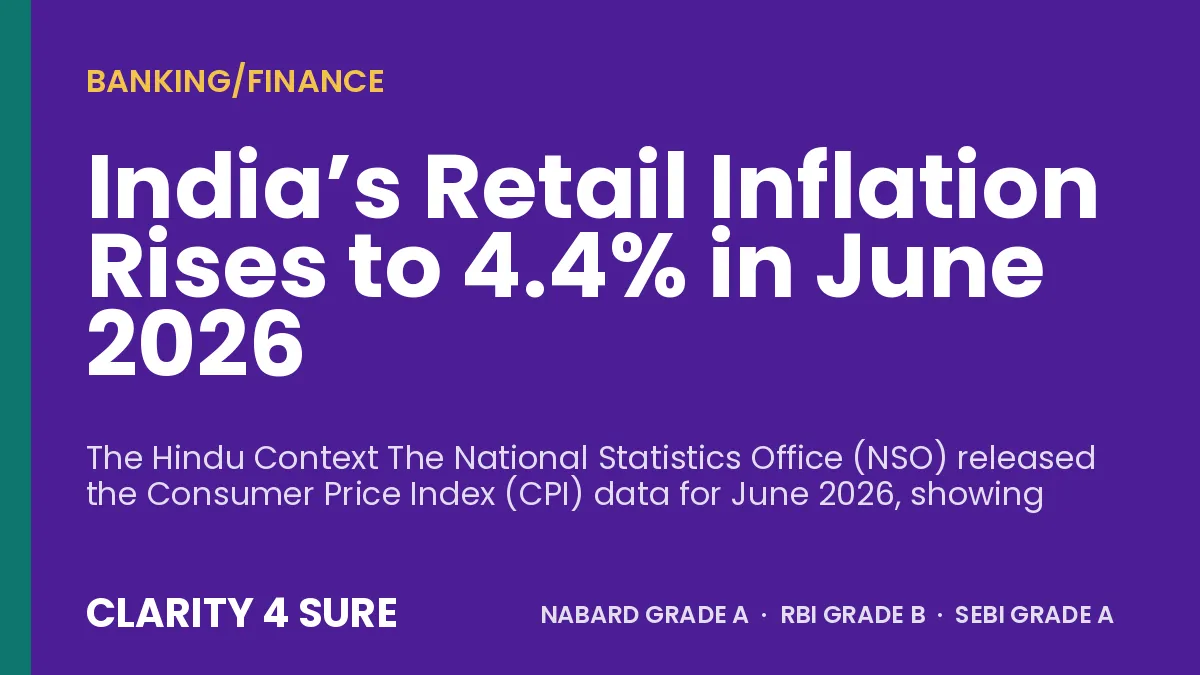
India’s retail inflation rose to a 13-month high of 3.5% in April 2026, up from 3.4% in March — the first full month after the outbreak of the West Asia conflict that pushed up global oil prices. The uptick was driven primarily by food inflation (4%) and a sharp rise in restaurant and accommodation prices (4.2%, up from 2.9%), as eateries passed on higher fuel costs to consumers. Counterintuitively, transport inflation eased to nearly zero (-0.01%) because of softer passenger transport-service prices — even though goods transportation costs rose 7.6%.
Key Highlights
- April 2026 CPI inflation: 3.5% — a 13-month high.
- March 2026 CPI: 3.4%.
- Sub-category breakdown:
- Food and beverages: 4.0% (vs 3.7% in March).
- Restaurant and accommodation services: 4.2% (vs 2.9% in March) — sharpest jump.
- Transport sector: –0.01% (vs 0% in March) — slight deflation due to easing passenger transport services.
- Transport of goods: Up 7.6%.
- Headline reading: Softer than market expectations.
- Context: April was the first full month after the start of the West Asia conflict.
- Upside risks flagged:
- Geopolitical tensions in West Asia.
- Crude oil prices above $100/barrel.
- Emerging El Niño pattern → deficient monsoon risk.
- Expert commentary:
- Upasna Bhardwaj (Kotak Mahindra Bank) — softer than expected, but outlook clouded.
- Madan Sabnavis (Bank of Baroda) — echoed similar sentiment.
- Rajni Thakur (L&T Finance) — flagged the divergence between services and goods transport within the transport sub-index.
- RBI’s flexible inflation-targeting band: 4% ± 2% — 3.5% remains comfortably within target, but trend matters.
About the News
“RBI MPC Unpacked: Key Theory Meets Today’s Macro Trends”Tap to play · from the C4S channel
A clean PDF of this page with the C4S header — it opens right away, and the link comes to your WhatsApp too.
What was India's retail inflation in April 2026?
It rose to 3.5%, a 13-month high, up from 3.4% in March.
What drove the inflation uptick?
Two main factors — higher food and beverages inflation (4.0%) and a sharp jump in restaurant and accommodation services prices (4.2%), as eateries passed on higher fuel costs.
How did expectations compare with actual data?
The reading came in softer than most economists had expected, but they cautioned that the outlook remains clouded by supply-side risks.
What is the broader context of the April reading?
April was the first full month after the start of the West Asia conflict, which has pushed up crude oil prices and raised concerns about supply-side inflation pressures.
How did the transport sub-index behave?
Overall transport inflation eased to –0.01% in April, mainly because of lower passenger transport-service prices. However, goods-transport prices rose 7.6% — reflecting the impact of fuel costs on logistics.
Why is the difference between services and goods transport important?
It tells us that fuel pass-through is uneven — services like passenger transport may absorb some cost (or face seasonal moderation), while freight and goods transport pass on costs faster. Goods transport inflation eventually feeds into retail prices of products.
Why is the inflation outlook described as "clouded"?
Because of three converging risks — the West Asia conflict (oil prices), El Niño (monsoon and food prices), and supply-side disruptions. All three could push food and energy prices higher in coming months.
Is 3.5% inflation a concern for the RBI?
It is below the RBI’s 4% central target under flexible inflation targeting (4% ± 2%), so not an immediate concern. But the rising trajectory, combined with the risks outlined above, may complicate the RBI’s policy stance in upcoming Monetary Policy Committee (MPC) meetings.
Background Concepts
Free live session
NABARD Grade A 2026: what the 2025 cut-offs changed, and the 90-day plan
In 2 days · Sun, 4 Oct at 7:30 PM IST
What is the Consumer Price Index (CPI)?
The CPI is a measure of the average change in retail prices of a fixed basket of goods and services consumed by households. In India, the CPI-Combined (CPI-C) is compiled by the National Statistical Office (NSO) under the Ministry of Statistics and Programme Implementation (MoSPI).
What is retail inflation?
Retail inflation is the year-on-year rate of change in the CPI. It measures the rise in prices of goods and services as experienced by end consumers.
What is the composition of the CPI basket in India?
The CPI basket includes major categories such as food and beverages (~46% weight), fuel and light, housing, clothing and footwear, transport and communication, education, health, and miscellaneous services. Food has the highest weight, making it the dominant inflation driver in India.
What is the difference between CPI and WPI?
CPI measures retail prices paid by consumers; it is used by the RBI for monetary policy targeting. WPI (Wholesale Price Index) measures prices at the wholesale level (producer-to-trader transactions); it does not include services and is used more for analytical purposes than for policy targeting.
What is the RBI's inflation targeting framework?
Under an amendment to the RBI Act, 1934 (Section 45ZA), India follows a flexible inflation targeting framework since 2016. The target is CPI inflation of 4% with a tolerance band of ±2% (i.e., 2% to 6%). The target is set by the Central Government in consultation with the RBI every five years.
What is the Monetary Policy Committee (MPC)?
A six-member statutory body under Section 45ZB of the RBI Act that sets the policy repo rate. It includes three RBI members (including the Governor) and three external members appointed by the Central Government. It meets at least four times a year.
What are "headline" and "core" inflation?
Headline inflation is the overall CPI inflation, including all components (food, fuel, etc.). Core inflation excludes the more volatile food and fuel components, capturing the underlying inflation in goods and services. It is a useful indicator of demand-side pressures.
What is the "base effect"?
A statistical phenomenon where the inflation reading is influenced by the level of prices in the same period of the previous year. A low base in the year-ago period inflates the current reading; a high base does the opposite.
Why does crude oil affect inflation in India?
Because India imports about 80% of its crude oil, which influences fuel prices, transport costs, manufacturing input costs, and food prices (via diesel-driven logistics and irrigation). Higher oil prices typically have a broad-based inflationary impact.
What is El Niño and how does it affect Indian inflation?
El Niño is the periodic warming of equatorial Pacific waters that weakens the Indian southwest monsoon, leading to deficient rainfall. This can hurt agricultural output, raise food prices, and drive headline inflation higher.
What are "supply-side" vs "demand-side" inflation drivers?
Supply-side drivers include disruptions, shortages, weather, oil-price shocks, and logistics costs — they can raise prices even without strong demand. Demand-side drivers include strong consumer spending and easy monetary conditions — they raise prices through increased buying. Different drivers call for different policy responses.
Practice MCQs
Q1. With reference to India’s retail inflation data for April 2026, consider the following statements:
- Retail inflation rose to a 13-month high of 3.5% in April 2026.
- Inflation in restaurant and accommodation services jumped to 4.2% in April from 2.9% in March.
- Inflation in the food and beverages category fell sharply in April.
- Overall transport inflation in April was negligible at -0.01%.
How many of the above statements are correct? (a) Only one (b) Only two (c) Only three (d) All four (e) None
Q2. With reference to the Consumer Price Index (CPI) in India, consider the following statements:
- CPI is compiled by the National Statistical Office (NSO) under MoSPI.
- Food and beverages account for the largest weight in the CPI basket.
- CPI is the inflation index used by the RBI for its flexible inflation targeting framework.
- CPI includes only goods and excludes all services.
Which of the above are correct? (a) 1, 2 and 3 only (b) 1, 2 and 4 only (c) 2 and 4 only (d) 1 and 4 only (e) All four
Q3. With reference to India’s flexible inflation targeting framework, consider the following statements:
- The framework was operationalised under an amendment to the RBI Act, 1934, in 2016.
- The CPI inflation target is 4%, with a tolerance band of ±2%.
- The inflation target is reviewed every five years.
- The target is set by the Reserve Bank of India unilaterally.
Which of the above are correct? (a) 1, 2 and 3 only (b) 1, 3 and 4 only (c) 2 and 4 only (d) 1 and 4 only (e) All four
Q4. Consider the following statements about factors influencing inflation in India:
- Crude oil price increases typically have a broad-based inflationary impact in India.
- El Niño can lead to deficient rainfall and higher food inflation.
- Headline inflation excludes food and fuel components.
- Supply-side disruptions can push inflation higher even when consumer demand is weak.
Which of the above are correct? (a) 1, 2 and 4 only (b) 1, 3 and 4 only (c) 2 and 3 only (d) 1 and 4 only (e) All four
Answer Key
- (c) — Statements 1, 2, 4 are correct. Statement 3 is wrong; food and beverages inflation actually rose to 4.0% in April from 3.7% in March — it did not fall.
- (a) — Statements 1, 2, 3 are correct. Statement 4 is wrong; CPI includes services as well as goods (housing, transport, communication, education, health, miscellaneous services).
- (a) — Statements 1, 2, 3 are correct. Statement 4 is wrong; the inflation target is set by the Central Government in consultation with the RBI, not by the RBI unilaterally.
- (a) — Statements 1, 2, 4 are correct. Statement 3 is wrong; headline inflation includes all components — food, fuel, and others. It is core inflation that excludes the volatile food and fuel components.
Exam Relevancemost asked
| Exam | Relevance |
|---|---|
| UPSC Prelims | GS Paper I — Indian Economy (Inflation, CPI/WPI, RBI, MPC) |
| UPSC Mains | GS Paper III — Indian Economy, Monetary Policy, External Sector, Food Security |
| State PCS | Indian Economy, Current Affairs |
| Banking (RBI Gr B, SBI PO, IBPS, NABARD) | Banking & Economy — high importance |
| SEBI Grade A | Macroeconomic policy, financial markets |