Introduction
Walk into any Indian supermarket today, or scroll through a grocery app, and the shelves are crowded with products shouting “organic,” “natural,” “chemical-free,” or “farm-fresh.” For the average consumer, telling a genuinely certified organic product apart from one that is simply well-marketed has become nearly impossible without a trustworthy mark to anchor that decision. Add to this the fact that India’s organic food market is expanding rapidly — projected by multiple industry estimates to grow from around USD 1,800–2,300 million in 2025 to well over USD 11,000–13,000 million within the next decade — and the stakes around consumer trust only get higher. As more money, more farmers, and more retail shelf space pour into “organic,” the risk of fraud, mislabelling, and consumer confusion grows right alongside it.
This is precisely the gap that Jaivik Bharat, the Food Safety and Standards Authority of India’s (FSSAI) unified organic food regulatory portal, was built to close. It is not just a website or a logo — it is India’s attempt to create one coherent, government-backed system of trust for an industry that had, until recently, been operating under multiple overlapping and often confusing certification marks.
What is Jaivik Bharat?
Jaivik Bharat is a regulatory portal built around the Indian Organic Integrity Database, jointly developed by three institutions:
- FSSAI — the Food Safety and Standards Authority of India, the apex food regulator
- APEDA — the Agricultural and Processed Food Products Export Development Authority, which administers NPOP
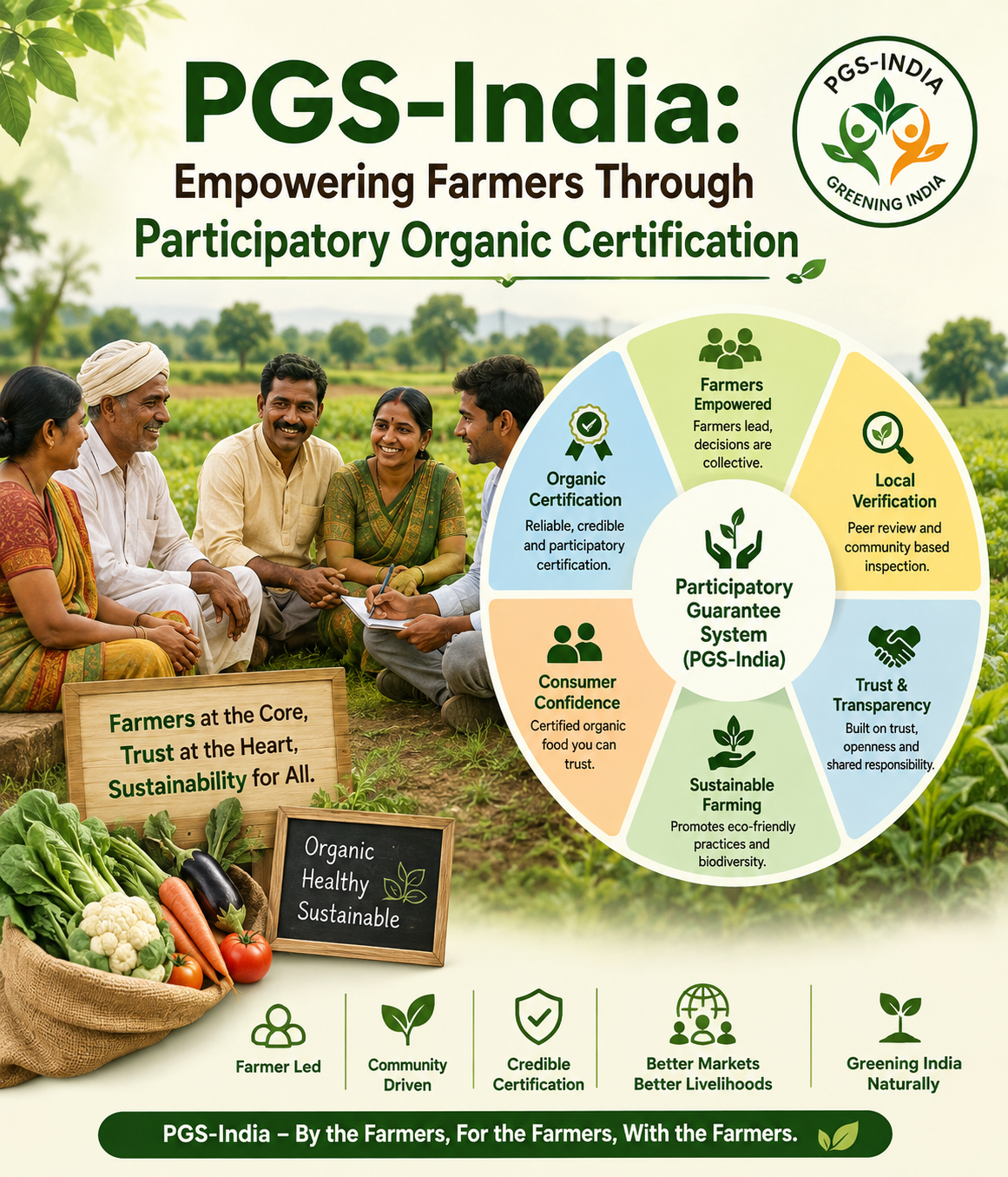
- PGS-India — the Participatory Guarantee System secretariat under the National Centre for Organic Farming
Together, these three bodies pooled their data to create a single portal carrying organic food standards, certification processes, information on Food Business Operators (FBOs), the products they sell, and the geographical areas in which those products are produced and available. Consumers can search this database by the name of the food product or by the name of the company, making it possible to verify, in a matter of seconds, whether a product’s organic claim is backed by real certification.
In effect, Jaivik Bharat sits at the intersection of three previously siloed systems — food safety regulation, export certification, and grassroots farmer certification — and pulls them together into a single point of public verification.
The Jaivik Bharat Logo: A Single Mark of Trust
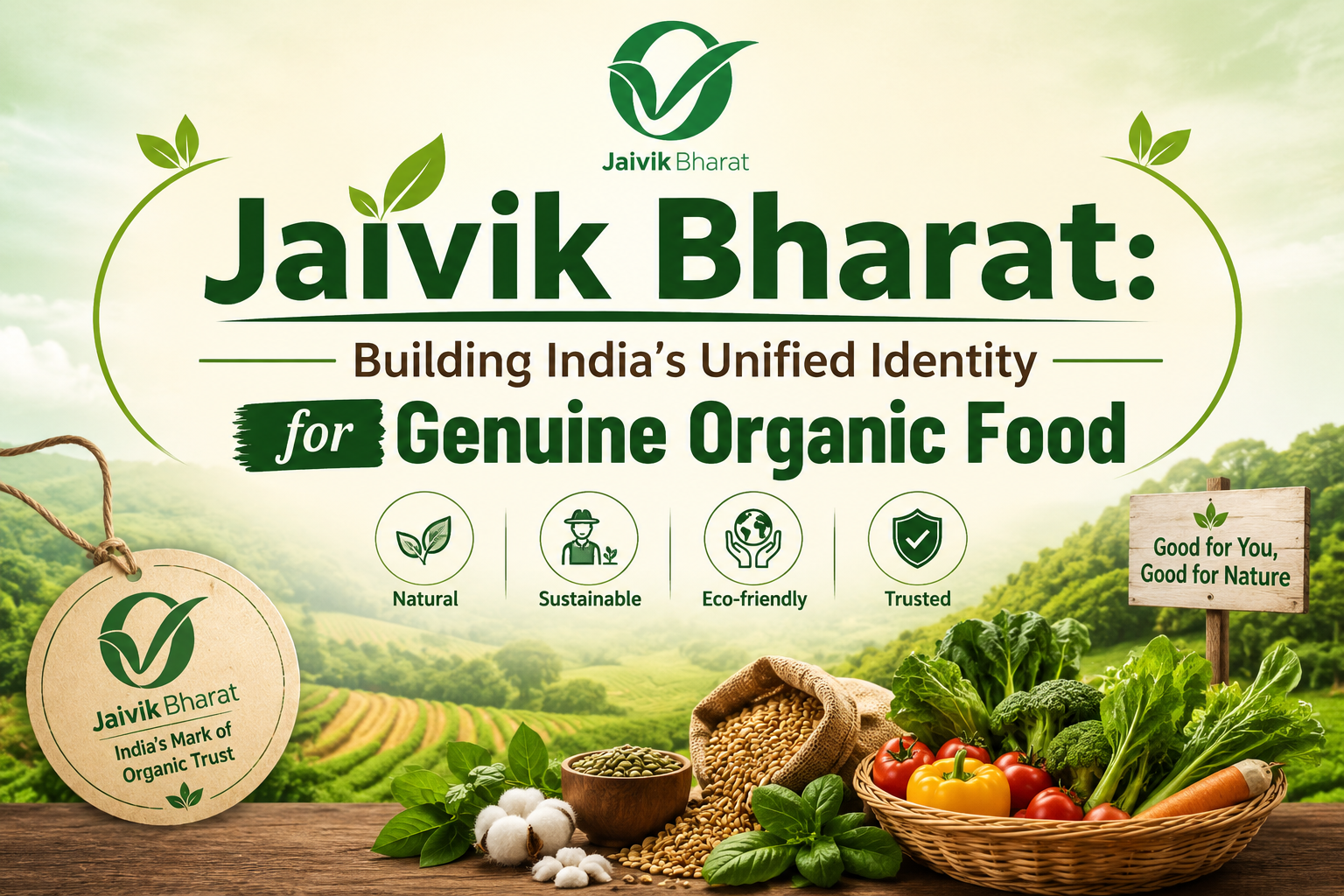
The centerpiece of the initiative is the Jaivik Bharat logo — a unified identity mark designed specifically to distinguish genuine organic products from non-organic ones. The tagline “Jaivik Bharat” appears at the bottom of the mark, signifying “Organic Food from India.”
The design choices behind the logo are deliberate:
- Color — The green color of the logo symbolizes nature, and communicates that the product has been grown without chemical fertilizers or pesticides, in an environmentally responsible manner.
- Simplicity — FSSAI designed the mark to employ a simple, easily recognizable visual approach, so that even a consumer unfamiliar with the technicalities of organic certification can identify it at a glance.
- Unification — By intertwining elements associated with the environment, the logo communicates adherence to India’s National Organic Standards as a whole, rather than pointing to just one certification pathway.
Importantly, the Jaivik Bharat logo does not replace the certification marks that already exist — it sits above them as an umbrella identity. Whether a product has gone through NPOP’s third-party certification or PGS-India’s community-based verification, it must additionally carry the Jaivik Bharat logo, alongside the FSSAI logo and license number, before it can be legitimately marketed as “organic” in India.
Why Was Jaivik Bharat Needed? The Trust Deficit in Organic Food
Organic foods are, by definition, products of holistic agricultural practices — ones that focus on biodiversity, soil health, and chemical-free inputs, following an environmentally and socially responsible approach throughout production. But good intentions in the field don’t automatically translate to trust on the shelf.
People have historically been wary of purchasing organic food simply because they lacked confidence in its genuineness — and this wariness is far from irrational. Fraud and mislabelling are real and documented risks in the sector. A Food Business Operator (FBO) might label a product “organic” while it actually contains non-organic ingredients, or while the underlying production process never actually adhered to organic production standards in the first place. Because organic claims are largely invisible — you cannot tell by looking at a grain of rice or a jar of honey whether it was grown or processed organically — the entire system depends on a credible chain of verification behind the label.
Before Jaivik Bharat, this problem was compounded by the fact that India had multiple organic logos in parallel circulation — the “India Organic” mark under NPOP, separate PGS-India marks, and various private or state-level organic labels — each with different visual identities and different levels of consumer recognition. Rather than resolving confusion, this fragmentation often deepened it.
To address both the trust deficit and the labelling confusion, the Food Safety and Standards (Organic Foods) Regulations, 2017 were notified in the Gazette of India on 29 December 2017. These regulations are built on the standards of two recognized, government-backed certification systems:
- National Programme for Organic Production (NPOP)
- Participatory Guarantee System for India (PGS-India)
Under these regulations, any organic food offered, promoted, or sold in India must comply with one of these two systems — closing the legal loophole that had previously allowed unverified “organic” claims to circulate freely in the market.
The Two Pillars: NPOP and PGS-India
Jaivik Bharat doesn’t invent a new certification process from scratch. Instead, it unifies and builds public trust around two existing, complementary systems that serve different segments of India’s organic producer base.
National Programme for Organic Production (NPOP)
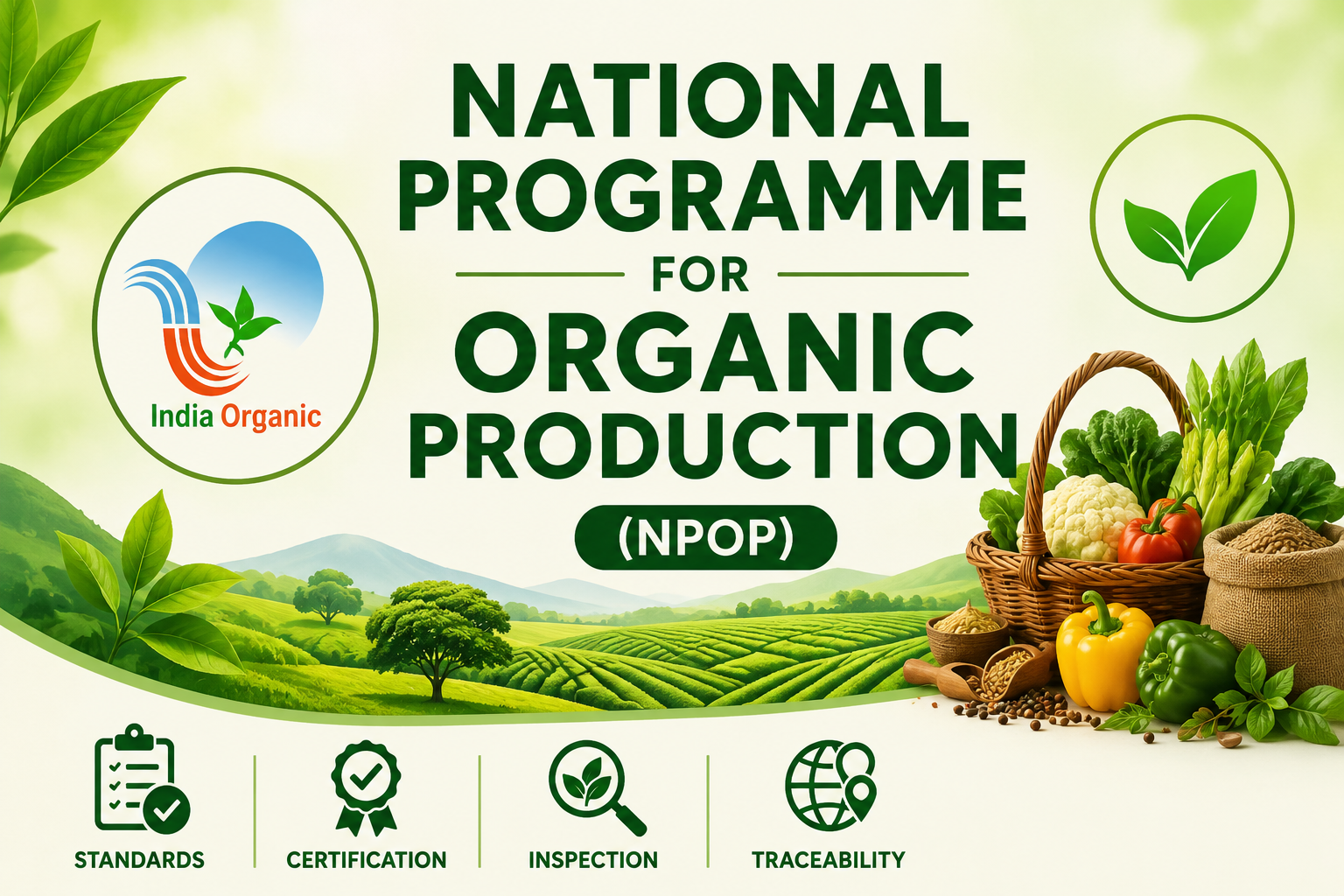
NPOP is a third-party certification system, administered through independently accredited certification bodies. According to the Jaivik Bharat portal, there are currently 28 Accredited Certification Bodies operating under NPOP. This system is the more rigorous of the two certification pathways and is generally used by producers who intend to access both export markets and larger organized domestic retail, since it is aligned with international organic standards recognized by trading partners abroad. Products certified under NPOP carry the well-known dark brown “India Organic” logo, in addition to the Jaivik Bharat mark.
Participatory Guarantee System for India (PGS-India)
PGS-India, in contrast, is a community-driven, peer-verification model designed specifically to be accessible to small and marginal farmers who cannot afford the cost and paperwork burden of third-party audits. Under this system, farmers in the same locality — organized into Local Groups — inspect and vouch for each other’s practices, under the oversight of Regional Councils. The Jaivik Bharat portal notes there are 562 Regional Councils (RCs) operating under this framework, forming the backbone of PGS-India’s decentralized verification network across the country. Depending on whether a farm is fully converted or still transitioning, products may carry the “PGS-India Organic” or “PGS-India Green” logo.
| Aspect | NPOP | PGS-India |
|---|---|---|
| Certification model | Third-party, accredited bodies | Peer/community-based verification |
| Best suited for | Exporters, large processors, organized retail | Small and marginal farmers, local/domestic markets |
| Cost | Higher (professional audit fees) | Low-cost, largely subsidized |
| Recognition | Aligned with international standards | Domestic recognition, IFOAM-aligned principles |
| Logo | India Organic | PGS-India Organic / PGS-India Green |
| Administering body | APEDA | NCOF (PGS Secretariat) |
Whether a product is certified under NPOP or PGS-India, it must carry the Jaivik Bharat logo before it can be legitimately sold as “organic” — the umbrella mark is the non-negotiable common thread tying both systems together.
What Certification Actually Assures
Certification of organic foods — under either NPOP or PGS — assures buyers that the product complies with the specific standards laid out for organic production, from farming inputs and soil management right through to processing, packaging, and labelling. This isn’t a one-time inspection; it’s backed by a documented, traceable chain that can, in principle, be verified through the Indian Organic Integrity Database at any point.
It’s worth flagging an important nuance here: products that are still “in-conversion” to organic — meaning the farm has begun transitioning away from chemical inputs but hasn’t yet completed the required certification timeline — are not covered under the Organic Foods Regulations, and are explicitly not permitted to use the Jaivik Bharat logo. This distinction protects the credibility of the mark, ensuring it is reserved strictly for produce that has completed the full certification process rather than diluting it with partially-converted farms.
How the Portal Works for Consumers and Businesses
The Jaivik Bharat portal isn’t a static informational page — it functions as an active regulatory and verification tool:
- Product search — Consumers can search organic food products by name or by company name to check certification status before buying.
- FBO information — The database holds details of Food Business Operators, the products they’ve registered as organic, and the geographical regions where these products are produced or sold.
- Traceability and endorsement — For businesses, the portal supports a structured workflow: an FBO’s NPOP certificate details are fetched into the system, verified by the FSSAI Licensing Authority, and the products are then formally endorsed as organic — with a user manual provided to guide FBOs through this endorsement process.
- Grievance redressal — A dedicated 24/7 support center allows any user — consumer or business — to submit a grievance directly through the portal, adding a layer of accountability that a simple logo alone could never provide.
At the time of the portal’s most recent published figures, it had already recorded over 14 lakh visits, reflecting a genuine, growing base of consumers actively checking organic claims rather than simply trusting labels at face value.
The Bigger Picture: Where Jaivik Bharat Fits in India’s Organic Story
India’s organic farming and food sector is in the middle of a genuine boom. <cite index=”22-1″>Industry estimates put the India organic farming market at around USD 6,133.68 million in 2025, projected to reach nearly USD 14,826.30 million by 2034, growing at a compound annual growth rate of close to 10 percent.</cite> On the food side specifically, <cite index=”23-1″>the India organic food market was valued at roughly USD 2,303.31 million in 2025 and is expected to grow at almost 19–20 percent annually through 2034, potentially exceeding USD 11,000 million by then.</cite> <cite index=”26-1″>On trade, India exported around 0.312 million metric tons of certified organic products in 2023, bringing in close to USD 708.33 million in foreign exchange.</cite>
That kind of growth is exactly why an initiative like Jaivik Bharat matters so much right now. A fast-expanding market with weak verification infrastructure is a market ripe for fraud; a fast-expanding market with strong, unified, publicly accessible verification is one that can scale sustainably, protect farmer incomes, and build lasting export credibility. Jaivik Bharat represents India’s attempt to get that infrastructure right before the scale of the problem outpaces the systems built to manage it.
But the sector’s growth also comes with well-documented friction points. <cite index=”22-1″>High certification and compliance costs, lower initial yields during the transition period, limited technical knowledge and access to organic inputs, and fragmented supply chains remain significant challenges for the market.</cite> <cite index=”23-1″>On the consumer side, premium pricing that limits mass-market adoption, underdeveloped cold chain and logistics infrastructure, complex certification processes for small farmers, and persistent consumer trust issues around product authenticity continue to hold the sector back.</cite> These are precisely the frictions that a well-functioning Jaivik Bharat ecosystem is positioned to ease — but only if it continues to evolve.
Way Forward
Jaivik Bharat has laid a strong regulatory foundation, but turning it from a good policy framework into a genuinely trusted, everyday consumer habit will require sustained effort on several fronts:
1. Full notification and enforcement. As of the portal’s own disclosures, use of the Jaivik Bharat logo is contingent on formal notification in the Gazette of India. Ensuring this notification is completed — and, more importantly, strictly enforced at the retail and e-commerce level — is the single most important next step. A logo that exists on paper but isn’t consistently checked at the point of sale does little to solve the trust problem it was designed to fix.
2. Deeper integration with e-commerce and retail platforms. With online grocery and quick-commerce growing rapidly in India, Jaivik Bharat verification needs to be built directly into e-commerce listings — ideally through an API or plug-in that lets platforms display real-time certification status next to any product labelled “organic,” rather than relying on consumers to manually cross-check the portal themselves.
3. Reducing certification costs and friction for small farmers. Since <cite index=”22-1″>high certification and compliance costs and limited technical knowledge remain major barriers</cite> for smallholders, expanding PGS-India’s reach — through more Regional Councils, better farmer training, and simplified digital documentation — will be essential to keeping the participatory pathway genuinely accessible rather than a certification system in name only.
4. Strengthening supply chain and cold storage infrastructure. <cite index=”23-1″>Underdeveloped cold chain and logistics infrastructure</cite> continues to limit how far organic produce can travel while retaining both its quality and its price premium. Government investment alongside private cold-chain partnerships, particularly for perishables, would let organic certification actually translate into market reach.
5. Consumer awareness campaigns. A logo only works if people recognize it and actively look for it. Sustained public awareness campaigns — especially in tier-2 and tier-3 cities where organic demand is now growing fastest — will be necessary to make “checking for the Jaivik Bharat logo” as habitual for Indian consumers as checking for an FSSAI license number already is.
6. Leveraging technology for traceability. Blockchain-based and QR-code-based traceability, already being piloted in parts of India’s organic supply chain, could be integrated into the Jaivik Bharat database to give consumers an end-to-end view — from farm to shelf — of any product they scan, building a level of transparency that goes beyond a static certification lookup.
7. Aligning with export ambitions. As India pushes to grow its organic exports through platforms like APEDA’s Organic Conclaves and international trade fairs such as BIOFACH and Gulfood, ensuring that Jaivik Bharat’s domestic integrity database stays fully synchronized with NPOP’s export certification records will help Indian organic exporters build credibility with international buyers, not just domestic consumers.
If these steps are taken seriously, Jaivik Bharat has the potential to become far more than a regulatory checkbox — it can become the backbone of consumer trust for one of India’s fastest-growing food sectors, protecting both the health-conscious buyer in a metro supermarket and the small farmer in a village Local Group who’s counting on that trust to earn a fair premium for genuinely organic produce.
Conclusion
Jaivik Bharat is India’s answer to a simple but pressing question: in a market flooded with organic claims, how does a consumer know what’s real? By unifying FSSAI’s regulatory authority, APEDA’s export-oriented NPOP certification, and PGS-India’s grassroots, farmer-driven verification model under one recognizable green logo and one searchable public database, Jaivik Bharat tries to serve two audiences at once — giving small farmers an affordable route to organic recognition, and giving consumers a single, credible mark to trust.
The framework is sound. What remains is execution — full enforcement, deeper retail integration, continued investment in farmer support and cold-chain infrastructure, and sustained consumer education. Get those right, and Jaivik Bharat won’t just be a logo on a package; it will be the quiet, everyday guarantee that what’s written on the label is exactly what’s growing in the field.