Kavach (Hindi for “shield” or “armour”) is the indigenous Automatic Train Protection (ATP) system of Indian Railways. Developed by the Research Designs and Standards Organisation (RDSO) with Indian firms, it continuously watches a train’s speed, warns the loco pilot, applies the brakes on its own if the pilot fails to act, and prevents collisions and signal passing at danger. Adopted as the National ATP system in July 2020, it is certified to Safety Integrity Level 4 (SIL-4), the highest safety standard for such systems.
Context
- RDSO approved Kavach version 4.0 on 16 July 2024, the upgraded specification with much better location accuracy, needed for safe movement in complex yards and station layouts.
- Deployment milestones reported after that approval: optical fibre cable laid on about 4,960 km, 378 telecom towers, Kavach at 381 stations, in 482 locomotives, and track-side equipment on 1,948 km of route.
- Funds: about Rs 1,547 crore spent on Kavach up to that point and Rs 1,112.57 crore allotted for 2024-25. Track-side equipment costs roughly Rs 50 lakh per km; equipping a locomotive costs around Rs 70 lakh.
- More than 9,000 railway personnel have been trained on Kavach at IRISET (Indian Railways Institute of Signal Engineering and Telecommunications), Secunderabad.
What Kavach Does
- Displays the signal aspect and the movement authority in the driver’s cab, so the pilot knows the permitted speed even in dense fog.
- Enforces the maximum permissible speed: if the loco pilot does not slow down, Kavach applies the brakes automatically.
- Prevents Signal Passing at Danger (SPAD) and head-on or rear-end collisions between two Kavach-fitted trains on the same track.
- Auto-whistles at level crossings, sends SOS messages in emergencies, and allows centralised live monitoring of train movements.
ARD notes, the monthly current affairs PDF and a descriptive English sample — all free, on WhatsApp.
Get it on WhatsApp — one tap or just leave your numberHow the System Is Built
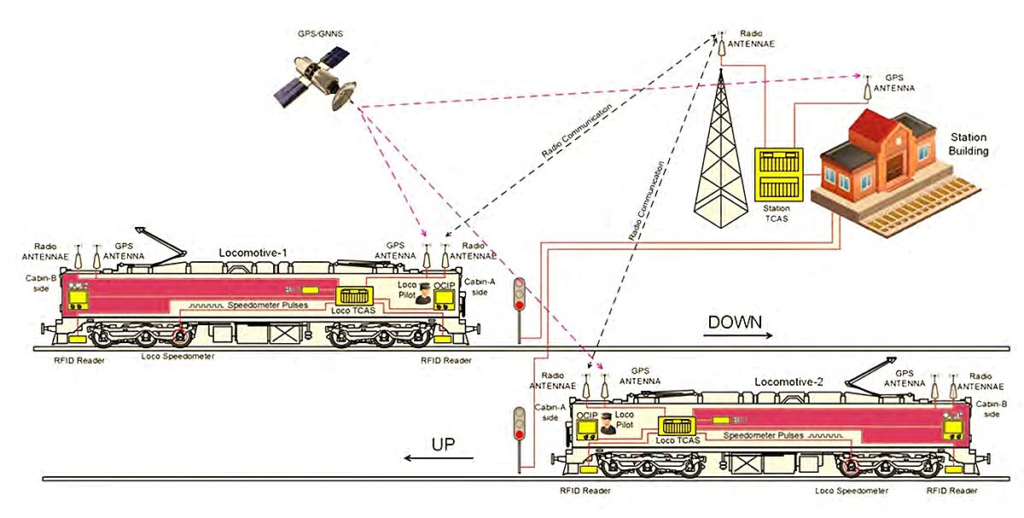
- Track side: RFID tags fixed on the track give the train its precise location; station Kavach units talk to the interlocking; UHF radio towers and optical fibre carry the data.
- On board: a loco Kavach unit with GPS, radio and a driver display; it computes the braking curve and intervenes when required.
- Safety measures: THR (Tolerable Hazard Rate) measures the acceptable rate of random and systematic failures; a system is then assigned a Safety Integrity Level from the quality of its safety management and its technical safeguards. Kavach is SIL-4, which corresponds to a probability of about one dangerous failure in 10,000 years.
Development Timeline
- 2016: first field trials of the system, then called the Train Collision Avoidance System (TCAS), on passenger trains.
- 2018-19: three Indian firms – Medha Servo Drives, HBL Power Systems and Kernex Microsystems – approved for version 3.2 after field trials and an Independent Safety Assessment (ISA).
- July 2020: Indian Railways adopted Kavach as the National ATP system.
- 4 March 2022: public demonstration on South Central Railway with the Railway Minister and the Chairman, Railway Board, on two locomotives approaching each other; Kavach stopped them automatically.
- 16 July 2024: RDSO approved version 4.0; the first section with Kavach 4.0 was commissioned on the Sawai Madhopur-Kota stretch of West Central Railway in September 2024.
- The Delhi-Mumbai and Delhi-Howrah trunk routes (about 3,000 route km) are the first corridors being covered; Indian Railways has announced plans to fit Kavach in 10,000 locomotives.
Why Kavach Matters
Free live session
NABARD Grade A 2026: what the 2025 cut-offs changed, and the 90-day plan
The 2025 cycle was the toughest on record at every stage. This session reads those numbers properly and turns them into a week-by-week plan for Phase 1.
In 8 days · Sun, 4 Oct at 7:30 PM IST · 75 minutes · free
- Head-on and rear-end collisions, and trains overshooting signals, are the accidents an ATP system prevents; the 2023 Balasore accident put the pace of Kavach rollout at the centre of the debate.
- It is a Made-in-India system, costing a fraction of comparable European train protection systems, with Indian vendors and Indian intellectual property.
Important Facts for Examsmost asked
- Kavach = indigenous Automatic Train Protection (ATP) system; developed by RDSO, Lucknow; earlier name TCAS.
- Safety standard: SIL-4; adopted as National ATP in July 2020; version 4.0 approved by RDSO on 16 July 2024.
- First field trials: 2016; live demonstration: 4 March 2022, South Central Railway.
- Three approved manufacturers: Medha, HBL Power Systems, Kernex. Training centre: IRISET, Secunderabad.
- Track-side cost about Rs 50 lakh per km.
FAQs
Does Kavach stop a train on its own?
Yes. If the loco pilot does not respond to a warning, Kavach applies the brakes automatically to keep the train within the permitted speed and to stop it before a red signal.
Which foreign systems are comparable?
ETCS (European Train Control System) in Europe and Positive Train Control (PTC) in the United States do similar jobs; Kavach is India’s own equivalent at a much lower cost per kilometre.
Why is Kavach asked in banking and railway exams?
It combines a current-affairs hook (accidents, budget allocations, version 4.0) with static facts – developer, year, SIL-4 – that make easy one-liner questions.