India’s infrastructure sector is a critical pillar for achieving high and sustainable economic growth. However, one of the biggest bottlenecks in infrastructure development has been the lack of long-term and low-cost funding. To address this, the Government of India established the National Bank for Financing Infrastructure and Development (NaBFID) — a dedicated development finance institution (DFI) to catalyze investment in the country’s core infrastructure.
Introduction
NaBFID is expected to play a transformative role in achieving the vision of a $5 trillion Indian economy by enabling large-scale infrastructure financing, reducing the infrastructure deficit, and crowding in private investments.
Historical Background
NABARD 2021-2024 Cutoff Analysis | What we can Learn? #nabard_grade_a_exam #nabard_cutoffTap to play · from the C4S channel
The need for a dedicated Development Finance Institution (DFI) had long been felt in India due to the mismatch between the long-term nature of infrastructure projects and the short-term liabilities of commercial banks. The following key developments led to the creation of NaBFID:
| Year | Event |
|---|---|
| 1990s | Earlier DFIs like ICICI and IDBI converted into commercial banks. |
| 2019-2020 | Infrastructure financing challenges became acute due to stressed assets in the banking sector. |
| Budget 2021-22 | Finance Minister Nirmala Sitharaman announced the setting up of a new DFI. |
| March 2021 | Parliament passed the NaBFID Act, 2021. |
| November 2021 | NaBFID was officially incorporated as a statutory body under the Act. |
A clean PDF of this page with the C4S header — it opens right away, and the link comes to your WhatsApp too.
Objectives of NaBFID
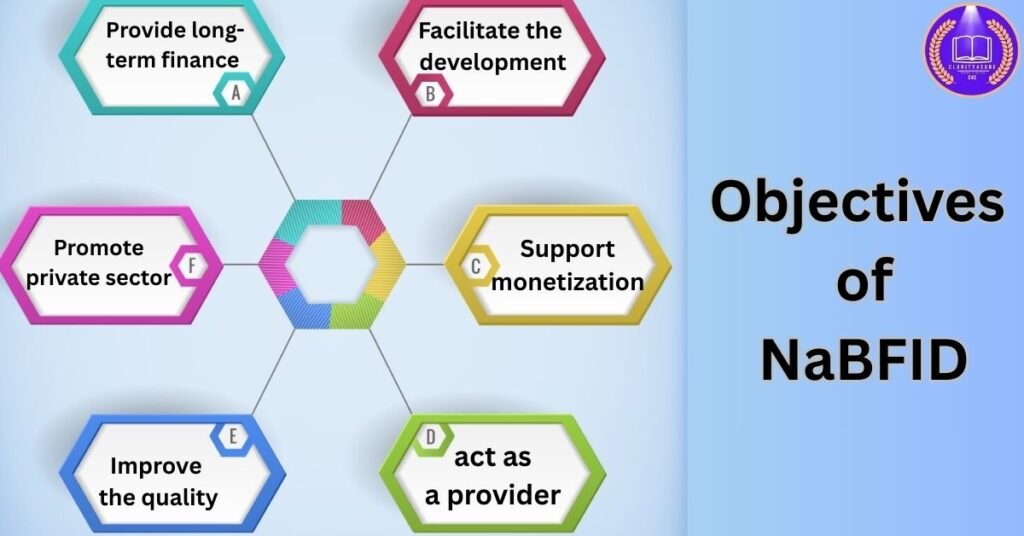
The core objective of NaBFID is to act as a provider, enabler, and catalyst for infrastructure financing in India.
Primary Objectives:
- Provide long-term finance for infrastructure projects.
- Facilitate the development of deep bond markets for infrastructure.
- Promote private sector participation in infrastructure.
- Support monetization of public infrastructure assets.
- Improve the quality of project preparation and risk management.
Institutional Structure
Free live session
NABARD Grade A 2026: what the 2025 cut-offs changed, and the 90-day plan
In 4 days · Sun, 4 Oct at 7:30 PM IST
| Feature | Details |
|---|---|
| Name | National Bank for Financing Infrastructure and Development (NaBFID) |
| Type | Statutory Body and Development Finance Institution |
| Incorporation | November 2021 |
| Headquarters | Mumbai, India |
| Ownership | Wholly owned by the Government of India initially; provisions allow gradual dilution of ownership to at least 26%. |
| Regulator | Financially regulated and supervised by the Reserve Bank of India (RBI) |
| Initial Capital | ₹20,000 crore authorized capital; ₹5,000 crore paid-up capital from GoI |
Key Functions of NaBFID
1. Direct Lending
- Provide long-term debt for commercially viable infrastructure projects.
- Financing through term loans, bonds, syndicated loans, and structured instruments.
2. Refinancing
- Offer refinancing to commercial banks, NBFCs, and other financial intermediaries for their infrastructure lending.
3. Developmental Role
- Assist in project structuring, financial modeling, and credit enhancement.
- Promote innovative financing instruments such as infrastructure investment trusts (InvITs), municipal bonds, and blended finance.
4. Capacity Building
- Support technical assistance and institutional strengthening for infrastructure development.
5. Sustainability Focus
- Prioritize green infrastructure, renewable energy, water conservation, and climate-resilient projects.
Sectors Covered by NaBFID
NaBFID is expected to finance infrastructure in various critical sectors, including:
| Sector | Examples |
|---|---|
| Transport | Roads, railways, ports, airports, urban transport |
| Energy | Renewable energy, power transmission, energy storage |
| Telecom | Broadband, 5G infrastructure, fiber optics |
| Water & Sanitation | Drinking water, sewage treatment, waste management |
| Social Infrastructure | Healthcare, education, urban housing |
| Logistics & Warehousing | Cold chains, industrial parks, logistics hubs |
Role of NaBFID in Infrastructure Development
Key Contributions:
- Bridge Long-Term Funding Gaps:
- Commercial banks are constrained due to ALM mismatches.
- NaBFID can raise long-term funds and offer extended-tenor loans.
- De-Risk Private Investments:
- Improve bankability of projects via credit enhancement and risk sharing.
- Strengthen Capital Markets:
- Develop infrastructure bond markets and attract institutional investors like insurance and pension funds.
- Support National Infrastructure Pipeline (NIP):
- NaBFID is expected to play a central role in financing projects under the ₹111 lakh crore NIP.
Funding Sources
- NaBFID raises funds from multiple sources to support long-term infrastructure financing.
- These include initial capital support from the Government of India, issuance of tax-free infrastructure bonds, and borrowing from multilateral development banks like the World Bank and ADB.
- It also aims to attract investments from institutional investors such as pension funds, insurance companies, and sovereign wealth funds.
- Additionally, NaBFID explores green finance instruments like climate bonds and ESG-linked funding to promote sustainable infrastructure development.
NaBFID has multiple avenues to raise funds:
| Source | Description |
|---|---|
| Government of India | Initial capital and support for sustainability |
| Bonds & Debentures | Tax-free infrastructure bonds for long-term funding |
| Multilateral Institutions | Loans from World Bank, ADB, AIIB, etc. |
| Institutional Investors | Pension funds, sovereign wealth funds, insurance companies |
| Green Finance | Climate bonds and ESG-linked instruments |
Governance and Autonomy
To ensure operational efficiency and professional management, the NaBFID Act provides:
- A professional Board of Directors with independent members.
- CEO appointed by the Government on recommendation of a selection committee.
- Exemptions from certain provisions of the Companies Act and RBI Act to allow flexibility.
- Internal and external audit mechanisms to ensure transparency.
Risk Mitigation Mechanisms
NaBFID has access to various mechanisms to manage risks:
- Credit enhancement through guarantees and insurance.
- Government support for initial loan losses.
- Professional due diligence and risk-based pricing models.
- Securitization and asset monetization tools.
Benefits of NaBFID
- NaBFID offers several significant benefits for India’s infrastructure sector.
- It provides long-term, low-cost financing for critical projects, helping to bridge the infrastructure funding gap.
- By improving the bankability of projects and supporting innovative financing tools, it attracts private and foreign investments. NaBFID also plays a vital role in job creation, promotes sustainable and green infrastructure, and supports the government’s ambitious National Infrastructure Pipeline (NIP), thereby boosting overall economic growth and development.
| Benefit | Description |
|---|---|
| Boosts Infrastructure Investment | Helps unlock large-scale infrastructure development. |
| Generates Employment | Infrastructure projects lead to direct and indirect job creation. |
| Encourages Sustainability | Supports green and climate-resilient infrastructure. |
| Reduces Cost of Capital | Enables long-term and low-cost funding. |
| Attracts Private Capital | Catalyzes private and foreign investments through blended finance. |
Challenges
- NaBFID faces several challenges in fulfilling its ambitious mandate. One major hurdle is the poor quality of project preparation, including weak feasibility studies and delayed approvals.
- Regulatory bottlenecks like land acquisition issues and environmental clearances can lead to cost and time overruns.
- Additionally, infrastructure projects often involve high credit and revenue risks, especially in sectors with uncertain cash flows.
- NaBFID must also navigate limited investor appetite for long-gestation projects and build technical capacity for risk assessment and project appraisal.
- Ensuring strong governance and transparency will be crucial to its long-term success.
While NaBFID is a promising initiative, it faces certain challenges:
| Challenge | Description |
|---|---|
| Project Preparation Issues | Delays and cost overruns due to weak DPRs. |
| Regulatory Bottlenecks | Delays in land acquisition, environmental clearances. |
| Revenue Risks | Toll collection, user charges, and offtake risks. |
| Credit Risk | Infrastructure projects are vulnerable to time and cost overruns. |
| Capacity Constraints | Limited technical and financial expertise at the state level. |
Future Outlook
NaBFID is expected to play a catalytic role in transforming India’s infrastructure landscape. With focus areas such as:
- Green and digital infrastructure
- Public-private partnerships (PPP)
- Asset monetization and InvITs
- Infra project preparation and pipeline management
…it will become a keystone institution in India’s growth story over the next two decades.
Conclusion
The National Bank for Financing Infrastructure and Development (NaBFID) represents a bold and strategic move by the Indian government to address the persistent infrastructure financing gap. With its specialized structure, access to long-term capital, and developmental mandate, NaBFID can revolutionize infrastructure development in India — creating jobs, attracting investments, and boosting economic growth. Its success will depend on effective governance, professional execution, and strong collaboration between public and private sectors.
Frequently Asked Questions (FAQs)
Q1. What is NaBFID?
A. NaBFID is the National Bank for Financing Infrastructure and Development — a government-owned Development Finance Institution (DFI) for infrastructure financing.
Q2. When was NaBFID established?
A. NaBFID was incorporated in November 2021 after the enactment of the NaBFID Act, 2021.
Q3. What are the key functions of NaBFID?
A. Providing long-term loans, refinancing, project structuring, bond market development, and supporting sustainable infrastructure.
Q4. How is NaBFID different from commercial banks?
A. Unlike commercial banks, NaBFID focuses solely on long-term infrastructure finance and has a development mandate.
Q5. Who regulates NaBFID?
A. It is financially regulated by the Reserve Bank of India (RBI) but operates under the NaBFID Act, 2021.