Social sector expenditure refers to government spending on sectors that contribute to human development and social welfare. These include:
Origin
- The origin of “Social Sector Expenditure” can be traced back to the concept of government spending aimed at improving the social well-being of citizens, with key areas like education, healthcare, sanitation, housing, and social security being the primary focus, often driven by the idea of redistributing wealth to address inequalities and promote human development; this concept gained significant traction with the rise of welfare state policies in the 20th century, where governments actively allocated funds to address social needs within their populations.
About
NABARD 2021-2024 Cutoff Analysis | What we can Learn? #nabard_grade_a_exam #nabard_cutoffTap to play · from the C4S channel
- Social sector expenditure plays a crucial role in ensuring economic growth, social welfare, and overall human development.
- It covers various essential services such as education, healthcare, social security, and employment generation.
- Governments allocate significant portions of their budgets to social sectors to improve living standards and promote inclusive development.
A clean PDF of this page with the C4S header — it opens right away, and the link comes to your WhatsApp too.
What is Social Sector Expenditure?
- Education
- Schools, higher education, skill development, research
- Health
- Public healthcare, immunization, nutrition programs
- Social Security
- Pensions, welfare schemes, unemployment benefits
- Housing & Urban Development
- Affordable housing, sanitation, smart cities
- Employment & Livelihood
- Rural employment programs, MSME support
- Women & Child Development
- Maternal care, child welfare, gender empowerment
This expenditure ensures economic inclusivity and addresses inequalities.
Importance of Social Sector Expenditure
Social sector spending is vital for:
- Reducing Poverty & Inequality
- Ensures access to essential services for marginalized groups.
- Improving Human Capital
- Investments in education and health lead to a productive workforce.
- Boosting Economic Growth
- A well-educated and healthy population drives economic progress.
- Enhancing Social Stability
- Reduces crime rates, promotes equality, and fosters peace.
- Encouraging Gender Equality
- Special schemes for women empower them economically and socially.
Without adequate funding, disparities widen, hindering sustainable development.
Trends in Social Sector Expenditure
A. Global Perspective
According to the World Bank and IMF reports:
High-income countries spend around 25-30% of GDP on social sectors.
Middle-income countries spend 10-15% of GDP.
Low-income countries spend below 10%, often relying on foreign aid.
Nordic countries (Sweden, Norway, Finland) have the highest social sector spending, ensuring universal healthcare, free education, and robust welfare programs.
B. Social Sector Spending in India
- In India, social sector spending includes key schemes such as:
- Education
- National Education Policy (NEP), Samagra Shiksha Abhiyan
- Health
- Ayushman Bharat, National Health Mission (NHM)
- Social Security
- PM Kisan, MGNREGA, Pension Schemes
- Urban & Rural Development
- PMAY, Smart Cities Mission, Swachh Bharat
Budget Trends
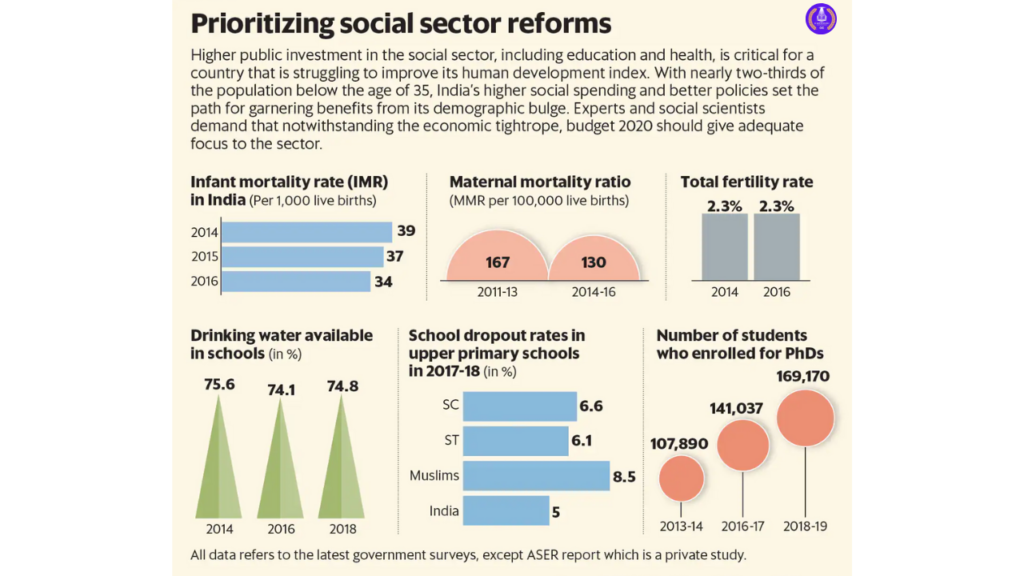
- India’s social sector expenditure is around 7-8% of GDP, lower than developed nations.
- The Union Budget 2023-24 allocated ₹22.5 lakh crore (~37% of total budget) for social sectors.
- Health & Education received ₹3.2 lakh crore, an increase from the previous year.
Challenges in Social Sector Expenditure
- Low Allocation
- Developing nations often allocate insufficient funds due to fiscal constraints.
- Leakages & Corruption
- Funds do not reach beneficiaries due to bureaucratic inefficiencies.
- Regional Disparities
- Rural and underdeveloped regions receive fewer resources.
- Poor Implementation
- Many schemes fail due to lack of infrastructure and governance issues.
- Private Sector Dependence
- Increasing privatization reduces government responsibility for essential services.
Measures to Improve Social Sector Spending
- Increase Budget Allocation
- Raise spending closer to international standards (12-15% of GDP).
- Strengthen Monitoring & Accountability
- Use digital platforms for direct benefit transfers (DBT) to reduce corruption.
- Public-Private Partnerships (PPP)
- Engage private entities to enhance efficiency in service delivery.
- Decentralized Governance
- Empower local governments for better resource allocation.
- Focus on Outcome-Based Funding
- Link expenditure with tangible results like literacy rates and health indicators.
Conclusion
- Social sector expenditure is essential for building an inclusive and progressive society.
- While developed countries prioritize human development with high social spending, many developing nations still lag behind.
- Increasing budget allocation, improving governance, and leveraging technology can ensure better outcomes.