
Daily Current Affairs (DCA) 02 October, 2026
Free live session
NABARD Grade A 2026: what the 2025 cut-offs changed, and the 90-day plan
Today · 7:30 PM IST
Schemes2
Context
The Union Environment Minister launched implementation guidelines for the National Coastal Mission 2.0 (NCM 2.0) — a Central Sector Scheme with an outlay of ₹767 crore for 2025-26 to 2030-31, across nine coastal States and four Union Territories.
What It Is
- A Central Sector Scheme establishing an integrated ecological governance and marine spatial planning framework
- Subsuming NCM 1.0 (2021-22 to 2025-26)
- To protect fragile coastal ecosystems and scale up nature-positive economic activities
- Administered directly by the MoEFCC
Aim
- Protect coastal and marine ecosystems
- Strengthen climate resilience
- Reduce marine pollution
- Sustainably harness India’s Blue Economy toward Viksit Bharat @2047
The Five Thematic Pillars
- Blue Economy growth
- Coastal risk reduction
- Climate adaptation and mitigation
- Capacity building
- Effective project management
Important Facts for Exams
- NCM 2.0 — ₹767 crore, 2025-26 to 2030-31; 9 coastal States and 4 UTs; administered by MoEFCC
- ICZM — Integrated Coastal Zone Management; the ICZM Project has been World Bank-supported since 2010
- CRZ Notification, 2019 governs coastal regulation; zones CRZ-I to IV
- NCSCM — National Centre for Sustainable Coastal Management, Chennai, the technical arm
- Blue carbon — carbon stored by mangroves, seagrass and salt marshes; the Indian Sundarbans stores about 24 million tonnes
- India has a coastline of about 7,500 km; 40 per cent of mangroves lost over the past century
- Green Climate Fund — the largest climate fund under the UNFCCC, established 2010
- Air Ayodhya, operated by Megamax Aviation, received a NOC from the Ministry of Civil Aviation to operate under RCS-UDAN.
- It aims to connect Tier-2 and Tier-3 cities, pilgrimage centres and tourism hubs in Uttar Pradesh.
- Operations are planned with Cessna Grand Caravan EX aircraft, later expanding to larger aircraft.
- The airline plans to build a 50-aircraft fleet by 2036.
Reports1
How & Why Farmers Producers Organization are formed? FPO #fpo #upsc #nabardgradea #agriculturenotesTap to play · from the C4S channel
- WHO and UNICEF released Progress on Drinking Water, Sanitation and Hygiene in Schools 2015–25 under the JMP-WASH programme.
- Around 50 million Indian children lacked access to sanitation services at school in 2025, the highest number globally.
- Globally, 244 million children lacked school sanitation services.
- About 20 million Indian children also lacked hygiene services at school.
Every day of the month in one file. Enter your details once — the download opens right away.
We already have your details, so no form: tap to open.
Download the October 2026 PDFDownload the October 2026 revision sheet PDFMisc3
- UIDAI launched five initiatives at Aadhaar Samvaad in Kolkata on 29 September 2026, marking the 17th Aadhaar Day.
- Initiatives include Face Authentication for ePDS, SWIK Portal 2.0, Sub-AUA/Sub-KUA (LITE) Framework, New Token Management System and a revamped UIDAI website.
- Aadhaar Day commemorates the issuance of the first Aadhaar number on 29 September 2010.
MoMSME–MoSPI MoU for Statistical Business Register
- MoMSME and MoSPI signed an MoU to strengthen the Statistical Business Register (SBR).
- Udyam Registration data will be shared with MoSPI through APIs.
- The data will help improve the coverage, consistency and reliability of business statistics.
- SBR is a regularly updated database of businesses and economic units used for statistical purposes.
DRDO–CSIR-CGCRI Indigenous Bulletproof Glass
- DRDO and CSIR-CGCRI are developing lightweight bulletproof glass for armoured vehicles.
- The ₹50-crore, four-year project uses glass-ceramic technology and nanocrystals.
- The project aims for multi-shot protection against AK-47-class threats.
- Initial trials successfully stopped TAR rounds at around 695 m/s.
Banking & Finance3
JNPA–IFC Blue Financing for Shore Power
- Jawaharlal Nehru Port Authority partnered with IFC for India’s first blue financing for shore power infrastructure.
- The financing is worth USD 70 million (about ₹672 crore) through a 10-year ECB loan.
- Shore Power Supply (SPS) allows ships at berth to use electricity from the grid instead of diesel engines.
- The project will help reduce fuel consumption and port-related emissions.
- Apple Pay was launched in India with Axis Bank-issued Visa and Mastercard credit cards.
- Transactions use tokenisation and can be authenticated through Face ID, Touch ID or a device passcode.
- The initial rollout covers sectors such as food and beverages, travel, fashion and lifestyle.
- The initial service supports cards but not UPI or RuPay cards.
- Bank of India launched user-level programmable CBDC with auto-issuance.
- Users can schedule recurring Digital Rupee (e₹) payments with fixed amounts and frequencies.
- Users can also specify the purpose for which the recipient can use the funds.
- Applications include allowances, education expenses and other recurring purpose-bound payments.
RBI & NABARD3
Context
The Union Cabinet approved the Green Energy Corridor Phase-III (GEC-III) scheme with an outlay of ₹1,86,405 crore.
What It Is
- A flagship central infrastructure scheme to expand and modernise state-level transmission grids (InSTS)
- Renewable Energy Evacuation: The scheme will enable evacuation of up to 135 GW of renewable energy across States/UTs.
- Battery Energy Storage: 50 GWh of Battery Energy Storage Systems (BESS) will be deployed to improve grid flexibility.
- Total Outlay:₹1,86,405 crore
- ₹1,36,378 crore – Intra-State Transmission Systems
- ₹50,000 crore – 50 GWh BESS
- Central Financial Support:₹54,082 crore
- This will help reduce intra-state transmission charges, ultimately keeping electricity costs lower.
- Target: The projects are planned for completion by FY 2032-33.
- Non-Fossil Energy Target: GEC-III will support India’s goal of 900 GW installed non-fossil fuel capacity by 2035.
- Nodal Ministry: Ministry of New and Renewable Energy (MNRE)
Important Facts for Exams
- Green Energy Corridor (GEC): Transmission network designed to integrate and evacuate electricity generated from renewable energy sources.
- Intra-State Transmission System (InSTS): Transmission network used to transfer electricity within a State.
- BESS: Battery-based system that stores electricity and supplies it when required.
- TBCB: A competitive bidding system where transmission projects are awarded to the bidder offering the required service at the most competitive tariff.
- BOOM: Build-Own-Operate-Maintain model in which a private transmission provider builds, owns, operates and maintains the infrastructure.
- Brownfield Project: Expansion, upgrading or strengthening of an existing infrastructure/network.
- Non-Fossil Capacity: Power capacity based on sources such as solar, wind, hydro and nuclear, rather than fossil fuels.
Context
The second edition of AIME commenced at Subic Bay, Philippines — with INS Sahyadri and INS Kulish deployed alongside naval assets from ASEAN member states.
Key Details
- A multilateral joint naval exercise between the Indian Navy and ASEAN maritime forces
- The second edition, after the inaugural edition hosted by Singapore in May 2023
- Host: the Philippines, at Subic Bay, Zambales, opening into the South China Sea / West Philippine Sea
Context
The NCERT incorporated the Sengol into its newly released Class 9 Social Science textbook, citing it as a historic symbol marking the transfer of power to Jawaharlal Nehru on the eve of Independence in 1947.
What It Is
- A ceremonial gold-plated silver sceptre rooted in ancient Tamil statecraft
- Historically presented at the coronation of monarchs, as an emblem of righteous rulership, judicial impartiality and adherence to dharma
Historical Background
- Chola legacy — the tradition originated over a millennium ago under the Imperial Cholas, where the high priest or royal guru handed the sceptre to a newly crowned sovereign, symbolising that temporal authority is subordinate to ethical law
- 1947 — commissioned by the Thiruvaduthurai Adheenam, a centuries-old non-Brahmin Saivite mutt in Tamil Nadu, and crafted by Madras jewellers Vummidi Bangaru Chetty; the five-foot sceptre was presented to Jawaharlal Nehru in August 1947
- Modern installation — preserved for decades at the Allahabad Museum, consecrated by pontiffs of Tamil Nadu Adheenams, and installed beside the Lok Sabha Speaker’s chair in the new Parliament building in May 2023
 Scheme to knowGreen Steel: Meaning, India’s Green Steel Taxonomy, Hydrogen DRI and Exam FactsGreen steel is steel made with far lower greenhouse-gas emissions than the conventional coal-based blast furnace route…
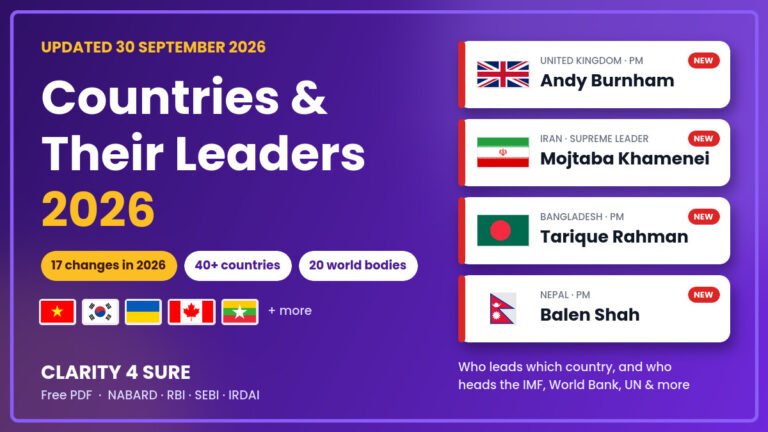 Free sheet · Static GKCountries & Their Leaders 2026Who leads which country in 2026, with all 17 changes marked. Get the article and the PDF free on WhatsApp.Get it free on WhatsApp →
Misc GA2
Lalit Kala Akademi National Exhibition of Art
- The 65th National Exhibition of Art showcased 6,175 artworks by 2,495 artists.
- The Lalit Kala Akademi announced 20 awards across visual art forms.
- Major categories included painting, sculpture, drawing, printmaking and mixed media.
- The exhibition was held at Rabindra Bhavan, New Delhi.
- Edward Rukidi Kijanangoma was crowned the 13th King (Omukama) of Tooro Kingdom, Uganda.
- He succeeded the late King Oyo Nyimba Kabamba Iguru Rukidi IV.
- He was selected by a 21-member Babiito clan committee.
- He adopted the regnal name Edward Rukidi Nyabongo I.
Social Issues3
International Day of the Deaf 2026
International Day for Universal Access to Information 2026
International Day of Awareness of Food Loss and Waste 2026