Daily Current Affairs (DCA) 09 & 10 August, 2026
Free live session
NABARD Grade A 2026: what the 2025 cut-offs changed, and the 90-day plan
Today · 7:30 PM IST
In the news5
Context: The Strategic Forces Command (SFC) successfully conducted a routine training launch of the Agni-IV intermediate-range ballistic missile off the coast of Odisha.
What It Is
- An indigenous, nuclear-capable, two-stage solid-fuelled Intermediate-Range Ballistic Missile (IRBM) with a strike range of about 4,000 km, serving as a core land-based component of India’s nuclear triad.
- Developed by: the Defence Research and Development Organisation (DRDO).
- Aim: to provide a highly mobile, survivable and precise land-based nuclear deterrent against regional strategic threats across Asia, strengthening India’s policy of Credible Minimum Deterrence and No First Use.
E-Samudra Platform
Context: The Union Minister for Ports, Shipping and Waterways launched E-Samudra, an integrated digital portal aimed at accelerating the digital transformation of India’s maritime administration.
What It Is
A comprehensive, single-window, Digital-First and Faceless portal designed to digitise and streamline administrative workflows across India’s maritime sector. It integrates services for seafarers, shipping companies, recruitment agencies, training institutes and port authorities under a unified digital framework.
| Parameter | Detail |
|---|---|
| Nodal Ministry | Ministry of Ports, Shipping and Waterways (MoPSW) |
| Implementing Agency | Directorate General of Maritime Administration (DGMA) |
| Strategic context | Aligned with Maritime India Vision 2030 and Maritime Amrit Kaal Vision 2047 |
Aim: to transition maritime governance from a paper-based office model to a transparent, predictable digital ecosystem, enhancing Ease of Living for Indian seafarers and Ease of Doing Business for maritime businesses.
Key Features
- Single-window digital governance — consolidates administrative workflows, online fee payments, real-time application tracking and digital certificate issuance into a single paperless portal.
- Digital Seafarers Employment Agreement (d-SEA) — verifiable digital employment agreements safeguarding contractual entitlements, transparent wages and labour standards for crew.
- Real-time seafarer tracking dashboard — monitors deployment, safety, location and welfare of Indian seafarers worldwide, regardless of vessel flag.
- 24×7 integrated grievance redressal (e-NAVIK) — connects seafarers directly with emergency response, medical help and grievance resolution, accessible onboard or ashore.
- Remote maritime access — the Digital-First and Faceless design allows seafarers deployed on high-seas vessels to access official services.
- Focus on inclusion and mental health — complements existing seafarer welfare programmes.
Context: The 8th edition of the Indian Navy–US Navy Explosive Ordnance Disposal (EOD) Exercise 2026 is scheduled to take place at the Southern Naval Command, Kochi, Kerala.
What It Is
A specialised bilateral military training exercise focused on underwater salvage, bomb disposal and explosive ordnance neutralisation. It forms part of the joint salvage and EOD series historically conducted under the SALVEX banner, initiated by both navies in 2005.
| Participant | Detail |
|---|---|
| India | Specialist diving and EOD teams of the Indian Navy, hosted at Southern Naval Command, Kochi |
| United States | Specialist diving and EOD technicians of the US Navy |
Aim: to enhance operational interoperability, deepen professional cooperation, and build tactical synergy between the specialist diving and EOD units of the two navies.
Context:
In Kenya’s Amboseli National Park ecosystem, a mystery unfolded following the sudden deaths of 15–16 African elephants within a single month. The Kenya Wildlife Service (KWS) launched an investigation after preliminary tests detected cyanide poisoning, likely linked to agrochemicals from nearby farms.
What It Is
Formerly the Maasai Amboseli Game Reserve, it is one of Kenya’s most famous national parks. Known as the “Land of Giants”, it is celebrated for large herds of free-ranging African elephants set against the backdrop of Mount Kilimanjaro.
| Aspect | Detail |
|---|---|
| Location | Kajiado County, southern Kenya, abutting the border with Tanzania |
| Drainage and basin | Protects a dried-up Pleistocene lake basin in a semi-arid savanna ecosystem |
| Gazetted as National Park | 1974 — originally a game reserve for the Maasai |
| UNESCO status | Man and Biosphere Reserve, 1991, recognising the coexistence of Maasai pastoralists, their livestock and wildlife |
Context: More than two-thirds of India’s registered nursing workforce are yet to be brought under the Nurses Registration and Tracking System (NRTS), despite the digital platform having been introduced over seven years ago. Government data tabled in the Lok Sabha show only 14.24 lakh of 46.02 lakh registered nursing personnel are enrolled, leaving 31.78 lakh outside the national system.
What It Is
A digital platform launched by the Indian Nursing Council (INC) in association with the National Informatics Centre (NIC) to maintain a live national register of nursing personnel and provide a common online platform for:
- Primary registration
- Renewal
- Reciprocal (inter-State) registration
- Higher qualification registration
- Other related services
Personnel covered: Auxiliary Nurse Midwives (ANMs), Registered Nurses and Registered Midwives (RN & RM), and Lady Health Visitors (LHVs). Enrolment leads to issue of a National Unique Identity (NUID) card.
Consequences of Incomplete Rollout
- Nurses wait months for No Objection Certificates (NOCs) required to change their place of employment.
- Those seeking overseas employment face delays in credential verification, affecting career opportunities and livelihoods.
- Duplication and delay: the Indian Professional Nurses Association (IPNA) contends that several State Nursing Registration Councils continue to process registration, renewal and reciprocal registration through their own systems, defeating the purpose of a centralised registry.
Agriculture2
How & Why Farmers Producers Organization are formed? FPO #fpo #upsc #nabardgradea #agriculturenotesTap to play · from the C4S channel
Context: An opinion piece arguing that the Self Help Group movement is the most significant innovation in the rural financial landscape in many decades, and that policymakers have misread its lessons. The core policy question posed: whether to nurture a system coming from the grassroots and allow it to grow naturally, or infuse growth hormones.
Self Help Groups (SHGs)
Self Help Groups are small, voluntary, community-based groups, usually comprising 10–20 members, who come together for savings, credit, livelihood activities and mutual support.
Key Features
- Members make regular savings and create a common fund.
- The group provides small loans to members, reducing dependence on informal moneylenders.
- SHGs promote financial inclusion, entrepreneurship and livelihood generation.
- They are an important tool for women’s economic empowerment in rural areas.
- SHGs are often linked with banks for access to formal credit.
What Made SHGs Work
- Savings first, not credit. The movement started with savings — a counter-intuitive initiative in a rural financial system where credit had always been the credo. This inversion is the movement’s foundational insight.
- Women at the centre. It targeted poor rural women, circumventing the patriarchal assumption that the male head of household should be at the centre of poverty intervention. The author argues this was not merely a gender argument but fundamentally a product-design argument.
How the SHG Model Works
- Members save small, fixed amounts regularly, usually weekly or monthly.
- Savings are collected during local group meetings.
- The accumulated fund is used to provide loans to members.
- Loans are provided based on mutual trust and group-based decision-making.
- SHGs effectively function as local financial institutions.
- Later, bank linkage enabled SHGs to access larger institutional loans.
Key Lesson — Savings First
The article challenges the idea that poor households cannot save.
Poor households generally value:
- Safety
- Proximity
- Easy transactions
- Regular savings
- Trust
The success of SHGs shows that small and regular savings can become an important source of financial security.
Problem with the Current Approach
Excessive focus on subsidised credit, grants and external funding can weaken the original savings-led model.
- SHGs may accumulate funds but have limited productive lending.
- Defaults can restrict further lending.
- Excessive dependence on external credit can reduce the importance of members’ own savings.
Innovative Example — Insurance + Savings
An SHG in Ananthapur, Andhra Pradesh, developed an approach to make insurance more accessible:
- Members opted for an annual insurance policy.
- The group provided an interest-free loan to pay the annual premium.
- The premium was effectively converted into a monthly savings-like arrangement.
- Group profits were also used to support members.
Context: The Union Cabinet’s decision to extend PM-KISAN for five years from 2026-27 to 2030-31 is an expected continuation of a programme providing annual income support to farmers. The editorial argues the extension is an opportunity to reorient the scheme — specifically, to extend it to tenant and landless farmers and to use its architecture to reform the fertiliser subsidy.
PM-KISAN — Current Position
- Provides ₹6,000 annually to eligible farmers in three instalments.
- Uses Aadhaar authentication and digital verification.
- Around 95 million farmers have benefited.
- The scheme has been extended for five years from 2026-27 to 2030-31.
- The annual support has remained at ₹6,000 since the scheme began.
Key Issue — Tenant Farmers
PM-KISAN primarily covers land-owning farmers, with eligibility linked to land records.
However:
- India has a large number of tenant farmers and landless cultivators.
- Tenant farmers are vulnerable to rising input costs and climate-related risks.
- They often have limited access to institutional credit and government support.
- Excluding them creates a gap between land ownership and actual cultivation.
Suggested solution: State-level verification can be used to identify genuine cultivators and extend support to eligible tenant farmers.
Linking Fertiliser Subsidy with PM-KISAN
The editorial proposes using PM-KISAN’s existing JAM and DBT infrastructure for fertiliser subsidy delivery.
Under the proposed approach:
- Fertiliser requirements could be estimated based on landholding and crop patterns.
- Subsidy could be transferred directly to farmers.
- This could reduce dependence on the current system of routing subsidies through fertiliser producers.
- Better targeting could reduce leakages and misuse.
- It could also address the excessive use of subsidised urea.
Every day of the month in one file. Enter your details once — the download opens right away.
We already have your details, so no form: tap to open.
Download the August 2026 PDFDownload the August 2026 revision sheet PDFFacts To Remember15
Squadron Leader Bhawana Kanth Becomes IAF’s First Woman Fighter Combat Leader
In August 2026, Squadron Leader Bhawana Kanth became the first woman fighter pilot of the Indian Air Force to complete the Fighter Combat Leader (FCL) course at TACDE, Gwalior. She became the first woman graduate of the IAF’s elite “Top Gun” school. The 20-week course trains selected pilots to lead complex air combat and tactical missions.
LASPL and Massivit Sign MoU for India’s First Large-Format Additive Manufacturing Facility
In August 2026, Lohia Aerospace Systems Private Limited (LASPL) signed an MoU with Israel-based Massivit to establish India’s first commercial large-format additive manufacturing facility in Kanpur, Uttar Pradesh. The project involves an investment of USD 8–10 million over 1–2 years. It will support aerospace and defence manufacturing through advanced 3D-printing technology.
RBI Expands Upper-Layer NBFC List to 17 for FY27
In August 2026, the Reserve Bank of India (RBI) identified 17 NBFCs for inclusion in the Upper Layer (NBFC-UL) for FY 2026–27. The number increased from 15 in January 2025. REC, PFC, IRFC and HUDCO were added to the list, while Tata Sons continued as an upper-layer NBFC.
RBI Extends Loan Recovery Norms Deadline to January 1, 2027
In August 2026, the RBI extended the implementation deadline for its revised framework on loan recovery and recovery agents from October 1, 2026 to January 1, 2027. Existing recovery agents not previously covered will receive a transition period to obtain certification from IIBF or an institute having a tie-up with IIBF. Certain bank employees, regular instalment collectors and assisting law firms are exempted.
SBI Life Partners with J&K Bank to Offer Insurance Solutions Across India
In August 2026, SBI Life Insurance Company entered into a corporate agency partnership with Jammu & Kashmir Bank. The partnership will distribute SBI Life’s protection, savings, retirement and child insurance products through J&K Bank’s branch network. It aims to improve insurance penetration and financial inclusion in line with the vision of Insurance for All by 2047.
Standard Chartered Gets IFSCA Approval for Wealth Management Services from GIFT City
In August 2026, Standard Chartered Bank received approval from IFSCA to offer wealth management products and services through its GIFT City branch. The approval will allow the bank to provide retail wealth management, capital-market products and other financial solutions. It further strengthens GIFT IFSC as an international financial hub.
 Scheme to knowBanking Related Government Schemesn1. Pradhan Mantri Jan Dhan Yojna Pradhan Mantri Jan Dhan Yojana is National Mission under the ministry of Finance on…
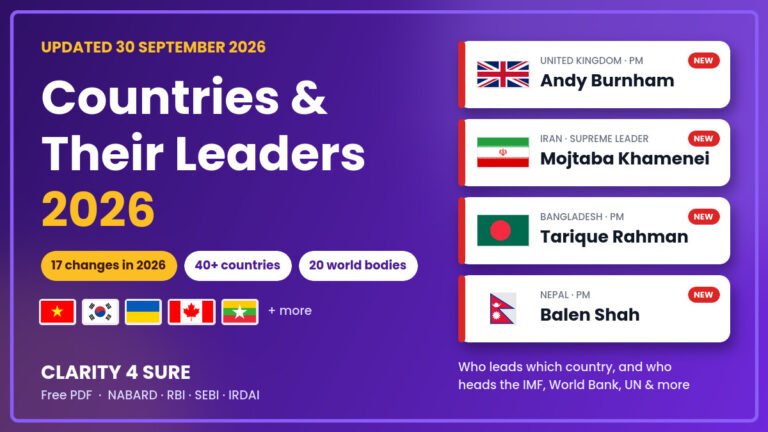 Free sheet · Static GKCountries & Their Leaders 2026Who leads which country in 2026, with all 17 changes marked. Get the article and the PDF free on WhatsApp.Get it free on WhatsApp →
Indian Bank Approves Rs 500 Crore MSME Loans During Credit Outreach Programme
In August 2026, Indian Bank approved nearly Rs 500 crore in MSME loans to 128 beneficiaries during its Credit Outreach Programme. The bank also mobilised credit proposals worth around Rs 1,250 crore. The programme included the launch of a Unified MSME Portal enabling digital lending through PAN, GST and Udyam Registration data.
Kroll Report 2025: Shah Rukh Khan Tops Indian Celebrity Brand Rankings
In August 2026, Kroll released its 11th Celebrity Brand Valuation 2025 report, ranking Shah Rukh Khan as India’s most valuable celebrity with a brand value of USD 177.9 million. Ranveer Singh ranked second at USD 162.9 million, while Virat Kohli ranked third at USD 158.4 million. The combined brand value of India’s top 25 celebrities stood at around USD 2 billion.
India Successfully Test-Fires Agni-4 Missile from Chandipur, Odisha
In August 2026, India successfully conducted the flight test of the Agni-4 Medium-Range Ballistic Missile from Chandipur, Odisha. The test was carried out by the Strategic Forces Command (SFC) in collaboration with DRDO. The two-stage, solid-fuel missile has an approximate range of 4,000 km and can carry a payload of up to 1,000 kg.
R Praggnanandhaa Wins Maiden Saint Louis Rapid & Blitz Title
Indian Grandmaster R Praggnanandhaa won his maiden Saint Louis Rapid & Blitz title in the United States, held from July 31 to August 7, 2026. He finished with 23.5 points, winning the rapid section and maintaining his lead in blitz. The tournament was the fourth leg of the 11th Grand Chess Tour.
England Pacer John Turner Announces Retirement from Professional Cricket
In August 2026, England fast bowler John Turner announced his retirement from professional cricket at the age of 25. A prolonged back stress fracture and recurring injuries ended his five-year career. He represented England in 2 ODIs and 2 T20Is and took 97 wickets in 51 domestic matches for Hampshire.
National Handloom Day is observed annually on August 7 to honour India’s handloom weavers and highlight the sector’s contribution to socio-economic development. The Government declared August 7 as National Handloom Day in 2015 to commemorate the Swadeshi Movement of 1905. The 12th National Handloom Day was celebrated in New Delhi in 2026.
Quit India Movement Day 2026 – August 8
Quit India Movement Day, also known as August Kranti Diwas, is observed on August 8 to commemorate the launch of the Quit India Movement in 1942. Mahatma Gandhi gave the historic “Do or Die” call during the movement. Aruna Asaf Ali became an iconic figure after hoisting the national flag at Gowalia Tank Maidan.
Nagasaki Day is observed annually on August 9 to commemorate the atomic bombing of Nagasaki, Japan, in 1945 during World War II. In 2026, the world marked the 81st anniversary of the bombing. The US B-29 bomber Bockscar dropped the plutonium-based “Fat Man” atomic bomb on the city.
The International Day of the World’s Indigenous Peoples is observed annually on August 9 to recognise the rights, cultures, traditions and knowledge systems of indigenous communities. The UN proclaimed the day in 1994, with the first observance held in 1995. The 2026 theme is “Honouring Indigenous Midwives: Safeguarding Life and Well-being.”