
Daily Current Affairs (DCA) 07 & 08 August, 2026
Free live session
NABARD Grade A 2026: what the 2025 cut-offs changed, and the 90-day plan
The 2025 cycle was the toughest on record at every stage. This session reads those numbers properly and turns them into a week-by-week plan for Phase 1.
Today · 7:30 PM IST · 75 minutes · free
In the news4
Context: The Ministry of Road Transport and Highways (MoRTH) issued a draft notification proposing amendments to the Central Motor Vehicles Rules, 1989, to introduce Vehicle-to-Vehicle communication technology in Indian vehicles.
What It Is
- An advanced wireless communication framework enabling nearby motor vehicles to continuously broadcast and receive real-time data on speed, location, direction, acceleration and braking status.
- Unlike traditional sensors — cameras and radar — which require a direct line of sight, V2V enables proactive accident prevention by warning drivers about hazards beyond their visual range.
- Aim: to reduce road fatalities and accidents by complementing existing Advanced Driver Assistance Systems (ADAS), expanding situational awareness, and building a foundation for broader Intelligent Transportation Systems (ITS).
How It Works
- On-Board Units (OBUs): factory-fitted units continuously transmit low-latency data packets containing GPS coordinates, velocity, trajectory and status alerts.
- Peer-to-peer data mesh: transmissions occur directly between nearby vehicles within a range of several hundred metres, without relying on cellular towers or cloud servers.
- Real-time risk computation: an onboard processor analyses received data against the host vehicle’s own vector, calculating collision risk within milliseconds and triggering visual, audio or haptic warnings before the hazard is visible.
Context: On International Clouded Leopard Day (observed 4 August), the Ministry of Environment, Forest and Climate Change launched the Clouded Leopard Conservation Action Plan (CAP).
About the Conservation Action Plan
- A comprehensive, multi-state strategic framework to secure habitats, restore ecological corridors, standardise population assessments, and empower local communities for the species’ long-term survival in India.
- Aim: to halt population decline, protect critical forest landscapes across Northeast India, establish reliable population baselines through advanced science, and mitigate human-wildlife conflict outside formal protected areas.
About the Species
The Clouded Leopard (Neofelis nebulosa) is an evolutionarily ancient, medium-sized wild cat bridging the gap between big cats (Panthera) and small cats (Felinae). Molecular research suggests it branched from the Pantherinae lineage over 6 million years ago, making it one of the most ancient living feline species.
Distribution and habitat
- Found from Nepal, Bhutan, Bangladesh and Northeast India through Southeast Asia (Indochina, Sumatra, Borneo) to southern China.
- Prefers lowland dense tropical rainforest, but adapts to dry woodlands, mangrove swamps (in Borneo), and Himalayan foothill forests up to 2,743 metres.
Conservation and legal status
| Framework | Status |
|---|---|
| IUCN Red List | Vulnerable |
| Wild Life (Protection) Act, 1972 | Schedule I |
| CITES | Appendix I |
Context: India concluded its Commonwealth Games 2026 campaign in Glasgow, Scotland, with a tally of 39 medals, finishing fourth overall.
About the Games
| Detail | Particulars |
|---|---|
| Edition | 23rd Commonwealth Games |
| Host | Glasgow, Scotland |
| Dates | 23 July – 2 August 2026 |
| Mascot | Finnie |
| Indian contingent | 122 athletes across 10 sports |
| Opening ceremony flag-bearer | Mirabai Chanu; baton-bearer Lovlina Borgohain |
| Closing ceremony flag-bearer | Jaismine Lamboria |
| Host for 2030 | Ahmedabad, Gujarat, India |
India’s Medal Tally
| Medal | Count |
|---|---|
| Gold | 13 |
| Silver | 17 |
| Bronze | 9 |
| Total | 39 — ranked 4th |
Sport-wise breakdown
| Sport | Gold | Silver | Bronze | Total |
|---|---|---|---|---|
| Boxing | 7 | 3 | 0 | 10 |
| Athletics | 0 | 5 | 5 | 10 |
| Weightlifting | 1 | 6 | 1 | 8 |
| Para Athletics | 3 | 2 | 1 | 6 |
| Judo | 2 | 1 | 1 | 4 |
| Para Powerlifting | 0 | 0 | 1 | 1 |
Note: some circulating tables give Para Athletics 2 golds and Athletics 7 silvers — the correct figures are Para Athletics 3 golds and Athletics 5 silvers and 5 bronzes.
India’s Gold Medallists
| Athlete | Event |
|---|---|
| Mirabai Chanu | Women’s 48 kg Weightlifting — a historic hat-trick of CWG golds |
| Preeti Pawar | Women’s 54 kg Boxing |
| Jaismine Lamboria | Women’s 57 kg Boxing |
| Sakshi Chaudhary | Women’s 51 kg Boxing |
| Priya Ghanghas | Women’s 60 kg Boxing |
| Arundhati Choudhary | Women’s 70 kg Boxing |
| Sachin Siwach | Men’s 60 kg Boxing |
| Ankush Panghal | Men’s 80 kg Boxing |
| Dilip Gavit | Men’s 100 m T47 Para Athletics |
| Soman Rana | Men’s Shot Put F57 Para Athletics |
| Sharmila Dhankar | Women’s Shot Put F57 Para Athletics |
| Asmita Dey | Women’s -48 kg Judo — first-ever individual judo gold |
| Harsh Singh | Men’s -60 kg Judo |
Records and Context
- Boxing delivered a record 10 medals including seven golds — the most won by any nation in the sport at a single Commonwealth Games.
- India recorded its best-ever judo performance at a single Games — three medals including its first-ever judo gold.
- Lovlina Borgohain, the Olympic medallist, added silver in the women’s 75 kg boxing category.
Context: The Union Cabinet approved the National Circular Bioenergy Scheme – GOBARdhan, with an outlay of ₹23,731 crore, to catalyse the growth of compressed biogas (CBG).
What It Is
GOBARdhan — Galvanising Organic Bio-Agro Resources Dhan — a scheme to raise domestic CBG production almost tenfold through assured offtake, administered pricing, capital subsidies, pipeline infrastructure and easier access to finance.
| Parameter | Detail |
|---|---|
| Outlay | ₹23,731 crore |
| Period | FY 2026-27 to FY 2035-36 |
| Administering Ministry | Petroleum and Natural Gas |
| Feedstock | Agricultural residue, cattle dung, sugar industry press mud, municipal organic waste and other biomass |
| Output | CBG, blended into CNG (transport) and PNG (domestic); plus organic manure |
Origin: GOBARdhan was originally launched under the Swachh Bharat Mission (Grameen) in 2018 as a solid and liquid waste management component. It has now been recast as a national clean-energy and circular-economy programme.
Objective
- Convert cattle dung, agricultural residues and other organic waste into Compressed Biogas (CBG) and organic manure.
- Increase domestic CBG production by nearly 10 times.
- Reduce dependence on imported natural gas and strengthen energy security.
- Promote waste-to-wealth and a circular bioeconomy.
- Mobilise large-scale private investment and generate rural employment.
The Six Growth Engines
- Assured CBG offtake — procurement by City Gas Distribution entities.
- Stable, administered CBG pricing.
- Capital assistance for plants.
- Pipeline infrastructure development.
- Credit guarantee support.
- CBG Ecosystem Challenge Fund.
Banking/Finance5
How & Why Farmers Producers Organization are formed? FPO #fpo #upsc #nabardgradea #agriculturenotesTap to play · from the C4S channel
Context: The Closing Auction Session was introduced by Indian stock exchanges for cash market stocks with derivatives, following SEBI’s directive of 16 January 2026. It became effective from 3 August 2026, launched simultaneously by the NSE and BSE.
What It Is
- A dedicated 20-minute daily auction mechanism in the cash market segment for equity stocks on which derivative (F&O) contracts are available. Instead of computing closing prices through continuous trade averages, CAS aggregates buy and sell orders to discover a single, fair equilibrium closing price.
- Aim: to curb end-of-day price manipulation, improve price discovery, align Indian equity markets with global best practices, and deliver more accurate benchmark values for mutual funds, ETFs and derivatives settlement.
How It Works
| Phase | Timing | What happens |
|---|---|---|
| Phase 1 — Transition and Reference Price | 3:15 – 3:20 PM | Continuous trading ends for eligible F&O stocks. A reference price is computed from the VWAP of trades between 3:00 and 3:15 PM, with a strict ±3% price band |
| Phase 2 — Order Entry | 3:20 – 3:30 PM | 3:20–3:25 PM: market and limit orders may be placed, modified or cancelled. 3:25–3:30 PM: only limit orders accepted; market orders cannot be altered or cancelled. The window closes at a random time between 3:28 and 3:30 PM to prevent order spoofing |
| Phase 3 — Order Matching and Price Discovery | 3:30 – 3:35 PM | Orders matched at a single equilibrium price maximising executable volume; market orders get execution priority over limit orders |
Context:
The Reserve Bank of India (RBI) is set to resume licensing of urban cooperative banks (UCBs), after a pause of more than two decades, as part of developing a vibrant co-operative sector.
The Legal Basis
Licensing of UCBs is the regulatory authorisation granted by the RBI under Section 22 read with Section 56 of the Banking Regulation Act, 1949. It empowers primary cooperative credit societies to conduct banking — accepting public deposits and granting credit — in urban and semi-urban areas.
Section 56 is the provision that applies the Banking Regulation Act to cooperative societies with modifications.
Regulatory Timeline
| Year | Development |
|---|---|
| 1966 | UCBs brought under RBI’s regulatory ambit via amendments to the BR Act |
| May 1993 – June 2001 | Liberalised licensing era — over 820 new UCB licences issued |
| 2004 | RBI suspended new UCB licensing following widespread failures |
| January 2026 | RBI released a comprehensive Discussion Paper on reopening licensing |
| August 2026 | Governor announced draft guidelines for on-tap licensing based on stakeholder feedback |
Why Licensing Was Halted in 2004
- Widespread insolvency: nearly 31% of UCBs licensed during the 1990s liberalisation turned financially unsound within a short period, owing to poor credit appraisal and rapid unviable expansion.
- Governance failures and frauds: the Madhavpura Mercantile Cooperative Bank crisis (2001) — linked to the Ketan Parekh stock scam — exposed severe corporate governance deficits, conflict of interest and insider lending.
- Dual regulation gaps: banking operations were supervised by the RBI while administrative and managerial oversight rested with State Registrars of Cooperative Societies, creating enforcement delays and supervisory loopholes.
Why a Restart Is Now Feasible
- Strengthened statutory powers: the Banking Regulation (Amendment) Act, 2020 gave the RBI direct powers over UCB management, board constitution and resolution — effectively closing the dual-regulation loophole.
- Four-tier prudential framework: deposit-based tiered regulatory standards (Tiers 1 to 4) in force since December 2022, ensuring calibrated risk oversight.
- Improved sector balance sheets: gross NPAs of UCBs fell to a six-year low of ₹21,769 crore in FY26, with higher provisioning coverage ratios and capital buffers.
- Institutional backing: the National Urban Cooperative Finance and Development Corporation (NUCFDC), established in 2024, offers shared technology platforms, liquidity support and capital mobilisation for UCBs.
Practice MCQs
Q1. With reference to the licensing of Urban Cooperative Banks, consider the following statements:
a. Licensing is granted under Section 22 read with Section 56 of the Banking Regulation Act, 1949.
b. UCBs were brought under the RBI’s regulatory ambit in 1966.
c. Over 820 new UCB licences were issued between 1993 and 2001.
d. The RBI suspended fresh UCB licensing in 2004.
How many of the above statements are correct? (a) Only one (b) Only two (c) Only three (d) All four (e) None
Answer Key
- (d) — All four are correct. Section 56 is the key provision — it applies the Banking Regulation Act to cooperative societies with modifications.
Exam Relevance
RBI Grade B — Very high relevance. Master the four-tier framework (Tier 1: deposits up to ₹100 crore; Tier 2: ₹100–1,000 crore; Tier 3: ₹1,000–10,000 crore; Tier 4: above ₹10,000 crore), the 2020 Amendment’s specific powers, NUCFDC’s role, and the Madhavpura episode as the reference failure.
Context: The Lok Sabha passed the Bankers’ Books Evidence Bill, 2026 by voice vote amid Opposition protests. Introduced by the Finance Minister on 3 August 2026, it replaces the 135-year-old colonial-era Bankers’ Books Evidence Act, 1891, aligning legal evidence standards with modern digital, virtual and cloud-based banking.
What It Is
- A framework regulating how bank records are admitted as valid evidence in legal proceedings. It allows certified physical and electronic extracts of bank records to be presented in court without requiring original ledgers or summoning bank officials as routine witnesses.
- Aim: to modernise India’s banking evidence law, incorporate technology-neutral provisions for digital records, speed up judicial proceedings in financial disputes, and reduce operational burdens on banking personnel.
Key Features
- Expanded definition of “bankers’ books” — broadened beyond paper ledgers to cover all record formats, including electronic, digital, virtual and cloud-based databases.
- Admissibility and integrity conditions for electronic records — enforceable provided they:
- are a true representation of the data,
- show no unauthorised data changes, and
- reflect no system tampering.
- Standardised digital certification — electronic records submitted to courts must carry a technical certificate detailing the generating computer system, authenticated by manual or digital signatures of designated branch or office heads.
- Protection against compulsory court attendance — bank officers cannot be compelled to produce original books or appear as witnesses where the bank is not a party, unless ordered by a judge for a strictly defined special cause.
- Power to extend coverage — empowers the Central Government to extend the Act to other financial sector institutions by notification.
Context: The Reserve Bank of India has proposed a revised framework governing how commercial banks must set aside capital against the risk of losses on their derivative trades, replacing rules in place since 2011. Comments have been invited until 28 August, with the rules proposed to take effect from 1 April 2027.
Applicability: all commercial banks, excluding small finance banks, payments banks and local area banks.
What CVA Is
Credit Valuation Adjustment (CVA) is an adjustment banks make to the price of a derivative contract to account for the possibility that the counterparty on the other side of the trade could default. The capital charge ensures banks set aside enough capital to cover such potential losses.
In simple terms: if a bank enters a ten-year interest rate swap with a corporate, the swap may be worth money to the bank — but only if the corporate is still solvent when payment falls due. CVA is the value the bank subtracts to reflect that risk, and the CVA capital charge is the buffer held against the risk that this adjustment itself moves adversely as the counterparty’s credit quality deteriorates.
Why the Change
- The existing framework was based on Basel Committee on Banking Supervision (BCBS) standards issued in 2010.
- The BCBS has since revised its guidelines as part of the final Basel III framework, prompting the RBI to update its rules to align with global standards.
The Proposed Approach
Banks must use the Basic Approach for CVA (BA-CVA), with a choice between two versions:
| Version | Feature | Suited to |
|---|---|---|
| Reduced BA-CVA | Does not recognise any hedges taken against CVA risk | Banks that do not hedge this risk |
| Full BA-CVA | Allows banks to factor in eligible hedges — such as single-name and index credit default swaps — provided they meet specific conditions linking the hedge to the counterparty | Banks that actively hedge CVA risk |
The Simplified Treatment for Smaller Books
- Banks whose aggregate notional amount of non-centrally cleared derivatives is ₹10 trillion or less may skip the BA-CVA computation altogether.
- Instead, they may set their CVA capital requirement equal to 100% of their capital requirement for counterparty credit risk.
- Such banks cannot recognise any CVA hedges under this simpler treatment.
- The RBI’s supervisory arm can deny a bank this option if it finds the bank’s CVA risk material to its overall risk profile.
Background Concepts
- Derivative: a contract whose value derives from an underlying asset, rate or index — interest rate swaps, currency forwards, credit default swaps.
- Counterparty credit risk: the risk that the other party to a derivative defaults before final settlement. Distinct from ordinary credit risk because the exposure varies with market movements and can be positive or negative.
- Central clearing: trades routed through a central counterparty (in India, the Clearing Corporation of India Ltd) are far less risky, since the CCP guarantees performance. This is why the ₹10 trillion threshold applies specifically to non-centrally cleared derivatives — those are where CVA risk actually resides.
- Credit default swap (CDS): a contract that pays out if a specified entity defaults — effectively insurance against counterparty failure, and hence an eligible CVA hedge.
- Basel III: the post-2008 global regulatory framework covering capital adequacy, leverage and liquidity, issued by the BCBS, which is hosted by the Bank for International Settlements at Basel.
Exam Relevance
RBI Grade B — Very high relevance for Phase II Paper III. This is core prudential regulation and precisely the technical territory RBI papers reward.
Context: The Reserve Bank of India released a list of 17 large (Upper Layer) non-banking finance companies for 2026-27, which included Tata Sons — subjecting them to enhanced regulatory norms for at least five years and mandatory listing within three years of identification. The RBI added that Tata Sons’ status “is without prejudice to the outcome of its application for de-registration, which is under examination.”
Scale-Based Regulation
Scale-Based Regulation (SBR) is a regulatory approach in which financial institutions are regulated according to their size, complexity, interconnectedness and risk profile, rather than applying identical rules to every institution.
Under the RBI’s Scale Based Regulation (SBR) framework, NBFCs are placed in four layers, with regulatory intensity rising by size, activity and perceived risk.
| Layer | Composition |
|---|---|
| Base Layer (NBFC-BL) | Smaller, non-deposit-taking NBFCs below the asset threshold |
| Middle Layer (NBFC-ML) | Deposit-taking NBFCs, HFCs, IFCs, IDFs, SPDs and larger non-deposit-taking NBFCs |
| Upper Layer (NBFC-UL) | NBFCs specifically identified annually by the RBI as warranting enhanced regulatory requirements |
| Top Layer (NBFC-TL) | Ordinarily empty; populated only if the RBI judges a substantial increase in systemic risk from specific UL NBFCs |
Consequences of UL classification
- Enhanced regulatory norms for a minimum of five years, even if the NBFC later falls below the parametric benchmarks.
- Mandatory listing within three years of identification.
- Additional requirements including a Common Equity Tier 1 ratio, large exposure norms, differential provisioning, an independent compliance function, and internal capital adequacy assessment.
Every day of the month in one file. Enter your details once — the download opens right away.
We already have your details, so no form: tap to open.
Download the August 2026 PDFDownload the August 2026 revision sheet PDFAgriculture3
Context: Digital Green India launched an upgraded version of its FarmerChat app, even as the number of users of the AI-powered farming advisory app crossed 10 lakh, spanning farmers and frontline extension workers across the country.
What It Is
An AI-powered farming advisory application offering trusted, hyperlocal guidance to farmers, developed by Digital Green India. It provides timely, context-aware advice across a farmer’s decisions — from crop and pest management to livestock care and weather — even in low-connectivity environments.
Key Features
- Conversational interface — farmers can ask questions by voice, photo or text, accommodating low literacy and the reality that many field problems are easier to photograph than to name.
- Coverage across the farming cycle — crop planning, pest and disease management, livestock care, weather forecasts and inputs.
- Technology stack — fine-tuned language models combined with Retrieval-Augmented Generation (RAG) and expert-validated datasets, refined through Reinforcement Learning from Human Feedback (RLHF).
- What 2.0 adds — saves farmer preferences, such as speaking to the digital assistant or uploading photographs of field problems.
Exam Relevance
NABARD Grade A — High relevance for Phase II Paper II. Agricultural extension, digital agriculture and women’s participation in agriculture are core themes. Retain the figures (10 lakh users, 5 languages, 30 lakh queries, 45% women, ₹33 per farmer per year) and the extension-reach argument.
Context: The Indian Council of Agricultural Research announced that it has developed India’s first fully annotated telomere-to-telomere (T2T) reference genome of pigeonpea (Cajanus cajan L. Millsp.), variety ‘Asha’.
What It Is
A complete, gap-free genome sequence covering every chromosome from one telomere to the other, including the centromeres — as distinct from a draft genome, which leaves gaps in repetitive regions that older sequencing technology could not resolve.
| Parameter | Detail |
|---|---|
| Developed by | ICAR–National Institute for Plant Biotechnology (NIPB), New Delhi |
| Size | 752.65 million base pairs |
| Chromosomes covered | All 11, including centromeres and telomeres |
| Assembly designation | NIPB_CcT2T_4, deposited in the global database NCBI |
Why a T2T Genome Is Different
- A draft genome sequences the readable parts of the DNA and leaves gaps wherever the sequence becomes repetitive — precisely where centromeres and telomeres sit. Short-read sequencing cannot resolve long stretches of near-identical repeats.
- A T2T assembly closes those gaps, reading each chromosome continuously end to end. The 92 contigs for 11 chromosomes indicates near-complete chromosome-level assembly, and the 99.9% transcriptome read alignment is the accuracy check — nearly every RNA sequence maps cleanly onto the assembly.
- Why the gaps mattered: centromeric and repetitive regions govern chromosome segregation, recombination frequency and the behaviour of large gene families — including many disease-resistance genes, which cluster in repeat-rich regions. A breeder working from a draft was effectively blind in exactly the areas where stress-tolerance and resistance traits often reside.
The Institutional Track Record
- 2011 — ICAR–NIPB published the world’s first draft genome of pigeonpea variety ‘Asha’ — the first crop genome sequenced entirely in India.
- 2017 — an improved draft genome was published.
- Now — the fully annotated T2T assembly.
Why Pigeonpea Matters
Popularly known as Arhar or Tur, it is one of India’s most important pulse crops and a major source of dietary protein, central to food and nutritional security. India remains a net importer of pulses.
Context: The Union government is considering a separate legislation to protect the rights of women farmers, on the lines of the Maharashtra Women Farmers Empowerment Act, 2026, said S. Mahendra Dev, Chairman of the Economic Advisory Council to the Prime Minister, in Chennai. He was speaking at the inauguration of a conference on “Building Gender-just Food, Land and Water Systems” at the M.S. Swaminathan Research Foundation (MSSRF).
The Core Problem
- For decades, the word “farmer” in government records meant the person who owns the land. Since agricultural land is predominantly registered in the names of male family members, women who sow, transplant, weed, harvest, rear livestock and handle post-harvest processing remained legally invisible — and therefore ineligible for institutional credit, subsidies, crop insurance, extension services and most farmer-centric schemes.
- In Maharashtra, women hold only about 15.5% of operational farmland, though they perform a large share of agricultural labour.
The Maharashtra Model
| Feature | Detail |
|---|---|
| Status | First Indian State law dedicated to women farmers; passed unanimously by the Legislative Assembly and later the Legislative Council |
| Introduced by | Agriculture Minister Dattatraya Bharane |
| Core instrument | Woman Farmer Certificate — formal recognition as a farmer irrespective of land ownership |
| Benefits unlocked | Government welfare schemes, agricultural subsidies, institutional credit, crop insurance, extension services and financial assistance |
| Institutions created | Women Farmers Database; Maharashtra State Fund for Women Farmers; Women Farmers Empowerment Cell; Women Farmers Empowerment Council; State Monitoring Committee |
| Local role | Gram Panchayats and local institutions identify eligible women farmers and facilitate certification |
| Definition of agriculture | Broad — crop cultivation, seed production, animal husbandry, poultry, dairy, livestock rearing, apiculture, fisheries, aquaculture, sericulture, vermiculture, horticulture, floriculture, mushroom cultivation and agro-forestry |
The Fund receives grants from the Central and State Governments, donations and other sources, and involves recurring expenditure from the Consolidated Fund of the State.
Exam Relevance
NABARD Grade A — Very high relevance for Phase II Paper II. Women in agriculture, land rights, Kisan Credit Card access and Self-Help Group linkage are core themes, and NABARD directly finances women’s SHGs and Joint Liability Groups — the standard workaround for cultivators without land title. Retain the 15.5% operational holding figure, the certificate mechanism, and the institutions created under the Maharashtra Act.
Facts To Remember35
Cabinet Approves GOBARdhan National Circular Bioenergy Scheme
The Union Cabinet approved the GOBARdhan National Circular Bioenergy Scheme with a total outlay of ₹23,731 crore to promote clean energy and rural prosperity. The scheme is expected to generate around 1.5 lakh jobs and strengthen India’s circular bioeconomy.
India Successfully Test-Fires Agni-4 Ballistic Missile
India successfully test-fired the Agni-4 medium-range ballistic missile from the Integrated Test Range at Chandipur, Odisha. The Defence Ministry said the launch successfully validated all operational and technical parameters.
Lok Sabha Passes Bankers’ Books Evidence Bill, 2026
The Lok Sabha passed the Bankers’ Books Evidence Bill, 2026, providing legal recognition to electronic and digital records of bankers’ books as evidence. The legislation seeks to modernise the legal framework governing banking records.
India Launches Clouded Leopard Conservation Action Plan
India launched a dedicated Conservation Action Plan for Clouded Leopards on International Clouded Leopard Day to strengthen habitat protection, scientific monitoring and community participation. The initiative focuses on conserving the species across Northeast India.
Tri-Services Future Warfare Course Begins in New Delhi
The 4th Tri-Services Future Warfare Course commenced in New Delhi under the Headquarters Integrated Defence Staff. The four-week programme aims to enhance jointness and prepare military officers for emerging and future warfare challenges.
India Wins 39 Medals at Glasgow Commonwealth Games 2026
India finished fourth at the Glasgow Commonwealth Games 2026 with 39 medals, including 13 gold, 17 silver and 9 bronze. Australia topped the medal table with 171 medals, while Glasgow handed over the Commonwealth Games baton to Ahmedabad, host of the 2030 edition.
India’s Economy Likely to Grow Around 7% in Q1 FY27
According to SBI Research, India’s economy is likely to grow by around 7% in Q1 FY27, supported by stronger economic indicators, industrial activity and recovering exports. The estimate is higher than the RBI’s earlier projection of 6.6%.
Air Marshal Tejpal Singh Takes Charge as Deputy Chief of Air Staff
Air Marshal Tejpal Singh assumed charge as the Deputy Chief of the Air Staff of the Indian Air Force. His appointment comes as part of the senior leadership changes within the IAF.
Indian Army Launches Indigenous Xtreme Weather Grade Diesel
Chief of Army Staff General Dhiraj Seth launched indigenously developed Xtreme Weather Grade Diesel in New Delhi. Developed jointly by the Indian Army and oil marketing companies, the specialised fuel is designed to improve the mobility and operational availability of military vehicles in extreme weather conditions.
Delhi Government Launches STEM Innovation Lab
Delhi Chief Minister Rekha Gupta inaugurated a STEM Innovation Lab at Sarvodaya Vidyalaya in Pitampura to promote experiential learning in Science, Technology, Engineering and Mathematics. The initiative aims to equip government-school students with skills needed for an innovation-driven future.
PM Modi Calls for Promotion of Indian Handloom
Prime Minister Narendra Modi urged citizens to promote Indian handloom products ahead of National Handloom Day on August 7. He also recalled the Swadeshi Movement of 1905, highlighting the cultural and economic significance of India’s handloom sector.
U.S. Senate Passes Bill Threatening 100% Tariff on India
The U.S. Senate passed the Lindsey O. Graham Sanctioning Russia and Iran Act, 2026, which could impose tariffs of up to 100% on countries continuing to import Russian oil under specified conditions. India faces potential exposure as one of the major importers of Russian crude oil.
IRDAI Seeks Monthly Insurance Data for Index of Service Production
The IRDAI directed insurers, excluding reinsurers, to submit monthly data on premium income, investment income and claims paid for the preparation of the Index of Service Production (ISP). The move will strengthen the availability of data for measuring activity in the insurance sector.
Odisha to Launch Five Food Parks at Investor Summit
The Odisha Government will launch five food parks at the Odisha Food Pro 2026 investors’ meet in New Delhi. The state is targeting around ₹10,000 crore in investments and more than 20,000 jobs through the initiative.
 Scheme to knowPM-WANI Scheme: Public Wi-Fi Framework, Four Components and Exam FactsPM-WANI (Prime Minister's Wi-Fi Access Network Interface) is the Department of Telecommunications' framework, approved…
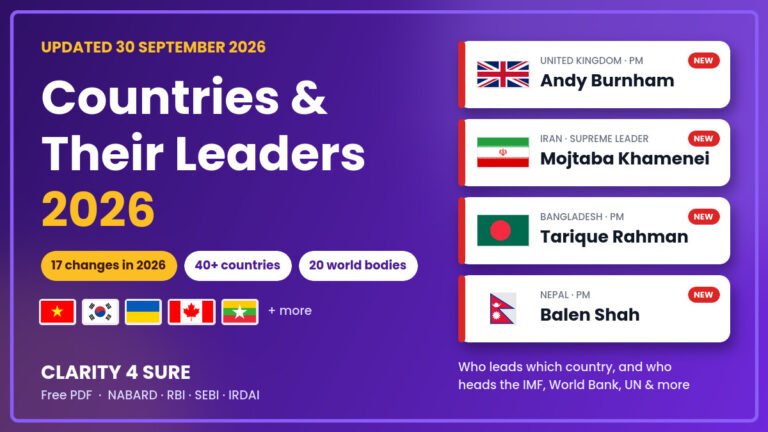 Free sheet · Static GKCountries & Their Leaders 2026Who leads which country in 2026, with all 17 changes marked. Get the article and the PDF free on WhatsApp.Get it free on WhatsApp →
Guwahati–Tezpur Highway Corridor Approved
The Union Cabinet approved the ₹8,970 crore Guwahati–Tezpur Highway Corridor in Assam as a four-lane, access-controlled section of NH-15. The project will be developed under the Build-Operate-Transfer (BOT) Toll model to improve connectivity in the region.
Bhawana Kanth Becomes India’s First Woman Fighter Combat Leader
Squadron Leader Bhawana Kanth became the first Indian woman Fighter Combat Leader (FCL) after completing the specialised course at TACDE, Gwalior. The achievement marks another milestone in the growing role of women in India’s fighter combat operations.
12 Rat-Hole Miners Receive Sarvottam Jeevan Raksha Padak
The Union Government conferred the Sarvottam Jeevan Raksha Padak, India’s highest-tier Jeevan Raksha Padak award, on 12 rat-hole miners for their extraordinary bravery during the Silkyara Tunnel rescue operation. The award recognises exceptional courage in saving human lives under extreme risk.
India Hosts BRICS Meeting of National Statistical Offices
India hosted the Meeting of Heads of National Statistical Offices of BRICS countries in Lucknow from August 3–4, 2026. Held under the theme “Quality Statistics as a Driver of Change,” the meeting focused on strengthening statistical cooperation among BRICS nations.
C-DAC and GSI Sign MoU for Mineral Exploration and Disaster Management
C-DAC and Geological Survey of India (GSI) signed an MoU to use advanced technologies for mineral exploration, geoscience and disaster management. The partnership will focus on AI-based geological data processing, 3D subsurface mapping, critical mineral exploration, landslide monitoring and GLOF studies.
IIT Hyderabad Launches Nuclear Technology Programme ANUGYAN
IIT Hyderabad and Crimson Energy Experts India launched ANUGYAN, India’s first industry–academia nuclear technology orientation programme. The three-month residential programme aims to develop skilled professionals to support India’s goal of expanding nuclear power capacity to 100 GW by 2047.
Jupiter Wagons Partners with Lucchini RS for Railwheel Manufacturing
Jupiter Wagons partnered with Italy’s Lucchini RS and SIMEST to establish India’s first fully integrated private-sector railwheel manufacturing platform. The partnership involves a combined €28 million investment and will support technology transfer and domestic railwheel production.
Niyo Forex and GlobalPay Receive RBI AD-II Licences
Niyo Forex and GlobalPay secured perpetual and expanded Authorised Dealer Category-II (AD-II) licences from the RBI under the updated FEMA framework. The approvals will enable the fintech companies to expand regulated foreign exchange, remittance and cross-border payment services.
Air India and Azerbaijan Airlines Sign Codeshare Partnership
Air India and Azerbaijan Airlines (AZAL) entered into a codeshare partnership to strengthen connectivity between India and Azerbaijan. Air India will place its AI code on AZAL’s daily Delhi–Baku and Mumbai–Baku flights, enabling passengers to book the services through Air India.
Prasanta Mahapatra Appointed SEBI Executive Director
Prasanta Mahapatra assumed charge as an Executive Director of SEBI, overseeing the Corporation Finance Investigation Department and Recovery and Refund Department. He brings more than 27 years of experience in securities market regulation and supervision.
Kerala Researchers Discover New Seahorse Species
Researchers from Kerala University of Fisheries and Ocean Studies identified a new seahorse species named Hippocampus amandavincentae, resolving a 150-year-old taxonomic confusion. The discovery represents the fifth recorded seahorse species from the Kerala coast and strengthens knowledge of India’s marine biodiversity.
D. Y. Patil Passes Away at 90
Former Governors of Tripura and Bihar, D. Y. Patil, passed away at the age of 90 in Kolhapur, Maharashtra. A renowned educationist and founder of the D.Y. Patil Group, he was awarded the Padma Shri in 1991 for his contributions to education and social service.
Annapurni Subramaniam Wins COSPAR Vikram Sarabhai Medal 2026
Indian astrophysicist Annapurni Subramaniam, Director of the Indian Institute of Astrophysics, received the COSPAR Vikram Sarabhai Medal 2026 in Italy. She became the first Indian woman and the fourth Indian scientist to receive the prestigious award.
Senior Bureaucrats Appointed to IMF, ADB and Other Global Bodies
The Appointments Committee of the Cabinet approved the appointment of senior Indian bureaucrats to international organisations including the IMF, ADB and ICAO. Rahul Jain was appointed Senior Adviser to the IMF Executive Director, while Baldeo Purushartha was appointed Senior Adviser to the ADB Executive Director.
Tewolde Gebremariam Appointed Air India CEO and MD
Air India appointed former Ethiopian Airlines CEO Tewolde Gebremariam as its new CEO and Managing Director, succeeding Campbell Wilson. He brings more than a decade of experience in international aviation, network expansion, safety management and airline operations.
T. V. Somanathan Gets One-Year Extension as Cabinet Secretary
The Appointments Committee of the Cabinet approved a one-year extension for T. V. Somanathan as Cabinet Secretary, extending his tenure beyond August 30, 2026. The ACC also approved a one-year extension for Union Home Secretary Govind Mohan until August 2027.
Justice M. S. Liberhan Passes Away at 87
Former Chief Justice of the Madras High Court and Andhra Pradesh High Court, Justice M. S. Liberhan, passed away at the age of 87. He was widely known for heading the Liberhan Commission, which investigated the 1992 Babri Masjid demolition.
National Javelin Day was observed on August 7 to commemorate Neeraj Chopra’s historic gold medal at the Tokyo Olympics 2020 and promote javelin throw in India. The Athletics Federation of India declared August 7 as National Javelin Day in 2021.
Tamil Nadu Presents First Budget of TVK Government
Tamil Nadu Finance Minister N. Marie Wilson presented the TVK government’s first budget for FY27, targeting a $1.5 trillion state economy by 2031. The budget focused on AI, industrial expansion, education, infrastructure and social welfare, with major allocations for education, health and energy.
Hiroshima Day was observed on August 6 to commemorate the victims of the atomic bombing of Hiroshima in 1945. The year 2026 marks the 81st anniversary of the tragedy.
International Clouded Leopard Day was observed on August 4 to raise awareness about conserving the elusive wild cat. India marked the occasion by launching a Conservation Action Plan focused on habitat protection, scientific monitoring and community participation across Northeast India.
Related on Clarity 4 Sure
 Daily quizDaily Current Affairs Quiz: 11 & 12 August 2026
 Daily current affairsDaily Current Affairs (DCA) 05 & 06 August, 2026
 AgricultureGOBARdhan Scheme Guidelines: How the CBG Scheme Works, Offtake, Pricing and Facts
 National AffairsNational Circular Bioenergy Scheme – GOBARdhan: Rs 23,731 Crore CBG Push Explained