Daily Current Affairs (DCA) 11 & 12 August, 2026
Free live session
NABARD Grade A 2026: what the 2025 cut-offs changed, and the 90-day plan
Today · 7:30 PM IST
In the news4
National Co-operative Development Corporation (Amendment) Bill, 2026
Context: The Minister of State for Cooperation introduced the National Co-operative Development Corporation (Amendment) Bill, 2026 in the Lok Sabha.
About the NCDC
A statutory apex financial and developmental organisation functioning under the Ministry of Cooperation.
| Aspect | Detail |
|---|---|
| Established | 1963, under the NCDC Act, 1962 |
| Ministry | Ministry of Cooperation (created 2021; earlier under Agriculture) |
| Headquarters | New Delhi |
Aim: to plan, promote and finance nationwide programmes for the production, processing, marketing, storage, export and import of agricultural produce, foodstuffs and notified commodities through cooperative frameworks.
Key functions
- Financial assistance and credit flow — direct loans, grants and working capital to eligible cooperative societies and developmental institutions.
- Infrastructure development — processing units, cold chains, storage godowns and marketing infrastructure across rural networks.
- Inclusive cooperative support — targeted assistance to weaker section cooperatives, including women, SC/ST and smallholder farmer collectives.
- Market integration and trade facilitation — agricultural export-import, value addition and supply chain linkages.
Key Features of the Amendment Bill
- Broadened statutory mandate — changes NCDC’s core mandate from planning and promoting programmes “through co-operative societies” to “for co-operative development”, expanding its operational scope.
- Direct funding via intermediary entities — allows NCDC to extend loans and grants directly to cooperative societies or non-cooperative entities such as specialised agencies and statutory bodies engaged in supporting cooperative development.
- Share capital participation — empowers NCDC, subject to Central Government approval, to participate directly in the share capital of eligible cooperative societies and supporting development entities.
- Expanded scope — widens the definition of foodstuffs to cover processed and notified food items, and removes geographical restrictions on industrial goods financing.
- Enhanced operational and credit powers — new Sections 9A and 13A granting incidental powers for smoother operations and enabling credit information sharing with the Central Government, RBI and banks.
The Moon Base Programme
Context: During the 9th meeting of the India–US Civil Space Joint Working Group (CSJWG) held at ISRO headquarters in Bengaluru, NASA officially invited the Indian Space Research Organisation to join its Moon Base programme. The invitation builds upon the growing strategic space partnership between the two nations under the Artemis Accords.
What It Is
A NASA-led initiative to build humanity’s first permanent lunar outpost near the lunar South Pole — a sustainable surface habitat where astronauts will live, work, conduct scientific research and test deep-space survival technologies.
| Aspect | Detail |
|---|---|
| Lead agency | NASA |
| Announced | 2026 |
Aim: to establish an enduring human presence on the Moon, explore volatile water-ice resources at the lunar South Pole, and create a technological stepping stone for future crewed missions to Mars.
Key Features
- Strategic South Pole positioning — capitalises on the region’s unique geology, where elevated ridges receive near-continuous sunlight for solar energy while nearby craters shield vast deposits of water ice in permanent shadow.
- Commercial and private sector integration — heavily leverages partners such as Astrobotic, Blue Origin, Firefly Aerospace and Intuitive Machines for cargo landers, surface rovers and autonomous drones.
- In-Situ Resource Utilisation (ISRU) — harvesting lunar regolith and extracting water ice to generate oxygen, drinking water and rocket propellant on site.
- Phased modular infrastructure — built step by step using expandable surface habitats, uncrewed logistics landers, surface power grids and pressurised rovers.
- Open scientific data architecture — designed under the Artemis Accords framework to enable transparent international sharing of lunar scientific data and environmental observations.
Shruti — Next Generation Offshore Patrol Vessel
Context: Yard 3037 (Shruti), a Next Generation Offshore Patrol Vessel (NGOPV) built for the Indian Navy, was launched at M/s Garden Reach Shipbuilders & Engineers (GRSE), Kolkata.
What It Is
- An indigenously designed and constructed NGOPV of the Shachi class, named after India’s ancient cultural heritage — Shruti, referring to the four Vedas. It is engineered for multi-domain maritime operations in both coastal and deep-sea waters.
- Aim: to augment the Navy’s surface fleet for constant ocean surveillance, protection of offshore assets, anti-piracy operations, counter-infiltration and Humanitarian Assistance and Disaster Relief (HADR).
Prakriti Gyan Dham — The Eco-Educational Hub
Context: The Union Minister of State for Science and Technology, Dr. Jitendra Singh, dedicated Prakriti Gyan Dham, India’s first-of-its-kind eco-educational hub, to the nation.
What It Is
An interactive, open-air eco-educational facility and living repository of India’s botanical wealth, heritage trees and environmental research. It functions as a “walkable classroom” for students, researchers, nature enthusiasts and farmers to engage directly with plant science and sustainable bio-resources.
| Aspect | Detail |
|---|---|
| Location | Maharishi Parashar Bioresource Centre (MPBC), Banthra, on the outskirts of Lucknow, Uttar Pradesh |
| Developing agency | CSIR–National Botanical Research Institute (CSIR-NBRI), Lucknow |
Aim: to extend scientific research beyond laboratory walls into society — fostering experiential environmental education, preserving botanical-cultural heritage, promoting threatened plant conservation, and driving livelihood generation through bio-technologies.
Key Features
- PAaVan Path (Heritage Trail) — the centrepiece. Plants and Associated Vegetations for Appreciating Nature — an interpretive trail displaying curated plant species representing India’s diverse ecological regions.
- Indian Heritage Garden with QR systems — features cloned descendants of historically sacred and freedom-struggle trees, paired with smartphone-scannable QR audio-guides.
- The Bamboosteum — houses 43 indigenous and exotic bamboo species, demonstrating their role as carbon-sequestering, renewable bioresources for soil restoration, green infrastructure and sustainable rural crafts.
Conservation Enclaves
| Enclave | Purpose |
|---|---|
| Vibhav | Preserving India’s Rare, Endangered and Threatened (RET) plant species |
| Bhairav | A living map of the official State Plants of all Indian States and Union Territories |
Banking/Finance2
How & Why Farmers Producers Organization are formed? FPO #fpo #upsc #nabardgradea #agriculturenotesTap to play · from the C4S channel
Polymer Banknotes for ₹10 and ₹20
Context: The government has approved the introduction of one billion polymer banknotes each of ₹10 and ₹20 for field trials, Finance Minister Nirmala Sitharaman informed the Rajya Sabha in a written reply.
What Was Approved
- The RBI, on the recommendation of its Central Board, sent a proposal to the government under Section 25 of the RBI Act, 1934.
- The proposal covers one billion pieces each of ₹10 and ₹20 polymer banknotes for field trials, and regular issuance in these two denominations after successful completion of field trials.
- Per the RBI, these polymer banknotes are proposed to be issued alongside paper substrate-based banknotes — not as replacements.
The Legal Basis — Section 25
- Section 25 of the RBI Act, 1934 provides that the design, form and material of bank notes shall be approved by the Central Government after consideration of the recommendations of the Central Board of the RBI.
- This is the constitutional division that matters: the RBI has the sole right to issue banknotes in India (Section 22), but the design and material require government approval. The denomination of notes is likewise governed by statute — Section 24 permits notes of ₹2, ₹5, ₹10, ₹20, ₹50, ₹100, ₹200, ₹500, ₹2,000, and other denominations up to ₹10,000 as the Central Government may specify.
Why Polymer Notes
| Advantage | Detail |
|---|---|
| Durability | Polymer notes last substantially longer than cotton-based paper notes — typically two to five times — which is why the trial targets the lowest denominations, where soiling and wear are worst |
| Cleanliness | Resistant to moisture, dirt and grease; harder for contaminants to adhere |
| Security | Permits features difficult to replicate — transparent windows, optically variable devices, holographic elements |
| Cost over life | Higher unit printing cost, offset by longer circulation life and reduced replacement volumes |
| Environment | Recyclable at end of life, though production is petroleum-based |
Exam Relevance
RBI Grade B — High relevance. Currency management is a core RBI function and this is precisely the kind of institutional detail Phase II Paper III rewards.
Fitch Affirms India's Sovereign Rating at BBB-
Context: Fitch Ratings affirmed India’s sovereign credit rating at BBB-, the lowest investment grade, and retained its stable outlook, citing robust growth prospects and sound external finance fundamentals — while flagging elevated government debt and lagging structural metrics as rating constraints.
What Fitch Said
Strengths cited
- A robust growth outlook and solid external finance fundamentals.
- A strengthening record of delivering macroeconomic stability and improving policy credibility, which should underpin continued robust growth and enhance resilience — despite near-term headwinds from the energy shock.
Constraints cited
- Still-weak fiscal metrics — high deficits, debt and debt service compared with peers, despite recent consolidation.
- Lagging structural metrics, including governance indicators and GDP per capita.
- Recent protests stemming from the NEET paper leaks may point to rising concerns among youth over employment opportunities, risking fiscal spending pressures over time.
India’s Sovereign Ratings
| Agency | Rating | Outlook |
|---|---|---|
| Fitch | BBB- | Stable |
| Moody’s | Baa3 | Stable |
| S&P Global Ratings | BBB | Stable |
| Morningstar DBRS | BBB | Stable |
Every day of the month in one file. Enter your details once — the download opens right away.
We already have your details, so no form: tap to open.
Download the August 2026 PDFDownload the August 2026 revision sheet PDFAgriculture1
National Climate Stack Innovation Challenge
Context: NABARD, with support from the Gates Foundation and Dalberg Advisors, announced the winners of the National Climate Stack Innovation Challenge — a national initiative to advance DiCRA (Data in Climate Resilient Agriculture) as a Digital Public Infrastructure for rural climate resilience.
What It Is
A challenge launched to mobilise India’s scientific, academic and innovation ecosystem to develop credible, near-term climate hazard forecasting models and decision-ready applications for agriculture, rural finance, insurance and public planning.
| Aspect | Detail |
|---|---|
| Lead institution | NABARD |
| Supported by | Gates Foundation, Dalberg Advisors |
| Platform advanced | DiCRA — Data in Climate Resilient Agriculture |
| NABARD Chairman | Shaji Krishnan V |
The Winners
| Rank | Organisation | Solution |
|---|---|---|
| First | SatSure Analytics India Pvt Ltd | A composite climate vulnerability index scoring villages on climate risk by combining exposure, sensitivity and adaptive capacity. Uses satellite and climate datasets to generate dynamic village-level risk scores supporting farmer advisories, financial-sector portfolio assessment and public planning |
| Second | EXPERIQS Pvt Ltd | A block-level drought intelligence platform combining drought indices, vegetation signals and climate projections. Translates climate intelligence into crop-cycle impact assessments, farmer financial stress signals and API-enabled outputs for farmers, FPOs, rural lenders, insurers and public agencies |
| Third | VARSAPRADAYA Pvt Ltd | A 3-km, 20-year hazard scoring and advisory engine built on DiCRA. Combines climate projections, satellite data and field intelligence to support irrigation scheduling, crop-risk alerts, rural credit assessment, afforestation planning and village-level vulnerability mapping |
Exam Relevance
NABARD Grade A — Highest possible relevance. This is NABARD’s own initiative, announced by its Chairman, and touches its core mandate.
Facts To Remember33
India Donates Five Peacocks to UN Office at Geneva
India donated five peacocks, including a rare white-feathered male, to the United Nations Office at Geneva (UNOG), reviving a historic tradition. The birds were formally handed over by Arindam Bagchi to UNOG Director-General Tatiana Valovaya. The donation highlights India’s natural heritage and environmental commitment.
NASA Invites ISRO to Join Moon Base Programme
NASA has invited ISRO to join its Moon Base programme, aimed at returning humans to the Moon and eventually establishing a permanent settlement. The offer was made during the 9th India-US Civil Space Joint Working Group meeting in Bengaluru on August 5–6, 2026. The partnership builds on India’s participation in the Artemis Accords.
Prof. Deepak Dhar Wins 2026 Dirac Medal
Renowned Indian theoretical physicist Prof. Deepak Dhar received the prestigious 2026 Dirac Medal from the International Centre for Theoretical Physics (ICTP). He shared the award with Bernard Derrida, Marc Mézard and Haim Sompolinsky. He became the first Indian physicist to receive the Dirac Medal.
Sangeet Natak Akademi Fellowship & Awards
The President of India will confer the Sangeet Natak Akademi Fellowships (Akademi Ratna) and Sangeet Natak Akademi Awards (Akademi Puraskar) for 2024 and 2025 at Vigyan Bhawan, New Delhi. Akademi Ratna is the highest honour of the Akademi and is limited to 40 living eminent personalities. The awards recognise outstanding contributions to India’s performing arts.
PM Modi Inaugurates ‘Param Pragya’ AI Supercomputing Facility
Prime Minister Narendra Modi inaugurated ‘Param Pragya’, an AI-enabled high-performance supercomputing facility at IIT Delhi’s Sonipat campus. The facility will strengthen research in Artificial Intelligence, data science and advanced computing. The event was held during the 57th convocation of IIT Delhi.
‘Prakriti Gyan Dham’ Eco-Educational Hub Launched in Lucknow
Union MoS Dr. Jitendra Singh dedicated ‘Prakriti Gyan Dham’, an eco-educational hub, to the nation in Lucknow. Developed by CSIR-NBRI, it integrates scientific research, biodiversity conservation, environmental education and botanical heritage. The event also featured the transfer of plant-based technologies to support women-led entrepreneurship.
Amit Shah Flags Off ‘Har Ghar Tiranga Yatra’ in Puducherry
Union Home Minister Amit Shah flagged off the Har Ghar Tiranga Yatra in Puducherry to promote the Tricolour as a symbol of national unity and identity. The campaign, launched in 2022 under Azadi Ka Amrit Mahotsav, will also focus on the commemoration of 150 years of Vande Mataram. Shah also presented the President’s Colours to Puducherry Police.
8th India-US Navy EOD Exercise Begins in Kochi
The Indian Navy and US Navy commenced the 8th Explosive Ordnance Disposal (EOD) Exercise 2026 at Kochi from 10–14 August 2026. The five-day exercise aims to improve interoperability and operational cooperation between specialist diving and EOD teams. It includes expert exchanges, cross-training, equipment demonstrations and practical exercises.
DPIIT Signs Five MoUs to Strengthen Startup Ecosystem
DPIIT signed five strategic MoUs with Cashfree Payments, Darwin Dynamics, Vultr India, Cars24 and Council for Startup India. The partnerships aim to improve startups’ access to digital infrastructure, technology, mentorship, investment and global markets. The initiative also focuses on strengthening entrepreneurship in Tier-II, Tier-III and rural regions.
NeGD and AAERI Launch ‘AAERI Verify’
The National e-Governance Division (NeGD) and Association of Australian Education Representatives in India (AAERI) launched ‘AAERI Verify’ in New Delhi. The platform enables digital verification of documents for Indian students applying to Australian universities. Integrated with DigiLocker, it reduces manual verification time from several days to around 120–240 seconds.
CCRAS and BIS Sign MoU for AYUSH Quality Standards
CCRAS signed an MoU with the Bureau of Indian Standards (BIS) to strengthen quality standards, scientific research and conformity assessment in the AYUSH sector. The agreement marks the 100th MoU signed by BIS and its first with an AYUSH organisation. It aims to establish globally recognised standards for safe and scientifically validated traditional medicine.
RBI’s 101st Survey of Professional Forecasters Projects 6.6% GDP Growth
The RBI’s 101st Survey of Professional Forecasters projected India’s real GDP growth at 6.6% for FY27, up from 6.5% in the previous survey. Growth is projected at 7.0% for FY28. The survey also estimated real GDP growth at 6.8% in Q1 FY27.
IndusInd Bank and EazyDiner Launch Lifetime-Free RuPay Credit Card
IndusInd Bank and EazyDiner launched the EazyDiner IndusInd Bank Platinum RuPay Credit Card. The lifetime-free card can be linked with UPI applications and offers dining, entertainment and other rewards. Customers can avail benefits without paying annual or joining fees.
Indel Remit Gets Perpetual AD-II Licence from RBI
Indel Remit, the foreign exchange arm of Indel Money, received a perpetual Authorised Dealer-II (AD-II) licence from the RBI. The licence expands its ability to provide foreign exchange and trade-remittance services. The facility will particularly benefit MSMEs, traders and business executives.
Rahul Navin Gets One-Year Extension as ED Director
The Appointments Committee of the Cabinet approved a one-year extension for Rahul Navin, Director of the Enforcement Directorate. His tenure has been extended until 13 August 2027 or until further orders. Navin, a 1993-batch IRS officer, has held several key positions in the ED since joining it as Special Director in 2019.
 Scheme to knowAmaravati Capital City Project: Integrated Urban Development Programme, Features and FactsAmaravati is the greenfield capital city of Andhra Pradesh, planned on the southern bank of the Krishna river between…
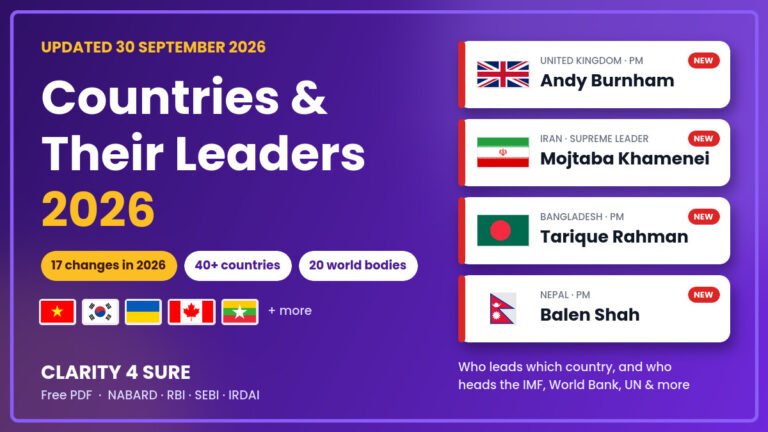 Free sheet · Static GKCountries & Their Leaders 2026Who leads which country in 2026, with all 17 changes marked. Get the article and the PDF free on WhatsApp.Get it free on WhatsApp →
Astrobase Unveils India’s First Private 800 kN FFSC Rocket Engine
Indian deep-tech startup Astrobase Space Technologies unveiled ‘EVEREST’, an 800 kN Full-Flow Staged Combustion (FFSC) rocket engine. The LOX–methane engine is designed for reusable medium-lift launch vehicles and orbital missions. The company plans full-scale hot-fire testing in 2026 and targets its first launch for December 2028.
Ariha Pangambam Wins India’s First Senior Women’s Gold in Asian Aerobic Gymnastics
Manipur’s Ariha Pangambam won India’s first-ever individual gold medal in the senior women’s category at the 2026 Asian Aerobic Gymnastics Championships. She scored 19.100 points in the event held in Tagaytay City, Philippines. Thailand’s Chanyapit Manee won silver and Japan’s Mahiro Kishibe won bronze.
World Lion Day 2026 – August 10
World Lion Day is observed annually on 10 August to raise awareness about lion conservation and threats to Panthera leo. The day was initiated in 2013 by Big Cat Rescue and co-founded by Dereck and Beverly Joubert. It promotes global efforts to protect lions and their ecosystems.
World Biofuel Day 2026 – August 10
World Biofuel Day is observed on 10 August to promote biofuels as renewable alternatives to fossil fuels. In India, the Ministry of Petroleum and Natural Gas has observed the day since 2015. The date commemorates Rudolf Diesel’s demonstration of a diesel engine powered by peanut oil in 1893.
PM E-DRIVE Incentive for Electric Two-Wheelers Revised
The Ministry of Heavy Industries amended the PM E-DRIVE Scheme, limiting the incentive for electric two-wheelers to ₹2,500 per kWh, capped at ₹5,000 per vehicle, for April 2025–March 2028. The scheme promotes EV adoption, charging infrastructure and domestic EV manufacturing. It has a total outlay of ₹11,900 crore.
GeM Completes 10 Years
Government e-Marketplace (GeM) completed 10 years of operations, with Union Minister Piyush Goyal honouring leading buyers and sellers. GeM launched a nationwide five-digit helpdesk number 14550 and a customised commemorative ‘My Stamp’. The government also highlighted plans to make GeM more AI-enabled and user-friendly.
PLFS April–June 2026: Unemployment Rate Rises to 5.4%
The National Statistics Office released the Quarterly PLFS Bulletin for April–June 2026. The unemployment rate for persons aged 15 years and above rose to 5.4%, compared with the previous quarter. Overall LFPR stood at 54.6%, while rural and urban LFPR were 56.9% and 50.2%, respectively.
MSME Ministry and DPIIT Sign MoU for GI Products
The Ministry of MSME and DPIIT signed an MoU to accelerate the commercialisation, standardisation and market access of GI products. Under the ‘Bharat GI’ banner, GI producers will be connected with platforms such as ONDC and GeM. The initiative also supports artisans, weavers, producers and the ODOP ecosystem.
Agriculture Students Receive Scholarships Through NSP
Union Minister Shivraj Singh Chouhan launched an initiative for scholarship and fellowship disbursement to agriculture students through the National Scholarship Portal. Around ₹21.35 crore was transferred through DBT to more than 6,000 students. The initiative aims to ensure regular and hassle-free financial assistance.
NABL Launches Accreditation Scheme for Mobile Food Testing Laboratories
NABL launched India’s first Accreditation Scheme for Mobile Food Testing Laboratories under its Integrated Assessment Programme. The scheme aims to provide reliable and internationally benchmarked food testing services closer to communities. It will strengthen food safety surveillance, speed up regulatory action and improve consumer confidence.
MoSPI Signs MoUs with IDEAS and ISI Kolkata
MoSPI signed two MoUs with IDEAS and the Indian Statistical Institute, Kolkata to strengthen data-driven statistical analysis. The collaboration will develop a GDP nowcasting tool and a harmonised indicator framework linking government scheme data with NSS household data. It aims to support evidence-based policymaking under Viksit Bharat @2047.
India Donates Five Peacocks to UNOG
India donated five peacocks, including one rare white-feathered male, to the United Nations Office at Geneva. The birds were handed over by Arindam Bagchi to UNOG Director-General Tatiana Valovaya. The donation revives a tradition dating back to 1981, when India had earlier gifted a breeding pair to Geneva.
Airtel Business Partners ITI for Digital Transformation
Airtel Business and ITI Limited entered into a strategic partnership to strengthen enterprise digital infrastructure in India. The collaboration covers data centres, sovereign cloud, AI, IoT, cybersecurity and LEO satellite services. It will also support secure connectivity through OFC, GPON, SD-WAN and private 4G/5G networks.
Adani Airport City Incorporates Global IFSC Subsidiary
Adani Airport City Limited incorporated AACL Global IFSC Limited, a wholly owned subsidiary under Adani Airport Holdings. The new entity will operate as a Global Treasury Centre under IFSCA regulations. It will undertake permitted treasury and finance-related activities from the International Financial Services Centre.
Deepak Dhar Becomes First Indian to Win Dirac Medal
Indian theoretical physicist Prof. Deepak Dhar became the first Indian physicist to receive the Dirac Medal in 2026. The award recognised his pioneering work in statistical mechanics, stochastic processes and complex physical systems. He shared the honour with Bernard Derrida, Marc Mézard and Haim Sompolinsky.
V.O.C. Port Becomes First Indian Port with ISO 50001:2018 Certification
V.O. Chidambaranar Port in Tamil Nadu became India’s first port to receive ISO 50001:2018 certification for its Energy Management System. The port also received recognition as a Scope-2 Emission-Free Port, with renewable energy meeting 93.89% of its electricity needs in FY26. The certification promotes efficient and sustainable energy management.
Vietnam’s VinSpace Signs SpaceX Launch Deal
Vietnamese aerospace company VinSpace signed an agreement with SpaceX to launch its first satellites through a 2027 Transporter rideshare mission. The partnership will support Vietnam’s indigenous satellite capabilities and reduce launch costs through shared Falcon 9 missions. VinSpace will manage satellite design, testing, launch coordination and in-orbit operations.
World Steelpan Day 2026 – August 11
World Steelpan Day is observed annually on 11 August to recognise the cultural importance of the steelpan, the national musical instrument of Trinidad and Tobago. The UN General Assembly adopted the observance through Resolution A/RES/77/316 in 2023. The day promotes the instrument’s cultural heritage and contribution to sustainable development.