
Daily Current Affairs (DCA) 14 August, 2026
Free live session
NABARD Grade A 2026: what the 2025 cut-offs changed, and the 90-day plan
Today · 7:30 PM IST
2. Schemes2
Gaj Gaurav Awards 2026
Context: During national celebrations of World Elephant Day 2026 at Visakhapatnam, the Union Minister of State for Environment, Forest and Climate Change conferred the Gaj Gaurav Awards 2026.
What is the Gaj Gaurav Award?
India’s national honour for outstanding contributions and frontline service in Asian elephant conservation and management.
| Aspect | Detail |
|---|---|
| Instituted | 2022, by the Ministry of Environment, Forest and Climate Change |
| Occasion | 30 years of Project Elephant (launched 1992) |
| Presented on | World Elephant Day, 12 August |
2026 Winners
- Jaldapara National Park, West Bengal — 7 mahouts, for courage during the severe Torsha and Malangi river floods: Bikash Kharia (stayed back in strong currents to guide stranded kumki — trained — elephants to safety), Rajiv Oraon (secured five captive elephants during flash floods), Ajibul Haque, Ajit Gabur, Mumtaz Alam, Amasur Kheriya, Dilip Munda.
- Namdapha National Park and Tiger Reserve, Arunachal Pradesh — 2 caregivers, the only recipients from the Northeast: Ganesh Tamang (Senior Mahout, over 26 years of service) and Sumit Gogoi (Elephant Attendant, 5 years).
Project Elephant
- Launched 1992 as a Centrally Sponsored Scheme
- India holds about 60% of the world’s wild Asian elephants
- The Asian elephant is Endangered on the IUCN Red List and listed in Schedule I of the Wild Life (Protection) Act, 1972
- It is India’s National Heritage Animal (declared 2010)
- 33 Elephant Reserves across the country
- Gaj Yatra is the awareness campaign for corridor protection
- MIKE — Monitoring the Illegal Killing of Elephants — is the CITES programme India participates in
Small Modular Reactors (SMRs)
Context: Under the newly launched Nuclear Energy Mission, the Government informed the Lok Sabha that it plans to develop and operationalise at least five indigenous Small Modular Reactors by 2033. This supports India’s goal of 100 GWe of nuclear capacity by 2047.
What is a Small Modular Reactor?
An advanced nuclear reactor with lower electrical output than conventional gigawatt-scale plants. As defined by the IAEA, an SMR typically produces up to 300 MWe per unit.
| Aspect | Detail |
|---|---|
| India’s nodal developer | Bhabha Atomic Research Centre (BARC), under the Department of Atomic Energy |
| Legal framework | SHANTI Act, 2025 — Sustainable Harnessing and Advancement of Nuclear Energy for Transforming India Act |
- The SHANTI Act, 2025 enables private sector participation in nuclear technology manufacturing and deployment — the change that makes SMR scale-up possible.
- Aim: deliver clean, flexible, low-carbon baseload electricity and industrial heat, while cutting initial capital cost, construction time and land requirement compared with large nuclear plants.
How SMRs Work
- Nuclear fission — heavy nuclei such as Uranium-235 are split in a controlled chain reaction to produce heat
- Modular factory fabrication — major components are built in centralised factories and shipped to site for rapid assembly, instead of a decade of site-specific civil construction
- Heat conversion — the heat produces steam to drive turbines, or is used directly for high-temperature industrial processes
3. Reports / Articles1
How & Why Farmers Producers Organization are formed? FPO #fpo #upsc #nabardgradea #agriculturenotesTap to play · from the C4S channel
NITI Aayog Report on Key Sectors for Global Manufacturing Hub
Context: NITI Aayog has released a report titled “Key Sectors to Position India as a Global Manufacturing Hub.” It uses a structured, data-driven framework to identify sectors that can drive India’s ambition to become a global manufacturing powerhouse. This edition covers four sectors — Chemicals, Textiles, Telecom and Networking Equipment, and Solar Photovoltaic manufacturing — with reports on eight more sectors to follow.
What the Report Does
- The assessment looks at India’s manufacturing position against global trends, sectoral growth opportunities and global benchmarks. It examines seven factors that decide whether a country can compete in manufacturing.
- The aim: find sectors where India has real growth potential and where targeted action can strengthen domestic capability, raise competitiveness and value addition, and accelerate export-oriented manufacturing.
Key Highlights:
Sector 1: Chemicals
- Main areas: Petrochemicals, specialty chemicals and inorganic chemicals.
- India should increase downstream production of higher-value products.
- Focus on domestic manufacturing, better use of raw materials and strategic FTAs to reduce imports.
Sector 2: Textiles
- Contributes about 2% of GDP, 11% of manufacturing GVA and 9% of merchandise exports.
- Employs over 45 million people and exports about $37.7 billion annually.
- Focus on MMF, technical and sustainable textiles, along with better raw materials, infrastructure, skills and technology.
- India needs to reduce its dependence on cotton and match the growing global demand for man-made fibres.
Sector 3: Telecom Equipment
- India is the world’s second-largest telecom market, with over 1.2 billion subscribers.
- Main issue: India is a large market but depends heavily on imported components.
- Focus on local component production, technology transfer, industrial clusters, R&D and exports.
Sector 4: Solar PV
- Solar capacity stood at 106 GW in March 2025, with a target of 280 GW by 2030.
- India has strong module production but still imports many cells and wafers.
- Build the full chain: polysilicon → wafers → cells → modules through technology, R&D, investment and skilled workers.
Common Theme
India needs to move beyond basic production and assembly and capture more value within the country. The focus is on domestic value addition, lower import dependence and stronger global competitiveness.
Practice MCQs
Q1. With reference to the NITI Aayog report on key manufacturing sectors, consider the following statements:
a. It covers chemicals, textiles, telecom and networking equipment, and solar photovoltaic manufacturing.
b. The study was structured into four phases, beginning with shortlisting sectors by relative attractiveness.
c. Reports on eight more sectors are to follow.
d. The report assesses only market size and ignores infrastructure and technology readiness.
How many of the above statements are correct? (a) Only one (b) Only two (c) Only three (d) All four (e) None
Q2. With reference to India’s textile and apparel sector as described in the report, consider the following statements:
a. It contributes about 11 per cent to manufacturing gross value added.
b. It accounts for about 9 per cent of merchandise exports.
c. It employs more than 45 million people and is the second-largest employer after agriculture.
d. India is the second-largest textile exporter in the world.
How many of the above statements are correct? (a) Only one (b) Only two (c) Only three (d) All four (e) None
Answer Key
- (c) — Statements a, b, c are correct. Statement d is wrong: the report assesses seven factors including infrastructure readiness, technology readiness, raw material availability and India’s position in the value chain, not market size alone.
- (c) — Statements a, b, c are correct. Statement d is wrong: India is the sixth-largest textile exporter globally, with a 4.1% share of global textile and apparel exports.
Every day of the month in one file. Enter your details once — the download opens right away.
We already have your details, so no form: tap to open.
Download the August 2026 PDFDownload the August 2026 revision sheet PDF2. Social Issue1
Joint Parliamentary Committee (JPC)
Context: The Lok Sabha referred the Foreign Contribution (Regulation) Amendment Bill, 2026 to a Joint Parliamentary Committee, following strong objections from Opposition parties and civil society.
What is a JPC?
An ad hoc (temporary) parliamentary committee set up for detailed, clause-by-clause examination of a controversial Bill, a complex legislative proposal, or a major financial or governance issue.
| Aspect | Detail |
|---|---|
| Constitutional status | Not mentioned in the Constitution |
| Governing rules | Rules of Procedure and Conduct of Business of both Houses |
| How formed | A motion moved in one House and concurred with by the other |
| Chairperson | Appointed by the Speaker of the Lok Sabha |
| Composition ratio | Lok Sabha members typically twice the number from the Rajya Sabha (2:1) |
| Party strength | Membership and chairmanship reflect relative party strengths, giving the ruling side a majority |
| After the report | The committee automatically stands dissolved |
Key Functions
- Clause-by-clause scrutiny to identify administrative, legal or constitutional loopholes
- Summoning power — may call for official records and papers, and summon officials, experts and stakeholders
- Public consultation — invites written submissions and holds oral hearings with affected organisations, industry bodies and civil society
- Recommendations and dissent — prepares an advisory report; dissenting members may append formal Notes of Dissent
Practice MCQs
Q1. With reference to a Joint Parliamentary Committee, consider the following statements:
a. It is not explicitly mentioned in the Constitution of India.
b. It is constituted when a motion moved in one House is adopted and concurred with by the other.
c. Its chairperson is appointed by the Speaker of the Lok Sabha.
d. It is a permanent committee that continues across Parliaments.
How many are correct? (a) One (b) Two (c) Three (d) All four (e) None
Answer Key
- (c) — a, b, c correct. Statement d is wrong: a JPC is an ad hoc committee, dissolved automatically once it submits its report — unlike standing committees, which are reconstituted annually.
Related on Clarity 4 Sure
 Scheme to knowMission Amrit Sarovar: Objectives, Progress, Implementation and Exam FactsMission Amrit Sarovar is a rural water conservation mission launched on 24 April 2022, during Azadi Ka Amrit Mahotsav,…
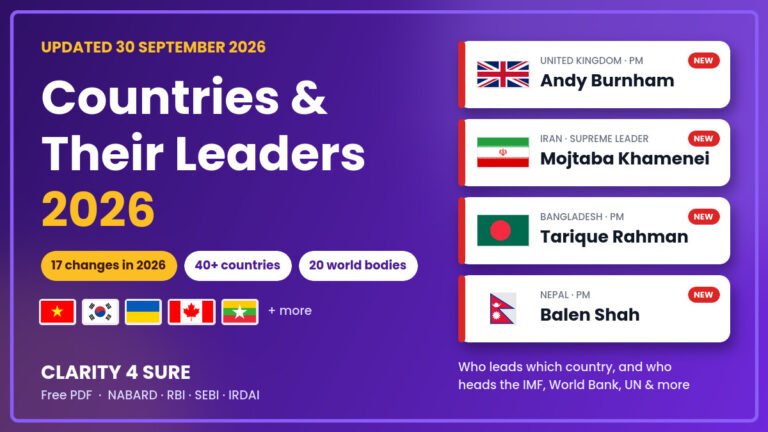 Free sheet · Static GKCountries & Their Leaders 2026Who leads which country in 2026, with all 17 changes marked. Get the article and the PDF free on WhatsApp.Get it free on WhatsApp →