Daily Current Affairs (DCA) 13 August, 2026
Free live session
NABARD Grade A 2026: what the 2025 cut-offs changed, and the 90-day plan
The 2025 cycle was the toughest on record at every stage. This session reads those numbers properly and turns them into a week-by-week plan for Phase 1.
Today · 7:30 PM IST · 75 minutes · free
In the news3
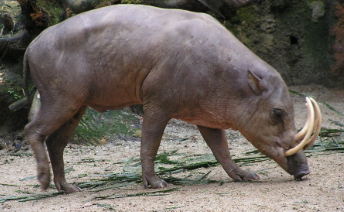
Context: Chester Zoo in the UK announced the birth of Rana, a rare babirusa piglet, amid declining wild populations threatened by African swine fever, habitat loss and hunting in Indonesia.
What It Is
The babirusa (genus Babyrousa) — commonly called the “pig-deer” — is one of the oldest living and strangest wild pig species. The name comes from Malay, describing its distinctive look and stag-like upper tusks (babi = pig, rusa = deer).
| Aspect | Detail |
|---|---|
| Geographic range | Endemic exclusively to four Indonesian islands — Sulawesi, Togian, Sula and Buru |
| Ecosystem | Tropical rainforests, swamps and wetlands, often near riverbanks and ponds rich in aquatic plants |
| IUCN status | Vulnerable |
Context: Parliament passed the Kerala (Alteration of Name) Bill, 2026, officially renaming Kerala as Keralam, following a unanimous resolution by the State Legislative Assembly.
What It Is
A Parliamentary law amending the First Schedule of the Constitution to change the official name from Kerala to Keralam — aligning the English legal name with its native Malayalam pronunciation and cultural heritage.
Constitutional Provisions
| Provision | Content |
|---|---|
| Article 3 | Empowers Parliament by law to form new States, alter State boundaries, or change the name of any existing State |
| First Schedule | Modified at Entry 15, which lists the names and territorial extents of States |
| Article 4 | Provides that such a law is not deemed a constitutional amendment under Article 368, and is passed by simple majority |
Procedure to Change a State’s Name
- Initiation and State resolution — typically begins with the State Legislative Assembly passing a resolution requesting the Centre to alter the name.
- Presidential recommendation — a Bill may be introduced in either House only on the prior recommendation of the President.
- Reference to the State Legislature — before recommending the Bill, the President refers it to the affected State Assembly to express its views within a specified period.
- Non-binding State views — consultation is mandatory, but the views expressed are not binding on the President or Parliament.
- Introduction in Parliament — once the referral period expires or views are received.
- Passage by simple majority — under Article 4, treated as an ordinary Bill requiring a simple majority in both Houses.
- Presidential assent and Gazette notification — the Act then modifies the First Schedule.
The key constitutional point: although the First Schedule is part of the Constitution, altering it under Article 3 is expressly excluded from Article 368 by Article 4. Parliament can therefore redraw the map of India by simple majority — a striking feature of India’s “indestructible Union of destructible States.”
Precedents: Orissa → Odisha (2011), Uttaranchal → Uttarakhand, Pondicherry → Puducherry, United Provinces → Uttar Pradesh, Madras → Tamil Nadu, Mysore → Karnataka.
Practice MCQs
Q1. With reference to the alteration of a State’s name, consider the following statements:
a. Article 3 empowers Parliament to change the name of an existing State. b. Such a Bill may be introduced only on the prior recommendation of the President. c. The President must refer the Bill to the affected State Legislature for its views. d. The views expressed by the State Legislature are binding on Parliament.
How many of the above statements are correct? (a) Only one (b) Only two (c) Only three (d) All four (e) None
Q2. Consider the following statements:
a. A law altering the name of a State amends the First Schedule of the Constitution. b. Under Article 4, such a law is not deemed to be a constitutional amendment for the purposes of Article 368. c. It is passed by a simple majority in both Houses of Parliament. d. Odisha was renamed from Orissa through a similar process in 2011.
How many of the above statements are correct? (a) Only one (b) Only two (c) Only three (d) All four (e) None
Answer Key
- (c) — Statements a, b, c are correct; statement d is wrong because the State Legislature’s views are consultative and not binding. Parliament may proceed even if the State disagrees — the basis for describing India as an indestructible Union of destructible States.
- (d) — All four are correct. The Article 4 exclusion from Article 368 is the most examinable constitutional point.
Context: The Ministry of Ayush and the Ministry of Health and Family Welfare renewed their partnership under the ‘One Herb, One Standard’ initiative for an additional three years.
What It Is
An inter-ministerial collaborative framework to establish unified, scientifically synchronised quality and testing standards (monographs) for medicinal plants used across different systems of medicine in India.
| Implementing body | Parent ministry |
|---|---|
| Pharmacopoeia Commission for Indian Medicine & Homoeopathy (PCIM&H) | Ministry of Ayush |
| Indian Pharmacopoeia Commission (IPC) | Autonomous body under MoHFW |
Aim: to eliminate conflicting quality parameters across different pharmacopoeias, establishing single, clear and scientifically reliable standards for medicinal herbs, improving the quality, safety and international credibility of Indian botanical products.
Key Features
- Harmonised quality standards — synchronises testing methods and quality parameters for identical medicinal plants across the Indian Pharmacopoeia (IP) and the Ayurvedic, Siddha, Unani and Homoeopathic (ASU&H) Pharmacopoeias.
- Phase-wise monograph development — builds on 50 single-herb monographs developed in the first phase, initiated in 2022.
- Cross-system integration — applies to single drugs of plant origin used across five recognised systems: Ayurveda, Siddha, Sowa-Rigpa, Unani and Homoeopathy.
- Alignment with global benchmarks — integrates international quality parameters to meet global trade and regulatory demands.
- Streamlined testing protocols — a single reference standard for testing laboratories, regulators and manufacturers, avoiding conflicting analytical requirements.
Exam Relevance
UPSC — Prelims: the babirusa’s endemism to four Indonesian islands and Vulnerable status; Article 3 and Article 4 and the simple-majority rule for altering State names; the five AYUSH systems including Sowa-Rigpa, and the distinction between IPC (MoHFW) and PCIM&H (Ayush). Mains: the Kerala renaming supports GS-II answers on federalism and Parliament’s power over State identity; OHOS supports GS-III answers on standardisation as a non-tariff trade enabler for AYUSH exports.
NABARD Grade A — OHOS has a real hook: medicinal and aromatic plants cultivation is a rural livelihood, and standardised monographs raise realisation for growers by making the crop export-grade. Connect to the National Medicinal Plants Board.
Banking/Finance1
How & Why Farmers Producers Organization are formed? FPO #fpo #upsc #nabardgradea #agriculturenotesTap to play · from the C4S channel
Context: As the Unified Payments Interface completed 10 years of operation, Parliament passed the Taxation and Other Laws (Amendment) Bill, 2026, which amends Section 10A of the Payment and Settlement Systems Act, 2007, removing the statutory prohibition against levying a Merchant Discount Rate on UPI and RuPay debit card transactions.
What UPI Is
- Launched as a pilot in April 2016 by the RBI and NPCI, fully operational from August 2016.
- India’s real-time, interoperable mobile payment system, built on the Immediate Payment Service (IMPS) protocol.
- Allows instant bank-to-bank transfers via Virtual Payment Addresses (VPAs) or QR codes.
- Over a decade it has moved from a domestic retail experiment to the backbone of India’s digital economy, handling the vast majority of non-cash consumer payments.
Evolution and Growth Drivers
- Early policy vision (2012–13): the RBI’s payment vision documents identified IMPS as a foundation for rapid proliferation of mobile merchant and peer-to-person transfers.
- Demonetisation and pandemic (2016 and 2020): both catalysed a structural shift away from cash and cash-on-delivery toward contactless QR payments.
- Private venture capital inflow (2019–2021): large investments into fintech firms such as Paytm and PhonePe expanded Point-of-Sale infrastructure and user acquisition.
- Zero-MDR mandate (2020): following the Nandan Nilekani Committee recommendations on deepening digital payments, the government mandated 0% MDR on UPI and RuPay cards, subsidising low-value transactions up to ₹2,000.
The Proposed MDR Reform
A calibrated, threshold-based MDR is being evaluated, designed to ensure sustainability without discouraging small merchants or individual citizens:
| Category | Treatment |
|---|---|
| Consumers and P2P transfers | 100% free — guaranteed zero fee |
| Small merchants (annual turnover below ₹1–1.5 crore), including kirana stores | Zero merchant fees continue |
| Large commercial enterprises | Nominal MDR of about 0.05% to 0.3–0.6%, applying only to P2M transactions exceeding ₹2,000 |
Every day of the month in one file. Enter your details once — the download opens right away.
We already have your details, so no form: tap to open.
Download the August 2026 PDFDownload the August 2026 revision sheet PDFAgriculture2
Context: With rainfall becoming increasingly unpredictable and temperatures rising, regenerative agriculture is emerging as a way to strengthen soil, water security, biodiversity and farm resilience. The experience of Beforest, a regenerative land restoration initiative, illustrates the approach.
What It Is
- Beforest, founded in 2018, works at the intersection of agriculture, ecology and climate resilience. It has built six collectives across Kodagu, Hyderabad, Mumbai and Bhopal, spanning about 1,300 acres with 196 members.
- What a collective is — per founder and CEO Sunith Reddy: a group of people bound by a shared commitment to regenerative living who co-own and co-manage a single landscape, with a minimum land requirement of about 100 acres.
The Model at Scale
Asked what would follow if every district adopted the model, Reddy described a sequence that becomes a cycle:
- Water security is established — the foundation on which everything else stands.
- Succession progresses — bare soil disappears, green cover thickens, biodiversity climbs.
- New diversity increases seed dispersal, which accelerates green cover, which attracts more diversity.
Regenerative Agriculture
A set of practices aimed at rebuilding soil health, water cycles and biodiversity rather than merely sustaining current yields. Core practices: minimal tillage, permanent soil cover, crop and species diversity, integration of trees and livestock, and elimination of synthetic inputs.
Distinguish from adjacent concepts:
- Organic farming — defined by the absence of synthetic inputs; certification-based.
- Natural farming (ZBNF/Bharatiya Prakritik Krishi Paddhati) — low-cost, input-free, using on-farm preparations such as jeevamrit.
- Agroforestry — integration of trees with crops or livestock.
- Regenerative agriculture — outcome-defined: is soil organic carbon, water retention and biodiversity improving?
Exam Relevance
NABARD Grade A — Very high relevance for Phase II Paper II. This touches several core areas at once: watershed development (NABARD’s flagship, through the Watershed Development Fund), agroforestry, climate-resilient agriculture, and financing gaps in green agriculture. The observation that institutional funding is almost absent from regenerative land restoration is directly a NABARD question — it is precisely the kind of long-gestation, ecology-first investment that commercial lenders avoid and a development bank exists to fund. Connect to NABARD’s role with the Green Climate Fund, Adaptation Fund and NAFCC, and to FPO-based aggregation as the smallholder route to the same practices.
Context: ICAR informed Parliament of its programme of national importance, the Network Programme on Precision Agriculture (ICAR-NePPA), involving 16 ICAR Research Institutes across different domains.
What It Is
- Precision agriculture applies inputs — water, nutrients, pesticides — in the right quantity, at the right place, at the right time, instead of uniformly across a field. The gain comes from matching input to actual need: yield rises and waste falls at the same time.
- ICAR-NePPA develops technologies using sensors, remote sensing (ground, drone, satellite), AI and ICTs, across five domains:
| Domain | Focus |
|---|---|
| Crop and soil | Spatio-temporal monitoring and management of crop and soil health |
| Post-harvest | Sensor-based quality monitoring — mango, banana, pulses, rice |
| Vertical farming | IoT-based precision farming for high-value vegetables under controlled environment |
| Aquaculture | Sensor-based monitoring of the aquatic environment |
| Livestock | IoT-enabled health monitoring |
Technologies Developed
- Water and nutrients: sensor-based irrigation, drip fertigation, precision subsurface drip, poly-mulching, raised-bed cultivation, modified raised and sunken conservation beds.
- Machinery and drones: drone-based spraying, AI-enabled precision planters, variable rate fertiliser applicator.
- Controlled environment: low-cost protected cultivation, hydroponics, aeroponics, agrivoltaic farming, agro-aqua land configuration.
- Sensing and quality instruments: SPAD meter 2.0 (leaf chlorophyll), rapid Aflatoxin-B1 detection in maize, IoT cold-room control, AI grain analyser, AI rice-seed quality assessment, image-processing contamination measurement in seed cotton, computer-vision ginning percentage measurement, digital twin-based fruit quality monitoring, and blockchain-enabled banana supply chain traceability.
- Digital tools: the Dweep Microclimate Monitor; a Remote Pilot Training Organisation (RPTO) at Dehradun for UAV training.
- Aquaculture: a tank-based super-intensive precision shrimp farming system yielding 120–150 tonnes/ha/year over three cycles, with smart automation and strict biosecurity.
Facts To Remember28
Retail Inflation Rises to 19-Month High of 4.45%
India’s retail inflation rose to 4.45% in July 2026, marking a 19-month high. The rise was driven mainly by higher food and fuel prices. The data indicates renewed inflationary pressure on household consumption and the overall economy.
President Murmu Gives Assent to Bill Criminalising Insult to Vande Mataram
President Droupadi Murmu gave assent to the Prevention of Insults to National Honour (Amendment) Bill, 2026. The amendment extends legal protection to Vande Mataram, similar to the protection already provided to the national anthem. It criminalises intentional disruption or prevention of its singing.
IBM Partners with MIT-Bengaluru and CHRIST University to Establish AI Centres
IBM partnered with MIT Bengaluru and CHRIST University to establish AI-focused centres in India. The centres will promote AI research, advanced computing, innovation and skilling. Key areas include Generative AI, Machine Learning, cybersecurity, LLMs and responsible AI.
PMS Bazaar Partners with NDML to Expand SEBI Accredited Investor Certification
PMS Bazaar partnered with NSDL Database Management Limited (NDML) to simplify the SEBI Accredited Investor certification process. The partnership aims to provide end-to-end assistance and faster certification. Eligible investors can benefit from lower investment thresholds and access to sophisticated investment products.
SBI Research Projects India’s GDP Growth at 8% for Q1 FY27
SBI Research projected India’s real GDP growth at around 8% in Q1 FY27, higher than the RBI’s 7% estimate. The projection is based on 54 high-frequency indicators covering agriculture, industry and services. Strong consumption, industrial output, services activity and government capital expenditure supported the optimistic outlook.
Ambani Family Tops 2026 Hurun India Most Valuable Family Businesses List
The Ambani family, led by Mukesh Ambani, retained the top position with a valuation of ₹25.8 lakh crore. The Birla and Jindal families ranked second and third respectively. The combined value of India’s top 300 family businesses reached ₹138 lakh crore, highlighting their major role in the Indian economy.
Hungary Elects András Baka as President
The Hungarian Parliament elected former Supreme Court chief András Baka as the country’s new President. He secured 140 votes in favour and 6 against. He is scheduled to assume office on 19 August 2026 for a term of up to five years.
Indian Navy Launches Next-Generation Offshore Patrol Vessel ‘Shruti’
The Indian Navy launched Shruti, the second of four Next-Generation Offshore Patrol Vessels being built by GRSE, Kolkata. The vessel is part of a ₹9,781-crore NGOPV programme. The project aims to strengthen India’s indigenous warship-building and maritime security capabilities.
Skyroot Aerospace Signs Multi-Launch Agreement with HEX20
Skyroot Aerospace signed a Multi-Launch Agreement with HEX20 for three dedicated Vikram-series missions. The missions will support Earth observation, payload demonstrations and rideshare opportunities. Launches are scheduled to begin from Q4 2027.
Don Nelson, Five-Time NBA Champion, Passes Away
Legendary American basketball coach Don Nelson passed away at the age of 86. He won five NBA championships as a player with the Boston Celtics and later coached for 31 years. He recorded 1,335 regular-season wins and was inducted into the Basketball Hall of Fame in 2012.
Nuclear Scientist M.P. Parameswaran Passes Away at 91
Renowned Indian nuclear scientist, writer and science communicator M.P. Parameswaran passed away at the age of 91. He worked at BARC and later became closely associated with the Kerala Sastra Sahitya Parishad. He made major contributions to science popularisation, literacy movements and environmental awareness.
PM Modi Releases Ram Nath Kovind’s Autobiography
Prime Minister Narendra Modi released former President Ram Nath Kovind’s autobiography, Triumph of the Indian Republic: My Life, My Struggles. Published by Rupa Publications, the book covers Kovind’s early life, legal career, public service and tenure as India’s 14th President. It also highlights perseverance, education and democratic values.
International Youth Day is observed annually on 12 August to highlight youth contributions and address issues affecting young people. The 2026 theme is “Different Contexts, Common Aspirations.” The first official observance was held in 2000.
 Scheme to knowAmaravati Capital City Project: Integrated Urban Development Programme, Features and FactsAmaravati is the greenfield capital city of Andhra Pradesh, planned on the southern bank of the Krishna river between…
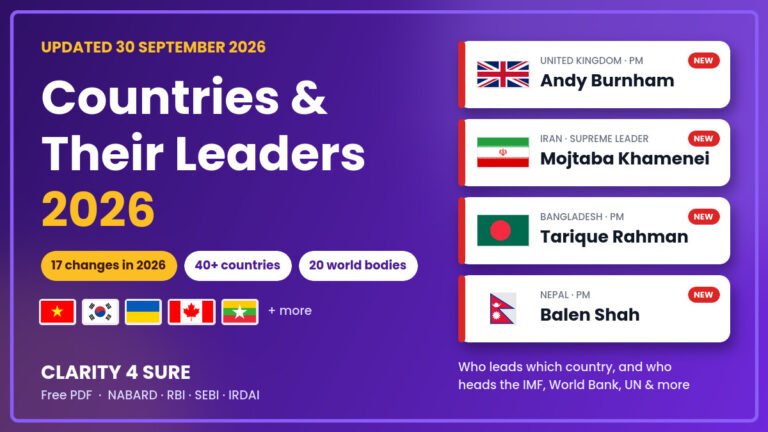 Free sheet · Static GKCountries & Their Leaders 2026Who leads which country in 2026, with all 17 changes marked. Get the article and the PDF free on WhatsApp.Get it free on WhatsApp →
World Elephant Day is observed on 12 August to promote elephant conservation and protection. It was first observed in 2012 and was conceptualised by Patricia Sims, Michael Clarke and Sivaporn Dardarananda. Elephants are the world’s largest land animals and have a gestation period of around 22 months.
Gujarat Approves ₹20 Crore for Four Centres of Excellence in Natural Farming
The Gujarat Government approved ₹20 crore for 2026–27 to establish four Centres of Excellence for natural farming. The centres will be located in Navsari, Morbi, Bhavnagar and Chhota Udepur. They will provide farmers with training, technology support, soil testing, value addition and post-harvest facilities.
National Biodiversity Authority Releases ₹15 Crore ABS Proceeds
The National Biodiversity Authority (NBA) released over ₹15 crore under the Access and Benefit Sharing (ABS) mechanism from mustard genetic resources. The amount will be distributed among 26 State Biodiversity Boards and 3 Union Territory Biodiversity Councils. The move supports fair sharing of benefits arising from the use of biological resources.
Ahilyabai Holkar Remembered on Her Death Anniversary
Union Home Minister Amit Shah and Defence Minister Rajnath Singh paid tributes to Ahilyabai Holkar on her death anniversary. She is remembered for her major contributions to the preservation and restoration of heritage sites. Her legacy also includes social welfare and public works across India.
‘Srijan: Voices from the Loom’ to Celebrate Women Weavers
The Ministry of Textiles will organise ‘Srijan: Voices from the Loom’ to celebrate women involved in India’s handloom sector. The programme will highlight their journeys, contributions and experiences. It aims to recognise the important role of women in preserving India’s weaving heritage.
Union Home Minister Amit Shah launched the Gramin Gyan Setu app through video conferencing. The app aims to integrate libraries across the Gandhinagar Lok Sabha constituency of Gujarat. It is designed to improve access to library resources and strengthen knowledge-sharing among communities.
Vriksh Mitra Parivar Launches Nationwide Plantation Drive
More than 50,000 saplings were planted across India on the occasion of Hariyali Amavasya. The campaign was conducted under the ‘Ek Ped Maa Ke Naam’ initiative. The plantation drive was led by Agriculture and Rural Development Minister Shivraj Singh Chouhan in collaboration with Vriksh Mitra Parivar.
Railways Approves Kavach 4.0 for 660 Route Kilometres
Indian Railways approved the installation of Kavach Version 4.0 on 660 route kilometres of the Izzatnagar Division of North Eastern Railway. The project has an estimated cost of ₹295 crore. Kavach is aimed at improving railway safety through an indigenous automatic train protection system.
India Home to Over 60% of World’s Wild Asian Elephants
Prime Minister Narendra Modi highlighted India’s role in elephant conservation on World Elephant Day. India is home to over 60% of the world’s wild Asian elephants. The statement underlined the importance of elephants in India’s ecological heritage and conservation efforts.
India-Nepal Sign MoUs for Eight Development Projects
India and Nepal signed MoUs for eight development projects covering education, health and agriculture. The projects will be implemented using Indian grant assistance. The initiatives aim to strengthen development cooperation and people-centric partnership between the two countries.
India Hosts Nearly 60% of World’s Wild Asian Elephants
Minister of State for Environment, Forest and Climate Change Kirti Vardhan Singh highlighted India’s importance in Asian elephant conservation. Nearly 60% of the world’s wild Asian elephants live in India. He described the country as a living symbol of the elephant’s ecological heritage.
MSME Ministry and DPIIT Sign MoU for GI Products
The Ministry of MSME and DPIIT signed an MoU to improve the commercialisation and market access of GI-tagged products. The collaboration seeks to strengthen their presence in domestic and global markets. It is expected to support producers and businesses associated with India’s Geographical Indication products.
India-US Navy EOD Exercise 2026 Begins
The Indian Navy-US Navy Explosive Ordnance Disposal (EOD) Exercise 2026 began at the Southern Naval Command in Kochi. The bilateral exercise will continue until 14 August 2026. It aims to improve interoperability, operational capabilities and professional cooperation between the two navies.
GI-Tagged Mithila Makhana Exported to Australia
For the first time, 18 metric tonnes of GI-tagged Mithila Makhana were exported from Bihar to Australia. The consignment was procured directly from farmers in Darbhanga. The export marks an important step in expanding international markets for Bihar’s GI-tagged agricultural products.
India–SACU Preferential Trade Agreement
India and the Southern African Customs Union (SACU) signed the Terms of Reference (ToR) to begin negotiations for a Preferential Trade Agreement (PTA). This is India’s first ToR signing with the African region.
About SACU: SACU is the oldest customs union in the world, established in 1910, with its secretariat in Windhoek, Namibia. It has five members — South Africa, Botswana, Namibia, Lesotho and Eswatini.