
Daily Current Affairs Quiz: 08 October 2026
Free live session
NABARD Grade A 2026: 45-Day Final Revision Plan + Daily Targets
 🔒 Register to watchLast Sunday’s session · recording
In 8 days · Sun, 25 Oct at 7:30 PM IST
1. A field study by FSII and NSAI estimates that roughly what share of India’s cotton area may be under unauthorised GM cotton hybrids?
A. 10–15 per cent
B. 24–30 per cent
C. 35–40 per cent
D. 50–55 per cent
E. 72–75 per cent
View Answer
Explanation: The Federation of Seed Industry of India and the National Seed Association of India found that 26.2–29 lakh hectares of the 114.8 lakh hectares under cotton in 2025–26 may carry unapproved traits. Labour shortages and costly manual weeding are the main reasons farmers are turning to these illegal hybrids.
2. Which two Bt genes are currently permitted in GM cotton in India?
A. cp4-epsps and Vip3A
B. cry1Ac and Vip3A
C. cry1Ac and cry2Ab
D. cry2Ab and cp4-epsps
E. cry1F and cry3Bb
View Answer
Explanation: India allows GM cotton with only cry1Ac and cry2Ab, which shield the crop from certain bollworm pests. The unapproved genes found in the study are cp4-epsps, which makes the plant tolerant to glyphosate herbicide, and Vip3A, a Bt-derived gene that protects against a wider set of pests, including pink bollworm.
3. In the study on illegal herbicide-tolerant cotton, which state recorded the highest prevalence of the cp4-epsps gene in field samples?
A. Maharashtra
B. Andhra Pradesh
C. Rajasthan
D. Gujarat
E. Telangana
View Answer
Explanation: The herbicide-tolerance gene turned up in 72.69 per cent of all field samples. Telangana led at 88.64 per cent, ahead of Maharashtra (70.92%), Andhra Pradesh (62.86%) and Rajasthan (57.14%). Researchers tested 227 geo-tagged samples from the fields of 984 farmers across 16 districts in these four states.
4. World Cotton Day, observed on 7 October, was proposed by the Cotton Four (C-4) countries. Which of the following is NOT a C-4 country?
A. Benin
B. Burkina Faso
C. Chad
D. Egypt
E. Mali
View Answer
Explanation: Benin, Burkina Faso, Chad and Mali form the C-4 group that proposed the day, and the United Nations formally recognised 7 October as World Cotton Day in 2021. The 2026 theme, “Cotton for Good: Building Prosperity Through Trade, Transformation and Partnership”, highlights cotton’s role in trade, growth and poverty reduction.
5. WWF’s Living Planet Report 2026 recorded what average decline in monitored vertebrate populations between 1970 and 2022?
A. 69 per cent
B. 73 per cent
C. 85 per cent
D. 59 per cent
E. 49 per cent
View Answer
Explanation: The biennial report draws on data from 35,803 populations of 5,790 species and finds an average fall of 73 per cent over 52 years. Its Living Planet Index measures relative change in population size, not the total number of animals lost. Food production and consumption is named the single largest driver of biodiversity loss.
6. Which type of ecosystem showed the steepest population decline in the Living Planet Report 2026?
A. Marine
B. Terrestrial
C. Mountain
D. Freshwater
E. Mangrove
View Answer
Explanation: Freshwater populations fell the most at 85 per cent, followed by terrestrial (69%) and marine (59%) ecosystems. Among regions, Latin America and the Caribbean saw the sharpest drop at 95 per cent. Recovery is still possible: global wild tiger numbers rose from around 3,200 in 2010 to 5,700 in 2025.
7. An RBI study on rural resilience found that for small farm households owning up to one acre, wages contribute:
A. About 36 per cent of income
B. More than 55 per cent of income
C. Less than 25 per cent of income
D. Exactly half of income
E. Over 80 per cent of income
View Answer
Explanation: The RBI found that non-farm work, allied sectors and better irrigation are making the rural economy less reliant on rainfall. In the smallest farm households, wages bring in over 55 per cent of income, while crops and livestock together add about 36 per cent. Even in years of severe rainfall deficit, non-agricultural rural growth stays fairly strong.
8. The Ministry of Rural Development has expanded the permissible works under the VB–G RAM G Act, 2025 from 266 to:
A. 300
B. 325
C. 350
D. 375
E. 400
View Answer
Explanation: Raising the list from 266 to 375 works is an increase of about 41 per cent under the Viksit Bharat – Guarantee for Rozgar and Ajeevika Mission (Gramin) Act. The works are grouped under four heads: Water Security, Core Rural Infrastructure, Livelihood Infrastructure and Disaster Preparedness.
9. Under the expanded VB–G RAM G list of permissible works, how many works are agriculture-related?
A. 109
B. 181
C. 266
D. 141
E. 211
View Answer
Explanation: Of the 375 permissible works, 181 relate to agriculture, covering water management, land development, plantations, livestock and productive assets. All works are to be planned through Viksit Gram Panchayat Plans that must be approved by the Gram Sabha, keeping planning rooted at the village level.
10. After raising the policy repo rate by 25 basis points to 5.5 per cent, the MPC changed its stance from neutral to:
A. Accommodative
B. Withdrawal of accommodation
C. Calibrated tightening
D. Hawkish pause
E. Calibrated easing
View Answer
Explanation: Calibrated tightening signals a gradual move towards tighter policy to contain inflation, ruling out rate cuts in the near term. Crude oil above $100 a barrel, West Asia tensions, El Niño risks to food prices and a weaker rupee clouded the inflation outlook, while strong growth gave the RBI room to raise rates.
11. Following the latest monetary policy decision, what is the Standing Deposit Facility (SDF) rate?
A. 5.00 per cent
B. 5.50 per cent
C. 5.75 per cent
D. 6.00 per cent
E. 5.25 per cent
View Answer
Explanation: With the repo rate at 5.50 per cent, the SDF now stands at 5.25 per cent, while both the MSF and the Bank Rate are at 5.75 per cent. The SDF lets banks park surplus funds with the RBI without collateral, whereas the MSF is an overnight borrowing window against specified securities.
12. SEBI launched the ‘Samajh Se Investing Simple’ campaign during World Investor Week 2026 under which initiative?
A. Project Jagrook
B. Project Nivesh
C. Project Sankalp
D. Investor Mitra
E. Project Suraksha
View Answer
Explanation: The campaign aims to raise financial literacy, encourage informed investment choices and strengthen investor protection. Its MUST programme trains university and college faculty, staff and senior students as investor-education trainers, with support from NISM, BSE, NSE, MCX, CDSL, NSDL and AMFI.
13. The Integrated Transport and Logistics Authority (ITLA), approved by the Union Cabinet, will be set up as a:
A. Statutory body under an Act of Parliament
B. Special Purpose Vehicle
C. Constitutional body
D. Attached office of NITI Aayog
E. Registered society under the Societies Act
View Answer
Explanation: ITLA will serve as the national apex body for transport and logistics planning, formed as an SPV — a separate company with one defined purpose rather than a body created by law. It will handle multimodal planning, big-data analytics, technical appraisal and project monitoring, filling gaps that remained after PM GatiShakti (2021) and the National Logistics Policy (2022).
14. GSMA’s India Consumer Scam Report 2026 found that what percentage of Indian respondents were scammed in the previous 12 months?
A. 8 per cent
B. 13 per cent
C. 33 per cent
D. 12 per cent
E. 67 per cent
View Answer
Explanation: About 12 per cent of Indians reported being scammed within a year, against 8 per cent across six ASEAN countries. Although 86 per cent of victims reported their case, a third of reported cases stayed unresolved and 67 per cent of those who lost money recovered nothing. Online shopping scams were the most common type at 33 per cent.
Every day of the month in one file. Enter your details once — the download opens right away.
We already have your details, so no form: tap to open.
Download the October 2026 current affairs quiz PDFDownload the October 2026 Exam Ready quiz PDFAll October 2026 quizzes in one place: every question of the month with answers, a full PDF and an Exam Ready PDF — October 2026 current affairs quiz
Related on Clarity 4 Sure

 Scheme to knowAmended BharatNet Programme (ABP): Jharkhand Agreement, Outlay, Design and FactsThe Amended BharatNet Programme (ABP) is the redesigned version of BharatNet, approved in August 2023 with an outlay…
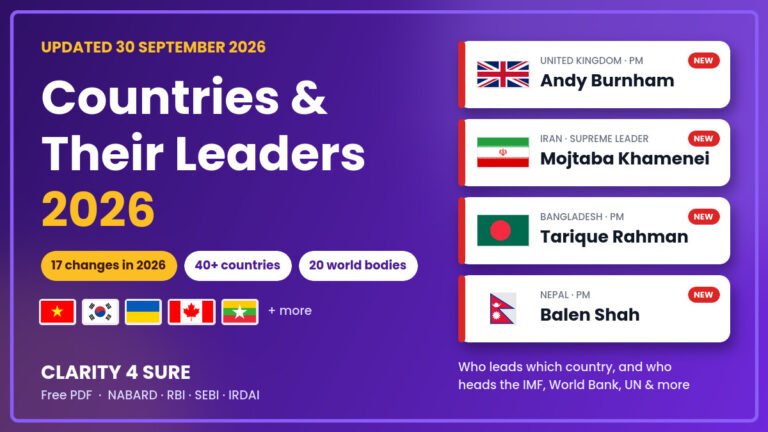 Free sheet · Static GKCountries & Their Leaders 2026Who leads which country in 2026, with all 17 changes marked. Get the article and the PDF free on WhatsApp.Get it free on WhatsApp →