
Daily Current Affairs Quiz: 10 October 2026
Free live session
NABARD Grade A 2026: 45-Day Final Revision Plan + Daily Targets
 🔒 Register to watchLast Sunday’s session · recording
In 8 days · Sun, 25 Oct at 7:30 PM IST
1. Union Agriculture Minister Shivraj Singh Chouhan inaugurated new facilities at ICAR-Indian Institute of Agricultural Biotechnology (ICAR-IIAB), located at:
A. Pusa, New Delhi
B. Garhkhatanga, Ranchi
C. Barrackpore, Kolkata
D. Hesaraghatta, Bengaluru
E. Baramati, Pune
View Answer
Explanation: ICAR-IIAB is at Garhkhatanga in Ranchi, Jharkhand. The new facilities include an Admin-cum-School Building, the Birsa Munda Multipurpose Hall, the Jaipal Singh Munda Sports Complex and a NEXTGEN Breeding Facility, and the foundation of a guest house was also laid. The project is worth ₹119 crore.
2. The Pre-Rabi Kisan Goshti-cum-Agricultural Input Distribution Programme at ICAR-IIAB, Ranchi was organised under which sub-plans?
A. MGNREGA and PMKSY
B. Scheduled Caste Sub-Plan (SCSP) and Tribal Sub-Plan (TSP)
C. RKVY and NFSM
D. PM-KISAN and PMFBY
E. MIDH and NMSA
View Answer
Explanation: The programme ran under the SCSP and TSP, which require a share of scheme funds to be earmarked for Scheduled Caste and Scheduled Tribe beneficiaries. About 1,500 farmers from Ranchi, Khunti, Gumla and Ramgarh districts attended, allowing direct interaction between farmers, scientists and policymakers ahead of the rabi season.
3. Balanced nutrient management, which the Agriculture Minister stressed for Jharkhand’s farmers, primarily means:
A. Using only organic manure and avoiding all chemical fertilisers
B. Applying nitrogen, phosphorus and potassium in the correct proportion instead of over-using urea
C. Raising urea application to maximise yields
D. Growing cereals only in rotation with pulses
E. Supplying micronutrients only through foliar sprays
View Answer
Explanation: Balanced nutrient management means using N, P and K in the right ratio rather than leaning heavily on urea. The Minister also pushed integrated farming, location-specific technologies, timely supply of improved seeds and quicker transfer of research to farmers’ fields, which matter in a largely rain-fed state with low irrigation coverage.
4. ICAR was established in 1929 under which original name?
A. Indian Agricultural Research Council
B. Imperial Council of Agricultural Research
C. Imperial Agricultural Research Institute
D. Royal Commission on Agriculture
E. Central Agricultural Research Board
View Answer
Explanation: ICAR began in 1929 as the Imperial Council of Agricultural Research and is headquartered in New Delhi. Its network of institutes, including ICAR-IIAB at Ranchi, works on crop improvement and biotechnology and helps carry improved seeds and technologies to farmers.
5. From 16 October, banks must maintain at least what share of their prescribed CRR on every day of the reporting fortnight?
A. 80%
B. 90%
C. 95%
D. 99%
E. 100%
View Answer
Explanation: The RBI raised the daily minimum CRR maintenance from 90% to 99% of the prescribed requirement. The CRR rate itself is unchanged at 3% of Net Demand and Time Liabilities. Banks therefore have far less room to run their reserve balances below the full requirement on any single day.
6. A bank has NDTL of ₹1,000 crore and the CRR rate is 3%. Under the revised daily norm, what is the minimum CRR balance it must hold each day?
A. ₹27 crore
B. ₹28.5 crore
C. ₹29.7 crore
D. ₹30 crore
E. ₹33 crore
View Answer
Explanation: The full CRR requirement is 3% of ₹1,000 crore, or ₹30 crore. Under the earlier 90% daily rule the floor was ₹27 crore; at 99% it rises to ₹29.7 crore. The worked example shows how the change tightens day-to-day reserve management without altering the CRR rate.
7. Which of the following correctly distinguishes CRR from SLR?
A. CRR is maintained by banks themselves, while SLR is kept with the RBI
B. CRR balances earn interest, while SLR securities earn nothing
C. CRR is held as cash with the RBI, while SLR can be kept in cash, gold and eligible securities
D. Both are calculated on a bank’s total assets
E. SLR is used only for monetary policy and CRR only for financial stability
View Answer
Explanation: CRR is a share of NDTL kept as cash reserves with the RBI, and banks earn no interest on it. SLR is maintained by the banks themselves in specified liquid assets such as cash, gold and eligible government securities, which can earn returns. Both are computed on Net Demand and Time Liabilities.
8. What is the main objective behind the RBI raising the daily CRR maintenance requirement?
A. To raise the policy repo rate
B. To inject fresh liquidity into the banking system
C. To absorb surplus liquidity and bring short-term market rates closer to the repo rate
D. To reduce the SLR
E. To increase bank credit to MSMEs
View Answer
Explanation: Banking system liquidity was in surplus by about ₹3.88 lakh crore on 8 October 2026. Making banks hold more of their CRR each day absorbs these surplus funds and helps align short-term rates, such as the Weighted Average Call Rate, with the repo rate. Selling securities through Open Market Operations is another way the RBI absorbs liquidity.
9. According to UNCTAD’s Trade and Development Report 2026, what was India’s share of global greenfield investment during 2020–25?
A. 2.8%
B. 3.8%
C. 4.0%
D. 5.7%
E. 7.5%
View Answer
Explanation: India drew 5.7% of global greenfield investment, ahead of Malaysia (4.0%), Indonesia (3.8%) and China (2.8%), more than twice China’s share. Greenfield investment means setting up a new facility abroad from scratch instead of buying an existing one. The report still called India the fastest-growing major economy, though consumption is under price pressure.
10. The Ayush Services Sector Report 2026 was prepared by which organisation?
A. NITI Aayog
B. Research and Information System for Developing Countries (RIS)
C. Central Council for Research in Ayurvedic Sciences
D. All India Institute of Ayurveda
E. Quality Council of India
View Answer
Explanation: RIS, a policy think tank under the Ministry of External Affairs, prepared the report, which the Ministry of Ayush released on Ayurveda Day 2026. It finds that women make up 43% of the Ayush services workforce, rising to over 60% in spas and wellness resorts and 58% in educational institutes.
11. As per the Ayush Services Sector Report 2026, what was the size of India’s Ayush services sector in FY2024-25?
A. US$16.21 billion
B. US$24.50 billion
C. US$36.92 billion
D. US$52.10 billion
E. US$216 billion
View Answer
Explanation: The sector was valued at US$36.92 billion, growing at a CAGR of 16.91%, and is projected to reach US$216–318 billion by 2047. It supports about 1.76 million livelihoods. Standalone clinics earn the largest share of revenue at US$16.21 billion, and Ayurveda accounts for nearly 48% of the total.
12. The World Bank Group’s World Development Report 2026, launched in New Delhi, is titled:
A. Digital Dividends
B. The Promise of Artificial Intelligence
C. Data for Better Lives
D. Trading for Development in the Age of Global Value Chains
E. The Middle-Income Trap
View Answer
Explanation: The 2026 report examines how AI can drive development, affect jobs and improve public services. It recommends an adopt-and-adapt approach in which developing countries customise existing AI models instead of building costly ones from scratch, and finds that just over 4% of Indian jobs face immediate automation risk, compared with over one-third in advanced economies.
13. NSAM 2.0, being rolled out by the Ministry of Electronics and Information Technology, stands for:
A. National Strategy for Advanced Microelectronics
B. National Strategy for Additive Manufacturing
C. National Semiconductor Assembly Mission
D. National Smart Agriculture Mission
E. National Space Applications Mission
View Answer
Explanation: NSAM 2.0 is the National Strategy for Additive Manufacturing, building on the first strategy launched in 2022. Additive manufacturing builds objects layer by layer from 3D model data, unlike subtractive methods that remove material. It cuts material waste and enables complex designs in aerospace, defence, healthcare and automobiles.
14. Navi Pillay, who received the 2026 Nobel Peace Prize, was born in which city?
A. Chennai, India
B. Durban, South Africa
C. Colombo, Sri Lanka
D. Kuala Lumpur, Malaysia
E. Port Louis, Mauritius
View Answer
Explanation: Pillay, 85, was born into an Indian Tamil family in Durban, South Africa. A judge and human rights lawyer, she defended Nelson Mandela and other opponents of apartheid and served as UN High Commissioner for Human Rights from 2008 to 2014. The Peace Prize is the only Nobel awarded in Oslo.
Every day of the month in one file. Enter your details once — the download opens right away.
We already have your details, so no form: tap to open.
Download the October 2026 current affairs quiz PDFDownload the October 2026 Exam Ready quiz PDFAll October 2026 quizzes in one place: every question of the month with answers, a full PDF and an Exam Ready PDF — October 2026 current affairs quiz
Related on Clarity 4 Sure



 Scheme to knowAyushman Bharat: Ayushman Arogya Mandirs and PM-JAY Explained – Rs 5 Lakh Cover, 70+ Senior Citizens, Achievements and FactsAyushman Bharat is India's flagship health programme, launched in 2018 on the recommendations of the National Health…
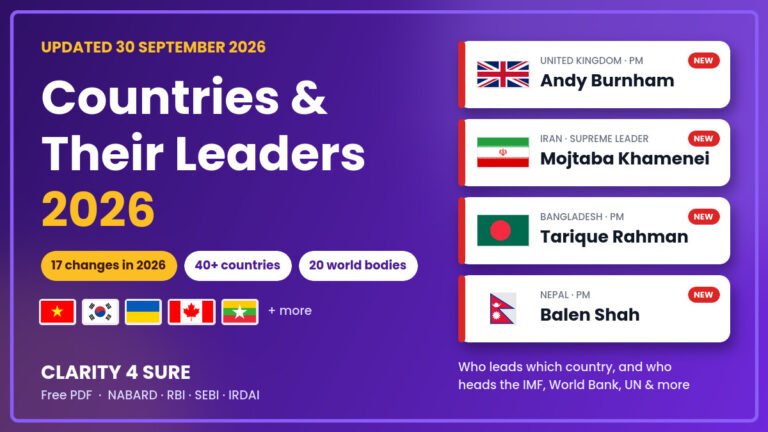 Free sheet · Static GKCountries & Their Leaders 2026Who leads which country in 2026, with all 17 changes marked. Get the article and the PDF free on WhatsApp.Get it free on WhatsApp →