
NABARD Grade A Phase 2 · Paper I · General English
NABARD Grade A Descriptive English 2026: Essay, Précis & Letter PYQs, Official Pattern and a 76/100 Topper Strategy
NABARD Grade A Descriptive English is Paper I of Phase 2: an online, typed paper of 3 questions, 100 marks and 90 minutes, usually one essay, one précis and one letter. In the 2025 cycle the minimum qualifying score rose to 60/100 for General candidates, and C4S student Prashant Nagar scored 76. This guide gives you the official pattern from NABARD’s handout, every memory-based PYQ from 2022 to the January 2026 paper, word limits, typing rules, essay topics for 2026–27 and a step-by-step writing method.
Official NABARD Phase 2 English descriptive exam pattern
NABARD’s Information Handout for Online Exam – Phase II (Assistant Manager Grade ‘A’ RDBS General, 2025) sets out the scheme below. Paper I General English is held in the morning shift; Paper II (Economic & Social Issues and Agriculture & Rural Development) follows in the afternoon. You must appear in both shifts.
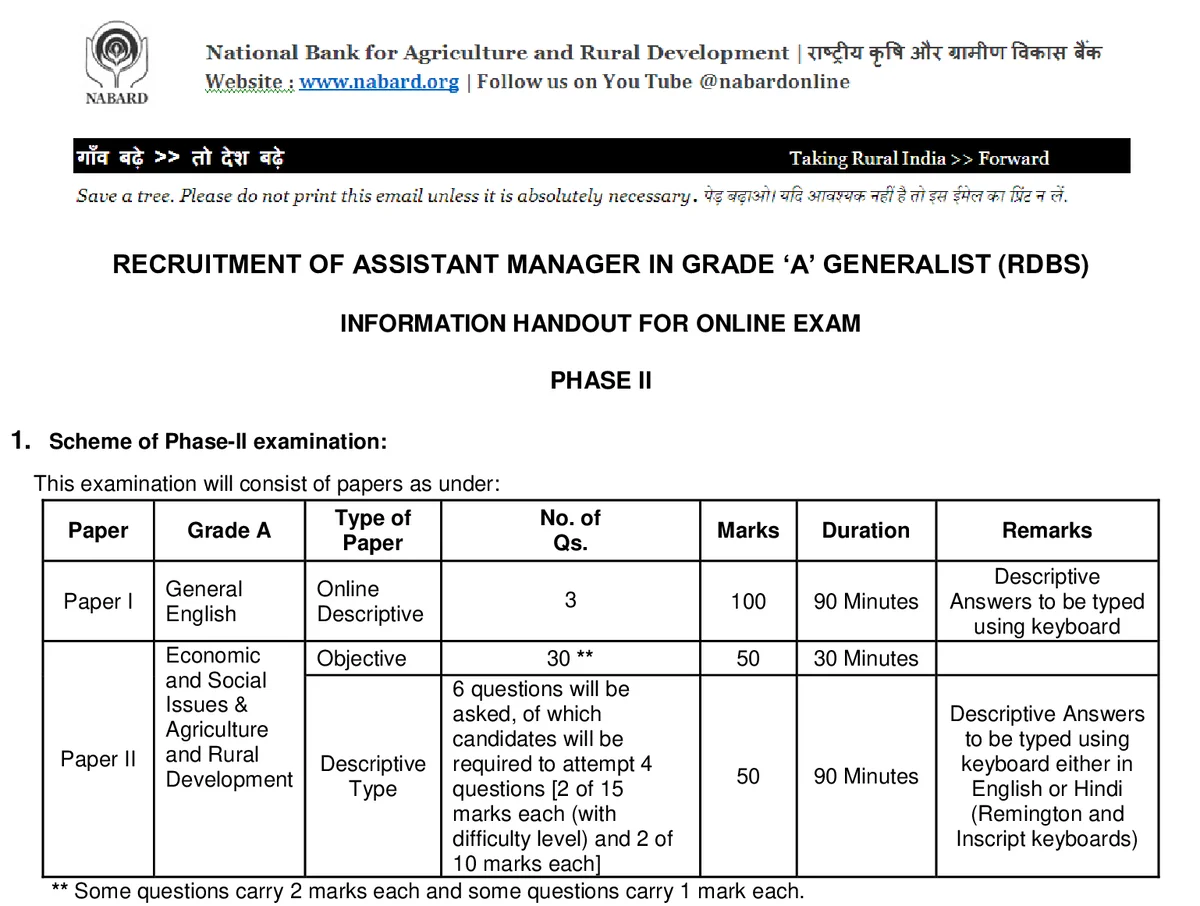
| Paper | Subject | Type | Questions | Marks | Time | Answer language |
|---|---|---|---|---|---|---|
| Paper I (morning) | General English | Online descriptive | 3 | 100 | 90 min | English only, typed on keyboard |
| Paper II (afternoon) | ESI & ARD | Objective | 30 (1 or 2 marks each) | 50 | 30 min | Mouse click; ¼ negative marking |
| Descriptive | Attempt 4 of 6 (2 × 15, 2 × 10 marks) | 50 | 90 min | English or Hindi (Inscript or Remington GAIL) |
NABARD descriptive English syllabus: what the paper tests
The handout says the English paper is framed “to assess the writing skills including expression and understanding of the topic”, and that it judges your analytical and drafting abilities through essay writing, comprehension, report writing, paragraph writing and letter writing. Recent papers have used three of these: an essay, a précis and a letter. Practise all five, because the handout keeps the others open and NABARD can switch formats without notice.
Two practical points follow from the official wording. First, “understanding of the topic” is marked: an essay that drifts from the question loses marks even if the English is clean. Second, your Phase 2 ESI and ARD preparation is the raw material for the essay, so it pays to read the NABARD ESI guide alongside this one.
Section-wise marks, word limits and time split
| Section | Marks | Word limit | Suggested time |
|---|---|---|---|
| Essay (choose 1 of 4) | 40 | 500–520 words | 40 min |
| Précis (with title) | 30 | About 120 words | 25 min |
| Letter (choose 1) | 30 | 200–220 words | 20 min |
| Final read-through | – | – | 5 min |
| Total | 100 | – | 90 min |
Marks and limits as reported in the C4S NABARD PYQ repository. The time split is a C4S recommendation. Limits move between years: the précis was 130 words in 2022, about 120 in 2024 and the January 2026 paper, and the official sample asks for about 150. Practise both 120 and 150.
Official NABARD sample questions for Paper I
NABARD’s handout gives these illustrative questions and warns that the real paper can be harder and can include question types not shown.
| Question | Official sample | What it tells you |
|---|---|---|
| Q1. Essay (any one) | Three effective measures to eradicate illiteracy in India and how they will work; or “Computerisation results in unemployment. Do you agree? Explain.” | Topics ask for a position plus reasoning. “Three measures” means exactly three, each explained. |
| Q2. Précis | A précis in about 150 words with a suitable title, on a passage about using electronic systems to cut routine paperwork in governance. | The title is part of the answer. Practise 150-word précis as well as 120. |
| Q3. Letter (any one) | To your younger brother on how agriculture in India has changed in the last decade; or to the Branch Manager of a crop insurance company appreciating good service in settling a claim. | Expect agriculture and rural-finance themes, in both informal and formal formats. |
Exam-day typing rules for NABARD descriptive writing
The paper is typed, and the handout includes rules that change how your answer looks on the examiner’s screen:
- Paragraph breaks: if you press Space and then Enter, the cursor does not move to a new line. Press Enter immediately after the last word of the paragraph.
- Repeated keys count once: pressing Space or Enter several times in a row registers as one space or one line break. You cannot leave blank lines for layout, so each paragraph needs a strong first sentence.
- Select English on the toggle bar before typing. Paper I questions appear only in English and must be answered only in English.
- One question at a time, and no early submission: answers save automatically when the 90 minutes end.
- Never click “Exit” on the language panel.
- Rough sheet: a sheet is provided. Plan your essay outline on it, then return it to the invigilator.
- Reporting: expect about 150 minutes at the venue for Paper I. Carry both admission letters with photographs pasted, an original photo ID with two photocopies, and Aadhaar for biometric authentication.
Source: NABARD, Information Handout for Online Exam, Phase II, Assistant Manager Grade ‘A’ (RDBS) General, 2025, on the NABARD careers page.
NABARD descriptive English qualifying marks and why the paper decides your rank
Phase 1 only shortlists. The final merit list is built from Phase 2 (200 marks) and the interview (50 marks), and half of Phase 2 is this English paper. The gap between the select list and the wait list has been only 2–5 marks, so every mark here moves you on the final list.
NABARD also sets a minimum score (group norm) in Paper I. For General discipline UR/EWS candidates it has risen almost 10 marks in five years:
Scores also vary widely between candidates who know the same ESI and ARD content. C4S’s analysis of NABARD 2025 English marks shows the spread:
767470+
495459+
NABARD 2025 topper story: how Prashant Nagar scored 76/100 in Descriptive English

Prashant Nagar scored 76 out of 100 in NABARD Grade A 2025 Descriptive English, and that score turned the final selection in his favour. In the same year he cleared three exams: IBPS AFO, DDA SO and NABARD Grade A.
Why 76 matters: the 2025 Paper I minimum was 60. A score of 76 is 16 marks above the qualifying line, in a final list where selection and wait list were separated by 2–5 marks. Few sections of Phase 2 give you that kind of margin.
What he prepared with at C4S:
- NABARD Mentorship Programme (personalised guidance)
- NABARD Test Series (regular testing and performance tracking)
- English Descriptive Programme (evaluated answers and model answers)
- Interview Programme (mock interviews with feedback)
- C4S IBPS AFO 24/7 Test Series
The lesson: high English scores come from written, evaluated and rewritten practice, not from a “good English” background. The same method is laid out section by section below.
C4S results in NABARD Grade A 2025
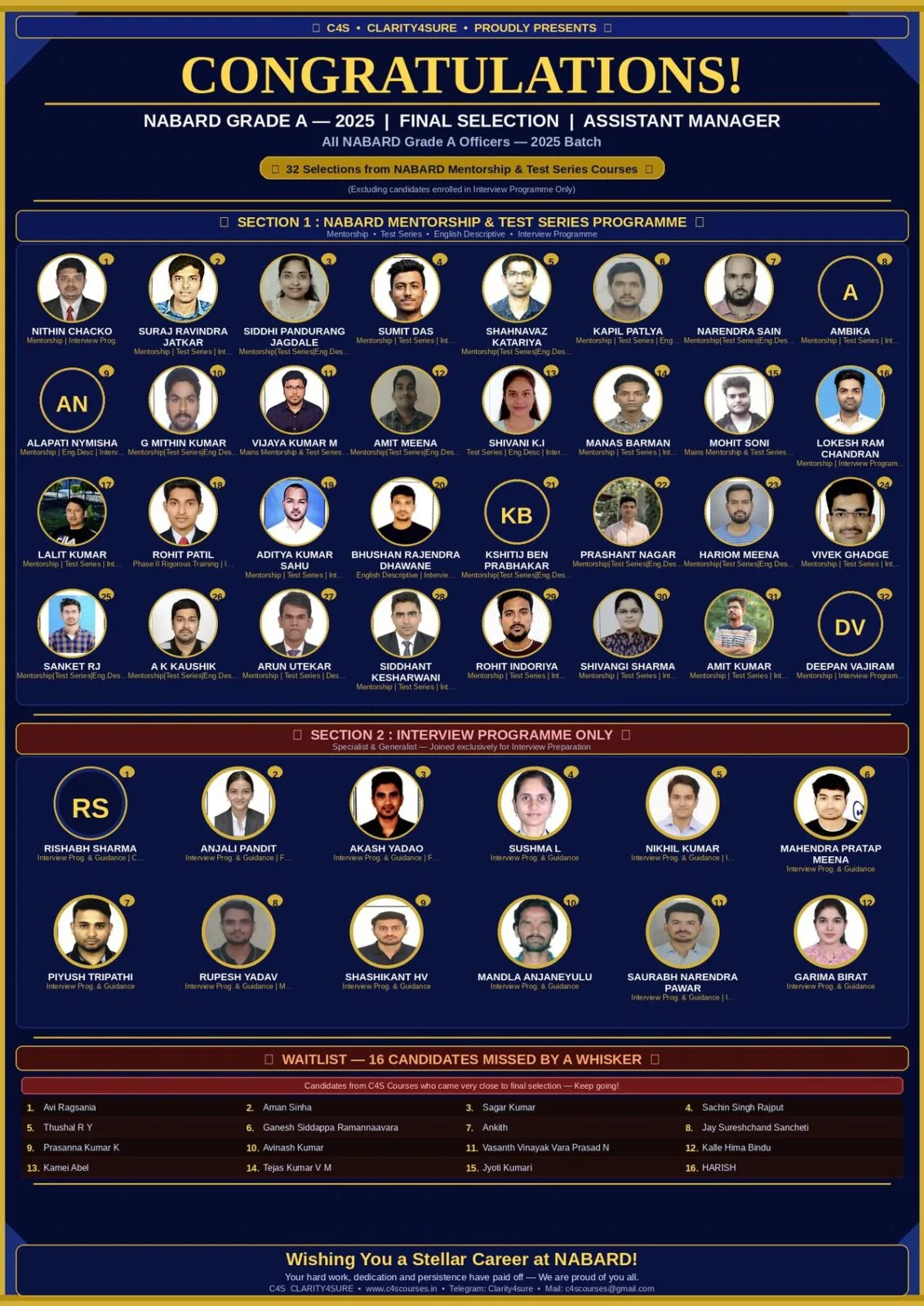
Prashant is one of 32 final selections from C4S in NABARD Grade A 2025. C4S students also took 8 of the top 10 ranks: Ranks 1, 2, 3, 5, 6, 7, 8 and 9.


NABARD descriptive English PYQs 2022–2026 (memory-based)
NABARD does not publish its papers. These questions were reconstructed by candidates after each exam and are compiled, with answer approaches, in the C4S NABARD Grade A PYQ repository. Wording may differ slightly from the actual paper.
NABARD descriptive English paper 2026 (2025 cycle, Phase 2 held 25 January 2026)
| Section | Question | What a good answer needs |
|---|---|---|
| Essay (500–520 words) | Startups in India: growth, challenges and role in the economy. | Context → growth drivers (digital public infrastructure, funding, Startup India) → contribution (jobs, innovation, exports) → challenges (funding winter, regulation, scaling) → way forward. |
| Essay | How can the Indian economy be strengthened by improving the manufacturing sector? | Share in GVA and jobs → PLI and Make in India → MSMEs and exports → constraints (logistics, skills, land) → reforms. |
| Essay | Agrovoltaics (agriculture + photovoltaic installations): is it feasible? | Concept → benefits (dual land use, extra farm income, lower evaporation) → constraints (cost, shading, design) → PM-KUSUM link → clear verdict. |
| Essay | Positive and negative impacts of agricultural subsidies. | Types (input, price, credit) → benefits → fiscal and environmental costs → WTO angle → reform through DBT and better targeting. |
| Précis (about 120 words) | Passage on agriculture in Peru. | Central idea, examples and repetition dropped, about one-third of the original, in your own words, with a title. |
| Letter (200–220 words) | Complaint to a factory manager or owner about problems faced by factory workers, or complaint to a publishing house about not receiving the newspaper despite paying the full annual subscription. | Formal format → subject line → the issue with specifics (dates, receipt number) → impact → clear request and deadline → courteous close. |
NABARD descriptive English paper 2024
| Section | Question | What a good answer needs |
|---|---|---|
| Essay (500–520 words, 40 marks) | Choose one: (1) How can youth contribute to India’s progress in education, entrepreneurship and social initiatives? (2) How does access to credit increase sustainable farming practices in India? (3) Integrating fish culture with agricultural crops enhances productivity and farmers’ income. Discuss. (4) “Look deep into nature, and then you will understand everything better.” – Albert Einstein. Elaborate. | Pick the topic you can support with data and examples. Topics 2 and 3 reward ARD knowledge: KCC, PACS, integrated rice–fish farming. |
| Précis (about 120 words, 30 marks) | Passage on Ethiopia’s water crisis: rainwater and pond harvesting, low access to drinking water and sanitation, children missing school, and a “Water for All” programme that raised access. | Problem → impact on children and health → government response → outcome, keeping only the key figures. |
| Letter (220 words, 30 marks) | Choose one: (1) to the municipal corporation about poor road conditions; (2) a grievance about a faulty electronic device delivered to you; (3) to the in-house editor seeking an extension for an article because of clashing tasks. | Formal format → subject → specifics (location, order number, deadline) → request → courteous close. |
Full 2024 model answers: NABARD Phase II English Descriptive questions and model answers 2024.
NABARD descriptive English paper 2022
| Section | Question | What a good answer needs |
|---|---|---|
| Essay | Choose one: (1) Agri-logistics: railways vs roadways; (2) Climate change and biodiversity; (3) Issues of the manufacturing sector. | For agri-logistics: cost, speed, wastage, cold chain, Kisan Rail, Dedicated Freight Corridors, last-mile road links → balanced conclusion. |
| Précis (130 words) | Passage on electric vehicles. | Central idea (EV adoption, benefits, barriers), examples and figures dropped, about one-third of the original. |
| Letter | Formal: seeking replacement of faulty furniture, or to the housing society secretary. Informal: to your manager congratulating him on his promotion. | Formal: format, subject, issue, request. Informal: warm tone, the specific achievement, good wishes. |
The full-length PDF of each year is free from C4S on WhatsApp via the PYQ repository.
NABARD descriptive English trend analysis and essay topics for 2026–27
Essays come from two pools. One is rural and agricultural: agrovoltaics, agricultural subsidies, credit for sustainable farming, fish–crop integration, agri-logistics. The other is economy and society: startups, manufacturing, youth, climate change. Manufacturing appeared in both 2022 and January 2026.
Your ESI and ARD notes are your essay content. An agrovoltaics essay needs PM-KUSUM; a credit essay needs KCC and PACS; a startups essay needs Startup India and digital public infrastructure.
Précis passages are factual and often set in another country: Ethiopia’s water crisis (2024), agriculture in Peru (January 2026), electric vehicles (2022). Expect figures you must drop or compress.
Letters are practical complaints and requests: faulty products, poor roads, undelivered subscriptions, workers’ problems, deadline extensions. 2022 also offered an informal letter, and so does NABARD’s official sample, so keep one informal format ready.
Essay themes to practise for the next paper (C4S practice list, not predictions): rural credit and financial inclusion; climate-resilient agriculture; cooperatives and PACS; digital agriculture and AgriStack; MSMEs and exports; women-led development and SHGs; water security; renewable energy in villages; food processing and value chains; literacy and skilling, which appears in NABARD’s own sample.
How to write the NABARD essay (40 marks)
Spend the first five minutes planning on the rough sheet, not typing. Read every part of the question: “growth, challenges and role” is three parts, and missing one costs marks however good your English is.
- Introduction (60–80 words): define the topic, give one data point or recent development, and state what the essay will examine.
- Body (330–380 words, 3–4 paragraphs): one idea per paragraph, each with a topic sentence, an explanation and an example, scheme or figure.
- Balance: for “is it feasible?” or “positive and negative impacts” questions, give both sides before your verdict.
- Conclusion or way forward (60–80 words): practical and forward-looking, with no new arguments.
Worked outline: “Agrovoltaics: is it feasible?” (January 2026 paper)
- Introduction: agrovoltaics combines farming with solar panels on the same land; link it to land scarcity and India’s renewable-energy targets.
- Benefits: dual use of land, extra and stable farmer income, shade that cuts evaporation and heat stress for some crops.
- Constraints: high installation cost, yield loss from shading, panel height and spacing that limit machinery, unclear land-use rules.
- Policy link: PM-KUSUM, cooperative and FPO ownership models, credit support.
- Verdict: feasible for selected crops and regions with the right design and finance; not a universal answer.
How to write the NABARD précis (30 marks)
A précis is about one-third of the passage, in your own words, keeping the central idea and the logical order. It is not a list of points and not your opinion.
- Read the passage twice and write its central idea in one line.
- Mark the 4–6 points that carry the argument. Drop examples, repetition, quotations and most figures.
- Draft in your own words, in the third person and in the passage’s tense.
- Count the words and cut to the limit (about 120 recently; 150 in the official sample).
- Add a short title when asked; NABARD’s sample and recent papers both asked for one.
Compression example (2024 Ethiopia passage): a paragraph listing pond harvesting, rooftop collection, low water access, poor sanitation and children missing school becomes one sentence: “Scarce safe water and sanitation in Ethiopia harm public health and keep children, especially girls, out of school.”
How to write the NABARD letter (30 marks)
Most NABARD letters are formal complaints or requests. Format marks are easy to earn and easy to lose.
- Sender’s address and date
- Receiver’s designation and address
- Subject line: one line stating the issue
- Salutation: “Dear Sir/Madam,”
- Opening: who you are and why you are writing
- Body: specifics (dates, location, order or receipt number) and the impact
- Request: the action you want, and by when
- Close: “Yours faithfully,” and your name
Tone: firm, polite, specific. “The newspaper has not been delivered since 3 October despite full payment of the annual subscription (Receipt No. 4512)” scores better than “I am very upset that I am not getting my newspaper.” For an informal letter, such as NABARD’s sample to a younger brother, keep the warmth but still organise the content into clear paragraphs.
Grammar and sentence formation: where most marks are lost
Most candidates lose marks on sentence-level errors, not on ideas. C4S teaches five areas before any essay practice:
| Area | What to master |
|---|---|
| Articles | a, an, the: definite, indefinite, zero article and special rules. |
| Subject | Singular/plural, collective nouns, subject–verb agreement, common errors. |
| Numbers | Figures, ordinals and approximations written correctly and consistently. |
| Vocabulary | Precise words, one-word substitutes and the vocabulary of economics, agriculture and social issues. |
| Active voice | Active and passive by tense, and when active voice reads more clearly. |
Then apply them in the C4S sentence-building sequence:
- What it is
- Find
- Fill
- Connect
- Frame small
- Frame big
Common mistakes that cost marks
- Answering only part of a multi-part question
- A long, generic introduction that never defines the topic
- Paragraphs without a clear point, or the same point repeated
- Informal phrases (“a lot of”, “nowadays”) in formal answers
- A précis copied from the passage, or with your opinion added; a missing précis title
- No subject line, or the wrong close, in a formal letter
- Going well over or under the word limit
- Pressing Space before Enter, so paragraphs merge into one block on screen
- Slow typing: speed matters as much as structure in a typed paper
NABARD descriptive English preparation strategy
- Start before Phase 1. Phase 2 came only about five weeks after Phase 1 in the last cycle, and the Paper I minimum rose to 60.
- Fix grammar first. Two weeks on articles, subject–verb agreement, numbers and voice.
- Write, then read model answers. Model answers help only after you have written your own version.
- Practise on a keyboard with a timer and a word counter, using the exam’s Enter-key rule.
- Build essay fodder from ESI and ARD: one page of data, schemes and examples per likely theme.
- Get every answer evaluated and rewrite it after feedback.
- Take full-length timed papers in the last six weeks: essay, précis and letter in one 90-minute sitting.
Free C4S video lessons for NABARD English descriptive
All free on the Clarity4Sure YouTube channel:
- Convent or UPSC Background? Still Don’t Take NABARD English Descriptive Lightly!
- IBPS AFO + NABARD + DDA SO: How Did Prashant Crack All 3?
- Essay writing strategy: score 35+ in the essay and 65+ overall
- NABARD Grade A: last 5 years’ English analysis and cut-off trends
- NABARD answer writing strategy (live session)
- An approach to excellence in descriptive English
- NABARD Phase II English Descriptive 2024: questions and model answers
- NABARD English Descriptive analysis 2024
More reading: An approach to excellence in descriptive English and why descriptive English matters for RBI, SEBI and NABARD.
Free daily English practice on Telegram. Join English4sure, the C4S English channel for RBI, NABARD, SEBI, SIDBI and IFSCA: daily grammar and vocabulary boosters, descriptive writing guidance, practice MCQs, notes and quizzes.
Join English4sure on TelegramC4S NABARD English Descriptive Course
The course covers all of Phase 2 Paper I (essay, précis, comprehension, letter and report writing) plus the technical descriptive answers for ESI and ARD. Every answer is read and marked by a mentor, with feedback on content, structure and language, and you rewrite it.
- 13 live foundation classes (recorded, 24×7 access): five on sentence formation (articles, subject, verb, numbers, active voice), two sentence-formation workshops, and two workshops each on essay, letter and précis
- 9 sectional tests: 3 essay, 3 letter, 3 précis, each with evaluation, model answers and discussion
- 10 full-length tests: 7 fortnightly papers (remaining on 4 Nov, 18 Nov, 2 Dec and 16 Dec 2026) plus 3 scheduled close to the NABARD Phase 2 date
- Typing-speed practice, essay and letter fodder, and skills that carry over to RBI Grade B and SEBI Grade A
Fee: ₹1,499 (list price ₹3,000). Also included in the NABARD Grade A Mentorship & Test Series.
See the English Descriptive course Practise the PYQs
Batch details and fee as listed on 31 October 2026; check the course page for current details. Questions: Telegram Clarity4Sure · English practice English4sure · c4scourses@gmail.com
NABARD descriptive English: frequently asked questions
What is asked in NABARD Grade A Descriptive English?
Phase 2 Paper I is a 100-mark, 90-minute typed paper of 3 questions. Recent papers have had one essay (40 marks), one précis (30 marks) and one letter (30 marks). NABARD’s handout also lists comprehension, report writing and paragraph writing.
What is the word limit for the NABARD essay, précis and letter?
In the January 2026 paper the limits were 500–520 words for the essay, about 120 words for the précis and 200–220 words for the letter. NABARD’s official sample précis asks for about 150 words, so read the instructions on the day.
What is the qualifying mark in NABARD Descriptive English?
For General discipline UR/EWS candidates, the Paper I minimum was 60 out of 100 in 2025, up from 54 in 2024, 53.25 in 2023, 49 in 2022 and 50.25 in 2021. For SC, ST, OBC and PwBD it was 56.50 in 2025.
What is a good score in NABARD Descriptive English?
Aim for 70 or more. The 2025 minimum was 60 for General candidates, and top scorers reached 74–76. C4S student Prashant Nagar scored 76 in 2025 and secured final selection.
Which essay topics were asked in the NABARD 2026 descriptive English paper?
In the Phase 2 paper of 25 January 2026 (2025 cycle): startups in India; strengthening the economy through manufacturing; agrovoltaics and whether it is feasible; and the positive and negative impacts of agricultural subsidies.
Is the NABARD English descriptive paper typed or handwritten?
It is typed on a keyboard, in English only. Press Enter immediately after the last word to start a new paragraph; Space followed by Enter will not move the cursor.
Can I write the NABARD English paper in Hindi?
No. Paper I questions are only in English and answers must be typed only in English. Hindi (Inscript or Remington GAIL keyboard) is allowed only for the descriptive part of Paper II (ESI & ARD).
When should I start preparing for NABARD Descriptive English?
Before Phase 1. In the last cycle Phase 2 came about five weeks after Phase 1, which is too little time to fix grammar and build a typed writing habit from scratch.
Where can I get NABARD English descriptive previous year questions?
The C4S NABARD Grade A PYQ repository lists the 2022, 2024 and January 2026 English descriptive questions with answer approaches, and the full-length PDF of each year is free on WhatsApp.
Sources: NABARD Information Handout for Online Exam, Phase II, Grade A RDBS (General), 2025; C4S NABARD Grade A PYQ 2021–2025; C4S NABARD English Descriptive course; C4S NABARD English Descriptive 2026 programme brochure; NABARD careers notices.