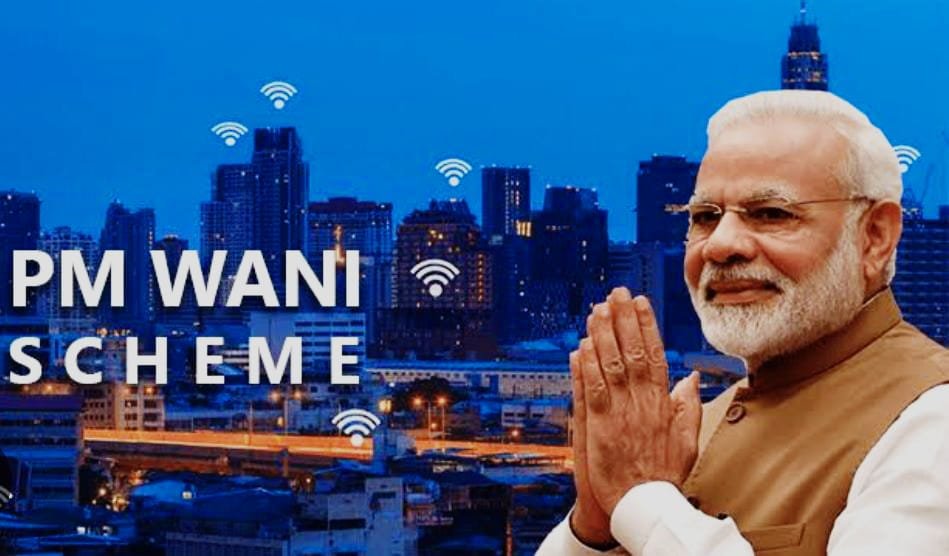
PM-WANI (Prime Minister’s Wi-Fi Access Network Interface) is the Department of Telecommunications’ framework, approved by the Cabinet on 9 December 2020, that lets any shop, tea stall or common service centre become a public Wi-Fi hotspot without a licence or registration fee, so that affordable broadband can spread through a network of small local providers.
Why PM-WANI Was Created
- Mobile data alone cannot carry the growing demand for broadband; public Wi-Fi offloads traffic and reaches places with weak mobile coverage.
- The National Digital Communications Policy 2018 set a target of 1 crore public Wi-Fi hotspots by 2022; India had only a few lakh, mostly in cities.
- Licensing requirements had kept small businesses out of the public Wi-Fi market; PM-WANI removed that barrier.
The Four Building Blocks
- Public Data Office (PDO): the shop or establishment that sets up the Wi-Fi access point and sells internet access; needs no licence, registration or fee.
- Public Data Office Aggregator (PDOA): an entity that aggregates PDOs and handles authorisation and accounting for them; registers with DoT.
- App Provider: develops the app that shows a user the nearby PM-WANI hotspots and authenticates the user once for all networks.
- Central Registry: maintained by the Centre for Development of Telematics (C-DOT), it holds the details of every app provider, PDOA and PDO.
ARD notes, the monthly current affairs PDF and a descriptive English sample — all free, on WhatsApp.
Get it on WhatsApp — one tap or just leave your numberHow It Works for a User
- The user downloads any PM-WANI-compliant app, completes a one-time e-KYC, sees the nearby hotspots and buys a small data pack (as little as a few rupees); the same sign-in works at every PM-WANI hotspot in the country.
- The PDO earns from the packs sold, the PDOA takes a share for its services, and the whole system runs on interoperable standards.
Targets and Progress
Free live session
NABARD Grade A 2026: what the 2025 cut-offs changed, and the 90-day plan
In 8 days · Sun, 4 Oct at 7:30 PM IST
- NDCP 2018 targeted 1 crore hotspots by 2022; the Bharat 6G Vision document (2023) set targets of 1 crore hotspots and 5 crore by 2030.
- Actual deployment has been far slower – a few lakh PM-WANI hotspots by 2025 – because PDOs had to buy bandwidth at commercial rates and margins were thin.
- To fix this, TRAI recommended and in January 2025 notified that PDOs may take broadband from telecom operators at retail (home broadband) tariffs, up to a defined capacity, sharply cutting their input cost.
- The scheme is a building block of Digital India and of BharatNet-based rural connectivity, where common service centres and gram panchayats can act as PDOs.
Important Facts for Examsmost asked
- PM-WANI: approved by the Cabinet on 9 December 2020; nodal body – Department of Telecommunications.
- Four components: Public Data Office, Public Data Office Aggregator, App Provider and Central Registry (C-DOT).
- PDOs need no licence, registration or fee; PDOAs and app providers register with DoT.
- NDCP 2018 target: 1 crore public Wi-Fi hotspots by 2022; Bharat 6G Vision: 5 crore by 2030.
- TRAI’s January 2025 tariff order allowed PDOs to buy bandwidth at retail broadband rates.
FAQs
Is PM-WANI free internet?
No. Users buy low-cost data packs from the PDO; the framework makes hotspots cheap to set up and interoperable, not free to use.
What is the difference between a PDO and a PDOA?
The PDO is the physical hotspot owner; the PDOA is the aggregator that authorises users, keeps accounts and settles payments for many PDOs.
Why is PM-WANI asked in bank exams?
It combines digital inclusion, MSME income and telecom policy; the launch date, the four components and C-DOT’s role are the facts usually tested.