Context
Recently, a report titled “Global Water Bankruptcy: Living Beyond Our Hydrological Means in the Post-Crisis Era” was released by the United Nations University Institute for Water, Environment and Health (UNU-INWEH). It was published ahead of the UN Water Conference 2026 and warns that the world is using far more water than nature can sustainably provide, pushing many regions towards severe water shortages and long-term crisis.
What Is Water Bankruptcy?
Water bankruptcy describes a situation where a society has used water far beyond what nature can replace over time. People keep drawing more water from rivers, lakes, glaciers, soils, and underground aquifers than is safely available, and they also pollute and damage water sources. As a result, water systems and ecosystems are permanently or nearly permanently harmed, meaning earlier levels of water availability cannot be brought back.
In short, it is like spending all your savings and damaging your income source at the same time—the natural water reserves built up over hundreds of years are exhausted, leaving future generations with much less water to depend on.
| Condition | Description | Recovery Potential |
|---|---|---|
| Water Stress | Demand for water is high compared to available supply, but resources are not exhausted and can recover with conservation and better management. | Reversible |
| Water Crisis | A sudden and short-term emergency such as drought, pollution, or supply disruption causing acute water shortage. | Temporarily reversible |
| Water Bankruptcy | Chronic, long-term overuse and degradation of water resources where natural replenishment is exceeded and ecosystems are permanently damaged. | Largely irreversible |
Concerns & Issues: Patterns of Water Bankruptcy
Systemic Global Water Insecurity
- 2.2 billion people lack safely managed drinking water.
- 3.5 billion people lack safely managed sanitation.
- 4 billion people experience severe water scarcity for at least one month every year.
- Nearly 75% of the world’s population lives in countries classified as water-insecure or critically water-insecure.
- The world is off-track to achieve Clean Water and Sanitation (SDG-6) by 2030, and the risks are global, interconnected, and escalating.
Declining Water Storage and Agricultural Stress
- Around three billion people and over half of global food production depend on regions where total water storage—including surface water, soil moisture, snow, ice, and groundwater—is declining or unstable.
- More than 170 million hectares of irrigated cropland face high or very high water stress.
- Simultaneously, over 50% of global agricultural land is moderately or severely degraded, reducing soil moisture retention and accelerating desertification.
- Salinisation has further degraded over 100 million hectares of cropland, undermining yields in major food-producing regions.
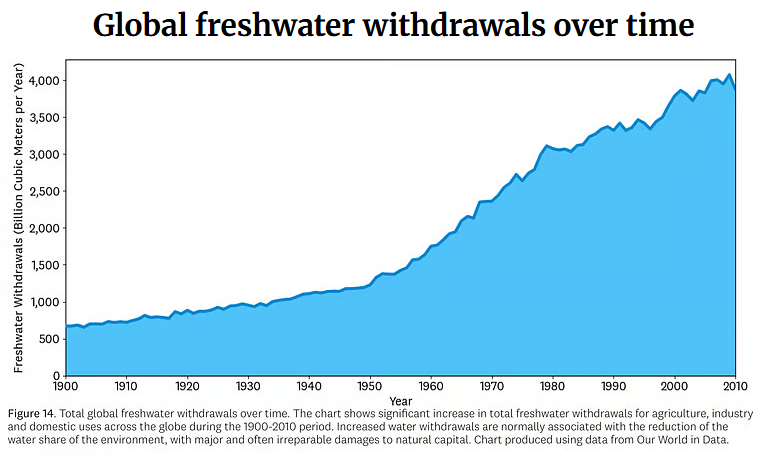
Visible Global Consequences
- Drying rivers and collapsing water bodies
- Major rivers such as the Colorado, Indus, and Yellow now dry up before reaching the sea due to excessive withdrawals.
- Lakes and glaciers are shrinking, including the Aral Sea, Lake Chad, and Himalayan glaciers.
- Damage to land and groundwater
- Over-pumping of groundwater has caused land subsidence and salinisation of aquifers.
- Ecosystem collapse and desert expansion
- Deserts are expanding, and dust storms are increasing as ecosystems lose their ability to regenerate.
- Urban water emergencies
- Several cities face ‘Day Zero’ situations, where taps may run dry, such as Cape Town, Chennai, and Mexico City.
Challenges of Irreversibility and Equity
- Environmental and social justice issue
- Water bankruptcy is not just an environmental problem but also a question of fairness and justice.
- Permanent and costly damages
- Some losses, such as aquifer collapse and extinction of ecosystems, are irreversible.
- Other damages can only be repaired at very high economic cost and over long time periods.
- Need for equitable management
- Addressing water bankruptcy requires sharing the burden fairly.
- Governments must ensure basic water access for all, while supporting communities that lose livelihoods due to water depletion.
Outdated Global Water Governance
- Limitations of existing approaches
- Global water policy still focuses mainly on:
- WASH (Water, Sanitation, and Hygiene) targets
- Small efficiency improvements
- Generic Integrated Water Resources Management (IWRM) frameworks
- Global water policy still focuses mainly on:
- Mismatch with current realities
- These approaches are no longer sufficient in an era marked by:
- Irreversible water damage
- Rising geopolitical tensions and fragmentation
- These approaches are no longer sufficient in an era marked by:
Anthropogenic Droughts and Economic Losses
- Human-made droughts
- Modern droughts are increasingly caused and worsened by human activities.
- Large-scale human impact
- Between 2022 and 2023, around 1.8 billion people lived under drought conditions.
- Severe economic costs
- Annual global drought-related losses have reached about $307 billion, more than the GDP of many countries.
- Structural causes
- These losses result not only from low rainfall, but also from:
- Long-term land degradation
- Excessive groundwater extraction
- Outdated and inefficient water infrastructure
- These losses result not only from low rainfall, but also from:
Cryosphere Crisis
- Rapid glacier loss
- The world has already lost over 30% of its glacier mass since 1970.
- Several mountain regions may lose glaciers entirely within decades.
- Threat to water security
- Glacier loss endangers 1.5–2 billion people who depend on glacier-fed rivers.
- Major affected river systems include the Indus, Ganges–Brahmaputra, Yangtze, Yellow, Amu Darya, and Andean rivers.
Reasons Behind Water Bankruptcy
Overextraction of Water Resources
- Water is being withdrawn from rivers, lakes, and aquifers faster than nature can recharge them.
- Excessive groundwater pumping for irrigation, industry, and cities has led to falling water tables and permanent aquifer damage.
- Many regions rely on fossil groundwater, which takes centuries to refill.
Climate Change and Altered Hydrology
- Climate change is disrupting rainfall patterns, making wet areas wetter and dry areas drier.
- More intense droughts, floods, and heatwaves reduce reliable water availability.
- Melting glaciers and reduced snow cover weaken natural water regulation systems.
Pollution and Water Quality Degradation
- Untreated sewage, industrial effluents, agricultural chemicals, and plastics contaminate water bodies.
- Polluted water becomes unfit for drinking, irrigation, or ecosystems, effectively reducing usable water supply.
- Cleaning polluted water often requires high costs and advanced technology.
Loss of Natural Water Infrastructure
- Wetlands, floodplains, forests, and soils act as natural water storage and filters.
- Their destruction through urbanisation, deforestation, and land conversion reduces groundwater recharge and flood control.
- This increases both water scarcity and disaster risks.
Unsustainable Economic and Urban Growth
- Rapid urbanisation and industrial growth increase water demand beyond local capacity.
- Cities often expand without planning for water recycling, recharge, or efficient use.
- Water-intensive industries and crops are promoted in water-scarce regions.
Poor Governance and Fragmented Water Policies
- Water management is often divided across multiple agencies with weak coordination.
- Policies focus on short-term supply solutions rather than long-term sustainability.
- Inadequate data, weak regulation, and poor enforcement worsen overuse.
Neglect of Justice and Equity in Water Distribution
- Water access is unequal, with the poor, rural communities, and marginal groups affected first.
- Large users such as industries and commercial agriculture often get priority over basic needs.
- Failure to consider equity leads to social conflict, livelihood loss, and injustice.
Key Suggestions and Recommendations
- Accepting the reality
- Governments and global institutions must openly accept that many regions are already using more water than nature can renew.
- Scientific diagnosis
- Clear scientific standards are needed to identify water-bankrupt regions.
- These should measure renewable water inflows, depletion rates, and ecosystem damage.
Transforming Water Governance Systems
- Resetting water use rules
- Water governance must be restructured, similar to how financial bankruptcy resets debts and spending limits.
- Water rights and allocations should reflect actual availability, not past assumptions.
- Hydrological restructuring
- Introduce systems to fairly reallocate water across agriculture, industry, cities, and ecosystems.
- Institutional coordination
- Strengthen cooperation between local, national, and transboundary authorities to manage shared rivers and aquifers.
Focusing on Justice and Equity
- Protecting basic needs
- Ensure drinking water and environmental flows are protected even during shortages.
- Safeguarding vulnerable groups
- Prevent poor and marginal communities from bearing disproportionate water losses.
- Provide compensation, livelihood support, and transition assistance where water-based livelihoods decline.
- Social protection and participation
- Create safety nets, retraining programs, and employment alternatives.
- Give local communities legal rights and a voice in water decision-making.
Rebuilding Hydrological and Ecological Capital
- Restoring natural systems
- Restore wetlands, floodplains, forests, aquifers, and peatlands that naturally store and purify water.
- Ecosystem-based solutions
- Integrate Ecosystem-based Adaptation (EbA) into national water policies.
- Strict regulation
- Enforce strong laws against groundwater over-extraction, excessive river diversion, and wetland destruction.
Integrating Water Bankruptcy into Global Frameworks
- Mainstreaming into SDGs
- Embed water bankruptcy principles within SDG 6, and link them with:
- SDG 13 (Climate Action)
- SDG 15 (Life on Land)
- SDG 16 (Peace and Institutions)
- Embed water bankruptcy principles within SDG 6, and link them with:
- Aligning global conventions
- Coordinate water governance with the Rio Conventions on climate change, biodiversity, and desertification.
- Water as a bridge for cooperation
- Use water as a connecting sector to reduce divides between:
- Global North and South
- Urban and rural regions
- Conflicting political blocs
- Position water cooperation as a way to rebuild trust in a fragmented global order.
- Use water as a connecting sector to reduce divides between: