
Context
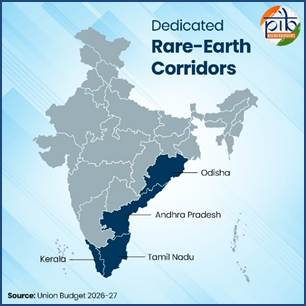
- Union Budget 2026–27 announces Dedicated Rare Earth Corridors in Odisha, Kerala, Andhra Pradesh, and Tamil Nadu for mining, processing, research, and manufacturing of Rare Earth Permanent Magnets (REPMs).
- ₹7,280 crore REPM Manufacturing Scheme approved in November 2025.
- 6,000 MTPA integrated REPM capacity to be created.
- ₹6,450 crore sales-linked incentives over five years.
- ₹750 crore capital subsidy for advanced facilities.
- Geological Survey of India (GSI) has identified 482.6 million tonnes of rare-earth ore resources.
Introduction
India is making a strong push to become self-reliant in critical materials by building a domestic ecosystem for Rare Earth Permanent Magnets (REPMs). These high-performance magnets are crucial for electric vehicles, wind turbines, electronics, aerospace, and defence technologies. To achieve this, the government approved a ₹7,280 crore scheme in November 2025 to set up 6,000 MTPA of integrated REPM manufacturing capacity, covering the entire value chain—from rare-earth oxides to finished magnets.
Further strengthening this effort, the Union Budget 2026–27 announced the creation of Dedicated Rare Earth Corridors in Odisha, Kerala, Andhra Pradesh, and Tamil Nadu. These corridors aim to support mining, processing, research, and manufacturing activities, creating a complete and coordinated ecosystem.
Together, these initiatives align with India’s goals of Atmanirbhar Bharat, Net Zero emissions by 2070, and Viksit Bharat @2047. They also position India as an emerging and reliable player in global advanced materials and clean-technology value chains.
Strategic Importance and Resource Potential of Rare Earth Permanent Magnets in India
Rare Earth Permanent Magnets (REPMs) are some of the most powerful permanent magnets available. They are small in size but extremely strong and stable, which makes them essential for modern technologies. REPMs are widely used in electric vehicle motors, wind turbine generators, consumer and industrial electronics, aerospace systems, defence equipment, and precision sensors.
As India expands manufacturing in areas such as clean energy, advanced mobility, and strategic industries, having a reliable domestic supply of REPMs becomes increasingly important. Domestic production helps reduce dependence on imports and improves India’s position in global advanced-materials value chains, making the country more competitive in high-tech manufacturing.
India’s Resource Base
India has a strong natural advantage when it comes to rare-earth minerals, which provides a solid base for downstream industries such as Rare Earth Permanent Magnet (REPM) manufacturing.
India holds around 13.15 million tonnes of monazite, which contains an estimated 7.23 million tonnes of rare-earth oxides (REO). These deposits are spread across several states, including Odisha, Kerala, Andhra Pradesh, Tamil Nadu, West Bengal, Gujarat, Maharashtra, and Jharkhand. Most of these resources are found in coastal beach sands, teri or red sands, and inland alluvial deposits.
In addition to this, hard-rock rare-earth resources have been identified in Gujarat and Rajasthan, amounting to about 1.29 million tonnes of in-situ REO. Further strengthening the resource base, the Geological Survey of India (GSI) has expanded known reserves by identifying 482.6 million tonnes of rare-earth ore resources through 34 exploration projects.
Together, these figures highlight that India has a robust raw-material foundation to support the development of a fully integrated REPM manufacturing ecosystem.
However, despite this strong resource base, India’s domestic production of permanent magnets is still at an early stage. Most of the country’s demand is currently met through imports, mainly from China, which accounted for nearly 60–80% of imports by value and 85–90% by quantity between 2022 and 2025.
With demand for REPMs expected to double by 2030, driven by the rapid growth of electric vehicles, renewable energy, electronics, and defence sectors, it is crucial for India to scale up domestic manufacturing and investment in this area. Doing so will reduce import dependence, strengthen supply security, and ensure long-term self-reliance in critical materials.
Budget Push for Rare Earth Manufacturing and Corridors
The Union Budget 2026–27 has given strong focus to building self-reliance in critical materials. It strengthens the recently approved Rare Earth Permanent Magnet (REPM) Manufacturing Scheme by introducing corridor-based initiatives.
Together, these steps create a complete and coordinated approach to expand domestic manufacturing capacity, reduce dependence on imports, and position India as an important player in the global advanced-materials ecosystem.
REPM Manufacturing Scheme
To strengthen India’s self-reliance in critical materials, the government on 26TH November, 2025, approved a major scheme for Rare Earth Permanent Magnets (REPMs). This initiative provides financial support and incentives to build a fully integrated domestic manufacturing ecosystem.
- Financial Outlay: ₹7,280 crore
- Capacity Creation:
- 6,000 MTPA integrated manufacturing capacity of sintered REPMs, distributed among up to five beneficiaries through global competitive bidding
- Incentives:
- ₹6,450 crore in sales-linked incentives over five years
- Capital Subsidy:
- ₹750 crore to support advanced facilities
- Timeline:
- Two-year gestation for setup, followed by five years of incentive disbursement linked to production
- Objective:
- Establish an end-to-end ecosystem from rare‑earth oxides to finished magnets, ensuring supply for sectors like electric mobility, renewable energy, electronics, aerospace, and defence.
Union Budget 2026–27: Rare Earth Corridors
To support the REPM manufacturing scheme, the Union Budget 2026–27 announced the creation of Dedicated Rare Earth Corridors in Odisha, Kerala, Andhra Pradesh, and Tamil Nadu. These corridors will bring together mining, processing, research, and manufacturing activities in regions that already have rich mineral resources.
The initiative is expected to boost local economies, strengthen research and development capabilities, and help India become more closely connected to global value chains in advanced materials.
These proposed corridors build directly on the existing operations of IREL (India) Limited in Odisha and Kerala.
Formerly known as Indian Rare Earths Limited, IREL has been operating under the Department of Atomic Energy since 1963 and plays a key role in India’s rare-earth ecosystem. With a processing capacity of 10 lakh tonnes per year, it produces important strategic minerals such as ilmenite, rutile, zircon, sillimanite, and garnet. Crucially, IREL already operates a Rare Earth Extraction Plant in Odisha and a Rare Earth Refining Unit in Aluva, Kerala, which align closely with the objectives of the new corridor initiative.
By linking IREL’s established facilities with the Dedicated Rare Earth Corridors, the government aims to scale up domestic rare-earth production, support advanced manufacturing, and speed up India’s move towards self-reliance and clean-energy–driven growth.
Rare Earth Development Aligned with National Goals
India’s recent policy steps show that rare earth development is being closely linked with larger national goals. The focus goes beyond industrial growth to include clean energy, defence preparedness, and long-term resource security.
- Self-reliance (Atmanirbhar Bharat):
- India currently depends heavily on imports for permanent magnets, with China supplying around 60–80% by value and 85–90% by quantity between 2022 and 2025. By building domestic capacity, India aims to reduce this dependence, secure critical supply chains, and strengthen its manufacturing base.
- Clean energy transition:
Rare earth magnets are essential for electric vehicle motors and wind turbine generators, both of which are central to India’s renewable energy expansion and its Net Zero 2070 target. The rare earth corridors announced in the Union Budget ensure that mineral-rich states play a direct role in supporting this clean energy transition. - National security and defence:
- Rare earth magnets are critical for aerospace systems, defence equipment, and precision sensors. Developing domestic manufacturing and corridor-based ecosystems ensures reliable access for strategic needs and reduces vulnerability to global supply disruptions.
- Policy and institutional reforms:
- These efforts are supported by wider reforms, including changes to the Mines and Minerals (Development and Regulation) Act in 2023, which identified critical minerals and allowed greater private participation in exploration and mining. They also align with the National Critical Minerals Mission, approved in January 2025, which aims to ensure stable and sustainable supply chains for rare earths and other strategic minerals.
Strengthening Global Mineral Partnerships
India’s approach to rare earths and critical minerals goes beyond domestic reforms and is strongly supported by international cooperation to build secure and resilient supply chains.
- Bilateral cooperation:
- The Ministry of Mines has signed agreements with several mineral-rich countries, including Australia, Argentina, Zambia, Mozambique, Peru, Zimbabwe, Malawi, and Côte d’Ivoire. These partnerships are aimed at ensuring long-term access to rare earths and other critical minerals that are essential for clean energy technologies, advanced mobility, and defence needs.
- Multilateral engagement:
- India is an active participant in the Minerals Security Partnership, a group of major economies working together to diversify and secure global supply chains for critical minerals.
India is also part of the Indo-Pacific Economic Framework, which promotes cooperation on clean energy and critical mineral supply chains. Through these platforms, India gains access to technology, investment opportunities, and best practices in sustainable mining, while reducing the risk of global supply disruptions.
- India is an active participant in the Minerals Security Partnership, a group of major economies working together to diversify and secure global supply chains for critical minerals.
- Role of Khanij Bidesh India Limited (KABIL):
- Khanij Bidesh India Limited is a joint venture of NALCO, Hindustan Copper Limited, and MECL under the Ministry of Mines. Its mandate is to acquire and develop mineral assets overseas to strengthen India’s domestic manufacturing and value chains.
A key milestone was KABIL’s agreement with CAMYEN in Argentina for the exploration and mining of five lithium brine blocks, marking an important step in securing overseas sources of critical minerals.
- Khanij Bidesh India Limited is a joint venture of NALCO, Hindustan Copper Limited, and MECL under the Ministry of Mines. Its mandate is to acquire and develop mineral assets overseas to strengthen India’s domestic manufacturing and value chains.
Overall, these international partnerships complement India’s domestic efforts and help ensure long-term resource security for its clean energy, industrial, and strategic sectors.
Conclusion
India’s rare earth strategy is clearly moving toward greater self-reliance by combining its strong natural resource base with focused policy and financial support. The ₹7,280 crore REPM Manufacturing Scheme, along with the Dedicated Rare Earth Corridors announced in the Union Budget 2026–27, together create a complete ecosystem covering mining, processing, research, and manufacturing.
These steps will help reduce import dependence, strengthen supply chains for clean energy and defence, and support key national goals such as Atmanirbhar Bharat, Net Zero by 2070, and Viksit Bharat @2047. At the same time, international partnerships and institutional reforms are ensuring secure and resilient access to critical minerals from both domestic and global sources.
By combining strong domestic action with global cooperation, India is positioning itself as a reliable, competitive player in advanced materials and critical mineral value chains, ready to support future-oriented industries and sustainable growth.