Why in News?
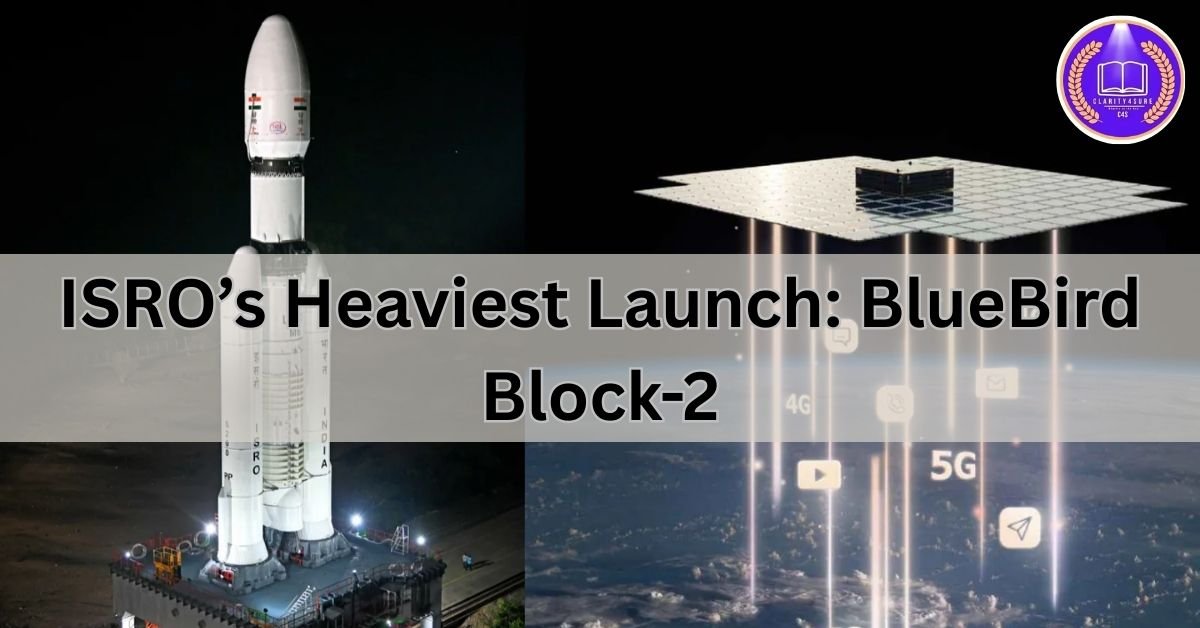
ISRO marked a major milestone by launching its heaviest satellite, BlueBird Block-2 (6,100 kg, by the US firm AST SpaceMobile), using the Launch Vehicle Mark-3 (LVM3) rocket, showcasing India’s strong heavy-lift launch capability.
What is BlueBird Block-2?
- Record-breaking payload:
- BlueBird Block-2 is the heaviest satellite payload that ISRO has ever launched into space. It is heavier than the earlier record of about 5,700 kg, which was set during the OneWeb satellite missions.
- Orbit placement:
- The satellite has been placed in Low Earth Orbit (LEO) at an altitude of around 520 km above the Earth.
- Main purpose:
- Its key aim is to provide direct mobile connectivity from space. This means it can deliver 4G and 5G signals straight to ordinary mobile phones, without the need for special ground equipment.
- Commercial importance:
- This is ISRO’s third commercial launch using the LVM-3 rocket, after two earlier missions that launched OneWeb satellites in 2022 and 2023.
- Global competitiveness:
- Even though other space agencies and companies have powerful launch vehicles, ISRO’s LVM-3 shows that India can carry out heavy satellite launches at a much lower cost, making it competitive in the global space market.
Low Earth Orbit (LEO)
- Overview: LEO extends from about 160 – 2,000 km above Earth’s surface, where satellites complete an orbit roughly every 90–120 minutes.
- Satellites in LEO: It hosts satellites used for communications, Earth observation, scientific missions, and navigation.
- Orbit Types: While many LEO satellites follow circular orbits, some operate in elliptical orbits.
- Special Elliptical Orbits: Molniya and Tundra orbits provide longer dwell times over high-latitude regions and are used for communications and observation where geostationary coverage is limited.
What is the LVM3 Launch Vehicle?
- India’s most powerful rocket:
LVM-3 is ISRO’s largest and strongest launch vehicle, designed to carry very heavy satellites into space.- It can carry about 4,000 kg to Geosynchronous Transfer Orbit (GTO).
- It can carry about 8,000 kg to Low Earth Orbit (LEO).
- Earlier name and first launch:
- It was earlier called GSLV Mk III (Geosynchronous Satellite Launch Vehicle Mk III).
- It first launched in December 2014.
Three-Stage Rocket Structure
1. First Stage – Solid Boosters
- Uses two large solid rocket boosters (S200).
- Burns solid fuel called HTPB.
- Provides the strong initial thrust needed to lift the rocket off the ground.
2. Second Stage – Liquid Core Stage
- Uses liquid fuel.
- Powered by two Vikas engines.
- Burns UDMH fuel and nitrogen tetroxide.
- Helps the rocket continue its journey after lift-off.
3. Third Stage – Cryogenic Upper Stage
- Uses very cold liquid fuels (liquid hydrogen and liquid oxygen).
- Powered by the CE-20 engine.
- This stage gives the final push to place the satellite precisely into orbit.
Technology Improvements for Better Performance
Cryogenic upgrade (C32 stage)
- ISRO is developing a more powerful cryogenic stage.
- It will produce more thrust and carry more fuel, improving performance.
Semi-cryogenic engine development
- New engines will use kerosene and liquid oxygen.
- This will increase payload capacity in Low Earth Orbit from 8,000 kg to about 10,000 kg.
Bootstrap reignition technology
- Future cryogenic engines will be able to restart in space without external support gases like helium.
- This reduces fuel weight and allows rockets to place satellites in multiple orbits during one mission.
Role in Future Space Missions
- A modified LVM-3 will be used for India’s human spaceflight programme (Gaganyaan) with added safety systems.
- It will also help launch parts of the Bharatiya Antariksh Station, India’s planned space station.
Frequently Asked Questions (FAQs)
1. What is BlueBird Block-2?
BlueBird Block-2 is a 6,100 kg commercial satellite by AST SpaceMobile, providing direct-to-mobile 4G/5G connectivity in LEO (160 km to 2,000 km).
2. What is the significance of LEO?
Low Earth Orbit (LEO) hosts communication, Earth observation, and navigation satellites, enabling low-latency global connectivity.
3. What are the stages of the LVM-3 rocket?
LVM-3 has three stages: S200 solid boosters, L110 liquid-fueled core, and C25 cryogenic upper stage, optimized for heavy-lift missions.