
Introduction
Harvesting crops produces a huge amount of leftover plant material, known as crop residue, both in the fields and outside them. The Ministry of New and Renewable Energy estimates that India generates around 500 million tonnes (Mt) of crop residue every year.
Farmers use crop residue in many useful ways. It can be used as animal bedding and livestock feed, for soil mulching, making biogas, preparing compost or bio-manure, roof thatching in rural homes, mushroom cultivation, biomass energy production, and as fuel for households and industries.
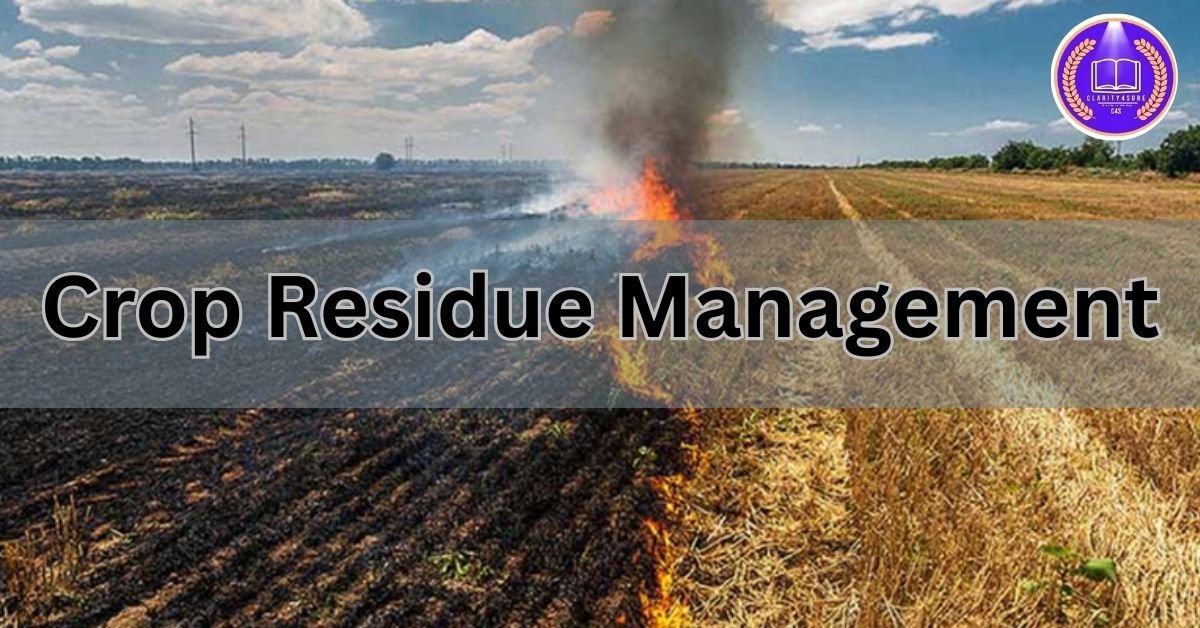
Despite these uses, a large share of crop residue is still burnt in the fields to quickly clear land for the next crop. This practice has increased in recent years due to a shortage of labour, the high cost of removing residues, and the use of mechanised harvesting, which leaves large amounts of stubble behind.
Crop residue burning is especially common in Haryana, Punjab, Uttar Pradesh, and West Bengal. To control the problem, the National Green Tribunal (NGT) in 2015 banned agricultural residue burning in Delhi, Rajasthan, Punjab, Uttar Pradesh, and Haryana.
In particular, paddy stubble burning is widely practiced in the Indo-Gangetic plains, especially in Punjab, Haryana, and Uttar Pradesh, where farmers burn leftover paddy straw to quickly prepare fields for sowing the Rabi crop.
In-situ Crop residue management
In-situ crop residue management is the practice of leaving crop residue in its natural state on the field. While lowering the danger of pests and diseases, in-situ management techniques can assist maintain the health and fertility of the soil.
Several methods can be used to manage crop residues within the field itself (in-situ management) instead of burning them. These practices help protect soil health, conserve moisture, and improve productivity.
- Mulching
- This involves leaving crop residues on the soil surface. The residue acts like a protective layer that prevents soil erosion, keeps moisture in the soil, suppresses weed growth, and gradually adds nutrients as it decomposes.
- No-till farming
- In this method, crops are planted without ploughing or disturbing the soil. The leftover crop residue remains on the surface, and seeds are sown through it. This helps conserve soil moisture and reduces soil erosion.
- Strip-till farming
- This is similar to no-till farming, but only narrow strips of soil where seeds will be planted are tilled. The rest of the field remains covered with crop residue. This approach protects the soil while still providing a suitable seedbed for crop growth.
- Cover crops
- Farmers grow cover crops between main (cash) crops to keep the soil covered. These crops improve soil fertility, prevent erosion, and can later be left on the surface to act as mulch.
- Crop rotation
- This involves growing different types of crops on the same field in different seasons. Changing crops helps maintain soil nutrients, reduce erosion, and improve overall soil health.
Crop residue ex-situ management
Ex-situ management of crop residue refers to the removal of agricultural waste from the field for use as compost, firewood, or animal feed.
Ex-situ management techniques offer a natural source of nutrients for the soil and can assist lower air pollution brought on by burning agricultural leftovers. These ex-situ crop residue management techniques are frequently employed:
- Biomass power generation:
- Crop residues can be used as a source of fuel for biomass power generation. This method involves burning crop residues to produce electricity or heat.
- Animal feed:
- Crop residues can be used as a source of animal feed, particularly for livestock such as cattle, sheep, and goats. Crop residues can be baled and stored for use as animal feed during the dry season when forage is scarce.
- Composting:
- Crop residues can be composted to produce a nutrient-rich soil amendment. This method involves collecting the crop residues and mixing them with other organic materials such as manure, leaves, and grass clippings. The compost can then be used to improve soil fertility and structure.
- Biochar production:
- Biochar is a type of charcoal that is produced by heating crop residues in the absence of oxygen. Biochar can be used as a soil amendment to improve soil fertility, water retention, and crop productivity.
- Industrial uses:
- Crop residues can be used in various industrial processes, such as the production of paper, textiles, and building materials.
Adverse effects of crop residue burning
- Loss of nutrients:
- It is estimated that the burning of one tonne of rice straw accounts for the loss of 5.5 kg of Nitrogen, 2.3 kg of phosphorus, 25 kg of potassium, and 1.2 kg of sulfur besides, organic carbon.
- Generally, crop residues of different crops contain 80% of Nitrogen (N), 25% of Phosphorus (P), 50% of Sulphur (S), and 20% of Potassium(K). If the crop residue is incorporated or retained in the soil itself, it gets enriched, particularly with organic C and N.
- Impact on soil properties:
- Heat from burning residues elevates soil temperature causing the death of beneficial soil organisms.
- Frequent residue burning leads to complete loss of microbial population and reduces levels of N and C in the top 0-15 cm soil profile, which is important for crop root development.
- Emission of greenhouse and other gases:
- Crop residues burning is a potential source of Green House Gases (GHGs) and other chemically and radiative important trace gases and aerosols such as CH4, CO, N2O, NOX, and other hydrocarbons.
Crop Residue Management guidelines
According to the updated rules, bilateral agreements between the beneficiary/aggregator and enterprises using paddy straw will build techno-commercial pilot projects for the supply chain of paddy straw, according to a statement from the agricultural ministry.
Govt shall provide financial assistance on the capital cost of machinery and equipment.
- The required working capital may be financed either by the Industry and Beneficiary jointly or utilizing the Agriculture Infrastructure Fund (AIF), NABARD Financial, or Financing from the Financial Institutions by the beneficiary.
- The land for storage of the collected paddy straw will be arranged and prepared by the beneficiary as may be guided by the end-use industry.
- Project proposal-based financial assistance will be extended for machines and equipment such as Higher HP Tractor, Cutters, Tedder, Medium to Large Balers, Rakers, Loaders, Grabbers, and Telehandlers which are essentially required for the establishment of a paddy straw supply chain.
- State Governments shall approve these projects through a project sanctioning committee.
Financial support break-up:
- The government (jointly by Central and State Governments) will provide financial support of 65% of the project cost
- Industry as the primary promoter of the project will contribute 25% and will act as the Primary consumer of the feedstock collected
- Farmers or groups of Farmers Rural Entrepreneurs Cooperative Societies of Farmers or Farmers Producer Organizations (FPOs), or Panchayats will be the direct Beneficiary of the project and will contribute the balance 10%.
The Outcomes of the above interventions are:
- The initiative will supplement the efforts of paddy straw management through in-situ options
- During the three-year tenure of the interventions, 1.5 million metric tonnes of surplus paddy straw are expected to be collected which would otherwise have been burnt in fields.
- About 333 biomass collection depots of capacity 4500 MT will be built in the States of Punjab, Haryana, Uttar Pradesh, and Madhya Pradesh.
- Air pollution caused by stubble burning will be considerably reduced.
- It would generate employment opportunities of about 9,00,000-man days.
- The interventions will encourage a robust supply chain management of paddy straw which shall further help in making paddy straw available for various end uses i.e., power generation, heat generation, bio-CNG, etc. by Power/bio-CNG/bio-ethanol producers
- The establishment of a supply chain would result in new investments in Biomass in the biofuel and energy sectors.
Way forward
Managing crop residues through conservation agriculture practices can improve both soil productivity and crop yields. When crop residues are left in the field and properly managed, they help maintain soil organic matter, which is essential for long-term soil health and fertility.
Effective crop residue management also helps increase soil carbon storage, which reduces agriculture’s environmental impact. By keeping more carbon in the soil instead of releasing it into the atmosphere, these practices support climate-friendly farming. Ideally, residue management methods should be selected in a way that increases farm productivity while causing minimal harm to the environment.
However, research shows that the impact of crop residue management on crop yields is not always the same. Results can vary widely because many factors influence outcomes. These include the quality of the residue, soil conditions, the health of the previous crop, how sensitive the next crop may be, and management decisions such as crop variety, crop rotation patterns, and planting time.
Because of these many interacting factors, no single crop residue management method works best in every situation. Farmers need to make decisions based on their local conditions to achieve the best balance between higher yields and environmental protection.
To develop the most effective, location-specific solutions, coordinated efforts are needed from scientists across different fields. Such collaboration can help design crop residue management practices that boost agricultural productivity while also reducing environmental damage.
Soil carbon is a valuable resource that supports both food security and environmental sustainability. By adopting improved and cost-effective crop residue management practices, farmers can maintain soil health, enhance agricultural productivity, and contribute to long-term ecological balance.