Why in News?
The Union Minister of Finance and Corporate Affairs presented the Union Budget 2026–27 in Parliament, marking the first Budget prepared in the newly inaugurated Kartavya Bhawan.
- The budget framed as a Yuva Shakti-driven Budget, is anchored in the vision of Viksit Bharat and reflects the guiding principles of Action over Ambivalence, Reform over Rhetoric, and People over Populism.
- The Budget is guided by three Kartavyas (duties) aimed at accelerating economic growth, building people’s capacities, and ensuring inclusive development.
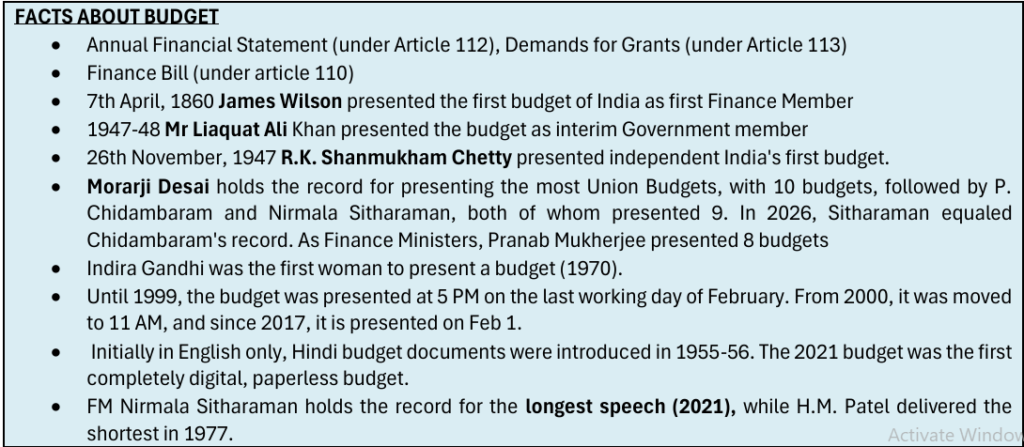
The Three Kartavyas
- Sustain Economic Growth:
- We want the economy to keep growing steadily by improving productivity, staying competitive, and being strong enough to handle global uncertainties.
- Fulfill Aspirations:
- We aim to empower young people and citizens by building their skills and abilities, so they can actively contribute to and benefit from the country’s progress.
- Sabka Saath, Sabka Vikas:
- Development should include everyone—every family, region, and community—especially those at the last mile, ensuring equal access to opportunities and resources.
What are the Key Highlights of the Union Budget 2026-27?
First Kartavya: Accelerate & Sustain Economic Growth
- The Budget aims to make India a global manufacturing hub by focusing on strategic and future-oriented sectors, while also strengthening existing industries. As part of this effort, a scheme has been announced to revive 200 legacy industrial clusters by improving their cost competitiveness and efficiency through better infrastructure and technology upgrades. To support small businesses, a ₹10,000 crore “SME Growth Fund” will be launched to help high-potential firms grow into globally competitive “Champion MSMEs.” In addition, the Self-Reliant India Fund will receive an extra ₹2,000 crore to continue supporting micro enterprises by ensuring steady access to risk capital. The concept of ‘Corporate Mitras’ is also introduced to mentor, guide, and integrate these enterprises into larger value chains.
- The Budget also treats infrastructure as “growth connectors” to drive economic activity. Seven high-speed rail corridors—Mumbai–Pune, Pune–Hyderabad, Hyderabad–Bengaluru, Hyderabad–Chennai, Chennai–Bengaluru, Delhi–Varanasi, and Varanasi–Siliguri—will be developed to improve connectivity and boost growth. For sustainable cargo movement, new Dedicated Freight Corridors will connect Dankuni to Surat, and 20 National Waterways will be made operational over the next five years. A Coastal Cargo Promotion Scheme aims to shift transport from road and rail to waterways and coastal shipping, increasing their share from 6% to 12% by 2047. The Seaplane VGF Scheme will support indigenous seaplane manufacturing and operations to improve last-mile connectivity and promote tourism.
- To reduce risks in infrastructure development, an Infrastructure Risk Guarantee Fund will provide partial credit guarantees to lenders during the construction phase. The government has also proposed “City Economic Regions” (CERs), where cities will be mapped based on their specific growth drivers, with an allocation of ₹5,000 crore per region over five years through a challenge-based approach. Additionally, a Carbon Capture, Utilization, and Storage (CCUS) scheme will be launched to reduce emissions in hard-to-decarbonize sectors such as steel and cement.
Second Kartavya: Fulfill Aspirations & Build Capacity
The Budget highlights the growing importance of the “Orange Economy” by supporting creative industries. It proposes setting up Animation, Visual Effects, Gaming and Comics (AVGC) Content Creator Labs in 15,000 secondary schools and 500 colleges through the Indian Institute of Creative Technologies in Mumbai, helping students develop skills in creative and digital fields. To strengthen the tourism and hospitality sector, the government plans to establish a National Institute of Hospitality by upgrading the existing National Council for Hotel Management and Catering Technology, which will help bridge the gap between academic learning and industry needs.
In the sports sector, the Budget expands the existing Khelo India programme into a full-fledged Khelo India Mission. This mission will focus on identifying and nurturing talent, improving coaching capacity, integrating sports science, promoting competitive leagues, and expanding sports infrastructure across the country. To boost India’s position in global healthcare services, the government has also proposed setting up five Regional Medical Hubs in partnership with the private sector. These hubs will support medical value tourism by offering integrated services such as AYUSH centres, diagnostics, post-treatment care, and rehabilitation.
Additionally, to encourage greater participation of girls in science, technology, engineering, and mathematics (STEM), the government plans to establish one girls’ hostel in every district. This will be supported through Viability Gap Funding (VGF) or capital assistance, making it easier for girls to access quality education in STEM fields.
Third Kartavya: Sabka Saath, Sabka Vikas
The Budget introduces several initiatives aimed at improving agriculture, social empowerment, healthcare, and regional development. To transform agriculture, the government will launch Bharat-VISTAAR (Virtually Integrated System to Access Agricultural Resources), a multilingual AI-based platform that will combine AgriStack and ICAR data to provide personalized advice to farmers. Building on the success of the “Lakhpati Didis,” community-owned retail outlets called SHE Marts (Self-Help Entrepreneur Marts) will be established within cluster federations to strengthen women-led entrepreneurship and local economies.
In the healthcare sector, the government has reaffirmed its commitment to mental health by announcing the establishment of NIMHANS-2 and upgrading institutes in Ranchi and Tezpur into Regional Apex Institutions. For regional development, especially in the North-East under the Purvodaya focus, a special scheme will be launched to develop Buddhist Circuits across states like Arunachal Pradesh, Sikkim, Assam, Manipur, Mizoram, and Tripura to promote tourism and cultural heritage. Additionally, an East Coast Industrial Corridor will be developed with a key node at Durgapur in West Bengal, along with the creation of five tourism destinations in five Purvodaya states.
The Budget also emphasizes inclusive growth by supporting differently-abled individuals (Divyangjan) through targeted welfare efforts, including schemes like Divyang Sahara Yojana, to enhance their empowerment and participation in society.
What are the Key Highlights of the Tax Reforms under Union Budget 2026-27?
The Budget introduces major reforms in taxation and business regulations to simplify the system and encourage investment. A new Income Tax Act, 2025 will replace the old 1961 law from 1st April 2026, making tax rules simpler and easier to understand, while tax slabs for FY 2026–27 remain unchanged to ensure stability. Tax Collected at Source (TCS) on overseas tour packages and remittances for education and medical purposes under LRS has been reduced to a uniform 2% without any threshold. To remove confusion, TDS on manpower services is fixed at 1% for individuals/HUFs and 2% for others. The government has also decriminalized cases like not maintaining books of accounts and failure to pay TDS where payments are made in kind. Customs duty on goods imported for personal use has been reduced from 20% to 10%, and full exemption has been provided on 17 cancer drugs and medicines or foods for seven rare diseases. At the same time, Securities Transaction Tax (STT) has been slightly increased in some segments (from 0.1% to 0.15%) to reduce excessive speculation in stock markets. Non-residents paying tax on a presumptive basis will now be exempt from Minimum Alternate Tax (MAT).
To improve tax administration, a joint committee of the Ministry of Corporate Affairs and the Central Board of Direct Taxes will align Income Computation and Disclosure Standards (ICDS) with Indian Accounting Standards (IndAS), removing the need for separate ICDS accounting from 2027–28 and simplifying compliance rules. The Budget also grants immunity from prosecution for non-disclosure of foreign assets below ₹20 lakh (with retrospective effect from 1st October 2024). Another key change is that share buybacks will now be taxed as capital gains in the hands of shareholders instead of companies. To promote investment and industry, foreign companies running global cloud services through Indian data centers will get a tax holiday till 2047, and tax holidays in IFSC (GIFT City) for offshore banking units have been extended from 10 to 20 years. Customs duty exemptions are also provided on capital goods for processing critical minerals like lithium and cobalt and for manufacturing lithium-ion cells. In the IT sector, the Safe Harbour threshold has been increased to ₹2,000 crore with a unified category for software development and KPO services.
The Budget also focuses on boosting exports and ease of doing business. Duty-free import limits for inputs in marine, leather, and textile sectors have been increased to enhance export competitiveness. In aviation and defence, duty exemptions are provided for parts and components used in aircraft manufacturing and maintenance (MRO). Trade processes will be simplified through a single digital window for cargo clearance, instant clearance for non-compliant goods, rollout of the Customs Integrated System (CIS), and greater use of AI-based container scanning. Additionally, fish caught in the Exclusive Economic Zone (EEZ) or on the high seas will be duty-free, duty-free baggage allowances have been revised, and honest taxpayers will benefit from easier dispute settlement with reduced penalties.
Macroeconomic Fundamentals Highlighted in Union Budget 2026-27
The Budget reflects a continued focus on fiscal discipline while supporting economic growth. The fiscal deficit for 2026–27 is targeted at 4.3% of GDP, improving from 4.4% in the revised estimates of 2025–26 and staying on track to bring it below 4.5%. The debt-to-GDP ratio is also expected to decline slightly to 55.6% from 56.1%, with a long-term goal of reducing it to 50% by 2030–31 so that more resources can be used for development. At the same time, the government is continuing to rely on public investment as a key growth driver, increasing capital expenditure to ₹12.2 lakh crore (around 3.1% of GDP), up from ₹11.2 lakh crore. When grants to states for capital assets are included, the effective capital expenditure rises to ₹17.1 lakh crore (about 4.4% of GDP).
The Budget assumes a nominal GDP growth of 10.5% for 2026–27, with real GDP growth projected at around 7%. For 2025–26 (revised estimates), non-debt receipts are estimated at ₹34 lakh crore, and total expenditure at ₹49.6 lakh crore, including about ₹11 lakh crore in capital expenditure. For 2026–27 (budget estimates), non-debt receipts are expected to increase to ₹36.5 lakh crore, with net tax receipts of ₹28.7 lakh crore, while total expenditure is projected at ₹53.5 lakh crore. To finance the fiscal deficit, the government plans net market borrowings of ₹11.7 lakh crore and gross borrowings of ₹17.2 lakh crore, with the remaining funding coming from small savings and other sources.
What are the Concerns Regarding the Union Budget 2026–27?
The Budget faces several challenges despite its growth focus. It assumes a nominal GDP growth of around 10%, but this could be affected by global economic slowdown, geopolitical tensions, and trade disruptions. There are also concerns about revenue generation, as shortfalls in income tax and GST collections have reduced the government’s fiscal space, leading to cuts in expenditure, including capital spending and important social sectors. The strategy relies heavily on supply-side measures like building infrastructure—roads, factories, and railways—to drive growth, but private consumption, which contributes about 60% of GDP, remains weak, especially in rural areas.
Implementation is another major concern, as high-technology schemes like Bharat-VISTAAR and Biopharma SHAKTI require strong institutional capacity and often face delays due to bureaucratic hurdles. Infrastructure projects also continue to struggle with land acquisition issues. In terms of employment, a capex-driven approach focused on sectors like semiconductors and biopharma may not generate enough jobs, leading to uneven or “K-shaped” growth, especially given the mismatch between education and required skills. The transition to green technologies also creates pressure on resources like water, energy, and critical minerals, increasing import dependence and the risk of rising costs (greenflation), which could impact MSMEs and manufacturing.
Additionally, uncertainty in capital flows is a concern, as continued outflows by Foreign Portfolio Investors (FPIs) and an unclear outlook for Foreign Direct Investment (FDI) may affect financial stability and investor confidence. Finally, there are strategic concerns in external aid allocation, as while countries like Bhutan receive significant grants, the absence of funding for important projects like the Chabahar Port in Iran raises questions about India’s regional connectivity and strategic priorities.
What Measures can Strengthen India’s Economy Beyond Budget 2026–27?
- Reviving the Twin Engines of Demand: India’s growth needs both investment and consumption to fire together. Faster rollout of SHE Marts and Bharat-VISTAAR can raise rural incomes and boost demand due to higher marginal propensity to consume.
- Securing Strategic Autonomy in Critical Resources: As critical minerals become the “new oil” of the green economy, India must combine domestic initiatives like Rare Earth Corridors with overseas mineral security partnerships.
- Simultaneously, boosting R&D spending beyond the current low share of GDP is essential to support semiconductors and biopharma ecosystems.
- Skilling for New Sectors: The AVGC and Semiconductor push must be matched with aggressive skill development (Skill India 2.0) to prevent a talent crunch.
- Quality of Expenditure: Move from “Outlays” to “Outcomes.” Every Rupee spent on schemes like Mahatma Gandhi Gram Swaraj must be audited for tangible asset creation and income generation, not just fund utilization.
- Correcting “Inverted Duty Structures”: In sectors like textiles and electronics, inverted duty structures (where raw materials are taxed higher than finished imports) hurt domestic manufacturing.
Conclusion
The Union Budget 2026–27 tries to strike a careful balance between maintaining fiscal discipline and pushing for rapid economic growth through high-tech industrial development and inclusive welfare measures. It focuses on strengthening India’s long-term growth by investing in sectors like manufacturing, infrastructure, and technology, while also ensuring that social welfare schemes continue to support vulnerable sections of society. In this way, it lays a strong foundation for the vision of a “Viksit Bharat,” or a developed India.
However, the real success of the Budget will depend on how effectively these plans are implemented on the ground. One major challenge is addressing the issue of “jobless growth,” where economic expansion does not create enough employment opportunities, especially for the youth. At the same time, boosting private consumption—particularly in rural areas—is crucial, since it drives a large part of the economy. Unless people’s incomes and spending power increase, overall economic momentum may remain limited. Therefore, ensuring that growth benefits reach every section of society, especially those at the last mile, will be key to achieving the Budget’s broader goals.
Frequently Asked Questions (FAQs)
1. What are the Three Kartavyas outlined in Union Budget 2026–27?
They focus on sustaining economic growth, building people’s capacities, and ensuring Sabka Saath, Sabka Vikas through last-mile inclusion.
2. What is Biopharma SHAKTI and why is it important?
Biopharma SHAKTI is a ₹10,000 crore mission to make India a global hub for biologics and biosimilars, supported by NIPERs and regulatory strengthening.
3. What are City Economic Regions (CERs)?
CERs are city-cluster based growth regions with ₹5,000 crore funding per region to leverage agglomeration economies through challenge-mode implementation.
4. Why is the Budget criticised for jobless growth?
The focus on capital-intensive sectors like semiconductors and biopharma may limit mass employment amid a widening education–employment skill gap.
5. What are the key fiscal targets in Budget 2026–27?
The fiscal deficit is targeted at 4.3% of GDP, debt-to-GDP at 55.6%, and capex raised to ₹12.2 lakh crore to drive growth.