Key Takeaways
- The Union Budget 2026–27 proposed a three-pronged approach to help Indian MSMEs grow as Champions by providing equity, liquidity, and professional support
- The Budget proposes complete removal of the current value cap of ₹10 lakh per consignment on courier exports to support aspirations of India’s small businesses, artisans and start-ups
- MSMEs account for ~35.4% of manufacturing, ~48.58% of exports, and 31.1% of GDP in India
- The sector comprises 7.47 crore+ enterprises employing 32.82 crore+ persons.
Union Budget 2026–27 Places MSMEs at the Centre of Growth
MSMEs are very important for India’s growth and development. They help create jobs, especially in rural and backward areas, which reduces unemployment and poverty. There are more than 7.47 crore MSMEs in India, employing over 32.82 crore people, making them the second-largest source of employment after agriculture. They also contribute a lot to the economy—about 35.4% in manufacturing, 48.58% in exports, and 31.1% to GDP.
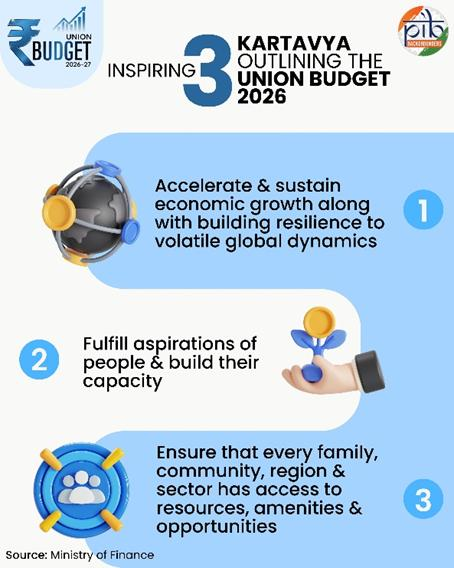
The Union Budget 2026–27 focuses on helping the poor and disadvantaged and sets three main goals: to boost economic growth, meet people’s aspirations, and ensure equal opportunities and resources for all sections of society.
To achieve this, the Budget proposes a three-step plan for MSMEs—providing financial support (equity), improving access to funds (liquidity), and offering better professional and managerial support—so that MSMEs can grow stronger and become leaders in the economy.
Budget Reforms and Strategic Initiatives for MSME Sector
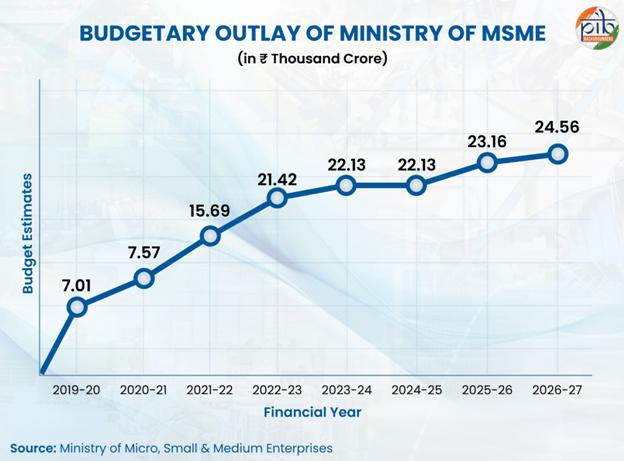
The Ministry of Micro, Small & Medium Enterprises aims to build a strong and active MSME sector by supporting its growth. It mainly helps states promote entrepreneurship, create jobs, and improve the competitiveness of small businesses. Over the years, the government has steadily increased the budget for this Ministry, with a long-term focus on improving MSMEs through skill development and entrepreneurship. In the Union Budget 2026–27, several steps have been introduced to strengthen MSMEs by improving financial support, encouraging innovation, and making rules simpler, so they can compete better in India and globally.
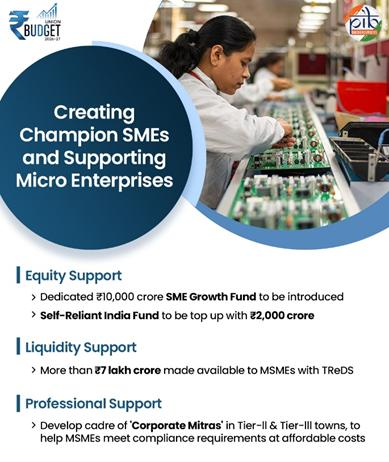
Under the first “Kartavya,” the government has introduced a three-part plan to help MSMEs grow into strong and successful businesses.
- For equity support, a ₹10,000 crore SME Growth Fund has been announced to support and grow promising enterprises. The Self-Reliant India (SRI) Fund, started in 2021, will also get an additional ₹2,000 crore to continue helping micro enterprises with risk capital. So far, the SRI Fund has supported 682 MSMEs with investments worth ₹15,442 crore.
- For liquidity support, more than ₹7 lakh crore has already been made available to MSMEs through the TReDS platform, which helps them get faster payments by discounting their invoices. To improve this system further, the government plans to make TReDS compulsory for CPSEs when buying from MSMEs, provide credit guarantees for invoice discounting, connect it with the GeM portal for better information sharing, and allow TReDS receivables to be traded as financial assets to improve liquidity and speed up payments.
- For professional support, the government will work with institutions like ICAI, ICSI, and ICMAI to create short-term courses and tools to train “Corporate Mitras.” These trained professionals, especially in smaller towns, will help MSMEs handle compliance and business requirements at a lower cost.
The Budget also includes a tax-related reform to help MSMEs access global markets. It removes the ₹10 lakh limit per consignment on courier exports, which will make it easier for small businesses, artisans, and start-ups to sell products internationally through e-commerce. It will also improve the handling of returned or rejected goods using better technology for tracking.
Powering MSMEs: Policies Turning Potential into Performance
- Udyam Registration & Udyam Assist Platform:
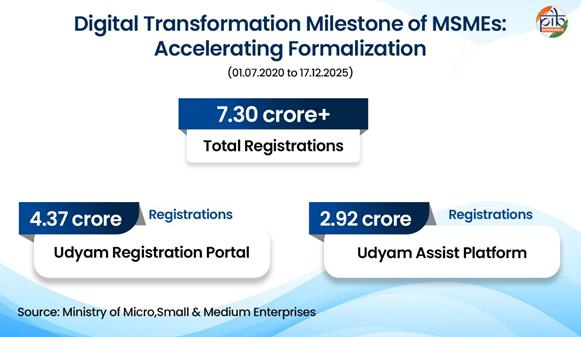
- The Udyam Portal, launched in 2020, provides a simple, free and fully digital way for MSMEs to register and access government schemes and benefits. The Udyam Assist Platform, launched in 2023, helps bring informal micro enterprises into the formal system and enables them to access bank credit under Priority Sector Lending. Together, they have significantly improved formalisation, with over 7.30 crore MSMEs registered till December 2025, including 4.37 crore on Udyam and 2.92 crore on Udyam Assist.
- PM Employment Generation Programme (PMEGP):
- PMEGP supports micro-entrepreneurs by providing subsidies on bank loans, thereby reducing their financial burden and encouraging self-employment. The scheme has been expanded to cover higher project costs and a wider range of activities. Since its launch, it has supported over 10.71 lakh enterprises, disbursed ₹29,249 crore in subsidies, and generated employment for more than 87 lakh people.
- MSME Champions Scheme:
- This scheme aims to strengthen MSMEs by improving their efficiency, competitiveness and global presence. It includes three components: ZED (which promotes quality production with minimal environmental impact), LEAN (which focuses on improving productivity and reducing waste), and Innovative (which supports incubation, design and intellectual property development). The scheme has seen strong participation, with lakhs of MSMEs registering and adopting best practices to enhance their performance.
- E-commerce & Supply Chain Support:
- The expansion of the ONDC platform and the TEAM initiative, which aims to onboard 5 lakh MSMEs, is helping small businesses enter digital markets and modern supply chains. These initiatives reduce dependence on intermediaries, lower transaction costs, and provide MSMEs with wider market access both within India and globally.
- Online Dispute Resolution (ODR):
- Launched on 27 June 2025, the ODR system provides a quick, structured and technology-driven mechanism for resolving payment disputes between buyers and MSMEs. It encourages amicable settlement before legal proceedings, enabling faster recovery of dues while maintaining business relationships.
- Credit Guarantee Scheme (CGTMSE):
- This scheme improves access to finance by providing collateral-free loans to MSMEs through credit guarantees. It has completed 25 years and crossed 1 crore guarantees, with ₹3.77 lakh crore worth of loans approved in 2025 alone. The guarantee limit has been increased to ₹10 crore, and special provisions have been introduced for transgender entrepreneurs, including lower fees and higher coverage, making credit more inclusive.
- PM Vishwakarma Scheme:
- Launched in 2023, this scheme supports traditional artisans and craftspeople by providing skill training, financial assistance and digital empowerment. It has registered over 30 lakh beneficiaries, trained more than 23 lakh, and provided loans worth ₹2,257 crore. The scheme also helps artisans access markets through platforms like GeM and e-commerce, improving their income opportunities.
- Labour Reforms:
- Labour reforms aim to modernise India’s labour system by simplifying compliance, promoting formal employment, and strengthening social security and worker safety. By reducing paperwork, inspections and procedural complexities, these reforms ease the burden on MSMEs while ensuring a balanced framework that supports both business growth and worker welfare.
Coclusion
Over the years, the MSME sector has become one of the strongest pillars of the Indian economy. It creates a large number of jobs with relatively low investment and plays an important role in developing rural and backward areas. By promoting industrial growth in these regions, MSMEs help reduce regional inequalities and support inclusive economic development. They also act as important support units for large industries, strengthening the overall industrial system.
Today, MSMEs are central to India’s growth story. With their wide presence, adaptability, and strength, they are well-positioned to benefit from the growing focus on manufacturing and increasing global trade. The sector is gradually becoming more formal, innovative, and export-oriented, helping India integrate better into global value chains.