Introduction
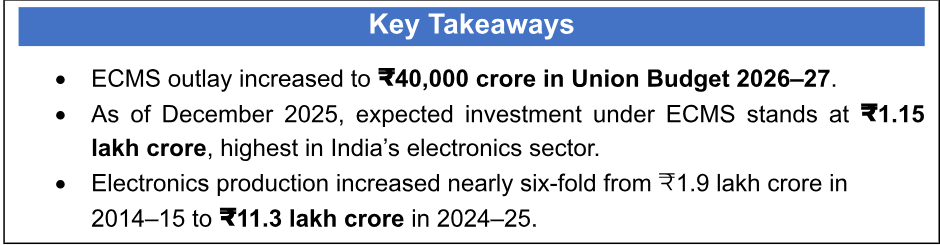
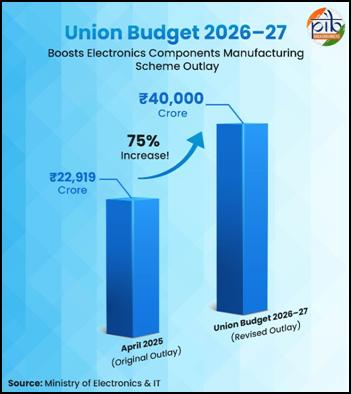
India’s electronics manufacturing sector is now growing faster than ever. In the Union Budget 2026–27, the government increased funding for the Electronics Components Manufacturing Scheme (ECMS) to ₹40,000 crore, showing a strong commitment to boost local production. Over the last decade, India has made huge progress—electronics production has grown nearly six times, and the sector has created around 25 lakh jobs. It has become an important source of employment and economic growth.
India is also exporting more electronics and becoming a bigger part of global supply chains. Government policies and initiatives have helped strengthen domestic manufacturing, attract global companies, and expand exports.
The ECMS aims to take this further by building a strong ecosystem for manufacturing electronic components within the country. The larger goal is ambitious: to create a $500 billion electronics manufacturing industry by 2030–31, making India a global technology leader while generating more jobs and opportunities at home.
Sectoral Outlook: Electronics as India’s Leading Export Category
India’s electronics sector has grown very quickly in recent years. According to the Economic Survey 2025–26, electronics have become India’s third-largest and fastest-growing export category in 2024–25. Just a few years ago (in 2021–22), it was in seventh place—so the rise has been quite rapid. In the first half of 2025–26 alone, electronics exports reached about USD 22.2 billion, showing strong momentum. If this continues, electronics could soon become India’s second-largest export sector.
Production has also increased massively. It has grown from about ₹1.9 lakh crore in 2014–15 to ₹11.3 lakh crore in 2024–25—around six times higher. Exports have grown even faster, rising from ₹38,000 crore to ₹3.27 lakh crore, which is more than eight times growth. This expansion has also created a lot of jobs around 25 lakh people have been employed in electronics manufacturing over the past decade.
Overview of ECMS
The Electronics Components Manufacturing Scheme (ECMS) was launched on April 8, 2025 with a budget of about ₹22,919 crore (around USD 2.7 billion). It will run for six years, with an extra one-year preparation period if needed.
The main goal of the scheme is to build a strong and self-reliant electronics manufacturing ecosystem in India. It aims to attract both Indian and global companies, increase local production of components, and make India an important player in the global electronics market. It also works alongside the India Semiconductor Mission (ISM) to strengthen the overall electronics and semiconductor sector.
Through this scheme, the government wants more electronic components, sub-parts, and raw materials to be made within India, instead of relying heavily on imports. This will help India become part of global supply chains.
By December 2025, the response to the scheme has been very strong:
- Expected investment is ₹1.15 lakh crore, almost double the original target
- Production is projected at ₹10.34 lakh crore over six years (about 2.2 times higher than expected)
- Government incentives may reach ₹41,468 crore (higher than initial estimates)
- Around 1.4 lakh direct jobs are expected, exceeding the original target, along with many indirect jobs.
Approved Applications under ECMS
Since it was launched, the Electronics Components Manufacturing Scheme (ECMS) has received a very positive response from companies across India. So far, 46 applications have been approved across 11 states.
These approved projects together involve:
- Investment of ₹54,567 crore
- Expected production worth ₹3,67,343 crore
- Around 51,000 direct jobs
The companies selected under the scheme will manufacture a wide range of important electronic components. These include things like printed circuit boards (PCBs), camera modules, connectors, oscillators, optical transceivers, and enclosures used in mobile phones, IT hardware, and other electronic devices.
The approvals have been disbursed in three tranches, each contributing significantly to production capacity and job creation:
| Tranche | Number of Projects | Approval Date | Investment (₹ crore) | Projected Production (₹ crore) | Direct Employment |
|---|---|---|---|---|---|
| First | 7 | 27 October 2025 | 5,532 | 36,559 | 5,100 |
| Second | 17 | 17 November 2025 | 7,172 | 65,111 | 11,808 |
| Third | 22 | 2 January 2026 | 41,863 | 2,58,152 | 33,791 |
These approvals demonstrate the scheme’s ability to attract substantial investment while supporting large-scale employment generation and the production of electronic components across the country.
Projected Outcomes for FY 2026–27
ECMS is expected to deliver tangible outcomes during FY 2026–27, reflecting the scale up of approved projects and sustained industry participation. Investments made under the scheme are projected to translate into higher production capacity and steady job creation across the electronics component manufacturing ecosystem.
| Outcome Indicator | Expected Outcome by end of FY 2026–27 |
|---|---|
| Investment | ₹11,156 crore |
| Production | ₹29,024 crore |
| Employment generation | 19,240 jobs |
Conclusion
The Electronics Components Manufacturing Scheme (ECMS) has become a central pillar of India’s strategy to strengthen its electronics manufacturing sector. Recognising its importance, the government significantly increased its allocation to ₹40,000 crore in the Union Budget 2026–27, signalling a clear and strong commitment to expanding domestic manufacturing capabilities. The scheme has already started delivering tangible results by attracting substantial investments, boosting production levels, and creating large-scale employment opportunities. It is also helping build a robust ecosystem for electronic components within the country, which is crucial for reducing dependence on imports.
By encouraging local value addition and integrating Indian manufacturers into global value chains, ECMS is positioning India as a reliable and competitive destination for advanced electronics manufacturing. Over time, this is expected to enhance technological capabilities, improve export performance, and strengthen India’s role in the global electronics industry.