

Daily Current Affairs Quiz
03 & 04 May, 2026
National Affairs
1. Operation WHITE STRIKE
Source: IE
Context:
In a major victory for India’s internal security and anti-narcotics efforts, the Narcotics Control Bureau (NCB) executed Operation WHITE STRIKE in early May 2026. The operation led to the seizure of 349 kg of high-grade cocaine, valued at approximately ₹1,745 crore, within the Mumbai logistics corridor.
Overview of the Operation
Operation WHITE STRIKE is a strategic, intelligence-led enforcement action aimed at dismantling transnational drug syndicates that use India’s maritime and logistics infrastructure as a transit hub for high-value narcotics.
| Feature | Details |
| Executing Agency | Narcotics Control Bureau (NCB) |
| Primary Target | International Cocaine Trafficking Syndicate |
| Seizure Volume | 349 kg (Exceeds India’s typical annual average) |
| Estimated Value | ₹1,745 Crore |
| Primary Locations | Kalamboli and Bhiwandi (Mumbai/Thane logistics hubs) |
Conceptual MCQs for Practice
Q1. Operation WHITE STRIKE, recently in the news, is primarily related to which of the following?
A) Counter-terrorism in Jammu & Kashmir
B) Anti-narcotics operation against cocaine trafficking
C) Evacuation of Indian citizens from a war zone
D) Cyber-security drill by CERT-In
Q2. Which agency led the execution of Operation WHITE STRIKE in Mumbai?
A) Enforcement Directorate (ED)
B) Central Bureau of Investigation (CBI)
C) Narcotics Control Bureau (NCB)
D) Directorate of Revenue Intelligence (DRI)
Q3. The logistics hubs of Kalamboli and Bhiwandi, central to this operation, are located in which Indian state?
A) Gujarat
B) Maharashtra
C) Karnataka
D) Tamil Nadu
Answers: Q1: B | Q2: C | Q3: B
Exam Relevance
| Exam | Focus Area | Relevance Level |
| UPSC CSE | GS-3 (Internal Security: Organized Crime, Drug Trafficking) | High |
| State PCS | Current Affairs: National Security and Agency Operations | Very High |
| CAPF (AC) | Role of Central Agencies in Border and Internal Security | Extreme |
2. The Citizenship (Amendment) Rules, 2026
Source: News on Air
Context:
On May 1, 2026, the Union Ministry of Home Affairs (MHA) notified the Citizenship (Amendment) Rules, 2026. This update serves as a major overhaul of the 2009 Rules, primarily focusing on digitizing the Overseas Citizen of India (OCI) framework and tightening document security for minors.
Evolution of the OCI Framework
The OCI scheme was introduced in 2005 to provide a form of “pseudo-dual citizenship” to the Indian diaspora, granting them lifelong visas and most rights available to Indian citizens, excluding voting, holding constitutional posts, and buying agricultural land.
What are the Core Pillars of the 2026 Amendment?
1. Transition to e-OCI (Digital Transformation)
The most significant change is the shift from a hybrid paper-based system to a fully digital ecosystem.
- e-OCI Registration: Introduction of Form XXIX, an electronic OCI certificate. This allows for instant verification and reduces the risk of lost or damaged physical cards.
- Mandatory Online Filing: All processes—registration (Form XXVIII), renunciation (Form XXXI), and cancellation—must now be executed through the ociservices.gov.in portal.
2. The Minor Passport Proviso (Rule 3)
To prevent legal complications regarding dual citizenship (which India does not permit), the new rules introduce a strict mandate:
- The Ban: A minor child cannot hold the passport of any other country simultaneously while holding an Indian passport.
- The Objective: This ensures that the child’s legal status is singular and clear, preventing the misuse of travel documents in international custody or residency disputes.
3. Biometric Integration & Fast-Track Travel
The 2026 Rules link OCI status with India’s modernizing border infrastructure.
- Consent for Data: Applicants must consent to share biometric data during registration.
- Fast-Track Immigration: This data is used to automatically enroll OCI holders in Fast Track Immigration Programmes (e-gates) at major Indian airports, allowing for seamless, touchless entry and exit.
Key Concepts
Q: Does an OCI holder have an Indian Passport?
A: No. An OCI holder is a foreign citizen holding a foreign passport (except for those from Pakistan or Bangladesh). The OCI card is a multi-purpose, life-long visa.
Q: Why is the ban on dual passports for minors significant?
A: India follows the principle of Single Citizenship (Article 9 of the Constitution). Some parents obtain a foreign passport for their child while keeping the Indian one; the 2026 rules effectively close this loophole, forcing a choice of a single travel document.
Q: What rights are denied to OCI holders?
A: Under Section 7B(2) of the Citizenship Act, 1955, they cannot:
- Vote in elections.
- Be a member of Parliament or State Legislature.
- Hold constitutional posts (President, Vice President, Supreme Court/High Court Judge).
- Apply for government jobs (unless specifically notified).
Conceptual MCQs
Q1. The Citizenship (Amendment) Rules, 2026 were notified by which Union Ministry?
A) Ministry of External Affairs
B) Ministry of Home Affairs
C) Ministry of Law and Justice
D) Ministry of Finance
Q2. Under the new 2026 Rules, what is the designation of the newly introduced electronic OCI registration form?
A) Form XX
B) Form XXVIII
C) Form XXIX
D) Form XXX
Q3. Which of the following is a mandatory requirement for OCI applicants under the 2026 Rules for enrollment in Fast Track Immigration?
A) Surrender of foreign citizenship
B) Biometric data consent
C) Local police clearance from India
D) Minimum 5-year residency in India
Answers: Q1: B | Q2: C | Q3: B
Exam Relevance
| Exam | Focus Area | Relevance Level |
| UPSC CSE | GS-2 (Citizenship, Indian Diaspora, Governance) | Extreme |
| JPSC / BPSC | Polity: Citizenship and Rights of NRIs/OCIs | High |
| SSC / RRB | Current Affairs: New Government Portals and Forms | Medium |
3. The Atomic Energy Regulatory Board (AERB)
Context:
In a significant boost to India’s nuclear energy capacity, the Atomic Energy Regulatory Board (AERB) recently cleared a critical milestone for the Kudankulam Nuclear Power Project (KKNPP). The board granted permission for the “Erection of Major Equipment” (including Reactor Pressure Vessels and Steam Generators) for Units 5 and 6, moving the project closer to operational status.
Role as the National “Watchdog”
The AERB is the independent statutory body responsible for ensuring that nuclear energy and ionizing radiation are used safely in India. It acts as a bridge between high-tech scientific advancement and public/environmental safety.
Historical Evolution
The need for a formal regulator grew as India’s nuclear program transitioned from research to large-scale power generation:
- 1969–1972: Early safety committees monitored the first stations at Tarapur and Rajasthan.
- 1979–1981: The Karkhanawala and Meckoni Committees argued that for public confidence, safety oversight must be handled by a dedicated statutory body rather than just internal committees.
- 1983: The AERB was formally established under the Atomic Energy Act, 1962.
What are Core Pillars of AERB?
The AERB’s authority extends across the entire lifecycle of a nuclear facility through a multi-tier regulatory process:
1. Licensing & Consents
A nuclear plant cannot move from one phase to the next without a specific “consent” from the AERB. Key stages include:
- Site Clearance: Approving the location based on seismic and environmental factors.
- First Pour of Concrete (FPC): Signifying the start of actual construction.
- Equipment Erection: (Current stage for KKNPP Units 5 & 6) Installing the “heart” of the reactor.
- Fuel Loading & Commissioning: The final step before power generation.
2. Standard Setting & Rule Framing
The AERB develops the Safety Codes and Guides that dictate how nuclear plants must be designed and operated. It also helps the government frame rules under the Environment (Protection) Act, 1986.
3. SARCOP (Safety Review Committee for Operating Plants)
Once a plant is running, SARCOP monitors it continuously. It reviews even minor operational incidents to ensure they do not escalate into safety risks.
Key Concepts
Q: Is the AERB fully independent of the Department of Atomic Energy (DAE)?
A: While the AERB is an independent authority, it currently reports to the Atomic Energy Commission (AEC), which is headed by the Secretary of the DAE. There have been long-standing discussions (and the proposed Nuclear Safety Regulatory Authority Bill) to make the regulator legally and administratively autonomous from the DAE to avoid any conflict of interest.
Q: What is a “Reactor Pressure Vessel” (RPV)?
A: It is a massive steel container that holds the nuclear fuel and the coolant. It is considered a “Category-1” safety component because it must withstand extreme pressure and radiation for the entire 40–60 year life of the plant.
Q: What power does the AERB have over non-compliant facilities?
A: The AERB has the authority to suspend or cancel licenses and can order the immediate shutdown of any facility (including a hospital X-ray unit or a nuclear plant) if safety standards are violated.
Conceptual MCQs
Q1. The Atomic Energy Regulatory Board (AERB) was established under the provisions of which Act?
A) The Environment (Protection) Act, 1986
B) The Atomic Energy Act, 1962
C) The Civil Liability for Nuclear Damage Act, 2010
D) The Disaster Management Act, 2005
Q2. Which committee’s recommendations were instrumental in broadening the functions of the AERB in 1987?
A) Karkhanawala Committee
B) Meckoni Committee
C) Kasturirangan Committee
D) Gadgil Committee
Q3. Permission for the “Erection of Major Equipment” at Kudankulam Units 5 & 6 indicates which stage of the project?
A) Decommissioning
B) Site Selection
C) Construction/Installation
D) Waste Management
Answers: Q1: B | Q2: B | Q3: C
Exam Relevance
| Exam | Focus Area | Relevance Level |
| UPSC CSE | GS-3 (Energy, S&T, Environmental Safety) | High |
| JPSC / State PCS | Statutory Bodies and Nuclear Power Projects in India | Very High |
| Engineering Services | Nuclear Safety Standards and Equipment Lifecycle | High |
4. Pradhan Mantri Gram Sadak Yojana (PMGSY)-IV
Context:
The launch of PMGSY-IV in Odisha in May 2026 marks a decisive step toward “Saturation Connectivity.” By targeting the most rugged terrains of the Eastern Ghats, the government is ensuring that no habitation is left behind due to geographical or logistical isolation.
The Journey of PMGSY (2000–2025)
The scheme has progressed through four distinct phases, each addressing a specific need in the rural landscape.
Phase-wise Evolution
- PMGSY–I (2000): The foundation phase. It targeted all-weather connectivity for unconnected habitations with populations of 500+ (plain areas) and 250+ (hilly/tribal areas).
- PMGSY–II (2013): Shifted focus from “new connectivity” to consolidation. It upgraded 50,000 km of existing rural roads to improve transport efficiency between villages and growth centers.
- RCPLWEA (2016): A specialized vertical for Left Wing Extremism affected areas, covering 44 districts to enhance security mobility and socio-economic development.
- PMGSY–III (2019): Focused on “Through Routes” and “Major Rural Links.” It prioritizes connecting habitations to Gramin Agricultural Markets (GrAMs), higher secondary schools, and hospitals.
- PMGSY–IV (2024–2029): The latest phase with an outlay of ₹70,125 crore. It aims to connect 25,000 remaining unconnected habitations through 62,500 km of new roads.
The Backbone of Accountability
One of PMGSY’s greatest successes is its digital architecture, which ensures that roads aren’t just built on paper.
Digital Monitoring Tools
- OMMAS: The central nervous system of the scheme. It provides real-time tracking of physical and financial progress.
- e-MARG: A performance-based maintenance platform. It ensures contractors are only paid during the 5-year Defect Liability Period (DLP) if the road is actually maintained.
- GPS Tracking: Mandatory since 2022 for all machinery and vehicles to ensure construction processes are followed accurately.
Key Exam Terms
- Habitation: A cluster of population, living in an area, the components of which are not separated by natural or man-made barriers.
- All-Weather Road: A road that is trafficable during all seasons of the year. This involves proper drainage and culverts to survive monsoons.
- Centrally Sponsored Scheme (CSS): A scheme where the funding is shared between the Centre and the States, but the implementation is done by the State.
- Rayagada: The district in Odisha chosen for the state-level launch of PMGSY-IV.
Multiple Choice Questions (MCQs)
Q1. PMGSY-IV was launched in Odisha from which of the following districts?
A) Khordha
B) Rayagada
C) Sambalpur
D) Keonjhar
Q2. What is the funding ratio between the Centre and the State for PMGSY-IV in Odisha?
A) 50:50
B) 75:25
C) 60:40
D) 90:10
Q3. How many road projects were taken up in this phase of PMGSY-IV in Odisha?
A) 500
B) 827
C) 1,000
D) 1,701
Q4. Which of the following is a primary goal of PMGSY-IV?
A) Building National Highways.
B) Connecting major cities via Bullet Trains.
C) Providing all-weather connectivity to remote and underserved habitations.
D) Urban slum redevelopment.
Q5. Who is the current Union Minister for Rural Development (as of May 2026)?
A) Mohan Charan Majhi
B) Nitin Gadkari
C) Shivraj Singh Chouhan
D) Ashwini Vaishnaw
Answers:
Q1: B | Q2: C | Q3: B | Q4: C | Q5: C
5. Mission Drishti
Source: TH
Context:
The successful launch of Mission Drishti marks a historic milestone for the Indian private space sector and the global satellite industry. Developed by GalaxEye, an IIT Madras-incubated startup, it introduces a paradigm shift in Earth Observation (EO) through its patented OptoSAR technology.
What is OptoSAR Technology?
Historically, satellites carried either an Optical sensor (like a high-resolution camera) or a Synthetic Aperture Radar (SAR) sensor. Each has limitations:
- Optical Sensors: Provide high-detail, intuitive images but are useless at night or when blocked by clouds/smoke.
- SAR Sensors: Can see through clouds, rain, and darkness by using radar waves, but the images can be difficult to interpret and may lack the “visual” clarity of optical photos.
Mission Drishti integrates both into a single platform. This allows the satellite to capture simultaneous data streams, merging the high-detail visual of an optical camera with the all-weather penetrative power of radar.
Key Features of Mission Drishti
- Weight: 190 kg (India’s largest privately developed EO satellite).
- Launch Vehicle: SpaceX Falcon 9 (Transporter mission).
- Launch Site: Vandenberg Space Force Base, California.
- Capability: All-weather, 24/7 imaging.
- Innovation: First satellite globally to synchronize EO and SAR sensors on a single operational platform.
Key Concepts
Q: What is a “Multi-sensor Fusion” platform?
A: It refers to the ability of a system to combine data from different types of sensors to reduce uncertainty. In Drishti’s case, it uses optical data to identify “what” an object is and SAR data to identify “where” it is and its “physical properties,” even through obstacles.
Q: How does this help in Disaster Management?
A: During events like the Kerala floods or Himalayan landslides, thick cloud cover often blinds traditional satellites. Mission Drishti can provide clear radar maps of the water extent while capturing optical snippets whenever the clouds break, allowing for much faster rescue coordination.
Q: Is this part of the “NewSpace” movement in India?
A: Yes. Along with companies like Pixxel and Skyroot, GalaxEye represents the “NewSpace India” era where private entities move beyond being suppliers to ISRO and instead become creators of world-first technologies.
Exam Relevance
| Exam | Focus Area | Relevance Level |
| UPSC CSE | GS-3 (Science & Tech: Space, Indigenous Tech) | Extreme |
| SSC / State PCS | General Science: Satellite types and sensor technologies | High |
Banking/Finance
1. NBBL, Juspay Launch New System to Simplify Bank Payments in India
Context:
The partnership between NPCI Bharat BillPay Limited (NBBL) and Juspay marks a significant technical upgrade to India’s digital payment landscape. By launching a unified Switch and SDK (Software Development Kit) for the Banking Connect platform, they are addressing the “fragmentation” that has long plagued the net banking experience compared to the seamless nature of UPI.
What is the “Banking Connect” Framework?
Banking Connect is an interoperable platform designed to modernize and standardize how banks interact with payment aggregators and merchants.
Historically, net banking required complex, individual “pipes” (integrations) between every bank and every payment gateway. Banking Connect replaces this with a unified integration layer.
Key Objectives:
- Standardization: Creating a uniform workflow for all net banking transactions across different banks.
- Interoperability: Ensuring that the system works seamlessly regardless of which bank or payment aggregator is being used.
- Legacy Modernization: Moving away from “fragmented legacy integrations” (older, slower, and less secure connection methods).
What are Switch and SDK?
- The Unified Switch: Acts as a central router. When you initiate a net banking payment, the Switch identifies the bank, routes the request through the most efficient path, and ensures the data reaches its destination in a structured format.
- The SDK (Software Development Kit): A set of tools given to banks and developers. It allows them to quickly integrate the Banking Connect features into their existing apps without writing thousands of lines of new code. This leads to faster onboarding for new banks and merchants.
Key Concepts
Q: What is a “Switch” in payment terms?
A: Think of it like a railway switching station. It receives a payment “message,” reads where it needs to go, and directs it to the correct bank server instantly and securely.
Q: Why is “Net Banking” being upgraded if we have UPI?
A: While UPI is dominant for small to medium transactions, Net Banking remains a critical channel for high-value transactions, corporate payments, and institutional transfers where higher limits and specific authorization workflows are required.
Q: Is this an “Open Architecture” system?
A: Yes. By using an SDK-based approach, NBBL ensures that the platform is not a “closed box.” It allows different players in the ecosystem to build their own features on top of the standardized Banking Connect layer.
Exam Relevance
| Exam | Focus Area | Relevance Level |
| RBI Grade B | Phase II: Finance (Payment Systems, Fintech Evolution) | Extreme |
| UPSC CSE | GS-3 (Indian Economy: Digital Infrastructure, Banking Reforms) | High |
| Banking (SBI/IBPS) | General Awareness: NPCI subsidiaries and digital payment updates | Very High |
Agriculture
1. Marine Fish Landings in India: CMFRI Data 2025
Source: BS
Context:
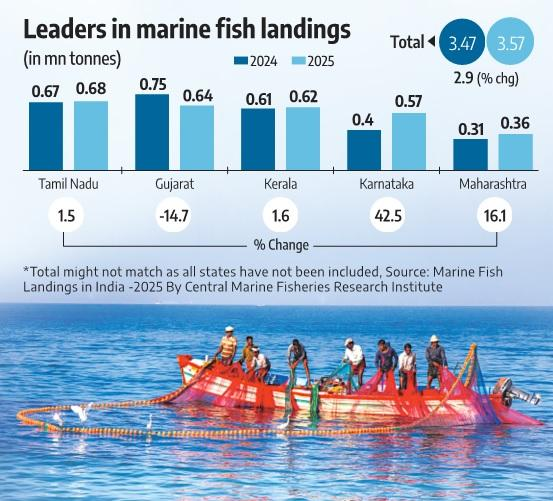
The Central Marine Fisheries Research Institute (CMFRI) released its 2025 annual report, revealing a major shift in India’s blue economy. For the first time in years, Tamil Nadu has overtaken Gujarat to become the leading marine fish producer in the country.
National Performance
Despite localized regional disruptions, India’s overall marine sector showed resilience and growth in 2025.
- Total Catch: 3.57 Million Tonnes (a 3% increase year-on-year).
- Economic Value:
- At Landing Centres: ₹69,254 Crore (up 10.45%).
- At Retail Level: ₹97,702 Crore (up 8.43%).
- National Marketing Efficiency: 70.88% (with Kerala leading at 72.83%).
State-wise Rankings and Shifts
| Rank | State | Catch (Million Tonnes) | Trend / Remarks |
| 1 | Tamil Nadu | — | Overtook Gujarat to take the top spot. |
| 2 | Gujarat | — | 15% Decline due to weather and fishing bans. |
| 3 | Kerala | 0.62 | Marginal 2% increase; highest marketing efficiency. |
| 4 | Karnataka | — | 43% Surge (recovering from a steep 2024 decline). |
| 5 | Maharashtra | — | 16% Increase in landings. |
Resource-wise Breakdown (Species)
The data highlights the diversity of India’s marine catch, with specific species reaching record levels:
- Indian Mackerel: The #1 landed resource (0.27 million tonnes).
- Cephalopods (Squid/Octopus): 0.25 million tonnes (reached a decadal high with 25% growth).
- Oil Sardine: 0.25 million tonnes (reached a decadal high in Kerala).
- Threadfin Breams: Recorded a massive 55% growth nationally.
Catch Composition by Depth/Zone:
- Pelagic Fish: 54% (Fish found in the upper layers of the open ocean).
- Demersal Resources: (Fish living on or near the sea bottom).
- Crustaceans & Molluscs: (Shrimp, crabs, and shellfish).
Key Concepts
Q: What is CMFRI?
A: The Central Marine Fisheries Research Institute, headquartered in Kochi, is a premier research organization under the Indian Council of Agricultural Research (ICAR). it is responsible for estimating marine fish landings and monitoring the health of India’s exclusive economic zone (EEZ).
Q: What is “Marketing Efficiency” in fisheries?
A: It refers to the percentage of the consumer’s rupee that actually reaches the fisherman. Higher efficiency (like Kerala’s 72.83%) means the supply chain is well-organized with fewer middlemen or lower logistics costs.
Q: Why was the fishing ban extended to 75 days?
A: Fishing bans (usually during the monsoon) are enforced to allow for the breeding season of various species. Extending the ban helps in the long-term sustainability of fish stocks by preventing the capture of juvenile fish and breeding adults.
Exam Relevance
| Exam | Focus Area | Relevance Level |
| UPSC CSE | GS-3 (Agriculture: Fisheries & Blue Economy; Geography: Marine Resources) | High |
| NABARD / Agri Exams | CMFRI Landing Data and Species-specific trends | Extreme |
Facts To Remember
1. Prasoon Joshi appointed Prasar Bharati Chairman
The Ministry of Information and Broadcasting has appointed noted lyricist and writer Prasoon Joshi as the Chairman of Prasar Bharati. “Prasoonji is a rare creative spirit celebrated across the world in advertising, literature, art and cinema, yet his heart beats unmistakably for India.
2. Centre appoints Rohit Jainas RBI Deputy Governor
The government has appointed Rohit Jain as Deputy Governor of the Reserve Bank of India for a three-year term. Mr. Jain is replacing T. Rabi Sankar, whose extended tenure ended
3. Kuldeep shatters pole vault National record, wins gold
In his first indoor competition, Kuldeep Kumar outsmarted title favourite Dev Meena to rewrite the men’s pole vault National record in the inaugural Indian Indoor Open combined events and pole vault meet at the Kalinga Stadium in Bhubaneswar on Saturday.
4. Ministry of Mines Approves Companies Under Critical Mineral Recycling Scheme
The Ministry of Mines approved 58 companies under a ₹1,500 crore scheme to boost recycling of lithium-ion batteries, e-waste, and scrap, with ₹5,000 crore pledged investments and 850 KTPA capacity to reduce import dependence.
5. Ministry of Earth Sciences Establishes C-ART Observatory in Visakhapatnam
MoES inaugurated a ₹180 crore coastal weather observatory at Andhra University to improve cyclone prediction, strengthen weather forecasting systems, and enhance early warning capabilities along India’s east coast.
5. ICAR-Central Marine Fisheries Research Institute Reports Tamil Nadu as Top Marine Fish Producer
CMFRI reported Tamil Nadu as the top marine fish producer in 2025 with 6.85 lakh tonnes, surpassing Gujarat, while India’s total production rose 3% to 35.7 lakh tonnes with strong market value growth.
6. Nitin Gadkari Launches Barrier-less Tolling System
Nitin Gadkari launched India’s first MLFF tolling system in Gujarat using AI-based ANPR and FASTag, enabling seamless toll deduction, reducing travel time, fuel consumption, and emissions, and promoting smart mobility infrastructure.
7. Sikkim Becomes First Fully Paperless Judiciary State
Sikkim achieved a fully digital judiciary system with e-filing, virtual hearings, and electronic summons, improving accessibility in remote regions while reducing costs and environmental impact.
8. Department for Promotion of Industry and Internal Trade Signs MoU with Chamber India
DPIIT partnered with Chamber India to boost startup ecosystem through global linkages, incubation centres, concessional memberships, and support for innovation across sectors like healthcare, agriculture, and technology.
9. United States Trade Representative Releases Special 301 Report 2026
USTR retained India on Priority Watch List while naming Vietnam as Priority Foreign Country, highlighting global IP concerns, classification changes, and potential Section 301 investigation implications.
10. NPCI Bharat BillPay Limited and Juspay Technologies Private Limited Launch Banking Connect
NBBL and Juspay introduced a unified switch and SDK to standardise net banking workflows, enhance interoperability, improve user experience, and strengthen India’s digital payment ecosystem.
11. India Post Payments Bank Launches SHG Savings Account
IPPB introduced a zero-balance SHG account to empower women-led groups with digital onboarding, free transactions, interest benefits, and support for rural livelihoods aligned with financial inclusion goals.
12. Vishvajit Sahay Assumes Charge as Defence Finance Secretary
Vishvajit Sahay took charge as Secretary (Defence Finance), Ministry of Defence, bringing extensive experience in public finance, procurement, and administration, succeeding Rasika Chaube.
13. Mazagon Dock Shipbuilders Limited Delivers Stealth Frigate ‘Mahendragiri’
MDL delivered the sixth Project-17A stealth frigate to the Indian Navy, marking completion of its assigned warships, showcasing indigenous shipbuilding and advanced naval design capabilities.
14. Ishank Singh Sets World Record in Palk Strait
Seven-year-old Ishank Singh became the youngest and fastest swimmer to cross the Palk Strait in 9 hours 50 minutes, demonstrating exceptional endurance and setting a global benchmark.
15. International Workers’ Day Observed on May 1
International Workers’ Day is observed globally to honor workers’ contributions, promote labour rights, and commemorate the Haymarket Affair of 1886, marking a historic labour movement milestone.
16. Mizoram Launches ‘Khuarel’ Disaster Management App
Mizoram launched the ‘Khuarel’ app for real-time disaster reporting and coordination, featuring offline access, multilingual support, and emergency databases to improve disaster response in remote areas.







