Source: BS
Context:
The Central Marine Fisheries Research Institute (CMFRI) released its 2025 annual report, revealing a major shift in India’s blue economy. For the first time in years, Tamil Nadu has overtaken Gujarat to become the leading marine fish producer in the country.
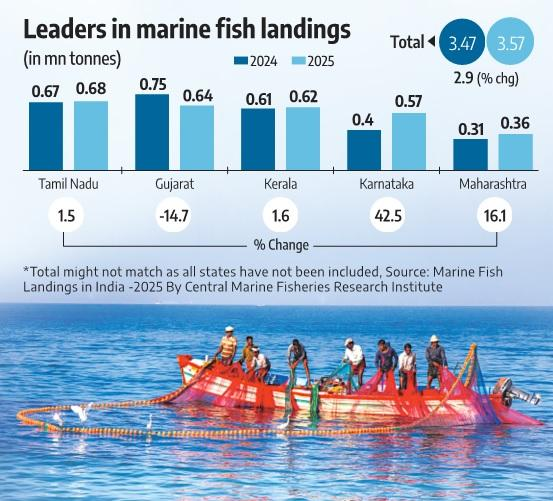
National Performance
Despite localized regional disruptions, India’s overall marine sector showed resilience and growth in 2025.
- Total Catch: 3.57 Million Tonnes (a 3% increase year-on-year).
- Economic Value:
- At Landing Centres: ₹69,254 Crore (up 10.45%).
- At Retail Level: ₹97,702 Crore (up 8.43%).
- National Marketing Efficiency: 70.88% (with Kerala leading at 72.83%).
State-wise Rankings and Shifts
| Rank | State | Catch (Million Tonnes) | Trend / Remarks |
| 1 | Tamil Nadu | — | Overtook Gujarat to take the top spot. |
| 2 | Gujarat | — | 15% Decline due to weather and fishing bans. |
| 3 | Kerala | 0.62 | Marginal 2% increase; highest marketing efficiency. |
| 4 | Karnataka | — | 43% Surge (recovering from a steep 2024 decline). |
| 5 | Maharashtra | — | 16% Increase in landings. |
Resource-wise Breakdown (Species)
The data highlights the diversity of India’s marine catch, with specific species reaching record levels:
- Indian Mackerel: The #1 landed resource (0.27 million tonnes).
- Cephalopods (Squid/Octopus): 0.25 million tonnes (reached a decadal high with 25% growth).
- Oil Sardine: 0.25 million tonnes (reached a decadal high in Kerala).
- Threadfin Breams: Recorded a massive 55% growth nationally.
Catch Composition by Depth/Zone:
- Pelagic Fish: 54% (Fish found in the upper layers of the open ocean).
- Demersal Resources: (Fish living on or near the sea bottom).
- Crustaceans & Molluscs: (Shrimp, crabs, and shellfish).
Key Concepts
Q: What is CMFRI?
A: The Central Marine Fisheries Research Institute, headquartered in Kochi, is a premier research organization under the Indian Council of Agricultural Research (ICAR). it is responsible for estimating marine fish landings and monitoring the health of India’s exclusive economic zone (EEZ).
Q: What is “Marketing Efficiency” in fisheries?
A: It refers to the percentage of the consumer’s rupee that actually reaches the fisherman. Higher efficiency (like Kerala’s 72.83%) means the supply chain is well-organized with fewer middlemen or lower logistics costs.
Q: Why was the fishing ban extended to 75 days?
A: Fishing bans (usually during the monsoon) are enforced to allow for the breeding season of various species. Extending the ban helps in the long-term sustainability of fish stocks by preventing the capture of juvenile fish and breeding adults.
Exam Relevance
| Exam | Focus Area | Relevance Level |
| UPSC CSE | GS-3 (Agriculture: Fisheries & Blue Economy; Geography: Marine Resources) | High |
| NABARD / Agri Exams | CMFRI Landing Data and Species-specific trends | Extreme |