
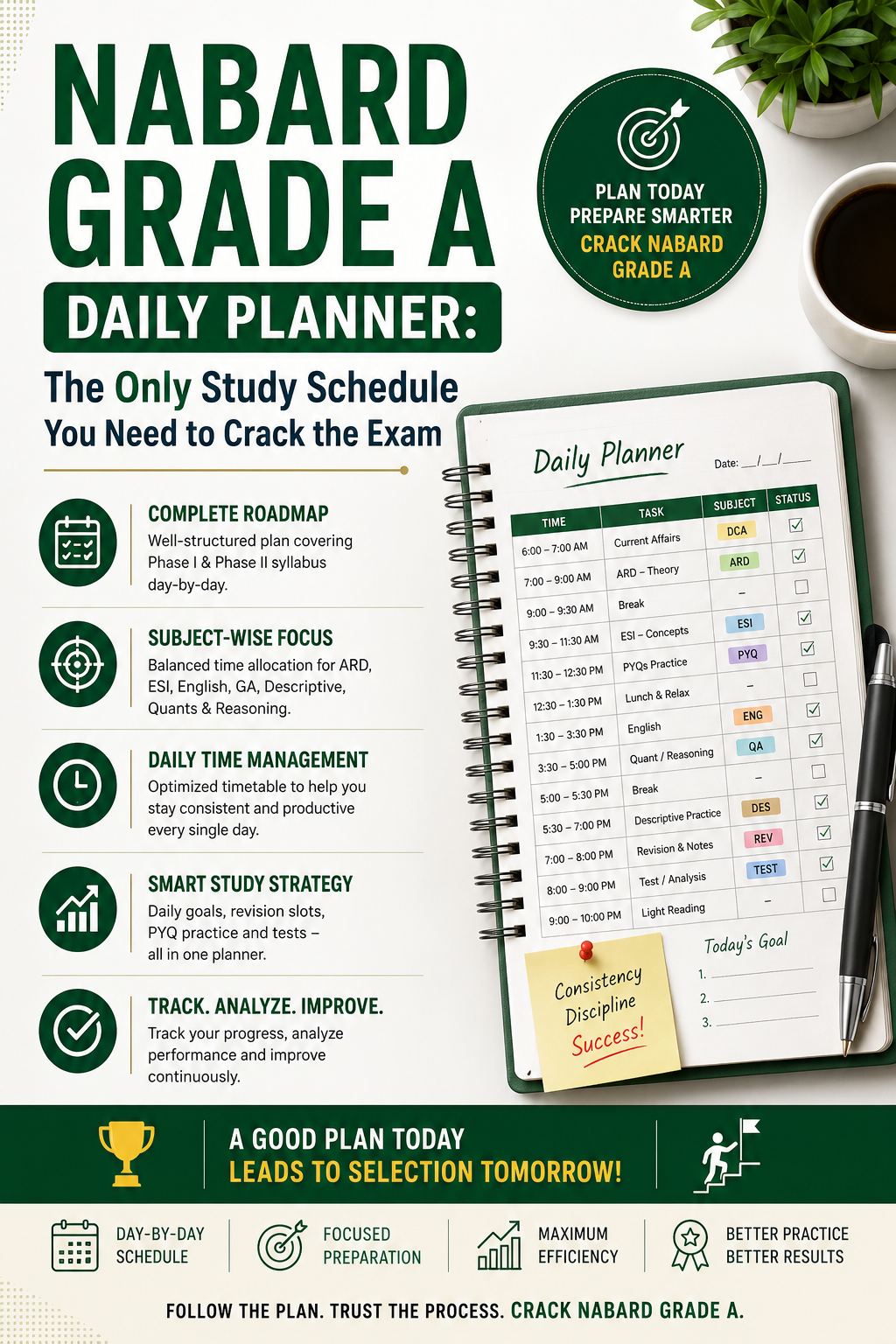
NABARD Grade A Daily Planner
If you are preparing for NABARD Grade A 2026, you already know that cracking this exam is not just about studying hard, it is about studying smart, consistently, and with a plan that holds. One of the most common reasons aspirants fail despite months of effort is the absence of a structured daily routine that covers every section of the syllabus without burning out.
At C4S Courses, we built the NABARD Grade A Daily Planner a 17-hour blueprint designed for the full-time serious aspirant. In this blog, we break down exactly how to use it, why every time block is placed where it is, and how this planner can transform your NABARD Grade A preparation from scattered to surgical.
What Is the NABARD Grade A Daily Planner?
The NABARD Grade A Daily Planner by Clarity4Sure is a structured, hour-by-hour study schedule that maps out your entire day from 06:30 AM to 11:30 PM. It is designed around the actual NABARD Grade A exam syllabus, which includes:
- Quantitative Aptitude & Reasoning (Prelims)
- Economic & Social Issues (ESI) (Mains)
- Agriculture & Rural Development (ARD) (Mains)
- Computer Awareness
- Descriptive Writing
- Current Affairs & Banking Awareness
The planner does not treat all subjects equally. It assigns time based on difficulty, depth, and the marks they carry in the final exam, which is exactly how you should be approaching your NABARD Grade A study plan.
Hour-by-Hour Breakdown of the C4S NABARD Grade A Daily Schedule
(07:00 – 09:00) Quantitative Aptitude or Reasoning (Alternate Days)
The morning brain is your sharpest tool. That is why the C4S Daily Planner opens with Quant or Reasoning on alternate days (Mon–Fri) and Computer Awareness on weekends. The approach is: concept → practice → speed.
Many NABARD Grade A aspirants neglect Quant and Reasoning, assuming Mains is the real battle. Do not make that mistake. A strong Prelims score is your entry ticket.
(10:00 – 13:00) Ministry-wise Schemes (ESI Deep Sitting)
This is a 3-hour power sitting dedicated to Economic & Social Issues specifically, ministry-wise flagship government schemes. The C4S method here is simple and powerful:
Read one ministry at a time → Build a tabular summary (year launched, ministry, budget outlay, target beneficiary) → Create recall cards.
This approach to ESI preparation is what separates toppers from average scorers in the NABARD Grade A Mains. When you can recall ₹1 lakh crore government schemes with their nodal ministry, outlay, and timeline in 30 seconds, you are exam-ready.
Topics to cover: PM-KISAN, PMFBY, NABARD refinance schemes, rural credit schemes, SHG-Bank Linkage Programme, PMAY-G, and every major scheme under the Ministry of Agriculture, Finance, and Rural Development.
(13:00 – 14:00) Lunch (Recharge)
A deliberate, screen-free break. No current affairs scrolling. No YouTube. Let the morning’s content consolidate in your memory. The C4S planner treats rest as part of the syllabus — because it is.
(14:00 – 15:00) Power Nap (Rest & Recovery)
Science backs this one. A 20–40 minute nap in the early afternoon improves memory consolidation and cognitive performance significantly. NABARD Grade A is a marathon, not a sprint. A well-rested brain retains more, writes better answers, and handles exam pressure with clarity.
(15:00 – 18:30) Agriculture & Rural Development (ARD Deep Sitting)
The longest sitting of the day at 3.5 hours is reserved for ARD — the paper that most aspirants either ignore or under-prepare. This is a serious strategic error. ARD is the paper that differentiates final rankers in NABARD Grade A Mains.
The C4S approach for ARD deep study:
- Follow the C4S master session topic for the day
- Take rough notes during reading
- Build a one-page chapter summary at the end of every session
High-value NABARD ARD topics: Types of farming, irrigation methods, soil health, NABARD’s role in rural credit, microfinance, cooperative banks, RIDF, Kisan Credit Card (KCC), FPOs, crop insurance, and government schemes for agriculture.
If you are searching for the best ARD notes for NABARD Grade A, start with c4scourses.in — the master sessions are structured exactly around this planner.
(18:30 – 19:00) Evening Walk
Outdoor, screen-free, no earphones for the first 10 minutes. This is not wasted time — it is active mental recovery. Physical movement after a long sitting improves focus for the next session and prevents the kind of mental fatigue that compounds over weeks.
(19:00 – 21:30) Weak Subject Revision + 2 Descriptive Answers
This slot has two functions:
- Revisit whichever subject bled during the day — ESI or ARD. This honest, ego-free self-assessment is what serious NABARD aspirants do.
- Write two descriptive answers in exam format, then self-evaluate against a model answer.
Descriptive writing is tested in NABARD Grade A Phase II, and most aspirants skip practice entirely. The C4S planner builds it into your daily routine so that by exam day, you have written hundreds of structured answers.
Practice answer writing on: Role of NABARD in agricultural credit, challenges of rural economy, financial inclusion in India, impact of MSP on farmers.
(22:00 – 23:00) Daily Current Affairs via C4S Website
Read the Daily Current Affairs (DCA) on c4scourses.in. The planner specifies exactly what to note:
- 5 banking & economy headlines
- 5 agriculture & rural development items
- 2 international news items
- 2 schemes-in-news
This targeted approach to current affairs is what gives C4S students an edge. You are not reading everything, you are reading what matters for NABARD Grade A.
(23:00 – 23:30) Self-Introspection + PYQ Recall
Five honest reflection questions, then 10–15 Previous Year Questions (PYQs) from the day’s topic. Mark what you failed. Fix it tomorrow. This daily closing ritual is the single most underrated habit in NABARD Grade A preparation.
(23:30 – 06:30) Sleep (Non-Negotiable)
7 hours of sleep is part of the syllabus. The C4S Aspirant’s Code says it plainly: “The exam rewards a rested brain.” Do not trade sleep for extra study hours — the math does not work in your favour.
Morning Subject Rotation: The Weekly Plan
| Day | 07:00–09:00 Subject |
|---|---|
| Monday | Quantitative Aptitude |
| Tuesday | Reasoning Ability |
| Wednesday | Quantitative Aptitude |
| Thursday | Reasoning Ability |
| Friday | Quantitative Aptitude |
| Saturday | Computer Awareness |
| Sunday | Computer Awareness |
This rotation ensures no subject is neglected across the week, and both Quant and Reasoning receive equal attention through the preparation phase.
The 5 Daily Non-Negotiables (C4S Method)
Every day, before you sleep, you must tick off all five:
- One full ARD master-session topic — covered and summarised
- One ministry’s schemes — tabularised neatly
- Two descriptive answers written under timed conditions
- DCA from c4scourses.in read and noted
- 10–15 PYQs attempted before bed
If you complete these five things every single day, you will be among the most prepared NABARD Grade A aspirants in the country by the time the exam arrives.
Self-Introspection Prompts (End of Day)
The C4S planner includes five daily reflection questions that high-performing students swear by:
- What did I learn today that I didn’t know yesterday?
- Which sitting was weakest — and exactly why?
- Did I revise yesterday’s notes before starting today?
- Is my descriptive writing tighter than last week?
- One thing I will do better tomorrow morning.
This is not journaling for the sake of it. This is performance monitoring, and it directly improves the quality of every subsequent study session.
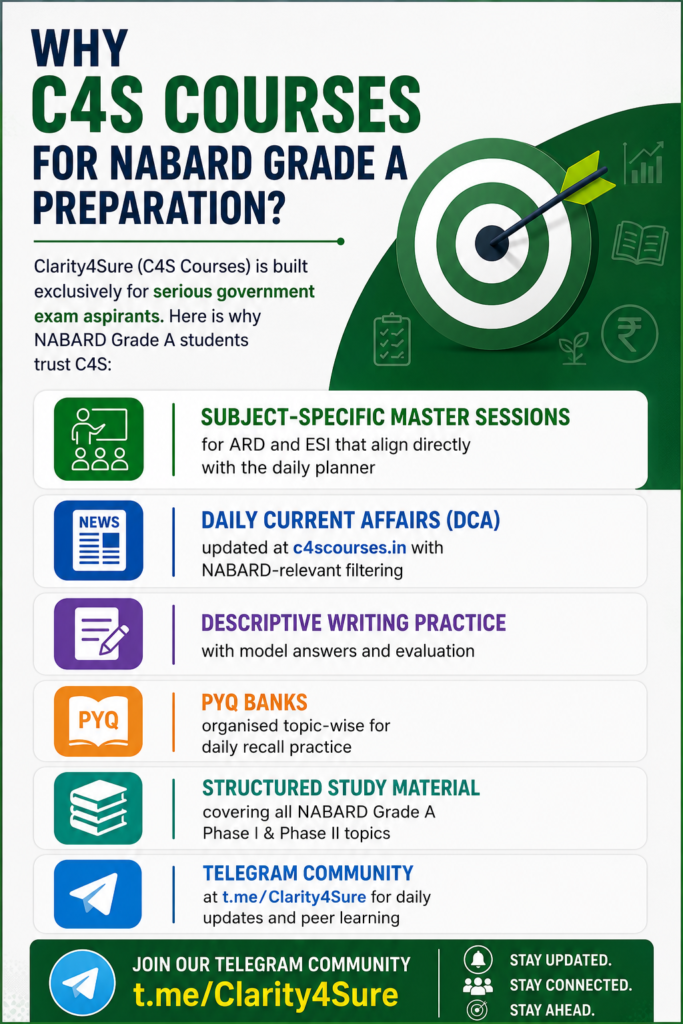
Why C4S Courses for NABARD Grade A Preparation?
Clarity4Sure (C4S Courses) is built exclusively for serious government exam aspirants. Here is why NABARD Grade A students trust C4S:
- Subject-specific master sessions for ARD and ESI that align directly with the daily planner
- Daily Current Affairs (DCA) updated at c4scourses.in with NABARD-relevant filtering
- Descriptive writing practice with model answers and evaluation
- PYQ banks organised topic-wise for daily recall practice
- Structured study material covering all NABARD Grade A Phase I & Phase II topics
- Telegram community at t.me/Clarity4Sure for daily updates and peer learning
Frequently Asked Questions: NABARD Grade A Preparation
Q1. How many hours should I study for NABARD Grade A daily? The C4S Daily Planner recommends a structured 10–12 hours of active study within a 17-hour framework, with deliberate breaks and sleep built in. Quality beats quantity.
Q2. Which is harder — ESI or ARD for NABARD Grade A? Both are equally important. ESI rewards breadth (schemes, policies, reports), while ARD rewards depth (agrarian concepts, credit systems, rural institutions). The planner assigns 3 hours each to ensure neither is neglected.
Q3. How important is Current Affairs for NABARD Grade A? Extremely important. Current Affairs appear in both Prelims and Mains, and questions on recent RBI policies, budget announcements, new agricultural schemes, and rural banking developments are common.
Q4. Should I focus on Mains from day one? Yes. The C4S planner begins Mains preparation (ESI + ARD) from Day 1, alongside Prelims subjects. This is the right approach — Mains content takes months to build, not weeks.
Q5. Where can I find NABARD Grade A previous year question papers? Visit c4scourses.in or join the Clarity4Sure Telegram channel for curated PYQs organised by topic and year.
Slow is Smooth, Smooth is Fast
As the C4S Aspirant’s Code puts it:
“Show up at the desk the same way a farmer shows up at the field — every single day, before the sun makes excuses possible.”
NABARD Grade A is not cracked by studying harder on some days and skipping others. It is cracked by the aspirant who shows up with the same structure, the same discipline, and the same non-negotiables ,every single day.
Website: www.c4scourses.in Telegram: t.me/Clarity4Sure Email: c4scourses@gmail.com