
Why in News?
The Union Minister for Road Transport and Highways advocated for India to move towards 100% ethanol blending (E100) in the near future to achieve energy self-reliance and insulate the country from global oil supply shocks.
What is India’s Ethanol Blending Programme?
Ethanol, also known as ethyl alcohol, is a renewable and eco-friendly fuel. It is produced naturally when yeast ferments sugar and can also be manufactured through industrial processes. In India, ethanol is mainly made from sugarcane molasses, but it is increasingly being produced from maize (corn), surplus rice, and damaged food grains.
Based on the raw materials used and the technology involved, ethanol is divided into First Generation (1G), Second Generation (2G), and Third Generation (3G) ethanol.
Ethanol blending means mixing ethanol with petrol before it is used in vehicles. This helps India reduce its dependence on imported crude oil, save foreign exchange, and lower harmful carbon emissions.
- E10 petrol contains 10% ethanol and 90% petrol.
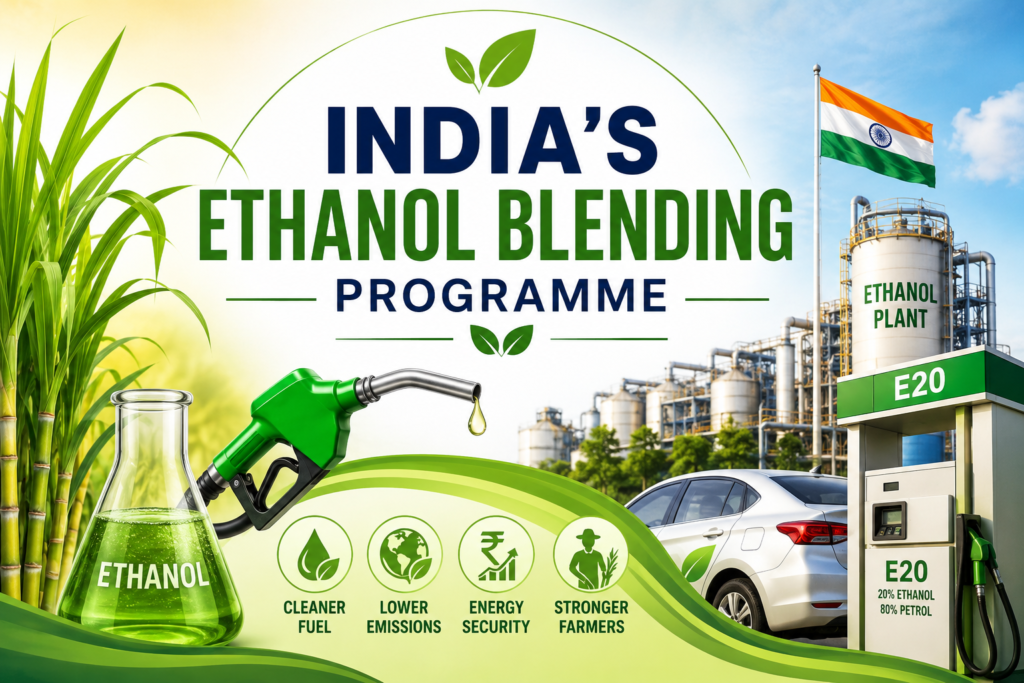
- E20 petrol contains 20% ethanol and 80% petrol.
- E100 refers to 100% pure ethanol being used as fuel without any petrol mixed in it.
Most vehicles can run on E10 fuel without any modifications. E20 fuel requires vehicles with compatible engines and may slightly affect fuel efficiency. E100 fuel can only be used in flex-fuel vehicles, which are specially designed to operate on different ethanol-petrol mixtures.
Flex-fuel vehicles have modified engines, corrosion-resistant parts, and advanced sensors to handle higher ethanol content safely and efficiently. Countries such as Brazil have successfully adopted these vehicles on a large scale, while India is still in the early stages of expanding their use.
Ethanol Blended Petrol (EBP) Programme
The Ethanol Blended Petrol (EBP) Programme is a Government of India initiative that promotes mixing ethanol with petrol. It operates under the National Biofuel Policy, 2018 and is managed by the Ministry of Petroleum and Natural Gas. The main objectives of the programme are to reduce India’s dependence on imported crude oil, lower pollution and greenhouse gas emissions, and increase farmers’ income by creating a new market for agricultural produce.
A major achievement of the programme came in 2025, when India successfully reached its target of 20% ethanol blending (E20), five years earlier than the original target year of 2030. Since April 2026, all petrol sold in the country has been required to contain 20% ethanol (E20) and meet the prescribed fuel quality standards.
India’s ethanol production capacity has grown tremendously, increasing from less than 2 billion litres in 2014 to nearly 20 billion litres today. This production is much higher than the amount required to meet the E20 blending target. The National Biofuel Coordination Committee (NBCC) supervises the use of feedstocks and ensures that only surplus agricultural produce is diverted for ethanol production.
Infrastructure and Policy Reforms Supporting the Programme
To encourage ethanol production and blending, the government introduced several reforms:
- Ethanol Interest Subvention Schemes (EISS): Financial assistance was provided between 2018 and 2022 for setting up new ethanol production plants based on molasses and grains.
- Long-Term Offtake Agreements (LTOAs): Public Sector Oil Marketing Companies signed long-term agreements with ethanol producers, ensuring stable demand, timely payments, and market security.
- Administered Pricing Mechanism: The government fixed assured prices for ethanol, giving producers confidence to invest in the sector.
- GST Reduction: The Goods and Services Tax (GST) on ethanol was reduced from 18% to 5%, lowering production costs and encouraging greater output.
- Regulatory Amendments: Changes in regulations made the interstate and intrastate transportation of ethanol easier and more efficient.
Impact of the EBP Programme
1. Improved Energy Security and Foreign Exchange Savings
By replacing a portion of imported crude oil with domestically produced ethanol, India has saved more than ₹1.4 lakh crore in foreign exchange since 2014. This also reduces the country’s vulnerability to fluctuations in international oil prices.
2. Higher Income for Farmers
The programme has created a reliable market for surplus crops such as sugarcane, maize, and rice. By 2025, ethanol procurement generated around ₹1.18 lakh crore for farmers and ₹1.96 lakh crore for distilleries. As a result, farmers are no longer only Annadatas (providers of food) but are also becoming Urjadaatas (providers of energy).
3. Rural Employment Generation
The expansion of ethanol plants, distilleries, and agro-processing industries has created thousands of jobs in rural areas, particularly in states such as Uttar Pradesh, Maharashtra, and Bihar.
4. Environmental Benefits
Ethanol burns more cleanly than conventional petrol because it is an oxygen-rich fuel. The adoption of E20 fuel has helped reduce approximately 832 lakh metric tonnes of carbon dioxide (CO₂) emissions. This contributes significantly to India’s commitment to achieve Net-Zero emissions by 2070. Higher blends such as E30 and E100 could further strengthen India’s climate goals.
5. Waste-to-Wealth and Circular Economy
Ethanol production, especially from grains, also produces a valuable by-product called Dried Distillers Grain with Solubles (DDGS). DDGS is a nutritious cattle feed that helps address fodder shortages and ensures that agricultural resources are utilized efficiently, supporting the principles of a circular economy.
| Ethanol Generation | Feedstock | Characteristics |
|---|---|---|
| First Generation (1G) | Edible biomass such as sugarcane, corn, and wheat | Uses food crops as raw material, which may affect food security. The technology is well-established and commercially viable but can put pressure on land and water resources. |
| Second Generation (2G) | Non-edible biomass such as agricultural residues, paddy stubble, and bamboo | Utilizes agricultural waste and helps reduce crop residue burning, especially in Punjab and Haryana. However, the conversion process is technologically complex and relatively expensive. |
| Third Generation (3G) | Algae-based biomass | Offers very high fuel yields and does not require fertile land or freshwater. It is environmentally promising but is still in the research and development stage in India. |
| Fourth Generation (4G) | Genetically modified crops and microorganisms | Designed to improve carbon capture and fuel production efficiency. This technology is largely experimental and remains at a theoretical or early development stage. |
Why Must India Accelerate Its Ethanol Strategy Towards E100?
1. Strengthening India’s Energy Security
India depends heavily on imports for its energy needs, importing nearly 89% of its crude oil and around 60% of its LPG requirements. Global events such as wars, conflicts, and economic crises often cause sharp increases in oil prices. For example, crude oil prices rose dramatically during the 2008 global crisis and again during the Russia–Ukraine conflict in 2022.
Recent tensions in West Asia have also highlighted the risks of relying on important shipping routes like the Strait of Hormuz. By increasing the use of domestically produced ethanol, India can reduce its dependence on imported oil and protect itself from sudden international price shocks and supply disruptions.
2. A Practical Alternative Fuel for Today
India has millions of vehicles running on petrol and diesel. Replacing all of them with electric vehicles overnight is neither practical nor affordable.
Ethanol provides a realistic solution because it can be blended with petrol and used in existing vehicles with minimal modifications. Fuels such as E20, E30, and E100, along with Flex-Fuel Vehicles (FFVs), allow India to reduce carbon emissions and oil imports without waiting for a complete shift to electric mobility.
3. Helping Solve the Stubble Burning Problem
Every year, large amounts of crop residue, especially paddy stubble, are burned in states such as Punjab and Haryana, causing severe air pollution in North India.
Promoting Second-Generation (2G) and Third-Generation (3G) ethanol can convert this agricultural waste into fuel instead of letting it be burned. Expanding ethanol production will encourage investment in advanced biorefineries that use crop residue as raw material, helping reduce air pollution while creating economic value from waste.
4. Building a More Resilient Energy System
Traditional oil refineries are large, centralized facilities, often located near coastal areas. Any disruption at these locations can affect fuel supplies across the country.
Ethanol production plants, on the other hand, are spread across different agricultural regions. This decentralized system creates a stronger and more resilient energy network, reducing the risk of disruptions caused by geopolitical conflicts, natural disasters, or supply chain problems.
5. Supporting a Circular Economy and Reducing Waste
India is one of the world’s largest producers of food waste, generating millions of tonnes every year. Damaged food grains, surplus crops, and agricultural residues often go unused.
Using these materials to produce ethanol converts waste into a valuable source of energy. This “waste-to-wealth” approach not only reduces wastage but also creates additional income opportunities for farmers and industries while supporting sustainable development.
What are the Challenges in Scaling Beyond E20?
1. Vehicle Compatibility Issues
Although ethanol is a cleaner fuel, it contains less energy per litre than petrol. Pure ethanol (E100) provides about 45–55% less energy, which can reduce a vehicle’s mileage. This often makes consumers worry about increased fuel consumption and higher running costs.
Most modern vehicles can safely use E20 fuel, but higher blends such as E30 or E100 may damage conventional engines by causing corrosion and wear. These fuels require Flex-Fuel Vehicles (FFVs), which are specially designed to run on different ethanol-petrol mixtures. However, FFVs are still not widely available in India.
2. Taxation Challenges
The tax structure for ethanol and petrol is not fully aligned. Ethanol used for blending attracts only 5% GST, while petrol is taxed through Central Excise Duty and State VAT.
Since consumers do not receive any significant tax benefit when purchasing ethanol-blended fuels, there is little financial motivation to prefer higher ethanol blends over regular petrol.
3. Food vs. Fuel Concerns
A major concern is whether crops should be used for food or fuel production. Increasing ethanol production from maize and rice could reduce the availability of food grains, especially during years of poor rainfall or climatic events such as El Niño.
This may contribute to higher food prices and create concerns about food security and nutrition for vulnerable populations.
4. High Water Consumption
While ethanol helps reduce vehicle emissions, its production can place significant pressure on water resources.
Sugarcane, the primary source of ethanol in India, is a water-intensive crop. Producing one litre of sugarcane-based ethanol can require approximately 2,800–3,000 litres of water. Encouraging large-scale sugarcane cultivation in water-stressed states such as Maharashtra and Uttar Pradesh could worsen groundwater depletion and create long-term environmental challenges.
5. Infrastructure and Cost Barriers
Producing ethanol is often as expensive as, or sometimes more expensive than, producing petrol. Expanding ethanol use on a large scale therefore requires continued government support, subsidies, or climate-finance investments.
In addition, fuel stations need special infrastructure to supply higher ethanol blends. This includes:
- Dedicated fuel dispensing units,
- Separate underground storage tanks,
- Upgraded handling and transportation facilities.
Building this infrastructure across the country requires substantial investment, making the transition to higher ethanol blends a gradual process.
How can India Scale to E100 while Ensuring Sustainability?
1. Learning from Brazil’s Success
Brazil is considered a global leader in ethanol use. After the oil crises of the 1970s, the country invested heavily in ethanol production and flex-fuel technology. Today, more than 80% of the vehicles sold in Brazil are Flex-Fuel Vehicles (FFVs), which can run on petrol, ethanol, or any mixture of the two.
Brazil introduced vehicles running on 100% ethanol (E100) in the 1980s and later developed advanced FFVs equipped with sensors that automatically adjust engine performance according to the fuel blend being used. Currently, Brazil mandates a 30% ethanol blend in petrol, and ethanol supplies more than half of the fuel used by its passenger vehicles.
India can learn from this model by encouraging automobile manufacturers to produce more FFVs and by supporting affordable conversion kits for existing vehicles.
2. Encouraging Flex-Fuel Technology
The government can promote FFVs by linking ethanol-related goals with future vehicle emission standards, such as the CAFE III norms scheduled for implementation from 2027.
Under the Make in India initiative, incentives can be provided to automakers to manufacture vehicles with:
- Corrosion-resistant parts,
- Modified engines,
- Advanced fuel sensors,
allowing them to operate efficiently on different ethanol blends.
3. Reforming the Tax Structure
To encourage consumers to use higher ethanol blends, the government should consider introducing a simpler and more uniform tax system for fuels such as E20, E30, and E100.
If the cost savings from ethanol production are passed on to consumers through lower fuel prices, demand for ethanol-blended fuels is likely to increase significantly.
4. Expanding 2G and 3G Ethanol Production
To avoid concerns about using food crops for fuel, India should focus on increasing the production of:
- Second-Generation (2G) Ethanol from agricultural waste such as stubble, bamboo, and wheat straw.
- Third-Generation (3G) Ethanol from algae.
These technologies can produce clean fuel without affecting food supplies while also helping to reduce agricultural waste and pollution.
5. Exploring New Uses for Ethanol
India should invest more in research and development through institutions such as IITs and specialized research centres to find additional uses for ethanol.
Potential areas include:
- Ethanol-powered cooking stoves,
- Ethanol blending in diesel,
- Industrial and commercial energy applications.
Since diesel accounts for a larger share of India’s fuel consumption than petrol, even limited success in diesel blending could have a major impact.
6. Building a Diverse Clean Energy Mix
Ethanol alone cannot solve all of India’s energy challenges. Therefore, the country should adopt a balanced approach by combining:
- Ethanol-blended fuels (E20, E85, etc.),
- Electric Vehicles (EVs),
- Green Hydrogen,
- Other renewable energy sources.
While ethanol can help decarburize passenger transport in the short and medium term, EVs and green hydrogen will play a crucial role in achieving long-term energy security and climate goals.
Conclusion
India’s move towards E100 ethanol fuel demonstrates its commitment to achieving energy security, reducing dependence on imported oil, and promoting cleaner transportation. However, the success of this transition will depend on several factors, including the availability of suitable vehicles, adequate fuel infrastructure, sustainable feedstock supply, and affordable production costs.
To ensure long-term success, India must invest in advanced biofuels such as Second-Generation (2G) ethanol, which is produced from agricultural waste rather than food crops. At the same time, the country needs to expand storage, distribution, and refuelling infrastructure for higher ethanol blends. Without these measures, challenges related to food security, water usage, vehicle compatibility, and economic viability could slow down progress. Therefore, a balanced and well-planned approach is essential for making ethanol a reliable pillar of India’s clean energy future.