
The GS-III Syllabus Overlap Nobody Talks About (2026 Guide)
If you are preparing for UPSC and quietly worrying about a Plan B, here is a question worth answering early: is NABARD a good option for UPSC aspirants? The short answer is yes — and the reason is hiding in plain sight inside your General Studies notes. A large chunk of the NABARD Grade A syllabus overlaps with UPSC GS-III, which means you can target a second prestigious exam without starting your preparation from scratch.
This guide breaks down the NABARD vs UPSC syllabus overlap topic by topic, explains why NABARD Grade A is one of the best backup exams for UPSC aspirants, covers the salary and career payoff, and gives you a realistic dual-preparation strategy for 2026.
Quick answer: why NABARD Grade A suits UPSC aspirants
NABARD Grade A is a strong fit for UPSC aspirants because:
- Its two scoring subjects — Economic & Social Issues (ESI) and Agriculture & Rural Development (ARD) — map almost directly onto UPSC GS-III economy and agriculture, plus GS-I/GS-II society.
- It follows the same Prelims → Mains → Interview structure UPSC aspirants already understand.
- It rewards subject depth and descriptive writing, not just exam-cracking speed.
- It offers a well-paid, respected central-institution career if the UPSC result does not land.
In other words, the question is less “should I add another exam?” and more “why leave this overlap on the table?”
What is the NABARD Grade A exam?
NABARD — the National Bank for Agriculture and Rural Development — recruits Assistant Managers (Grade A) into its Rural Development Banking Services. The exam runs in three stages: a Phase 1 (Prelims) objective test, a Phase 2 (Mains) with descriptive English plus objective and descriptive papers on ESI and ARD, and a final interview.
Crucially, only a few sections count toward the final merit list: General Awareness, ESI, and ARD. The reasoning, quantitative, English, decision-making, and computer sections are largely qualifying. So NABARD effectively rewards the exact economy-and-agriculture depth UPSC GS-III demands.
(The 2026 official notification is expected around mid-year, so always confirm dates and pattern against the official NABARD notification when it is released.)
NABARD vs UPSC syllabus: the GS-III overlap at a glance
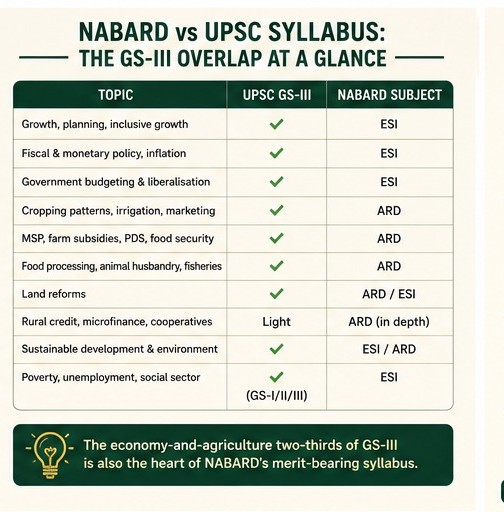
| Topic | UPSC GS-III | NABARD subject |
| Growth, planning, inclusive growth | ✅ | ESI |
| Fiscal & monetary policy, inflation | ✅ | ESI |
| Government budgeting & liberalisation | ✅ | ESI |
| Cropping patterns, irrigation, marketing | ✅ | ARD |
| MSP, farm subsidies, PDS, food security | ✅ | ARD |
| Food processing, animal husbandry, fisheries | ✅ | ARD |
| Land reforms | ✅ | ARD / ESI |
| Rural credit, microfinance, cooperatives | Light | ARD (in depth) |
| Sustainable development & environment | ✅ | ESI / ARD |
| Poverty, unemployment, social sector | ✅ (GS-I/II/III) | ESI |
That is the headline: the economy-and-agriculture two-thirds of GS-III is also the heart of NABARD’s merit-bearing syllabus.
How the NABARD syllabus matches UPSC GS-III, topic by topic
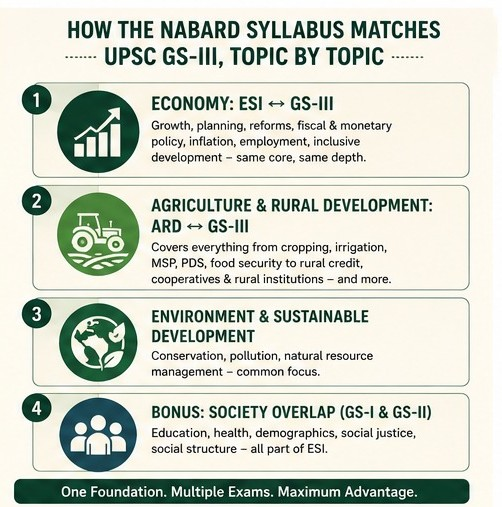
1. Economy: NABARD ESI ↔ UPSC GS-III
UPSC GS-III tests growth and development, planning, resource mobilisation, inclusive growth, government budgeting, fiscal and monetary policy, inflation, employment, and the effects of liberalisation. NABARD’s ESI paper covers the same ground — the structure of the Indian economy, post-1991 reforms, monetary and fiscal policy, inflation, poverty, unemployment, and inclusive development. If you can write a strong GS-III answer on inclusive growth, you are already most of the way to an ESI answer on it.
2. Agriculture & rural development: NABARD ARD ↔ UPSC GS-III
This is where the NABARD Grade A and UPSC GS-III overlap becomes hard to ignore. GS-III dedicates a whole cluster to agriculture: cropping patterns, irrigation, storage and marketing, e-technology for farmers, minimum support prices, farm subsidies, the public distribution system, buffer stocks, food security, food processing, the economics of animal rearing, and land reforms. The ARD paper covers all of this — and goes further into rural credit, microfinance, cooperatives, and rural development institutions, where NABARD itself is the apex body. A UPSC aspirant studying agriculture is extending existing knowledge here, not building it from zero.
3. Environment & sustainable development
GS-III’s environment portion — conservation, pollution, degradation, and the development-versus-environment balance — overlaps with the sustainable-development component of ESI and the natural-resource-management angle of ARD.
4. Bonus: society overlap with GS-I and GS-II
The “Social Issues” half of ESI — education, health, demographics, social justice, social structure — feeds the society portion of GS-I and the welfare and social-sector schemes portion of GS-II. So NABARD preparation pays off across three GS papers, not just one.
Where NABARD and UPSC do NOT overlap (be honest)
A credible Plan B means knowing the gaps. NABARD will not cover the science & technology, internal security, or disaster management portions of GS-III, so those remain UPSC-only effort. ARD also dives deeper into technical agronomy (soil science, crop science, animal science) than UPSC requires. And the formats differ: NABARD answers are typed and reward crisp, data-backed, point-based writing, while UPSC mains demands handwritten, analytical, well-argued answers under time pressure. The knowledge transfers; the answer-writing muscle needs separate practice for each.
NABARD Grade A salary: is the payoff worth it?
For UPSC aspirants weighing a backup, the NABARD Grade A salary is a strong incentive. The starting basic pay for an Assistant Manager is around ₹1 lakh(approx.), with traditional in-hand pay in different region depending on posting and deductions. A wage revision for NABARD officers has also been reported, which aspirants expect to push pay higher, so check the latest figures before you decide. Add leased accommodation, concessional loans, and a clear promotion ladder up to senior management, and NABARD becomes a genuine career, not just a consolation prize.
How to prepare for NABARD and UPSC together in 2026
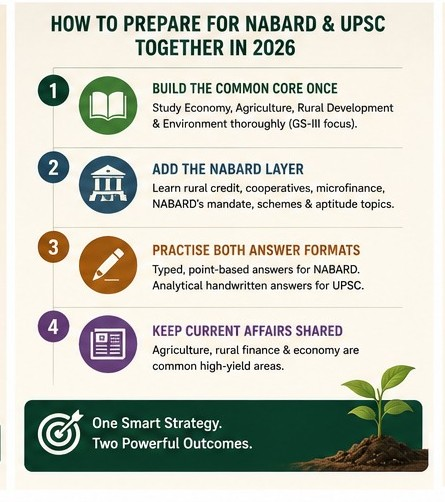
The smart approach is not “two separate exams” — it is one shared foundation with a thin specialised layer on top:
- Build the common core once. Study economy, agriculture, rural development, and environment thoroughly, the way GS-III demands.
- Add the NABARD layer. Pick up institutional depth — rural credit systems, cooperatives, microfinance, NABARD’s mandate and schemes — plus the qualifying aptitude sections.
- Practise both answer formats. Typed, point-based answers for NABARD; analytical handwritten answers for UPSC.
- Keep current affairs shared. Agriculture, rural finance, and the economy feature heavily in both, so one current-affairs routine serves both exams.
NABARD for UPSC aspirants: FAQs
Is NABARD Grade A a good option for UPSC aspirants?
Yes. The NABARD ESI and ARD papers overlap heavily with UPSC GS-III economy and agriculture and with GS-I/II society, so much of the preparation is shared. It is one of the best backup exams for UPSC aspirants.
How much of the NABARD syllabus overlaps with UPSC?
The economy, agriculture, rural development, environment, and society themes overlap substantially — effectively the bulk of NABARD’s merit-bearing ESI and ARD papers maps onto UPSC GS-III and parts of GS-I/II. Science & tech, internal security, and disaster management in GS-III do not overlap.
Which UPSC paper does NABARD overlap with the most?
GS Paper III, especially its economy and agriculture sections.
Is NABARD Grade A tough to crack alongside UPSC?
The subject portion is manageable for UPSC aspirants because of the overlap. The main additions are the qualifying aptitude sections and NABARD-specific institutional detail, plus practice in typed, point-based answer writing.
What other exams are similar to the UPSC syllabus?
RBI Grade B and SEBI Grade A also overlap strongly on the economy and current-affairs side, which is why many aspirants prepare for the RBI–SEBI–NABARD cluster together as a Plan B.
Does NABARD recruit every year?
NABARD Grade A recruitment is typically an annual cycle, making it a reliable parallel target. Always confirm against the official notification.

The bottom line
For a UPSC aspirant, NABARD Grade A is one of the most natural parallel exams available. It rewards the same economic and agricultural depth that GS-III is built on, gives you a well-paid, respected career outcome, and demands only a modest incremental effort relative to the overlap it offers. Best of all, the institutional depth it forces — on rural credit, agricultural economics, and development finance — tends to make your GS-III answers sharper too. A backup that strengthens your main attempt is about as good as a backup gets.
Planning your 2026 attempt? Map your GS-III notes against the NABARD ESI and ARD syllabus this week, and you’ll see exactly how little extra you need to add.