
NABARD Is a Good Option for You
If the UPSC Civil Services Prelims on 24 May left you with a sinking feeling, you are not alone. This year’s paper was widely described as tough, unusually conceptual, and a clear shift in how UPSC frames its questions — and as the result lands, thousands of sincere, hard-working aspirants are staring at the same hard question: what now?
Before anything else: take a breath. One difficult paper is not a verdict on your ability, your intelligence, or your future. But it is a signal to think clearly about the next twelve months — and that is exactly where a smart parallel plan changes everything. This is where NABARD Grade A deserves your serious attention.
First, put the result in perspective
The UPSC Civil Services Examination has one of the harshest success rates of any exam in the world. Lakhs register, a few hundred are finally selected. When the funnel is that narrow, not clearing prelims in a given year says far more about the design of the exam than about you. Many eventual toppers have a “failed” prelims somewhere in their story.
So the goal now is not to spiral, and not to freeze. It is to make the coming months count — to convert a setback into momentum instead of an empty year of waiting for the next attempt.
Why a year of “only UPSC” is the real risk
Here is the trap that catches a lot of aspirants: after a disappointing prelims, they decide to simply restart the same cycle and wait eleven months for the next attempt. The preparation continues, but with nothing to show for it and no fallback if the next attempt also goes sideways. The pressure compounds, the self-doubt grows, and family conversations get harder.
The antidote is not to abandon UPSC. It is to point the same knowledge at a second, genuinely prestigious target — so that the year produces a result no matter what. For most UPSC aspirants, the cleanest such target is NABARD Grade A.
Why NABARD Grade A fits you specifically
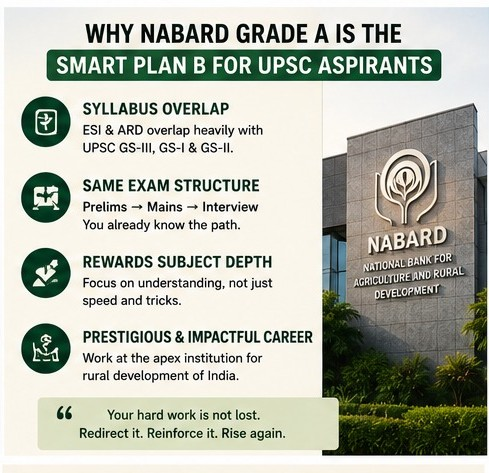
NABARD — the National Bank for Agriculture and Rural Development — recruits Assistant Managers (Grade A) through a three-stage process you already understand instinctively: Prelims → Mains → Interview. No new exam architecture to learn.
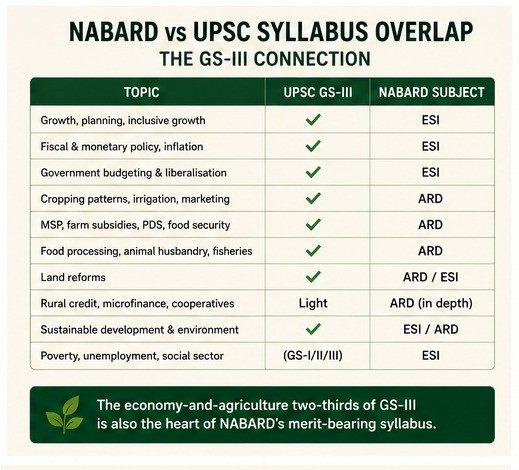
More importantly, its two merit-bearing subjects are subjects you have already been studying for UPSC:
- Economic & Social Issues (ESI) maps directly onto UPSC GS-III economy and GS-I/II society — growth, inclusive development, fiscal and monetary policy, inflation, poverty, employment, and social-sector themes.
- Agriculture & Rural Development (ARD) maps onto the GS-III agriculture cluster — cropping, irrigation, MSP, farm subsidies, PDS, food security, food processing, animal husbandry, land reforms — and goes deeper into rural credit and development finance.
In other words, the months you have already poured into economy, agriculture, and rural development are not wasted. They are a head start. You are not switching tracks; you are adding a second destination on a track you are already running.
The 2026 timeline actually works in your favour
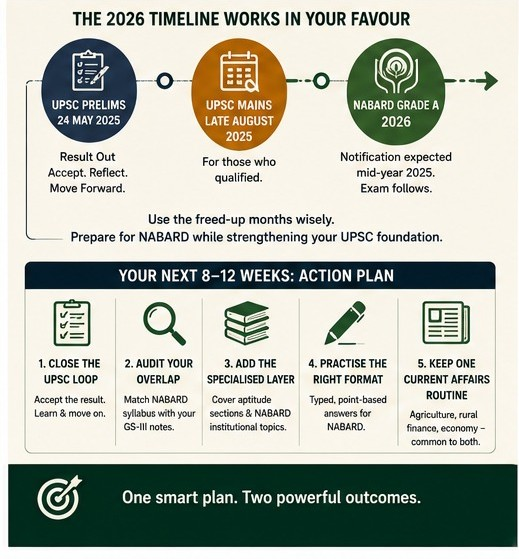
The timing lines up unusually well this year. The UPSC Mains is scheduled to begin in late August, which is for candidates who cleared prelims. If this attempt did not go your way, those same months are free — and the NABARD Grade A 2026 notification is expected around the middle of the year, with the exam cycle following after. That gives you a clear runway to prepare for and attempt NABARD using the very knowledge base you have already built, without sacrificing your next UPSC attempt.
(Always confirm exact dates against the official NABARD notification when it is released.)
Your next 8–12 weeks: a simple action plan
- Close the UPSC loop calmly. Once the result is out, check it, accept it, and stop re-litigating the paper. Note two or three honest lessons for your next attempt, then move forward.
- Audit your overlap. Sit with the NABARD ESI and ARD syllabus beside your UPSC GS-III notes. You will be surprised how much you already know. Mark only the genuinely new bits — NABARD-specific institutional detail like rural credit systems, cooperatives, microfinance, and NABARD’s own schemes and mandate.
- Add the thin specialised layer. Cover the qualifying aptitude sections (reasoning, quantitative, English, computer knowledge, decision making) — usually manageable — and the descriptive English paper.
- Practise the right answer format. NABARD descriptive answers reward crisp, data-backed, point-based writing. Practise that style; it is different from UPSC’s long analytical essays, but the underlying content is shared.
- Keep one current-affairs routine for both. Agriculture, rural finance, and the economy feature heavily in both exams, so a single daily routine serves both your NABARD attempt and your next UPSC attempt.
NABARD is a destination, not a consolation prize
It is worth being clear-eyed about what NABARD actually offers, because aspirants often undersell it to themselves.”A NABARD Grade A officer earns a salary of ₹1 lakh+ per month(approx), along with attractive perks, benefits, and a clear promotion ladder leading to senior management positions.”
A wage revision for NABARD officers has also been reported, which aspirants expect to improve this further. This is a respected central-institution career working directly on rural India’s development — meaningful, secure, and well-paid.
Many aspirants who pivot to NABARD describe it not as a step down from the civil services, but as a parallel way of doing the same kind of nation-building work they were drawn to in the first place.
Two paths, both good
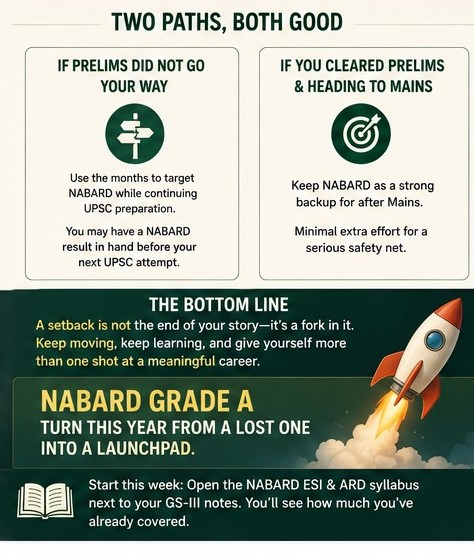
- If this prelims did not go your way: use the freed-up months to target NABARD while continuing your UPSC foundation. You walk into your next UPSC attempt sharper, and you may well have a NABARD result in hand before then.
- If you scraped through and are heading to Mains: keep NABARD on your radar as a backup for after Mains. The overlap means minimal extra effort for a serious safety net.
Either way, you end the year with options instead of anxiety.
The bottom line
A hard prelims is not the end of your story — it is a fork in it. The aspirants who come out of a setback strongest are rarely the ones who simply wait for next year. They are the ones who keep moving, keep their hard-won knowledge working for them, and give themselves more than one shot at a meaningful career.
NABARD Grade A lets you do exactly that. Your economy and agriculture preparation is already half the battle. Point it at a second target, and turn this year from a lost one into a launchpad.
Start this week: open the NABARD ESI and ARD syllabus next to your GS-III notes, and see for yourself how much ground you have already covered.