

What is the NABARD Grade A 2026 Eligibility Criteria?
Before applying for the NABARD Grade A 2026 exam, candidates should carefully check the latest eligibility criteria to ensure they meet all the requirements. Understanding these criteria in advance can help aspirants plan their preparation more effectively.
The NABARD Grade A eligibility criteria are based on four key factors:
1. Educational Qualification
Candidates must possess a Graduation or Post-Graduation degree from a recognized university or institution.
Graduation
- General Category: Bachelor’s degree in any discipline with at least 60% aggregate marks.
- SC/ST/PwBD Candidates: Minimum 55% aggregate marks.
Post-Graduation (including MBA/PGDM)
- General Category: Minimum 55% aggregate marks.
- SC/ST/PwBD Candidates: Minimum 50% aggregate marks.
Candidates holding professional qualifications such as CA, CS, ICWA, or a Ph.D. from institutions recognized by the Government of India (GOI) or UGC are also eligible.
2. Age Limit
Applicants must be between 21 and 30 years of age to apply for the NABARD Grade A exam.
3. Nationality
Only Indian citizens are eligible to apply for the NABARD Grade A examination.
4. Number of Attempts
There is no restriction on the number of attempts. Candidates can apply as many times as they wish, provided they continue to satisfy the age and educational qualification requirements.
| Post | Minimum Educational Qualification |
|---|---|
| General | Graduation: Minimum 60% aggregate marks in a Bachelor’s degree from a recognized university. (For SC/ST/PwBD candidates: 55% aggregate marks). Note: The required percentage is calculated as the average of all semesters/years, not separately for each semester. |
| OR | |
| Post-Graduation (including MBA/PGDM): Minimum 55% aggregate marks in a Post-Graduate degree from a recognized university/institution. (For SC/ST/PwBD candidates: 50% aggregate marks). | |
| OR | |
| Professional Qualifications: Candidates possessing CA, CS, ICWA, or a Ph.D. from institutions recognized by the Government of India (GOI) or UGC are also eligible. |
What is the age limit for the NABARD Grade A 2026 exam?
- As per the latest NABARD Grade A age limit criteria, you should be between 21 and 30 years of age as on 01st November 2025.
- You must have been born not earlier than 02-11-1995 and not later than 01-11-2004 to be eligible for the exam.
- Here is the category-wise NABARD Grade A age relaxation:
- SC/ST: the upper age limit after relaxation is 35 years for SC/ST candidates
- OBC: Maximum age 33 years for OBC candidates
- PwBD: For this category, the upper age limit 40 years for PwBD (General), 43 years for PwBD (OBC), and 45 years for PwBD (SC/ST)
- Ex-servicemen: 35 Years
- Emergency Commissioned/Short Service Commissioned Officers: 35 Years
- Family members of victims died in the1984 riots: 35 Years
| Category | Age Relaxation |
|---|---|
| SC/ST Candidates | 5 years |
| Other Backward Classes (OBC) Candidates | 3 years |
| Ex-Servicemen (including Emergency Commissioned Officers/Short Service Commissioned Officers who have rendered at least 5 years of service) | 5 years |
| Emergency Commissioned Officers/Short Service Commissioned Officers who have completed 5 years of military service and are eligible for release within 3 months of receiving an appointment offer | 5 years |
| Family Members of Victims of the 1984 Riots | 5 years |
| Persons with Benchmark Disabilities (PwBD) | General: 10 yearsOBC: 13 yearsSC/ST: 15 years |
Nationality Criteria for NABARD Grade A 2026
According to the official NABARD notification, only Indian citizens are eligible to apply for the NABARD Grade A 2026 examination.
- Eligibility: Applicants must be citizens of India.
- Verification: Candidates may be required to provide valid proof of nationality during the document verification stage or later phases of the recruitment process.
Understanding the nationality requirement is important because candidates who do not meet this criterion will not be considered eligible for the selection process.
Maximum Number of Attempts for NABARD Grade A
One of the advantages of the NABARD Grade A exam is that there is no fixed limit on the number of attempts. Candidates can appear for the examination multiple times, provided they continue to satisfy the eligibility requirements.
- No Attempt Restriction: There is no cap on the number of times a candidate can apply for the exam.
- Eligibility-Based Attempts: Candidates must fulfill the prescribed educational qualifications, age limit, and nationality criteria each time they apply.
- Age Limit Applies: You can continue appearing for the exam only until you exceed the maximum age limit specified by NABARD.
This flexibility gives aspirants multiple opportunities to improve their preparation, gain experience, and attempt the examination again with a better strategy if needed.
Understanding the NABARD Grade A 2026 eligibility criteria is an important first step before submitting your application. By checking the requirements related to educational qualifications, age limit, and nationality in advance, you can avoid unnecessary mistakes and ensure that you are eligible for the recruitment process. Having a clear understanding of these criteria allows you to focus on your preparation with confidence and avoid any last-minute confusion during the application process.
NABARD Grade A Phase 1 (Prelims)
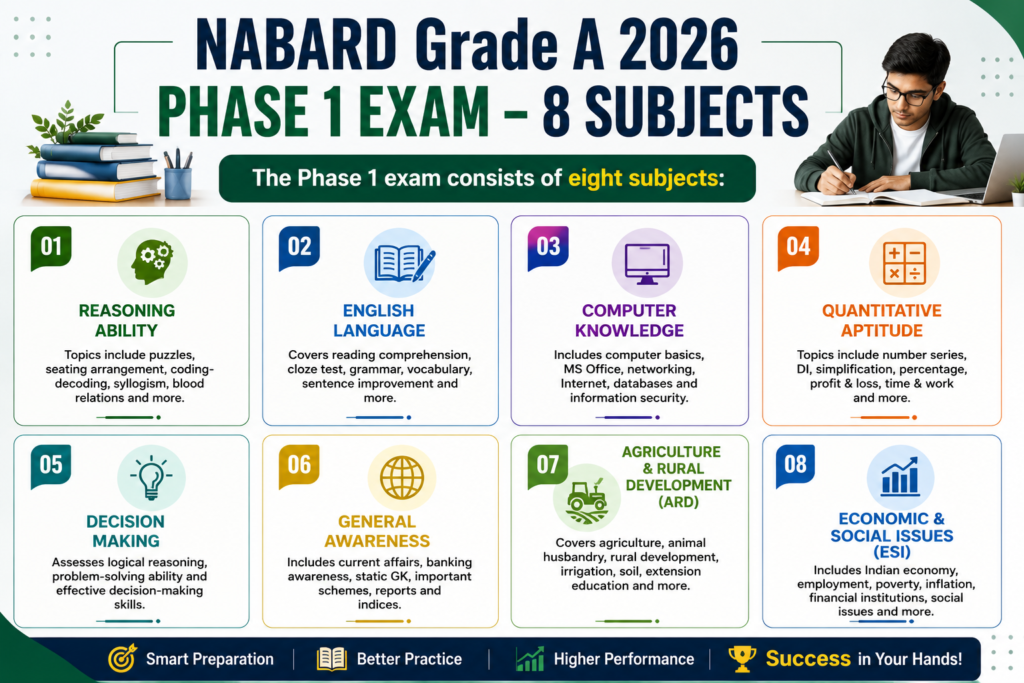
The Phase 1 exam consists of eight subjects:
- Reasoning Ability
- English Language
- Computer Knowledge
- Quantitative Aptitude
- Decision Making
- General Awareness
- Agriculture and Rural Development (ARD)
- Economic and Social Issues (ESI)
This stage is designed to assess a candidate’s overall aptitude, awareness, and subject knowledge. ARD and ESI are particularly important as they carry significant weight in the selection process.
NABARD Grade A Phase 2 (Mains)
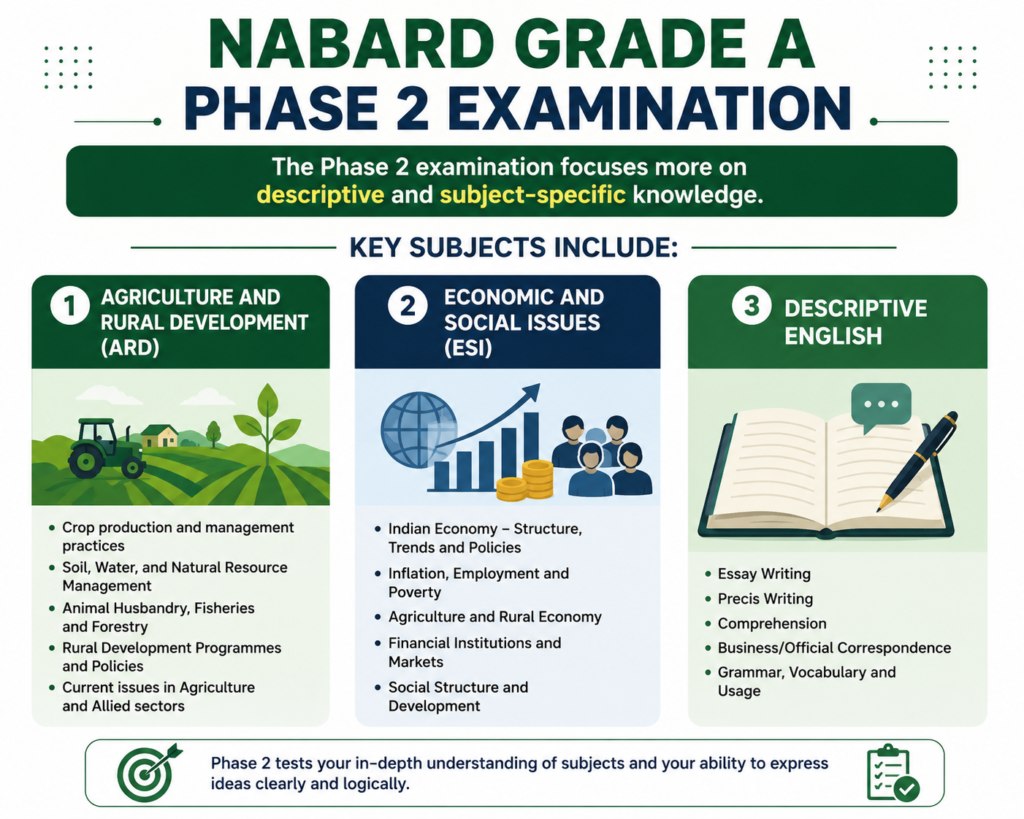
The Phase 2 examination focuses more on descriptive and subject-specific knowledge. The key subjects include:
- Agriculture and Rural Development (ARD)
- Economic and Social Issues (ESI)
- Descriptive English
Candidates may also be expected to have a strong understanding of topics related to Finance & Management, Development Economics, and Statistics, depending on the stream and nature of the examination.
Interview (Final Stage)
The interview is the final stage of the selection process. During this round, candidates can expect questions related to:
- Their educational background
- Current affairs and NABARD-related topics
- Agriculture, rural development, and economic issues
- Conceptual understanding of important subjects
- Reasoning and analytical ability
- Communication skills
- Leadership qualities and decision-making ability
A good understanding of your academic subjects, awareness of current developments, and the ability to express your thoughts clearly can significantly improve your performance in the interview.
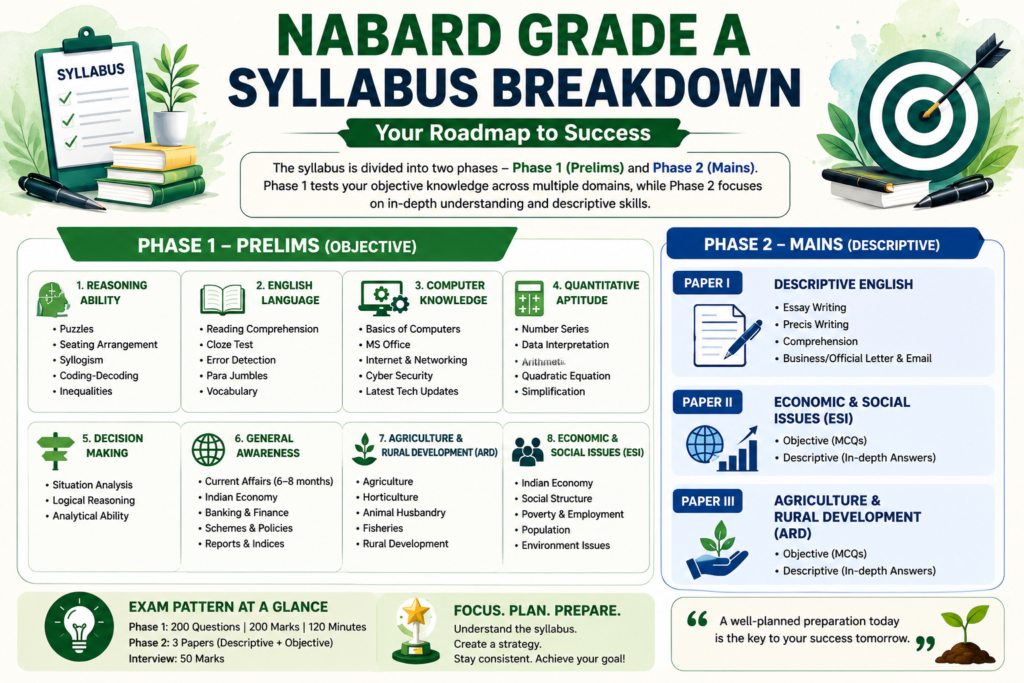
NABARD Grade A Phase 1 Reasoning Syllabus
| Name of Section | Topics Covered |
|---|---|
| Reasoning Ability | • Puzzles and Seating Arrangements • Alphanumeric Series • Syllogism • Coding and Decoding • Order and Ranking • Blood Relations • Direction and Distance • Data Sufficiency • Machine Input and Output • Inequality • Verbal Reasoning |
NABARD Grade A Phase 1 Quantitative Aptitude Syllabus
| Name of Section | Topics Covered |
|---|---|
| Quantitative Aptitude | Arithmetic: • Percentage • Ratio and Proportion • Profit, Loss & Discount • Simple & Compound Interest • Average and Ages • Mixture and Alligation • Time and Work • Time, Speed and Distance Other Important Topics: • Data Interpretation • Number Series • Quadratic Equations • Simplification and Approximation • Quantity Comparison and Data Sufficiency • Mathematical Inequalities • Mensuration |
NABARD Grade A Phase 1 General Awareness Syllabus
| Name of Subject | Topics Covered |
|---|---|
| General Awareness | • Current Affairs • Banking Awareness • Economy and Financial Awareness • Insurance Awareness • Recent Appointments • Sports Events and Achievements • Awards and Honours • Government Schemes and Initiatives • International News and Developments • National News and Important Events • Latest Science and Technology Developments |
NABARD Grade A Decision Making & Computer Knowledge Syllabus
| Name of Subject | Topics Covered |
|---|---|
| Decision Making | • Basics of Decision Making • Types of Decision Making • Types of Problems in Decision Making • Factors Affecting Decision Making • Making and Interpreting Information • Recognising Assumptions • Situation-Based Questions • Case Studies |
| Computer Knowledge | • Input and Output Devices • Computer Networking • Database Management System (DBMS) • MS Office (Word, Excel, PowerPoint) • Internet and Web Technologies • History of Computers and Computer Generations • Computer Shortcuts and Basic Commands • Computer Security and Cyber Security Basics • Computer Hardware • Memory and Storage Devices |
NABARD Grade A Phase 01 & 02 English Language Syllabus
| Name of Subject | Topics Covered |
|---|---|
| Phase 01 English Language Syllabus | Question Types: • Reading Comprehension • Gap Fillers • Double Fillers • Error Spotting • Sentence Rearrangement • Idioms and Phrases Usage & Replacement • Word Reshuffle/Word Swapping • Para Jumbles • Cloze Test • Misspelled Words/Inappropriate Word Usage • Sentence Improvement • One Word Substitution Grammar Topics: • Subject-Verb Agreement • Parts of Speech (Nouns, Pronouns, Adjectives, Verbs, Adverbs, Prepositions, Conjunctions) • Tenses • Articles • Conditional Sentences • Modals • Active and Passive Voice |
| Phase 02 Descriptive English Syllabus | Essay Writing: • Economic and Financial Issues • Social and Contemporary Developments • Governance and Public Policy • Technology and Society • Environmental Concerns • Ethical or Abstract Themes • Agriculture and Rural Development Topics Precis Writing: • Condensing a given passage into a precis of approximately 120–180 words while retaining the original meaning and avoiding personal opinions. Letter Writing: • Formal and Semi-Formal Letters • Candidates are required to choose one topic from the given options and write a well-structured letter of approximately 200–220 words. |
NABARD Grade A Phase 1 & 2 ARD Syllabus 2026
| Name of Section | Topics Covered |
|---|---|
| Agriculture | • Definition, Meaning, and Branches of Agriculture • Agronomy: Definition and Scope • Field Crop Classification • Factors Affecting Crop Production • Agro-Climatic Zones • Cropping Systems: Definition and Types • Problems of Dryland Agriculture • Seed Production, Processing, and Seed Village Concept • Agricultural Meteorology and Crop-Weather Advisory Services • Precision Farming, System of Crop Intensification (SCI), and Organic Farming |
| Soil & Water Conservation | • Major Soil Types in India • Soil Fertility and Productivity • Fertilizers and Nutrient Management • Soil Erosion and Conservation Techniques • Watershed Management |
| Water Resource & Irrigation | • Types and Sources of Irrigation • Crop Water Requirement • Command Area Development • Water Conservation Techniques • Micro-Irrigation Systems • Irrigation Pumps • Major, Medium, and Minor Irrigation Projects |
| Farm & Agricultural Engineering | • Farm Machinery and Implements • Sources of Farm Power (Human, Animal, Mechanical, Electrical, Wind, Solar, Biomass, Biofuels) • Water Harvesting Structures and Farm Ponds • Agro-Processing Technologies • Controlled and Modified Storage Systems • Storage of Perishable Commodities • Godowns, Bins, and Grain Silos |
| Plantation & Horticulture | • Definition and Branches of Horticulture • Agronomic Practices and Production Technology • Post-Harvest Management • Value Chain and Supply Chain Management |
| Animal Husbandry | • Role of Animal Husbandry in the Indian Economy • Animal Husbandry Practices in India • Common Livestock Terminology and Species • Classification of Cattle Breeds Based on Utility • Feed and Fodder Classification and Uses • Poultry Industry: Past, Present, and Future Trends • Poultry Production and Management Terms • Mixed Farming and Its Socio-Economic Relevance • Complementarity Between Livestock, Poultry, and Agriculture |
| Fisheries | • Fisheries Resources and Their Management (Freshwater, Brackish Water, Marine) • Inland and Marine Aquaculture • Fisheries Biotechnology • Post-Harvest Technology • Importance of Fisheries and Common Terminology |
| Forestry | • Basic Forestry Concepts • Principles of Silviculture • Forest Mensuration, Management, and Economics • Social Forestry, Agroforestry, and Joint Forest Management (JFM) • Forest Policies and Legislation • India State of Forest Report • Recent Developments of the Ministry of Environment, Forest and Climate Change (MoEFCC) |
| Agricultural Extension | • Importance and Role of Agricultural Extension • Extension Education and Evaluation Methods • Krishi Vigyan Kendras (KVKs) and Their Functions |
| Ecology & Climate Change | • Ecology and Natural Resource Management • Causes and Impact of Climate Change • Greenhouse Gases (GHGs) and Major Emitters • Adaptation and Mitigation Strategies • Impact on Agriculture and Rural Livelihoods • Carbon Credits and Carbon Markets • IPCC, UNFCCC, and Conference of Parties (CoP) • Climate Finance Mechanisms • National Action Plan on Climate Change (NAPCC) • State Action Plans on Climate Change (SAPCC) • India’s Climate Commitments (INDCs/NDCs) |
| Present Indian Agriculture | • Trends and Challenges in Indian Agriculture • Measures for Improving Farm Viability • Factors Affecting Agricultural Production • Agricultural Finance and Marketing • Impact of Globalization on Agriculture • Food Security Issues • Farm Management Concepts and Types |
| Rural Development | • Concept of Rural Areas • Structure of the Indian Rural Economy • Economic, Social, and Demographic Role of the Rural Sector • Causes of Rural Backwardness • Rural Occupations: Farmers, Agricultural Labourers, Artisans, Handicraft Workers, Traders, and Tribal Communities • Rural Workforce Trends • Problems of Rural Labour • Challenges Faced by the Handloom Sector • Panchayati Raj Institutions (PRIs) • Government Schemes: MGNREGA, NRLM, Rural Drinking Water Programme, Swachh Bharat Mission, Rural Housing Schemes, and PURA (Providing Urban Amenities in Rural Areas) |
NABARD Grade A 2026 Phase 1 & 2 ESI Syllabus
| Name of Subject | Topics Covered |
|---|---|
| Basic Economic Concepts | • National Income Accounting • Schools of Economic Thought • Economic Growth and Economic Development • Human Development • Sustainable Development |
| Indian Economic Development (Historical Perspective) | • Nature of the Indian Economy • Indian Economy on the Eve of Independence • India (1947–1991): Macroeconomy • India (1947–1991): Agriculture Sector • India (1947–1991): Industrial Sector • India (1947–1991): Services Sector • India (1947–1991): External Sector • Economic Reforms and Liberalization • Indian Economy Post-1991: Macroeconomy • Indian Economy Post-1991: Agriculture Sector • Indian Economy Post-1991: Industrial Sector • Indian Economy Post-1991: Services Sector • Indian Economy Post-1991: External Sector |
| Public Finance and Macroeconomic Policies | • Public Expenditure and Public Receipts • Public Debt • Fiscal Policy • Federal Finance • Inflation and Price Stability • Indian Taxation System • Planning in India and Five-Year Plans |
| Social and Development Issues | • Poverty and Poverty Alleviation • Unemployment • Population Growth and Demographic Issues • Health and Nutrition • Education • Gender Issues and Women Empowerment • Positive Discrimination and Social Justice • Multiculturalism • Urbanisation and Migration |
| Banking, Institutions and Development | • Major International Economic Institutions • Role of Banks in Economic Development • Role of the Reserve Bank of India (RBI) in the Development Process • Rural Credit System in India • Microfinance and Financial Inclusion |
NABARD Grade A Interview Syllabus
The interview is the final stage of the NABARD Grade A selection process and requires a well-rounded preparation strategy. Unlike Phase 1 and Phase 2, there is no fixed syllabus for the interview. The panel can ask questions from a variety of areas to assess your knowledge, personality, communication skills, and suitability for the role.
Below are the key areas candidates should focus on while preparing for the NABARD Grade A interview:
1. Knowledge of NABARD
Candidates should have a good understanding of NABARD’s role, functions, objectives, schemes, and recent initiatives. Questions are often asked about how NABARD contributes to agricultural growth, rural development, financial inclusion, and sustainable development in India.
2. Economy, Finance, and Banking
The interview panel may ask questions related to basic economic concepts, banking awareness, rural credit, financial inclusion, government policies, and agricultural finance. Candidates should understand how these factors influence rural development and the agricultural sector.
3. Current Affairs Related to Agriculture and Rural Development
A strong awareness of recent developments is essential. Candidates should stay updated on government schemes, agricultural policies, rural development programs, banking reforms, economic developments, and important NABARD-related initiatives.
4. Biodata/DAF-Based Questions
Interviewers often ask questions based on the information provided in your Detailed Application Form (DAF) or biodata. Topics may include your educational background, hometown, academic subjects, achievements, hobbies, interests, and extracurricular activities.
5. Work Experience (If Applicable)
Candidates with prior work experience should be prepared to discuss their job role, responsibilities, key achievements, challenges faced, and lessons learned. The panel may also ask how your experience can contribute to your role at NABARD.
6. HR and Personality-Based Questions
These questions are designed to assess your attitude, confidence, leadership qualities, decision-making ability, strengths, weaknesses, career goals, and motivation for joining NABARD. The panel evaluates your overall personality and suitability for a development-oriented organization.
7. Opinion-Based and Situational Questions
Candidates may be asked to share their views on current issues or respond to hypothetical situations. These questions often relate to agriculture, rural development, financial inclusion, governance, or social issues. The focus is on evaluating your analytical thinking, problem-solving ability, and balanced approach to decision-making.
Interview Preparation Tips
- Thoroughly study NABARD’s functions, schemes, and annual reports.
- Stay updated with current affairs related to agriculture, rural development, banking, and the economy.
- Revise basic concepts of ESI, ARD, and banking awareness.
- Prepare detailed answers about your educational background, work experience, and hobbies.
- Practice mock interviews to improve confidence and communication skills.
- Focus on maintaining a positive attitude, clarity of thought, and professionalism during the interview.
A well-prepared candidate with sound subject knowledge, awareness of current issues, and good communication skills can perform exceptionally well in the NABARD Grade A interview.
https://c4scourses.in/nabard-grade-a-2026-mentorship-online-coaching.html#free-trial