Why in News?
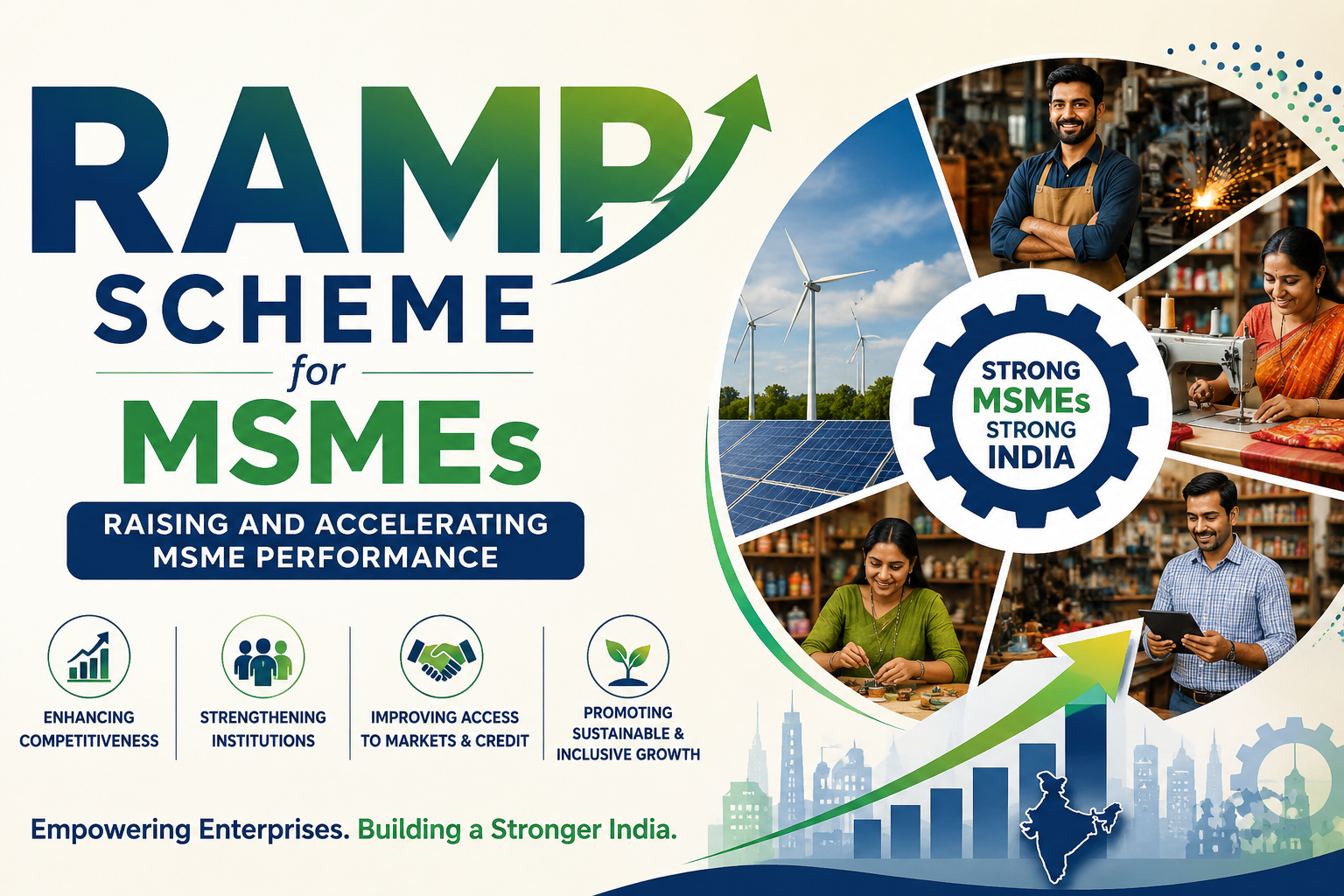
The Union Cabinet has approved the Raising and Accelerating MSME Performance (RAMP) scheme, which was launched in the financial year 2022–23 to strengthen the growth and competitiveness of Micro, Small and Medium Enterprises (MSMEs) across India. The scheme is based on the recommendations of the U.K. Sinha Committee, the K.V. Kamath Committee, and the Economic Advisory Council to the Prime Minister (PMEAC), all of which suggested reforms to improve the performance and resilience of the MSME sector.
In 2019, the Reserve Bank of India set up an Expert Committee chaired by U. K. Sinha to recommend long-term measures for improving the financial health and sustainability of MSMEs. The RAMP scheme was announced by the Finance Minister in the Union Budget 2022–23 and aims to improve access to finance, strengthen institutions, promote technology adoption, enhance market access, and make MSMEs more competitive.
What is the RAMP Scheme?
The Raising and Accelerating MSME Performance (RAMP) scheme is a Central Sector Scheme launched in 2022–23 to improve the performance and competitiveness of India’s Micro, Small and Medium Enterprises (MSMEs). It is supported by the World Bank and helps MSMEs recover from the impact of the COVID-19 pandemic while becoming more productive and resilient.
Objectives
The scheme aims to:
- Improve MSMEs’ access to finance and markets.
- Strengthen the capacity of MSME institutions at both the Central and State levels.
- Promote better coordination between the Centre and States for MSME development.
- Reduce delayed payments to MSMEs.
- Encourage green and sustainable business practices.
- Support women-led enterprises and businesses in rural areas.
Key Components
A major feature of the scheme is the preparation of Strategic Investment Plans (SIPs) by States and Union Territories.
These plans help States:
- Identify MSMEs that need support.
- Understand the major challenges faced by local businesses.
- Set clear targets and prepare budgets for development activities.
- Focus on priority sectors such as renewable energy, rural and non-farm enterprises, wholesale and retail trade, village and cottage industries, and women-owned businesses.
Governance
The scheme is monitored by the National MSME Council, which provides overall policy guidance.
- The Council is chaired by the Minister for MSME.
- It includes representatives from different Central Ministries.
- A dedicated secretariat supports its functioning.
Funding
The total financial outlay of the scheme is ₹6,062.45 crore.
- ₹3,750 crore is provided as a loan from the World Bank.
- ₹2,312.45 crore is contributed by the Government of India.
Implementation
The funds are routed through the Ministry of MSME and are linked to specific performance targets, known as Disbursement Linked Indicators (DLIs). Funds are released only after these targets are achieved.
The key performance areas include:
- Implementing MSME reforms across the country.
- Strengthening cooperation between the Centre and States.
- Improving technology upgradation under the Credit Linked Capital Subsidy–Technology Upgradation Scheme (CLCS-TUS).
- Expanding receivable financing so MSMEs receive payments more quickly.
- Strengthening the Credit Guarantee Fund Trust for Micro and Small Enterprises to improve credit access.
- Promoting green business practices and women entrepreneurship.
- Reducing delays in payments made to MSMEs.
Why the RAMP Scheme is Important
The RAMP scheme helps make MSMEs stronger by improving access to finance, technology, markets, and institutional support. It also encourages sustainable growth, faster payments, and greater participation of women and rural entrepreneurs, making the MSME sector more competitive and resilient in the long run.
How will this Scheme be Beneficial?
1. Helps MSMEs Overcome Challenges
The RAMP scheme helps MSMEs deal with both long-standing problems and the difficulties caused by the COVID-19 pandemic. It strengthens existing government schemes and makes small businesses more competitive and financially resilient.
2. Strengthens Areas That Need More Support
The scheme focuses on areas where MSMEs often need additional assistance, such as:
- Capacity building and business guidance
- Skill development
- Improving product quality
- Technology upgradation
- Digital adoption
- Better marketing and outreach
This support helps MSMEs grow, improve productivity, and compete in larger markets.
3. Creates More Employment
By improving access to finance, markets, and government support, the RAMP scheme encourages the growth of MSMEs, which in turn creates new job opportunities. It also supports women entrepreneurs, rural enterprises, and environmentally sustainable (green) businesses.
4. Encourages Formalisation of Businesses
Many small businesses in India still operate in the informal sector. RAMP encourages them to register and become part of the formal economy, especially in States where the MSME sector is less developed. This allows businesses to access government schemes, bank credit, and other benefits.
5. Supports State-Level MSME Development
Under the scheme, every State and Union Territory prepares a Strategic Investment Plan (SIP) based on its local needs. These plans serve as a roadmap for improving the MSME ecosystem and ensuring that support reaches the sectors and regions that need it the most.
6. Supports the Atmanirbhar Bharat Mission
The RAMP scheme complements the Atmanirbhar Bharat initiative by encouraging innovation, improving industry standards, promoting modern technology, and making MSMEs more productive and globally competitive.
What is the Significance of MSMEs in the Indian Economy?
Micro, Small and Medium Enterprises (MSMEs) are often called the backbone of the Indian economy because they play a vital role in economic growth, employment generation, exports, and inclusive development.
1. Major Source of Employment
MSMEs are the second-largest employer after agriculture in India. They provide jobs to millions of people, especially youth, women, and workers in rural and semi-urban areas. Since they require relatively low investment, they generate employment at a lower cost than large industries.
2. Significant Contribution to GDP
The MSME sector makes a substantial contribution to India’s economy by producing a wide range of goods and services. It contributes around 30% to India’s Gross Domestic Product (GDP), making it one of the key drivers of economic growth.
3. Boosts Exports
Indian MSMEs manufacture products such as textiles, handicrafts, engineering goods, leather products, pharmaceuticals, and food products that are exported worldwide. The sector contributes around 45% of India’s total exports, strengthening India’s foreign trade.
4. Promotes Entrepreneurship
MSMEs encourage innovation and entrepreneurship by enabling individuals to start businesses with relatively low capital. They create opportunities for first-generation entrepreneurs and startups across different sectors.
5. Supports Rural and Regional Development
Many MSMEs operate in rural and backward regions, creating local employment and reducing migration to cities. They promote balanced regional development by spreading industrial growth beyond major urban centres.
6. Strengthens Supply Chains
MSMEs supply raw materials, components, and services to large industries. They play an important role in manufacturing and value chains, making the overall industrial ecosystem more efficient.
7. Encourages Inclusive Growth
The sector provides business opportunities to women entrepreneurs, Scheduled Castes (SCs), Scheduled Tribes (STs), Other Backward Classes (OBCs), and economically weaker sections, contributing to more inclusive and equitable economic development.
8. Promotes Innovation and Competitiveness
Many MSMEs adopt new technologies, develop innovative products, and provide specialised services. With government support for digitalisation and technology upgradation, they are becoming more competitive in domestic and global markets.
9. Supports the Make in India and Atmanirbhar Bharat Initiatives
MSMEs increase domestic production, reduce dependence on imports, promote local manufacturing, and strengthen India’s vision of becoming a self-reliant economy.
10. Contributes to Government Revenue
By expanding production, employment, and exports, MSMEs contribute to tax collections and overall economic activity, supporting public investment and development.
Conclusion
The Raising and Accelerating MSME Performance (RAMP) scheme is a significant initiative to strengthen India’s MSME sector by improving access to finance, technology, markets, and institutional support. Through greater collaboration between the Centre and States, the scheme aims to enhance the competitiveness, productivity, and resilience of MSMEs while promoting formalisation, digitalisation, green growth, and women entrepreneurship. By addressing key challenges faced by small businesses, RAMP supports employment generation, inclusive economic development, and contributes to the vision of Atmanirbhar Bharat and Viksit Bharat.