

Source: The Hindu
Context
A captive-bred, radio-tagged female white-rumped vulture (Gyps bengalensis) — tagged ‘Z25’ — was electrocuted on Sunday, 28 June 2026 after coming into contact with a power transmission line near Ebbanad / Kallatti village on the Sigur plateau, close to the Mudumalai Tiger Reserve (MTR) in the Nilgiris district of Tamil Nadu. The bird had been captive-bred at the Jatayu Conservation Breeding Centre (JCBC), Pinjore, Haryana (a joint BNHS–Haryana Forest Department facility). It was one of five white-rumped vultures radio-tagged at Tadoba on 22 December 2025 and released at the Tadoba-Andhari Tiger Reserve, Maharashtra on 30 December 2025. Z25 flew south, was captured in Kalaburagi (Karnataka), briefly kept at the Kalaburagi Zoological Park, and then released at Mudumalai on 7 April 2026 where a wild white-rumped vulture population already existed. Radio telemetry data monitored by the Bombay Natural History Society (BNHS) at Tadoba-Andhari showed the bird was “slipping out of the wild” and BNHS was reportedly considering relocating it to a breeding centre — but the bird died before that decision could be actioned. The case demonstrates the power and limits of radio telemetry in the reintroduction of critically endangered species.
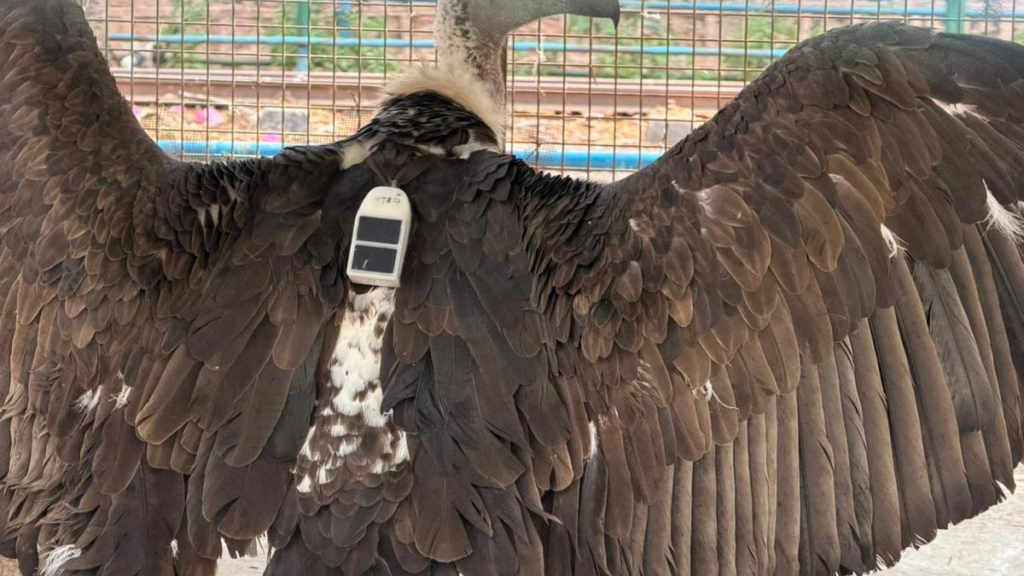
The story of Z25
- Species: White-rumped vulture (Gyps bengalensis) — Critically Endangered (IUCN).
- Identity: Z25 (its radio-tagged code).
- Sex: Female.
- Origin: Captive-bred at Jatayu Conservation Breeding Centre (JCBC), Pinjore, Haryana (BNHS + Haryana Forest Department).
What is radio telemetry?
- A technique that fits an animal with a radio transmitter (transmitter emits radio waves at specific frequency); movements are tracked via receivers/antennas or satellite links.
- Used to monitor movement patterns, home ranges, dispersal, migration routes, survival, and cause of death of wildlife.
- In vulture conservation: enables real-time tracking of released captive-bred birds to check whether they are adapting to the wild.
- Types: VHF radio telemetry (line-of-sight), satellite/PTT telemetry (GPS), and GSM telemetry (cellular network based).
- -15-9+
What is the White-Rumped Vulture (Gyps bengalensis)?
- Also called Oriental White-backed Vulture or Indian White-backed Vulture.
- Family: Accipitridae; Genus: Gyps.
- Native to South Asia — India, Nepal, Bangladesh, Pakistan (was earlier abundant across the Indo-Gangetic plains).
- IUCN Red List: Critically Endangered (since 2000).
- CITES: Appendix II.
- Wildlife (Protection) Act, 1972: Schedule I.
- Population decline: Lost 99.7% of its population between 1993 and 2002 — one of the fastest recorded declines of any bird species in history.
- Cause: Diclofenac poisoning — a veterinary NSAID (non-steroidal anti-inflammatory drug) used to treat cattle; vultures that fed on treated carcasses died of kidney failure due to visceral gout (uric acid crystallisation).
- Ecological role: Nature’s clean-up crew — a group of vultures can strip a large carcass to bone in under 40 minutes; their strong stomach acid destroys anthrax, rabies, tuberculosis bacteria.
- Estimated South-Asia population (1980s): ~40 million Gyps vultures across 3 species.
- 2017 population estimate: Only ~6,000 white-rumped vultures.
- Smallest among the Gyps species; feeds exclusively on carrion; gregarious and colonial; monogamous; one nestling per year.
What are India’s 9 vulture species?
- Resident species (6):
- White-rumped Vulture (Gyps bengalensis) — CR.
- Indian Long-billed Vulture (Gyps indicus) — CR.
- Slender-billed Vulture (Gyps tenuirostris) — CR.
- Red-headed Vulture (Sarcogyps calvus) — CR.
- Egyptian Vulture (Neophron percnopterus) — EN.
- Bearded Vulture / Lammergeier (Gypaetus barbatus) — NT (globally); Schedule I in India.
- Migratory species (3):
- Himalayan Vulture / Himalayan Griffon (Gyps himalayensis) — NT.
- Eurasian Griffon (Gyps fulvus) — LC.
- Cinereous Vulture (Aegypius monachus) — NT.
What is the Jatayu Conservation Breeding Centre (JCBC), Pinjore?
- Established: September 2001 — Asia’s first vulture breeding facility.
- Where: Village Jodhpur, on the edge of Bir Shikargah Wildlife Sanctuary, ~8 km from Pinjore, Haryana.
- Named after: The mythical vulture Jatayu from the Hindu epic Ramayana.
Where are the four JCBCs / Vulture Conservation Breeding Centres (VCBCs) in India?
- JCBC Pinjore, Haryana — 2001; joint BNHS + Haryana Forest Department + RSPB.
- VCBC Rajabhatkhawa, West Bengal — inside Buxa Tiger Reserve.
- VCBC Rani, Assam — near Guwahati (established 2008; ~90 vultures as of Dec 2018).
- VCBC Kerwa, Bhopal, Madhya Pradesh — inside Van Vihar National Park; established 2014.
- Together, these 4 JCBCs/VCBCs house ~740 vultures (as of 2026), of which ~110 have been released.
What is SAVE?
- Full form: Saving Asia’s Vultures from Extinction.
- Launched: 2011.
- Goal: Restore at least 40% (~16 million) of the vanished white-backed, long-billed, and slender-billed vulture populations.
- Plan: Set up 8 vulture breeding centres across India (JCBC + 7 more), each housing ~25 vultures/species, releasing 600 vultures across 3 million sq km.
- Partners: BNHS, RSPB (UK), BirdLife International, Zoological Society of London (ZSL), Bird Conservation Nepal, National Trust for Nature Conservation (Nepal), International Centre for Birds of Prey (UK), and 7 others (14 partner organisations + 14 Indian government agencies).
Practice MCQs
Q1. With reference to the recent electrocution of the radio-tagged white-rumped vulture ‘Z25’, consider the following statements:
- Z25 was captive-bred at the Jatayu Conservation Breeding Centre (JCBC), Pinjore, Haryana.
- It was first released at the Tadoba-Andhari Tiger Reserve, Maharashtra on 30 December 2025.
- It was electrocuted near Ebbanad village on the Sigur plateau, close to Mudumalai Tiger Reserve, on 28 June 2026.
- Z25 was one of five white-rumped vultures radio-tagged at Tadoba on 22 December 2025.
How many of the above statements are correct?
(a) Only one (b) Only two (c) Only three (d) All four (e) None
(All four statements are correct.)
Q2. With reference to the White-Rumped Vulture (Gyps bengalensis), consider the following statements:
- It is classified as Critically Endangered on the IUCN Red List.
- It is listed under Schedule I of the Wildlife (Protection) Act, 1972.
- Its primary cause of population decline has been the veterinary use of diclofenac and other NSAIDs.
- It is endemic to the South American continent.
How many of the above statements are correct?
(a) Only one (b) Only two (c) Only three (d) All four (e) None
(Statement 4 is wrong; the White-Rumped Vulture is native to South Asia (India, Nepal, Bangladesh, Pakistan) — NOT endemic to South America.)
Q3. With reference to the Jatayu Conservation Breeding Centre (JCBC), Pinjore, consider the following statements:
- It was established in 2001 and is Asia’s first vulture breeding facility.
- It is jointly run by the Bombay Natural History Society (BNHS) and the Haryana Forest Department, with support from the Royal Society for the Protection of Birds (RSPB), UK.
- It is located on the edge of the Bir Shikargah Wildlife Sanctuary in Haryana.
- It is named after a mythical vulture from the Hindu epic Mahabharata.
How many of the above statements are correct?
(a) Only one (b) Only two (c) Only three (d) All four (e) None
(Statement 4 is wrong; JCBC is named after the mythical vulture Jatayu from the RAMAYANA — NOT the Mahabharata.)
Q4. With reference to the Bombay Natural History Society (BNHS), consider the following statements:
- BNHS was founded in 1883 and is headquartered at Hornbill House, Mumbai.
- BNHS is the Indian partner of BirdLife International.
- BNHS leads India’s vulture conservation breeding programme in collaboration with state forest departments and RSPB (UK).
- BNHS is a statutory body created under an Act of Parliament.
How many of the above statements are correct?
(a) Only one (b) Only two (c) Only three (d) All four (e) None
(Statement 4 is wrong; BNHS is a NON-GOVERNMENTAL scientific research organisation (autonomous society) — NOT a statutory body created under an Act of Parliament.)
Q5. With reference to diclofenac and vulture conservation in India, consider the following statements:
- Diclofenac is a non-steroidal anti-inflammatory drug (NSAID) used to treat cattle.
- It caused kidney failure and visceral gout in vultures that fed on treated carcasses.
- Veterinary use of diclofenac was banned in India on 11 March 2006.
- Meloxicam has been identified as a vulture-safe alternative to diclofenac.
How many of the above statements are correct?
(a) Only one (b) Only two (c) Only three (d) All four (e) None
(All four statements are correct.)
Answer Key
- (d) — All four correct.
- (c) — Statement 4 wrong: WRV is native to South Asia, not South America.
- (c) — Statement 4 wrong: JCBC is named after Jatayu (Ramayana), not Mahabharata.
- (c) — Statement 4 wrong: BNHS is a private NGO, not a statutory body.
- (d) — All four correct.
Exam Relevance
- UPSC Prelims & Mains: Very High — GS-III (Environment, Biodiversity, Conservation, IUCN Red List categories); Prelims (species, drugs, breeding centres, key acts); the diclofenac question has appeared in UPSC Prelims (2011: “Which drug is responsible for vulture decline?”).
- NABARD Grade A: High — ESI + ARD papers on ecology, biodiversity, conservation programmes; Phase II descriptive on environment.
- State PCS (Haryana, Maharashtra, Tamil Nadu, Karnataka, MP, Assam, WB): Very High — State-specific breeding centres, tiger reserves, and vulture habitats.







