

Source: News on Air
Context
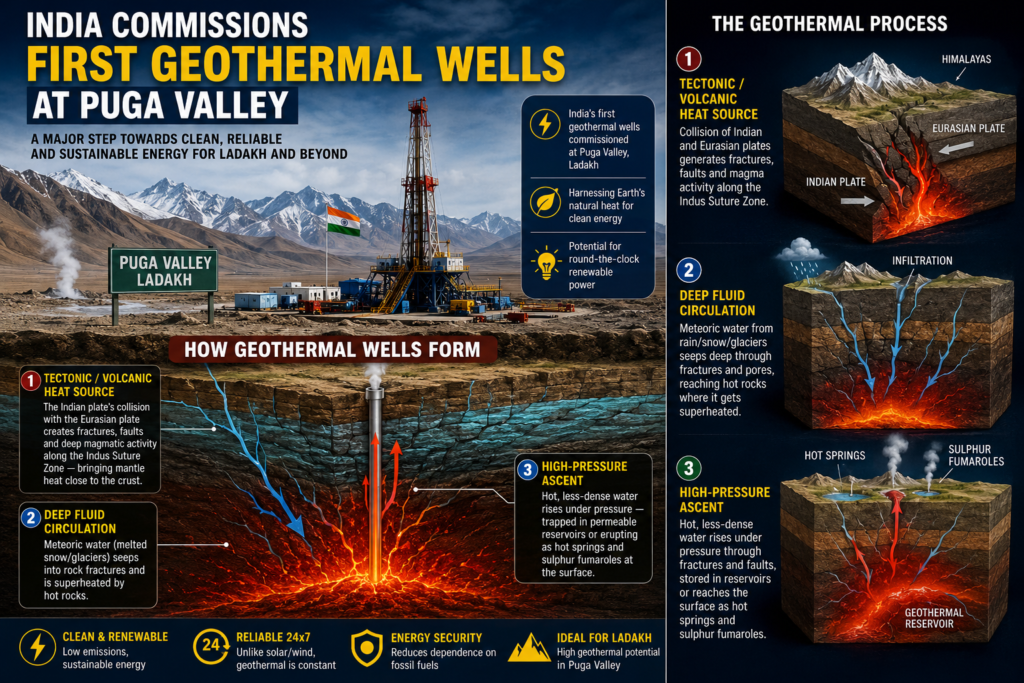
Ladakh Lieutenant Governor V.K. Saxena officially commissioned India’s first and deepest twin geothermal wells at Puga Valley, eastern Ladakh. Executed by the ONGC Energy Centre, these 1,000-metre-deep wells will serve as the technical backbone for India’s first 1 MW demonstration-scale geothermal power plant.
About the Puga Valley Geothermal Project
What It Is
- India’s pioneer breakthrough into geothermal energy — tapping clean, round-the-clock power from natural heat reservoirs beneath the Earth’s crust.
Key Details
- Location: Puga Valley, eastern Ladakh, at over 14,000 feet altitude.
- Executing agency: ONGC Energy Centre; drilling by SEROS Drilling Pvt Ltd, with Iceland geothermal experts (ÍSOR) as consultants.
- Two wells, each 1,000 m deep: First reached target depth on 22 May 2026; second spudded 3 June, completed 8 July 2026 (in just over a month).
- Temperature: 135°C recorded at 400 m depth; thermal output expected to exceed 200–240°C in the deepest reservoir sections.
- Feeds steam into India’s first 1 MWe demonstration pilot plant, foundation for future multi-megawatt commercial deployment.
How Geothermal Wells Form?
- Tectonic/volcanic heat source: The Indian plate’s collision with the Eurasian plate creates fractures, faults and deep magmatic activity along the Indus Suture Zone — bringing mantle heat close to the crust.
- Deep fluid circulation: Meteoric water (melted snow/glaciers) seeps into rock fractures and is superheated by hot rocks.
- High-pressure ascent: Hot, less-dense water rises under pressure — trapped in permeable reservoirs or erupting as hot springs and sulphur fumaroles at the surface.
Exam Relevance
- UPSC Prelims: Puga Valley = Ladakh (first geothermal wells); executing agency ONGC Energy Centre; Indus Suture Zone; India’s ~10 GW geothermal potential; other geothermal sites (Tattapani, Manikaran).
- UPSC Mains (GS-1 Geography / GS-3 Energy & Environment): Renewable energy transition; baseload vs intermittent sources; energy security for remote/border regions; Himalayan ecological fragility.
- RBI Grade B (ESI): Energy/infrastructure current affairs — clean energy transition, net-zero context.
- NABARD Grade A/B: Highly relevant — rural/remote energy access, renewable energy, environment & climate (core ARD/ESI syllabus); geothermal as clean rural power.
Practice MCQs
Q1. With reference to the Puga Valley geothermal project, consider the following statements:
- It is located in eastern Ladakh at an altitude of over 14,000 feet.
- The project is being executed by the ONGC Energy Centre.
- It will support India’s first 1 MW demonstration-scale geothermal power plant.
- The geothermal heat here is associated with the Indus Suture Zone, formed by the Indian–Eurasian plate collision.
How many of the above statements are correct? (a) Only one (b) Only two (c) Only three (d) All four (e) None
Q2. With reference to geothermal energy, consider the following statements:
- Geothermal energy can provide 24×7 baseload power, unlike intermittent solar and wind.
- Fumaroles are surface vents that emit steam and volcanic gases such as sulphur.
- The Geological Survey of India estimates India’s geothermal power potential at around 10 GW.
- Puga Valley is India’s only site with geothermal potential.
How many of the above statements are correct? (a) Only one (b) Only two (c) Only three (d) All four (e) None
Answer Key
- (d) — All four statements are correct.
- (c) — Statement 4 wrong: India has multiple geothermal sites, not just Puga Valley.







