
Just ten years ago, solar power played only a small role in India’s electricity sector. Today, it has become the biggest contributor to the country’s renewable energy capacity. India’s solar journey has been remarkable. Installed solar capacity has grown from around 3 GW in 2014 to 162.15 GW as of 30 June 2026—an increase of more than fifty times in just over a decade.
India's Solar Rise
This rapid growth has been made possible by strong government policies, better infrastructure, increased domestic manufacturing, and active participation from citizens. Large solar parks, rooftop solar systems, and solar-powered pumps for farmers have helped bring clean energy to homes, businesses, and villages across the country. To further speed up this transition, the Government has recently approved the Pradhan Mantri Surya Sarovar Yojana (PM-SSY), which aims to expand solar power generation and strengthen India’s clean energy future. The Government of India approved the Pradhan Mantri Surya Sarovar Yojana (PM-SSY) on 31 July 2026 to promote floating solar power across the country.
Under this scheme, the government plans to develop 5,000 MW of Floating Solar Photovoltaic (FSPV) projects on reservoirs, lakes, and other suitable water bodies. These projects will also include Energy Storage Systems (ESS) with a minimum backup capacity of 10,000 MWh, providing at least two hours of energy storage. This will help states meet electricity demand during peak hours and ensure a more reliable power supply. One of the biggest advantages of the scheme is that it uses existing reservoirs and industrial ponds instead of land. This reduces pressure on scarce land resources while making better use of water bodies. The addition of energy storage will also improve grid reliability, making renewable energy available even when sunlight is not available.
The scheme has a total budget of ₹5,070 crore and will be implemented over five years, from FY 2026–27 to FY 2030–31. The plan is based on a study by the National Institute of Solar Energy (NISE), which estimates that India has a floating solar potential of about 102.18 GWp across its reservoirs and other suitable inland water bodies.
Once implemented, the scheme is expected to reduce around 10 million tonnes of carbon dioxide (CO₂) emissions every year. It is also likely to create 16,000–17,000 full-time jobs and encourage domestic manufacturing of floating platforms, solar cells, solar modules, and energy storage systems. The scheme will benefit all States and Union Territories. It will increase India’s floating solar capacity by 5,000 MW, taking it from the current around 700 MW to nearly 5,700 MW, giving a major boost to the country’s clean energy mission.
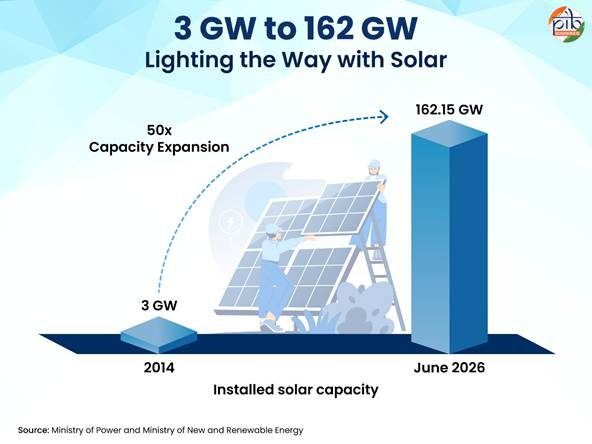
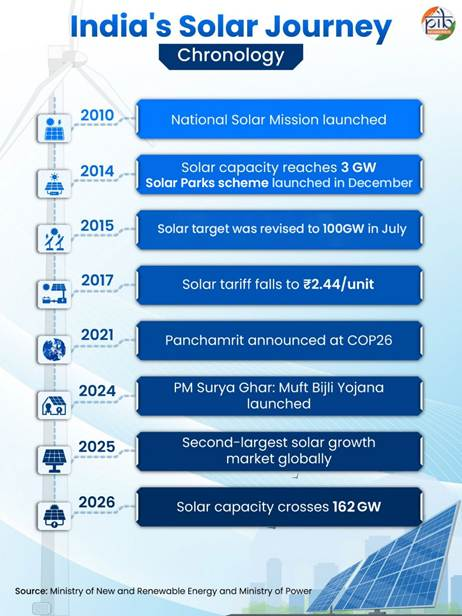
The coordinated momentum has translated into measurable outcomes. The country has added 37 GW of solar capacity in 2025, surpassing the United States in annual additions. India has also emerged as the world’s second-largest solar growth market, underlining its growing role in the global clean energy transition.
A Decade of Solar Expansion
India’s rapid growth in solar energy has been supported by strong government policies and long-term planning. Important initiatives such as the National Solar Mission (2010), the Solar Parks Scheme, the Green Energy Corridor Programme, and competitive bidding have made solar power more affordable and encouraged large-scale investments. Together, these measures have helped India become one of the world’s leading solar energy producers.
Solar Capacity Across India
Today, solar power projects are spread across different parts of the country. States such as Rajasthan, Gujarat, Karnataka, Tamil Nadu, Andhra Pradesh, and Maharashtra have emerged as the biggest contributors to India’s solar capacity because of their favourable weather conditions and large-scale projects.
The largest share of solar capacity comes from utility-scale solar parks, which together have an installed capacity of 118.79 GW. Some of India’s most well-known solar parks include the Bhadla Solar Park in Rajasthan, the Pavagada Solar Park in Karnataka, and the Rewa Ultra Mega Solar Park in Madhya Pradesh.
Apart from these large projects, grid-connected rooftop solar systems installed on homes, offices, schools, and commercial buildings contribute 27.88 GW of capacity.
The remaining solar capacity comes from hybrid solar projects and off-grid solar systems. Hybrid projects combine solar power with battery storage or other energy sources to ensure a steady electricity supply. Off-grid solar systems provide electricity to remote villages and areas that are not connected to the main power grid, helping improve access to clean and reliable energy.
Record Growth in FY 2025–26
The financial year 2025–26 was a landmark year for India’s renewable energy sector. The country recorded its highest-ever growth in solar power and overall non-fossil fuel capacity, reflecting the rapid pace of the clean energy transition.
During the year, India added 44.61 GW of new solar capacity, almost twice the 23.83 GW added in FY 2024–25. This was the highest annual addition of solar capacity in the country’s history.
India also made significant progress in solar manufacturing. The country’s solar module manufacturing capacity increased from just 2.3 GW in 2014 to around 172 GW by 31 March 2026, strengthening domestic production and reducing dependence on imports.
By the end of FY 2025–26, India’s total non-fossil fuel power capacity had reached 283.46 GW, of which 274.68 GW came from renewable energy sources such as solar, wind, hydro, and bioenergy. The year also saw the highest-ever annual addition of non-fossil fuel capacity, with 55.29 GW added.
Another major achievement came on 29 July 2025, when renewable energy sources supplied 51.5% of India’s electricity demand—the highest share ever recorded. This milestone highlights the growing role of clean energy in meeting the country’s electricity needs.
ARD notes, the monthly current affairs PDF and a descriptive English sample — all free, on WhatsApp.
Get it on WhatsApp — one tap or just leave your numberPolicy Architecture Behind the Solar Expansion
India’s rapid growth in solar energy has been made possible by a stable policy framework, transparent bidding, and clear long-term goals. Over the years, the government has introduced several measures that work together to encourage investment, increase demand, reduce costs, and make solar power more accessible. These efforts can be understood through five key pillars.
1. Setting a Long-Term Vision
India has set ambitious clean energy goals to guide its transition towards renewable energy. At the COP26 Climate Summit in Glasgow, the country announced its Panchamrit commitments, which include achieving 500 GW of non-fossil fuel power capacity by 2030 and becoming net zero by 2070. These goals were later included in India’s updated Nationally Determined Contributions (NDCs) under the Paris Agreement.
To involve people in this transition, the government also launched Mission LiFE (Lifestyle for Environment). The mission encourages citizens to adopt eco-friendly habits, conserve resources, and make environmentally responsible choices in their daily lives.
2. Creating Demand for Solar Power
A strong and growing demand for solar energy has been one of the biggest reasons behind India’s success. The National Solar Mission laid the foundation by setting long-term targets and promoting solar projects across the country.
The government also introduced Renewable Purchase Obligations (RPOs), which require electricity distribution companies and certain large consumers to purchase a fixed share of their electricity from renewable sources. This gives developers and investors confidence that there will be a steady demand for renewable power. The RPO targets have been fixed up to 2029–30, with the target for 2026–27 set at 35.95%.
Demand has also increased at the household and farm level. The PM Surya Ghar: Muft Bijli Yojana encourages families to install rooftop solar systems, helping them reduce electricity bills. At the same time, PM-KUSUM (Pradhan Mantri Kisan Urja Suraksha evam Utthaan Mahabhiyan) supports farmers by promoting solar-powered irrigation pumps and the solarisation of agricultural feeders. Together, these schemes have expanded the use of solar energy among households, farmers, businesses, and power utilities.
3. Making Solar Power More Affordable
One of the biggest achievements of India’s solar sector has been the sharp decline in the cost of solar electricity over the past decade.
This has been possible because of competitive bidding through the e-Reverse Auction system, where developers compete to offer electricity at the lowest possible price. The Solar Energy Corporation of India (SECI) has played a major role in conducting these transparent auctions and promoting fair competition.
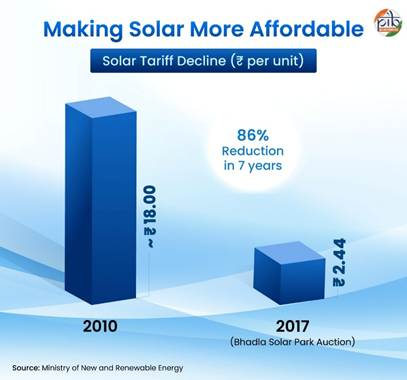
As competition increased and technology improved, solar tariffs fell dramatically—from around ₹18 per unit in 2010 to a record low of ₹2.44 per unit during the Bhadla Solar Park auction in 2017. This made solar power one of the cheapest sources of electricity in India.
Today, India is among the lowest-cost solar power markets in the world. In 2025, the Levelised Cost of Electricity (LCOE) from utility-scale solar photovoltaic (PV) projects was USD 35 per MWh, significantly lower than the global average of USD 44 per MWh. Lower costs have made solar energy more affordable for consumers while encouraging faster adoption across the country.
Building the Infrastructure for Solar Growth
Along with supportive policies, the government has invested in the infrastructure needed to expand solar power across the country.
One of the most important initiatives is the Solar Parks Scheme, which provides developers with ready-to-use land and essential infrastructure such as roads, transmission lines, and grid connectivity. This reduces project delays and makes it easier to set up large solar power plants.
The scheme was launched with an initial target of 20 GW of solar capacity. Seeing its success, the target was increased to 40 GW in 2017. As of February 2026, the government had approved 54 solar parks across India with a combined sanctioned capacity of 39,188 MW.
These solar parks have become major centres for large-scale renewable energy generation. Spread across different states, they play a crucial role in increasing clean energy production, attracting private investment, and helping India move towards its renewable energy and climate goals.
| S. No. | State/Union Territory | No. of Solar Parks | Sanctioned Capacity (MW) |
|---|---|---|---|
| 1 | Andhra Pradesh | 5 | 4,200 |
| 2 | Chhattisgarh | 1 | 100 |
| 3 | Gujarat | 7 | 12,150 |
| 4 | Jharkhand | 2 | 334 |
| 5 | Jharkhand & West Bengal* | 1 | 310 |
| 6 | Karnataka | 1 | 2,000 |
| 7 | Kerala | 3 | 255 |
| 8 | Madhya Pradesh | 9 | 4,208 |
| 9 | Maharashtra | 4 | 1,105 |
| 10 | Mizoram | 1 | 20 |
| 11 | Odisha | 1 | 40 |
| 12 | Rajasthan | 11 | 10,726 |
| 13 | Uttar Pradesh | 8 | 3,740 |
| Total | 13 States/UTs | 54 | 39,188 MW |
Taking Solar to Every Household and Farm
India’s solar revolution is not limited to large solar parks. The government is also helping ordinary families and farmers benefit from clean energy. Through dedicated schemes, solar power is reducing electricity bills, improving energy access, and creating new opportunities for people across the country.
PM Surya Ghar: Muft Bijli Yojana
Launched on 13 February 2024 with a budget of ₹75,021 crore, the PM Surya Ghar: Muft Bijli Yojana is the world’s largest rooftop solar programme for households.
The scheme encourages families to install rooftop solar panels by providing government subsidies and collateral-free loans, making solar systems more affordable. A dedicated online portal allows people to register, apply for subsidies, track installations, and receive financial assistance through a simple and transparent process.
Key Achievements
- More than 43 lakh households had installed rooftop solar systems under the scheme by June 2026.
- The government had disbursed ₹14,771.82 crore as Central Financial Assistance by December 2025.
- Over 7.7 lakh households were enjoying zero electricity bills as of 9 December 2025.
- The scheme enables families to generate electricity on their own rooftops, helping them reduce their dependence on the grid and save money on monthly electricity bills.
- It has also played an important role in increasing the adoption of rooftop solar across the country.
- Recognising the success and potential of the programme, the World Bank has approved financial support to help expand residential rooftop solar adoption in India.
PM-KUSUM: Bringing Solar Power to Farmers
Launched in 2019, the Pradhan Mantri-Kisan Urja Suraksha Evam Utthaan Mahabhiyan (PM-KUSUM) aims to increase the use of solar energy in the agriculture sector. The scheme helps farmers install solar-powered irrigation pumps, set up small decentralised solar power plants, and solarise existing grid-connected agricultural pumps.
The main objective is to provide farmers with a reliable supply of electricity during the day for irrigation, reduce their dependence on expensive diesel pumps, lower farming costs, and create an additional source of income.
Under the scheme, farmers can use solar energy to run irrigation pumps. In places where it is allowed, they can also sell surplus electricity generated from their solar systems to electricity distribution companies, earning extra income. PM-KUSUM aims to add around 34,800 MW of solar capacity by 2026–27, with Central financial assistance of ₹34,422 crore.
Key Achievements
- Nearly 11.49 lakh off-grid solar pumps have been installed for agricultural use.
- More than 15.89 lakh agricultural pumps have been covered under feeder-level solarisation.
- Around 1,726 MW of decentralised solar power capacity has been commissioned on farmers’ land.
- More than 21.77 lakh farmers have benefited from the scheme across India.
Driving Distributed Solar Growth
Together, PM Surya Ghar: Muft Bijli Yojana and PM-KUSUM have become two of the most important programmes for expanding distributed solar energy in India. Instead of relying only on large solar parks, these schemes bring clean energy directly to homes and farms.
In FY 2025–26, distributed solar systems contributed 16.3 GW, accounting for 36% of the 44.61 GW of new solar capacity added during the year. Out of this, 7.6 GW came from PM-KUSUM, while 8.7 GW was added through rooftop solar systems, highlighting the growing role of households and farmers in India’s clean energy transition.
India's Growing Leadership in Global Solar Cooperation
India’s contribution to solar energy is not limited to meeting its own energy needs. The country is also playing a leading role in promoting clean energy across the world by encouraging international cooperation, sharing technology, and supporting other countries in expanding the use of solar power.
International Solar Alliance (ISA)
The International Solar Alliance (ISA) was jointly launched by India and France during the COP21 Climate Summit in Paris in 2015. It has grown into a major global platform for promoting solar energy.
Today, the ISA brings together many countries, including the Maldives, Greece, Germany, Italy, Bhutan, Luxembourg, Argentina, and several others, to work together on expanding solar power. Member countries cooperate by sharing knowledge, technology, best practices, and financial solutions to make solar energy more affordable and accessible around the world.
One Sun One World One Grid (OSOWOG)
In 2018, India proposed the One Sun One World One Grid (OSOWOG) initiative, which aims to create a globally interconnected network of electricity grids powered by renewable energy.
To take this vision forward, India and the United Kingdom launched the Green Grids Initiative–One Sun One World One Grid (GGI–OSOWOG) at COP26 in 2021. The initiative is supported by countries such as Australia, France, and the United States, along with the International Solar Alliance.
The goal of the initiative is to connect electricity grids across countries so that clean energy can be shared across borders. This can improve energy security, make better use of renewable energy, and help countries reduce their dependence on fossil fuels.
Strengthening Global Renewable Energy Cooperation
Through the International Solar Alliance and other international partnerships, India has become a strong advocate for renewable energy, especially among countries in the Global South.
During its G20 Presidency, India also played an important role in building global consensus on the goal of tripling the world’s renewable energy capacity by 2030, highlighting its commitment to leading the global transition towards clean and sustainable energy.
Way Forward
India’s journey in solar energy over the past decade has been remarkable. From having only a small share of solar power in its electricity mix, the country has emerged as one of the world’s fastest-growing solar energy markets. This progress has not happened overnight. It is the result of consistent government policies, ambitious long-term targets, large investments in infrastructure, growing domestic manufacturing, technological advancements, and the active participation of citizens, businesses, and farmers.
The government has introduced several initiatives to support this transformation. Large solar parks have increased utility-scale power generation, while schemes such as PM Surya Ghar: Muft Bijli Yojana and PM-KUSUM have taken solar energy directly to homes and farms. At the same time, competitive bidding has reduced the cost of solar electricity, making it one of the cheapest sources of power in India. Investments in transmission infrastructure, energy storage, and domestic manufacturing have further strengthened the country’s renewable energy ecosystem.
India has also made significant progress in building a strong manufacturing base for solar modules, promoting innovation, and encouraging private sector investment. As a result, the country is becoming less dependent on imports while creating new employment opportunities across manufacturing, installation, operations, and maintenance. The rapid growth of rooftop solar systems, floating solar projects, hybrid renewable energy plants, and battery storage solutions reflects the increasing diversity and maturity of India’s solar sector.
Beyond its domestic achievements, India has established itself as a global leader in clean energy. Through initiatives such as the International Solar Alliance (ISA) and One Sun One World One Grid (OSOWOG), the country is working with other nations to promote renewable energy, share technology, strengthen energy security, and support sustainable development. India’s leadership during its G20 Presidency further demonstrated its commitment to accelerating the global transition towards clean energy.
Looking ahead, solar power will play an even more important role in India’s energy future. It will help meet the country’s rising electricity demand while reducing dependence on fossil fuels and lowering greenhouse gas emissions. The continued expansion of rooftop solar, utility-scale solar parks, floating solar projects, and energy storage systems will make clean electricity more reliable, affordable, and accessible for millions of people.
As India moves towards achieving its Panchamrit commitments, including 500 GW of non-fossil fuel capacity by 2030 and the goal of net-zero emissions by 2070, solar energy will remain one of the strongest pillars of the country’s clean energy transition. With continued policy support, technological innovation, increased investments, and active participation from citizens and industries, India is well positioned to become a global leader in sustainable and renewable energy. The country’s solar journey is not only transforming its own energy sector but also contributing to global efforts to combat climate change and build a cleaner, greener future for generations to come.