Why in News?
The Government has highlighted the achievements of the Pradhan Mantri Fasal Bima Yojana (PMFBY), a crop insurance scheme designed to protect farmers when their crops are damaged due to unexpected events. It provides insurance coverage against natural calamities, pests, diseases, prevented sowing, localized disasters, and certain post-harvest losses.
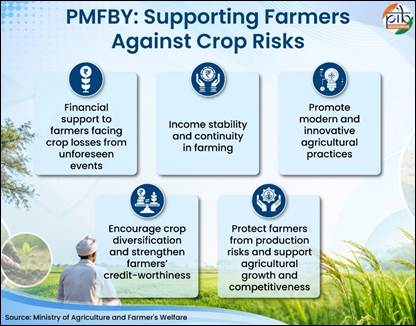
With ₹12,200 crore allocated for 2026–27, the scheme aims to provide greater financial support to farmers during difficult agricultural seasons. By reducing the financial impact of crop losses, PMFBY helps farmers manage risks, maintain income stability, recover from crop damage, and continue farming despite changing climate conditions.
Key Facts About PMFBY
About PMFBY
The Pradhan Mantri Fasal Bima Yojana (PMFBY) was launched on 18 February 2016 to protect farmers from the financial loss caused by crop damage. It provides affordable crop insurance when crops are affected by natural disasters, bad weather, pests, diseases and other specified risks.
Premium Structure
Farmers have to pay only a small part of the insurance premium:
- Kharif foodgrain and oilseed crops: 2% of the sum insured
- Rabi foodgrain and oilseed crops: 1.5%
- Commercial and horticultural crops: Maximum 5%
The remaining premium is generally shared between the Central and State Governments in a 50:50 ratio. For North-Eastern and Himalayan States, the subsidy sharing ratio is 90:10.
What Risks Does PMFBY Cover?
PMFBY provides protection at different stages of crop cultivation:
1. Crop Loss Due to Natural Calamities
Farmers can receive insurance support when standing crops are damaged by events such as:
- Drought
- Floods and inundation
- Cyclones
- Hailstorms
- Lightning
- Pests and diseases
This helps farmers recover financially when uncontrollable natural events destroy their crops.
2. Prevented or Failed Sowing
Sometimes farmers spend money on seeds, fertilizers and other inputs but cannot sow their crops because of unfavourable weather conditions.
In such cases, eligible farmers can receive a claim of up to 25% of the sum insured, subject to the scheme’s conditions.
3. Post-Harvest Losses
Crop damage can also happen after harvesting. PMFBY covers certain post-harvest losses when harvested crops are kept in the field in a cut-and-spread condition for drying.
This protection is available for up to 14 days after harvesting against specified events such as cyclones and unseasonal rainfall, subject to applicable conditions.
4. Localised Calamities
PMFBY also provides protection against certain disasters that affect an individual farm or a small area, such as:
- Hailstorms
- Landslides
- Inundation
- Cloudbursts
- Natural fires
This is important because sometimes a disaster may damage only a particular village or a few farms rather than an entire region.
5. What PMFBY Does Not Cover
PMFBY does not cover every type of crop loss. Certain risks are excluded, including losses arising from war, nuclear risks, riots, theft, negligence and other preventable or specifically excluded causes.
PMFBY works like a financial safety net for farmers. Farmers pay a small premium, while the government provides substantial premium support. If their crops are damaged by covered natural disasters, pests, diseases or specified post-harvest events, they can receive insurance compensation. This helps farmers reduce financial losses, maintain income stability and continue farming even when unexpected problems occur.
Inclusive Coverage of Farmers
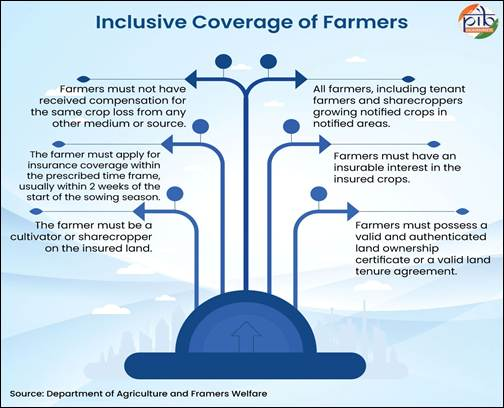
PMFBY is designed to provide crop insurance to different types of farmers, not just those who take loans. This includes farmers who own land as well as those who cultivate land as tenants or sharecroppers, provided they meet the required conditions.
1. Who Can Get PMFBY Coverage?
The scheme can cover:
- Loanee farmers – farmers who take crop loans.
- Non-loanee farmers – farmers who do not take crop loans and choose to buy crop insurance voluntarily.
- Tenant farmers – farmers who cultivate land belonging to someone else.
- Sharecroppers – farmers who cultivate land and share the produce with the landowner.
Farmers need to provide the required land, cultivation or tenancy documents to establish that they are cultivating the insured crop.
2. Non-Loanee Farmers
Farmers who do not have a crop loan can voluntarily enrol in PMFBY. Over the past decade, around 50% of enrolled farmers, on average, have been non-loanee farmers. This shows that crop insurance is increasingly being taken up by farmers even when they do not have a bank crop loan.
3. Loanee Farmers
Farmers who take seasonal agricultural loans or Kisan Credit Card (KCC)-linked crop loans can also be covered under PMFBY. In such cases, the applicable insurance premium is generally deducted by the lending bank from the farmer’s loan account as per the scheme’s provisions.
4. Basic Eligibility
To receive insurance coverage, farmers generally need to:
- Have a valid interest in the crop and cultivated land.
- Provide valid land records, tenancy documents or other accepted proof of cultivation.
- Grow a notified crop in a notified area.
- Enrol within the prescribed deadline.
- Submit the required documents and information correctly.
PMFBY tries to include different categories of farmers—whether they take loans or not, and whether they own or cultivate the land. The main requirement is that the farmer must be genuinely cultivating an eligible crop and provide the necessary documents within the specified time. This makes crop insurance more accessible and helps farmers protect themselves from unexpected crop losses.
PMFBY: Progress and Achievements
The Pradhan Mantri Fasal Bima Yojana (PMFBY) has expanded significantly since its launch in 2016. The scheme is helping farmers manage the financial risk of crop losses caused by bad weather, natural disasters, pests and diseases.
1. Wider Implementation
During Kharif 2026, PMFBY is being implemented in 25 States and Union Territories. This shows that the scheme has gained wide acceptance across different parts of the country.
2. Large Number of Farmers Covered
Since its launch, more than 92.46 crore farmer applications have been insured under PMFBY.
Out of these, more than 26.33 crore farmer applications have received insurance claims. The total value of these claims is over ₹2.06 lakh crore.
This means that the scheme has provided significant financial support to farmers whose crops were affected by covered risks.
3. Record Enrolment in 2024–25
PMFBY recorded its highest-ever enrolment in 2024–25.
During this year:
- More than 15.23 crore farmer applications were registered.
- Over 4 crore farmers were covered.
- Around 623 lakh hectares of agricultural land came under crop insurance.
The increase in enrolment shows that more farmers are using crop insurance to protect themselves from agricultural risks.
4. Coverage of Tenant and Sharecropper Farmers
PMFBY is not limited only to farmers who own agricultural land. Tenant farmers and sharecroppers can also receive coverage if they meet the required eligibility conditions and provide valid proof of cultivation.
This is important because many farmers cultivate land that they do not legally own but still face the same risks of crop failure.
PMFBY has grown into a large-scale crop insurance programme covering millions of farmers and large areas of farmland. It provides financial assistance when insured crops suffer damage from covered risks. The growing participation of small farmers, non-loanee farmers, tenant farmers and sharecroppers makes the scheme an important tool for reducing agricultural risk and improving farmers’ financial security.
What are the Key Government Initiatives to Strengthen PMFBY Implementation?
National Crop Insurance Portal (NCIP)
- About: The National Crop Insurance Portal (NCIP) is a digital platform that makes crop insurance easier to manage. It helps with farmer registration, subsidy management, coordination between different stakeholders, and sharing insurance-related information.
- It also stores details of insured farmers, helps in automatic calculation of claims, and enables insurance money to be directly transferred to farmers’ bank accounts.
- Integration of Land Records with NCIP: State-level digital land records are being connected with NCIP to verify the farmer, the land being insured and the area under cultivation. This helps reduce errors and improve transparency.
- This digital verification is being used in Madhya Pradesh, Chhattisgarh, Andhra Pradesh, Maharashtra, Rajasthan, Karnataka, Haryana, Himachal Pradesh, Uttar Pradesh and Odisha.
- Together, these States account for around 85% of the insured area covered through this system.
- Digiclaim Module: The Digiclaim module, introduced in Kharif 2022, helps calculate, process and settle crop insurance claims digitally through NCIP.
- Claims are transferred through the Public Finance Management System (PFMS), making it possible to track the payment process from the government level up to the individual farmer.
- More than ₹55,000 crore in claims have been calculated and paid through this digital system.
- CCE-Agri App: The Crop Cutting Experiment (CCE)-Agri App is used to digitally record and upload information about crop yields.
- This information helps determine the actual crop yield and the insurance claim payable to farmers.
- It also allows insurance companies to monitor crop-cutting experiments, making the process more transparent, accurate and faster.
Digital Innovations Strengthening Crop Insurance Delivery
- YES-TECH (Yield Estimation System Based on Technology): YES-TECH uses remote sensing and other modern technologies to estimate crop yields more accurately.
- It was introduced for paddy and wheat in Kharif 2023 and for soybean in Kharif 2024.
- In some States, YES-TECH estimates can now account for up to 50% of the weightage used for determining crop yield.
- WINDS (Weather Information Network and Data System): WINDS uses Automatic Weather Stations (AWS) and Automatic Rain Gauges (ARGs) to collect detailed weather information.
- It provides weather data at the Block and Gram Panchayat levels.
- This information can help in crop insurance, yield estimation, disaster management and weather forecasting.
- CROPIC (Collection of Real-time Photos and Observations of Crops): CROPIC uses geo-tagged photographs of crops to understand their condition.
- These photographs can help monitor crop health, assess crop damage and improve future yield estimation using image-based technology.
- Krishi Rakshak Portal & Helpline (KRPH): KRPH provides farmers with a toll-free helpline – 14447 to register and track their crop insurance-related complaints.
- Since its launch in January 2024, it has resolved around 26.12 lakh grievances, with a 99.66% resolution rate.
- Digital Tools for Enrolment and Claims: Several digital tools are being used to make crop insurance easier and more efficient.
- LMS (Learning Management System): Helps educate and train stakeholders about crop insurance.
- AIDE (App for Intermediary Enrolment): Helps with doorstep enrolment of non-loanee farmers.
- CLAP (Crop Loss Assessment App): Helps in the quick and transparent assessment of crop losses, particularly for localized crop damage.
Restructured Weather-Based Crop Insurance Scheme (RWBCIS)
- About: RWBCIS provides insurance against weather-related risks. Unlike traditional crop insurance, it does not mainly depend on measuring the actual loss in crop yield. Instead, it uses weather conditions as an indicator of possible crop damage.
- How It Works: Claims are triggered when recorded weather conditions cross pre-decided limits or thresholds. For example, if rainfall is much lower or higher than the specified level, farmers may become eligible for an insurance payout.
- Coverage Parameters: The scheme can cover weather-related risks such as:
- Excess or deficit rainfall
- Dry spells
- Extreme temperatures
- High or low humidity
- High wind speed
- States and UTs may also provide additional protection against risks such as hailstorms and cloudbursts.
- Area-Based Implementation: RWBCIS works through Reference Unit Areas (RUAs). Weather information collected for these areas is used to calculate weather-based indices and determine the insurance payout.
- The crop season is divided into different stages, and the sum insured is distributed across these stages depending on how vulnerable the crop is during each phase.
- Premium and Coverage: RWBCIS follows the same affordable farmer premium structure as PMFBY:
- Kharif foodgrain and oilseed crops: 2%
- Rabi foodgrain and oilseed crops: 1.5%
- Commercial and horticultural crops: Up to 5%
- Importance: RWBCIS is particularly useful for fruits, vegetables and plantation crops, where weather conditions can have a major impact on production.
Digital technology is making crop insurance faster, more transparent and easier for farmers. NCIP brings different parts of the insurance process onto one digital platform, while tools such as YES-TECH, WINDS, CROPIC and CCE-Agri help improve crop and weather assessment. At the same time, RWBCIS protects farmers by using actual weather data to determine insurance payouts, reducing the need to measure crop damage manually in every case.
Conclusion
The Pradhan Mantri Fasal Bima Yojana (PMFBY) has become an important part of India’s efforts to protect farmers from the financial risks of agriculture. By providing affordable crop insurance against natural disasters, pests, diseases, and other production-related risks, the scheme helps farmers recover when their crops are damaged and reduces the financial burden on them.
As climate change is making farming more uncertain through irregular rainfall, droughts, floods, heatwaves and other extreme weather events, crop insurance is becoming increasingly important. PMFBY can help farmers face these challenges with greater confidence while supporting income stability and continued investment in farming.
Going forward, better use of digital technology, faster claim settlement, accurate crop-loss assessment and wider coverage of eligible farmers can make the scheme more effective. A stronger crop insurance system will not only protect farmers but also contribute to food security, sustainable agriculture and a more climate-resilient rural economy.
Frequently Asked Questions (FAQs)
1. What is Pradhan Mantri Fasal Bima Yojana (PMFBY)?
PMFBY is a crop insurance scheme launched in 2016 to protect farmers from financial losses when their crops are damaged due to natural calamities, pests, diseases and adverse weather conditions. It provides financial support to help farmers recover and continue farming.
2. How much premium do farmers have to pay under PMFBY?
Farmers pay only a small portion of the crop insurance premium:
- Kharif foodgrain and oilseed crops: 2%
- Rabi foodgrain and oilseed crops: 1.5%
- Commercial and horticultural crops: Up to 5%
The remaining eligible premium is supported by the government as per the scheme’s provisions.
3. What is YES-TECH?
YES-TECH (Yield Estimation System Based on Technology) is a technology-based system used to estimate crop yields more accurately. It uses remote sensing and other scientific technologies to improve yield assessment and make insurance claim settlement more transparent and reliable.
4. What is WINDS under PMFBY?
WINDS (Weather Information Network and Data System) collects detailed, local-level weather information using Automatic Weather Stations and Automatic Rain Gauges. This data helps in weather-based insurance, crop-loss assessment, agricultural planning and disaster management.
5. What is the maximum claim available for prevented sowing?
If farmers are unable to sow their crops because of unfavourable weather conditions, eligible farmers can receive a claim of up to 25% of the sum insured, subject to the applicable conditions of the scheme.