Why in News?
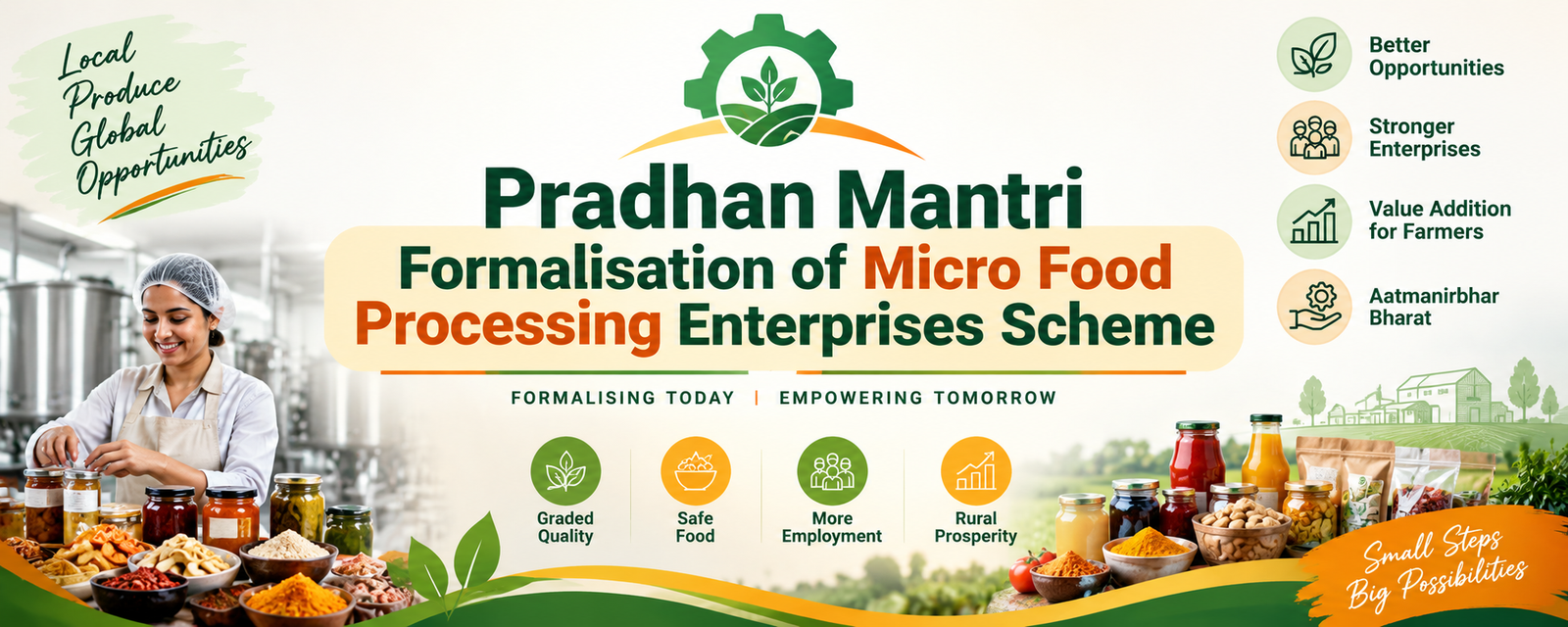
Recently, the Ministry of Food Processing Industries organised the PMFME Bazaar at the India Habitat Centre in New Delhi. The event brought together micro food processing businesses from different parts of India and gave them an opportunity to display and promote their products.
The event also highlighted how the Pradhan Mantri Formalisation of Micro Food Processing Enterprises (PMFME) Scheme is helping small food businesses grow. The scheme provides support through financial assistance, technical guidance, better packaging and branding, and access to wider markets.
PMFME is helping small food entrepreneurs turn local food products into better-organised and market-ready businesses, creating employment opportunities and strengthening local economies.
Introduction
The Pradhan Mantri Formalisation of Micro Food Processing Enterprises (PMFME) Scheme is a government initiative launched in 2020 to support small and micro food processing businesses across India. Many small entrepreneurs work with traditional food products but often face problems such as limited finance, outdated technology, weak branding and lack of access to bigger markets.
PMFME aims to address these challenges by providing financial assistance, training, technology support, branding and market linkages. The scheme also promotes local food products through the One District One Product (ODOP) approach, helping entrepreneurs turn locally available products into commercially successful businesses.
What are the Salient Features of PMFME Scheme?
- About: The Pradhan Mantri Formalisation of Micro Food Processing Enterprises (PMFME) Scheme was launched on 29 June 2020 under the Atmanirbhar Bharat Abhiyaan. It is a Centrally Sponsored Scheme aimed at helping small and informal food processing businesses become more organised, competitive and financially stronger.
- Objective: The main aim of PMFME is to help micro food processing enterprises start new businesses or improve their existing units. The scheme provides support through financial assistance, technical guidance, training, branding and market support. This helps small entrepreneurs improve the quality and value of their food products.
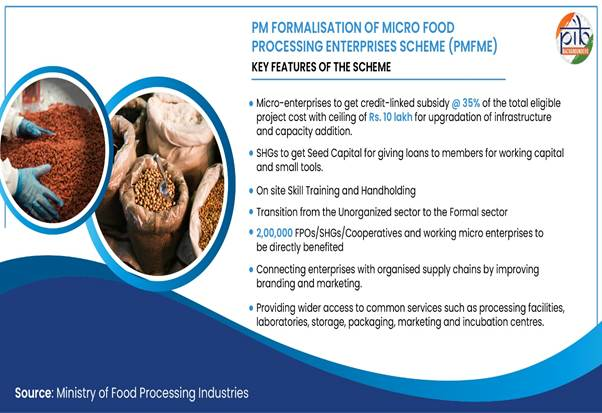
- Common Infrastructure Support: The scheme provides a 35% credit-linked capital subsidy on eligible project costs, up to a maximum of ₹3 crore, for organisations such as FPOs, FPCs, cooperatives, SHGs and their federations, and government agencies.
- The support can be used to create food processing facilities, storage and value-chain infrastructure, or incubation centres.
- Beneficiaries have to contribute at least 10% of the project cost, while the remaining amount can be financed through a bank loan.
- Credit-Linked Subsidy for Individual Units: Individuals and organisations such as proprietorships, partnerships, FPOs, NGOs, cooperatives, SHGs and private companies can receive a 35% credit-linked capital subsidy for setting up a new food processing unit or upgrading an existing one.
- The maximum subsidy available is ₹10 lakh per unit.
- One District One Product (ODOP) Approach: PMFME follows the One District One Product (ODOP) approach to promote products that are special or widely produced in a particular district.
- It helps create economies of scale in procurement, processing, common facilities, packaging and marketing.
- ODOP has been approved for 713 districts across 35 States/UTs, covering 137 unique products.
- This approach helps local products reach bigger markets while creating more opportunities for farmers and food-processing entrepreneurs.
- Seed Capital Support for SHGs: Members of Self-Help Groups (SHGs) can receive seed capital of ₹40,000 per member. This money can be used for working capital and purchasing small tools or equipment.
- The maximum support is ₹4 lakh per SHG.
- The funds are provided through SHG federations with the help of State Rural Livelihood Missions (SRLMs) or State Urban Livelihood Missions (SULMs).
- Marketing and Branding Support: PMFME provides 50% financial assistance for branding and marketing activities undertaken by groups such as FPOs, SHGs, cooperatives and Special Purpose Vehicles (SPVs) of micro food processing enterprises.
- This helps small businesses improve packaging, branding, promotion and market reach, allowing local food products to compete in larger markets.
- Capacity Building and Training: The scheme provides training through Food Processing Entrepreneurship Development Programmes (FPEDP).
- These programmes help beneficiaries improve their food processing skills, business knowledge, entrepreneurship abilities and management skills.
- This is particularly useful for small entrepreneurs who may have good products but lack formal business or technical knowledge.
- Detailed Project Report (DPR) Support: PMFME also helps beneficiaries prepare Detailed Project Reports (DPRs) for their projects and branding or marketing proposals.
- These reports can cover areas such as product details, quality control, packaging, pricing, promotion, storage and marketing strategies.
- Financial assistance of up to ₹5 lakh is available through State Nodal Agencies for preparing DPRs.
- Significance: PMFME plays an important role in strengthening India’s small and local food businesses. It helps entrepreneurs formalise their businesses, improve product quality, reduce wastage and increase the value of locally produced food.
- The scheme also supports rural employment and income generation by creating opportunities around local food processing.
- By promoting local products through the ODOP approach, PMFME supports the ideas of Atmanirbhar Bharat and Vocal for Local and helps traditional and regional food products reach wider markets.
PMFME is designed to help small food businesses grow from local, informal units into better-organised and market-ready enterprises. Through subsidies, loans, training, branding, technology and market support, the scheme helps entrepreneurs improve their businesses and earn better incomes. At the same time, it promotes local products, creates rural employment, reduces food wastage and strengthens the value chain from farmers and producers to consumers.
Conclusion
The PMFME Scheme is helping India’s small food processing businesses become more formal, competitive and financially sustainable. By providing subsidies, training, technology, branding and market support, the scheme helps entrepreneurs improve their products and reach more customers.
The initiative is also important for rural employment, value addition and better use of local agricultural produce. Through the ODOP approach and platforms such as PMFME Bazaar, local food products can get greater visibility and access to wider markets. Overall, PMFME supports the idea of “Vocal for Local” and Atmanirbhar Bharat by helping small food entrepreneurs build stronger businesses and create new livelihood opportunities.
Frequently Asked Questions (FAQs)
1. What was the objective of PMFME Bazaar?
The PMFME Bazaar was organised to give micro food processing businesses a platform to display and promote their products. It also helped entrepreneurs meet potential buyers, understand market opportunities and explore new and larger markets for their products.
2. What is the PMFME Scheme?
The PMFME Scheme is a government programme launched in 2020 to help micro food processing enterprises become more organised and competitive. It provides support through financial assistance, skill development, technology, branding and market linkages. The scheme also encourages entrepreneurs to improve the quality and value of their food products.
3. Which Ministry implements the PMFME Scheme?
The PMFME Scheme is implemented by the Ministry of Food Processing Industries (MoFPI), Government of India.
4. What subsidy is provided under PMFME?
Individual micro food processing units can receive a 35% credit-linked capital subsidy for setting up a new unit or upgrading an existing one. The maximum subsidy available is ₹10 lakh per unit, subject to the applicable scheme conditions.