Introduction
In today’s financial world, investors seek stability, security, and consistent returns. Certificates of Deposit (CDs) are an excellent option for individuals looking for a low-risk investment with guaranteed returns. This blog will explore what CDs are, how they work, their benefits and drawbacks, and how to choose the right CD for your financial needs.
What is a Certificate of Deposit?
NABARD 2021-2024 Cutoff Analysis | What we can Learn? #nabard_grade_a_exam #nabard_cutoffTap to play · from the C4S channel
A Certificate of Deposit (CD) is a time deposit offered by banks and credit unions. Unlike regular savings accounts, CDs require the depositor to keep their money in the account for a fixed period in exchange for a higher interest rate. The term of a CD can range from a few months to several years, and the interest rate is usually higher than that of a standard savings account.
ARD notes, the monthly current affairs PDF and a descriptive English sample — all free, on WhatsApp.
Get it on WhatsApp — one tap or just leave your numberWho Issues CDs?
CDs are issued by:
- Banks (both commercial and online banks)
- Credit unions
- Brokerage firms (offering brokered CDs from partner banks)
These financial institutions use CDs to attract deposits, which they can then use for lending and other investment activities.
The Reserve Bank of India (RBI) governs the issuance of CDs in India.
Who Can Invest in CDs?
CDs are available to:
- Individual investors (anyone with a bank account can open a CD)
- Businesses and corporations (as a safe place to store excess cash)
- Trusts and estates
- Retirement accounts (IRAs) (some CDs are designed for tax-advantaged retirement investing)
CDs are a great option for those looking for a safe, predictable return on their money.
How Do CDs Work?
- Deposit Funds:
- The investor deposits a fixed amount of money into a CD account.
- Fixed Term:
- The money remains in the CD for a predetermined period, known as the term length.
- Fixed Interest Rate:
- The CD earns a fixed interest rate throughout the term.
- Maturity Date:
- At the end of the term, the investor can withdraw the principal along with accrued interest or roll it over into a new CD.
- The Commercial Paper and Certificates of Deposit (CDs) serve similar purposes, they differ in several aspects:
| Feature | Commercial Paper (CP) | Certificate of Deposit (CD) |
|---|---|---|
| Issuer | Corporations, financial institutions | Banks and financial institutions |
| Security | Unsecured | Secured by the bank issuing it |
| Maturity | 7 days to 1 year | 3 months to 5 years |
| Investor Type | Institutional investors, mutual funds | Institutional and retail investors |
| Regulatory Body | RBI, SEBI | RBI |
| Risk Level | Higher due to no collateral | Lower due to bank guarantee |
| Liquidity | High | High, but depends on secondary market demand |
Types of CDs
To better understand the various CD options, here is a tabular representation:
| Type of CD | Description |
|---|---|
| Traditional CD | Offers a fixed interest rate for a specific term. |
| Bump-Up CD | Allows for a one-time interest rate adjustment if rates rise. |
| Step-Up CD | Features periodic interest rate increases over the term. |
| No-Penalty CD | Allows early withdrawal without penalties. |
| Jumbo CD | Requires a large deposit but offers higher interest rates. |
| Brokered CD | Purchased through brokerage firms instead of directly from banks. |
Benefits of Investing in CDs
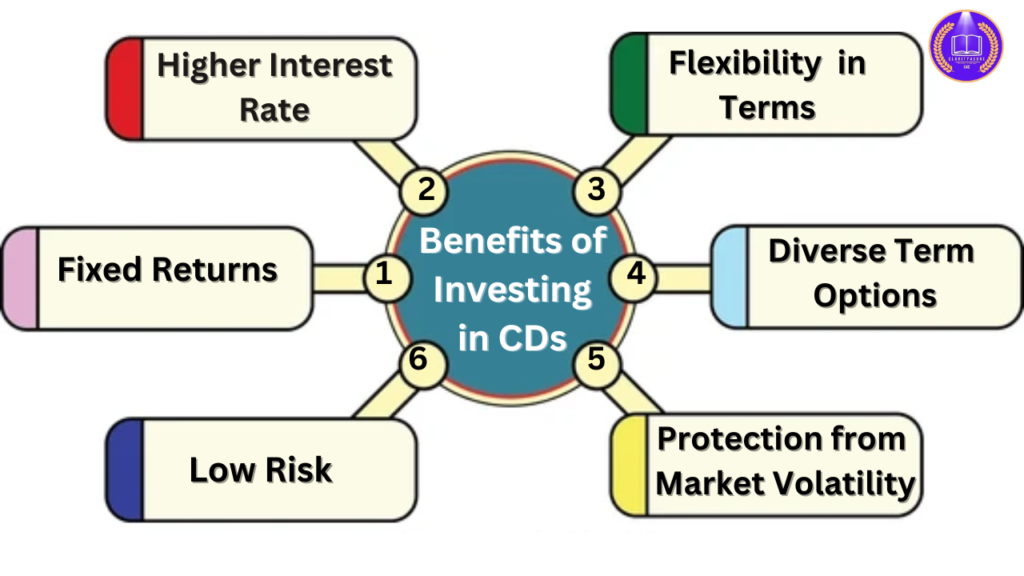
- Low Risk:
- CDs are FDIC-insured (up to $250,000 per depositor, per bank) and provide guaranteed returns.
- Predictable Earnings:
- Fixed interest rates ensure consistent returns.
- Diverse Term Options:
- Investors can choose from various term lengths to align with their financial goals.
- Protection from Market Volatility:
- Unlike stocks or mutual funds, CDs are not affected by market fluctuations.
Drawbacks of CDs
| Drawback | Explanation |
|---|---|
| Limited Liquidity | Funds are locked in until the maturity date unless withdrawn early with penalties. |
| Lower Returns Compared to Other Investments | CD interest rates are generally lower than potential stock market returns. |
| Inflation Risk | If inflation rises significantly, the fixed return on a CD may not keep up with the cost of living. |
How to Choose the Right CD ?
- Compare Interest Rates:
- Shop around for the best CD rates.
- Consider Term Lengths:
- Choose a term that matches your financial timeline.
- Check Penalties for Early Withdrawal:
- Understand the fees involved if you need to access funds early.
- Evaluate Different Types of CDs:
- Consider alternative options like bump-up or no-penalty CDs if flexibility is needed.
- Confirm FDIC or NCUA Insurance:
- Ensure your deposit is protected by a government-backed insurance program.
Strategies for Maximizing CD Returns
| Strategy | Explanation |
|---|---|
| CD Laddering | Invest in multiple CDs with different maturity dates to access funds periodically while earning higher interest. |
| CD Barbell Strategy | Invest in short-term and long-term CDs to balance liquidity and high interest. |
| CD Bullet Strategy | Invest in CDs that mature at the same time to take advantage of future high rates. |
Conclusion
Certificates of Deposit are a solid choice for conservative investors seeking security and predictable returns. While they may not offer the high growth potential of stocks or mutual funds, their stability makes them an excellent component of a diversified investment strategy. Before investing, it’s essential to evaluate different CD options, compare interest rates, and consider your financial goals to maximize returns while maintaining financial security.