Poverty is not just about having a low income. It also means struggling to access basic necessities such as food, clean drinking water, proper housing, healthcare, education, electricity and employment opportunities.
Introduction
For a developing country like India, reducing poverty has always been a major development priority. Over the last decade, the government has introduced several welfare schemes to improve the living conditions of economically weaker sections and ensure that the benefits of economic growth reach every section of society.
From providing tap water and LPG connections to expanding healthcare coverage, improving rural roads and promoting women’s entrepreneurship, India’s approach to poverty reduction has gradually moved beyond financial assistance towards overall socio-economic development.
On 17 June 2026, the Government of India highlighted the progress made through various welfare programmes, digital governance initiatives and infrastructure development. According to the figures reported, nearly 25 crore people have moved out of multidimensional poverty, while the multidimensional poverty rate declined from 29.17% in 2013–14 to 11.28% in 2022–23.
This transformation reflects India’s broader development vision of Antyodaya (uplifting the poorest) and inclusive growth, where every individual gets an opportunity to live with dignity and participate in economic development.
Why Is Inclusive Development Important for India?
NABARD 2021-2024 Cutoff Analysis | What we can Learn? #nabard_grade_a_exam #nabard_cutoffTap to play · from the C4S channel
Economic growth alone cannot ensure that every citizen enjoys a better standard of living. A country may experience rising GDP, but if people continue to lack healthcare, education, sanitation and employment opportunities, development remains incomplete.
This is why inclusive development is important.
Inclusive development means ensuring that the benefits of economic growth reach all sections of society, particularly poor households, women, children, rural communities, Scheduled Castes, Scheduled Tribes and other vulnerable groups.
Its major objectives include:
- Reducing poverty and income inequality.
- Ensuring access to essential public services.
- Improving healthcare and educational opportunities.
- Promoting women’s economic independence.
- Creating employment and sustainable livelihood opportunities.
- Strengthening financial and digital inclusion.
- Improving the quality of life in rural and backward regions.
India’s welfare programmes increasingly focus on delivering these services directly to eligible households.
A clean PDF of this page with the C4S header — it opens right away, and the link comes to your WhatsApp too.
How Has India Reduced Multidimensional Poverty?
- Traditionally, poverty was mainly measured through income or consumption expenditure. However, income alone does not explain the complete living conditions of a household.
- For example, a family may earn some income but still lack proper sanitation, drinking water, electricity, education or healthcare.
- To understand these multiple disadvantages, the concept of Multidimensional Poverty is used.
- The Multidimensional Poverty Index (MPI) considers deprivation across three broad dimensions:
Three dimensions of multidimensional poverty
Health
Nutrition, child mortality
Education
Years of schooling, school attendance
Living Standards
Housing, sanitation, electricity, drinking water and other indicators
According to the figures highlighted in the June 2026 government release:
- Multidimensional poverty declined from 29.17% in 2013–14 to 11.28% in 2022–23.
- Nearly 25 crore people were estimated to have escaped multidimensional poverty.
Decline in India’s multidimensional poverty
Reported poverty headcount ratio for the two reference periods.
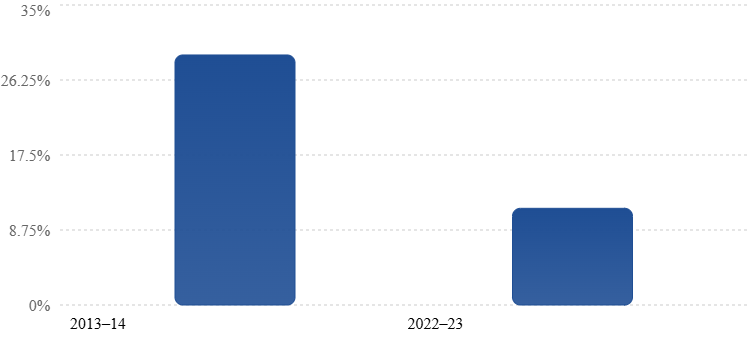
The decline reflects improvements in basic services, sanitation, housing, financial inclusion, healthcare and living standards.
Important: These are multidimensional poverty estimates, not the same as the conventional income-based poverty rate. The reference periods also differ from the publication date of the June 2026 release.
How Has India Achieved Wider Access to Basic Needs?
One of the biggest reasons behind the improvement in living standards is the expansion of basic infrastructure and essential services.
The government has focused on ensuring that poor households have access to clean drinking water, sanitation, cooking fuel, electricity, housing and rural connectivity.
Let’s understand the major initiatives.
A. Jal Jeevan Mission: Providing Clean Drinking Water to Rural Households
The Jal Jeevan Mission (JJM) was launched in August 2019 by the Ministry of Jal Shakti.
Its primary objective is to provide Functional Household Tap Connections (FHTCs) to every rural household.
Earlier, many rural families, particularly women and children, had to travel long distances to collect drinking water. This affected their health, education and daily activities.
The mission aims to address this problem by ensuring access to safe and adequate drinking water through household tap connections.
Major achievements highlighted in June 2026:
- Rural tap water coverage increased from 3.23 crore households in 2019 to 15.84 crore households by May 2026.
- Nearly 82% of rural households were covered.
- More than 9.23 lakh schools received tap water connectivity.
- Around 9.66 lakh Anganwadi Centres were connected with tap water.
Significance:
- Reduces the burden of collecting water, particularly for women.
- Improves hygiene and public health.
- Reduces the risk of waterborne diseases.
- Improves attendance and sanitation facilities in schools.
- Supports women’s participation in education and economic activities.
B. Swachh Bharat Mission: Towards a Clean and Sanitation-Friendly India
The Swachh Bharat Mission (SBM) was launched on 2 October 2014 to improve sanitation and eliminate open defecation.
The mission has two major components:
- Swachh Bharat Mission-Gramin (SBM-G).
- Swachh Bharat Mission-Urban (SBM-U).
The programme initially focused on toilet construction and achieving Open Defecation Free (ODF) status. Its second phase places greater emphasis on sustaining sanitation facilities and improving waste management.
Major achievements:
- More than 12.11 crore household toilets were constructed.
- Rural India achieved 100% initial toilet coverage by 2019, as reported in the government material.
- More than 5 lakh villages achieved ODF Plus (Model) status.
What is ODF Plus?
ODF Plus goes beyond stopping open defecation. It focuses on maintaining ODF status along with effective solid and liquid waste management.
Significance:
- Improves public health and hygiene.
- Reduces sanitation-related diseases.
- Promotes dignity and safety for women.
- Encourages community participation in waste management.
- Improves the overall quality of rural life.
C. Pradhan Mantri Ujjwala Yojana: Clean Cooking Fuel for Women
The Pradhan Mantri Ujjwala Yojana (PMUY) was launched on 1 May 2016 by the Ministry of Petroleum and Natural Gas.
Its main objective is to provide deposit-free LPG connections to adult women from eligible poor households.
Earlier, many rural households depended on traditional cooking fuels such as firewood, coal and cow dung cakes. Smoke generated from these fuels caused indoor air pollution and increased the risk of respiratory diseases.
Ujjwala Yojana aims to shift households towards cleaner cooking fuel.
Major achievements:
- More than 10.57 crore LPG connections were provided under the scheme, according to the supplied June 2026 figures.
- Women are the primary beneficiaries and connection holders.
Significance:
- Reduces indoor air pollution.
- Improves the health of women and children.
- Reduces the time spent collecting firewood.
- Promotes women’s dignity and convenience.
- Encourages the use of cleaner cooking energy.
However, regular LPG refill affordability remains important to ensure that households continue using clean fuel.
D. Universal Electrification: Bringing Electricity to Every Village
Electricity is essential for education, healthcare, communication, agriculture and economic activities.
The government has implemented initiatives such as the Deen Dayal Upadhyaya Gram Jyoti Yojana (DDUGJY) and Saubhagya Scheme to improve rural electrification and household electricity access.
The Saubhagya Scheme was launched in September 2017 to provide electricity connections to willing unelectrified households, subject to scheme provisions.
Major developments highlighted in the government release:
- Village electrification was reported as completed by 2025.
- Average daily electricity supply in rural areas increased from 12.5 hours in 2014 to 22.6 hours in 2025.
Significance:
- Enables children to study after sunset.
- Supports irrigation and agricultural activities.
- Improves rural healthcare facilities.
- Encourages small businesses and local industries.
- Expands access to digital services.
It is important to distinguish between village electrification and universal household electricity access. Both are separate development indicators.
E. Pradhan Mantri Awas Yojana: Housing for All
Having a safe and permanent house is one of the most basic requirements for a dignified life.
The government introduced the Pradhan Mantri Awas Yojana (PMAY) to provide affordable housing to eligible urban and rural households.
It has two major components:
- PMAY-Urban: Focuses on affordable housing for eligible urban households.
- PMAY-Gramin: Aims to provide pucca houses with basic amenities to eligible rural households.
Achievements highlighted in the supplied data:
- More than 98.10 lakh houses completed under PMAY-Urban.
- Around 3.03 crore rural houses completed under PMAY-Gramin.
An important feature is the emphasis on women’s ownership or joint ownership of houses, which promotes women’s asset ownership and economic security.
Significance:
- Provides safe and permanent shelter.
- Improves living conditions.
- Promotes women’s financial independence.
- Generates employment in construction and allied sectors.
- Supports rural and urban infrastructure development.
F. Pradhan Mantri Gram Sadak Yojana: Improving Rural Connectivity
The Pradhan Mantri Gram Sadak Yojana (PMGSY) was launched in 2000 to provide all-weather road connectivity to eligible unconnected rural habitations.
Road connectivity is not merely about transportation. It plays an important role in improving access to markets, schools, hospitals and employment opportunities.
Major achievement highlighted in the government release:
– Around 99.6% of eligible habitations were reported to have all-weather road connectivity.
Significance:
- Helps farmers transport agricultural produce to markets.
- Reduces transportation difficulties.
- Improves access to healthcare and education.
- Supports rural trade and businesses.
- Creates employment opportunities.
How Are Public Health and Food Security Being Strengthened?
Poverty is closely linked with poor health and food insecurity. A family that spends a major portion of its income on medical treatment or struggles to obtain sufficient food cannot easily improve its economic condition.
Recognising this, the government has introduced several programmes to improve healthcare access, maternal health and food security.
A. Ayushman Bharat: Making Healthcare More Accessible
Ayushman Bharat was launched in 2018 with the objective of moving towards Universal Health Coverage.
It has two important components:
1. Ayushman Arogya Mandirs (formerly Health and Wellness Centres)
These centres aim to strengthen primary healthcare services, including preventive, promotive and basic curative healthcare.
2. Pradhan Mantri Jan Arogya Yojana (AB-PMJAY)
PM-JAY provides eligible beneficiaries with health coverage of up to ₹5 lakh per family per year for specified secondary and tertiary hospitalisation.
Major achievements highlighted in the June 2026 material:
- Around 43.93 crore Ayushman cards issued.
- Health coverage of up to ₹5 lakh annually for eligible families.
Significance:
- Reduces out-of-pocket healthcare expenditure.
- Protects poor households from medical-related financial distress.
- Improves access to hospital treatment.
- Promotes financial security and better health outcomes.
B. Ayushman Bharat Digital Mission: Building Digital Healthcare Infrastructure
The Ayushman Bharat Digital Mission (ABDM) was launched in September 2021 to develop an integrated digital health ecosystem in India.
It aims to connect patients, healthcare providers and digital health services through interoperable digital infrastructure.
Its important feature is the creation of the Ayushman Bharat Health Account (ABHA).
An ABHA number helps individuals establish a digital identity for accessing and sharing their health records with appropriate consent.
Achievements highlighted in the supplied data:
- 88.33 crore ABHA accounts created.
- 97.81 crore health records linked.
Significance:
- Promotes paperless healthcare services.
- Improves access to digital health records.
- Supports continuity of treatment.
- Reduces the administrative burden on healthcare institutions.
- Encourages technology-based healthcare delivery.
C. Janani Suraksha Yojana: Improving Maternal Healthcare
The Janani Suraksha Yojana (JSY) is a safe motherhood intervention under the National Health Mission.
It was launched in 2005 to encourage institutional deliveries among pregnant women, particularly from economically weaker households.
The programme provides conditional cash assistance to eligible pregnant women to promote institutional delivery and reduce maternal and neonatal mortality.
According to the supplied government figures, India’s Maternal Mortality Ratio (MMR) declined from 130 per 1,00,000 live births in 2014–16 to 88 in 2021–23.
Significance:
- Encourages institutional deliveries.
- Improves access to maternal healthcare.
- Reduces risks associated with childbirth.
- Supports safer pregnancies and deliveries.
- Improves maternal and child health outcomes.
D. Pradhan Mantri Garib Kalyan Anna Yojana: Strengthening Food Security
Food security is an essential part of poverty reduction.
The Pradhan Mantri Garib Kalyan Anna Yojana (PMGKAY) ensures free foodgrains for eligible beneficiaries covered under the National Food Security Act (NFSA).
The scheme provides free foodgrains to approximately 81 crore beneficiaries.
The government has continued free foodgrain distribution under the NFSA framework for five years from 1 January 2024.
Major features:
- Free foodgrains for eligible beneficiaries.
- Digitisation of the Public Distribution System (PDS).
- Aadhaar-based authentication and transparency measures.
- Use of electronic Point of Sale (e-PoS) devices at Fair Price Shops.
According to the supplied data, 99.8% of Fair Price Shops were automated.
Significance:
- Protects poor households from food insecurity.
- Reduces the burden of food expenditure.
- Supports nutritional security.
- Improves transparency in foodgrain distribution.
- Strengthens the public distribution system.
How Are Education and Learning Opportunities Being Improved?
- Education is one of the most effective long-term tools for breaking the cycle of poverty.
- A child from a poor household who receives quality education has better opportunities to secure employment, improve income and achieve social mobility.
- The government has introduced several initiatives to improve school infrastructure, reduce dropout rates, promote girls’ education and expand access to digital learning.
A. Samagra Shiksha Abhiyan
- Samagra Shiksha is an integrated school education programme that covers education from pre-school to Class XII.
- It focuses on improving school infrastructure, learning outcomes, teacher training and inclusive education.
- According to the supplied data, the female primary school dropout rate declined from 4.6% in 2013–14 to 0.3% in 2024–25.
Major objectives:
- Universal access to school education.
- Improvement in learning outcomes.
- Reduction in school dropout rates.
- Support for children from disadvantaged backgrounds.
- Improvement in teacher training and school infrastructure.
B. Beti Bachao Beti Padhao
The Beti Bachao Beti Padhao (BBBP) scheme was launched on 22 January 2015.
Its primary objective is to address gender discrimination, improve the child sex ratio and promote the education and empowerment of girls.
It focuses on three broad areas:
- Preventing gender-biased sex selection.
- Ensuring the survival and protection of girls.
- Promoting education and participation of girls.
According to the supplied figures, the national sex ratio reached 1,020 and female secondary school enrolment reached 80.2%.
The scheme highlights the importance of changing social attitudes towards girls and creating equal opportunities.
C. Kasturba Gandhi Balika Vidyalaya
The Kasturba Gandhi Balika Vidyalaya (KGBV) scheme focuses on providing residential schooling facilities to girls from disadvantaged communities.
It is particularly important for girls belonging to Scheduled Castes, Scheduled Tribes, Other Backward Classes, minority communities and families living below the poverty line, as per applicable eligibility provisions.
The supplied data reports enrolment of approximately 7.11 lakh students by 2024.
Importance:
- Encourages girls’ education in educationally backward areas.
- Reduces gender-based educational inequality.
- Provides residential schooling facilities.
- Improves access to education for disadvantaged girls.
D. SWAYAM and DIKSHA: Promoting Digital Education
Digital platforms have made educational resources more accessible to students across India.
SWAYAM (Study Webs of Active-Learning for Young Aspiring Minds) is an online learning platform that provides access to courses from school to higher education.
DIKSHA (Digital Infrastructure for Knowledge Sharing) is a national digital platform that provides learning resources for students and teachers.
According to the supplied information, SWAYAM recorded more than 5.80 crore enrolments.
These platforms help reduce geographical barriers and expand access to learning opportunities.
Women Empowerment and Rural Livelihood Development
- Women’s economic empowerment is essential for reducing poverty and achieving inclusive growth.
- When women have access to financial services, income-generating opportunities and decision-making power, the benefits extend to the entire household.
- The government has focused on Self-Help Groups, entrepreneurship, credit facilities and livelihood development to strengthen women’s participation in the economy.
A. Deendayal Antyodaya Yojana – National Rural Livelihoods Mission (DAY-NRLM)
The DAY-NRLM was launched to reduce rural poverty by promoting sustainable livelihoods and organising rural poor households into Self-Help Groups (SHGs).
The mission primarily focuses on women by encouraging them to become members of SHGs and participate in income-generating activities.
Achievements highlighted in the supplied material:
- Women’s participation in SHGs increased from 2.37 crore to 10 crore.
- The number of SHGs increased from 21.31 lakh to 91.75 lakh between the earlier reference period and May 2026.
How does DAY-NRLM help rural women?
- Promotes savings and financial discipline.
- Improves access to bank credit.
- Encourages micro-enterprises.
- Provides livelihood and skill development opportunities.
- Strengthens women’s participation in community-level decision-making.
B. Lakhpati Didi Initiative: Promoting Women Entrepreneurs
- The Lakhpati Didi Initiative is an important initiative under the broader rural livelihood framework.
- It aims to help women associated with Self-Help Groups earn an annual household income of at least ₹1 lakh on a sustainable basis.
- The initiative encourages women to establish and expand businesses in areas such as agriculture, livestock, food processing, handicrafts and other rural enterprises.
- According to the supplied June 2026 figures, 3.07 crore rural women had achieved Lakhpati Didi status.
Significance:
- Promotes women’s financial independence.
- Encourages rural entrepreneurship.
- Creates employment opportunities.
- Strengthens household income.
- Improves women’s participation in economic activities.
C. Pradhan Mantri Mudra Yojana: Financial Support for Small Businesses
The Pradhan Mantri Mudra Yojana (PMMY) was launched on 8 April 2015 to provide institutional credit to micro and small non-corporate businesses.
It supports entrepreneurs who often struggle to obtain loans from traditional banking institutions.
Under the scheme, loans are classified into four categories:
| Category | Loan amount |
|---|---|
| Shishu | Up to ₹50,000 |
| Kishor | Above ₹50,000 and up to ₹5 lakh |
| Tarun | Above ₹5 lakh and up to ₹10 lakh |
| Tarun Plus | Above ₹10 lakh and up to ₹20 lakh |
Tarun Plus was introduced in October 2024 for entrepreneurs who have successfully repaid previous Tarun-category loans.
According to the supplied figures, 66% of PMMY loans were disbursed to women entrepreneurs.
Significance:
- Encourages entrepreneurship.
- Improves access to institutional credit.
- Supports small businesses.
- Promotes women’s economic participation.
- Helps create self-employment opportunities.
Skill Development and Employment Generation
Providing education is important, but education alone may not guarantee employment. Young people also need practical skills and industry-relevant training.
The government has introduced several programmes to improve employability and create livelihood opportunities.
A. Pradhan Mantri Kaushal Vikas Yojana (PMKVY)
- PMKVY is a flagship skill development initiative under the Ministry of Skill Development and Entrepreneurship.
- It aims to provide industry-relevant skill training to young people and improve their employment opportunities.
- The programme supports training in areas such as manufacturing, services, construction, healthcare and emerging technologies.
- According to the supplied information, more than 1.64 crore youth received employability training.
Recent skill development efforts increasingly focus on areas such as:
- Artificial Intelligence (AI).
- Robotics.
- Internet of Things (IoT).
- Industry 4.0.
- Advanced manufacturing.
- Digital technologies.
B. MGNREGA: Providing Employment Security in Rural Areas
The Mahatma Gandhi National Rural Employment Guarantee Act (MGNREGA), 2005 provides a legal guarantee of at least 100 days of wage employment in a financial year to every rural household whose adult members volunteer to undertake unskilled manual work.
It is an important social security programme for rural households, especially during periods of agricultural unemployment.
According to the supplied figures, the programme generated more than 3,036 crore person-days of employment since 2014.
Importance:
- Provides income support to rural households.
- Reduces seasonal unemployment.
- Creates rural infrastructure.
- Supports water conservation and natural resource management.
- Reduces distress migration.
C. e-Shram Portal: Social Security for Unorganised Workers
- A large proportion of India’s workforce is engaged in the unorganised sector.
- These workers often face irregular incomes, limited access to social security and a lack of formal employment records.
- The e-Shram Portal was launched in August 2021 by the Ministry of Labour and Employment to create a national database of unorganised workers.
- It helps establish a digital identity for workers and supports better coordination of social security and welfare benefits.
- According to the supplied figures, 31.64 crore unorganised workers were registered on the portal.
Significance:
- Creates a national database of unorganised workers.
- Improves identification of vulnerable workers.
- Supports targeted welfare delivery.
- Strengthens social security planning.
- Helps improve the visibility of informal employment.
Financial Inclusion and Digital Governance
Financial inclusion means ensuring that individuals and businesses have access to affordable and useful financial services such as bank accounts, credit, insurance, pensions and digital payments.
Over the last decade, India has made significant progress in connecting economically weaker households with the formal financial system.
A. Pradhan Mantri Jan Dhan Yojana (PMJDY)
The Pradhan Mantri Jan Dhan Yojana (PMJDY) was launched on 28 August 2014.
Its objective is to provide universal access to banking facilities, particularly to economically weaker and unbanked households.
The scheme provides access to basic savings bank deposit accounts and facilitates access to other financial services.
Key features:
- Zero-balance basic savings bank accounts.
- RuPay debit cards.
- Access to eligible overdraft facilities.
- Direct Benefit Transfer (DBT).
- Financial literacy and banking access.
According to the supplied June 2026 figures, PMJDY had reached 58.16 crore beneficiaries.
Why is PMJDY important for poverty reduction?
Earlier, many poor households depended on cash transactions and intermediaries to receive government benefits.
With bank accounts and DBT, eligible beneficiaries can receive money directly into their accounts, improving transparency and reducing leakages.
B. Unified Payments Interface (UPI)
The Unified Payments Interface (UPI) was developed by the National Payments Corporation of India (NPCI) and launched in 2016.
It enables instant money transfers between bank accounts through mobile applications.
UPI has transformed everyday transactions by making digital payments faster, easier and more accessible.
According to the supplied material, the UPI ecosystem routinely processed more than 2,100 crore monthly transactions.
Significance:
- Promotes cashless and digital transactions.
- Makes small-value payments easier.
- Supports street vendors and small businesses.
- Reduces dependence on cash.
- Encourages financial and digital inclusion.
C. BharatNet: Connecting Rural India Through Broadband
The BharatNet Project aims to provide broadband connectivity to Gram Panchayats across India.
It is an important digital infrastructure initiative because internet access enables rural citizens to use online education, banking, healthcare, government services and digital marketplaces.
The supplied figures report that high-speed broadband infrastructure expanded to 2.19 lakh Gram Panchayats.
Importance:
- Reduces the rural-urban digital divide.
- Supports online education.
- Improves access to digital banking.
- Encourages rural entrepreneurship.
- Facilitates e-governance and digital service delivery.
How Are Tribal Communities Being Included in India's Development Journey?
Tribal communities, particularly those living in remote and forest regions, often face challenges such as poor road connectivity, limited healthcare facilities, inadequate educational infrastructure and restricted livelihood opportunities.
To address these issues, the government has introduced targeted programmes focusing on tribal welfare and socio-economic development.
A. PM-JANMAN Mission: Development of Particularly Vulnerable Tribal Groups
The Pradhan Mantri Janjati Adivasi Nyaya Maha Abhiyan (PM-JANMAN) was launched in November 2023.
Its primary objective is to improve the socio-economic conditions of 75 Particularly Vulnerable Tribal Groups (PVTGs) across India.
These communities often live in remote habitations and face significant development challenges.
The mission focuses on providing essential services through coordinated interventions in areas such as:
- Permanent housing.
- Safe drinking water.
- Electricity connectivity.
- Road connectivity.
- Education.
- Healthcare facilities.
- Nutrition and livelihood opportunities.
Why is PM-JANMAN important?
Unlike general welfare programmes, PM-JANMAN specifically focuses on the development needs of PVTGs. It follows a targeted approach to ensure that vulnerable tribal communities are not left behind in India’s development process.
B. Eklavya Model Residential Schools (EMRS)
The Eklavya Model Residential Schools initiative aims to provide quality residential education to Scheduled Tribe students, particularly in tribal-dominated areas.
These schools provide educational facilities along with residential infrastructure, helping students from remote areas access better learning opportunities.
According to the supplied figures:
- The number of operational schools increased from 129 to 499.
- Around 1.54 lakh Scheduled Tribe students were enrolled.
Significance:
- Improves access to quality education.
- Reduces educational inequality.
- Promotes higher education opportunities.
- Encourages social and economic mobility among tribal communities.
C. Van Dhan Vikas Kendras: Strengthening Tribal Livelihoods
The Van Dhan Vikas Kendra initiative focuses on improving the income of tribal communities through the collection, processing and marketing of Minor Forest Produce (MFP).
Many tribal families depend on forests for their livelihoods. However, they often sell raw forest products at low prices because of limited processing facilities and market access.
Van Dhan Vikas Kendras encourage tribal communities to work collectively, add value to forest produce and improve their earnings.
According to the supplied information, 1,146 Van Dhan Vikas Kendras had been sanctioned.
Importance:
- Promotes tribal entrepreneurship.
- Increases the value of forest produce.
- Generates rural employment.
- Improves income opportunities.
- Strengthens the economic position of tribal communities.
Major Challenges in Achieving Inclusive Development in India
Although India has made considerable progress in expanding welfare coverage, several challenges continue to affect the effective delivery of government schemes. Development is not just about launching schemes or increasing the number of beneficiaries. It is equally important to ensure that the benefits actually improve people’s living conditions.
The major challenges include:
1. Regional inequality
Development is not uniform across all states and districts. Remote, tribal and backward regions continue to face infrastructure and service delivery gaps.
2. Quality of public services
Providing a school building, hospital or tap water connection does not automatically guarantee quality education, effective healthcare or regular water supply.
The focus must shift from infrastructure creation to reliable service delivery.
3. Digital divide
Many poor households still lack smartphones, stable internet connectivity and digital literacy. This can restrict their ability to access online government services.
4. Exclusion errors
Some eligible beneficiaries may be left out because of documentation problems, incorrect records, authentication failures or lack of awareness.
5. Unemployment and underemployment
Welfare assistance can provide immediate relief, but long-term poverty reduction requires productive employment, stable incomes and livelihood opportunities.
6. Gender inequality
Despite progress in women’s financial inclusion and SHG participation, women continue to face barriers related to property ownership, employment, wages and decision-making.
7. Nutrition challenges
Access to foodgrains does not necessarily guarantee adequate nutrition. Malnutrition, anaemia and poor dietary diversity remain important concerns.
8. Financial sustainability
Large-scale welfare programmes require adequate budgetary support, efficient fund utilisation and proper monitoring to remain sustainable.
Way Forward
To ensure that poverty reduction becomes sustainable, India needs to focus on improving the quality, accessibility and effectiveness of welfare programmes.
The following measures can strengthen India’s inclusive development strategy:
| Priority area | Suggested measures |
|---|---|
| Healthcare | Strengthen primary healthcare, preventive care and rural hospitals |
| Education | Focus on learning outcomes, teacher training and digital education |
| Employment | Promote labour-intensive industries and skill-based employment |
| Women empowerment | Expand women’s access to credit, property and entrepreneurship |
| Agriculture | Improve farmers’ income through infrastructure and market access |
| Financial inclusion | Strengthen banking access, insurance and affordable credit |
| Tribal development | Improve connectivity, education, healthcare and forest-based livelihoods |
| Digital inclusion | Expand affordable internet and digital literacy |
| Nutrition | Strengthen maternal and child nutrition programmes |
| Governance | Improve transparency, accountability and social audits |
Moving from Welfare Delivery to Empowerment
India’s next stage of development should focus on helping beneficiaries become economically independent.
For example:
- A woman receiving an LPG connection should also have access to opportunities for education and employment.
- A farmer receiving financial assistance should also have access to irrigation, technology and better markets.
- A rural household receiving a pucca house should also have reliable electricity, drinking water and sanitation.
- A young person receiving skill training should be able to access suitable employment or entrepreneurship opportunities.
This approach can transform welfare beneficiaries into active participants in economic development.
Conclusion
Over the last decade, India has expanded its welfare architecture through a combination of social protection, infrastructure development, digital governance and financial inclusion. Initiatives such as Jal Jeevan Mission, Swachh Bharat Mission, PMAY, Ayushman Bharat, PMJDY, DAY-NRLM and PM-JANMAN have contributed to improving access to essential services and creating better opportunities for vulnerable communities.
However, the success of inclusive development should not be measured only by the number of houses constructed, bank accounts opened, health cards issued or people registered under government schemes. The real measure of progress is whether people are healthier, better educated, financially secure and capable of earning a sustainable livelihood.
India must therefore move from merely providing welfare benefits to creating opportunities for long-term economic and social empowerment.
The ultimate goal is to transform Antyodaya (upliftment of the poorest) into Sarvodaya (development and welfare of all).
Frequently Asked Questions (FAQs)
Q1. What is inclusive development?
Inclusive development refers to economic and social development in which all sections of society, particularly poor and vulnerable communities, get equal opportunities to access resources, basic services and economic benefits.
Q2. How has India reduced multidimensional poverty?
India has reduced multidimensional poverty through improvements in sanitation, housing, drinking water, electricity, education, healthcare, financial inclusion and livelihood opportunities.
Q3. What is the Multidimensional Poverty Index (MPI)?
MPI is a measure of poverty that considers multiple forms of deprivation across three dimensions: health, education and living standards.
Q4. What is the main objective of Jal Jeevan Mission?
The mission aims to provide Functional Household Tap Connections (FHTCs) to rural households to ensure access to safe and adequate drinking water.
Q5. What is the Lakhpati Didi Initiative?
It is an initiative aimed at helping women associated with Self-Help Groups achieve sustainable annual household income of at least ₹1 lakh.
Q6. What is the main objective of PM-JANMAN?
PM-JANMAN aims to improve the socio-economic conditions of 75 Particularly Vulnerable Tribal Groups through housing, healthcare, education, drinking water, connectivity and livelihood support.
Q7. How does PMJDY promote financial inclusion?
PMJDY provides access to basic banking facilities, savings accounts, RuPay cards and other eligible financial services, while facilitating Direct Benefit Transfers.
Q8. What is the role of DAY-NRLM in rural poverty reduction?
DAY-NRLM promotes women’s Self-Help Groups, access to institutional credit, skill development, entrepreneurship and sustainable livelihood opportunities.a1