Humanity has achieved another remarkable milestone in space exploration. NASA’s Voyager 1, the farthest human-made object from Earth, has reached a distance of one light-day from our planet, marking an extraordinary achievement in the history of space science.
Introduction
Launched in 1977, Voyager 1 was originally designed to explore the outer planets of our Solar System. However, its mission went far beyond its initial objectives. After completing its planetary exploration, the spacecraft continued travelling into interstellar space, sending valuable scientific information back to Earth. On 18 November 2026, Voyager 1 reached approximately 25.9 billion kilometres (16.1 billion miles) from Earth. At this distance, a radio signal travelling at the speed of light takes approximately 24 hours to reach the spacecraft. NASA+1 This milestone highlights the remarkable achievements of space engineering, long-distance communication and scientific exploration.
Latest development: NASA officially confirmed the one-light-day milestone on 19 November 2026. However, the spacecraft is also facing technical challenges, including an interruption in the transmission of its science and engineering data.
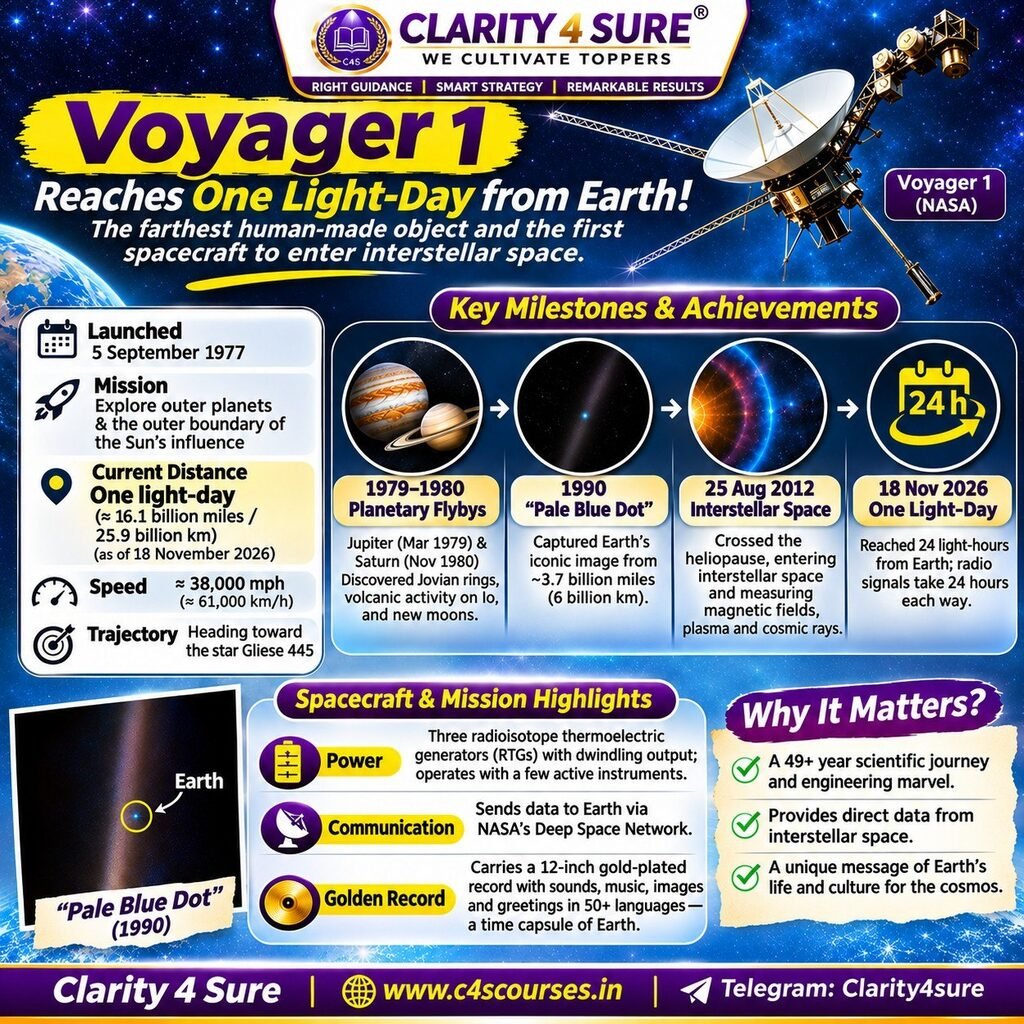
What is NASA's Voyager 1?
NABARD 2021-2024 Cutoff Analysis | What we can Learn? #nabard_grade_a_exam #nabard_cutoffTap to play · from the C4S channel
NASA’s Voyager 1 is an unmanned robotic spacecraft launched in 1977 as part of the Voyager programme. It was designed to study the outer planets of the Solar System, particularly Jupiter and Saturn, along with their moons and surrounding environments.
After completing its planetary exploration, Voyager 1 continued its journey beyond the heliosphere and entered interstellar space. It is currently the most distant human-made object from Earth.
Key facts about Voyager 1
| Particulars | Details |
|---|---|
| Mission name | Voyager 1 |
| Launch date | 5 September 1977 |
| Launch location | Cape Canaveral, Florida, USA |
| Launch agency | NASA |
| Managed by | Jet Propulsion Laboratory (JPL) |
| Mission type | Unmanned robotic space probe |
| Primary objective | Exploration of Jupiter and Saturn |
| Current mission | Interstellar exploration |
| Major milestone | Reached one light-day from Earth on 18 November 2026 |
| Power source | Radioisotope Thermoelectric Generators (RTGs) |
| Communication system | NASA’s Deep Space Network (DSN) |
A clean PDF of this page with the C4S header — it opens right away, and the link comes to your WhatsApp too.
What Does One Light-Day from Earth Mean?
One of the most important aspects of Voyager 1’s recent achievement is the concept of a light-day. A light-day is a unit of distance, not time. It refers to the distance that light travels in a vacuum in 24 hours. Since light travels at approximately 299,792 kilometres per second, one light-day is approximately 25.9 billion kilometres.
Understanding the milestone
- Distance from Earth: Approximately 25.9 billion kilometres.
- Equivalent distance: Approximately 16.1 billion miles.
- Time taken by light: 24 hours to travel this distance.
- Radio communication: A signal takes approximately one day to travel from Earth to Voyager 1.
- Round-trip communication: A command and its response can take approximately 48 hours.
This means that scientists cannot communicate with Voyager 1 in real time.
- For example, if NASA sends a command to the spacecraft, it takes approximately 24 hours to reach it. If Voyager 1 sends a response immediately, another 24 hours are required for that response to reach Earth.
- Therefore, engineers must plan spacecraft operations carefully and account for significant communication delays.NASA Science+1
History of NASA's Voyager 1 Mission
The Voyager programme is one of NASA’s most successful and longest-running space exploration missions.
The programme consists of two spacecraft:
- Voyager 1
- Voyager 2
Both spacecraft were launched in 1977 to explore the outer Solar System.
A. Launch in 1977
- Voyager 1 was launched on 5 September 1977 from Cape Canaveral, Florida.
- Interestingly, Voyager 2 was launched earlier, on 20 August 1977.
- Although Voyager 1 was launched later, it followed a faster trajectory and reached Jupiter and Saturn before its twin spacecraft.
B. Exploration of Jupiter (1979)
- Voyager 1 reached Jupiter in March 1979.
- During its journey, it made several important observations about the planet and its moons.
- One of its most remarkable discoveries was active volcanic activity on Io, one of Jupiter’s moons.
- This was the first direct evidence of active volcanoes outside Earth.
- The spacecraft also studied Jupiter’s atmosphere, magnetic field, radiation environment and complex moon system.
C. Exploration of Saturn (1980)
- Voyager 1 reached Saturn in November 1980.
- It provided valuable information about Saturn’s rings, atmosphere and moons.
- One of its major achievements was the detailed study of Titan, Saturn’s largest moon.
- The observations revealed important details about Titan’s dense, nitrogen-rich atmosphere.
D. Entry into Interstellar Space (2012)
- On 25 August 2012, Voyager 1 crossed the heliopause and entered interstellar space.
- It became the first human-made spacecraft to enter this region.
- This was one of the most important achievements in the history of space exploration.
E. One Light-Day from Earth (2026)
- On 18 November 2026, Voyager 1 reached a distance of approximately 25.9 billion kilometres from Earth.
- It became the first human-made object to reach the one-light-day distance milestone.NASA Jet Propulsion Laboratory (JPL)+1
What is the Voyager Programme?
- The Voyager programme is a NASA space exploration mission launched in 1977 to study the outer planets and explore the distant regions of the Solar System. It consists of two spacecraft, Voyager 1 and Voyager 2.
- Both spacecraft were designed to take advantage of a rare planetary alignment that made it possible to visit multiple outer planets using gravitational assistance.
Objectives of the Voyager Programme
- Study the outer planets of the Solar System.
- Examine the atmospheres, magnetic fields and moons of giant planets.
- Investigate the structure of planetary rings.
- Study the environment beyond the heliosphere.
- Collect scientific information about interstellar space.
Difference Between Voyager 1 and Voyager 2
| Basis | Voyager 1 | Voyager 2 |
|---|---|---|
| Launch date | 5 September 1977 | 20 August 1977 |
| First major planetary encounter | Jupiter | Jupiter |
| Saturn exploration | Yes | Yes |
| Uranus exploration | No | Yes |
| Neptune exploration | No | Yes |
| Entry into interstellar space | August 2012 | November 2018 |
| Current mission | Interstellar exploration | Interstellar exploration |
An important distinction is that Voyager 1 travelled towards interstellar space after its Saturn encounter, whereas Voyager 2 continued its journey to Uranus and Neptune. Voyager 2 remains the only spacecraft to have visited both Uranus and Neptune.
What is the Heliopause and Interstellar Space?
To understand Voyager 1’s journey, it is important to understand two scientific terms: heliosphere and heliopause.
A. Heliosphere
- The heliosphere is a large protective bubble surrounding the Sun and the planets.
- It is created by the continuous flow of charged particles from the Sun, known as the solar wind, along with the Sun’s magnetic field.
- The heliosphere extends far beyond the orbit of Pluto.
- It helps shield the Solar System from a significant portion of galactic cosmic radiation.
B. Heliopause
- The heliopause is the outer boundary of the heliosphere.
- It is the region where the outward pressure of the solar wind becomes balanced by the pressure of the surrounding interstellar medium.
- When a spacecraft crosses this boundary, it enters interstellar space.
C. Interstellar Space
- Interstellar space refers to the region between stars.
- It contains gas, dust, magnetic fields and energetic particles.
- Voyager 1 crossed the heliopause on 25 August 2012 and became the first human-made spacecraft to enter interstellar space.
- Voyager 2 crossed the heliopause in November 2018.
Important: Entering interstellar space does not mean leaving the Solar System completely. The Sun’s gravitational influence extends much farther than the heliosphere.
Key Features of NASA's Voyager 1
Voyager 1 was designed to operate in the extreme conditions of deep space for several decades. Its engineering features have helped it continue its mission long after its original planetary exploration objectives were completed.
1. Nuclear Power Source: Radioisotope Thermoelectric Generators
- Voyager 1 does not depend on solar panels for electricity.
- Instead, it uses three Radioisotope Thermoelectric Generators (RTGs) powered by plutonium-238.
- These generators convert heat produced by radioactive decay into electrical energy.
- RTGs are particularly useful for deep-space missions because sunlight becomes extremely weak at large distances from the Sun.
- However, the electrical output of these generators gradually decreases over time as the radioactive material decays.
2. Deep Space Communication
- Voyager 1 communicates with Earth through NASA’s Deep Space Network (DSN).
- It uses a high-gain antenna approximately 3.7 metres in diameter to transmit and receive radio signals.
The Deep Space Network consists of large communication facilities located at three major sites:
- Goldstone, California, USA.
- Madrid, Spain.
- Canberra, Australia.
These facilities are positioned approximately 120 degrees apart around Earth, allowing NASA to maintain communication with distant spacecraft as our planet rotates.
3. Remote Reprogrammability
- Voyager 1 contains onboard computers that can be reprogrammed remotely.
- This feature has allowed NASA engineers to modify software, correct technical problems and improve spacecraft operations even after decades in space.
4. Scientific Instruments
Voyager 1 carries scientific instruments designed to study the planetary environment and interstellar space. These instruments measure:
- Cosmic rays.
- Charged particles.
- Magnetic fields.
- Plasma waves.
- Solar wind and interstellar particle environments.
Over time, several instruments have been switched off to conserve electrical power.
5. Voyager Golden Record
- One of the most interesting features of Voyager 1 is the Golden Record.
- It carries a gold-plated copper record containing sounds, music, images and greetings from Earth.
- The record was designed as a message to any intelligent extraterrestrial civilisation that might encounter the spacecraft in the distant future.
- It represents humanity’s attempt to communicate information about Earth and human civilisation beyond our planet.NASA Jet Propulsion Laboratory (JPL)+1
What is the Voyager Golden Record?
The Voyager Golden Record is a 12-inch gold-plated copper disc carried by both Voyager 1 and Voyager 2. It was designed to communicate information about Earth and humanity to potential extraterrestrial life. The project was led by a team headed by renowned astronomer Carl Sagan.
What does the Golden Record contain?
The record contains:
- Greetings in 55 languages.
- Natural sounds from Earth, including wind, thunder and animal sounds.
- Human sounds, including laughter.
- Approximately 90 minutes of music from different cultures and musical traditions.
- 115 encoded images representing life and civilisation on Earth.
- Messages from important human figures, including US President Jimmy Carter and United Nations Secretary-General Kurt Waldheim.
The record also includes instructions explaining how it can be played. It is intended to act as a cultural message from Earth to the wider universe.
Major Scientific Discoveries and Contributions of Voyager 1
Voyager 1 has made several important contributions to planetary science and astronomy.
A. Discovery of Active Volcanoes on Io
- One of Voyager 1’s most important discoveries was active volcanic activity on Io, a moon of Jupiter.
- It revealed that volcanic activity is not limited to Earth.
- This discovery changed scientists’ understanding of geological activity on other celestial bodies.
B. Study of Jupiter
- Voyager 1 provided detailed observations of Jupiter’s atmosphere, magnetic field, radiation belts and moons.
- Its findings helped scientists better understand the largest planet in our Solar System.
C. Study of Saturn’s Rings
The spacecraft examined Saturn’s complex ring system and helped improve scientific understanding of its structure and composition.
D. Study of Titan
- Voyager 1 studied Titan’s dense atmosphere, which is primarily composed of nitrogen.
- Its observations provided important information about the largest moon of Saturn.
E. Exploration of Interstellar Space
After entering interstellar space in 2012, Voyager 1 began providing direct measurements of the environment beyond the heliosphere.
Its observations have helped researchers understand:
- Galactic cosmic rays.
- Interstellar magnetic fields.
- Charged particles.
- Plasma waves.
- The interaction between the heliosphere and interstellar medium.
F. The Pale Blue Dot Photograph
- On 14 February 1990, Voyager 1 captured one of the most famous photographs in the history of astronomy.
- The photograph became known as the Pale Blue Dot.
- It showed Earth as a tiny point of light from an enormous distance of approximately 6 billion kilometres.
- The image became a powerful reminder of Earth’s small place in the vast universe.
- The photograph also inspired reflections on humanity’s shared existence and the importance of protecting our planet.
Current Status of Voyager 1: Technical Challenges in 2026
Despite travelling through space for nearly five decades, Voyager 1 continues to represent an extraordinary achievement in engineering. However, the spacecraft is now facing serious technical challenges due to its age and declining power supply.
NASA reported that Voyager 1 stopped transmitting its science and engineering data on 14 November 2026. Although the Deep Space Network received a carrier signal from the spacecraft, the expected scientific and engineering data were not being received. A carrier signal indicates that the spacecraft’s radio transmission is being detected, but it does not necessarily mean that usable science data are reaching Earth. Engineers are investigating the cause of the problem.
NASA was still able to confirm the spacecraft’s one-light-day milestone using its carrier signal and trajectory calculations. The mission team continues to work on extending the spacecraft’s operational life through power conservation and technical adjustments. This demonstrates the importance of long-term engineering innovation in deep-space exploration.NASA Science+1
Why Is Voyager 1 Important for Future Space Exploration?
Voyager 1 is not simply a spacecraft travelling away from Earth. It is an important scientific mission that has expanded our understanding of the Solar System and the interstellar environment. Its contributions are significant in several ways.
1. Understanding interstellar space
Voyager 1 provides direct scientific observations from a region beyond the heliosphere.
2. Advancing space communication
Its mission demonstrates how radio communication can be maintained over billions of kilometres.
3. Improving spacecraft engineering
The mission has provided valuable lessons about spacecraft reliability, power management and remote troubleshooting.
4. Understanding planetary systems
Its observations of Jupiter, Saturn and their moons have contributed significantly to planetary science.
5. Inspiring future missions
The Voyager programme has demonstrated the scientific value of long-duration space missions and encouraged further exploration of distant regions of space.
Voyager 1 and Other Important Space Missions
Voyager 1 is part of a wider history of human exploration beyond Earth. Some other important space missions include:
| Mission | Organisation | Major Objective |
|---|---|---|
| Voyager 1 | NASA | Jupiter, Saturn and interstellar space |
| Voyager 2 | NASA | Jupiter, Saturn, Uranus, Neptune and interstellar space |
| New Horizons | NASA | Pluto and Kuiper Belt exploration |
| Pioneer 10 | NASA | First spacecraft to fly past Jupiter |
| Parker Solar Probe | NASA | Study of the Sun’s outer atmosphere |
| Juno | NASA | Study of Jupiter’s atmosphere and interior |
| Cassini-Huygens | NASA, ESA and ASI | Study of Saturn and Titan |
These missions have expanded our knowledge of planetary systems, the Sun and the wider universe.
Important Organisations Associated with Voyager 1
| Organisation | Role |
|---|---|
| NASA | Space agency responsible for the mission |
| Jet Propulsion Laboratory (JPL) | Manages the Voyager mission |
| California Institute of Technology (Caltech) | Operates JPL |
| Deep Space Network (DSN) | Provides communication with the spacecraft |
Conclusion
NASA’s Voyager 1 represents one of humanity’s greatest achievements in space exploration. Launched in 1977 with the objective of studying the outer planets, it has travelled far beyond its original mission and entered the unexplored environment of interstellar space. Its achievement of reaching one light-day from Earth on 18 November 2026 is a historic milestone. The spacecraft has travelled approximately 25.9 billion kilometres, and its radio signals now take around 24 hours to reach Earth.
Apart from its distance record, Voyager 1 has made important contributions to our understanding of Jupiter, Saturn, their moons and the interstellar environment. Although ageing technology and declining power present serious challenges, the mission continues to demonstrate the importance of scientific innovation, engineering excellence and human curiosity.
Voyager 1 is a reminder that human exploration does not end at the boundaries of our Solar System. It continues into the vastness of the universe.
Frequently Asked Questions (FAQs)
Q1. What is NASA's Voyager 1?
Voyager 1 is an unmanned robotic spacecraft launched by NASA in 1977 to explore the outer planets of the Solar System and subsequently study interstellar space.
Q2. When was Voyager 1 launched?
It was launched on 5 September 1977 from Cape Canaveral, Florida, USA.
Q3. When did Voyager 1 enter interstellar space?
Voyager 1 crossed the heliopause and entered interstellar space on 25 August 2012.
Q4. What is the one-light-day milestone achieved by Voyager 1?
On 18 November 2026, Voyager 1 reached approximately 25.9 billion kilometres from Earth, equivalent to the distance light travels in 24 hours.
Q5. What is a light-day?
A light-day is a unit of distance representing how far light travels in a vacuum in 24 hours, approximately 25.9 billion kilometres.
Q6. What is the power source of Voyager 1?
It uses three Radioisotope Thermoelectric Generators powered by plutonium-238.
Q7. What is the Voyager Golden Record?
It is a gold-plated copper disc containing sounds, music, images and greetings from Earth, intended as a message to potential extraterrestrial life.
Q8. What is the Deep Space Network?
NASA’s Deep Space Network is a global system of large radio antennas used to communicate with spacecraft operating far from Earth.
Q9. What is the Pale Blue Dot?
It is a famous photograph of Earth captured by Voyager 1 on 14 February 1990, showing our planet as a tiny point of light from approximately 6 billion kilometres away.
Q10. Which spacecraft was the first to enter interstellar space?
NASA’s Voyager 1 became the first human-made spacecraft to enter interstellar space in August 2012.
Q11. What is the difference between the heliosphere and heliopause?
The heliosphere is the protective bubble created by the Sun’s solar wind and magnetic field, while the heliopause is its outer boundary.