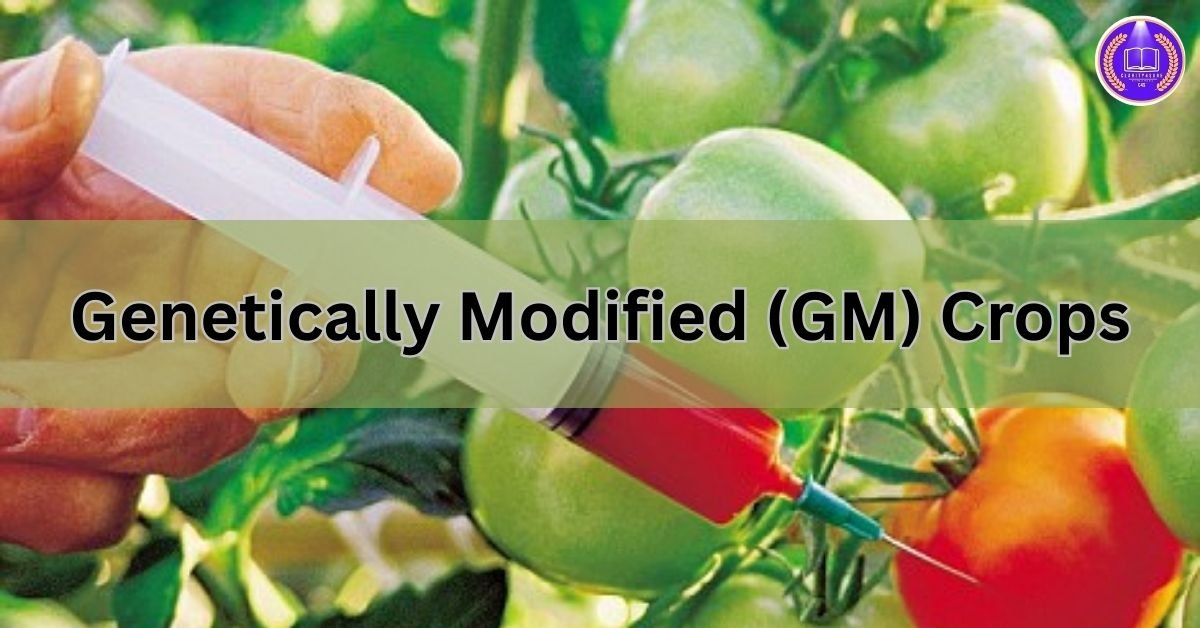
A Genetically Modified crop is created when new DNA is introduced into plant cells. Plant genetic modification entails inserting a specific stretch of DNA into the plant’s genome to confer new or different characteristics.
Introduction
Genetic modification (GM) is a scientific technique in which a piece of DNA is deliberately introduced into the genetic material of a living organism. In plants, this process involves adding a specific segment of DNA to the plant’s genome so that it develops new or improved traits, such as resistance to certain diseases. Globally, the most commonly grown genetically modified crops are cotton, soybeans, maize, and canola, mainly engineered for herbicide tolerance and resistance to insect pests. The United States, Brazil, Argentina, India, and Canada are the leading countries cultivating GM crops, and together they account for about 90% of the total area under GM cultivation worldwide.
GM Crops and their Development
Genetically modified (GM) crops were first introduced in the United States in 1994 with the Flavr Savr tomato, which was developed to slow down the ripening process and delay softening and spoilage. Even before GM crops entered agriculture, genetic modification was already being widely used in the medical field to produce products such as insulin, vaccines, and other pharmaceutical drugs on a large scale.
- Objectives of the GM crops:
- Reducing dependence on pesticides/herbicides as the toxins produced by the GM crops (such as Bt-toxins) are used to kill the pests
- Providing resistance to certain plant viruses
- Providing tolerance of herbicides used to control weeds
- Reducing the need to till the soil to control weeds
- Bt genes:
- Bacillus thuringiensis (Bt) is a bacterium that produces two important proteins – cytolytic (Cyt) and crystal (Cry) toxins, which are toxic to a specific group of insects such as beetles, caterpillars, flies, mosquitoes, etc.
- The genes expressing these toxins are engineered into plant crops so that they too have the ability to produce them. For example: Bt Cotton
Methods of producing GM Crops
To genetically modify a crop, a specific gene that provides a desired trait—such as Cry or Cyt genes or any other useful gene—is inserted into the plant’s DNA. This process is mainly carried out using two methods: one involves recombinant DNA technology, where Agrobacterium tumefaciens is used as a natural carrier to transfer the gene into the plant, and the other is a direct method, in which the gene is introduced straight into the plant cells using physical or chemical techniques.
Direct approach
- In the direct approach, the desired gene is first inserted into a plant DNA vector.
- This gene is then directly transferred into plant cells using methods such as:
- Gene gun (particle bombardment)
- Electroporation
- Microinjection
- Gene gun (particle bombardment) method
- Very small particles of gold or tungsten are coated with the required DNA (gene).
- These DNA-coated particles are fired into plant cells using a gene gun or particle gun, allowing the gene to enter the plant’s DNA.
Agrobacterium tumefaciens–mediated gene transfer
- Agrobacterium tumefaciens is a soil bacterium often called nature’s genetic engineer.
- It naturally causes crown gall disease in plants by transferring tumour-causing DNA into the plant genome.
- This transfer happens through a special DNA molecule known as the tumour-inducing plasmid (Ti plasmid).
- Scientists remove the disease-causing gene from the Ti plasmid and replace it with the desired gene, creating recombinant DNA.
- The modified T-DNA is then transferred into the plant genome with the help of Agrobacterium tumefaciens.
Advantages of Genetically Modified Crops
Better than conventional breeding
- Genetic modification is a highly effective way to develop pest-resistant crops, such as Bt crops.
- Desired traits can be introduced much faster than through traditional breeding methods.
- It allows the transfer of genes from different organisms, which is not possible through conventional breeding.
Pest resistance
- Bt genes produce substances that are toxic to many insect pests.
- This reduces or eliminates the need for chemical pesticides.
- As a result, crop yields increase, farmers save money, and environmental pollution is reduced.
Virus resistance
- Virus-resistant traits can be added to plants that do not naturally have resistance.
- This helps protect crops and improves overall productivity.
Drought-resistant plants
- Crops can be genetically modified to tolerate drought conditions.
- This reduces dependence on groundwater for irrigation.
Herbicide tolerance
- GM crops can be made resistant to specific herbicides used to control weeds.
- This reduces the need for ploughing and tilling, helping to prevent soil erosion.
- It also lowers soil, water, and air pollution.
Sustainable agricultural practices
- GM crops support sustainable farming methods, such as no-till farming.
- No-till farming helps retain carbon in the soil instead of releasing it into the atmosphere.
Enhanced nutritional value
- Food crops can be genetically modified to increase their nutritional content.
- This can improve human health and strengthen global food security.
Disadvantages of Genetically Modified Crops
- Uncertain long-term consequences
- GM crops may cause horizontal gene transfer of pesticide, herbicide, or antibiotic resistance genes.
- This can alter the metabolism of organisms and their response to environmental factors.
- Such changes may disturb natural ecological balance.
- Impact on human and animal health
- Transfer of resistance genes to other organisms can pose health risks to humans.
- It may also spread diseases among plants and animals, leading to ecological imbalance.
- Impact of herbicide-tolerant crops
- Excessive use of herbicides can cause weeds to develop resistance.
- Example: Continuous use of glyphosate in the USA since 1974 has resulted in glyphosate-resistant weeds.
- Impact of pest resistance
- Insect pests may develop resistance to pest-resistant traits such as Bt toxins.
- This reduces the effectiveness of GM crops over time.
- Impact on genetic diversity
- GM crops may reduce the genetic diversity of nearby crops, wild relatives, and weeds.
- This can weaken agricultural resilience.
- Herbicide-resistant weeds
- Weeds may cross-pollinate with herbicide-tolerant crops.
- This can lead to the emergence of super weeds, which are difficult to control.
- Impact on pollinators
- There is growing global concern that GM crops may negatively affect honeybees and other pollinators.
- This could threaten pollination and food security.
Applications of GM Crops
- Biofortification
- Biofortification enhances the micronutrient content of crops.
- Genetic modification is one of the most effective tools for this.
- Example: Golden Rice, enriched with β-carotene (introduced in 2000).
- It can help prevent diseases such as cancer, diabetes, and cardiovascular disorders.
- Edible vaccines
- GM plants can be used to produce vaccines that are edible.
- They are cheaper to produce and have fewer side effects than traditional vaccines.
- Biofuels
- Fourth-generation biofuels are produced using GM algae and cyanobacteria.
- These biofuels are gaining attention as sustainable energy sources.
- Phytoremediation
- GM plants can clean polluted soil and water.
- They do so by expressing genes that break down harmful pollutants.
GM Crops in India
- Several GM crops such as brinjal, tomato, maize, and chickpea are under different stages of trials.
- India is among the leading producers of GM crops globally.
Regulatory Framework for GM Crops in India
- India has strict laws to protect human health, animal safety, and biodiversity during:
- Development
- Cultivation
- Environmental release
- Transboundary movement of GM crops
Statutory Bodies Involved
- Recombinant DNA Advisory Committee (RDAC)
- Monitors biotechnology developments at national and international levels.
- Review Committee on Genetic Manipulation (RCGM)
- Reviews high-risk research and controlled field trials.
- Approves applications for generating research data on GM plants.
- Genetic Engineering Appraisal Committee (GEAC)
- Evaluates proposals for environmental release of GM organisms.
- Functions under the Ministry of Environment.
- GEAC Safety Assessment
- Includes:
- Molecular characterisation
- Food safety studies
- Environmental safety studies
- Field trials
- Soil impact studies
- Pollen flow analysis
- Includes:
- State Biotechnology Coordination Committee (SBCC)
- Reviews safety measures in institutions handling GM organisms.
- Acts as the state-level nodal authority.
Status of GM Crops in India
- Bt Cotton
- Commercialised in 2002.
- Only GM crop approved for commercial cultivation in India.
- Developed to control bollworm infestation.
- Led to major improvement in cotton production, exports, and the textile industry.
- Bt Brinjal
- Resistant to fruit and shoot borer.
- Approved by GEAC in 2009.
- Placed under a 10-year moratorium due to public opposition.
- New indigenous varieties approved for field trials (2020–2023) in eight states.
- GM Mustard
- Developed for higher yield.
- Commercial cultivation has not yet started in India.