Introduction
Genome editing is transforming the world of science and medicine in ways we never thought possible. The ability to precisely modify DNA has opened doors to curing genetic diseases, improving agricultural productivity, and even preventing future pandemics. However, as with any groundbreaking technology, genome editing also raises important ethical, legal, and social concerns.
What is Genome Editing?
Genome editing, also known as gene editing, is a scientific technique that allows researchers to modify an organism’s DNA. This process enables scientists to make targeted changes to genetic material, either by removing, adding, or altering DNA sequences.
With genome editing, researchers can fix genetic mutations, create disease-resistant crops, and even engineer bacteria for industrial and environmental benefits. The most well-known genome-editing tool is CRISPR-Cas9, but several other methods exist as well.
The History of Genome Editing
The idea of altering DNA isn’t new. Scientists have been modifying genes for decades, but earlier methods were slow, expensive, and imprecise. Let’s take a look at some major breakthroughs that led to modern genome editing:
- 1970s: Early Genetic Engineering
- Scientists started modifying DNA using recombinant DNA technology, allowing them to insert foreign genes into bacteria.
- 1980s-1990s: Gene Targeting in Mice
- Gene editing became more refined with the ability to create genetically modified mice for research.
- 2000s: Zinc Finger Nucleases (ZFNs) and TALENs
- These were the first real genome-editing tools that allowed scientists to make precise changes in DNA. However, they were costly and complex.
- 2012: The CRISPR-Cas9 Revolution
- Scientists Jennifer Doudna and Emmanuelle Charpentier developed CRISPR-Cas9, a faster, cheaper, and more precise genome-editing tool. This breakthrough won them the 2020 Nobel Prize in Chemistry.
- 2020s and Beyond: Advanced Genome Editing
- New technologies like prime editing and base editing offer even more precision with fewer unintended mutations.
How Does Genome Editing Work?
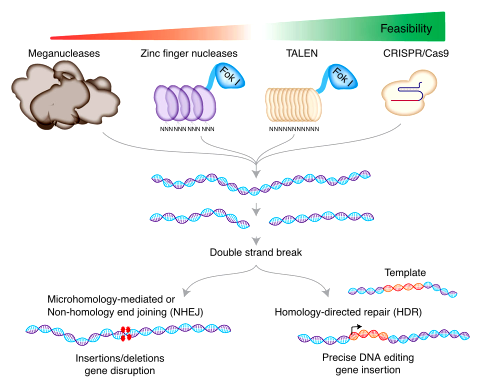
Genome editing works by using special enzymes called nucleases to cut DNA at specific locations. Once the DNA is cut, cells naturally repair the damage, allowing scientists to introduce changes during the repair process.
Key Genome Editing Techniques
- CRISPR-Cas9
- The most widely used genome-editing tool.
- Uses a guide RNA (gRNA) to direct the Cas9 enzyme to the exact location in the genome where it needs to make a cut.
- Once the DNA is cut, scientists can insert, delete, or modify genetic material.
- TALENs (Transcription Activator-Like Effector Nucleases)
- A precise genome-editing tool that binds to specific DNA sequences.
- More accurate than earlier methods but less efficient than CRISPR.
- Zinc Finger Nucleases (ZFNs)
- One of the first genome-editing technologies, but it is expensive and difficult to design.
- Prime Editing
- A newer, more precise method that doesn’t require cutting both DNA strands.
- Reduces the risk of unintended mutations.
- Base Editing
- Allows scientists to change single DNA letters without cutting the DNA.
- Ideal for correcting point mutations (small genetic errors).
Genome Editing and Its Connection to DNA & RNA
- Genome editing is a revolutionary technology that allows scientists to modify an organism’s DNA with precision.
- Since DNA (Deoxyribonucleic Acid) carries genetic instructions for life, editing it can correct mutations, enhance traits, or study diseases.
- RNA (Ribonucleic Acid) plays a crucial role in this process, as many genome-editing tools, like CRISPR-Cas9, use guide RNA (gRNA) to target specific DNA sequences for modification.
- Advances in genome editing, including base editing and prime editing, allow precise changes at the molecular level, opening doors to new medical treatments, improved crops, and scientific breakthroughs.
Applications of Genome Editing
Genome editing has potential applications in various fields, including medicine, agriculture, and environmental conservation.
1. Medical Breakthroughs
Treating Genetic Disorders
- Genome editing offers hope for curing diseases caused by faulty genes, such as:
- Sickle cell anemia –
- Scientists are using CRISPR to correct the mutation responsible for this disease.
- Cystic fibrosis –
- Researchers aim to fix defective genes in lung cells to restore normal function.
- Huntington’s disease –
- Gene editing could potentially silence the faulty gene that causes this neurodegenerative disorder.
- Sickle cell anemia –
Cancer Treatment
- Scientists are using genome editing to modify immune cells (T cells) to attack cancer more effectively.
- CAR-T cell therapy, a form of gene therapy, is already showing success in treating blood cancers.
Infectious Disease Prevention
- Researchers are investigating how genome editing could eliminate viruses like HIV by removing them from infected cells.
- CRISPR is also being used to develop new antiviral treatments for diseases like COVID-19.
2. Agricultural Advancements
Genome editing is revolutionizing farming by creating:
- Pest-resistant crops –
- Scientists have developed crops like CRISPR-edited wheat and corn that resist pests, reducing pesticide use.
- Drought-tolerant plants –
- Climate change is threatening food security, but gene-edited crops can survive extreme conditions.
- Nutrient-rich foods –
- Scientists are developing crops with higher vitamins and minerals to combat malnutrition.
One exciting example is golden rice, which has been genetically modified to produce vitamin A, helping prevent blindness in children in developing countries.
3. Environmental Applications
Genome editing is being explored for environmental conservation:
- Reducing greenhouse gas emissions –
- Scientists are modifying microbes to break down pollutants.
- Gene drives to control pests –
- Scientists are developing gene drives that could reduce populations of disease-carrying mosquitoes.
- Biodegradable plastics –
- Engineered bacteria could produce sustainable materials to replace traditional plastics.
Ethical Concerns and Controversies
Despite its potential benefits, genome editing raises important ethical questions:
1. Designer Babies
- Should we allow parents to select traits like intelligence, height, or eye color in their children?
- Could this create genetic inequality, where only the rich can afford genetic enhancements?
2. Unintended Consequences
- Genome editing is powerful, but mistakes could create new diseases or harmful mutations.
- Off-target effects (unintentional edits) remain a concern.
3. Who Regulates Genome Editing?
- Some countries, like China, have moved forward aggressively with gene-editing research.
- Others, like the US and Europe, have stricter regulations to prevent unethical use.
Genome Editing in India
Genome editing is an emerging technology in India with significant potential in medicine, agriculture, and biotechnology. Indian scientists and researchers are actively working on CRISPR-based gene editing to address genetic disorders, improve crop yield, and contribute to global scientific advancements.
Genome Editing Research in India
India is investing in genome editing through various research institutions and government initiatives. Some of the key areas of research include:
A. Medical Applications
- Scientists at the CSIR-Institute of Genomics and Integrative Biology (CSIR-IGIB) and Indian Institute of Science (IISc) are exploring CRISPR-based therapies for diseases like:
- Sickle cell anemia
Beta-thalassemia
Cancer therapies
- Sickle cell anemia
- Research is also underway to use genome editing in stem cell therapy and regenerative medicine.
B. Agricultural Applications
- Indian agricultural research institutions like ICAR (Indian Council of Agricultural Research) and IARI (Indian Agricultural Research Institute) are using gene editing to:
- Develop drought-resistant and pest-resistant crops
Improve rice, wheat, and mustard yields
Enhance nutritional content in staple foods
- Develop drought-resistant and pest-resistant crops
- The National Institute of Plant Genome Research (NIPGR) is actively using CRISPR technology to improve plant genetics.
C. Livestock and Dairy Industry
- Genome editing is being explored to improve cattle breeds for higher milk yield and disease resistance.
- Scientists are also working on editing buffalo and poultry genetics for better productivity.
Regulations and Ethical Concerns in India
A. Government Regulations
- Genome editing is regulated under the Environment Protection Act, 1986 and the Rules for Manufacture, Use, Import, Export, and Storage of Hazardous Microorganisms (1989).
- The Department of Biotechnology (DBT) and the Genetic Engineering Appraisal Committee (GEAC) oversee genome-editing research.
- Unlike GMOs (Genetically Modified Organisms), genome-edited crops that do not introduce foreign genes (SDN-1 and SDN-2) may have simpler regulatory approvals.
B. Ethical Concerns
- Editing human embryos remains highly controversial and is not legally allowed in India.
- Concerns exist about off-target effects (accidental genetic changes).
- There is debate on affordability and accessibility, ensuring gene-editing benefits reach all sections of society.
Future of Genome Editing in India
- The Indian government is increasing funding for genome-editing research.
- More clinical trials may be conducted in the coming years for gene-editing therapies.
- CRISPR-based crops could help India reduce dependency on pesticides and increase food security.
- India is also collaborating with global institutions to advance gene-editing research.
Way Forward
The future of genome editing is both exciting and uncertain. Some of the developments we can expect include:
- Gene-editing therapies for rare diseases becoming more accessible and affordable.
- CRISPR-based diagnostics and treatments for infectious diseases.
- Lab-grown organs using gene-edited stem cells for transplantation.
- Global regulations and ethical guidelines to ensure responsible use of genome editing.
Scientists believe that genome editing could one day be as common as vaccines, providing personalized medicine and preventive treatments for genetic conditions.
Conclusion
Genome editing is one of the most powerful scientific tools of our time. While it offers incredible potential to cure diseases, improve food security, and even combat climate change, it must be used responsibly.
As research progresses, we must balance innovation with ethics to ensure that gene editing benefits all of humanity—without creating unintended consequences.