The Cabinet Committee on Economic Affairs (CCEA), chaired by the Prime Minister Shri Narendra Modi, has approved the increase in the Minimum Support Prices (MSP) for all mandated Rabi Crops for Marketing Season 2027-28. Government has increased the Minimum Support Prices (MSP) of Rabi Crops for Marketing Season 2027-28, to ensure remunerative prices to the growers for their produce.
Why in News?
Introduction
NABARD 2021-2024 Cutoff Analysis | What we can Learn? #nabard_grade_a_exam #nabard_cutoffTap to play · from the C4S channel
The Cabinet Committee on Economic Affairs (CCEA), chaired by Prime Minister Shri Narendra Modi, has approved a hike in the Minimum Support Prices (MSP) for all mandated Rabi crops for Marketing Season 2027-28.
The decision aims to provide remunerative prices to farmers, improve farm income, encourage the cultivation of pulses and oilseeds, and promote crop diversification. The highest absolute increase has been announced for safflower at ₹675 per quintal, followed by rapeseed and mustard at ₹413 per quintal. This MSP decision is also aligned with the government’s policy of fixing MSP at at least 1.5 times the all-India weighted average cost of production.
A clean PDF of this page with the C4S header — it opens right away, and the link comes to your WhatsApp too.
MSP for Rabi Crops 2027-28: Key Highlights
Free live session
NABARD Sprint 60: the 2025 cut-offs and your 60-day Phase I plan
8 of the top 10 in NABARD Grade A 2025, Rank 1 included, and Rank 1 back to back before that in 2021 and 2022: all prepared with C4S. The 2025 cycle was the toughest on record at every stage. This session reads those numbers properly and turns them into a 60-day, week-by-week plan for Phase I.
In 2 days · Sun, 11 Oct at 7:30 PM IST · 75 minutes · free
The government has increased the MSP of all six mandated Rabi crops for the 2027-28 marketing season.
| Rabi Crop | MSP 2027-28 (₹/quintal) | Cost of Production (₹/quintal) | Margin Over Cost | MSP 2026-27 (₹/quintal) | Increase (₹/quintal) |
|---|---|---|---|---|---|
| Wheat | 2,610 | 1,264 | 106% | 2,585 | 25 |
| Barley | 2,286 | 1,447 | 58% | 2,150 | 136 |
| Gram | 5,958 | 3,751 | 59% | 5,875 | 83 |
| Lentil (Masur) | 7,390 | 3,854 | 92% | 7,000 | 390 |
| Rapeseed & Mustard | 6,613 | 3,367 | 96% | 6,200 | 413 |
| Safflower | 7,215 | 4,810 | 50% | 6,540 | 675 |
Which Rabi Crop Got the Highest MSP Increase?
Among the six mandated Rabi crops, safflower received the highest absolute MSP increase.
MSP Increase for Rabi Crops 2027-28
- Safflower: ₹675/quintal
- Rapeseed & Mustard: ₹413/quintal
- Lentil (Masur): ₹390/quintal
- Barley: ₹136/quintal
- Gram: ₹83/quintal
- Wheat: ₹25/quintal
Therefore, safflower recorded the highest MSP increase, while wheat received the lowest absolute increase.
What is Minimum Support Price (MSP)?
Minimum Support Price (MSP) is a government-announced price at which farmers are assured a minimum price for selected agricultural commodities, particularly when market prices fall. MSP is intended to:
- Protect farmers from sharp falls in market prices
- Provide a remunerative return on agricultural production
- Encourage the production of important crops
- Support food security
- Promote crop diversification
- Provide greater income stability to farmers
The MSP is announced for different crops for their respective marketing seasons based on recommendations of the Commission for Agricultural Costs and Prices (CACP) and the government’s consideration of various economic and agricultural factors.
MSP for Rabi Crops 2027-28 and Farmers' Income
The latest MSP decision is significant because Rabi crops form an important part of India’s agricultural production. Wheat, barley, gram, lentil, rapeseed and mustard, and safflower are among the important Rabi crops for which MSP has been increased. Higher MSP can provide farmers with greater price assurance and may encourage them to continue cultivating these crops. The increase is particularly significant for pulses and oilseeds, where the government has been seeking to increase domestic production and reduce dependence on imports.
MSP and the 1.5 Times Cost of Production Formula
One of the most important aspects of India’s MSP policy is the government’s commitment to fixing MSP at at least 1.5 times the all-India weighted average cost of production. This approach was announced in the Union Budget 2018-19.
For the 2027-28 Rabi Marketing Season, the expected margins over the all-India weighted average cost of production are:
| Crop | Margin Over Cost |
|---|---|
| Wheat | 106% |
| Rapeseed & Mustard | 96% |
| Lentil | 92% |
| Gram | 59% |
| Barley | 58% |
| Safflower | 50% |
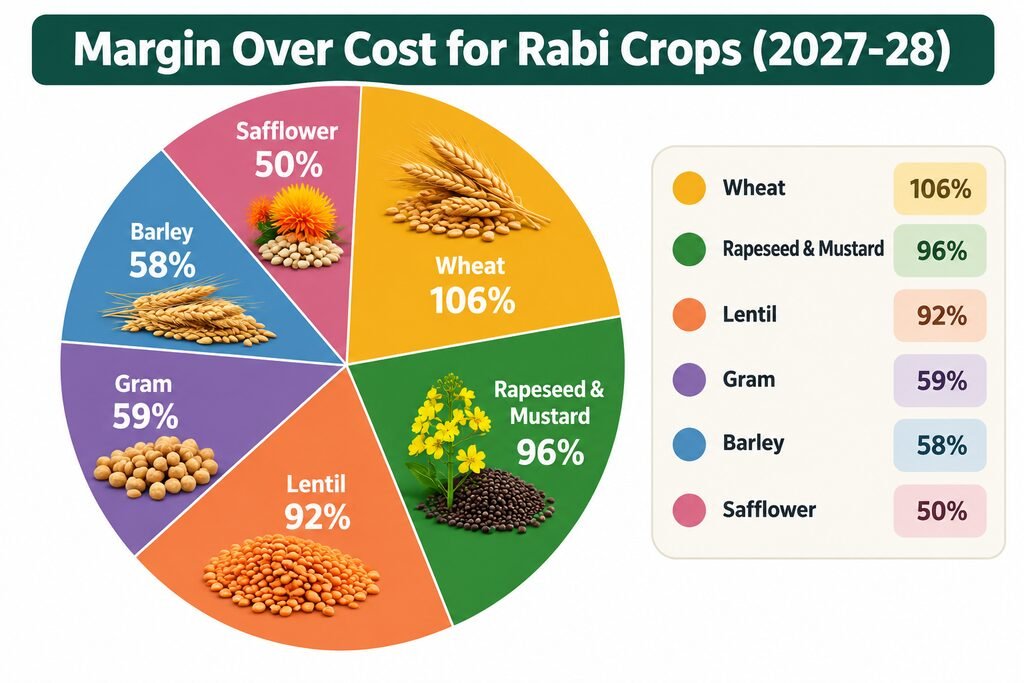
Wheat has the highest expected margin at 106%, while safflower has a margin of 50% over its estimated cost of production.
Why Has the Government Increased MSP for Rabi Crops?
The MSP increase has several important objectives.
1. Ensuring Remunerative Prices
The primary objective is to ensure that farmers receive a reasonable return for their agricultural produce. Higher MSP provides a price benchmark and can protect farmers from unfavourable market conditions.
2. Increasing Farmers’ Income
Higher support prices can improve the potential income of farmers, particularly when market prices remain close to or below MSP.
3. Promoting Crop Diversification
The government has been encouraging farmers to move beyond cereals and increase the cultivation of pulses and oilseeds. Higher MSP for crops such as lentil, rapeseed and mustard, and safflower can support this objective.
4. Encouraging Pulses Production
Pulses are important for India’s food and nutritional security. Increasing MSP for pulses such as gram and lentil can encourage farmers to expand production.
5. Supporting Oilseed Production
Rapeseed and mustard and safflower are important oilseed crops. Better price incentives can encourage farmers to increase oilseed cultivation and contribute to India’s efforts to strengthen domestic edible oil production.
Government Procurement of Wheat Has Increased
The government’s procurement data also highlights the growing scale of agricultural procurement. During 2014-15 to 2025-26, wheat procurement increased to 3,715 LMT, compared with 2,254 LMT during 2004-05 to 2013-14. This indicates a substantial increase in the quantity of wheat procured under the government’s procurement system.
Wheat Procurement Comparison
| Period | Wheat Procurement |
|---|---|
| 2004-05 to 2013-14 | 2,254 LMT |
| 2014-15 to 2025-26 | 3,715 LMT |
LMT = Lakh Metric Tonnes
Procurement of Six Rabi Crops Also Increased
Procurement of the six Rabi crops has also increased significantly. During 2014-15 to 2025-26, procurement of the six Rabi crops reached 3,921 LMT, compared with 2,302 LMT during 2004-05 to 2013-14.
| Period | Procurement of 6 Rabi Crops |
|---|---|
| 2004-05 to 2013-14 | 2,302 LMT |
| 2014-15 to 2025-26 | 3,921 LMT |
The increase reflects the growing role of procurement and price-support mechanisms in India’s agricultural policy.
MSP Payments to Wheat Farmers
The amount paid as MSP to wheat-growing farmers has also increased substantially. During 2014-15 to 2025-26, MSP payments to wheat-growing farmers increased to approximately ₹7.31 lakh crore, compared with ₹2.56 lakh crore during 2004-05 to 2013-14.
MSP Payments to Wheat Farmers
- 2004-05 to 2013-14: ₹2.56 lakh crore
- 2014-15 to 2025-26: ₹7.31 lakh crore
This represents a substantial increase in the amount of government procurement expenditure directed towards wheat farmers.
MSP Payments for Six Rabi Crops
The MSP amount paid to farmers growing the six Rabi crops also recorded a major increase.
| Period | MSP Amount Paid |
|---|---|
| 2004-05 to 2013-14 | ₹2.65 lakh crore |
| 2014-15 to 2025-26 | ₹8.36 lakh crore |
Thus, the MSP amount paid for the six Rabi crops increased from ₹2.65 lakh crore during 2004-05 to 2013-14 to ₹8.36 lakh crore during 2014-15 to 2025-26.
Cost of Production: What Does It Include?
The cost of production used for calculating the MSP includes several agricultural expenses. These include:
- Hired human labour
- Bullock labour
- Machine labour
- Rent paid for leased-in land
- Seeds
- Fertilizers
- Manures
- Irrigation charges
- Depreciation on farm implements
- Depreciation on farm buildings
- Interest on working capital
- Diesel and electricity used for pump sets
- Miscellaneous expenses
- Imputed value of family labour
Therefore, the cost of production is not limited to the price of seeds or fertilizers. It covers a broader range of expenses involved in agricultural production.
MSP Increase 2027-28: Impact on Crop Diversification
One of the major policy implications of the latest MSP decision is its potential impact on crop diversification. India has historically had a strong focus on cereal production, particularly wheat and rice. However, the government is increasingly encouraging farmers to cultivate pulses and oilseeds.
The relatively higher MSP increases announced for:
- Lentil
- Rapeseed & mustard
- Safflower
can provide additional price incentives for farmers.
This is important because increasing domestic production of pulses and oilseeds can contribute to:
Higher farm income → Greater crop diversification → Increased domestic production → Better food security → Reduced import dependence
Why Are Pulses and Oilseeds Important for India?
Pulses are an important source of protein in the Indian diet, while oilseeds are critical for edible oil production. India’s agricultural policy has therefore increasingly focused on improving domestic production of these crops. The latest MSP increase supports this broader policy objective by providing relatively attractive price incentives for several pulses and oilseed crops.
MSP Rabi Crops 2027-28
| Crop | MSP 2027-28 | Increase |
|---|---|---|
| Wheat | ₹2,610 | ₹25 |
| Barley | ₹2,286 | ₹136 |
| Gram | ₹5,958 | ₹83 |
| Lentil | ₹7,390 | ₹390 |
| Rapeseed & Mustard | ₹6,613 | ₹413 |
| Safflower | ₹7,215 | ₹675 |
Remember the highest increases:
Safflower → ₹675
Rapeseed & Mustard → ₹413
Lentil → ₹390
Conclusion
The government’s decision to increase the MSP for all mandated Rabi crops for Marketing Season 2027-28 is an important step towards strengthening agricultural price support and improving farmers’ income prospects. The highest increase of ₹675 per quintal for safflower, followed by ₹413 for rapeseed and mustard and ₹390 for lentil, demonstrates the government’s continued focus on encouraging the cultivation of oilseeds and pulses alongside traditional cereal crops.
The decision also reinforces the policy of providing MSP at at least 1.5 times the all-India weighted average cost of production. Along with increased procurement and MSP payments over recent years, the move is aimed at providing greater price assurance to farmers while supporting crop diversification, food security and sustainable agricultural growth. For competitive examinations such as NABARD Grade A, RBI Grade B, SEBI Grade A, IBPS AFO and other agriculture and economy-based exams, the MSP hike is an important topic under Agriculture, Economic & Social Issues (ESI), Rural Development and Current Affairs.