Context
India has submitted its 7th National Report to the Convention on Biological Diversity (CBD). The report evaluates the country’s progress in achieving biodiversity conservation goals aligned with the Kunming–Montreal Global Biodiversity Framework (KMGBF) adopted in 2022, which sets global biodiversity targets to be achieved by 2030.
What is the 7th National Biodiversity Report?
The report is India’s official periodic submission to the CBD, outlining:
- Progress in biodiversity conservation
- Implementation of national biodiversity strategies
- Challenges in achieving global biodiversity targets
It was prepared by the Ministry of Environment, Forest and Climate Change (MoEFCC) in coordination with institutions such as the National Biodiversity Authority (NBA) and other government agencies.
What are the Key Facts Regarding the 7th National Report to the Convention on Biological Diversity?
- About: This is India’s first full progress assessment since the adoption of the KMGBF in 2022, and it works as an important reality check on how committed the country is to stopping biodiversity loss by 2030.
- Preparation and Scope: The report was prepared by the Union Ministry of Environment, Forest and Climate Change (MoEFCC) with inputs from 33 central ministries, the Wildlife Institute of India, the National Biodiversity Authority, and technical support from the United Nations Development Programme (UNDP).
- Report Significance: India is one of the world’s megadiverse countries, so its progress plays a major role in global biodiversity outcomes. The data from this report will contribute to international assessments that track progress toward the 23 global targets of the KMGBF, including the “30×30” goal, which aims to conserve 30% of land and sea by 2030.
- Targets On Track: Progress is measured using 142 national indicators, which are compiled through a digital NR7 data portal.
- NBT1 (Biodiversity-inclusive planning): There has been steady progress, with forest and tree cover reaching 25.17% (827,357 sq km), an increase of 1,445.81 sq km between 2021 and 2023. Wetland inventories have been completed, the PARIVESH 2.0 portal has streamlined environmental approvals, and eco-sensitive zones have been notified.
- NBT2 (Ecosystem Restoration): India has restored or placed under restoration 24.1 million hectares out of its 26 million hectare Bonn Challenge pledge.
- Forest and Ecosystem Indicators: India’s forest carbon stock increased by about 81.5 million tonnes to 7,285.5 million tonnes. Mangrove cover has increased slightly, and bamboo area expanded by 1,540 sq km.
- Marine Conservation: Marine protected areas have expanded, and the government is also identifying Other Effective Area-Based Conservation Measures (OECMs) outside the formal protected area network.
Critical Challenges and Concerns
- Land Degradation: Despite restoration efforts, 29.77% (97 million hectares) of India’s geographical area is facing degradation. This suggests that new degradation may be happening faster than restoration.
- Conservation Coverage (30×30 Goal): Only a little over 5% of India’s geographical area is currently designated as formal protected areas. The report does not clearly explain how India plans to reach the 30% conservation target by 2030.
- Species Recovery Bias: The report highlights success in protecting flagship species such as tigers (3,167), Asiatic lions, rhinos, and includes the first national snow leopard assessment. However, there is limited data on lesser-known species.
- Data Gaps and Monitoring: Biodiversity data is spread across many departments, and there is no uniform method for collecting new indicators. Different data collection intervals and fast-changing technologies also make long-term comparisons difficult.
- Financial and Technical Capacity: The report highlights limited financial resources and technical capacity as major structural challenges. It also points to the increasing impact of climate change, including floods, droughts, and forest fires, which affect ecosystems.
- Agriculture and Invasive Species: Although agroforestry covers 8.65% of the country, the report does not provide detailed quantitative analysis on key issues like pesticide reduction, nutrient runoff, and the control of invasive species, which are important drivers of biodiversity loss.
Kunming-Montreal Global Biodiversity Framework
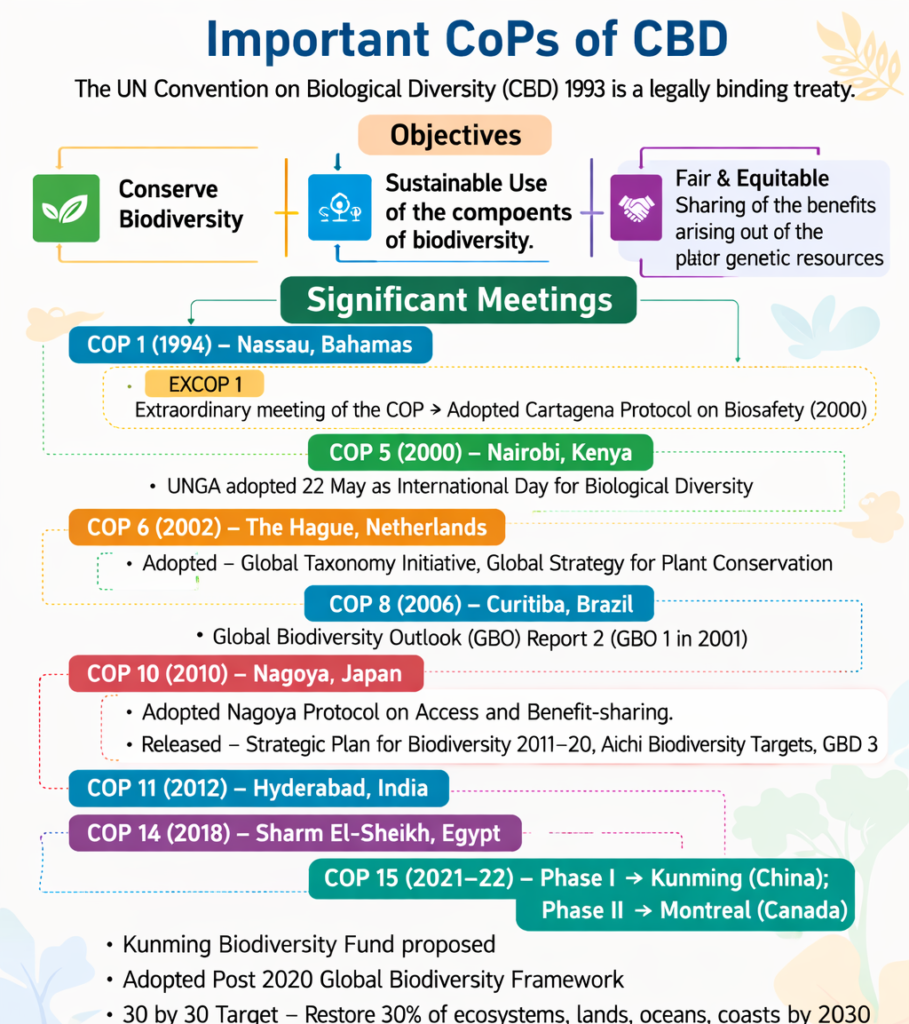
- About: KMGBF is an important international agreement that was adopted at the Conference of the Parties (COP15) to the UN Convention on Biological Diversity (CBD) in December 2022.
- Goal: Its main aim is to stop and reverse biodiversity loss by 2030 and to achieve the vision of living in harmony with nature by 2050. It replaces the earlier Aichi Biodiversity Targets (2011–2020).
- Structure of the Framework: The framework is based on four long-term goals for 2050, which reflect the vision of living in harmony with nature, and 23 action-oriented targets for 2030, known as the global milestones. These targets focus on key areas such as ecosystem conservation, sustainable use of biodiversity, and fair sharing of benefits.
- The “30×30” Target (Target 3): This target aims to ensure that at least 30% of the world’s land, inland water, coastal, and marine areas are effectively conserved and managed by 2030 through protected areas and Other Effective Area-based Conservation Measures (OECMs). This would be a major increase from the current global coverage of about 16%.
- Implementation Mechanism: All countries that are part of the CBD, including India, are required to set and implement national targets aligned with the GBF, update their National Biodiversity Strategies and Action Plans (NBSAPs), and create strong monitoring systems to track progress.
Convention on Biological Diversity
- About: The Convention on Biological Diversity (CBD) is an important international treaty that came out of the 1992 Rio Earth Summit. It provides the main global framework for the conservation and sustainable use of biological resources.
- Three Core Objectives: The CBD is based on three connected goals:
- Conservation of biological diversity,
- Sustainable use of its components, and
- Fair and equitable sharing of benefits arising from genetic resources.
- Comprehensive Scope: The Convention covers biodiversity at all levels, including diversity within species (genetic diversity), diversity between species, and diversity of ecosystems. It applies to terrestrial, marine, and other aquatic ecosystems.
- Key Supplementary Protocols:
- Cartagena Protocol on Biosafety (2000): This protocol focuses on the safe handling, transport, and use of Living Modified Organisms (LMOs) that result from modern biotechnology.
- Nagoya Protocol on Access and Benefit-Sharing (2010): This protocol provides a legal framework for the fair and equitable sharing of benefits that arise from the use of genetic resources, helping to implement the third objective of the CBD.
FAQ’s
1. What is the Kunming–Montreal Global Biodiversity Framework (KMGBF)?
It is a global agreement adopted at CBD COP15 (2022) to halt and reverse biodiversity loss by 2030, built around 23 targets for 2030 and four long-term goals for 2050.
2. What is the “30×30 Target” under the KMGBF?
It aims to conserve at least 30% of the world’s land, inland waters, and marine areas by 2030 through protected areas and Other Effective Area-based Conservation Measures (OECMs).
3. Which biodiversity targets are currently on track in India according to the 7th National Report?
NBT1 (Biodiversity-inclusive land and sea-use planning) and NBT2 (Ecosystem restoration) are identified as being on track among the 23 national biodiversity targets.