
India’s financial system is built upon robust regulatory bodies and institutions that ensure the efficient functioning of capital markets. One such key regulatory authority is the Securities and Exchange Board of India (SEBI). In parallel, Market Infrastructure Institutions (MIIs) form the backbone of the capital market by ensuring smooth execution, clearing, settlement, and safekeeping of securities.
Introduction
In India, SEBI (Securities and Exchange Board of India) regulates MIIs, which include stock exchanges, clearing corporations, and depositories. These institutions act as the backbone of the financial markets, ensuring fair, efficient, and secure trading.
What are Market Infrastructure Institutions (MIIs)?
NABARD 2021-2024 Cutoff Analysis | What we can Learn? #nabard_grade_a_exam #nabard_cutoffTap to play · from the C4S channel
Market Infrastructure Institutions (MIIs) are institutions that form the core of the capital market system. These include:
- Stock Exchanges
- Depositories
- Clearing Corporations
These institutions facilitate trading, safekeeping, and settlement of securities and thus are critical for the allocation and reallocation of financial resources in the economy.
ARD notes, the monthly current affairs PDF and a descriptive English sample — all free, on WhatsApp.
Get it on WhatsApp — one tap or just leave your numberDefinition and Importance
According to the Bimal Jalan Committee (2010) set up by SEBI:
“Market infrastructure refers to fundamental facilities and systems that serve the capital market.“
MIIs are considered vital public institutions like roads, railways, and power systems, as they enable:
- Efficient capital formation
- Investor confidence
- Transparent market practices
- Economic growth and stability
Types of Market Infrastructure Institutions (MIIs)
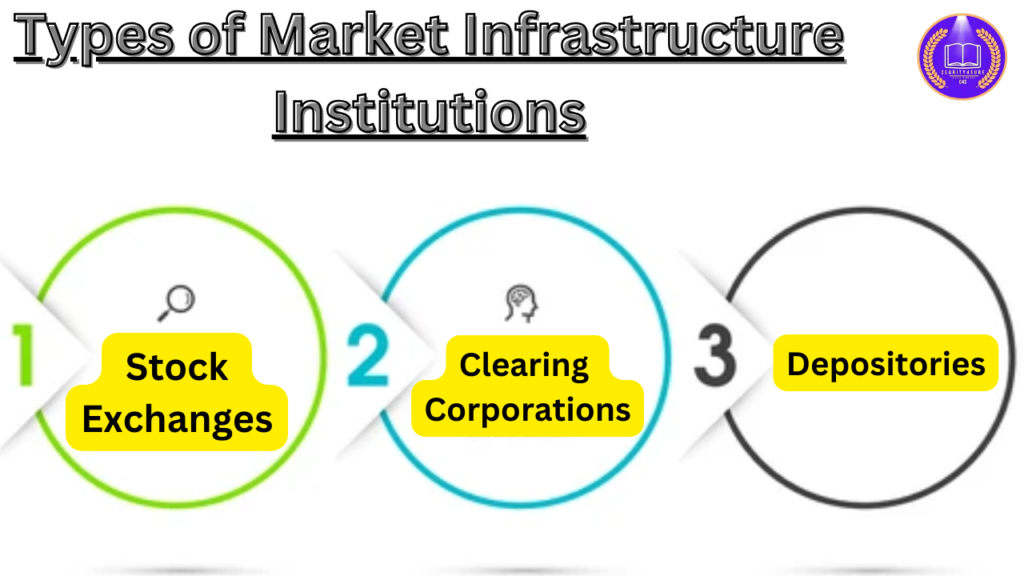
1. Stock Exchanges
A Stock Exchange is a marketplace where stocks, bonds, derivatives, and other securities are bought and sold.
Key Stock Exchanges in India
- National Stock Exchange (NSE) –
- India’s largest exchange by trading volume.
- Bombay Stock Exchange (BSE) –
- Asia’s oldest stock exchange.
- Multi Commodity Exchange (MCX) –
- Deals in commodity trading (gold, silver, crude oil, etc.).
- India International Exchange (India INX) –
- India’s first international exchange in GIFT City.
Functions of Stock Exchanges
- Facilitating buying and selling of financial instruments.
- Ensuring price discovery based on demand and supply.
- Regulating trading practices for fairness and transparency.
2. Clearing Corporations
A Clearing Corporation acts as a mediator between buyers and sellers to ensure trade settlement without risks.
Key Clearing Corporations in India
- National Securities Clearing Corporation Limited (NSCCL) –
- Handles clearing for NSE.
- Indian Clearing Corporation Limited (ICCL) –
- Manages BSE trade settlements.
- Multi Commodity Exchange Clearing Corporation (MCXCCL) –
- Clears and settles commodity trades.
Functions of Clearing Corporations
- Guaranteeing trade settlements by eliminating default risks.
- Reducing counterparty risk by acting as a buyer to every seller and a seller to every buyer.
- Managing collateral and margins to safeguard financial transactions.
3. Depositories
A Depository is a financial institution that holds securities in electronic (demat) form to ensure safety and easy access.
Major Depositories in India
- National Securities Depository Limited (NSDL) – India’s first depository, primarily serving NSE transactions.
- Central Depository Services Limited (CDSL) – Another key depository handling BSE transactions.
Functions of Depositories
- Converting physical shares into demat form.
- Ensuring safe and secure storage of securities.
- Reducing risks of fraud and forgery in securities trading.
- Enabling paperless and faster transactions.
Why Are MIIs Considered Systemically Important?
In 9 daysNABARD Grade A 2026: what the 2025 cut-offs changed, and the 90-day planRegister free →MIIs play a systemic role in the economy for several reasons:
| Factors | Details |
|---|---|
| Scale and Reach | Massive investor base, high trading volumes, and extensive infrastructure |
| Market Capitalization | Billions in market value and capital raised |
| Financial Interlinkages | Connected to banks, NBFCs, AMCs, mutual funds, and FIs |
| Potential Domino Effect | Failure of one MII can destabilize the entire financial ecosystem |
| Cross-sector Impact | Failure may impact the economy beyond the securities market |
Due to this, SEBI mandates stringent governance standards, periodic audits, and regulatory surveillance for MIIs.
Key Institutions Recognized as MIIs by SEBI
SEBI officially categorizes three types of entities as Market Infrastructure Institutions:
1. Stock Exchanges
These platforms facilitate trading of securities including shares, bonds, and derivatives.
- Recognized MIIs among Stock Exchanges:
- BSE Ltd. (Bombay Stock Exchange)
- NSE Ltd. (National Stock Exchange)
- Multi Commodity Exchange of India Ltd. (MCX)
- Metropolitan Stock Exchange of India Ltd. (MSEI)
- Other SEBI-recognized regional exchanges
2. Depositories
Depositories are responsible for the safekeeping of securities in dematerialized (electronic) form and enabling their transfer.
- Recognized MIIs among Depositories:
- National Securities Depository Ltd. (NSDL)
- Central Depository Services (India) Ltd. (CDSL)
3. Clearing Corporations
They are critical for the clearing and settlement of trades executed on stock exchanges. They ensure:
- Timely delivery of securities and funds
- Risk management and counterparty guarantees
- Recognized MIIs among Clearing Corporations:
- Indian Clearing Corporation Ltd. (ICCL – BSE)
- National Securities Clearing Corporation Ltd. (NSCCL – NSE)
- MCX Clearing Corporation Ltd. (MCX-CCL)
- Others recognized under SEBI regulations
market health.
Governance and Oversight of MIIs
Due to their systemic importance, MIIs are subject to rigorous oversight under SEBI’s regulatory framework, which includes:
- Fit and Proper Criteria for promoters and directors
- Separation of ownership and management
- Cap on shareholding by single entities
- Public interest directors on board
- Regular audits and stress testing
These safeguards ensure that MIIs operate with integrity, transparency, and accountability.
Challenges Faced by MIIs
Despite their importance, MIIs face several challenges:
- Cybersecurity Risks –
- Threats like hacking and data breaches can disrupt market operations.
- Regulatory Compliance –
- MIIs must continuously adapt to new SEBI regulations.
- Operational Risks –
- System failures or technical glitches can halt trading.
- Market Volatility –
- Extreme fluctuations can strain clearing and settlement systems.
To tackle these, MIIs invest in advanced technology, cybersecurity, and regulatory compliance.
Conclusion
In summary, SEBI and Market Infrastructure Institutions (MIIs) form the spine of India’s capital market ecosystem. While SEBI ensures market regulation and investor protection, MIIs ensure smooth functioning, transparency, and trust in market transactions. Their importance cannot be overstated, and maintaining high governance standards is crucial to ensure that India’s markets remain resilient and robust.
As India’s economy grows and integrates with global financial systems, the role of SEBI and MIIs will become even more pivotal in shaping the future of India’s capital markets.
FAQs
1. What is the role of SEBI in India?
SEBI is the market regulator that ensures investor protection, regulates securities markets, and enforces rules for financial intermediaries.
2. What are MIIs?
Market Infrastructure Institutions include stock exchanges, clearing corporations, and depositories that form the foundation of the securities market.
3. Why are MIIs considered systemically important?
Because their failure could lead to widespread disruption in the capital market and the economy due to their interconnectedness and financial significance.
4. Which institutions are designated as MIIs by SEBI?
BSE, NSE, MCX, NSDL, CDSL, NSCCL, ICCL, and MCX-CCL among others.
5. What is the NIFTY 50?
It is NSE’s benchmark index that tracks the performance of the top 50 most liquid and large-cap Indian companies.