

How the NABARD Grade A syllabus overlaps with UPSC General Studies, especially GS Paper III
Every serious UPSC aspirant eventually runs into the same uncomfortable arithmetic. The Civil Services Examination has a notoriously low success rate, the cycle runs for more than a year, and a single attempt can swallow twelve to eighteen months of focused effort. Putting all of that on one result, once a year, is a lot of pressure to carry alone.
This is exactly why the NABARD Grade A (Assistant Manager) exam deserves a closer look. It isn’t a distraction from UPSC preparation. For a large slice of the syllabus, it is the same preparation pointed at a second, parallel target. And the strongest point of contact is GS Paper III.
What NABARD Grade A actually tests

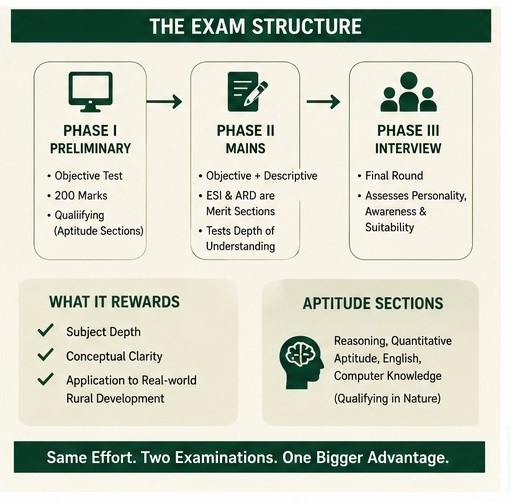
The NABARD Grade A exam is conducted in stages: a preliminary (Phase 1) objective test, a mains (Phase 2) with both objective and descriptive papers, and a final interview round. Beyond the usual aptitude sections like reasoning, quantitative ability, English, and computer knowledge, the exam is built around two subject pillars that carry the real weight in the merit list:
- Economic and Social Issues (ESI)
- Agriculture and Rural Development (ARD)
These two subjects, along with General Awareness, are what count toward the final merit. The reasoning and aptitude sections are largely qualifying. In other words, NABARD rewards exactly the kind of subject depth that UPSC also demands, rather than pure exam-cracking speed.
It is worth noting that the official notification for the next cycle is expected around the middle of the year, so the dates below are indicative and aspirants should confirm against the official notification when it drops.
The GS III connection
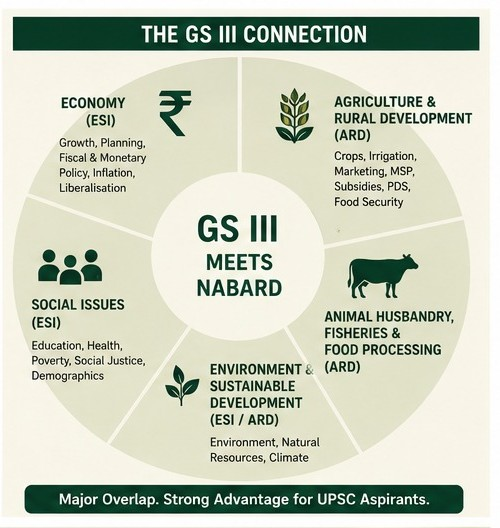
UPSC General Studies Paper III covers the economy, agriculture, science and technology, environment, biodiversity, internal security, and disaster management. NABARD’s ESI and ARD papers map onto the economic, agricultural, and environmental two-thirds of that paper almost line for line. Here is how the pieces fit together.
1. Economy: ESI ↔ GS III
The economy portion of GS III asks aspirants to understand growth and development, planning, resource mobilisation, inclusive growth, government budgeting, fiscal and monetary policy, inflation, employment, infrastructure, and the effects of liberalisation. NABARD’s ESI paper walks through the same territory: the nature and structure of the Indian economy, economic reforms since 1991, monetary and fiscal policy, inflation, poverty, unemployment, and the broad project of inclusive development.
If you can write a good GS III answer on why inclusive growth is hard to achieve, you are already most of the way to an ESI descriptive answer on the same theme. The vocabulary, the data points, and the policy debates are shared.
2. Agriculture and rural development: ARD ↔ GS III
This is where the overlap becomes genuinely striking. GS III devotes an entire cluster of topics to agriculture: cropping patterns, irrigation systems, storage and marketing of produce, e-technology for farmers, direct and indirect farm subsidies, minimum support prices, the public distribution system, buffer stocks, food security, food processing, the economics of animal rearing, and land reforms.
Open the ARD syllabus and you will find these same subjects, often in more detail. ARD covers the fundamentals of agriculture, soil and water management, animal husbandry and fisheries, agricultural economics, rural credit and microfinance, cooperatives, and the institutional architecture of rural development. Because NABARD is itself the apex institution for agriculture and rural finance, its exam treats this domain as the main event rather than a sub-topic.
A UPSC aspirant who has prepared agriculture for GS III is not starting from zero in ARD. They are deepening and extending knowledge they already have, and picking up institutional detail (rural credit structures, NABARD’s own role, scheme architecture) that often makes their UPSC answers sharper too.
3. Environment and sustainable development
GS III also covers environmental conservation, pollution, degradation, and the development-versus-environment balance. ESI carries a sustainable development and environmental issues component, and ARD touches the same theme from the angle of natural resource management in rural India. The climate, land, and water debates an aspirant studies for one exam carry directly into the other.
4. A bonus overlap with GS I and GS II
The “Social Issues” half of ESI, covering education, health, social justice, demographics, and social structure, overlaps with the society portion of GS I and the welfare and social-sector schemes portion of GS II. So NABARD preparation does not just feed GS III; it spills helpfully into two other GS papers.

Side-by-side at a glance
| Theme | UPSC GS III | NABARD ESI / ARD |
| Growth, planning, inclusive growth | Yes | ESI |
| Fiscal & monetary policy, inflation | Yes | ESI |
| Government budgeting, liberalisation | Yes | ESI |
| Cropping, irrigation, marketing | Yes | ARD |
| MSP, subsidies, PDS, food security | Yes | ARD |
| Food processing, animal husbandry | Yes | ARD |
| Land reforms | Yes | ARD / ESI |
| Rural credit & microfinance | Touched lightly | ARD (in depth) |
| Sustainable development, environment | Yes | ESI / ARD |
| Poverty, unemployment, social sector | Yes (GS I/II/III) | ESI |
Be honest about where they diverge
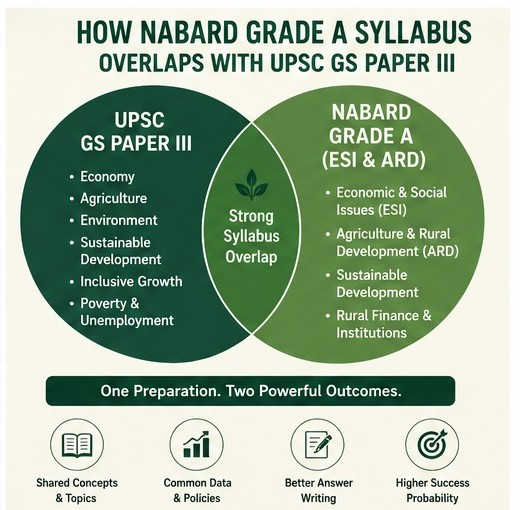
A balanced case has to acknowledge the gaps. NABARD will not cover the science and technology, internal security, or disaster management portions of GS III, so those still need separate UPSC-only effort. ARD also goes deeper into technical agronomy (soils, crops, animal science) than UPSC ever requires, which means some ARD-specific study is “extra” from a pure UPSC standpoint.
The format differs too. NABARD’s descriptive answers are typed and tend to reward crisp, factual, point-based writing, whereas UPSC’s handwritten mains answers demand more analysis, structure, and a balanced argument under tight time pressure. The knowledge transfers; the answer-writing muscle needs separate practice for each.
And finally, the aptitude sections (reasoning, quantitative, computer knowledge) are NABARD-specific and have no UPSC equivalent. They are usually qualifying and not very demanding, but they do need a few weeks of attention.
How to use this overlap in practice
The smart play is not to “prepare for two exams” as if they were unrelated. It is to recognise that one large body of knowledge serves both, and to add a thin specialised layer on top for each.
Build your economy, agriculture, rural development, and environment foundation once, thoroughly, the way GS III demands. Then layer NABARD-specific institutional detail (rural credit systems, cooperative structures, NABARD’s mandate and schemes) and the aptitude sections on top. Practise typed, point-based answers for NABARD and analytical handwritten answers for UPSC so both formats stay sharp. Keep current affairs common across both, since agriculture, rural finance, and the economy feature heavily in each.
The bottom line
For a UPSC aspirant, NABARD Grade A is one of the most natural parallel exams available. It rewards the same economic and agricultural depth that GS III is built on, it gives you a genuine, well-paid career outcome if the UPSC result does not land, and the incremental study it demands is modest relative to the overlap it offers.
Treating it as a hedge does not dilute your UPSC preparation. If anything, the institutional depth it forces you to acquire, especially on rural credit, agricultural economics, and development finance, tends to make your GS III answers more specific and more credible. A backup that strengthens the main attempt is about as good as a backup gets.