
Plan B for UPSC Aspirants

Every UPSC aspirant knows the hard truth. The Civil Services Examination is one of the toughest exams in the world, and despite years of preparation, lakhs of dedicated candidates do not make the final list — not because they lack ability, but because there are simply only a few hundred seats for millions of applicants. This is exactly why having a strong Plan B for UPSC aspirants is not a sign of giving up. It is a sign of smart, mature planning.
And among all the backup options available, the NABARD Grade A exam stands out as one of the best. If you are a serious UPSC candidate looking for a parallel career path that respects the effort you have already put in, this blog explains exactly why NABARD Grade A is a good option for UPSC candidates — and how your existing preparation gives you a real head start.
What Is NABARD Grade A?
NABARD stands for the National Bank for Agriculture and Rural Development. It is an apex development financial institution that shapes agricultural credit, rural infrastructure, and financial inclusion policy across India. In short, NABARD does at the policy and banking level what many aspirants dream of doing as civil servants — driving rural transformation.
The NABARD Grade A exam recruits officers for the post of Assistant Manager in the Rural Development Banking Service (RDBS) and specialised streams such as Agriculture, Finance, and more. It is widely seen as one of the most prestigious officer-level jobs in the banking and development sector, on par with RBI Grade B and SEBI Grade A in terms of work culture and respect.
Why NABARD Grade A Is the Perfect Plan B for UPSC Aspirants
Here is the core reason this exam deserves your attention: the preparation overlap with UPSC is enormous. You are not starting from zero. You are repurposing knowledge you have already built. Let us break this down.
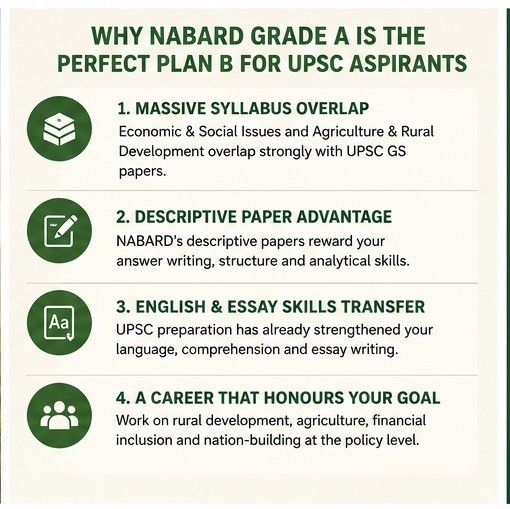
1. Massive Syllabus Overlap With UPSC
The NABARD Grade A syllabus includes Economic and Social Issues (ESI) and Agriculture and Rural Development (ARD) as its two core specialist subjects. If you have prepared for UPSC, this should feel familiar:
- Economic and Social Issues maps directly onto UPSC GS Paper III (economy, growth, inflation, poverty, social sector schemes) and parts of GS Paper II (governance and welfare).
- Agriculture and Rural Development overlaps with the agriculture, food security, and rural-economy portions you already revise for UPSC Mains and Prelims.
- General Awareness and Current Affairs is a shared backbone of both exams — government schemes, the Union Budget, Economic Survey, and policy news all count twice.
A UPSC aspirant typically knows more about the Indian economy, government schemes, and rural development than a candidate preparing only for banking exams. That is a genuine competitive edge.
2. The Descriptive Paper Rewards Your Mains Practice
The NABARD Grade A Mains exam includes descriptive papers designed to test your writing ability and depth of understanding — not just objective recall. This is a huge advantage for UPSC aspirants, who have spent months mastering answer writing, structuring arguments, and writing analytically under time pressure. While most banking aspirants struggle with descriptive writing, you are already trained for it.
3. English and Essay Skills Transfer Directly
UPSC demands strong language, comprehension, and essay-writing skills. The English section and the descriptive component of NABARD Grade A reward exactly these abilities. Your UPSC preparation has already polished them.
4. A Career That Honours Your Original Goal
Many people choose UPSC because they want to contribute to nation-building, especially in rural and underserved areas. NABARD Grade A lets you do precisely that. As an officer, you work on rural credit, cooperative banking, agricultural development, and the implementation of central and state government schemes. The mission is deeply aligned with the spirit of public service — making this a fulfilling Plan B, not a compromise.
NABARD Grade A Salary: Is It Worth It?
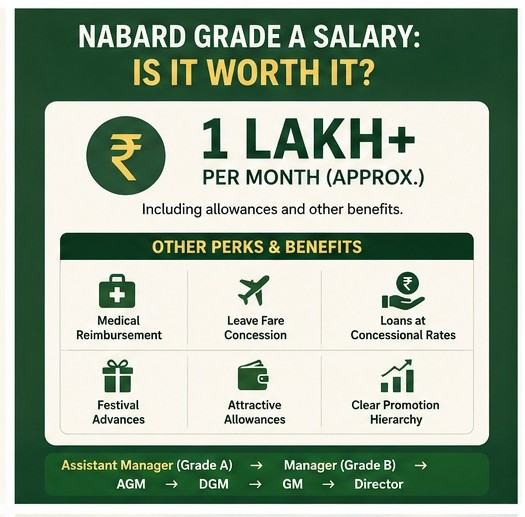
Absolutely. The NABARD Grade A salary is among the most attractive in the government banking sector.
- With Dearness Allowance, House Rent Allowance, Grade Allowance, and other benefits, the gross monthly salary is more than ₹1,00,000.
- Reports of a wage revision (a hike of around 20% for NABARD, RBI, and related institutions) suggest entry pay is set to move even higher.
Beyond pay, officers enjoy perks such as medical reimbursement, leave fare concession, loans at concessional rates, festival advances, and a clear promotion ladder — from Assistant Manager (Grade A) → Manager (Grade B) → Assistant General Manager → Deputy General Manager → General Manager, all the way up to Director level.
For a candidate who has invested years in UPSC, this is a financially secure, high-status career that does not feel like a step down.
NABARD Grade A Eligibility Criteria
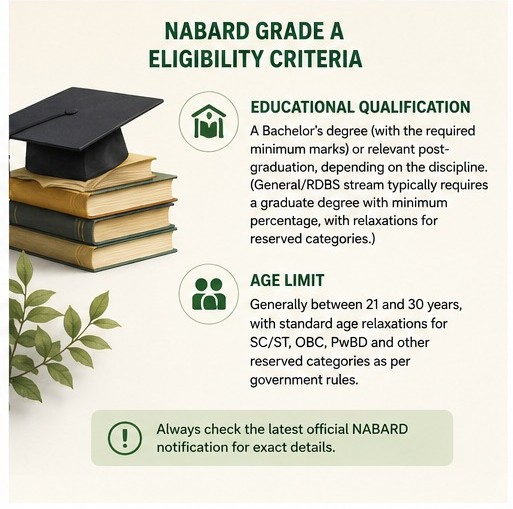
While you must always confirm details from the official notification, the broad NABARD Grade A eligibility criteria are:
- Educational Qualification: A Bachelor’s degree (with the required minimum marks) or relevant post-graduation, depending on the discipline you apply for. The General/RDBS stream typically requires a graduate degree with a minimum percentage, with relaxations for reserved categories.
- Age Limit: Generally between 21 and 30 years, with standard age relaxations for SC/ST, OBC, PwBD, and other reserved categories as per government rules.
Because eligibility can vary slightly by stream and cycle, always cross-check with the latest official NABARD notification before applying.
NABARD Grade A Exam Pattern and Selection Process
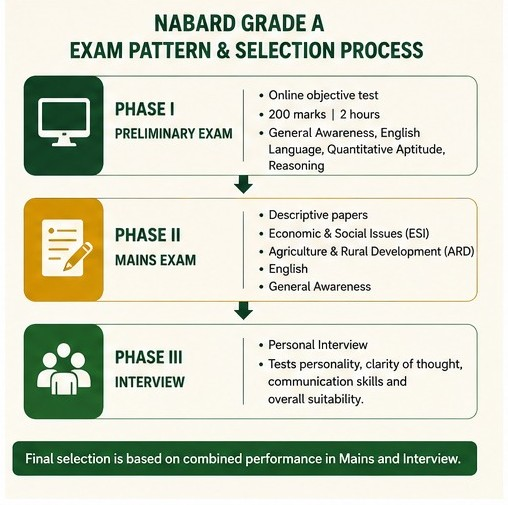
The selection process for Assistant Manager (Grade A) is conducted in three stages:
- Phase I — Preliminary Exam:
- An online objective screening test of 200 marks, to be completed in 2 hours. It includes sections such as Reasoning, Quantitative Aptitude, English Language, Computer Knowledge, General Awareness, Economic and Social Issues, and Agriculture and Rural Development. Some sections are qualifying in nature.
- Phase II — Mains Exam:
- Includes both an objective test and descriptive papers, which assess your writing ability and in-depth subject understanding — the stage where UPSC aspirants shine.
- Phase III — Interview:
- Candidates who clear the Mains are called for a personal interview. Final selection is based on combined performance in the Mains and the interview.
This three-stage structure — screening, depth, and personality test — closely mirrors the Prelims–Mains–Interview rhythm of UPSC, which means the exam feels familiar to a civil services aspirant.
NABARD Grade A vs UPSC: A Quick Comparison
| Factor | UPSC Civil Services | NABARD Grade A |
| Vacancies | A few hundred (high competition) | Limited but more focused |
| Stages | Prelims, Mains, Interview | Prelims, Mains, Interview |
| Key shared subjects | Economy, agriculture, schemes, current affairs | ESI, ARD, general awareness |
| Writing skills | Essential | Rewarded in descriptive papers |
| Starting pay | Higher entry grade | ~₹1 lakh gross/month |
| Mission | Public administration | Rural & agricultural development |
The takeaway is simple: a UPSC aspirant is already 60–70% prepared for NABARD Grade A in terms of subject knowledge and exam temperament. A few months of focused, exam-specific revision can convert years of UPSC effort into a concrete result.
How a UPSC Aspirant Should Prepare for NABARD Grade A
- Reuse your economy and current affairs notes — they directly feed ESI and General Awareness.
- Add the Agriculture & Rural Development module, which is the main new subject to master. Focus on agricultural finance, cooperatives, rural schemes, and NABARD’s own functions.
- Sharpen quantitative aptitude and reasoning, since UPSC does not train these heavily. CSAT practice helps, but dedicated banking-style speed practice is needed.
- Leverage your answer-writing skill for the descriptive papers — this is your biggest hidden advantage.
- Solve previous year question papers and take mock tests to get comfortable with the pattern and time management.
Important Dates: NABARD Grade A 2026
The NABARD Grade A 2026 notification had not yet been officially released as of mid-2026, and is widely expected around the second half of the year (commonly cited as July–August). The official notification will confirm the exact number of vacancies, application dates, eligibility, and exam dates. (For reference, the previous cycle announced roughly 90–100 Assistant Manager vacancies.)
Action step: Keep checking the official NABARD website (www.nabard.org) and update this section with the exact vacancy count, application window, and exam dates the moment the official notification drops.
Frequently Asked Questions (FAQ)
Q1. Is NABARD Grade A a good option for UPSC aspirants?
Yes. The syllabus overlaps heavily with UPSC GS (economy, agriculture, rural development, schemes), the descriptive paper rewards UPSC answer-writing practice, and the job offers a prestigious, mission-driven career in rural development with an attractive salary.
Q2. Can I prepare for NABARD Grade A along with UPSC?
Yes. A large part of the preparation is shared. With focused effort on Agriculture & Rural Development, quantitative aptitude, and reasoning, UPSC aspirants can prepare for both in parallel.
Q3. What is the salary of a NABARD Grade A officer?
The salary is ₹1 lakh+ per month, along with various allowances, benefits, and perks as per government norms.
Q4. What subjects in NABARD Grade A overlap with UPSC?
Economic and Social Issues, Agriculture and Rural Development, General Awareness, current affairs, and English are the major overlapping areas.
Q5. How many attempts does NABARD Grade A allow?
There is no fixed limit on the number of attempts; you can appear as long as you meet the age and eligibility criteria each year. Always confirm from the official notification.
Final Word
A strong Plan B for UPSC aspirants does not weaken your Plan A — it protects your future while you chase your dream. NABARD Grade A is arguably the best such backup: it rewards the exact knowledge and skills you have built for UPSC, offers a near-six-figure monthly salary, and places you in a role that genuinely contributes to India’s rural and agricultural growth.
If you are a UPSC aspirant, do not let years of effort go to waste. Start your NABARD Grade A preparation today, and turn your Plan B into a powerful, parallel path to success.