

Introduction
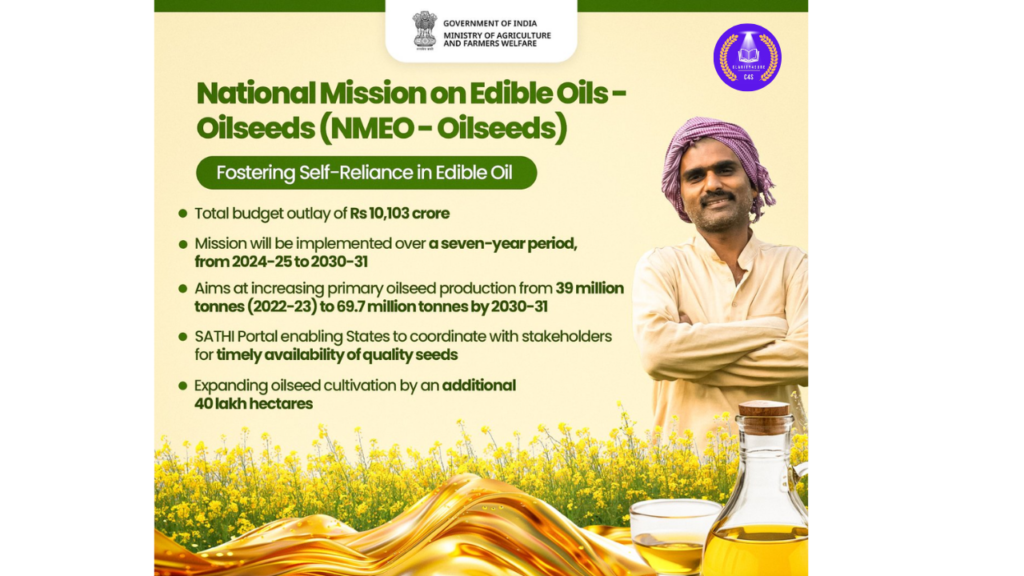
- The National Mission on Edible Oils – Oilseeds (NMEO-Oilseeds) is an initiative by the Government of India aimed at increasing the production of edible oils and oilseeds within the country.
- India is one of the largest consumers of edible oils in the world but heavily relies on imports (around 55-60% of total demand).
- The NMEO-Oilseeds mission seeks to make India self-sufficient in edible oils by enhancing the productivity of oilseed crops such as mustard, soybean, groundnut, sunflower, safflower, sesame, and oil palm.
Budget Allocation and Funding
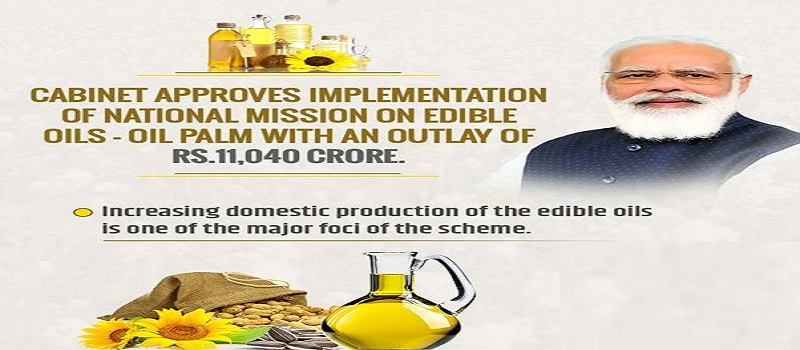
- The Government of India has allocated ₹11,040 crore for NMEO-Oilseeds in the Union Budget 2025-26 under a five-year plan.
- The mission follows a centrally sponsored scheme (CSS) model, where funding is shared between the central and state governments:
- 60:40 ratio for general states
- 90:10 ratio for northeastern states
- 100% central funding for union territories
A special package of ₹4,800 crore has been dedicated to oil palm cultivation under the NMEO-Palm Oil (NMEO-OP) initiativ
Objectives of NMEO-Oilseeds
- The NMEO-Oilseeds aims to achieve the following key objectives:
- Increase domestic production of oilseeds to reduce import dependence.
- Expand oilseed cultivation area through better farming practices.
- Improve productivity and yield through the adoption of high-yielding varieties (HYVs) and advanced technologies.
- Enhance farmers’ income by supporting oilseed growers with better market access.
- Promote research and development (R&D) to create superior seed varieties and efficient processing techniques.
- Improve post-harvest management and value addition in the oilseed sector.
- Encourage sustainable farming practices for long-term agricultural resilience.
Key Features of NMEO-Oilseeds
- Financial Assistance to Farmers
- nThe government provides financial support to farmers for procuring quality seeds, fertilizers, and adopting advanced technologies like micro-irrigation and precision farming.
- Research and Development (R&D)
- The mission emphasizes collaboration with research institutions like the Indian Council of Agricultural Research (ICAR) and State Agricultural Universities (SAUs) to develop high-yield and disease-resistant oilseed varieties.
- Seed Production and Distribution
- A special seed multiplication and distribution program ensures farmers get access to high-quality seeds of oilseeds like mustard, sunflower, groundnut, and soybean.
- Focus on Water-Efficient Crops
- Given the water-intensive nature of some oilseed crops, NMEO-Oilseeds promotes the use of drought-resistant and water-efficient varieties.
- Value Addition and Processing Infrastructure
- The mission encourages investment in modern processing units to reduce wastage and increase the efficiency of oil extraction.
- Public-Private Partnerships (PPP)
- The mission seeks to engage private players and farmer producer organizations (FPOs) to strengthen the oilseed value chain.
- Use of Technology
- Advanced agriculture technology, including AI, drones, and satellite monitoring, is promoted for better crop health management and yield prediction.
Target Crops Under NMEO-Oilseeds
The NMEO-Oilseeds focuses on nine major oilseeds, classified into three categories:
- Traditional Oilseeds
- Groundnut
- Soybean
- Rapeseed & Mustard
- Non-Traditional Oilseeds
- Sunflower
- Safflower
- Sesame
- Niger seed
- Tree-borne Oilseeds (TBOs)
- Coconut
- Palm oil
Challenges in Oilseed Production
- Oilseed production faces several challenges that impact yield, quality, and profitability.
- These challenges can be grouped into agronomic, environmental, economic, and policy-related issues.
- Below are some key challenges:
- Agronomic Challenges
- Pest and Disease Pressure:
- Oilseed crops (e.g., soybean, sunflower, canola, and groundnut) are susceptible to various pests (e.g., aphids, whiteflies) and diseases (e.g., rust, powdery mildew, blights).
- Weed Management:
- Weeds compete with oilseed crops for nutrients, water, and sunlight, reducing yields.
- Soil Fertility and Nutrient Deficiency:
- Many oilseeds require specific nutrients (e.g., sulfur for canola) for optimal growth.
- Drought and Water Stress:
- Oilseeds are often grown in rain-fed conditions, making them vulnerable to water shortages.
- Seed Quality and Availability:
- Access to high-yielding, pest-resistant, and climate-resilient seeds is crucial but often limited.
- Pest and Disease Pressure:
- Environmental Challenges
- Climate Change:
- Rising temperatures, erratic rainfall, and extreme weather events (floods, droughts) affect oilseed productivity.
- Soil Degradation:
- Continuous monocropping, poor land management, and soil erosion reduce land productivity.
- Pollination Issues:
- Some oilseeds (e.g., sunflower) rely on pollinators like bees, but declining pollinator populations can negatively impact yields.
- Climate Change:
- Economic Challenges
- High Production Costs:
- Inputs like fertilizers, pesticides, and machinery are costly, reducing profit margins.
- Market Volatility:
- Oilseed prices fluctuate due to global supply-demand dynamics and trade policies.
- Post-Harvest Losses:
- Poor storage facilities lead to losses from spoilage, mold, and pest infestations.
- Limited Value Addition:
- In many regions, oilseeds are exported as raw materials rather than processed locally, reducing profitability.
- High Production Costs:
- Policy and Institutional Challenges
- Subsidy and Support Issues:
- Some countries lack proper government support for oilseed farmers.
- Trade Barriers and Tariffs:
- Import-export restrictions affect market access.
- Lack of Research and Extension Services:
- Farmers need better access to agronomic knowledge, improved varieties, and modern farming techniques.
- Subsidy and Support Issues:
- Technological Challenges
- Limited Mechanization:
- Many smallholder farmers rely on traditional farming methods, reducing efficiency.
- Poor Irrigation Infrastructure:
- Water management remains a challenge in semi-arid and arid regions.
- Slow Adoption of Improved Varieties:
- Genetically improved or hybrid oilseeds could boost yields but are not widely adopted due to cost and availability constraints.
- Limited Mechanization:
Expected Outcomes of NMEO-Oilseeds
- The successful implementation of NMEO-Oilseeds is expected to:
- Increase oilseed production from 32-33 million tonnes to 47-50 million tonnes.
- Reduce edible oil imports from 60% to 30-40%.
- Boost farmers’ incomes through better productivity and price realization.
- Strengthen India’s self-reliance in edible oil production and reduce the foreign exchange burden.
- Improve processing efficiency and infrastructure, leading to higher value addition.
Conclusion
- The National Mission on Edible Oils – Oilseeds (NMEO-Oilseeds) is a significant step toward achieving Atmanirbhar Bharat (self-reliant India) in the edible oil sector.
- By improving oilseed productivity, supporting farmers, and encouraging sustainable practices, this initiative aims to reduce India’s dependence on imports and ensure long-term food security.
While challenges remain, technological advancements, policy support, and public-private partnerships will play a crucial role in making India a global leader in oilseed production.
FAQs on NMEO-Oilseeds
1. When was NMEO-Oilseeds launched?
It was launched in August 2021 by the Government of India.
2. What is the budget allocation for NMEO-Oilseeds?
The government has allocated ₹11,040 crore, with a special ₹4,800 crore package for palm oil.
3. Which oilseeds are covered under NMEO-Oilseeds?
The mission covers groundnut, soybean, mustard, sunflower, safflower, sesame, niger, coconut, and palm oil.
4. What is the main goal of NMEO-Oilseeds?
To increase domestic oilseed production, reduce edible oil imports, and enhance farmers’ income.
5. How does NMEO-Oilseeds benefit farmers?
It provides financial support, high-quality seeds, better processing infrastructure, and market access to farmers.














