

Introduction
- The Pradhan Mantri Annadata Aay SanraksHan Abhiyan (PM-AASHA) is a flagship initiative launched by the Government of India in September 2018 to ensure that farmers get fair prices for their produce and are protected from market fluctuations.
- The scheme is focused on enhancing farmer incomes and ensuring the government’s commitment to doubling farmers’ income by 2022 (a target proposed earlier by the government).
Origin
- The Pradhan Mantri Annadata Aay SanraksHan Abhiyan (PM-AASHA) was launched in September 2018.
- It is a central sector scheme of the Ministry of Agriculture & Farmers Welfare.
Objective of PM-AASHA
- The primary goal of PM-AASHA is to provide remunerative prices to farmers for their produce and ensure they are safeguarded against distress sales.
- It aims to cover major agricultural crops and ensure that Minimum Support Prices (MSP) are accessible to farmers, thus protecting them from market volatility.
Key Components of PM-AASHA
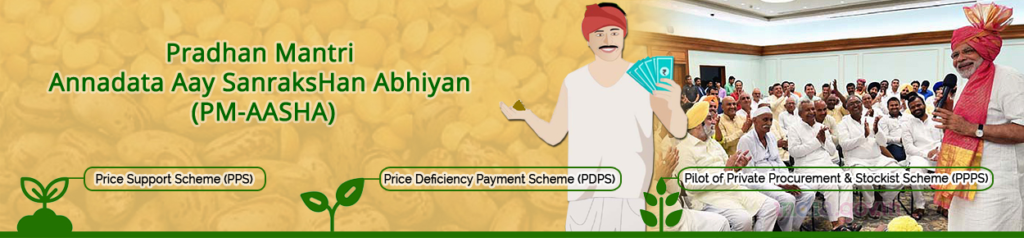
PM-AASHA operates through a three-pronged strategy to ensure price guarantees and income security for farmers:
1. Price Support Scheme (PSS)
- Under this scheme, physical procurement of pulses, oilseeds, and copra is undertaken by government agencies.
- The procurement is done at Minimum Support Prices (MSP) declared by the government.
- Nodal agencies such as National Agricultural Cooperative Marketing Federation of India (NAFED) and Food Corporation of India (FCI) are responsible for procurement and storage.
- The scheme is aimed at reducing market pressure and ensuring that farmers receive fair returns on their crops.
2. Price Deficiency Payment Scheme (PDPS)
- This scheme focuses on price deficiency payments for oilseeds.
- Farmers are paid the difference between the MSP and the selling price if they sell their produce at a price lower than MSP.
- The farmers must register in advance to avail of this benefit, and the payment is made directly to their bank accounts.
- This scheme eliminates the need for physical procurement, reducing the burden on storage and warehousing.
3. Private Procurement & Stockist Scheme (PPSS)
- This scheme encourages private players to procure oilseeds from farmers at MSP.
- Private agencies approved by the government procure the crops, ensuring farmers get MSP.
- To incentivize private players, the government provides a service charge and financial assistance.
Benefits of PM-AASHA
- Income Security:
- PM-AASHA aims to protect farmers from price volatility and market risks.
- Minimized Distress Sales:
- Farmers are less likely to resort to distress sales when MSP support is guaranteed.
- Boost to Oilseeds & Pulses Cultivation:
- Focus on oilseeds and pulses promotes self-sufficiency and reduces import dependency.
- Digital Payments:
- Payments are made directly to farmers’ bank accounts, promoting transparency and reducing middlemen exploitation.
- Market Development:
- Involvement of private players helps in developing a robust agricultural market.
Challenges in Implementation
- Awareness Gap:
- Many farmers remain unaware of the benefits of PM-AASHA.
- Procurement Issues:
- The scheme is heavily dependent on effective procurement mechanisms, which may not be equally efficient across all regions.
- Infrastructure Constraints:
- Adequate storage and warehousing infrastructure remain a challenge for government agencies.
- Budgetary Limitations:
- Ensuring sufficient budget allocation and timely payments is critical for the scheme’s success.
- Farmer Registration Issues:
- Some farmers face challenges with the registration process for the Price Deficiency Payment Scheme (PDPS).
Government Initiatives to Strengthen PM-AASHA
To improve implementation, the government has taken steps such as:
- Technology Integration:
- Use of mobile apps and online portals for farmer registration and payment tracking.
- Increased Procurement Centers:
- Setting up more procurement centers in remote and rural areas to enhance accessibility.
- Training & Awareness Campaigns: C
- Conducting workshops and campaigns to educate farmers about the scheme and its benefits.
Conclusion
- The Pradhan Mantri Annadata Aay SanraksHan Abhiyan (PM-AASHA) is a comprehensive initiative that aims to enhance farmer welfare by ensuring fair prices and minimizing income uncertainty.
- However, its success largely depends on effective implementation, adequate infrastructure, and farmer awareness.
With proper execution, PM-AASHA can play a significant role in achieving sustainable agriculture and fulfilling the government’s vision of doubling farmers’ income.
FAQs on PM-AASHA
1. Which crops are covered under PM-AASHA?
PM-AASHA primarily covers pulses, oilseeds, and copra.
2. How can farmers avail of the benefits under PM-AASHA?
Farmers must register with nodal agencies or participate in the procurement process to avail of the scheme’s benefits.
3. Is there a timeline for procurement under PM-AASHA?
Procurement timelines are announced before each crop season and vary based on crop type and region.














